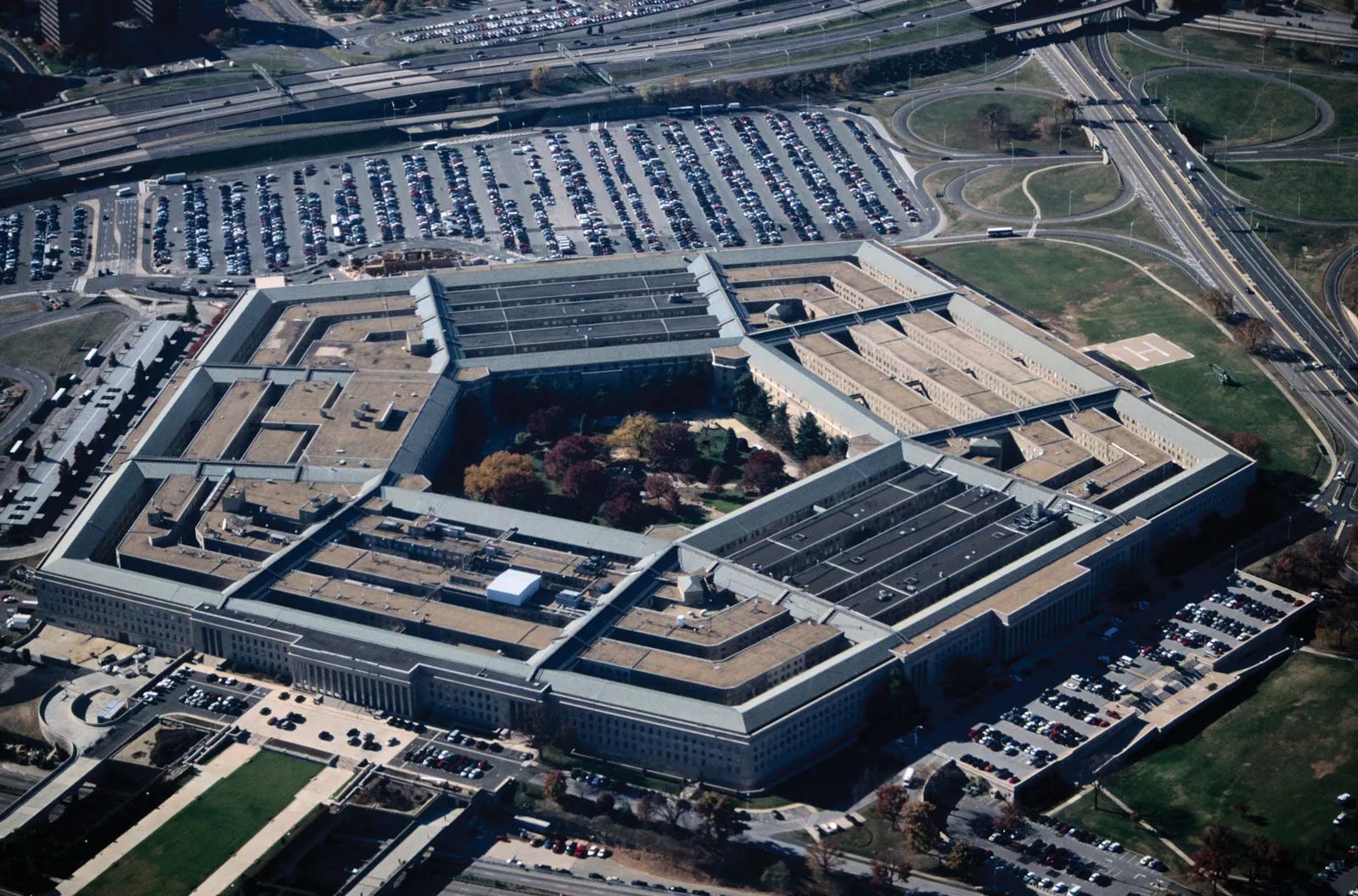
Trump Says He’ll Audit the Pentagon

W.J. Astore

Will it prove to be a bridge too far?

FEB 08, 2025

President Donald Trump says he’s ready to tackle the Pentagon, which has failed seven audits in a row. He says America might save “trillions” after effective audits. Will it happen?

The Pentagon budget currently sits at roughly $900 billion for this fiscal year, representing more than half of federal discretionary spending. This vast sum doesn’t include (among other things) Homeland Security, nuclear weapons covered by the Department of Energy, the VA (Veterans Administration), and interest on the national debt due to wasteful failed wars in places like Afghanistan and Iraq.

A successful audit of the Pentagon would be a monumental victory for what’s left of American democracy. It may also prove to be a bridge too far for Trump. The National Security State is America’s unofficial fourth branch of government and arguably its most powerful. It is a colossus that hides malfeasance and corruption behind a “top secret” security classification. It deters and prevents efforts at transparency by crying that those who try to expose its crimes are endangering national security. It expects your obedience and praise, not your questions and criticism.

Presidents, of course, are supposed to serve as the commander-in-chief of the U.S. military. They rarely do. Not nowadays. The U.S. system may in theory rest on civilian control of the military, but the military has been out of control since at least 1947, when it rebranded itself the “Department of Defense” instead of the old War Department. Not coincidentally, every war America has fought since then has been undeclared, i.e. lacking a formal Congressional declaration of war.

America has fought a mind-blowing number of wasteful and illegal wars that have been sold to the people through lies, whether in Vietnam (“The Pentagon Papers”), Iraq (No WMD), Afghanistan (“The Afghan War Papers”), and elsewhere. Few things are needed more in America than an honest reckoning of Pentagon spending—and future Pentagon war plans.

Such a reckoning could very well save our lives—indeed, the world, if done honestly and transparently by true patriots. It could also prove to be a bridge too far—for any president.

Purge at the Pentagon!

W.J. Astore

It’s OK to Lose Wars, Not OK to be “Woke”

Purge at the Pentagon! Reuters reports that the incoming Trump administration is drawing up a list of generals to be fired. These are generals associated with former Chairman of the JCS Mark Milley and anyone else branded with a scarlet “W” for woke. The current Chairman, Air Force General C.Q. Brown, may also be fired, as some within the Trump camp suspect he may have been a DEI hire.

This is how Reuters put it: Hegseth [Trump’s nominee for Defense Secretary] has also taken aim at Milley’s successor, Air Force General C.Q. Brown, asking whether he would have gotten the job if he were not Black.

“Was it because of his skin color? Or his skill? We’ll never know, but always doubt – which on its face seems unfair to CQ. But since he has made the race card one of his biggest calling cards, it doesn’t really much matter,” he wrote.

Ouch. It does indeed seem unfair to CQ.

General C.Q. Brown, Chairman of the JCS

Retired General Milley is no fan of Trump, having called the president “fascist to the core,” so it’s time for vengeance against him and his cohort. General Brown might be collateral damage, but of course the general, if purged, will find seven-figure salaries available to him on the industrial side of the military-industrial complex, so don’t cry for him too hard.

What’s amazing about all this is reason for the purge. Wokeness. Vengeance. Not military incompetence.

Think about it. The U.S. military lost in Vietnam. Lost in Iraq. Lost in Afghanistan. And no general was fired for cause. Sure, Obama dismissed General Stanley McChrystal in 2010, but that was because McChrystal was an idiot. The last general I can remember who was fired for just cause by a president exercising true authority was Douglas MacArthur during the Korean War. That was over 70 years ago. 

As Army officer Paul Yingling famously wrote (“A Failure in Generalship”), a private is severely punished for losing a rifle but generals get promoted for losing wars. I doubt this is going to change. Instead, under Trump it appears the firing of generals is another leg of his vengeance tour, a purge of those who are perceived as disloyal.

Back in March of 2016, I wrote Trump had disqualified himself for the position of commander-in-chief because he had no understanding of the U.S. Constitution. For Trump, laws, principles, integrity, and character are far less important than loyalty and obedience to Trump.

If the Trump administration does indeed pursue a Pentagon purge based on vengeance, a courageous and principled officer corps should resign en masse in protest against this usurpation of authority. I’m no fan of the generals, but firing them because they’re associated with “woke” (whatever that means) and/or Milley is a misuse of power.

If you want to fire generals, fire them because they’ve failed in their primary duties, not because they’re allegedly “woke.”

Multicultural Militarism

W.J. Astore

The Bombs Land Softer When a Latina Lesbian Drops Them

Listening to Chris Hedges and Cornel West the other day, I heard them use the term “multicultural militarism” to describe the Democratic Party’s embrace of war and the U.S. military. It fits. Consider Kamala Harris as commander-in-chief. She’ll be celebrated as the first woman of color, the first Black and South Asian president, even as she embraces and boasts about the “lethality” of the U.S. military and the utility of war. And by “utility,” I mean Harris’ support of Ukraine and Israel to the tune of $200 billion in weapons and other forms of mainly military aid.

But do the bombs and missiles land softer because a Latina lesbian Air Force pilot drops and launches them?

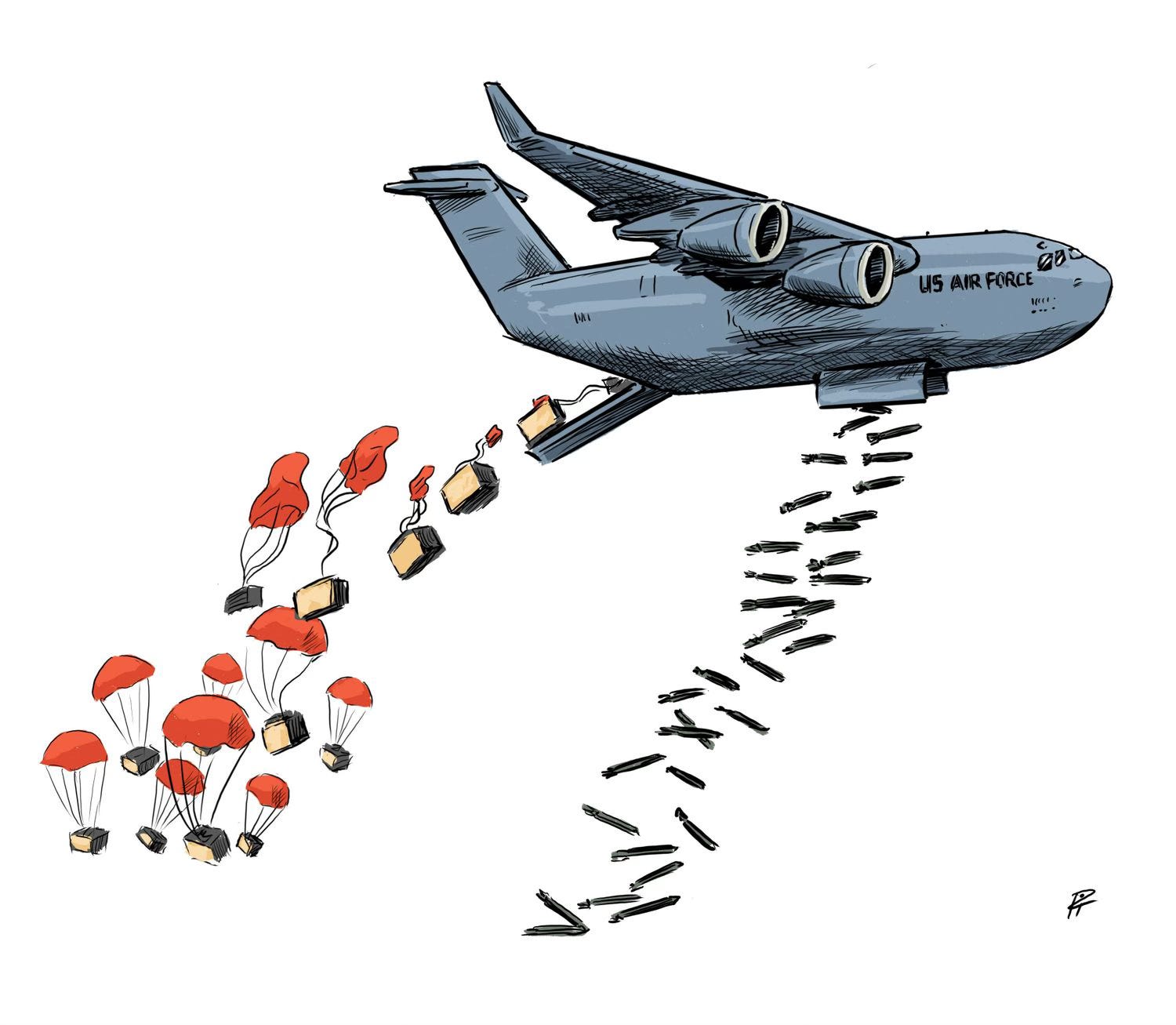
Speaking of the Air Force, my old service, I caught this cartoon by Pia Guerra:

The U.S. government really believes it can have it both ways. It can provide bombs to Israel to annihilate Gaza while at the same time dropping care packages among the wounded and desperate. Call it feel-good militarism. Have some MREs with your HE.* A new form of American (un)happy meal.

Harris and Trump reflect the bipartisan consensus in DC that Pentagon budgets must always go up. They both boast and brag about the U.S. military and its deadliness. They mainly disagree on which enemy is the most serious, with Harris favoring Iran and Russia while Trump hypes China. Neither candidate sees militarism as a problem: they see it as something to celebrate. It’s just that Harris and the Democrats prefer “diverse” militarism.

Trump, of course, has said he wants to end the Russia-Ukraine War. He also raised the specter of nuclear war. Harris, apparently, seems to think she must be more hawkish than Trump, hence her embrace of generals and her talk of lethality.

Whether Harris or Trump wins, higher military budgets are guaranteed and probably more war too. Interestingly, Trump talks more of the enemy within than the enemy without, though his “enemy within” is typically a caricature of woke liberals out to destroy America by forcing your kids to undergo gender-reassignment surgery. Just as Trump is using threat inflation for the enemy within, Harris is inflating the Iranian and Russian threats from without.

Civil discord within America or more war outside of America? That may be our “choice” on November 5th. Or maybe we’ll get both.

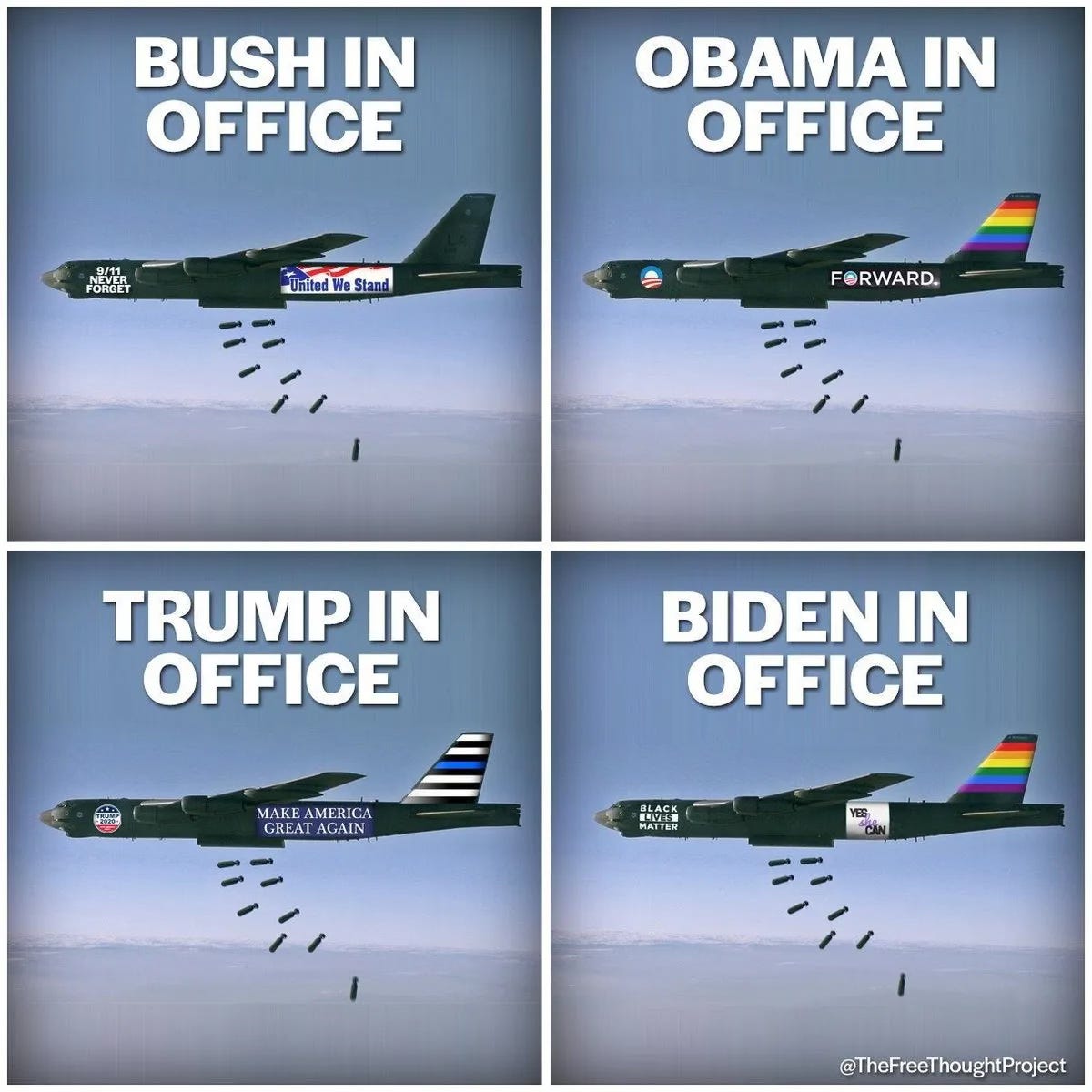
One thing is certain: A B-52 with a rainbow flag and a BLM slogan is still a B-52.

I suppose a Harris B-52 will be the first joyful bomber

* That’s meals ready to eat (MRE), or rations, with your high explosives (HE).

America Is Weak!

W.J. Astore

Spend More on the Military! Says the New York Times

As the U.S. deploys more troops to the Middle East (now nearing 50,000 and rising), as Israel expands its war into Lebanon by killing nearly 500 people there, as Palestinians continue to die in Gaza and the West Bank as Israel steals their land, the “liberal” New York Times is running features on how “weak” the U.S. military is.

This is from yesterday’s New York Times send-out, citing a recent (and typical) bipartisan study:

*******

American weaknesses

The report cited several major U.S. weaknesses, including:

A failure to remain ahead of China in some aspects of military power. “China is outpacing the United States and has largely negated the U.S. military advantage in the Western Pacific through two decades of focused military investment,” the report concluded.

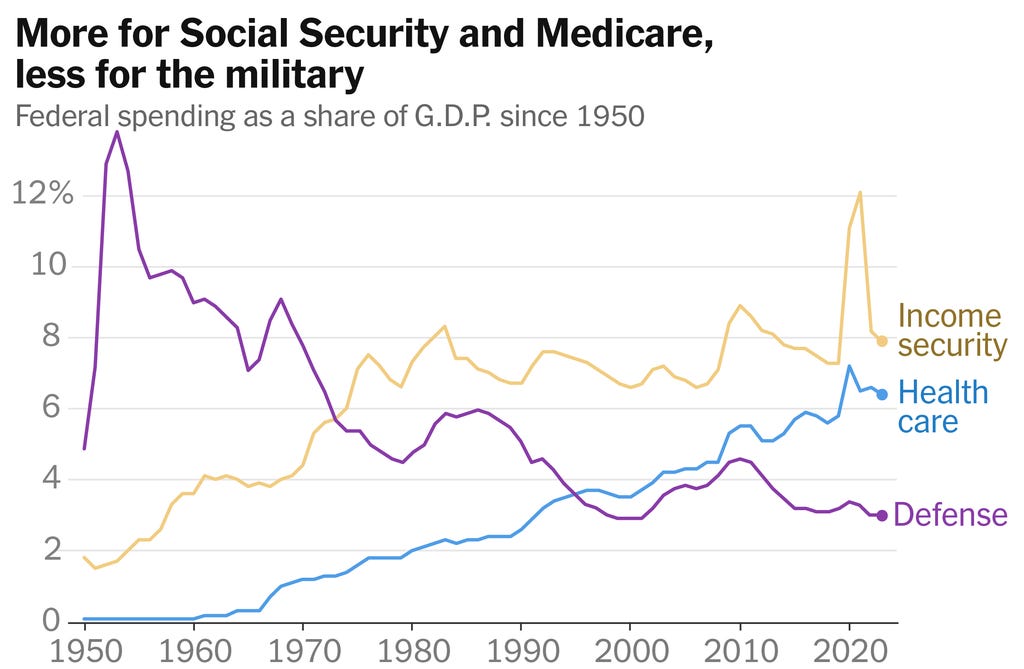
One reason is the decline in the share of U.S. resources devoted to the military. This Times chart, which may surprise some readers, tells the story:

Three lines track federal spending on health care, social security and defense. Total budget allocated to defense has fallen since 1950, while money spent on health care and income security has risen.

Source: Congressional Budget Office | By The New York Times

The report recommended increasing military spending, partly by making changes to Medicare and Social Security (which is sure to upset many liberals) and partly by increasing taxes, including on corporations (which is sure to upset many conservatives). The report also called for more spending on diplomacy and praised the Biden administration for strengthening alliances in Europe and Asia.

A Pentagon bureaucracy that’s too deferential to military suppliers. The report criticized consolidation among defense contractors, which has raised costs and hampered innovation. The future increasingly lies with drones and A.I., not the decades-old equipment that the Pentagon now uses.

A U.S. manufacturing sector that isn’t strong enough to produce what the military needs. A lack of production capacity has already hurt the country’s efforts to aid Ukraine, as The Times has documented. “Putin’s invasion has demonstrated how weak our industrial base is,” David Grannis, the commission’s executive director, said. If the Pentagon and the innovative U.S. technology sector collaborated more, they could address this problem, Grannis added.

A polarized political atmosphere that undermines national unity. A lack of patriotism is one reason that the military has failed to meet its recent recruitment goals. Perhaps more worrisome, many Americans are angry at one another rather than paying attention to external threats.

*******

Where to begin with such nonsense?

  1. So-called “defense” spending currently sits at or above $1 trillion, representing roughly 60% of federal discretionary spending. It continues to rise. Showing it as declining vis-a-vis the GDP is lying through statistics.
  2. Even if military spending was truly declining, which it isn’t, that would be a “good news” story. As President Eisenhower explained in 1953, military spending represents a theft from those who hunger, those who need shelter, those who need better schools and hospitals.
  3. Social Security: Yes, the government is going to keep trying to cut benefits while handing the savings to military contractors. Ditto for Medicare.
  4. Notice who’s mainly to blame for the alleged need for higher military spending: Putin and China.
  5. The Pentagon has misspent funds and misunderstands war. The solution: give the Pentagon more money as a reward.
  6. Americans are allegedly so angry with each other we’re not sufficiently hating Russians, Chinese, Iranians, and other alleged “external threats.”
  7. America lacks patriotism!

All this is reported with a straight face and the utmost seriousness by your “liberal” friends at the New York Times

So, when your Social Security benefits are reduced, when your Medicare bills go up, as you struggle even more mightily to make ends meet, just know your money is going to the Pentagon and the weapons makers.

Got a problem with that? The real problem just might be your lack of patriotism.

Wars that Never Should Have Been Fought Cannot Be Won

W.J. Astore

Perpetual War Abroad Is the Most Insidious Enemy to Liberty and Freedom at Home

I wrote my first article for TomDispatch in 2007, two years after I’d retired from the military. That article was highly critical of the U.S. military and its disastrous war in Iraq. I wrote that we, the citizens of America, had to save the military from itself and its worst excesses. Sadly, we the people have been demobilized; we have no say about “our” military and its wars.

In fact, while the Iraq and Afghan Wars are now officially over, both lost at enormous cost, we the people are still issuing blank checks to a Pentagon that is wildly if not fatally deluded and delusional.

Much like a black hole, the Pentagon keeps sucking in everything around it, especially taxpayer dollars

Back in 2018, Tom Engelhardt, the creator, editor, and prime mover of TomDispatch, asked me to write a new introduction to my article from 2007. Here’s that intro as I wrote it back then:

Retiring from the U.S. military liberated my tongue, but I quickly learned few people were interested in what I had to say. In 2007, I was outraged by the way the Bush administration hid behind the richly bemedaled chest of General David Petraeus, using his testimony before a spineless Congress to evade responsibility for the catastrophic war in Iraq. I wrote an op-ed about how ‘my’ military was deluding itself not only into believing that it was the ‘greatest’ but that it could somehow find a formula to win an unwinnable war. I sent it to the usual suspects, newspapers like the New York Times and Boston Globe, with no response. A friend then mentioned a website I’d never heard of, TomDispatch.com, and I found a man there who would listen: today’s equivalent of I.F. Stone, Tom Engelhardt. What started as a one-off article led to 55 more ‘Tomgrams‘ over the last decade.

In that very first post, I asked, ‘How can you win someone else’s civil war?’ It’s a question the U.S. military still avoids asking, let alone answering. Indeed, a state of what I then called ‘ongoing self-delusion’ about war persists in that military and American society as a whole. More than a decade later, its commanders continue to mislead themselves and the rest of us by speaking about ‘new’ approaches that promise ‘progress’ in places like Afghanistan.

Who will teach the Pentagon that wars that never should have been fought cannot be won? Who will remind the American people that perpetual war abroad is the most insidious enemy to liberty and freedom at home? Members of the military, active duty and retired, need to speak up. Our oath to the Constitution was never about saluting smartly and following blindly, but about allegiance to the noble ideals expressed in that document. William J. Astore, May 2018

Since 2018, I’ve written another fifty or so articles for TomDispatch, nearly all of them focusing on U.S. military folly and fallacies. It hasn’t mattered. Both parties, Republicans and Democrats, profess their unconditional love of “our” troops, even as they’ve shoved and shoveled trillions of dollars to the military-industrial-congressional complex, the all-powerful MICIMATT* that increasingly infects our lives and infests our society and culture.

This November provides us another opportunity to go to the polls and allegedly vote for what we want. Most people want peace. The Republicans and Democrats offer us more war. Might I suggest that we vote for a person or party that actually seeks peace?

It’s highly unlikely we’re going to vote ourselves out of the mess we’re in. Look at the mainstream candidates! But at least we shouldn’t vote for yet more insanity.

*MICIMATT: military industrial congressional intelligence media academe think tank complex. To that you can now add Hollywood and the world of sports as well. Hercules had a much easier time vanquishing the hydra. It only had seven heads.

The Pentagon Ate Our Government

W.J. Astore

Looking at the New Federal Budget

Courtesy of Stephen Semler, let’s take a look at the federal budget recently signed into law by President Biden:

The biggest boost in spending from 2023 to 2024 went to the Pentagon. Of course! Even though the Pentagon has yet to pass an audit. Throw money at it as a reward!

Let’s do some basic math. Add the Pentagon budget, Homeland Security, Military Construction and the VA, and State/Foreign Ops and you get $1.118 trillion. (Basically, the State Department is a tiny branch of the Pentagon.) But even that figure is low, since some Energy spending goes to nuclear weapons, and I can’t imagine that spending on science doesn’t have military applications.

Let’s go with the $1.118 trillion figure as a rough estimate of military spending. Adding up all the numbers of money spent produces a total of $1.627 trillion. That means the percentage of money spent on the Pentagon and related military matters amounts to 68.7% of federal discretionary spending.

Yes, the Pentagon ate our government.

Of course, not included in the figures above is mandatory federal spending on the rapidly escalating national debt, Medicare and Medicaid, and Social Security. Nevertheless, the rough figures here are a telling indicator of the dominance of militarism and military spending in our lives. When nearly seventy cents on the dollar goes to empire, internal security, wars, foreign military sales, and the like, there’s little money left for other concerns like better education and transportation or safer water and a cleaner environment.

Well, America gets what it pays for. More military bases, more wars, more weapons, and more bloodshed globally. Add in some apocalyptic nuclear weapons and now I’m really having a bad Monday.

Update: Courtesy of Stephen Semler once again, my guesstimates above were close to being spot on, as shown in his new post, which I’ll attach here:

Sixty-eight percent of the FY2024 discretionary budget is for military and law enforcement-related programs.

This $1.1 trillion total includes the Pentagon and Military Construction/VA spending bills and parts of four others:

  • Homeland SecurityTitle II — CBP, ICE, TSA, Coast Guard, Secret Service ($55 billion); Title III — State Homeland Security Grant Program, Urban Area Security Initiative, Nonprofit Security Grant Program, Public Transportation Security Assistance, Port Security Grants ($1.5 billion)
  • Commerce, Justice, ScienceTitle II — Marshals Service, National Security Division, Interagency Law Enforcement, FBI, DEA, ATF, Federal Prison System, State and Local Law Enforcement Activities ($32.3 billion)
  • Energy and Water: Atomic energy military activities ($32.8 billion)
  • State, Foreign OperationsTitle IV — Foreign military aid ($8.9 billion)

Cutting the Pentagon Down to Size

W.J. Astore

It’s not a new idea

Also at TomDispatch.com.

In an age when American presidents routinely boast of having the world’s finest military, where nearly trillion-dollar war budgets are now a new version of routine, let me bring up one vitally important but seldom mentioned fact: making major cuts to military spending would increase U.S. national security.

Why? Because real national security can neither be measured nor safeguarded solely by military power (especially the might of a military that hasn’t won a major war since 1945). Economic vitality matters so much more, as does the availability and affordability of health care, education, housing, and other crucial aspects of life unrelated to weaponry and war. Add to that the importance of a Congress responsive to the needs of the working poor, the hungry and the homeless among us. And don’t forget that the moral fabric of our nation should be based not on a military eternally ready to make war but on a determination to uphold international law and defend human rights. It’s high time for America to put aside its conveniently generic “rules-based order” anchored in imperial imperatives and face its real problems. A frank look in the mirror is what’s most needed here.

It should be simple really: national security is best advanced not by endlessly preparing for war, but by fostering peace. Yet, despite their all-too-louddisagreements, Washington’s politicians share a remarkably bipartisan consensus when it comes to genuflecting before and wildly overfunding the military-industrial complex. In truth, ever-rising military spending and yet more wars are a measure of how profoundly unhealthy our country actually is.

“The Scholarly Junior Senator from South Dakota”

Such insights are anything but new and, once upon a time, could even be heard in the halls of Congress. They were, in fact, being aired there within a month of my birth as, on August 2, 1963, Democratic Senator George McGovern of South Dakota — later a hero of mine — rose to address his fellow senators about “New Perspectives on American Security.”

George McGovern

Nine years later, he (and his vision of the military) would, of course, lose badly to Republican Richard Nixon in the 1972 presidential election. No matter that he had been the one who served in combat with distinction in World War II, piloting a B-24 bomber on 35 missions over enemy territory, even as Nixon, then a Navy officer, amassed a tidy sum playing poker. Somehow, McGovern, a decorated hero, became associated with “weakness” because he opposed this country’s disastrous Vietnam War, while Nixon manufactured a self-image as the staunchest Cold Warrior around, never missing a chance to pose as tough on communism (until, as president, he memorably visited Communist China, opening relations with that country).

But back to 1963, when McGovern gave that speech (which you can read in the onlineSenate Congressional Record, volume 109, pages 13,986-94). At that time, the government was already dedicating more than half of all federal discretionary spending to the Pentagon, roughly the same percentage as today. Yet was it spending all that money wisely? McGovern’s answer was a resounding no. Congress, he argued, could instantly cut 10% of the Pentagon budget without compromising national security one bit. Indeed, security would be enhanced by investing in this country instead of buying yet more overpriced weaponry. The senator and former bomber pilot was especially critical of the massive amounts then being spent on the U.S. nuclear arsenal and the absurd planetary “overkill” it represented vis-à-vis the Soviet Union, America’s main competitor in the nuclear arms race. As he put it then:

“What possible advantage [can be had] in appropriating additional billions of dollars to build more [nuclear] missiles and bombs when we already have excess capacity to destroy the potential enemy? How many times is it necessary to kill a man or kill a nation?”

How many, indeed? Think about that question as today’s Congress continues to ramp up spending, now estimated at nearly $2 trillion over the next 30 years, on — and yes, this really is the phrase — “modernizing” the country’s nuclear triad of intercontinental ballistic missiles (ICBMs), as well as its ultra-expensive nuclear-missile-firing submarines and stealth bombers. And keep in mind that the U.S. already has an arsenal quite capable of wiping out life on several Earth-sized planets.

What, according to McGovern, was this country sacrificing in its boundless pursuit of mass death? In arguments that should resonate strongly today, he noted that America’s manufacturing base was losing vigor and vitality compared to those of countries like Germany and Japan, while the economy was weakening, thanks to trade imbalances and the exploding costs of that nuclear arms race. Mind you, back then, this country was still on the gold standard and unburdened by an almost inconceivable national debt, 60 years later, of more than $34 trillion, significant parts of it thanks to this country’s failed “war on terror” in Iraq, Afghanistan, and elsewhere across all too much of the planet.

McGovern did recognize that, given how the economy was (and still is) organized, meaningful cuts to military spending could hurt in the short term. So, he suggested that Congress create an Economic Conversion Commission to ensure a smoother transition from guns to butter. His goal was simple: to make the economy “less dependent upon arms spending.” Excess military spending, he noted, was “wasting” this country’s human resources, while “restricting” its political leadership in the world.

In short, that distinguished veteran of World War II, then serving as “the scholarly junior Senator from South Dakota” (in the words of Senator Jennings Randolph of West Virginia), was anything but proud of America’s “arsenal of democracy.” He wasn’t, in fact, a fan of arsenals at all. Rather, he wanted to foster a democracy worthy of the American people, while freeing us as much as possible from the presence of just such an arsenal.

To that end, he explained what he meant by defending democracy:

“When a major percentage of the public resources of our society is devoted to the accumulation of devastating weapons of war, the spirit of democracy suffers. When our laboratories and our universities and our scientists and our youth are caught up in war preparations, the spirit of [freedom] is hampered.

“America must, of course, maintain a fully adequate military defense. But we have a rich heritage and a glorious future that are too precious to risk in an arms race that goes beyond any reasonable criteria of need.

“We need to remind ourselves that we have sources of strength, of prestige, and international leadership based on other than nuclear bombs.”

Imagine if his call had been heeded. This country might today be a far less militaristicplace.

Something was, in fact, afoot in the early 1960s in America. In 1962, despite the wishes of the Pentagon, President John F. Kennedy used diplomacy to get us out of the Cuban Missile Crisis with the Soviet Union and then, in June 1963, made a classic commencement address about peace at American University. Similarly, in support of his call for substantial reductions in military spending, McGovern cited the farewell address of President Dwight D. Eisenhower in 1961 during which he introduced the now-classic phrase “military-industrial complex,” warning that “we must never let the weight of this combination [of the military with industry, abetted by Congress] endanger our liberties or democratic processes.”

Echoing Ike’s warning in what truly seems like another age, McGovern earned the approbation of his Senate peers. His vision of a better, more just, more humane America seemed, however briefly, to resonate. He wanted to spend money not on more nuclear bombs and missiles but on “more classrooms, laboratories, libraries, and capable teachers.” On better hospitals and expanded nursing-home care. On a cleaner environment, with rivers and streams saved from pollution related to excessive military production. And he hoped as well that, as military bases were closed, they would be converted to vocational schools or healthcare centers.

McGovern’s vision, in other words, was aspirational and inspirational. He saw a future America increasingly at peace with the world, eschewing arms races for investments in our own country and each other. It was a vision of the future that went down fast in the Vietnam War era to come, yet one that’s even more needed today.

Praise from Senate Peers

Here’s another way in which times have changed: McGovern’s vision won high praise from his Senate peers in the Democratic Party. Jennings Randolph of West Virginia agreed that “unsurpassed military power in combination with areas of grave economic weakness is not a manifestation of sound security policy.” Like McGovern, he called for a reinvestment in America, especially in underdeveloped rural areas like those in his home state. Joseph Clark, Jr., of Pennsylvania, also a World War II veteran, “thoroughly” agreed that the Pentagon budget “needs most careful scrutiny on the floor of the Senate, and that in former years it has not received that scrutiny.” Stephen Young of Ohio, who served in both World War I and World War II, looked ahead toward an age of peace, expressing hope that “perhaps the necessity for these stupendous appropriations [for weaponry] will not be as real in the future.”

Possibly the strongest response came from Frank Church of Idaho, who reminded his fellow senators of their duty to the Constitution. That sacred document, he noted, “vests in Congress the power to determine the size of our military budget, and I feel we have tended too much to rubberstamp the recommendations that come to us from the Pentagon, without making the kind of critical analysis that the Senator from South Dakota has attempted… We cannot any longer shirk this responsibility.” Church saluted McGovern as someone who “dared to look a sacred cow [the Pentagon budget] in the teeth.”

A final word came from Wayne Morse of Oregon. Very much a gadfly, Morse shifted the topic to U.S. foreign aid, noting that too much of that aid was military-related, constituting a “shocking waste” to the taxpayer even as it proved detrimental to the development of democracy abroad, most notably in Latin America. “We should be spending the money for bread, rather than for military aid,” he concluded.

Imagine that! Bread instead of bullets and bombs for the world. Of course, even then, it didn’t happen, but in the 60 years since then, the rhetoric of the Senate has certainly changed. A McGovern-style speech today would undoubtedly be booed down on both sides of the aisle. Consider, for example, consistent presidential and Congressional clamoring now for more military aid to Israel during a genocide in Gaza. So far, U.S. government actions are more consistent with letting starving children in Gaza eat lead instead of bread.

Peace Must Be Our Profession

What was true then remains true today. Real national defense should not be synonymous with massive spending on wars and weaponry. Quite the reverse: whenever possible, wars should be avoided; whenever possible, weapons should be beaten into plowshares, and those plowshares used to improve the health and well-being of people everywhere.

Oh, and that Biblical reference of mine (swords into plowshares) is intentional. It’s meant to highlight the ancient roots of the wisdom of avoiding war, of converting weapons into useful tools to sustain and provide for the rest of us.

Yet America’s leaders on both sides of the aisle have long lost the vision of George McGovern, of John F. Kennedy, of Dwight D. Eisenhower. Today’s president and today’s Congress, Republicans and Democrats alike, boast of spending vast sums on weapons, not only to strengthen America’s imperial power but to defeat Russia and deter China, while bragging all the while of the “good” jobs they’re allegedly creatinghere in America in the process. (This country’s major weapons makers would agree with them, of course!)

McGovern had a telling rejoinder to such thinking. “Building weapons,” he noted in 1963, “is a seriously limited device for building the economy,” while an “excessive reliance on arms,” as well as overly “rigid diplomacy,” serve only to torpedo promising opportunities for peace.

Back then, it seemed to politicians like McGovern, as well as President Kennedy, that clearing a path toward peace was not only possible but imperative, especially considering the previous year’s near-cataclysmic Cuban Missile Crisis. Yet just a few months after McGovern’s inspiring address in the Senate, Kennedy had been assassinated and his calls for peace put on ice as a new president, Lyndon B. Johnson, succumbed to pressure by escalating U.S. military involvement in what mushroomed into the catastrophic Vietnam War.

In today’s climate of perpetual war, the dream of peace continues to wither. Still, despite worsening odds, it’s important that it must not be allowed to die. The high ground must be wrested away from our self-styled “warriors,” who aim to keep the factories of death churning, no matter the cost to humanity and the planet.

My fellow Americans, we need to wake up from the nightmare of forever war. This country’s wars aren’t simply being fought “over there” in faraway and, at least to us, seemingly forgettable places like Syria and Somalia. In some grim fashion, our wars are already very much being fought right here in this deeply over-armed country of ours.

George McGovern, a bomber pilot from World War II, knew the harsh face of war and fought in the Senate for a more peaceful future, one no longer haunted by debilitating arms races and the prospect of a doomsday version of overkill. Joining him in that fight was John F. Kennedy, who, in 1963, suggested that “this generation of Americans has already had enough, more than enough, of war, and hate, and oppression.”

If only.

Today’s generation of “leaders” seems not yet to have had their fill of war, hate, and oppression. That tragic fact — not China, not Russia, not any foreign power — is now the greatest threat to this country’s “national security.” And it’s a threat only aggravated by ever more colossal Pentagon budgets still being rubberstamped by a spinelessly complicit Congress.

“All Options Are On the Table”

W.J. Astore

Then why is bombing the option that’s always chosen?

There they go again. The geniuses inside the DC Beltway are bombing the Middle East again, specifically 85+ targets in Iraq and Syria allegedly supported by Iran. It’s funny: I don’t recall a Congressional declaration of war against Iraq and Syria (or Iran, for that matter), but who needs to be limited by the U.S. Constitution, am I right?

After the recent attack that killed three U.S. soldiers, I heard again that hackneyed expression from DC that “all options are on the table” in response. Amazing how the option that’s always picked by U.S. presidents is the military one. If it’s not “bomb bomb bomb bomb bomb Iran,” as John McCain once jokingly sang, it’s bomb Iranian-backed units in Iraq and Syria, because that’s the best way toward greater stability and peace in the Middle East. Perfectly logical.

Yes, he died in 2018, but he’s America’s most likely presidential winner in 2024.

Speaking of John McCain, I like the joke that’s making the rounds that no matter who Americans vote for as president, they get John McCain, which is a shorthand way of saying that the National Security State is the unofficial fourth and most powerful branch of the U.S. government. Or, if you prefer, the MICIMATT, the military-industrial-congressional-intelligence-media-academe-think-tank complex.

Speaking of the media, you can always count on U.S. media talking heads issuing resounding hosannas to the highest whenever a U.S. president bombs a foreign country. Remember when reporters gushed that Donald Trump had finally become a real president in 2017 when he bombed Syria? Trump, who expressed his contempt for John McCain, finally became him—and earned the MICIMATT’s approval—when he started bombing and launching missiles to kill foreigners.

Finally, we often hear the expression from U.S. government-types that the only thing “they” understand is physical violence and war. It’s often far more accurate to say that the only thing “we” (the MICIMATT, that is) understand (and profit from) is physical violence and war.

Mr. President, Your Secretary of Defense Is Missing

W.J. Astore

SecDef Lloyd Austin Goes MIA

Secretary of Defense Lloyd Austin went into the hospital both before Christmas and on New Year’s Day, apparently not informing the White House and Congress on either occasion. Other than the president as commander-in-chief, SecDef Austin is the senior civilian in the U.S. military’s chain of command.

Secretary of Defense Lloyd Austin looks on during a joint press conference with Israeli Defense Minister Yoav Gallant at Israel’s Ministry of Defense in Tel Aviv, Israel December 18, 2023. REUTERS/Violeta Santos Moura/File Photo

Austin’s medical condition is serious, most recently requiring four days in an intensive care unit. A blindsided president has already declared he won’t fire Austin, nor will Austin resign. No big deal, then?

I’m amazed. One of the first and most valuable lessons I learned in the military was to keep your boss informed. Tell her if the project is behind schedule. Tell him if you’re missing critical spares that would hamper the combat performance of your unit. Don’t let your boss be blindsided. Most obviously, under combat conditions, failing to keep your boss informed of critical information is an almost certain way to get your people killed.

When I was a lieutenant, I served on the “battle staff” for exercises in Cheyenne Mountain. This was in 1986 at the tail end of the Cold War. During one exercise, a friend of mine, another LT, witnessed the commanding four-star general chewing out a colonel on his staff. The colonel had failed to tell the general that AWACS planes were unavailable during the exercise. (Remember, this was an exercise, i.e. “fake.”) My friend told me the general reamed the colonel a new one for failing to inform him of what in wartime would have been a critical piece of information.

Lloyd Austin, it seems, has been MIA for several days without keeping his immediate superior, Joe Biden, in the loop, potentially threatening the national security of our country. Yet Austin has no plans to resign and Biden has no plans to take action.

It’s a bad example to our military that something so critical as a failure to respect the chain of command is being dismissed as a trivial matter. A blindsided Biden should not turn a blind eye here. If Austin has honor, he should resign to avoid further embarrassment to his boss. If he doesn’t, Biden should fire him.

Liberty at the Point of a Sword

W.J. Astore

Lessons from Napoleon and Hitler

There’s a man who famously crowned himself emperor rather than submit to the otherworldly power of a pope. A new movie will soon be out on his “glories.” Napoleon Bonaparte, a military genius, embraced war and drove for total victory until his empire collapsed on him and the French people. Napoleon’s Waterloo came in 1815, a decade after perhaps his greatest victory at Austerlitz in 1805. Empires—they often seem to decline slowly before collapsing all at once, though the Napoleonic version flared so brightly that it burned out quickly.

I once studied the military glories of Napoleon, enthusiastically playing war-games like Waterloo and Empire in Arms, where this time maybe I could win a great victory for the emperor. More than a few books on my shelves cover the campaigns of Napoleon. But as my dad quipped to me, Napoleon wanted to give people liberty, equality, and fraternity at the point of his sword.  And that, my dad would say, is an intolerable price to pay for one’s freedom.

Win one for the Emperor

Endless war is, as often as not, the final nail in an empire’s coffin. Early in 1943, after defeat at Stalingrad, which came as a profound shock to a German public sold on the idea it possessed the finest fighting force in history (such rhetoric should sound familiar to Americans today), Joseph Goebbels, the infamous Nazi propaganda minister, gave a fanatical speech calling for “total war” from the German people. Despite disaster at Stalingrad, despite visible and widening cracks in the alleged superiority of the Thousand Year Reich, the German people largely cheered or echoed the cry for more and more war. Two years later, they witnessed total defeat as Germany surrendered unconditionally in May 1945.

As led by Adolf Hitler and his henchmen, Nazi Germany wasn’t interested in peace. These men knew only the feverish pursuit of total victory until it ended in their deaths and total disaster for Germany.  They were the original seekers of “full spectrum dominance” as they asserted Germany was the exceptional and essential nation.

We Americans were supposed to learn something from megalomaniacs like Napoleon and Hitler. Committed to democracy, we were supposed to reject war, to repudiate militarism and the warrior mystique, and to embrace instead diplomacy and the settlement of differences peacefully through international organizations like the United Nations.

America today, however, is busy beating plowshares into swords and sending them to global hotspots like Gaza and Ukraine. What gives?

Endless wars can exhaust even the richest and wisest of empires, and America isn’t as rich or wise as it used to be.  Interestingly, ordinary Americans haven’t been overcome with bloodthirst. Roughly two-thirds of Americans, for example, support a ceasefire in Gaza. But they are a silent majority compared to the loud minority flowing through the halls of power in DC lobbying for war and more war.

The U.S., which largely created the UN in the immediate aftermath of World War II, now does everything it can to block UN calls for ceasefires, whether in Ukraine or Gaza. The U.S., while allegedly manifesting its allegiance to Judeo-Christian values, embraces war and distributes weaponry like the devil while rejecting calls for peace by church leaders such as Pope Francis.

The U.S. is an empire in serious decline because it devotes so much money to wars and more wars.  Military budgets now approach $1 trillion yearly even as the Pentagon just announced it failed its sixth audit in a row.  These repetitive failures provoke a bizarre response from Congress and the President: yet more money for war and dominance.

Whether measured in blood or treasure or both, seeking to dominate the world through military hegemony is a surefire recipe for imperial collapse.  It’s a lesson taught by the fates of Napoleon and Hitler, one U.S. leaders have dismissed as they’ve been caught up in a belief one can be a superpower, a global hegemon, totally dominant, while remaining a beacon of freedom.

Like Napoleon, U.S. leaders sell the idea they’re giving people liberty at the point of a sword.  My dad taught me something about the fallacy and folly of this.