America’s war budget now exceeds $1 trillion a year—an almost unimaginable sum.
The Pentagon plans to spend $1.7 trillion “modernizing” a nuclear triad that should instead be downsized. A proposed “Golden Dome” missile defense system may cost $500 billion while making nuclear war more likely. And a “new” Cold War with China and Russia is already underway, with threat inflation as one of its defining features.
With military spending so high—and the military so valorized—Washington offers it as the solution to nearly everything: crime in D.C., eliminating drug cartels south of the border, containing China and Russia, “winning” in Somalia, preventing Iran from acquiring nuclear weapons—the list is endless. Supporting and defending the Constitution, however, is rarely mentioned.
War has become America’s new normal. “Peace” is now a word that dare not speak its name. According to the Pentagon, the only peace worth pursuing is “peace through [military] strength.” A warrior ethos is marketed as if it were synonymous with democratic virtue.
I once called for a 10% reduction in Pentagon spending. That’s no longer enough. We need a 50% cut—we need a military dedicated to genuine national defense, not imperial dominance. Surely we can protect America for $500 billion a year rather than the $1 trillion we’re spending now.
Changing the narrative is crucial. Why do we need 750+ bases overseas? Why expand our nuclear arsenal when we already have 5,000 warheads? We don’t need these things—they are the hallmarks of wasteful militarism. They escalate tensions, endanger us, and drain the nation’s wealth.
And why do we have 17 or 18 intelligence agencies? Despite all that intelligence, we still lost in Vietnam, Iraq, and Afghanistan. Where is the accountability? Why are no generals relieved of command for such failures? In fact, they’re more likely to fail upwards.
“All governments lie,” as I.F. Stone warned. Combine that with the truth that war’s first casualty is truth itself, and you begin to see the rot in America today. Perpetual war fuels deception and government overreach. Almost anything can be justified when the cry is, “We’re at war!”—even when the reasons for going to war are false.
Consider the Gulf of Tonkin incident—revealed later as phony—and the Pentagon Papers during the Vietnam War. Consider Iraq’s mythical WMDs. Consider the lies revealed in the Afghan War Papers. Consider the weasel words of generals like David Petraeus, forever hedging “gains” as “fragile” and “reversible.” Consider the U.S. military’s record since World War II—generally ineffective because there’s been little accountability for failure. (And yes, civilian leaders share the blame.)
The military-industrial complex grows ever more powerful, sidelining the American people while democracy withers.
Something is rotten in the States of America.
Many thanks to Judge Napolitano for asking me to discuss some of these issues on his show, “Judging Freedom.”
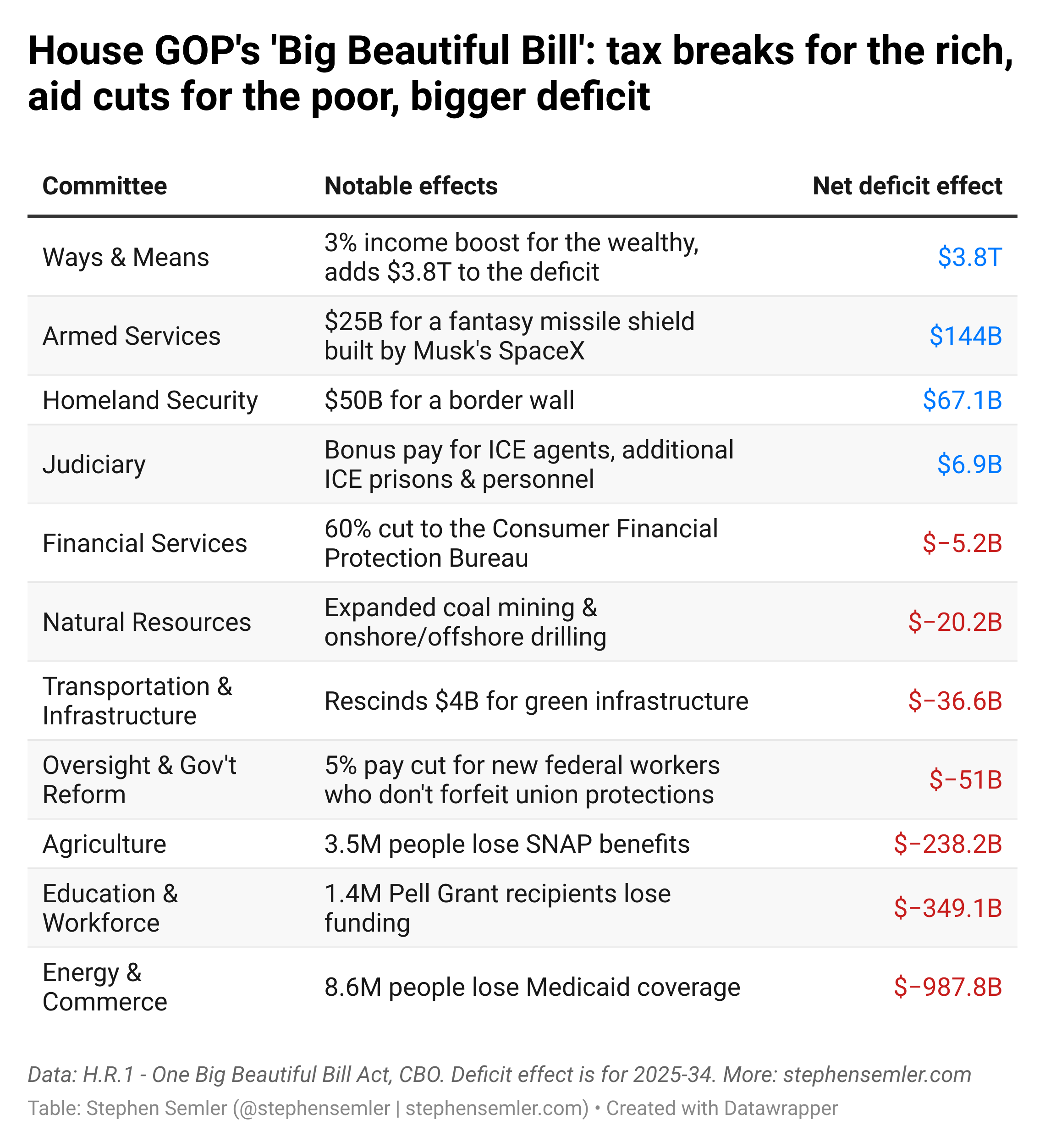
The “Big Beautiful Bill” passed recently by the House is petty and ugly. A sham. A reverse Robin Hood. It cuts SNAP benefits (food stamps) to the poor. It cuts Medicaid. Because who needs food and medical care, amirite? Meanwhile, it cuts taxes for the richest Americans and funds various weapons follies (a foolish and wasteful missile shield known as “Golden Dome,” more nuclear weapons, yet more billions for the wall on America’s border with Mexico). And it adds significantly to the national debt.
Remember when Republicans were once known as fiscal conservatives? Remember calls for a balanced budget? Those days are long gone. The “Big Beautiful Bill” is a fever dream, or a night terror if you prefer, of wanton and wasteful spending that rewards the already well-heeled and hurts the most vulnerable of Americans.
Trump, who is truly an expert at the craft of the con, concocts the most outrageous names to sell his BS. Thus a missile shield that may end up wasting $500 billion is a “golden dome.” Heck, the whole bill, which is contempuous toward the poor and punishing to workers organizing for higher wages, is sold as “big” and “beautiful.”
When Trump describes things as “golden” and “big” and “beautiful,” you should know to hold tightly to your wallets and purses, America, because you’re about to get scammed.
At his site, Stephen Semler has a superb chart that breaks down the petty ugly bill the House just passed. Here’s an excerpt. Read it and weep, America.
The bottom line: More money for the already affluent and for the Pentagon; less money and benefits for the poor. The rich get richer, the poor poorer, as America reinforces its turn to weapons, walls, police, domes, and warriors.
Spend More on the Military! Says the New York Times
As the U.S. deploys more troops to the Middle East (now nearing 50,000 and rising), as Israel expands its war into Lebanon by killing nearly 500 people there, as Palestinians continue to die in Gaza and the West Bank as Israel steals their land, the “liberal” New York Times is running features on how “weak” the U.S. military is.
This is from yesterday’s New York Times send-out, citing a recent (and typical) bipartisan study:
*******
American weaknesses
The report cited several major U.S. weaknesses, including:
A failure to remain ahead of China in some aspects of military power. “China is outpacing the United States and has largely negated the U.S. military advantage in the Western Pacific through two decades of focused military investment,” the report concluded.
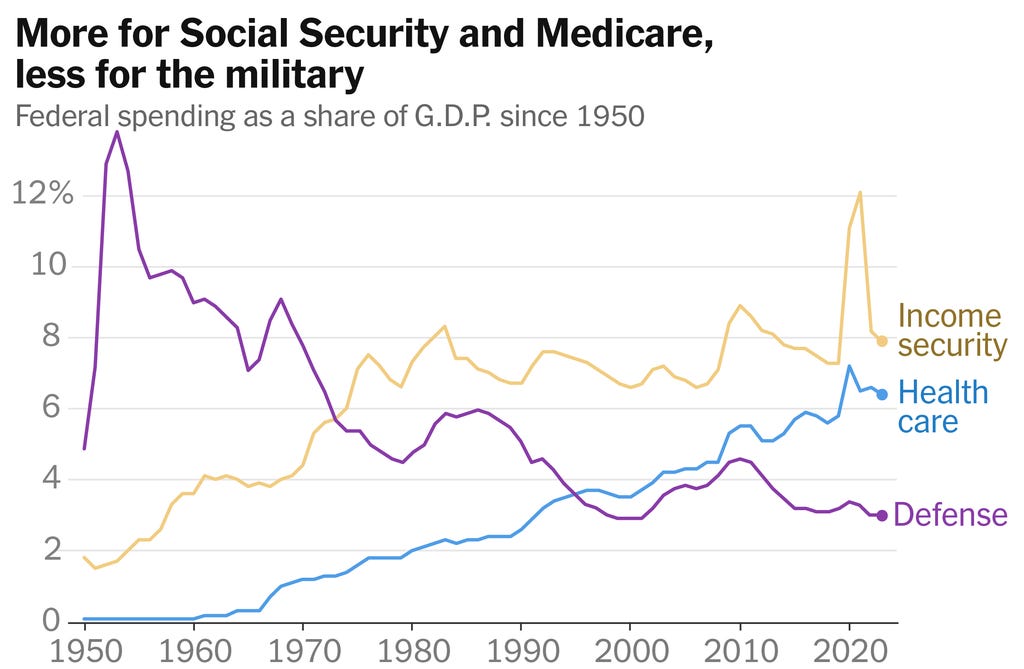
One reason is the decline in the share of U.S. resources devoted to the military. This Times chart, which may surprise some readers, tells the story:
Source: Congressional Budget Office | By The New York Times
The report recommended increasing military spending, partly by making changes to Medicare and Social Security (which is sure to upset many liberals) and partly by increasing taxes, including on corporations (which is sure to upset many conservatives). The report also called for more spending on diplomacy and praised the Biden administration for strengthening alliances in Europe and Asia.
A Pentagon bureaucracy that’s too deferential to military suppliers. The report criticized consolidation among defense contractors, which has raised costs and hampered innovation. The future increasingly lies with drones and A.I., not the decades-old equipment that the Pentagon now uses.
A U.S. manufacturing sector that isn’t strong enough to produce what the military needs. A lack of production capacity has already hurt the country’s efforts to aid Ukraine, as The Times has documented. “Putin’s invasion has demonstrated how weak our industrial base is,” David Grannis, the commission’s executive director, said. If the Pentagon and the innovative U.S. technology sector collaborated more, they could address this problem, Grannis added.
A polarized political atmosphere that undermines national unity. A lack of patriotism is one reason that the military has failed to meet its recent recruitment goals. Perhaps more worrisome, many Americans are angry at one another rather than paying attention to external threats.
*******
Where to begin with such nonsense?
So-called “defense” spending currently sits at or above $1 trillion, representing roughly 60% of federal discretionary spending. It continues to rise. Showing it as declining vis-a-vis the GDP is lying through statistics.
Even if military spending was truly declining, which it isn’t, that would be a “good news” story. As President Eisenhower explained in 1953, military spending represents a theft from those who hunger, those who need shelter, those who need better schools and hospitals.
Social Security: Yes, the government is going to keep trying to cut benefits while handing the savings to military contractors. Ditto for Medicare.
Notice who’s mainly to blame for the alleged need for higher military spending: Putin and China.
The Pentagon has misspent funds and misunderstands war. The solution: give the Pentagon more money as a reward.
Americans are allegedly so angry with each other we’re not sufficiently hating Russians, Chinese, Iranians, and other alleged “external threats.”
America lacks patriotism!
All this is reported with a straight face and the utmost seriousness by your “liberal” friends at the New York Times.
So, when your Social Security benefits are reduced, when your Medicare bills go up, as you struggle even more mightily to make ends meet, just know your money is going to the Pentagon and the weapons makers.
Got a problem with that? The real problem just might be your lack of patriotism.
Courtesy of Stephen Semler, let’s take a look at the federal budget recently signed into law by President Biden:
The biggest boost in spending from 2023 to 2024 went to the Pentagon. Of course! Even though the Pentagon has yet to pass an audit. Throw money at it as a reward!
Let’s do some basic math. Add the Pentagon budget, Homeland Security, Military Construction and the VA, and State/Foreign Ops and you get $1.118 trillion. (Basically, the State Department is a tiny branch of the Pentagon.) But even that figure is low, since some Energy spending goes to nuclear weapons, and I can’t imagine that spending on science doesn’t have military applications.
Let’s go with the $1.118 trillion figure as a rough estimate of military spending. Adding up all the numbers of money spent produces a total of $1.627 trillion. That means the percentage of money spent on the Pentagon and related military matters amounts to 68.7% of federal discretionary spending.
Yes, the Pentagon ate our government.
Of course, not included in the figures above is mandatory federal spending on the rapidly escalating national debt, Medicare and Medicaid, and Social Security. Nevertheless, the rough figures here are a telling indicator of the dominance of militarism and military spending in our lives. When nearly seventy cents on the dollar goes to empire, internal security, wars, foreign military sales, and the like, there’s little money left for other concerns like better education and transportation or safer water and a cleaner environment.
Well, America gets what it pays for. More military bases, more wars, more weapons, and more bloodshed globally. Add in some apocalyptic nuclear weapons and now I’m really having a bad Monday.
Update: Courtesy of Stephen Semler once again, my guesstimates above were close to being spot on, as shown in his new post, which I’ll attach here:
Sixty-eight percent of the FY2024 discretionary budget is for military and law enforcement-related programs.
This $1.1 trillion total includes the Pentagon and Military Construction/VA spending bills and parts of four others:
Homeland Security: Title II — CBP, ICE, TSA, Coast Guard, Secret Service ($55 billion); Title III — State Homeland Security Grant Program, Urban Area Security Initiative, Nonprofit Security Grant Program, Public Transportation Security Assistance, Port Security Grants ($1.5 billion)
Commerce, Justice, Science: Title II — Marshals Service, National Security Division, Interagency Law Enforcement, FBI, DEA, ATF, Federal Prison System, State and Local Law Enforcement Activities ($32.3 billion)
Energy and Water: Atomic energy military activities ($32.8 billion)
In his message to the troops prior to the July 4th weekend, Secretary of Defense Lloyd Austin offered high praise indeed. “We have the greatest fighting force in human history,” he tweeted, connecting that claim to the U.S. having patriots of all colors, creeds, and backgrounds “who bravely volunteer to defend our country and our values.”
As a retired Air Force lieutenant colonel from a working-class background who volunteered to serve more than four decades ago, who am I to argue with Austin? Shouldn’t I just bask in the glow of his praise for today’s troops, reflecting on my own honorable service near the end of what now must be thought of as the First Cold War?
Yet I confess to having doubts. I’ve heard it all before. The hype. The hyperbole. I still remember how, soon after the 9/11 attacks, President George W. Bush boasted that this country had “the greatest force for human liberation the world has ever known.” I also remember how, in a pep talk given to U.S. troops in Afghanistan in 2010, President Barack Obama declared them “the finest fighting force that the world has ever known.” And yet, 15 years ago at TomDispatch, I was already wondering when Americans had first become so proud of, and insistent upon, declaring our military the world’s absolute best, a force beyond compare, and what that meant for a republic that once had viewed large standing armies and constant warfare as anathemas to freedom.
In retrospect, the answer is all too straightforward: we need something to boast about, don’t we? In the once-upon-a-time “exceptional nation,” what else is there to praise to the skies or consider our pride and joy these days except our heroes? After all, this country can no longer boast of having anything like the world’s best educational outcomes, or healthcare system, or the most advanced and safest infrastructure, or the best democratic politics, so we better damn well be able to boast about having “the greatest fighting force” ever.
Leaving that boast aside, Americans could certainly brag about one thing this country has beyond compare: the most expensive military around and possibly ever. No country even comes close to our commitment of funds to wars, weapons (including nuclear ones at the Department of Energy), and global dominance. Indeed, the Pentagon’s budget for “defense” in 2023 exceeds that of the next 10 countries (mostly allies!) combined.
And from all of this, it seems to me, two questions arise: Are we truly getting what we pay so dearly for — the bestest, finest, most exceptional military ever? And even if we are, should a self-proclaimed democracy really want such a thing?
The answer to both those questions is, of course, no. After all, America hasn’t won a war in a convincing fashion since 1945. If this country keeps losing wars routinely and often enough catastrophically, as it has in places like Vietnam, Afghanistan, and Iraq, how can we honestly say that we possess the world’s greatest fighting force? And if we nevertheless persist in such a boast, doesn’t that echo the rhetoric of militaristic empires of the past? (Remember when we used to think that only unhinged dictators like Adolf Hitler boasted of having peerless warriors in a megalomaniacal pursuit of global domination?)
Actually, I do believe the United States has the most exceptional military, just not in the way its boosters and cheerleaders like Austin, Bush, and Obama claimed. How is the U.S. military truly “exceptional”? Let me count the ways.
Yes, the Pentagon budget, enormous and still growing, is as large as the next ten countries in the world combined. We’re #1 in wars and weapons!
The Pentagon as a Budgetary Black Hole
In so many ways, the U.S. military is indeed exceptional. Let’s begin with its budget. At this very moment, Congress is debating a colossal “defense” budget of $886 billion for FY2024 (and all the debate is about issues that have little to do with the military). That defense spending bill, you may recall, was “only” $740 billion when President Joe Biden took office three years ago. In 2021, Biden withdrew U.S. forces from the disastrous war in Afghanistan, theoretically saving the taxpayer nearly $50 billion a year. Yet, in place of any sort of peace dividend, American taxpayers simply got an even higher bill as the Pentagon budget continued to soar.
Recall that, in his four years in office, Donald Trump increased military spending by 20%. Biden is now poised to achieve a similar 20% increase in just three years in office. And that increase largely doesn’t even include the cost of supporting Ukraine in its war with Russia — so far, somewhere between $120 billion and $200 billion and still rising.
Colossal budgets for weapons and war enjoy broad bipartisan support in Washington. It’s almost as if there were a military-industrial-congressional complex at work here! Where, in fact, did I ever hear a president warning us about that? Oh, perhaps I’m thinking of a certain farewell address by Dwight D. Eisenhower in 1961.
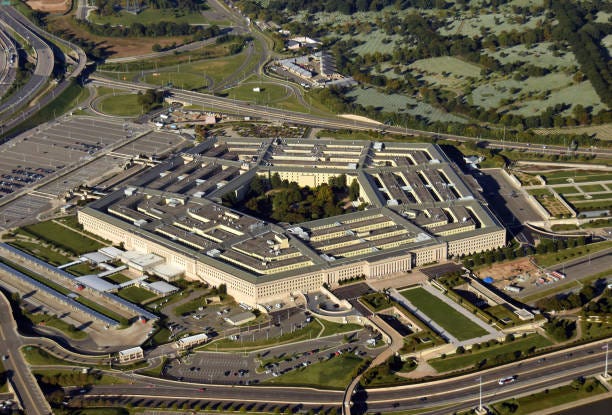
In all seriousness, there’s now a huge pentagonal-shaped black hole on the Potomac that’s devouring more than half of the federal discretionary budget annually. Even when Congress and the Pentagon allegedly try to enforce fiscal discipline, if not austerity elsewhere, the crushing gravitational pull of that hole just continues to suck in more money. Bet on that continuing as the Pentagon issues ever more warnings about a new cold war with China and Russia.
Given its money-sucking nature, perhaps you won’t be surprised to learn that the Pentagon is remarkably exceptional when it comes to failing fiscal audits — five of them in a row (the fifth failure being a “teachable moment,” according to its chief financial officer) — as its budget only continued to soar. Whether you’re talking about lost wars or failed audits, the Pentagon is eternally rewarded for its failures. Try running a “Mom and Pop” store on that basis and see how long you last.
Speaking of all those failed wars, perhaps you won’t be surprised to learn that they haven’t come cheaply. According to the Costs of War Project at Brown University, roughly 937,000 people have died since 9/11/2001 thanks to direct violence in this country’s “Global War on Terror” in Afghanistan, Iraq, Libya, and elsewhere. (And the deaths of another 3.6 to 3.7 million people may be indirectly attributable to those same post-9/11 conflicts.) The financial cost to the American taxpayer has been roughly $8 trillion and rising even as the U.S. military continues its counterterror preparations and activities in 85 countries.
No other nation in the world sees its military as (to borrow from a short-lived Navy slogan) “a global force for good.” No other nation divides the whole world into military commands like AFRICOM for Africa and CENTCOM for the Middle East and parts of Central and South Asia, headed up by four-star generals and admirals. No other nation has a network of 750 foreign bases scattered across the globe. No other nation strives for full-spectrum dominance through “all-domain operations,” meaning not only the control of traditional “domains” of combat — the land, sea, and air — but also of space and cyberspace. While other countries are focused mainly on national defense (or regional aggressions of one sort or another), the U.S. military strives for total global and spatial dominance. Truly exceptional!
Strangely, in this never-ending, unbounded pursuit of dominance, results simply don’t matter. The Afghan War? Bungled, botched, and lost. The Iraq War? Built on lies and lost. Libya? We came, we saw, Libya’s leader (and so many innocents) died. Yet no one at the Pentagon was punished for any of those failures. In fact, to this day, it remains an accountability-free zone, exempt from meaningful oversight. If you’re a “modern major general,” why not pursue wars when you know you’ll never be punished for losing them?
Indeed, the few “exceptions” within the military-industrial-congressional complex who stood up for accountability, people of principle like Daniel Hale, Chelsea Manning, and Edward Snowden, were imprisoned or exiled. In fact, the U.S. government has even conspired to imprison a foreign publisher and transparency activist, Julian Assange, who published the truth about the American war on terror, by using a World War I-era espionage clause that only applies to American citizens.
And the record is even grimmer than that. In our post-9/11 years at war, as President Barack Obama admitted, “We tortured some folks” — and the only person punished for that was another whistleblower, John Kiriakou, who did his best to bring those war crimes to our attention.
And speaking of war crimes, isn’t it “exceptional” that the U.S. military plans to spend upwards of $2 trillion in the coming decades on a new generation of genocidal nuclear weapons? Those include new stealth bombers and new intercontinental ballistic missiles (ICBMs) for the Air Force, as well as new nuclear-missile-firing submarines for the Navy. Worse yet, the U.S. continues to reserve the right to use nuclear weapons first, presumably in the name of protecting life, liberty, and the pursuit of happiness. And of course, despite the countries — nine! — that now possess nukes, the U.S. remains the only one to have used them in wartime, in the atomic bombings of Hiroshima and Nagasaki.
Finally, it turns out that the military is even immune from Supreme Court decisions! When SCOTUS recently overturned affirmative action for college admission, it carved out an exception for the military academies. Schools like West Point and Annapolis can still consider the race of their applicants, presumably to promote unit cohesionthrough proportional representation of minorities within the officer ranks, but our society at large apparently does not require racial equity for its cohesion.
A Most Exceptional Military Makes Its Wars and Their Ugliness Disappear
Here’s one of my favorite lines from the movie The Usual Suspects: “The greatest trick the devil ever pulled was convincing the world he did not exist.” The greatest trick the U.S. military ever pulled was essentially convincing us that its wars never existed. As Norman Solomon notes in his revealing book, War Made Invisible, the military-industrial-congressional complex has excelled at camouflaging the atrocious realitiesof war, rendering them almost entirely invisible to the American people. Call it the new American isolationism, only this time we’re isolated from the harrowing and horrific costs of war itself.
America is a nation perpetually at war, yet most of us live our lives with little or no perception of this. There is no longer a military draft. There are no war bond drives. You aren’t asked to make direct and personal sacrifices. You aren’t even asked to pay attention, let alone pay (except for those nearly trillion-dollar-a-year budgets and interest payments on a ballooning national debt, of course). You certainly aren’t asked for your permission for this country to fight its wars, as the Constitution demands. As President George W. Bush suggested after the 9/11 attacks, go visit Disneyworld! Enjoy life! Let America’s “best and brightest” handle the brutality, the degradation, and the ugliness of war, bright minds like former Vice President Dick (“So?”) Cheney and former Secretary of Defense Donald (“I don’t do quagmires”) Rumsfeld.
Did you hear something about the U.S. military being in Syria? In Somalia? Did you hear about the U.S. military supporting the Saudis in a brutal war of repression in Yemen? Did you notice how this country’s military interventions around the world kill, wound, and displace so many people of color, so much so that observers speak of the systemic racism of America’s wars? Is it truly progress that a more diverse military in terms of “color, creed, and background,” to use Secretary of Defense Austin’s words, has killed and is killing so many non-white peoples around the globe?
Praising the all-female-crewed flyover at the last Super Bowl or painting rainbow flags of inclusivity (or even blue and yellow flags for Ukraine) on cluster munitionswon’t soften the blows or quiet the screams. As one reader of my blog Bracing Viewsso aptly put it: “The diversity the war parties [Democrats and Republicans] will not tolerate is diversity of thought.”
Of course, the U.S. military isn’t solely to blame here. Senior officers will claim their duty is not to make policy at all but to salute smartly as the president and Congress order them about. The reality, however, is different. The military is, in fact, at the core of America’s shadow government with enormous influence over policymaking. It’s not merely an instrument of power; it is power — and exceptionally powerful at that. And that form of power simply isn’t conducive to liberty and freedom, whether inside America’s borders or beyond them.
Wait! What am I saying? Stop thinking about all that! America is, after all, the exceptional nation and its military, a band of freedom fighters. In Iraq, where war and sanctions killed untold numbers of Iraqi children in the 1990s, the sacrifice was “worth it,” as former Secretary of State Madeleine Albright once reassured Americans on 60 Minutes.
Even when government actions kill children, lots of children, it’s for the greater good. If this troubles you, go to Disney and take your kids with you. You don’t like Disney? Then, hark back to that old marching song of World War I and “pack up your troubles in your old kit-bag, and smile, smile, smile.” Remember, America’s troops are freedom-delivering heroes and your job is to smile and support them without question.
Have I made my point? I hope so. And yes, the U.S. military is indeed exceptional and being so, being #1 (or claiming you are anyway) means never having to say you’re sorry, no matter how many innocents you kill or maim, how many lives you disrupt and destroy, how many lies you tell.
I must admit, though, that, despite the endless celebration of our military’s exceptionalism and “greatness,” a fragment of scripture from my Catholic upbringing haunts me still: Pride goeth before destruction and a haughty spirit before a fall.
Four days ago, I got a story in my New York Times email feed on “A Turning Point in Military Spending.” The article celebrated the greater willingness of NATO members as well as countries like Japan to spend more on military weaponry, which, according to the “liberal” NYT, will help to preserve democracy. Interestingly, even as NATO members have started to spend more, the Pentagon is still demanding yet higher budgets, abetted by Congress. I thought if NATO spent more, the USA could finally spend less?
No matter. Russia’s invasion of Ukraine, as well as the hyping of what used to be called the “Yellow Peril,” today read “China,” is ensuring record military spending in the USA as yearly Pentagon budgets approach $900 billion. That figure does not include the roughly $120 billion or more in aid already provided to Ukraine in its war with Russia. And since the Biden administration’s commitment to Ukraine remains open-ended, you can add scores of billion more to that sum if the war persists into the fall and winter.
Here’s an excerpt from the New York Times piece that I found especially humorous in a grim way:
[Admittedly,] The additional money that countries spend on defense is money they cannot spend on roads, child care, cancer research, refugee resettlement, public parks or clean energy, my colleague Patricia points out. One reason Macron has insisted on raising France’s retirement age despite widespread protests, analysts believe, is a need to leave more money for the military.
But the situation [in Europe of spending more on butter than guns] over the past few decades feels unsustainable. Some of the world’s richest countries were able to spend so much on social programs partly because another country — the U.S. — was paying for their defense. Those other countries, sensing a more threatening world, are now once again promising to pull their weight. They still need to demonstrate that they’ll follow through this time.
Yes, Europe could continue to invest in better roads, cleaner energy, and the like, but now it’s time to buckle down and build more weapons. Stop freeloading, Europe! Dammit, “pull your weight”! You’ve had better and cheaper health care than Americans, stellar educational systems, child care benefits galore, all sorts of social programs we Americans can only dream of, but that’s because we’ve been paying for it! Captain America’s shield has been protecting you on the cheap! Time to pay up, you Germans, you French, you Italians, and especially you cheap Spaniards.
Look at all those cheap Spaniards. They have good stuff because of Captain America. Freeloaders! (NYT Chart, 7/12/23)
As the NYT article says: NATO allies need to “follow through this time” on strengthening their militaries. Because strong militaries produce democracy. And European “investments” in arms will ensure more equitable burden sharing in funding stronger cages and higher barriers to deter a rampaging Russian bear.
Again, you Americans out there, that doesn’t mean we can spend less on “defense.” What it means is that the U.S. can “pivot to Asia” and spend more on weaponry to “deter” China. Because as many neocons say, the real threat is Xi, not Putin.
We have met the enemy, and he is us. That’s an old saying you won’t see in the “liberal” NYT.
With Veterans Day in mind, I was asked as a retired U.S. military officer for a comment on the 2022 election results, which produced this:
When both political parties pose as pro-military, when both are pro-war, when both are enablers of record-high Pentagon spending, when both act as if a new cold war with China and Russia is inevitable, do election results even matter? No matter which party claims victory, the true victor remains the military-industrial-Congressional complex.
We have a winner, America!
To paraphrase Joe Biden, nothing fundamentally changed in the 2022 elections when it comes to colossal military spending, incessant wars and preparations for the same, and non-stop imperialism around the globe. There is no new vision for lower Pentagon spending, for fewer wars and weapons exports, and for a smaller, less domineering, imperial mission.
As General and President Dwight D. Eisenhower warned us in 1961, the military-industrial-Congressional complex represents a disastrous rise of misplaced power that is profoundly anti-democratic. Collectively, we’ve failed to heed Ike’s warning. The result has been one unnecessary and disastrous war after another, even as democracy in America withers. The Vietnam War—disaster. The Iraq War—disaster. The Afghan War—disaster. The War on Terror—disaster. Even the war America ostensibly won, the Cold War against the USSR, is now apparently about to be refought.
I suppose we need to refight the Cold War we “won” thirty years ago so we can lose that one too.
With the Democrats doing somewhat better than expected at the polls, war business should continue to grow in Washington, D.C. Most political commentators seem to think this is a good thing, when they think about it at all. Few seem to recall Ike’s warning that a military establishment of vast proportions is antithetical to democracy.
In this election cycle, I’ve heard nothing about peace. I’ve heard nothing about strengthening and preserving democracy by downsizing our military and imperial presence around the globe. Not from Democrats and Republicans.
So the winner in 2022 is the same winner as always: the military-industrial-Congressional complex. It’s a sad result to contemplate with Veterans Day looming.
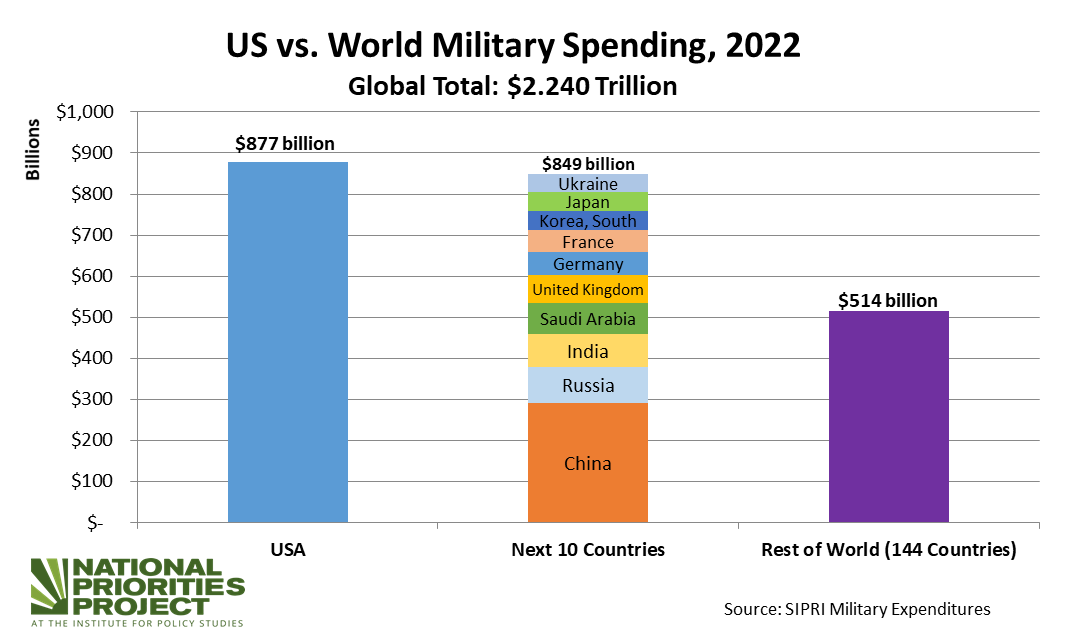
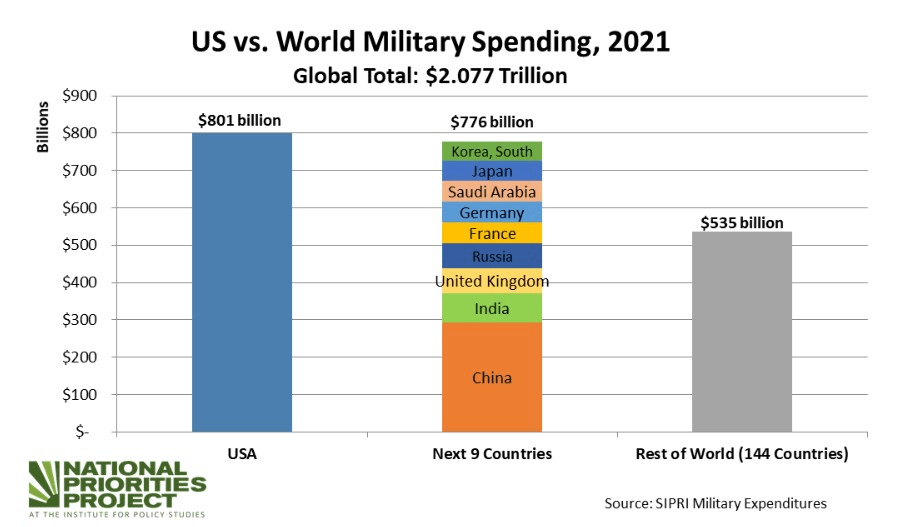
Two images of American exceptionalism to mull over today. The first shows how exceptional the U.S. is with its military spending:
Of course, U.S. military spending is projected to rise in FY 2023 to $840 billion or so. Note how most of the countries that spend significant sums on their military are U.S. allies, such as Germany, the U.K., Japan, and South Korea. Russia is weakening due to its war with Ukraine, yet U.S. military spending continues to soar because of alleged threats from Russia and China.
The second image is a spoof sent by a friend, but it wouldn’t entirely surprise me if it did become the official seal of the Department of Education:
Jesus riding a dinosaur: Why not? We have serious museums for creationists in the U.S., where dinosaurs wear saddles and Adam and Eve are depicted as cavorting with creatures dating to the Jurassic and Cretaceous eras. I’m not sure how they all fit on Noah’s ark, but the Lord does work in mysterious ways.
Given the emphasis on gun rights, babies, and Jesus in America, perhaps the bald eagle isn’t our best national symbol. Perhaps it should be the Baby Jesus holding an assault rifle. It certainly would give new meaning to “love God” and “love thy neighbor.”
Unless you’re working for Raytheon or some other weapons contractor, you’re being robbed whenever our government spends excessively on the military, which is always. $54 billion of your money was stolen from you and sent to Ukraine, with much of it going to Raytheon and similar merchants of death. More than $813 billion will be spent next year on the Pentagon, with roughly half of that being unnecessary for true national defense. Excessive military spending is a form of theft in which workers and the poor are the biggest victim.
My point here isn’t original. President Dwight D. Eisenhower said it nearly 70 years ago in 1953 in his brilliant “Cross of Iron” speech. In Ike’s words:
Every gun that is made, every warship launched, every rocket fired signifies, in the final sense, a theft from those who hunger and are not fed, those who are cold and are not clothed.
This world in arms is not spending money alone. It is spending the sweat of its laborers, the genius of its scientists, the hopes of its children. The cost of one modern heavy bomber is this: a modern brick school in more than 30 cities. It is two electric power plants, each serving a town of 60,000 population. It is two fine, fully equipped hospitals. It is some fifty miles of concrete pavement. We pay for a single fighter plane with a half million bushels of wheat. We pay for a single destroyer with new homes that could have housed more than 8,000 people.
This is, I repeat, the best way of life to be found on the road the world has been taking. This is not a way of life at all, in any true sense. Under the cloud of threatening war, it is humanity hanging from a cross of iron. These plain and cruel truths define the peril and point the hope that come with this spring of 1953.
Ike, a Republican, a retired five-star general, told it like it was, is, and remains. Excessive military spending isn’t a left-right issue. It isn’t a Democrat-Republican issue. It’s a class issue. It’s a moral issue. Ike knew this and was unafraid to say it.
Ike said we are crucifying ourselves with this militarized way of life. He chose this image deliberately for its Christian meaning and moral power. He spoke openly of “plain and cruel truths.” Ike, a true public servant, wanted to make a better America. He had no fear of the military-industrial-Congressional complex because he knew it so well and could resist its old siren song of perpetual war as being somehow in our national interest. I salute him for his honesty and his wisdom.
What do we need to do? We need to reject militarism, we need to reinvest in America, we need to reanimate our democracy, and we need to restore peace. We need more Americans to run and work on these 4 Rs. America needs a thoroughgoing reformation now or, mark my words, as my dad used to say, we will soon experience something far more disruptive and unpleasant.
What does “security” mean to you? My dad had a utilitarian definition. Born in 1917, he found himself in a fatherless immigrant family with four siblings during the height of the Great Depression. To help his family survive, he enlisted in the Civilian Conservation Corps in 1935 and served for two years, earning a dollar a day, most of it sent home to his mother. For my dad, security meant a roof over one’s head, three square meals a day, and warm clothes on one’s back. Food, shelter, clothing: it really was that simple.
Of course, you needed to pay for those bare necessities, meaning you needed a job with decent pay and benefits. Personal security, therefore, hinges on good pay and affordable health care, which many U.S. workers today – in the richest country in the world – continue to scratch and claw for. Another aspect of personal security is education because pay and career advancement within U.S. society often depend on one’s educational level. A college education is proven to lead to higher pay and better career prospects throughout one’s life.
Personal security is in many ways related to national security. Certainly, a nation as large as the U.S. needs a coast guard, border controls, an air force, a national guard, and similar structures for defensive purposes. What it doesn’t need is a colossal, power-projecting juggernaut of a military at $800+ billion a year that focuses on imperial domination facilitated by 750 overseas bases that annually cost more than $100 billion just to maintain. True security, whether personal or national, shouldn’t be about domination. It should be focused on providing a collective standard of living that ensures all Americans can afford nutritious food, a decent place to live, adequate clothing, a life-enriching education, and health care.
President Dwight D. Eisenhower understood this. In his farewell address as president in 1961, he warned us about the military-industrial complex and its anti-democratic nature. Even more importantly, he called for military disarmament as a “continuing imperative,” and he talked of peace, which he tied to human betterment, and which he said could be “guaranteed by the binding force of mutual respect and love.” Ike knew that huge, offensive-minded military budgets constituted a theft from the people; even worse, he knew they constituted a betrayal of our national ideals. A hugely powerful military establishment had “grave implications” to the “very structure of our society,” Ike presciently warned. We have failed to heed his warning.
Ike, a former five-star U.S. general who led the D-Day invasion in 1944, knew the dangers of funding an immense military establishment
For Ike, true national security was about fostering human betterment and working toward world peace. It was about securing the necessities of life for everyone. It entailed the pursuit of military disarmament, a pursuit far preferable to allowing the world to be crucified on a cross of iron erected by wars and weapons manufacturers.
Tragically, America’s “councils of government” no longer guard against militarism; rather, they have been captured, often willingly, by the military-industrial complex. The “alert and knowledgeable citizenry” that Ike was counting on to hold the line against incessant warfare and wasteful weaponry is largely uninterested, or uninformed, or uneducated in matters of civics and public policy. Meanwhile, military spending keeps soaring, and the result is greater national insecurity.
In a paradox Ike warned us about, the more money the government devotes to its military, the less secure the nation becomes. Because security isn’t measured in guns and bullets and warheads. It’s measured in a healthy life, a life of meaning, a life of liberty. The pursuit of happiness, not eternal belligerence, should be the goal.
Consider the following fable. A man lives in a castle. He says he seeks security. So he digs moats and erects walls and piles cannon ball upon cannon ball. He posts armed guards and launches raids into the surrounding countryside to intimidate “near-peer” rivals. He builds outlying fortifications and garrisons them, thinking these will secure his castle from attack. Meanwhile, his family and relations in the castle are starving; the roof leaks and internal walls are covered in mold; the people, shivering and in rags, are uneducated and in poor health. Has this man truly provided security for his people? Would we call this man wise?
Grossly overspending on the military and weaponry — on castles and cannons everywhere — produces insecurity. It’s the very opposite of wisdom. Let’s end this folly, America, and seek human betterment and world peace as Ike advised us to do.
Addendum: these are the words Ike spoke in 1953
Every gun that is made, every warship launched, every rocket fired signifies, in the final sense, a theft from those who hunger and are not fed, those who are cold and are not clothed.
This world in arms is not spending money alone. It is spending the sweat of its laborers, the genius of its scientists, the hopes of its children. The cost of one modern heavy bomber is this: a modern brick school in more than 30 cities. It is two electric power plants, each serving a town of 60,000 population. It is two fine, fully equipped hospitals. It is some fifty miles of concrete pavement. We pay for a single fighter plane with a half million bushels of wheat. We pay for a single destroyer with new homes that could have housed more than 8,000 people.
This is, I repeat, the best way of life to be found on the road the world has been taking. This is not a way of life at all, in any true sense. Under the cloud of threatening war, it is humanity hanging from a cross of iron.







 Bracing Views