What will historians say decades or centuries from now when the U.S. empire collapses into ruin? How will they explain it?
Consider the United States in the big picture. I see a country with unique strengths. Two wide oceans protecting us. A long secure border with Canada. A securable border with Mexico, the current immigrant “crisis” be damned. Canada and Mexico aren’t our enemies. No invasion is coming from them. As a country, the USA occupies a geographical/global position that is uniquely safe and advantageous.
Why are we so fearful? Why do we spend a trillion dollars (or more) each year on national “defense”?
How incredibly lucky we are! (Credit: Tom Van Sant/Geosphere Project, Santa Monica/Science Photo Library)
Of course, I put “defense” in quotes because the USA is an empire with a military configured for offense. Global reach, global power, was the motto of my service, the U.S. Air Force. The U.S. military strives for full-spectrum dominance, meaning total control of the land, sea, air, space, and cyberspace, justified in the false name of “defense.” The cost of this febrile quest for dominance is, I believe, ultimately unbearable. Why do we persist in such folly?
What country would dare to attack the USA? Other than small terrorist networks like Al Qaeda, no country, no people, no leaders in their right mind would dare attack us, let alone invade us. They know they’d likely be obliterated if they did. Does anyone truly fear an attack on the USA from China? Russia? Iran? North Korea? Given America’s belligerence, evidence of our unbridled vengeance after Pearl Harbor and 9/11, and our vast arsenal of highly destructive weaponry, including thousands of nuclear warheads, anyone attacking the U.S. would be pursuing a death wish.
I am not afraid of Russia, a regional power that is stuck in a quagmire war against Ukraine. I am not afraid of China, a regional military power and economic superpower that is tied to us in global trade and has no intent, near as I can tell, to attack my country. I am not afraid of Iran, or North Korea, or similar “threats” of the moment. So why is my government constantly exaggerating these threats and telling me to be afraid?
Of course, I know all about Ike’s military-industrial-congressional complex. I write against it all the time. It’s not just the MICC and its pursuit of profits and power, however. It’s the corporate interests that say Taiwan must be “protected” for its microchips, the Middle East must be “protected” because of its oil, that Ukraine must be “protected” for its rich agricultural wealth (even as Russia’s gas pipelines to Germany are destroyed) and the riches to be had once the war is over and Ukraine is rebuilt. I know there’s nothing new about this; I’ve read my Smedley Butler.
When I first signed up for the U.S. military in 1981, and then went on active duty in 1985, I thought the U.S. did face a possible existential threat: the Soviet Union, the Warsaw Pact, and Communism. By 1991, that threat was largely gone. Even Cold War hawks like Jeanne Kirkpatrick wrote enthusiastically of the U.S. becoming a normal country in normal times. WTF happened? Why didn’t we?
Here we are, more than 30 years after the collapse of the Soviet Union, and the U.S. government is selling Putin’s Russia as a serious threat again. When we see clear evidence that Putin has more than enough to handle with Ukraine, we’re told to look toward China as the Next Big Threat. Meanwhile, irrational, indefensible, blank checks of support given to Israel in its murderous campaign of ethnic cleansing in Gaza threaten a wider war in the Middle East, a war some in our government seem to be spoiling to fight, knowing of course that they and theirs won’t be fighting it.
We Americans need to get a collective grip on ourselves and our own government. Stop feeding the Pentagon brass with money: it only encourages the bastards. Stop listening to the fear mongers. Turn off the mainstream media and ignore all the threat inflation. Look within yourself and control the fear and divisiveness they try to instill in you.
As Senator George McGovern, a war hero, said in 1972 when he won the Democratic nomination for the presidency: Come home, America. Close most of the military bases that America has overseas. Make deep cuts to the Pentagon war budget. Let other peoples settle their differences without our meddling, without our depleted uranium shells, without our cluster munitions, without our Hellfire missiles, without our mendacious rhetoric about a “rules-based order.”
Come home, America. We have a vast country with vast potential—and serious problems. Time to tackle them instead of seeking to dominate the world.
Or, as the Good Book says, “Why do you look at the speck of sawdust in your brother’s eye and pay no attention to the plank in your own eye?” (Matthew 7:3 NIV) Yes, indeed. Let’s remove the planks from our own eyes, which should keep us very busy for decades, rather than globetrotting to remove the sawdust from the eyes of other peoples who’d prefer us to stay home and leave them alone.
Hellfire Missiles and Cluster Munitions under the White House Christmas Tree
As Christmas approaches, it doesn’t seem to be the season to be jolly, unless you’re a U.S. weapons manufacturer. It seems instead yet another season for war, as the president and Congress fight over how much deadly weaponry to send to Ukraine and Israel (and to Taiwan as well). Look under the White House Christmas tree and you’ll find Hellfire missiles for Israel, cluster munitions for Ukraine, and similar gifts offering joy to the world.
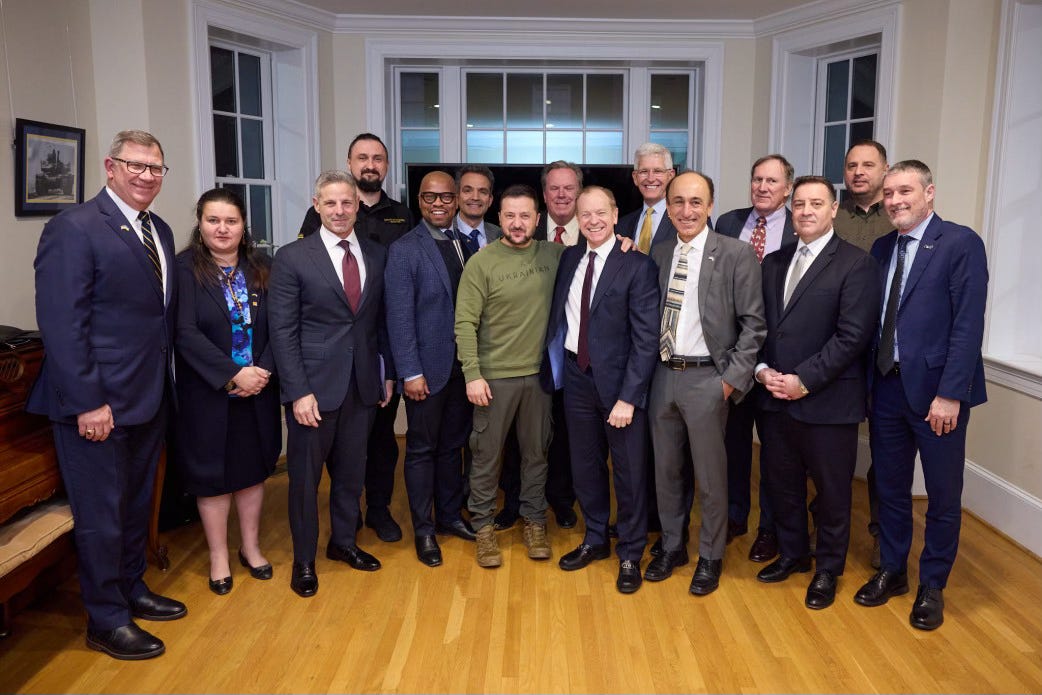
Last week, Ukraine’s president paid a visit to Washington where he posed with his most fervent supporters and gift-givers: U.S. arms manufacturers. Talk about a photo op!
Zelensky meets with high-ranking executives of the “merchants of death,” or Santa’s DC Beltway elves
Zelensky is no dummy. He knows that Congress and the President ultimately answer to the military-industrial complex. Look for a compromise bill in January that gives Ukraine most of the weapons that it’s requesting.
Meanwhile, the U.S. continues to send Israel the bombs, missiles, and shells it’s using to level Gaza. Last night, I was reading a book and came across this quote about war. Can you guess the person speaking?
“The victor will not be asked afterwards whether he told the truth or not [about the war]. When starting and waging a war it is not right that matters, but victory. Close your hearts to pity. Act brutally. [The] people must obtain what is their right. Their existence must be made secure. The stronger man is right. The greatest harshness.”
“The greatest harshness” might give the game away. It’s Adolf Hitler before the Nazi invasion of Poland in 1939. It’s from Ian Kershaw’s definitive two-volume biography of Hitler, v.2, p. 209.
A brutal, pitiless, war of the greatest harshness: that description doesn’t seem alien to our world today.
I’m a member of the Eisenhower Media Network, or EMN. We’re a small network of retired military types and former U.S. government officials who are openly critical of the military-industrial-congressional complex, America’s open-ended forever wars (the global war on terror; the cold war against Russia and China), and rising militarism within and across our society.
Recently, EMN issued a new letter in opposition to the Washington bipartisan consensus for war and more war. I’m proud to say I had a hand in writing it, as did Matthew Hoh and other members of EMN. Here’s what we had to say:
Military and Foreign Policy Experts Open Letter on U.S. Diplomatic Malpractice
Does America inspire the world by the power of its example or the example of its power? Far too often, and despite President Joe Biden’s words during his inaugural address, America’s overmilitarized power and diplomatic malpractice are its examples to the world.
We must change that. To make America truly essential and indispensable, we must not remain the world’s leading arms maker and weapons exporter. We must instead become the world’s greatest and most committed peacemaker and diplomat.
The problem is that America continues to make war, continues being “essential” only as the world’s leading merchant of death, and continues seeking dominance through military supremacy that ends, in places like Afghanistan, Iraq, and earlier in Vietnam, in mass death and colossal folly.
In our first open letter last spring in The New York Times, we, the undersigned, argued that a thoroughly militarized U.S. foreign policy would generate ruinous and worsening consequences and increasingly limited options for the U.S. and the world. Recent events bear this out.
The results of U.S. diplomatic malpractice are cruelly displayed in Eastern Europe, the Middle East and the Indo-Pacific. Risks of further escalation and a world war are rising. Predictably, a militarized foreign policy characterized by rejecting or ignoring international laws and treaties and by disingenuous negotiations and talks has offered no solutions to volatile wars in Eastern Europe and the Middle East while making war more likely in the Indo-Pacific.
Militarized solutions breed and feed more war. Earnest and deliberate diplomacy is the best hope to bring peace, stability and reconciliation to the world.
We chose Ike as our inspiration because he warned Americans of the dangers of the military-industrial complex and because he rejected a world dedicated to manufacturing weapons to commit mass murder.
War in Ukraine
The failure to pursue diplomacy in Eastern Europe, both before and after Russia’s invasion of Ukraine, has resulted in a costly and destructive stalemate for which there are two likely futures:
The collapse of the Ukrainian state due to a deteriorating economic and military situation hastened by corruption.Here, Ukraine’s fragility resembles that of previous houses of cards built by the U.S. in Afghanistan, Iraq, and Vietnam.
A harrowing and bloody stalemate in Ukraine where firepower, made more lethal by technological advances, rules a battlefield where neither side can achieve decisive tactical or operational gains. The pursuit of ways out of this stalemate likely entails horizontal and vertical escalation, neither of which offers solace to those seeking an end to death and destruction in Ukraine and the establishment of peace and stability.
Horizontal escalation sees the war extending further to civilian population centers and infrastructure and includes the possibility of other nations joining the conflict. Vertical escalation sees the expansion of arsenals to weapons of greater range, lethality, and consequence, including nuclear weapons. These two forms of escalation may be intertwined and reinforcing. So, as the war may expand horizontally to resemble The War of Cities between Iran and Iraq in the 1980s, it may expand vertically as well with more powerful weapons being introduced by both sides. The use of nuclear weapons is increasingly conceivable under these conditions.
These two likely futures may intersect. For example, a Ukrainian collapse could see NATO forces, likely Polish and Romanian, marching into western and central Ukraine to counter a Russian push to fill a collapsing Ukrainian state. Such an event could lead to a war between NATO and Russia, a war that conceivably could go nuclear.
Hamas, Israel and the Middle East
The Russia-Ukraine War now rages concurrently with the war between Hamas and Israel. This war, too, is born of a U.S. refusal to foster diplomacy. Unlike the conventional war between Russia and Ukraine, we are witnessing an asymmetrical conflict more akin to the wars of insurgency many of us experienced in Vietnam, Afghanistan, and Iraq.
Worse, the Hamas/Israel bloodletting in Gaza is characterized by an ethnic cleansing campaign that would be impossible without U.S. diplomatic, economic, media, military and political support. We are disgusted by and find repugnant the brazen and bipartisan support by the U.S. government for rampant violations of international law by Israel. Ethnic cleansing in Gaza, long planned by senior members of the Israeli government and powerful elements of Israel’s reactionary right wing, follows in the ghastly wake of Hamas atrocities against civilians on October 7.
Here, the U.S. government isn’t just passively witnessing war crimes; it is enabling them. With the frightening possibility of escalation to a regional or even a world war, the violence in Gaza has fed and feasted upon decades of deliberate diplomatic malpractice in America. Decades of putting Israel first, second, and last while ignoring the plight and pleas of Palestinians have made political settlements to the blockade of Gaza and the occupation of East Jerusalem and the West Bank nearly impossible.
Whereas a month ago, we lived with the risk of nuclear war as an outcome of escalating conflict in Ukraine, we now face the elevated risk of a rightfully feared world war as a consequence of entangling alliances between nuclear-armed Moscow and Washington in the Middle East.
China and the Path Ahead
To this, we must add the dangers of war with China, something hyped by leading U.S. politicians; the still unpaid costs of the $8 trillion wars in Afghanistan and Iraq; a militarized federal budget for which 60% of discretionary spending goes to war and all its wounds; and a hollowed American economy.
Decades of reckless U.S. war-making, both direct and via proxies, while coddling corrupt, ruthless, and unjust foreign governments has, not surprisingly, made the world more dangerous and less stable. Failure to invest in and maintain our country has weakened and corroded America’s infrastructure, institutions, and industries. A hypocritical flaunting of international law and an espousal of an ethereal rules-based order, coupled with an arrogant disregard for past U.S. crimes and blunders, have caused dozens of nations to flock to competitors – a movement away from America that will undoubtedly accelerate if we remain on our current militaristic path.
Moreover, decades of colossal military spending have witnessed few strategic gains for the U.S. Our military, often saluted as the world’s greatest by politicians, hasn’t won a major war since World War II. That same military annually faces significant recruiting shortfalls that cast considerable doubt on the integrity and staying power of the All-Volunteer Force. America’s legacy of failed wars is not redeemed by ongoing displays of vacuous military boosterism. Feel-good patriotism can’t suppress the bitterness many of us military veterans feel toward the past, nor does it calm the worries we have about our nation’s future.
Pope Francis has spoken of a “famine of peace” that exists in the world today. In this spirit, we call for immediate ceasefires, without conditions, in Gaza and Ukraine.
The surest way to prevent wars from exploding into uncontainable wildfires is to starve them of fuel. To think or speak that these conflagrations can be managed, adjusted as if by damper or thermostat, is a fool’s conceit or a liar’s word. We have been burned too many times in our professional lives to believe hot wars can be “won” by throwing more gasoline on them, whether rhetorically or in the form of cluster munitions, depleted uranium shells, and similar forms of “aid.”
A better path ahead is clear. Peace, not war, must be fostered. In embracing peace through diplomacy conducted in good faith, America would indeed exhibit the power of its example, becoming essential to a world that cries out for liberty and justice for all.
We are witnessing the obliteration of Gaza. The death toll has already surpassed 16,000 as Israel continues to pummel targets with American-made bombs and missiles. Even CNN is worried (from my email update this AM):
Top UN officials are warning of an “apocalyptic” situation in Gaza with “no place safe to go” for civilians as the deepening humanitarian crisis sparks international concern. Israel is expanding ground operations to the entire territory to “eliminate” Hamas and has told Palestinians to flee large swaths of southern Gaza, where many had previously sought refuge. But the war-torn region is in the midst of a near-total internet blackout as the last major telecommunications operator said services are completely cut off. This means many Palestinians are unable to communicate with one another or call for help while evacuating, and emergency workers can’t coordinate their responses.
Caitlin Johnstone has a telling article in which she states an important truth: Israel couldn’t be doing this without generous U.S. support. Israel is dropping the bombs, firing the missiles, and shooting the artillery rounds and bullets, but the U.S. is largely serving as the merchant of death for all this, though “merchant” is the wrong word. The U.S. is giving all this deadly weaponry to Israel as “aid,” even as there’s much rhetorical gnashing of teeth in Washington about Israel’s “indiscriminate” bombing and wanton killing of Palestinian innocents, including thousands of children. I say “rhetorical” because as Johnstone notes, the U.S. government could curtail Israeli military action by turning off the spigot of arms flowing from U.S. arsenals and warehouses to Israel.
But that’s not going to happen. AIPAC has a hammerlock on Congress; those few members of Congress who’ve called for a ceasefire in Gaza are already being targeted by the powerful pro-Israel lobby, with AIPAC promising to spend upwards of $100 million to unseat those politicians who aren’t consumed by bloodlust against Gaza. The power of AIPAC is reinforced here by the MICC, the military-industrial-congressional complex that Ike warned us about in 1961, which stands to profit immensely from more war in the Middle East as well as Ukraine. The combination of AIPAC with the MICC is akin to Mechagodzilla, an almost unstoppable monster of immense power.
They create a desert and call it “peace”: Gaza turned to rubble
Godzilla in its various incarnations would be hard-pressed to duplicate the scenes of devastation we’re seeing in Gaza. Israel is practicing its own version of the infamous statement from America’s war against Vietnam: “It became necessary to destroy the town to save it.”
The Israeli version: We had to destroy Gaza to save it from Hamas.
It made no sense in Vietnam, and it makes no sense today in Gaza. But this is not about making sense: it’s about power and vengeance and profit.
The intent of this “tribunal” is to draw attention to America’s overwhelming dominance of the world’s trade in deadly weaponry and the cost we all pay when “weapons ‘r’ us.” How did the U.S. come to embrace this deadly trade, to the point of boasting of our market dominance as a sign of America’s health and fitness? How did we come to equate arsenals with democracy? And isn’t it high time we denounced this trade in death, as the U.S. Senate did back in the 1930s with the Nye Commission?
Back in 2012, I wrote an article for TomDispatch, “Confessions of a Recovering Weapons Addict,” in which I admitted my own childish enthusiasm for weaponry and all things that go “bang”—and kill. It’s reposted today at TomDispatch and also here below.
Perhaps you’ve heard of “Makin’ Thunderbirds,” a hard-bitten rock & roll song by Bob Seger that I listened to 30 years ago while in college. It’s about auto workers back in 1955 who were “young and proud” to be making Ford Thunderbirds. But in the early 1980s, Seger sings, “the plants have changed and you’re lucky if you work.” Seger caught the reality of an American manufacturing infrastructure that was seriously eroding as skilled and good-paying union jobs were cut or sent overseas, rarely to be seen again in these parts.
If the U.S. auto industry has recently shown sparks of new life (though we’re not making T-Birds or Mercuries or Oldsmobiles or Pontiacs or Saturns anymore), there is one form of manufacturing in which America is still dominant. When it comes to weaponry, to paraphrase Seger, we’re still young and proud and makin’ Predators and Reapers (as in unmanned aerial vehicles, or drones) and Eagles and Fighting Falcons (as in F-15 and F-16 combat jets), and outfitting them with the deadliest of weapons. In this market niche, we’re still the envy of the world.
Yes, we’re the world’s foremost “merchants of death,” the title of a best-selling exposé of the international arms trade published to acclaim in the U.S. in 1934. Back then, most Americans saw themselves as war-avoiders rather than as war-profiteers. The evil war-profiteers were mainly European arms makers like Germany’s Krupp, France’s Schneider, or Britain’s Vickers.
Not that America didn’t have its own arms merchants. As the authors of Merchants of Death noted, early on our country demonstrated a “Yankee propensity for extracting novel death-dealing knickknacks from [our] peddler’s pack.” Amazingly, the Nye Committee in the U.S. Senate devoted 93 hearings from 1934 to 1936 to exposing America’s own “greedy munitions interests.” Even in those desperate depression days, a desire for profit and jobs was balanced by a strong sense of unease at this deadly trade, an unease reinforced by the horrors of and hecatombs of dead from the First World War.
We are uneasy no more. Today we take great pride (or at least have no shame) in being by far the world’s number one arms-exporting nation. A few statistics bear this out. From 2006 to 2010, the U.S. accounted for nearly one-third of the world’s arms exports, easily surpassing a resurgent Russia in the “Lords of War” race. Despite a decline in global arms sales in 2010 due to recessionary pressures, the U.S. increased its market share, accounting for a whopping 53% of the trade that year. Last year saw the U.S. on pace to deliver more than $46 billion in foreign arms sales. Who says America isn’t number one anymore?
For a shopping list of our arms trades, try searching the Stockholm International Peace Research Institute database for arms exports and imports. It reveals that, in 2010, the U.S. exported “major conventional weapons” to 62 countries, from Afghanistan to Yemen, and weapons platforms ranging from F-15, F-16, and F-18 combat jets to M1 Abrams main battle tanks to Cobra attack helicopters (sent to our Pakistani comrades) to guided missiles in all flavors, colors, and sizes: AAMs, PGMs, SAMs, TOWs — a veritable alphabet soup of missile acronyms. Never mind their specific meaning: they’re all designed to blow things up; they’re all designed to kill.
Rarely debated in Congress or in U.S. media outlets is the wisdom or morality of these arms deals. During the quiet last days of December 2011, in separate announcements whose timing could not have been accidental, the Obama Administration expressed its intent to sell nearly $11 billion in arms to Iraq, including Abrams tanks and F-16 fighter-bombers, and nearly $30 billion in F-15 fighter jets to Saudi Arabia, part of a larger, $60 billion arms package for the Saudis. Few in Congress oppose such arms deals since defense contractors provide jobs in their districts — and ready donationsto Congressional campaigns.
Let’s pause to consider what such a weapons deal implies for Iraq. Firstly, Iraq only “needs” advanced tanks and fighter jets because we destroyed their previous generation of the same, whether in 1991 during Desert Shield/Storm or in 2003 during Operation Iraqi Freedom. Secondly, Iraq “needs” such powerful conventional weaponry ostensibly to deter an invasion by Iran, yet the current government in Baghdad is closely aligned with Iran, courtesy of our invasion in 2003 and the botched occupation that followed. Thirdly, despite its “needs,” the Iraqi military is nowhere near ready to field and maintain such advanced weaponry, at least without sustained training and logistical support provided by the U.S. military.
As one U.S. Air Force officer who served as an advisor to the fledging Iraqi Air Force, or IqAF, recently worried:
“Will the IqAF be able to refuel its own aircraft? Can the Iraqi military offer adequate force protection and security for its bases? Can the IqAF provide airfield management services at its bases as they return to Iraqi control after eight years under US direction? Can the IqAF ensure simple power generation to keep facilities operating? Will the IqAF be able to develop and retain its airmen?… Only time will tell if we left [Iraq] too early; nevertheless, even without a renewed security agreement, the USAF can continue to stand alongside the IqAF.”
Put bluntly: We doubt the Iraqis are ready to field and fly American-built F-16s, but we’re going to sell them to them anyway. And if past history is a guide, if the Iraqis ever turn these planes against us, we’ll blow them up or shoot them down — and then (hopefully) sell them some more.
Our Best Arms Customer
Let’s face it: the weapons we sell to others pale in comparison to the weapons we sell to ourselves. In the market for deadly weapons, we are our own best customer. Americans have a love affair with them, the more high-tech and expensive, the better. I should know. After all, I’m a recovering weapons addict.
Well into my teen years, I was fascinated by military hardware. I built models of what were then the latest U.S. warplanes: the A-10, the F-4, the F-14, -15, and -16, the B-1, and many others. I read Aviation Week and Space Technology at my local library to keep track of the newest developments in military technology. Not surprisingly, perhaps, I went on to major in mechanical engineering in college and entered the Air Force as a developmental engineer.
Enamored as I was by roaring afterburners and sleek weaponry, I also began to read books like James Fallows’sNational Defense (1981) among other early critiques of the Carter and Reagan defense buildup, as well as the slyly subversive and always insightful Augustine’s Laws (1986) by Norman Augustine, later the CEO of Martin Marietta and Lockheed Martin. That and my own experience in the Air Force alerted me to the billions of dollars we were devoting to high-tech weaponry with ever-ballooning price tags but questionable utility.
Perhaps the best example of the persistence of this phenomenon is the F-35 Lightning II. Produced by Lockheed Martin, the F-35 was intended to be an “affordable” fighter-bomber (at roughly $50 million per copy), a perfect complement to the much more expensive F-22 “air superiority” Raptor. But the usual delays, cost overruns, technical glitches, and changes in requirements have driven the price tag of the F-35 up to $160 million per plane, assuming the U.S. military persists in its plans to buy 2,400 of them. (If the Pentagon decides to buy fewer, the cost-per-plane will soar into the F-22 range.) By recent estimates the F-35 will now cost U.S. taxpayers (you and me, that is) at least $382 billion for its development and production run. Such a sum for a single weapons system is vast enough to be hard to fathom. It would, for instance, easily fund all federal government spending on education for the next five years.
The escalating cost of the F-35 recalls the most famous of Norman Augustine’s irreverent laws: “In the year 2054,” he wrote back in the early 1980s, “the entire defense budget will [suffice to] purchase just one aircraft.” But the deeper question is whether our military even needs the F-35, a question that’s rarely asked and never seriously entertained, at least by Congress, whose philosophy on weaponry is much like King Lear’s: “O, reason not the need.”
But let’s reason the need in purely military terms. These days, the Air Force is turning increasingly to unmanned drones. Meanwhile, plenty of perfectly good and serviceable “platforms” remain for attack and close air support missions, from F-16s and F-18s in the Air Force and Navy to Apache helicopters in the Army. And while many of our existing combat jets may be nearing the limits of airframe integrity, there’s nothing stopping the U.S. military from producing updated versions of the same. Heck, this is precisely what we’re hawking to the Saudis — updated versions of the F-15, developed in the 1970s.
Because of sheer cost, it’s likely we’ll buy fewer F-35s than our military wants but many more than we actually need. We’ll do so because Weapons ‘R’ Us. Because building ultra-expensive combat jets is one of the few high-tech industries we haven’t exported (due to national security and secrecy concerns), and thus one of the few industries in the U.S. that still supports high-paying manufacturing jobs with decent employee benefits. And who can argue with that?
The Ultimate Cost of Our Merchandise of Death
Clearly, the U.S. has grabbed the brass ring of the global arms trade. When it comes to investing in militaries and weaponry, no country can match us. We are supreme. And despite talk of modest cuts to the Pentagon budget over the next decade, it will, according to President Obama, continue to grow, which means that in weapons terms the future remains bright. After all, Pentagon spending on research and development stands at $81.4 billion, accounting for an astonishing 55% of all federal spending on R&D and leaving plenty of opportunity to develop our next generation of wonder weapons.
But at what cost to ourselves and the rest of the world? We’ve become the suppliers of weaponry to the planet’s hotspots. And those weapons deliveries (and the training and support missions that go with them) tend to make those spots hotter still — as in hot lead.
As a country, we seem to have a teenager’s fascination with military hardware, an addiction that’s driving us to bust our own national budgetary allowance. At the same time, we sell weapons the way teenage punks sell fireworks to younger kids: for profit and with little regard for how they might be used.
Sixty years ago, it was said that what’s good for General Motors is good for America. In 1955, as Bob Seger sang, we were young and strong and makin’ Thunderbirds. But today we’re playing a new tune with new lyrics: what’s good for Lockheed Martin or Boeing or [insert major-defense-contractor-of-your-choice here] is good for America.
In a candid assessment, Gen. Valery Zaluzhny said no “beautiful breakthrough” was imminent and that breaking the deadlock could require advances in technological warfare.
*************
(As an aside, I should note that back in July we saw articles in the New York Times and Wall Street Journal using that dreaded word, “stalemate,” as I wrote about here:)
Nice to know Ukrainian officials are finally being “candid.” Yet Zelensky is having none of it. In my CNN feed this morning, I saw this response from Ukraine’s leader: “People are tired. Everyone is tired … But this is not a stalemate.”
Truth is that Russia-Ukraine War will enter its third year in February of next year, even as the U.S. government has provided more than $130 billion in weaponry and other forms of aid to a Ukrainian government that’s known for its corruption. Meanwhile, the Biden administration wants to send another $60 billion in weaponry and aid to Ukraine. Many Republicans, notably new House Speaker Mike Johnson, are on record as being against scores of billions to perpetuate a stalemated war, though their motivation seems less “America first” than “Biden sucks.”
Things are so bad with the war that I now see articles at NBC News arguing for diplomacy! When NBC News, a reliable mouthpiece for Neo-con Democrats, suggests negotiations and the possibility of Ukraine making territorial concessions to end its war with Russia, you know the situation on the ground in Ukraine is likely worse than we’re being told.
Interestingly, this photo of a grim Zelensky accompanied the NBC article. No more hero-worship from the mainstream media? (Timothy Clary, AFP-Getty Images)
The U.S. government, obviously distracted by the crisis in Gaza and the potential for a much wider war in the Middle East, may be near the point of cutting its losses in Ukraine, though obviously the military-industry-congressional complex (MICC) wants to keep sending weaponry until the final bullet and cluster munition is fired. After which Ukraine will have to “rebuild” its military, so you can count on more military “aid” going to Kyiv.
Yet, for the MICC there are bigger fish to fry now. Republicans in particular are obsessed with China. Democrats and Republicans are obsessed with Israel. Ukraine has become something of a distraction. Sure, you may continue to fly blue-and-yellow Ukrainian flags, but it’s time to back Israel unconditionally while threatening Iran with the full might of the U.S. military. Looming in the background is the alleged threat of “near-peer” competitor, China. After all, you can’t justify a massive U.S. war budget that’s approaching $900 billion with a stalemated war in Ukraine.
If nothing else, perhaps the U.S. warmonger obsession with empowering Israel and encircling China may provide an opportunity for diplomacy between Ukraine and Russia. With Ukraine apparently no longer enjoying a blank check of support (that’s now reserved for Israel), a grim-faced Zelensky may come to conclude that jaw-jaw is better than war-war.
Guess What’s a High Priority for Democrats in Congress?
Here’s a reminder of a stark reality: When President Joe Biden finally ended the disastrous Afghan War in 2021, the Pentagon war budget went up by roughly $50 billion.
The Afghan War was costing America almost $50 billion a year until the war party in DC (both Democrats and Republicans) decided enough was enough. So how could ending a war result in a substantial increase in military spending?
That’s easily answered. The bipartisan war party pivoted from the lucrative but frustrating war on terror to the much more lucrative “new cold war” with Russia and China. And of course Vladimir Putin’s provoked invasion of Ukraine early in 2022 sealed the deal. Putin’s illegal invasion, provoked as it was, as NATO itself admits, was a massive boon to the military-industrial-congressional complex. Pentagon war budgets have continued to soar since 2021 (and indeed since 2001 and the original launch of the war on terror), with no end in sight other than perhaps nuclear Armageddon. (Not an end I’m looking forward to, but there’s no fate but that which we make.)
A few in Congress, mostly Republicans, are finally growing tired of massive military aid to Ukraine, though these same Republicans are generally in favor of even more massive military budgets to “deter” China. Yet Democrats are fighting against reductions in military weaponry to Ukraine with the kind of energy you’d think would be devoted to helping Americans deal with poverty and inflation.
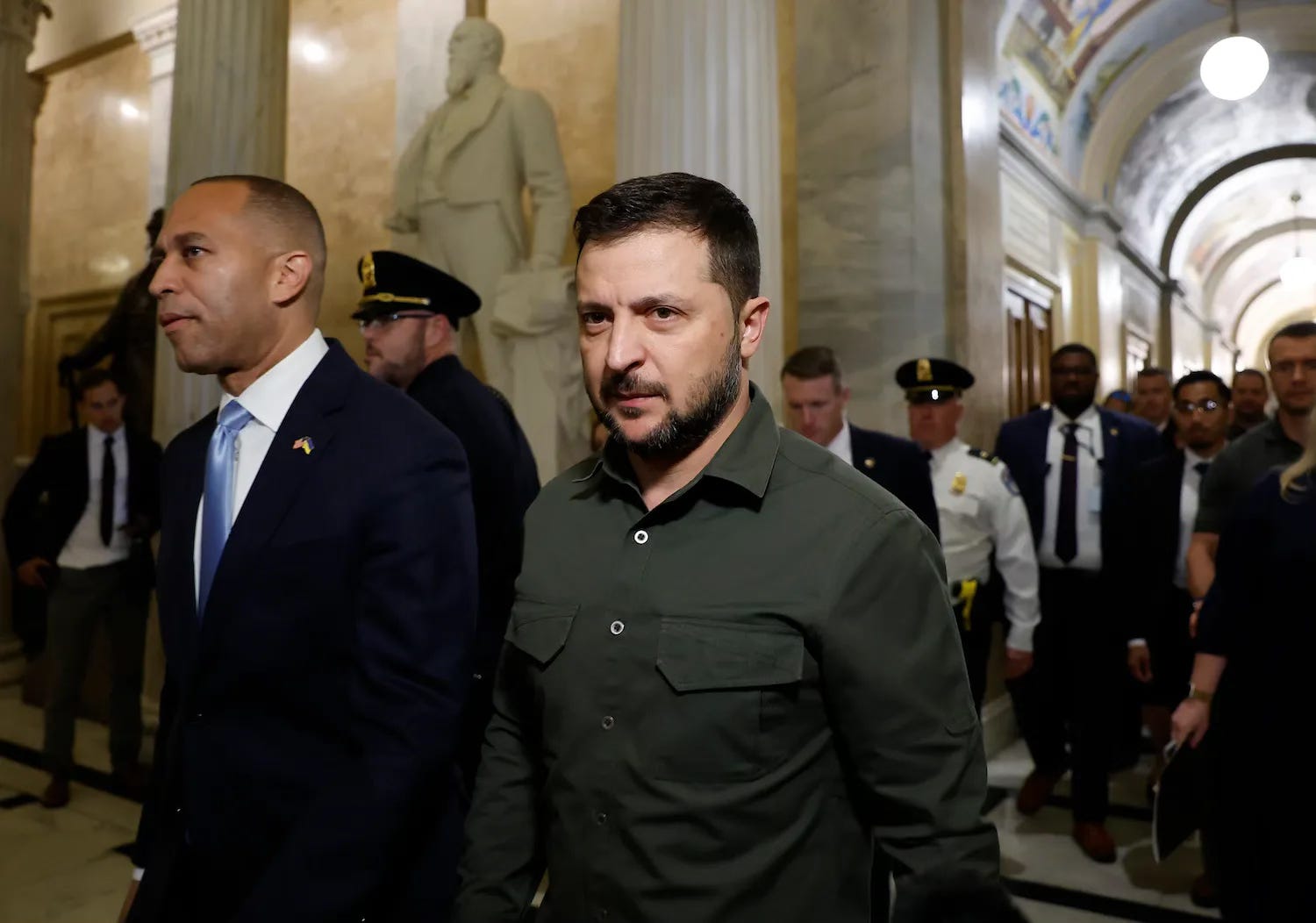
House Minority Leader Hakeem Jeffries (left) carrying water for Zelensky of Ukraine. More war, please!
So, for example, House Minority leader Hakeem Jeffries has stated that a high priority for Democrats in the ongoing struggle over electing a new House Speaker is that the new Speaker must support higher funding—for Ukraine! (Jeffries also wants the impeachment inquiry into Joe Biden to end.)
Higher military spending for Ukraine is a top priority for Democrats, even as Americans struggle with higher bills for food, housing, health care, and other essentials of life. Think about that for a moment.
Of course, Congress was prepared to continue paying for Ukraine’s war effort even if the federal government had shut down, so Jeffries is nothing but consistent here. Waging a wildly expensive and dangerous proxy war against Russia is more important to Congress than helping Americans who are struggling across our land with food and gas bills.
Small wonder that the largest political party in America is composed of “independents.”
Whether it’s RFK Jr., Cornel West, or someone else, we need to get behind independent candidates and reject the Democratic-Republican war party. Vote the war pigs out!
In his message to the troops prior to the July 4th weekend, Secretary of Defense Lloyd Austin offered high praise indeed. “We have the greatest fighting force in human history,” he tweeted, connecting that claim to the U.S. having patriots of all colors, creeds, and backgrounds “who bravely volunteer to defend our country and our values.”
As a retired Air Force lieutenant colonel from a working-class background who volunteered to serve more than four decades ago, who am I to argue with Austin? Shouldn’t I just bask in the glow of his praise for today’s troops, reflecting on my own honorable service near the end of what now must be thought of as the First Cold War?
Yet I confess to having doubts. I’ve heard it all before. The hype. The hyperbole. I still remember how, soon after the 9/11 attacks, President George W. Bush boasted that this country had “the greatest force for human liberation the world has ever known.” I also remember how, in a pep talk given to U.S. troops in Afghanistan in 2010, President Barack Obama declared them “the finest fighting force that the world has ever known.” And yet, 15 years ago at TomDispatch, I was already wondering when Americans had first become so proud of, and insistent upon, declaring our military the world’s absolute best, a force beyond compare, and what that meant for a republic that once had viewed large standing armies and constant warfare as anathemas to freedom.
In retrospect, the answer is all too straightforward: we need something to boast about, don’t we? In the once-upon-a-time “exceptional nation,” what else is there to praise to the skies or consider our pride and joy these days except our heroes? After all, this country can no longer boast of having anything like the world’s best educational outcomes, or healthcare system, or the most advanced and safest infrastructure, or the best democratic politics, so we better damn well be able to boast about having “the greatest fighting force” ever.
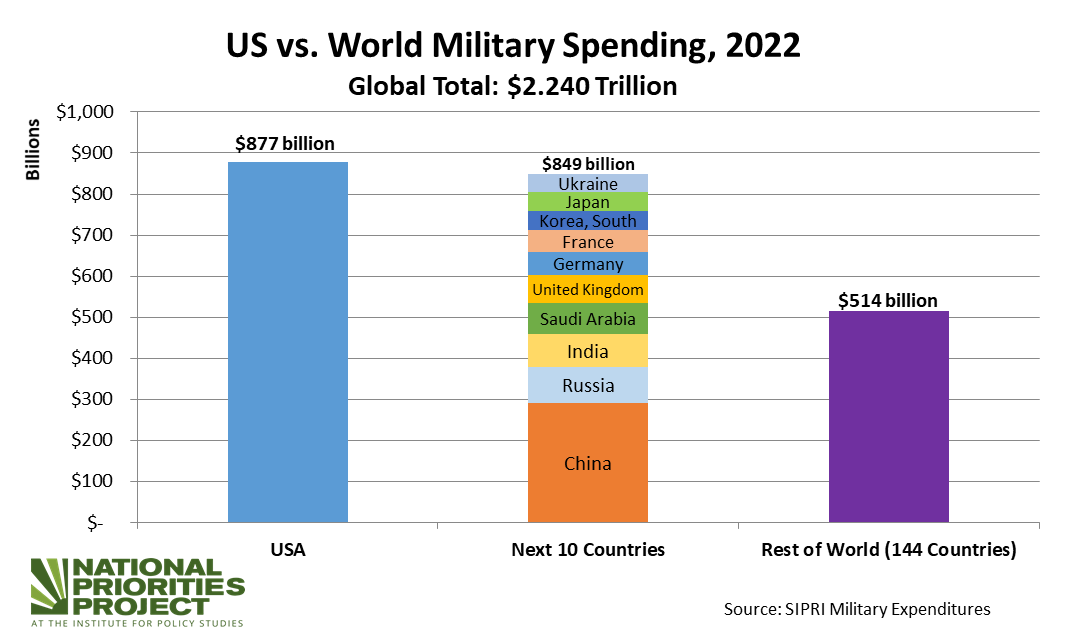
Leaving that boast aside, Americans could certainly brag about one thing this country has beyond compare: the most expensive military around and possibly ever. No country even comes close to our commitment of funds to wars, weapons (including nuclear ones at the Department of Energy), and global dominance. Indeed, the Pentagon’s budget for “defense” in 2023 exceeds that of the next 10 countries (mostly allies!) combined.
And from all of this, it seems to me, two questions arise: Are we truly getting what we pay so dearly for — the bestest, finest, most exceptional military ever? And even if we are, should a self-proclaimed democracy really want such a thing?
The answer to both those questions is, of course, no. After all, America hasn’t won a war in a convincing fashion since 1945. If this country keeps losing wars routinely and often enough catastrophically, as it has in places like Vietnam, Afghanistan, and Iraq, how can we honestly say that we possess the world’s greatest fighting force? And if we nevertheless persist in such a boast, doesn’t that echo the rhetoric of militaristic empires of the past? (Remember when we used to think that only unhinged dictators like Adolf Hitler boasted of having peerless warriors in a megalomaniacal pursuit of global domination?)
Actually, I do believe the United States has the most exceptional military, just not in the way its boosters and cheerleaders like Austin, Bush, and Obama claimed. How is the U.S. military truly “exceptional”? Let me count the ways.
Yes, the Pentagon budget, enormous and still growing, is as large as the next ten countries in the world combined. We’re #1 in wars and weapons!
The Pentagon as a Budgetary Black Hole
In so many ways, the U.S. military is indeed exceptional. Let’s begin with its budget. At this very moment, Congress is debating a colossal “defense” budget of $886 billion for FY2024 (and all the debate is about issues that have little to do with the military). That defense spending bill, you may recall, was “only” $740 billion when President Joe Biden took office three years ago. In 2021, Biden withdrew U.S. forces from the disastrous war in Afghanistan, theoretically saving the taxpayer nearly $50 billion a year. Yet, in place of any sort of peace dividend, American taxpayers simply got an even higher bill as the Pentagon budget continued to soar.
Recall that, in his four years in office, Donald Trump increased military spending by 20%. Biden is now poised to achieve a similar 20% increase in just three years in office. And that increase largely doesn’t even include the cost of supporting Ukraine in its war with Russia — so far, somewhere between $120 billion and $200 billion and still rising.
Colossal budgets for weapons and war enjoy broad bipartisan support in Washington. It’s almost as if there were a military-industrial-congressional complex at work here! Where, in fact, did I ever hear a president warning us about that? Oh, perhaps I’m thinking of a certain farewell address by Dwight D. Eisenhower in 1961.
In all seriousness, there’s now a huge pentagonal-shaped black hole on the Potomac that’s devouring more than half of the federal discretionary budget annually. Even when Congress and the Pentagon allegedly try to enforce fiscal discipline, if not austerity elsewhere, the crushing gravitational pull of that hole just continues to suck in more money. Bet on that continuing as the Pentagon issues ever more warnings about a new cold war with China and Russia.
Given its money-sucking nature, perhaps you won’t be surprised to learn that the Pentagon is remarkably exceptional when it comes to failing fiscal audits — five of them in a row (the fifth failure being a “teachable moment,” according to its chief financial officer) — as its budget only continued to soar. Whether you’re talking about lost wars or failed audits, the Pentagon is eternally rewarded for its failures. Try running a “Mom and Pop” store on that basis and see how long you last.
Speaking of all those failed wars, perhaps you won’t be surprised to learn that they haven’t come cheaply. According to the Costs of War Project at Brown University, roughly 937,000 people have died since 9/11/2001 thanks to direct violence in this country’s “Global War on Terror” in Afghanistan, Iraq, Libya, and elsewhere. (And the deaths of another 3.6 to 3.7 million people may be indirectly attributable to those same post-9/11 conflicts.) The financial cost to the American taxpayer has been roughly $8 trillion and rising even as the U.S. military continues its counterterror preparations and activities in 85 countries.
No other nation in the world sees its military as (to borrow from a short-lived Navy slogan) “a global force for good.” No other nation divides the whole world into military commands like AFRICOM for Africa and CENTCOM for the Middle East and parts of Central and South Asia, headed up by four-star generals and admirals. No other nation has a network of 750 foreign bases scattered across the globe. No other nation strives for full-spectrum dominance through “all-domain operations,” meaning not only the control of traditional “domains” of combat — the land, sea, and air — but also of space and cyberspace. While other countries are focused mainly on national defense (or regional aggressions of one sort or another), the U.S. military strives for total global and spatial dominance. Truly exceptional!
Strangely, in this never-ending, unbounded pursuit of dominance, results simply don’t matter. The Afghan War? Bungled, botched, and lost. The Iraq War? Built on lies and lost. Libya? We came, we saw, Libya’s leader (and so many innocents) died. Yet no one at the Pentagon was punished for any of those failures. In fact, to this day, it remains an accountability-free zone, exempt from meaningful oversight. If you’re a “modern major general,” why not pursue wars when you know you’ll never be punished for losing them?
Indeed, the few “exceptions” within the military-industrial-congressional complex who stood up for accountability, people of principle like Daniel Hale, Chelsea Manning, and Edward Snowden, were imprisoned or exiled. In fact, the U.S. government has even conspired to imprison a foreign publisher and transparency activist, Julian Assange, who published the truth about the American war on terror, by using a World War I-era espionage clause that only applies to American citizens.
And the record is even grimmer than that. In our post-9/11 years at war, as President Barack Obama admitted, “We tortured some folks” — and the only person punished for that was another whistleblower, John Kiriakou, who did his best to bring those war crimes to our attention.
And speaking of war crimes, isn’t it “exceptional” that the U.S. military plans to spend upwards of $2 trillion in the coming decades on a new generation of genocidal nuclear weapons? Those include new stealth bombers and new intercontinental ballistic missiles (ICBMs) for the Air Force, as well as new nuclear-missile-firing submarines for the Navy. Worse yet, the U.S. continues to reserve the right to use nuclear weapons first, presumably in the name of protecting life, liberty, and the pursuit of happiness. And of course, despite the countries — nine! — that now possess nukes, the U.S. remains the only one to have used them in wartime, in the atomic bombings of Hiroshima and Nagasaki.
Finally, it turns out that the military is even immune from Supreme Court decisions! When SCOTUS recently overturned affirmative action for college admission, it carved out an exception for the military academies. Schools like West Point and Annapolis can still consider the race of their applicants, presumably to promote unit cohesionthrough proportional representation of minorities within the officer ranks, but our society at large apparently does not require racial equity for its cohesion.
A Most Exceptional Military Makes Its Wars and Their Ugliness Disappear
Here’s one of my favorite lines from the movie The Usual Suspects: “The greatest trick the devil ever pulled was convincing the world he did not exist.” The greatest trick the U.S. military ever pulled was essentially convincing us that its wars never existed. As Norman Solomon notes in his revealing book, War Made Invisible, the military-industrial-congressional complex has excelled at camouflaging the atrocious realitiesof war, rendering them almost entirely invisible to the American people. Call it the new American isolationism, only this time we’re isolated from the harrowing and horrific costs of war itself.
America is a nation perpetually at war, yet most of us live our lives with little or no perception of this. There is no longer a military draft. There are no war bond drives. You aren’t asked to make direct and personal sacrifices. You aren’t even asked to pay attention, let alone pay (except for those nearly trillion-dollar-a-year budgets and interest payments on a ballooning national debt, of course). You certainly aren’t asked for your permission for this country to fight its wars, as the Constitution demands. As President George W. Bush suggested after the 9/11 attacks, go visit Disneyworld! Enjoy life! Let America’s “best and brightest” handle the brutality, the degradation, and the ugliness of war, bright minds like former Vice President Dick (“So?”) Cheney and former Secretary of Defense Donald (“I don’t do quagmires”) Rumsfeld.
Did you hear something about the U.S. military being in Syria? In Somalia? Did you hear about the U.S. military supporting the Saudis in a brutal war of repression in Yemen? Did you notice how this country’s military interventions around the world kill, wound, and displace so many people of color, so much so that observers speak of the systemic racism of America’s wars? Is it truly progress that a more diverse military in terms of “color, creed, and background,” to use Secretary of Defense Austin’s words, has killed and is killing so many non-white peoples around the globe?
Praising the all-female-crewed flyover at the last Super Bowl or painting rainbow flags of inclusivity (or even blue and yellow flags for Ukraine) on cluster munitionswon’t soften the blows or quiet the screams. As one reader of my blog Bracing Viewsso aptly put it: “The diversity the war parties [Democrats and Republicans] will not tolerate is diversity of thought.”
Of course, the U.S. military isn’t solely to blame here. Senior officers will claim their duty is not to make policy at all but to salute smartly as the president and Congress order them about. The reality, however, is different. The military is, in fact, at the core of America’s shadow government with enormous influence over policymaking. It’s not merely an instrument of power; it is power — and exceptionally powerful at that. And that form of power simply isn’t conducive to liberty and freedom, whether inside America’s borders or beyond them.
Wait! What am I saying? Stop thinking about all that! America is, after all, the exceptional nation and its military, a band of freedom fighters. In Iraq, where war and sanctions killed untold numbers of Iraqi children in the 1990s, the sacrifice was “worth it,” as former Secretary of State Madeleine Albright once reassured Americans on 60 Minutes.
Even when government actions kill children, lots of children, it’s for the greater good. If this troubles you, go to Disney and take your kids with you. You don’t like Disney? Then, hark back to that old marching song of World War I and “pack up your troubles in your old kit-bag, and smile, smile, smile.” Remember, America’s troops are freedom-delivering heroes and your job is to smile and support them without question.
Have I made my point? I hope so. And yes, the U.S. military is indeed exceptional and being so, being #1 (or claiming you are anyway) means never having to say you’re sorry, no matter how many innocents you kill or maim, how many lives you disrupt and destroy, how many lies you tell.
I must admit, though, that, despite the endless celebration of our military’s exceptionalism and “greatness,” a fragment of scripture from my Catholic upbringing haunts me still: Pride goeth before destruction and a haughty spirit before a fall.
Reason and Rationality Have Little to Do with Them
It is often hard to understand the reasons for America’s wars, especially since World War II, but they always have a rationale backed up by lies. The rationale for Vietnam was the containment of communism and the domino theory. The lie was that U.S. naval ships had been attacked at Tonkin Gulf. The rationale for Iraq was overthrowing a ruthless dictator and spreading “freedom.” The lie was that he had WMD and that he was somehow connected to the 9/11 attacks.
Nations and peoples are not dominoes
The real reasons for America’s many disastrous wars are opaque. Domestic politics are almost always paramount. No U.S. president wants to be accused of losing a war or appearing to be weak, so starting or continuing a war is considered as “strength.” Congress doesn’t want to be accused of “tying the hands of the president” or of “betraying the troops,” so most members happily go along with wars. The military, of course, always thinks it can win, and wars are good for promotions and power. And military contractors, the “merchants of death,” are even more happy to make money off war. Not surprisingly, perhaps, President Dwight D. Eisenhower’s farewell speech in 1961 warned America of the military-industrial complex, to which Ike had added Congress in an earlier draft. Ike’s warning has been largely forgotten; even his own monument in DC obscures it.
In Washington today, the Democrats accuse the Republicans of being weak on Russia; the Republicans return the favor by accusing the Biden administration of being weak on China. Military and industry are happy to play this blame game, knowing the Pentagon budget will soar as a result, as it has. And thus a dangerous “new cold war” appears to be a certainty.
The folly and fallaciousness of America’s wars, along with their carnage, are enough to make any rational human angry, especially one who has served in one of these wars. Mike Murry, a Vietnam War veteran, is angry, and so am I. Back in 2017, I wrote a piece on the atrociousness of the Vietnam War, to which Mr. Murry appended this comment. It merits consideration by all thinking Americans.
The ”Rationale” of America’s Wars. Comment by Mike Murry in 2017.
An excellent choice of words, “rationale.” Not the reason for doing something in the first place, but a conscious lie made up beforehand just to get things started, or an excuse invented afterwards to avoid accountability and, where required, the necessary punishment that true justice occasionally administers. Marine Corps General Smedley Butler once said that we have only two acceptable reasons for going to war: to defend our homes or defend the Constitution. In not a single case after World War II has either of these conditions applied, so that none of the pointless and ruinous fighting — I won’t dignify these Presidential/Career Military misadventures by calling them “war” — has had any justifiable reason or purpose. Not surprisingly, no Congress has declared war on another nation state since 1941 because no nation state on planet earth has attacked either American homes or America’s Constitution. The United States has not just “gone abroad in search of monsters to destroy,” as our sixth President, John Quincy Adams, warned us against foolishly doing, but has invented imaginary hobgoblins at home before even setting out to vanquish them on the far side of the globe.
Of course, Smedley Butler only made his remarks after serving for thirty years as an admitted “gangster for capitalism,” probably the best summary description of the U.S. military offered to date by one who ought to know. Today, as for the past seventy-plus years, the U.S. military simply fights — aimlessly and disastrously — for the sake of fighting. The fighting has no “reason” other than to provide a steady stream of outrageous corporate CEO bonuses, stockholder dividends, and the pensions and perquisites of retired senior military officers. This Warfare Welfare and Make-work Militarism has secondary beneficiaries, of course, most notably the hothouse orchids, special snowflakes and privileged peacock pugilists known as United States as “political leaders.” Naturally, the feeding and maintenance of this system of corrupt cronyism requires a death grip on over half the nation’s discretionary budget. As George Orwell wrote in “The Theory and Practice of Oligarchical Collectivism” (the book-within-a-book from 1984):
“The primary aim of modern warfare (in accordance with the principles of doublethink, this aim is simultaneously recognized and not recognized by the directing brains of the Inner Party) is to use up the products of the machine without raising the general standard of living.”
In other words, the entire U.S. military/security monstrosity — which I like to call the Lunatic Leviathan — has only one purpose: to suck the life out of the domestic economy so that the productivity of the people’s labor will not result in the betterment of their station in life, which might in due course result in the discarding of America’s useless parasitic economic and political “elites.” Any transparent euphemism designed and deployed to disguise this ugly, fundamental truth properly deserves the label “rationale.” In no way do the usual and time-dishonored obfuscations amount to a reason. Reason has fled the United States, replaced by a deserved and rancid Ridicule. The country now consumes itself, lost in its own vicarious fears and fantasies featuring the celluloid exploits of our vaunted Visigoths vanquishing visions of vultures somewhere, someplace, at some time, until … eventually … after some “progress” and “fragile gains” … as T.S. Eliot wrote of The Hollow Men:
This is the way the world ends This is the way the world ends This is the way the world ends Not with a bang but a whimper.
Men and women so hollow that you can hear their own bullshit echoing in them even before they start moving their jaws and flapping their lips to begin lying.
Its biggest advantage is that it knows what it wants
The military-industrial-congressional complex (MICC) has a huge advantage over its critics. Its proponents are united by greed and power. They know exactly what they want. Like Johnny Rocco in “Key Largo,” they want MORE. More money. More authority. And obviously more weapons and more war.
Whereas critics of the MICC tend to approach the beast from different angles with different emphases. Tactical differences lead to fissures. Fissures prevent coalitions from forming. Unity is lacking, and not for want of trying. And so the MICC rumbles on, unchallenged by any societal force that is remotely its size.
A colleague of mine, Dennis Showalter, was fond of a saying that helps to explain the situation. Critics and intellectuals, he said, have a propensity to see the fourth side of every three-sided problem. Analysis leads to paralysis. The tyranny of small differences prevents unanimity of purpose.
Dennis Showalter, a fine historian and a better friend.
Another key strength of the MICC is reflected in an alternate acronym: the MICIMATT, which adds the intelligence “community,” the mainstream media, academe, and various think tanks to the military, industry, and Congress. To that we might also add the world of sports, entertainment (Hollywood and TV especially), and the very idea of patriotism in America with all its potent symbols. I’d even add Christianity here, the muscular version practiced in the U.S. rather than the compassionate version promulgated by Christ.
When you focus just on the MICC, you miss the wellsprings of its power. It’s not just about greed and authority, it’s about full-spectrum dominance of all aspects of American life and society.
America hasn’t won a major war since World War II, but the MICC has won the struggle for societal dominance in America. Serious challenges to it will require Americans to put aside differences in the name of a greater cause of peace and sanity. The wildcard here, of course, is the ever-present hyping of fear by the MICC.
FDR told Americans the only thing we truly needed to fear was fear itself. Fear paralyzes the mind and inhibits action. Fear is the only darkness, Master Po said in “Kung Fu.”
If we can overcome our fear and our differences to focus on building a more compassionate world, a world in harmony with nature and life, then maybe, just maybe, we can see the foolishness of funding and embracing an MICC based on an unnatural pursuit of destruction and death.










 Bracing Views