The Bombs Land Softer When a Latina Lesbian Drops Them
Listening to Chris Hedges and Cornel West the other day, I heard them use the term “multicultural militarism” to describe the Democratic Party’s embrace of war and the U.S. military. It fits. Consider Kamala Harris as commander-in-chief. She’ll be celebrated as the first woman of color, the first Black and South Asian president, even as she embraces and boasts about the “lethality” of the U.S. military and the utility of war. And by “utility,” I mean Harris’ support of Ukraine and Israel to the tune of $200 billion in weapons and other forms of mainly military aid.
But do the bombs and missiles land softer because a Latina lesbian Air Force pilot drops and launches them?
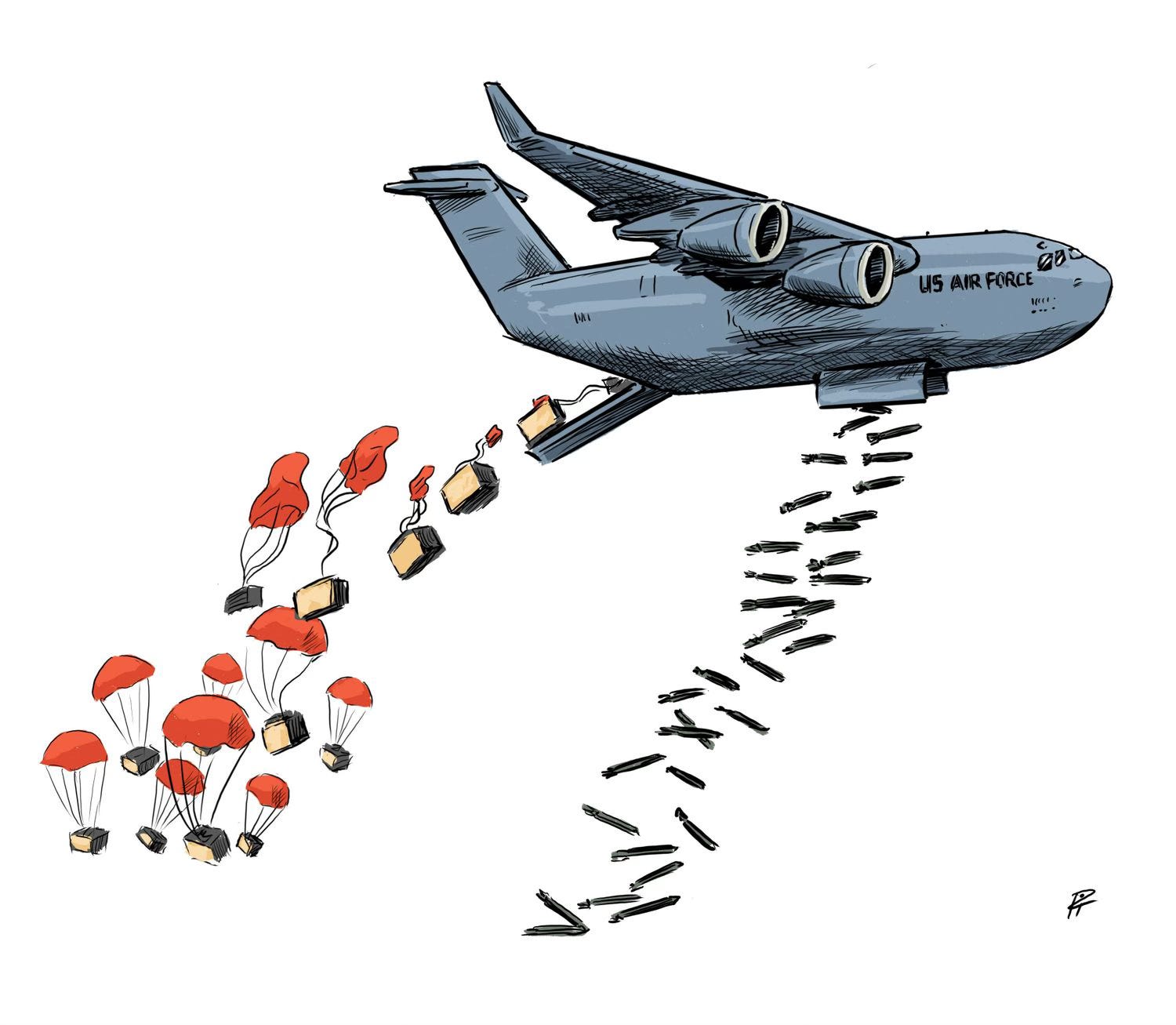
Speaking of the Air Force, my old service, I caught this cartoon by Pia Guerra:
The U.S. government really believes it can have it both ways. It can provide bombs to Israel to annihilate Gaza while at the same time dropping care packages among the wounded and desperate. Call it feel-good militarism. Have some MREs with your HE.* A new form of American (un)happy meal.
Harris and Trump reflect the bipartisan consensus in DC that Pentagon budgets must always go up. They both boast and brag about the U.S. military and its deadliness. They mainly disagree on which enemy is the most serious, with Harris favoring Iran and Russia while Trump hypes China. Neither candidate sees militarism as a problem: they see it as something to celebrate. It’s just that Harris and the Democrats prefer “diverse” militarism.
Trump, of course, has said he wants to end the Russia-Ukraine War. He also raised the specter of nuclear war. Harris, apparently, seems to think she must be more hawkish than Trump, hence her embrace of generals and her talk of lethality.
Whether Harris or Trump wins, higher military budgets are guaranteed and probably more war too. Interestingly, Trump talks more of the enemy within than the enemy without, though his “enemy within” is typically a caricature of woke liberals out to destroy America by forcing your kids to undergo gender-reassignment surgery. Just as Trump is using threat inflation for the enemy within, Harris is inflating the Iranian and Russian threats from without.
Civil discord within America or more war outside of America? That may be our “choice” on November 5th. Or maybe we’ll get both.
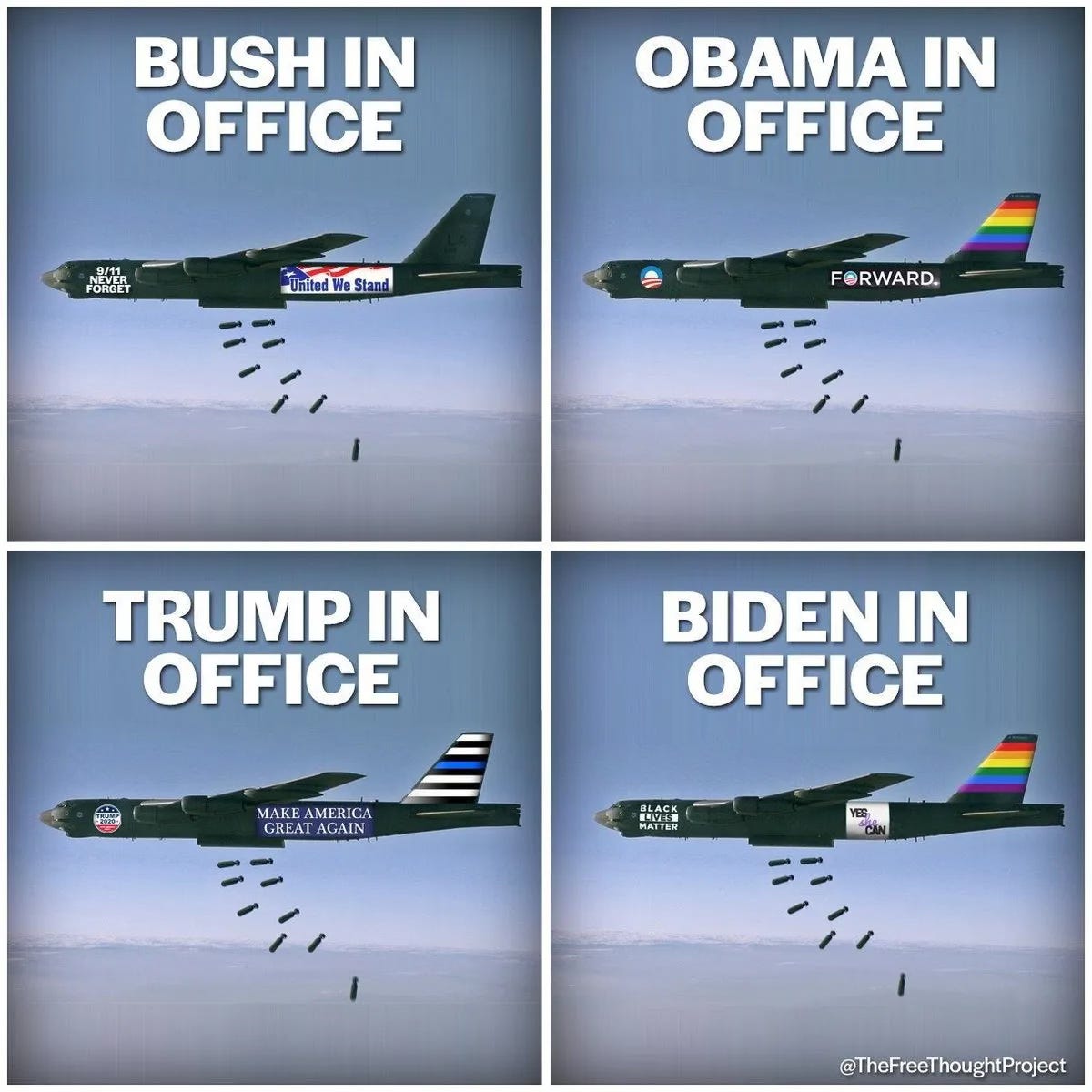
One thing is certain: A B-52 with a rainbow flag and a BLM slogan is still a B-52.
I suppose a Harris B-52 will be the first joyful bomber
* That’s meals ready to eat (MRE), or rations, with your high explosives (HE).
During his one debate with Joe Biden, Donald Trump made the audacious claim that if reelected in November he would end the Russia-Ukraine War before his inauguration in January. While it’s doubtful he could do that, the boast certainly disturbed self-styled supporters of Ukraine like Senator Lindsey Graham.
Graham recently made an appearance to highlight strategic minerals in Ukraine. He said Ukraine is sitting on $10-$12 trillion in various “critical” minerals and metals and that Putin must not be allowed to seize, mine, sell, or otherwise share them with China.
Mr. President, we cannot allow a strategic minerals gap!
Trump, in general, has been skeptical of providing an almost open-ended commitment to Ukraine, to the tune of roughly $200 billion in aid since Russia launched its “special military operation.” This new emphasis on Ukraine as a business partner sitting on a “gold mine,” a mine that could be stolen by Putin, seems tailor-made to convince Trump, a businessman with an affinity for gold, to keep funneling weapons and money to Ukraine if he does indeed win reelection in November.
A trillion here, a trillion there, pretty soon you’re talking real money.
*****
This week in U.S. militarism: I was scrolling through my CNN email feed this morning and noticed this headline:
Army officer wins Miss USA Michigan’s Alma Cooper was crowned the new Miss USA on Sunday, capping a tumultuous year of pageant controversy.
A U.S. Army officer is Miss USA. At least she’s used to obeying orders.
Back in January at CNN, I noted this headline: US Air Force officer crowned as 2024 Miss America.
Miss America, 2Lt Madison Marsh (from the AF Website). Taken at the Daytona 500 Speedway, where she was engaged in recruitment and PR
This truly must be a first. Both Miss USA and Miss America are serving U.S. military officers. My only question is this: What’s wrong with the Navy? How come the Army and the Air Force are dominating the beauty pageants?
In all seriousness, public relations teams for the U.S. military must think this is a major coup, but it seems so strange to me to mix beauty pageants with military service. I recently caught Miss America on NESN (New England Sports Network) doing an on-air interview wearing mufti and a tiara. She attended the Air Force Academy, where I taught for six years. She’s smart, ambitious, accomplished, and obviously pretty.
She may yet fulfill her dream of becoming an Air Force pilot. Will she then launch missiles and drop bombs, perhaps on whatever country is threatening Israel in the Middle East? At least those on the receiving end of those missiles and bombs can say they were killed by a former Miss America.
Empty Boasts of Having the “World’s Best” Military Hide Rot, Waste, and Stupidity
Sixteen years ago, I made a plea to my fellow citizens to banish the word “warfighter” from our vocabulary. I asked that we stop referring to the U.S. military as the “world’s best,” an empty boast then and, after twin disasters in Iraq and Afghanistan, an emptier one today. (If something can indeed be “emptier,” it’s certainly bellicose boasts of alleged military brilliance.) Today’s military is overstretched, busy guaranteeing Israel’s security as the Israeli Defense Forces demolish and depopulate Gaza. Facing recruiting shortfalls, open-ended imperial commitments across the globe, and fears of hostilities with Russia, China, Iran, or an almost unimaginable and certainly unbeatable combination of the three, the U.S. military faces grim times. If leaders like President Biden truly want to protect “our” troops, they should look not to God but in the mirror. They should pursue peace through diplomacy while downsizing an unsustainable empire. Isn’t it finally time for “Generation Warfighter” to come to an end before the U.S. military is utterly hollowed out — and America with it?
Having the “Best Military” Is Not Always a Good Thing Reclaiming Our Citizen-Soldier Heritage By William J. Astore
[Originally posted at TomDispatch in July of 2008]
When did American troops become “warfighters” — members of “Generation Kill” — instead of citizen-soldiers? And when did we become so proud of declaring our military to be “the world’s best”? These are neither frivolous nor rhetorical questions. Open up any national defense publication today and you can’t miss the ads from defense contractors, all eagerly touting the ways they “serve” America’s “warfighters.” Listen to the politicians, and you’ll hear the obligatory incantation about our military being “the world’s best.”
All this is, by now, so often repeated — so eagerly accepted — that few of us seem to recall how against the American grain it really is. If anything — and I saw this in studying German military history — it’s far more in keeping with the bellicose traditions and bumptious rhetoric of Imperial Germany under Kaiser Wilhelm II than of an American republic that began its march to independence with patriotic Minutemen in revolt against King George.
So consider this a modest proposal from a retired citizen-airman: A small but meaningful act against the creeping militarism of the Bush years would be to collectively repudiate our “world’s best warfighter” rhetoric and re-embrace instead a tradition of reluctant but resolute citizen-soldiers.
Becoming Warfighters
I first noticed the term “warfighter” in 2002. Like many a field-grade staff officer, I spent a lot of time crafting PowerPoint briefings, trying to sell senior officers and the Pentagon on my particular unit’s importance to the President’s new Global War on Terrorism. The more briefings I saw, the more often I came across references to “serving the warfighter.” It was, I suppose, an obvious selling point, once we were at war in Afghanistan and gearing up for “regime-change” in Iraq. And I was probably typical in that I, too, grabbed the term for my briefings. After all, who wants to be left behind when it comes to supporting the troops “at the pointy end of the spear” (to borrow another military trope)?
But I wasn’t comfortable with the term then, and today it tastes bitter in my mouth. Until recent times, the American military was justly proud of being a force of citizen-soldiers. It didn’t matter whether you were talking about those famed Revolutionary War Minutemen, courageous Civil War volunteers, or the “Greatest Generation” conscripts of World War II. After all, Americans had a long tradition of being distrustful of the very idea of a large, permanent army, as well as of giving potentially disruptive authority to generals.
Our tradition of citizen-soldiery was (and could still be) one of the great strengths of this country. Let me give you two examples of such citizen-soldiers, well known within military circles because they wrote especially powerful memoirs. Eugene B. Sledge served in the U.S. Marines during World War II, surviving two unimaginably brutal campaigns on the islands of Peleliu and Okinawa. His memoir With the Old Breed is arguably the best account of ground warfare in the Pacific. After three years of selfless, heroic service to his country, Sledge gladly returned to civilian life, eventually becoming a professor of biology. His conclusion — that “war is brutish, inglorious, and a terrible waste” — is one seconded by many a combat veteran.
Richard (Dick) Winters is better known because his exploits were captured in the HBO series Band of Brothers. He rose from platoon commander to battalion commander, serving in the elite 101st Airborne Division during World War II. A hero beloved by his men, Winters wanted nothing more than to quit the military and return to the civilian world. After the war, he lived a quiet life as a businessman in Pennsylvania, rarely mentioning his service and refusing to use his military rank for personal gratification. In Beyond Band of Brothers, he recounts both his service and his ideas on leadership. It’s a book to put in the hands of any young American who wishes to understand the noble ideas of service and sacrifice.
Sledge and Winters were regular guys who answered their country’s call. What comes across in their memoirs, as well as in the many letters I’ve read from World War II soldiers, was the desire of the average dogface to win the war, return home, hang up the uniform, and never again fire a shot in anger. These men were war-enders, not warfighters. Indeed, they would’ve been sickened by the very idea of being “warfighters.”
The term “warfighter” — a combination, I suppose, of “warrior” and “war fighting” — suggests a person who lives for war, who spoils for a fight. Certainly, the United States has fought its share of ruthless wars. But traditionally our soldiers have thought of themselves as civilians first, soldiers second. Equally as important, the American people thought of their troops that way.
Why are we now, with so little debate, casting aside an ethos that served us well for two centuries for one that straightforwardly embraces war and killing? Possibly because we’ve invented a distinctly American product: sanitized militarism. I bumped into it last week at a most unlikely place.
Visiting Gettysburg
Last week, I finally made it to Gettysburg, site of the great three-day battle between Union and Confederate forces in July 1863 that ended with the defeat of General Robert E. Lee’s army. Walking the battlefield was a sobering experience. I found myself on Little Round Topat 5:00 PM, just about the time of day that Union generals rushed men to reinforce the hill against a determined Confederate assault at the close of the battle’s second day. Earlier, I was at the Angle, just when, almost a century and a half ago, Pickett’s Charge failed to pierce the Union center, sealing Lee’s fate on the third day.
The Devil’s Den at Gettysburg
As these events played through my mind, I marveled that I had the battlefield largely to myself. Not that I was alone, mind you. Tour buses circled; cars, trucks, and SUVs whizzed about, but many, perhaps most, Americans who visit Gettysburg get surprisingly little tactile or sensory experience of its difficult topography. Yes, a few kids (and fewer adults) joined me in clambering about the huge, claustrophobically placed boulders of Devil’s Den, and I did spy a couple of guided tour groups on foot. But at the site of a bloodcurdling, distinctly septic nineteenth century battle, most visitors were clearly having a distinctly bloodless, even antiseptic, twenty-first century experience.
That day, I learned a lot about Gettysburg the battle — and maybe a little about us as well. As surely as my fellow tourists were staying in their cars and buses, we, as a people, are distancing ourselves from the realities of war. As we seal ourselves away from war’s horrors, we’re correspondingly finding it easier to speak of “warfighters” and to boast of having the world’s best military.
As we catch a glimpse, from the comfort of our living rooms, of a suicide bombing in Iraq or an American outpost attacked, then abandoned, in Afghanistan, are we not like those tourists in buses at Gettysburg, listening to sanitized recordings telling us what to see and think about the (expurgated) reality in front of us? And who dares challenge the “expert” commentary? Who dares turn off the canned talking heads and stare into the face of war?
But if we are to end our militaristic, yet curiously sanitized, “warfighter” moment, if we are ever to return to our citizen-soldier ethos and heritage, this is just what we must do.
After all, it’s later than you think. Our military now relies not only on a volunteer (if, at times, “stop-lossed”) Army, but increasingly on tens of thousands of hired guns, consultants, interrogators, interpreters, and other paramilitary camp followers. Private, for-profit “security contractors” — companies like Blackwater and Triple Canopy — give a disturbing new meaning to our “warfighter” terminology and the rhetoric that marches in step with it. As even casual students of history will recall, a clear sign of the Roman Empire’s decline was its shift from citizen-soldiers motivated by duty to mercenaries motivated by profit.
Replacing “warfighters” with true citizen-soldiers in the mold of Sledge and Winters would hardly be a solve-all solution at this late date, but it might be a step in the right direction — however unlikely it is to happen. For when we look at our troops, if we don’t see ourselves, then we see aliens or, worse yet, superiors (“warfighters”) in need of “support.” And that’s a clear sign of trouble for the republic.
Want to Be in the “World’s Best Military”? Ask German Veterans
It may come as a shock to some, but the American army wasn’t the best in the field in World War I, or World War II either. And thank heavens for that.
The distinction falls to the Kaiser Wilhelm’s army in 1914, and to Hitler’s Wehrmacht in 1941. Even toward the end of World War II, the American army was still often outmaneuvered and outclassed by its German foe. Because victory has a way of papering over faults and altering memories, few but professional historians today recall the many shortcomings of our military in both world wars.
But that’s precisely the point: The American military made mistakes because it was often ill-trained, rushed into combat too quickly, and handled by officers lacking in experience. Put simply, in both World Wars it lacked the tactical virtuosity of its German counterpart.
But here’s the question to ponder: At what price virtuosity? In World War I and World War II, the Germans were the best soldiers because they had trained and fought the most, because their societies were geared, mentally and in most other ways, for war, because they celebrated and valued feats of arms above all other contributions one could make to society and culture.
Being “the best soldiers” meant that senior German leaders — whether the Kaiser, Field Marshal Paul von Hindenburg, that Teutonic titan of World War I, or Hitler — always expected them to prevail. The mentality was: “We’re number one. How can we possibly lose unless we quit — or those [fill in your civilian quislings of choice] stab us in the back?”
If this mentality sounds increasingly familiar, it’s because it’s the one we ourselves have internalized in these last years. German warfighters and their leaders knew no limitations until it was too late for them to recover from ceaseless combat, imperial overstretch, and economic collapse.
Today, the U.S. military, and by extension American culture, is caught in a similar bind. After all, if we truly believe ours to be “the world’s best military” (and, judging by how often the claim is repeated in the echo chamber of our media, we evidently do), how can we possibly be losing in Iraq or Afghanistan? And, if the “impossible” somehow happens, how can our military be to blame? If our “warfighters” are indeed “the best,” someone else must have betrayed them — appeasing politicians, lily-livered liberals, duplicitous and weak-willed allies like the increasingly recalcitrant Iraqis, you name it.
Today, our military is arguably the world’s best. Certainly, it’s the world’s most powerful in its advanced armaments and its ability to destroy. But what does it say about our leaders that they are so taken with this form of power? And why exactly is it so good to be the “best” at this? Just ask a German military veteran — among the few who survived, that is — in a warrior-state that went berserk in a febrile quest for “full spectrum dominance.”
Fighting to End Wars
Words matter. Let’s start by banishing the word “warfighter,” and, while we’re at it, let’s toss out that “world’s best” boast as well. Boasting about military prowess is more Spartan than Athenian, more Second and Third Reich Germany than republican and democratic America.
Indeed, imagine, for a moment, a world in which the U.S. is no longer “number one” in military might (and, at the same time, no longer fighting endless wars in the Middle East and Central Asia). Would we then be weak and vulnerable? Or would we become stronger precisely because we stopped boasting about our ability as “warfighters” to dominate far from our shores and instead redirected our resources to developing alternative energy, bolstering our education system, reviving American industry, and focusing on other “soft power” alternatives to weapons and warriors? In other words, alternatives we can actually boast about with the pride of accomplishment.
Think about it: Must our military forever remain “second to none” for you to feel safe? Our national traditions suggest otherwise. In fact, if we no longer had the world’s strongest military, perhaps we would be more reluctant to tap its strength — and more hesitant to send our citizen-soldiers into harm’s way. And while we’re at it, perhaps we’d also learn to boast about a new kind of “warfighter” — not one who fights our wars, but one who fights against them.
Joe Biden has become a major distraction. Much like Donald Trump, he’s demanding far too much attention.
As genocide continues in Gaza, as war continues to rage in Ukraine, as America continues to pursue militarism both at home and abroad, all the press can talk about is whether Biden should stay or go.
The answer is obvious: he should go.
Sure, Biden remains capable of having a “good” day in the sense of doing OK at a rally while reading prepared remarks from a teleprompter. Yet it’s impossible to ignore brain glitches where he introduces Zelensky of Ukraine as President Putin and suggests his vice president’s name is Trump instead of Harris.
America faces serious issues, especially working- and middle-class Americans who are struggling to make ends meet. Their stories are rarely told in the corporate-owned media as Biden’s flubs and stubbornness and Trump’s lies and showboating grab nearly all the attention.
A new (and desperate) ploy I’ve seen on Twitter/X is Biden supporters arguing that a failing older man is better than a lying one as president. That argument assumes Biden has a strong record as a truth-teller when it was gratuitous lies and flagrant plagiarism that ended his presidential campaign in 1988. Besides, is it really true that Biden, a man visibly in mental and physical decline, is the only choice Democrats can muster to defeat Trump in 2024?
Let’s look at one chart that shows Biden’s record. Since he became President, military spending has soared as social spending has dipped.
And this man, Democrats say in reverent tones, is the new FDR?
I suppose their counter would be: Trump will be worse! So, it’s the old “lesser of two evils” argument.
Biden and Harris continue to run a campaign devoid of any message other than vote for us because Trump will be worse. That empty message, and Biden’s visible decline, produce images like this:
Exactly. Which “job” is the Biden/Harris team so intent on finishing? No one knows since they’re not saying. Vague messaging and a confused candidate are almost certain to lead to a Trump victory in November.
And if that happens, those to blame will be clear, starting with Biden, the DNC, and all the scheming powerbrokers behind the scenes like the Obamas and the Clintons.
American foreign policy remains in the grip of heretics. They believe that the Prince of Peace is actually a god of war. They believe America is strengthened by entangling alliances (think here of our so-called alliance with Israel). They believe in constant war as a recipe both for dominant power and greater freedom and democracy throughout the world. They believe that spending roughly a trillion dollars each year on weapons and war is a wise “investment.” And they believe they are the toughest and truest of patriots, the ones who see further, the ones with the guts to get things done, no matter how poorly America’s wars have gone from Korea and Vietnam through Afghanistan, Iraq, and today’s proxy wars.
There used to be a different America, a much less militaristic and bellicose one. The American tradition is rich and complex; it contains multitudes, as Walt Whitman might say. Why are we so stuck on warmongers, thieves, and vainglorious simps of empire?
As an American, I’m very much a part of my country’s complexity and richness. And the America that speaks to me contains elements and lessons such as these:
George Washington’s prescient warning about the dangers of entangling alliances with foreign powers.
James Madison’s warning that constant warfare is the direst of enemies of liberty, freedom, and democracy in America.
General Smedley Butler’s confession that “war is a racket” and that he had often served as a “gangster for capitalism.”
The Nye Commission in the U.S. Senate that investigated arms manufacturers and weapons makers as “Merchants of Death” that profited greatly from war.
President Dwight D. Eisenhower’s “cross of iron” speech and his warning about the growing power and insidious nature of the military-industrial complex.
President John F. Kennedy’s powerful peace speech in which he extended an olive branch to the Soviet Union.
Martin Luther King Jr.’s powerful speech against the Vietnam War and the perils of militarism, racism, and materialism in America.
Of course, America has always had its dark side, with slavery and the genocidal treatment of Native Americans being at the top of the list. Yet America also has had its triumphs of wisdom and goodness. That is the America we should be embracing and celebrating. I believe it’s captured in the words of Washington, Madison, JFK, MLK, and so many others who’ve fought for peace and sanity, people like Dorothy Day, the Catholic activist who fought against war and all its awful excesses.
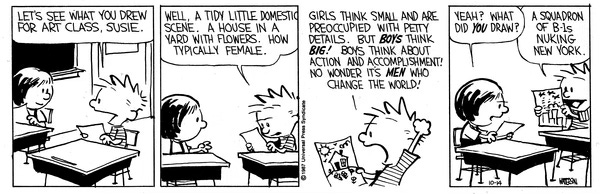
All that said, sometimes cartoons can express truths in ways that are as powerful as they are simple. In the cartoon below, the heretics of U.S. foreign policy are so many Calvins, spreading destruction and employing nukes in the name of manly seriousness. They are wrong. They are heretics. And if we continue to allow them to rule, they will surely lead America (as they already are in Gaza) to mass graves.
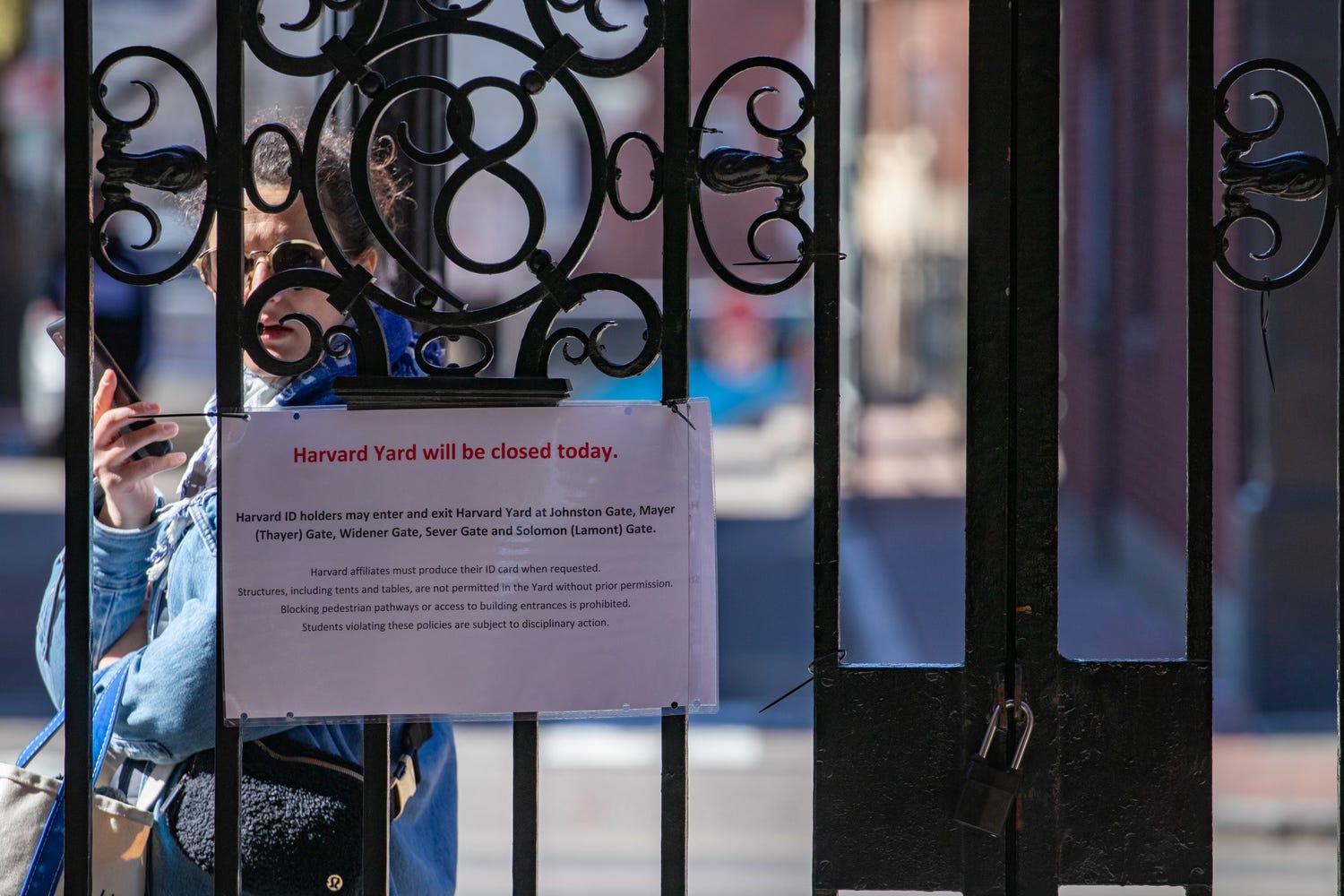
As a retired military officer and also as a longtime student and professor, I’ve come to recognize the increasing resemblance of “civilian” campuses to military academies, especially in light of recent student protests against genocide in Gaza. Controlled gates, armed guards, military-grade weaponry, even men and women in uniform, marching in formation and shouting. The message is clear: Welcome to Sparta University, land of brave warriors, but not of free thought
The famous gate to Harvard, locked for your security.
Once again, America’s imperial wars have come home to inflict their violence on us. In a saying attributed (falsely?) to Leon Trotsky, you may not be interested in war, but war is interested in you, especially if you’re a young person protesting against it. And America’s warfare state is not about to allow you to meddle in its affairs or mess with its profits.
U.S. campuses may espouse liberal Athenian values or look blissfully Arcadian, but behind the facade is billions of dollars of research money funneled to them by the Department of Defense, Homeland Security, and similar Spartan agencies. Whether students know it or not (and they’ve been getting a better idea of it lately), their campuses are already militarized, though that militarization is often carefully camouflaged.
It’s sad, of course, and detrimental to democracy. Campuses, after all, are supposed to be sanctuaries for free thought and expression, not battlegrounds where students are suppressed by warrior-cops using military tactics, even military-grade weaponry.
Campuses, especially rich ones, are often authoritarian, corporate, and increasingly instruments of empire. Just think of the Harvard “Corporation,” for example. Corporations are citizens too, as Mitt Romney reminded us, and the Harvard version is a very rich citizen indeed, as well as being quite jealous of its power and profits, earned often enough through imperial exploitation.
Students are certainly learning disturbing lessons from all this. It’s not exactly what they paid six-figure tuition bills for, but who said learning was free?
This brings me to the article that inspired these thoughts, “Repress U,” at TomDispatch yesterday. Its author, Michael Gould-Wartofsky, explains how colleges and universities are becoming adjunct agents of America’s Homeland Security Complex. He’s got a nice seven-step plan of how it’s being done, from repressing students and faculty to dominating the narrative with information warfare. Check it out. It may just make you look at that leafy green campus nearest you in a new Army olive-drab light.
Bonus Lesson: Speaking of “brave” Harvard, they released a statement yesterday saying they will no longer issue official statements on anything other than their “core” functions.
This from The Boston Globe: Harvard University said Tuesday that its leaders would no longer issue official statements about public matters that “do not directly affect the university’s core function.”
Genocide? What genocide? Not our core function to comment on that!
Yesterday, I appeared on Podcast by George. George Clark and I discussed the Russia-Ukraine War, Gaza, and the military-industrial-congressional complex. Here’s the video:
As George and I discussed America’s constant state of (very expensive and deadly) war, it occurred to me, not for the first time, that my country lost the Cold War that we allegedly won in 1991.
How so? After that “victory,” America was supposed to cash in on its peace dividends, becoming a normal country in normal times, to cite Jeanne Kirkpatrick. Instead, America doubled down on empire and the idea of imperial dominance. Militarism, not democracy, became a leading feature of our society, especially after the trauma of the 9/11 attacks. The U.S. government today remains shrouded in secrecy; those who would expose imperial war crimes, like Julian Assange or Daniel Hale, are imprisoned, even tortured.
The national security state, the MICIMATT,* is a colossus, far more insidious and invasive than anything even President Dwight D. Eisenhower imagined in his farewell address against the military-industrial complex in 1961. “Peace” is a word rarely heard in Washington, and the State Department has become a tiny branch of the Pentagon, bragging about weapons sales and shipments overseas rather than embracing diplomatic solutions to increasingly deadly conflicts. Even genocide in Gaza is dismissed as the Biden administration embraces Israel’s right to defend itself—against women and children in Gaza.
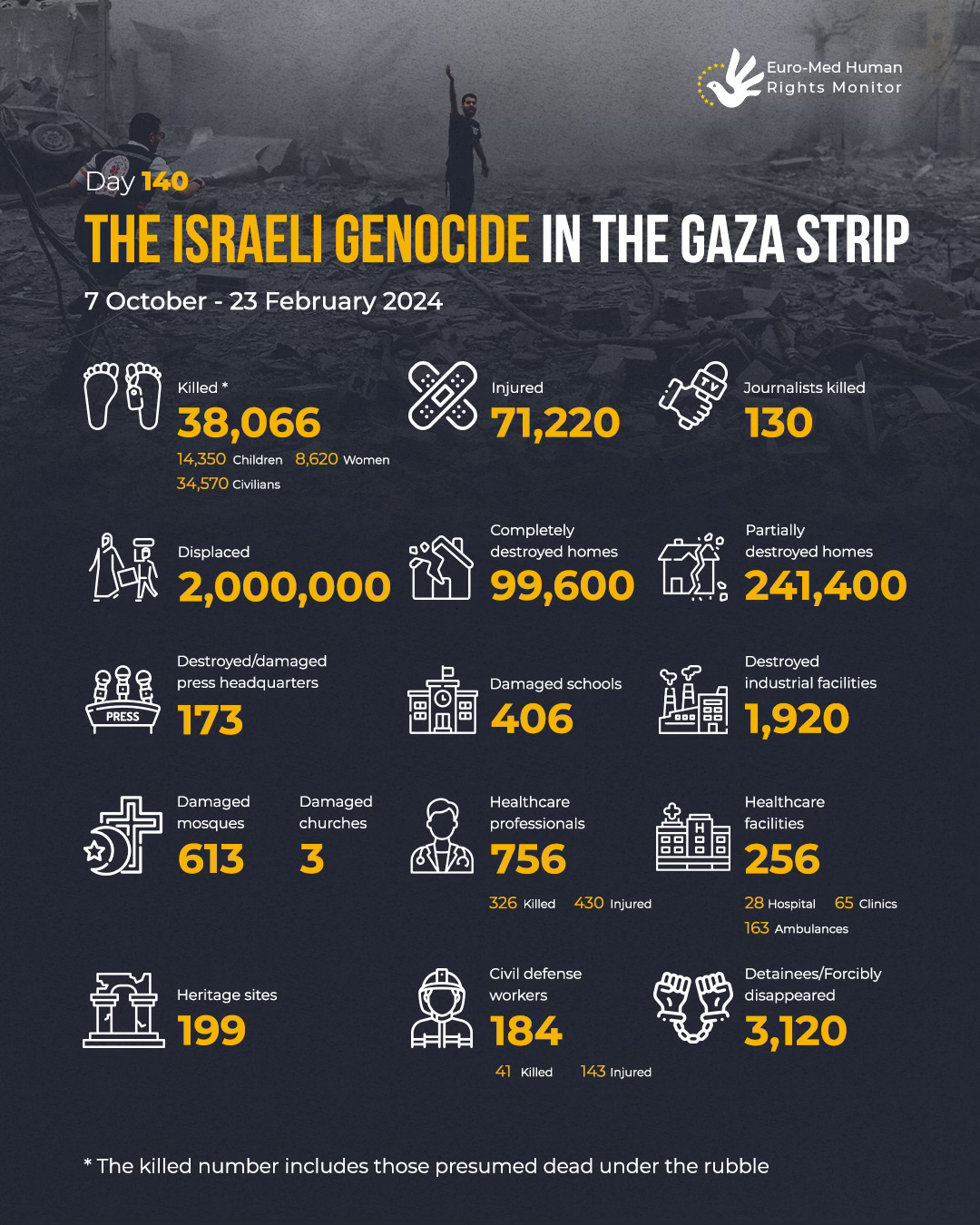
Courtesy of John Whitbeck, here’s a handy (and devastating) chart showing the damage inflicted on Gaza:
Chart prepared by the Euro-Med Human Rights Monitor available at this link:
*MICIMATT: military industrial congressional intelligence media academe think tank complex. We might also add Hollywood and the sports world to the complex, since both are so eager to celebrate war and “our” troops.
Democracy doesn’t die in darkness. It dies from constant warfare, as James Madison warned us about. It’s worth repeating his words:
Of all the enemies of true liberty, war is, perhaps, the most to be dreaded, because it comprises and develops the germ of every other. War is the parent of armies; from these proceed debt and taxes; and armies, and debts, and taxes are the known instruments for bringing the many under the domination of the few. In war, too, the discretionary power of the Executive is extended; its influence in dealing out offices, honors and emoluments is multiplied; and all the means of seducing the minds, are added to those of subduing the force, of the people. The same malignant aspect in republicanism may be traced in the inequality of fortunes, and the opportunities of fraud, growing out of a state of war, and in the degeneracy of manner and of morals, engendered in both. No nation can preserve its freedom in the midst of continual warfare …
MLK recognized the evils of racism, extreme materialism, and militarism
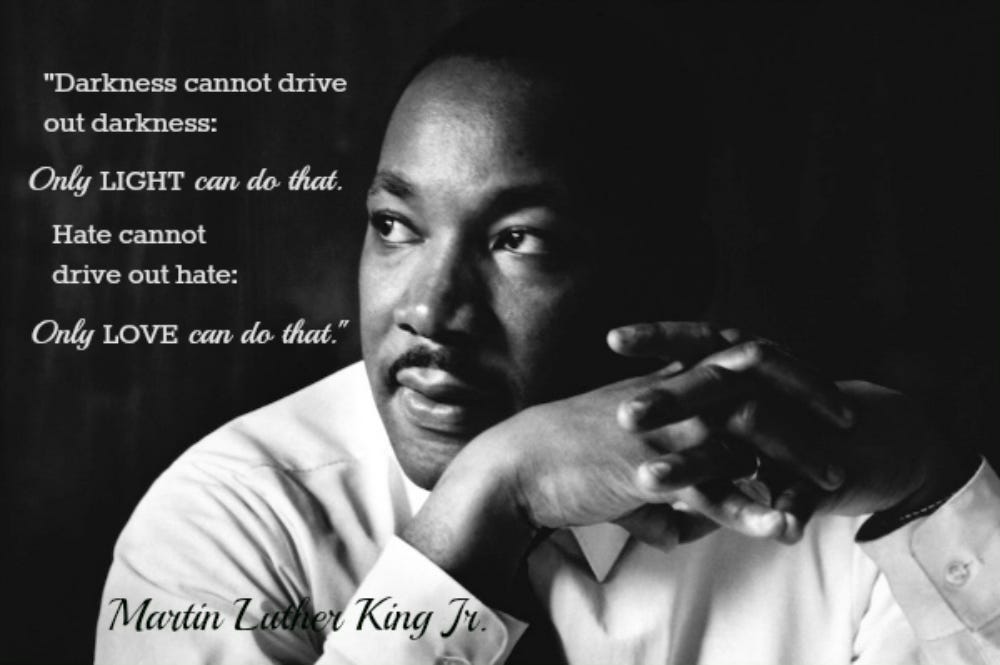
Martin Luther King, Jr., hero for peace.
It’s sad that the word “hero” is so often modified by or married to “war” in history. He’s a war hero, we say, without giving it too much thought. As if wars are somehow ennobling and sublime.
Waging peace is far more noble than waging war. MLK Jr. recognized this in his famous speech against the Vietnam War on April 4, 1967. Back in 2015, I posted this article on MLK and his warning that America was close to suffering a spiritual death in its constant warmongering. Today, we see America enabling genocide by Israel in Gaza with nary a complaint from those in power. Spiritual death, indeed.
*****
On April 4, 1967, Martin Luther King Jr. gave a powerful speech (“Beyond Vietnam – A Time to Break Silence”) that condemned America’s war in Vietnam. Exactly one year later, he was assassinated in Memphis.
What follows are excerpts from MLK’s speech. I urge you to read it in its entirety, but I’d like to highlight this line:
A nation that continues year after year to spend more money on military defense than on programs of social uplift is approaching spiritual death.
MLK called for a revolution of values in America. In his address, he noted that:
There is nothing except a tragic death wish to prevent us from reordering our priorities so that the pursuit of peace will take precedence over the pursuit of war.
MLK didn’t just have a dream of racial equality. He had a dream for justice around the world, a dream of a world committed to peace, a world in which America would lead a reordering of values in the direction of universal brotherhood.
Both of MLK’s dreams remain elusive. Racial inequalities and biases remain, though America is better now than it was in the 1960s in regards to racial equity. And what of a commitment to peace? Sadly, America remains dedicated to war, spending nearly a trillion dollars yearly on defense, Homeland Security, nuclear weapons, and “overseas contingency operations,” i.e. wars.
America has failed to dream the dreams of Martin Luther King, Jr., and we are the worse for it. (Bolded passages below are my emphasis.)
Excerpts from MLK’s Speech on Vietnam, April 4, 1967
At this point I should make it clear that while I have tried in these last few minutes to give a voice to the voiceless in Vietnam and to understand the arguments of those who are called “enemy,” I am as deeply concerned about our own troops there as anything else. For it occurs to me that what we are submitting them to in Vietnam is not simply the brutalizing process that goes on in any war where armies face each other and seek to destroy. We are adding cynicism to the process of death, for they must know after a short period there that none of the things we claim to be fighting for are really involved. Before long they must know that their government has sent them into a struggle among Vietnamese, and the more sophisticated surely realize that we are on the side of the wealthy, and the secure, while we create a hell for the poor.
Somehow this madness must cease. We must stop now. I speak as a child of God and brother to the suffering poor of Vietnam. I speak for those whose land is being laid waste, whose homes are being destroyed, whose culture is being subverted. I speak of the — for the poor of America who are paying the double price of smashed hopes at home, and death and corruption in Vietnam. I speak as a citizen of the world, for the world as it stands aghast at the path we have taken. I speak as one who loves America, to the leaders of our own nation: The great initiative in this war is ours; the initiative to stop it must be ours…
If we continue, there will be no doubt in my mind and in the mind of the world that we have no honorable intentions in Vietnam. If we do not stop our war against the people of Vietnam immediately, the world will be left with no other alternative than to see this as some horrible, clumsy, and deadly game we have decided to play. The world now demands a maturity of America that we may not be able to achieve. It demands that we admit that we have been wrong from the beginning of our adventure in Vietnam, that we have been detrimental to the life of the Vietnamese people. The situation is one in which we must be ready to turn sharply from our present ways. In order to atone for our sins and errors in Vietnam, we should take the initiative in bringing a halt to this tragic war…
It is with such activity in mind that the words of the late John F. Kennedy come back to haunt us. Five years ago he said, “Those who make peaceful revolution impossible will make violent revolution inevitable.” Increasingly, by choice or by accident, this is the role our nation has taken, the role of those who make peaceful revolution impossible by refusing to give up the privileges and the pleasures that come from the immense profits of overseas investments. I am convinced that if we are to get on the right side of the world revolution, we as a nation must undergo a radical revolution of values. We must rapidly begin…we must rapidly begin the shift from a thing-oriented society to a person-oriented society. When machines and computers, profit motives and property rights, are considered more important than people, the giant triplets of racism, extreme materialism, and militarism are incapable of being conquered.
A true revolution of values will soon cause us to question the fairness and justice of many of our past and present policies. On the one hand, we are called to play the Good Samaritan on life’s roadside, but that will be only an initial act. One day we must come to see that the whole Jericho Road must be transformed so that men and women will not be constantly beaten and robbed as they make their journey on life’s highway. True compassion is more than flinging a coin to a beggar. It comes to see that an edifice which produces beggars needs restructuring.
A true revolution of values will soon look uneasily on the glaring contrast of poverty and wealth. With righteous indignation, it will look across the seas and see individual capitalists of the West investing huge sums of money in Asia, Africa, and South America, only to take the profits out with no concern for the social betterment of the countries, and say, “This is not just.” It will look at our alliance with the landed gentry of South America and say, “This is not just.” The Western arrogance of feeling that it has everything to teach others and nothing to learn from them is not just.
A true revolution of values will lay hand on the world order and say of war, “This way of settling differences is not just.” This business of burning human beings with napalm, of filling our nation’s homes with orphans and widows, of injecting poisonous drugs of hate into the veins of peoples normally humane, of sending men home from dark and bloody battlefields physically handicapped and psychologically deranged, cannot be reconciled with wisdom, justice, and love. A nation that continues year after year to spend more money on military defense than on programs of social uplift is approaching spiritual death.
America, the richest and most powerful nation in the world, can well lead the way in this revolution of values. There is nothing except a tragic death wish to prevent us from reordering our priorities so that the pursuit of peace will take precedence over the pursuit of war. There is nothing to keep us from molding a recalcitrant status quo with bruised hands until we have fashioned it into a brotherhood.
Perhaps it seemed in 1967, even to MLK Jr., with all his experience to the contrary, that America could lead the world in a revolution of values, a pursuit of peace. MLK’s dream of such a revolution is dead, drowned in the vast profits of the merchants of death.
Fourteen years ago, I wrote the following article for TomDispatch. A colleague wrote to me today saying he had saved the article, had re-read it, and still found it useful, which is just about the highest compliment you can pay an author. I continue to believe, as I wrote in 2009, that America is experiencing a form of militarism on steroids. It’s a peculiar form of militarism, since the Pentagon works hard to obscure the costs and realities of war (see the recent book by Norman Solomon, War Made Invisible), but camouflaged or not, it persists.
Gary Cooper in “High Noon”
[Written in August 2009]
I have a few confessions to make: After almost eight years of off-and-on war in Afghanistan and after more than six years of mayhem and death since “Mission Accomplished” was declared in Operation Iraqi Freedom, I’m tired of seeing simple-minded magnetic ribbons on vehicles telling me, a 20-year military veteran, to support or pray for our troops. As a Christian, I find it presumptuous to see ribbons shaped like fish, with an American flag as a tail, informing me that God blesses our troops. I’m underwhelmed by gigantic American flags — up to 100 feet by 300 feet — repeatedly being unfurled in our sports arenas, as if our love of country is greater when our flags are bigger. I’m disturbed by nuclear-strike bombers soaring over stadiums filled with children, as one did in July just as the National Anthem ended during this year’s Major League Baseball All Star game. Instead of oohing and aahing at our destructive might, I was quietly horrified at its looming presence during a family event.
We’ve recently come through the steroid era in baseball with all those muscled-up players and jacked-up stats. Now that players are tested randomly, home runs are down and muscles don’t stretch uniforms quite as tightly. Yet while ending the steroid era in baseball proved reasonably straightforward once the will to act was present, we as a country have yet to face, no less curtail, our ongoing steroidal celebrations of pumped-up patriotism.
It’s high time we ended the post-Vietnam obsession with Rambo’s rippling pecs as well as the jaw-dropping technological firepower of the recent cinematic version of G.I. Joe and return to the resolute, undemonstrative strength that Gary Cooper showed in movies like High Noon.
In the HBO series “The Sopranos,” Tony (played by James Gandolfini) struggles with his own vulnerability — panic attacks caused by stress that his Mafia rivals would interpret as fatal signs of weakness. Lamenting his emotional frailty, Tony asks, “What ever happened to Gary Cooper?” What ever happened, in other words, to quiet, unemotive Americans who went about their business without fanfare, without swagger, but with firmness and no lack of controlled anger at the right time?
Tony’s question is a good one, but I’d like to spin it differently: Why did we allow lanky American citizen-soldiers and true heroes like World War I Sgt. Alvin York(played, at York’s insistence, by Gary Cooper) and World War II Sgt. (later, 1st Lt.) Audie Murphy(played in the film “To Hell and Back,” famously, by himself) to be replaced by all those post-Vietnam pumped-up Hollywood “warriors,” with Sylvester Stallone and Arnold Schwarzenegger-style abs and egos to match?
And far more important than how we got here, how can we end our enduring fascination with a puffed-up, comic book-style militarism that seems to have stepped directly out of screen fantasy and into our all-too-real lives?
A seven-step recovery program
As a society, we’ve become so addicted to militarism that we don’t even notice the way it surrounds us or the spasms of societal ‘roid rage that go with it. The fact is, we need a detox program. At the risk of incurring some of that ‘roid rage myself, let me suggest a seven-step program that could help return us to the saner days of Gary Cooper:
1. Baseball players on steroids swing for the fences. So does a steroidal country. When you have an immense military establishment, your answer to trouble is likely to be overwhelming force, including sending troops into harm’s way. To rein in our steroidal version of militarism, we should stop bulking up our military ranks, as is now happening, and shrink them instead. Our military needs not more muscle supplements (or the budgetary version of the same), but far fewer.
2. It’s time to stop deferring to our generals, and even to their commander in chief. They’re ours, after all; we’re not theirs. When President Obama says Afghanistan is not a war of choice but of necessity, we shouldn’t hesitate to point out that the emperor has no clothes. Yet when it comes to tough questioning of the president’s generals, Congress now seems eternally supine. Senators and representatives are invariably too busy falling all over themselves praising our troops and their commanders, too worried that “tough” questioning will appear unpatriotic to the folks back home, or too connected to military contractors in their districts, or some combination of the three.
Here’s something we should all keep in mind: Generals have no monopoly on military insight. What they have a monopoly on is a no-lose situation. If things go well, they get credit; if they go badly, we do. Retired five-star Gen. Omar Bradley was typical when he visited Vietnam in 1967 and declared: “I am convinced that this is a war at the right place, at the right time and with the right enemy — the Communists.” North Vietnam’s only hope for victory, he insisted, was “to hang on in the expectation that the American public, inadequately informed about the true situation and sickened by the loss in lives and money, will force the United States to give up and pull out.”
There we have it: A classic statement of the belief that when our military loses a war, it’s always the fault of “we the people.” Paradoxically, such insidious myths gain credibility not because we the people are too forceful in our criticism of the military, but because we are too deferential.
3. It’s time to redefine what “support our troops” really means. We console ourselves with the belief that all our troops are volunteers, who freely signed on for repeated tours of duty in forever wars. But are our troops truly volunteers? Didn’t we recruit them using multimillion-dollar ad campaigns and lures of every sort? Are we not, in effect, running a poverty and recession draft? Isolated in middle- or upper-class comfort, detached from our wars and their burdens, have we not, in a sense, recruited a “foreign legion” to do our bidding?
If you’re looking for a clear sign of a militarized society — which few Americans are — a good place to start is with troop veneration. The cult of the soldier often covers up a variety of sins. It helps, among other things, hide the true costs of, and often the futility of, the wars being fought. At an extreme, as the war began to turn dramatically against Nazi Germany in 1943, Germans who attempted to protest Hitler’s failed strategy and the catastrophic costs of his war were accused of (and usually executed for) betraying the troops at the front.
The United States is not a totalitarian state, so surely we can hazard criticisms of our wars and even occasionally of the behavior of some of our troops, without facing charges of stabbing our troops in the back and aiding the enemy. Or can we?
4. Let’s see the military for what it is: a blunt instrument of force. It’s neither surgical nor precise nor predictable. What Shakespeare wrote 400 years ago remains true: when wars start, havoc is unleashed, and the dogs of war run wild — in our case, not just the professional but the “mercenary” dogs of war, those private contractors to the Pentagon that thrive on the rich spoils of modern warfare in distant lands. It’s time to recognize that we rely ever more massively to prosecute our wars on companies that profit ever more handsomely the longer they last.
5. Let’s not blindly venerate the serving soldier, while forgetting our veterans when they doff their spiffy uniforms for the last time. It’s easy to celebrate our clean-cut men and women in uniform when they’re thousands of miles from home, far tougher to lend a hand to scruffier, embittered veterans suffering from the physical and emotional trauma of the battle zones to which they were consigned, usually for multiple tours of duty.
6. I like air shows, but how about — as a first tiny step toward demilitarizing civilian life — banning all flyovers of sporting events by modern combat aircraft? War is not a sport, and it shouldn’t be a thrill.
7. I love our flag. I keep my father’s casket flag in a special display case next to the very desk on which I’m writing this piece. It reminds me of his decades of service as a soldier and firefighter. But I don’t need humongous stadium flags or, for that matter, tiny flag lapel pins to prove my patriotism — and neither should you. In fact, doesn’t the endless post-9/11 public proliferation of flags in every size imaginable suggest a certain fanaticism bordering on desperation? If we saw such displays in other countries, our descriptions wouldn’t be kindly.
Of course, none of this is likely to be easy as long as this country garrisons the planet and fights open-ended wars on its global frontiers. The largest step, the eighth one, would be to begin seriously downsizing that mission. In the meantime, we shouldn’t need reminding that this country was originally founded as a civilian society, not a militarized one. Indeed, the revolt of the 13 colonies against the King of England was sparked, in part, by the perceived tyranny of forced quartering of British troops in colonial homes, the heavy hand of an “occupation” army, and taxation that we were told went for our own defense, whether we wanted to be defended or not.
If Americans are going to continue to hold so-called tea parties, shouldn’t some of them be directed against the militarization of our country and an enormous tax burden fed in part by our wasteful, trillion-dollar wars?
Modest as it may seem, my seven-step recovery program won’t be easy for many of us to follow. After all, let’s face it, we’ve come to enjoy our peculiar brand of muscular patriotism and the macho militarism that goes with it. In fact, we revel in it. Outwardly, the result is quite an impressive show. We look confident and ripped and strong. But it’s increasingly clear that our outward swagger conceals an inner desperation. If we’re so strong, one might ask, why do we need so much steroidal piety, so many in-your-face patriotic props, and so much parade-ground conformity?
Forget Rambo and action-picture G.I. Joes: Give me the steady hand, the undemonstrative strength, and the quiet humility of Alvin York, Audie Murphy — and Gary Cooper.
From Boots on the Ground to Robot Assassins in the Sky
I’m proud to say I’ve been writing for TomDispatch since 2007, posting more than 100 original articles at the site. Among the many features of that remarkable site, run by Tom Engelhardt, this generation’s I.F. Stone, is its reach across political spectrums, across America, and indeed across the globe. My most recent article, for example, was translated into Portuguese (for a Brazilian site) and Swedish. Tom and I usually aren’t contacted for permission; these translations and postings just happen.
Briefly in 2010, a few of my “tomgrams” broke through to the mainstream media, being reposted by CBS News. What follows is one of them, “Seven Reasons Why We Can’t Stop Making War,” in which I refer to a disaster of that day, the BP Deepwater Horizon oil spill.
Sadly, despite a little boost from CBS News, my critique went unheeded. Surprise! America is still making war (with certain entities profiting greatly from this), now with yet more robots even as U.S. boots on ground in direct combat are far fewer. It’s a formula for “low-cost” forever war that of course comes at a very high cost indeed, starting with a Pentagon budget soaring toward $900 billion a year, not including more than $120 billion already provided or promised to Ukraine for its war effort.
From CBS News in 2010, my article on why the U.S. can’t stop making war. The original title was “Operation Enduring War” at TomDispatch in July 2010.
If one quality characterizes our wars today, it’s their endurance. They never seem to end.
Though war itself may not be an American inevitability, these days many factors combine to make constant war an American near certainty. Put metaphorically, our nation’s pursuit of war taps so many wellsprings of our behavior that a concerted effort to cap itwould dwarfBP’s efforts in the Gulf of Mexico.
Our political leaders, the media, and the military interpret enduring war as a measure of our national fitness, our global power, our grit in the face of eternal danger, and our seriousness. A desire to de-escalate and withdraw, on the other hand, is invariably seen as cut-and-run appeasement and discounted as weakness. Withdrawal options are, in a pet phrase of Washington elites, invariably “off the table” when global policy is at stake, as was true during the Obama administration’s full-scale reconsideration of the Afghan war in the fall of 2009. Viewed in this light, the president’s ultimate decision to surge in Afghanistan was not only predictable, but the only course considered suitable for an American war leader. Rather than the tough choice, it was the path of least resistance.
Why do our elites so readily and regularly give war, not peace, a chance? What exactly are the wellsprings of Washington’s (and America’s) behavior when it comes to war and preparations for more of the same?
Consider these seven:
1. We wage war because we think we’re good at it — and because, at a gut level, we’ve come to believe that American wars can bring good to others (hence our feel-good names for them, like Operations Enduring Freedom and Iraqi Freedom). Most Americans are not only convinced we have the best troops, the best training, and the most advanced weapons, but also the purest motives. Unlike the bad guys and the barbarians out there in the global marketplace of death, our warriors and warfightersare seen as gift-givers and freedom-bringers, not as death-dealers and resource-exploiters. Our illusions about the military we “support” serve as catalyst for, and apology for, the persistent war-making we condone.
2. We wage war because we’ve already devoted so many of our resources to it. It’s what we’re most prepared to do. More than half of discretionary federal spending goes to fund our military and its war making or war preparations. The military-industrial complex is a well-oiled, extremely profitable machine and the armed forces, our favorite child, the one we’ve lavished the most resources and praise upon. It’s natural to give your favorite child free rein.
3. We’ve managed to isolate war’s physical and emotional costs, leaving them on the shoulders of a tiny minority of Americans. By eliminating the draft and relying ever more on for-profit private military contractors, we’ve made war a distant abstractionfor most Americans, who can choose to consume it as spectacle or simply tune it out as so much background noise.
4. While war and its costs have, to date, been kept at arm’s length, American society has been militarizing fast. Our media outlets, intelligence agencies, politicians, foreign policy establishment, and “homeland security” bureaucracy are so intertwined with military priorities and agendas as to be inseparable from them. In militarized America, griping about soft-hearted tactics or the outspokenness of a certain general may be tolerated, but forceful criticism of our military or our wars is still treated as deviant and “un-American.”
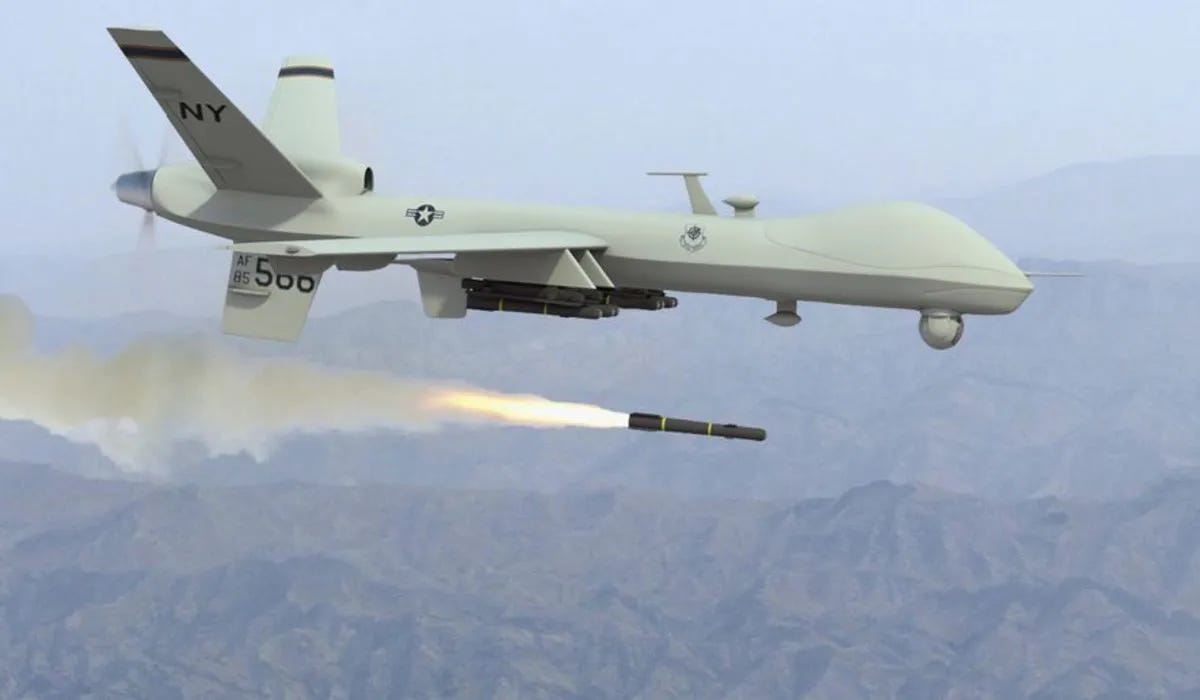
5. Our profligate, high-tech approach to war, including those Predator and Reaper drones armed with Hellfire missiles, has served to limit American casualties — and so has limited the anger over, and harsh questioning of, our wars that might go with them. While the U.S. has had more than 1,000 troops killed in Afghanistan, over a similar period in Vietnam we lost more than 58,000 troops. Improved medical evacuation and trauma care, greater reliance on standoff precision weaponry and similar “force multipliers,” stronger emphasis on “force protection” within American military units: all these and more have helped tamp down concern about the immeasurable and soaring costs of our wars.
It all seems so easy—even “clean”—from the sky. Not even a single U.S. pilot at risk.
6. As we incessantly develop those force-multiplying weapons to give us our “edge” (though never an edge that leads to victory), it’s hardly surprising that the U.S. has come to dominate, if not quite monopolize, the global arms trade. In these years, as American jobs were outsourced or simply disappeared in the Great Recession, armaments have been one of our few growth industries. Endless war has proven endlessly profitable — not perhaps for all of us, but certainly for those in the business of war.
7. And don’t forget the seductive power of beyond-worse-case, doomsday scenarios, of the prophecies of pundits and so-called experts, who regularly tell us that, bad as our wars may be, doing anything to end them would be far worse. A typical scenario goes like this: If we withdraw from Afghanistan, the government of Hamid Karzai will collapse, the Taliban will surge to victory, al-Qaeda will pour into Afghan safe havens, and Pakistan will be further destabilized, its atomic bombs falling into the hands of terrorists out to destroy Peoria and Orlando.
Such fevered nightmares, impossible to disprove, may be conjured at any moment to scare critics into silence. They are a convenient bogeyman, leaving us cowering as we send our superman military out to save us (and the world as well), while preserving our right to visit the mall and travel to Disney World without being nuked.
The truth is that no one really knows what would happen if the U.S. disengaged from Afghanistan. But we do know what’s happening now, with us fully engaged: we’re pursuing a war that’s costing us nearly $7 billion a month that we’re not winning (and that’s arguably unwinnable), a war that may be increasing the chances of another 9/11, rather than decreasing them.
Capping the Wellsprings of War
Each one of these seven wellsprings feeding our enduring wars must be capped. So here are seven suggestions for the sort of “caps” — hopefully more effective than BP’s flailing improvisations — we need to install:
1. Let’s reject the idea that war is either admirable or good — and in the process, remind ourselves that others often see us as “the foreign fighters” and profligate war consumers who kill innocents (despite our efforts to apply deadly force in surgically precise ways reflecting “courageous restraint“).
2. Let’s cut defense spending now, and reduce the global “mission” that goes with it. Set a reasonable goal — a 6-8% reduction annually for the next 10 years, until levels of defense spending are at least back to where they were before 9/11 — and then stick to it.
3. Let’s stop privatizing war. Creating ever more profitable incentives for war was always a ludicrous idea. It’s time to make war a non-profit, last-resort activity. And let’s revive national service (including elective military service) for all young adults. What we need is a revived civilian conservation corps, not a new civilian “expeditionary” force.
4. Let’s reverse the militarization of so many dimensions of our society. To cite one example, it’s time to empower truly independent (non-embedded) journalists to cover our wars, and stop relying on retired generals and admirals who led our previous wars to be our media guides. Men who are beholden to their former service branch or the current defense contractor who employs them can hardly be trusted to be critical and unbiased guides to future conflicts.
5. Let’s recognize that expensive high-tech weapons systems are not war-winners. They’ve kept us in the game without yielding decisive results — unless you measure “results” in terms of cost overruns and burgeoning federal budget deficits.
6. Let’s retool our economy and reinvest our money, moving it out of the military-industrial complex and into strengthening our anemic system of mass transit, our crumbling infrastructure, and alternative energy technology. We need high-speed rail, safer roads and bridges, and more wind turbines, not more overpriced jet fighters.
7. Finally, let’s banish nightmare scenarios from our minds. The world is scary enough without forever imagining smoking guns morphing into mushroom clouds.
There you have it: my seven “caps” to contain our gushing support for permanent war.
No one said it would be easy. Just ask BP how easy it is to cap one out-of-control gusher.
Nonetheless, if we as a society aren’t willing to work hard for actual change — indeed, to demand it — we’ll be on that military escalatory curve until we implode. And that way madness lies.
The opinions expressed in this commentary are solely those of the author.
By William J. Astore (2010)
Bonus Lesson (2023): “Enduring war” is not consistent with “enduring freedom.” Who knew? And we do seem as a society to be closer to implosion, a prediction I very much hope I’m ultimately proven wrong about.







 Bracing Views