Yesterday, Ira Chernus had a stimulating article at TomDispatch.com in which he noted the present lack of an American anti-war movement. When it comes to war and foreign policy, Americans face a Hobson’s choice: the Democrats with drones and Special Ops and bombing against evildoers, or the Republicans with even more drones and Special Ops and bombing against even more evildoers. The American master narrative, Chernus noted, is essentially all war.
He’s right about this, and I think it’s mainly for five reasons:
The military draft is gone, so our youth can safely (they think) ignore America’s never-ending wars. In Vietnam, with the draft, most of our youth didn’t have the luxury of apathy. Today, our youth have little personal incentive (as yet) to push back against the prevailing war narrative.
Militarism. Creeping militarism has shifted the American narrative rightwards. In the Vietnam period, General Curtis LeMay’s “bomb them back to the stone age” was a fringe opinion; now it’s mainstream with “carpet bombing” Cruz and Trump and Rubio, the “top three” Republican presidential contenders after the Iowa caucuses.
The Democrats have also shifted rightwards, so much so that now both major political parties embrace endless war. War, in short, has been normalized and removed from partisan politics. As Chernus documents, you simply can’t get an alternative narrative from the U.S. political mainstream. For that, you have to look to much smaller political parties, e.g. the Green Party.
The U.S. mainstream media has been thoroughly co-opted by corporations that profit from war. Anti-war ideas simply don’t get published; or, if they do, they’re dismissed as unserious. I simply can’t imagine any of today’s TV talking heads coming out against the war on terror like Walter Cronkite came out in the 1960s against Vietnam. There is simply no push back from the U.S. media.
Finally, a nebulous factor that’s always lurking: FEAR. The popular narrative today is that terrorists may kill you at any time right here in America. So you must be ready to “lockdown“; you must be ready to “shelter in place.” You must always defer to the police and military to keep you safe. You must fully fund the military or YOU WILL DIE. Repeated incantations of fear reinforce the master narrative of war.
Chernus makes many good points about how America’s constant warring in the Middle East only feeds radical Islam. In short, it’s vital to develop a new narrative, not only because the current one feeds war and death, but also because it’s fated to fail.
I doubt pacifism will fly in warrior corp USA. But why not containment? Containment worked against the Soviet Union, or so most Americans believe. If it worked against the far greater threat posed by the USSR, why shouldn’t it work against radical Islam?
Containment suggests several concrete actions: American troops should pull out of the Middle East. Bombing and drone strikes should stop. Establish a cordon sanitaire around the area. Lead a diplomatic effort to resolve the conflicts. And recognize that violent civil and ideological wars within Islam may need to burn themselves out.
One thing is certain: Because violent U.S. actions are most likely to act as accelerants to radical Islam, we need to stop attacking. Now.
Yes, the U.S. has a responsibility to help the peoples of the region. American actions helped to create the mess. But you don’t “solve” the mess by blowing more people and things to smithereens.
Containment, diplomacy, humanitarian aid. Not a chest-thumping course of action celebrated by the likes of Trump or Cruz or Clinton, but a new master narrative that would be more likely to spare lives and reduce the chaos in the Middle East.
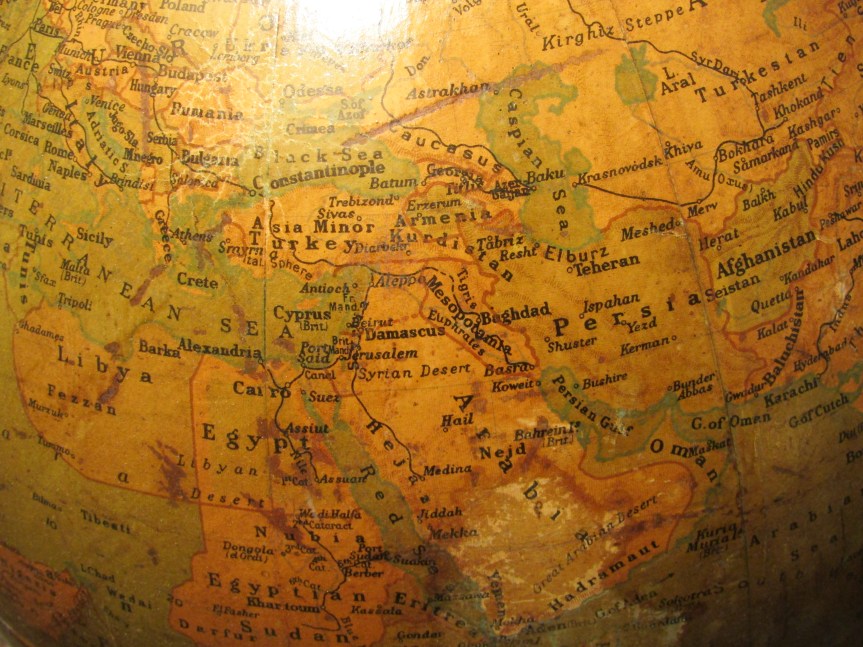
How about a contrary perspective on the Middle East, courtesy of my old globe? It dates from the early 1920s, just after World War I but before Russia became the Soviet Union. Taking a close look at the Middle East (a geographic term that I use loosely), you’ll notice more than a few differences from today’s maps and globes:
Iraq and Syria don’t exist. Neither does Israel. Today’s Iran is yesterday’s Persia, of course.
Instead of Iraq and Syria, we have Mesopotamia, a name that resonates history, part of the Fertile Crescent that encompassed the Tigris and Euphrates Rivers as well as the Nile in Egypt. Six thousand years ago, the cradle of human civilization, and now more often the scene of devastation caused mainly by endless war.
Ah, Kurdistan! The Kurds today in northern Iraq and southern Turkey would love to have their own homeland. Naturally, the Arabs and Turks, along with the Persians, feel differently.
Look closely and you’ll see “Br. Mand.” and “Fr. Mand.” With the collapse of the Ottoman Empire (roughly a larger version of modern-day Turkey) at the end of World War I, the British gained a mandate over Palestine and Mesopotamia and the French gained one over territory that would become Lebanon and Syria. The British made conflicting promises to Jews and Arabs over who would control Palestine while scheming to protect their own control over the Suez Canal. A large portion of Palestine, of course, was given to Jews after the Holocaust of World War II, marking the creation of Israel and setting off several Arab-Israeli Wars(1948-73) and the ongoing low-level war between Israel and the Palestinians, most bitterly over the status of the “Occupied Territories”: land captured by the Israelis during these wars, i.e. the West Bank (of the Jordan River) and the Gaza Strip (both not labeled on my outdated globe).
Improvisation marked the creation of states such as Lebanon, Syria, and Iraq. Borders encapsulated diverse peoples with differing goals. Western powers like Britain and France cared little for tribal allegiances or Sunni/Shia sensitivities or political leanings, favoring autocratic rulers who could keep the diverse peoples who lived there in line.
Historically powerful peoples with long memories border the Middle East. The Turks and the Persians (Iranians), of course, with Russians hovering in the near distance. They all remain players with conflicting goals in the latest civil war in Syria and the struggle against ISIS/ISIL.
Three of the world’s “great” religions originated from a relatively tiny area of our globe: Judaism, Christianity, and Islam. Talk about a fertile crescent! Sadly, close proximity and shared roots did not foster tolerance: quite the reverse.
Remember when Saudi Arabia was just Arabia? Ah, those were the good old days, Lawrence.
Nobody talks much about Jordan, an oasis of relative calm in the area (not shown on my old globe). Lucky Jordan.
The presence of Armenia in Turkey on my old globe raises all kinds of historical ghosts, to include the Armenian genocide of World War I. Today, Turkey continues to deny that the word “genocide” is appropriate to the mass death of Armenians during World War I.
My fellow Americans, one statement: The idea that America “must lead” in this area of the world speaks to our hubris and ignorance. We are obviously not seen as impartial. Our “leadership” is mainly expressed by violent military action.
But we just can’t help ourselves. The idea of “global reach, global power” is too intoxicating. We see the globe as ours to spin. Ours to control.
Perhaps old globes can teach us the transitory nature of power. After all, those British and French mandates are gone. European powers, however grudgingly, learned to retrench. (Of course, the British and French, together with the Germans, are now bombing and blasting old mandates in the name of combating terrorism.)
I wonder how a globe made in 2115 will depict this area of the world. Will it look like today’s globe, or more like my globe from c.1920, or something entirely different? Will it show a new regional empire or more fragmentation? An empire based on Islam or a shattered and blasted infertile crescent ravaged by war and an inhospitable climate driven by global warming?
When you do something again and again, placing great faith in it, investing enormous amounts of money in it, only to see indifferent or even negative results, you wouldn’t be entirely surprised if a neutral observer questioned your sanity or asked you if you were part of some cult. Yet few Americans question the sanity or cult-like behavior of American presidents as they continue to seek solutions to complex issues by bombing Iraq (as well as numerous other countries across the globe).
Poor Iraq. From Operation Desert Shield/Storm under George H.W. Bush to enforcing no-fly zones under Bill Clinton to Operation Iraqi Freedom under George W. Bush to the latest “humanitarian” bombing under Barack Obama, the one constant is American bombs bursting in Iraqi desert air. Yet despite this bombing — or rather in part because of it — Iraq is a devastated and destabilized country, slowly falling apart at seams that have been unraveling under almost a quarter-century of steady, at times relentless, pounding. “Shock and awe,” anyone?
Well, I confess to being shocked: that U.S. airpower assets, including strategic bombers like B-52s and B-1s, built during the Cold War to deter and, if necessary, attack that second planetary superpower, the Soviet Union, have routinely been used to attack countries that are essentially helpless to defend themselves from bombing.
In 1985, when I entered active duty as an Air Force lieutenant, if you had asked me which country the U.S. would “have” to bomb in four sustained aerial campaigns spanning three decades, among the last countries I would have suggested was Iraq. Heck, back then we were still helping Saddam Hussein in his war against Iran, sharing intelligence that aided his military in pinpointing (and using his chemical weapons against) Iranian troop concentrations. The Reagan administration had sent future Bush secretary of defense Donald Rumsfeld there to shake Saddam’s hand for a photo op. We even overlooked Iraq’s “accidental” bombing in 1987 of a American naval vessel, the USS Stark, that resulted in the death of 37 American sailors, all in the name of containing Iran (and Shia revolutionary fervor).
…
What we need in 2014 is a new expression that catches the essence of the cult of U.S. air power, something like: “The bomber will always get funded — and used.”
Let’s tackle the first half of that equation: the bomber will always get funded. Skeptical? What else captures the reality (as well as the folly) of dedicating more than $400 billion to the F-35 fighter-bomber program, a wildly over-budget and underperforming weapons system that may, in the end, cost the American taxpayer $1.5 trillion. Yes, you read that right. Or the persistence of U.S. plans to build yet another long-range “strike” bomber to augment and replace the B-1 and B-2 fleet? It’s a “must-have,” according to the Air Force, if the U.S. is to maintain its “full-spectrum dominance” on Planet Earth. Already pegged at an estimated price of $550 million per plane while still on the drawing boards, it’s just about guaranteed to replace the F-35 in the record books, when it comes to delays, cost overruns, and price. And if you don’t think it’ll get funded, you don’t know recent history.
Heck, I get it. I was a teenager once. In the 1970s, as an Air Force enthusiast and child of the Cold War, I hugged exotic and therefore pricey bomber jets to my chest. (Well, models of them, anyway.) I considered them to be both uniquely American and an absolute necessity when it came to defending our country against the lumbering (but nevertheless menacing) Soviet “bear.” As a result, I gasped in 1977 when President Jimmy Carter dared to cancel the B-1 bomber program. While I was a little young to pen my outrage, more mature critics than I quickly accused him of being soft on defense, of pursuing “unilateral disarmament.”
Back then, I’d built a model of the B-1 bomber. In my mind’s eye I still see its sexy white body and its rakish swing wings. No question that it was a man’s bomber. I recall attaching a firecracker to its body, lighting the wick, and dropping the plane from the third-floor porch. It exploded in mid-air, symbolic to me of the plane’s tragic fate at the hands of the pusillanimous Carter.
But I need not have feared for the B-1. In October 1981, as one of his first major acts in office, President Ronald Reagan rescinded Carter’s cancellation and revived the mothballed program. The Air Force eventually bought 100 of the planes for $28 billion, expensive at the time (and called a “turkey” by some), but a relative bargain in the present budgetary environment when it comes to bombers (but these days, little else).
At that point, I was a young lieutenant serving on active duty in the Air Force. I had by then come to learn that Carter, the peanut farmer (and former Navy nuclear engineer), was right. We really didn’t need the B-1 for our defense. In 1986, for a contest at Peterson Air Force Base where I was stationed, I wrote a paper against the B-1, terming the idea of a “penetrating strategic bomber” a “flawed strategy” in an era of long-range air-launched cruise missiles. It earned an honorable mention, the equivalent of drawing the “you have won second prize in a beauty contest” card in Monopoly, but without the compensatory $10.
That “penetrating,” by the way, meant being loaded with expensive avionics, nowadays augmented by budget-busting “stealth” features, so that a plane could theoretically penetrate enemy air defenses while eluding detection. If the idea of producing such a bomber was flawed in the 1980s, how much more is it today, in an age of remotely-piloted drones and missiles guided by GPS and in a world in which no country the U.S. chooses to bomb is likely to have air defenses of any sophistication? Yet the Air Force insists that it needs at least 100 of the next generation version of them at a cost of $55 billion. (Based on experience, especially with the F-35, you should automatically double or even triple that price tag, cost overruns and product development delays being a given in the process. So let’s say it’ll cost closer to $150 billion. Check back with me, God willing, in 2040 to see whether the Air Force’s figure or mine was closer to reality.)
Idols for Worship, Urges to Satisfy
Obviously, there are staggering amounts of money to be made by feeding America’s fetish for bombers. But the U.S. cult of air power and its wildly expensive persistence requires further explanation. On one level, exotic and expensive attack planes like the F-35 or the future “long range strike bomber” (LRS-B in bloodless acronym-speak) are the military equivalent of sacred cows. They are idols to be worshipped (and funded) without question. But they are also symptoms of a larger disease — the engorgement of the Department of Defense. In the post-9/11 world, this has become so pronounced that the military-industrial-congressional complex clearly believes it is entitled to a trough filled with money with virtually no accountability to the American taxpayer.
Add to that sense of entitlement the absurdist faith of administration after administration in the efficacy of bombing as a problem solver — despite overwhelming evidence to the contrary — and you have a truly lethal combo. Senator John McCain was widely mocked by progressives for his “bomb Iran” song, warbled during the 2008 presidential campaign to the tune of the Beach Boys’s “Barbara Ann.” In fact, his tuneless rendition captured perfectly Washington’s absolute faith in bombing as a solution to…whatever.
Even if the bombs bursting over Iraq or elsewhere don’t solve anything, even when they make things worse, they still make a president look, well, presidential. In America, land of warbirds, it is always better politically to pose as a hunting hawk than a helpless dove.
So don’t blame the Air Force for wanting more and deadlier bombers. Or don’t blame only them. Just as admirals want more ships, flyboys naturally want more planes, even when strategically obsolete from scratch and blazingly expensive. No military service has ever willingly given up even a tiny slice of its share of the prospective budgetary pie, especially if that slice cuts into the service’s core image. In this sense, the Air Force takes its motto from King Lear’s “Reason not the need!” and from Zack Mayo’s “I want to fly jets!” (memorably uttered by that great Shakespearean actor Richard Gere in An Officer and a Gentleman).
The sad truth runs deeper: Americans evidently want them, too. More bombers. More bombs. In the movie Top Gun, Tom Cruise’s Maverick got it all wrong. It’s not speed Americans feel a need for; they have an urge to bomb. When you refuse to reason, when you persist in investing ever more resources in ever more planes, use almost automatically follows.
In other words, fund it, build it, and, as promised in the second half of my equation, the bomber will always get used. Mock him all you want, but John McCain was on to something. It’s bomb, bomb, bomb, bomb bomb if not (yet) Iran… then Iraq, or Pakistan, or Libya, or Yemen, or (insert intransigent foreign country/peoples here).
And like cults everywhere, it’s best not to question the core belief and practices of its leaders — after all, bombs bursting in air is now as American as the “Star Spangled Banner.”
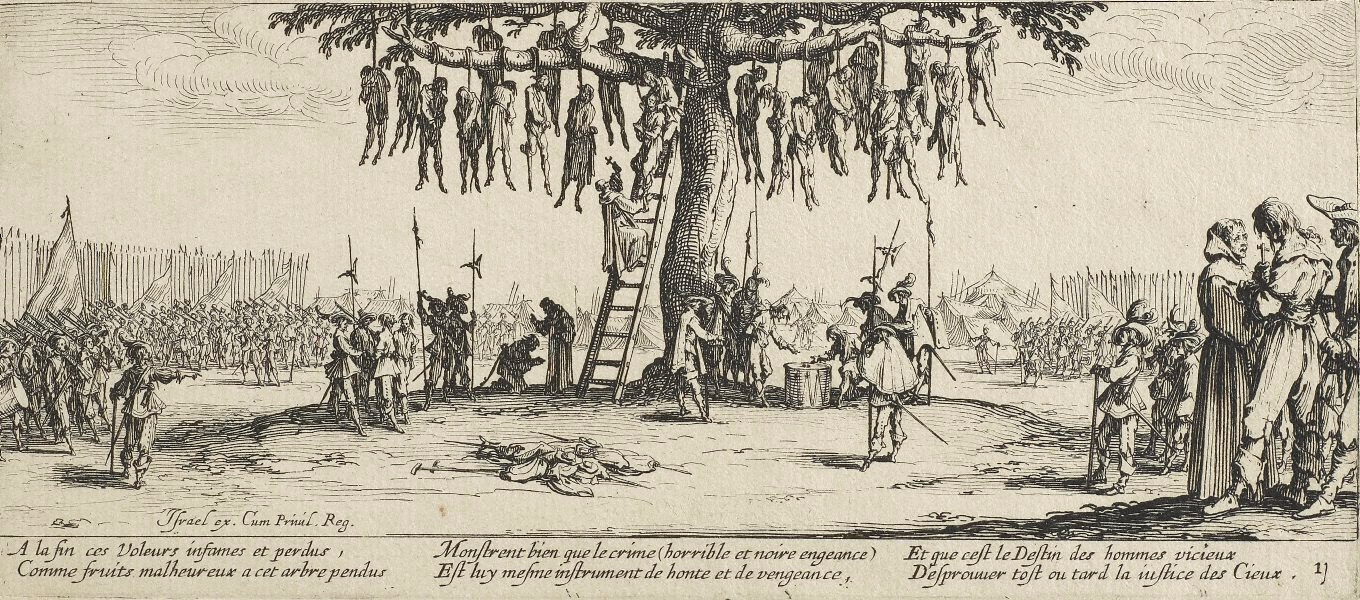
Jacques Callot captured the miseries of the Thirty Years’ War. Here we see a mass hanging
W.J. Astore
The Middle East of the early 21st century is looking more and more like the Thirty Years’ War of the early 17th century that tore apart the Germanic states of the Holy Roman Empire. Religious sectarianism? In the 17th century, Catholics and Protestants killed each other with gusto. Disunity? Yes, within and among the various Germanic states of the Holy Roman Empire. Great power intervention that made matters far worse? Yes, Protestant Sweden and Catholic France intervened in a big way, among a host of other lesser powers. Privatized, for-profit militaries that threw more fuel on the fire? Yes, Albrecht von Wallenstein, the greatest mercenary captain of the age, created his own empire until he was assassinated in 1634.
The war finally ended when it burnt itself out, and when European leaders realized the more they intervened, the more they risked the infection spreading to their own kingdoms. Thus came the Peace of Westphalia in 1648, but not before roughly eight million people, most of them civilians, died in and of the war.
When will conflicts in the Middle East finally burn themselves out? In 2048? When the oil is finally gone? (Sadly, water may replace oil as a major source of conflict.)
And when will great powers like the United States realize the more they intervene, the more the infection spreads elsewhere? Indeed, the more it comes home to endanger the United States?
Speaking of 30 years, when did the war for the greater Middle East truly begin? With the Iraq-Iran war of the 1980s? The creation of Israel in 1948? The end of World War I and the breakup of the Ottoman Empire in 1918? Biblical times?
The Thirty Years’ War worked to delay German unification until 1871, after which Germany, late to European power politics, decided to rattle its saber for a bigger seat at the table. World War I was the result.
What will be the long-term effects of constant warfare in the Middle East? Impossible to see, perhaps, but the short-term ones are before our eyes: more instability ahead, more innocents dead, more hatred spread.




 Bracing Views