When you have an unrepresentative government, or, put differently, a government that represents oligarchic interests and corporations, as well as being heavily influenced by lobbyists, domestic and foreign (AIPAC), you get Trump and Congress conspiring to decrease Medicaid, to cut food support for the poor, while funneling more money upward to the very richest Americans.
American workers essentially have no agency, no ability to act in meaningful ways in the political realm. Along with no agency, Americans also have fewer liberties, especially if you should choose to criticize U.S./Israeli policies and otherwise challenge the imperatives of the powerful.
Be careful shouting “Give me liberty or give me death!” in these times. Death may be far easier to achieve.
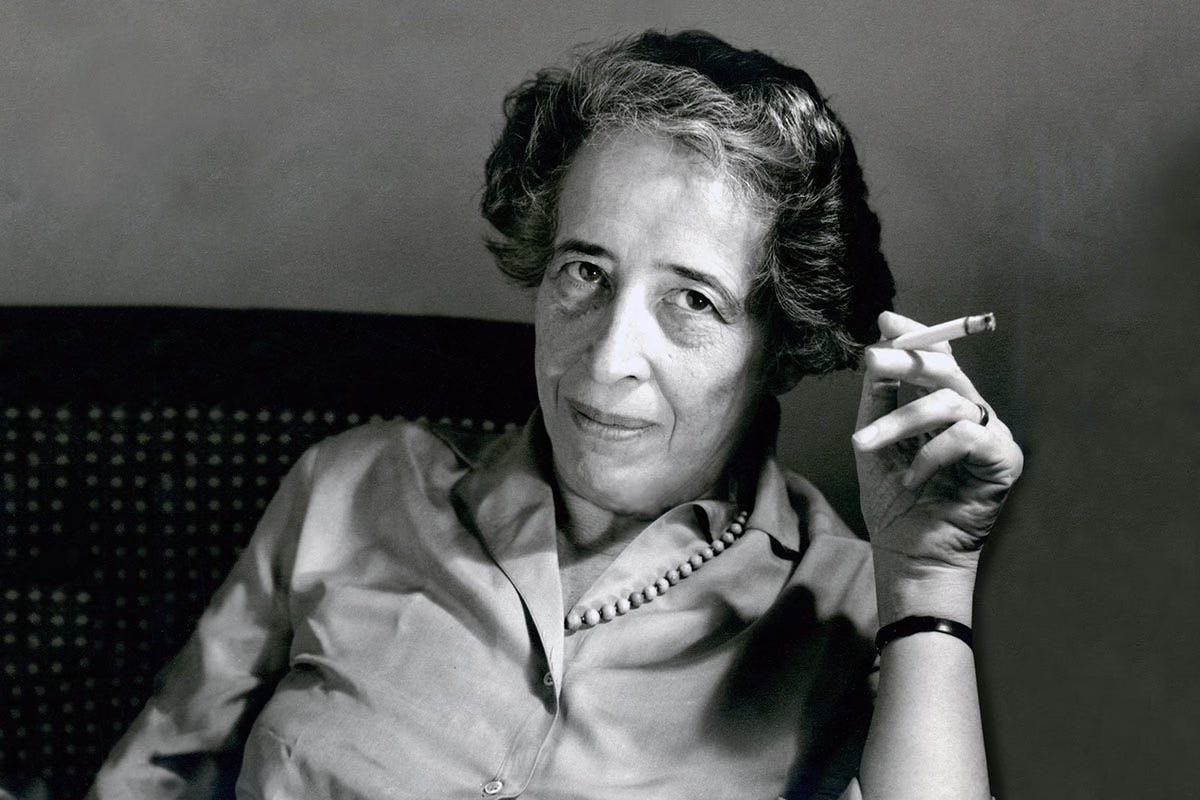
Hannah Arendt
What is the answer to regaining our agency? In “Between Past and Future,” the political philosopher Hannah Arendt wrote how French resisters to the Nazis during World War II discovered themselves—their true nature—in and through action. In resisting the Nazis, they seized control over their own agency by exercising it in the face of danger. They chose risk, they fought to effect change, they took stands that often meant life or death.
Through action, these resisters lifted themselves out of “normal” time, Arendt argued, entering instead a realm between past and future, a realm of true existence, a present of dynamism, of possibilities, of clarity of commitment.
Political agency is not going to be given back to the people. If we regain it, it will only be by seizing it ourselves, through action, through commitment, through risk-taking, and perhaps most of all through large-scale organized resistance.
Hopefully, that resistance can remain non-violent. I prefer reformation or restoration to revolution, recalling the words of Aleksandr Solzhenitsyn that revolutions unleash the most elemental barbarism.
As a teenager in the late 1970s, I read about Israel’s “Six-Day War” in 1967. The account I read was sympathetic toward Israel, respecting the audacity of its sneak attack on the Egyptian and Syrian air forces and its Blitzkrieg in the Sinai. But it also mentioned the Israeli attack on a U.S. Navy ship, the USS Liberty, a signals intelligence ship that was monitoring the war in international waters. The Israeli air and sea attack killed 34 crew members aboard the Liberty and wounded another 173. The ship, heavily damaged, never sailed again and was later sold as scrap.
The USS Liberty, post-attack
The Israeli government claimed the attack was unintentional and a mistake. There’s plenty of evidence to suggest the story is far more complicated. Yet I was thinking this morning about how the Trump administrations’s strenuous attempt to criminalize critical speech vis-à-vis Israel is yet another assault on liberty. Once again, the ship of liberty is endangered in the U.S., yet the U.S. government is content to look the other way, or even to collaborate with the attackers.
Let me be clear: Those Americans who criticize Israel for its actions in Gaza are exercising their liberty. We are free to speak, and indeed we should speak freely on crimes against humanity, for that is what ethnic cleansing in Gaza is: a crime against humanity.
Yet the U.S. government, which essentially agreed to look the other way in response to Israel’s attack on the USS Liberty in 1967, is now looking the other way as free speech in America is suppressed, or even twisting denunciations of Israel’s war crimes in Gaza as anti-Semitic hate speech.
Liberty is something precious, and we as Americans are supposed to admire and applaud Patrick Henry and his sentiment from 250 years ago: “Give me liberty or give me death!”
If we as Americans have the right to criticize our own government, which we do, we certainly have the right to criticize foreign governments, including, of course, Israel. Yet, judging by U.S. mainstream media coverage and the words of government spokespeople, American citizens actually have less scope to criticize Israel than any other country, including their own.
Liberty attacked and abridged is liberty denied. How long before liberty itself in America, rocketed and strafed and torpedoed, is decommissioned and sold for scrap, just as the USS Liberty was?
Addendum: There are many books and videos about Israel’s attack on the USS Libertyand what was *really* behind it. I’m not an expert on the subject, but the official story of a regrettable “mistake” is decidedly fishy. Wikipedia does a decent job of summarizing a complex subject. Here’s an excerpt to ponder:
Some intelligence and military officials dispute Israel’s explanation.[79]Dean Rusk, U.S. Secretary of State at the time of the incident, wrote:
I was never satisfied with the Israeli explanation. Their sustained attack to disable and sink Liberty precluded an assault by accident or some trigger-happy local commander. Through diplomatic channels we refused to accept their explanations. I didn’t believe them then, and I don’t believe them to this day. The attack was outrageous.[80]
And reflecting on notes I made in the margins forty years ago
In college, I majored in mechanical engineering but also took courses in U.S. history and philosophy. I kept most of my college textbooks for a couple of decades, books on statics, dynamics, strength of materials, fluid mechanics and dynamics, thermodynamics, heat transfer, vibrations, along with calculus, physics, chemistry, and the like. But there came a time when these books seemed not only obsolete but a burden of sorts, so I brought them to various used bookstores for trade.
One book I didn’t trade in was a slim volume: John Stuart Mill’s “On Liberty.” It cost me the princely sum of $5.75 in 1983, and I read it for a course in political philosophy. The theme of liberty seemed timeless to me, always pertinent and worth pondering, so I kept the book.
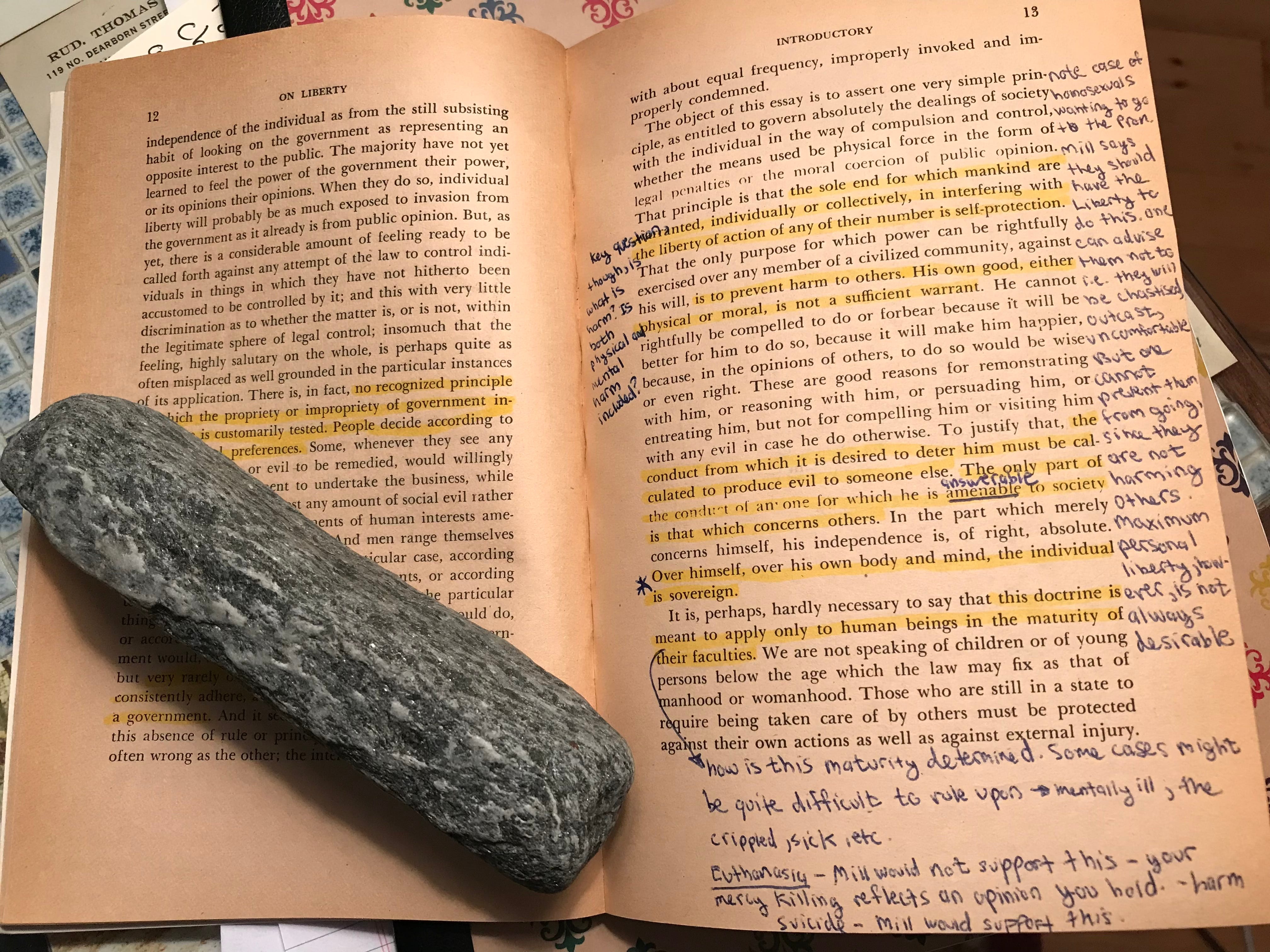
Yesterday, I was shifting some books around and spied my copy among my small collection on philosophy. I opened it and came across a long passage I wrote in the margins back when I first read it in college in 1983. This “marginalia” struck me as a somewhat interesting window into America in 1983 and what I was thinking about as I tried to apply Mill’s insights to American culture.
My college copy of Mill’s “On Liberty” with my marginalia
My marginal comment came as Mill discussed liberty and when people are warranted “in interfering with the liberty of action of any of their number.” Self-protection, Mill wrote, was the only purpose sufficiently compelling here to exercise power to abridge liberty. Preventing harm. It’s insufficient and wrong, Mill added, to act to abridge someone’s liberty because you think it would be better for them, wiser for them, as well as being better for society at large. If the person isn’t harming others, if their actions aren’t “calculated to produce evil to someone else,” those actions shouldn’t be interfered with.
Now, here’s the example that popped into my head back in 1983, which I wrote in the margin:
Note [the] case of homosexuals wanting to go to the prom. Mill says they should have the liberty to do this. One can advise them not to [go], i.e. they will be chastised, outcast, uncomfortable. But one cannot prevent them from going, since they are not harming others.
Back in 1983, before LGBTQ+, in the era of the Reagan revolution in which real men didn’t eat quiche, the idea of homosexuals taking same-sex (or non-binary) dates to the high school prom was more than controversial. It must have been “in the news” for that example to have popped into my head.
It’s interesting how times have changed in forty years. Personal liberty for the LGBTQ+ communities is, I think, far less restricted by the “tyranny of the majority” than it used to be. We have Pride month, Pride celebrations, rainbow flags, and the like. I assume it’s now unremarkable when LGBTQ+ members attend proms with same-sex (or non-binary) dates. And that reflects greater diversity and tolerance within our society along with more liberty, which John Stuart Mill would applaud.
Mill’s message is a good one. We should strive as a society and culture to maximize personal liberty. We should be very careful indeed in exercising power to abridge liberty, especially in the cause of “helping” the other person. As Mill writes, quite powerfully, “Over himself, over his own body and mind, the individual is sovereign.”
Which, to put it in non-gendered language: Over themselves, over their own bodies and minds, individuals are sovereign.
Sometimes, old college textbooks are worth keeping around.
Readers, is there an old high school or college textbook you’ve never parted with, and why?
There’s a man who famously crowned himself emperor rather than submit to the otherworldly power of a pope. A new movie will soon be out on his “glories.” Napoleon Bonaparte, a military genius, embraced war and drove for total victory until his empire collapsed on him and the French people. Napoleon’s Waterloo came in 1815, a decade after perhaps his greatest victory at Austerlitz in 1805. Empires—they often seem to decline slowly before collapsing all at once, though the Napoleonic version flared so brightly that it burned out quickly.
I once studied the military glories of Napoleon, enthusiastically playing war-games like Waterloo and Empire in Arms, where this time maybe I could win a great victory for the emperor. More than a few books on my shelves cover the campaigns of Napoleon. But as my dad quipped to me, Napoleon wanted to give people liberty, equality, and fraternity at the point of his sword. And that, my dad would say, is an intolerable price to pay for one’s freedom.
Win one for the Emperor
Endless war is, as often as not, the final nail in an empire’s coffin. Early in 1943, after defeat at Stalingrad, which came as a profound shock to a German public sold on the idea it possessed the finest fighting force in history (such rhetoric should sound familiar to Americans today), Joseph Goebbels, the infamous Nazi propaganda minister, gave a fanatical speech calling for “total war” from the German people. Despite disaster at Stalingrad, despite visible and widening cracks in the alleged superiority of the Thousand Year Reich, the German people largely cheered or echoed the cry for more and more war. Two years later, they witnessed total defeat as Germany surrendered unconditionally in May 1945.
As led by Adolf Hitler and his henchmen, Nazi Germany wasn’t interested in peace. These men knew only the feverish pursuit of total victory until it ended in their deaths and total disaster for Germany. They were the original seekers of “full spectrum dominance” as they asserted Germany was the exceptional and essential nation.
We Americans were supposed to learn something from megalomaniacs like Napoleon and Hitler. Committed to democracy, we were supposed to reject war, to repudiate militarism and the warrior mystique, and to embrace instead diplomacy and the settlement of differences peacefully through international organizations like the United Nations.
America today, however, is busy beating plowshares into swords and sending them to global hotspots like Gaza and Ukraine. What gives?
Endless wars can exhaust even the richest and wisest of empires, and America isn’t as rich or wise as it used to be. Interestingly, ordinary Americans haven’t been overcome with bloodthirst. Roughly two-thirds of Americans, for example, support a ceasefire in Gaza. But they are a silent majority compared to the loud minority flowing through the halls of power in DC lobbying for war and more war.
The U.S., which largely created the UN in the immediate aftermath of World War II, now does everything it can to block UN calls for ceasefires, whether in Ukraine or Gaza. The U.S., while allegedly manifesting its allegiance to Judeo-Christian values, embraces war and distributes weaponry like the devil while rejecting calls for peace by church leaders such as Pope Francis.
The U.S. is an empire in serious decline because it devotes so much money to wars and more wars. Military budgets now approach $1 trillion yearly even as the Pentagon just announced it failed its sixth audit in a row. These repetitive failures provoke a bizarre response from Congress and the President: yet more money for war and dominance.
Whether measured in blood or treasure or both, seeking to dominate the world through military hegemony is a surefire recipe for imperial collapse. It’s a lesson taught by the fates of Napoleon and Hitler, one U.S. leaders have dismissed as they’ve been caught up in a belief one can be a superpower, a global hegemon, totally dominant, while remaining a beacon of freedom.
Like Napoleon, U.S. leaders sell the idea they’re giving people liberty at the point of a sword. My dad taught me something about the fallacy and folly of this.
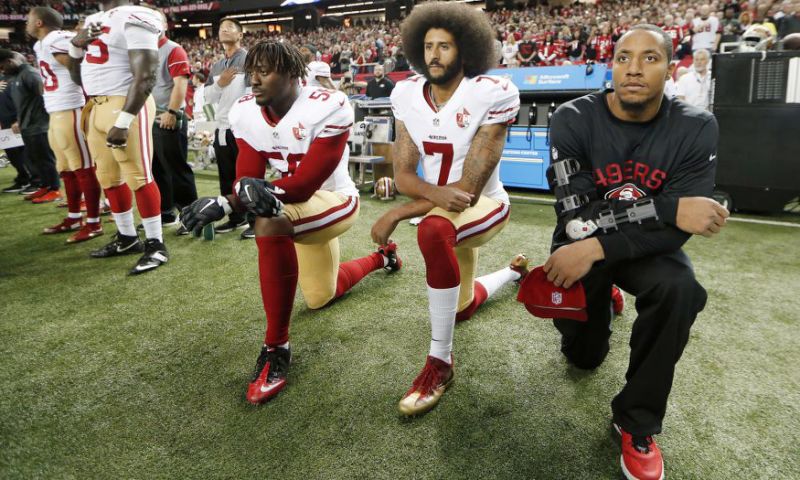
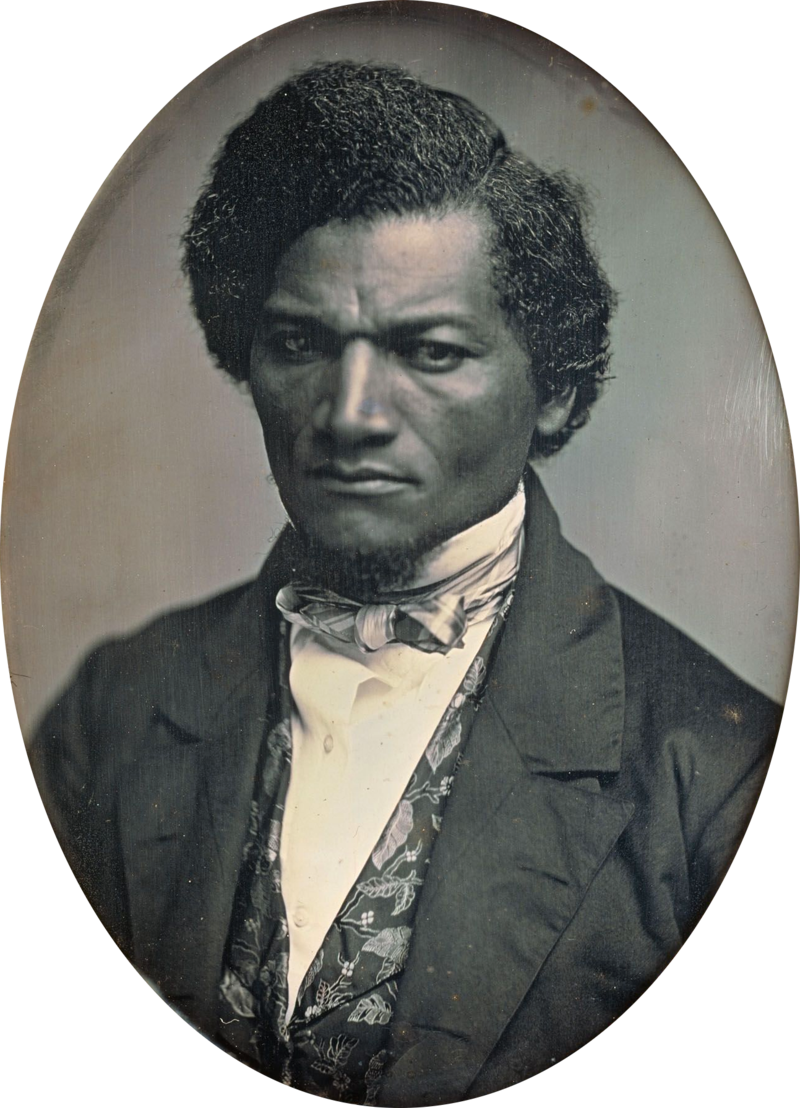
A week after Super Bowl Sunday, I was reading Frederick Douglass’s “Fourth of July Address,” given by the intrepid abolitionist and eminent public intellectual on July 5, 1852 to several hundred spectators in Rochester, New York. It struck me then how contemporary Douglass’s antebellum insights into the nature of patriotism in America seemed, especially in the wake of an NFL season steeped in controversy over football players (mostly African-American) taking a knee during the national anthem. Their symbolic protest, dismissed by some, notably including a tweeting president, as unpatriotic, was intended to highlight how police encounters with people of color in this country all too often and disproportionately end in unjustified uses of deadly force.
Frederick Douglass near the time of the Rochester Speech, given on the 5th of July 1852
At the time of his Fourth of July Address, Douglass was about fifteen years removed from a state of enslavement he managed, against steep odds, to escape and had become an orator of note in abolitionist circles. Attesting to a sense of trepidation in accepting an invitation to speak before such a large audience on their august day of national celebration, Douglass praised the generation of 1776 (“your fathers,” he calls them) for “lov[ing] their country better than their own private interests” and for their “solid manhood” in “preferr[ing] revolution to peaceful submission to bondage.”
Douglass then reminded his audience that, while it is easy in present times to celebrate the founders for resisting British oppression, “to pronounce against England, and in favor of the cause of the colonies” in the 1770s meant being pilloried and browbeaten as “plotters of mischief, agitators and rebels, dangerous men.” Moving beyond this critique of the easy and self-congratulatory patriotism of his contemporaries, Douglass raised the prospect that the founders’ great deeds might even be evoked by men of tyrannical intent: “The cause of liberty may be stabbed by the men who glory in the deeds of your fathers.”
Douglass went on to warn his listeners, and free citizens of the American republic generally, against shirking their own responsibility for carrying on the emancipatory tradition celebrated each Fourth of July–“You have no right to wear out and waste the hard-earned fame of your fathers to cover your indolence.”
While there is much more to Douglass’s powerful address, his opening discourse on the patriotic meaning of the Fourth of July provides a way of dousing the “fire and fury” that has been generated by the right-wing media around the symbolic protest started by Colin Kaepernick in 2016 and seeing the significance of that protest with a quiet clarity.
Douglass’s Fourth of July Address warns against the self-serving belief that routinized, programmed patriotic gesture is equivalent to a true love of liberty. He daringly calls out those who would abuse patriotic gesture in order to control others. His words remind us that the struggle for freedom is always a work in progress and that it is too easy to celebrate its provisional achievement after the hard and risk-laden work is done by others.
Douglass’s speech is part of a tradition of exposing empty patriotic gesture and challenging citizens to live up to the emancipatory demands of true patriotism, a tradition which Colin Kaepernick and his emulators can be seen as stalwartly embracing. His speech serves as a powerful rejoinder to those who would, like Donald J. Trump, attempt to shame NFL player-protesters into anthem-standing conformity with transparently cynical references to the sacrifices of US veterans and members of the armed forces.
M. Davout (pseudonym) is a professor of political science who teaches in the Deep South.
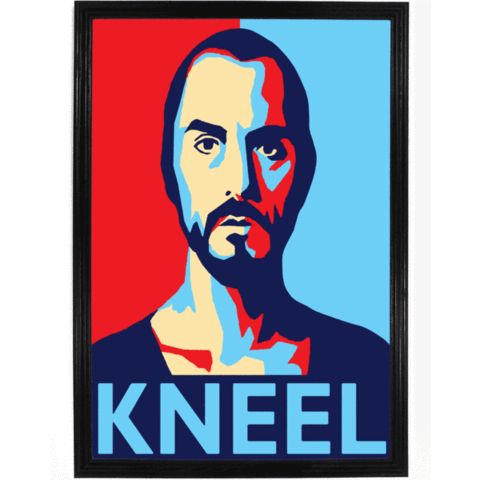
He promises safety and security. You just have to kneel.
W.J. Astore
What is true national security? Recent answers to this question focus on the U.S. military, Homeland Security, various intelligence agencies, and the like. The “threat” is usually defined as foreign terrorists, primarily of the Islamist variety; marauding immigrants, mainly of the Mexican variety; and cyber hackers, often of the Russian variety. To “secure” the homeland, to make us “safe,” the U.S. government spends in the neighborhood of $750 billion, each and every year, on the Department of Defense, Homeland Security, and intelligence agencies such as the CIA and NSA (and there are roughly 15 more agencies after those two goliaths).
But what makes people truly secure? How about a living wage, decent health care, and quality education? Affordable housing? Some time off to decompress, to pursue one’s hobbies, to connect with family and friends, to continue to grow as a human being? Water without lead, air without toxins, land without poisons?
These thoughts came to me as I read the usual anodyne statement put out by Lt. Gen. H.R. McMaster, nominated as President Trump’s new National Security Adviser. “The safety of the American people and the security of the American homeland are our top priorities,” McMaster said in his statement.
I agree that safety and security are important, but I wouldn’t place them as America’s top priorities, even in the realm of national defense. Our top priority is supporting and defending the U.S. Constitution, including all those rights and freedoms that are often threatened in nervous and excitable times. Institutions like the press, freedoms like the right to assemble and protest, the right to individual privacy, and the like.
When the powerful threaten those freedoms, as President Trump is doing by denouncing the press as the enemy of the people, that very act is a bigger threat to national security than ISIS or illegal immigrants or Russian hackers or what-have-you.
Security is not just about weapons and warriors and killing terrorists and other “bad hombres,” and safety is not just about guarding your money and property or even your person from physical harm. Safety and security draw their strength from our Constitution, our communities, and our societal institutions, not only those that catch and punish criminals, but those that enlighten us, those that make us better, those that enrich our souls.
In the USA, we have a very narrow and negative definition of safety and security. It’s a definition that’s been increasingly militarized, much like our government, over the last few decades.
We’d be wise to broaden and deepen our view of what security and safety really mean; we’d be especially wise not to allow leaders like Donald Trump to define them for us. In their minds, security and safety mean doing what you’re told while shutting up and paying your taxes.
Kneeling before General Zod (to cite Superman for a moment) or indeed any other leader is not what I call safety and security.
Update: Just after I wrote this, I saw these two headlines from today: “Trump on deportations: ‘It’s a military operation,'” and “Trump adviser Bannon assails media at CPAC: Of media coverage of Trump, Steve Bannon said: ‘It’s not only not going to get better — it’s going to get worse every day… they’re corporatist, globalist media.'”
There you have it: militarization (at least of rhetoric) and scapegoating of the media before the fact. Judge Trump, Bannon, and Co. by their deeds, but also by their words.
Update 2: Last night, a PBS report noted that the USA, with less than 5% of the world’s population, accounts for 80% of opioid prescriptions. The overuse of powerful and addictive painkillers points to serious problems in national morale. Even as many Americans have poor access to health care or overpay for it, America itself is awash in prescription drugs, many of them either highly expensive or highly addictive, or both. This reliance on prescription drugs is a sign of a complex communal malaise, yet the government seems most focused on policing the use of marijuana, which is now legal in many states.
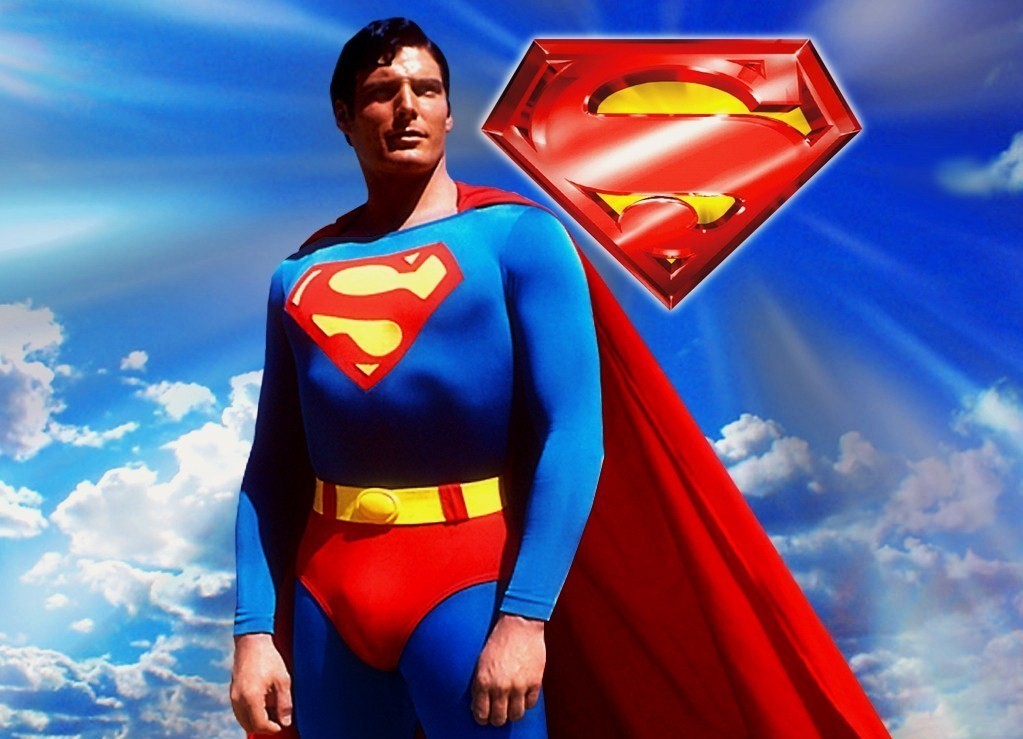
He said he fought for truth, justice, and the American way. Why does that seem so much more far-fetched today?
W.J. Astore
This is an Andy Rooney moment for me, but did you ever notice how Americans tend to favor either humongous trophy houses (McMansions), or closet-like tiny houses? Did you ever notice how so many Americans tend to be either very fat or super fit? Crusading evangelicals or militant atheists? Faithful believers in creationism or fervid followers of science? Proud “cave man” carnivores or proselytizing vegans? Coffee fiends or caffeine avoiders? Lushes or teetotalers? Materialists and hoarders or declutterers and minimalists?
The list of opposites, of extremes, goes on. Heck, why not include Obama supporters or Trump followers? Obama is urbane, sophisticated, cerebral, “no drama.” A devoted family man with one very successful marriage. The Donald? Well, let’s just say he’s very different than our sitting president. And I’m not talking skin color.
A good friend of mine once complained about his fellow Americans that he didn’t necessarily mind their extremism. What he did mind was their efforts to convert him to whatever extreme causes they believed in. Rodney King famously asked, Can’t we all just get along? My friend’s cry was more plaintive: Can’t you all just leave me alone?
As Trump crawls closer to power, America risks devolving even more into a society where the byword is “My way or the highway.” Where the national motto is no longer “In God we trust” or the older “E pluribus unum” (out of many, one) but instead “America: love it or leave it.”
I once read a great rejoinder to the “America: love it or leave it” sentiment. I first saw it in a bicycle repair book. The author simply added this coda: “Or change it.”
Extremism in the pursuit of your own selfish definition of “liberty” can indeed be a vice, America. We need to reject a black/white, love/hate, on/off, Manichean view of each other and the world. Moderation as a way of pursuing a more inclusive and compassionate world can indeed be a virtue.
That doesn’t mean one submits supinely to injustice. That doesn’t mean one surrenders meekly to tyrants. What it does mean is a rejection of a “shoot first, ask questions later” approach to life and each other. We have enough polarization already in America, and we certainly have enough death.
Superman used to say he fought for truth, justice, and the American way. There was a sense, a few generations ago, that those words were not laughable. That they meant something. We need to get back to those times.
In the crusade against Communism, otherwise known as the Cold War, the U.S. saw “freedom” as its core strength. Our liberties were contrasted with the repression of our chief rival, the USSR. We drew strength from the idea that our system of government, which empowered people whose individualism was guided by ethics based on shared values, would ultimately prevail over godless centralism and state-enforced conformity. An important sign of this was our belief in citizen-soldiers rather than warriors, and a military controlled by democratically-elected civilians rather than by dictators and strong men.
Of course, U.S. foreign policy during the Cold War could be amoral or immoral, and ethics were often shunted aside in the name of Realpolitik. Even so, morality was nevertheless treated as important, and so too were ethics. They weren’t dismissed out of hand.
Fast forward to today. We no longer see “freedom” as a core U.S. strength. Instead, too many of us see freedom as a weakness. In the name of defeating radical Islamic terrorism, we’ve become more repressive, even within the USA itself. Obedience and conformity are embraced instead of individualism and liberty. In place of citizen-soldiers, professional warriors are now celebrated and the military is given the lion’s share of federal resources without debate. Trump, a CEO rather than a statesman, exacerbates this trend as he surrounds himself with generals while promising to obliterate enemies and to revive torture.
In short, we’ve increasingly come to see a core national strength (liberty, individualism, openness to others) as a weakness. Thus, America’s new crusades no longer have the ethical underpinnings (however fragile they often proved) of the Cold War. Yes, the Cold War was often unethical, but as Tom Engelhardt notes at TomDispatch.com today, the dirty work was largely covert, i.e. we were in some sense embarrassed by it. Contrast this to today, where the new ethos is that America needs to go hard, to embrace the dark side, to torture and kill, all done more or less openly and proudly.
Along with this open and proud embrace of the dark side, America has come increasingly to reject science. During the Cold War, science and democracy advanced together. Indeed, the superior record of American science vis-à-vis that of the Soviet Union was considered proof of the strength and value of democracy. Today, that is no longer the case in America. Science is increasingly questioned; evidence is dismissed as if it’s irrelevant. “Inconvenient truths” are no longer recognized as inconvenient — they’re simply rejected as untrue. Consider the astonishing fact that we have a president-elect who’s suggested climate change is a hoax perpetrated by China.
Yesterday, I saw the following comment online, a comment that summed up the new American ethos: “Evidence and facts are for losers.” After all, President-elect Trump promised America we’d win again. Let’s not let facts get in the way of “victory.”
That’s what a close-minded crusader says. That the truth doesn’t matter. All that matters is belief and faith. Obey or suffer the consequences.
Where liberty is eroded and scientific evidence is denied, you don’t have democracy. You have something meaner. And dumber. Something like autocracy, kleptocracy, idiocracy. And tyranny.
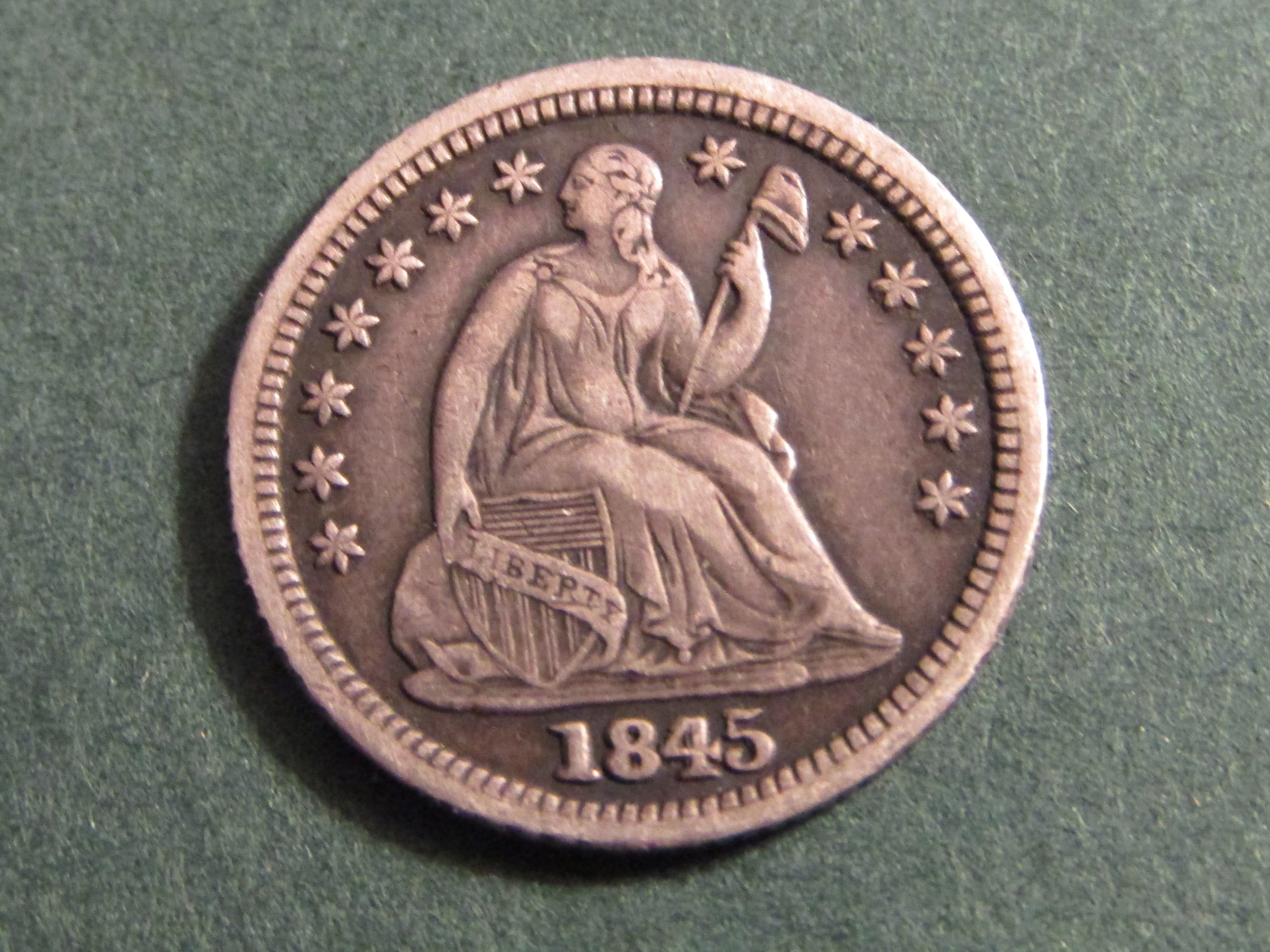
When I was a kid, I was a stamp collector. My dad, in contrast, saved old coins. He was not a collector; he didn’t file them away in special folders. He just tossed old silver coins into a cigar box.
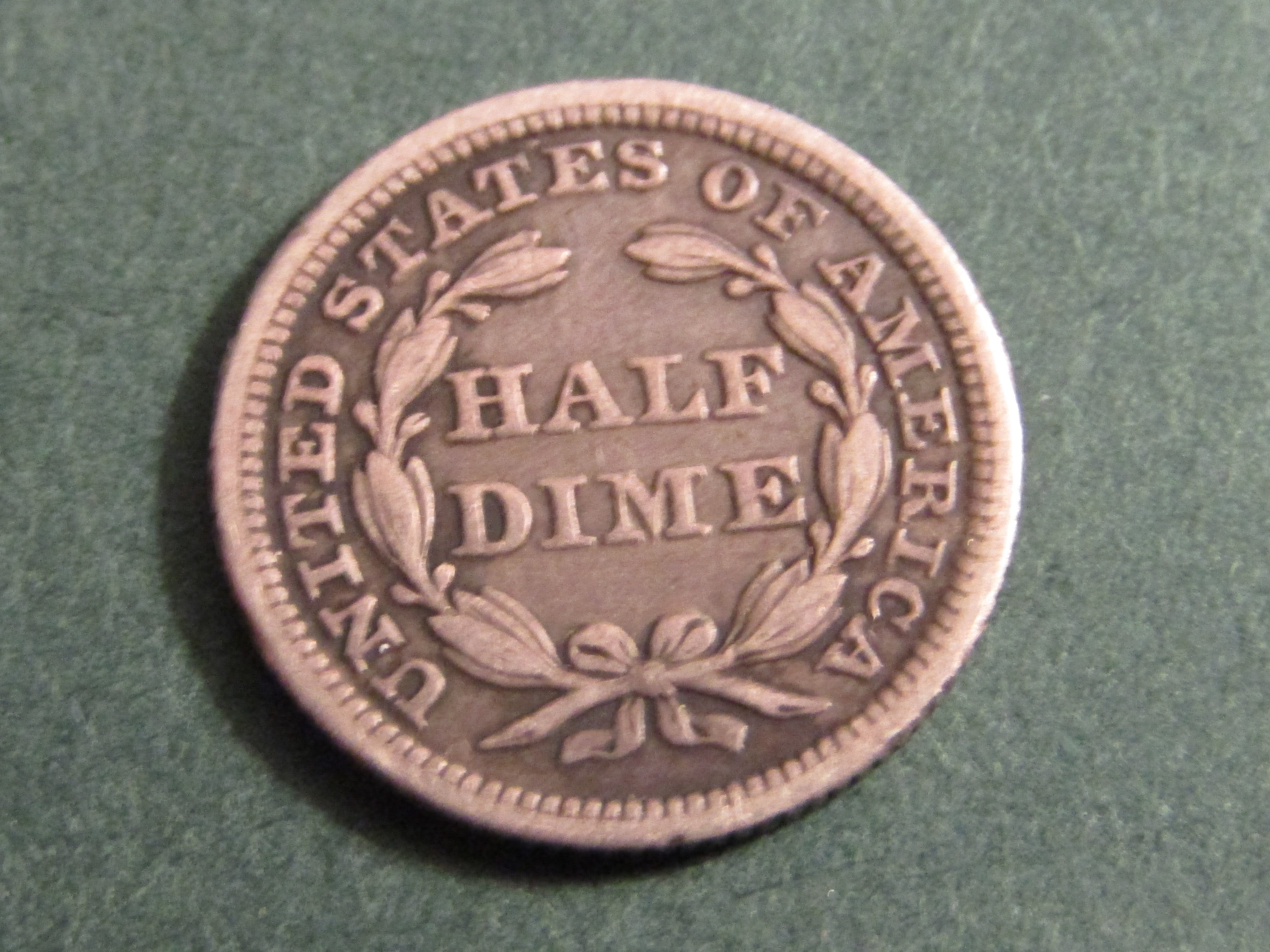
My favorite coin of his was also the oldest one he had: a “half dime” from 1845. To me, it’s a remarkably simple and aesthetically pleasing design, featuring a seated figure of “Liberty” on the obverse, with the words “Half Dime” on the reverse.
Note what’s missing: the words “In God We Trust.” This motto was not added to coins until the national trauma of the U.S. Civil War reinforced religious revivals that had preceded that war. It made its first appearance in 1864. (Interestingly, in the “Pledge of Allegiance,” the words “under God” were added only in 1954 during another crisis, the fear of communism stoked by McCarthyism during the Cold War.)
As a nation it seems we invoke God during crises, calling on Him for support and guidance and blessing.
But I want to return to my dad’s half dime from 1845, because that coin, in its simplicity, enshrines a value that is most fundamental to our country: Liberty.
With respect to religion, liberty to me means the freedom to worship God in one’s own way, to include the freedom not to worship God, even the freedom to express disbelief in God.
Such liberty was extremely rare in the 18th century when our nation was founded. Back then, being labeled an “atheist” was roughly equivalent to being labeled a “terrorist” today. But our nation’s founders were of diverse religious persuasions, to include Catholics and Quakers as well as myriad branches of “dissenting” Protestantism. A few were deists (Thomas Jefferson most famously) who rejected the Trinitarian Christianity of most of their peers, and a small number (Thomas Paine, perhaps) were skeptics to the point of atheism.
What united them was a belief in liberty. In religion, this was expressed as the freedom to worship in any way you chose, or not to worship at all. Thus there was no religious “test” for office, no requirement to be a Christian or to express a belief that “In God We Trust.”
That profound belief in personal freedom — in liberty first — is captured on my dad’s old coin. It’s also captured in the Pledge of Allegiance before 1954: “one nation indivisible with liberty and justice for all.”
In today’s political climate, with all of our public prayers and calls to God to bless America, with talk of Muslims not being allowed to hold office because their god is somehow the wrong god, we need to recall that America was founded on Liberty first.
Or as my mom put it in her inimitable way, “You worry about your soul and I’ll worry about mine.” Jefferson and Paine would have liked my mom.
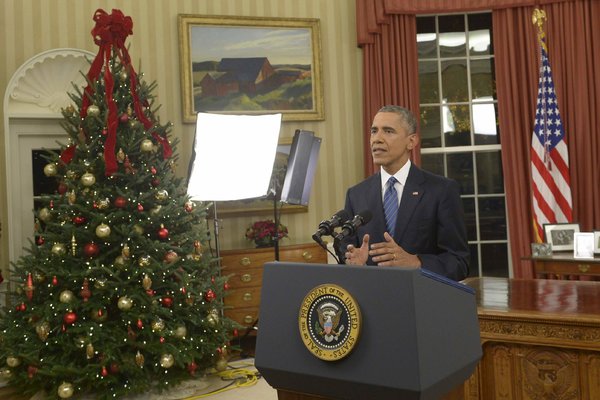
My wife and I watched the president’s speech last night. Overall, it was a solid, even praiseworthy, performance. First, we had to get past the NBC pre-speech fear-mongering. Lester Holt and Chuck Todd, the NBC commentators, were talking about how afraid Americans were, hinting that we all feared our holiday parties would be invaded by active shooters bent on murder. My wife and I looked at each other. Are you fearful, honey? Neither am I.
President Obama himself made many good points. Yes, we shouldn’t vilify Muslim-Americans or condemn all of Islam. Yes, we shouldn’t commit major ground forces to the Middle East to chase ISIL terrorists. Yes, we need sane gun control measures in the USA. Nobody needs an AK-47 or AR-15 (these are not hunting guns: they are military assault rifles designed to kill people). And nobody needs the right to buy a gun if they’re on a “no fly” list as a possible terror threat.
These were “common sense” points, and it pains me to think the president has to belabor what should be obvious. But he does. Because the National Rifle Association wants no restrictions on gun ownership, and the radical right does want to vilify Muslims, commit large numbers of U.S. ground troops to the Middle East, and extend a regimen of militarized surveillance and security at home that will make us even less safe.
Where President Obama consistently disappoints is what he leaves unsaid. That the U.S. invasion and occupation of Iraq essentially created ISIL; and that his policy of overthrowing the Syrian government by arming indigenous Arab forces contributed to it (according to Lieutenant General Michael Flynn, formerly head of the Defense Intelligence Agency). That his strategy of drone assassination (so-called signature strikes that are often based on faulty intelligence) is creating more terrorists than it kills, as several military drone operators have recently argued.
Defenders of the U.S. drone assassination program argue that it’s not the intent of the U.S. government to kill innocents, therefore the U.S. is free from blame. Try telling that to those who have lost loved ones to drones. (So sorry: We didn’t mean to kill your mother/brother/loved one. Wrong place/wrong time: an explanation as infuriating as it is unconvincing.)
President Obama concluded by arguing that he needed even more of a blank check (in the form of a Congressional authorization) to prosecute the war on terror. All in the name of keeping Americans safe, naturally. But he has it exactly backwards. Congress needs to exercise more oversight, not less. Imagine giving President Donald Trump a Congressional blank check to exercise the war on terror. Not such a good idea, right?
Finally, and disappointingly, Obama misunderstands the solemn duty of his office. As commander in chief, Obama believes his first duty is to keep Americans safe and secure. Wrong. His first duty is to “preserve, protect and defend” the U.S. Constitution and the rights, freedoms, and responsibilities defined within. Put bluntly, you can’t keep Americans safe and secure by abridging their rights to freedom of speech or to privacy or to dissent. “Safety” and “security” were not the bywords of America’s founders. Liberty was. And liberty entails risks.
A saying popular on the right is Thomas Jefferson’s “The tree of liberty must be refreshed from time to time with the blood of patriots and tyrants.” In the USA today, “tyranny” is most likely to come in the form of a leader who promises to keep us safe and secure at any cost. (Just look at the Republican candidates for president with their calls for Muslim detention camps, mass expulsion of immigrants, the shuttering of houses of worship, and similar measures of repression.)
The president was right to argue that we must not betray our values. He was right to talk about human dignity. He was right to say that freedom is more powerful than fear. Now we as Americans need to live up to those words. And so does he.




 Bracing Views