When Barack Obama took over as president in 2009, the global war on terror, or GWOT, just didn’t seem to fit the tenor of his “hope” and “change” message. So wars in Iraq and Afghanistan were rebranded as “overseas contingency operations.” Talk about the banality of evil! Even Orwell’s Big Brother might be impressed by OCOs as a substitute for invasion and war.
A euphemistic word Obama didn’t banish was “surge.” The “surge” in Iraq allegedly had worked under General David Petraeus, even though its gains proved as “fragile” and “reversible” as Petraeus hinted they would be. So Obama conducted his own surge in Afghanistan, the so-called good or smart war after the Bush/Cheney disaster in Iraq. And of course the “gains” in Afghanistan also proved both fragile and reversible, though no one was held to account for the miserable failure of the Afghan War. Whoops. I mean the Afghan contingency operation for democracy and enduring freedom.
Showing that he too could learn from America’s folly, Vladimir Putin termed his invasion of Ukraine a “special military operation.” U.S. leaders laughed at this, criticizing Putin for his propagandistic euphemism, even as they persisted in using terms like “overseas contingency operation” for America’s “kinetic” military actions. The eye of the beholder, I guess.
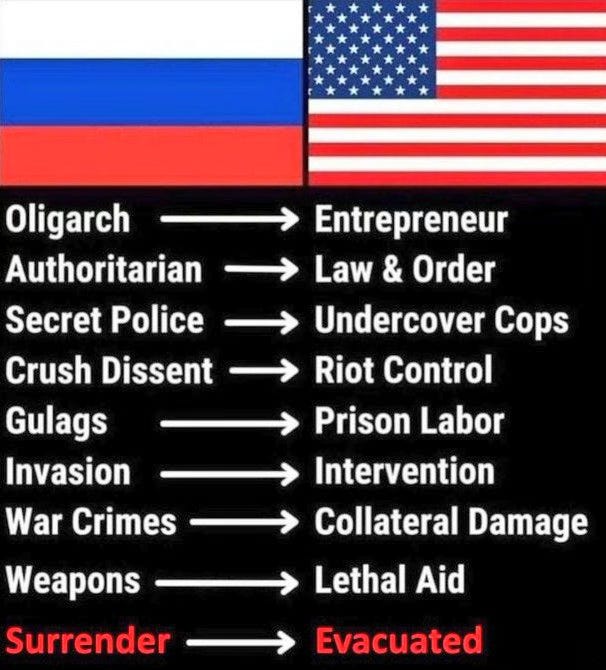
These thoughts came to mind as I perused my Twitter/X feed yesterday and spied this illustration posted by Chay Bowes:
Though the Russian flag is on the left, it could be the flag of China, Iran, North Korea, or any other alleged evildoer. The Russians invade, we intervene (for the sake of democracy, naturally). The Russians commit war crimes, we have unfortunate instances of collateral damage. In the war of the words, the U.S. military is clearly rather clever in a self-aggrandizing and self-exculpatory way.
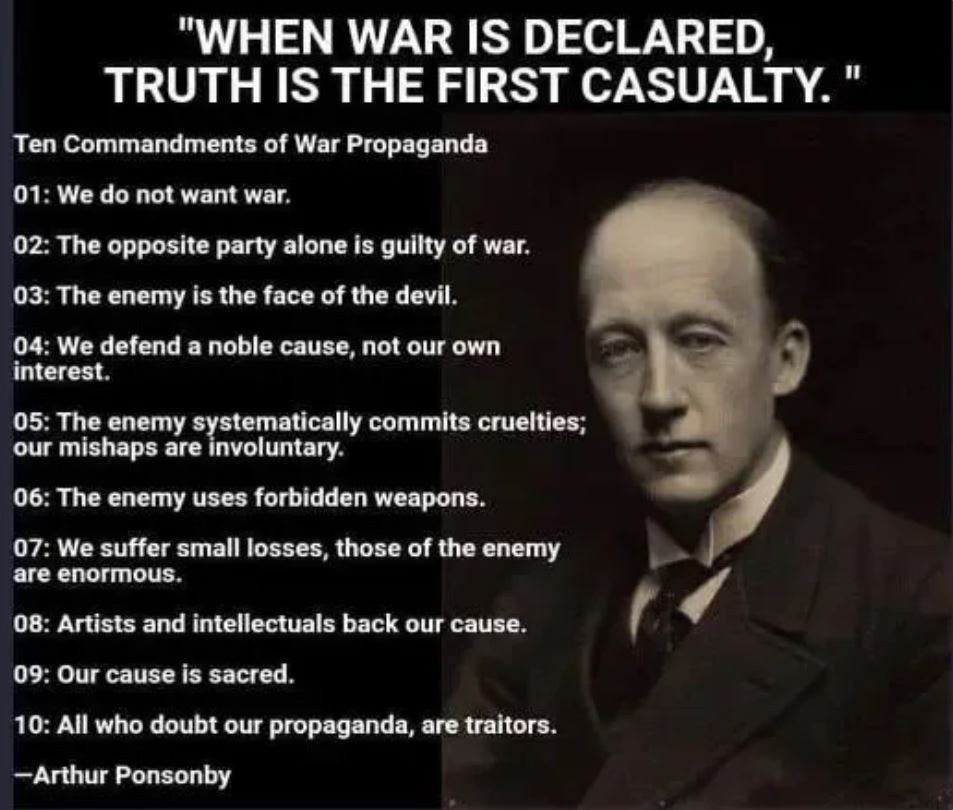
Looking at comments from this Twitter feed, I came across another useful illustration of manipulating language and information in the cause of war. Take a gander:
I confess I’d never heard of Arthur Ponsonby and his book, Falsehood in War-Time. I need to check it out.
This may prove a handy list to keep around as America’s national (in)security state acts to gin up the next war.
History teaches that you can have genocide without war, you can have war without genocide, and you can have war and genocide together. In Gaza today, the right-wing Israeli government is clearly engaged in a war on the Palestinian people that amounts to a genocide.
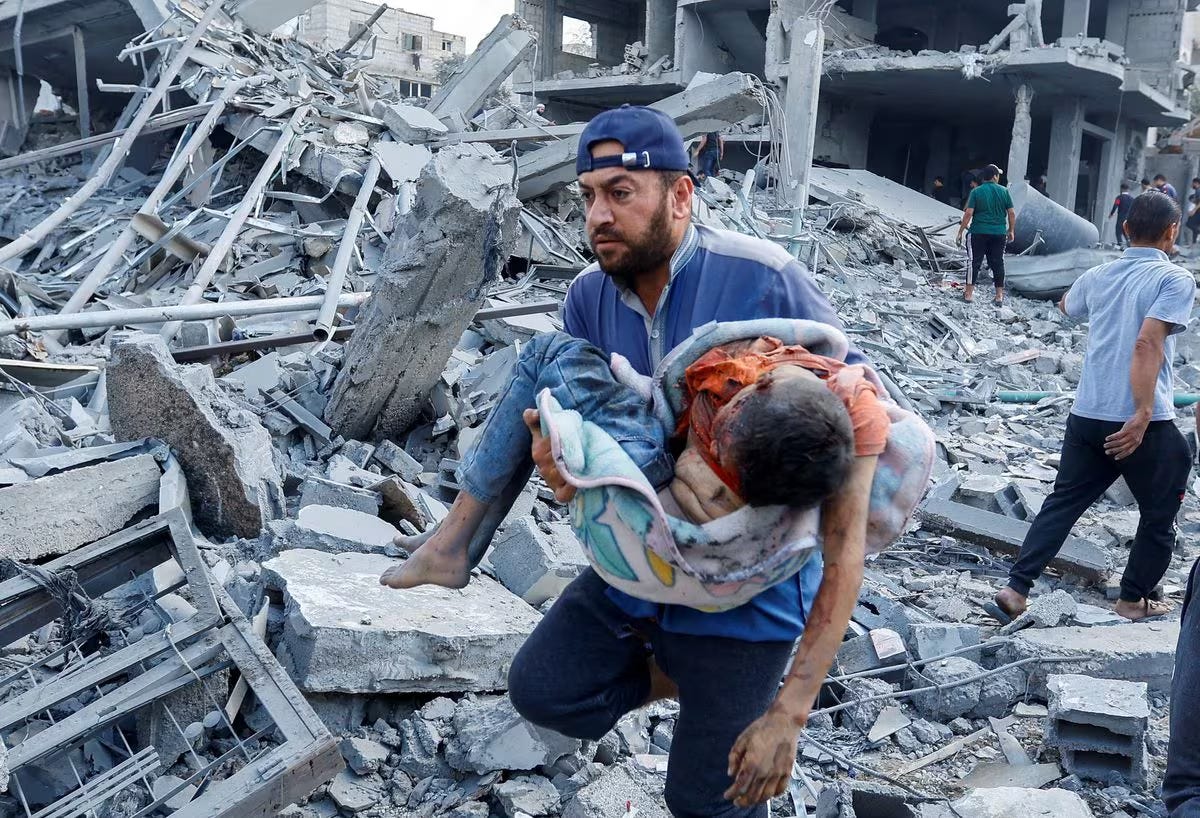
The horrific face of genocidal war
Of course, Israeli leaders claim they are engaged in a war against Hamas, and Hamas alone. Events, however, prove they are engaged in a genocidal war of annihilation.
A few harrowing data points: Israeli forces have already killed or wounded 100,000 Palestinians in Gaza. Journalist Chris Hedges reports that Israel:
has damaged or destroyed all 12 of Gaza’s universities. Some 280 government schools and 65 UNRWA-run schools have also been destroyed or damaged, often resulting in dozens of fatalities. About 133 remaining schools are used to shelter those displaced by the assault. More than 85 percent of Gaza’s 2.3 million people have been driven from their homes amid continued Israeli ground and air offensive that has killed more than 25,000 [now more than 28,000] people, including 10,000 [now more than 12,000] children.
Clearly, Israeli leaders are using war as a means of genocide, an excuse for it, as well as a form of camouflage for it. Don’t be deceived. War and genocide can and do coexist and feed off each other, as did the Nazi Holocaust against the Jews during World War II. As Israeli leaders readily admit to war while dissembling about genocide, at least they can be justly accused of war crimes while being held to international agreements governing the conduct of war, such as the Geneva Conventions.
Israel’s genocidal war, if left unchecked, will eliminate Gaza and its people. That is the stated intent of the Netanyahu government, which spouts the worst kind of eliminationist rhetoric, rhetoric that amounts to a “final solution to the Palestinian question.”
Any country that arms Israel in its genocidal war is complicit. Guess which country is clamoring to send another $14 billion in weaponry to Israel so it can pursue its war/genocide in Gaza? Yes: The United States of America.
In Gaza, both Hamas and Israel may act savagely and cruelly, but only one side truly has the means at its disposal to slaughter the other, and that side is Israel. Meanwhile, the mainstream media reserves words like “slaughter” for Hamas, even as Israeli forces kill Palestinians on a massive scale.
Clearly, the current strategy of the Israeli government is to destroy Gaza, making it uninhabitable, forcing the Palestinians in Gaza to leave or die.
When Israel is done in Gaza, they will turn to the West Bank. As Netanyahu said, Israel’s goal is to dominate Palestine “from the river to the sea.” Palestinians “in the way” are being killed, or starved, or expelled, or (if lucky) reduced to subjects under intolerable conditions of apartheid.
The Israeli government is getting away with this because it has the legal, military, and propaganda cover of the U.S. and much of Europe as well. The Biden administration complains about the worst excesses of Israel’s genocide while sending its leaders the weapons they need to continue the killing. Members of Congress like Nancy Pelosi suggest that earnest Americans calling for a ceasefire in Gaza are the useful idiots of Vladimir Putin.
It seemingly never occurs to Biden and Pelosi that they are the useful idiots of Bibi Netanyahu.
Stop the war in Gaza. Stop the genocide.
Postscript: The “Words About War” Team have posted ten suggestions for writing and talking more clearly, honestly, and accurately about Israel’s genocidal war in Gaza. Please go to https://www.wordsaboutwar.org/gaza.html.
Did you know the Russia-Ukraine War is a great “investment” for the United States? A terrific opportunity to kill lots of Russians and to destroy lots of their military equipment at a relatively cheap cost to us? (Just don’t mention the price paid by Ukraine.) It gives new meaning to the expression “making a killing” on the “market.”
To Gordon Gekko’s infamous “greed is good” speech we must now add “war is good.” That war is “right.” That it “works”—at least for America, allegedly.
War as an “investment” truly symbolizes the moral bankruptcy of conventional discourse in the U.S. political mainstream. Instead of war being a calamity, a catastrophe, a realm of death and destruction, dare I say even a mortal sin of grievous evil, we’re told that instead it’s an investment that’s paying dividends, especially in that growth stock known as Ukraine.
We can’t let MAGA Republicans stop the Ukraine “investment,” can we? Not when it’s paying such great dividends
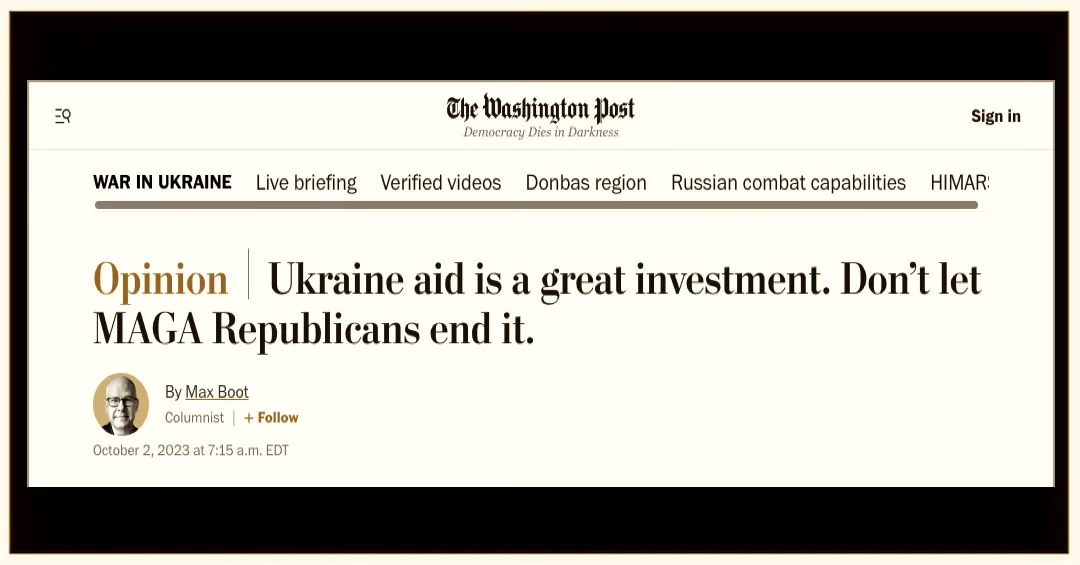
Even body counts and truck counts from the Vietnam War era are being brought back to show what a great “investment” the Ukraine War has been for the U.S. In her latest, Caitlin Johnstone cites war-lover Max Boot for his advocacy of the Russia-Ukraine War as a continuing investment opportunity for the U.S., including the use of body and truck counts as a measure of progress:
“Russia has lost an estimated 120,000 soldiers and 170,000 to 180,000 have been injured,” [Max] Boot writes [in a Washington Post op-ed]. “Russia has also lost an estimated 2,329 tanks, 2,817 infantry fighting vehicles, 2,868 trucks and jeeps, 354 armored personnel carriers, 538 self-propelled artillery vehicles, 310 towed artillery pieces, 92 fixed-wing aircraft and 106 helicopters.”
“The Russian armed forces have been devastated, thereby reducing the risk to front-line NATO states such as Poland and the Baltic republics that the United States is treaty-bound to protect,” Boot continues. “And all of that has been accomplished without having to put a single U.S. soldier at risk on the front lines.”
“That’s an incredible investment,” gloats Boot.
At no time in his masturbatory gushing about how many Russians this war has helped kill does Boot make any mention of the immense toll this deliberately provoked and completely unnecessary war has taken on Ukrainian lives. Their deaths and dismemberments and displacement are the largest price being paid into this “investment” by far, but Boot doesn’t deem them worthy of even a footnote.
We’ve been seeing this “investment” line being promoted with increasing frequency by US empire managers and their apologists. In an article published in the Connecticut Post last month, Senator Richard Blumenthal assured Americans that “we’re getting our money’s worth on our Ukraine investment.” A few days prior to that Senator Mitt Romney had described the proxy war as “the best national defense spending I think we’ve ever done,” because “We’re diminishing and devastating the Russian military for a very small amount of money… a weakened Russia is a good thing.” In December Senate Minority Leader Mitch McConnell said that funding the proxy war is “a direct investment in reducing Vladimir Putin’s future capabilities to menace America, threaten our allies and contest our core interests.” Last November the imperial war machine-funded think tank Center for European Policy Analysis published a report arguing that “US spending of 5.6% of its defense budget to destroy nearly half of Russia’s conventional military capability seems like an absolutely incredible investment.”
Imagine the vacuity, the bankruptcy, the venality, the sinfulness of writing about war and killing as “an absolutely incredible investment.” And what is our ROI, our return on investment? A lot of dead and wounded Russians and Ukrainians, a devastated and poisoned landscape, millions of war refugees, and an increasing likelihood of a wider war that could possibly go nuclear. ROI, indeed.
War is many things, but it is not an “investment.” People who talk and write like this have no moral center. They are soulless. They are automatons of war.
Military invasions don’t produce democracies—who knew? Whether in Afghanistan or Iraq, somehow the U.S. government worked to convince itself and the American people that democracy could be exported at rifle point. Not surprisingly, military invasions spread what they usually do: death, destruction and chaos while sowing seeds for further violence and conflict. Such is one of the many lessons of Bush/Cheney’s disastrous decision to invade Iraq 20 years ago this weekend.
When the U.S. invaded Iraq in March of 2003, I was still on active duty in the military. I was a lieutenant colonel assigned to the Defense Language Institute Foreign Language Center in Monterey, California, or DLI for short. I can tell you this: the U.S. government expected a short and utterly victorious war, since there was no direction to us to expand foreign language training in Arabic. Only after Bush’s premature “Mission Accomplished” speech and the war’s subsequent degeneration into occupation, torture, battles of frustration like Fallujah, and subsequent quagmire did DLI finally get direction and more resources to expand training in Arabic.
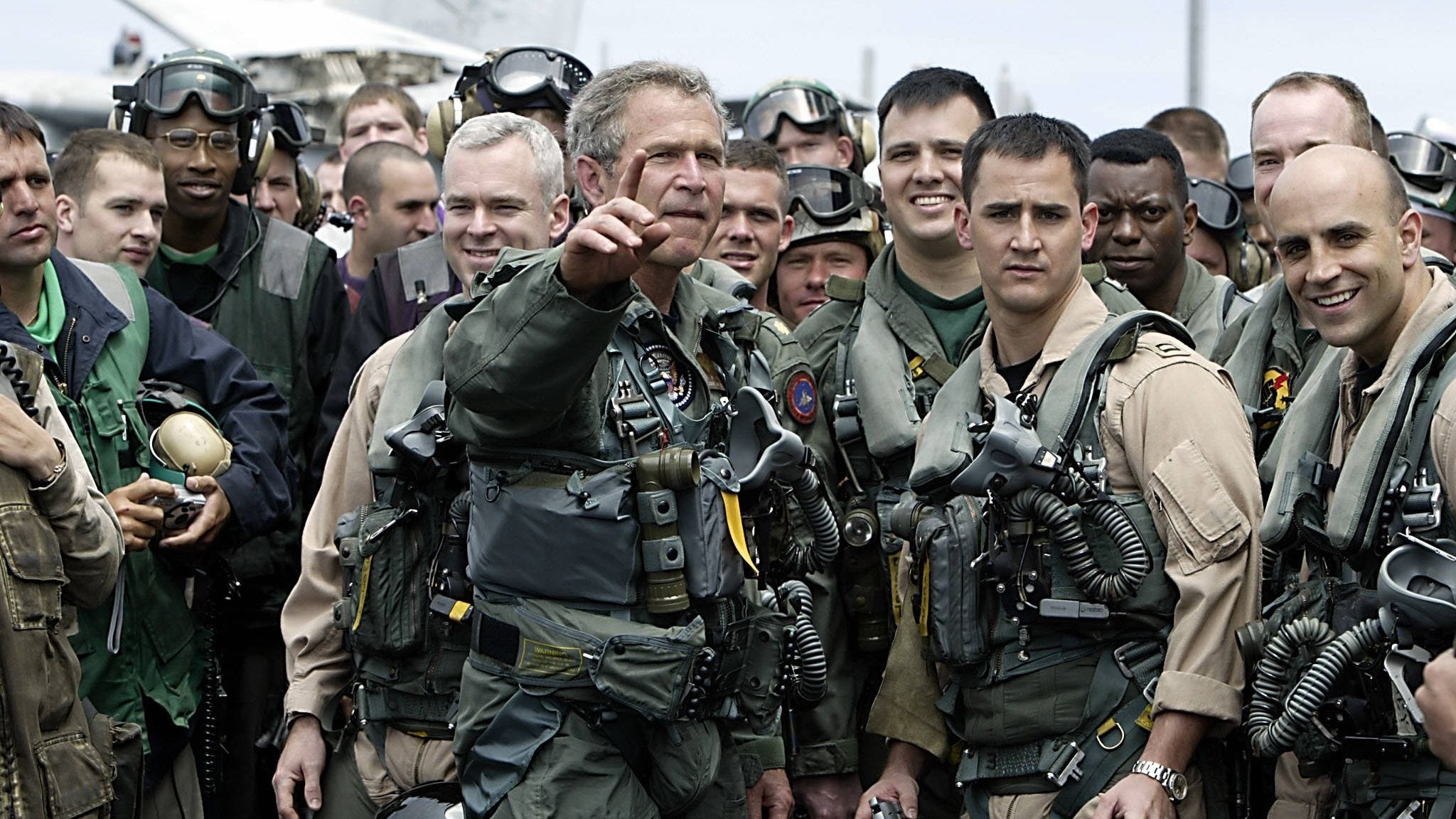
Mission Accomplished! But the Iraq War had only just begun.
That led to my first and only interview as a military officer in May 2005, when a reporter for the CS Monitor asked me about the importance of language training for U.S. troops. Here was my glib reply:
“We are trying to win the peace, and it is very important for us to be able to communicate even at a basic level,” says Lt. Col. William Astore, dean of students at the DLI. “I would much rather have soldiers communicate using words rather than using a rifle butt.”
OK as far as it went, but by the middle of 2005 we had already lost the peace in Iraq and Afghanistan. For one thing, we simply had too few troops with language skills, and it took 16 months to train them to a decent level of competence in Arabic. So we resorted to those rifle butts—and worse.
Another minor controversy at the time was the loss of skilled linguists to the military’s “Don’t ask, don’t tell” policy. As soon as a soldier said he was gay, he was basically gone, regardless of his language proficiency. A few troops gamed the system, finishing the bulk of their language training then self-reporting they were gay. That was enough to get them discharged.
Along with that mess, I recall a friend of mine, an Army major, being sent to Iraq in 2004 and working for the CPA, the Coalition Provisional Authority. He said he and his colleagues at the CPA knew Iraq wasn’t ready for the transfer of power overseen by the hapless L. Paul Bremer, but it went ahead anyway for political reasons.
He also told me how the military filled billets at the CPA and in the Green Zone of Baghdad. Basically, Big Army tasked unit commanders for bodies. The DLI Commandant sent one of his best officers, an experienced and skilled FAO (foreign area officer). But many other commanders took advantage of this “draft” by sending their worst officers to Iraq, the under-performers. At the same time, the Bush/Cheney administration was recruiting inexperienced civilians for Iraq and vetting them based on their views on abortion, capital punishment, and similar hot-button issues within the Republican Party. Combine less-than-competent officers with unprepared and largely clueless civilians and it’s not surprising the CPA performed poorly.
My experience with the chaos of Iraq was indirect and limited, but I well recall an urgent tasking to DLI to help with the translation of a Peter, Paul & Mary song to promote tolerance within Iraqi schools. No, I’m not kidding. Some American in Iraq decided a smart way of defusing ethnic and religious tensions in Iraq was to translate a song for kids. So we gathered some of our best Arabic instructors and quickly learned the song was more than problematic. It was about American kids making fun of other kids with braces and glasses, but any Iraqi kid with braces or glasses would be fortunate indeed. Other lines of the song mentioned gays, lesbians, and a teenage mother trying to overcome her past — not a place we wanted to go.
The song just didn’t translate, just like much of the American effort “to win the peace” and build a stable democratic Iraq didn’t translate (if you accept for the moment that that was the true mission). Too many Americans were prisoners of their own illusions in Iraq, or trying to make a fast buck, while troops at the front were simply fighting to survive a ghastly war, a war that was obviously far worse for the Iraqi people.
In the first few weeks of the Iraq invasion in 2003, the U.S. military did its job fairly well, and by that I mean the narrow mission of destroying Iraqi forces and overthrowing Saddam Hussein. After that, it was one disaster after another, one lie after another, because once Saddam was removed from power and the Iraqi military was disbanded, all hell broke loose. Civil war was the result, and, as I wrote in 2007, you can’t win someone else’s civil war. What we got in place of a “win” were the lies of Bush/Cheney and of General David Petraeus about “progress” in the Surge. But as the weasel Petraeus always said, his “gains” were fragile and reversible, and so they proved.
Of course, the Iraq War was based on alarmist lies (those WMD that weren’t there, those mushroom clouds in American skies). It was then preserved by lies until the lies could no longer be countenanced (or until they proved no longer profitable). Yet the liars were promoted (whether in the military or outside of it) and those who warned of the folly of war 20 years ago or those who tried to reveal the truth about war crimes or profiteering during the war were punished.
Though Donald Rumsfeld lost his job as Defense Secretary, few in the hierarchy were ever called to account for their crimes and blunders, so little was learned and much was forgotten.
So, it’s on to the next war, this time with China or Russia or Iran or whomever, but not to worry, the experts that brought you Iraq and Afghanistan and all the rest will get it right. Just look at their track record and how much they’ve learned!
Most drone-strike images show technology, e.g. drones, missiles, or targeting crosshairs with foreigners appearing as ant-like creatures in infrared cameras. Rarely do we see damage, and, rarer still, the shredded and blasted bodies of innocents
W.J. Astore
When do humans count in drone warfare, and when do they not?
I thought of this question as I read Christopher Fuller’s “See It/Shoot It: The Secret History of the CIA’s Lethal Drone Program.” Revealingly, U.S. pilots and crews who operate these drones, such as Predators and Reapers, reject the terminology of “drones” and UAV (unmanned aerial vehicle) or UAS (unmanned aerial system). They prefer the term RPA, or remotely piloted aircraft. They want to be known as the essential humans in the loop, they want to stand out, they want to count for something, and in fact the Department of Defense at various times has suggested a new “drone medal” to recognize their service.
Whereas American pilots want to stand up and be recognized as the pilots of their “remote aircraft,” the Pentagon doesn’t want to think about the targets of these drones as human beings. Civilian casualties are grouped and shrouded under the term “collateral damage,” a nasty euphemism that combines a banking term (collateral) with the concept of damage that hints at reversibility and repair. But collateral damage really means innocents blown up and blasted by missiles. Shouldn’t these humans count?
Another term that Fuller discusses is “neutralization.” The U.S. counterterrorism goal is to “neutralize” opponents, meaning, as Fuller notes, “killing, rendition, and imprisonment.” Again, with a word like neutralization, we’re not encouraged to think of those being attacked as humans. We’re just “neutralizing” a threat, right? A terrorist, not a fellow human being. Right?
Interestingly, the whole idea of terrorism is something they do, not us. Why? Because the U.S. defines terrorism as “premeditated, politically motivated violence perpetrated against noncombatant targets by subnational groups or clandestine agents.” Note that word: subnational. By this definition, nations do not commit terrorism, which is handy for the U.S., which presents its drone attacks as defensive or proactive or preemptive.
Finally, the Pentagon and the CIA are at pains to assert they take the utmost care in reducing “collateral damage” in their “neutralization” efforts. Yet as Fuller notes in his book (page 214), “the U.S. government did not always know the identity or affiliations of those killed in its drone strikes.”
So who counts, and who doesn’t? Whose humanity is to be celebrated (pilots of RPAs?), and whose humanity (innocent victims) is to be suppressed?
Addendum: On how the U.S. seriously undercounts civilian deaths in its air strikes, see this article.



 Bracing Views