The scary part is that the official death toll of 76,134 is an undercount. So many bodies remain under rubble or just plain obliterated by bombs.
Of course, the so-called cease fire in Gaza is anything but as Israel continues its policy of not-so-selective killing and slow strangulation. If you suggest genocide is wrong, the predictable response from the Israeli-U.S. government is that you’re a Hamas terrorist sympathizer and probably an anti-Semite as well (the latter is true even if you’re Jewish).
Coincidentally, I just took a drink after typing that and started choking. OK, maybe that wasn’t a coincidence.
I remember during Catholic service we’d sing the hymn: “Whatsoever you do to the least my brothers, that you do unto me.” I guess they’re just empty words to all those avowed Christians in the government.
Back in June of 2023, I wrote a letter to my archdiocese in response to a request for money. (I am a lapsed Catholic who has in the past given money to the Church.) Here is the letter I wrote, with some follow-on thoughts:
*****
June 2023
Most Reverend ***
Archdiocese of Boston
Dear Reverend ***
I received your Catholic Appeal funding letter dated June 1st. I won’t be contributing…
[Well into the 1990s,] I took my Catholic faith seriously; in fact, my master’s thesis at Johns Hopkins, which examined Catholic responses to science in the mid-19th century, especially Darwinism, geology, and polygenism, was published in the Catholic Historical Review. But scandals involving the Church drove me to question my commitment to Catholicism and especially its patriarchal hierarchy, which was so intimately involved in the coverups of crimes committed against innocents.
I grew up in Brockton, Mass., where the archdiocese assigned a predatory priest to our church of St. Patrick’s. His name was Robert F. Daly. He abused minors and was eventually defrocked by the Church, but far too late. (See the Boston Globe, 6/14/11.)
When I attended St. Patrick’s in the 1970s, Father Daly was teaching CCD. A sexual predator was attempting to teach young people the meaning of Christian love. He had a decent definition for love, something like “giving, without expecting anything in return.” Selfless love, I suppose. Tragically, he obviously failed catastrophically to practice what he preached.
Fortunately, I was never abused. I was supposed to have one meeting with him, alone, that was cancelled at the last minute. I’d like to imagine God was looking out for me on that day, but that’s absurd. Why wasn’t God looking out for all those children abused by Catholic clergy like Father Daly?
To be blunt, I am thoroughly disgusted by the moral cowardice of the archdiocese in confronting fully its painful legacy of failing to protect vulnerable children against predatory priests like Father Daly. Shame on the Church.
The Bible says that all sins may be forgiven except those against the Holy Spirit. This is supposed to refer to a stubborn form of blasphemy. Yet I truly can’t think of a worse sin committed by the Church than to allow innocent children to suffer at the hands of predators disguised as “fathers.”
I sincerely hope you are doing something to change the Church, to reform it, to save it. I fear the Church has not fully confessed its sins, and in that sense it truly does not deserve absolution from the laity. Far too often, the Church has placed its own survival ahead of Truth, ahead of Christ as the Way and the Truth, and thus the Church has washed its hands of its crimes, as Pontius Pilate did.
I am staggered by this betrayal.
Perhaps you have truly fought to reform the Church. If you have not yet done so, perhaps you will soon find the moral courage. I pass no judgment on you. Judge not, lest you be judged. But I do find the Church to be wanting.
Recalling scripture, if the Church does not abide in Christ, should it not be cast into the fire and be consumed?
I am sorry to share such a bleak message with you. I find the Church’s decline to be truly tragic because we need high moral standards now more than ever. Yet the Church is adrift, consumed by petty concerns and obedience to power. Just one example: The U.S. Church cannot even clearly condemn the moral depravity of genocidal nuclear weapons!
I realize I am seriously out of step with today’s Catholic church. I believe priests should be able to marry if they so choose. I believe women who have a calling should be ordained as priests. I believe the Church’s position on abortion is absolutist and wrong. More than anything, I believe the Church is too concerned with itself and its own survival and therefore is alienated from the true spirit of Christ, a spirit of compassion and love.
Unlike you, I cannot in good conscience claim to be “devotedly yours in Christ.” But I am sincere in wishing you the moral courage you will need to manifest your devotion in directions that will help the least of those among us the most. For I well recall the song we sang in our youth: Whatsoever you do for the least of my brothers, that you do unto Me.
Sincerely yours
*****
I’m happy to say I get a thoughtful response from a local bishop, who assured me the Church was serious about reform, was doing all that it could to eliminate pedophilia and to punish those who were guilty of it, and that therefore the Church no longer needed outside policing.
It was the last statement that puzzled me. The Church disgraced itself precisely because it had swept decades of crimes under the rug. Hadn’t the Church learned that earnest attempts at reform by insiders were necessary but not sufficient?
So I wrote back these comments to the bishop:
I will say this as well: I don’t think the Church can police itself from within. That’s what produced the scandals to begin with. It’s like asking the Pentagon to police itself, or police forces with their “internal affairs” departments.
The Church has to open itself to being accountable to the laity, not just to reformers like yourself. Thus the Church has to cede power and a certain measure of autonomy, and institutions are loath to do this, for obvious reasons. Meanwhile, the Church is being weakened by lawsuits, as people seek compensation (and perhaps a measure of vengeance) for sins of the past.
Skeptics would reply that it took a huge scandal with major financial implications to force the Church to do the right thing.
For too long, the Church tolerated these crimes. The Church is hardly unique here. Think of sexual assaults within the military (notably during basic training), or think of the Sandusky scandal at Penn State, where Joe Paterno clearly knew of (some) of Sandusky’s abuse, yet chose not to take adequate action. (I was at Penn College when that scandal broke.)
The challenge, as you know, is that the Church is supposed to be a role model, an exemplar of virtue. Priests hold a special place of trust within communities and are therefore held in especially high regard.
Image courtesy of the Mormon (LDS) Church
As my older brother-in-law explained to me, if a young boy or girl accused a priest of assault in the 1950s or 1960s, few if any people would have believed them. Indeed, the youngster was likely to be slapped by a parent for defaming a priest. That moral authority, that respect, was earned by so many priests who had done the right thing, set the right example. It was ruined by a minority of priests who became predators and a Church hierarchy that largely looked the other way, swept it under the rug, or otherwise failed to act quickly and decisively.
As you say, the Church has learned. It is now better at policing itself. The shame of it all is that it took so much suffering by innocents, and the revelations of the same and the moral outrage that followed, to get the Church to change.
*****
Friends of mine who are still firm believers tell me, correctly, that the Church is much more than the hierarchy. It certainly shouldn’t be defined by the grievous sins of a few. Still, I can’t bring myself to rejoin a Church that so grievously failed the most innocent among us.
There’s a passage in the New Testament where Christ says: “Suffer little children to come unto me.” As in, let the children come, I will bless them, for they in their innocence and humility are examples to us all. He didn’t teach, let the children suffer, molest them and exploit them, then cover it all up.
I still have respect for priests who exhibit the true fruits of their calling. I still find the teachings of Christ to be foundational to my moral outlook. But I find the Church itself to be unnecessary to the practice of my faith, such as it is. I do hope the Church truly embraces transparency and service; I hope it recalls as well its need to preach life and love and peace, as we need these now more than ever.
We’re #1 (once again) in selling weapons! Amazingly, the USA now accounts for 43% of the world’s trade in deadly weaponry. No country beats more plowshares into swords and pruning hooks into spears than America, which is also, obviously, the most Christian nation in the world.
Let’s take a look at a useful chart from Stephen Semler (be sure to check out his blogon Substack):
*****
Finding #1: The US is the world’s largest arms dealer
The US accounts for 43% of global arms exports, more than the next seven largest arms-exporting countries combined. All the countries outside the top eight account for less than 17% of the worldwide total.
^Alt text for screen readers: The U.S. exports more weapons than the next 7 largest arms exporters combined. This graph has two columns, one showing the U.S.’s 43% share of global arms transfers, and the other showing the combined share of France, Russia, China, Germany, Italy, U.K., and Israel, totaling 40.4%.
For another perspective on America’s record-breaking year of selling deadly weaponry, check out this column by Lenny Broytman.
*****
Way back in 2012, I wrote a column for TomDispatch: “Weapons ‘r’ us,” in which I examined America’s dominance of the weapons trade. Here’s what I wrote back then:
Yes, we’re the world’s foremost “merchants of death,” the title of a best-selling exposé of the international arms trade published to acclaim in the U.S. in 1934. Back then, most Americans saw themselves as war-avoiders rather than as war-profiteers. The evil war-profiteers were mainly European arms makers like Germany’s Krupp, France’s Schneider, or Britain’s Vickers.
Not that America didn’t have its own arms merchants. As the authors of Merchants of Death noted, early on our country demonstrated a “Yankee propensity for extracting novel death-dealing knickknacks from [our] peddler’s pack.” Amazingly, the Nye Committee in the U.S. Senate devoted 93 hearings from 1934 to 1936 to exposing America’s own “greedy munitions interests.” Even in those desperate depression days, a desire for profit and jobs was balanced by a strong sense of unease at this deadly trade, an unease reinforced by the horrors of and hecatombs of dead from the First World War.
We are uneasy no more. Today we take great pride (or at least have no shame) in being by far the world’s number one arms-exporting nation. A few statistics bear this out. From 2006 to 2010, the U.S. accounted for nearly one-third of the world’s arms exports, easily surpassing a resurgent Russia in the “Lords of War” race. Despite a decline in global arms sales in 2010 due to recessionary pressures, the U.S. increased its market share, accounting for a whopping 53% of the trade that year. Last year saw the U.S. on pace to deliver more than $46 billion in foreign arms sales. Who says America isn’t number one anymore?
Who, indeed? And we remain, of course, our own best customers, as this year’s Pentagon budget soars to $900 billion, even as the Trump administration argues for “peace through strength,” or, put bluntly, peace through superior firepower.
Only in America is Jesus heavily armed and packing heat. Truly exceptional!
Obviously, American Jesus preached peace through strength
I started blogging in 2007 for TomDispatch.com. Tom Engelhardt, the mastermind of that indispensable site, saw something in an article I sent him on saving the U.S. military from itself. That is, from its own vainglory, its own global ambitions for power and dominance, its own illusions of being number one, both the world’s toughest military and also the world’s freedom-bringers. Certainly, the megalomania and Messiah-like fantasies weren’t a military mindset alone; it was even more pronounced among the neocons who orbited the Bush/Cheney administration and who still largely define U.S. foreign policy in the Biden/Harris administration. Things are so bad that some (wrongly) believe Trump/Vance offer a more moderate, far less warlike, alternative, when Trump’s record suggests little of the sort.
Anyhow, this is my 108th article for TomDispatch in the 17 years I’ve been writing for the site, a mark of persistence that suggests a certain folly on my part, and considerable patience on Tom’s part.
During World War II, American leaders proudly proclaimed this country the “arsenal of democracy,” supplying weapons and related materiel to allies like Great Britain and the Soviet Union. To cite just one example, I recall reading about Soviet armored units equipped with U.S. Sherman tanks, though the Soviets had an even better tank of their own in the T-34 and its many variants. However, recent news that the United States is providing yet more massive arms deliveries to Israel (worth $20 billion) for 2026 and thereafter caught me off guard. Israel quite plainly is engaged in the near-total destruction of Gaza and the massacre of Palestinians there. So, tell me, how over all these years did the self-styled arsenal of democracy become an arsenal of genocide?
Israel, after all, couldn’t demolish Gaza, killing at least 40,000 Palestinians in a population of only 2.1 million, including thousands of babies and infants, without massive infusions of U.S. weaponry. Often, the U.S. doesn’t even sell the weaponry to Israel, a rich country that can pay its own bills. Congress just freely gifts body- and baby-shredding bombs in the name of defending Israel from Hamas. Obviously, by hook or crook, or rather by shells, bombs, and missiles, Israel is intent on rendering Gaza Palestinian-free and granting Israelis more living space there (and on the West Bank). That’s not “defense” — it’s the 2024 equivalent of Old Testament-style vengeance by annihilation.
As Tacitus said of the rampaging Romans two millennia ago, so it can now be said of Israel: they create a desert — a black hole of death in Gaza — and call it “peace.” And the U.S. government enables it or, in the case of Congress, cheers on its ringleader, Israeli Prime Minister Bibi Netanyahu.
Of course, anyone who knows a little American history should have some knowledge of genocide. In the seventeenth century, Native Americans were often “satanized” by early colonial settlers. (In 1994, a friend of mine, the historian David Lovejoy, wrote a superband all-too-aptly titled article on exactly that topic: “Satanizing the American Indian.”) Associating Indians with the devil made it all the easier for the white man to mistreat them, push them off their lands, and subjugate or eradicate them. When you satanize an enemy, turning them into something irredeemably evil, all crimes become defensible, rational, even justifiable. For how can you even consider negotiating or compromising with the minions of Satan?
Growing up, I was a strong supporter of Israel, seeing that state as an embattled David fighting against a Goliath, most notably during the Yom Kippur War of 1973. Forty years later, I wrote an article suggesting that Israel was now the Goliath in the region with Palestinians in Gaza playing the role of a very much outgunned and persecuted David. An American-Jewish friend told me I just didn’t get it. The Palestinians in Gaza were all terrorists, latent or incipient ones in the case of the infants and babies there. At the time, I found this attitude uncommon and extreme, but events have proven it to be far too common (though it certainly remains extreme). Obviously, on some level, the U.S. government agrees that extremism in the pursuit of Israeli hegemony is no vice and so has provided Israel with the weaponry and military cover it needs to “exterminate all the brutes.” Thus, in 2024, the U.S. “cradle of democracy” reveals its very own heart of darkness.
Looking Again at the World Wars That Made America “Great”
When considering World Wars I and II, we tend to see them as discrete events rather than intimately connected. One was fought from 1914 to 1918, the other from 1939 to 1945. Americans are far more familiar with the Second World War than the First. From both wars this country emerged remarkably unscathed compared to places like France, Germany, Russia, the United Kingdom, China, and Japan. Add to that the comforting myth that America’s “greatest generation” pretty much won World War II, thereby saving democracy (and “Saving Private Ryan” as well).
Perhaps, however, we should imagine those years of conflict, 1914-1945, as a European civil war (with an Asian wing thrown in the second time around), a new Thirty Years’ War played out on a world stage that led to the demise of Europe’s imperial powers and their Asian equivalent and the rise of the American empire as their replacement. Germanic militarism and nationalism were defeated but at an enormous cost, especially to Russia in World War I and the Soviet Union in World War II. Meanwhile, the American empire, unlike Germany’s Second and Third Reichs or Japan’s imperial power, truly became for a time an untrammeled world militarist hegemon with the inevitable corruption inherent in the urge for near-absolute power.
Vast levels of destruction visited upon this planet by two world wars left an opening for Washington to attempt to dominate everywhere. Hence, the roughly 750 overseas bases its military set up to ensure its ultimate global reach, not to speak of the powerful navy it created, centered on aircraft carriers for power projection and nuclear submarines for possible global Armageddon, and an air force that saw open skies as an excuse for its own exercises in naked power projection. To this you could add, for a time, U.S. global economic and financial power, enhanced by a cultural dominance achieved through Hollywood, sports, music, and the like.
Not, of course, that the United States emerged utterly unchallenged from World War II. Communism was the specter that haunted its leaders, whether in the Soviet Union, China, or Southeast Asia (where, in the 1960s and early 1970s, it would fight a disastrous losing war, the first of many to come, in Vietnam, Laos, and Cambodia). Here, there, and everywhere, even under the very beds of Americans, there was a fear of the “commie rat.” And for a while, communism, in its Soviet form, did indeed threaten capitalism’s unbridled pursuit of profits, helping American officials to create a permanent domestic war state in the name of containing and rolling back that threat. The collapse of the Soviet Union in 1991 erased that fear, but not the permanent war state that went with it, as Washington sought new enemies to justify a Pentagon budget that today is still rising toward the trillion-dollar mark. Naturally (and remarkably disastrously), it found them, whether in Afghanistan, Iraq, or so many other places in the case of the costly and ultimately futile Global War on Terror in the aftermath of the 9/11 attacks.
And eternally losing (or at least not winning) its wars raised the question: What will replace it? What will happen as imperial America continues to decline, burdened by colossal debt and strategic overreach, and crippled from within by a rapacious class of oligarchs who fancy themselves as a new all-American aristocracy. Will that decline lead to collapse or can its officials orchestrate a soft landing? In World Wars I and II, Europeans fought bitterly for world dominance, powered by militarism, nationalism, racism, and greed. They suffered accordingly and yet did recover even if as far less powerful nations. Can the U.S. manage to curb its own militarism, nationalism, racism, and greed in time and so recover similarly? And by “racism,” I mean, for example, reviving the idea (however put) of China as a “yellow peril,” or the tendency to see the darker-skinned peoples of the Middle East as violent “terrorists” and the latest minions of Satan.
And then, of course, there’s always the fear that, in the future, a world war could once again break out, raising the possibility of the use of nuclear weapons from global arsenals that are always being “modernized” and the possible end of most life on Earth. It’s an issue worth highlighting, since the U.S. continues to “invest” significant sums in producing yet more nuclear weapons, even as it ratchets up tensions with nuclear powers like Russia and China. Though a winnable nuclear war among the great powers on this planet is inconceivable, that hasn’t stopped my country from pushing for a version of nuclear superiority (disguised, of course, as “deterrence”).
Making America Sane Again
The world wars of the previous century facilitated America’s global dominance in virtually all its dimensions. That, in fact, was their legacy. No other nation in history had, without irony or humility, divided the globe into military combatant commandslike AFRICOM for Africa, CENTCOM for the Middle East, and NORTHCOM here at home. There are also “global” commands for strategic nuclear weapons, cyber dominance, and even the dominance of space. It seemed that the only way America could be “safe” was by dominating everything everywhere all at once. That insane ambition, that vainglory, was truly what made the U.S. the “exceptional” nation on the world stage.
Such a boundless pursuit of dominance, absurdly disguised as benefiting democracy, is now visibly fraying at the seams and may soon come apart entirely. In 2024, it’s beyond obvious that the United States no longer dominates the world, even if its military-industrial-congressional complex (MICC) does indeed dominate its national (in)security state and so increasingly the country. What an irony, in fact, that defeating European militarism in two world wars only accelerated the growth of American militarism and nationalism, making the world’s lone superpower for so many decades the scariest country for all too many peoples outside its borders.
Think, in fact, of the U.S. emerging from World War II with what might be thought of as victory disease. The last nearly 80 years of its foreign policy witnessed the remarkable progression of that “disease,” despite a lack of actual victories (unless you count minor escapades like the invasion of Grenada). Put differently, the U.S. emerged from World War II so singularly an economic, financial, and cultural juggernaut that subsequent military defeats almost didn’t seem to matter.
Even as America’s economic, financial, and cultural power has waned in this century, along with its moral position (consider President Obama’s curt “We tortured some folks” admission, along with support for Israel’s ongoing genocide), the government does continue to double-down on military spending. Pentagon budgets and related “national security” costs now significantly exceed $1 trillion annually even as arms shipments and sales continue to surge. War, in other words, has become big business in America or, as General Smedley Butler so memorably put it 90 years ago, a first-class “racket.”
Worse yet, war, however prolonged and even celebrated, may be the very definition of insanity, a deadly poison to democracy. Don’t tell that to the MICC and all its straphangers and camp followers, though.
Ironically, the two countries, Germany and Japan, that the U.S. took credit for utterly defeating in World War II, forcing their unconditional surrender, have over time emerged in far better shape. Neither of them is perfect, mind you, but they largely have been able to avoid the militarism, nationalism, and constant warmongering that so infects and weakens American-style democracy today. Whatever else you can say about Germany and Japan in 2024, neither of them is bent in any fashion on either regional or global domination, nor are their leaders bragging of having the finest military in all human history. American presidents from George W. Bush to Barack Obama have indeed bragged about having a matchless, peerless, “finest” military. The Germans and Japanese, having known the bitter price of such boasts, have kept their mouths shut.
My brother Stevie once memorably said: “No brag, just facts.”
My brother has a saying: no brag, just facts. And when we look at facts, the pursuit of global dominance has been driving the American empire toward an early grave. The “finest” military lost disastrously, of course, in Vietnam in the last century, and in Afghanistan and Iraq in this one. It functionally lost its self-proclaimed Global War on Terror and it keeps losing in its febrile quest for superiority everywhere.
If we met a person dressed in a military uniform who insisted he was Napoleon, boasted that his Imperial Guard was the world’s best, and that he could rule the world, we would, of course, question his sanity. Why are we not questioning the collective sanity of America’s military and foreign-policy elites?
This country doesn’t need to be made great again, it needs to be made sane again by the rejection of wars and the weaponry that goes with them. For if we continue to follow our present pathway, MADness could truly lie in wait for us, as in the classic nuclear weapons phrase, mutually assured destruction (MAD).
Another form of madness is having a president routinely implore God — yes, no one else! — to protect our troops. This is not a knock on Joe Biden alone. He’s just professing a nationalist piety that’s designed to win applause and votes. Assuming Biden has the Christian God in mind, consider the irony, not to say heresy, of functionally begging Christ, the Prince of Peace, to protect those who are already armed to the teeth. It’s also an abdication of the commander-in-chief’s responsibility to support and defend the U.S. Constitution while protecting those troops himself. Who has the biggest impact, God or the president, when it comes to ensuring that troops aren’t sent into harm’s way without a justifiable cause supported by the American people through a Congressional declaration of war?
Consider the repeated act of looking skyward to God to support military actions as a major league cop-out. But that’s what U.S. presidents routinely do now. Such is the pernicious price of pursuing a vision that insists on global reach, global power, and global dominance. America’s leaders have, in essence, elevated themselves to a god-like position, a distinctly angry, jealous, and capricious one, far more like Zeus or Ares than Jesus. Speaking of Jesus, he is alleged to have said, “Suffer the children to come unto me.” The militarized American god, however, says: suffer the children of Gaza to die courtesy of bombs and shells made here in the U.S.A. and shipped off to Israel at a remarkably modest price (given the destruction they cause).
To echo a popular ad campaign, Jesus may “get” us, but our leaders (self-avowed Christians, all) sure as hell don’t get him. I may be a lapsed Catholic, not a practicing one like Joe Biden, but even I remember my catechism and a certain commandment that Thou shalt not kill.
“A Ministry of Risk” is a new book on Philip Berrigan that gathers his “writings on peace and nonviolence.” It’s edited by Brad Wolf, who has helped to lead the ongoing “Merchants of Death” war crimes tribunal against the vast profiteering of America’s military-industrial complex. (Full disclosure: I participated in the tribunal and blurbed the book.)
The Berrigan brothers, Phil and Dan, fought courageously against war and for peace, coming from a deeply felt Catholicism centered in Christ’s teachings, e.g. blessed are the peacemakers, for they shall be called the children of God. I previously wrote about Dan Berrigan and his spirited protest against the Vietnam War as part of the Catonsville Nine. Phil was equally devoted to peace, being a Christian witness against America’s deep-seated culture of war and other forms of violence.
Phil wrote with great eloquence about the need to change America, and his short entry on “Liberation from Fear” in 1969 from New Politics vividly shows the brilliance of his insights. I’ve written before about the salience of fear in America and the need to counter it. Given my own peculiar interests, I’ve cited a powerful saying from “Dune” that “fear is the mind-killer” as well as the words of Master Po from “Kung Fu” that “fear is the only darkness.”
This is what Phil Berrigan had to say about fear, love, and the need for a revolution in America, not, hopefully, a violent revolution, but a complete change in values:
As for myself [wrote Berrigan], I fail to see how a society can be thrown into revolution except through massive civil disobedience, which in the case of America means that domestic and foreign business is rendered unprofitable, and hence inoperable. And I fail to see how extensive civil disobedience can be an effective factor unless the movement is built of people who are less concerned about power and more about justice; who are fearless but not rash; who are disciplined but not bureaucratic; who are patient but not dilatory; who are moral but not moralistic—in private and in public.
But above all, a movement must be built of those who would risk the jaws of the Beast, not in the prospect of being torn alive but rather in trust of their own weapons—truth, justice, freedom, love. Revolution is a time of personal and public purification if it is truly revolution, and the liberation principally sought after is a liberation from fear. Doesn’t Scripture say something about perfect love casting out fear? Which may suggest that the chief obstacle to revolution is fear, or the fear to love. And revolution without vast resources of love will be a bloodbath and, at best, a mere shift in power.
These words pulse with meaning and insight. America needs a revolution, and one based on love is the one least likely to end in a violent bloodbath. Marianne Williamson, to her credit, campaigned on a message of love four years ago to counter the fear she saw being stoked by candidates like Donald Trump. She wasn’t wrong about this.
Too many Church positions trouble me, as does the awful legacy of sexual abuse
I was raised Catholic and attended church well into my twenties until I began to lose interest in the ritual and repetition. Still, I did my master’s thesis on American Catholic responses to evolution, polygenism, and geology in the 19th century, a version of which was published when I was in my early thirties. To this day, I continue to read the New Testament and am still inspired by the teachings of Jesus Christ. As a popular ad campaign puts it, He (Jesus Christ) gets us. Or at least he gets me, or I get him.
Yet I am seriously out of step with today’s Catholic church. I believe priests should be able to marry if they so choose. I believe women who have a calling should be ordained as priests. I believe the Church’s position on abortion is absolutist and wrong. More than anything, I believe the Church is too concerned with itself and its own survival and therefore is alienated from the true spirit of Christ, a spirit of compassion and love.
Yes, I still have a rosary
Scandals involving the Church contributed to my loss of commitment to the Church and especially its patriarchal hierarchy, which was so intimately involved in the coverups of crimes committed against innocents. The betrayal struck close to home. In my hometown, the Church assigned a known predatory priest. His name was Robert F. Daly. He abused minors and was eventually defrocked by the Church, but far too late and more than thirty years after his abusive behavior.
Fortunately, I was never abused. I had a scheduled meeting with him, alone, when I was about fifteen, but fortunately it was cancelled at the last minute. So many other children and teens were not so fortunate. To be blunt, I remain thoroughly disgusted by the moral cowardice exhibited by the Church in confronting fully its painful legacy of failing to protect vulnerable children against predatory priests. Shame on the Church.
The Bible says that all sins may be forgiven except those against the Holy Spirit. This is supposed to refer to a stubborn form of blasphemy. Yet I truly can’t think of a worse sin committed by the Church than to allow innocent children to suffer at the hands of predators disguised as “fathers.”
I have written to the Church and have heard from prominent leaders that the Church takes these crimes seriously and can now police itself in the matter of predatory priests. I’m sure these officials are sincere, but the idea of a self-policing church is a self-serving one.
As I wrote to one Catholic bishop, who assured me the Church now “gets it”:
Skeptics would reply that it took a huge scandal with major financial implications to force the Church to do the right thing.
For too long, the Church tolerated these crimes. The Church is hardly unique here. Think of sexual assaults within the military (notably during basic training), or think of the Sandusky scandal at Penn State, where Joe Paterno clearly knew of (some) of Sandusky’s abuse yet chose not to take adequate action. (I was at Penn College when that scandal broke.)
The challenge, as you know, is that the Church is supposed to be a role model, an exemplar of virtue. Priests hold a special place of trust within communities and are therefore held in especially high regard.
As my brother-in-law, who’s now 76, explained to me, if a young boy or girl accused a priest of assault in the 1950s or 1960s, few if any people would have believed them. Indeed, the youngster was likely to be slapped by a parent for defaming a priest. That moral authority, that respect, was earned by so many priests who had done the right thing, set the right example. It was ruined by a minority of priests who became predators and a Church hierarchy that largely looked the other way, swept it under the rug, or otherwise failed to act quickly and decisively.
As you say, the Church has learned. It is now better at policing itself. The shame of it all is that it took so much suffering by innocents, and the revelations of the same and the moral outrage that followed, to get the Church to change.
I’m encouraged by the example set by Pope Francis and especially his commitment to peace, but I don’t believe I will ever be a practicing Catholic again. Too many church policies still trouble me, as does the awful legacy of the sexual abuse scandal.
Too many Americans see war as a positive force as they applaud Ukraine’s ongoing resistance to Russian aggression; along with seeing war as admirable, they see it as predictable and controllable. Of course, it’s easy to cheer Ukraine on from thousands of miles away, celebrating their surprising victories over Russia, even as both sides suffer tens of thousands killed, many more injured, and many more forced from their homes.
When Americans think about war, there’s a tendency to focus on favorable outcomes while eliding war’s worst aspects. So, for example, the American Revolutionary War is celebrated for enabling U.S. independence. The U.S. Civil War freed the slaves. World War II liberated the world from the twin threats of Nazi fascism and Imperial Japan’s militarism. Other wars that are far less easy to simplify and spin as positive, such as the Vietnam War or recents wars in Afghanistan and Iraq, are dismissed or forgotten, to say nothing of open land grabs as in the Mexican-American War and the Spanish-American War. Let’s not even talk about the wanton brutality of various wars against Native American peoples glorified in so many westerns of my youth.
Looking at America’s history, Christ, the Prince of Peace, is clearly not America’s favored god. America’s god is a warrior one, like Ares for the Greeks and Mars for the Romans. “Blessed are the war makers” could be a guiding tenet of American life, especially considering how much money is made and power wielded by those who embrace war.
The Greeks had wisdom in seeing war as akin to a god, a powerful force, capricious, unpredictable, intoxicating, and uncontrollable. War can consume a person, a people, a nation. It appeals to our irrational nature, our darkest passions. “War fever” is thus an accurate descriptive phrase. We can be seized by it, deluded by it, consumed by it.
I’ve never run across “peace fever” as a phrase or descriptor of American behavior.
A young Tom Cruise loving his machine gun in “Taps”
“[W]ar is a distressing, ghastly, harrowing, horrific, fearsome and deplorable business. How can its actual awfulness be described to anyone?” Stuart Hills, By Tank Into Normandy, p. 244
“[E]very generation is doomed to fight its war, to endure the same old experiences, suffer the loss of the same old illusions, and learn the same old lessons on its own.” Philip Caputo, A Rumor of War, p. 81
The persistence of war is a remarkable thing. Two of the better books about war and its persistence are J. Glenn Gray’s “The Warriors” and Chris Hedges “War Is a Force that Gives Us Meaning.” Hedges, for example, writes about “the plague of nationalism,” our willingness to subsume our own identities in the service of an abstract “state” as well as our eagerness to serve that state by killing “them,” some “other” group that the state has vilified.
In warning us about the perils of nationalism, Hedges quotes Primo Levi’s words: “I cannot tolerate the fact that a man should be judged not for what he is but because of the group to which he belongs.” Levi’s lack of tolerance stems from the hardest of personal experiences: surviving Auschwitz as an Italian Jew during the Holocaust.
Gray takes this analysis in a different direction when he notes that those who most eagerly and bloodthirstily denounce “them,” the enemy, are typically far behind the battle lines or even safely at home. The troops who fight on the front lines more commonly feel a sort of grudging respect for the enemy, even a sense of kinship that comes with sharing danger in common.
Part of the persistence of war, in other words, stems from the ignorant passions of those who most eagerly seek it and trumpet its heroic wonders even as they stand (and strive to remain) safely on the sidelines.
Both Hedges and Gray also speak to the dangerous allure of war, its spectacle, its excitement, its awesomeness. Even the most visceral and “realistic” war films, like the first thirty minutes of “Saving Private Ryan,” represent war as a dramatic spectacle. War films tend to glamorize combat (think of “Apocalypse Now,” for example), which is why they do so little to put an end to war.
One of the best films to capture the dangerous allure of war to youth is “Taps.” I recall seeing it in 1981 at the impressionable age of eighteen. There’s a tiny gem of a scenenear the end of the film when the gung ho honor guard commander, played by Tom Cruise before he was TOM CRUISE, mans a machine gun. He’s firing against American troops sent to put down a revolt at a military academy, but Cruise’s character doesn’t care who he’s firing at. He’s caught in the rapture of destruction.
He shouts, “It’s beautiful, man. Beautiful.” And then he himself is shot dead.
This small scene with Cruise going wild with the machine gun captures the adrenaline rush, that berserker capacity latent in us, which acts as an accelerant to the flames of war.
War continues to fascinate us, excite us. It taps primal roots of power and fear and ecstasy all balled together. It masters us, hence its persistence.
If and when we master ourselves, perhaps then we’ll finally put an end to war.
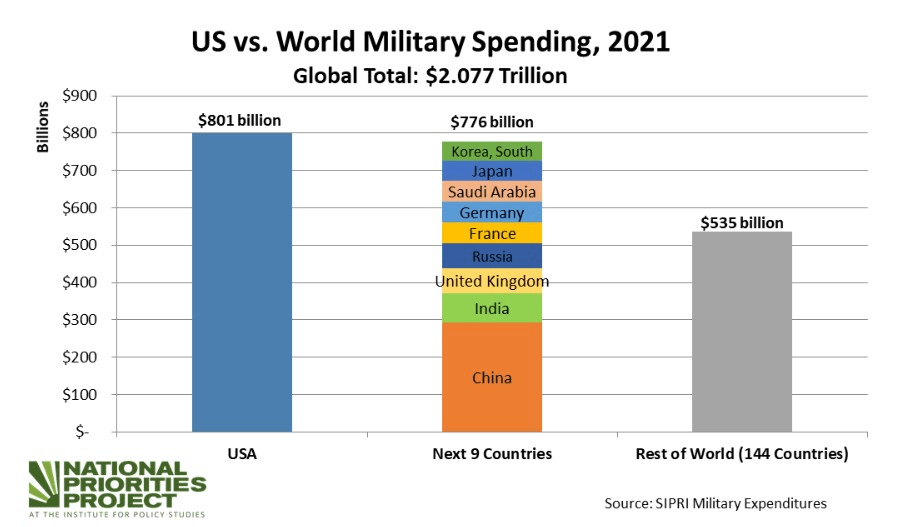
Two images of American exceptionalism to mull over today. The first shows how exceptional the U.S. is with its military spending:
Of course, U.S. military spending is projected to rise in FY 2023 to $840 billion or so. Note how most of the countries that spend significant sums on their military are U.S. allies, such as Germany, the U.K., Japan, and South Korea. Russia is weakening due to its war with Ukraine, yet U.S. military spending continues to soar because of alleged threats from Russia and China.
The second image is a spoof sent by a friend, but it wouldn’t entirely surprise me if it did become the official seal of the Department of Education:
Jesus riding a dinosaur: Why not? We have serious museums for creationists in the U.S., where dinosaurs wear saddles and Adam and Eve are depicted as cavorting with creatures dating to the Jurassic and Cretaceous eras. I’m not sure how they all fit on Noah’s ark, but the Lord does work in mysterious ways.
Given the emphasis on gun rights, babies, and Jesus in America, perhaps the bald eagle isn’t our best national symbol. Perhaps it should be the Baby Jesus holding an assault rifle. It certainly would give new meaning to “love God” and “love thy neighbor.”
I have a brother who’s mentally ill. When you deal with mental illness in your family, you come to realize that local, state, and federal resources are limited. Funding is iffy. Expertise is dodgy. Facilities are often disappointing. And systems and bureaucracies can seem heartless.
I take nothing away from the dedicated doctors, nurses, and other staff I’ve met who’ve helped care for my brother. Considering the resources available to them, they often do a fantastic job.
It soon appears my brother will be assigned to a nursing home, though he does not yet require that level of care. The system, however, has virtually no other options available between a halfway-house-like setting, where a nurse isn’t available 24/7, and a nursing home, which does have nurses 24/7.
My brother was in a smaller group home where he had his own room, but a series of minor medical issues caused him to be “re-leveled” beyond the care provided by that home. He was rather unceremoniously dumped into a private, for-profit, nursing home, where he remains as he awaits a much-delayed court date. Indeed, his “temporary” assignment to the nursing home expired last December, with various agencies finger-pointing and blaming each other for the delay in reviewing my brother’s case.
Mental illness is such a devastating thing. It can be far worse than physical illness. When my brother had his first serious breakdown in 1973, we certainly didn’t understand what was happening. Back then, there was far more stigma attached to mental illness, and few people talked about it. It’s a shattering experience, and my brother had the worst of it, including ECT or electroshock treatments and powerful drugs like Stelazine and similar anti-psychotic drugs.
I was writing to a sympathetic attorney about my brother’s case today, and I thought maybe I’d share a little of what I wrote. My brother’s situation, I wrote,
speaks to a larger point about how our government cares for the mentally ill, the lack of funding and so forth, something that’s not going to be fixed by an email by me.
Still, it’s a system that tends to see my brother as just another client, just another case file, just another court date, even just another billable moment.
Wouldn’t it be nice to have asylums in the true sense of that word for those among us who needed them? But our government chooses to fund more F-35 jet fighters, more nuclear missiles, more police forces, and so forth.
The poor and mentally ill have no power because they have no lobbyists and very few advocates.
It’s a sign of the sickness of our society that we care so little for the sick.
That poor attorney got more than she bargained for. But I truly believe a society can be judged by how it treats the poor, the sick, the unhoused, the desperate. Our society tends to treat them like dirt, like losers, like a nuisance, even as the government gushes money for more police, more weapons, and more wars, whether internally or externally.
This is ultimately why our society is so sick. Because we care so little for the neediest among us.
I’m sorry this is so depressing, and I plead guilty as well for not caring enough, for not acting instead of just blogging away about it.
Jesus healed the sick and dying and attracted society’s outcasts. He praised the poor and railed against the rich. Is it any wonder He was crucified? So, we Americans invented our own Jesus, one who showers money on his believers, one who rewards them with happiness and health, a Santa Claus Jesus who gives out gifts to good little girls and boys.
And if you’re not “good”? I guess you get to be homeless or dumped in a nursing home. Next time, pray harder, loser.
A quick Google search reveals that, “According to the Department of Housing and Urban Development, it would cost $20 billion to end homelessness in the United States.” That’s roughly the cost of a few dozen ICBM interceptor missiles (estimated cost: $18 billion) that are unlikely to work and which may encourage potential adversaries to build more nuclear missiles to overcome them (assuming they do work, but hitting a bullet with a bullet is truly a long shot). Another cost comparison: ending homelessness in America could be done for the cost of roughly 150 F-35 jet fighters. Another: ending homelessness in America could be done for less than half the yearly cost of America’s Afghan War. Yet we’d rather build interceptors, fighter jets, and continue wars than house the homeless.
I’m seeing predictions by America’s generals that Afghan national forces will likely collapse if U.S. combat troops are withdrawn by 9/11. Yet the U.S. military has been training those same Afghan forces for nearly twenty years, all the while making “progress” according to those same generals. What gives? If after two decades Afghan forces don’t have the wherewithal to defend themselves despite untold billions in U.S. assistance and aid, isn’t it logical to assume they will never have the wherewithal?
Of course, it’s an effective strategy for U.S. generals to warn of an impending collapse after Biden’s troop withdrawal. For when it comes, they can say “we told you so” and shift the blame for the loss to Biden and the politicians. Sorry, folks, Afghanistan was never ours to win to begin with. It wasn’t even ours to lose, because we never “had” it. Never mind that: Whenever the U.S. military loses anywhere (including Vietnam), there is always someone else to blame.
The NFL draft concluded this past weekend, and once again I was astonished by the media coverage: the sheer amount of resources dedicated to it. Just go to ESPN, for example, which has “draft cards” on every player with all their vitals, including video highlights. If only the media devoted a tenth of the resources to covering America’s various wars across the globe! With verifiable metrics and video highlights (or lowlights). It’s good to know that sports are much more important to our nation than the military’s global presence and actions.
And now to return to the beginning: Why not act to end homelessness? WWJD: What would Jesus do? I always remember from Catholic mass how Jesus healed the sick, fed the hungry, and helped the poor. Where’s that Jesus nowadays? He seems to have been replaced, at least in America, by Prosperity Gospel Jesus, who shares good news and money only with the richest and most fortunate of Americans.
Can I please have “old” Jesus back? The one who helped lame people to walk and blind people to see?










 Bracing Views