Why American Efforts to Create Foreign Armies Fail

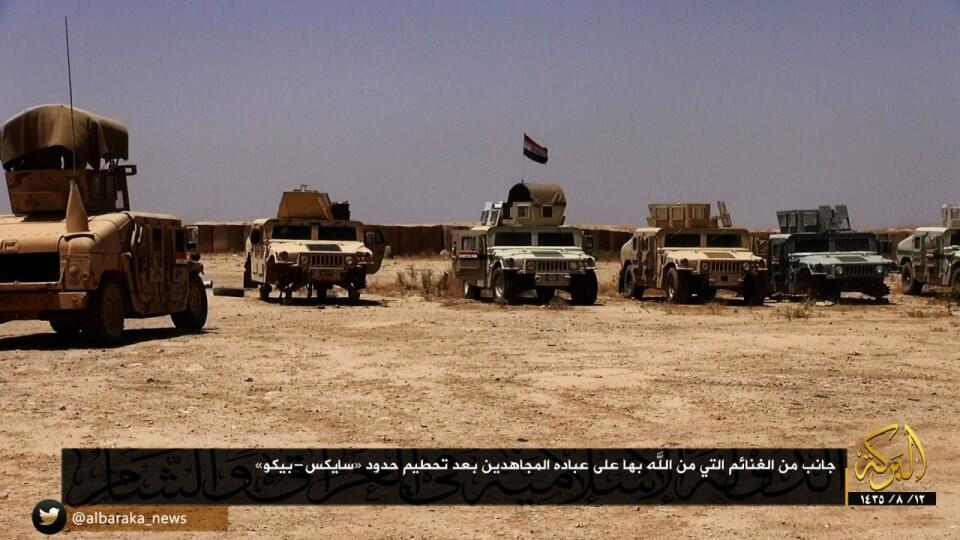
Iraqi equipment provided by the U.S. and captured by ISIS

W.J. Astore

In my latest article for TomDispatch, I examine why the Iraqi security forces that the U.S. trained and equipped at a cost of $25 billion performed so poorly when attacked by ISIS in June. Read on! And be sure to check out other articles at TomDispatch, a contrarian site edited by the inestimable (and indefatigable) Tom Engelhardt.

America’s Hollow Foreign Legions
By William J. Astore

In June, tens of thousands of Iraqi Security Forces in Nineveh province north of Baghdad collapsed in the face of attacks from the militants of the Islamic State (IS or ISIS), abandoning four major cities to that extremist movement. The collapse drew much notice in our media, but not much in the way of sustained analysis of the American role in it. To put it bluntly, when confronting IS and its band of lightly armed irregulars, a reputedly professional military, American-trained and -armed, discarded its weapons and equipment, cast its uniforms aside, and melted back into the populace. What this behavior couldn’t have made clearer was that U.S. efforts to create a new Iraqi army, much-touted and funded to the tune of $25 billion over the 10 years of the American occupation ($60 billion if you include other reconstruction costs), had failed miserably.

Though reasonable analyses of the factors behind that collapse exist, an investigation of why U.S. efforts to create a viable Iraqi army (and, by extension, viable security forces in Afghanistan) cratered so badly are lacking.  To understand what really happened, a little history lesson is in order.  You’d need to start in May 2003 with the decision of L. Paul Bremer III, America’s proconsul in occupied Iraq and head of the Coalition Provisional Authority (CPA), to disband the battle-hardened Iraqi military.  The Bush administration considered it far too tainted by Saddam Hussein and his Baathist Party to be a trustworthy force.

Instead, Bremer and his team vowed to create a new Iraqi military from scratch.  According to Washington Post reporter Tom Ricks in his bestselling book Fiasco, that force was initially conceived as a small constabulary of 30,000-40,000 men (with no air force at all, or rather with the U.S. Air Force for backing in a country U.S. officials expected to garrison for decades).  Its main job would be to secure the country’s borders without posing a threat to Iraq’s neighbors or, it should be added, to U.S. interests.

Bremer’s decision essentially threw 400,000 Iraqis with military training, including a full officer corps, out onto the streets of its cities, jobless.  It was a formula for creating an insurgency.  Humiliated and embittered, some of those men would later join various resistance groups operating against the American military.  More than a few of them later found their way into the ranks of ISIS, including at the highest levels of leadership.  (The most notorious of these is Izzat Ibrahim al-Douri, a former general in Saddam’s army who was featured as the King of Clubs in the Bush administration’s deck of cards of Iraq’s most wanted figures.  Al-Douri is now reportedlyhelping to coordinate IS attacks.)

IS has fought with considerable effectiveness, quickly turning captured American and Syrian weaponry, including artillery pieces, Humvees, and even a helicopter, on their enemies.  Despite years of work by U.S. military advisers and all those billions of dollars invested in training and equipment, the Iraqi army has not fought well, or often at all.  Nor, it seems, will it be ready to do so in the immediate future. Retired Marine Corps General John R. Allen, who played a key role in organizing, arming, and paying off Sunni tribal groups in Iraq the last time around during the “Anbar Awakening,” and who has been charged by President Obama with “coordinating” the latest American-led coalition to save Iraq, has alreadygone on record on the subject.  By his calculations, even with extensive U.S. air support and fresh infusions of American advisers and equipment, it will take up to a year before that army is capable of launching a campaign to retake Mosul, the country’s second largest city.

What went wrong?  The U.S. Army believes in putting the “bottom line up front,” so much so that they have even turned the phrase into an acronym: BLUF.  The bottom line here is that, when it comes to military effectiveness, what ultimately matters is whether an army — any army — possesses spirit.  Call it fire in the belly, a willingness to take the fight to the enemy.  The Islamic State’s militants, at least for the moment, clearly have that will; Iraqi security forces, painstakingly trained and lavishly underwritten by the U.S. government, do not.

This represents a failure of the first order.  So here’s the $60 billion question: Why did such sustained U.S. efforts bear such bitter fruit?  The simple answer: for a foreign occupying force to create a unified and effective army from a disunified and disaffected populace was (and remains) a fool’s errand.  In reality, U.S. intervention, now as then, will serve only to aggravate that disunity, no matter what new Anbar Awakenings are attempted.

Read more at TomDispatch.com.

In the military, it’s called an “after action report” or a “hotwash” — a review, that is, of what went wrong and what can be learned, so the same mistakes are not repeated. When it comes to America’s Iraq training mission, four lessons should top any “hotwash” list:

1. Military training, no matter how intensive, and weaponry, no matter how sophisticated and powerful, is no substitute for belief in a cause.  Such belief nurtures cohesion and feeds fighting spirit.  ISIS has fought with conviction.  The expensively trained and equipped Iraqi army hasn’t.  The latter lacks a compelling cause held in common.  This is not to suggest that ISIS has a cause that’s pure or just. Indeed, it appears to be a complex mélange of religious fundamentalism, sectarian revenge, political ambition, and old-fashioned opportunism (including loot, plain and simple). But so far the combination has proven compelling to its fighters, while Iraq’s security forces appear centered on little more than self-preservation.

2. Military training alone cannot produce loyalty to a dysfunctional and disunified government incapable of running the country effectively, which is a reasonable description of Iraq’s sectarian Shia government.  So it should be no surprise that, as Andrew Bacevich has noted, its security forces won’t obey orders.  Unlike Tennyson’s six hundred, the Iraqi army is unready to ride into any valley of death on orders from Baghdad. Of course, this problem might be solved through the formation of an Iraqi government that fairly represented all major parties in Iraqi society, not just the Shia majority. But that seems an unlikely possibility at this point.  In the meantime, one solution the situation doesn’t call for is more U.S. airpower, weapons, advisers, and training.  That’s already been tried — and it failed.

3. A corrupt and kleptocratic government produces a corrupt and kleptocratic army.  On Transparency International’s 2013 corruption perceptions index, Iraq came in 171 among the 177 countries surveyed. And that rot can’t be overcome by American “can-do” military training, then or now. In fact, Iraqi security forces mirror the kleptocracy they serve, often existing largely on paper.  For example, prior to the June ISIS offensive, as Patrick Cockburn has noted, the security forces in and around Mosul had a paper strength of 60,000, but only an estimated 20,000 of them were actually available for battle. As Cockburn writes, “A common source of additional income for officers is for soldiers to kickback half their salaries to their officers in return for staying at home or doing another job.”

When he asked a recently retired general why the country’s military pancaked in June, Cockburn got this answer:

“‘Corruption! Corruption! Corruption!’ [the general] replied: pervasive corruption had turned the [Iraqi] army into a racket and an investment opportunity in which every officer had to pay for his post. He said the opportunity to make big money in the Iraqi army goes back to the U.S. advisers who set it up ten years ago. The Americans insisted that food and other supplies should be outsourced to private businesses: this meant immense opportunities for graft. A battalion might have a nominal strength of six hundred men and its commanding officer would receive money from the budget to pay for their food, but in fact there were only two hundred men in the barracks so he could pocket the difference. In some cases there were ‘ghost battalions’ that didn’t exist at all but were being paid for just the same.”

Only in fantasies like J.R.R. Tolkien’s Lord of the Rings do ghost battalions make a difference on the battlefield. Systemic graft and rampant corruption can be papered over in parliament, but not when bullets fly and blood flows, as events in June proved.

Such corruption is hardly new (or news). Back in 2005, in his article “Why Iraq Has No Army,” James Fallows noted that Iraqi weapons contracts valued at $1.3 billion shed $500 million for “payoffs, kickbacks, and fraud.” In the same year, Eliot Weinberger, writing in the London Review of Books, cited Sabah Hadum, spokesman for the Iraqi Ministry of the Interior, as admitting, “We are paying about 135,000 [troop salaries], but that does not necessarily mean that 135,000 are actually working.” Already Weinberger saw evidence of up to 50,000 “ghost soldiers” or “invented names whose pay is collected by [Iraqi] officers or bureaucrats.”  U.S. government hype to the contrary, little changed between initial training efforts in 2005 and the present day, as Kelley Vlahos noted recently in her article “The Iraqi Army Never Was.”

4. American ignorance of Iraqi culture and a widespread contempt for Iraqis compromised training results.  Such ignorance was reflected in the commonplace use by U.S. troops of the term “hajji,” an honorific reserved for those who have made the journey (or hajj) to Mecca, for any Iraqi male; contempt in the use of terms such as “raghead,” in indiscriminate firing and overly aggressive behavior, and most notoriously in the events at Abu Ghraib prison.  As Douglas Macgregor, a retired Army colonel, noted in December 2004, American generals and politicians “did not think through the consequences of compelling American soldiers with no knowledge of Arabic or Arab culture to implement intrusive measures inside an Islamic society.  We arrested people in front of their families, dragging them away in handcuffs with bags over their heads, and then provided no information to the families of those we incarcerated.  In the end, our soldiers killed, maimed, and incarcerated thousands of Arabs, 90 percent of whom were not the enemy.  But they are now.”

Sharing that contempt was Secretary of Defense Donald Rumsfeld, who chose a metaphor of parent and child, teacher and neophyte, to describe the “progress” of the occupation.  He spoke condescendingly of the need to take the “training wheels” off the Iraqi bike of state and let Iraqis pedal for themselves.  A decade later, General Allen exhibited a similarly paternalistic attitude in an article he wrote calling for the destruction of the Islamic State.  For him, the people of Iraq are “poor benighted” souls, who can nonetheless serve American power adequately as “boots on the ground.”  In translation that means they can soak up bullets and become casualties, while the U.S. provides advice and air support.  In the general’s vision — which had déjà vu all over again scrawled across it — U.S. advisers were to “orchestrate” future attacks on IS, while Iraq’s security forces learned how to obediently follow their American conductors.

The commonplace mixture of smugness and paternalism Allen revealedhardly bodes well for future operations against the Islamic State.

What Next?

The grim wisdom of Private Hudson in the movie Aliens comes to mind: “Let’s just bug out and call it ‘even,’ OK? What are we talking about this for?”

Unfortunately, no one in the Obama administration is entertaining such sentiments at the moment, despite the fact that ISIS does not actually represent a clear and present danger to the “homeland.” The bugging-out option has, in fact, been tested and proven in Vietnam.  After 1973, the U.S. finally walked away from its disastrous war there and, in 1975, South Vietnam fell to the enemy.  It was messy and represented a genuine defeat — but no less so than if the U.S. military had intervened yet again in 1975 to “save” its South Vietnamese allies with more weaponry, money, troops, and carpet bombing.  Since then, the Vietnamese have somehow managed to chart their own course without any of the above and almost 40 years later, the U.S. and Vietnam find themselves informally allied against China.

To many Americans, IS appears to be the latest Islamic version of the old communist threat — a bad crew who must be hunted down and destroyed.  This, of course, is something the U.S. tried in the region first against Saddam Hussein in 1991 and again in 2003, then against various Sunni and Shiite insurgencies, and now against the Islamic State.  Given the paradigm — a threat to our way of life — pulling out is never an option, even though it would remove the “American Satan” card from the IS propaganda deck.  To pull out means to leave behind much bloodshed and many grim acts.  Harsh, I know, but is it any harsher than incessant American-led bombing, the commitment of more American “advisers” and money and weapons, and yet more American generals posturing as the conductors of Iraqi affairs?  With, of course, the usual results.

One thing is clear: the foreign armies that the U.S. invests so much money, time, and effort in training and equipping don’t act as if America’s enemies are their enemies.  Contrary to the behavior predicted by Donald Rumsfeld, when the U.S. removes those “training wheels” from its client militaries, they pedal furiously (when they pedal at all) in directions wholly unexpected by, and often undesirable to, their American paymasters. 

And if that’s not a clear sign of the failure of U.S. foreign policy, I don’t know what is.

A retired U.S. Air Force lieutenant colonel and history professor, William Astore is a TomDispatch regular. He edits the blog The Contrary Perspective.

Copyright 2014 William J. Astore
War Again in Iraq and the American Desire Never to be Labeled a Loser

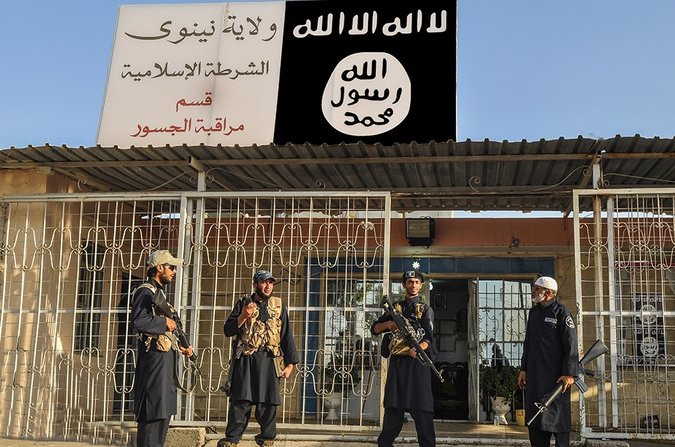
Fighters of the Islamic State (Associated Press)
Fighters of the Islamic State (AP/NYT)

W.J. Astore

In April 2009, I wrote an article for TomDispatch.com recounting Mary McCarthy’s critique of the American experience in Vietnam, and how her lessons applied to President Obama’s “surge” in Afghanistan.  A central lesson cited by McCarthy was the American desire never to be labeled a loser.  That desire explains, at least in part, the persistence of folly within the Obama Administration today, as Peter Van Buren explains in his latest article for TomDispatch, “Apocalypse Now, Iraq Edition: Fighting in Iraq Until Hell Freezes Over.”

Here’s what McCarthy had to say in 1968 about the American moment and the Vietnam War:

The American so-called free-enterprise system, highly competitive, investment-conscious, expansionist, repels a loser policy by instinctive defense movements centering in the ganglia of the presidency. No matter what direction the incumbent, as candidate, was pointing in, he slowly pivots once he assumes office.

Obama campaigned in 2008 as a “hope” and “change” candidate who as president would end the war in Iraq (so he could prosecute the “better” war in Afghanistan).  Yet the U.S. finds itself yet again bombing widely in Iraq (and now Syria) while deploying thousands of military “advisers” (combat troops in plain speak).  And after six weeks of airstrikes in Iraq against ISIS, with indecisive results, how long before those U.S. “advisers” start taking the fight directly to the enemy on the ground?

The questions I posed for President Obama back in 2009 were these:

Have you, like Vietnam-era presidents, pivoted toward yet another surge simply to avoid the label of “loser” in Afghanistan? And if the cost of victory (however defined) is hundreds, or even thousands, more American military casualties, hundreds of billions of additional dollars spent, and extensive collateral damage and blowback, will this “victory” not be a pyrrhic one, achieved at a price so dear as to be indistinguishable from defeat?

Similar questions apply to our latest military operations in Iraq and Syria.  Is the U.S. surging militarily just to avoid the label of “loser”?  And even if the U.S. “wins” this latest round (whatever “win” means), won’t the price paid be indistinguishable from defeat?

In his article, Van Buren offers an excellent summary of the U.S. experience in Iraq since the overthrow of Saddam in 2003.  In his words:

The staggering costs of all this — $25 billion to train the Iraqi Army, $60 billion for the reconstruction-that-wasn’t, $2 trillion for the overall war, almost 4,500 Americans dead and more than 32,000 wounded, and an Iraqi death toll of more than 190,000 (though some estimates go as high as a million) — can now be measured against the results. The nine-year attempt to create an American client state in Iraq failed, tragically and completely. The proof of that is on today’s front pages.

According to the crudest possible calculation, we spent blood and got no oil. Instead, America’s war of terror resulted in the dissolution of a Middle Eastern post-Cold War stasis that, curiously enough, had been held together by Iraq’s previous autocratic ruler Saddam Hussein. We released a hornet’s nest of Islamic fervor, sectarianism, fundamentalism, and pan-nationalism. Islamic terror groups grew stronger and more diffuse by the year. That horrible lightning over the Middle East that’s left American foreign policy in such an ugly glare will last into our grandchildren’s days. There should have been so many futures. Now, there will be so few as the dead accumulate in the ruins of our hubris. That is all that we won.

Under a new president, elected in 2008 in part on his promise to end American military involvement in Iraq, Washington’s strategy morphed into the more media-palatable mantra of “no boots on the ground.” Instead, backed by aggressive intel and the “surgical” application of drone strikes and other kinds of air power, U.S. covert ops were to link up with the “moderate” elements in Islamic governments or among the rebels opposing them — depending on whether Washington was opting to support a thug government or thug fighters.

The results? Chaos in Libya, highlighted by the flow of advanced weaponry from the arsenals of the dead autocrat Muammar Gaddafi across the Middle East and significant parts of Africa, chaos in Yemen, chaos in Syria, chaos in Somalia, chaos in Kenya, chaos in South Sudan, and, of course, chaos in Iraq.

And then came the Islamic State (IS) and the new “caliphate,” the child born of a neglectful occupation and an autocratic Shia government out to put the Sunnis in their place once and for all. And suddenly we were heading back into Iraq. What, in August 2014, was initially promoted as a limited humanitarian effort to save the Yazidis, a small religious sect that no one in Washington or anywhere else in this country had previously heard of, quickly morphed into those 1,600 American troops back on the ground in Iraq and American planes in the skies from Kurdistan in the north to south of Baghdad. The Yazidis were either abandoned, or saved, or just not needed anymore. Who knows and who, by then, cared?  They had, after all, served their purpose handsomely as the casus belli of this war. Their agony at least had a horrific reality, unlike the supposed attack in the Gulf of Tonkin that propelled a widening war in Vietnam in 1964 or the nonexistent Iraqi WMDs that were the excuse for the invasion of 2003.

And this is how Van Buren concludes his article:

We’ve been here before, as the failures of American policy and strategy in Vietnam metastasized into war in Cambodia and Laos to deny sanctuary to North Vietnamese forces. As with ISIS, we were told that they were barbarians who sought to impose an evil philosophy across an entire region. They, too, famously needed to be fought “over there” to prevent them from attacking us here. We didn’t say “the Homeland” back then, but you get the picture.

As the similarities with Vietnam are telling, so is the difference. When the reality of America’s failure in Vietnam finally became so clear that there was no one left to lie to, America’s war there ended and the troops came home. They never went back. America is now fighting the Iraq War for the third time, somehow madly expecting different results, while guaranteeing only failure. To paraphrase a young John Kerry, himself back from Vietnam, who’ll be the last to die for that endless mistake? It seems as if it will be many years before we know.

That is indeed the question.  As Mary McCarthy noted about the Vietnam War, “The more troops and matériel committed to Vietnam, the more retreat appears to be cut off — not by an enemy, but by our own numbers. To call for withdrawal in the face of that commitment… is to seem to argue not against a policy, but against facts, which by their very nature are unanswerable.”

Back to 2014 and the present moment: The more troops committed against ISIS, the more bombing raids made, the more money spent, the more prestige put on the line, the fewer the options the United States has in the Middle East.  Indeed, the only option that remains is “to win,” since losing is unacceptable for the reason Mary McCarthy indicated.

But as Michael Murry, a Vietnam Veteran and regular contributor to this site, noted about Vietnam (citing Bernard Fall’s classic book, Street Without Joy), “You can’t do a wrong thing the right way,” and “We lose the day we start (these stupid imperial wars) and we win the day we stop.”  Put differently, just as with Vietnam, the Middle East is not an incredibly complex puzzle for us to solve; it’s simply an impossible situation.  Impossible for us.  Until we admit this, the U.S. can never “win”; it can only lose.

The U.S. finally “won” in Vietnam when we admitted defeat and left.  How long before we come to this realization in the Middle East?  Tragically, the persistence of American hubris, amplified by resistance to the very idea of being labeled a “loser,” suggests yet another long, bloody, learning curve.

General Allen’s Revealing Article on Iraq

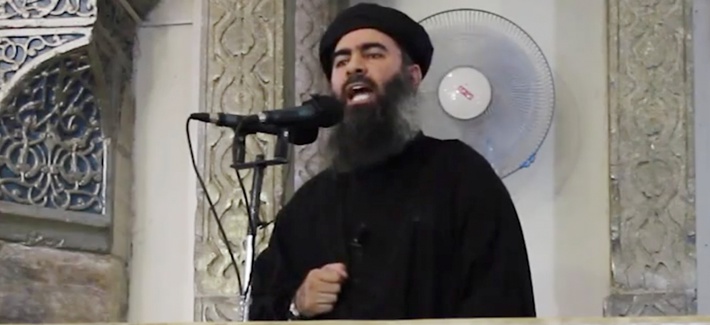
Is this the leader of a scourge and an abomination and a witch's brew?
Is this the leader of a “scourge” and an “abomination” and a “witch’s brew”?

W.J. Astore

General John Allen wants to “destroy the Islamic State now.”  So he says in an article for Defense One.  Allen, a retired Marine Corps general who led troops in Iraq and Afghanistan, is currently a distinguished fellow at the Brookings Institution.  But what is distinguishing him in this article is his crusader-speak, a remarkable blend of religious extremism and chauvinistic parochialism.

Let’s tackle the latter first.  For Allen, the good people of Iraq are “poor” and “benighted.”  But some of them can serve as our “boots on the ground” in the region, i.e. they can serve as bullet magnets while the U.S. provides air support with impunity.  It’s up to the U.S. to “orchestrate” their attacks against the Islamic State.  As long as they follow our conductor’s baton, all will end well, perhaps with a crescendo of U.S. bombs.  (As an aside, he describes the Taliban in Afghanistan as “cavemen” when compared to the new enemy in Iraq.  Some of those “cavemen” did fairly well against the former Soviet Union, did they not?)

My charge that the general’s language is that of “religious extremism” may itself appear extreme, but take a close look at his article.  The general refers to the Islamic State as a “scourge” and an “abomination.”  (I’ve read my Bible and recognize the religious resonances here.)  They are “beyond the pale of humanity” and must be “eradicated” because they are engaged in “total war” aided by a “witch’s brew” of foreign recruits.

In sum, General Allen has demonized the enemy while at the same time diminishing potential allies (those “poor benighted” people in need of an American conductor).  The answer is eradication, i.e. extermination of that enemy. Now!

Remind me again: Which side is engaged in religious war here?

As Richard Nixon used to say, let me make one thing perfectly clear: I’m not in any way defending the murderous extremism of the Islamic State.  What I’m saying is that the best solution is not to return the favor (unless you’re truly seeking a crusade).  I’m also suggesting that the general’s article is (unintentionally) indicative of a mindset that explains much about why American efforts in Iraq and Afghanistan have failed.

The American Cult of Bombing

A common sight: American warplanes over a burning Iraq
A common sight: American warplanes over a burning desert

Why You Should Expect More Bombs to be Dropped Everywhere
By William J. Astore

Read the entire article at TomDispatch.com

When you do something again and again, placing great faith in it, investing enormous amounts of money in it, only to see indifferent or even negative results, you wouldn’t be entirely surprised if a neutral observer questioned your sanity or asked you if you were part of some cult.  Yet few Americans question the sanity or cult-like behavior of American presidents as they continue to seek solutions to complex issues by bombing Iraq (as well as numerous other countries across the globe).

Poor Iraq. From Operation Desert Shield/Storm under George H.W. Bush to enforcing no-fly zones under Bill Clinton to Operation Iraqi Freedom under George W. Bush to the latest “humanitarian” bombing under Barack Obama, the one constant is American bombs bursting in Iraqi desert air.  Yet despite this bombing — or rather in part because of it — Iraq is a devastated and destabilized country, slowly falling apart at seams that have been unraveling under almost a quarter-century of steady, at times relentless, pounding.  “Shock and awe,” anyone?


Well, I confess to being shocked: that U.S. airpower assets, including strategic bombers like B-52s and B-1s, built during the Cold War to deter and, if necessary, attack that second planetary superpower, the Soviet Union, have routinely been used to attack countries that are essentially helpless to defend themselves from bombing.

In 1985, when I entered active duty as an Air Force lieutenant, if you had asked me which country the U.S. would “have” to bomb in four sustained aerial campaigns spanning three decades, among the last countries I would have suggested was Iraq.  Heck, back then we were still helping Saddam Hussein in his war against Iran, sharing intelligence that aided his military in pinpointing (and using his chemical weapons against) Iranian troop concentrations.  The Reagan administration had sent future Bush secretary of defense Donald Rumsfeld there to shake Saddam’s hand for a photo op.  We even overlooked Iraq’s “accidental” bombing in 1987 of a American naval vessel, the USS Stark, that resulted in the death of 37 American sailors, all in the name of containing Iran (and Shia revolutionary fervor).

What we need in 2014 is a new expression that catches the essence of the cult of U.S. air power, something like: “The bomber will always get funded — and used.”

Let’s tackle the first half of that equation: the bomber will always get funded.  Skeptical?  What else captures the reality (as well as the folly) of dedicating more than $400 billion to the F-35 fighter-bomber program, a wildly over-budget and underperforming weapons system that may, in the end, cost the American taxpayer $1.5 trillion.  Yes, you read that right.   Or the persistence of U.S. plans to build yet another long-range “strike” bomber to augment and replace the B-1 and B-2 fleet?  It’s a “must-have,” according to the Air Force, if the U.S. is to maintain its “full-spectrum dominance” on Planet Earth.  Already pegged at an estimated price of $550 million per plane while still on the drawing boards, it’s just about guaranteed to replace the F-35 in the record books, when it comes to delays, cost overruns, and price.  And if you don’t think it’ll get funded, you don’t know recent history.

Heck, I get it.  I was a teenager once.  In the 1970s, as an Air Force enthusiast and child of the Cold War, I hugged exotic and therefore pricey bomber jets to my chest. (Well, models of them, anyway.)  I considered them to be both uniquely American and an absolute necessity when it came to defending our country against the lumbering (but nevertheless menacing) Soviet “bear.”  As a result, I gasped in 1977 when President Jimmy Carter dared to cancel the B-1 bomber program.  While I was a little young to pen my outrage, more mature critics than I quickly accused him of being soft on defense, of pursuing “unilateral disarmament.”

Back then, I’d built a model of the B-1 bomber.  In my mind’s eye I still see its sexy white body and its rakish swing wings.  No question that it was a man’s bomber.  I recall attaching a firecracker to its body, lighting the wick, and dropping the plane from the third-floor porch.  It exploded in mid-air, symbolic to me of the plane’s tragic fate at the hands of the pusillanimous Carter.

But I need not have feared for the B-1.  In October 1981, as one of his first major acts in office, President Ronald Reagan rescinded Carter’s cancellation and revived the mothballed program.  The Air Force eventually bought 100 of the planes for $28 billion, expensive at the time (and called a “turkey” by some), but a relative bargain in the present budgetary environment when it comes to bombers (but these days, little else).

At that point, I was a young lieutenant serving on active duty in the Air Force.  I had by then come to learn that Carter, the peanut farmer (and former Navy nuclear engineer), was right.  We really didn’t need the B-1 for our defense.  In 1986, for a contest at Peterson Air Force Base where I was stationed, I wrote a paper against the B-1, terming the idea of a “penetrating strategic bomber” a “flawed strategy” in an era of long-range air-launched cruise missiles.  It earned an honorable mention, the equivalent of drawing the “you have won second prize in a beauty contest” card in Monopoly, but without the compensatory $10.

That “penetrating,” by the way, meant being loaded with expensive avionics, nowadays augmented by budget-busting “stealth” features, so that a plane could theoretically penetrate enemy air defenses while eluding detection.  If the idea of producing such a bomber was flawed in the 1980s, how much more is it today, in an age of remotely-piloted drones and missiles guided by GPS and in a world in which no country the U.S. chooses to bomb is likely to have air defenses of any sophistication?  Yet the Air Force insists that it needs at least 100 of the next generation version of them at a cost of $55 billion.  (Based on experience, especially with the F-35, you should automatically double or even triple that price tag, cost overruns and product development delays being a given in the process.  So let’s say it’ll cost closer to $150 billion.  Check back with me, God willing, in 2040 to see whether the Air Force’s figure or mine was closer to reality.)

Idols for Worship, Urges to Satisfy

Obviously, there are staggering amounts of money to be made by feeding America’s fetish for bombers.  But the U.S. cult of air power and its wildly expensive persistence requires further explanation.  On one level, exotic and expensive attack planes like the F-35 or the future “long range strike bomber” (LRS-B in bloodless acronym-speak) are the military equivalent of sacred cows.  They are idols to be worshipped (and funded) without question.  But they are also symptoms of a larger disease — the engorgement of the Department of Defense.  In the post-9/11 world, this has become so pronounced that the military-industrial-congressional complex clearly believes it is entitled to a trough filled with money with virtually no accountability to the American taxpayer.

Add to that sense of entitlement the absurdist faith of administration after administration in the efficacy of bombing as a problem solver — despite overwhelming evidence to the contrary — and you have a truly lethal combo.  Senator John McCain was widely mocked by progressives for his “bomb Iran” song, warbled during the 2008 presidential campaign to the tune of the Beach Boys’s “Barbara Ann.”  In fact, his tuneless rendition captured perfectly Washington’s absolute faith in bombing as a solution to…whatever.

Even if the bombs bursting over Iraq or elsewhere don’t solve anything, even when they make things worse, they still make a president look, well, presidential.  In America, land of warbirds, it is always better politically to pose as a hunting hawk than a helpless dove.

So don’t blame the Air Force for wanting more and deadlier bombers.  Or don’t blame only them.  Just as admirals want more ships, flyboys naturally want more planes, even when strategically obsolete from scratch and blazingly expensive.  No military service has ever willingly given up even a tiny slice of its share of the prospective budgetary pie, especially if that slice cuts into the service’s core image.  In this sense, the Air Force takes its motto from King Lear’s “Reason not the need!” and from Zack Mayo’s “I want to fly jets!” (memorably uttered by that great Shakespearean actor Richard Gere in An Officer and a Gentleman).

The sad truth runs deeper: Americans evidently want them, too.  More bombers.  More bombs.  In the movie Top Gun, Tom Cruise’s Maverick got it all wrong.  It’s not speed Americans feel a need for; they have an urge to bomb.  When you refuse to reason, when you persist in investing ever more resources in ever more planes, use almost automatically follows.

In other words, fund it, build it, and, as promised in the second half of my equation, the bomber will always get used.  Mock him all you want, but John McCain was on to something.  It’s bomb, bomb, bomb, bomb bomb if not (yet) Iran… then Iraq, or Pakistan, or Libya, or Yemen, or (insert intransigent foreign country/peoples here).

And like cults everywhere, it’s best not to question the core belief and practices of its leaders — after all, bombs bursting in air is now as American as the “Star Spangled Banner.”

Still Pursuing the Dream of Bombing

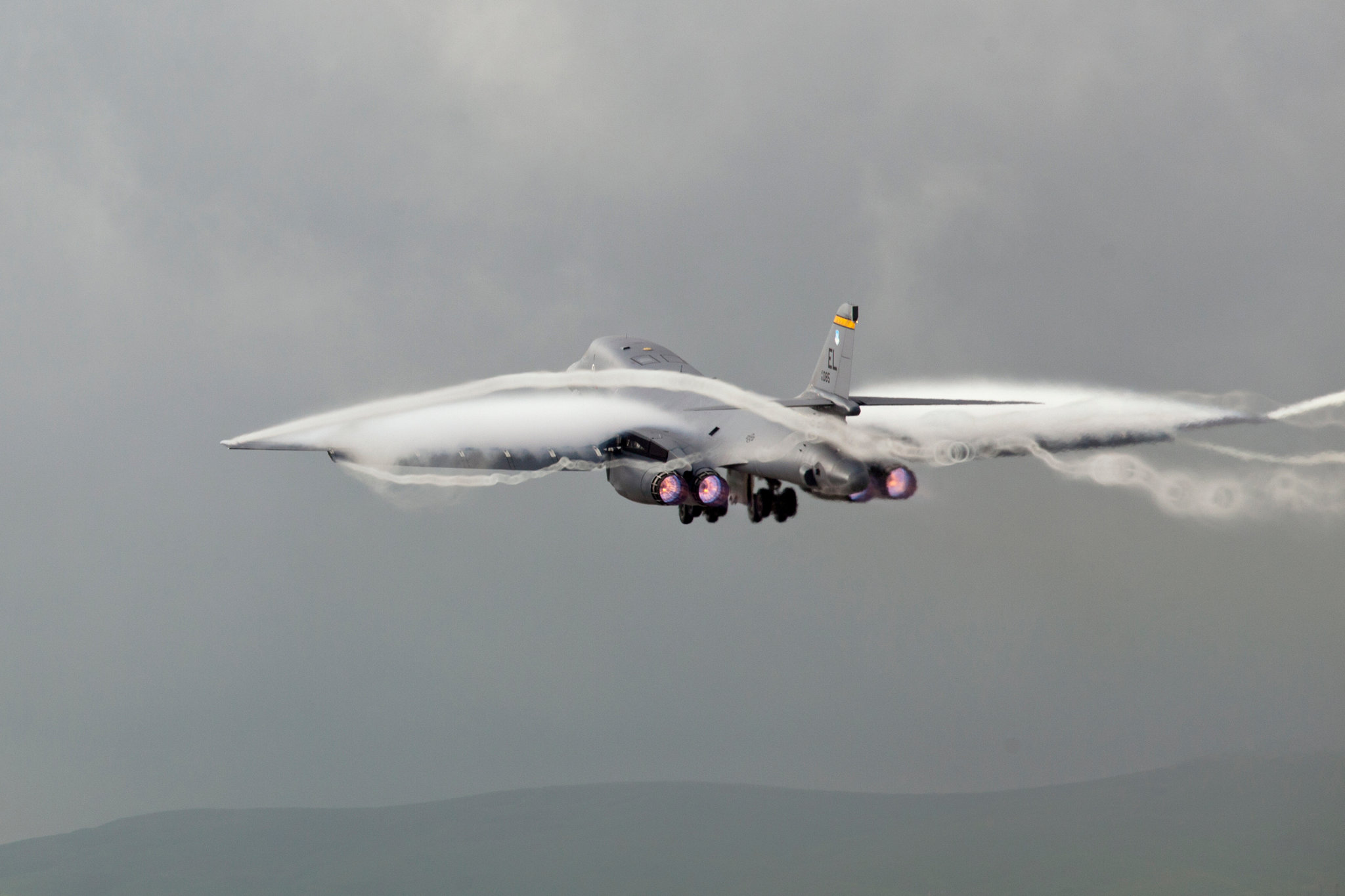
B-1 Bomber (NYT photo)

W.J. Astore

There you go again, President Obama, echoing a line delivered by that consummate actor, Ronald Reagan.  Yes, we’re bombing Iraq again, in the name of humanitarianism.  This time, we’re only getting the “bad” Iraqis, so it’s OK.  Right?

The only “humanitarian” bombing I’ve ever heard of is in fiction; specifically, in Slaughter-House Five, where Kurt Vonnegut imagined a bombing raid in reverse, with bombs returning to their planes and bodies blown into pieces magically reassembling into living, breathing, human beings.

The U.S. still believes in the dream of airpower: that it’s cheap, surgical, decisive.  But history has taught us otherwise, a fact I wrote about at TomDispatch.com in March of 2013.  But who cares about history — it’s bunk, right?

So we persist in our “bombs away” mentality, whether it’s Iraq or Afghanistan or Pakistan or Libya or Yemen or … well, you get the picture.

Here is the article I wrote about airpower and its lessons.  Consider it as you listen to media reports of how precise and decisive and “modulated” and “measured” our most current raids have been.

The lesson, I think, is simple: So many bombs; so little brains.

The Ever-Destructive Dreams of Air Power Enthusiasts

By William J. Astore

Today’s unmanned aerial vehicles, most famously Predator and Reaper drones, have been celebrated as the culmination of the longtime dreams of airpower enthusiasts, offering the possibility of victory through quick, clean, and selective destruction.  Those drones, so the (very old) story goes, assure the U.S. military of command of the high ground, and so provide the royal road to a speedy and decisive triumph over helpless enemies below.

Fantasies about the certain success of air power in transforming, even ending, war as we know it arose with the plane itself.  But when it comes to killing people from the skies, again and again air power has proven neither cheap nor surgical nor decisive nor in itself triumphant.  Seductive and tenacious as the dreams of air supremacy continue to be, much as they automatically attach themselves to the latest machine to take to the skies, air power has not fundamentally softened the brutal face of war, nor has it made war less dirty or chaotic.

Indeed, by emboldening politicians to seek seemingly low-cost, Olympian solutions to complex human problems — like Zeus hurling thunderbolts from the sky to skewer puny mortals — it has fostered fantasies of illimitable power emboldened by contempt for human life.  However, just like Zeus’s obdurate and rebellious subjects, the mortals on the receiving end of death from on high have shown surprising strength in frustrating the designs of the air power gods, whether past or present. Yet the Olympian fantasy persists, a fact that requires explanation.


The Rise of Air Power

It did not take long after the Wright Brothers first put a machine in the air for a few exhilarating moments above the sandy beaches of Kitty Hawk, North Carolina, in December of 1903, for the militaries of industrialized countries to express interest in buying and testing airplanes.  Previously balloons had been used for reconnaissance, as in the Napoleonic wars and the U.S. Civil War, and so initially fledgling air branches focused on surveillance and intelligence-gathering.  As early as 1911, however, Italian aircraft began dropping small bombs from open-air cockpits on the enemy — we might today call them “insurgents” — in Libya.

World War I encouraged the development of specialized aircraft, most famously the dancing bi- and tri-winged fighter planes of the dashing “knights of the air,” as well as the more ponderous, but for the future far more important, bombers.   By the close of World War I in 1918, each side had developed multi-engine bombers like the German Gotha, which superseded the more vulnerable zeppelins.  Their mission was to fly over the trenches where the opposing armies were stalemated and take the war to the enemy’s homeland, striking fear in his heart and compelling him to surrender.  Fortunately for civilians a century ago, those bombers were too few in number, and their payloads too limited, to inflict widespread destruction, although German air attacks on England in 1917 did spread confusion and, in a few cases, panic.

Pondering the hecatombs of dead from trench warfare, air power enthusiasts of the 1920s and 1930s not surprisingly argued strongly, and sometimes insubordinately, for the decisive importance of bombing campaigns launched by independent air forces.  A leading enthusiast was Italy’s Giulio Douhet.  In his 1921 work Il dominio dell’aria (Command of the Air), he argued that in future wars strategic bombing attacks by heavily armed “battle-planes” (bombers) would produce rapid and decisive victories.  Driven by a fascist-inspired logic of victory through preemptive attack, Douhet called for all-out air strikes to destroy the enemy’s air force and its bases, followed by hammer blows against industry and civilians using high-explosive, incendiary, and poison-gas bombs.  Such blows, he predicted, would produce psychological uproar and social chaos (“shock and awe,” in modern parlance), fatally weakening the enemy’s will to resist.

As treacherous and immoral as his ideas may sound, Douhet’s intent was to shorten wars and lessen casualties — at least for his side.  Better to subdue the enemy by pressing hard on select pressure points (even if the “pressing” was via high explosives and poison gas, and the “points” included concentrations of innocent civilians), rather than forcing your own army to bog down in bloody, protracted land wars.

That air power was inherently offensive and uniquely efficacious in winning cheap victories was a conclusion that found a receptive audience in Great Britain and the United States.  In England, Hugh Trenchard, founding father of the Royal Air Force (RAF), embraced strategic bombing as the most direct way to degrade the enemy’s will; he boldly asserted that “the moral effect of bombing stands undoubtedly to the material effect in a proportion of twenty to one.”

Even bolder was his American counterpart, William “Billy” Mitchell, famously court-martialed and romanticized as a “martyr” to air power.  (In his honor, cadets at the U.S. Air Force Academy still eat in Mitchell Hall.)  At the Air Corps Tactical School in the 1930s, U.S. airmen refined Mitchell’s tenets, developing a “vital centers” theory of bombing — the idea that one could compel an enemy to surrender by identifying and destroying his vulnerable economic nodes.  It therefore came as no accident that the U.S. entered World War II with the world’s best heavy bomber, the B-17 Flying Fortress, and a fervid belief that “precision bombing” would be the most direct path to victory.

World War II and After: Dehousing, Scorching, Boiling, and Baking the Enemy

In World War II, “strategic” air forces that focused on winning the war by heavy bombing reached young adulthood, with all the swagger associated with that stage of maturity.  The moral outrage of Western democracies that accompanied the German bombing of civilian populations in Guernica, Spain, in 1937 or Rotterdam in 1940 was quickly forgotten once the Allies sought to open a “second front” against Hitler through the air.  Four-engine strategic bombers like the B-17 and the British Lancaster flew for thousands of miles carrying bomb loads measured in tons.  From 1942 to 1945 they rained two million tons of ordnance on Axis targets in Europe, but accuracy in bombing remained elusive.

While the U.S. attempted and failed at precision daylight bombing against Germany’s “vital centers,” Britain’s RAF Bomber Command began employing what was bloodlessly termed “area bombing” at night in a “dehousing” campaign led by Arthur “Bomber” Harris.  What became an American/British combined bomber offensive killed 600,000 German civilians, including 120,000 children, reducing cities like Cologne (1942), Hamburg (1943), Berlin (1944-45), and Dresden (1945) to rubble.

Yet, contrary to the dreams of air power advocates, Germany’s will to resist remained unbroken.  The vaunted second front of aerial battle became yet another bloody attritional brawl, with hundreds of thousands of civilians joining scores of thousands of aircrews in death.

Similarly mauled but unbroken by bombing was Japan, despite an air campaign of relentless intensity that killed hundreds of thousands of Japanese civilians.  Planned and directed by Major General Curtis LeMay, new B-29 bombers loaded with incendiaries struck Tokyo, a city made largely of wood, in March 1945, creating a firestorm that in his words “scorched and boiled and baked [the Japanese] to death.”  As many as 100,000 Japanese died in this attack.

Subsequently, 60 more cities were firebombed until the apotheosis of destruction came that August as atomic bombs incinerated Hiroshima and Nagasaki, killing another 200,000 people.  It quickly became an article of faith among American air power enthusiasts that these bombs had driven Japan to surrender; together with this, the “decisive” air campaign against Germany became reason enough to justify an independent U.S. Air Force, which was created by the National Security Act of 1947.

In the total war against Nazi and Japanese terror, moral concerns, when expressed, came privately.  General Ira Eaker worried that future generations might condemn the Allied bombing campaign against Germany for its targeting of “the man in the street.”  Even LeMay, not known for introspective doubts, worried in 1945 that he and his team would likely be tried as war criminals if the U.S. failed to defeat Japan.  (So Robert McNamara, then an Army Air Force officer working for LeMay, recalled in the documentary The Fog of War.)

But moral qualms were put aside in the post-war glow of victory and as the fear rose of future battles with communism.  The Korean War (1950-1953) may have ushered in the jet age, as symbolized by the dogfights of American Sabre Jets and Soviet MiGs over the Yalu River, but it also witnessed the devastation by bombing of North Korea, even as the enemy took cover underground and refused to do what air power strategists had always assumed they would: give up.

Still, for the U.S. Air Force, the real action of that era lay largely in the realm of dystopian fantasies as it created the Strategic Air Command (SAC), which coordinated two legs of the nuclear triad, land-based intercontinental ballistic missiles in silos and nuclear-armed long-range bombers. (The third was nuclear-missile-armed submarines.)  SAC kept some of those bombers carrying thermonuclear weapons in the air 24/7 as a “deterrent” to a Soviet nuclear first strike (and as a constant first strike threat of our own).  “Thinking about the unthinkable” — that is, nuclear Armageddon — became all the rage, with “massive retaliation” serving as the byword for air power enthusiasts.  In this way, dreams of clean victories morphed into nightmares of global thermonuclear annihilation, leaving the 1930s air power ideal of “clean” and “surgical” strikes in the dust — for the time being.

Reaping What We Sow

Despite an unimaginably powerful nuclear deterrent that essentially couldn’t be used, the U.S. Air Force had to relearn the hard way that there remained limits to the efficacy of air power, especially when applied to low-intensity, counterinsurgency wars.  As in Korea in the 1950s, air power in the 1960s and 1970s failed to provide the winning edge in the Vietnam War, even as it spread wanton destruction throughout the Vietnamese countryside.  But it was the arrival of “smart” bombs near that war’s end that marked the revival of the fantasies of air power enthusiasts about “precision bombing” as the path to future victory.

By the 1990s, laser- and GPS-guided bombs (known collectively as PGMs, for precision guided munitions) were relegating unguided, “dumb” bombs largely to the past.  Yet like their predecessors, PGMs proved no panacea.  In the opening stages of Operation Iraqi Freedom in 2003, for example, 50 precision “decapitation strikes” targeting dictator Saddam Hussein’s top leadership failed to hit any of their intended targets, while causing “dozens” of civilian deaths.  That same year, air power’s inability to produce decisive results on the ground after Iraq’s descent into chaos, insurrection, and civil war served as a reminder that the vaunted success of the U.S. air campaign in the First Gulf War (1991) was a fluke, not a flowering of air power’s maturity.  (Saddam Hussein made his traditionally organized military, defenseless against air power, occupy static positions after his invasion of Kuwait.)

The recent marriage of PGMs to drones, hailed as the newest “perfect weapon” in the air arsenal, has once again led to the usual fantasies about the arrival — finally, almost 100 years late — of clean, precise, and decisive war.  Using drones, a military need not risk even a pilot’s life in its attacks.  Yet the nature of war — its horrors, its unpredictability, its tendency to outlive its original causes — remains fundamentally unaltered by “precision” drone strikes.  War’s inherent fog and friction persist.  In the case of drones, that fog is often generated by faulty intelligence, the friction by malfunctioning weaponry or innocent civilians appearing just as the Hellfire missiles are unleashed.  Rather than clean wars of decision, drone strikes decide nothing.  Instead, they produce their share of “collateral damage” that only spawns new enemies seeking revenge.

The fantasy of air war as a realm of technical decision, as an exercise in decisively finding, fixing, and dispatching the enemy, appeals to a country like the United States that idolizes technology as a way to quick fixes.  As a result, it’s hardly surprising that two administrations in Washington have ever more zealously pursued drone wars and aerial global assassination campaigns, already killing 4,700 “terrorists” and bystanders. And this has been just part of our Nobel Peace Prize-winning president’s campaign of 20,000 air strikes (only 10% of which were drone strikes) in his first term of office.  Yet despite — or perhaps because of — these attacks, our global war against al-Qaeda, its affiliates, and other groups like the Taliban appears no closer to ending.

And that is, in part, because the dream of air power remains just that: a fantasy, a capricious and destructive will-o’-the-wisp.  It’s a fantasy because it denies agency to enemies (and others) who invariably find ways to react, adapt, and strike back.  It’s a fantasy because, however much such attacks seem both alluringly low-risk and high-reward to the U.S. military, they become a rallying cause for those on the other end of the bombs and missiles.

A much-quoted line from the movie Apocalypse Now captured the insanity of the American air war in Vietnam.  “I love the smell of napalm in the morning,” says an Air Cav commander played by Robert Duvall.  “Smelled like… victory.”  Updated for drone warfare, this line might read: “I love the sound of drones in the morning.  Sounds like… victory.”  But will we say the same when armed drones are hovering, not only above our enemies’ heads but above ours, too, in fortress America, enforcing security and conformity while smiting citizens judged to be rebellious?

Something tells me this is not the dream that airpower enthusiasts had in mind.

William J. Astore

Why We Fight? Oil

Pay no attention to the "black gold" in Iraq!
Pay no attention to the “black gold” in Iraq!

W.J. Astore

Rachel Maddow at MSNBC aired a new documentary last night on why we went to war against Iraq in 2003.  In a word: oil.  Bush and Cheney were looking to overthrow Saddam Hussein as a prerequisite to controlling and privatizing Iraqi oil production.  Pre-war planning in the U.S. as well as Great Britain focused on identifying, safeguarding, and ultimately privatizing Iraqi oil facilities.  When U.S. forces took Baghdad, the one building they protected was the Iraqi oil ministry (museums containing priceless objects from the dawn of human civilization, left unprotected, were looted).

This is a familiar story, of course, though many Americans continue wrongly to believe that Saddam had WMD or that he was allied to Al Qaeda (or both).  Watching the documentary, I appreciated the honesty of the Polish government, which admitted that it had participated in the invasion of Iraq precisely to gain access to Iraqi oil resources.  Bush and Blair, naturally, denied any such connection, even as Bush was warning Iraqis not to damage oil facilities, even as Blair’s government was negotiating with British Petroleum on how best to divide the spoils.

When it comes to oil, maybe “The Beverly Hillbillies” song had it right: “Black gold.  Texas tea.”  And whether it’s black gold or the yellow variety, the West has always shown a rapacity for it that borders on the insane.  Just ask the Aztecs and the Incas, for example.

Here’s an article I wrote back in 2012 for Huffington Post on the question of why the U.S. invaded Iraq and not, say, North Korea, which as Maddow points out was identified as one head of Bush’s three-headed “Axis of Evil,” but which unlike Iraq and Iran actually was hard at work on building an atomic bomb, efforts that ended in a successful test in 2006.  But North Korea is not floating on a sea of oil, is it?

Why We Fight? Oil  (written in 2012)

I’m old enough to remember the Arab oil embargo of 1973 and long lines for gasoline in the United States. A joke that circulated among my schoolmates caught the spirit of the moment. It involved calculators, which were fairly new back then for the masses. It went like this: 142 Arabs fight 154 Israelis for control of 69 oil wells for five years. Who wins?

Punch the numbers 142, 154, and 69 into your calculator and then multiply by 5 and you get 71077345. Turn the calculator upside down and those numbers spell out “ShELLOIL,” or so we joked. Call it the cynicism of 11-year-olds.

Thirty years later, as an Air Force officer I recall a discussion of what we should name the operation to liberate Iraq from Saddam Hussein. Wags in my office suggested the obvious: Operation IRAQI LIBERATION, with lots of chuckles about the resulting acronym (OIL). Call it the cynicism of 40-somethings.

Fighting for vital resources is nothing new in history, and nothing new in U.S. history either. Smedley Butler, the famous U.S. Marine general who penned War Is a Racket, wrote in the 1930s that “those damned oil companies” should fly their own flag — perhaps one with a gas pump on it — over foreign lands that they viewed as their personal property. Call it the cynicism of a retired major-general who twice was awarded the Congressional Medal of Honor.

But is it cynicism — or just plain honesty? Consider the book by Greg Muttitt on the Iraq war and its fallout, which places oil back where it belongs, front and center, in American motivations and machinations. This is hardly surprising, for recall the words of then-Deputy Secretary of Defense Paul Wolfowitz that Iraq floated on a sea of oil, or the background of then-Vice President Dick Cheney and his overweening ambition to dominate global energy resources.

Our nation’s great thirst for oil should come as no surprise to anyone. Even former President George W. Bush gave a speech in which he declared that the U.S. was addicted to foreign oil. What’s surprising is that we continue to wrap our wars in the rhetoric of “freedom” even as we pursue the fix that our leaders believe they need to thrive: foreign oil, and lots of it.

There’s plenty of oil still in the ground in Iraq and elsewhere in the Middle East, and at $100 a barrel for oil and $4.00 a gallon for gasoline, you’re talking trillions of dollars for oil companies over the next few decades.

Considering the vast profits involved, you don’t have to be a cynic to recognize that concerns about oil continue to drive our nation’s foreign policy. But you do have to be willing to face that fact; and you do have to be willing, like General Smedley Butler was willing, to ignore the siren song about waging war for freedom and democracy.

As former President Bush said, we’re addicted to oil. And history has shown we’re willing to fight for it, though the biggest winners may well be powerful energy companies.

Don’t believe me? Read Smedley Butler or Greg Muttitt. Or just ask to see an 11-year-old’s calculator.

Old Thoughts on the Iraq War and Its Aftermath

W.J. Astore

It all seemed so promising in 2003 (Wiki)

Note to readers: I wrote these words in November 2008, just after Obama was elected President for the first time.  I’ve decided not to edit them.  Perhaps they capture the thoughts (however flawed) of one American who was trying to understand the mess we had made of Iraq.

Straight Talk on Iraq: Of Revolutions, Surges, and Victories (2008)

As a retired U.S. military man, I’d like to see “victory” in Iraq, not only for Americans, but also for the oft-neglected and oft-misunderstood Iraqi people.  With Saddam deposed and executed and the illusory weapons of mass destruction eliminated from our fevered intelligence guestimates, one could make an argument we’ve already won.  But “winning,” of course, was never supposed to be just about eliminating Saddam or WMD; it was about creating democracy, or at least a simulacrum of democracy, in Iraq.  We aimed to inspire and sustain an Iraqi government, allied with the United States, which would give a voice to the people instead of terrorizing them into compliance and silence.  This new freedom-loving Iraq would then serve as a positive role model to other states in the Middle East.  Or so it was pitched in 2003, among those who subscribed to neo-con dreams of the unqualified benevolence and irresistible potency of American power.

Even before the war in Iraq became an occupation that degenerated into an insurgency and civil war among rival factions, even before the Iraqi people paid a terrible price in lives lost and refugees created, our new president-elect expressed his opposition to the war, calling it a mistake and couching his criticism primarily in strategic terms (as a distraction from the real war on terror in Afghanistan, for example).  Many people in the U.S. and around the world believed the war was not simply a strategic distraction—one that allowed Bin Laden and other senior Al Qaeda leaders to escape from a noose tightening around them—but also an immoral one.  For them, the war was worse than a mistake.  It was a crime.

Those today who view the war as either a mistake, or a crime, or both naturally have little compunction about pulling our troops out immediately, even if it means “losing” the war.  But surely our new president-elect got it right when he said repeatedly on the stump, “We need to be as careful getting out [of Iraq] as we were careless getting in.”

The Iraqi Revolution: Made by America

Before we get out, however, we should understand what we did when we went in.  Basically, by overthrowing Saddam, disbanding the Iraqi army, and criminalizing the Ba’ath party and thus throwing most of Iraq’s professional bureaucracy out of work, we initiated a revolution in Iraq.  And revolutions, as we should know from our own history, are usually bloody, unpredictable, and run to extremes (think Reign of Terror) before they play themselves out (think Thermidorean Reaction), followed often by the emergence of a strong man (think Napoleon or Lenin; the U.S. was very fortunate indeed to produce George Washington).

Moreover, the Iraqi revolution we precipitated and attempted to negotiate was more than political and military: It was social, economic, religious, you name it.  Many of the Iraqi professional and educated elite fled the country as it degenerated into violence; a socialist economy, already weakened by more than a decade of sanctions, collapsed under U.S. bombing, Iraqi looting, and widespread corruption; a Shi’a majority, oppressed under Saddam, suddenly found itself able to settle violently its grievances and grudges against a previously overbearing Sunni minority.  Post-Saddam Iraq was a world that we turned upside down.  And our troops were in the thick of it—no longer victors, increasingly victims, whether of extremist violence or of our own leadership that failed to give them the equipment, both physical and mental, to defend themselves adequately.

Our military has its faults, but offering blunt self-assessments is not one of them.  As one Army field-grade officer put it to me recently, “We deployed an Army [in 2004-05 that was] unsympathetic to local Iraqis, sophomoric even at fairly senior levels in their approach to the fight, refusing to admit there was the potential and then the presence of an insurgency.”  His assessment squares with one made by a friend of mine assigned to the CPA in Baghdad in 2004 that the U.S. approach was “a train wreck waiting to happen, and the [Bush] administration simply refused to acknowledge it, much less do anything about it.”

And the wreck came.  An Army battalion commander told me recently of a conversation he had with a former Iraqi insurgent leader about the “hot time” of 2004-05.  “Everyone,” this Iraqi leader confessed, “had gone just a little crazy killing members of their own tribes, other sects, in addition to fighting the [Iraqi] government forces and us [the U.S. military].”  His is a painful reminder that the Bush Administration started a revolution in Iraq that they chose neither to understand nor adequately control.  More than five years later, we are still picking up the pieces.

Of Simplistic Narratives

When Americans bother about Iraq, they rarely think of the violent top-to-bottom revolution that we precipitated.  Instead, they usually see it in the simplistic and solipsistic terms of the presidential debates.  For John McCain, Iraq was all about staying the course to victory (however defined) and achieving “peace with honor.”  Somehow, achieving victory would redeem the sacrifices of American troops (the sacrifices of Iraqis were rarely if ever mentioned).

For Barack Obama, Iraq was all about pulling out (most) troops as expeditiously as possible, following a seemingly prudent timeline of sixteen months.  Stressing the generous American taxpayer was contributing $10 billion a month to stabilize and rebuild Iraq, while an untrustworthy and seemingly ungrateful Iraqi government continued to pile up scores of billions in unspent oil-related profits, Obama called for shifting the war’s burden to the Iraqis, both militarily and monetarily.

Thus McCain and Obama, perhaps unwittingly, essentially stressed two different sides of the old Nixonian playbook of 1969: “peace with honor” together with an Iraqi version of Vietnamization completed in lockstep with a U.S. withdrawal.  Neither candidate chose to emulate Nixon’s “madman theory”: His idea that the North Vietnamese would negotiate in better faith if he convinced them the president was wildly unpredictable and so fanatically anti-communist that he might do anything, even toss a few nukes.  (Interestingly, the candidate who came closest was Hillary Clinton in her promise to “obliterate” Iran if it ever dared to threaten Israel.)

Complicating the simplistic narratives offered in the presidential debates were certain unpleasant facts on the ground, the most recent one being the Iraqis themselves and their growing assertiveness in affirming their autonomy and sovereignty.  Their resistance to renewing the status of forces agreement (SOFA) is a clear sign of growing weariness with our military occupation.  Other annoying facts include Iranian meddling: Iran’s leaders obviously have little interest in seeing either the U.S. or Iraq succeed, unless the latter is ruled by a Shi’a party closely aligned with them.  And let’s not forget other niggling facts and factions, such as the Sunni Awakening and its disputed role in Iraq’s future; the Kurds and their contested desire for more autonomy and control over Iraq’s oil resources; various extremist factions jostling for power, such as the Shi’a JAM (Sadrist militia) and its related criminal elements; and looming humanitarian and logistical problems such as accommodating millions of returning Iraqi refugees, assuming conditions improve to a point where they want to return.

Surging to Victory of a Sort

It’s undeniable that last year’s surge orchestrated by General Petraeus helped to curb violence in Iraq, providing a glimmer of hope that a comparatively bloodless political reconciliation in Iraq might yet be possible.  Yet most Americans, conditioned by campaign rhetoric, still remain unaware of the fact that the surge was arguably not the most important factor in the decrease in violence.  Petraeus himself has testified that recent gains achieved by Iraqis and American troops are both fragile and reversible.  As one U.S. Army battalion commander recently described it to me, Iraq remains “a Rubik’s cube of cross cutting rivalries and vengeances.”  As someone who never had much luck solving Rubik’s cube, I wasn’t encouraged by his analogy.

Our military has learned the hard way that Iraq eludes simple solutions.  The immense challenge facing us in the immediate future is to build on our limited gains and to make them irreversible.  And the first step for Americans in this process is to recognize that “victory” is ultimately in Iraqi hands, not ours.  Are we finally ready to admit the limits of our military power—and to share these limitations honestly and forthrightly with the American people?  Especially those whose knowledge of the war begins and ends with “Support Our Troops” ribbons?

If, as one U.S. Army commander puts it in plain-speak, a “shit storm” comes to Iraq despite our best efforts to head it off, are we honest enough to admit our culpability and the limits of our own power to remake the world?  Or will we once again play the blame game, and ask, “Who lost Iraq?”  And if we insist on asking, will we remember to look back to the huge blunders committed in 2003-04 by Bush/Cheney/Rumsfeld/Bremer before rendering a final verdict?

Just before I retired from the Air Force in 2005, I shared a few words of goodbye with an Iraqi-American officer in my unit.  After consenting to sharing kisses with him (a sign of affection and honor in Iraqi culture, and the first time I’ve kissed a scraggly cheek since I was a kid), he left me with an optimistic message.  I don’t recall his exact words, but the gist of it was that although things in Iraq looked dire, ordinary, decent Iraqis would eventually come to the fore and renew the country of his birth.  His guarded optimism reminded me that there is hope for Iraq, and it resides in the Iraqi people themselves.  And as we slowly withdraw our combat forces, let us do whatever we can to support and preserve the spirit of peace-loving Iraqis.

Iraq and Afghanistan Are Not Rubik’s Cubes

A Rubik's Cube
A Rubik’s Cube

W.J. Astore

A few years ago I was talking to an experienced U.S. Army lieutenant colonel, a battalion commander in Iraq.  He compared the Iraqi situation to a Rubik’s Cube – a puzzling array of shifting loyalties, interconnected tribes, and religious sects.  At the time, I thought it was a telling metaphor.

But the metaphor was misleading.  A Rubik’s Cube can be solved.  Iraq couldn’t.  Not by the U.S.  Why?  Because Iraq was and is an Iraqi problem, not an American puzzle.  The more we twisted and turned the Iraqi cube, the more we avoided the reality that the heavily militarized U.S. presence in Iraq was a large part of the problem.

Similarly, Afghanistan is an Afghan problem.  Our long-term, heavily militarized, presence there is ultimately not in the best interests of the vast majority of Afghan people.  Nor for that matter is it ultimately in the best interests of America.

This conclusion may seem deceptively simple, even simple-minded.  But it isn’t.  It requires us to be humble.  It requires us to recognize that other countries and people are not problems for us to solve.  And American officials are loath to do that.  They are loath to admit any limits either to their power or insight.

This ham-fisted puzzle-solving mentality was endemic to the American presence in Vietnam.  In a probing book review of Carl Oglesby’s Ravens in the Storm, Dan White cites Oglesby’s experiences talking with the Vietnamese journalist Cao Giao.  One passage in particular caught my attention:

“You Americans [Cao Giao said] like to say the Vietnam problem is complex.  But this is only an excuse to not face the truth.  The truth is that the Vietnam problem is not complex at all.  It is only impossible.  Do you see?  If it was complex, you could try to solve it.  But it is simple because it is impossible.  Because it is simple it cannot be solved.”

Iraq and Afghanistan (or Yemen or Somalia or Syria) are not complex puzzles.  They’re not Rubik’s Cubes to be flipped and turned and massaged until we get all the colors to line up for us.  They’re impossible.  They’re impossible for us, that is.  We can’t “solve” them, no matter how many billions of dollars we spend, no matter how many troop brigades we send, no matter how many weapons we sell to them.

The simple truth (that U.S. officialdom seeks to deny) is that we consume our own myths of global reach, global power, and global goodness.  In the process we reduce other peoples and nations to puzzles.  We play with them until we “solve” them to our satisfaction.  Or we grow bored and tired and throw them away like yesterday’s toys.

Other nations and peoples are not toys.  Nor are they complex puzzles.  Nor should it be puzzling when the peoples we’ve flipped and spun like so many Rubik’s Cubes seek redress – and revenge.

Asymmetrical Warfare: Its Real Meaning

Don't worry, it's just a game, and we have the best toys
Don’t worry, it’s just a game, and we have the best toys

When U.S. military theorists talk about asymmetrical warfare, they nearly always mean that the enemy has a diabolical advantage against us (They use human shields!  They have no qualms about endangering women and children!).  Rarely do these theorists recognize our own asymmetries, the enormous advantages they convey, and the seemingly irresistible temptation to use those advantages to smite our enemies, real or imagined.

Our enormous military capability and virtual invulnerability to direct attack combine to actuate “proactive” and “kinetic” aggressiveness whose means are entirely out of proportion to the ends.  We “shock and awe” because we can, and because the targets on the receiving end of American firepower have little recourse and no ability to reply in kind.

How likely would it be that we’d meddle in Afghanistan or Iraq or Libya or Syria if these countries could strike with equal fury against the U.S.?

As the U.S. military responds with “urgent fury” in the name of “enduring freedom,” ordinary Americans are reduced to spectators at a bloodless video game, watching on American TV stock footage of missiles being launched, jet aircraft taking off, etc.  We’re supposed to gaze, with pride, at our arsenal in action, and applaud when U.S. missiles, at a cost of $50 million plus, slam into their targets.  It’s all bloodless (to us), just explosions from a distance blossoming on our TV screens in our living rooms.

So, when we talk of asymmetrical war, let’s remember our own asymmetries: the asymmetry of enormous American firepower, and the asymmetry of seeing war as a bloodless video game even as various enemies (or innocents) get vaporized by remotely-launched American missiles.

Our government has worked tirelessly to insulate the American people from the true costs of making war, which makes it far more likely that our war on terror, in one form or another, will continue indefinitely.

Let us recall, once again, the words of James Madison: No nation can preserve its freedom in the midst of continual warfare.

W.J. Astore

Our Disneyland Approach to Empire

Iraqi theme park?Remember in 2011 after SEAL Team 6 killed Osama bin Laden and Disney wanted to trademark the unit’s name for a collection of toys and games and miscellanea?

It’s one of those blips on our collective cultural radar that seems insignificant, yet it points to our tendency to see war and empire as a game, as a form of entertainment, as a product.

This attitude is not confined to corporations like Disney.  Consider this telling passage from Kim Barker’s “The Taliban Shuffle,” which discusses the potential attractions to service in places like Afghanistan:

“It was a place to escape, to run away from marriages and mistakes, a place to forget your age, your responsibilities, your past, a country in which to reinvent yourself.  Not that there was anything wrong with that, but the motives of most people were not likely to help a fragile and corrupt country stuck somewhere between the seventh century and Vegas.”

Our tendency to view foreign lands and peoples as an opportunity for adventure and escape is hardly new, of course.  But it certainly says something about our failure to understand and confront the severity of the challenges once we intervened in Iraq and Afghanistan.  Recall President George W. Bush’s weirdly wistful comment in 2008 about Afghanistan being a sort of Wild West, a romantic adventure, a place of excitement and danger.  Bush said he envied our troops and their opportunity for Afghan romance.

I wonder why as a young buck he didn’t go to Vietnam in the 1960s for romance and danger.  And I gather he’d never heard of Rudyard Kipling’s take on the pleasures awaiting the young British soldier on the Afghan plains:

When you’re wounded and left on Afghanistan’s plains,
And the women come out to cut up what remains,
Jest roll to your rifle and blow out your brains
An’ go to your Gawd like a soldier.
Go, go, go like a soldier,
So-oldier of the Queen! 

It was said about the British that they acquired an empire in a fit of absentmindedness.  Did we acquire our empire in a fit of pure escapism?

Wanton and wasteful imperial entanglements are only accelerating our national decline.  Yet we continue to treat foreign lands as a sort of Disney theme park.   Troops smile and pose under Saddam Hussein’s crossed swords (at least they used to) or in front of Predator drones and other exotic weaponry.  Everything overseas is a photo op and an opportunity to win a trophy (or a medal).

But even as we seek “romance” and “danger” in foreign lands, a place “to reinvent ourselves,” we paradoxically bring with us all the trappings of consumerist America, hence our steroidal bases with all the conveniences of home (well, in Muslim lands, maybe not liquor, at least openly).

And when we get fed up with the natives and roughing it, we know we can just leave.

But if Iraq and Afghanistan have taught us anything, it’s that the price of admission is far too high.  We should keep our theme parks and our fantasies where they belong: right here in America.

W.J. Astore