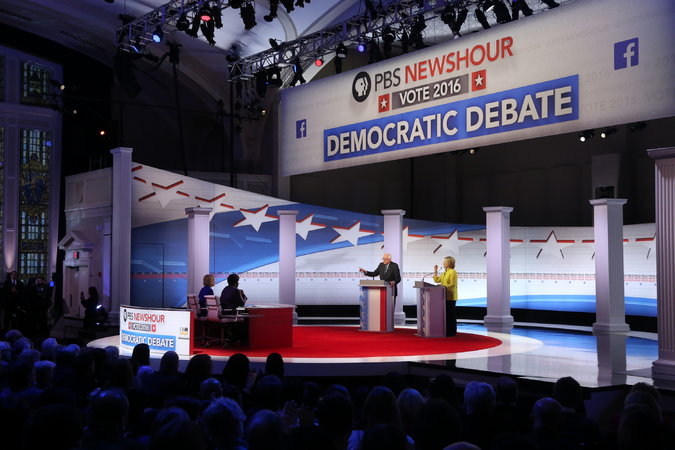
Bernie and Hillary at last night’s debate (Source: NYT)
W.J. Astore
Last night’s Democratic debate between Hillary Clinton and Bernie Sanders in Milwaukee hit the usual notes for these two candidates (the transcript is here). Clinton is all about competence and being ready on “day one” in the Oval office, whereas Bernie seeks a political revolution to galvanize the people. But a few telling items came up, mostly toward the end of the debate.
1. Hillary accused Bernie of being too critical of President Obama, of not supporting him, of suggesting he was “weak,” and of not respecting Obama’s legacy of results, especially the Affordable Care Act. This was a “low blow” for Bernie, who explained that he fully supported Obama, considered him to be a friend, and that he did indeed respect the president’s accomplishments. Besides that, Bernie noted, “one of us ran against Barack Obama [in 2008]. I was not that candidate.”
2. Bernie actually dared to suggest the Defense Department’s budget had to be given careful scrutiny, noting that the DoD has yet to pass an audit. In these days of issuing blank checks to the Pentagon, it was a significant moment.
3. Bernie took Hillary to task, successfully I believe, for her cozy relationship with Henry Kissinger. In my view, this was the most important moment of the night. With respect to U.S. foreign policy, Hillary promises continuity with neo-conservative principles of American interventionism and preemptive war. Bernie, even as he promises to crush the Islamic State, is far less enamored with neo-con agendas and peace through aggression.
Here is what Bernie had to say about Kissinger:
“I happen to believe that Henry Kissinger was one of the most destructive secretaries of state in the modern history of this country. I am proud to say that Henry Kissinger is not my friend. I will not take advice from Henry Kissinger. And in fact, Kissinger’s actions in Cambodia, when the United States bombed that country, overthrew Prince Sihanouk, created the instability for Pol Pot and the Khmer Rouge to come in, who then butchered some 3 million innocent people, one of the worst genocides in the history of the world. So count me in as somebody who will not be listening to Henry Kissinger…”
“Kissinger was one of those people during the Vietnam era who talked about the domino theory. Not everybody remembers that. You do. I do. The domino theory, you know, if Vietnam goes, China, da, da, da, da, da, da, da. That’s what he talked about, the great threat of China.”
“And then, after the war, this is the guy who, in fact, yes, you’re right, he opened up relations with China, and now pushed various type of trade agreements, resulting in American workers losing their jobs as corporations moved to China.”
“The terrible, authoritarian, Communist dictatorship he warned us about, now he’s urging companies to shut down and move to China. Not my kind of guy.”
Hillary defended her relationship with Kissinger, just as she defended herself from suggestions she’d be influenced by big money donors. In both cases, she came across as the establishment candidate, one who is most comfortable in the corridors of power, schmoozing with other power brokers and players.
In sum, even as Hillary attempts to appropriate some of Bernie’s anti-establishment rhetoric, her actions demonstrate how much she’s ensconced within the establishment camp, especially when it comes to U.S. foreign policy.
For voters looking for change in November, Hillary promises only an amped up version of more of the same.
Francis Bacon is famous for the aphorism, “Knowledge is power.” Yet the reverse aphorism is not true. The United States is the most powerful nation in the world, yet its knowledge base is notably weak in spite of all that power. Of course, many factors contribute to this weakness. Our public educational systems are underfunded and driven by meaningless standardized test results. Our politicians pander to the lowest common denominator. Our mainstream media is corporate-owned and in the business of providing info-tainment when they’re not stoking fear. Our elites are in the business of keeping the American people divided, distracted, and downtrodden, conditions that do not favor critical thinking, which is precisely the point of their efforts.
All that is true. But even when the U.S. actively seeks knowledge, we get little in return for our investment. U.S. intelligence agencies (the CIA, NSA, DIA, and so on) aggregate an enormous amount of data, then try to convert this to knowledge, which is then used to inform action. But these agencies end up drowning in minutiae. Worse, competing agencies within a tangled bureaucracy (that truly deserves the label of “Byzantine”) end up spinning the data for their own benefit. The result is not “knowledge” but disinformation and self-serving propaganda.
When our various intelligence agencies are not drowning in minutiae or choking on their own “spin,” they’re getting lost in the process of converting data to knowledge. Indeed, so much attention is put on process, with so many agencies being involved in that process, that the end product – accurate and actionable knowledge – gets lost. Yet, as long as the system keeps running, few involved seem to mind, even when the result is marginal — or disastrous.
Consider the Vietnam War. Massive amounts of “intelligence” data took the place of knowledge. Data like enemy body counts, truck counts, aircraft sorties, bomb tonnages, acres defoliated, number of villages pacified, and on and on. Amassing this data took an enormous amount of time; attempting to interpret this data took more time; and reaching conclusions from the (often inaccurate and mostly irrelevant) data became an exercise in false optimism and self-delusion. Somehow, all that data suggested to US officialdom that they were winning the war, a war in which US troops were allegedly making measurable and sustained progress. But events proved such “knowledge” to be false.
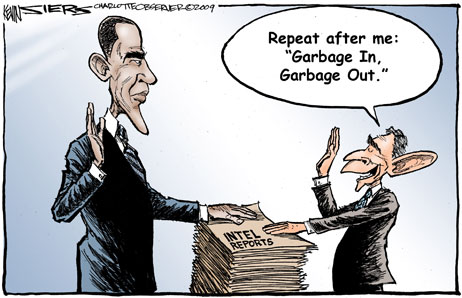
Of course, there’s an acronym for this: GIGO, or garbage (data) in, garbage (knowledge) out.
In this case, real knowledge was represented by the wisdom of Marine Corps General (and Medal of Honor recipient) David M. Shoup, who said in 1966 that:
I don’t think the whole of Southeast Asia, as related to the present and future safety and freedom of the people of this country, is worth the life or limb of a single American [and] I believe that if we had and would keep our dirty bloody dollar-crooked fingers out of the business of these nations so full of depressed, exploited people, they will arrive at a solution of their own design and want, that they fight and work for. And if, unfortunately, their revolution must be of the violent type…at least what they get will be their own and not the American style, which they don’t want…crammed down their throat.
But few wanted to hear Shoup and his brand of hard-won knowledge, even if he’d been handpicked by President Kennedy to serve as the Commandant of the Marine Corps exactly because Shoup had a reputation for sound and independent thinking.
Consider as well our rebuilding efforts in Iraq after 2003. As documented by Peter Van Buren in his book “We Meant Well,” those efforts were often inept and counterproductive. Yet the bureaucracy engaged in those efforts was determined to spin them as successes. They may even have come to believe their own spin. When Van Buren had the clarity and audacity to say, We’re fooling no one with our Kabuki dance in Iraq except the American people we’re sworn to serve, he was dismissed and punished by the State Department.
Why? Because you’re not supposed to share knowledge, real knowledge, with the American people. Instead, you’re supposed to baffle them with BS. But Van Buren was having none of that. His tell-all book (you can read an excerpt here) captured the Potemkin village-like atmosphere of US rebuilding efforts in Iraq. His accurate knowledge had real power, and for sharing it with the American people he was slapped down.
Tell the truth – share real knowledge with the American people – and you get punished. Massage the data to create false “knowledge,” in these cases narratives of success, and you get a pat on the back and a promotion. Small wonder that so many recent wars have gone so poorly for America.
What the United States desperately needs is insight. Honesty. A level of knowledge that reflects mastery. But what we’re getting is manufactured information, or disinformation, or BS. Lies, in plainspeak, like the lie that Iraq had in 2002 a large and active program in developing WMD that could be used against the United States. (Remember how we were told we had to invade Iraq quickly before the “smoking gun” became a “mushroom cloud”?)
If knowledge is power, what is false knowledge? False knowledge is a form of power as well, but a twisted one. For when you mistake the facade you’re constructing as the real deal, when you manufacture your own myths and then forget they’re myths as you consume them, you may find yourself hopelessly confused, even as the very myths you created consume you.
So, a corollary to Francis Bacon: Knowledge is power, but as the United States has discovered in Vietnam, Iraq, and elsewhere, power is no substitute for knowledge.
A Roman Cavalry Mask found at the presumed site of the Battle of Teutoburg Forest
W.J. Astore
Reports that President Obama is considering even more troops and bases to fight ISIS in Iraq put me to mind of Roman general Publius Quinctilius Varus. Two millennia ago, Varus committed three Roman legions to the Teutoburg Forest in Germania in terrain that neutralized Roman advantages in firepower and maneuverability. Ambushed and caught in a vise, his legions were destroyed in detail as Varus took his own life. To Rome the shock and disgrace of defeat were so great that Emperor Augustus cried, “Quinctilius Varus, give me back my Legions!”
Ever since 9/11, American presidents and their military advisors have repeatedly committed U.S. troops and prestige to inhospitable regions in terrain that largely neutralizes U.S. advantages in firepower and maneuverability. Whether it’s the urban jungles of Baghdad or Fallujah or Mosul or the harshly primitive and mountainous terrain of Afghanistan, American troops have been committed to campaigns that they can’t win (in any enduring sense), under conditions that facilitate ambushes by an elusive enemy with superior knowledge of the local terrain. The number of U.S. soldiers killed or seriously wounded in these campaigns is roughly equivalent to those lost by Varus, though unlike Varus no U.S. general has yet to fall on his sword.
Unlike Rome, which did learn from Varus’s catastrophe the perils of imperial overreach, the U.S. persists in learning nothing. Perhaps that’s because America’s defeat is collective and gradual, rather than singular and quick. America may lack a Varus or a calamity like Teutoburg Forest, yet the overall result since 9/11 has been no less debilitating to American foreign policy.
Despite setback after setback, American presidents and generals persist in trying to control hostile territory at the end of insecure logistical lines while mounting punitive raids designed to deny Al Qaeda or ISIS or the Taliban “safe havens.” We should have learned the impossibility of doing this from Vietnam, but it seems America’s presidents and generals keep trying to get Vietnam right, even if they have to move the fight to the deserts of Iraq or the mountains of Afghanistan.
Yet seeking to control territory in inhospitable regions like the Middle East or Afghanistan, whether you use American troops or proxy armies, is an exercise in strategic futility. It’s also old-fashioned thinking: the idea that, to exert influence and control, you need large numbers of military boots on the ground. But the world has already moved past such thinking into “borderless” hegemony as demonstrated by the Internet, by global business and finance, and by America’s own practice of drone strikes and cyber-war.
By repeatedly deploying American troops – whether in the tens of hundreds or tens of thousands – to so many equivalents of the Teutoburg Forest, our leaders continue a strategy of overreach that was already proven bankrupt in Vietnam. Meanwhile, despite our own early revolutionary history, our leaders seem to have forgotten that no country likes to be occupied or interfered with by foreigners, no matter how “generous” and “benevolent” they claim to be. Let’s also not forget that boots on the ground in faraway foreign lands cost an enormous amount of money, a cost that cannot be sustained indefinitely (just ask the British in 1781).
America simply cannot afford more troop deployments (and commitments of prestige) that set the stage for more military disasters. When you persist in committing your legions to torturous terrain against an enemy that is well prepared to exact a high price for your personal hubris and strategic stubbornness, you get the fate you deserve.
After Varus’s calamity, the Romans stopped campaigning east of the Rhine. When will America’s leaders learn that persistence in strategic overreach is nothing but folly?
Update (6/21/15): A friend writing from Germany reports that “new archaeological finds near the Elbe apparently show at least one major battle between Roman and Germanic forces in the second century AD. The documentary film’s claim was that the archaeological finds, combined with a few classical source references, show that the Roman armies did engage in major punitive expeditions deep into the territory across the Rhine in the time after Varus, including the one newly discovered which apparently showed a major Roman victory.”
Difficult to see. Always in motion the future, Yoda once said. He might have added that the past too “is always in motion.” Did a punitive raid such as this strengthen the Roman Empire or weaken it? If the Romans won a victory, was it of the Pyrrhic variety? Did the Romans attempt to sustain a presence across the Rhine only to abandon the attempt? It will be interesting to see what new evidence is uncovered by archaeologists working in the area.
History may not repeat itself, but it sure does echo – often loudly. That’s the theme of Tom Engelhardt’s new article, “Tomorrow’s News Today: Writing History Before It Happens.” Tom comes up with nine headlines that we’ve seen before, and that (sadly) we’re likely to see again — and again. Here, shortened, are his nine “future” headlines:
U.S. airstrike obliterates foreign wedding party.
U.S. government surveillance is far more intrusive than previously reported.
Patriotic whistleblower charged with espionage.
Extremist groups exploit unrest caused by U.S. military strikes.
Supposed U.S. ally snubs Presidential summit/meeting.
Young American with Islamic sympathies caught planning terrorism in FBI sting operation.
“Lone Wolf” homegrown terrorist kills innocents; says he was inspired by ISIS.
Toddler kills mother in gun accident.
President says U.S. is both exceptional and indispensable.
You can read all of Tom’s article here. Perhaps the most sobering aspect of his article is how readily predictable (and repetitive) such headlines are. Toddlers shooting parents and siblings? Sadly predictable due to the proliferation of guns and lack of safety measures. Whistleblowers charged with espionage? The next Snowden or Manning should be ready to be so charged, even when (especially when) their motives are focused on informing ordinary Americans of what their government is up to.
Inspired by Tom’s article, I came up with seven grim “future” headlines of my own. I challenge our readers to come up with a few as well. Just add them to the “Comments” section below.
This is not simply a whimsical or cynical exercise: it’s a reminder of how narrow our country’s narrative appears to be, both now and in the immediate future. Details change, a name here, a country there, but the headlines remain the same. We need to act to change these headlines.
My seven “future” headlines
U.S.-trained army [in Iraq, Afghanistan, whereverstan] collapses, abandoning heavy weapons and ammo stocks to rebel forces.
Deep-sea oil drilling platform [in Gulf of Mexico, Arctic Circle, insert environmentally sensitive area] malfunctions, triggering major spill and environmental disaster.
U.S. President starts new war without Congressional declaration of war.
After declaring “mission accomplished” [in Iraq, Afghanistan, Libya, Yemen, insert almost any Middle Eastern/African Country] and withdrawing U.S. troops, President [Bush, Obama, Bush/Clinton] orders troops to return as war is rekindled.
U.S. loses huge weapons cache [in Iraq, Afghanistan, whereverstan]; sends more weapons as replacements.
Lawbreaking major bank/corporation “too big to jail”; pays fine and admits no wrongdoing.
Pentagon weapon system, 10 years behind schedule and $100 billion over budget, fully funded by Congress.
Always in motion the future, as Yoda said. Let’s hope that a change for the better is not something that’s limited to “Star Wars” movies.
In the early 1970s, the US counted Iran as a close ally. A big fan of warplanes and weapons, I recall the US selling the F-14 Tomcat, the plane flown by Tom Cruise in “Top Gun,” as well as HAWK surface-to-air missiles and other advanced weaponry to the Shah of Iran. Back then, the F-14 had the most advanced avionics of any American plane, with a powerful radar linked to Phoenix air-to-air missiles. By selling the F-14 to Iran, the US was in a sense entrusting the Iranians with some of America’s most classified military secrets. (I later recall reading that the Iranians used F-14s as mini-AWACs planes, as in airborne warning and control, due to the power of its radar systems.)
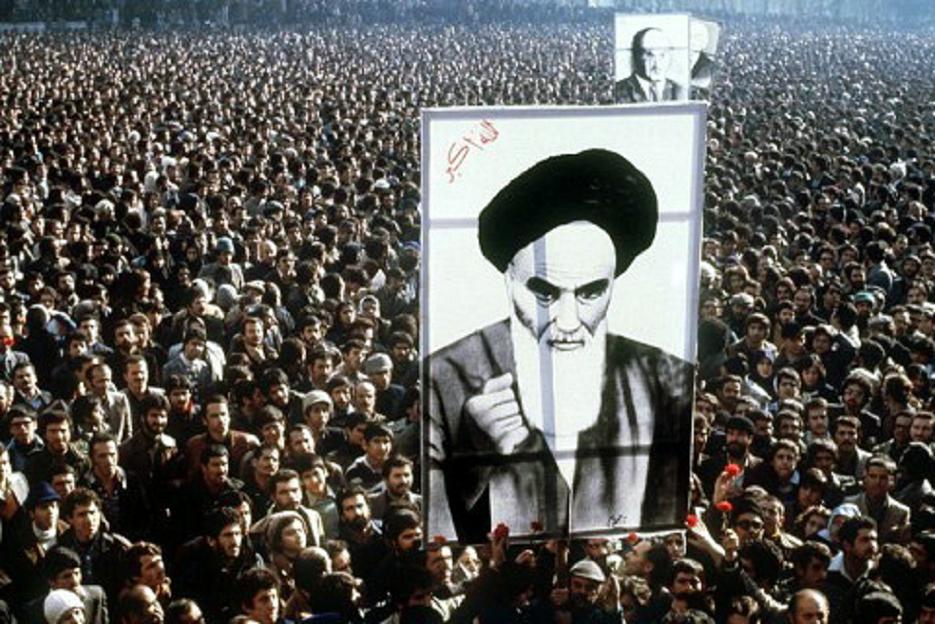
Well, that was then, when the Shah of Iran was our ally. Then the Iranian Revolution came, the Ayatollah Khomeini came to power, Iranians took Americans hostage in the US embassy, and Iran morphed into our “Great Satan” even as we became theirs. (As a teenager, I wore a t-shirt with Khomeini’s profile in a sniper’s crosshairs; the t-shirt read “Put a Hola in the Ayatollah.” It was quite popular.)
Now, of course, Iran is a nuclear bogeyman and a meddler in American designs on the Middle East. The irony is that the USA itself has been instrumental in facilitating the rise of Iran. This is amply documented in Peter Van Buren’s latest article for TomDispatch.com. It seems that what ever the US attempts in the Middle East, notably the invasion and occupation of Iraq, Iran emerges as the biggest beneficiary.
Maybe we’re still allies after all, and the Iranian Revolution was just a dream, as in that old plotline on the nighttime soap opera, “Dallas”? Heck, given the poor script being written by our foreign policy experts, anything seems possible.
Iran should send America a fruit basket to thank it for setting the stage so perfectly for its ascent. As a start, in 2003 the United States eliminated Iran’s major border threats: Iraq’s Saddam Hussein to the west and the Taliban in Afghanistan to the east. (The Taliban are back of course, but diligently focused on America’s puppet Afghan government.) The long slog of Washington’s wars in both those countries dulled even the reliably bloodthirsty American public’s taste for yet more of the same, and cooled off Bush-era plans in Tel Aviv and Washington for air strikes against Iran’s nuclear facilities. (After all, if even Vice President Dick Cheney couldn’t pull the trigger on Iran before leaving office in 2008, who in 2015 America is going to do so?)
Better yet for the Iranians, when Saddam was hanged in 2006, they not only lost an enemy who had invaded their country in 1980, launching a bitter waragainst them that didn’t end for eight years, but gained an ally in the new Iraq. As U.S. influence witheredaway with the failure of the March 2010 Iraqi elections to produce a broadly representative government, Iran stepped in to broker a thoroughly partisan settlement leading to a sectarian Shia government in Baghdad bent on ensuring that the country’s minority Sunni population would remain out of power forever. The Obama administration seemed nearly oblivious to Iran’s gains in Iraq in 2010 — and seems so again in 2015 …
The U.S. is running around in circles in the Middle East, patching together coalitions here, acquiring strange bedfellows there, and in location after location trying to figure out who the enemy of its enemy actually is. The result is just what you’d expect: chaos further undermining whatever’s left of the nations whose frailty birthed the jihadism America is trying to squash.
And in a classic tale of unintended consequences, just about every time Washington has committed another blunder in the Middle East, Iran has stepped in to take advantage. Consider that country the rising power in the region and credit American clumsiness for the new Iranian ascendancy.”
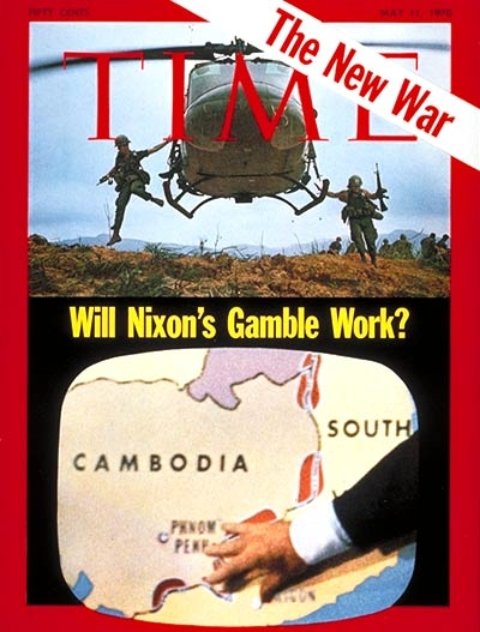
On 30 April 1970, 45 years ago this month, President Richard M. Nixon ordered an invasion into Cambodia. Explaining his reasoning for widening the war in Southeast Asia, Nixon declared:
If, when the chips are down, the world’s most powerful nation acts like a pitiful, helpless giant, the forces of totalitarianism and anarchy will threaten free nations and free institutions.” [Emphasis added]
So much of the U.S. foreign policy establishment, then and now, is frightfully worried about appearing weak, helpless, impotent. The solution, then and now, is military action. They all want to be Caesars, if only in their own besotted minds. As Shakespeare had Cassius say about Caesar:
he doth bestride the narrow world/Like a colossus, and we petty men/Walk under his huge legs and peep about/To find ourselves dishonorable graves.
America, to its image-conscious imperators like Nixon, must bestride the world like a well-hung giant, while little foreigners gasp in awe at the shadow cast, especially when aroused.
Think about John McCain’s fervent desire to bomb Iran, as Dan White deconstructed here. Think about George W. Bush’s transparent desire to play the conquering hero in the Middle East, ending Saddam Hussein’s reign once and for all in Iraq in 2003. Recall here the words of Henry Kissinger when he was asked about why he supported the invasion of Iraq, when it was clear that country bore no responsibility for the 9/11 attacks. “Because [attacks on] Afghanistan wasn’t enough,” Kissinger replied. Radical Islam had humiliated the U.S. at 9/11, and now it was our turn to strike back harder and to humiliate them. That simple.
As America’s foreign policy establishment continues to struggle with radical Islam and instability in Iraq, Syria, Yemen, Libya, and elsewhere, don’t expect any strategic retreats or retrenchment. Don’t expect wisdom. Don’t expect a containment policy that might allow radical Islam to burn itself out. No. Expect more military strikes, more troops, more weapons, more impassioned speeches about holding the line against barbarians determined to end our way of life.
Why? In part because it’s far easier for insecure men to lash out as a way of compensating for their impotence and growing irrelevance. Acting tough is the easier path. Having patience, demonstrating forbearance, knowing when to sheath the sword, requires a quieter strength and a more confident sense of self.
You would think the “most powerful nation on the planet” with “the world’s best military in all of history” would have such quiet strength and confidence. But remember that Nixon quote: No matter how big and strong we are, we can’t afford to look tiny and weak.
Yet another “magnificent victory” in Iraq, this time in Tikrit, twelve years after “Mission Accomplished” was declared
W.J. Astore
American reporting on Iraq focuses on the eternal now, such as the rise of ISIS or recent battles in Tikrit. Rarely is any context given to these events, and rarer still is any accounting of the costs of war (still rising) to the Iraqi people.
Let’s return to 2003 and the U.S. invasion of Iraq. Before the invasion, the U.S. Army War College accurately predicted what was to come. A report co-authored by Conrad C. Crane and W. Andrew Terrill warned that U.S. forces would have “to prevent Sunnis from fighting Shiites, secular Iraqis from fighting religious ones, returned Iraqi exiles from fighting non-exiles, Kurds from fighting Turkomans or establishing an independent state, tribes within all these groups from fighting one another, Turkey from invading from the north, Iran from invading from the east, and the defeated Iraqi army–which may be the only national institution that can keep the country from being ripped apart–from dissolving,” as summarized in “After Saddam,” a short article in “Primary Sources” in the Atlantic Monthly in June 2003.*
Read that last bit again: America’s military experts stated the Iraqi army had to be preserved so as to prevent Iraq from devolving into factionalism and chaos. So what did America’s proconsul for Iraq, L. Paul Bremer III, proceed to do when he took over in 2003? He dissolved the Iraqi army! Under the orders of the all-wise Bush Administration.
In a much longer article for the Atlantic Monthly, James Fallows detailed how the Bush Administration went “Blind into Baghdad” (January/February 2004). Fallows concluded that Bush/Cheney (and Rumsfeld/Wolfowitz) oversaw “a historic failure” in Iraq precisely because they “willfully” disregarded “a vast amount of expert planning.” Whether this was by design or not is still disputed, but one must recall Cheney’s rosy prediction that Iraqis would welcome U.S. troops as “liberators.”
Hubris is one explanation for such folly. Other commentators suggest a deliberate policy to destabilize Iraq. Whatever the case, the big winner of Iraq’s decline and near fall was Iran, followed by various forms of Islamic extremism that arose from the ashes of violence and civil war.
By the spring of 2004, as the Coalition Provisional Authority (CPA) headed by Bremer prepared to return “sovereignty” to the allegedly newly-democratic Iraq, American officials who hadn’t drunk the kool-aid recognized that civil war was coming. A friend of mine, an Army major, was at that time serving with the CPA in Baghdad. He wrote to me at the time that:
“The emperor has no clothes … corruption, private militias, insecurity, and coming civil war [in Iraq] is accepted as given amongst the CPA staff. The focus is on making some sort of transition on 30 June [2004] to whatever ‘government’ we can get in place by then. Anything after 30 June is ‘we’ll get to that when we can.’ This whole operation is a train wreck waiting to happen, and the [Bush] administration simply refused to acknowledge it, much less do anything about it.”
Ominously, my friend concluded that “Even the Iraqis who welcomed us after Saddam [fell] have lost patience with us and are pursuing other routes to power and national control.” This was because the U.S. was throwing its support behind an Iraqi regime “which is seen as completely illegitimate by the people it’s supposed to rule in the name of democracy.”
In short, the CPA and Bush Administration were selling a lie in 2004, and they knew it. But Bush won reelection later that year, so who really cares if the U.S. lost, in the words of my friend, “serious credibility” in the region as a result?
For informed Americans not suffering from amnesia, the above narrative shouldn’t come as a total surprise. By its actions and inaction and lies, the Bush Administration brought endless civil war to Iraq. The U.S. essentially created the conditions for the rise of ISIS and similar extremist groups. But the U.S. media has cloaked this hard reality in a shroud of myths about the “decisive” Petraeus Surge of 2007 (really a temporary lull in the civil war) or various other “mission accomplished” moments promoted by both Bush and Obama.
Mission accomplished? A magnificent victory? Only if the “mission” was the dismantling of Iraq, and “victory” is measured by more and more war.
*The report, dated February 2003, was “Reconstructing Iraq: Insights, Challenges, and Missions for Military Forces in a Post-Conflict Scenario.”
Over at TomDispatch.com, retired Army Colonel Andrew Bacevich asks a telling question: Why does Washington continue to rely on policy “experts,” the “best and brightest” as they were called during the Vietnam War, even when events prove their advice to be consistently wrong?
As Bacevich puts it (with considerable relish):
“Policy intellectuals — eggheads presuming to instruct the mere mortals who actually run for office — are a blight on the republic. Like some invasive species, they infest present-day Washington, where their presence strangles common sense and has brought to the verge of extinction the simple ability to perceive reality. A benign appearance — well-dressed types testifying before Congress, pontificating in print and on TV, or even filling key positions in the executive branch — belies a malign impact. They are like Asian carp let loose in the Great Lakes.”
One of the big drawbacks of a Hillary Clinton vs. Jeb Bush joust in 2016 is that both candidates will be relying on the same neocon “experts” who got us into Afghanistan and Iraq and the ongoing, seemingly endless, war on terror. What Washington needs most of all is fresh blood and fresher thinking; what 2016 promises is retread candidates and recycled pundits.
The problem is that these pundits rarely admit that they’re wrong. Even when they do, their admissions run false. They say things like: “We were wrong for the right reason [about Iraq and WMD],” a sentiment echoed by George W. Bush in his memoir that “There are things we got wrong in Iraq, but the cause is eternally right.” So, as long as your cause is “eternally right” (fighting against Communism in Vietnam; against terror in the Middle East), it doesn’t matter how many things you get wrong (such as how many innocents you end up killing, especially if they’re foreigners).
Their mantra is something like this: Never admit your wrong. And never apologize. Instead, double down on talking tough and committing troops.
As Bacevich notes:
The present-day successors to Bundy, Rostow, and Huntington subscribe to their own reigning verities. Chief among them is this: that a phenomenon called terrorism or Islamic radicalism, inspired by a small group of fanatic ideologues hidden away in various quarters of the Greater Middle East, poses an existential threat not simply to America and its allies, but — yes, it’s still with us — to the very idea of freedom itself. That assertion comes with an essential corollary dusted off and imported from the Cold War: the only hope of avoiding this cataclysmic outcome is for the United States to vigorously resist the terrorist/Islamist threat wherever it rears its ugly head….
The fact that the enterprise itself has become utterly amorphous may actually facilitate such efforts. Once widely known as the Global War on Terror, or GWOT, it has been transformed into the War with No Name. A little bit like the famous Supreme Court opinion on pornography: we can’t define it, we just know it when we see it, with ISIS the latest manifestation to capture Washington’s attention.
All that we can say for sure about this nameless undertaking is that it continues with no end in sight. It has become a sort of slow-motion Vietnam, stimulating remarkably little honest reflection regarding its course thus far or prospects for the future. If there is an actual Brains Trust at work in Washington, it operates on autopilot. Today, the second- and third-generation bastard offspring of RAND that clutter northwest Washington — the Center for this, the Institute for that — spin their wheels debating latter day equivalents of Strategic Hamlets, with nary a thought given to more fundamental concerns.”
Tough talk by “experts” with no skin in the game has proved to be a recipe for disaster in slow-motion. The best and the brightest have become the venal and the vacuous. Bacevich is right: We can do better, America.
Like so many bloated Hollywood movies nowadays, America’s wars may bomb, but they always produce their own sequels.
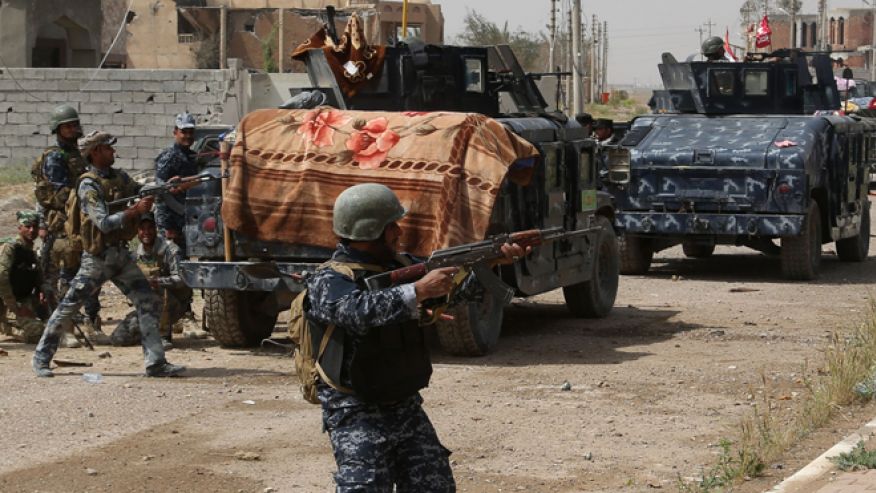
Look at the latest news from Iraq and Afghanistan. These wars have persisted for more than a decade, with several re-releases to include “surges” and repeats. The latest from Iraq is preparations to retake the city of Mosul from ISIS, which promises a repeat of the level of destruction visited upon Fallujah in 2004. In this there are echoes of Vietnam: in Mosul, we may have to destroy the city to save it. Five Iraqi brigades, most likely supported by American airpower and some American troops on the ground (air controllers and Special Forces), are poised to strike as early as April. Doubtless they’ll prevail, at least for the moment, as the city and its civilians pay a price so dear as to be indistinguishable from defeat. Mosul will be “liberated,” but just look what happened to Fallujah, which after the American “victory” in 2004 is now a devastated city retaken by elements of al-Qaeda in 2014.
(As an aside, it’s interesting that the New York Times uses the word “epic” to describe the Battle of Fallujah from 2004. Surely a better word is “catastrophic.” What is epic about a battle that destroys a city, a battle that is ultimately inconclusive? Check out Bing West’s book about Fallujah, whose title, “No True Glory,” captures the frustrations and contradictions of that battle, mainly from the American perspective.)
Moving to Afghanistan, the latest is that American troops may stay longer than expected (surprise!). Despite all the talk of “progress” in Afghanistan, the takeaway is the following section, from Secretary of Defense Ash Carter’s recent visit to Afghanistan:
“Despite the aid of American air power, 2014 was the deadliest year for Afghan forces since the start of the war in 2001, and many Afghan and Western officials in Kabul believe that 2015 will likely be worse, particularly with less support from Western allies. That has begun to change the conversation about the possibility of slowing down in the [American] withdrawal.”
In other words, expect more micro-surges of American troops and assets in the coming years, as well as more reports of “progress,” however temporary or illusory (at least America’s best and brightest learned from Vietnam not to talk of seeing light at the end of tunnels).
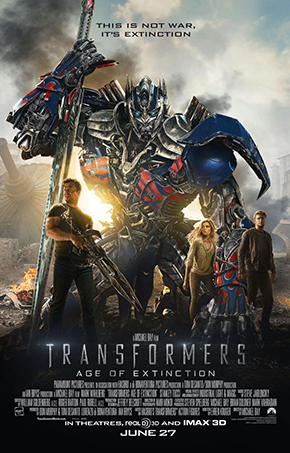
America’s wars are much like the “Transformers” franchise of movies: thrilling and seemingly conclusive at first, with much talk of missions being accomplished, followed by sequel after sequel of repetitive battles, increasingly loud and destructive, signifying vapidity and intellectual bankruptcy even as a few profit greatly from them.
And no one (certainly none of the producers at the Pentagon) seems to be able to pull the plug on green-lighting ever more sequels to these wars. Even when they bomb.
(For a different perspective on how recent Hollywood movies support American warmaking through myth-making, see Peter Van Buren’s insightful article “War Porn” at TomDispatch.com.)
In America’s war on terror, the groundhog always sees its own shadow, meaning six (or more) years of additional war. War is indeed the new normal in America, as I argue in this article today for TomDispatch.com.
War Is the New Normal Seven Deadly Reasons Why America’s Wars Persist
By William J. Astore
It was launched immediately after the 9/11 attacks, when I was still in the military, and almost immediately became known as the Global War on Terror, or GWOT. Pentagon insiders called it “the long war,” an open-ended, perhaps unending, conflict against nations and terror networks mainly of a radical Islamist bent. It saw the revival of counterinsurgency doctrine, buried in the aftermath of defeat in Vietnam, and a reinterpretation of that disaster as well. Over the years, its chief characteristic became ever clearer: a “Groundhog Day” kind of repetition. Just when you thought it was over (Iraq, Afghanistan), just after victory (of a sort) was declared, it began again.
Now, as we find ourselves enmeshed in Iraq War 3.0, what better way to memorialize the post-9/11 American way of war than through repetition. Back in July 2010, I wrote an article for TomDispatch on the seven reasonswhy America can’t stop making war. More than four years later, with the war on terror still ongoing, with the mission eternally unaccomplished, here’s a fresh take on the top seven reasons why never-ending war is the new normal in America. In this sequel, I make only one promise: no declarations of victory (and mark it on your calendars, I’m planning to be back with seven new reasons in 2019).
1. The privatization of war: The U.S. military’s recourse to private contractors has strengthened the profit motive for war-making and prolonged wars as well. Unlike the citizen-soldiers of past eras, the mobilized warrior corporations of America’s new mercenary moment — the Halliburton/KBRs (nearly $40 billion in contracts for the Iraq War alone), the DynCorps ($4.1 billion to train 150,000 Iraqi police), and the Blackwater/Xe/Academis ($1.3 billion in Iraq, along with boatloads of controversy) — have no incentive to demobilize. Like most corporations, their business model is based on profit through growth, and growth is most rapid when wars and preparations for more of them are the favored options in Washington.
“Freedom isn’t free,” as a popular conservative bumper sticker puts it, and neither is war. My father liked the saying, “He who pays the piper calls the tune,” and today’s mercenary corporations have been calling for a lot of military marches piping in $138 billion in contracts for Iraq alone, according to the Financial Times. And if you think that the privatization of war must at least reduce government waste, think again: the Commission on Wartime Contracting in Iraq and Afghanistan estimated in 2011 that fraud, waste, and abuse accounted for up to $60 billion of the money spent in Iraq alone.
To corral American-style war, the mercenaries must be defanged or deflated. European rulers learned this the hard way during the Thirty Years’ War of the seventeenth century. At that time, powerful mercenary captains like Albrecht von Wallenstein ran amok. Only Wallenstein’s assassination and the assertion of near absolutist powers by monarchs bent on curbing war before they went bankrupt finally brought the mercenaries to heel, a victory as hard won as it was essential to Europe’s survival and eventual expansion. (Europeans then exported their wars to foreign shores, but that’s another story.)
2. The embrace of the national security state by both major parties:Jimmy Carter was the last president to attempt to exercise any kind of control over the national security state. A former Navy nuclear engineer who had served under the demanding Admiral Hyman Rickover, Carter cancelled the B-1 bomber and fought for a U.S. foreign policy based on human rights. Widely pilloried for talking about nuclear war with his young daughter Amy, Carter was further attacked for being “weak” on defense. His defeat by Ronald Reagan in 1980 inaugurated 12 years of dominance by Republican presidents that opened the financial floodgates for the Department of Defense. That taught Bill Clinton and the Democratic Leadership Council a lesson when it came to the wisdom of wrapping the national security state in a welcoming embrace, which they did, however uncomfortably. This expedient turn to the right by the Democrats in the Clinton years served as a temporary booster shot when it came to charges of being “soft” on defense — until Republicans upped the ante by going “all-in” on military crusades in the aftermath of 9/11.
Since his election in 2008, Barack Obama has done little to alter the course set by his predecessors. He, too, has chosen not to challenge Washington’s prevailing catechism of war. Republicans have responded, however, not by muting their criticism, but by upping the ante yet again. How else to explain House Speaker John Boehner’s invitation to Israeli Prime Minister Benjamin Netanyahu to address a joint session of Congress in March? That address promises to be a pep talk for the Republicans, as well as a smack down of the Obama administration and its “appeasenik” policies toward Iran and Islamic radicalism.
Serious oversight, let alone opposition to the national security state by Congress or a mainstream political party, has been missing in action for years and must now, in the wake of the Senate Torture Report fiasco (from which the CIAemerged stronger, not weaker), be presumed dead. The recent midterm election triumph of Republican war hawks and the prospective lineup of candidates for president in 2016 does not bode well when it comes to reining in the national security state in any foreseeable future.
3. “Support Our Troops” as a substitute for thought. You’ve seen them everywhere: “Support Our Troops” stickers. In fact, the “support” in that slogan generally means acquiescence when it comes to American-style war. The truth is that we’ve turned the all-volunteer military into something like aforeign legion, deploying it again and again to our distant battle zones and driving it into the ground in wars that amount to strategic folly. Instead of admitting their mistakes, America’s leaders have worked to obscure them by endlessly overpraising our “warriors” as so many universal heroes. This may salve our collective national conscience, but it’s a form of cheap grace that saves no lives — and wins no wars.
Instead, this country needs to listen more carefully to its troops, especially the war critics who have risked their lives while fighting overseas. Organizations like Iraq Veterans Against the War and Veterans for Peace are good places to start.
4. Fighting a redacted war. War, like the recent Senate torture report, is redacted in America. Its horrors and mistakes are suppressed, its patriotic whistleblowers punished, even as the American people are kept in a demobilized state. The act of going to war no longer represents the will of the people, as represented by formal Congressional declarations of war as the U.S. Constitution demands. Instead, in these years, Americans were told togo to Disney World (as George W. Bush suggested in the wake of 9/11) and keep shopping. They’re encouraged not to pay too much attention to war’s casualties and costs, especially when those costs involve foreigners with funny-sounding names (after all, they are, as American sniper Chris Kyle so indelicately put it in his book, just “savages”).
Redacted war hides the true cost of a permanent state of killing from the American people, if not from foreign observers. Ignorance and apathy reign, even as a national security state that is essentially a shadow governmentequates its growth with your safety.
5. Threat inflation: There’s nothing new about threat inflation. We saw plenty of it during the Cold War (nonexistent missile and bomber gaps, for example). Fear sells and we’ve had quite a dose of it in the twenty-first century, from ISIS to Ebola. But a more important truth is that fear is a mind-killer, a debate-stifler.
Back in September, for example, Senator Lindsey Graham warned that ISIS and its radical Islamic army was coming to America to kill us all. ISIS, of course, is a regional power with no ability to mount significant operations against the United States. But fear is so commonplace, so effectively stoked in this country that Americans routinely and wildly exaggerate the threat posed by al-Qaeda or ISIS or the bogeyman du jour.
Decades ago, as a young lieutenant in the Air Force, I was hunkered down inCheyenne Mountain during the Cold War. It was the ultimate citadel-cum-bomb-shelter, and those in it were believed to have a 70% likelihood of surviving a five-megaton nuclear blast. There, not surprisingly, I found myself contemplating the very real possibility of a thermonuclear exchange with the Soviet Union, a war that would have annihilated life as we knew it, indeed much of life on our planet thanks to the phenomenon of nuclear winter. You’ll excuse me for not shaking in my boots at the threat of ISIS coming to get me. Or of Sharia Law coming to my local town hall. With respect to such fears, America needs, as Hillary Clinton said in an admittedly different context, to “grow a pair.”
6. Defining the world as a global battlefield: In fortress America, all realms have by now become battle spheres. Not only much of the planet, the seas, air, and space, as well as the country’s borders and its increasingly up-armored police forces, but the world of thought, the insides of our minds. Think of the 17 intertwined intelligence outfits in “the U.S. Intelligence Community” and their ongoing “surge” for information dominance across every mode of human communication, as well as the surveillance of everything. And don’t forget the national security state’s leading role in making cyberwar a reality. (Indeed, Washington launched the first cyberwar in history by deploying the Stuxnet computer worm against Iran.)
Think of all this as a global matrix that rests on war, empowering disaster capitalism and the corporate complexes that have formed around the Pentagon, the Department of Homeland Security, and that intelligence community. A militarized matrix doesn’t blink at $1.45 trillion dollars devoted to the F-35, a single under-performing jet fighter, nor at projections of $355 billion over the next decade for “modernizing” the U.S. nuclear arsenal, weapons that Barack Obama vowed to abolish in 2009.
7. The new “normal” in America is war: The 9/11 attacks happened more than 13 years ago, which means that no teenagers in America can truly remember a time when the country was at peace. “War time” is their normal; peace, a fairy tale.
What’s truly “exceptional” in twenty-first-century America is any articulated vision of what a land at peace with itself and other nations might be like. Instead, war, backed by a diet of fear, is the backdrop against which the young have grown to adulthood. It’s the background noise of their world, so much a part of their lives that they hardly recognize it for what it is. And that’s the most insidious danger of them all.
How do we inoculate our children against such a permanent state of war and the war state itself? I have one simple suggestion: just stop it. All of it. Stop making war a never-ending part of our lives and stop celebrating it, too. War should be the realm of the extreme, of the abnormal. It should be the death of normalcy, not the dreary norm.
It’s never too soon, America, to enlist in that good fight!
William J. Astore, a retired lieutenant colonel (USAF), is a TomDispatch regular. His D.Phil. is in Modern History from the University of Oxford. He’s just plain tired of war and would like to see the next politician braying for it be deployed with a rifle to the front lines of battle. He edits the blog The Contrary Perspective.