I awoke to the news that Israel has bombed Iran, focusing on nuclear enrichment facilities and military targets. For the U.S. and Israel, war always finds a way.
The U.S. is claiming that Israel alone is bombing Iran, but of course Israel is using U.S. weaponry, intelligence and logistical support, and political cover at the United Nations. The planes may be Israeli, but the U.S. government is complicit in the attacks, just as the U.S. government is complicit in genocide in Gaza.
At Eunomia, Daniel Larison has an informative article on the “insanity” of the Israeli/U.S. attack on Iran. A few points come to mind here:
+ Israel is allowed to have 90-200 nuclear bombs, but no other country in the region is allowed to have any. I guess that’s because Israel is so clearly peace-loving?
+ Iran is the latest target of Israel’s quest for regional dominance. As far back as 2003, if not earlier, Israel (and U.S. neocon “warriors”) always wanted to go to Tehran. Baghdad was supposed to be both a cakewalk and a stepping-stone. Two decades and several disasters later, these “real men” finally achieved their dream of war with Iran.
+ The success of Israel in getting the U.S. government and military to do its bidding is nothing short of phenomenal. Iraq? Greatly weakened. Syria? Greatly weakened. The same with Libya. And now it’s Iran’s turn to be “greatly weakened,” i.e. bludgeoned with bombs made in the USA.
+ Iran will likely strike back. U.S. media will frame these attacks as “unprovoked” and “anti-semitic.” See this grimly amusing article by Caitlin Johnstone about future headlines at the New York Times.
+ One thing is certain: Israel, like the U.S., has an irrational belief in the efficacy of bombing, an efficacy largely disproven by military history.
+ One might recall how the U.S. conspired with Britain in 1953 to overthrow Iran’s democratically-elected leader, replacing him with the Shah, leading to 25 years of a repressive police state until the Shah was finally overthrown. I wonder how Americans would feel if Iran conspired in 1953 to overthrow Dwight D. Eisenhower as U.S. president, replacing him with a petty dictator who ruled through secret police?
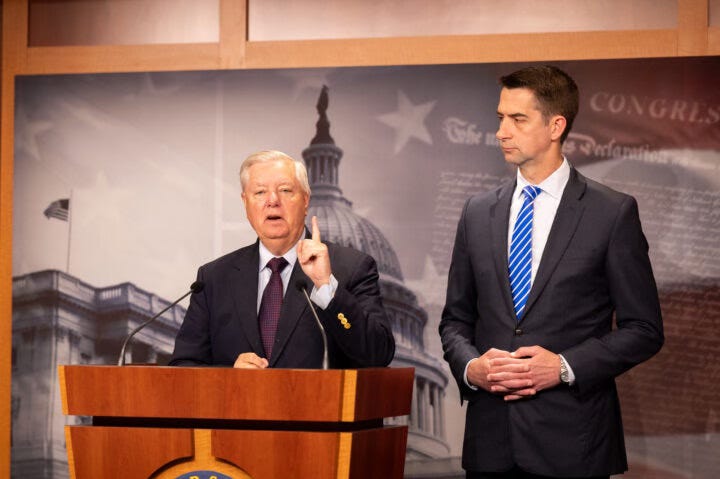
Chickenhawk Graham says “Game on.”
Here are a few responses by prominent U.S. politicians to Israel’s attacks on Iran. I just love the “game on” reference by Senator Lindsey Graham. Has there ever been a more abject and delusional chickenhawk than him?
Sen. Tom Cotton (R-AR), the chairman of the Senate Intelligence Committee said, minutes after reports of the operation began, “Proud to stand with Israel.” Sen. Lindsey Graham (R-SC) soon followed, saying, “Game on. Pray for Israel.”
Cotton later added that “We back Israel to the hilt, all the way,” adding that if “the ayatollahs harm a single American, that will be the end of the ayatollahs.”
House Speaker Mike Johnson (R-LA), said “Israel IS right—and has a right—to defend itself!”
Sen. Jim Risch (R-ID), the chair of the Senate Foreign Relations Committee said, “We stand with Israel tonight and pray for the safety of its people and the success of this unilateral, defensive action.”
“I am also praying for the brave U.S. service members in the Middle East who keep America safe — Iran would be foolish to attack the United States,” Risch continued.
U.S. members of Congress seem to think they swore an oath to Israel, not the U.S. Constitution. And, given all the money they receive from AIPAC and similar pro-Israel lobbying groups, maybe they have sold their souls to Israel.
Once again, all they are saying is give war a chance.
I read the news today, oh boy. About a lucky man named Elon Musk. But he lost out on one thing: he didn’t get a top secret briefing on Pentagon war plans for China. And the news people breathed a sigh of relief.
With apologies to John Lennon and The Beatles, a day in the life is getting increasingly tough to take here in the land of the free. I’m meant to be reassured that Musk didn’t get to see America’s top-secret plans for — yes! — going to war with China, even as I’m meant to ignore the constant drumbeat of propaganda, the incessant military marches that form America’s background music, conveying the message that America must have war plans for China, that indeed war in or around China is possible, even probable, in the next decade. Maybe in 2027?
My fellow Americans, we should be far more alarmed by such secret U.S. war plans, along with those “pivots” to Asia and the Indo-Pacific, and the military base-building efforts in the Philippines, than reassured by the “good news” that Comrade Billionaire Musk was denied access to the war room, meaning (for Dr. Strangelove fans) he didn’t get to see “the big board.”
It’s war, war, everywhere in America. We do indeed have a strange love for it. I’ve been writing for TomDispatch for 18 years now — this is my 111th essay (the other 110 are in a new book of mine) — most of them focusing on militarism in this country, as well as our disastrous wars in Iraq, Afghanistan, and elsewhere, the ruinous weapons systems we continue to fund (including new apocalyptic nuclear weapons), and the war song that seems to remain ever the same.
A few recent examples of what I mean: President Trump has already bombed Yemen more than once. He’s already threatening Iran. He’s sending Israel all the explosives, all the weaponry it needs to annihilate the Palestinians in Gaza (so too, of course, did Joe Biden). He’s boasting of building new weapons systems like the Air Force’s much-hyped F-47 fighter jet, the “47” designation being an apparent homage by its builder, Boeing, to Trump himself, the 47th president. He and his “defense” secretary, Pete Hegseth, continually boast of “peace through strength,” an Orwellian construction that differs little from “war is peace.” And I could, of course, go on and on and on and on…
Occasionally, Trump sounds a different note. When Tulsi Gabbard became the director of national intelligence, he sang a dissonant note about a “warmongering military-industrial complex.” And however haphazardly, he does seem to be working for some form of peace with respect to the Russia-Ukraine War. He also talks about his fear of a cataclysmic nuclear war. Yet, if you judge him by deeds rather than words, he’s just another U.S. commander-in-chief enamored of the military and military force (whatever the cost, human or financial).
Consider here the much-hyped Department of Government Efficiency (DOGE) led by that lucky man Elon Musk. Even as it dismantles various government agencies like the Department of Education and USAID, it has — no surprise here! — barely touched the Pentagon and its vast, nearly trillion-dollar budget. In fact, if a Republican-controlled Congress has any say in the matter, the Pentagon budget will likely be boosted significantly for Fiscal Year 2026 and thereafter. As inefficient as the Pentagon may be (and we really don’t know just how inefficient it is, since the bean counters there keep failing audit after audit, seven yearsrunning), targeted DOGE Pentagon cuts have been tiny. That means there’s little incentive for the generals to change, streamline their operations, or even rethink in any significant fashion. It’s just spend, spend, spend until the money runs out, which I suppose it will eventually, as the national debt soars toward $37 trillion and climbing.
Even grimmer than that, possibly, is America’s state of mind, our collective zeitgeist, the spirit of this country. That spirit is one in which a constant state of war (and preparations for more of the same) is accepted as normal. War, to put it bluntly, is our default state. It’s been that way since 9/11, if not before then. As a military historian, I’m well aware that the United States is, in a sense, a country made by war. It’s just that today we seem even more accepting of that reality, or resigned to it, than we’ve ever been. What gives?
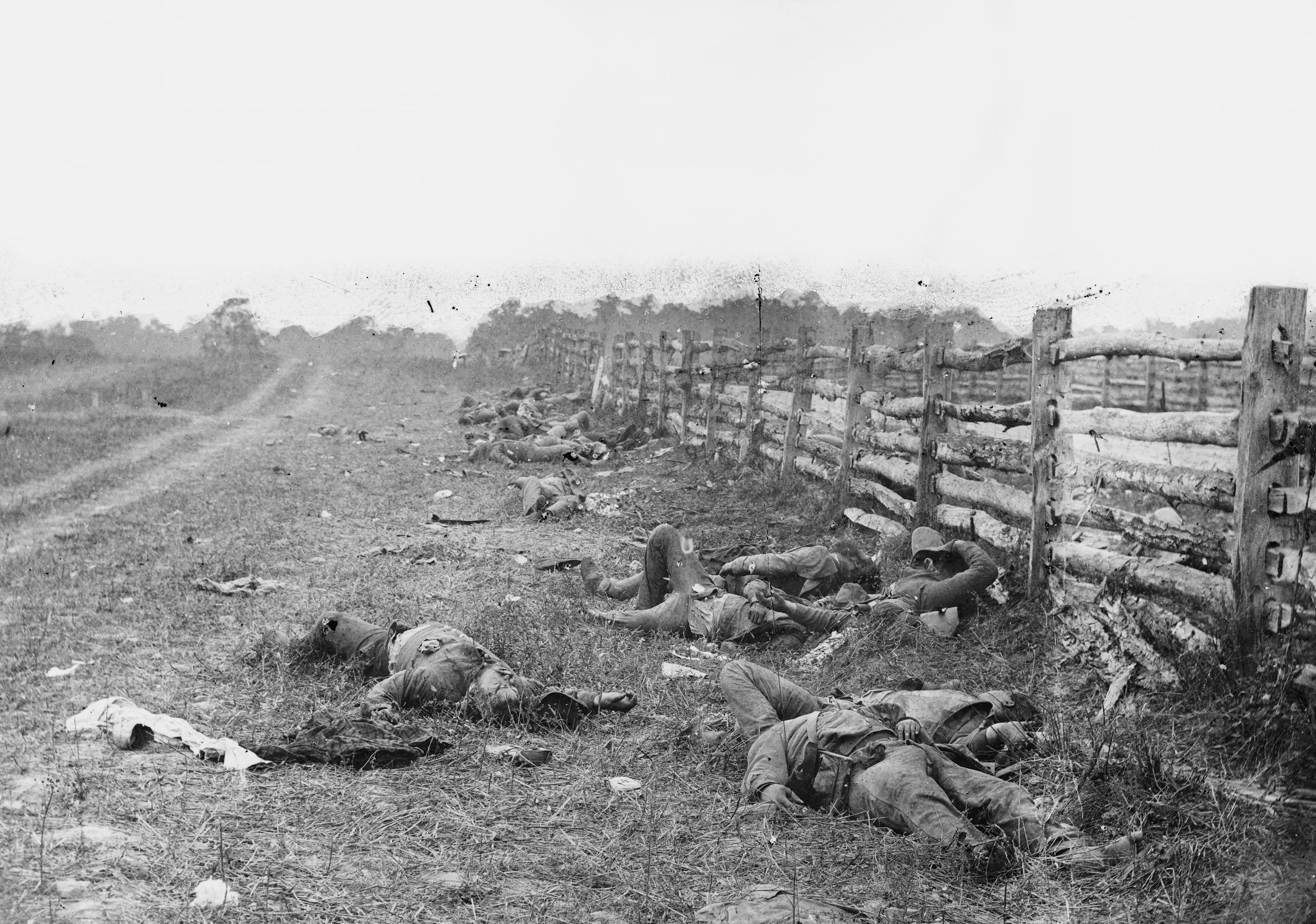
The Face of War: Confederate Dead at Antietam (Matthew Brady)
Remember when, in 1963, Alabama Governor George Wallace said, “Segregation now, segregation tomorrow, and segregation forever”? Fortunately, after much struggle and bloodshed, he was proven wrong. So, can we change the essential American refrain of war now, war tomorrow, and war forever? Can we render that obsolete? Or is that too much to hope for or ask of America’s “exceptional” democracy?
Taking on the MICIMATT(SH)
Former CIA analyst Ray McGovern did America a great service when he came up with the acronym MICIMATT, or the Military-Industrial-Congressional-Intelligence-Media-Academia-Think-Tank complex, an extension of President Dwight D. Eisenhower’s military-industrial complex, or MIC (from his farewell speech in 1961). Along with the military and industry (weapons makers like Boeing and Lockheed Martin), the MICIMATT adds Congress (which Eisenhower had in his original draft speech but deleted in the interest of comity), the intelligence “community” (18 different agencies), the media (generally highly supportive of wars and weapons spending), academia (which profits greatly from federal contracts, especially research and development efforts for yet more destructive weaponry), and think tanks (which happily lap up Pentagon dollars to tell us the “smart” position is always to prepare for yet more war).
You’ll note, however, that I’ve added a parenthetical SH to McGovern’s telling acronym. The S is for America’s sporting world, which eternally gushes about how it supports and honors America’s military, and Hollywood, which happily sells war as entertainment (perhaps the best known and most recent film being Tom Cruise’s Top Gun: Maverick, in which an unnamed country that everyone knows is Iran gets its nuclear ambitions spanked by a plucky team of U.S. Naval pilots). A macho catchphrase from the original Top Gun was “I feel the need — the need for speed!” It may as well have been: I feel the need — the need for pro-war propaganda!
Yes, MICIMATT(SH) is an awkward acronym, yet it has the virtue of capturing some of the still-growing power, reach, and cultural penetration of Ike’s old MIC. It should remind us that it’s not just the military and the weapons-makers who are deeply invested in war and — yes! — militarism. It’s Congress; the CIA; related intel “community” members; the mainstream media (which often relies on retired generals and admirals for “unbiased” pro-war commentary); academia (consider how quickly institutions like Columbia University have bent the knee to Trump); and think tanks — in fact, all those “best and brightest” who advocate for war with China, the never-ending war on terror, war everywhere.
But perhaps the “soft power” of the sporting world and Hollywood is even more effective at selling war than the hard power of bombs and bullets. National Football League coaches patrol the sidelines wearing camouflage, allegedly to salute the troops. Military flyovers at games celebrate America’s latest death-dealing machinery. Hollywood movies are made with U.S. military cooperation and that military often has veto power over scripts. To cite only one example, the war movie 12 Strong (2018) turned the disastrous Afghan War that lasted two horrendous decades into a stunningly quick American victory, all too literally won by U.S. troops riding horses. (If only the famed cowboy actor John Wayne had still been alive to star in it!)
The MICIMATT(SH), employing millions of Americans, consuming trillions of dollars, and churning through tens of thousands of body bags for U.S. troops over the years, while killing millions of people abroad, is an almost irresistible force. And right now, it seems like there’s no unmovable object to blunt it.
Believe me, I’ve tried. I’ve written dozens of “Tomgrams” suggesting steps America could take to reverse militarism and warmongering. As I look over those essays, I see what still seem to me sensible ideas, but they die quick deaths in the face of, if not withering fire from the MICIMATT(SH), then being completely ignored by those who matter.
And while this country has a department of war (disguised as a department of defense), it has no department of peace. There’s no budget anywhere for making peace, either. We do have a colossal Pentagon that houses 30,000 workers, feverishly making war plans they won’t let Elon Musk (or any of us) see. It’s for their eyes only, not yours, though they may well ask you or your kids to serve in the military, because the best-laid plans of those war-men do need lots of warm bodies, even if those very plans almost invariably (Vietnam, Afghanistan, Iraq, etc.) go astray.
So, to repeat myself, how do you take on the MICIMATT(SH)? The short answer: It’s not easy, but I know of a few people who had some inspirational ideas.
On Listening to Ike, JFK, MLK, and, Yes, Madison, Too
Militarism isn’t exactly a new problem in America. Consider Randolph Bourne’s 1918 critique of war as “the health of the state,” or General Smedley Butler’s confession in the 1930s that “war is a racket” run by the “gangsters of capitalism.” In fact, many Americans have, over the years, spoken out eloquently against war and militarism. Many beautiful and moving songs have asked us to smile on your brother and “love one another right now.” War, as Edwin Starr sang so powerfully once upon a time, is good for “absolutely nothin’,” though obviously a lot of people disagree and indeed are making a living by killing and preparing for yet more of it.
And that is indeed the problem. Too many people are making too much money off of war. As Smedley Butler wrote so long ago: “Capital won’t permit the taking of the profit out of war until the people — those who do the suffering and still pay the price — make up their minds that those they elect to office shall do their bidding, and not that of the profiteers.” Pretty simple, right? Until you realize that those whom we elect are largely obedient to the moneyed class because the highest court in our land has declared that money is speech. Again, I didn’t say it was going to be easy. Nor did Butler.
As a retired lieutenant colonel in the U.S. Air Force, I want to end my 111th piece at TomDispatch by focusing on the words of Ike, John F. Kennedy (JFK), Martin Luther King, Jr. (MLK), and James Madison. And I want to redefine what words like duty, honor, country, and patriotism should mean. Those powerful words and sentiments should be centered on peace, on the preservation and enrichment of life, on tapping “the better angels of our nature,” as Abraham Lincoln wrote so long ago in his First Inaugural Address.
Why do we serve? What does our oath of office really mean? For it’s not just military members who take that oath but also members of Congress and indeed the president himself. We raise our right hands and swear to support and defend the U.S. Constitution against all enemies, foreign and domestic, to bear true faith and allegiance to the same.
There’s nothing in that oath about warriors and warfighters, but there is a compelling call for all of us, as citizens, to be supporters and defenders of representative democracy, while promoting the general welfare (not warfare), and all the noble sentiments contained in that Constitution. If we’re not seeking a better and more peaceful future, one in which freedom may expand and thrive, we’re betraying our oath.
If so, we have met the enemy — and he is us.
Ike told us in 1953 that constant warfare is no way of life at all, that it is (as he put it), humanity crucifying itself on a cross of iron. In 1961, he told us democracy was threatened by an emerging military-industrial complex and that we, as citizens, had to be both alert and knowledgeable enough to bring it to heel. Two years later, JFK told us that peace — even at the height of the Cold War — was possible, not just peace in our time, but peace for all time. However, it would, he assured us, require sacrifice, wisdom, and commitment.
How, in fact, can I improve on these words that JFK uttered in 1963, just a few months before he was assassinated?
What kind of peace do we seek? Not a Pax Americana enforced on the world by American weapons of war. Not the peace of the grave or the security of the slave. I am talking about genuine peace, the kind of peace that makes life on earth worth living…
I speak of peace because of the new face of war. Total war makes no sense in an age… when the deadly poisons produced by a nuclear exchange would be carried by wind and water and soil and seed to the far corners of the globe and to generations yet unborn… surely the acquisition of such idle [nuclear] stockpiles — which can only destroy and never create — is not the only, much less the most efficient, means of assuring peace.
I speak of peace, therefore, as the necessary rational end of rational men. I realize that the pursuit of peace is not as dramatic as the pursuit of war — and frequently the words of the pursuer fall on deaf ears. But we have no more urgent task.
Are we ready to be urgently rational, America? Are we ready to be blessed as peacemakers? Or are we going to continue to suffer from what MLK described in 1967 as our very own “spiritual death” due to the embrace of militarism, war, empire, and racism?
Of course, MLK wasn’t perfect, nor for that matter was JFK, who was far too enamored of the Green Berets and too wedded to a new strategy of “flexible response” to make a clean break in Vietnam before he was killed. Yet those men bravely and outspokenly promoted peace, something uncommonly rare in their time — and even more so in ours.
More than 200 years ago, James Madison warned us that continual warfare is the single most corrosive force to the integrity of representative democracy. No other practice, no other societal force is more favorable to the rise of authoritarianism and the rule of tyrants than pernicious war. Wage war long and it’s likely you can kiss your democracy, your rights, and just maybe your ass goodbye.
America, from visionaries and prophets like MLK, we have our marching orders. They are not to invest yet more in preparations for war, whether with China or any other country. Rather, they are to gather in the streets and otherwise raise our voices against the scourge of war. If we are ever to beat our swords into plowshares and our spears into pruning hooks and make war no more, something must be done.
Let’s put an end to militarism in America. Let’s be urgently rational. To cite John Lennon yet again: You may say I’m a dreamer, but I’m not the only one. Together, let’s imagine and create a better world.
Then why is bombing the option that’s always chosen?
There they go again. The geniuses inside the DC Beltway are bombing the Middle East again, specifically 85+ targets in Iraq and Syria allegedly supported by Iran. It’s funny: I don’t recall a Congressional declaration of war against Iraq and Syria (or Iran, for that matter), but who needs to be limited by the U.S. Constitution, am I right?
After the recent attack that killed three U.S. soldiers, I heard again that hackneyed expression from DC that “all options are on the table” in response. Amazing how the option that’s always picked by U.S. presidents is the military one. If it’s not “bomb bomb bomb bomb bomb Iran,” as John McCain once jokingly sang, it’s bomb Iranian-backed units in Iraq and Syria, because that’s the best way toward greater stability and peace in the Middle East. Perfectly logical.
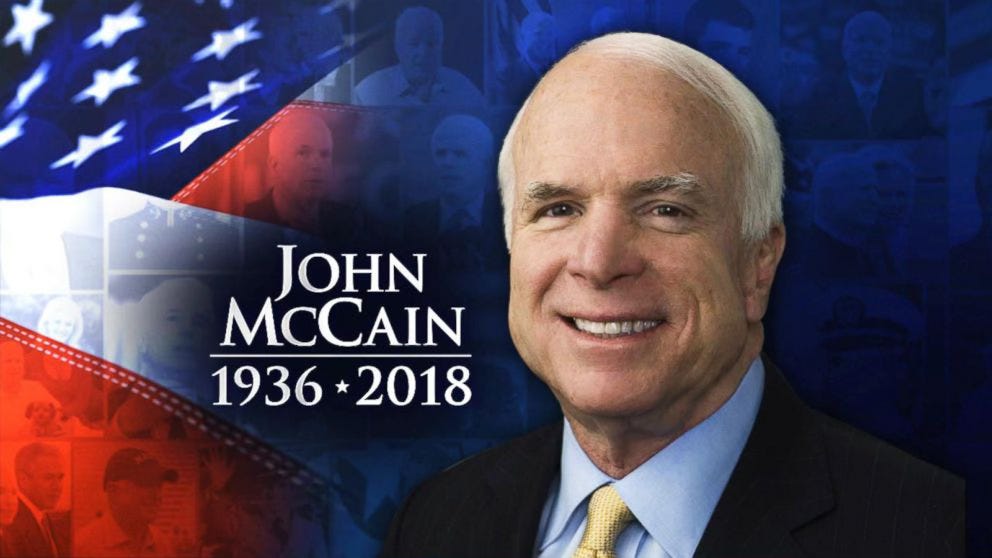
Yes, he died in 2018, but he’s America’s most likely presidential winner in 2024.
Speaking of John McCain, I like the joke that’s making the rounds that no matter who Americans vote for as president, they get John McCain, which is a shorthand way of saying that the National Security State is the unofficial fourth and most powerful branch of the U.S. government. Or, if you prefer, the MICIMATT, the military-industrial-congressional-intelligence-media-academe-think-tank complex.
Speaking of the media, you can always count on U.S. media talking heads issuing resounding hosannas to the highest whenever a U.S. president bombs a foreign country. Remember when reporters gushed that Donald Trump had finally become a real president in 2017 when he bombed Syria? Trump, who expressed his contempt for John McCain, finally became him—and earned the MICIMATT’s approval—when he started bombing and launching missiles to kill foreigners.
Finally, we often hear the expression from U.S. government-types that the only thing “they” understand is physical violence and war. It’s often far more accurate to say that the only thing “we” (the MICIMATT, that is) understand (and profit from) is physical violence and war.
In 2002-03, before the U.S. invasion of Iraq, there was great optimism within the U.S. government that Baghdad was only the first stop on the worldwide victory tour of “the finest fighting force” in human history. The saying back then was: “Everyone wants to go to Baghdad. Real men want to go to Tehran.” Baghdad, of course, didn’t turn out quite as well as Bush/Cheney expected. The “real men” never did quite make it to Tehran.
With the deaths of three U.S. troops reported yesterday in Jordan near the Syrian border, those “real men” may start dreaming again of going to Tehran. The Biden administration has been quick to blame “radicals” backed by Iran for those deaths. Iran is also being blamed for its support of Houthis in their attacks on shipping as a protest against Israel’s ongoing war of annihilation against Gaza.
How long before the “real men” in Biden’s administration decide that strikes against Iran are justified as reprisals for U.S. troop casualties in Jordan? How long before wars in the Middle East escalate and perhaps spiral out of control?
Only the “real men” of Washington, I suppose, have the answers here. One of those self-styled “real men,” Senator Lindsey Graham of South Carolina, had this to say via a manly tweet: “Hit Iran now. Hit them hard.” His “hard man” service in the U.S. Air Force was as a lawyer.
Lindsey Graham, on the right, decorated by Ukraine. He’s a “hard” hitter!
Update (1/29/24): It remains unclear (at least to me) whether the attack occurred in Jordan or Syria. Here’s an excerpt from Reuters:
Sunday’s attack on a remote outpost known as Tower 22 near Jordan’s northeastern border with Syria, the strikes had not killed U.S. troops nor wounded so many. That allowed Biden the political space to mete out U.S. retaliation, inflicting costs on Iran-backed forces without risking a direct war with Tehran.
Biden said the United States would respond, without giving any more details.
Republicans accused Biden of letting American forces become sitting ducks, waiting for the day when a drone or missile would evade base defenses. They say that day came on Sunday, when a single one-way attack drone struck near base barracks early in the morning.
In response, they say Biden must strike Iran.
“He left our troops as sitting ducks,” said Republican U.S. Senator Tom Cotton. “The only answer to these attacks must be devastating military retaliation against Iran’s terrorist forces, both in Iran and across the Middle East.”
The Republican who leads the U.S. military oversight committee in the House of Representatives, Representative Mike Rogers, also called for action against Tehran.
“It’s long past time for President Biden to finally hold the terrorist Iranian regime and their extremist proxies accountable for the attacks they’ve carried out,” Rogers said.
Former President Donald Trump, who hopes to face off against Biden in this year’s presidential election, portrayed the attack as a “consequence of Joe Biden’s weakness and surrender.”
Note the usual partisan criticism of whichever party is in power in Washington about its alleged “weakness” and “surrender” policies. Few in Congress question the need for U.S. troops operating in Syria in an apparently open-ended commitment.
The death of these troops should not be used as a cause for more war. If anything, they should lead to the withdrawal of U.S. troops from an area and country where they shouldn’t be based.
Trump boasting of big missiles while denouncing Democrats
W.J. Astore
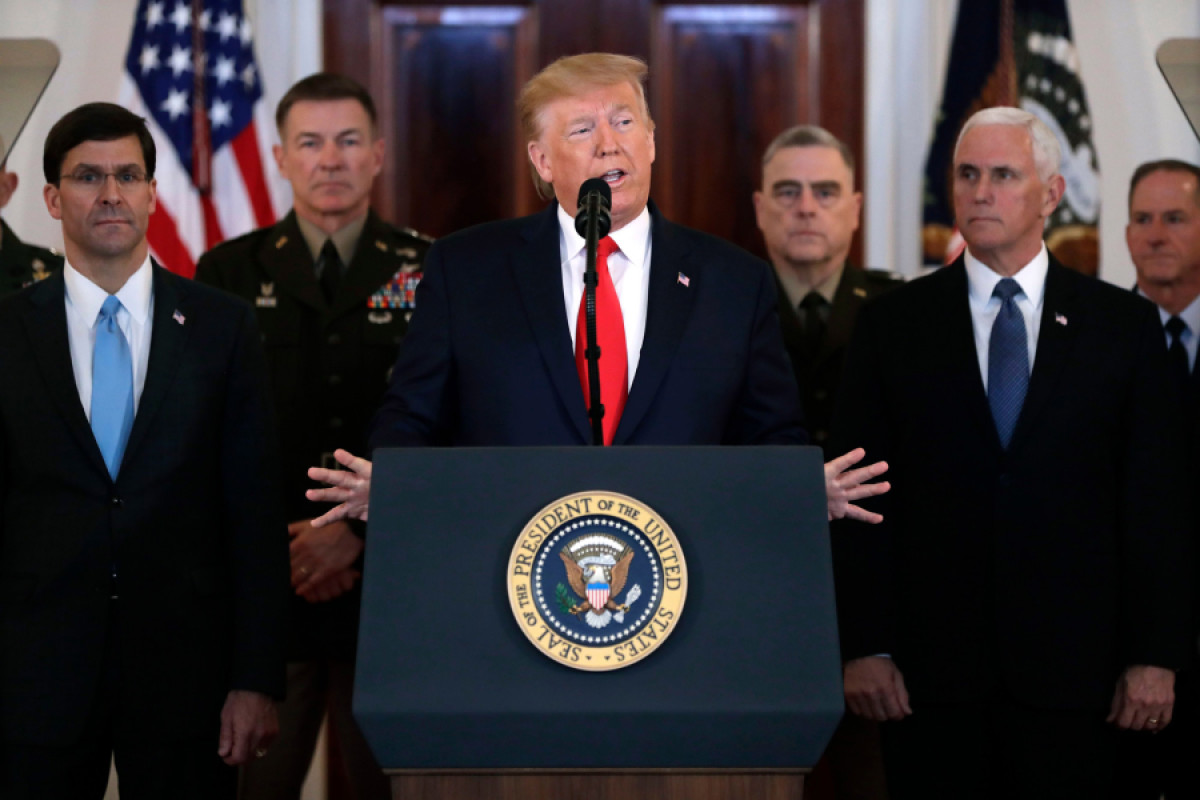
I watched Trump’s speech today to the nation on Iran. It had the usual boasts about the U.S. military and its “big” and “lethal” missiles, the usual bombast, the usual lies. But this passage of his speech truly struck me as beyond the pale:
Iran’s hostilities substantially increased after the foolish Iran nuclear deal was signed in 2013, and they were given 150 billion dollars, not to mention 1.8 billion dollars in cash. Instead of saying thank you to the United States, they chanted Death to America.
In fact, they chanted Death to America the day the agreement was signed. Then Iran went on a terrorist spree funded by the money from the deal and created hell in Yemen, Syria, Lebanon, Afghanistan, and Iraq. The missiles fired last night at us and our allies were paid for with the funds made available by the last administration.
That’s right: the missiles used against U.S. forces last night we’re paid for by the Obama administration. Not only that: Iran went on a “terrorist spree” funded by the “foolish” Iran nuclear treaty, spreading “hell” throughout Yemen, Syria, Lebanon, Afghanistan, and Iraq. I’m sure glad Saudi Arabia, Israel, the United States, and other military actors in the region never spread any “hell,” despite all those Hellfire missiles launched from American drones.
So here’s a new claim for you. If the U.S. military is losing in Iraq and Afghanistan and elsewhere, the culprit is clear: the Obama administration and by extension the Democrats, the appeasers who funded Iran and made possible all of its “terrorist” activities.
Best of all, Trump wished peace and prosperity to the Iranian people, but you heard nothing about working peacefully and in prosperous ways with the Democrats.
Clearly, Trump sees the real enemy of America: Obama and the Democrats.
What happened to Afghanistan and all that lying about progress?
W.J. Astore
According to FP: Foreign Policy, these are the top five stories in U.S. foreign policy in 2019. I’ve inserted quick comments at the end in bold:
1. U.S. and Turkey Lock Horns Over Syria.
“U.S. support to the Syrian Democratic Forces has long angered Turkey, a NATO ally which views the Kurdish-led group as a terrorist threat … But in a fateful October phone call, Turkish President Recep Tayyip Erdogan repeated his longtime threat to launch a cross-border invasion. This time Trump capitulated, moving a handful of U.S. troops so the Turks could begin the assault against the Kurds … Hundreds have been killed and roughly 200,000 people were displaced.”
Comment: Syria is not a vital U.S. interest. U.S. forces shouldn’t be there. And who are these “democratic forces” of Syria?
2. Trump Impeached Over Ukraine Scandal.
“Trump’s efforts to pressure Ukraine into investigating a Democratic rival this year led to the third impeachment of a U.S. president in history, thrusting Washington’s national security apparatus into the spotlight.”
Comment: The U.S. shouldn’t be meddling in Ukraine. And we shouldn’t be sending more weapons there. I sure as hell don’t want my taxpayer dollars going to weapons for Ukraine.
3. North Korea Talks Sputter and Stall.
“The historic nuclear talks between Trump and North Korean Supreme Leader Kim Jong Un in 2018 offered hope that the two countries could de-escalate tensions and prevent a nuclear confrontation. Talks stalled after the Singapore Summit in June 2018. While both sides made significant verbal commitments in 2019, the year saw a gradual deterioration of bilateral relations.”
Comment: North Korea isn’t giving up its nuclear weapons. The North Koreans saw what happened to Gaddafi in Libya when he gave up his WMD. Plus nuclear weapons and missiles are a prestige project for Kim Jong-un, who’s played Trump like a fiddle.
4. Iran Strikes Back.
“Tensions between Iran and the United States skyrocketed in 2019, as the U.S. maximum pressure campaign took effect and Tehran lashed out against harsh U.S. sanctions. (Trump withdrew from the 2015 nuclear deal in 2018.) … Attacks have ceased in recent weeks as Tehran launched a brutal crackdown on the worst political unrest the country has seen since the Islamic Revolution 40 years ago. But U.S. officials are bracing for another devastating strike in the region, this time perhaps targeting the region’s critical sources of drinking water.”
Comment: Harsh U.S. sanctions are an act of war — or at least we’d see them that way if the roles were reversed. And why is Iran always seen as the aggressor capable of launching “devastating” strikes?
5. Venezuela Crisis Simmers.
“Venezuela’s Russia-backed leader Nicolás Maduro clung to power this year despite an economic collapse, nationwide blackouts and fierce opposition from Juan Guaidó, who declared himself Venezuela’s interim president in January with support from the West. Tensions threatened to boil over in May, when Guaidó tried and failed to ignite an uprising. The attempted coup was seen as an embarrassing failure by the United States and particularly National Security Advisor John Bolton, reportedly the architect of multiple attempts to unseat Maduro. In addition to harsh sanctions, the United States went so far as to draw up military options, but never took any action.”
Comment: Looks like Bolton takes the fall for inept U.S. meddling in Venezuela. Guess what? It’s all about the oil — and the money.
Of course, FP: Foreign Policy missed the biggest story of 2019: Consistent, extensive, and persistent lying by U.S. leaders about the course of the Afghan War, as revealed by the “Afghan Papers” published by the Washington Post.
Readers — what do you think about this list? In the holiday spirit, I see much naughtiness here, and no niceness. Santa won’t be pleased.
You won’t see this illustration in the mainstream media:
If the Iranians really wanted peace, they’d move their country.
In all seriousness, U.S. media talking heads, many of them retired military officers, are constantly talking about the aggression of others and their weapons of mass destruction (WMD). Never do these “experts” speak of U.S. aggression and the WMD we have in our possession. Indeed, the U.S. maintains an earth-busting arsenal of nuclear weapons, and we remain the only country to have used atomic bombs for real (at Hiroshima and Nagasaki in 1945). Yet we’re the ones who have to worry about Iranian nuclear weapons that don’t yet exist (and probably never will)?
Tom Engelhardt has a great new article at TomDispatch.com on how the U.S. always sees itself as the victim, as the aggrieved party, as the one who’s being threatened. Here’s an excerpt:
So here’s the strange thing, on a planet on which, in 2017, U.S. Special Operations forces deployed to 149 countries, or approximately 75% of all nations; on which the U.S. has perhaps 800 military garrisons outside its own territory; on which the U.S. Navy patrols most of its oceans and seas; on which U.S. unmanned aerial drones conduct assassination strikes across a surprising range of countries; and on which the U.S. has been fighting wars, as well as more minor conflicts, for years on end from Afghanistan to Libya, Syria to Yemen, Iraq to Niger in a century in which it chose to launch full-scale invasions of two countries (Afghanistan and Iraq), is it truly reasonable never to identify the U.S. as an “aggressor” anywhere?
What you might say about the United States is that, as the self-proclaimed leading proponent of democracy and human rights (even if its president is now having a set of love affairs with autocrats and dictators), Americans consider ourselves at home just about anywhere we care to be on planet Earth. It matters little how we may be armed and what we might do. Consequently, wherever Americans are bothered, harassed, threatened, attacked, we are always the ones being provoked and aggressed upon, never provoking and aggressing. I mean, how can you be the aggressor in your own house, even if that house happens to be temporarily located in Afghanistan, Iraq, or perhaps soon enough in Iran?
The U.S. as an aggressor? Impossible! Our military installations, our weaponry, even our wars are all about keeping the peace. Right?
There was a time, almost 250 years ago, when Americans successfully fought for their independence (though quite a few “loyalists” preferred compromise with the British crown). There was a time, 75 years ago, when Americans landed on the beaches of Normandy to defeat Nazi aggression. But when you look at America’s long history of wars, precious few of them can be said to have been defensive in nature. Indeed, most were acts of aggression, e.g. the Mexican-American War, the Spanish-American War, the long bloody wars against Native Americans, the Vietnam War, and more recent, undeclared, wars in Iraq and Afghanistan.
Dare I state the obvious? Americans are generally not shy, diffident, passive people. Ask most foreigners about Americans and you’ll hear words like pushy, outspoken, loud, and, yes, aggressive. (Of course. not all Americans fit this description, but think of recent representatives like Trump, Pompeo, and Bolton or Bush, Cheney, and Rumsfeld.) Yet, with all our aggressiveness, with all our violent tendencies, why do we continue to see others as the pushy ones, the headstrong ones, the ones who want war?
A little empathy, America? Forget about it! Come on, Iran. It’s time to move. And since the U.S. dominates this planet, I have the perfect destination for you. How about Mars?
But wait: NASA wants to launch a manned mission there! And since Mars is named after the god of war, it’s a natural for us. Red and fiery in the sky — how long until we build our first military base there?
General Joseph Votel, U.S. Centcom commander, testified to the House Armed Services Committee this week that the greatest destabilizing force in the Middle East is Iran, and that the U.S. must be prepared to use “military means” to confront and defeat the Iranian threat to the region.
No doubt Iran is a pest to U.S. designs in the Middle East. No doubt Iran has its own agenda. No doubt Iran is no friend to Israel. But the greatest destabilizing force in the Greater Middle East? That’s the USA. We’re the ones who toppled Iraq in 2003, along with the legitimate government of Iran 50 years earlier.
Iran/Persia has lived in, and sometimes dominated, the Greater Middle East for 2500 years. By comparison, the USA is a newcomer on the block. Yet it’s the Iranians who are the destabilizers, the ones operating in a nefarious “grey zone” between peace and war, at least according to U.S. generals.
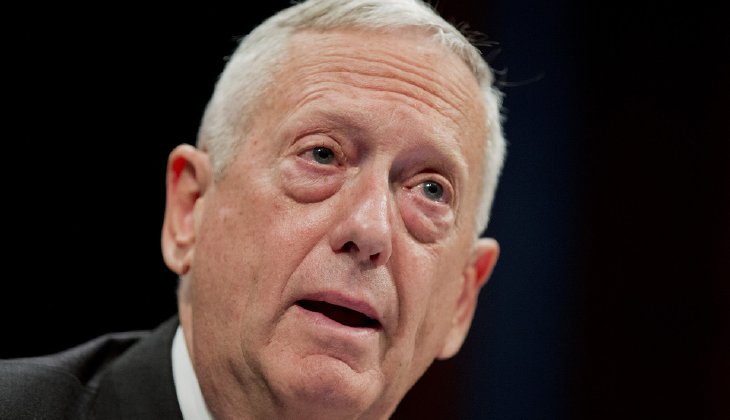
According to General Mattis, the Iranians are the greatest threat to stability and peace in the Middle East. The U.S., with its massive military and extensive weapons sales, only safeguards peace and stability.
Besides the disastrous U.S. invasion of Iraq in 2003, which accidentally helped Iran, the U.S. continues to sell massive amounts of weaponry to Iran’s rivals, most especially Saudi Arabia. U.S. military operations in Yemen, Syria, Iraq, and elsewhere in the Middle East have both destabilized the region and created marketplaces for U.S. weaponry and opportunities for economic exploitation by multinational corporations.
I’m no fan of Iran and its leaders, but can one blame them for resisting U.S. military and economic incursions into their sphere of influence? Recall how we reacted when the Russians put missiles into Cuba. Look at all the hostile rhetoric directed today against Mexico and its allegedly unfair trade practices vis-a-vis the U.S.
Let’s not forget that for 25 years (1953-78), the Shah of Iran was an American ally. The U.S. military loved to sell him our most advanced weaponry, which at that time included F-14 Tomcat fighters and HAWK missile systems. That cozy relationship died with the Iranian Revolution (1979); ally turned to enemy as the U.S. supported Saddam Hussein and Iraq during the bloody Iran-Iraq War of the 1980s.
Yet, despite all this history, despite all the U.S. meddling, all the weapons sales, all the invasions and sanctions, somehow it’s the Iranians who are the destabilizing force, the ones deserving of more “disruptive” U.S. military action.
As America’s designs are frustrated in the Middle East, American generals never look in the mirror to see their own faults and failings. Instead, they cast about for new countries to blame — and to attack. Iran is seemingly next on the list, a country that General Mattis, America’s Secretary of Defense, said is “the single most enduring threat to stability and peace in the Middle East.”
Anyone for war with Iran? U.S. generals are ready.
How about a contrary perspective on the Middle East, courtesy of my old globe? It dates from the early 1920s, just after World War I but before Russia became the Soviet Union. Taking a close look at the Middle East (a geographic term that I use loosely), you’ll notice more than a few differences from today’s maps and globes:
Iraq and Syria don’t exist. Neither does Israel. Today’s Iran is yesterday’s Persia, of course.
Instead of Iraq and Syria, we have Mesopotamia, a name that resonates history, part of the Fertile Crescent that encompassed the Tigris and Euphrates Rivers as well as the Nile in Egypt. Six thousand years ago, the cradle of human civilization, and now more often the scene of devastation caused mainly by endless war.
Ah, Kurdistan! The Kurds today in northern Iraq and southern Turkey would love to have their own homeland. Naturally, the Arabs and Turks, along with the Persians, feel differently.
Look closely and you’ll see “Br. Mand.” and “Fr. Mand.” With the collapse of the Ottoman Empire (roughly a larger version of modern-day Turkey) at the end of World War I, the British gained a mandate over Palestine and Mesopotamia and the French gained one over territory that would become Lebanon and Syria. The British made conflicting promises to Jews and Arabs over who would control Palestine while scheming to protect their own control over the Suez Canal. A large portion of Palestine, of course, was given to Jews after the Holocaust of World War II, marking the creation of Israel and setting off several Arab-Israeli Wars(1948-73) and the ongoing low-level war between Israel and the Palestinians, most bitterly over the status of the “Occupied Territories”: land captured by the Israelis during these wars, i.e. the West Bank (of the Jordan River) and the Gaza Strip (both not labeled on my outdated globe).
Improvisation marked the creation of states such as Lebanon, Syria, and Iraq. Borders encapsulated diverse peoples with differing goals. Western powers like Britain and France cared little for tribal allegiances or Sunni/Shia sensitivities or political leanings, favoring autocratic rulers who could keep the diverse peoples who lived there in line.
Historically powerful peoples with long memories border the Middle East. The Turks and the Persians (Iranians), of course, with Russians hovering in the near distance. They all remain players with conflicting goals in the latest civil war in Syria and the struggle against ISIS/ISIL.
Three of the world’s “great” religions originated from a relatively tiny area of our globe: Judaism, Christianity, and Islam. Talk about a fertile crescent! Sadly, close proximity and shared roots did not foster tolerance: quite the reverse.
Remember when Saudi Arabia was just Arabia? Ah, those were the good old days, Lawrence.
Nobody talks much about Jordan, an oasis of relative calm in the area (not shown on my old globe). Lucky Jordan.
The presence of Armenia in Turkey on my old globe raises all kinds of historical ghosts, to include the Armenian genocide of World War I. Today, Turkey continues to deny that the word “genocide” is appropriate to the mass death of Armenians during World War I.
My fellow Americans, one statement: The idea that America “must lead” in this area of the world speaks to our hubris and ignorance. We are obviously not seen as impartial. Our “leadership” is mainly expressed by violent military action.
But we just can’t help ourselves. The idea of “global reach, global power” is too intoxicating. We see the globe as ours to spin. Ours to control.
Perhaps old globes can teach us the transitory nature of power. After all, those British and French mandates are gone. European powers, however grudgingly, learned to retrench. (Of course, the British and French, together with the Germans, are now bombing and blasting old mandates in the name of combating terrorism.)
I wonder how a globe made in 2115 will depict this area of the world. Will it look like today’s globe, or more like my globe from c.1920, or something entirely different? Will it show a new regional empire or more fragmentation? An empire based on Islam or a shattered and blasted infertile crescent ravaged by war and an inhospitable climate driven by global warming?
Heck ya! Send some B-52s to Israel (U.S. Air Force photo)
W.J. Astore
Any optimism that the Iran nuclear deal might slow the momentum of weapons sales to the Middle East has already been strangled in the cradle. Consider the following news item, courtesy of FP: Foreign Policy:
While U.S. Defense Department officials make promises to partner with Middle East allies nervous about the Iranian missile threat in their backyard, U.S. defense contractors are rushing in to ink multiple billion dollar deals to fill the gap. On Wednesday, the State Department announced a pending $5.4 billion deal with Saudi Arabia for a 600 new PAC-3 Patriot missile interceptors, which will bring the Saudi missiles up to date with the latest version of the Patriot.
The massive deal follows an April agreement with Riyadh for $2 billion worth of Patriots, and another $1.5 billion sale, announced this month, for Patriot interceptors in Qatar, United Arab Emirates, Taiwan, South Korea, and Saudi Arabia. Defense contractors Lockheed Martin and Raytheon will produce the missiles.
That’s $9 billion in Patriot surface-to-air missile (SAM) sales, a coup indeed for Lockheed Martin and Raytheon.
At least the Patriot SAM is largely defensive in nature. One former Obama official has gone a quantum leap further in advocating that the U.S. supply B-52 bombers to Israel armed with special bunker-busting bombs. Here’s the gist of the story, courtesy of Defense News:
A former top adviser to US President Barack Obama is calling on Washington to provide bunker-busting B-52 bombers to Israel as a means of bolstering Israeli deterrence and the credibility of its so-called military option should Iran opt out of commitments codified in Tuesday’s deal with world powers.
“To have a credible military option, it’s not enough to say all options are on the table. We have to be much more blunt,” said Ambassador Dennis Ross, a longtime diplomat and former special adviser to Obama on Iran.
In an interview Thursday, Ross said he favors the transfer of an unspecified quantity of B-52 Stratofortress bombers outfitted to deliver 30,000-pound GBU-57 Massive Ordnance Penetrators as one of the means of shoring up deterrence vis a vis Iran.
Sure: Just what the Israelis need: a huge long-range strategic bomber, originally built in the 1950s to deter, and if necessary to attack, the Soviet Union with nuclear weapons. Perhaps an Israeli Major Kong can ride one of those bunker-busters right into the heartland of Iran.







 Bracing Views