Language and repetition of the same is so important. We hear about the Department of Defense (DoD) and the Pentagon budget and we think little of it. The DoD, of course, used to be called the Department of War until 1947, a far more telling and accurate name, and there wasn’t a Pentagon until we built one during World War II. In the old days, the Army fought the Navy for which service would get more money in the War Budget, with the Navy usually winning as America sought to control the seas as a means of dominating trade and “intercourse” among nations.
Those were more honest times when retired generals like Smedley Butler wrote in the 1930s that he’d served as a “gangster” for capitalism. Butler was a Marine who was twice awarded the Medal of Honor, so it wasn’t easy for the imperialists to smear him, though they certainly tried (as they did to David M. Shoup, another Marine Corps general and Medal of Honor recipient who turned against the Vietnam War in the 1960s).
Anyhow, I just saw at Antiwar.com that President Trump is proposing a $1.01 trillion budget for the Pentagon for FY2026, a 13% increase in imperial spending. Trump, of course, is proud of reaching the Trillion Dollar threshold. Big numbers have always appealed to him.
It doesn’t seem to matter who is president, whether it’s Biden or Trump, Democrat or Republican, when it comes to the Department of Empire and its bloated imperial budget. For that is what it is, a budget that seeks to sustain and enlarge America’s imperial domain. If you add other costs related to imperial dominance, such as interest on the national debt due to war spending, VA costs, nuclear weapons, and the like, the true imperial budget soars toward $1.7 trillion yearly.
No matter. A trillion here, a trillion there, and pretty soon you’re talking real money.
The Pentagon tries to disguise the enormous waste of this imperial budget by speaking of it as an “investment,” but imagine an “investment” that you’re involved in which fails seven audits in a row. How likely would you be to see this as anything other than theft?
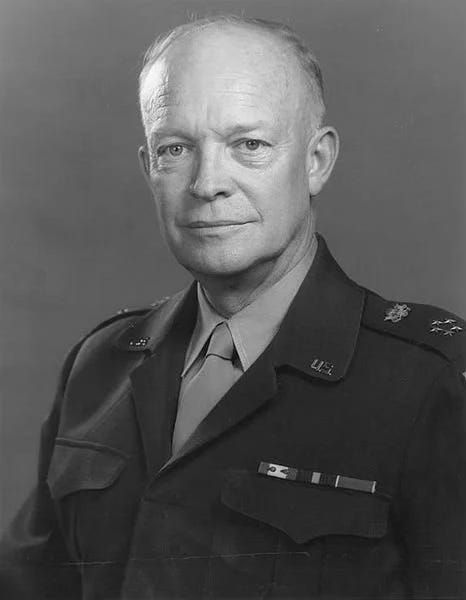
Dwight D. Eisenhower had it right in 1953 when he spoke of military spending as a theft from those who hunger. Ike’s words are almost never heard today inside the Washington Beltway. It’s worth reflecting upon them again as America’s leaders boast of trillion-dollar war budgets:
Every gun that is made, every warship launched, every rocket fired signifies, in the final sense, a theft from those who hunger and are not fed, those who are cold and are not clothed. This world in arms is not spending money alone. It is spending the sweat of its laborers, the genius of its scientists, the hopes of its children… This is not a way of life at all, in any true sense. Under the cloud of threatening war, it is humanity hanging from a cross of iron.
My latest article at TomDispatch (below) was written before President Trump’s most recent commitment to end the Russia-Ukraine War while cutting Pentagon spending in a big way (up to 50%, he said; even a 10% cut would be a minor miracle in DC).
Even as Trump makes positive moves in favor of peace and lower spending on wars and weapons, he continues to advance a madman’s theory of Gaza as a new Riviera (without Palestinians, of course) while gobbling up places like Greenland and the Panama Canal. A man, a plan, a canal, Panama. Trump is a palindrome of sorts. Whether read forward or backward, it’s always all about TRUMP.
Greenland! Canada! The Panama Canal! The Gulf of America! Gaza!
Manifest Destiny Gets a Reboot Under President Donald Trump
A few years ago, I came across an old book at an estate sale. Its title caught my eye: “Our New Possessions.” Its cover featured the Statue of Liberty against stylized stars and stripes. What were those “new possessions”? The cover made it quite clear: Cuba, Hawaii, the Philippines, and Puerto Rico. The subtitle made it even clearer: “A graphic account, descriptive and historical, of the tropic islands of the sea which have fallen under our sway, their cities, peoples, and commerce, natural resources and the opportunities they offer to Americans.” What a mouthful! I’m still impressed with the notion that “tropical” peoples falling “under our sway” offered real Americans amazing opportunities, as did our (whoops — I meant their) lands. Consider that Manifest Destiny at its boldest, imperialism unapologetically being celebrated as a new basis for burgeoning American greatness.
The year that imperial celebration was published — 1898 — won’t surprise students of U.S. history. America had just won its splendid little imperial war with Spain, an old empire very much in the “decline and fall” stage of a rich, long, and rapacious history. And just then red-blooded Americans like “Rough Rider” Teddy Roosevelt were emerging as the inheritors of the conquistador tradition of an often murderously swashbuckling Spanish Empire.
Of course, freedom-loving Americans were supposed to know better than to follow in the tradition of “old world” imperial exploitation. Nevertheless, cheerleaders and mentors like storyteller Rudyard Kipling were then urging Americans to embrace Europe’s civilizing mission, to take up “the white man’s burden,” to spread enlightenment and civilization to the benighted darker-skinned peoples of the tropics. Yet to cite just one example, U.S. troops dispatched to the Philippines on their “civilizing” mission quickly resorted to widespread murder and torture, methods of “pacification” that might even have made Spanish inquisitors blush. That grim reality wasn’t lost on Mark Twain and other critics who spoke out against imperialism, American-style, with its murderous suppression of Filipino “guerrillas” and bottomless hypocrisy about its “civilizing” motives.
After his exposure to “enlightened” all-American empire-building, retired Major General Smedley Butler, twice awarded the Medal of Honor, would bluntly write in the 1930s of war as a “racket” and insist his long career as a Marine had been spent largely in the service of “gangster” capitalism. Now there was a plain-speaking American hero.
And speaking of plain-speaking, or perhaps plain-boasting, I suggest that we think of Donald Trump as America’s retro president from 1898. Isn’t it time, America, to reach for our destiny once again? Isn’t it time for more tropical (and Arctic) peoples to be put “under our sway”? Greenland! Canada! The Panama Canal! These and other regions of the globe offer Donald Trump’s America so many “opportunities.” And if we can’t occupy an area like the Gulf of Mexico, the least we can do is rebrand it the Gulf of America! A lexigraphic “mission accomplished” moment bought with no casualties, which sure beats the calamitous wars of George W. Bush and Barack Obama in this century!
Now, here’s what I appreciate about Trump: the transparent nature of his greed. He doesn’t shroud American imperialism in happy talk. He says it just like they did in 1898. It’s about resources and profits. As the dedication page to that old book from 1898 put it: “To all Americans who go a-pioneering in our new possessions and to the people who are there before them.” Oh, and pay no attention to that “before” caveat. We Americans clearly came first then and, at least to Donald Trump, come first now, and — yes! — we come to rule. The world is our possession and our beneficence will certainly serve the peoples who were there before us in Greenland or anywhere else (the “hellhole” of Gaza included), even if we have to torture or kill them in the process of winning their hearts and minds.
It’s 1900 Again in America
My point is this: Donald Trump doesn’t want to return America to the 1950s, when men were men and women were, as the awful joke then went, “barefoot, pregnant, in the kitchen.” No, he wants to return this country (and the world) to 1900, when America was unapologetically and nakedly grabbing everything it could. To put it in his brand of “locker room” language, Trump wants to grab Mother Earth by the pussy, because when you’re rich and powerful, when you’re a “star,” you can do anything.
It’s white (male) hunter all over again. Think Teddy Roosevelt and all those animals he manfully slaughtered on safari. Today, we might even add white (female) hunter, considering that Kristi Noem, the new director of homeland security, infamously shot her own dog in a gravel pit because she couldn’t train it to behave. It’s an America where men are men again, women are women, and trans people are simply defined out of existence while simultaneously being forced out of the U.S. military.
To replace the “yellow journalism” of newspaperman William Randolph Hearst in that age, think of the corporate-owned media networks of today, with billionaire owners like Jeff Bezos showing due deference to you know who. For the robber barons of that age, substitute men like Elon Musk and Mark Zuckerberg (to name only the two most famous billionaires of our moment) along with Bezos and their billionaire tech bros. It’s a new gilded age, a new age of smash and grab, where the rich get richer and the poor poorer, where the strong do what they will and the weak suffer as they must.
Of course, it’s highly doubtful Trump can convince Canada to become the 51st state. Denmark doesn’t seem remotely interested in selling Greenland to America and the Panamanians aren’t eager to return their canal to all-American interlopers and occupiers. Even the “Gulf of America” remains the Gulf of Mexico to the other peoples of the Western Hemisphere. But perhaps Trump and Musk can team up to plant the American flag on Mars!
Yet, while Trump may fail when it comes to any of these specific imperial designs, he’s already succeeding, famously so, where it really matters. With all his imperial blather about Greenland, Gaza, and the like, what he’s really conquering and colonizing is our minds. The man and his ideas are now everywhere. Whatever else you can say about Trump, you can’t get rid of him, especially in the mainstream media which he uses so effectively to trumpet (pun intended) his expansionist agenda.
Yes, Trump is normalizing imperial conquest (again); yes, naked exploitation is unapologetically “destiny” (again). It’s “drill, baby, drill” and party like it’s 1900, since ideas about global warming due to fossil-fuel production and consumption simply didn’t exist in that age. It’s so retro chic to be chauvinistically selfish, to loot openly, even to commit or enable atrocities under the cover of humanitarian concerns. (Think of Gaza and Trump’s recent open call for cleansing the region of Palestinians to make way for their “betters,” the Israelis, to enjoy peace and a “beautiful” seaside location.)
Regression, thy name be Trump. Unabashed greed and unbridled hypocrisy are selling points once again. Protectionist tariffs are “great” again. Immigrants, black- and brown-skinned ones naturally, are depicted as endangering America’s way of life. Time to get rid of as many “illegals” as we can. Deport them! Jail them in Cuba! America is for Americans!
A Global Military Makes It All Possible
President Teddy Roosevelt was a big fan of the U.S. Navy’s Great White Fleet, the 16 battleships, painted white, that he sent around the world in 1907. He used it to intimidate recalcitrant powers and impress them with America’s growing might and reach. Though the U.S. wasn’t quite a military superpower yet, it was already an economic one, and combining military persuasion with economic prowess was an effective tactic to get other countries to toe Washington’s line.
Today’s U.S. military is quite obviously a global one, an imperial one bent on total dominance of everything: land, sea, air, space, cyberspace, information, narrative. You name it and our military and its partners in what Ray McGovern calls the MICIMATT (which includes industry, Congress, intelligence, the media, academe, and think tanks) conspire to seize, occupy, control, and otherwise dominate. Small wonder that Trump and his operatives within what might be thought of as the Mondial Imperial State have continued a tradition of seeking ever greater budgets for the Pentagon, more and more weapons sales, and the unending construction of new military bases. Contraction in this highly militarized version of disaster imperialism is never an option (until, of course, it becomes one). Only growth is to be allowed, commensurate with seemingly bottomless appetites.
One example: newly appointed Secretary of Defense Pete Hegseth and his Project 2025 supporters argue that U.S. military spending should equal 5% of America’s gross domestic product (GDP). With this country’s GDP sitting just under $29 trillion in 2024, that would drive an imperial war budget of $1.45 trillion instead of the nearly $900 billion in this year’s Pentagon budget. For Hegseth & Co., the U.S. military is all about warfighting (and wars, if nothing else, are expensive), so it must embrace and hone its warrior mystique. It matters to him and his like not at all that, since 9/11, if not before then, the U.S. military has honed its warfighting identity in disastrous wars in Afghanistan, Iraq, Libya, and elsewhere.
Another example. Just before I retired from the U.S. military in 2005, I learned of efforts to create a new military command with sub-Saharan Africa as its focus. At first, it seemed like a joke. How was Africa directly related to U.S. national security? Whence the threat? Of course, Africa as a threat wasn’t the issue. It was Africa as an arena for U.S. economic exploitation, just as it had been for European countries like Belgium, England, France, and Germany circa 1900, most infamously in the Congo, later exposed as the “heart of darkness” at the center of a European imperialism that would contribute to the tensions leading to the eruption of World War I in 1914. Two years after I retired, the U.S. military did indeed form Africa Command (AFRICOM) as its latest combatant command. Today, every sector of the globe has been accounted for by various commands within the Pentagon assigned to four-star generals and admirals, each in his or her own way as powerful as, once upon a time, the proconsuls of the Roman Empire.
With all of this as background, in his own mind at least, Donald Trump doth bestride the world like a colossus. What backs him up is a Republican vision (shared by most Democrats) of an imperial military (theoretically) unchallengeable in all domains. And whether the United States spends $1.45 trillion or a mere $900 billion annually on it, count on this: in the years to come, that military will be used in, most likely, the stupidest and most violent ways imaginable.
How Long Before the Next World War?
If you buy the conceit that Donald Trump is taking America back to 1900, it suggests a likely starting point for the next world war roughly 10 to 15 years in our future. Ever-increasing military spending; calls for mobilization and a return of the draft; talk of enervating national decline that could allegedly be reversed by an embrace of a new warrior mystique; viewing all competition as zero-sum games that America must win and countries like China must lose: these could act collectively to create conditions similar to 1914 — a tinderbox of tensions just waiting for the right spark to set the world aflame.
The critical difference, of course, is nuclear weapons. Though World War I wasn’t the “war to end all wars,” a World War III fought between the U.S. and its allies and China and/or Russia and their allies promises to be that “last” war. There’s nothing like a few dozen thermonuclear weapons to settle accounts — as in ending most life on Planet Earth.
In an age of weapons of mass destruction and their widespread “modernization,” jaw-jaw, as in compromise and cooperation through conversation, is the only sane choice when war-war looms. Dominance through destruction must give way to détente through dialogue. Can the Trump administration advance progress toward peace instead of letting us regress into war?
Mr. President, here’s the real art of the deal. Rather than turning the calendar back to 1900, your goal should be to turn the atomic clock back to several hours (if not days or weeks) before midnight. That clock currently sits at a perilous 89 seconds to midnight, or global nuclear war. With every fiber of your being, your goal should be to guarantee that it will never strike that ungodly hour.
For surely, even the most deluded strong man shouldn’t wish his manifest destiny to be ruling over an empire of the dead.
All around us things are falling apart. Collectively, Americans are experiencing national and imperial decline. Can America save itself? Is this country, as presently constituted, even worth saving?
For me, that last question is radical indeed. From my early years, I believed deeply in the idea of America. I knew this country wasn’t perfect, of course, not even close. Long before the 1619 Project, I was aware of the “original sin” of slavery and how central it was to our history. I also knew about the genocide of Native Americans. (As a teenager, my favorite movie — and so it remains — was Little Big Man, which pulled no punches when it came to the white man and his insatiably murderous greed.)
Nevertheless, America still promised much, or so I believed in the 1970s and 1980s. Life here was simply better, hands down, than in places like the Soviet Union and Mao Zedong’s China. That’s why we had to “contain” communism — to keep themover there, so they could never invade our country and extinguish our lamp of liberty. And that’s why I joined America’s Cold War military, serving in the Air Force from the presidency of Ronald Reagan to that of George W. Bush and Dick Cheney. And believe me, it proved quite a ride. It taught this retired lieutenant colonel that the sky’s anything but the limit.
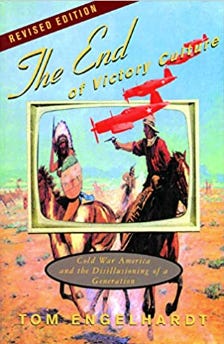
In the end, 20 years in the Air Force led me to turn away from empire, militarism, and nationalism. I found myself seeking instead some antidote to the mainstream media’s celebrations of American exceptionalism and the exaggerated version of victory culture that went with it (long after victory itself was in short supply). I started writingagainst the empire and its disastrous wars and found likeminded people at TomDispatch — former imperial operatives turned incisive critics like Chalmers Johnson and Andrew Bacevich, along with sharp-eyed journalist Nick Turse and, of course, the irreplaceable Tom Engelhardt, the founder of those “tomgrams” meant to alert America and the world to the dangerous folly of repeated U.S. global military interventions.
But this isn’t a plug for TomDispatch. It’s a plug for freeing your mind as much as possible from the thoroughly militarized matrix that pervades America. That matrix drives imperialism, waste, war, and global instability to the point where, in the context of the conflict in Ukraine, the risk of nuclear Armageddon could imaginably approach that of the 1962 Cuban Missile Crisis. As wars — proxy or otherwise — continue, America’s global network of 750-odd military bases never seems to decline. Despite upcoming cuts to domestic spending, just about no one in Washington imagines Pentagon budgets doing anything but growing, even soaring toward the trillion-dollar level, with militarized programs accounting for 62% of federal discretionary spending in 2023.
Indeed, an engorged Pentagon — its budget for 2024 is expected to rise to $886 billionin the bipartisan debt-ceiling deal reached by President Joe Biden and House Speaker Kevin McCarthy — guarantees one thing: a speedier fall for the American empire. Chalmers Johnson predicted it; Andrew Bacevich analyzed it. The biggest reason is simple enough: incessant, repetitive, disastrous wars and costly preparations for more of the same have been sapping America’s physical and mental reserves, as past wars did the reserves of previous empires throughout history. (Think of the short-lived Napoleonic empire, for example.)
Known as “the arsenal of democracy” during World War II, America has now simply become an arsenal, with a military-industrial-congressional complex intent on forging and feeding wars rather than seeking to starve and stop them. The result: a precipitous decline in the country’s standing globally, while at home Americans pay a steep price of accelerating violence (2023 will easily set a record for mass shootings) and “carnage” (Donald Trump’s word) in a once proud but now much-bloodied“homeland.”
Lessons from History on Imperial Decline
I’m a historian, so please allow me to share a few basic lessons I’ve learned. When I taught World War I to cadets at the Air Force Academy, I would explain how the horrific costs of that war contributed to the collapse of four empires: Czarist Russia, the German Second Reich, the Ottoman empire, and the Austro-Hungarian empire of the Habsburgs. Yet even the “winners,” like the French and British empires, were also weakened by the enormity of what was, above all, a brutal European civil war, even if it spilled over into Africa, Asia, and indeed the Americas.
And yet after that war ended in 1918, peace proved elusive indeed, despite the Treaty of Versailles, among other abortive agreements. There was too much unfinished business, too much belief in the power of militarism, especially in an emergent Third Reich in Germany and in Japan, which had embraced ruthless European military methods to create its own Asiatic sphere of dominance. Scores needed to be settled, so the Germans and Japanese believed, and military offensives were the way to do it.
As a result, civil war in Europe continued with World War II, even as Japan showed that Asiatic powers could similarly embrace and deploy the unwisdom of unchecked militarism and war. The result: 75 million dead and more empires shattered, including Mussolini’s “New Rome,” a “thousand-year” German Reich that barely lasted 12 of them before being utterly destroyed, and an Imperial Japan that was starved, burnt out, and finally nuked. China, devastated by war with Japan, also found itself ripped apart by internal struggles between nationalists and communists.
As with its prequel, even most of the “winners” of World War II emerged in a weakened state. In defeating Nazi Germany, the Soviet Union had lost 25 to 30 million people. Its response was to erect, in Winston Churchill’s phrase, an “Iron Curtain” behind which it could exploit the peoples of Eastern Europe in a militarized empire that ultimately collapsed due to its wars and its own internal divisions. Yet the USSR lasted longer than the post-war French and British empires. France, humiliated by its rapid capitulation to the Germans in 1940, fought to reclaim wealth and glory in “French” Indochina, only to be severely humbled at Dien Bien Phu. Great Britain, exhausted from its victory, quickly lost India, that “jewel” in its imperial crown, and then Egypt in the Suez debacle.
There was, in fact, only one country, one empire, that truly “won” World War II: the United States, which had been the least touched (Pearl Harbor aside) by war and all its horrors. That seemingly never-ending European civil war from 1914 to 1945, along with Japan’s immolation and China’s implosion, left the U.S. virtually unchallenged globally. America emerged from those wars as a superpower precisely because its government had astutely backed the winning side twice, tipping the scales in the process, while paying a relatively low price in blood and treasure compared to allies like the Soviet Union, France, and Britain.
History’s lesson for America’s leaders should have been all too clear: when you wage war long, especially when you devote significant parts of your resources — financial, material, and especially personal — to it, you wage it wrong. Not for nothing is war depicted in the Bible as one of the four horsemen of the apocalypse. France had lost its empire in World War II; it just took later military catastrophes in Algeria and Indochina to make it obvious. That was similarly true of Britain’s humiliations in India, Egypt, and elsewhere, while the Soviet Union, which had lost much of its imperial vigor in that war, would take decades of slow rot and overstretch in places like Afghanistan to implode.
Meanwhile, the United States hummed along, denying it was an empire at all, even as it adopted so many of the trappings of one. In fact, in the wake of the implosion of the Soviet Union in 1991, Washington’s leaders would declare America the exceptional “superpower,” a new and far more enlightened Rome and “the indispensable nation” on planet Earth. In the wake of the 9/11 attacks, its leaders would confidently launch what they termed a Global War on Terror and begin waging wars in Afghanistan, Iraq, and elsewhere, as in the previous century they had in Vietnam. (No learning curve there, it seems.) In the process, its leaders imagined a country that would remain untouched by war’s ravages, which was we now know — or do we? — the height of imperial hubris and folly.
For whether you call it fascism, as with Nazi Germany, communism, as with Stalin’s Soviet Union, or democracy, as with the United States, empires built on dominance achieved through a powerful, expansionist military necessarily become ever more authoritarian, corrupt, and dysfunctional. Ultimately, they are fated to fail. No surprise there, since whatever else such empires may serve, they don’t serve their own people. Their operatives protect themselves at any cost, while attacking efforts at retrenchment or demilitarization as dangerously misguided, if not seditiously disloyal.
That’s why those like Chelsea Manning, Edward Snowden, and Daniel Hale, who shined a light on the empire’s militarized crimes and corruption, found themselves imprisoned, forced into exile, or otherwise silenced. Even foreign journalists like Julian Assange can be caught up in the empire’s dragnet and imprisoned if they dare expose its war crimes. The empire knows how to strike back and will readily betray its own justice system (most notably in the case of Assange), including the hallowed principles of free speech and the press, to do so.
Perhaps he will eventually be freed, likely as not when the empire judges he’s approaching death’s door. His jailing and torture have already served their purpose. Journalists know that to expose America’s bloodied tools of empire brings only harsh punishment, not plush rewards. Best to look away or mince one’s words rather than risk prison — or worse.
Yet you can’t fully hide the reality that this country’s failed wars have added trillions of dollars to its national debt, even as military spending continues to explode in the most wasteful ways imaginable, while the social infrastructure crumbles.
Clinging Bitterly to Guns and Religion
Today, America clings ever more bitterly to guns and religion. If that phrase sounds familiar, it might be because Barack Obama used it in the 2008 presidential campaign to describe the reactionary conservatism of mostly rural voters in Pennsylvania. Disillusioned by politics, betrayed by their putative betters, those voters, claimed the then-presidential candidate, clung to their guns and religion for solace. I lived in rural Pennsylvania at the time and recall a response from a fellow resident who basically agreed with Obama, for what else was there left to cling to in an empire that had abandoned its own rural working-class citizens?
Something similar is true of America writ large today. As an imperial power, we cling bitterly to guns and religion. By “guns,” I mean all the weaponry America’s merchants of death sell to the Pentagon and across the world. Indeed, weaponry is perhaps this country’s most influential global export, devastatingly so. From 2018 to 2022, the U.S. alone accounted for 40% of global arms exports, a figure that’s only risen dramatically with military aid to Ukraine. And by “religion,” I mean a persistent belief in American exceptionalism (despite all evidence to the contrary), which increasingly draws sustenance from a militant Christianity that denies the very spirit of Christ and His teachings.
Yet history appears to confirm that empires, in their dying stages, do exactly that: they exalt violence, continue to pursue war, and insist on their own greatness until their fall can neither be denied nor reversed. It’s a tragic reality that the journalist Chris Hedges has written about with considerable urgency.
The problem suggests its own solution (not that any powerful figure in Washington is likely to pursue it). America must stop clinging bitterly to its guns — and here I don’t even mean the nearly 400 million weapons in private hands in this country, including all those AR-15 semi-automatic rifles. By “guns,” I mean all the militarized trappings of empire, including America’s vast structure of overseas military bases and its staggering commitments to weaponry of all sorts, including world-ending nuclearones. As for clinging bitterly to religion — and by “religion” I mean the belief in America’s own righteousness, regardless of the millions of people it’s killed globally from the Vietnam era to the present moment — that, too, would have to stop.
History’s lessons can be brutal. Empires rarely die well. After it became an empire, Rome never returned to being a republic and eventually fell to barbarian invasions. The collapse of Germany’s Second Reich bred a third one of greater virulence, even if it was of shorter duration. Only its utter defeat in 1945 finally convinced Germans that God didn’t march with their soldiers into battle.
What will it take to convince Americans to turn their backs on empire and war before it’s too late? When will we conclude that Christ wasn’t joking when He blessed the peacemakers rather than the warmongers?
As an iron curtain descends on a failing American imperial state, one thing we won’t be able to say is that we weren’t warned.
On his new show at The Real News, Chris Hedges recently spoke with Cornel West on the state of America. It’s not easy listening, nor should it be. Brother Chris and Brother Cornel didn’t mince words as they deplored the commodification of American life, the militarism of American society, and the imperialism of the U.S. empire. Here’s the link to their interview:
I jotted down key phrases as I listened to both men. Phrases like spiritual decadence, bootlickers for war, mass incarceration, self-glorification and self-indulgence, the Neo-fascism of Trump followers versus the Neo-liberalism of Democrats, and that the American empire has no moral authority, given its “vicious atrocities” in Iraq, Yemen, and elsewhere.
Brother Cornel was especially strong on the seductive dangers of nationalism, the grotesque wealth inequality here at home, and a U.S. political system deeply compromised by legalized bribery and normalized corruption. Reality is defined by a corporatized state in which profit maximization is pursued at any cost, including impending ecological catastrophe, where education is reduced to indoctrination, vocations are reduced to professions, and callings reduced to careers.
Sure, it’s grim stuff, but the truth is often grim. Nor are these two men irredeemably grim. Both spoke of the need to be faithful unto death, to resist the paralysis that comes from despair. Both are fighters and truth-tellers; both are men of faith and men of action; both are humanistic. And both are most assuredly worth listening to.
Brother Cornel’s message is ultimately one of love. Of joy-sharing. Of thinking for yourself. Of becoming a force for good and beauty and justice in the world. Of empowering others through an expansive and inclusive humanism. His is the perfect message for this Easter season, a season of rebirth and hope, of salvation through sacrifice and love.
Heat rays don’t always carry the day. (I used to own this double album, narrated by the great Richard Burton)
W.J. Astore
A few years ago, I picked up H.G. Wells’s classic novel, “War of the Worlds,” and read it in full. I had seen the movies based on it and had also dipped into the book, but I finally read the whole thing, marveling at the suspense Wells created in his classic account of Martians invading our planet, stomping us with their superior technology, only to be overcome by microbes to which they had no resistance.
As I read the book, I asked myself: Are we Americans becoming the new Martians? Warlike ways, superior technology, a predilection to invade and dominate for resources, with no regard for the “primitives” we stomp on or push out of the way in our quest for full-spectrum dominance?
I’m not the only one with questions along these lines. At TomDispatch today, Tom Engelhardt recounts his own affection for “War of the Worlds,” which he avidly read as a boy, and which he recently turned to again in our era of dangerous microbes, incessant war, and a changing climate that is threatening life as we know it on this planet.
Wells, of course, intended his story partly as a critique of the British and Western imperialism of his day, which is why it remains relevant to our imperial world today.
Think about it. America’s leaders, and especially the military-industrial-congressional complex, are in many ways the new Martians. Their god seems to be Mars, the god of war, and the planet they’re remaking is increasingly red, barren, and inhospitable. They’re doing a fair job of emulating those Martians as well, leaving Planet America to attack other lands for their resources, banking on superior technology and “heat rays” (Hellfire missiles!) to win the day.
Yet, like those very same Martians in “War of the Worlds,” Planet America loses its wars to “inferior” peoples, betrayed by “primitive” and hostile environments (the sweltering jungles of Vietnam, the urban jungle and heat of Iraq, the rugged mountains and omnipresent dust of Afghanistan). But do America’s Martians ever quit? Of course not! They keep building new war machines, they keep “investing” in new technologies, they keep advocating dominance through invasion and killing, much like those desperate Martians in Wells’s book, who, faced with a dying planet, decided their only course of action was to invade a different planet and steal its resources for themselves.
In Wells’s book, the Martians reveled in war, shouting “Ulla! Ulla!” as they fired their death rays. Our leaders are doing something similar while many of us shout “USA! USA!” mindlessly.
Wells sought to teach us that war and technology and destruction are just as likely to lead to our demise as to our triumph. The more we make war on ourselves and our planet, the more likely it is that Earth will come to resemble Mars, an inhospitable place for a dying species. Yet, unlike the imaginary Martians of Wells’s book, there’s no other hospitable planet in the neighborhood for us to invade.
Bonus: Here’s an excerpt from Jeff Wayne’s musical version of “War of the Worlds,” featuring Justin Hayward on vocals and Richard Burton as narrator. “The massacre of mankind”: No one says it quite like Burton.
The Biden administration says it wants to remove U.S. combat troops from Iraq. Hooray! Mission finally accomplished, right? It may be 18 years after George W. Bush declared it to be so, but who’s counting the years?
Not so fast. For President Biden still wants to keep roughly 2000 or so U.S. troops in Iraq for training and advisory purposes. So much for mission accomplished.
Why can’t U.S. troops just leave — for good? If Iraq can’t defend itself after nearly two decades of U.S. “training” in the war on terror, maybe it’s finally time to admit our limits (or our folly) and simply leave.
It almost seems like America’s system of “defense” is an imperial project — an effort to enlarge American power at almost any cost (and the Iraq war has cost America in the trillions of dollars).
This is the telling argument of Tom Engelhardt’s latest post at TomDispatch.com. The U.S. is the empire that dare not speak its name, even as it begins to collapse due to perpetual war externally and perpetual rancor internally. And, believe me, as former President Trump would say, those two are related. He should know, given how he tapped that rancor and aggravated it for his own purposes.
Here’s an excerpt from Engelhardt’s latest, where he points out what might be termed the Pentagon Paradox: The more America’s generals fail, the more they succeed (more money, more promotions, more power):
Still, let’s face it, this isn’t the set of conflicts that, once upon a time, involved invasions, massive air strikes, occupations, the killing of staggering numbers of civilians, widespread drone attacks, the disruption of whole countries, the uprooting and displacement of more than 37 million people, the deployment at one point of 100,000 U.S. troops in Afghanistan alone, and the spending of untold trillions of American taxpayer dollars, all in the name of fighting terror and spreading democracy. And think of it as mission (un)accomplished in the truest sense imaginable.
In fact, that idea of spreading of democracy didn’t really outlast the Bush years. Ever since, there’s been remarkably little discussion in official Washington about what this country was really doing as it warred across significant parts of the planet. Yes, those two decades of conflict, those “forever wars,” as they came to be called first by critics and then by anyone in sight, are at least winding, or perhaps spiraling, down — and yet, here’s the strange thing: Wouldn’t you think that, as they ended in visible failure, the Pentagon’s stock might also be falling? Oddly enough, though, in the wake of all those years of losing wars, it’s still rising. The Pentagon budget only heads ever more for the stratosphere as foreign policy “pivots” from the Greater Middle East to Asia (and Russia and the Arctic and, well, anywhere but those places where terror groups still roam).
In other words, when it comes to the U.S. military as it tries to leave its forever wars in someone else’s ditch, failure is the new success story.
And how! Maybe we need a new saying in America: Nothing succeeds like failure. It’s truly paradoxical until you realize that someone is always winning and profiting from this failure, even as the rest of America suffers.
Engelhardt’s book above has a well-judged title: “A Nation Unmade By War.” But perhaps we can improve it? How about “An Empire Unmade By War”?
America recently marked the 18th anniversary of the Iraq War by basically ignoring it. The 20th anniversary of the Afghan War approaches, and it appears we’ll get there since President Biden is saying U.S. forces can’t leave until this November at the earliest. Apparently, our withdrawal of troops must be “responsible” and based on ever-changing benchmarks. Leaving aside the harrowing human cost, these calamitous wars have cost the American taxpayer at least $6 trillion, yet they go on and on.
One person who’s learned a lot from these wars is Andrew Bacevich, a retired U.S. Army colonel who runs the Quincy Institute for Responsible Statecraft. In his latest article for TomDispatch.com, Bacevich had this to say about America’s seemingly unending pursuit of peace through war:
The longest war in U.S. history [the Afghan War] should by now have led Americans to reflect on the consequences that stem from succumbing to imperial temptations in a world where empire has long since become obsolete. Some might insist that present-day Americans have imbibed that lesson. In Washington, hawks appear chastened, with few calling for President Biden to dispatch U.S. troops to Yemen or Myanmar or even Venezuela, our oil-rich “neighbor,” to put things right. For now, the nation’s appetite for military intervention abroad appears to be sated.
But mark me down as skeptical. Only when Americans openly acknowledge their imperial transgressions will genuine repentance become possible. And only with repentance will avoiding further occasions to sin become a habit. In other words, only when Americans call imperialism by its name will vows of “never again” deserve to be taken seriously.
Bacevich is right to be skeptical. The prevailing narrative in the USA still rejects the notion of imperial wars. America’s wars are always sold as defensive. Put simply, we allegedly fight “them” over there so we won’t have to fight them over here. The Afghan War is still being sold as preventing terrorist attacks on America. The Iraq War was sold as preventing Saddam Hussein from using his non-existent weapons of mass destruction against us. In short, Americans are routinely sold a false bill of goods, and the price tag attached, $6 trillion and rising, again leaving aside the human cost, is truly prodigal to behold.
I urge you to read all of Bacevich’s article here. And I urge all Americans to think about our leaders’ imperial ambitions and their horrendous costs. Like the Romans, we are too fond of creating deserts with our weaponry and calling it “peace.” We can and must open our eyes and do better.
War is not pretty, whether in Iraq or Afghanistan or Syria or Anywhere
Pro-Trump supporters storm the U.S. Capitol, January 6, 2021 (Photo by Samuel Corum/Getty Images)
W.J. Astore
When I taught the core course in military history at the U.S. Air Force Academy, it focused on “major” wars. A review of my syllabus from 20 years ago confirms that we spent most of our time teaching military cadets about the American Revolutionary War, the U.S. Civil War, World Wars I and II, Korea and the Cold War, and Vietnam. There were special lessons that focused on airpower history and strategic thinkers like Clausewitz and Jomini, but the main focus was on “conventional” wars. I was OK with this, since mastering the course material was my main challenge, not challenging subjects within the course.
An astute student of U.S. military history would quickly note what’s missing. Genocidal wars against Native Americans were rarely mentioned. There were no specific lessons devoted to the Mexican-American War, the Spanish-American War, the Filipino Insurrection, or any of America’s frequent regime-change wars in Latin America. American imperialism wasn’t specifically addressed. Critiques of American imperialism by critics like Mark Twain and General Smedley Butler were rarely (if ever) heard.
What that means is this: America’s young officers go out into the world with little knowledge of America’s military interventions beyond the victories (more or less) in World Wars I and II, stalemate in Korea, and a misbegotten war in Vietnam that America could (and perhaps should) have won with better tactics and/or less civilian interference, or so they are often taught. Small wonder that disasters like Iraq, Afghanistan, Libya, and others occur and persist, though I wouldn’t put the blame for these simply on a lack of critical teaching about America’s various for-profit cock-ups and screw-ups.
This was on my mind as I read Kevin Tillman’s recent article at TomDispatch.com. As Tillman notes, America’s regime-change wars and propensity for foreign coups came home to our own country on January 6th with the storming of the Capitol. That such an action so deeply shocked Americans is a sign of our collective amnesia when it comes to remembering the totality of our military history.
Here’s an except from his article, which I encourage you to read in its entirety at TomDispatch:
Kevin Tillman, Capitol Blowback
Just about everyone was shocked by what happened at the Capitol building on January 6th. But as a former soldier in America’s forever wars, horrifying as the scenes were, I also found what happened strangely familiar, almost inevitable. I thought that, if only we had taken our country’s imperial history seriously, none of us would have found that day either shocking or unprecedented.
Honestly, it could only seem that way if you imagined our domestic politics as completely separate from our foreign policy. But if we’re to learn anything from that maladroit attempt at a government-toppling coup, it should be that they are anything but separate. The question isn’t whether then-President Donald Trump incited the assault on the Capitol — of course he did. It is rather: Since when have we cared if an American president lies to incite an illegal insurrection? In all honesty, our commanders-in-chief have been doing so abroad for generations with complete impunity. It was only a matter of time before the moral rot finally made its way home.
Back in 2007, I actually met Nancy Pelosi whom those insurrectionists were going after — “Tell Pelosi we’re coming for that b**ch. Tell f***ing Pelosi we’re coming for her!” — in that very Capitol building. That day, my family was testifying before the House Committee on Oversight and Reform concerning the U.S. government’s disinformation campaign about how, three years earlier, my brother Pat Tillman had died in Afghanistan (as a result of “friendly,” not enemy, fire). We would testify alongside former soldier Jessica Lynch who had suffered a similar disinformation fate in the wake of a tragic ambush of her convoy in Nasiriyah, Iraq, where soldiers died and she was taken prisoner. After the hearing, we discussed the case with Pelosi, who then took us on a brief personal tour of the halls of the building. Given the circumstances, it was a thoughtful gesture and a humbling experience.
So, it was personally quite unsettling to watch that rabid mob of insurrectionists storm our Capitol, some actively seeking to kill the woman who had walked our family through those same halls, wearing her signature green business suit. To see people desecrating that building over grievances rooted in demonstrable and absurd untruths manufactured by President Trump was both grotesque and shameful.
And yet, however surreal, disappointing, disqualifying, even treasonous that assault and the 57-43 Senate acquittal of the president would be, what took place should, in another sense, not have been a shock to anyone. The idea that January 6th was something new for this country and so a unique affront to the American idea of democracy, not to speak of common decency, was simply wrong. After all, ever since 1945, this country has regularly intervened in elections all over the globe and done far worse as well. What’s disorienting, I suppose, is that this time we did it to ourselves.
Around the Globe, Generation after Generation
My own limited experience with American interventionism involves the occupations of Afghanistan and Iraq. After the September 11th attacks, I enlisted in the U.S. Army with Pat. We would be assigned to the 75th Ranger Regiment and our unit would in March 2003 be sent into Iraq, one of so many tools in the Bush administration’s war of aggression there. We would help remove Iraqi leader Saddam Hussein by force. It was hardly the mission I had in mind when I signed up, but I was naive when it came to foreign policy. Being part of illegal invasions, however, leaves lasting impressions.
That particular intervention in Iraq began with a barrage of administration lies about Saddam’s supposed supply of weapons of mass destruction, his reputed links to al-Qaeda, and the idea that we were liberating the Iraqi people. Some of us actually were assigned to run around Baghdad, “east, west, south, and north somewhat,” looking for those nonexistent weapons of mass destruction. The whole invasion would prove catastrophic, of course, resulting in the destruction of Iraqi society, the deaths of hundreds of thousands of Iraqis and thousands of American soldiers, even as that country’s leadership was removed and its military disbanded (mission accomplished!). Of course, neither President George W. Bush, nor the rest of the top officials of his administration were held responsible for what happened.
So, when I watched the January 6th insurrection unfold, my mind was immediately drawn to the period leading up to the Iraq war — except this time, the drumbeat of lies had to do with massive voter fraud, voting irregularities, “dead voters,” rigged software, and other fabrications. Obviously, the two events were drastically different in scale, complexity, and destructiveness. Still, they seemed to share common fundamental threads.
Examples of American interference in the governance of foreign countries via coups, regime change, and other ploys are commonplaces of our modern history. Among the best known would be the replacing of a number of democratically elected leaders like Iranian Prime Minister Mohammad Mosaddegh with the Shah (1953), Guatemalan President Jacobo Arbenz with Colonel Carlos Castillo Armas (1954), Chilean President Salvador Allende with General Augusto Pinochet (1973), or Honduran President Manuel Zelaya in a U.S.-backed coup (2009). In other words, we’re not talking about a few one-off mistakes or a couple of dumb wars.
In truth, there has been an endless supply of such U.S. interventions around the globe: invasions, military coups, soft coups, economic sanctions, secretly funding candidates of Washington’s choice, the fueling of existing conflicts, you name it and it’s probably happened.
Take for example our neighbors in South America, Central America, and the Caribbean. I honestly don’t know if there is a single nation in Latin America that hasn’t fallen victim to a U.S. intervention of some sort: Argentina (1976), Bolivia (1971), Brazil (1964), Cuba (1961), El Salvador (the 1980s), Grenada (1983), Haiti (2004), Honduras (1980 and 2009), Panama (1989), Paraguay (1962), Peru (1968), Suriname (the 1980s), Uruguay (1973), Venezuela (the present moment). Maybe Costa Rica was spared?
Please read the rest of Kevin Tillman’s article here at TomDispatch.com.
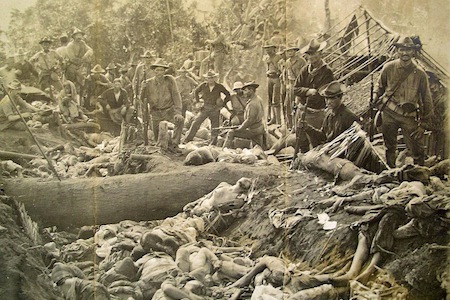
U.S. troops pose with dead Moro rebels, Philippines, 1906
W.J. Astore
Introduction: In September 2012, I wrote the following piece on U.S. imperialism, inspired by an old sound recording. It came to mind as I read a review in The Nation of a new book by Stephen Kinzer, The True Flag: Theodore Roosevelt, Mark Twain, and the Birth of American Empire. Its reviewer, Brenda Wineapple, notes the terrible toll of America’s “splendid little war” against Spain in 1898, followed by the campaign to conquer and control (or, to use the expression from those days, to “civilize”) the Filipino people. Here’s an excerpt from her review:
The war in the Philippines, however, was far from over. Even after McKinley’s assassination, US soldiers continued to ravage the country, killing Filipinos, burning their villages, and laying waste to crops; after three years of such “counterinsurgency,” Kinzer writes, “Americans lost whatever national innocence had survived slavery, anti-Indian campaigns, and the Mexican War.” Twain and the anti- imperialists had never seen any innocence to speak of: “Lust of conquest had long ago done its work…. There was no principle but commercialism, no patriotism but of the pocket,” Twain wrote.
At the end of 41 months, hundreds of thousands of Filipino civilians had died, and at least 20,000 insurgents—far more than had perished in the 350 years of Spanish rule. But, Kinzer argues, no lessons had been learned: US foreign policy in the 20th and 21st centuries may spring from an ambivalence to intervene in the world, but it continues to represent itself as benevolent when it does so for its own economic self-interest.
She and Stephen Kinzer mention President William Howard Taft, which brings me again to my article from 2012. I can still faintly hear Taft’s voice, emerging from my friend’s old phonograph horn, telling Americans how they had to embrace “the ignorant masses” of the Philippines. How deadly that embrace would prove for so many Filipinos …
The Siren Song of American Imperialism (2012)
Considering the scale of our mistakes over the last decade in Iraq and Afghanistan, if we as a country truly want to pursue a leaner, smarter, more effective foreign policy, the first step we must take is to stop listening to the siren song of our own imperial rhetoric. We need to stop posing as benevolent caregivers and start being more honest with ourselves.
And that honesty extends to our own history. The French have a saying that translates to “the more things change, the more they remain the same.” The appropriateness of that saying was brought home to me last week when a good friend of mine played an old campaign speech of William Howard Taft. In 1908, when he was running for president to succeed Teddy Roosevelt, Taft recorded several speeches on Edison-era cylinders. Fortunately for me, my friend collects vintage Edison phonographs and cylinders.
As I stood in front of the large trumpet-like horn of the player, Taft’s voice came alive for me. As Taft sought to justify the U.S. invasion and occupation of the Philippines, it occurred to me that the rhetoric he was using a century ago was the same as that of Presidents Bush and Obama in justifying our most recent foreign misadventures in Iraq and Afghanistan. Taft, as we shall see, was if anything more direct and honest than our most recent commanders-in-chief.
The thrust of Taft’s speech was that Americans were lifting up the benighted and “ignorant masses” of the Philippines. In Taft’s words, we were involved “in a great missionary work that does our nation honor,” one that “is certain to promote … the influence of Christian civilization.” Evidence of our progress included improvements to Filipino infrastructure such as the building of harbors, roads, and railroads. More evidence included our role in building up Filipino police forces to improve internal security. Education was also cited as decreasing “the dense ignorance of the ninety percent.”
Having portrayed our presence in the Philippines as purely benevolent and disinterested, Taft ended with a rousing dismissal of critics who were advocating what today would be termed “cutting and running.” To relinquish the “burden” of our civilizing mission in the Philippines, Taft concluded, would be “cowardly.”
Considering Taft’s rhetoric and comparing it to that of Bush and Obama, it’s clear that little has changed in one hundred years. It’s true that we no longer talk openly about spreading “Christian” civilization. And we’re more circumspect about portraying native peoples as “dense” and “ignorant.” But other than that, our imperial rhetoric hasn’t changed at all. Our presidents still praise our country as being motivated entirely by benevolence; as evidence of our generosity and “progress,” they still tout infrastructure built and native police forces trained; and they still dismiss critics of our imperial efforts as misguided (at best) or cowardly (of the worst kind of “cut and run” variety).
But the truth is that it’s tragically hard to win hearts and minds overseas when we don’t even recognize what’s in our own hearts and minds. We venture forth on “civilizing” missions when our own culture could use some civilizing. We think we’re pure of heart, but “civilizing” missions based on military occupation inevitably contain a heart of darkness.
Whether it’s the presidential election of 1908 or our current one of 2012, we’ve heard enough speeches about how great and noble and honorable we are. To chart a new course, let’s educate our own “ignorant natives” in the USA before we try to cure ignorance elsewhere. Let’s rebuild our own crumbling infrastructure. Let’s tame our own passions. And let’s reconnect with a virtue that, though not unique to Christianity, was then and is now closely associated with it. The virtue? Humility.
To put this in words that may have resonated with Taft, the self-styled “Christian missionary,” let’s first work on removing the beam from our own eye before focusing on the motes in the eyes of others. For it’s only after removing our own beam that we’ll succeed in charting a smarter foreign policy — as well as a far less hypocritical one.
To paraphrase Taft, it would be cowardly indeed to lay down the burden of removing that beam until our purpose is achieved.
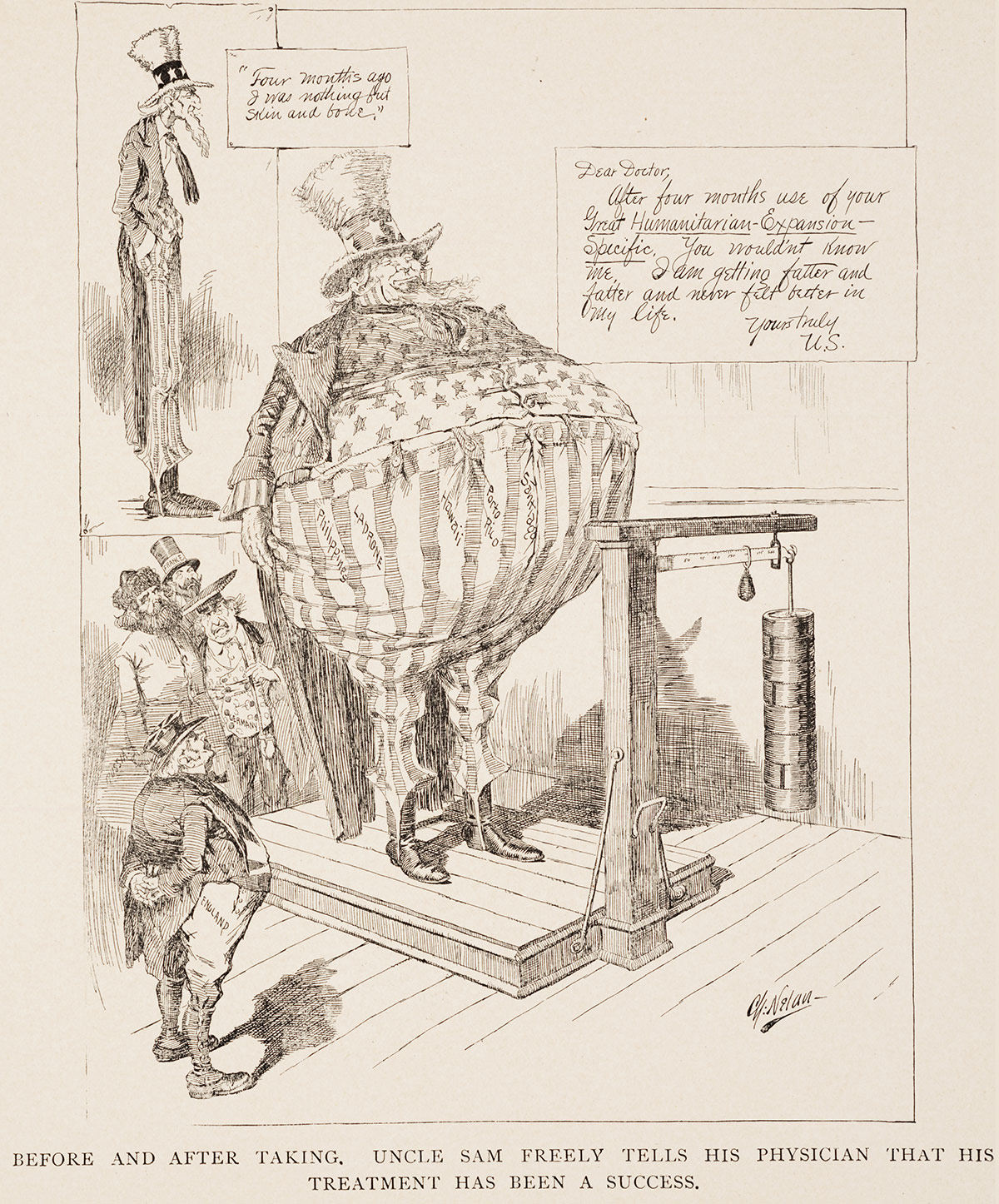
Uncle Sam: No stranger to imperialism (from the Spanish-American War of 1898)
W.J. Astore
Why do empires fall? Sometimes, it’s easy to identify a cause. Whether led by the Kaiser or by Hitler, Germany’s Second and Third Empires were destroyed by world wars. Germany’s ambition was simply too great, its militarism too dominant, its policies too harsh to win long-term converts, its leaders too blinded by the pursuit of power, its enemies too many to conquer or otherwise neutralize.
Other imperial falls are more complex. What caused Rome’s fall? (Leaving aside the eastern part of the empire, which persisted far longer as the Byzantine Empire.) Barbarians and their invasions, say some. The enervating message and spirit of Christianity, said the historian Edward Gibbon. Rome’s own corruption and tyranny, say others. Even lead in Roman water pipes has been suggested as a contributing cause to Rome’s decline and fall. Taking a longer view, some point to the rise of Islam in the 7th century and its rapid expansion into previously Roman territories as the event that administered the final coup de grâce to a dying empire.
America’s empire, it is clear, is now in decline, and a key reason is imperial overstretch as manifested by endless wars and overspending on the military (with literally trillions of dollars being thrown away on fruitless wars). An especially fine summary is Alfred McCoy’s article this week at TomDispatch.com. As McCoy notes:
In effect, the president and his team, distracted by visions of shimmering ships and shiny planes (with their predictable staggering future cost overruns), are ready to ditch the basics of global dominion: the relentless scientific research that has long been the cutting edge of U.S. military supremacy. And by expanding the Pentagon while slashing the State Department, Trump is also destabilizing that delicate duality of U.S. power by skewing foreign policy ever more toward costly military solutions (that have proved anything but actual solutions) …
In just one extraordinary year, Trump has destabilized the delicate duality that has long been the foundation for U.S. foreign policy: favoring war over diplomacy, the Pentagon over the State Department, and narrow national interest over international leadership. But in a globalizing world interconnected by trade, the Internet, and the rapid proliferation of nuclear-armed missiles, walls won’t work. There can be no Fortress America.
In this passage, McCoy stresses the damage being done by the Trump administration. But Trump is just the culmination of certain trends, e.g. favoring the Pentagon over the State Department is nothing new, as I wrote about here in 2010. And America has been in love with shimmering ships and shiny planes for generations, with several administrations supporting the F-35 jet fighter, a program that may end up costing as much as $1.4 trillion. Plenty of money for weapons that kill; not so much for medicines that cure: that’s imperial America in a nutshell.
I would stress that America’s strength overseas was (and is) always based on its strength at home in areas such as science, education, infrastructure, medicine, manufacturing, and exports. But what we’ve witnessed over the last 40 years is an immense and wasteful “investment” in wars and weapons even as our country itself has hollowed out. Science is now marked by the denial of facts (such as global warming). Education is all about students as consumers, with an overall decline in standards and performance. Infrastructure is crumbling. Medicine is too expensive and America’s overall health and life expectancy are both in decline. Manufacturing and exports have withered (except for the production and export of weapons, naturally).
As a result of all this, America is running a national debt of roughly 20 trillion dollars. The future is being sacrificed for the present, a tragic reality reflected in the latest Republican tax cut, which benefits the richest Americans the most, along with big corporations, and which will likely add another trillion to the national debt.
In short, America’s foreign decline is mirrored (and driven) by its domestic decline as reflected by its choices. Looking at the USA today, you get the sense it’s the best of times for the richest few, and the worst of times for so many Americans struggling with health care debt, student loan debt, and the uncertainty of low-wage jobs that could be outsourced at any moment. At the same time, the American political scene is driven by fear: of immigrants, of a nuclear war with North Korea, of Russian meddling (real or imagined), of growing Chinese power, and of the perpetually-hyped threat of terrorist attacks on “the Homeland.”
Empires can fall very quickly, as the “thousand-year” Third Reich did, or they can fall ever so slowly, as the Roman Empire did. But fall they do. What is in the cards for the United States? Readers, fire away in the comments section.
Update (1/20/18): Secretary of Defense James Mattis now claims that China and Russia represent bigger threats than terrorism, along with Congress itself since it can’t pass an extended budget for the Pentagon. He also claimed the U.S. military’s “competitive edge” is eroding in “every domain of warfare,” despite a defense budget of $700 billion.
None of this is a surprise. Indeed, this is exactly what happens when you put a retired general and known war hawk in charge of the defense department. Generals will always want more: more troops, more money, more resources, more authority. And to support their demands, they will always find more enemies as well.








 Bracing Views