Time for Glasnost, Perestroika, and a New Generation of Leaders in America
A year ago, I asked whether Joe Biden and Donald Trump were too old to serve as president. Recently, concerns about advanced age and failing health have come to the fore in Congress. Senator Diane Feinstein, 90 years old, recently had to be told by her aides to vote “aye.” Senator Mitch McConnell, 81 years old, recently froze mid-sentence at a press conference; he may have suffered a mini-stroke, possibly related to a bad fall he had previously that resulted in a concussion. Meanwhile, concerns about President Biden’s age and declining health are being openly aired even among Democrats, with Hillary Clinton opining that Joe’s age is a legitimate campaign issue. At the young age of 75, is she angling to ride to the rescue in the 2024 election?
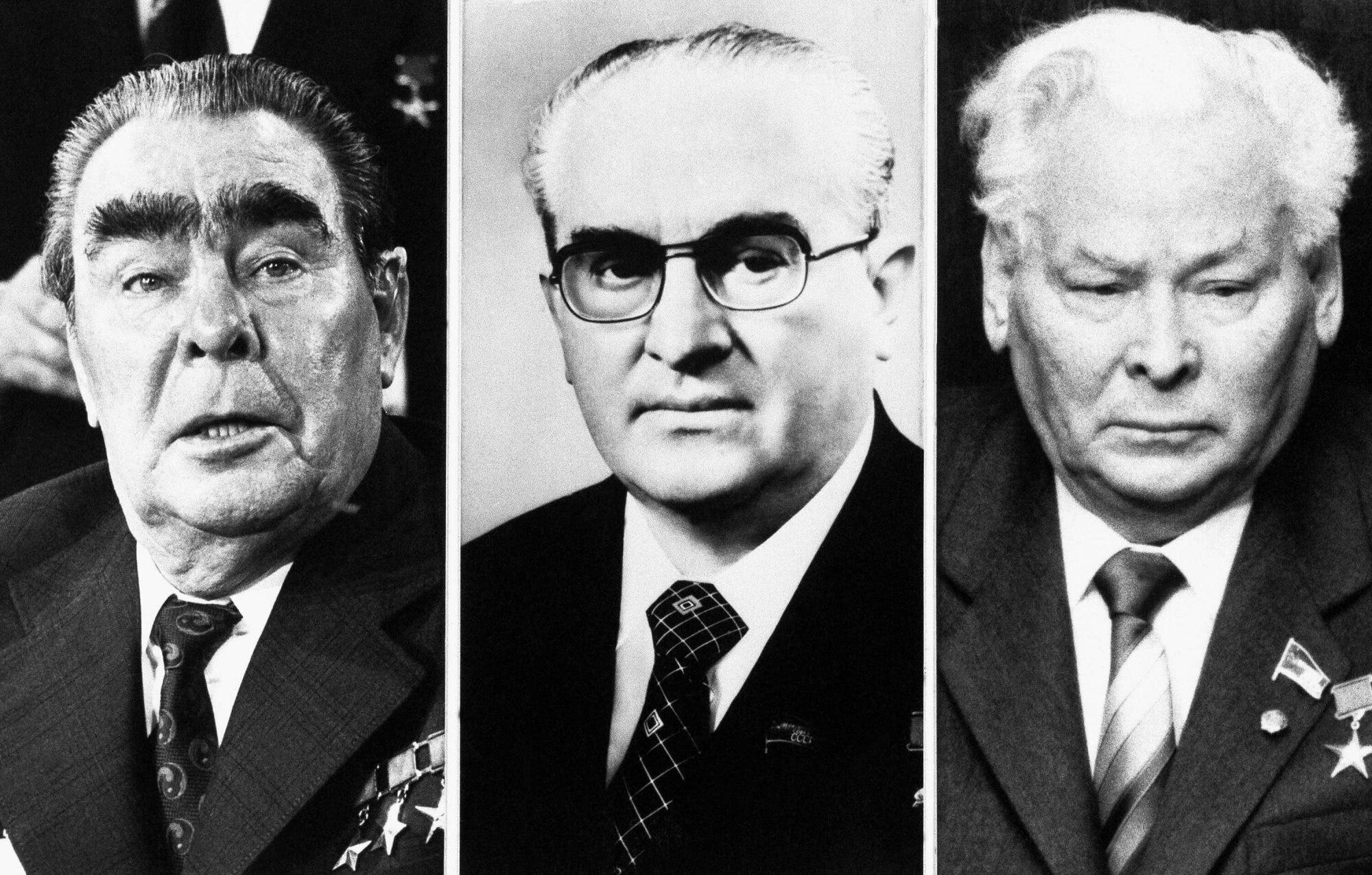
Glenn Greenwald did a long segment on Washington’s gerontocracy that is well worth watching. A point he made is one that I echoed in my article from a year ago. Back in the 1970s, the U.S. pointed to an alleged gerontocracy in the Soviet Union to criticize the hidebound nature of the Communist party there and the way its leaders were holding back much-needed reforms.
Americans made fun of “old” Soviet leaders of the 1970s and early 1980s. They were younger than Biden, Trump, Feinstein, McConnell, and the U.S. gerontocracy of today
The same, of course, is now true of the U.S. empire and its uniparty of Republican and Democrat enablers. An American gerontocracy with a near-death grip on power are holding back much-needed reforms here, especially reductions to the enormous sums of money being spent on weapons and warfare by the federal government.
Much like the former Soviet Union, the United States is a declining empire that’s been debilitated by constant and unnecessary wars and wanton spending on weaponry. Fresh thinking is needed. Remember glasnost and perestroika? Openness and restructuring? They were ushered in by Mikhail Gorbachev in the 1980s, who at age 54 was relatively young when he assumed the reins of power in the USSR.
I still remember when Americans made fun of “old guard” Soviet leaders and used words like “sclerotic” to describe them. They were a visible symbol of Soviet tiredness and decline, the refuse of the past when compared to a younger, more vigorous, United States with its dominant and thrusting world economy.
Who’s laughing now?
Surely, America needs a new generation of leaders who are willing to fight for glasnost (much greater openness and transparency in government) and perestroika (a restructuring of government away from imperialism, weapons, and war). The collapse of the Soviet Union should teach us something about the fate of sclerotic empires that refuse to change.
All around us things are falling apart. Collectively, Americans are experiencing national and imperial decline. Can America save itself? Is this country, as presently constituted, even worth saving?
For me, that last question is radical indeed. From my early years, I believed deeply in the idea of America. I knew this country wasn’t perfect, of course, not even close. Long before the 1619 Project, I was aware of the “original sin” of slavery and how central it was to our history. I also knew about the genocide of Native Americans. (As a teenager, my favorite movie — and so it remains — was Little Big Man, which pulled no punches when it came to the white man and his insatiably murderous greed.)
Nevertheless, America still promised much, or so I believed in the 1970s and 1980s. Life here was simply better, hands down, than in places like the Soviet Union and Mao Zedong’s China. That’s why we had to “contain” communism — to keep themover there, so they could never invade our country and extinguish our lamp of liberty. And that’s why I joined America’s Cold War military, serving in the Air Force from the presidency of Ronald Reagan to that of George W. Bush and Dick Cheney. And believe me, it proved quite a ride. It taught this retired lieutenant colonel that the sky’s anything but the limit.
In the end, 20 years in the Air Force led me to turn away from empire, militarism, and nationalism. I found myself seeking instead some antidote to the mainstream media’s celebrations of American exceptionalism and the exaggerated version of victory culture that went with it (long after victory itself was in short supply). I started writingagainst the empire and its disastrous wars and found likeminded people at TomDispatch — former imperial operatives turned incisive critics like Chalmers Johnson and Andrew Bacevich, along with sharp-eyed journalist Nick Turse and, of course, the irreplaceable Tom Engelhardt, the founder of those “tomgrams” meant to alert America and the world to the dangerous folly of repeated U.S. global military interventions.
But this isn’t a plug for TomDispatch. It’s a plug for freeing your mind as much as possible from the thoroughly militarized matrix that pervades America. That matrix drives imperialism, waste, war, and global instability to the point where, in the context of the conflict in Ukraine, the risk of nuclear Armageddon could imaginably approach that of the 1962 Cuban Missile Crisis. As wars — proxy or otherwise — continue, America’s global network of 750-odd military bases never seems to decline. Despite upcoming cuts to domestic spending, just about no one in Washington imagines Pentagon budgets doing anything but growing, even soaring toward the trillion-dollar level, with militarized programs accounting for 62% of federal discretionary spending in 2023.
Indeed, an engorged Pentagon — its budget for 2024 is expected to rise to $886 billionin the bipartisan debt-ceiling deal reached by President Joe Biden and House Speaker Kevin McCarthy — guarantees one thing: a speedier fall for the American empire. Chalmers Johnson predicted it; Andrew Bacevich analyzed it. The biggest reason is simple enough: incessant, repetitive, disastrous wars and costly preparations for more of the same have been sapping America’s physical and mental reserves, as past wars did the reserves of previous empires throughout history. (Think of the short-lived Napoleonic empire, for example.)
Known as “the arsenal of democracy” during World War II, America has now simply become an arsenal, with a military-industrial-congressional complex intent on forging and feeding wars rather than seeking to starve and stop them. The result: a precipitous decline in the country’s standing globally, while at home Americans pay a steep price of accelerating violence (2023 will easily set a record for mass shootings) and “carnage” (Donald Trump’s word) in a once proud but now much-bloodied“homeland.”
Lessons from History on Imperial Decline
I’m a historian, so please allow me to share a few basic lessons I’ve learned. When I taught World War I to cadets at the Air Force Academy, I would explain how the horrific costs of that war contributed to the collapse of four empires: Czarist Russia, the German Second Reich, the Ottoman empire, and the Austro-Hungarian empire of the Habsburgs. Yet even the “winners,” like the French and British empires, were also weakened by the enormity of what was, above all, a brutal European civil war, even if it spilled over into Africa, Asia, and indeed the Americas.
And yet after that war ended in 1918, peace proved elusive indeed, despite the Treaty of Versailles, among other abortive agreements. There was too much unfinished business, too much belief in the power of militarism, especially in an emergent Third Reich in Germany and in Japan, which had embraced ruthless European military methods to create its own Asiatic sphere of dominance. Scores needed to be settled, so the Germans and Japanese believed, and military offensives were the way to do it.
As a result, civil war in Europe continued with World War II, even as Japan showed that Asiatic powers could similarly embrace and deploy the unwisdom of unchecked militarism and war. The result: 75 million dead and more empires shattered, including Mussolini’s “New Rome,” a “thousand-year” German Reich that barely lasted 12 of them before being utterly destroyed, and an Imperial Japan that was starved, burnt out, and finally nuked. China, devastated by war with Japan, also found itself ripped apart by internal struggles between nationalists and communists.
As with its prequel, even most of the “winners” of World War II emerged in a weakened state. In defeating Nazi Germany, the Soviet Union had lost 25 to 30 million people. Its response was to erect, in Winston Churchill’s phrase, an “Iron Curtain” behind which it could exploit the peoples of Eastern Europe in a militarized empire that ultimately collapsed due to its wars and its own internal divisions. Yet the USSR lasted longer than the post-war French and British empires. France, humiliated by its rapid capitulation to the Germans in 1940, fought to reclaim wealth and glory in “French” Indochina, only to be severely humbled at Dien Bien Phu. Great Britain, exhausted from its victory, quickly lost India, that “jewel” in its imperial crown, and then Egypt in the Suez debacle.
There was, in fact, only one country, one empire, that truly “won” World War II: the United States, which had been the least touched (Pearl Harbor aside) by war and all its horrors. That seemingly never-ending European civil war from 1914 to 1945, along with Japan’s immolation and China’s implosion, left the U.S. virtually unchallenged globally. America emerged from those wars as a superpower precisely because its government had astutely backed the winning side twice, tipping the scales in the process, while paying a relatively low price in blood and treasure compared to allies like the Soviet Union, France, and Britain.
History’s lesson for America’s leaders should have been all too clear: when you wage war long, especially when you devote significant parts of your resources — financial, material, and especially personal — to it, you wage it wrong. Not for nothing is war depicted in the Bible as one of the four horsemen of the apocalypse. France had lost its empire in World War II; it just took later military catastrophes in Algeria and Indochina to make it obvious. That was similarly true of Britain’s humiliations in India, Egypt, and elsewhere, while the Soviet Union, which had lost much of its imperial vigor in that war, would take decades of slow rot and overstretch in places like Afghanistan to implode.
Meanwhile, the United States hummed along, denying it was an empire at all, even as it adopted so many of the trappings of one. In fact, in the wake of the implosion of the Soviet Union in 1991, Washington’s leaders would declare America the exceptional “superpower,” a new and far more enlightened Rome and “the indispensable nation” on planet Earth. In the wake of the 9/11 attacks, its leaders would confidently launch what they termed a Global War on Terror and begin waging wars in Afghanistan, Iraq, and elsewhere, as in the previous century they had in Vietnam. (No learning curve there, it seems.) In the process, its leaders imagined a country that would remain untouched by war’s ravages, which was we now know — or do we? — the height of imperial hubris and folly.
For whether you call it fascism, as with Nazi Germany, communism, as with Stalin’s Soviet Union, or democracy, as with the United States, empires built on dominance achieved through a powerful, expansionist military necessarily become ever more authoritarian, corrupt, and dysfunctional. Ultimately, they are fated to fail. No surprise there, since whatever else such empires may serve, they don’t serve their own people. Their operatives protect themselves at any cost, while attacking efforts at retrenchment or demilitarization as dangerously misguided, if not seditiously disloyal.
That’s why those like Chelsea Manning, Edward Snowden, and Daniel Hale, who shined a light on the empire’s militarized crimes and corruption, found themselves imprisoned, forced into exile, or otherwise silenced. Even foreign journalists like Julian Assange can be caught up in the empire’s dragnet and imprisoned if they dare expose its war crimes. The empire knows how to strike back and will readily betray its own justice system (most notably in the case of Assange), including the hallowed principles of free speech and the press, to do so.
Perhaps he will eventually be freed, likely as not when the empire judges he’s approaching death’s door. His jailing and torture have already served their purpose. Journalists know that to expose America’s bloodied tools of empire brings only harsh punishment, not plush rewards. Best to look away or mince one’s words rather than risk prison — or worse.
Yet you can’t fully hide the reality that this country’s failed wars have added trillions of dollars to its national debt, even as military spending continues to explode in the most wasteful ways imaginable, while the social infrastructure crumbles.
Clinging Bitterly to Guns and Religion
Today, America clings ever more bitterly to guns and religion. If that phrase sounds familiar, it might be because Barack Obama used it in the 2008 presidential campaign to describe the reactionary conservatism of mostly rural voters in Pennsylvania. Disillusioned by politics, betrayed by their putative betters, those voters, claimed the then-presidential candidate, clung to their guns and religion for solace. I lived in rural Pennsylvania at the time and recall a response from a fellow resident who basically agreed with Obama, for what else was there left to cling to in an empire that had abandoned its own rural working-class citizens?
Something similar is true of America writ large today. As an imperial power, we cling bitterly to guns and religion. By “guns,” I mean all the weaponry America’s merchants of death sell to the Pentagon and across the world. Indeed, weaponry is perhaps this country’s most influential global export, devastatingly so. From 2018 to 2022, the U.S. alone accounted for 40% of global arms exports, a figure that’s only risen dramatically with military aid to Ukraine. And by “religion,” I mean a persistent belief in American exceptionalism (despite all evidence to the contrary), which increasingly draws sustenance from a militant Christianity that denies the very spirit of Christ and His teachings.
Yet history appears to confirm that empires, in their dying stages, do exactly that: they exalt violence, continue to pursue war, and insist on their own greatness until their fall can neither be denied nor reversed. It’s a tragic reality that the journalist Chris Hedges has written about with considerable urgency.
The problem suggests its own solution (not that any powerful figure in Washington is likely to pursue it). America must stop clinging bitterly to its guns — and here I don’t even mean the nearly 400 million weapons in private hands in this country, including all those AR-15 semi-automatic rifles. By “guns,” I mean all the militarized trappings of empire, including America’s vast structure of overseas military bases and its staggering commitments to weaponry of all sorts, including world-ending nuclearones. As for clinging bitterly to religion — and by “religion” I mean the belief in America’s own righteousness, regardless of the millions of people it’s killed globally from the Vietnam era to the present moment — that, too, would have to stop.
History’s lessons can be brutal. Empires rarely die well. After it became an empire, Rome never returned to being a republic and eventually fell to barbarian invasions. The collapse of Germany’s Second Reich bred a third one of greater virulence, even if it was of shorter duration. Only its utter defeat in 1945 finally convinced Germans that God didn’t march with their soldiers into battle.
What will it take to convince Americans to turn their backs on empire and war before it’s too late? When will we conclude that Christ wasn’t joking when He blessed the peacemakers rather than the warmongers?
As an iron curtain descends on a failing American imperial state, one thing we won’t be able to say is that we weren’t warned.


 Bracing Views