Who the hell wants to talk about genocide and man’s inhumanity to man?
I taught courses on the Holocaust, where I came across a two-volume encyclopedia of genocide (see list of references at the end). We humans have a remarkable record of killing each other (usually couched as killing the “other,” the “bad” people). That a two-volume encyclopedia of genocide exists says something truly horrendous about the human condition.
Far too often, a chosen people, a “master race,” decides to eliminate barbarians, inferiors, primitives, race enemies, whatever words are used to demonize other humans. Often, it’s said we must kill them before they kill us, so mass murder is defined and defended in terms of safety and security. The “bad” people force us to kill them. We don’t want to do it—they make us! And we hate them all the more for making us kill.
At the same time, mass murder is often quite profitable for the killers. In the Holocaust, the Nazis systematically stole everything from the Jews they were killing. They stole their houses and apartments, their businesses, their furniture, their jewelry, their clothing: everything they could get their greedy murderous hands on. In Gaza today and on the West Bank, we see Israel stealing land and most everything else from murdered and displaced Palestinians. The Israeli government justifies mass theft and mass death as a defensive war against barbaric terrorists, just as the Nazis saw themselves as being at war with inferior Jews and other racial undesirables like the gypsies.
The Nazis claimed the Jews were an existential threat to the “master race,” thus all Jews had to be killed, even women, children, and babies. The Israeli government claims Hamas is an existential threat to Jews and that all Palestinians are, more or less, members or supporters of Hamas and therefore must be eliminated (murdered or expelled). Women, children, babies: they’re all Hamas.
America has its own history of genocide. Various Native American peoples were murdered, shunted aside onto reservations, sent to “civilizing” schools that denied them their history and identity, most of their land stolen from them. This had to be done, the white man claimed, because the Indians were brutal savages, demonically so.
Today, there is great resistance (certainly among U.S. politicians) to the idea that Israel is conducting a genocide in Gaza. Most U.S. politicians prefer to think of it as a morally justifiable war against Hamas, and even if they don’t completely buy that, they give Israel everything it wants, weapons and money, to facilitate that genocide. Like Pontius Pilate, they wash their hands of blood shed in Gaza, blaming Hamas (or, perhaps for a few, quietly blaming Israel without daring to say it).
Anyhow, these musings came to me as I contemplated a short encyclopedia article I wrote on genocide about 25 years ago. What follows is that article.
GENOCIDE: Legal term coined in 1944 initially to define and condemn Nazi efforts to destroy, deliberately and systematically, Jews as well as Sinti and Roma (Gypsies) in the Holocaust. The term encompasses not only ethnic- and racially-motivated extermination but also cultural, national, and political. Although the term is fairly recent, genocidal practices are nearly as old as recorded history. Witness the Roman annihilation of Carthage at the end of the Third Punic War. Yet genocide as a category is usually applied to events of more recent history, with the Turkish persecution of Armenians during World War I providing a paradigm of ruthless and wholesale murder to extirpate an entire people. Accusing Armenians of being pro-Russian and envying their domination of eastern Anatolia, Turkish officials forced them to emigrate east across mountains in winter. Hundreds of thousands died of exposure, starvation, or in massacres; perhaps 1.5 million died in total from 1915 to 1923.
Josef Stalin’s persecution of Ukrainians in the 1930s also constituted genocide, as Stalin distrusted their political loyalty. By confiscating crops and seed grain and preventing emigration, Stalin consigned five million Ukrainians to early graves. Nazi extermination policies were more racially oriented, as Adolf Hitler considered Jews and Gypsies to be irredeemable biological menaces to the purity of Aryan blood. The machinery of death employed by Nazis—railroads and cattle cars, gas chambers and ovens—and the systematic pillaging and gleeful humiliation of victims set a despicably new standard for human barbarity. Six million Jews and half a million Gypsies died at the hands of this evil regime. The post-war Nuremberg Trials prosecuted a few of the more prominent architects of the so-called Final Solution, but many others escaped judgment.
Although the United Nations’ Genocide Convention (1951) made genocide a crime under international law, lack of military forces and international criminal courts to enforce the convention has crippled efforts to deter or punish perpetrators. Acts of genocide continued, whether by the Khmer Rouge in the Cambodian “killing fields” in the 1970s, where one million perished, or by Hutu extremists in 1994, who massacred 800,000 Tutsis in a matter of months as the international community wrung its hands. Events closer to Europe that endangered Western stability drew greater scrutiny. Thus in 1993 the UN created a War Crimes Tribunal to prosecute practitioners of “ethnic cleansing” in the former Yugoslavia. Despite a handful of convictions, prosecution and prevention of genocidal crimes remain serious challenges facing the international community in the twenty-first century.
BIBLIOGRAPHY
Bartov, Omer. Mirrors of Destruction: War, Genocide, and Modern Identity, Oxford, 2000.
Charny, Israel W. Encyclopedia of Genocide, 2 vols, Santa Barbara, CA, 1999.
Power, Samantha. “A Problem from Hell”: America and the Age of Genocide, New York, 2002.
Rosenbaum, Alan S., ed. Is the Holocaust Unique? Perspectives on Comparative Genocide, Boulder, CO, 1998.
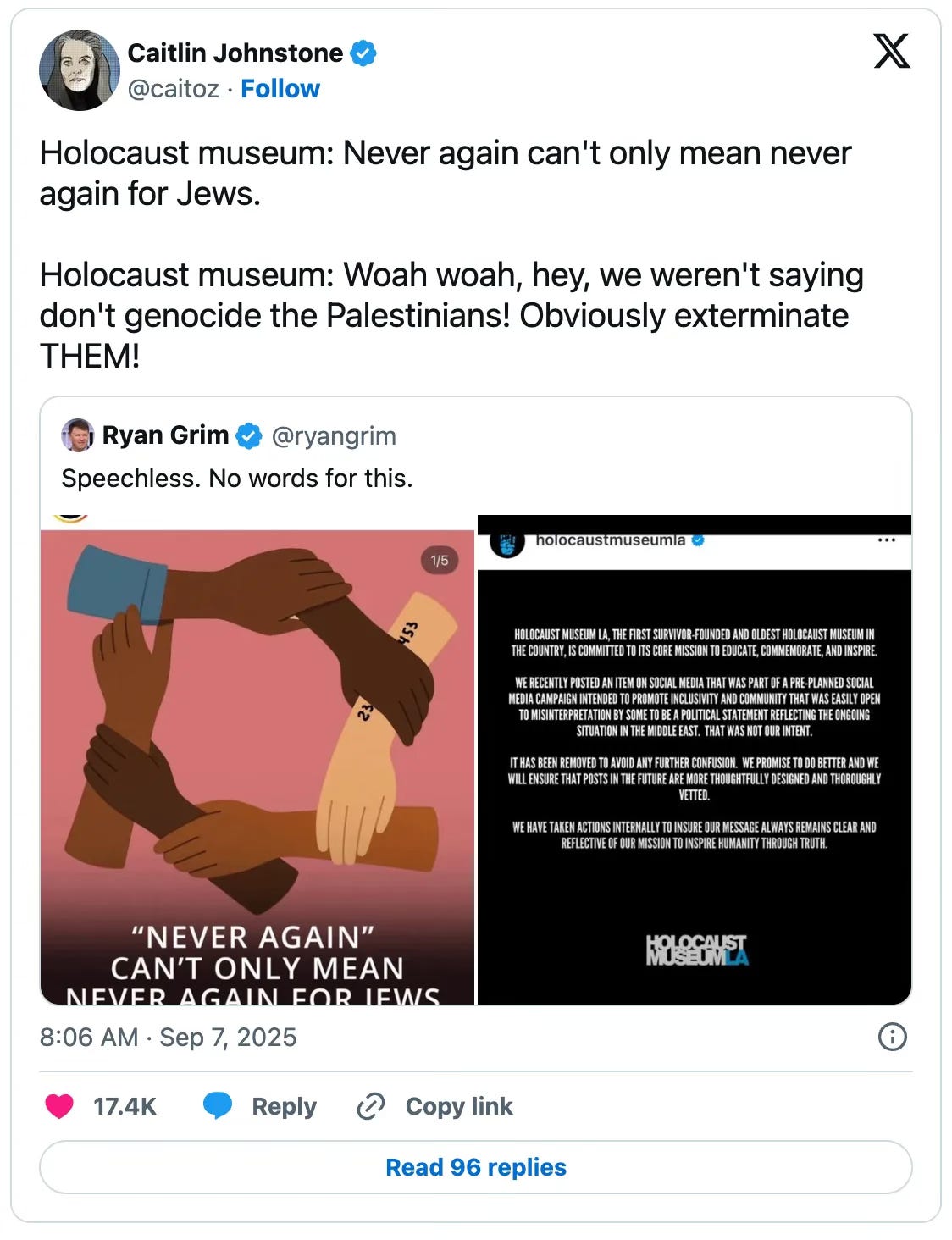
The LA Holocaust Museum recently suggested that “Never Again” is a fundamental lesson of the Holocaust. Then they took it back. Here’s the (almost) inconceivable story from Caitlin Johnstone:
Israel supporters are so crazy and evil that the Los Angeles Holocaust Museum recently retracted a statement saying “Never again can’t only mean never again for Jews” after objections from Zionists.
The museum issued a statement saying, “We recently posted an item on social media that was part of a pre-planned social media campaign intended to promote inclusivity and community that was easily open to misinterpretation by some to be a political statement reflecting the ongoing situation in the Middle East. That was not our intent. It has been removed to avoid any further confusion.”
Think about how gross your position has to be for you to be all hey, let’s say no genocide for ANYBODY, and then immediately have to come back and clarify that you definitely weren’t saying no genocide for the Palestinians.
I’m glad that’s clear! Talk about a profile in cowardice.
Then there are those who get testy about applying the word “genocide” to events in Gaza. Their distorted mouth noises sound something like this: Israel is at war with terrorists (Hamas) and *only* 70,000 or so Palestinians are dead so it’s not really a genocide, is it? Plus it’s all their fault because of October 7th, end of story.
For what it’s worth, I taught the Holocaust as a professor of history after attending a seminar at the US Holocaust Memorial Museum. Also, if it means anything, I’m Catholic, retired military, with no particular axe to grind.
Yes, it’s a genocide in Gaza. A holocaust in slow motion. Heck, Israeli leaders have freely confessed their goal is a final solution to the Gaza question, mainly by killing many Palestinians while forcing the rest to leave. (Whether they’ll have any place to go remains to be seen.)
There is no one model of genocide, and definitions also vary. But if what’s happening in Gaza isn’t a genocide, I don’t know what other word applies. Mass murder, perhaps? Extermination, but slowly? Ethnic cleansing and mass death followed by mass expulsion? That is genocide, plain and simple.
At her Substack, Lisa Savage asks whether the “Gaza Hunger Games” we’re witnessing—the concentration of Palestinians there accompanied by slaughter and mass starvation—was the plan all along for Israel and the United States. It got me to thinking, so I wrote a rather longwinded response to Lisa, which I’d like to share with all of you.
Whether it was the plan all along or whether it’s the result of ad hoc decisions over time, one thing is certain: the holocaust in Gaza must be stopped.
*****
Lisa, I’ve taught the Holocaust, and your question reminds me of a debate among historians: Did Hitler and the Nazis always plan to kill all the Jews, or was it the result of ad hoc decisions over time? Scholars still debate this.*
Perhaps the debate is somewhat artificial in the sense that Hitler and the Nazis vilified the Jews, demeaning them, attacking them, dehumanizing them, establishing the conditions for genocide, which were linked to the need to win a war (Jews as an existential enemy that had to be destroyed, even Jewish children, i.e. they were all “guilty”).
The “logic” of genocide sees even children as enemies who must be eliminated (Image of the “Warsaw Ghetto Boy” during World War II)
Something similar is happening with Palestinians in Gaza. I don’t think Israel and the U.S. had a plan all along to concentrate them in Gaza and kill them. But all that’s gone before this has created the preconditions for a final solution to the Gaza question.
When you vilify Palestinians, demean them, attack them, incarcerate them, dehumanize them, you establish the conditions for a genocide. Then you use the excuse of a “war” to drive the most radical solution–elimination–just as the Nazis used the excuse of World War II to eliminate the Jews (who, of course, posed no existential threat to Germany).
Within the Nazi government (and now within the Israeli government), extremists always come to the forefront. Many officials in Nazi Germany wanted to relocate the Jews, not kill them all, or they wanted to exploit them as slave labor before killing them. But the extremists–the ones who just wanted to kill them all–tended to win the argument. They were the most committed, most sure of themselves, the most radical.
So, what’s happening in Gaza has been the result of long-term dehumanization and propaganda coupled with ad hoc decisions that have run to extremes, because those who are most radical tend to win these “arguments.”
What is truly unconscionable is the eagerness of the U.S. government to provide Israel with all the weapons and diplomatic cover it needs to implement its final solution in Gaza. Whether the president is Biden or Trump, whether Congress is controlled by the Democratic or Republican parties, the policy and result is the same: a blank check to Israel to kill as many Palestinians as they want, justified falsely in “defending” Israel from Hamas.
The Nazis thought or said the Jews were out to destroy them (obviously the Jews were totally incapable of threatening the German war machine) so they tried to destroy the Jews.
The Israeli government says Hamas is out to destroy them (obviously Hamas is totally incapable of threatening the IDF war machine) so they’re trying to destroy the Palestinians.
Genocide is sold as “defensive” and “necessary.”
The parallels are there, yet few people want to see them.
*****
*Addendum: Among Holocaust historians it’s known as the “intentionalist” versus “functionalist” debate, i.e. was it always the Nazis’ intent to kill the Jews, or did it emerge slowly as a function of specific events and decisions?
Some might say, who cares? Dead is dead. Stop the killing!
During World War II, the Nazi system of extermination camps was fairly efficient. Relatively small death camps like Belzec, Sobibor, and Treblinka killed an astonishing number of people, more than 1.6 million and nearly all Jews, quickly and efficiently. If there were a Nazi DOGE, I suppose these death camps may have won “efficiency” awards from it. They stripped the incoming victims of all their valuables and then killed virtually all of them. The loot stolen by the SS was then distributed, again fairly efficiently.
Yet, conducting a genocide, a mass murder, a horrendous atrocity, efficiently is nothing to praise. Right?
Today, America doesn’t need a government that wages wars more efficiently around the globe. We don’t need more efficient genocidal nuclear ICBMs. We don’t need more efficient weapons delivery to Israel so that Gaza can be leveled and its people murdered or displaced from their land.
What we need is an effective government that does the right thing.
The DOGE associated with Elon Musk can’t seem to recognize that you can’t do a wrong thing the right way. If you’re doing a wrong thing, you must stop doing it. Period.
Genocidal nuclear missiles are wrong. Stop building them.
Genocide in Gaza is wrong. Stop supplying Israel with weapons.
Waging war for peace is wrong. Stop doing it.
That said, efficiency does have some relevance. Consider the Pentagon. It has failed seven audits in a row. It is grossly inefficient even as it continues to be ineffective. How do you rein in a vast government bureaucracy that lacks both efficiency and effectiveness?
You don’t do it by rewarding it with more money. But that’s exactly what President Trump, Elon Musk, and Congress are doing. They all seek a trillion dollar war budget. They all want the Pentagon to grow and then grow some more.
If a sprawling bureaucracy is out of control, you must cut its budget in a big way, forcing it to confront its own waste, fraud, abuse, and related forms of corruption. That said, efficiency is again less important than effectiveness. Is the Pentagon effectively defending America? If not, how do you make it more effective?
Pentagon misadventures around the world are making Americans less safe. Incessant warfare is strengthening authoritarianism and militarism in America while weakening democracy and hollowing out infrastructure and finances.
A more effective Pentagon is one that would focus strictly on defending America proper while upholding the U.S. Constitution and the rule of law. After achieving that, one could then focus on efficiency. A Pentagon budget cut roughly in half would lead to a more effective defense of America. A much smaller Pentagon budget could then be more easily audited, leading to greater efficiency.
Committing murderous wrongs in an efficient way is nothing to celebrate. Didn’t the Nazis already provide us with the most horrifying example of this?
A Few Thoughts and Questions on Israel, Gaza, and the USA
As Israel is ethnically cleansing Gaza, the United States is ethically cleansing Israel. It doesn’t matter what Israel does to the Palestinians in Gaza. War crimes or genocide, it’s all ethically justifiable, according to U.S. government officials.
Never conflate the Jewish people with the deeds of the Israeli government. Many Jewish people have bravely spoken out against the ongoing Israeli genocide in Gaza. Holocaust survivors have powerfully said that “Never again!” applies just as much to Palestinians in Gaza (or anyone else for that matter) as it does to Jews.
Is any entity harming the Jewish tradition as much as the hardline Israeli government that is destroying Gaza? Is anything more anti-semitic than associating Zionism and Jewish identity with mass murder?
A Republican U.S. Congressman essentially said he reaches out to AIPAC to tell him how to vote on any bill related to Israel. How is that representative of the will of the American people?
In Tel Aviv, protesters call for a ceasefire and the release of hostages.
As a college professor, I taught a course on the Holocaust. In my research, I recall finding a two-volume encyclopedia on genocides throughout human history. A two-volume encyclopedia! When will it ever end?
It’s always struck me that debate about Israel and its actions is far more intense, diverse, and contentious within Israel than it is within the United States.
Israel is, according to the U.S., a wildly successful democracy, a rich country with national health care for all. Why does such a rich and successful country need so many scores of billions in aid from the American taxpayer?
Speaking of U.S. aid, it curiously seems to provide the U.S. with absolutely no leverage over the actions of the Israeli government.
Whether you support Biden, Trump, or RFK Jr., it doesn’t matter. All three of them are committed to issuing blank checks of support to Israel. As is Congress, which has yet again invited Bibi Netanyahu to address a joint session. What has Bibi done to deserve such an honor?
There are many reasons to hate war, and one of the leading ones is how war facilitates, enables, and seemingly justifies the very worst crimes against humanity. Basically, “We’re at war” is a cry being used by Israel to justify genocide in Gaza.
If Hamas surrendered en masse today, does anyone think Israel would rebuild Gaza for the Palestinians?
When I took a seminar on the Holocaust with Henry Friedlander, he taught me that “You don’t kill the people you hate; you hate the people you kill.” It’s a powerful sentiment that captures something awful about human nature.
As a college professor, I taught a course on the Holocaust. In my research, I recall finding a two-volume encyclopedia on genocides throughout human history. A two-volume encyclopedia! When will it ever end?
Student Protest and the White Rose Movement in Nazi Germany
Apologists for the Israeli government and its genocidal policies are now warning us about “radicalized” college and university students. Apparently, it’s “radical” to protest genocide, famine, and ceaseless bombing. Contrariwise, it’s apparently “normal” to support mass murder, total destruction, and widespread starvation. Talk about a world turned upside down …
Of course, it’s only “radical” to oppose genocide if you live in a totalitarian state that’s prosecuting that genocide or aiding others in prosecuting it. Anyone with a working conscience and a smidgen of humanity would think it’s normal and sane to oppose mass murder and to protest against it.
Sophie Scholl flanked by her brother, Hans (L) and friend Christoph Probst (R) in 1942
Consider a university student who famously protested against genocide: Sophie Scholl. She, her brother Hans, and the rest of the White Rose movement in Nazi Germany are celebrated as heroes today in Germany because they spoke out at great risk against mass murder, and indeed the Nazis executed them in 1943 after holding show trials.
Again, we don’t dismiss Sophie Scholl as a campus “radical” for standing up for Jews and protesting against the murderous policies of the Third Reich. We see her as a paradigmatic individual, an example of the very best of us, a young woman of great moral courage. Of course, the Nazis thought otherwise, arresting her then executing her, her brother, and other White Rose members as traitors to their “race.”
Perhaps the Scholls were radical after all: radical in their courage and their commitment to human rights and values for all.
If you want to watch a powerful movie about young campus “radicals,” check out “Sophie Scholl: The Final Days,” from 2005. I highly recommend it. Back in 2013, I put together a list of 13 movies about the Holocaust and genocide for a college course I taught. In that course, I used well-known movies and documentaries like “Schindler’s List,” “The Sorrow and the Pity,” and “Night and Fog.” The list below was my attempt to expand on that and to point my students to some movies and documentaries that they may not have seen.
Here’s the original article I posted back in 2013:
Thirteen Movies About the Holocaust
I’ve seen a lot of movies and documentaries about the Holocaust or with themes related to the Holocaust and totalitarianism. Of the films I’ve seen, these are the thirteen that stayed with me. Please note that these movies have adult themes; they may not be suitable for children or teens.
American History X (1998): Searing movie about neo-Nazis and the power of hate. Violent scenes for mature audiences only.
Anne Frank: The Whole Story (2001): Excellent dramatization of Anne Frank’s life, to include the tragic end at Bergen-Belsen.
For My Father (2008): A movie about Palestinians, Israelis, and suicide bombers, but also a movie about the difficulties of confronting and overcoming prejudice.
Hotel Rwanda (2004): The genocide in Rwanda, and how one brave man made a difference.
Judgment at Nuremberg (1961): Powerful indictment of Nazi war criminals after World War II.
Katyn (2007): A reminder that the Nazis weren’t the only mass murderers in World War II.
The Last Days (1998): Incredibly moving documentary that explores the fate of Hungarian Jews. Highly recommended.
Life Is Beautiful (1997): It’s hard to believe that a comedy could be made about the Holocaust. But I think this movie works precisely because the main character is so resourceful and full of life.
The Lives of Others (2006): Astonishing movie about life under a totalitarian regime (East Germany). A “must see” to understand how people can be controlled and cowed and coerced, but also how some find ways to resist.
Lore (2012): Movie about a German teenager who has to survive in the chaos of 1945 as the Third Reich comes crashing down. Various small scenes show the hold that Hitler had over the German people, and the reluctance of many Germans to believe that the Holocaust occurred and that Hitler had ordered it.
Sarah’s Key (2010): Heart-wrenching movie about the roundup of Jews in France, which reminds us that the Nazis had plenty of helpers and collaborators.
Sophie Scholl: The Final Days (2005): Inspiring movie about Hans and Sophie Scholl and the White Rose movement in Nazi Germany. The Scholls were college students who took a courageous stand against the Nazis. Executed as traitors in 1943, they are now celebrated as heroes in Germany.
The Wave (2008): Compelling movie about the allure of fascism and “the Fuhrer (leader) principle.” Highly recommended, especially if you want to know how Hitler got so many young people to follow him.
Don’t worry, be happy about unaccountable weapons exports to Israel
Just in case you missed this story (courtesy of ReThink Roundup):
Biden’s secrecy on arms transfers to Israel unnerves some Democrats. As Palestinian civilian deaths mount, President Biden faces growing pressure from Congressional Democrats to publicly disclose the scope of U.S. arms transfers to Israel. Contrary to Ukraine military aid, for which the Pentagon releases recurring fact sheets about the U.S. arms transfers, the administration has not made public the quantities of weapons it is sending to Israel. The administration is also pushing for the authority to bypass notification requirements to Congress that apply to every other country receiving military financing, a move members of Congress and advocates have criticized.
I think Biden’s secrecy on arms transfers to Israel should unnerve all Americans, don’t you?
And why should Israel be the only country in the world where weapons can be shipped, funded by U.S. taxpayers, where Congress won’t be notified?
What is it about this shameless kowtowing to a far-right government in Israel? A government that is bitterly resisted by many Israelis? One led by Bibi Netanyahu, who has said that the idea for killing all Jews in the Holocaust came from an Arab leader rather than Adolf Hitler? Seriously, he said that.
Strangely, Netanyahu is a Holocaust denier in the sense he claims the idea came from Arabs rather than Hitler and the Nazis.
Meanwhile, Donald Trump, Biden’s mostly likely opponent in 2024, is arguably even more virulent in his support of Israel and its attacks on Gaza.
All these U.S. government officials and candidates who love Israel so passionately should grab assault rifles, head to Gaza, and go down into the tunnels and root out Hamas. Put your mouth where you’re sending America’s money.
After attending a seminar at the U.S. Holocaust Memorial Museum with Henry Friedlander, I taught my first course on the Holocaust just over two decades ago. I then continued to teach courses on the Holocaust until I retired as a professor of history in 2014. Having read dozens of books on the Holocaust, seen dozens of moviesand documentaries on it, and having talked to Jewish survivors of the Holocaust, including Henry Friedlander, I learned a few things about how and why such a colossal crime against humanity happened.
When I took his seminar, Friedlander, who as a teenager survived Auschwitz, taught us that “You don’t kill the people you hate—you hate the people you kill.” It may seem paradoxical, but this insight is powerful. Normal human beings don’t want to be or become killers. Thankfully, killing isn’t easy, even at a remove. (Drone operators are known to suffer adverse symptoms from witnessing death at a distance.)
Yet, if you’re taught and told that you must kill, the moral, mental, physical, and other burdens of killing may drive you to hate those you are killing. “Look at what you made me do!” the killer thinks. You made me do this—and I hate you for it. Doesn’t matter that you’re a guiltless child, I still hate you.
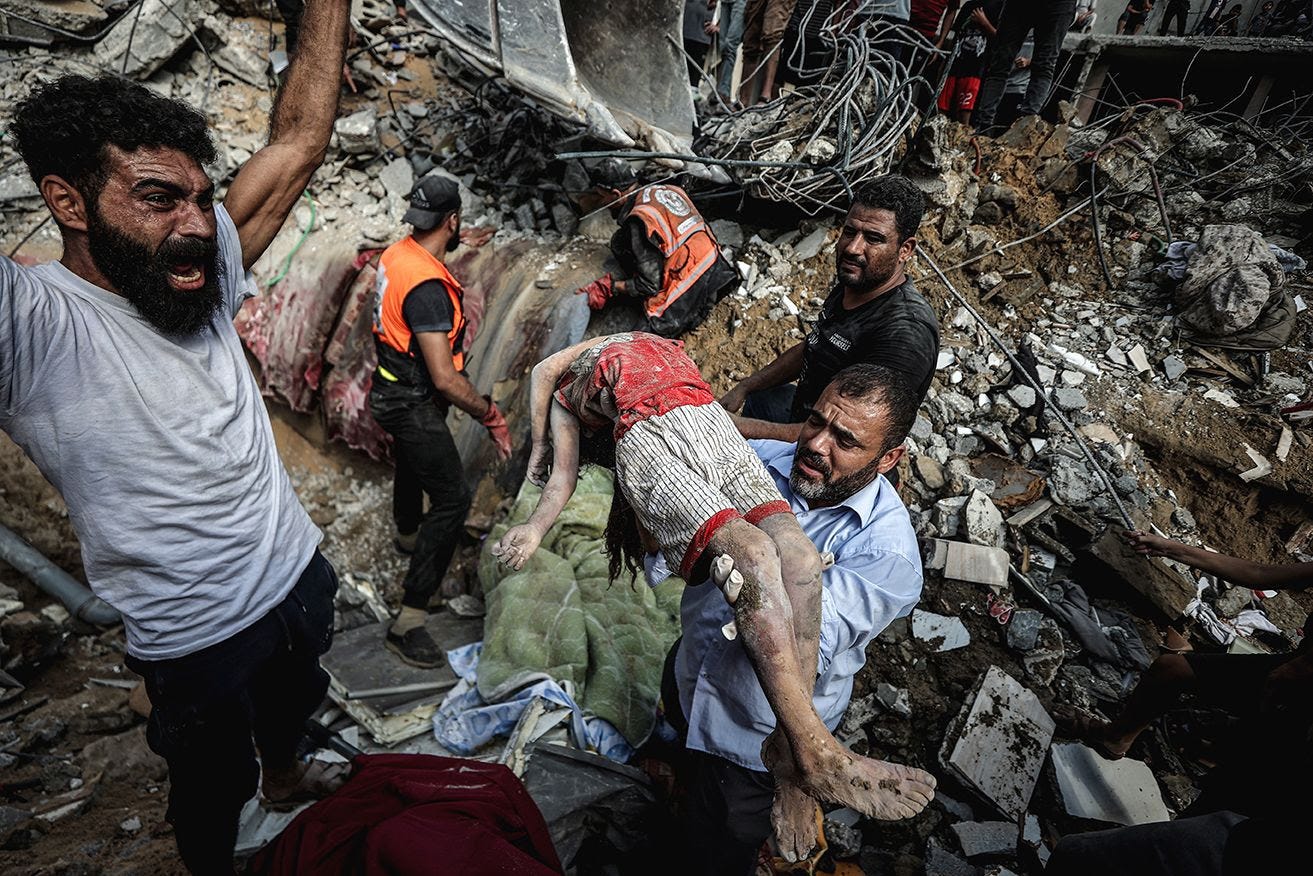
Photo by Ali Jadallah in Gaza (Anadolu Agency via Getty Images)
I wonder about Israeli officials today, those who are in control of the demolition of Gaza. A few must truly hate Hamas, but there are many more, I think, who’d prefer not to be put in the position of ordering (or carrying out) massive bombing raids and ground invasions that result in the deaths of tens of thousands of innocent Palestinians.
How many in Israel, notably in the Israeli Defense Forces, will come to hate those that they kill? How many will succumb to hate as a matter of survival, a sort of mental coping mechanism?
Honestly, I don’t pretend to understand it all. Catchphrases like “man’s inhumanity to man” or “the banality of evil” seem too easy. I remember reading an interview with Primo Levi, another Holocaust survivor, who related an anecdote about his experience communicating with an unrepentant Nazi in Germany well after World War II. This man wrote to Levi to defend himself; unbeknownst to him, his wife snuck a note into the letter that read:
“When the devil is loose in the village, a few people try to resist and are overcome, many bow their heads, and the majority follow him with enthusiasm.”*
Whether you prefer “devil” or “evil” or “racist extremist” or some other term, history shows how humans readily unleash the most elemental barbarism when they believe they are threatened, especially when the “threat” is dehumanized.
Do we kill those we hate, or do we come to hate those we kill? Regardless of the causality here, the common words “hate” and “kill” tell us that to stop the hating and killing, we must simply stop. Stop killing. Stop hating. Find another way, a better way, a way that is life-affirming.
In teaching the Holocaust, I came across a multi-volume encyclopedia devoted to humanity’s genocides throughout history. Imagine that! An encyclopedia is needed just to document the almost countless times humans have engaged in mass murder against other humans.
Will Gaza (2023) become the latest entry in this devilish encyclopedia?
*Ferdinando Camon, Conversations with Primo Levi, The Marlboro Press, 1989, p. 37.
From the Gaza Strip, the Hamas offensive against Israel has been murderously effective. The vaunted and much-celebrated Israeli military was caught by surprise and is responding to the Hamas attacks with its own version of murder, as captured in this announcement:
Israel Defense Minister: “I have ordered a complete siege on the Gaza Strip. There will be no electricity, no food, no fuel, everything is closed. We are fighting human animals and we act accordingly.” [emphasis added]
Actually, we have laws against allowing animals to starve. Think of the SPCA, the society for the prevention of cruelty to animals. Furthermore, comparing humans to animals is most often an insult to animals. Animals’ thirst for blood is sated quickly compared to humans and our thirst.
Let’s be clear: Hamas and the Palestinian people are not “human animals.” They are not lesser humans or beasts. Are the Jewish people forgetting the way that the Nazis reduced them to lesser humans or beasts to be exterminated during the Holocaust?
The Gaza Strip has been described as the world’s largest open-air prison.
Announcing a siege against all Palestinians in the Gaza Strip (no food, no power, mostly unsafe water) is the equivalent of launching a holocaust in slow motion. How is this in any way a proportionate and defensible response to the attacks by Hamas?
Meanwhile, as usual the U.S. government, showing its inherent unity and conformity, is 100% behind Israel, sending an aircraft carrier and issuing blank checks of unequivocal support. The mainstream media once again is telling Americans which side to hate. Think of the Palestinians as a gaggle of little Putins and you’ll be applauded for your right-think.
This is why I hate war. It turns us into killers. It leads us to hate those we kill. And hate kills our minds and makes us even more willing killers.
I applaud and support neither Hamas nor Israel. I applaud and support those who fight for a peaceful future in which we don’t see each other as “human animals” to be slaughtered with impunity.
I turn 60 this year. My health is generally good, though I have aches and pains from a form of arthritis. I’m not optimistic enough to believe that the best years of my life are ahead of me, nor so pessimistic as to assume that the best years are behind me. But I do know this, however sad it may be to say: the best years of my country are behind me.
Indeed, there are all too many signs of America’s decline, ranging from mass shootings to mass incarceration to mass hysteria about voter fraud and “stolen” elections to massive Pentagon and police budgets. But let me focus on just one sign of all-American madness that speaks to me in a particularly explosive fashion: this country’s embrace of the “modernization” of its nuclear arsenal at a price tag of at least $2 trillion over the next 30 years or so — and that staggering sum pales in comparison to the price the world would pay if those “modernized” weapons were ever used.
Just over 30 years ago in 1992, a younger, still somewhat naïve version of Bill Astore visited Los Alamos National Laboratory (LANL) in New Mexico and the Trinity test site in Alamogordo where the first atomic device created at that lab, a plutonium “gadget,” was detonated in July 1945. At the time I took that trip, I was a captain in the U.S. Air Force, co-teaching a course at the Air Force Academy on — yes, would you believe it? — the making and use of the atomic bombs that devastated the Japanese cities of Hiroshima and Nagasaki to end World War II. At the time of that visit, the Soviet Union had only recently collapsed, inaugurating what some believed to be a “new world order.” No longer would this country have to focus its energy on waging a costly, risky cold war against a dangerous nuclear-armed foe. Instead, we were clearly headed for an era in which the United States could both dominate the planet andbecome “a normal country in normal times.”
I was struck, however, by the anything-but-celebratory mood at Los Alamos then, though I really shouldn’t have been surprised. After all, budget cuts loomed. With the end of the Cold War, who needed LANL to design new nuclear weapons for an enemy that no longer existed? In addition, there was already an effective START treaty in place with Russia aimed at reducing strategic nuclear weapons instead of just limiting their growth.
At the time, it even seemed possible to imagine a gradual withering away of such great-power arsenals and the coming of a world liberated from apocalyptic nightmares. Bipartisan support for nuclear disarmament would, in fact, persist into the early 2000s, when then-presidential candidate Barack Obama joined old Cold War hawks like former Secretary of State Henry Kissinger and former Senator Sam Nunn in calling for nothing less than a nuclear-weapons-free world.
An Even More Infernal Holocaust
It was, of course, not to be and today we once again find ourselves on an increasingly apocalyptic planet. To quote Pink Floyd, the child is grown and the dream is gone. All too sadly, Americans have become comfortably numb to the looming threat of a nuclear Armageddon. And yet the Bulletin of Atomic Scientist’sDoomsday Clockcontinues to tick ever closer to midnight precisely because we persist in building and deploying ever more nuclear weapons with no significant thought to either the cost or the consequences.
Over the coming decades, in fact, the U.S. military plans to deploy hundreds — yes, hundreds! — of new intercontinental ballistic missiles (ICBMs) in silos in Wyoming, Montana, North Dakota, and elsewhere; a hundred or so nuclear-capable B-21 stealth bombers; and a brand new fleet of nuclear-missile-firing submarines, all, of course, built in the name of necessity, deterrence, and keeping up with the Russians and the Chinese. Never mind that this country already has thousands of nuclear warheads, enough to comfortably destroy more than one Earth. Never mind that just a few dozen of them could tip this world of ours into a “nuclear winter,” starving to death most creatures on it, great and small. Nothing to worry about, of course, when this country must — it goes without saying — remain the number one possessor of the newest and shiniest of nuclear toys.
And so those grim times at Los Alamos when I was a “child” of 30 have once again become boom times as I turn 60. The LANL budget is slated to expand like a mushroom cloud from $3.9 billion in 2021 to $4.1 billion in 2022, $4.9 billion in 2023, and likely to well over $5 billion in 2024. That jump in funding enables “upgrades” to the plutonium infrastructure at LANL. Meanwhile, some of America’s top physicists and engineers toil away there on new designs for nuclear warheads and bombs meant for one thing only: the genocidal slaughter of millions of their fellow human beings. (And that doesn’t even include all the other life forms that would be caught in the blast radii and radiation fallout patterns of those “gadgets.”)
The very idea of building more and “better” nuclear weapons should, of course, be anathema to us all. Once upon a time, I taught courses on the Holocaust after attending a teaching seminar at the U.S. Holocaust Memorial Museum. Now, the very idea of modernizing our nuclear arsenal strikes me as the equivalent of developing upgraded gas chambers and hotter furnaces for Auschwitz. After all, that’s the infernal nature of nuclear weapons: they transform human beings into matter, into ash, killing indiscriminately and reducing us all to nothingness.
I still recall talking to an employee of Los Alamos in 1992 who assured me that, in the wake of the collapse of the Soviet Union, the lab would undoubtedly have to repurpose itself and find an entirely new mission. Perhaps, he said, LANL scientists could turn their expertise toward consumer goods and so help make America more competitive vis-à-vis Japan, which, in those days, was handing this country its lunch in the world of electronics. (Remember the Sony Walkman, the Discman, and all those Japanese-made VCRs, laser disc players, and the like?)
I nodded and left Los Alamos hopeful, thinking that the lab could indeed become a life-affirming force. I couldn’t help imagining then what this country might achieve if some of its best scientists and engineers devoted themselves to improving our lives instead of destroying them. Today, it’s hard to believe that I was ever so naïve.
“Success” at Hiroshima
My next stop on that tour was Alamogordo and the Trinity test site, then a haunted, still mildly radioactive desert landscape thanks to the world’s first atomic explosion in 1945. Yes, before America nuked Japan that August at Hiroshima and Nagasaki, we nuked ourselves. The Manhattan Project team, led by J. Robert Oppenheimer, believed a test was needed because of the complex implosion device used in the plutonium bomb. (There was no test of the uranium bomb used at Hiroshima since it employed a simpler triggering device. Its first “test” was Hiroshima itself that August 6th and the bomb indeed “worked,” as predicted.)
J. Robert Oppenheimer, the “father” of the atomic bomb
So, our scientists nuked the desert near the Jornada del Muerto, the “dead man’s journey” as the Spanish conquistadors had once named it in their own febrile quest for power. While there, Oppenheimer famously reflected that he and his fellow scientists had become nothing short of “Death, the destroyer of worlds.” In the aftermath of Hiroshima, he would, in fact, turn against the military’s pursuit of vastly more powerful hydrogen or thermonuclear, bombs. For that, in the McCarthy era, he was accused of being a Soviet agent and stripped of his security clearance.
Oppenheimer’s punishment should be a reminder of the price principled people pay when they try to stand in the way of the military-industrial complex and its pursuit of power and profit.
But what really haunts me isn’t the “tragedy” of Opie, the American Prometheus, but the words of Hans Bethe, who worked alongside him on the Manhattan Project. Jon Else’s searing documentary film, The Day After Trinity, movingly catches Bethe’s responses on hearing about the bomb’s harrowing “success” at Hiroshima.
His first reaction was one of fulfillment. The crash program to develop the bomb that he and his colleagues had devoted their lives to for nearly three years was indeed a success. His second, he said, was one of shock and awe. What have we done, he asked himself. What have we done? His final reaction: that it should never be done again, that such weaponry should never, ever, be used against our fellow humans.
And yet here we are, nearly 80 years after Trinity and our country is still devoting staggering resources and human effort to developing yet more “advanced” nuclear weapons and accompanying war plans undoubtedly aimed at China, North Korea, Russia, and who knows how many other alleged evildoers across the globe.
Fire and Fury Like the World Has Never Seen?
Perhaps now you can see why I say that the best years of my country are behind me. Thirty years ago, I caught a fleeting glimpse out of the corner of my eye (Pink Floyd again) of a better future, a better America, a better world. It was one where a sophisticated lab like Los Alamos would no longer be dedicated to developing new ways of exterminating us all. I could briefly imagine the promise of the post-Cold-War moment — that we would all get a “peace dividend” — having real meaning, but it was not to be.
And so, I face my sixtieth year on this planet with trepidation and considerable consternation. I marvel at the persuasive power of America’s military-industrial-congressional complex. In fact, consider it the ultimate Houdini act that its masters have somehow managed to turn nuclear missiles and bombs into stealth weapons — in the sense that they have largely disappeared from our collective societal radar screen. We go about our days, living and struggling as always, even as our overlords spend trillions of our tax dollars on ever more effective ways to exterminate us all. Indeed, at least some of our struggles could obviously be alleviated with an infusion of an extra $2 trillion over the coming decades from the federal government.
Instead, we face endless preparations for a planetary holocaust that would make even the Holocaust of World War II a footnote to a history that would cease to exist. The question is: What can we do to stop it?
The answer, I think, is simply to stop. Stop buying new nuclear stealth bombers, new ICBMs, and new ultra-expensive submarines. Reengage with the other nuclear powers to halt nuclear proliferation globally and reduce stockpiles of warheads. At the very least, commit to a no-first-use policy for those weapons, something our government has so far refused to do.
I’ve often heard the expression “the nuclear genie is out of the bottle,” implying that it can never be put back in again. Technology controls us, in other words.
That’s the reality we’re all supposed to accept, but don’t believe it. America’s elected leaders and its self-styled warrior-generals and admirals have chosen to build such genocidal weaponry. They seek budgetary authority and power, while the giant weapons-making corporations pursue profits galore. Congress and presidents, our civilian representatives, are corrupted or coerced by a system that ensnares their minds. Much like Gollum in The Lord of the Rings, the nuclear button becomes their “precious,” a totem of power. Consider President Trump’s boast to Kim Jong-un that “his” nuclear button was much bigger than theirs and his promise that, were the North Korean leader not to become more accommodating, his country would “face fire and fury like the world has never seen.” The result: North Korea has vastly expandedits nuclear arsenal.
It wouldn’t have to be this way. To cite Dorothy Day, the Catholic peace activist, “Our problems stem from our acceptance of this filthy, rotten system.” Don’t accept it, America. Reject it. Get out in the streets and protest as Americans did during the nuclear freeze movement of the early 1980s. Challenge your local members of Congress. Write to the president. Raise your voice against the merchants of death, as Americans proudly did (joined by Congress!) in the 1930s.
If we were to reject nuclear weapons, to demand a measure of sanity and decency from our government, then maybe, just maybe, the best years of my country would still lie ahead of me, no matter my growing aches and pains on what’s left of my life’s journey.
Not to be morbid, but I suppose we all walk our own Jornada del Muerto. I’d like what’s left of mine to remain unlit by the incendiary glare of nuclear explosions. I’d prefer that my last days weren’t spent in a hardscrabble struggle for survival in a world cast into darkness and brutality by a nuclear winter. How about you?










 Bracing Views