Last Tuesday, I appeared again on Judge Napolitano’s show. We talked about the Russia-Ukraine War and President Trump’s efforts to foster a peace deal, as well as the so-called Deep State and (briefly) the CIA.
The show’s lede raises a provocative question: Can America be rid of the CIA? Anything is possible in theory; the problem is the sprawling size and enormous power of the so-called intelligence community, or IC. (This idea of “community” was already a euphemism in the 1970s, as the movie “Three Days of the Condor” reveals; I’ve always liked how Robert Redford’s character scoffs at the “community” conceit.)
There are eighteen (18!) agencies that make up the IC with a combined yearly budget just north of $100 billion. For all that spending on intelligence, America has not fared well in recent wars in places like Iraq and Afghanistan. A bureaucracy of that size and reach is difficult to corral and control, especially since its budget keeps rising. Threat inflation is a major component of these rising budgets; you’re not going to get a threat assessment from the IC that says, well, actually, America’s pretty safe, let’s spend money on infrastructure, education, and social uplift.
As Chuck Schumer once said about Trump’s efforts to challenge the IC, the community has “six ways from Sunday” to get back at the president. That is, of course, more than worrisome. POTUS is supposed to command the IC; the IC is supposed to serve the president while upholding the U.S. Constitution. The IC shouldn’t scheme to “get back” at the president—any president.
My guess is that Trump has learned that lesson from Schumer. He’s appeasing the IC by giving it more and more money. Meanwhile, a Trump loyalist, Tulsi Gabbard, is trying to exert a measure of control as DNI, or Director of National Intelligence. I can’t imagine the in-fighting going in within the “community” as Gabbard releases files that suggest elements within the IC put their thumbs on the scale against Trump’s runs for president.
Eighteen agencies, $100 billion, and less than impressive results suggest a deep state that is out of control and in urgent need of major reform. Meanwhile, Edward Snowden’s revelations show a power structure that is more than willing to illegally spy on and surveil Americans.
For democracy to prosper, Americans need privacy and the government should be transparent to and controllable by the people. Instead, the IC is shrouded in secrecy and Americans are the ones whose lives are transparent to and controllable by the IC.
Of course, I’m not suggesting the IC is peeking under every door—unless you’re some kind of crazy dissident who believes genocide is wrong and the military-industrial complex is dangerous. You know—someone like Dwight D. Eisenhower.
America’s war budget now exceeds $1 trillion a year—an almost unimaginable sum.
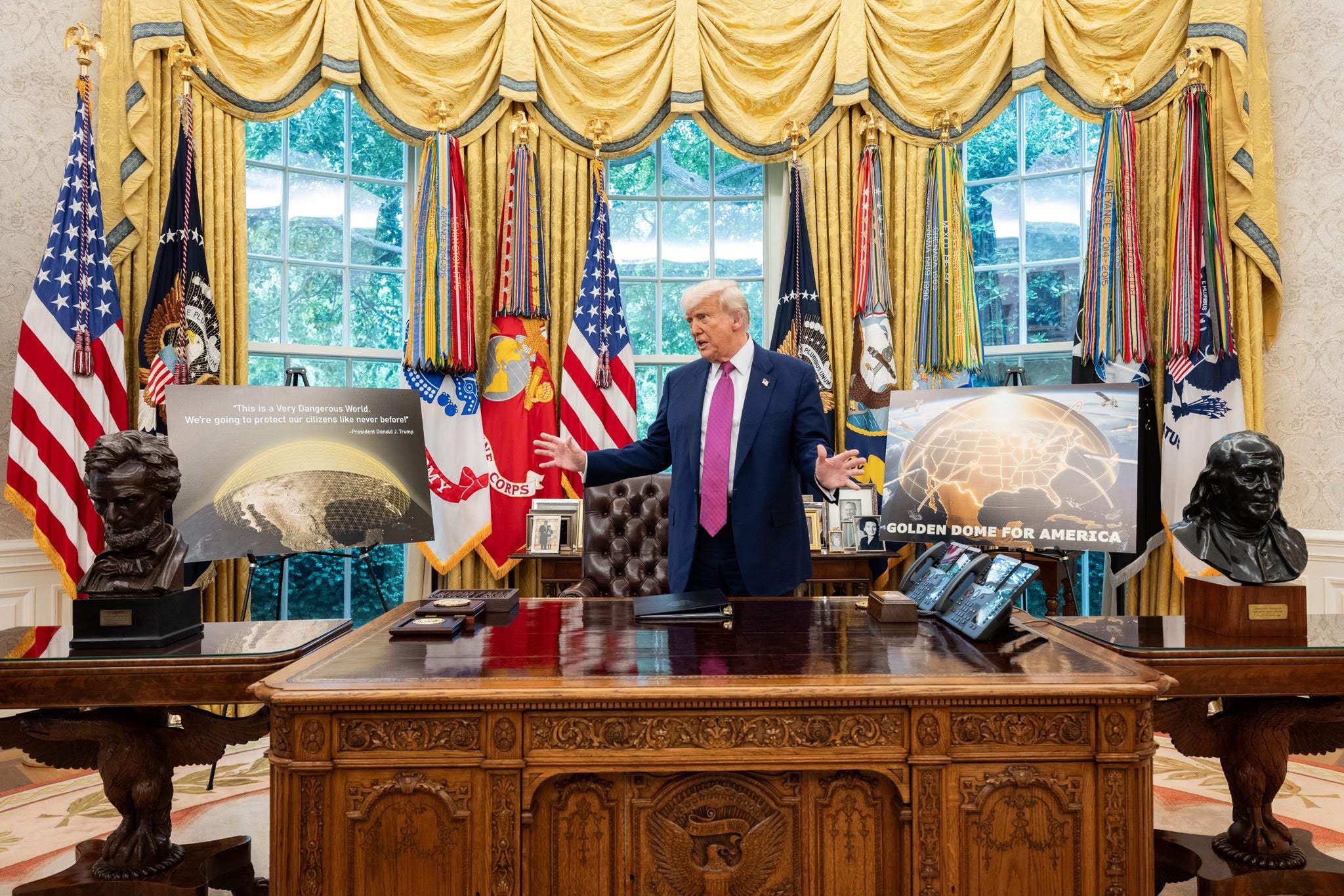
The Pentagon plans to spend $1.7 trillion “modernizing” a nuclear triad that should instead be downsized. A proposed “Golden Dome” missile defense system may cost $500 billion while making nuclear war more likely. And a “new” Cold War with China and Russia is already underway, with threat inflation as one of its defining features.
With military spending so high—and the military so valorized—Washington offers it as the solution to nearly everything: crime in D.C., eliminating drug cartels south of the border, containing China and Russia, “winning” in Somalia, preventing Iran from acquiring nuclear weapons—the list is endless. Supporting and defending the Constitution, however, is rarely mentioned.
War has become America’s new normal. “Peace” is now a word that dare not speak its name. According to the Pentagon, the only peace worth pursuing is “peace through [military] strength.” A warrior ethos is marketed as if it were synonymous with democratic virtue.
I once called for a 10% reduction in Pentagon spending. That’s no longer enough. We need a 50% cut—we need a military dedicated to genuine national defense, not imperial dominance. Surely we can protect America for $500 billion a year rather than the $1 trillion we’re spending now.
Changing the narrative is crucial. Why do we need 750+ bases overseas? Why expand our nuclear arsenal when we already have 5,000 warheads? We don’t need these things—they are the hallmarks of wasteful militarism. They escalate tensions, endanger us, and drain the nation’s wealth.
And why do we have 17 or 18 intelligence agencies? Despite all that intelligence, we still lost in Vietnam, Iraq, and Afghanistan. Where is the accountability? Why are no generals relieved of command for such failures? In fact, they’re more likely to fail upwards.
“All governments lie,” as I.F. Stone warned. Combine that with the truth that war’s first casualty is truth itself, and you begin to see the rot in America today. Perpetual war fuels deception and government overreach. Almost anything can be justified when the cry is, “We’re at war!”—even when the reasons for going to war are false.
Consider the Gulf of Tonkin incident—revealed later as phony—and the Pentagon Papers during the Vietnam War. Consider Iraq’s mythical WMDs. Consider the lies revealed in the Afghan War Papers. Consider the weasel words of generals like David Petraeus, forever hedging “gains” as “fragile” and “reversible.” Consider the U.S. military’s record since World War II—generally ineffective because there’s been little accountability for failure. (And yes, civilian leaders share the blame.)
The military-industrial complex grows ever more powerful, sidelining the American people while democracy withers.
Something is rotten in the States of America.
Many thanks to Judge Napolitano for asking me to discuss some of these issues on his show, “Judging Freedom.”
Donald Trump has a dream: a “golden dome” over America to defend the country against nuclear missiles. It’s a repeat of Ronald Reagan’s dream, the Strategic Defense Initiative, nicknamed “Star Wars” after the movie. The problem is that the dream represents a nightmare.
How so? Golden Dome would be dangerously escalatory, wildly expensive, and unlikely to work as a “shield” to America. It is worse than a mistake: it is a crime. It represents a massive theft from those who hunger and suffer in America. As Republican President Dwight D. Eisenhower said in 1953, wasting enormous resources on weapons systems is no way of life at all. It is humanity crucifying itself on a cross of iron. Crucifixion is not made more pleasant when the cross is golden.
A new golden idol occupies his mind
Put differently, the Golden Dome is a golden idol, a false god, one that by making a massive nuclear strike more likely endangers all of us and God’s creation.
Golden Dome is a grotesque example of makework militarism and warfare as welfare for weapons makers. Though it’s unlikely to work, if it did (partially) it would make a massive nuclear strike more likely, not less, endangering the world with the ecocidal terror of nuclear winter.
Golden Dome and the so-called investment in America’s nuclear triad are both examples of socio-technological madness–America’s leaders are like the mutants in “Beneath the Planet of the Apes,” worshipping the bombs that twisted them and which can only destroy what’s left of civilization.
Some Christians today await the apocalypse when Christ is supposed to return–but the most likely apocalypse features not the second coming of a God-man but a third world war featuring bomb-gods of thermonuclear destruction.
As Daniel Ellsberg once noted, U.S. nuclear attack plans in the early 1960s envisioned 600 million killed, or 100 Holocausts (before we knew such an attack would lead to nuclear winter). We’re lucky this insanity never came to pass. The only sane policy is to cancel Golden Dome and end “investment” in a new nuclear triad. Disarmament, not rearmament, is what’s needed.
*****
The Global Network Against Weapons & Nuclear Power in Space has released a statement against Golden Dome that you can read here. You can add your name to the statement, as I have. Here are some bullet points released along with the statement:
Golden Dome is financially reckless and unsustainable. Early cost estimates range from $550 billion to several trillion dollars over two decades. This dwarfs even the Pentagon’s annual budget and adds to the US’s $37 trillion national debt—a price tag that makes the project fiscally indefensible.
Experts overwhelmingly agree that 100% effective missile interception is a fantasy, especially against complex attacks involving decoys, hypersonic missiles, and maneuverable warheads. Even Israel’s Iron Dome has been bypassed by more rudimentary drone and missile attacks.
Golden Dome includes space-based interceptors—effectively weaponizing the Earth’s orbit and triggering an arms race. This violates the spirit of the Outer Space Treaty and pushes nations like China and Russia to accelerate space weapons development.
By giving the illusion of first-strike survivability, it runs counter to the Mutually Assured Destruction (MAD) doctrine that has prevented so far a nuclear holocaust and incentivizes other powers to retain or expand their nuclear arsenals, blocking disarmament efforts permanently.
Thousands of rocket launches for satellite interceptors would further damage the ozone layer, could generate dangerous orbital debris (Kessler Syndrome), and will harm our already fragile space environment.
The only guaranteed winners of Golden Dome are weapons giants like Lockheed Martin, Raytheon, and Palantir, which stand to profit enormously regardless of the system’s effectiveness or risks.
The trillions funneled into Golden Dome could be used for urgent domestic priorities—such as healthcare, infrastructure, climate action, and education, directly benefiting millions of Americans.
In short, Golden Dome is a massive, dangerous, and futile vanity project, cloaked in patriotism but driven by profit, politics, and illusion.
When you have an unrepresentative government, or, put differently, a government that represents oligarchic interests and corporations, as well as being heavily influenced by lobbyists, domestic and foreign (AIPAC), you get Trump and Congress conspiring to decrease Medicaid, to cut food support for the poor, while funneling more money upward to the very richest Americans.
American workers essentially have no agency, no ability to act in meaningful ways in the political realm. Along with no agency, Americans also have fewer liberties, especially if you should choose to criticize U.S./Israeli policies and otherwise challenge the imperatives of the powerful.
Be careful shouting “Give me liberty or give me death!” in these times. Death may be far easier to achieve.
Hannah Arendt
What is the answer to regaining our agency? In “Between Past and Future,” the political philosopher Hannah Arendt wrote how French resisters to the Nazis during World War II discovered themselves—their true nature—in and through action. In resisting the Nazis, they seized control over their own agency by exercising it in the face of danger. They chose risk, they fought to effect change, they took stands that often meant life or death.
Through action, these resisters lifted themselves out of “normal” time, Arendt argued, entering instead a realm between past and future, a realm of true existence, a present of dynamism, of possibilities, of clarity of commitment.
Political agency is not going to be given back to the people. If we regain it, it will only be by seizing it ourselves, through action, through commitment, through risk-taking, and perhaps most of all through large-scale organized resistance.
Hopefully, that resistance can remain non-violent. I prefer reformation or restoration to revolution, recalling the words of Aleksandr Solzhenitsyn that revolutions unleash the most elemental barbarism.
Are we living through a nightmarish simulacrum of reality, a Hollywood without happy endings? If so, let’s call it “Trumpwood.”
You may know that Donald Trump, who’s appeared in movies and had his own popular TV show, The Apprentice (where his signature line was, “You’re fired!”), has his very own star on Hollywood’s walk of fame (and shame). It’s rather amazing to recall that Trump was once seen as an entertaining billionaire buffoon, a friend to the Clintons, among other liberal A-listers. The relatable billionaire, so to speak, whose vulgar tastes ran to golden toilets. As they say, who cares if it’s true—go with the legend!
He’s a star! A star!
Trumpwood, I’d argue, is a twisted and bizarre version of Hollywood, where the Oval Office is just a set to him, where the world is just a stage where he manifests all his hatred and trauma and egotism. The rest of us are just bit players (or scenery, easily changeable and discardable) in his psychodrama.
It’s all show business to The Donald, all centered on himself, where he is (at least in his own mind) the ultimate A-lister. He is the “very stable genius,” the most powerful man in the world with the biggest nuclear button, the man who craves attention but who also demands obedience. Adoration is what fuels him. Without adoring masses, without his trumped-up towers to himself, he would wither away.
Trump is the ultimate taker, feeding off the adoration as well as the hatred of the rest of us. I wish we could ignore him, but he is the president, after all, so we can’t just wish him into the cornfield.
Perhaps in 2028, assuming we last that long, Americans might care to elect a public servant rather than a self-centered scene-stealing “star” as president. A man can dream.
P.S. Check out Tom Engelhardt’s latest at TomDispatch, which helped to inspire these thoughts of mine.
A patriotic song I was taught in my youth was “You’re A Grand Old Flag,” written by George M. Cohan in 1906. It’s been a long time since I’ve heard it, but it flashed into my mind the other day because of its lyrics, especially the refrain:
You’re a grand old flag, You’re a high-flying flag, And forever in peace may you wave. You’re the emblem of the land I love, The home of the free and the brave. Ev’ry heart beats true ‘Neath the Red, White and Blue, Where there’s never a boast or brag. But should auld acquaintance be forgot, Keep your eye on the grand old flag.
Forever in peace? I second that sentiment, except America is constantly at war or preparing for war. An America that doesn’t boast or brag? Amen to that, except presidents from Bush to Obama to Biden to Trump boast and brag about America having the world’s best and strongest military, with Obama adding that America has the best military in all human history. How’s that for a boast?
Cohan’s song, of course, is nakedly patriotic, with its references to marches and pride. Yet even this stanza is more resonant of democracy than America’s actions today:
Here’s a land with a million soldiers, That’s if we should need ’em, We’ll fight for freedom!
The song speaks of U.S. military potential (“a million soldiers”) but adds only if we should need them, in which case they’ll fight for freedom.
When was the last time the U.S. military truly fought for freedom? World War II, I reckon.
This song’s references to peace, to humility, and to fighting only if we should need to in the defense of freedom, mark it as a true museum piece. How do we recover that version of America?
I’ve been reading John Ketwig’s memoir “…and a hard rain fell: A GI’s true story of the War in Vietnam,” and it’s reminding me just how plain dumb, destructive, and duplicitous America’s wars have been since World War II.
America’s wars are always dressed up with a necessary, even allegedly noble, cause. In Vietnam, we had to stop communism and all those dominoes from falling. In Iraq, it was about WMD and stopping Saddam Hussein, “the next Hitler.” In Afghanistan, it was about vengeance for 9/11, then creating democracy and even helping women. (How about helping women in America? Never mind.)
Vietnam is nominally communist today—and a big trading partner of the U.S. and an ally of sorts against China. No dominoes fell. Iraq didn’t have WMD and Saddam wasn’t the next Hitler; he was merely a regional strongman and a former U.S. ally who got a little too big for his britches, especially for Israel. Afghanistan was a war in search of a clear mission and attainable goals. After twenty years of effort and roughly $2 trillion in expenditures, the U.S. replaced the Taliban with—the Taliban. (I heard Norman Finkelstein say this first.)
We’re always told versions of the same lie: We need to fight them over there so that we don’t have to fight them here. Communism had to be rolled back in Vietnam else commies would be landing in Manhattan. Iraq had to be pummeled and Saddam overthrown before WMD landed in Boston. Afghanistan had to be pacified and modernized before the Taliban enforced conservative Sharia law in Biloxi.
None of this was true. The United States would have been perfectly safe without committing any troops to Vietnam, Iraq, and Afghanistan. In fact, the U.S. would have been far better off if those wars had never been fought. Certainly Vietnam, Iraq, and Afghanistan would have been far better off if they’d never become free-fire zones for American munitions (including the poisonous Agent Orange in Vietnam and, more recently, depleted uranium and other poisons in Iraq and Afghanistan).
Now we’re hearing about a possible U.S. war with Iran, allegedly to stop that country from acquiring an atomic bomb. It’s OK for the U.S. to have more than 5000 nuclear warheads and for Israel to have 200 or so, but it’s not OK for Iran to have even one, because reasons.
The U.S. military, vast as it is, with a vision of global dominance, always needs enemies. Of course, it’s not simply the military but the whole military-industrial complex, the MICIMATT,* which needs war and conflict to sustain itself.
I recently read “American War,” a powerful novel by Omar El Akkad. It imagines a second U.S. civil war starting roughly 50 years from now. It’s a fascinating book, well worth reading because it captures the horror of war, with all its atrocities, its massacres, its war crimes, and the deep wounds war leaves behind even among the most resolute survivors. John Ketwig’s book does the same as he recounts the fears and horrors of his year in Vietnam and the personal struggles he endured in coming to terms with what he’d seen and endured.
So, count me among those who are already against the next war, whether against Iran, China, or for that matter any other country. Sure, I think America needs to defend itself; I don’t think peace is going to break out spontaneously around the world; but I know for a fact that fighting constant wars is not a way toward greater peace and prosperity. Quite the opposite.
If you want to know what desperate and profoundly wounded war survivors are capable of, read “American War.” If you want to know what desperate and profoundly confused troops are capable of, read “…and a hard rain fell.” And ponder the continued propaganda here of the “good war,” the wonders of warriors and warfighters, and the repetition of slogans like “peace through strength,” a specific form of strength measured in kilotons and megatons of explosives, in massive body counts and military production figures.
Ask yourself: Is that “strength”? Are constant wars truly the path toward peace? How can we possibly be so dumb as to believe this?
MICIMATT: military-industrial-congressional-intelligence-media-academe-think-tank complex. It employs millions of people and spends more than a trillion dollars a year. It’s not easily confronted. Nor is it easily contained, let alone curtailed.
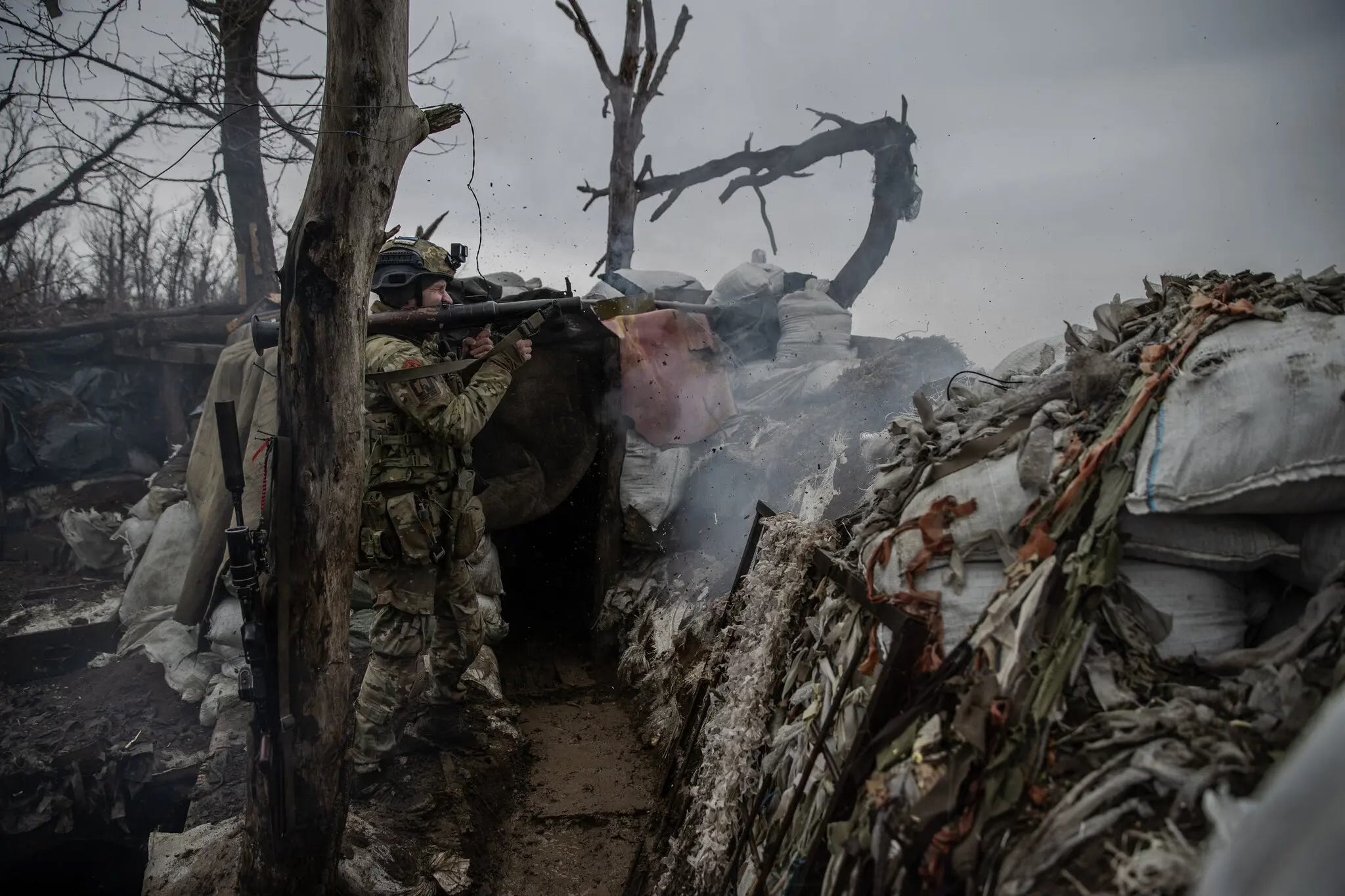
I recently read the book, “Generals Die in Bed,” a classic account of World War I. In terms of combat between Ukraine and Russia, there are serious echoes of WW1 with trench warfare and needless death on a massive scale.
There are few things dumber and more wasteful than trench warfare (Ukraine, from the New York Times)
Far too often, war is glorified when it is really colossal waste. As Dwight D. Eisenhower said, war is to be hated. So, short of abject capitulation to a tyrant, I support efforts to end wars. Stop the waste. Stop the hate. Find a way to live together in peace. The alternative, perpetual war, is too terrible to contemplate.
Diplomacy can be pursued without abandoning Ukraine or betraying NATO. Certainly, Ukraine should be a party to the negotiations. The war is being fought on their turf. They have bled, as has Russia.
But: All wars must end. The trick is ending them in a way that doesn’t generate future wars. That was the greatest tragedy of World War I: that its ending and the botched settlement led almost inexorably to World War II and an even greater bloodletting.
Here’s the rub: Ever since 9/11, indeed ever since World War II, almost without exception, America has ALWAYS been at war. And it hasn’t gone well, has it? (Except for the arms makers and the Cheney neocon crowd.) Isn’t it time we worked for peace?
Far too often, America’s worst enemy hasn’t been Putin or China or some other bogeyman. It’s been the enemy within. And I don’t mean the “red menace” or the “woke” crowd. I mean the enemy that is threat inflation. The enemy that is incessant warfare in unnecessary wars of choice, which drives deficit spending, and which is reinforced by lies.
How many times have we heard of bomber gaps, missile gaps, falling dominoes in Asia, WMD in Iraq, etc., that turned out not to be true, but which were used to justify massive military spending and (especially in Southeast Asia) drove horrendous casualties? Yes, the MICIMATT is powerful, but why are Americans so easy to scare? Why are we so fearful when this country’s geographic position is so enviably strong and defensible? It’s not like Putin’s on our northern border: friendly Canadians are there! (Even if they boo our National Anthem at hockey games.)
The world is becoming multipolar again, which doesn’t mean it has to be a scarier place. A multipolar world could be a more stable one if U.S. leaders could just back off on their goal of dominating everything everywhere all at once.
The idea of full-spectrum dominance and America as a global hegemon at any price must give way to an irenic and ecumenical view of the world. The American religion of violent militarism and prideful exceptionalism is simply too expensive to sustain.
When the ship of state is slowly slipping under the waves, it’s not wise to steer closer to more icebergs. Let’s work to save our ship of state first.
Yesterday at a local barber shop, I spied some old Life magazines from the 1940s, 1950s, and 1960s. Two covers caught my eye:
The first cover celebrated the newish B-52 nuclear bomber that circumnavigated the globe in record time (for the year 1957). Incredibly, the Air Force still relies on updated B-52s today for global bombing missions. Note how the cover mentions nothing about the B-52’s purpose, which was (and remains) to carry nuclear payloads with yields in the megatons of explosive force, anywhere on the globe.
The second cover celebrated fallout shelters. Check this out!
This gives new meaning to living under bridges in America. If only we had built all these fallout shelters—the homeless would have places to live in America today. It sure looks communal and fun in that cutaway view: women holding babies, people reading newspapers and books, even group discussions featuring people dressed like Ward and June Cleaver.
This, I submit to you, is propaganda, the intent of which was to normalize nuclear weapons, perhaps even nuclear war. (Just calmly walk or drive to the nearest shelter if our B-52s have to nuke Moscow.)
It persists today, of course. Now when the Pentagon speaks of nuclear weapons, they frame it as “investing” and “modernization.” Invest in ICBMs! Promised to soar upward like a rocket! Modernize your portfolio with some new B-21 Raider bombers—only $750 million per plane!
If the risk of nuclear war comes up, the suggestion is made that all these new nukes will serve to deter, even to prevent, nuclear Armageddon. Nothing deters war and killing like more genocidal weapons.
Those Life covers from 1957 and 1962 may look quaint—even silly—until you realize nothing really has changed in America in 70 years. We’re still normalizing nuclear weapons and even nuclear war itself. And there’s nothing quaint or silly about that.
It’s always the right time to stop building more weapons of mass destruction
William Astore and Matthew Hoh
[Note to readers: Back in early September, Congressman Mike Turner penned an op-ed for the “liberal” New York Times supporting a massive “investment” in new nuclear weapons. Matt Hoh and I quickly submitted letters to the Times to protest this op-ed and its arguments; the Times ignored them. We then wrote our own op-ed below, shopping it to various mainstream media outlets without success. Here it finally appears for the first time.]
*****
Representative Mike Turner’s essay on nuclear weapons in The New York Times (We Must Invest in Our Aging Nuclear Arsenal, September 6, 2024) is dangerously loyal to counterproductive US national security policies and narratives.
Turner’s lamentation over foreign nuclear weapons programs ignores destabilizing US arms control choices this century. The US spends more on nuclear weapons than the rest of the world combined. Its $1.7 trillion modernization program (the Sentinel ICBM; the B-21 Raider bomber; Columbia-class nuclear submarines) has done little more than upset the decades-long nuclear deterrence balance among nations.
In his essay, Turner neglects to mention the US government’s unilateral withdrawal from multiple arms control treaties. Then-Senator Joe Biden rightly predicted the effects of George W. Bush’s abandonment of the Anti-Ballistic Missile (ABM) Treaty: “A year ago [in 2000], it was widely reported that our intelligence community had concluded that pulling out of ABM would prompt the Chinese to increase their nuclear arsenal tenfold.” The Chinese are now clearly headed in that escalatory direction.
To prevent the apocalyptic consequences of yet another nuclear arms race, the US should act to decrease “investments” in new weapons while cutting current arsenals by negotiating and enacting new arms reduction treaties. Together, the US and Russia already possess ten thousand nuclear warheads, enough to destroy life on earth and several other earth-sized planets. We need desperately to divest from nuclear weapons, not “invest” in them.
Consider as well that America’s current nuclear triad, especially the Navy’s Trident submarine force, is potent, survivable, and more than sufficient to deter any conceivable adversary.
Simply put, the US must stop building genocidal nuclear weapons. It must instead renew international efforts and treaties to downsize these dreadful and dangerous arsenals. Spending yet more trillions on more world-shattering nukes is worse than a mistake—it’s a crime against humanity.
Here we are haunted by the words of Hans Bethe, who worked on the Manhattan Project that created the atomic bomb during World War II. The first reaction Bethe said he’d had after Hiroshima was one of fulfillment—that the project they had worked on for so long had succeeded. The second reaction, he said, was one of shock and awe: “What have we done? What have we done,” he repeated. And the third reaction: It should never be done again.
That is the imperative here. The US must act so that future Hiroshimas will never happen.
It’s not America’s fate alone that’s at stake here, but the fate of humanity itself, and indeed most life on earth, as only a few dozen thermonuclear warheads exploding would likely produce nuclear winter and an eventual “body count” in the billions.
During the First Cold War, one heard it said: “Better dead than red.” That mentality remains, even as the “reds” today are more capitalist than communist. Meanwhile, the weapons makers for the military-industrial-congressional complex (MICC), in their greed, are the adversary within. From Israel and events in Gaza, we’ve learned the MICC will literally empower a people to commit mass murder. With more and newer thermonuclear weapons, the MICC may yet kill the world.
Higher quarterly profits will mean little when everybody is dead.
During the Vietnam War, a US Army major was heard to say: “We had to destroy the town to save it [from communism].” If America can destroy towns in Vietnam to “save” them from communism, if it can facilitate the destruction of Gaza to “save” it from Hamas, it can similarly destroy the earth to “save” it from China, or Russia, or some other “threat.” That is the indefensible (il)logic of building yet more weapons of mass destruction.
Contra Congressman Turner, there is no logical, sensible, defensible reason for America’s proposed “investment” in new nuclear weapons. But there are nearly two trillion reasons why it’s going forward, because that’s the projected total cost of modernizing America’s nuclear triad. Money talks—loudly, explosively, perhaps catastrophically.
Today, more than half of US federal discretionary spending is devoted to war and weapons. Americans, in essence, live both in a permanent war state and a persistent state of war. As bad as that reality is, a state of nuclear war is unimaginable and must not be allowed to happen.
At the height of the Cold War, one of us served in Cheyenne Mountain, America’s nuclear command center, and witnessed a simulated nuclear attack on the US. Even on the primitive monitors the Air Force had back in 1986, seeing Soviet missile tracks crossing the North Pole and terminating at American cities was unforgettable.
A generation earlier, Robert Oppenheimer, the “father of the atomic bomb,” tragically noted in 1965 that it was 20 years too late to control nuclear arms. Those efforts, he said, should have been started “the day after Trinity” in July of 1945.
Let’s not make it 80 years too late. Congressman Turner is exactly wrong here. We must cut America’s nuclear arsenal and pursue new nuclear disarmament treaties. Never should our children be haunted as we were (and still are) by the darkness and doom of radioactive mushroom clouds.
William Astore, a retired lieutenant colonel (USAF) and historian, is a senior fellow at the Eisenhower Media Network.
Matthew Hoh, a former Marine Corps captain and State Department official, resigned in protest in 2009 against America’s ill-conceived war in Afghanistan. He is Associate Director at the Eisenhower Media Network.








 Bracing Views