Yesterday, Ira Chernus had a stimulating article at TomDispatch.com in which he noted the present lack of an American anti-war movement. When it comes to war and foreign policy, Americans face a Hobson’s choice: the Democrats with drones and Special Ops and bombing against evildoers, or the Republicans with even more drones and Special Ops and bombing against even more evildoers. The American master narrative, Chernus noted, is essentially all war.
He’s right about this, and I think it’s mainly for five reasons:
The military draft is gone, so our youth can safely (they think) ignore America’s never-ending wars. In Vietnam, with the draft, most of our youth didn’t have the luxury of apathy. Today, our youth have little personal incentive (as yet) to push back against the prevailing war narrative.
Militarism. Creeping militarism has shifted the American narrative rightwards. In the Vietnam period, General Curtis LeMay’s “bomb them back to the stone age” was a fringe opinion; now it’s mainstream with “carpet bombing” Cruz and Trump and Rubio, the “top three” Republican presidential contenders after the Iowa caucuses.
The Democrats have also shifted rightwards, so much so that now both major political parties embrace endless war. War, in short, has been normalized and removed from partisan politics. As Chernus documents, you simply can’t get an alternative narrative from the U.S. political mainstream. For that, you have to look to much smaller political parties, e.g. the Green Party.
The U.S. mainstream media has been thoroughly co-opted by corporations that profit from war. Anti-war ideas simply don’t get published; or, if they do, they’re dismissed as unserious. I simply can’t imagine any of today’s TV talking heads coming out against the war on terror like Walter Cronkite came out in the 1960s against Vietnam. There is simply no push back from the U.S. media.
Finally, a nebulous factor that’s always lurking: FEAR. The popular narrative today is that terrorists may kill you at any time right here in America. So you must be ready to “lockdown“; you must be ready to “shelter in place.” You must always defer to the police and military to keep you safe. You must fully fund the military or YOU WILL DIE. Repeated incantations of fear reinforce the master narrative of war.
Chernus makes many good points about how America’s constant warring in the Middle East only feeds radical Islam. In short, it’s vital to develop a new narrative, not only because the current one feeds war and death, but also because it’s fated to fail.
I doubt pacifism will fly in warrior corp USA. But why not containment? Containment worked against the Soviet Union, or so most Americans believe. If it worked against the far greater threat posed by the USSR, why shouldn’t it work against radical Islam?
Containment suggests several concrete actions: American troops should pull out of the Middle East. Bombing and drone strikes should stop. Establish a cordon sanitaire around the area. Lead a diplomatic effort to resolve the conflicts. And recognize that violent civil and ideological wars within Islam may need to burn themselves out.
One thing is certain: Because violent U.S. actions are most likely to act as accelerants to radical Islam, we need to stop attacking. Now.
Yes, the U.S. has a responsibility to help the peoples of the region. American actions helped to create the mess. But you don’t “solve” the mess by blowing more people and things to smithereens.
Containment, diplomacy, humanitarian aid. Not a chest-thumping course of action celebrated by the likes of Trump or Cruz or Clinton, but a new master narrative that would be more likely to spare lives and reduce the chaos in the Middle East.
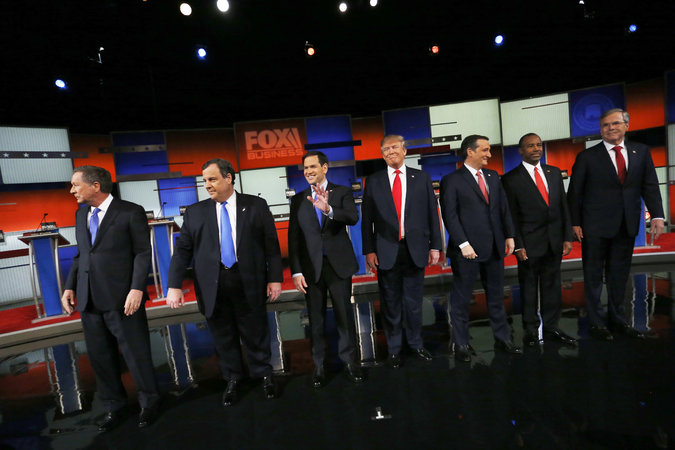
I watched last night’s Republican debate so you wouldn’t have to. Leaving aside the usual mugging by Donald Trump, the usual jousting over side issues like whether Ted Cruz is a natural born citizen, I thought I’d take an impressionistic approach to the debate. You can read the debate transcript here (if you dare), but here is my admittedly personal take on the main messages of the debate.
Barack Obama and Hillary Clinton are coming to take your guns. So you need to elect a Republican who will allow you to keep your guns and to buy many, many more guns while carrying them openly in public.
Related to (1), ISIS is coming to these shores. In fact, they’re already here. That’s one big reason why everyone needs guns – to protect ourselves from ISIS and other terrorists out to kill Americans on Main Street USA.
America is weak. Obama has gutted our military. The Iranians and Russians laugh at us. To stop them from laughing, America needs to rebuild its military, buy more weapons, and use them freely. In fact, all the next commander-in-chief needs to do is ask military leaders what they need to win, give them exactly that, then stand back as our military (especially Special Ops troops) kicks ass. Victory!
America is weak (again), this time economically. The Chinese are kicking our ass. They’re tougher than us and smarter than us. We need to teach them who’s boss, perhaps with a big tariff on Chinese imports, combined with intense pressure on them to revalue their currency.
The American tax system is unfair to corporations. We need to lower corporate tax rates so that American companies won’t relocate, and also so that American businesses will be more competitive vis-à-vis foreign competitors.
The most oppressed “minority” in the U.S. are not Blacks or Hispanics or the poor: it’s the police. Yes, the police. They are mistreated and disrespected. Americans need to recognize the police are there to protect them and to defer to them accordingly.
The only amendment worth citing in the U.S. Constitution is the Second Amendment.
The National Security Agency, along with all the other intelligence agencies in America, need to be given more power, not less. They need broad and sweeping surveillance powers to keep America safe. Privacy issues and the Fourth Amendment can be ignored. People like Edward Snowden are traitors. “Safety” is everything.
Bernie Sanders is a joke. Hillary Clinton just might be the anti-Christ.
Immigrants are a threat, especially if they’re Muslim. They must be kept out of America so that they don’t steal American jobs and/or kill us all.
What I didn’t hear: Anything about the poor, or true minorities, or gender inequities, or the dangers of more war, and so on.
My main takeaway from this debate: Republican candidates live in the United States of Paranoia, a hostile land in which fear rules. Think “Mad Max, Fury Road,” but without any tough females about. (I have to admit I missed Carly Fiorina/Imperator Furiosa on the main stage.)
Only one candidate struck a few tentative notes of accord through bipartisan collaboration and compromise: Ohio governor John Kasich. In his closing statement, he spoke eloquently of his parents’ working-class background. He’s also the only candidate with the guts not to wear the by-now obligatory flag lapel pin. I’m not a Republican, but if I had to vote for one, it would be him. Why? Because he’s the least batshit crazy of the bunch.
Yes, it was a depressing night, one spent in an alternate universe detached from reality. In the end, old song lyrics popped into my head: “paranoia will destroy ya.” Yes, yes it will, America.
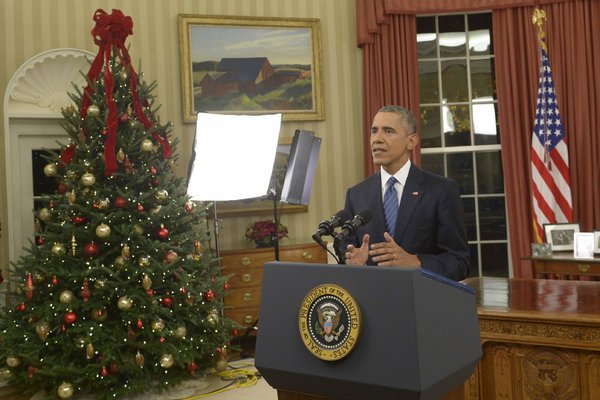
My wife and I watched the president’s speech last night. Overall, it was a solid, even praiseworthy, performance. First, we had to get past the NBC pre-speech fear-mongering. Lester Holt and Chuck Todd, the NBC commentators, were talking about how afraid Americans were, hinting that we all feared our holiday parties would be invaded by active shooters bent on murder. My wife and I looked at each other. Are you fearful, honey? Neither am I.
President Obama himself made many good points. Yes, we shouldn’t vilify Muslim-Americans or condemn all of Islam. Yes, we shouldn’t commit major ground forces to the Middle East to chase ISIL terrorists. Yes, we need sane gun control measures in the USA. Nobody needs an AK-47 or AR-15 (these are not hunting guns: they are military assault rifles designed to kill people). And nobody needs the right to buy a gun if they’re on a “no fly” list as a possible terror threat.
These were “common sense” points, and it pains me to think the president has to belabor what should be obvious. But he does. Because the National Rifle Association wants no restrictions on gun ownership, and the radical right does want to vilify Muslims, commit large numbers of U.S. ground troops to the Middle East, and extend a regimen of militarized surveillance and security at home that will make us even less safe.
Where President Obama consistently disappoints is what he leaves unsaid. That the U.S. invasion and occupation of Iraq essentially created ISIL; and that his policy of overthrowing the Syrian government by arming indigenous Arab forces contributed to it (according to Lieutenant General Michael Flynn, formerly head of the Defense Intelligence Agency). That his strategy of drone assassination (so-called signature strikes that are often based on faulty intelligence) is creating more terrorists than it kills, as several military drone operators have recently argued.
Defenders of the U.S. drone assassination program argue that it’s not the intent of the U.S. government to kill innocents, therefore the U.S. is free from blame. Try telling that to those who have lost loved ones to drones. (So sorry: We didn’t mean to kill your mother/brother/loved one. Wrong place/wrong time: an explanation as infuriating as it is unconvincing.)
President Obama concluded by arguing that he needed even more of a blank check (in the form of a Congressional authorization) to prosecute the war on terror. All in the name of keeping Americans safe, naturally. But he has it exactly backwards. Congress needs to exercise more oversight, not less. Imagine giving President Donald Trump a Congressional blank check to exercise the war on terror. Not such a good idea, right?
Finally, and disappointingly, Obama misunderstands the solemn duty of his office. As commander in chief, Obama believes his first duty is to keep Americans safe and secure. Wrong. His first duty is to “preserve, protect and defend” the U.S. Constitution and the rights, freedoms, and responsibilities defined within. Put bluntly, you can’t keep Americans safe and secure by abridging their rights to freedom of speech or to privacy or to dissent. “Safety” and “security” were not the bywords of America’s founders. Liberty was. And liberty entails risks.
A saying popular on the right is Thomas Jefferson’s “The tree of liberty must be refreshed from time to time with the blood of patriots and tyrants.” In the USA today, “tyranny” is most likely to come in the form of a leader who promises to keep us safe and secure at any cost. (Just look at the Republican candidates for president with their calls for Muslim detention camps, mass expulsion of immigrants, the shuttering of houses of worship, and similar measures of repression.)
The president was right to argue that we must not betray our values. He was right to talk about human dignity. He was right to say that freedom is more powerful than fear. Now we as Americans need to live up to those words. And so does he.
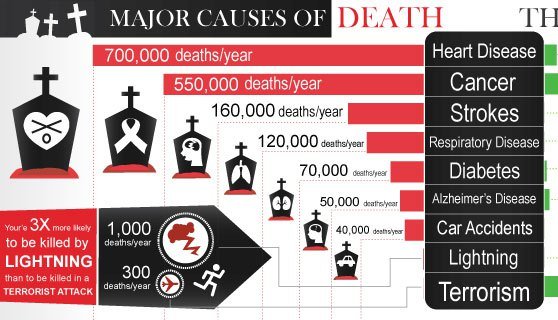
Over the last ten years in the United States, more than 280,000 Americans (more than 300,000 by some counts) have died because of guns. Over that same period, roughly 350,000 Americans have died on the roads in vehicular accidents. That’s roughly 630,000 Americans dying every decade either in road accidents or by gunshots, which is roughly the number of Americans who died in the horrible carnage of the U.S. Civil War from 1861 to 1865, America’s bloodiest war.
In other words, at the hands of guns and vehicles, Americans suffer the equivalent of a civil war-like bloodletting each and every decade. Is it time to declare war on guns and cars? (And now roughly 30,000 people each year are dying from drug overdoses related to the abuse of prescription painkillers and other opiates.)
The U.S. media and our leaders prefer to fixate on radical Islamic terrorism, which has accounted for 24 deaths over the same period. Indeed, by the numbers the White supremacist threat to America is twice as serious as threats from ISIS or other external radical groups.
According to the Washington Times,
“In the 14 years since the Sept. 11 terror attacks, nearly twice as many people have been killed in the United States by white supremacists and anti-government radicals than by Muslim jihadis, according to a new study.”
“White supremacists and anti-government radicals have killed 48 Americans … versus 26 killings by Muslim radicals, according to a count by New America, a Washington research center.”
“New America program associate David Sterman said the study shows that white supremacy and anti-government idealists are a major problem, that their growth rate needs to be addressed and that there is an ‘ignored threat’ woven in the fabric of American society.”
Given these numbers and realities, why are America’s leaders so fixated on hyping the threat of radical Islamic terrorists? Shouldn’t we be focusing on saving lives on our roads? Reducing gun accidents and gun crimes and suicide by guns? On reducing hate-filled radicalism within our own country?
We should be, but we’re not. Our leaders prefer threat inflation: They believe in making political hay while the foreign terrorist threat shines. So presidential candidates like Jeb Bush and Marco Rubio predictably call for a war on terrorism, for military “boots on the ground” in Syria and Iraq, and (of course) for higher military spending and more surveillance, in the name of protecting America. Threat inflation knows no political party, of course, with Hillary Clinton joining the chorus of the tough-talkers against terror.
Threat inflation sells. And threat inflation pays. This is an important theme in Tom Engelhardt’s latest tour de force at TomDispatch.com, “The National Security State’s Incestuous Relationship with the Islamic State.” As Engelhardt notes, threat inflation drives a dance of death even as it eliminates grey zones — opportunities for dialog, diplomacy, compromise, forms of accommodation. It enforces a black and white world of crusaders and jihadists bent on killing one another in the name of righteousness.
Here is how Engelhardt puts it:
the officials of [the U.S. national] security state have bet the farm on the preeminence of the terrorist “threat,” which has, not so surprisingly, left them eerily reliant on the Islamic State and other such organizations for the perpetuation of their way of life, their career opportunities, their growing powers, and their relative freedom to infringe on basic rights, as well as for that comfortably all-embracing blanket of secrecy that envelops their activities. Note that, as with so many developments in our world which have caught them by surprise, the officials who run our vast surveillance network and its staggering ranks of intelligence operatives and analysts seemingly hadn’t a clue about the IS plot against Paris (even though intelligence officials in at least one other country evidently did). Nonetheless, whether they see actual threats coming or not, they need Paris-style alarms and nightmares, just as they need local “plots,” even ones semi-engineered by FBI informers or created online by lone idiots, not lone wolves. Otherwise, why would the media keep prattling on about terrorism or presidential candidates keep humming the terror tune, and how, then, would public panic levels remain reasonably high on the subject when so many other dangers are more pressing in American life?
The relationship between that ever-more powerful shadow government in Washington and the Islamic terrorists of our planet is both mutually reinforcing and unnervingly incestuous.
Of course, Engelhardt knows that terrorism must be fought. The point is not to lose our collective heads over the (much exaggerated) threat of it. To cite Frank Herbert’s insight in Dune, “Fear is the mind-killer.” Yet our media and leaders seem determined to hype fear so as to kill our minds.
As our media and politicians stoke our fear by exaggerating the threat posed by terrorism, ask yourself to what purpose are they attacking your minds.
“Whoever controls the media, controls the mind,” Jim Morrison said, and this is certainly true in America. Consider the lead stories over the July 4th weekend. The first was the threat of terror attacks against America. We were told that law enforcement officials were “in no mood for a national party” — that the threat of an ISIS-inspired terror attack was real. That no attack occurred is of no consequence. Fear was stoked, and that’s what matters. Prepare for the next terror reminder on the anniversary of 9/11, if not sooner.
The second story was shark attacks off the Carolina coast. Unusual, yes, but hardly a threat to America or to the vast majority of its people, even those who chose to go swimming in the ocean. “Shark surge!” “Fear at the beach!” “High alert!” These were common expressions in the media.
Of course, Americans were much more likely to be hurt in fireworks accidents than by terrorists or sharks, but the sensational always takes precedence over the mundane in our media. Indeed, if the goal was to safeguard ordinary Americans, we should have been told to stay off the roads this past weekend, but of course that would hurt tourism and the economy, so you weren’t about to hear that advice coming from America’s talking heads.
It seems nearly impossible to remember that one of FDR’s Four Freedoms was the freedom from fear. FDR knew the paralyzing and stultifying effects of fear, the way it erodes individual autonomy, the way it can be made to serve the powerful. Frank Herbert in Dune captured a powerful truth when he wrote that “Fear is the mind-killer.” The movie Blade Runner echoes the sentiment, with the Replicant Roy Batty (played by Rutger Hauer) explaining that to live in fear is to be a slave.
A media that spreads fear facilitates a government of wolves. Or, put slightly differently by the great Edward R. Murrow, “A nation of sheep will beget a government of wolves.”
There’s a definite method to the media madness, America.
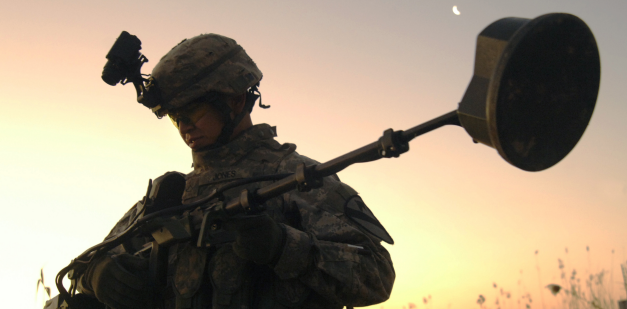
PFC Jones with Mine-Detector. Want to talk about fear?
W.J. Astore
Why, looky here, another article in the New York Times that examines the Republican “hawks” posturing for a presidential run in 2016. As the article blurb states, “Republicans are scrambling to outmuscle one another on national security issues.” It’s all about looking tough and calling for more boots on the ground in battles against ISIS and terror everywhere.
Here’s the money quote:
“There’s a lot of fear out there,” said Katon Dawson, a former chairman of the South Carolina Republican Party, noting that the Islamic State, also known as ISIS or ISIL, had become a regular topic of discussion at his regular breakfast spot in Columbia, the Lizard’s Thicket. “The waitresses and managers and everybody there has a notion about ISIL. People understand who this group is now.”
I should think the waitresses at “Lizard’s Thicket” would be more fearful of paying their weekly and monthly bills, given the low wages earned by wait staff in America. Or that they and their customers would be more fearful of their sons and daughters in uniform being deployed to Iraq to showcase those “muscles” that Republican politicians are always trying to flex. (Don’t worry: No politicians, Republican or Democrat, are eager to send their own sons and daughters overseas to fight.)
Once again, Republican politicians are banging the drums of fear – and as my dad always said, the empty barrel makes the most noise. The music is as tragic as it is predictable: endless war in the name of looking tough and defeating terror. And anyone who dares to suggest the folly of this risks being tarred as an appeaser to ISIS and its ilk.
What burns my butt is that none of these blowhard politicians has any skin in the game. They risk nothing in bleating for war. It’s not their sons and daughters who are being deployed to the front lines.
The other day, I was talking to a young woman at my eye doctor’s office. Her brother is in the Army. She told me he’s an EOD, an explosive ordnance disposal specialist. A risky job, I said, to which she replied, “He volunteered for the extra money,” money that the Army has yet to pay him. He’s got a four-year commitment and is due to be deployed after his training is completed.
So, as they seek to “outmuscle” their political rivals, how many politicians’ sons are in the Army right now, training for EOD duty and risking their lives for the extra money that comes with this hazardous duty? My educated guess: none. Absolutely none.
It’s easy to flex (and to risk) the muscles of others, America. Stop listening to politicians and their fear-mongering. No foreign terrorist is coming to get you as you enjoy your coffee and hash browns at “Lizard’s Thicket.” No – the biggest risk is blowhard politicians who are so, so, eager to send your sons and daughters off to yet more wars in the cause of outmuscling their rivals for political office.
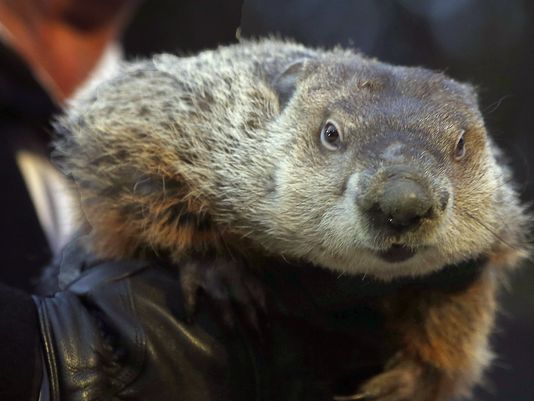
In America’s war on terror, the groundhog always sees its own shadow, meaning six (or more) years of additional war. War is indeed the new normal in America, as I argue in this article today for TomDispatch.com.
War Is the New Normal Seven Deadly Reasons Why America’s Wars Persist
By William J. Astore
It was launched immediately after the 9/11 attacks, when I was still in the military, and almost immediately became known as the Global War on Terror, or GWOT. Pentagon insiders called it “the long war,” an open-ended, perhaps unending, conflict against nations and terror networks mainly of a radical Islamist bent. It saw the revival of counterinsurgency doctrine, buried in the aftermath of defeat in Vietnam, and a reinterpretation of that disaster as well. Over the years, its chief characteristic became ever clearer: a “Groundhog Day” kind of repetition. Just when you thought it was over (Iraq, Afghanistan), just after victory (of a sort) was declared, it began again.
Now, as we find ourselves enmeshed in Iraq War 3.0, what better way to memorialize the post-9/11 American way of war than through repetition. Back in July 2010, I wrote an article for TomDispatch on the seven reasonswhy America can’t stop making war. More than four years later, with the war on terror still ongoing, with the mission eternally unaccomplished, here’s a fresh take on the top seven reasons why never-ending war is the new normal in America. In this sequel, I make only one promise: no declarations of victory (and mark it on your calendars, I’m planning to be back with seven new reasons in 2019).
1. The privatization of war: The U.S. military’s recourse to private contractors has strengthened the profit motive for war-making and prolonged wars as well. Unlike the citizen-soldiers of past eras, the mobilized warrior corporations of America’s new mercenary moment — the Halliburton/KBRs (nearly $40 billion in contracts for the Iraq War alone), the DynCorps ($4.1 billion to train 150,000 Iraqi police), and the Blackwater/Xe/Academis ($1.3 billion in Iraq, along with boatloads of controversy) — have no incentive to demobilize. Like most corporations, their business model is based on profit through growth, and growth is most rapid when wars and preparations for more of them are the favored options in Washington.
“Freedom isn’t free,” as a popular conservative bumper sticker puts it, and neither is war. My father liked the saying, “He who pays the piper calls the tune,” and today’s mercenary corporations have been calling for a lot of military marches piping in $138 billion in contracts for Iraq alone, according to the Financial Times. And if you think that the privatization of war must at least reduce government waste, think again: the Commission on Wartime Contracting in Iraq and Afghanistan estimated in 2011 that fraud, waste, and abuse accounted for up to $60 billion of the money spent in Iraq alone.
To corral American-style war, the mercenaries must be defanged or deflated. European rulers learned this the hard way during the Thirty Years’ War of the seventeenth century. At that time, powerful mercenary captains like Albrecht von Wallenstein ran amok. Only Wallenstein’s assassination and the assertion of near absolutist powers by monarchs bent on curbing war before they went bankrupt finally brought the mercenaries to heel, a victory as hard won as it was essential to Europe’s survival and eventual expansion. (Europeans then exported their wars to foreign shores, but that’s another story.)
2. The embrace of the national security state by both major parties:Jimmy Carter was the last president to attempt to exercise any kind of control over the national security state. A former Navy nuclear engineer who had served under the demanding Admiral Hyman Rickover, Carter cancelled the B-1 bomber and fought for a U.S. foreign policy based on human rights. Widely pilloried for talking about nuclear war with his young daughter Amy, Carter was further attacked for being “weak” on defense. His defeat by Ronald Reagan in 1980 inaugurated 12 years of dominance by Republican presidents that opened the financial floodgates for the Department of Defense. That taught Bill Clinton and the Democratic Leadership Council a lesson when it came to the wisdom of wrapping the national security state in a welcoming embrace, which they did, however uncomfortably. This expedient turn to the right by the Democrats in the Clinton years served as a temporary booster shot when it came to charges of being “soft” on defense — until Republicans upped the ante by going “all-in” on military crusades in the aftermath of 9/11.
Since his election in 2008, Barack Obama has done little to alter the course set by his predecessors. He, too, has chosen not to challenge Washington’s prevailing catechism of war. Republicans have responded, however, not by muting their criticism, but by upping the ante yet again. How else to explain House Speaker John Boehner’s invitation to Israeli Prime Minister Benjamin Netanyahu to address a joint session of Congress in March? That address promises to be a pep talk for the Republicans, as well as a smack down of the Obama administration and its “appeasenik” policies toward Iran and Islamic radicalism.
Serious oversight, let alone opposition to the national security state by Congress or a mainstream political party, has been missing in action for years and must now, in the wake of the Senate Torture Report fiasco (from which the CIAemerged stronger, not weaker), be presumed dead. The recent midterm election triumph of Republican war hawks and the prospective lineup of candidates for president in 2016 does not bode well when it comes to reining in the national security state in any foreseeable future.
3. “Support Our Troops” as a substitute for thought. You’ve seen them everywhere: “Support Our Troops” stickers. In fact, the “support” in that slogan generally means acquiescence when it comes to American-style war. The truth is that we’ve turned the all-volunteer military into something like aforeign legion, deploying it again and again to our distant battle zones and driving it into the ground in wars that amount to strategic folly. Instead of admitting their mistakes, America’s leaders have worked to obscure them by endlessly overpraising our “warriors” as so many universal heroes. This may salve our collective national conscience, but it’s a form of cheap grace that saves no lives — and wins no wars.
Instead, this country needs to listen more carefully to its troops, especially the war critics who have risked their lives while fighting overseas. Organizations like Iraq Veterans Against the War and Veterans for Peace are good places to start.
4. Fighting a redacted war. War, like the recent Senate torture report, is redacted in America. Its horrors and mistakes are suppressed, its patriotic whistleblowers punished, even as the American people are kept in a demobilized state. The act of going to war no longer represents the will of the people, as represented by formal Congressional declarations of war as the U.S. Constitution demands. Instead, in these years, Americans were told togo to Disney World (as George W. Bush suggested in the wake of 9/11) and keep shopping. They’re encouraged not to pay too much attention to war’s casualties and costs, especially when those costs involve foreigners with funny-sounding names (after all, they are, as American sniper Chris Kyle so indelicately put it in his book, just “savages”).
Redacted war hides the true cost of a permanent state of killing from the American people, if not from foreign observers. Ignorance and apathy reign, even as a national security state that is essentially a shadow governmentequates its growth with your safety.
5. Threat inflation: There’s nothing new about threat inflation. We saw plenty of it during the Cold War (nonexistent missile and bomber gaps, for example). Fear sells and we’ve had quite a dose of it in the twenty-first century, from ISIS to Ebola. But a more important truth is that fear is a mind-killer, a debate-stifler.
Back in September, for example, Senator Lindsey Graham warned that ISIS and its radical Islamic army was coming to America to kill us all. ISIS, of course, is a regional power with no ability to mount significant operations against the United States. But fear is so commonplace, so effectively stoked in this country that Americans routinely and wildly exaggerate the threat posed by al-Qaeda or ISIS or the bogeyman du jour.
Decades ago, as a young lieutenant in the Air Force, I was hunkered down inCheyenne Mountain during the Cold War. It was the ultimate citadel-cum-bomb-shelter, and those in it were believed to have a 70% likelihood of surviving a five-megaton nuclear blast. There, not surprisingly, I found myself contemplating the very real possibility of a thermonuclear exchange with the Soviet Union, a war that would have annihilated life as we knew it, indeed much of life on our planet thanks to the phenomenon of nuclear winter. You’ll excuse me for not shaking in my boots at the threat of ISIS coming to get me. Or of Sharia Law coming to my local town hall. With respect to such fears, America needs, as Hillary Clinton said in an admittedly different context, to “grow a pair.”
6. Defining the world as a global battlefield: In fortress America, all realms have by now become battle spheres. Not only much of the planet, the seas, air, and space, as well as the country’s borders and its increasingly up-armored police forces, but the world of thought, the insides of our minds. Think of the 17 intertwined intelligence outfits in “the U.S. Intelligence Community” and their ongoing “surge” for information dominance across every mode of human communication, as well as the surveillance of everything. And don’t forget the national security state’s leading role in making cyberwar a reality. (Indeed, Washington launched the first cyberwar in history by deploying the Stuxnet computer worm against Iran.)
Think of all this as a global matrix that rests on war, empowering disaster capitalism and the corporate complexes that have formed around the Pentagon, the Department of Homeland Security, and that intelligence community. A militarized matrix doesn’t blink at $1.45 trillion dollars devoted to the F-35, a single under-performing jet fighter, nor at projections of $355 billion over the next decade for “modernizing” the U.S. nuclear arsenal, weapons that Barack Obama vowed to abolish in 2009.
7. The new “normal” in America is war: The 9/11 attacks happened more than 13 years ago, which means that no teenagers in America can truly remember a time when the country was at peace. “War time” is their normal; peace, a fairy tale.
What’s truly “exceptional” in twenty-first-century America is any articulated vision of what a land at peace with itself and other nations might be like. Instead, war, backed by a diet of fear, is the backdrop against which the young have grown to adulthood. It’s the background noise of their world, so much a part of their lives that they hardly recognize it for what it is. And that’s the most insidious danger of them all.
How do we inoculate our children against such a permanent state of war and the war state itself? I have one simple suggestion: just stop it. All of it. Stop making war a never-ending part of our lives and stop celebrating it, too. War should be the realm of the extreme, of the abnormal. It should be the death of normalcy, not the dreary norm.
It’s never too soon, America, to enlist in that good fight!
William J. Astore, a retired lieutenant colonel (USAF), is a TomDispatch regular. His D.Phil. is in Modern History from the University of Oxford. He’s just plain tired of war and would like to see the next politician braying for it be deployed with a rifle to the front lines of battle. He edits the blog The Contrary Perspective.
On this Super Bowl Sunday of 2014, doubtless we’ll be hearing about the “heroes” of the gridiron. Whichever team wins will have its “heroes” (Peyton Manning, perhaps?). Meanwhile, remote feeds will show various military units watching the Big Game, and doubtless these troops will be touted as American heroes. (They’re indisputably a tad more heroic than a multi-millionaire quarterback who shills everything from pizza to cars.)
But who are the real heroes of America? I tackled this question on Memorial Day 2011 at Truthout. For me, it’s loving, hard-working, self-sacrificing people like my parents. I recall learning in Catholic catechism class that love is all about selfless giving — giving of yourself, freely and generously, without expecting anything in return. That is assuredly one characteristic of a “hero.”
Here is what I wrote back in 2011. My thanks to Truthout for publishing it back then.
This Memorial Day [2011], let’s remember and learn from our heroes who are gone from us. For me, my heroes are my parents, both of whom grew up in single-parent families during the Great Depression. Let’s start with my Mom. Our concept of “hero” today often works against moms; our culture tends to glorify our troops and other people of action: police, firefighters, and other risk-takers who help others. But to me my Mom was a hero. As a young woman, she worked long hours in a factory to help support her mother. She married at twenty-seven and quickly had four children in five years (I came along a few years later, the beneficiary of the “rhythm method” of Catholic birth control). As a full-time homemaker, she raised five children in a working-class neighborhood while struggling with intense family issues (an older son, my brother, struggled with schizophrenia, a mental disease little understood in the early 1970s).
Despite these burdens and more, my Mom was always upbeat and giving: traits that didn’t change even when she was diagnosed with cancer. She struggled against the ravages of that disease for five long years before succumbing to it in 1980. Cancer took her life but not her spirit. I never heard her once complain about the painful chemotherapy and cobalt treatments she endured.
My father too had a difficult life. He had to quit high school after the tenth grade and find a paying job to support the family. At the age of eighteen, he entered the Civilian Conservation Corps and fought forest fires in Oregon; factory work followed (where he met my Mom) until that was interrupted by the draft and service in the Army during World War II. After more factory work in the latter half of the 1940s, my Dad got on the local firefighting force, serving with distinction for more than thirty years until his retirement. He died in 2003 after a heart attack and surgery, from which he never fully recovered.
America’s heroes are women and men like my Mom and Dad: the factory workers, the homemakers, the blue-collar doers and givers. And as I think about my Mom and Dad, I recall both their loving natures and their toughness. They had few illusions, and they knew how to get a tough job done, without complaint.
There’s so much we can learn from women and men like them. Personally, I’m so sick of our media and our government telling us how scared we should be — whether of violent crime or violent tornadoes or bogeyman terrorists overseas. My parents recognized the hard-won wisdom of Franklin Delano Roosevelt: the only thing we have to fear is fear itself.
But today our government prefers to abridge our rights (see the latest extension of the so-called Patriot Act) in the name of keeping us safe and less fearful, a bargain for those who exercise power, but not for tough-minded people working hard to scrape a living for their children (thanks again, Mom and Dad).
My parents weren’t worried about threats emerging from left field. They had real — and much more immediate — challenges to deal with right at home. In this spirit, I still recall my Dad talking somewhat heretically about the Cold War and the Soviet threat. His opinion: if the Americans and Soviets are stupid enough to nuke one another, a billion Chinese will pick up the slack of human civilization. No bomb shelters or ducking and covering for him. It was back to work to support the family by putting out fires in our neck of the woods.
And that’s what we need to do today as a country. We need to put fear aside and band together to put out fires in our neck of the woods. Together we can make a better country. In so doing, we’ll honor the heroic sacrifices of our families and ancestors: people like my Mom and Dad.
God bless you, Mom, Dad, and all the other quiet and unsung heroes of America.
Fear is the mind-killer (From the movie, “Dune”) W.J. Astore
Tom Engelhardt has a stimulating article at TomDispatch on the many monsters stalking us, both real and imagined. The imagined ones we can deal with; the real ones, well, not so much. As Engelhardt notes:
“we’re living in a country that my parents would barely recognize. It has a frozen, riven, shutdown-driven Congress, professionally gerrymandered into incumbency, endlessly lobbied, and seemingly incapable of actually governing. It has a leader whose presidency appears to be imploding before our eyes and whose single accomplishment (according to most pundits), like the website that goes with it, has been unraveling as we watch. Its 1% elections, with their multi-billion dollar campaign seasons and staggering infusions of money from the upper reaches of wealth and corporate life, are less and less anybody’s definition of ‘democratic.’”
We’ve up-armored our country and our nightmares even as we’ve downsized our jobs and our dreams. The worst nightmare of all, Engelhardt notes, is our continued trashing of the planet in a drive for corporate profits tied to fossil fuel extraction and consumption. We may be making our planet a hell-hole, but it’s hell in slow motion. And since our corporate sponsors are telling us to look away, we hardly notice the descent, even as it gets just a little warmer every day …
“However nameless it may be, tell me the truth,” Engelhardt asks: “Doesn’t the direction we’re heading in leave you with the urge to jump out of your skin?”
Yes, it does. Our real fears are not as Hollywood-ready as vampires or zombies or velociraptors, but they’re equally as frightening and immobilizing. Fears like keeping our jobs, paying the rent or mortgage, not getting an illness that may bankrupt us.
Fear is indeed something to fear. “Fear is the only darkness,” as Master Po explains to the young Kwai Chang Caine in “Kung Fu.” “Fear is the mind-killer,” as Frank Herbert wrote in “Dune.” “Quite an experience to live in fear, isn’t it? That’s what it is to be a slave,” explains the doomed replicant in “Blade Runner,” memorably played by Rutger Hauer.
Today, our fears run at fever pitch. In movies and on TV, they take the form of zombies, vampires, and other “terrorists” out to destroy us. But in real life, our fears are more mundane, even as we’re distracted from the true vampires and zombies – those among us who mindlessly consume without ever reaching satiation.
How are we kept distracted? Because we’re taught that voracious “monsters” are really superheroes. We inhabit a world turned upside down in which victims (the homeless, the jobless, the desperate) are portrayed as despoilers even as zombie capitalists are celebrated for voraciously munching their way through America’s wealth.
What keeps us in line? Our fear. Fear keeps us in the dark. Fear numbs our minds. Fear slaps us in chains.
Change – if it comes to America – will come when Americans master their fear. But before that, we must recognize the true monsters.
A word that’s symbolic of our growing police state mentality is “lockdown.” I saw today on the news that Indiana University is in “lockdown” due to a suspect on the loose with a knife.
You can lockdown a prison. But you can’t lockdown a campus as large as Indiana University in Bloomington. Nor is a college campus a prison. The campus should certainly be alerted to a potentially dangerous situation, but there’s no need to apply prison terminology to the situation.
In so many aspects of our lives, Americans are being told to be afraid. We’re told “to shelter in place,” to huddle scared like so many rabbits, until the proper “locked and loaded” authorities are deployed with their SWAT teams and armored cars.
This lockdown mentality extends to commercials. New TV ads for ADT show parents smiling as they secretly monitor their children at home with cameras linked to their security systems and their personal laptops/iPads. Adults attain a look of blissful contentment as they remotely arm their security systems, knowing that they’re keeping the have-nots out of their “have” communities.
Sorry, I don’t think lockdowns are the answer to danger. And I don’t think turning your home into a prison with gates and perimeter lights and alarms and cameras is the answer to our worries about security.
We don’t need to lockdown our communities and our homes. We need to lockdown our fear. For as Master Po said in Kung Fu, “Fear is the only darkness.”





 Bracing Views