It seems like forever and a day, but I finally published my dad’s journal with my notes and photos at Amazon. Here’s the link.
It’s available for $10 in paperback, $5 on Kindle, or free if you have Kindle unlimited.
Here’s my description of the book:
Before he died, my father wrote a journal about his life. Born in 1917, he lived through the Great Depression, served in the Civilian Conservation Corps (mainly in Oregon) in the 1930s, survived working in factories and in the U.S. Army during World War II, and eventually became a firefighter for the City of Brockton (MA), serving for over 30 years.
Though he never finished high school, he read philosophy, loved classical music, and was an avid opera fan. The son of Italian immigrants, his story is the story of America, the story of a young man who worked hard and who in the process acquired a lot of wisdom from life’s setbacks.
This journal recounts many episodes in his life and the lessons he learned from them. It is one remarkable note in a fanfare for the common man.
*****
I started transcribing my dad’s journal soon after he died in 2003, but it took me two decades to put it all together in book form. If you find time to read it and you like it, perhaps you can bop on over to Amazon and write a review of it.
Thanks so much to all my readers. I hope you enjoy my book about my dad.
I had a great time this weekend with family, including my brother-in-law who’s a combat veteran of the Vietnam War. If I’m on the left, he’s on the right (whatever those often vague political labels may mean). Guess what we agree on? A lot, actually:
+ We both agreed the Iraq and Afghan Wars were disasters.
+ We both agreed $105 billion in more weapons and “aid” to Ukraine, Israel, Taiwan, etc. is a complete waste of money. We’d both rather see that money spent here in the USA, especially on America’s crumbling infrastructure. (“Crumbling” as a descriptor is inseparable from infrastructure here in America.)
+ We both agreed the government response to Covid was badly botched and that Anthony Fauci often lied to the American people. We both agreed government experts should have treated us like adults, admitting they couldn’t answer all the questions about Covid. We both think it’s more likely than not that Covid was a man-modified virus that leaked from a lab in China.
+ We both agreed Joe Biden isn’t the answer in 2024. My brother-in-law is open to Trump; I can’t vote for Trump for so many reasons. A minor disagreement, though we’d both like to see more and younger candidates, not a Biden-Trump rematch.
+ We both agreed a ban on assault weapons would do little or nothing to stop gun violence and mass shootings in America. There are already 20 million AR-15-type assault weapons in America; sorry, a ban won’t fix anything.
+ We both agreed the New England Patriots suck this year, but that Mac Jones isn’t solely to blame for an offense that simply can’t score points.
+ We both agreed Budweiser went well with our turkey and sausage gumbo.
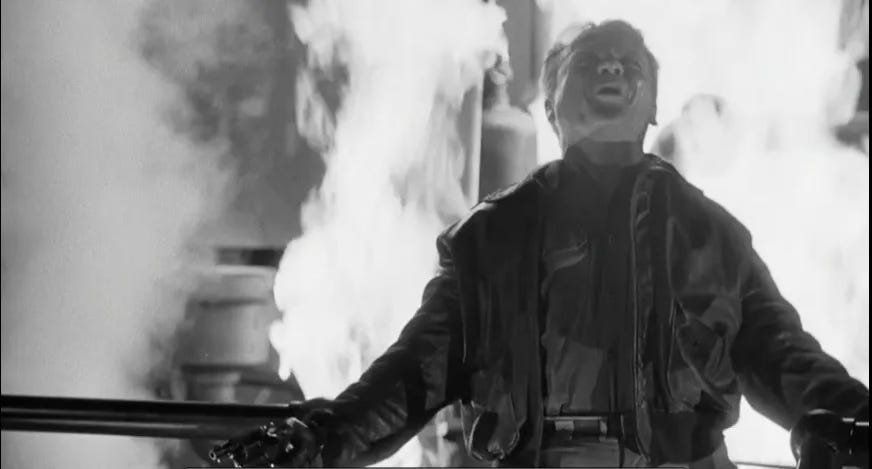
+ We both agreed “White Heat” (1949) with Jimmy Cagney is one of the greatest movies ever made.
Top of the world, Ma. Jimmy Cagney at the explosive conclusion to “White Heat”
+ Finally, we both agreed we are immersed in Operation Ongoing Bullshit, a felicitous phrase my brother-in-law came up with. We are constantly being bullshitted by “our” government. I put “our” in scare-quotes because we agreed we have a pay-to-play government. Pay a lot, as in millions of lobbying dollars, you get to play a lot. Can’t pay? Too bad. You have no say.
Operation Ongoing Bullshit is one of the more honest names I’ve heard to describe what the U.S. government is usually up to. Right and left can heartily agree on this, I think.
Far too often, we’re told there are unbridgeable differences between right and left in America. Differences exist, of course, yet there’s so much Americans can and do agree on. To cite only one example, I think most Americans agree with James Madison that ongoing war (and ongoing BS, for that matter) contributes to the death of democracy. And also to our colossal national deficit, now in the neighborhood of $34 trillion.
When I was a college professor, whether civilian or military, I was told unironically that I was part of a “family.” I had an Air Force “family.” I had a Penn College “family.” But when these institutions wanted me to do something, often something I really didn’t want to do, the “family” talk went out the window and I was reminded I was an “employee” in the civilian world and “just another f*cking officer” in the military world. None of this surprised me because I never bought any of that “family” crap. I only have one family, thank you very much, and they are related to me by blood or by marriage. My “family” is not my boss, not my employer.
Management loves to talk about employees as if they’re “family” when they really think of us as “assets” or “products” or even simply “the cost of doing business” (and the quickest way to reduce cost is often to get rid of “family” members).
It’s especially telling to hear corporate/management talk in the sports world. Sam Kennedy, who’s the president of the Red Sox, talks openly about putting the best “product” on the baseball diamond. He doesn’t see his players as people, he reduces them to “assets” that are basically interchangeable. Winning only matters in the sense that it produces profit while elevating the value of the “product.”
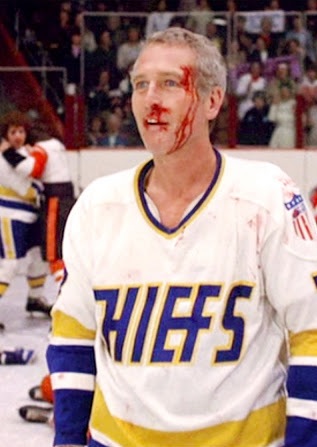
Of course, this is nothing new. In Slap Shot (1977), an amusingly vulgar and perceptive movie about a minor-league hockey team starring Paul Newman as an aging player, we learn that the team is owned by a wealthy woman who decides to liquidate the team rather than sell it because it’s more valuable that way as a tax write-off. The players, the fans, all the employees, mean nothing to this absentee owner. All that matters is money.
Paul Newman as player-coach Reg Dunlop in “Slap Shot,” one of the finest movies about sports in America
And of course any Red Sox fan can cite “the curse of the Bambino,” when a century ago the owner of the Red Sox sold Babe Ruth to the New York Yankees to raise money (for a theater production, if memory serves).
Capitalism reduces everything to products, assets, profit margins, and the like. I don’t know about you, but this is not how I think of my real family.



 Bracing Views