Language and repetition of the same is so important. We hear about the Department of Defense (DoD) and the Pentagon budget and we think little of it. The DoD, of course, used to be called the Department of War until 1947, a far more telling and accurate name, and there wasn’t a Pentagon until we built one during World War II. In the old days, the Army fought the Navy for which service would get more money in the War Budget, with the Navy usually winning as America sought to control the seas as a means of dominating trade and “intercourse” among nations.
Those were more honest times when retired generals like Smedley Butler wrote in the 1930s that he’d served as a “gangster” for capitalism. Butler was a Marine who was twice awarded the Medal of Honor, so it wasn’t easy for the imperialists to smear him, though they certainly tried (as they did to David M. Shoup, another Marine Corps general and Medal of Honor recipient who turned against the Vietnam War in the 1960s).
Anyhow, I just saw at Antiwar.com that President Trump is proposing a $1.01 trillion budget for the Pentagon for FY2026, a 13% increase in imperial spending. Trump, of course, is proud of reaching the Trillion Dollar threshold. Big numbers have always appealed to him.
It doesn’t seem to matter who is president, whether it’s Biden or Trump, Democrat or Republican, when it comes to the Department of Empire and its bloated imperial budget. For that is what it is, a budget that seeks to sustain and enlarge America’s imperial domain. If you add other costs related to imperial dominance, such as interest on the national debt due to war spending, VA costs, nuclear weapons, and the like, the true imperial budget soars toward $1.7 trillion yearly.
No matter. A trillion here, a trillion there, and pretty soon you’re talking real money.
The Pentagon tries to disguise the enormous waste of this imperial budget by speaking of it as an “investment,” but imagine an “investment” that you’re involved in which fails seven audits in a row. How likely would you be to see this as anything other than theft?
Dwight D. Eisenhower had it right in 1953 when he spoke of military spending as a theft from those who hunger. Ike’s words are almost never heard today inside the Washington Beltway. It’s worth reflecting upon them again as America’s leaders boast of trillion-dollar war budgets:
Every gun that is made, every warship launched, every rocket fired signifies, in the final sense, a theft from those who hunger and are not fed, those who are cold and are not clothed. This world in arms is not spending money alone. It is spending the sweat of its laborers, the genius of its scientists, the hopes of its children… This is not a way of life at all, in any true sense. Under the cloud of threatening war, it is humanity hanging from a cross of iron.
I started blogging in 2007 for TomDispatch.com. Tom Engelhardt, the mastermind of that indispensable site, saw something in an article I sent him on saving the U.S. military from itself. That is, from its own vainglory, its own global ambitions for power and dominance, its own illusions of being number one, both the world’s toughest military and also the world’s freedom-bringers. Certainly, the megalomania and Messiah-like fantasies weren’t a military mindset alone; it was even more pronounced among the neocons who orbited the Bush/Cheney administration and who still largely define U.S. foreign policy in the Biden/Harris administration. Things are so bad that some (wrongly) believe Trump/Vance offer a more moderate, far less warlike, alternative, when Trump’s record suggests little of the sort.
Anyhow, this is my 108th article for TomDispatch in the 17 years I’ve been writing for the site, a mark of persistence that suggests a certain folly on my part, and considerable patience on Tom’s part.
During World War II, American leaders proudly proclaimed this country the “arsenal of democracy,” supplying weapons and related materiel to allies like Great Britain and the Soviet Union. To cite just one example, I recall reading about Soviet armored units equipped with U.S. Sherman tanks, though the Soviets had an even better tank of their own in the T-34 and its many variants. However, recent news that the United States is providing yet more massive arms deliveries to Israel (worth $20 billion) for 2026 and thereafter caught me off guard. Israel quite plainly is engaged in the near-total destruction of Gaza and the massacre of Palestinians there. So, tell me, how over all these years did the self-styled arsenal of democracy become an arsenal of genocide?
Israel, after all, couldn’t demolish Gaza, killing at least 40,000 Palestinians in a population of only 2.1 million, including thousands of babies and infants, without massive infusions of U.S. weaponry. Often, the U.S. doesn’t even sell the weaponry to Israel, a rich country that can pay its own bills. Congress just freely gifts body- and baby-shredding bombs in the name of defending Israel from Hamas. Obviously, by hook or crook, or rather by shells, bombs, and missiles, Israel is intent on rendering Gaza Palestinian-free and granting Israelis more living space there (and on the West Bank). That’s not “defense” — it’s the 2024 equivalent of Old Testament-style vengeance by annihilation.
As Tacitus said of the rampaging Romans two millennia ago, so it can now be said of Israel: they create a desert — a black hole of death in Gaza — and call it “peace.” And the U.S. government enables it or, in the case of Congress, cheers on its ringleader, Israeli Prime Minister Bibi Netanyahu.
Of course, anyone who knows a little American history should have some knowledge of genocide. In the seventeenth century, Native Americans were often “satanized” by early colonial settlers. (In 1994, a friend of mine, the historian David Lovejoy, wrote a superband all-too-aptly titled article on exactly that topic: “Satanizing the American Indian.”) Associating Indians with the devil made it all the easier for the white man to mistreat them, push them off their lands, and subjugate or eradicate them. When you satanize an enemy, turning them into something irredeemably evil, all crimes become defensible, rational, even justifiable. For how can you even consider negotiating or compromising with the minions of Satan?
Growing up, I was a strong supporter of Israel, seeing that state as an embattled David fighting against a Goliath, most notably during the Yom Kippur War of 1973. Forty years later, I wrote an article suggesting that Israel was now the Goliath in the region with Palestinians in Gaza playing the role of a very much outgunned and persecuted David. An American-Jewish friend told me I just didn’t get it. The Palestinians in Gaza were all terrorists, latent or incipient ones in the case of the infants and babies there. At the time, I found this attitude uncommon and extreme, but events have proven it to be far too common (though it certainly remains extreme). Obviously, on some level, the U.S. government agrees that extremism in the pursuit of Israeli hegemony is no vice and so has provided Israel with the weaponry and military cover it needs to “exterminate all the brutes.” Thus, in 2024, the U.S. “cradle of democracy” reveals its very own heart of darkness.
Looking Again at the World Wars That Made America “Great”
When considering World Wars I and II, we tend to see them as discrete events rather than intimately connected. One was fought from 1914 to 1918, the other from 1939 to 1945. Americans are far more familiar with the Second World War than the First. From both wars this country emerged remarkably unscathed compared to places like France, Germany, Russia, the United Kingdom, China, and Japan. Add to that the comforting myth that America’s “greatest generation” pretty much won World War II, thereby saving democracy (and “Saving Private Ryan” as well).
Perhaps, however, we should imagine those years of conflict, 1914-1945, as a European civil war (with an Asian wing thrown in the second time around), a new Thirty Years’ War played out on a world stage that led to the demise of Europe’s imperial powers and their Asian equivalent and the rise of the American empire as their replacement. Germanic militarism and nationalism were defeated but at an enormous cost, especially to Russia in World War I and the Soviet Union in World War II. Meanwhile, the American empire, unlike Germany’s Second and Third Reichs or Japan’s imperial power, truly became for a time an untrammeled world militarist hegemon with the inevitable corruption inherent in the urge for near-absolute power.
Vast levels of destruction visited upon this planet by two world wars left an opening for Washington to attempt to dominate everywhere. Hence, the roughly 750 overseas bases its military set up to ensure its ultimate global reach, not to speak of the powerful navy it created, centered on aircraft carriers for power projection and nuclear submarines for possible global Armageddon, and an air force that saw open skies as an excuse for its own exercises in naked power projection. To this you could add, for a time, U.S. global economic and financial power, enhanced by a cultural dominance achieved through Hollywood, sports, music, and the like.
Not, of course, that the United States emerged utterly unchallenged from World War II. Communism was the specter that haunted its leaders, whether in the Soviet Union, China, or Southeast Asia (where, in the 1960s and early 1970s, it would fight a disastrous losing war, the first of many to come, in Vietnam, Laos, and Cambodia). Here, there, and everywhere, even under the very beds of Americans, there was a fear of the “commie rat.” And for a while, communism, in its Soviet form, did indeed threaten capitalism’s unbridled pursuit of profits, helping American officials to create a permanent domestic war state in the name of containing and rolling back that threat. The collapse of the Soviet Union in 1991 erased that fear, but not the permanent war state that went with it, as Washington sought new enemies to justify a Pentagon budget that today is still rising toward the trillion-dollar mark. Naturally (and remarkably disastrously), it found them, whether in Afghanistan, Iraq, or so many other places in the case of the costly and ultimately futile Global War on Terror in the aftermath of the 9/11 attacks.
And eternally losing (or at least not winning) its wars raised the question: What will replace it? What will happen as imperial America continues to decline, burdened by colossal debt and strategic overreach, and crippled from within by a rapacious class of oligarchs who fancy themselves as a new all-American aristocracy. Will that decline lead to collapse or can its officials orchestrate a soft landing? In World Wars I and II, Europeans fought bitterly for world dominance, powered by militarism, nationalism, racism, and greed. They suffered accordingly and yet did recover even if as far less powerful nations. Can the U.S. manage to curb its own militarism, nationalism, racism, and greed in time and so recover similarly? And by “racism,” I mean, for example, reviving the idea (however put) of China as a “yellow peril,” or the tendency to see the darker-skinned peoples of the Middle East as violent “terrorists” and the latest minions of Satan.
And then, of course, there’s always the fear that, in the future, a world war could once again break out, raising the possibility of the use of nuclear weapons from global arsenals that are always being “modernized” and the possible end of most life on Earth. It’s an issue worth highlighting, since the U.S. continues to “invest” significant sums in producing yet more nuclear weapons, even as it ratchets up tensions with nuclear powers like Russia and China. Though a winnable nuclear war among the great powers on this planet is inconceivable, that hasn’t stopped my country from pushing for a version of nuclear superiority (disguised, of course, as “deterrence”).
Making America Sane Again
The world wars of the previous century facilitated America’s global dominance in virtually all its dimensions. That, in fact, was their legacy. No other nation in history had, without irony or humility, divided the globe into military combatant commandslike AFRICOM for Africa, CENTCOM for the Middle East, and NORTHCOM here at home. There are also “global” commands for strategic nuclear weapons, cyber dominance, and even the dominance of space. It seemed that the only way America could be “safe” was by dominating everything everywhere all at once. That insane ambition, that vainglory, was truly what made the U.S. the “exceptional” nation on the world stage.
Such a boundless pursuit of dominance, absurdly disguised as benefiting democracy, is now visibly fraying at the seams and may soon come apart entirely. In 2024, it’s beyond obvious that the United States no longer dominates the world, even if its military-industrial-congressional complex (MICC) does indeed dominate its national (in)security state and so increasingly the country. What an irony, in fact, that defeating European militarism in two world wars only accelerated the growth of American militarism and nationalism, making the world’s lone superpower for so many decades the scariest country for all too many peoples outside its borders.
Think, in fact, of the U.S. emerging from World War II with what might be thought of as victory disease. The last nearly 80 years of its foreign policy witnessed the remarkable progression of that “disease,” despite a lack of actual victories (unless you count minor escapades like the invasion of Grenada). Put differently, the U.S. emerged from World War II so singularly an economic, financial, and cultural juggernaut that subsequent military defeats almost didn’t seem to matter.
Even as America’s economic, financial, and cultural power has waned in this century, along with its moral position (consider President Obama’s curt “We tortured some folks” admission, along with support for Israel’s ongoing genocide), the government does continue to double-down on military spending. Pentagon budgets and related “national security” costs now significantly exceed $1 trillion annually even as arms shipments and sales continue to surge. War, in other words, has become big business in America or, as General Smedley Butler so memorably put it 90 years ago, a first-class “racket.”
Worse yet, war, however prolonged and even celebrated, may be the very definition of insanity, a deadly poison to democracy. Don’t tell that to the MICC and all its straphangers and camp followers, though.
Ironically, the two countries, Germany and Japan, that the U.S. took credit for utterly defeating in World War II, forcing their unconditional surrender, have over time emerged in far better shape. Neither of them is perfect, mind you, but they largely have been able to avoid the militarism, nationalism, and constant warmongering that so infects and weakens American-style democracy today. Whatever else you can say about Germany and Japan in 2024, neither of them is bent in any fashion on either regional or global domination, nor are their leaders bragging of having the finest military in all human history. American presidents from George W. Bush to Barack Obama have indeed bragged about having a matchless, peerless, “finest” military. The Germans and Japanese, having known the bitter price of such boasts, have kept their mouths shut.
My brother Stevie once memorably said: “No brag, just facts.”
My brother has a saying: no brag, just facts. And when we look at facts, the pursuit of global dominance has been driving the American empire toward an early grave. The “finest” military lost disastrously, of course, in Vietnam in the last century, and in Afghanistan and Iraq in this one. It functionally lost its self-proclaimed Global War on Terror and it keeps losing in its febrile quest for superiority everywhere.
If we met a person dressed in a military uniform who insisted he was Napoleon, boasted that his Imperial Guard was the world’s best, and that he could rule the world, we would, of course, question his sanity. Why are we not questioning the collective sanity of America’s military and foreign-policy elites?
This country doesn’t need to be made great again, it needs to be made sane again by the rejection of wars and the weaponry that goes with them. For if we continue to follow our present pathway, MADness could truly lie in wait for us, as in the classic nuclear weapons phrase, mutually assured destruction (MAD).
Another form of madness is having a president routinely implore God — yes, no one else! — to protect our troops. This is not a knock on Joe Biden alone. He’s just professing a nationalist piety that’s designed to win applause and votes. Assuming Biden has the Christian God in mind, consider the irony, not to say heresy, of functionally begging Christ, the Prince of Peace, to protect those who are already armed to the teeth. It’s also an abdication of the commander-in-chief’s responsibility to support and defend the U.S. Constitution while protecting those troops himself. Who has the biggest impact, God or the president, when it comes to ensuring that troops aren’t sent into harm’s way without a justifiable cause supported by the American people through a Congressional declaration of war?
Consider the repeated act of looking skyward to God to support military actions as a major league cop-out. But that’s what U.S. presidents routinely do now. Such is the pernicious price of pursuing a vision that insists on global reach, global power, and global dominance. America’s leaders have, in essence, elevated themselves to a god-like position, a distinctly angry, jealous, and capricious one, far more like Zeus or Ares than Jesus. Speaking of Jesus, he is alleged to have said, “Suffer the children to come unto me.” The militarized American god, however, says: suffer the children of Gaza to die courtesy of bombs and shells made here in the U.S.A. and shipped off to Israel at a remarkably modest price (given the destruction they cause).
To echo a popular ad campaign, Jesus may “get” us, but our leaders (self-avowed Christians, all) sure as hell don’t get him. I may be a lapsed Catholic, not a practicing one like Joe Biden, but even I remember my catechism and a certain commandment that Thou shalt not kill.
We can’t have a president that focuses on domestic concerns!
In my “daily briefing” from Reuters yesterday, an old canard popped up again:
As Donald Trump strengthens his lead in the race for the Republican nomination, some US allies are worried about an American turn toward isolationism, a shift that would reflect an electorate largely focused on domestic issues.
We can’t have a U.S. electorate focused on domestic issues! That would be “isolationism.” America must lead! Because Iraq, Afghanistan, Syria, Libya, Somalia, Yemen, Gaza, et al.
When Donald Trump was president, the U.S. military was involved in 40% of the world’s countries in its war on terror. Isolationist? (Smithsonian Magazine, 1/19)
These concerns about “isolationism” always amuse me. The U.S. has roughly 800 overseas bases and a military configured for global reach, global power, and full-spectrum dominance. What are the odds that the U.S. empire is going to abandon all this and turn to isolationism under the visionary and dynamic leadership of Donald J. Trump? It’s not like America became isolationist when Trump was president from 2017 to 2021.
The smartest thing the next U.S. president could do is to start dismantling this costly global empire while reinvesting in America. This is not “isolationism.” This is common sense. Yet “isolationism” is the scary word that’s tossed out there to prevent any downsizing of America’s imperial bootprint.
Speaking of empire and bootprints, William Hartung has an excellent article at TomDispatch on the bottomless pit that is Pentagon spending. As Hartung succinctly puts it in his subtitle: “Overspending on the Pentagon is Stealing Our Future.” You can see how the military-industrial-congressional complex strikes back at any talk of focusing on domestic concerns—America can’t come home and put its own house in order. That’s isolationist! That would “worry” our allies, who need us and our global military.
Maybe those allies, if they’re truly worried, could choose to spend more on their own militaries? Not that I’m worried that our allies genuinely fear a less interventionist America.
As I read and digested Hartung’s article, I had the following disconnected thoughts that I sent along to a friend.
It seems one of the few things Congress can agree on is funding the military, weaponry, bases, etc. They continue to feed a monster because they personally profit from it and/or are afraid to challenge it. Presidents as diverse as Bush, Obama, Trump, and Biden refuse to challenge it as well.
The entire system is cowardly. What the British termed LMF: lack of moral fiber. Or what MLK Jr. diagnosed as a form of spiritual death.
The solution? Wish I knew. The awfulness of the Vietnam War spawned a strong and committed antiwar movement, but now America’s wars and profits have been outsourced to Ukraine, Israel, etc. The monster is flexible and adaptable. It is so intertwined with our society and culture today that to reform it meaningfully would require major invasive surgery that might just kill the patient, meaning America as we know it.
I urge you to read Hartung’s article and then ask yourself if America is in any danger of turning to isolationism under Biden or Trump or any other major candidate for the presidency in 2024. The idea is arrant nonsense.
What will historians say decades or centuries from now when the U.S. empire collapses into ruin? How will they explain it?
Consider the United States in the big picture. I see a country with unique strengths. Two wide oceans protecting us. A long secure border with Canada. A securable border with Mexico, the current immigrant “crisis” be damned. Canada and Mexico aren’t our enemies. No invasion is coming from them. As a country, the USA occupies a geographical/global position that is uniquely safe and advantageous.
Why are we so fearful? Why do we spend a trillion dollars (or more) each year on national “defense”?
How incredibly lucky we are! (Credit: Tom Van Sant/Geosphere Project, Santa Monica/Science Photo Library)
Of course, I put “defense” in quotes because the USA is an empire with a military configured for offense. Global reach, global power, was the motto of my service, the U.S. Air Force. The U.S. military strives for full-spectrum dominance, meaning total control of the land, sea, air, space, and cyberspace, justified in the false name of “defense.” The cost of this febrile quest for dominance is, I believe, ultimately unbearable. Why do we persist in such folly?
What country would dare to attack the USA? Other than small terrorist networks like Al Qaeda, no country, no people, no leaders in their right mind would dare attack us, let alone invade us. They know they’d likely be obliterated if they did. Does anyone truly fear an attack on the USA from China? Russia? Iran? North Korea? Given America’s belligerence, evidence of our unbridled vengeance after Pearl Harbor and 9/11, and our vast arsenal of highly destructive weaponry, including thousands of nuclear warheads, anyone attacking the U.S. would be pursuing a death wish.
I am not afraid of Russia, a regional power that is stuck in a quagmire war against Ukraine. I am not afraid of China, a regional military power and economic superpower that is tied to us in global trade and has no intent, near as I can tell, to attack my country. I am not afraid of Iran, or North Korea, or similar “threats” of the moment. So why is my government constantly exaggerating these threats and telling me to be afraid?
Of course, I know all about Ike’s military-industrial-congressional complex. I write against it all the time. It’s not just the MICC and its pursuit of profits and power, however. It’s the corporate interests that say Taiwan must be “protected” for its microchips, the Middle East must be “protected” because of its oil, that Ukraine must be “protected” for its rich agricultural wealth (even as Russia’s gas pipelines to Germany are destroyed) and the riches to be had once the war is over and Ukraine is rebuilt. I know there’s nothing new about this; I’ve read my Smedley Butler.
When I first signed up for the U.S. military in 1981, and then went on active duty in 1985, I thought the U.S. did face a possible existential threat: the Soviet Union, the Warsaw Pact, and Communism. By 1991, that threat was largely gone. Even Cold War hawks like Jeanne Kirkpatrick wrote enthusiastically of the U.S. becoming a normal country in normal times. WTF happened? Why didn’t we?
Here we are, more than 30 years after the collapse of the Soviet Union, and the U.S. government is selling Putin’s Russia as a serious threat again. When we see clear evidence that Putin has more than enough to handle with Ukraine, we’re told to look toward China as the Next Big Threat. Meanwhile, irrational, indefensible, blank checks of support given to Israel in its murderous campaign of ethnic cleansing in Gaza threaten a wider war in the Middle East, a war some in our government seem to be spoiling to fight, knowing of course that they and theirs won’t be fighting it.
We Americans need to get a collective grip on ourselves and our own government. Stop feeding the Pentagon brass with money: it only encourages the bastards. Stop listening to the fear mongers. Turn off the mainstream media and ignore all the threat inflation. Look within yourself and control the fear and divisiveness they try to instill in you.
As Senator George McGovern, a war hero, said in 1972 when he won the Democratic nomination for the presidency: Come home, America. Close most of the military bases that America has overseas. Make deep cuts to the Pentagon war budget. Let other peoples settle their differences without our meddling, without our depleted uranium shells, without our cluster munitions, without our Hellfire missiles, without our mendacious rhetoric about a “rules-based order.”
Come home, America. We have a vast country with vast potential—and serious problems. Time to tackle them instead of seeking to dominate the world.
Or, as the Good Book says, “Why do you look at the speck of sawdust in your brother’s eye and pay no attention to the plank in your own eye?” (Matthew 7:3 NIV) Yes, indeed. Let’s remove the planks from our own eyes, which should keep us very busy for decades, rather than globetrotting to remove the sawdust from the eyes of other peoples who’d prefer us to stay home and leave them alone.
All around us things are falling apart. Collectively, Americans are experiencing national and imperial decline. Can America save itself? Is this country, as presently constituted, even worth saving?
For me, that last question is radical indeed. From my early years, I believed deeply in the idea of America. I knew this country wasn’t perfect, of course, not even close. Long before the 1619 Project, I was aware of the “original sin” of slavery and how central it was to our history. I also knew about the genocide of Native Americans. (As a teenager, my favorite movie — and so it remains — was Little Big Man, which pulled no punches when it came to the white man and his insatiably murderous greed.)
Nevertheless, America still promised much, or so I believed in the 1970s and 1980s. Life here was simply better, hands down, than in places like the Soviet Union and Mao Zedong’s China. That’s why we had to “contain” communism — to keep themover there, so they could never invade our country and extinguish our lamp of liberty. And that’s why I joined America’s Cold War military, serving in the Air Force from the presidency of Ronald Reagan to that of George W. Bush and Dick Cheney. And believe me, it proved quite a ride. It taught this retired lieutenant colonel that the sky’s anything but the limit.
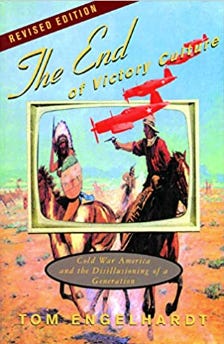
In the end, 20 years in the Air Force led me to turn away from empire, militarism, and nationalism. I found myself seeking instead some antidote to the mainstream media’s celebrations of American exceptionalism and the exaggerated version of victory culture that went with it (long after victory itself was in short supply). I started writingagainst the empire and its disastrous wars and found likeminded people at TomDispatch — former imperial operatives turned incisive critics like Chalmers Johnson and Andrew Bacevich, along with sharp-eyed journalist Nick Turse and, of course, the irreplaceable Tom Engelhardt, the founder of those “tomgrams” meant to alert America and the world to the dangerous folly of repeated U.S. global military interventions.
But this isn’t a plug for TomDispatch. It’s a plug for freeing your mind as much as possible from the thoroughly militarized matrix that pervades America. That matrix drives imperialism, waste, war, and global instability to the point where, in the context of the conflict in Ukraine, the risk of nuclear Armageddon could imaginably approach that of the 1962 Cuban Missile Crisis. As wars — proxy or otherwise — continue, America’s global network of 750-odd military bases never seems to decline. Despite upcoming cuts to domestic spending, just about no one in Washington imagines Pentagon budgets doing anything but growing, even soaring toward the trillion-dollar level, with militarized programs accounting for 62% of federal discretionary spending in 2023.
Indeed, an engorged Pentagon — its budget for 2024 is expected to rise to $886 billionin the bipartisan debt-ceiling deal reached by President Joe Biden and House Speaker Kevin McCarthy — guarantees one thing: a speedier fall for the American empire. Chalmers Johnson predicted it; Andrew Bacevich analyzed it. The biggest reason is simple enough: incessant, repetitive, disastrous wars and costly preparations for more of the same have been sapping America’s physical and mental reserves, as past wars did the reserves of previous empires throughout history. (Think of the short-lived Napoleonic empire, for example.)
Known as “the arsenal of democracy” during World War II, America has now simply become an arsenal, with a military-industrial-congressional complex intent on forging and feeding wars rather than seeking to starve and stop them. The result: a precipitous decline in the country’s standing globally, while at home Americans pay a steep price of accelerating violence (2023 will easily set a record for mass shootings) and “carnage” (Donald Trump’s word) in a once proud but now much-bloodied“homeland.”
Lessons from History on Imperial Decline
I’m a historian, so please allow me to share a few basic lessons I’ve learned. When I taught World War I to cadets at the Air Force Academy, I would explain how the horrific costs of that war contributed to the collapse of four empires: Czarist Russia, the German Second Reich, the Ottoman empire, and the Austro-Hungarian empire of the Habsburgs. Yet even the “winners,” like the French and British empires, were also weakened by the enormity of what was, above all, a brutal European civil war, even if it spilled over into Africa, Asia, and indeed the Americas.
And yet after that war ended in 1918, peace proved elusive indeed, despite the Treaty of Versailles, among other abortive agreements. There was too much unfinished business, too much belief in the power of militarism, especially in an emergent Third Reich in Germany and in Japan, which had embraced ruthless European military methods to create its own Asiatic sphere of dominance. Scores needed to be settled, so the Germans and Japanese believed, and military offensives were the way to do it.
As a result, civil war in Europe continued with World War II, even as Japan showed that Asiatic powers could similarly embrace and deploy the unwisdom of unchecked militarism and war. The result: 75 million dead and more empires shattered, including Mussolini’s “New Rome,” a “thousand-year” German Reich that barely lasted 12 of them before being utterly destroyed, and an Imperial Japan that was starved, burnt out, and finally nuked. China, devastated by war with Japan, also found itself ripped apart by internal struggles between nationalists and communists.
As with its prequel, even most of the “winners” of World War II emerged in a weakened state. In defeating Nazi Germany, the Soviet Union had lost 25 to 30 million people. Its response was to erect, in Winston Churchill’s phrase, an “Iron Curtain” behind which it could exploit the peoples of Eastern Europe in a militarized empire that ultimately collapsed due to its wars and its own internal divisions. Yet the USSR lasted longer than the post-war French and British empires. France, humiliated by its rapid capitulation to the Germans in 1940, fought to reclaim wealth and glory in “French” Indochina, only to be severely humbled at Dien Bien Phu. Great Britain, exhausted from its victory, quickly lost India, that “jewel” in its imperial crown, and then Egypt in the Suez debacle.
There was, in fact, only one country, one empire, that truly “won” World War II: the United States, which had been the least touched (Pearl Harbor aside) by war and all its horrors. That seemingly never-ending European civil war from 1914 to 1945, along with Japan’s immolation and China’s implosion, left the U.S. virtually unchallenged globally. America emerged from those wars as a superpower precisely because its government had astutely backed the winning side twice, tipping the scales in the process, while paying a relatively low price in blood and treasure compared to allies like the Soviet Union, France, and Britain.
History’s lesson for America’s leaders should have been all too clear: when you wage war long, especially when you devote significant parts of your resources — financial, material, and especially personal — to it, you wage it wrong. Not for nothing is war depicted in the Bible as one of the four horsemen of the apocalypse. France had lost its empire in World War II; it just took later military catastrophes in Algeria and Indochina to make it obvious. That was similarly true of Britain’s humiliations in India, Egypt, and elsewhere, while the Soviet Union, which had lost much of its imperial vigor in that war, would take decades of slow rot and overstretch in places like Afghanistan to implode.
Meanwhile, the United States hummed along, denying it was an empire at all, even as it adopted so many of the trappings of one. In fact, in the wake of the implosion of the Soviet Union in 1991, Washington’s leaders would declare America the exceptional “superpower,” a new and far more enlightened Rome and “the indispensable nation” on planet Earth. In the wake of the 9/11 attacks, its leaders would confidently launch what they termed a Global War on Terror and begin waging wars in Afghanistan, Iraq, and elsewhere, as in the previous century they had in Vietnam. (No learning curve there, it seems.) In the process, its leaders imagined a country that would remain untouched by war’s ravages, which was we now know — or do we? — the height of imperial hubris and folly.
For whether you call it fascism, as with Nazi Germany, communism, as with Stalin’s Soviet Union, or democracy, as with the United States, empires built on dominance achieved through a powerful, expansionist military necessarily become ever more authoritarian, corrupt, and dysfunctional. Ultimately, they are fated to fail. No surprise there, since whatever else such empires may serve, they don’t serve their own people. Their operatives protect themselves at any cost, while attacking efforts at retrenchment or demilitarization as dangerously misguided, if not seditiously disloyal.
That’s why those like Chelsea Manning, Edward Snowden, and Daniel Hale, who shined a light on the empire’s militarized crimes and corruption, found themselves imprisoned, forced into exile, or otherwise silenced. Even foreign journalists like Julian Assange can be caught up in the empire’s dragnet and imprisoned if they dare expose its war crimes. The empire knows how to strike back and will readily betray its own justice system (most notably in the case of Assange), including the hallowed principles of free speech and the press, to do so.
Perhaps he will eventually be freed, likely as not when the empire judges he’s approaching death’s door. His jailing and torture have already served their purpose. Journalists know that to expose America’s bloodied tools of empire brings only harsh punishment, not plush rewards. Best to look away or mince one’s words rather than risk prison — or worse.
Yet you can’t fully hide the reality that this country’s failed wars have added trillions of dollars to its national debt, even as military spending continues to explode in the most wasteful ways imaginable, while the social infrastructure crumbles.
Clinging Bitterly to Guns and Religion
Today, America clings ever more bitterly to guns and religion. If that phrase sounds familiar, it might be because Barack Obama used it in the 2008 presidential campaign to describe the reactionary conservatism of mostly rural voters in Pennsylvania. Disillusioned by politics, betrayed by their putative betters, those voters, claimed the then-presidential candidate, clung to their guns and religion for solace. I lived in rural Pennsylvania at the time and recall a response from a fellow resident who basically agreed with Obama, for what else was there left to cling to in an empire that had abandoned its own rural working-class citizens?
Something similar is true of America writ large today. As an imperial power, we cling bitterly to guns and religion. By “guns,” I mean all the weaponry America’s merchants of death sell to the Pentagon and across the world. Indeed, weaponry is perhaps this country’s most influential global export, devastatingly so. From 2018 to 2022, the U.S. alone accounted for 40% of global arms exports, a figure that’s only risen dramatically with military aid to Ukraine. And by “religion,” I mean a persistent belief in American exceptionalism (despite all evidence to the contrary), which increasingly draws sustenance from a militant Christianity that denies the very spirit of Christ and His teachings.
Yet history appears to confirm that empires, in their dying stages, do exactly that: they exalt violence, continue to pursue war, and insist on their own greatness until their fall can neither be denied nor reversed. It’s a tragic reality that the journalist Chris Hedges has written about with considerable urgency.
The problem suggests its own solution (not that any powerful figure in Washington is likely to pursue it). America must stop clinging bitterly to its guns — and here I don’t even mean the nearly 400 million weapons in private hands in this country, including all those AR-15 semi-automatic rifles. By “guns,” I mean all the militarized trappings of empire, including America’s vast structure of overseas military bases and its staggering commitments to weaponry of all sorts, including world-ending nuclearones. As for clinging bitterly to religion — and by “religion” I mean the belief in America’s own righteousness, regardless of the millions of people it’s killed globally from the Vietnam era to the present moment — that, too, would have to stop.
History’s lessons can be brutal. Empires rarely die well. After it became an empire, Rome never returned to being a republic and eventually fell to barbarian invasions. The collapse of Germany’s Second Reich bred a third one of greater virulence, even if it was of shorter duration. Only its utter defeat in 1945 finally convinced Germans that God didn’t march with their soldiers into battle.
What will it take to convince Americans to turn their backs on empire and war before it’s too late? When will we conclude that Christ wasn’t joking when He blessed the peacemakers rather than the warmongers?
As an iron curtain descends on a failing American imperial state, one thing we won’t be able to say is that we weren’t warned.
Terminology is so important. There was a time when America spoke honestly of a Department of War. But not everyone is keen on war, even Americans, so in 1947 the national (in)security state slyly changed its name to the Department of Defense (DoD). And who can be against “defense”?
The problem is that America’s fundamental vision is offensive. We speak openly of global reach, global power, global vigilance. We never speak of regional or hemispheric defense. Regional power? Forget about it! Everything has to be “global.” Indeed, not just global but soaring above it into space. And not just outer space but virtual space and inner space, into one’s mind, so-called information dominance. For that’s what “full-spectrum” dominance is all about. To be safe, to “defend” us, the DoD must dominate everywhere, so we’re told.
This vision serves to generate yearly budgets that consume more than half of federal discretionary spending. It’s used to justify 750 military bases around the world. It’s consistent with dividing the globe into commands headed by four-star generals and admirals, e.g. AFRICOM, CENTCOM, NORTHCOM, and the like. It generates U.S. involvement in wars that few Americans know anything about, e.g. Somalia, Syria, and Yemen. It’s a vision consistent with a state of permanent warfare driven by imperial ambitions.
I don’t think there’s ever been a military more ambitious and vainglorious than the U.S. military and its various straphangers (industry, congress, intelligence agencies, the media, academe, think tanks, hence the term MICIMATT).1 No wonder its “thought” leaders keep demanding and getting more and more money: at least $858 billion for FY2023 alone. The DoD is supposed to be a means to an end. Clearly, it’s become an end in and of itself; it may yet lead to the end of everything.
He who has the gold makes the rules—and no government agency gets more gold to dominate rule-making than the DoD/Pentagon. It’s a golden fleecing of America, as the Pentagon after five attempts has yet to pass an audit. The war on terror, including failed wars in Iraq and Afghanistan cost America as much as $8 trillion, yet those failures have already been largely forgotten, with no senior officials called to account.
Our future is being stolen from us by wanton military spending. At the same time, our past is being rewritten. Lincoln’s ideal that “right makes might” and Washington’s ideal of the citizen-soldier have been replaced by might makes right enforced by warriors. Orwell rules the moment as war is sold as peace, surveillance as privacy, and censorship as free speech.
I remember my military oath of office: to support and DEFEND the Constitution of the United States against all enemies, foreign and domestic. I still believe in defending the Constitution. I just don’t see that we’re doing it when we spend $858 billion (and more) on a global quest to dominate everyone everywhere all at once.
MICIMATT: military-industrial-congressional-intelligence-media-academia-think-tank complex. Awkward acronym that has the virtue of capturing the size and scope of Ike’s old military-industrial complex.
In my latest article for TomDispatch.com, I argue for major cuts in military spending.
This year’s Pentagon budget is a staggering $778 billion, a sum that’s virtually unimaginable. That said, the real budget for “defense,” or, as we should say, the budget for wars and weapons, is well over a trillion dollars. This is madness. No self-avowed democracy can survive such a misappropriation of resources for domination and destruction. But of course America is not a democracy, it’s an empire, with a figurehead for a president and a Congress that acts as a rubber stamp for the generals and their weapons makers.
The military-industrial complex has become America’s fourth branch of government, eclipsing the roles and powers of the other three branches (executive, legislative, judicial). The only way to rein it in, I believe, is to cut its budget. In my article, I propose cutting that budget by $50 billion a year for the next seven years. Thus by Fiscal Year 2029, the Pentagon budget should be no more than $400 billion, still a vast sum, but roughly half of what we’re paying for war and weaponry today. Such cuts can be made sensibly and without harming America’s true defense needs. Indeed, a smaller U.S. military establishment will reduce adventurism and increase our security and safety.
Here’s the conclusion to my piece at TomDispatch.com. Please read the rest of it at the site. And I urge you as well to read Tom Engelhardt’s introduction, which provides stunning details about how America’s generals profit from endless wars and weapons production, so much so that “In wars and weapons we trust” could very well serve as America’s truest national motto.
Of Smoking Guns and Mushroom Clouds
What would real oversight look like when it comes to the defense budget? Again, glad you asked!
It would focus on actual defense, on preventing wars, and above all, on scaling down our gigantic military. It would involve cutting that budget roughly in half over the next few years and so forcing our generals and admirals to engage in that rarest of acts for them: making some tough choices. Maybe then they’d see the folly of spending $1.7 trillion on the next generation of world-ending weaponry, or maintaining all those military bases globally, or maybe even the blazing stupidity of backing China into a corner in the name of “deterrence.”
Here’s a radical thought for Congress: Americans, especially the working class, are constantly being advised to do more with less. Come on, you workers out there, pull yourself up by your bootstraps and put your noses to those grindstones!
To so many of our elected representatives (often sheltered in grotesquely gerrymandered districts), less money and fewer benefits for workers are seldom seen as problems, just challenges. Quit your whining, apply some elbow grease, and “git-r-done!”
The U.S. military, still proud of its “can-do” spirit in a warfighting age of can’t-do-ism, should have plenty of smarts to draw on. Just consider all those Washington “think tanks” it can call on! Isn’t it high time, then, for Congress to challenge the military-industrial complex to focus on how to do so much less (as in less warfighting) with so much less (as in lower budgets for prodigal weaponry and calamitous wars)?
For this and future Pentagon budgets, Congress should send the strongest of messages by cutting at least $50 billion a year for the next seven years. Force the guys (and few gals) wearing the stars to set priorities and emphasize the actual defense of this country and its Constitution, which, believe me, would be a unique experience for us all.
Every year or so, I listen again to Eisenhower’s military-industrial complex speech. In those final moments of his presidency, Ike warned Americans of the “grave implications” of the rise of an “immense military establishment” and “a permanent armaments industry of vast proportions,” the combination of which would constitute a “disastrous rise of misplaced power.” This country is today suffering from just such a rise to levels that have warped the very structure of our society. Ike also spoke then of pursuing disarmament as a continuous imperative and of the vital importance of seeking peace through diplomacy.
In his spirit, we should all call on Congress to stop the madness of ever-mushrooming war budgets and substitute for them the pursuit of peace through wisdom and restraint. This time, we truly can’t allow America’s numerous smoking guns to turn into so many mushroom clouds above our beleaguered planet.
The Biden administration says it wants to remove U.S. combat troops from Iraq. Hooray! Mission finally accomplished, right? It may be 18 years after George W. Bush declared it to be so, but who’s counting the years?
Not so fast. For President Biden still wants to keep roughly 2000 or so U.S. troops in Iraq for training and advisory purposes. So much for mission accomplished.
Why can’t U.S. troops just leave — for good? If Iraq can’t defend itself after nearly two decades of U.S. “training” in the war on terror, maybe it’s finally time to admit our limits (or our folly) and simply leave.
It almost seems like America’s system of “defense” is an imperial project — an effort to enlarge American power at almost any cost (and the Iraq war has cost America in the trillions of dollars).
This is the telling argument of Tom Engelhardt’s latest post at TomDispatch.com. The U.S. is the empire that dare not speak its name, even as it begins to collapse due to perpetual war externally and perpetual rancor internally. And, believe me, as former President Trump would say, those two are related. He should know, given how he tapped that rancor and aggravated it for his own purposes.
Here’s an excerpt from Engelhardt’s latest, where he points out what might be termed the Pentagon Paradox: The more America’s generals fail, the more they succeed (more money, more promotions, more power):
Still, let’s face it, this isn’t the set of conflicts that, once upon a time, involved invasions, massive air strikes, occupations, the killing of staggering numbers of civilians, widespread drone attacks, the disruption of whole countries, the uprooting and displacement of more than 37 million people, the deployment at one point of 100,000 U.S. troops in Afghanistan alone, and the spending of untold trillions of American taxpayer dollars, all in the name of fighting terror and spreading democracy. And think of it as mission (un)accomplished in the truest sense imaginable.
In fact, that idea of spreading of democracy didn’t really outlast the Bush years. Ever since, there’s been remarkably little discussion in official Washington about what this country was really doing as it warred across significant parts of the planet. Yes, those two decades of conflict, those “forever wars,” as they came to be called first by critics and then by anyone in sight, are at least winding, or perhaps spiraling, down — and yet, here’s the strange thing: Wouldn’t you think that, as they ended in visible failure, the Pentagon’s stock might also be falling? Oddly enough, though, in the wake of all those years of losing wars, it’s still rising. The Pentagon budget only heads ever more for the stratosphere as foreign policy “pivots” from the Greater Middle East to Asia (and Russia and the Arctic and, well, anywhere but those places where terror groups still roam).
In other words, when it comes to the U.S. military as it tries to leave its forever wars in someone else’s ditch, failure is the new success story.
And how! Maybe we need a new saying in America: Nothing succeeds like failure. It’s truly paradoxical until you realize that someone is always winning and profiting from this failure, even as the rest of America suffers.
Engelhardt’s book above has a well-judged title: “A Nation Unmade By War.” But perhaps we can improve it? How about “An Empire Unmade By War”?
America recently marked the 18th anniversary of the Iraq War by basically ignoring it. The 20th anniversary of the Afghan War approaches, and it appears we’ll get there since President Biden is saying U.S. forces can’t leave until this November at the earliest. Apparently, our withdrawal of troops must be “responsible” and based on ever-changing benchmarks. Leaving aside the harrowing human cost, these calamitous wars have cost the American taxpayer at least $6 trillion, yet they go on and on.
One person who’s learned a lot from these wars is Andrew Bacevich, a retired U.S. Army colonel who runs the Quincy Institute for Responsible Statecraft. In his latest article for TomDispatch.com, Bacevich had this to say about America’s seemingly unending pursuit of peace through war:
The longest war in U.S. history [the Afghan War] should by now have led Americans to reflect on the consequences that stem from succumbing to imperial temptations in a world where empire has long since become obsolete. Some might insist that present-day Americans have imbibed that lesson. In Washington, hawks appear chastened, with few calling for President Biden to dispatch U.S. troops to Yemen or Myanmar or even Venezuela, our oil-rich “neighbor,” to put things right. For now, the nation’s appetite for military intervention abroad appears to be sated.
But mark me down as skeptical. Only when Americans openly acknowledge their imperial transgressions will genuine repentance become possible. And only with repentance will avoiding further occasions to sin become a habit. In other words, only when Americans call imperialism by its name will vows of “never again” deserve to be taken seriously.
Bacevich is right to be skeptical. The prevailing narrative in the USA still rejects the notion of imperial wars. America’s wars are always sold as defensive. Put simply, we allegedly fight “them” over there so we won’t have to fight them over here. The Afghan War is still being sold as preventing terrorist attacks on America. The Iraq War was sold as preventing Saddam Hussein from using his non-existent weapons of mass destruction against us. In short, Americans are routinely sold a false bill of goods, and the price tag attached, $6 trillion and rising, again leaving aside the human cost, is truly prodigal to behold.
I urge you to read all of Bacevich’s article here. And I urge all Americans to think about our leaders’ imperial ambitions and their horrendous costs. Like the Romans, we are too fond of creating deserts with our weaponry and calling it “peace.” We can and must open our eyes and do better.
War is not pretty, whether in Iraq or Afghanistan or Syria or Anywhere
It’s time again to listen to the common sense of Thomas Paine
W.J. Astore
This past weekend, General Mark Milley, Chairman of the JCS, said U.S. troops would remain in Syria for another few years, ostensibly to prevent an ISIS resurgence, and that troops would also continue to fight the Afghan War for several years to come. This should have been been big news, but in an America now distracted by a public impeachment circus, endless wars are greeted with a collective shrug within the media.
Thomas Paine would not have been happy. Famously outspoken for writing “Common Sense” at the beginning of the American Revolutionary War, Paine had some choice words about war and empire that Americans would do well to read and heed today.
“If there is a sin superior to every other,” Paine wrote, “it is that of willful and offensive war … he who is the author of a war, lets loose the whole contagion of Hell, and opens a vein that bleeds a nation to death.”
Paine then wrote that “We leave it to England and Indians [allied with England] to boast of these honors; we feel no thirst for such savage glory; a nobler flame, a purer spirit animates America.”
Imagine an America today that felt no thirst for the savage glory of war!
Paine supported only defensive wars, for Freedom and against Tyranny, as he put it. Remind me how keeping troops in Syria to secure oil is a just war for freedom? Remind me how prolonging the Afghan War (now in its 18th year) by several more years is necessary for America’s defense and in the cause of freedom?
Paine further had choice words for empires that were foolish enough to wage ruinous wars far from home. Naturally, he had Britain most in mind:
“If ever a nation was mad and foolish, blind to its own interest and bent on its own destruction, it is Britain … Bless’d with all the commerce she could wish for, and furnished by a vast extension of dominion with the means of civilizing both the eastern and western world, she has made no other use of both than proudly to idolize her own ‘Thunder,’ and rip up the bowels of whole countries for what she could get; –like Alexander she has made war her sport, and inflicted misery for prodagality [sic] sake.”
Making war our sport while idolizing our “thunderous” military — isn’t that an apt description of much of U.S. foreign policy for the past few decades?
But Paine wasn’t finished. He made a dire prediction:
“All countries have sooner or later been called to their reckoning; the proudest empires have sunk when the balance was struck; and Britain, like an individual penitent, must undergo her day of sorrow, and the sooner it happens to her the better.”
No empire lasts forever — certainly not one that engages in endless and largely pointless wars. Paine warned Britain about the high costs of war with America and how British forces were fated to lose, and he was right.
In a country that supposedly respects and even worships its Founders, isn’t it time Americans listened to Thomas Paine on the horrors of war and the perils of empires blinded by power and greed?
End the wars, America. Bring our troops home. And restore freedom to our land.
(Quotations from Paine are from “The American Crisis” as published in Thomas Paine: Collected Writings, Library of America, pp. 108, 165-66, written originally in 1777 and 1778)









 Bracing Views