A friend of mine thinks Joe Biden has a strong chance of winning reelection in November. He thinks the economy will continue to get better and that Donald Trump may yet be convicted of, well, something. I am far more skeptical about Biden’s chances of victory this fall. Here’s what I wrote to him this morning:
You’re betting on an improving economy and the conviction of Trump as the catalysts for another Biden win. To me, economic growth is very uneven, with an “improving” economy measured mainly by the performance of Wall Street. Few benefits are trickling down to the working classes. Meanwhile, we don’t know if Trump will be convicted of anything; also, I don’t think a conviction that’s seen as politically motivated will hurt Trump. If anything, depending on the conviction and its seriousness, it could even help him.
The largest bloc of voters are those Americans who don’t vote. You have to give people a reason to get off their duffs and vote for you. For Obama, it was “hope” and “change” and idealism. Biden won in 2020 because of the pandemic and Trump’s incompetent leadership. In 2024, Biden is increasingly “Genocide Joe” for youth and progressives; he’s taking his own base for granted, thinking that people will opt for him over Trump because the latter is too divisive.
But what may happen is that Democrats and Independents just stay home, or vote third party, while Trump loyalists show up at the polls.
We can bookmark this conversation if you wish and come back to it this November. We are, after all, trying to predict the future. My guess is that Biden loses; you’re guessing he’s going to win. We’ll see.
I also believe that if Trump wins, the DNC will blame the voters rather than the weakness of the Biden/Harris ticket. I’m sure Putin will also be blamed, as will any 3rd-party candidates like Stein of RFK Jr. The DNC will then fundraise off of fear of Trump. No matter what, the DNC will win. What counts as a “loss” for the DNC is allowing a progressive to run.
It’s some “democracy” we live in when voters are shamed for voting for someone other than Joe Biden. (The Trumpers, of course, are universally dismissed as irredeemable deplorables.) So I know I will be shamed for not voting for Joe (or the Don) this November.
As Yoda the Jedi Master said: “Difficult to see. Always in motion the future.” I just don’t see a lot of enthusiasm for Biden. I see Biden as a figurehead of Neo-liberal economic policies at home and Neo-conservative war policies abroad. Otherwise known as Dickensian conditions for the working classes here and lots of bombs and artillery shells falling on “foreign” peoples of color.
Meanwhile, I doubt the DNC will allow Biden to appear in any presidential debates. Too risky. Biden will largely “campaign” by reading from teleprompters at carefully staged appearances.
The shadow of Trump looms again (photo from 2020)
Biden, to state the obvious, is not in his prime. If reelected, he’ll be 82 and will serve until he’s 86. Voters have legitimate concerns about his health and his endurance. Meanwhile, his vice president, Kamala Harris, isn’t popular and lends little credibility to the ticket. It doesn’t bode well.
I already had four years of Trump; they were more than enough for me. I’ve had three years of Biden and they’ve been more than enough. Yet the RNC and DNC want to offer me a Trump/Biden rematch, and I just can’t stomach it.
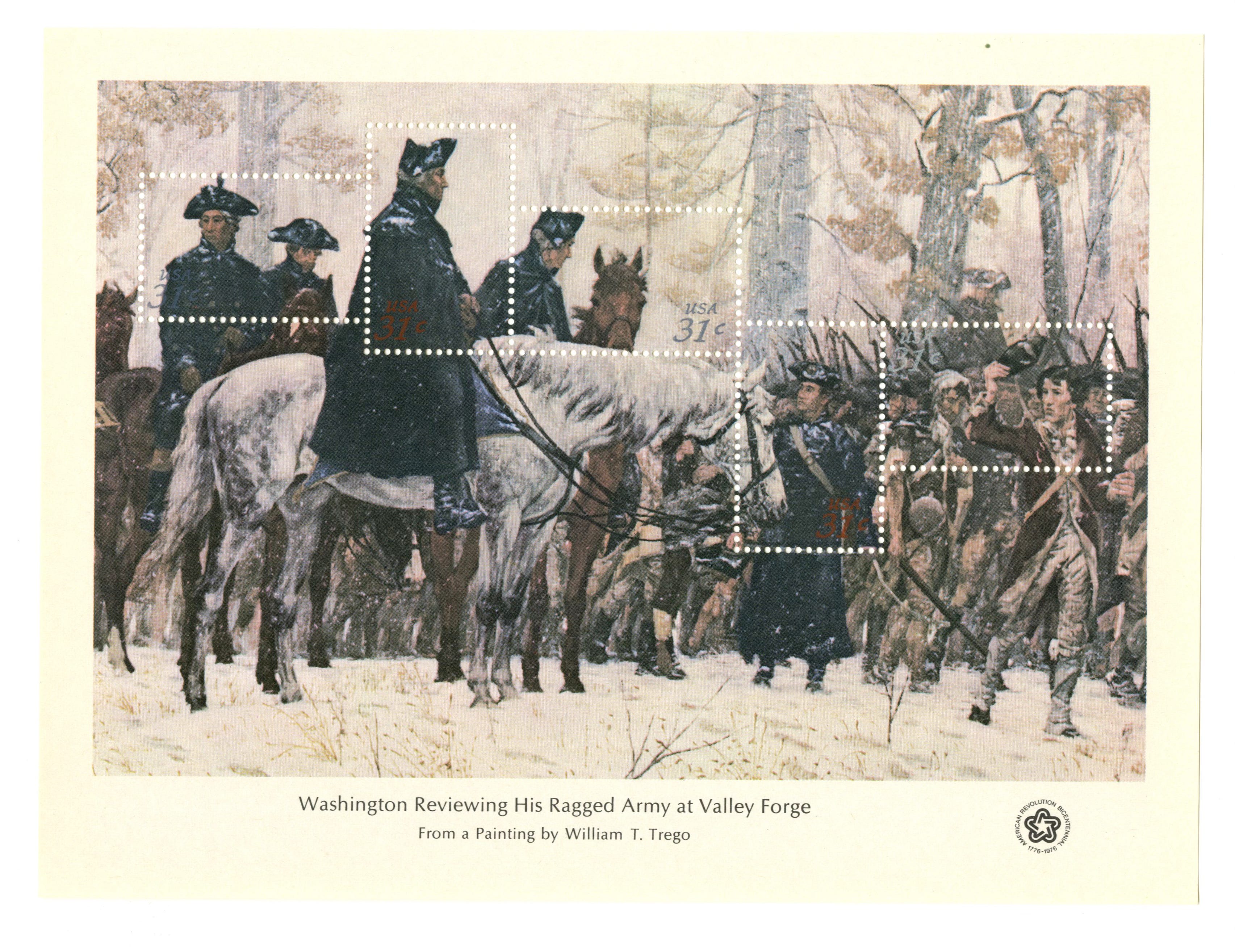
Yesterday, Joe Biden kicked off his reelection campaign by visiting Valley Forge and echoing the dark times of George Washington in 1777-78 during the American Revolutionary War. In a campaign speech that lasted about 30 minutes, Biden declared that “Democracy is on the ballot,” by which he meant Trump is on the ballot. Biden denounced Trump and his MAGA supporters for the “insurrection” they launched on January 6, 2021, when “hell was unleashed” at the Capitol. We nearly lost America on that date, Biden opined, due to the Trump-inspired “violent assault” on democracy.
As a teenager, I loved to collect stamps, just like FDR did
Going further, Biden described Trump as “sick” and “despicable” and noted how recent language about “vermin” and “poison” echoed that of Nazi Germany. Trump and MAGA, Biden said, seek to “bury history” (or “steal” it) and “ban books,” with Trump himself being a sore loser who refused to admit defeat. Biden reminded the audience that being president is about duty and service to your country, including the willingness to walk away peacefully, relinquishing power gracefully when you lose.
All in all, it was a coherent speech that Biden read competently from the teleprompter. He occasionally came across as angry, especially when shouting for emphasis, but overall Biden, though he looked his age, appeared to be committed and engaged.
To me, the main problem with Biden’s speech was that it focused almost entirely on Trump. The essence was “Trump bad,” therefore vote for me, Joe Biden, to secure America’s future, with that “future” left entirely unspecified. The Trump future would be violent, racist, and divisive, marked by vitriol and vengeance, so Biden claimed. A Biden future wouldn’t be that, apparently, but no other details were offered. Biden offered no positive vision.
Biden closed his speech with the usual boilerplate: that America is “the greatest nation on the face of the earth” and “the greatest nation in the history of the world.” Biden said “We know America is winning,” but what exactly we’re winning was left unspecified. Rhetorically, Biden asked “Who are we?” then enjoined us “Just remember who we are.” Huh? Then he said we’re the people who emerge stronger after every crisis. Does that mean we should wish for another Trump crisis so we can emerge stronger still?
Finally, Biden used a phrase that Hillary used to use for us commoners: “everyday people.” Remember when presidents used to say, my fellow Americans, when addressing us? Now we’re “everyday people” as opposed to what, exactly? Someday people? In Washington, I gather there are special people, the elites, the best and brightest, like Joe Biden, and then there are the masses, the everyday people, like you and me.
And I think that’s a big problem for the Beltway crowd: the “everyday people” might just prefer Trump and the chaos he represents. Come November, we’ll find out.
News that the Colorado Supreme Court has ruled that Trump is ineligible to be included on the presidential ballot due to his encouragement of and participation in “insurrection” during the January 6th Capitol riot is being greeted as tidings of comfort and joy in many quarters, especially among Democrats facing lengthening odds in the 2024 election. Is this the way to beat Trump: to bar him from the ballot due to his alleged crimes against the Constitution and the country?
Readers of Bracing Views know that I’m not a Trump supporter, nor for that matter do I support Joe Biden. Trump, I wrote back in March of 2016, disqualified himself from office when he boasted during a debate that U.S. troops would follow his orders irrespective of their legality. The man is most definitely an ignoramus and therefore is a menace to himself and to others.
That said, being an ignoramus is not disqualifying for the presidency.
After a swift appeal, I’d wager the U.S. Supreme Court will reverse the decision of the Colorado Court, putting Trump back on the ballot. What then?
I think it’s relatively easy to defeat Trump in November 2024: run a candidate whose views and deeds correspond to the views and desires and priorities of the vast majority of Americans. The working and middle classes.
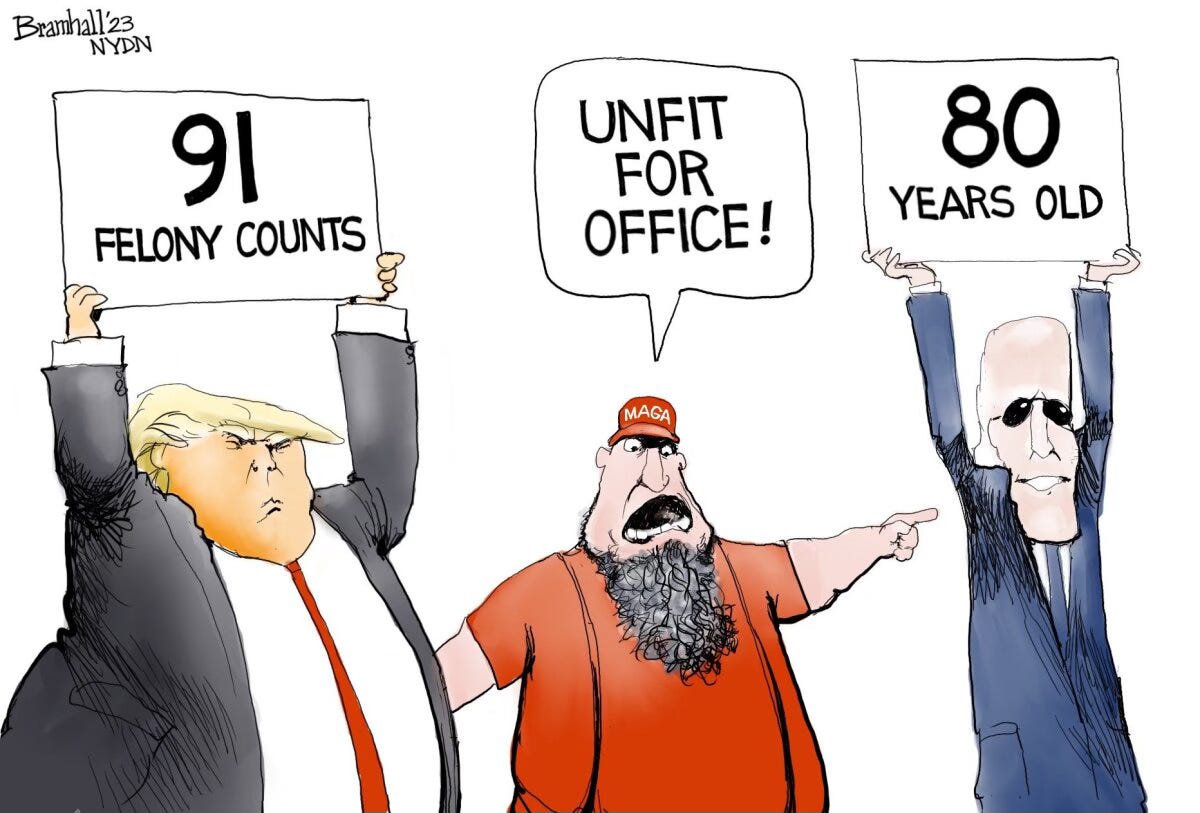
Cartoons like this one are frankly unconvincing
If I were a candidate for the presidency, and wanted to maximize my vote vis-a-vis Trump, here are a few things I’d support:
Higher wages for American workers. A hike in the federal minimum wage to at least $15 an hour.
Health care for all. Use the common wealth for common health.
“Free” college education at state colleges and universities. (By “free,” I mean subsidized at a tolerable level for students, with tuition and fees capped at $2000 a year.)
Legalization of marijuana for personal use across the USA.
Criminal justice reform that would greatly reduce the number of non-violent offenders held in prison.
Major reductions in military spending and a commitment to peace and diplomacy.
With the hundreds of billions saved from reductions in war spending, a major commitment to rebuilding American infrastructure, including the creation of a new Civilian Conservation Corps (CCC) tied to alleviating damage due to climate change.
An end to divisive rhetoric and talk of “deplorables” and “blue and red” America. A national celebration of and renewed commitment to the U.S. Constitution.
The salute of brave people willing to inform Americans of crimes being committed in their name. The return of Edward Snowden to America and a celebration of his patriotism and service to America. The pardon and release of Daniel Hale from prison. The dropping of all charges against Julian Assange. A commitment to freedom of speech, the press, and indeed of all Constitutional rights.
Privacy for the people; transparency for the government.
That’s ten positions that I believe would garner the support of a majority of Americans in the 2024 election.
The problem is that the main rival to Trump in 2024, Joe Biden, is a “nothing will fundamentally change” guy who lacks the will, energy, and wherewithal to motivate and unify the American people behind these and similar popular positions.
What does Biden have going for him? Well, he’s not Trump. That’s seemingly the beginning and the end of Democratic messaging. And it’s not enough. Which is why Democrats are so excited about the Colorado Supreme Court’s ruling.
That court ruling isn’t going to stop Trump. What will stop Trump is a candidate of courage and conviction who truly wants to serve the people. All the people, equally. The obstacle to be overcome is a Washington establishment, including most especially the corporate owners and donors, the big money people, that is determined to block any candidate or any party that is truly dedicated to the Constitution and to the needs of the people writ large.
Former President Donald Trump went on CNN last week and said something sensible. When asked if he wanted Ukraine to win the war, Trump replied he didn’t think about the war in terms of winning and losing. His priority was to stop the killing on both sides by ending the war. Naturally, he boasted he could end the war in 24 hours, surely a hyperbolic claim, though if the U.S. ended its massive package of military and financial aid, Ukraine would likely be forced to sue for peace, and quickly.
Interestingly, the CNN anchor badgered Trump, trying to get him to say he favored Ukraine over Russia and that Ukraine had to win. Trump, to his credit, was having none of it. Nor would Trump declare that Putin was a war criminal for the sensible reason that such a declaration would make a diplomatic settlement much more problematic.
Readers here know I’m no fan of Trump. I think he’s a dangerous con man without a clue about what public service is about. But I give him credit for not giving the easy answers, the expected ones, that Ukraine must win, that Russia must lose, that Putin is a war criminal, and that as long as Ukraine wins it really doesn’t matter how many people die in this disastrous war.
Former President Donald Trump at the recent CNN “Town Hall”
The CNN anchor never bothered to define what “winning” looks like for Ukraine. I assume she meant something like this: All Russian troops expelled from Ukraine; democracy flourishing in Ukraine as the country is rebuilt, in part from sanctions put on Russia; Ukraine eventually joining NATO; and perhaps even the end of Vladimir Putin’s power and his possible execution as a war criminal. Such a decisive win for Ukraine is unlikely; what I see is more stalemate, more dead and wounded on both sides, more destruction, and escalatory pressure as the war continues without a clear end in sight.
I can’t fault Trump for wanting to stop the killing in the Russia-Ukraine War. I also can’t fault him for refusing to take the bait and declaring Ukraine must win. It matters because a lot of Americans find Trump attractive because he’s willing to pose as antiwar. Clearly, he’s an alternative to the Democrats and Joe Biden who insist on prosecuting the war for reasons that I believe are largely cynical and self-interested.
Americans are war-weary. Very few Americans, I think, truly want a war with Russia or China. Trump is a serial liar, a venal manipulator, and a selfish braggart, but he doesn’t want World War III. Who knows: that very fact alone might be enough to win him four more years in the Oval Office.
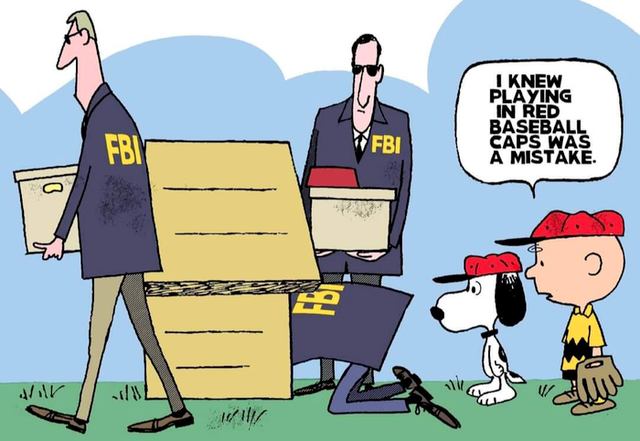
So the FBI has raided Donald Trump’s compound in Mar-a-Lago, where Trump allegedly had classified material squirreled away. Apparently, Trump is being hounded under the Espionage Act passed by Woodrow Wilson during World War I more than a century ago.
Was Trump holding classified material? Was he being careless with this information, perhaps to the extent of endangering national security? I doubt that very much. A few boxes of files (mis)appropriated by Trump, perhaps in his usual careless manner, hardly pose a threat to America’s existence.
I’m much more concerned about the heavy-handed use of the Espionage Act against a former president, even a president I think was a chimp, and the precedent it sets for the future. Are we now going to see the FBI and other law enforcement agencies sent against political opponents in openly partisan attacks? If the Biden Justice Department can openly sic the FBI on the previous president, and Biden’s most likely challenger in 2024, then shouldn’t we expect Trump or some future Republican do the same to Biden? Or Kamala Harris? And on and on?
I can’t help but think this raid on Trump’s home will only help Trump in 2024. This only seems to confirm what Trump always says: that the Deep State is after him, and that only he can take it on, because only he is on your side against big government and its many abuses of power.
Ironically, the Espionage Act is typically used against honorable whistleblowers. People like Daniel Ellsberg, Chelsea Manning, Edward Snowden, Daniel Hale, and Julian Assange. To think that Donald Trump’s name might be linked to these principled people, however tangentially, beggars belief. Trump’s name shouldn’t be mentioned in the same galactic breath as these truth-tellers, but now it can be, impossible as that seemed a few days ago.
I don’t get it. Trump is a nincompoop who shouldn’t have been president, but this kind of politically motivated raid can only generate sympathy for him among so many people who are tired of a government that pays virtually no attention to their real needs and real security.
It’s safe to say that if Trump runs in 2024, he almost certainly will win (again), because of the stupidity of establishment Democrats who seem to think the only way they can beat him is to turn him into a pariah. Their actions, however, are much more likely turn him into a martyr. And few people deserve that status less than con-man Trump.
Americans may already be lying themselves out of what little remains of their democracy.
The big lie uniting and motivating today’s Republicans is, of course, that Donald Trump, not Joe Biden, won the 2020 presidential election. Other big lies in our recent past include the notion that climate change is nothing but a Chinese hoax, that Russia was responsible for Hillary Clinton’s electoral defeat in 2016, and that the invasion of Iraq in 2003 was necessary because that country’s leader, Saddam Hussein, had something to do with the 9/11 attacks (he didn’t!) and possessed weapons of mass destruction that could be used against the United States, a “slam dunk” truth, according to then-CIA Director George Tenet (it wasn’t!).
Those and other lies, large and small, along with systemic corruption in Washington are precisely why so many Americans have been driven to despair. Small wonder that, in 2016, those “deplorables” reached out in desperation to a figure who wasn’t a product of Washington’s mendacious Beltway culture. Desperate times engender desperate acts, including anointing a failed casino owner and consummate con man as America’s MAGA-cap-wearing savior. As the 45th president, Donald Trump set a record for lies that will likely remain unmatchable in its “greatness” — or so we must hope anyway.
Sadly, Americans have become remarkably tolerant of comfortable lies, generally preferring them to uncomfortable truths. Nowhere can this be seen more clearly than in the military realm that I’ve inhabited most of my life. The first casualty of war, so it’s said, is truth, and since this country has remained perennially at war, we continue to eternally torture the truth as well.
When it comes to war, here are just a few of our all-American falsehoods: that this country is slow to anger because we prefer peace, even if wars are often necessary, which is also why peace-loving America must have the world’s “finest” and by far the most expensive military on the planet; that just such a military is also a unique force for freedom on Planet Earth; that it fights selflessly “to liberate the oppressed” (a Special Forces motto) but never to advance imperial or otherwise selfish ambitions.
For a superpower that loves to flex its military muscles, such lies are essentially par for the course. Think of them, in fact, as government-issue (GI) lies. As a historian looking to the future, what worries me more are two truly insidious lies that, in the early 1930s, led to the collapse of a fledgling democracy in Weimar Germany, lies that in their own way helped to facilitate the Holocaust and that, under the right (that is, wrong) circumstances, could become ours as well. What were those two lies?
Germany’s Tragic Lies After World War I
During World War I, the German military attempted to defeat the combined forces of Britain, France, Russia, and later the United States, among other powers, while simultaneously being “shackled to a corpse,” as one German general described his country’s main ally, the Austro-Hungarian Empire. By the middle of 1916, the German Second Reich led by Kaiser Wilhelm II had, in essence, become a military dictatorship devoted to total victory at any cost.
Two years later, that same military had been driven to exhaustion by its commanders. When it was on the verge of collapse, its generals washed their hands of responsibility and allowed the politicians to sue for peace. But even before the guns fell silent on November 11, 1918, certain reactionary elements within the country were already rehearsing two big and related lies that would facilitate the rise of a demagogue and the onset of an even more disastrous world war.
The first big lie was that the German military, then considered the world’s finest (sound familiar?), emerged from World War I undefeated in the field, its troops a band of heroes covered in glory. That lie was tenable because Germany itself had not been invaded in World War I; the worst fighting took place in France, Belgium, and Russia. It was also tenable because its military leaders had lied to the people about the progress being made toward “victory.” (This should again sound familiar to contemporary American ears.) So, when those senior leaders finally threw in the towel in late 1918, it came as a shock to most Germans, who’d been fed a steady diet of “progress,” while news of serious setbacks on the Western Front was suppressed.
The second big lie followed from the first. For if one accepted the “undefeated in the field” myth, as so many Germans did, then who was responsible for the defeat of the world’s finest military? Not Germany’s generals, of course. Indeed, in 1919, led by Field Marshal Paul von Hindenburg, those same generals would maliciously claim that disloyal elements on the home front — an enemy within — had conspired to betray the country’s heroic troops. Thus was born the “stab-in-the-back” myth that placed the blame on traitors from within, while ever so conveniently displacing it from the Kaiser and his generals.
Who, then, were Germany’s backstabbers? The usual suspects were rounded up: mainly socialists, Marxists, anti-militarists, pacifists, and war profiteers of a certain sort (but not weapons makers like the Krupp Family). Soon enough, Germany’s Jews would be fingered as well by gutter-inhabitants like Adolf Hitler, since they had allegedly shirked their duty to serve in the ranks. This was yet another easy-to-disprove lie, but all too many Germans, desperate for scapegoats and undoubtedly bigoted as well, proved eager to believe such lies.
Those two big and insidious falsehoods led to an almost total lack of accountability in Weimar Germany for militarists like Hindenburg and General Erich Ludendorff who were significantly responsible for the country’s defeat. Such lies fed the anger and fattened the grievances of the German people, creating fertile ground for yet more grievous lies. In a climate of fear driven by the massive economic dislocation brought on by the Great Depression of 1929, a previously fringe figure found his voice and his audience. Those two big lies served to empower Hitler and, not surprisingly, he began promoting both a military revival and calls for revenge against the backstabbing “November criminals” who had allegedly betrayed Germany. Hitler’s lies were readily embraced in part because they fell on well-prepared ears.
Of course, a mature democracy like America could never produce a leader remotely like a Hitler or a militaristic empire bent on world domination. Right?
To read the rest of my article for TomDispatch.com, please click here. Thanks!
Note: In writing my book on Paul von Hindenburg, I was greatly helped by Dennis Showalter, a wonderful historian and a better friend. Dennis was remarkably generous to me and to so many other students of history. Dennis died at the end of 2019, and I miss his keen mind, his exceptional scholarship, but most of all his warmth and sense of humor. We joked that our work on Hindenburg represented a rare “bipartisan” collaboration between a Yankees fan (that’s him) and a Red Sox fan (that’s me). Thanks for everything, Dennis.
Dennis Showalter, a remarkable historian and a better friend
America’s Democratic Party, as it stands today, is essentially a pro-business and pro-war party. On the political spectrum, it’s a center-right party, roughly equivalent to the Republican Party of the 1970s but probably more conservative. Joe Biden, for example, is against Medicare for All, and he’s abandoned all talk of a single-payer option. He’s refused to fight for a $15 federal minimum wage. He’s most likely extending the war in Afghanistan well past the troop pullout date of May 1st as negotiated by the Trump administration. He’s keeping military spending high and is pursuing a hardline foreign policy vis-à-vis Russia and China.
America’s Republican Party has become the party of Trump. It’s unapologetically far-right, evangelical, anti-immigrant, and openly contemptuous of Democratic calls for “diversity.” Like the Democratic Party, it’s militaristic, pro-business, and pro-war, but is even more in favor of blank checks for Wall Street and the major banks and corporations. Its strategy for future victories focuses on suppression of minority voters through various laws and restrictions (voter ID laws, closing polling places, restricting mail-in and early voting, and so on). The Republican Party’s version of “cancel culture” is canceling as much of the vote by minorities as it can.
You’ll notice what’s missing: any major political party that’s center-left or left; any party that has any allegiance to workers, i.e. most of America. There are new parties being created, like the People’s Party, that promise to fill a gaping hole on the left, but it may take decades before a new party can seriously challenge America’s two main parties.
What’s truly depressing is that the mainstream media, along with the Republicans, sell and support a narrative that the Democrats are radical leftists. That such a laughably false narrative is embraced by America’s talking heads on CNN, MSNBC, Fox News, and the other major networks highlights their complicity in ensuring the triumph of business and war imperatives in America.
What this means for elections in 2022 and 2024 was brought home to me by Richard Dougherty’s book, “Goodbye, Mr. Christian: A Personal Account of McGovern’s Rise and Fall” published in 1973. Dougherty nailed it back then when he talked about the baneful influence of the Republican Party as led by Richard Nixon and its reaction to attempts at real reform by George McGovern. Here’s an excerpt:
“McGovern saw something new emerging in American politics and saw that it was ugly and frightening not only because of its burglars and saboteurs, its insensitivity to the delicate mechanisms of freedom, but for its profound deceptions of a troubled people which, if successful, would reduce and debase them as a people. Nixon offered no improvement in the life of the people but only empty and ersatz satisfactions to their angers and bewilderments. It cost the rich Nixonian oligarchs nothing, yet it gratified the lumpenbourgeoisie to tell the poor to go out and get jobs, the black children to stay off the buses, the young draft evaders to stay out of the country, to make noises about permissive judges rather than hire more policeman.
Let ‘em eat revenge.
That was the gimmick. Was not this sleaziness, this moral midgetry, this menace to the American character, proper stuff for a presidential candidate [like McGovern] to raise as an issue?” (246-7)
If only …
I thought this passage captured what we’re likely to see in the next four years: more sleaziness, more deceptions, more divisiveness, even as the plight of ordinary Americans worsens.
But it’s worse now than in 1973 because the oligarchs now own both parties, the Democratic as well as the Republican.
The challenge for us all is to look past the sleaze, the deceptions, the divisiveness and to focus on bettering the plight of ordinary Americans. To free ourselves from the oligarchs and the narrative control they exercise via the major media networks. To recapture the reformist spirit of the 1960s and early 1970s as embodied by a leader like George McGovern.
Treating rivals as enemies has been an identifying characteristic of the Trump administration. Trump has been at pains to denounce Democrats collectively as enemies. He’s denounced with relish the American press (like CNN) as enemies of the people. He knows such incendiary rhetoric inflames his base. He knows it divides Americans, which has made it easier for Trump to rule.
When you denounce your political rivals and the press as not just your personal enemies but enemies of the people, you’re setting the stage for violent actions. Trump’s stage-setting reached its logical culmination with the riots at the U.S. Capitol. Some of the rioters acted like an invading army, planting their own flag, attacking the police, occupying “enemy” offices, even looting. A few apparently contemplated political assassinations of their “enemies.” Having swallowed Trump’s lies, they apparently believed they were the patriots even as their activities amounted to a violent attack on Congress as it attempted to do its job in certifying Joe Biden as the winner of the 2020 election.
Trump and his followers failed in their cosplay coup. Some of the rioters are being tracked down and arrested. Trump himself has already been impeached by Congress for inciting the riot. What should Trump now do?
It comes down to this: Trump instigated and incited a rebellion against Congress and violated the Constitution. His rebellion failed. Is it not time for him to pay a price?
I have a suggestion from history for Trump, a man who is much impressed by his own bravery. (Recall when he claimed he’d rush in without a weapon to take on the armed shooter at Stoneman Douglas high school in Florida.) Mister Trump, learn from Michel Ney, the “bravest of the brave,” the famous Napoleonic marshal who, when he was sent to arrest Napoleon after his return from exile, joined him instead — and paid the ultimate price.
Napoleon and Ney, of course, had their Waterloo. Napoleon was sent yet again into exile, this time much further away from continental Europe, never to return. How did Ney pay for his treachery — his rebellion? He commanded his own firing squad.
When you turn against your government, and when your rebellion fails, you should be prepared to pay for it. Ney knew this. And he met his death with courage.
I have it on the very best authority — Trump’s own words! — that he’s a brave man. With typical hyperbole, he’d probably add he’s the bravest of the brave. In that spirit, then, I urge him to follow Michel Ney. Man up. Give the order that Ney gave unblindfolded:
Soldiers, when I give the command to fire, fire straight at my heart. Wait for the order. It will be my last to you … Soldiers, fire!
I know: Trump commanding his own firing squad? Unlikely indeed! Much more likely is Trump fighting to the last dying gasp — of Rudy Giuliani. And then not paying his estate for services rendered.
I started writing for TomDispatch.com in 2007. I really thought I had one article to write, focusing on the disastrous Iraq War and the way in which the Bush/Cheney administration was hiding its worst results behind the bemedaled chest of General David Petraeus. Here we are, in 2020, and my latest article is my 75th contribution to the site, which truly amazes me. Special thanks to Tom Engelhardt for publishing my first piece back in 2007 and for setting a stellar example of what alternative freethinking media can be.
We Could Use A Leader Like George McGovern Again By William J. Astore
As I lived through the nightmare of the election campaign just past, I often found myself dreaming of another American world entirely. Anything but this one.
In that spirit, I also found myself looking at a photo of my fourth-grade class, vintage 1972. Tacked to the wall behind our heads was a collage, a tapestry of sorts that I could make out fairly clearly. It evoked the promise and the chaos of a turbulent year so long ago. The promise lay in a segment that read “peace” and included a green ecology flag, a black baseball player (Brooklyn Dodgers second baseman Jackie Robinson, who had died that year), and a clenched fist inside the outline of the symbol for female (standing in for the new feminism of that moment and the push for equal rights for women).
Representing the chaos of that era were images of B-52s dropping bombs in Vietnam (a war that was still ongoing) and a demonstration for racist Alabama governor and presidential candidate George Wallace (probably because he had been shot and wounded in an assassination attempt that May). A rocket labeled “USA” reminded me that this country was then still launching triumphant Apollo missions to the moon.
How far we’ve come in not quite half a century! In 2020, “peace” isn’t even a word in the American political dictionary; despite Greta Thunberg, a growing climate-change movement, and Joe Biden’s two-trillion-dollar climate plan, ecology was largely a foreign concept in the election just past as both political parties embraced fracking and fossil fuels (even if Biden’s embrace was less tight); Major League Baseball has actually suffered a decline in African-American players in recent years; and the quest for women’s equality remains distinctly unfulfilled.
Bombing continues, of course, though those bombs and missiles are now aimed mostly at various Islamist insurgencies rather than communist ones, and it’s often done by drones, not B-52s, although those venerable planes are still used to threaten Moscow and Beijing with nuclear carnage. George Wallace has, of course, been replaced by Donald Trump, a racist who turned President Richard Nixon’s southern strategy of my grade school years into a national presidential victory in 2016 and who, as president, regularly nodded in the direction ofwhite supremacists.
Progress, anyone? Indeed, that class photo of mine even featured the flag of China, a reminder that Nixon had broken new ground that very year by traveling to Beijing to meet with Chinese Communist leader Mao Zedong and de-escalate the Cold War tensions of the era. Nowadays, Americans only hear that China is a military and economic threat; that Joe Biden and some Democrats are allegedly far too China-friendly (they aren’t); and that Covid-19 (aka the “Wuhan Flu” or “Kung Flu”) was — at least to Donald Trump and his followers — a plague sent by the Chinese to kill us.
Another symbol from that tapestry, a chess piece, reminded me that in 1972 we witnessed the famous Cold War meeting between the youthful, brilliant, if mercurial Bobby Fischer and Soviet chess champion Boris Spassky in a match that evoked all the hysteria and paranoia of the Cold War. Inspired by Fischer, I started playing the game myself and became a card-carrying member of the U.S. Chess Federation until I realized my talent was limited indeed.
The year 1972 ended with Republican Richard Nixon’s landslide victory over Democratic Senator George McGovern, who carried only my home state of Massachusetts. After Nixon’s landslide victory, I remember bumper stickers that said: “Don’t blame me for Nixon, I’m from Massachusetts.”
Eighteen years later, in 1990, I would briefly meet the former senator. He was attending a history symposium on the Vietnam War at the U.S. Air Force Academy and, as a young Air Force captain, I chased down a book for him in the Academy’s library. I don’t think I knew then of McGovern’s stellar combat record in World War II. A skilled pilot, he had flown 35 combat missions in a B-24 bomber, winning the Distinguished Flying Cross for, at one point, successfully landing a plane heavily damaged by enemy fire and saving his crew. Nixon, who had served in the Navy during that war, never saw combat. But he did see lots of time at the poker table, winning a tidy sum of money, which he would funnel into his first political campaign.
Like so many combat veterans of the “greatest generation,” McGovern never bragged about his wartime exploits. Over the years, however, that sensible, honorable, courageous American patriot became far too strongly associated with peace, love, and understanding. A staunch defender of civil rights, a believer in progressive government, a committed opponent of the Vietnam War, he would find himself smeared by Republicans as weak, almost cowardly, on military matters and an anti-capitalist (the rough equivalent today of democratic-socialist Bernie Sanders).
Apparently, this country couldn’t then and still can’t accept any major-party candidate who doesn’t believe in a colossal military establishment and a government that serves business and industry first and foremost or else our choice in 2020 wouldn’t have been Trump-Pence versus Biden-Harris.
Channeling Lloyd Bentsen
As I began writing this piece in late October, I didn’t yet know that Joe Biden would indeed win the most embattled election of our lifetime. What I did know was that the country that once produced (and then rejected) thoughtful patriots like George McGovern was in serious decline. Most Americans desperately want change, so the pollsters tell us, whether we call ourselves Republicans or Democrats, conservatives, liberals, or socialists. Both election campaigns, however, essentially promised us little but their own versions of the status quo, however bizarre Donald Trump’s may have been.
In truth, Trump didn’t even bother to present a plan for anything, including bringing the pandemic under control. He just promised four more years of Keeping America Trumpish Again with yet another capital gains tax cut thrown in. Biden ran on a revival of Barack Obama’s legacy with the “hope and change” idealism largely left out. Faced with such a choice in an increasingly desperate country, with spiking Covid-19 cases in state after state and hospitals increasingly overwhelmed, too many of us sought relief in opioids or gun purchases, bad habits like fatty foods and lack of exercise, and wanton carelessness with regard to the most obvious pandemic safety measures.
Since the presidencies of Richard Nixon and Ronald Reagan, and especially since September 11, 2001, it’s amazing what Americans have come to accept as normal. Forget about peace, love, and understanding. What we now see on America’s streets aren’t antiwar protesters or even beat cops, but Robocops armed to the teeth with military-style weaponry committing indefensible acts of violence. Extremist “militias” like the Proud Boys are celebrated (by some) as “patriots.” Ludicrous QAnon conspiracy theories are taken all too seriously with political candidates on the Republican side of the aisle lining up to endorse them.
Even six-figure death tolls from a raging pandemic were normalized as President Trump barnstormed the country, applauding himself to maskless crowds at super-spreader rallies for keeping Covid-19 deaths under the mythical figure of 2.2 million. Meanwhile, the rest of us found nothing to celebrate in what — in Vietnam terms — could be thought of as a new body count, this time right here in the homeland.
And speaking of potential future body counts, consider again the Proud Boys whom our president in that first presidential debate asked to “stand back and stand by.” Obviously not a militia, they might better be described as a gang. Close your eyes and imagine that all the Proud Boys were black. What would they be called then by those on the right? A menace, to say the least, and probably far worse.
A real militia would, of course, be under local, state, or federal authority with a chain of command and a code of discipline, not just a bunch of alienated guys playing at military dress-up and spoiling for a fight. Yet too many Americans see them through a militarized lens, applauding those “boys” as they wave blue-line pro-police flags and shout “all lives matter.” Whatever flags they may wrap themselves in, they are, in truth, nothing more than nationalist bully boys.
Groups like the Proud Boys are only the most extreme example of the “patriotic” poseurs, parades, and pageantry in the U.S.A. of 2020. And collectively all of it, including our lost and embattled president, add up to a red-white-and-blue distraction (and what a distraction it’s been!) from an essential reality: that America is in serious trouble — and you can take that “America” to mean ordinary people working hard to make a living (or not working at all right now), desperate to maintain roofs over their heads and feed their kids.
It’s a distraction as well from the reality that America hasn’t decisively won a war since the time George McGovern flew all those combat missions in a B-24. It’s a distraction from some ordinary Americans like George Floyd, Breonna Taylor, and Jacob Blake being not just manipulated and exploited, but murdered, hence the need for a Black Lives Matter movement to begin with. It’s a distraction from the fact that we don’t even debate gargantuan national security budgets that now swell annually above a trillion dollars, while no one in a position of power blinks.
Today’s never-ending wars and rumors of more to come remind me that George McGovern was not only against the Vietnam conflict, but the ones in Afghanistan and Iraq, too. Joe Biden, meanwhile, voted for the Iraq War, which Donald Trump also spoke in favor of, then, only to campaign on ending this country’s wars in 2016, even if by 2020 he hadn’t done so — though he had set up a new military service, the Space Force. Feeling the need to sharpen his own pro-war bona fides, Biden recently said he’d raise “defense” spending over and above what even Trump wanted.
If you’ll indulge my fantasy self for a moment, I’d like to channel Lloyd Bentsen, the 1988 Democratic vice presidential nominee who, in a debate with his Republican opposite Dan Quayle, dismissed him as “no Jack Kennedy.” In that same spirit, I’d like to say this to both Trump and Biden in the wake of the recent Covid-19 nightmare of a campaign: “I met George McGovern. George McGovern, in a different reality, could have been my friend. You, Joe and Donald, are no George McGovern.”
Prior military service is not essential to being president and commander-in-chief, but whose finger would you rather have on America’s nuclear button: that of Trump, who dodged the draft with heel spurs; Biden, who dodged the draft with asthma; or a leader like McGovern, who served heroically in combat, a leader who was willing to look for peaceful paths because he knew so intimately the blood-spattered ones of war?
A Historical Tapestry for Fourth Graders as 2020 Ends
What about a class photo for fourth graders today? What collage of images would be behind their heads to represent the promise and chaos of our days? Surely, Covid-19 would be represented, perhaps by a mountain of body bags in portable morgues. Surely, a “Blue Lives Matter” flag would be there canceling out a Black Lives Matter flag. Surely, a drone launching Hellfire missiles, perhaps in Somalia or Yemen or some other distant front in America’s endless war of (not on) terror, would make an appearance.
And here are some others: surely, the flag of China, this time representing the growing tensions, not rapprochement, between the two great powers; surely, a Trump super-spreader rally filled with the unmasked expressing what I like to think of as the all-too-American “ideal” of “live free and die”; surely, a vast firenado rising from California and the West, joined perhaps by a hurricane flag to represent another record-breaking year of such storms, especially on the Gulf Coast; surely, some peaceful protesters being maced or tased or assaulted by heavily armed and unidentified federal agents just because they cared about the lives of George Floyd and Breonna Taylor, among others.
And I suppose we could add something about sports into that collage, maybe an image of football players in empty stadiums, kneeling as one for racial equality. Look, sports used to unite us across race and class lines, but in his woebegone presidency, Donald Trump, among others, used sports only to divide us. Complex racial relations and legacies have been reduced to slogans, Black Lives Matter versus blue lives matter, but what’s ended up being black and blue is America. We’ve beaten ourselves to a pulp and it’s the fight promoters, Donald Trump above all, who have profited most. If we are to make any racial progress in America, that kind of self-inflicted bludgeoning has to end.
And what would be missing from the 2020 collage that was in my 1972 one? Notably, clear references to peace, ecology, and equal rights for women. Assuming that, on January 20th, Joe Biden really does take his place in the Oval Office, despite the angriest and most vengeful man in the world sitting there now, those three issues would be an ideal place for him to start in his first 100 days as president (along, of course, with creating a genuine plan to curb Covid-19): (1) seek peace in Afghanistan and elsewhere by ending America’s disastrous wars; (2) put the planet first and act to abate climate change and preserve all living things; (3) revive the Equal Rights Amendment and treat women with dignity, respect, and justice.
One final image from my fourth-grade collage: an elephant is shown on top of a somewhat flattened donkey. It was meant, of course, to capture Richard Nixon’s resounding victory over George McGovern in 1972. Yet, even with Joe Biden’s victory last week, can we say with any confidence that the donkey is now on top? Certainly not the one of McGovern’s day, given that Biden has already been talking about austerity at home and even higher military spending.
Sadly, it’s long past time to reclaim American idealism and take a stand for a lot less war and a lot more help for the most vulnerable among us, including the very planet itself. How sad that we don’t have a leader like George McGovern in the White House as a daunting new year looms.
William Astore, a retired lieutenant colonel (USAF) and professor of history, is a TomDispatch regular. His personal blog is Bracing Views.
I’ll admit it: I never saw Joe Biden as president. Not when I remembered his abortive presidential run in 1988, when he lied about his college record and plagiarized speeches of Bobby Kennedy and Neil Kinnock.
He made an effective vice president for Barack Obama, mainly at first because he reassured White America that the Black guy was OK. Being vice president is an “It must have been cold there in my shadow” kind of job, but Joe handled it pretty well, and even catastrophically deferred to Hillary Clinton as Obama’s rightful successor in 2016.
After that debacle, Joe persisted, and in the campaign of 2020 he found a Democratic establishment that loved his pro-business and pro-banking record, his strong support of high military spending and overseas wars, and his past calls for cuts to Social Security as well as his steadfast opposition to Medicare for all. Our kind of Democrat, the owners and donors said, and with a big push from Obama, Biden found himself anointed as the candidate to defeat the Orange Ogre.
But Biden didn’t defeat Trump; Trump defeated Trump. Trump’s response to Covid-19 was so incompetent, so reckless, and so tone-deaf to lives lost that even the usual spin about fake news and alternative facts didn’t work. Indeed, Trump first said the pandemic would magically disappear, then tried to blame it all on China, then said the media was covering it only because it hurt his chances for reelection, then persisted in holding rallies that turned into super-spreader events for the virus.
Despite all of Trump’s flaws, despite all of his lies, he still almost defeated Biden, a stunning achievement when you really think about it. To my mind, the closeness of this election, the narrowness of Biden’s victory, is as much a reflection of the weaknesses of Joe Biden as it is the strength of the Trump cult.
What kind of president can we expect Biden to be? He won’t be anything like Trump, which in some ways is a bad thing. What I mean is this: Trump turned the narrowest of victories over Hillary Clinton into mandate-level deeds. He got the big tax cut Republicans covet. He got to pick three Supreme Court justices and to redefine lower-level courts for a generation. He served his base and made no apologies.
What is the likelihood that Biden adopts a progressive agenda? That he takes no prisoners, that he rides roughshod over Republicans, that he calls them traitors and dictates terms to them? Unlikely indeed. Even if Democrats win a majority in the Senate, which we won’t know until January and runoff elections in Georgia, Biden will likely position himself as a centrist, i.e. a moderate Republican, a man willing to reach across the aisle for bipartisan accord.
It’s likely Biden will even appoint Republicans to his cabinet. I’m betting we’ll see more Republicans in his cabinet than progressive Democrats.
I won’t shed any tears when Trump departs, perhaps into a new self-named media empire. Because for Trump it’s Trump now, Trump tomorrow, Trump forever. Biden, unlike Trump, has at least some experience with public service, and that can’t be a bad thing.
The question is: Which publics will Joe Biden serve with the most passion?