Military Control of the Civilian: It’s Opposite Day in America

mattis
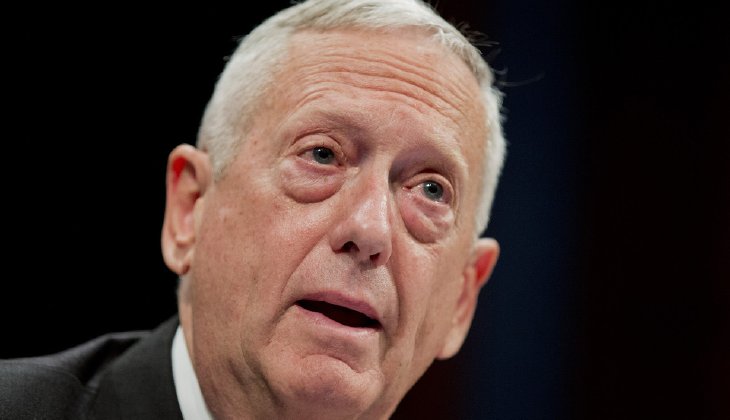
General Mattis: Celebrated as a moderating influence on Trump

W.J. Astore

It’s becoming increasingly difficult for Americans to recall that civilian leaders are supposed to command and control the military, not vice-versa.  Consider an article posted yesterday at Newsweek with the title, TRUMP’S GENERALS CAN SAVE THE WORLD FROM WAR—AND STOP THE CRAZY.  The article extols the virtues of “Trump’s generals”: James Mattis as Secretary of Defense, John Kelly as White House Chief of Staff, and H.R. McMaster as National Security Adviser.  The article presents them as the adults in the room, the voices of calm and reason, a moderating force on a bombastic and bellicose president.

I’ve written about Trump’s generals already at TomDispatch.com and elsewhere.  The latest gushing tribute to America’s generals at Newsweek illustrates a couple of points that bear repeating.  First, you don’t hire generals to rein in a civilian leader, or at least you shouldn’t if you care to keep a semblance of democracy in America.  Second, lifelong military officers favor military solutions to problems.  That’s precisely why you want civilians to control them, and to counterbalance their military advice.  Only in a democracy that is already crippled by creeping militarism can the rise of generals to positions of power be celebrated as a positive force for good.

Speaking of creeping militarism in the USA, I caught another headline the other day that referenced General Kelly’s appointment as Chief of Staff.  This headline came from the “liberal” New York Times:

John Kelly Quickly Moves to Impose Military Discipline on White House


Note that headline.  Not that Kelly was to impose discipline, but rather military discipline. What, exactly, is military discipline?  Well, having made my first career in the military, I can describe its features. Obedience.  Deference to authority.  Respect for the chain of command.  A climate that sometimes degenerates to “a put up and shut up” mentality. Such a climate may be needed in certain military settings, but do we want it to rule the White House?

Here is what I wrote back in December about Trump and “his” generals:

In all of this, Trump represents just the next (giant) step in an ongoing process.  His warrior-steeds, his “dream team” of generals, highlight America’s striking twenty-first-century embrace of militarism. At the same time, the future of U.S. foreign policy seems increasingly clear: more violent interventionism against what these men see as the existential threat of radical Islam. 

Of course, now the threat of nuclear war looms with North Korea.  For a moderating influence, America places its faith in military generals controlling the civilian commander-in-chief, and that’s something to draw comfort from, at least according to Newsweek.

When military control of the civilian is celebrated, you know it’s truly opposite day in America.

Trump: Much “Fire and Fury,” Signifying Something Vital


fat man
Fat Man, the atomic bomb that devastated Nagasaki on August 9, 1945

W.J. Astore

The big story today is Trump’s threat to North Korea about “fire and fury like the world has never seen” in response to any aggression against the U.S. and its allies.  The world witnessed American “fire and fury” in August of 1945 when Hiroshima and Nagasaki were obliterated by atomic bombs (indeed, today is the 72nd anniversary of the Nagasaki bombing).  Roughly 250,000 people were killed in those two bombings, and Trump is apparently promising a worst form of fury against North Korea (“like the world has never seen”).

Back in October 2016, I wrote a piece at this site with the title: “On nuclear weapons, Trump is nightmarishly scary,” and that nightmare is beginning to take shape.  As I wrote back then, Trump’s worst attribute is his “sweeping ignorance to the point of recklessness when it comes to matters of national defense, and specifically America’s nuclear arsenal.”  I further wrote that:

Back in March … Trump boasted at a debate that the U.S. military would follow his orders irrespective of their legality.  In this latest debate, he yet again revealed that he has no real knowledge of America’s nuclear capability and how modern and powerful (and scary) it truly is.

Sure, Trump is crude, lewd, and sexist, but those qualities won’t destroy the world as we know it.  Ignorance about nuclear weapons, combined with impetuosity and an avowed affection for he-man wild-card generals like George S. Patton and Douglas MacArthur, is a recipe for utter disaster.

A man of Trump’s vanity and impetuosity — a man of raging grievances who lives in his own reality of alternative facts — is hardly a reassuring figure to have at the top of America’s “fire and fury” nuclear arsenal.  Is it all just bluster?  It’s impossible to know, and that’s truly the scary part.

All this fire and fury, even if it remains only bluster, should teach the world a critical lesson: the necessity of nuclear disarmament. Holding millions of people hostage to nuclear terror (as we’ve been doing since the Cold War) has long been immoral, inhumane, and unconscionable.

Instead of making nightmarish threats, a sober and mature U.S. president might actually lead the world in serious efforts to reduce and ultimately to eliminate nuclear weapons. That would be real moral leadership,  That would be real guts.

Trump’s easy boasts of “fire and fury” do signify something vital — the need for global nuclear disarmament, no matter how long it takes.

Update (8/10/17): There’s been a lot of talk, more or less sensible, that Trump’s “fire and fury” rhetoric is just that: rhetoric.  That it will not become reality because North Korean leaders are sensible and rational actors, and that U.S. leaders like Tillerson and Mattis provide a counterbalance to Trump.  Well, maybe.  But escalatory rhetoric can become reality, i.e. it serves to exacerbate tensions that can lead to miscalculation and war.

Think of North Korea’s latest threat to shoot missiles in the direction of Guam.  If that threat is carried out, a U.S. attack on North Korean missile sites is quite likely, and where that would lead is impossible to say.

Reckless rhetoric is not harmless; words can and do box nations as well as people in, often leading to unexpected actions.  Just think of hateful words flung by people in domestic disputes that escalate into something far worse.  Rationality does not always win out.

Update 2 (8/10/17): Trump recently boasted that, during his short presidency, his actions have led to a U.S. nuclear arsenal that is “now far stronger and more powerful” than it was under President Obama.  The truth is that this arsenal hasn’t measurably changed at all.  The Washington Post gives Trump “four Pinocchios” for his latest lie, but surely big lies about nuclear weapons deserve a different rating system.  Should we call it a four megaton lie?  Lie-mageddon?

On Afghanistan, Trump is Right to be Skeptical

trump mattis
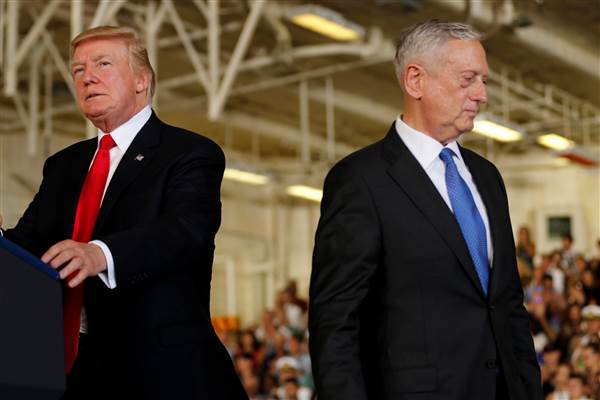
Not seeing eye-to-eye: Trump and Mattis (Jonathan Ernst / Reuters)

W.J. Astore

NBC news reports that President Trump is skeptical about the U.S. military’s prospects in Afghanistan.  The military is losing, not winning, Trump said, and he further suggested the U.S. commander on the scene should be fired.  Meanwhile, China is cleaning up with mineral rights (such as copper mining), even as America’s generals continue with a “stay the course” policy, a policy that’s led to sixteen years of “stalemate” (the U.S. military’s word) at a cost of roughly a trillion dollars.

I highly recommend reading the NBC article for at least two reasons. First, Trump is right to question his advisers’ stale advice.  He’s right to question the generals.  Indeed, that’s his job as president and commander-in-chief.  If sixteen years of effort and a trillion dollars has produced “stalemate” (at best) in Afghanistan, can one blame the president for seeking a new strategy?  Perhaps even a withdrawal?

Second, and most interesting, is the push-back from NBC News and its hired guns: the retired generals and admirals who work for NBC as “consultants.”  Let’s look closely at their comments.

Retired Admiral James Stavridis, a former head of NATO and an NBC News analyst, basically blames the Trump administration, not the military, for the Afghan stalemate.  In his words:

“The situation in Afghanistan is not improving, but I think it’s hardly irretrievable at this point, and what the president needs to be doing is deciding on the strategy.” 

“What is hurting the process at the moment is this back and forth about do we stay or do we go, how many troops,” he added. “Any commander is going to be incredibly handicapped in an environment like that. So I think the fundamental problem here is lack of decisiveness in Washington, specifically in the White House.”

Now, let’s turn to retired General Barry McCaffrey.  President Trump had the audacity to ask experienced combat veterans in Afghanistan (i.e., not only the generals) for advice on the war. and McCaffrey is having none of that:

“One of the last things you necessarily want to do is form policy advice based on what the current combatants think about something in a war zone,” said Gen. McCaffrey, an MSNBC military analyst. “They’re qualified totally to talk about tactics and things like that and what they’re seeing, but the president’s job is to formulate strategy and policy not to do tactical decisions.”

In short, a retired admiral and general at NBC News are taking the President to task for (1) Not being quick enough to rubber-stamp the military’s latest call for more troops in Afghanistan; (2) Daring to listen to the advice of lower-level U.S. combat veterans of the Afghan war, veterans who are rightly critical of the war.

Tell me again: Where’s that “liberal” media bias we’re always hearing about?

Trump is right to question his generals, and he’s right to seek advice from those who don’t wear stars on their shoulders.  And he’s certainly right in not making a hasty decision.

Finally, to NBC News: Can’t you find military experts who aren’t retired generals and admirals?  And with critical perspectives?  Your article essentially supports the generals and their strategy (if that’s the right word) for endless war in Afghanistan.  Is that really the best and only course for America and Afghanistan?  Where’s the talk of negotiation? Withdrawal? An end to America’s seemingly endless commitment to Afghanistan?

Trump is more skeptical of the Afghan war than NBC News and its team of “starry” experts.  Advantage, Trump.

Who needs a military coup?

MPW-100679

W.J. Astore

With the swearing in of John Kelly as White House Chief of Staff, a retired four-star Marine general now controls the White House. Another retired four-star Marine general, James Mattis, controls the Department of Defense (DoD) and much of the National Security State. Meanwhile, a serving three-star Army general, H.R. McMaster, controls the National Security Council.

Who needs a military coup?  Remember when the U.S. was founded on civilian control of a citizen-soldier military?  Those were the days.  The point is not that Kelly-Mattis-McMaster constitute a military cabal; it’s that there’s no rival civilian authority at the upper regions of Trump’s government.  Is Steve Bannon going to rein in the generals?  He fancies himself a military strategist in his own right.  Should we place our faith in Congress?  How about Jared and Ivanka?  Prospects for less bellicose policies are indeed looking grim.

Our clueless president, after all, professes love for “his” generals while acclaiming the WWII generals George Patton and Douglas MacArthur, two soldiers who were not known for their deference to civilian authority.

Again, who needs a military coup?  As the real U.S. military budget soars above a trillion dollars a year and as the U.S. State Department is sidelined and gutted, the future of U.S. foreign policy seems clear: More and more “kinetic” operations, together with more and more brinksmanship with Iran, North Korea, and possibly Russia and China as well.

With generals in the White House and the DoD running the show, advised by another general on the National Security Council, enabling a president whose patience and knowledge base are as thin as his skin, the prospects for catastrophic miscalculation and war loom ever larger.

Update (8/2/17): Speaking of Congress, here’s Senator Lindsey Graham on the appointment of retired Marine General John Kelly as White House Chief of Staff: “The Marines can do almost anything,” Senator Graham said. “The Marines have landed at the White House. They have a beachhead.”

And that’s a good thing, Senator?  In a military dictatorship, perhaps …

Diversion by Aspersion: Trump’s Latest Tweet

Trump tweet
Donald Trump’s twitter image

W,J. Astore

Give the hobgoblin with the bad comb-over his due: He knows how to divide and distract, to divert attention by casting aspersions on others.

The latest Trump tweet that showcased this tactic came today at the G-20 Summit when Trump tweeted the following:

“Everyone here is talking about why John Podesta refused to give the DNC server to the FBI and the CIA. Disgraceful!”

The Washington Post analyzes why this tweet is so wrongheaded and misleading, but a factual analysis won’t matter to Trump’s legion of followers.

There’s a method to Trump’s madness.  By continuing to vilify Hillary Clinton, Barack Obama, and smaller fish like John Podesta, he’s distracting Americans from his own problems with the FBI.  He’s saying the real crooks, the true inept leaders, are Democrats. Somehow, he thinks this “look over there!” misdirection ploy will work.  And he may well be right.  Trump learned a lot from “reality” TV and wrestling shows, including how to entertain people even as he exploits them.

When I think about Trump, I come back to one of my father’s favorite sayings: the empty barrel makes the most noise.  Trump always makes a lot of noise, but there’s nothing there.  There’s no substance.  The noise, because it’s so loud and annoying, briefly grabs your attention, then it’s gone.

Yet the damage it does isn’t gone.  Even as we become accustomed to the thunder of Trump’s tweet storms, we’re slowly losing our hearing.  By hearing, I mean our ability to discern truth, or at least to block out the thunderous distraction of big lies.

When the president is a walking (or golf cart-riding), tweeting, fabricating, drum-beating clown, democracy can’t help but suffer.

More and more under Trump, discourse in America is being degraded. But the bigger problem may be that so few Americans seem to care.

Donald Trump and America’s Decline

W.J. Astore

Donald Trump, as Tom Engelhardt reminds us today at TomDispatch.com, was a declinist candidate for the presidency.  He saw America in decline, in peril, and said so.  He deplored America’s trade policies, its immigration policies, its position in the world.  He was a unique blend of pessimism, realism, and optimism — but, as recent events have shown, it has all ended in opportunism for Trump. And that opportunism — combined with his ego-driven need for adulation — is only exacerbating the very real decline of America.

As a candidate, Trump was rightly pessimistic about America and its wars, outspokenly realistic about our “third-world” infrastructure, and cagily optimistic that America could be great “again.” But if his first five months as president have shown anything, it’s that his approach to governance is in the service of his own brand and interests.  His motto: What’s good for Trump is good for America.  And that motto defines as well as restricts his vision.

As a candidate, Trump had valid insights into some of the aspects of American decline.  If only he would act on these insights!  If only he’d get us out of debilitating forever wars; if only he’d invest a trillion dollars in U.S. infrastructure; if only he’d commit truly to helping the working classes with better jobs (support for higher wages and health care for all would be a start).  Yet Trump, who talked of draining the swamp of Washington, has only become the latest and scariest creature of that swamp.

Despite all his failings, Trump has managed to secure a base of support that is resilient (so far).  Why is this?  As undisciplined as Trump can be and often is (all those damaging tweets!), there’s a reality to him. He may be boorish, bullying, boastful, and belligerent, but he’s real in the sense that he’s not trying to hide his flaws (because he sees them as strengths).

Contrast Trump with the Democratic establishment.  Yes, Bernie Sanders is real; he resonated (and resonates still) with America.  But the Democratic Party?  It’s still caught in the past, re-fighting the election of 2016, re-fighting the Cold War with Russia, re-fighting its old dispute between its “activists” and its “pragmatists.”  It appears the pragmatists are still winning, despite the fact that its posing pragmatist of progressivism (yes, it’s an oxymoron), Hillary Clinton, crashed and burned so spectacularly last November.

download
“It says so on his hat.”

But to return to Tom Engelhardt’s article.  The grim irony of Trump is that the man who campaigned on the slogan “MAGA: Make America Great Again,” is doing his best as president to lead America deeper into a ditch.

In a different context, the Gospel speaks of a day when the first shall be last, and the last shall be first.  Trump, posing as an American Firster, may well lead Americans to a new and shocking position as Lasters.

The Disco Ball of Trump-Comey

RTS15WVA-1024x653
Not them again.

W.J. Astore

An astute Bracing Views reader described the Trump-Comey-Russia hearings as “the audio version of a glittering disco ball,” which captures the moment.  Sure, there’s lots of flash there, but the real problems of the USA are being very much ignored.  Put differently, it’s hard to hear any real news when the thump-thump-thump of Trump-Comey-Russia drowns out all other voices.

I’ve already said my piece (at TomDispatch.com) about some of the big problems that face our country, so indulge me for a moment as I consider the disco inferno of Trump-Comey.

My take: Trump wanted loyalty, Comey didn’t promise that, nor should he have. Trump, it seems, also felt upstaged by Comey (not only because the former FBI Director is taller than Trump and more vigorous). Comey, in short, was uncooperative, not one of Trump’s guys, so he fired him.  As president, Trump has that power.

Was it a smart move?  No.  Does it look bad?  Yes, especially the timing. Is it obstruction of justice?  Apparently not, since the various Russia-Trump investigations are progressing.  (To my knowledge, there are at least three of them ongoing.)

More than anything, Comey’s testimony makes Trump look like a dick (to use a technical term). But we already knew that.  Trump’s been posing (it didn’t require acting) as a dick for years on TV, taking great relish in saying, “You’re fired!” to a range of has-been celebrities. Should we really be surprised that Trump is acting like a dick as president? Even his followers knew he was a dick; they just thought he was their dick.

Did Trump collude with Russia?  Of course he did!  He admitted it himself. Remember when Trump called for the Russians to hack Hillary Clinton — to find her “thirty thousand” missing emails, ha ha!  That may not be the legal definition of collusion, but if you heard that and refused to consider that Candidate Trump’s encouragement of hacking by a foreign power in an election for his benefit was wrongful, well, so be it. Those Americans who voted for Trump were apparently untroubled by it.

I’m not defending Trump.  The man is a menace to the world, with his denial of global warming/climate change, his embrace of nuclear weapons, his cocksureness fed by his ignorance, the list goes on.  But, based on the evidence that’s been presented so far, he’s done nothing that reaches an impeachable offense.  Major league dick status, yes. Impeachment?  Not yet.  Or Nyet.

The biggest problem with Trump is not that he’s a Russian stooge. It’s that he’s not presidential.  He doesn’t understand public service.  It’s utterly foreign to him, not just because he has no experience of it but because it’s contrary to his egocentric personality.

Look at his priorities as president.  (They are the same as they were when he was a real estate developer.) #1 for Trump is Trump. #2 for Trump is his immediate family, joined by a few trusted lackeys, toadies, and sycophants. #3 for Trump is his money, his position in society, and his reputation among his peers and fellow billionaires, those “masters of the universe,” to use Tom Wolfe’s phrase.

Make America great again?  That’s never been Trump’s priority.  Make Trump greater and greater?  That’s more like it.

Trump is fulfilling his version of the American dream.  Too bad it’s a nightmare for America.

Trump Is Sending Us All to the Cornfield

Mumy1
Let the 6-year-old rule, unless you prefer the cornfield (Twilight Zone)

W.J. Astore

Let’s state the obvious: Donald Trump is a climate change denier.  And this is for political as well as petty reasons.  When it comes to his investments, his resorts, he is not stupid enough to deny the evidence of his own eyes.  As I wrote a year ago:

On global warming, Trump is essentially a skeptic on whether it exists (“hoax” and “con job” are expressions of choice), even as he seeks to protect his resorts from its effects. Along with this rank hypocrisy, Trump is advocating an energy plan that is vintage 1980, calling for more burning of fossil fuels, more drilling and digging, more pipelines, as if fossil fuel consumption was totally benign to the environment and to human health.

His climate change skepticism is politically motivated and calculated to appeal to his base.  No surprise there.  But Trump also revels in anti-intellectualism, which has a strong tradition in the U.S.

Sure, intellectuals mess up, and more than a few can find a fourth side to every three-sided problem.  But Trump only sees one side to every three-sided problem.  His side. Like a temperamental child, he thinks he can create his own reality, regardless of facts. And the rest of us now have to put up with the spoiled brat until 2020 (or impeachment, which is unlikely before 2018, at the earliest).

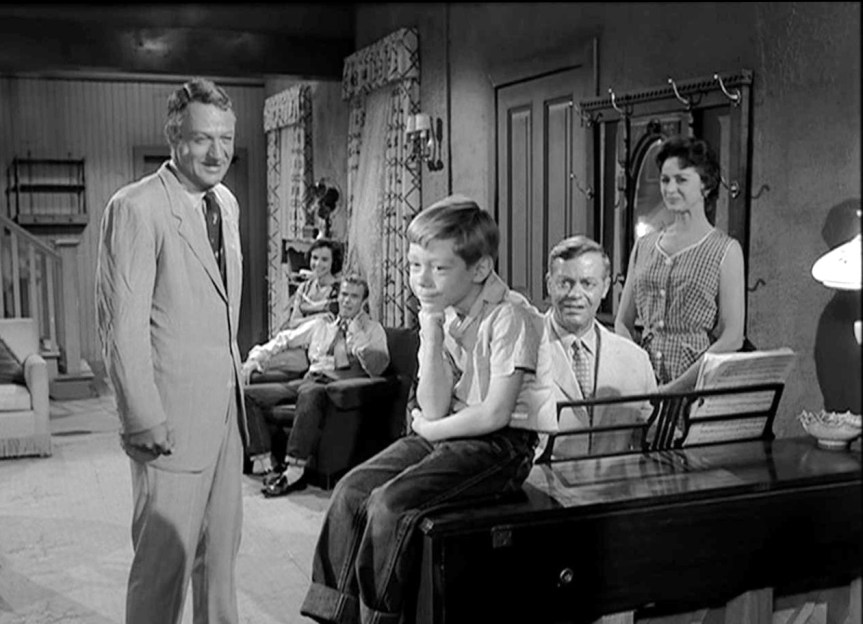
Trump reminds me of the spoiled kid in the famous “Twilight Zone” episode, “It’s A Good Life.”  In that episode, a six-year-old kid prone to temper tantrums and getting his own way rules with absolute power over his parents and the townfolk of “Peaksville.”

Mumy
Don’t offend this kid (Bill Mumy, the child-tyrant in “It’s A Good Life”)

Anyone who offends the petty tyrant (played memorably by Billy Mumy) is punished, often in gruesome ways.  A more merciful result is to be “sent to the cornfield,” a euphemism for death.

Welcome to Peaksville, America.  And think only good thoughts of our six-year-old leader.  Unless, of course, you prefer the cornfield.

Dystopias Are All the Rage

W.J. Astore

The historian Jill Lepore has an interesting article at The New Yorker on dystopic novels and their popularity today.  Dystopias are all the rage, which is not surprising given the politics of fear that rules us.

Consider the stark contrast between the Republican Party of today versus that of the 1980s.  Remember the sunny optimism projected by Ronald Reagan?  The idea it’s “morning again” in America?  Now we have the dystopia of Trump.  Mexicans are rapists!  Muslims are terrorists!  They’re coming to get us!  Build a wall!  Torture and kill them!

I’m not suggesting Reagan was a saint.  Reagan was, however, a gifted communicator and an inspiring symbol for many. There was substance there as well.  As a young man, he served as a lifeguard and helped to save lives.  I find it intriguing that he was somewhat of an introvert, somewhat of a dreamer.  He worked with the Soviets and Mikhail Gorbachev on the elimination of nuclear weapons, a dream that did not come to pass.  For all his flaws, there was a fundamental decency about him.

Reagan_Gorbachev_White_House_Library

Contrast Reagan to Trump.  With Trump, it’s all about him.  Trump’s favorite way of communicating is with insults, bluster, threats, and tweets.  Reagan dreamt of eliminating nuclear weapons; Trump insists America will remain “at the top of the [nuclear] pack,” at a cost of a trillion dollars over the next generation.

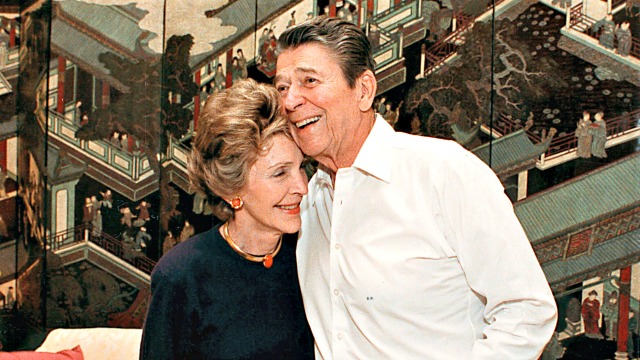
Reagan and his wife Nancy were quirky as well (astrology, anyone?), but seeing how they looked at each other and treated one another, no one could doubt their love.  Trump and Melania?  In public, at least, they come across as ill at ease, uncomfortable with each other.  Small potatoes, perhaps, but part of being the “First Family” is projecting harmony, or so it has been in the past.  Nowadays, such symbolism seems unimportant as Trump himself dominates the scene, his wife seemingly a bit player in his life.

434489-ronald-and-nancy-reagan-36-anniversary-white-house-gettyimages

There’s a toxicity to Trump that’s consistent with the emergence of all these dystopic novels.  The Victorian author Samuel Smiles once wrote that a man should be what he seems or purposes to be.  By this Smiles meant that a man must demonstrate, by his behavior, uprightness of character.  A quaint expression, that.  When people think of Trump today, “uprightness of character” doesn’t exactly spring to mind.  Rather the reverse.

Though I wrote early on that Donald Trump had a serious chance at the presidency, by early November of last year I thought the negativity of his message – his bundle of hate – would not prove compelling enough to carry him to victory.  I was wrong, of course.  Trump, with his dystopic rhetoric as well as his actions, captured as well as amplified a prevailing mood.

It’s not morning again in America.  Under Trump, darkness and dystopia prevail.

America’s “Beautiful” Weapons

a-10-thunderbolt-ii_001
Beauty is in the eye of the beholder

W.J. Astore

President Trump is hawking weapons in the Middle East.  After concluding a deal with the Saudis for $110 billion in weaponry, he sought out the Emir of Qatar and said their discussions would focus on “the purchase of lots of beautiful military equipment.”

Trump’s reference to American weapons as “beautiful” echoed the recent words of Brian Williams at MSNBC, who characterized images from the Tomahawk missile attack on Syria as “beautiful,” not once but three times.

We can vilify Trump and Williams for seeing beauty in weapons that kill, but we must also recognize Americans love their technology of death.  It’s one big reason why we have more than 300 million guns in America, enough to arm virtually every American, from cradle to grave.

Why do we place so much faith in weapons?  Why do we love them so?

In military affairs, America is especially prone to putting its faith in weapons.  The problem is that often weaponry is either less important than one thinks, or seductive in its promise.  Think of U.S. aerial drones, for example.  They’ve killed a lot of people without showing any decisiveness.

Technology is a rational and orderly endeavor, but war is irrational and chaotic.  Countries develop technology for war, thinking they are adding order and predictability, when they are usually adding just another element of unpredictability while expanding death.

U.S. air power is a great example — death everywhere, but no decisiveness.  Look at Southeast Asia (Vietnam, Laos, Cambodia).  The U.S. obliterated vast areas with high explosive and napalm and Agent Orange, killing millions without winning the war.  The technological image of America today is not stunning cars or clever consumer inventions but rather Predator and Reaper drones and giant bombs like MOAB.

Profligate expenditures on weapons and their export obviously feed America’s military-industrial complex.  Such weapons are sold by our politicians as job-creators, but they’re really widow-makers and life-takers.   Americans used to describe armament makers as “merchants of death,” until, that is, we became the number one producer and exporter of these armaments.  Now they’re “beautiful” to our president and to our media mouthpieces.

We have a strange love affair with weapons that borders on a fetish.  I’ve been to a few military re-enactments, in which well-intended re-enactors play at war.  The guys I’ve talked to are often experts on the nuts and bolts of the military weaponry they carry, but of course the guns aren’t loaded.  It’s all bloodless fun, a “war game,” if you will.

Nowadays real war is often much like a video game, at least to U.S. “pilots” sitting in trailers in Nevada.  It’s not a game to an Afghan or Yemeni getting blown to bits by a Hellfire missile fired by a drone.  For some reason, foreigners on the receiving end of U.S. weaponry don’t think of it as “beautiful.”  Nor do we, when our weapons are turned against us.

Enough with the “beautiful” weapons, America.  Let’s stick to the beauty of spacious skies and amber waves of grain.