Insurgencies and America’s Defeat in Vietnam

An Old Paper from 1993

BILL ASTORE

JAN 29, 2026

Scrolling through old files today, I came across this paper that I prepared for a “Strategic Studies Seminar” at Oxford that I presented on 28 January 1993. Back then, I was a captain in the Air Force, and in the room were other serving and retired military officers. Anyhow, here’s what I read to my peers (and the two professors hosting the seminar) about the U.S. defeat in Vietnam. Again, this presentation is 33 years old, but I hope it’s still useful despite its age. 

Insurgencies and America’s Defeat in Vietnam (1993)

A revolutionary war is a war within a state; the ultimate aim of the insurgents is political control of the state. Nowhere is Clausewitz’s dictum of war as a continuation of politics more true than in a revolutionary war. It typically takes the form of a protracted struggle, conducted patiently and inexorably, a variant of Chinese water torture. Educating or, more accurately, indoctrinating, the people – gaining their sympathy, cooperation, and assistance – is paramount. And all people have a role to play: men and women, young and old. After World War II, insurgencies have been guided by Mao Zedong’s concept of People’s War, and inspired by a complex combination of nationalism, anti-colonialism, and communism. They have bedeviled France, Great Britain, and the United States. This paper addresses the strategy of People’s War in terms of means, ends, and will, and details some of the reasons why the United States lost the Vietnam War.

The strategic end of People’s War is simple in its boldness: the overthrow of the existing government and its replacement with an insurgent-led government. The means are incredibly complex, encompassing social, economic, psychological, military, and political dimensions, but it must be remembered that all means are directed towards the political end. Strength of will usually favors the insurgents, partly because a major goal of People’s War is to mold the minds of its followers to convince them of the righteousness of their cause.

People’s War passes through three stages. At first the insurgents get to know the people as they spread propaganda and build a political infrastructure.

Every insurgent is an ambassador for the cause. They create safe havens while intimidating opponents and neutrals, and they commit terrorist acts to undermine the legitimacy of the government. They build their safe havens on the periphery of the state, usually in rural or impoverished areas where they can feed on the misery of the people. The more difficult the terrain, the better, whether it be the mountains of Spain and Afghanistan or the jungles of Malaya and Vietnam. They extend their control over the countryside and into the urban areas during the second stage of People’s War. They use guerrilla tactics and terrorism to further undermine the political legitimacy of the government. The main target is not the government’s troops but the will of its leaders. As they extend their physical control over the countryside, they install their own political structure to control the people. With the government’s will fatally weakened, the insurgents move to the final stage: a conventional military offensive to overthrow the government.

The three stages are not rigidly sequential, however. For example, while conducting guerrilla operations against the government, the insurgents continue to build their infrastructure, conduct terrorist acts, and spread propaganda. Even during the last stage — the general offensive — the insurgents continue stages one and two. This aspect of People’s War was well expressed by John M. Gates in the Journal of Military History in July 1990:

American conventional war doctrine does not anticipate reliance upon population within the enemy’s territory for logistical and combat support. It does not rely upon guerrilla units to fix the enemy, establish clear lines of communication, and maintain security in the rear. And it certainly does not expect enemy morale to be undermined by political cadres within the very heart of the enemy’s territory, cadres who will assume positions of political power as the offensive progresses. Yet all of these things happened in South Vietnam in 1975….

Flexibility, judgement, and comprehensiveness of methods are the keys to success. If the insurgents overestimate the weakness of the government and lose large-scale battles, they slip back into the earlier two phases and continue to work towards weakening the government for the next general offensive.

It bears repeating the primary goal of insurgents is political control. Military actions are only one tool for obtaining this control. As Mao cautions, guerrilla operations are just “one aspect of the revolutionary struggle.” The insurgent appeals to the hearts and minds of the people. He is, after all, one of them. Too much can be made of Mao’s “fish and sea” analogy. The insurgent is not just a fish that swims in the sea of the people: his purpose is to convert the sea to his purpose. He wants to walk on water. He employs any method to command the sea to his will. He would prefer ideological converts, true believers, but converts through terror are acceptable. Those who can’t be converted he ruthlessly kills. That his methods produce squeamishness among some in the West only accentuates their value to him.

As a strategy, People’s War is difficult but not impossible to counter. The United States defeated the Philippine insurrection in the first two decades of this century, and after World War II Great Britain put down a communist insurgency in Malaya. More famous, however, have been the stunning successes of People’s War: Mao’s victory over Japan and the Nationalists in the 1930s and ‘40s, and Ho Chi Minh’s victories over France and the United States in the 1950s, ‘60s, and ‘70s. Perhaps most unsettling was America’s defeat in Vietnam. How could the world’s foremost superpower lose to, in the words of General Richard G. Stilwell in 1980, a “fourth-rate half-country?”

There are no simple answers to America’s defeat, although Hollywood tells us otherwise. A theory still believed by some in the US military is a variation of the German “stab-in-the-back” legend of the Great War. Our hands were tied by meddling civilians who didn’t let the military fight and win the war. One American soldier is the equal of hundreds of pajama-clad midgets, or so it appears in the Rambo flicks. A wretched, dishonorable government also abandoned our POWs to the godless communists, now rescued several times over by Stallone, Chuck Norris, and other martial arts experts. That such films make money is an affront to the genuine sacrifices of Americans represented so tragically by the Vietnam War memorial in Washington.

Perhaps such sentiments seem out of place in a paper devoted to a dispassionate strategic analysis of America’s role in Vietnam. Yet my feelings are perhaps typical of the emotionalism that still surrounds this topic among Americans. A dispassionate critique from an American, let alone an American service member, may still be impossible; nevertheless, I’ll give it a shot.

The United States lost the war for several related reasons. First, we fought the wrong kind of war. As the Navy and especially the Air Force built up their nuclear forces, the army chaffed against its “New Look” and diminished role in the 1950s. Under Kennedy and Johnson, the Army had a new doctrine – Flexible Response – and an opportunity – the Vietnam War – to prove its worth. Vietnam was to be the proving ground for a revitalized Army.

The opposite proved to be the case because the Army pursued the wrong strategy. From 1965-68, when we sent more than half a million troops to Vietnam, the US Army tried to fight a conventional war against the Viet Cong (VC) and North Vietnamese Army (NVA). As LTG Harry Kinnard, commander of the Army’s elite 1st Cavalry Division (Airmobile), put it, “I wanted to make them fight our kind of war. I wanted to turn it into a conventional war – boundaries – and here we go, and what are you going to do to stop us?” Obeying Mao’s teachings, the VC and NVA wisely avoided stand up fights. The Army responded with search-and-destroy operations to find, fix and kill the enemy. The goal was attrition through decisive battles, reflected by high body counts. Nothing illustrates the bankruptcy of American strategy better than the idea of body counts. In theory, a high body count means you’re killing the fish in the sea, without hurting the sea. In practice, a high body count is a measure of the success of the insurgents: they’re recruiting many fish to their cause. And in killing the fish, Americans poisoned the sea with defoliants, bomb craters, unexploded artillery shells, the list goes on. Americans were stuck in Catch-22 dilemmas: they had to destroy villages to save them, they had to destroy villagers’ crops while pursuing guerrilla bands. Such an approach flies in the face of Mao’s “Three Rules and Eight Remarks,” which exhibit a profound respect for the people and their property.
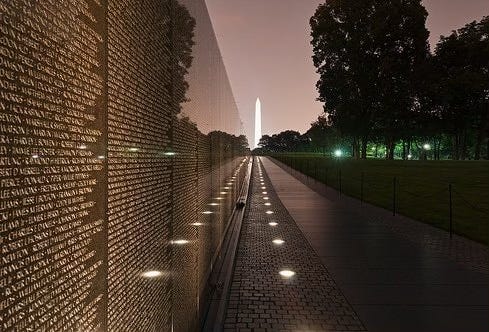
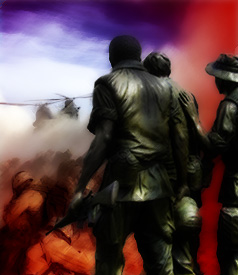
The Vietnam War Memorial in DC

After killing, or perhaps more often not killing, the guerrillas, the Army left, and the guerrillas regained control of the area. This did not disturb LTG Stanley Larson, who observed that if guerrillas returned, “we’ll go back in and kill more of the sons of bitches.” But the VC and NVA retained the initiative, had plenty of manpower, and time was on their side.

Why did the Army pursue such a faulty strategy? In part due to the legacy of World War II, particularly American experience in the Pacific. In island-hopping to Japan, Americans gained faith in massive firepower and lost interest in controlling land. The islands were a means to an end, not the end itself, and success could be measured in some sense by the number of Japanese casualties. Such was not the case in Vietnam, where control of the land was essential to winning the support of the people. Part of the Army’s problem was its lack of experience in counterinsurgency (or COIN) operations. Ronald Spector reports that in the 1950s, COIN operations were limited to four hours in most infantry training courses. What little was taught focused on preventing a conventional enemy from holding raids or infiltrating rear areas. But in the end, the Army fought the war it was trained to fight: a conventional war of maneuver and massive firepower. This worked well in Desert Storm, but failed in Vietnam.

In contrast to the Army, the Marines were far more aware of the nature of the war they were fighting, reports Andrew Krepinevich. They combined 15 marines and 34 Popular Force territorial troops (who lived in and provided security for a village or hamlet) into combat action platoons (CAPs). These CAPs sought to destroy insurgent infrastructure, protect the people and the government infrastructure, organize local intelligence networks, and train local paramilitary troops. In other words, they adopted traditional COIN tactics. But the Army ran the show in Vietnam, and its leaders rejected the Marines’ approach.

The Marines were not alone in their appreciation of the multidimensional aspects of COIN. Robert Komer’s Phoenix program also targeted the Viet Cong infrastructure, but the efforts of the CIA were not well coordinated with those of the military or the State Department, let alone the South Vietnamese. In fact Westmoreland refused to create a combined command to coordinate American actions with those of the South Vietnamese. The latter were an especially neglected resource. Admittedly, the Army of the Republic of Vietnam (ARVN) was corrupt and at times incompetent, but part of the problem was caused by American mistraining and the Army’s contempt. In the 1950s, American military advisors trained ARVN to repel a conventional invasion from the north, using North Korea as a model. From 1965-68, the US Army gave ARVN the static security mission, judged to be of low importance by the Army. US advisors assigned to help ARVN recognized their careers were endangered: they would advance far quicker if they had “true” combat assignments. After years of neglect, ARVN was built up with billions of US dollars during Nixon’s Vietnamization policy (and that’s exactly what it was – a policy, not a strategy), but by 1969 the rot had gone too far. ARVN lacked a unifying national spirit, VC agents had penetrated the ranks, and the officers were thoroughly politicized. Our ally always thought we’d be there if they ran into trouble, but they didn’t understand how American government worked. As Ambassador Bui Diem explained in 1990, “Our faith in America was total, and our ignorance was equally total.” South Vietnam paid the price in 1975.

Could the United States have won the Vietnam War if we had followed a proper strategy? This question may be unanswerable and ultimately moot, but it’s worth discussing. First, one must admit the war may not have been worth winning. Hannah Arendt has stated the Vietnam War was a case of excess means applied for minor aims in a region of marginal interest. In retrospect this seems irrefutable, but in the climate of the Cold War and Containment Vietnam seemed a critical theater in which communist aggression had to be stopped. Second, one must admit the United States was not protecting a viable government in South Vietnam: we were trying to create one. But we were creating one in our image. We ignored the Vietnamese culture and destroyed their economy with our hard currency. Rear area troops with money to spend spread prostitution and drugs in the streets of Saigon. In short, we alienated the people instead of winning them over to our cause. The few people we did win over were terrorized and often killed by the Viet Cong. Even following a proper COIN strategy, victory would have taken 5-10 more years at least. With weak support from the American people, (the “Silent Majority” was silent due to its ignorance and ambivalence), which waned dramatically after Tet, we never had a chance in Vietnam.

The one strategy that would have succeeded for the United States, I believe, is Mao’s People’s War. We must not deceive ourselves: if free elections had been held as promised in 1956, Ho Chi Minh would have won and unified the country. His was the legitimate government; we were trying to overthrow that government and replace it with almost any non-communist regime. In that effort, we should have formed an alliance of military, state department, intelligence, and academic resources to educate Americans in Vietnamese language and culture. These experts, with a suitable, politically-indoctrinated military force to protect them, would win the hearts of the people. Our main weapons would be our ideas and the ideological fervor of our troops, whether civilian or military. Diplomacy and military strikes would be used to cut-off the flow of arms to the VC and NVA from the Soviet Union. The political infrastructure of the enemy would be targeted, including Ho Chi Minh himself.

But this is ridiculous. Our very arrogance blinded us to the war’s complexities. We attacked the symptoms of the disease – the guerrillas and NVA – without examining what caused the disease in the body politic. Our can-do attitude was reinforced by our military traditions and our pride in our nation as being more moral than the rest of the world. We became our own worst enemy as we tried to manage the war. The commitment was there (at least among the soldiers), the energy was there, the money was there, the technology was there -the strategy, intelligence, and leadership wasn’t. People’s War proved superior to search-and-destroy, the VC and NVA intelligence proved superior to ARVN and ignorant Americans, the brilliant Giap out-thought the dedicated but shortsighted Westmoreland. The Vietnam War was ultimately unwinnable.

In the aftermath of the American-led victory over Iraq in Desert Storm, many Americans predicted the stigma of our defeat in Vietnam had finally been exorcised from our minds. Such was not the case, nor is such a result even desirable. The “dreaded V-word,” as the London Times recently described it, is being whispered again in the endless corridors of the Pentagon. If this breeds an aversion to the use of military force, harm may result; but if it leads to more thought and a more subtle study of the efficacy of military force as applied under different conditions, the dreaded V-word will have served a useful purpose, and those names engraved on the Wall in Washington will not have died in vain.
The Siren Song of American Imperialism

BudDajo1a
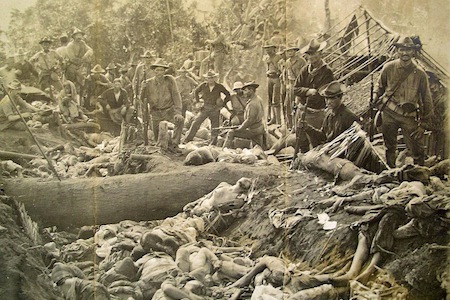
U.S. troops pose with dead Moro rebels, Philippines, 1906

W.J. Astore

Introduction: In September 2012, I wrote the following piece on U.S. imperialism, inspired by an old sound recording.  It came to mind as I read a review in The Nation of a new book by Stephen Kinzer, The True Flag: Theodore Roosevelt, Mark Twain, and the Birth of American Empire.  Its reviewer, Brenda Wineapple, notes the terrible toll of America’s “splendid little war” against Spain in 1898, followed by the campaign to conquer and control (or, to use the expression from those days, to “civilize”) the Filipino people.  Here’s an excerpt from her review:

The war in the Philippines, however, was far from over. Even after McKinley’s assassination, US soldiers continued to ravage the country, killing Filipinos, burning their villages, and laying waste to crops; after three years of such “counterinsurgency,” Kinzer writes, “Americans lost whatever national innocence had survived slavery, anti-Indian campaigns, and the Mexican War.” Twain and the anti-
imperialists had never seen any innocence to speak of: “Lust of conquest had long ago done its work…. There was no principle but commercialism, no patriotism but of the pocket,” Twain wrote.

At the end of 41 months, hundreds of thousands of Filipino civilians had died, and at least 20,000 insurgents—far more than had perished in the 350 years of Spanish rule. But, Kinzer argues, no lessons had been learned: US foreign policy in the 20th and 21st centuries may spring from an ambivalence to intervene in the world, but it continues to represent itself as benevolent when it does so for its own economic self-interest.

She and Stephen Kinzer mention President William Howard Taft, which brings me again to my article from 2012.  I can still faintly hear Taft’s voice, emerging from my friend’s old phonograph horn, telling Americans how they had to embrace “the ignorant masses” of the Philippines.  How deadly that embrace would prove for so many Filipinos …

The Siren Song of American Imperialism (2012)

Considering the scale of our mistakes over the last decade in Iraq and Afghanistan, if we as a country truly want to pursue a leaner, smarter, more effective foreign policy, the first step we must take is to stop listening to the siren song of our own imperial rhetoric. We need to stop posing as benevolent caregivers and start being more honest with ourselves.

And that honesty extends to our own history. The French have a saying that translates to “the more things change, the more they remain the same.” The appropriateness of that saying was brought home to me last week when a good friend of mine played an old campaign speech of William Howard Taft. In 1908, when he was running for president to succeed Teddy Roosevelt, Taft recorded several speeches on Edison-era cylinders. Fortunately for me, my friend collects vintage Edison phonographs and cylinders.

As I stood in front of the large trumpet-like horn of the player, Taft’s voice came alive for me. As Taft sought to justify the U.S. invasion and occupation of the Philippines, it occurred to me that the rhetoric he was using a century ago was the same as that of Presidents Bush and Obama in justifying our most recent foreign misadventures in Iraq and Afghanistan. Taft, as we shall see, was if anything more direct and honest than our most recent commanders-in-chief.

The thrust of Taft’s speech was that Americans were lifting up the benighted and “ignorant masses” of the Philippines. In Taft’s words, we were involved “in a great missionary work that does our nation honor,” one that “is certain to promote … the influence of Christian civilization.” Evidence of our progress included improvements to Filipino infrastructure such as the building of harbors, roads, and railroads. More evidence included our role in building up Filipino police forces to improve internal security. Education was also cited as decreasing “the dense ignorance of the ninety percent.”

Having portrayed our presence in the Philippines as purely benevolent and disinterested, Taft ended with a rousing dismissal of critics who were advocating what today would be termed “cutting and running.” To relinquish the “burden” of our civilizing mission in the Philippines, Taft concluded, would be “cowardly.”

Considering Taft’s rhetoric and comparing it to that of Bush and Obama, it’s clear that little has changed in one hundred years. It’s true that we no longer talk openly about spreading “Christian” civilization. And we’re more circumspect about portraying native peoples as “dense” and “ignorant.” But other than that, our imperial rhetoric hasn’t changed at all. Our presidents still praise our country as being motivated entirely by benevolence; as evidence of our generosity and “progress,” they still tout infrastructure built and native police forces trained; and they still dismiss critics of our imperial efforts as misguided (at best) or cowardly (of the worst kind of “cut and run” variety).

But the truth is that it’s tragically hard to win hearts and minds overseas when we don’t even recognize what’s in our own hearts and minds. We venture forth on “civilizing” missions when our own culture could use some civilizing. We think we’re pure of heart, but “civilizing” missions based on military occupation inevitably contain a heart of darkness.

Whether it’s the presidential election of 1908 or our current one of 2012, we’ve heard enough speeches about how great and noble and honorable we are. To chart a new course, let’s educate our own “ignorant natives” in the USA before we try to cure ignorance elsewhere. Let’s rebuild our own crumbling infrastructure. Let’s tame our own passions. And let’s reconnect with a virtue that, though not unique to Christianity, was then and is now closely associated with it. The virtue? Humility.

To put this in words that may have resonated with Taft, the self-styled “Christian missionary,” let’s first work on removing the beam from our own eye before focusing on the motes in the eyes of others. For it’s only after removing our own beam that we’ll succeed in charting a smarter foreign policy — as well as a far less hypocritical one.

To paraphrase Taft, it would be cowardly indeed to lay down the burden of removing that beam until our purpose is achieved.

On Vietnam, Afghanistan, and Bloody Irreversibility

020910astore
One war ends; another begins; nothing really changes (Image from the original article/Jared Rodriguez)

W.J. Astore

Eight years ago to this month, I wrote the following article for Truthout about America’s ongoing folly in Afghanistan.  I was inspired by an old Look magazine from the 1960s and its coverage of the Vietnam War.

Reading old articles about the Vietnam War is sobering precisely because they read like articles written yesterday. Consider just one example. On May 30, 1967, Look magazine published a comprehensive, 25-page review entitled “USA in Asia.” The subtitle gave the game away: “Our bloody commitments in Asia horrify many Americans. But like it or not, we are irreversibly involved.”

Today, more than forty years later, many say the same of our involvement in Central Asia. Our bloody commitments continue to horrify Americans. And yet again we’re told we’re irreversibly involved. Yet if Vietnam taught us anything, it’s that the “irreversible” is eminently reversible.

Historians and pundits alike can cite dozens of well-informed reasons why today’s Afghanistan is not like yesterday’s Vietnam. And they’re right — and wrong. For what remains the same is us, especially the power of our own self-regard, as well as that of our overly militarized vision, both of which must be overcome if we are ever to succeed in Asia.

Consider how Look in 1967 labeled Vietnam as “our albatross.” Yet those Americans who dared to question our country’s immense military commitment to this “albatross” were labeled as leftist isolationists, “more upset about the billions diverted to Asia than the $22 billion being spent to put a man on the moon,” a non sequitur if ever there was one. Meanwhile, comparing Vietnam to landlocked Laos, an unnamed US official gushed that Vietnam has “the ocean, and we’re great on the ocean. It’s the right place.”

So, Look portrayed “our” Vietnam either as an albatross weighing us down or as the “right place” for American power projection. That the real Vietnam was something different from a vexatious burden for us or an ideal showcase for our military prowess doesn’t seem to have occurred to an Amero-centric Look staff.

Consider as well Look’s précis of the Vietnam War in 1967 and its relevance to our approach to fighting in Afghanistan today:

“The crux is winning the loyalty of the people. We have spent billions … [on] ‘strategic hamlets’ to ‘Revolutionary Development,’ and have failed to make much progress. We have had to reoccupy villages as many as eight times. There is no front and no sanctuary.”

“Our latest ploy has been to turn ‘pacification’ over to the South Vietnamese Army … Unfortunately, most of the ARVN is badly trained and led, shows little energy and is reputedly penetrated by the Vietcong …. Whether such an undisciplined army can move into villages and win over the people is dubious.

“We are trying harsher measures. We have even organized ‘counter-terror’ teams to turn Vietcong tactics against their own terrorist leaders. ‘The real cancer is the terrorist inner circle,’ says one U.S. leader. ‘These terrorists are very tough people. We haven’t scratched the surface yet.’

“We can really win in Vietnam only if we achieve the ‘pacification’ that now seems almost impossible.”

Note the continuities between past and present: the emphasis on winning hearts and minds, the unreliability and corruption of indigenous allied forces, the use of counter-terror against a “very tough” terrorist foe (with barely suppressed disgust that “our” friendly allies lack this same toughness, for reasons that are not exposed in bright sunlight), the sense of mounting futility.

Counterinsurgency combined with counter-terror, escalating US combat forces while simultaneously seeking to “Vietnamize” (today’s “Afghanize”) the war to facilitate an American withdrawal: An approach that failed so miserably forty years ago does not magically improve with age.

Look’s Asian tour concluded on a somber, even fatalistic, note: “The wind blows not of triumphs but of struggle, at a high price, from which there is no escape and with which we have to learn to live…. Men who bomb; men who are killed. Men who booby-trap; men who are maimed. And children who are maimed and who die. They are the price of our bloody involvements in Asia.”

Bloody inevitability — but was it inevitable? Was it irreversible?

So it seems, even today. Why? Precisely because we continue to look so unreflectively and so exclusively through military field glasses for solutions. As Look noted in 1967: “Our massive military presence dominates our involvement in Asia,” words that ring as true today as they did then. And as Secretary of State Dean Rusk opined back then, “It’s going to be useful for some time to come for American power to be able to control every wave of the Pacific, if necessary.”

Again, the sentiment of “full spectrum dominance” rings ever true.

But one thing has changed. Back then, Look described our “massive” commitment to Asia as a byproduct of our “might and wealth,” evidence of our “fat.” We wouldn’t be there, Look suggested, “if we were poor or powerless.”

Today, a slimmer America (at least in terms of budgetary strength) nevertheless persists in making massive military commitments to Asia. Again, we say we’re irreversibly involved, and that blood is the price of our involvement.

But is Central Asia truly today’s new “right place” to project American power? In arresting the spread of a “very tough” terrorist foe, must we see Afghanistan as a truly irreversible — even irresistible — theater for war?

Our persistence in squinting at Asia through blood-stained military goggles suggests that we still have much to learn from old articles about Vietnam.

The Kennedy Administration: Camelot or Incompetence?

jackie-and-john-jackie-kennedy-3856502-816-800
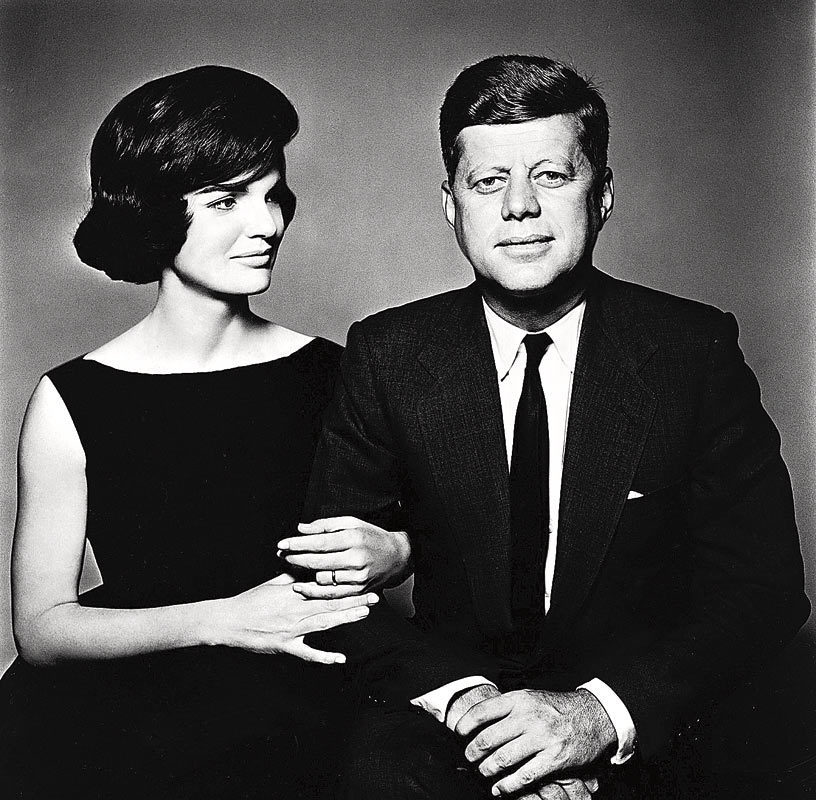
They seemed perfect …

The Kennedy Administration: Camelot or Incompetence?

W.J. Astore

President John F. Kennedy is surrounded by myths, the most famous of which is Camelot. The Kennedys brought youth and glamour to the White House, a reprieve from the perceived stodginess of Ike and Mamie Eisenhower (as well as the “square” and indeed criminal Nixon White House to come).  They seemed the perfect couple, John and Jackie, and it seems churlish and graceless to note how much of this was image.  Kennedy was a notorious womanizer, a fact both known and suppressed by a fawning Washington Press Corps.  Jackie came across as a traditional wife: loyal, unobjectionable, limited by her times but also steely in her grace and fortitude after her husband was assassinated in Dallas in November 1963 (the latest movie that captures this awful event is Jackie, starring Natalie Portman).

Kennedy’s father, Joe Sr., taught his sons a sense of winning at all costs. A sense of recklessness. Kennedy’s older brother, Joe Jr. died leading a risky bombing mission in World War II, and John F. Kennedy nearly died when he lost his PT boat in action in the Pacific.  The loss of PT-109 was depicted as a heroic act, as the young JFK helped to save some of his crew, but one may question how he came to lose his boat in the first place. JFK’s perfect marriage, as already mentioned, was a sham, and despite his relative youth, he was not in the best of health, plagued by a bad back, Addison’s disease, and other health issues. His Pulitzer-prize winning book, “Profiles in Courage,” was largely ghost written.  JFK’s life was often more a triumph of image than a profile in courage.

As President, Kennedy made many unwise decisions.  He escalated American involvement in Laos and Vietnam, setting the stage for a major commitment of U.S. ground troops by President Lyndon Johnson early in 1965.  He oversaw the disastrous Bay of Pigs invasion of Cuba, which backfired badly on the inexperienced U.S. commander-in-chief.  As Lawrence Freedman put it in his book, Kennedy’s Wars (2000), “This was exactly the sort of move—gambling on the basis of insufficient strength and then abandoning the operation before it was complete—that made [Dean] Acheson despair.”  Freedman further cites Acheson as saying European leaders compared JFK’s bungling to “a gifted amateur practicing with a boomerang and suddenly knocking himself cold.  They were amazed that so inexperienced a person should play with so lethal a weapon.”

Greater lethality was to come the next year with the Cuban Missile Crisis.  This is often sold as JFK’s moment of steely toughness, when he made the Soviets blink and back down, but as a recent book by Daniel Ellsberg reveals, that crisis nearly resulted in nuclear war between the U.S. and the Soviet Union.  It was yet another instance of JFK’s tendency toward taking big risks as a way of proving himself.  Almost precipitating nuclear Armageddon, however, is terrifying way to prove one’s fitness for office.

Even before JFK became president, he fabricated what today might be called “alternative facts.”  He invented a missile gap vis-à-vis the Soviet Union that didn’t exist.  In fact, the true missile gap was the opposite of what JFK claimed, in that the U.S. had many more nuclear ICBMs than the Soviets did.  When he became president, JFK embarked on a strategic policy of “Flexible Response” (suggested by General Maxwell Taylor) that activated and empowered more conventional operations by the U.S. military.  In practice what this meant was that the U.S. became embroiled in conflicts that were secondary to national interests; worst of all, of course, was a major land war in Vietnam that was essentially a lost cause even before Kennedy chose to escalate it with more advisers and materiel aid.

Defenders of JFK suggest he grew in office and would have seen the folly of continuing in Vietnam, but there’s little evidence to support this narrative.  The recent Ken Burns series on the Vietnam War cites Kennedy as saying the U.S. couldn’t win in Vietnam, but that he couldn’t order a withdrawal because to do so would cost him his reelection in 1964.  JFK, moreover, fancied the notion of Flexible Response, his New Look military and its emphasis on special ops forces such as the Green Berets, and he saw Vietnam as a test bed for a “counterinsurgency” approach to defeating communism. What LBJ did in 1965 in escalating that conflict by committing U.S. ground troops is probably what JFK would have done if he had lived.  (In his book, Choosing War: The Lost Chance for Peace and the Escalation of War in Vietnam, Fredrik Logevall suggests JFK may have had the political will to resist escalation in 1965, effectively allowing South Vietnam to fall to communism, an intriguing if unprovable scenario.)

In sum, JFK set the stage for America’s disastrous war in Southeast Asia while provoking the Soviet Union into an escalatory nuclear arms race that threatened the world with extinction.  Profiles in courage these are not.

It’s worth briefly comparing JFK’s record to that of Richard Nixon, who has no Camelot myths attached to him.  Nixon, of course, was and is vilified as “Tricky Dick” and dismissed as one of America’s worst presidents.  He deserves opprobrium for his mendacious, meretricious, and murderous policies vis-à-vis Southeast Asia, especially his well-nigh treasonous meddling in peace negotiations in 1968, before he was elected president.  Nixon and Henry Kissinger saw themselves as the world’s powerbrokers, working to overthrow governments they disliked, as in Chile with the coup against Allende.  But Nixon and Kissinger deserve a measure of credit for opening negotiations with communist China as well as starting a process of détente with the Soviet Union.  Nixon showed a capacity for growth in office even as he permitted his own ego and paranoia to undermine his administration’s accomplishments in foreign policy.

The point here is not to praise Nixon, a man of considerable gifts but also of crippling flaws.  Rather, the point is to highlight an overly fawning approach to the presidency of John F. Kennedy.  His administration, rather than serving as a shining moment, a Camelot, ultimately was an exercise in imagery and incompetence.

The Afghan War: Questions Unasked, Answers Unsought, Victory Unattainable

saidtjawad_1945912591
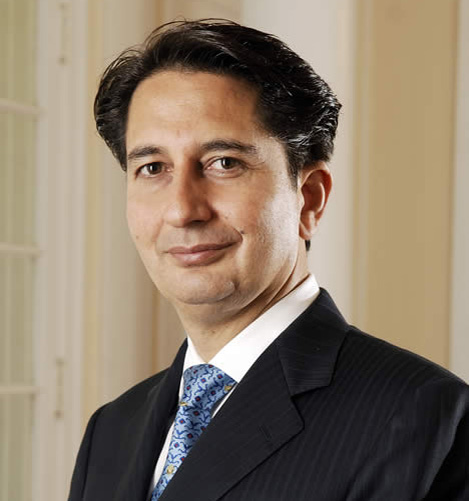
Said Jawad, formerly Afghan Ambassador to the US

Daniel N. White.  Introduction by W.J. Astore

Now in its 15th year, the US war in Afghanistan continues to go poorly.  The drug trade is up, the Taliban is resurgent, and Afghan security forces are weakening.  Nevertheless, as Dan White notes below, Americans are told by their leaders in Washington that progress is steady, even if the usual Petraeus caveats (“fragile” and “reversible”) are thrown in about that “progress.” White recently had the chance to hear Said Jawad, Afghanistan’s former Ambassador to the US, speak about the war and his country’s relations with the US.  What he heard was not encouraging.  Sadly, the policy among America’s leaders is never to hear a discouraging word – or, never to share such a word with the American people.

Looming Failure in the Afghan War: It’s All Out in the Open

Dan White

A story from some actress about marriage and divorce always stuck with me, even if the actress’ name hasn’t.  She talked about how if you are head over heels in love with someone, or if you are pissed off at them and divorcing them, you still see everything about the person, good and bad.  Your vision doesn’t change with emotion, she said.  The only thing that changes is which aspects of that person you bring into focus.  Everything is out in the open for you to see, and you just choose what you want to focus on.  She’s right about that.  Not just in love, but in world events, too.

The Current Official Word (COW) from the Washington Beltway is that things are going as well as can be expected in Afghanistan.  That’s the official spin, and it hasn’t changed since the war began.  But other things are out there, in the open, and it’s high time we focused on them.

Afghanistan’s former Ambassador to the United States, Said Jawad, gave a speech on “America’s Longest War: The Afghan Perspective” on April 5th at UT-Austin, at a Strauss Center for International Relations/LBJ School event.  Attendance at North America’s second-largest college campus for this event was about sixty; half the attendees were students while the rest were local residents, mostly affluent social security age or thereabouts.  (Rather piss-poor attendance for a war America’s leaders are calling “generational.”)

I talked briefly to the Ambassador beforehand—he was friendly and approachable, always good for a diplomat.  We talked about a book I was carrying, David Talbot’s The War Without a Name, which is the best book written in English to date about the French counterinsurgency war in Algeria, 1954-62.  This book was worth around $200 on Amazon back in 2004 or so, but I’d picked it up at the Half-Price slushpile for $2 the other day, and that fact probably showed something about how serious America was these days about wars, counterinsurgencies, and learning from history.  Ambassador Jawad nodded politely.  He declined my offer of the book as a gift; perhaps he knows the subject too well.

The Ambassador spoke for about 40 minutes.  His PowerPoint presentation wasn’t working; it is somewhat disturbing that the Ambassador has become a slave to PowerPoint like everyone in the US government nowadays.  I wasn’t expecting him to say much (the usual diplomatic discretion before an American audience combined with Beltway conformity).  But if you were paying attention, the Ambassador let drop in the forefront, in easy camera range, some things that normally stay in the deep dark background.

Ambassador Jawad was as upfront as a diplomat can be about Afghanistan’s complete dependence on US military and political support and his expectations that it would continue at the current level for the next several years.  This despite pronouncements from Official DC about our doing the contrary.  He mentioned several times that ISIL pays its soldiers about three times what his government pays theirs, and how this was a major factor in ISIL’s success.  Hmmm—I guess the three to one pay advantage trumps his army’s six to one numbers advantage.  The former Ambassador also complained about Pakistan’s providing sanctuary for the enemy forces, and expressed a desire that the US would pressure Pakistan to stop doing so. Saudi Arabia came in for its licks too, and the Ambassador urged that the US pressure the Saudis into doing something to stop the financial support their citizens (and government too, Mr. Ambassador?) are giving to ISIS/ISIL.  The Ambassador used the term ‘realistically’ several times about various actions Afghanistan or the United States could, and should, do.

One fact got dropped that I should have heard before, and that is that this past year was the bloodiest ever for the Afghan National Army and security forces.  This was the first year ever that the war did not go into hibernation for the winter; it ran the whole year round. Ambassador Jawad said that there were 7000 government forces killed this past year and that current losses ran 16 KIA (killed in action) daily.  I’d never heard this one before.  7000 KIA means a minimum of 21,000 WIA (wounded in action), a total of 28,000 casualties a year.  The Afghan National Army has an official strength of around 150,000 (actual troop strength is a different smaller number due to potted plant soldiers) with roughly 150,000 auxiliary/police.

Losses at this level are militarily unsustainable for very long.  I doubt anyone militarily knowledgeable would give the Afghan national forces more than two years before they collapse from losses at this rate.  This means things are going to fall apart there in Afghanistan like they did in Iraq, and soon.  There was not a sign of anyone in the audience catching this.  If they did, they were too polite to say anything.

The Q&A came up, and again I wasn’t picked for a question (actually, I was ignored, a story for another day).  Several faculty asked mostly pointless questions, and the student questions were wonkish policy-adjustment ruminations hewing to the Beltway line.  No sign of intelligent life there, Scotty.

After the event, I spoke to the Ambassador again.  He was apologetic about not selecting me for a question, delicately deferring blame, with much justification, to his host Robert Chesney.  I dumped the question I had in mind to ask during the Q&A and instead I asked him this, something that had bubbled up from deep inside me:

Mr. Ambassador, I’ve already pointed out to you the story of this book and how its cratering in price shows something about how much interest the US has in its war in your country.  Doesn’t this also show a distinct lack of competence in the US ruling elites, that they choose to remain ignorant about the biggest counterinsurgency war in the 20th Century, after this many years of failed wars?

And speaking of just how much real interest my country and countrymen have in your country and people, just look at the foreign aid amounts we’ve given to your country, a desperately poor country in dire need of everything, every last god-blasted handiwork of man there is, after four decades of war and devastation.  It took us five years before we gave your country five billion dollars in aid.  That’s peanuts and you know it.  You also have to know that it took us another three years more before we hit ten billion dollars in aid.  And certainly you have to know that aid like this is absolutely critically necessary and desperately time-sensitive for successful prosecution of a counter-insurgency, and doesn’t  the fact that we cheaped out and didn’t deliver this militarily essential aid in anything near a timely fashion show again the incompetence of this country’s military and political ruling elites?

Doesn’t it also again show how little regard we here have for your fellow countrymen and their problems?  Just look at our aid to Ukraine, instead.  We officially spent five billion up front, unofficially twice that, on the latest color revolution there, and that was all money going to white European politicians for them to piss away on parties, bribes, and Swiss bank accounts.  Doesn’t that show, decade and a half long war or not, just how little your country, its people, and our war there matter to the DC crowd?

Mr. Ambassador, you talked several times today about ‘realistic’ and ‘realistically’.   Shouldn’t you be more realistic about the fact that there’s been a decade and a half for us to pressure the Saudis and Pakistanis to cooperate and we haven’t ever yet so realistically that just isn’t going to ever happen?  Realistically shouldn’t you and your country adjust your policy plans and expectations to reflect this fact instead of calling still again for them?   Shouldn’t you and your fellow countrymen be more realistic about this country of mine and its government and peoples and its profound indifference to you and your war and our rather gross and obvious failings as a nation and as a people by now?

The Former Ambassador listened to all this politely, and then gave a little speechette about how America was a great country full of great people who could do anything they put their minds to.  I thanked him and left.

So just like that actress said, it’s all out in the open, and it’s just a question of if you want to focus on it and see it.   We don’t, it doesn’t look like the Afghans do either, and we all will act surprised when the big crackup in Afghanistan happens soon.  Our surprise will be genuine because our profound blindness certainly is.

Daniel N. White has lived in Austin, Texas, for a lot longer than he originally planned to.  He reads a lot more than we are supposed to, particularly about topics that we really aren’t supposed to worry about.  He works blue-collar for a living–you can be honest doing that–but is somewhat fed up with it right now.  He will gladly respond to all comments that aren’t too insulting or dumb.  He can be reached at Louis_14_le_roi_soleil@hotmail.com.