I’ve written several articles about the United States and creeping militarism (see here and here, for example). This should be obvious, but I’ll say it again: Calling attention to the militarization of American society is pro-democracy, not anti-military. Indeed, back in the citizen-soldier era of my father, being “gung ho” for the military wasn’t even applauded within the military!
As one veteran wrote to me:
When I was in the military, being “gung ho” was not considered a compliment by most of my friends… Of course we were not professional military types, just taking our turns to do our duty. We remembered the American soldier epitomized by Bill Mauldin as “Willie” and “Joe” who fought successfully against the German Army and the Japanese fanatics…The popular war movies of WWII after the war usually pitted the austere, indoctrinated Nazis fighting to demonstrate the Nazi superiority against the average American citizen soldier. Remember the movie “Battleground”? Today the images of our Army uncomfortably remind me of the way the German superman was portrayed that we overcame.
As America today celebrates its “superman” warriors (one soldier recently called this “the age of the commando”), our country neglects these same men and women when they leave the military, often with crippling physical and psychological wounds.
As another veteran wrote to me:
[There is a] disjunction between the cult of military hero-worship in American society and American ignorance of veterans’ problems. I am continually disgusted with those who are pimping off the mystique [surrounding our troops] who don’t deserve any special regard for their military service. And a final but important point: many combat vets, knowing full well the realities of combat and its effects on combatants, do not want to be thanked at all [by the public].
America’s militarism both feeds and draws support from our endless wars. The war on terror has been ongoing since 2001. So too the war in Afghanistan. Iraq keeps getting more chaotic. Miscalculation in Syria could lead to World War III.
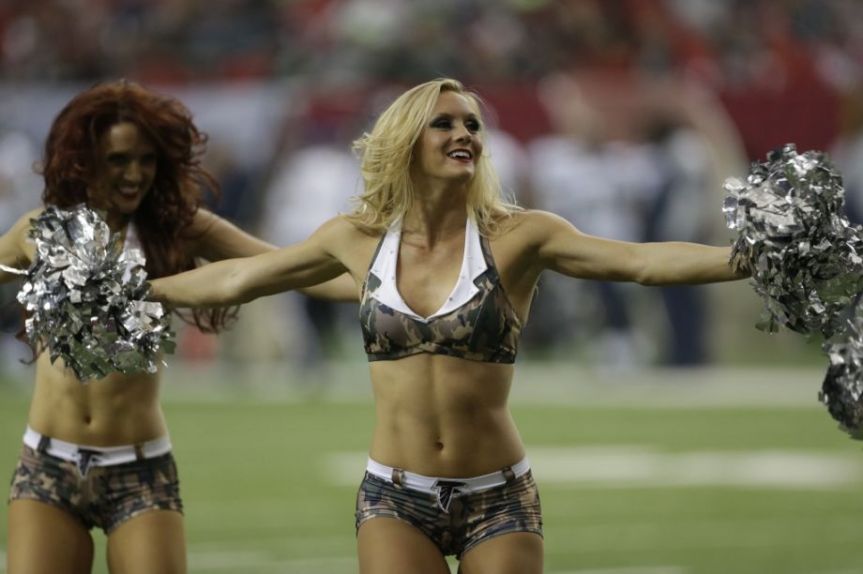
Speaking of future wars, just look at the rhetoric of our more popular political candidates for president, to include Donald “bomb those suckers” Trump and Ted “carpet bomb” Cruz. Chickenhawk politicians are nothing but opportunists. They may be leading the war charge, but they know they’re backed by a society in thrall to military spectacle (as represented, for example, by pom-pom shaking cheerleaders in skimpy camouflage outfits).
Unstinting praise of America’s “warriors” and “heroes” is reinforced by feel-good corporate/military advertising. Recall Budweiser’s “welcome home” party for an Army lieutenant that aired during the Super Bowl a couple of years back. Or red-white-and-blue Budweiser cans to “honor” the troops on July 4th. “Saluting” the troops with colorful beer cans – really?
Signs of militarism USA are everywhere. Police forces with MRAPs and similar tank-like vehicles. Colleges and universities jostling for “defense” funding (even bucolic campuses want those war bucks). Popular games that glorify military mayhem, such as the “Call of Duty” video games. Even mundane items like camouflage headsets for NFL coaches.
It’s time to end the madness. Paraphrasing Dwight Eisenhower, only Americans can defeat America. Constant celebration of all things military is not a recipe for victory. But it is a surefire recipe for the end of democracy.
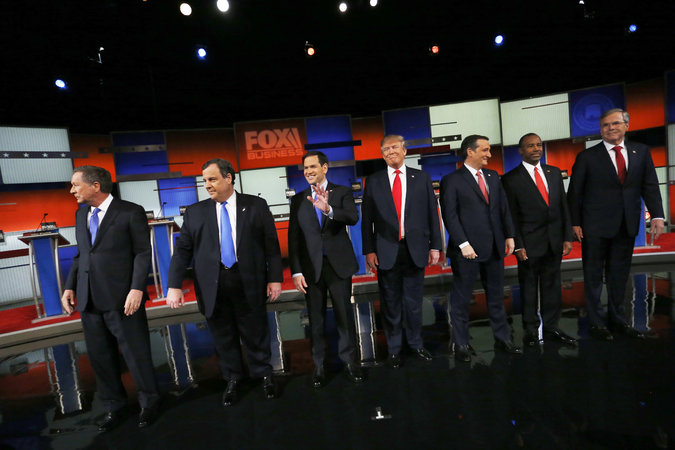
I watched last night’s Republican debate so you wouldn’t have to. Leaving aside the usual mugging by Donald Trump, the usual jousting over side issues like whether Ted Cruz is a natural born citizen, I thought I’d take an impressionistic approach to the debate. You can read the debate transcript here (if you dare), but here is my admittedly personal take on the main messages of the debate.
Barack Obama and Hillary Clinton are coming to take your guns. So you need to elect a Republican who will allow you to keep your guns and to buy many, many more guns while carrying them openly in public.
Related to (1), ISIS is coming to these shores. In fact, they’re already here. That’s one big reason why everyone needs guns – to protect ourselves from ISIS and other terrorists out to kill Americans on Main Street USA.
America is weak. Obama has gutted our military. The Iranians and Russians laugh at us. To stop them from laughing, America needs to rebuild its military, buy more weapons, and use them freely. In fact, all the next commander-in-chief needs to do is ask military leaders what they need to win, give them exactly that, then stand back as our military (especially Special Ops troops) kicks ass. Victory!
America is weak (again), this time economically. The Chinese are kicking our ass. They’re tougher than us and smarter than us. We need to teach them who’s boss, perhaps with a big tariff on Chinese imports, combined with intense pressure on them to revalue their currency.
The American tax system is unfair to corporations. We need to lower corporate tax rates so that American companies won’t relocate, and also so that American businesses will be more competitive vis-à-vis foreign competitors.
The most oppressed “minority” in the U.S. are not Blacks or Hispanics or the poor: it’s the police. Yes, the police. They are mistreated and disrespected. Americans need to recognize the police are there to protect them and to defer to them accordingly.
The only amendment worth citing in the U.S. Constitution is the Second Amendment.
The National Security Agency, along with all the other intelligence agencies in America, need to be given more power, not less. They need broad and sweeping surveillance powers to keep America safe. Privacy issues and the Fourth Amendment can be ignored. People like Edward Snowden are traitors. “Safety” is everything.
Bernie Sanders is a joke. Hillary Clinton just might be the anti-Christ.
Immigrants are a threat, especially if they’re Muslim. They must be kept out of America so that they don’t steal American jobs and/or kill us all.
What I didn’t hear: Anything about the poor, or true minorities, or gender inequities, or the dangers of more war, and so on.
My main takeaway from this debate: Republican candidates live in the United States of Paranoia, a hostile land in which fear rules. Think “Mad Max, Fury Road,” but without any tough females about. (I have to admit I missed Carly Fiorina/Imperator Furiosa on the main stage.)
Only one candidate struck a few tentative notes of accord through bipartisan collaboration and compromise: Ohio governor John Kasich. In his closing statement, he spoke eloquently of his parents’ working-class background. He’s also the only candidate with the guts not to wear the by-now obligatory flag lapel pin. I’m not a Republican, but if I had to vote for one, it would be him. Why? Because he’s the least batshit crazy of the bunch.
Yes, it was a depressing night, one spent in an alternate universe detached from reality. In the end, old song lyrics popped into my head: “paranoia will destroy ya.” Yes, yes it will, America.
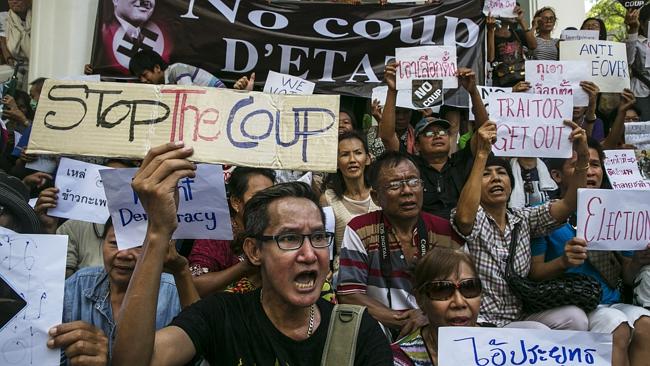
Back in January 2010, I wrote the following article for TomDispatch.com on the possibility of “a very American coup” occurring in conjunction with the presidential election of 2016. I make no claims to prescience: for example, the “great recession” I predicted didn’t come to pass, and there are as yet very few protesters in the streets, and no concerted movement rallying disaffected troops that I’m aware of. Nevertheless, I think there’s validity to some of my predictions in this article, and I encourage your comments in the section below on the path our country is treading as we head into 2016.
Here is the article, unchanged from when I wrote it nearly six years ago.
A Very American Coup Coming Soon to a Hometown Near You By William J. Astore
The wars in distant lands were always going to come home, but not this way.
It’s September 2016, year 15 of America’s “Long War” against terror. As weary troops return to the homeland, a bitter reality assails them: despite their sacrifices, America is losing.
Iraq is increasingly hostile to remaining occupation forces. Afghanistan is a riddle that remains unsolved: its army and police forces are untrustworthy, its government corrupt, and its tribal leaders unsympathetic to the vagaries of U.S. intervention. Since the Obama surge of 2010, a trillion more dollars have been devoted to Afghanistan, Iraq, Pakistan, and other countries in the vast shatter zone that is central Asia, without measurable returns; nothing, that is, except the prolongation of America’s Great Recession, now entering its tenth year without a sustained recovery in sight.
Disillusioned veterans are unable to find decent jobs in a crumbling economy. Scarred by the physical and psychological violence of war, fed up with the happy talk of duplicitous politicians who only speak of shared sacrifices, they begin to organize. Their motto: take America back.
Meanwhile, a lame duck presidency, choking on foreign policy failures, finds itself attacked even for its putative successes. Health-care reform is now seen to have combined the inefficiency and inconsistency of government with the naked greed and exploitative talents of corporations. Medical rationing is a fact of life confronting anyone on the high side of 50. Presidential rhetoric that offered hope and change has lost all resonance. Mainstream media outlets are discredited and disintegrating, resulting in new levels of information anarchy.
Protest, whether electronic or in the streets, has become more common — and the protestors in those streets increasingly carry guns, though as yet armed violence is minimal. A panicked administration responds with overlapping executive orders and legislation that is widely perceived as an attack on basic freedoms.
Tapping the frustration of protesters — including a renascent and mainstreamed “tea bag” movement — the former captains and sergeants, the ex-CIA operatives and out-of-work private mercenaries of the War on Terror take action. Conflict and confrontation they seek; laws and orders they increasingly ignore. As riot police are deployed in the streets, they face a grim choice: where to point their guns? Not at veterans, they decide, not at America’s erstwhile heroes.
A dwindling middle-class, still waving the flag and determined to keep its sliver-sized portion of the American dream, throws its support to the agitators. Wages shrinking, savings exhausted, bills rising, the sober middle can no longer hold. It vents its fear and rage by calling for a decisive leader and the overthrow of a can’t-do Congress.
Savvy members of traditional Washington elites are only too happy to oblige. They too crave order and can-do decisiveness — on their terms. Where better to find that than in the ranks of America’s most respected institution: the military?
A retired senior officer who led America’s heroes in central Asia is anointed. His creed: end public disorder, fight the War on Terror to a victorious finish, put America back on top. The United States, he says, is the land of winners, and winners accept no substitute for victory. Nominated on September 11, 2016, Patriot Day, he marches to an overwhelming victory that November, embraced in the streets by an American version of the post-World War I GermanFreikorps and the police who refuse to suppress them. A concerned minority is left to wonder (and tremble) at the de facto military coup that occurred so quickly, and yet so silently, in their midst.
It Can Happen Here, Unless We Act
Yes, it can happen here. In some ways, it’s already happening. But the key question is: at this late date, how can it be stopped? Here are some vectors for a change in course, and in mindset as well, if we are to avoid our own stealth coup:
1. Somehow, we need to begin to reverse the ongoing militarization of this country, especially our ever-rising “defense” budgets. The most recent of these, we’ve just learned, is a staggering $708 billion for fiscal year 2011 — and that doesn’t even include the $33 billion President Obama has requested for his latest surge in Afghanistan. We also need to get rid of the idea that anyone who suggests even minor cuts in defense spending is either hopelessly naïve or a terrorist sympathizer. It’s time as well to call a halt to the privatization of military activity and so halt the rise of security contractors like Xe (formerly Blackwater), thereby weakening the corporate profit motive that supports and underpins the American version of perpetual war. It’s time to begin feeling chastened, not proud, that we’re by far the number one country in the world in arms manufacturing and the global arms trade.
2. Let’s downsize our global mission rather than endlessly expanding our military footprint. It’s time to have a military capable of defending this country, not fighting endless wars in distant lands while garrisoning the globe.
3. Let’s stop paying attention to major TV and cable networks that rely onretired senior military officers, most of whom have ties both to the Pentagon and military contractors, for “unbiased” commentary on our wars. If we insist on fighting our perpetual “frontier” wars, let’s start insisting as well that they be covered in all their bitter reality: the death, the mayhem, the waste, the prisons, and the torture. Why is our war coverage invariably sanitized to “PG” or even “G,” when we can go to the movies anytime and see “R” rated, pornographically violent films? And by the way, it’s time to be more critical of the government’s and the media’s use of language and propaganda. Mindlessly parroting the Patriot Act doesn’t make you patriotic.
4. It’s time to elect a president who doesn’t surround himself with senior “civilian” advisors and ambassadors who are actually retired military generals and admirals, one who won’t accept a Nobel Peace Prize by defending war in theory and escalating it in practice.
5. Let’s toughen up. Let’s stop deferring to authority figures who promise to “protect” us while abridging our rights. Let’s stop bowing down before men and women in uniform, before they start thinking that it’s their right to be worshipped and act accordingly.
6. Let’s act now to relieve the sort of desperation bred by joblessness and hopelessness that could lead many — notably male workers suffering from the “He-Cession” — to see a militarized solution in “the homeland” as a credible last resort. It’s the economy, stupid, but with Main Street’s health, not Wall Street’s, in our focus.
7. Let’s take Sarah Palin and her followers seriously. They’re tapping into anger that’s real and spreading. Don’t let them become the voices of the angry working (and increasingly unemployed) classes.
8. Recognize that we face real enemies in our world, the most powerful of which aren’t in distant Afghanistan or Yemen but here at home. The essence of our struggle to sustain our faltering democracy should not be against “terrorists,” with their shoe and crotch bombs, but against various powerful, perfectly legal groups here whose interests lie in a Pentagon that only grows ever stronger.
9. Stop thinking the U.S. is uniquely privileged. Don’t take it on faith that God is on our side. Forget about God blessing America. If you believe in God, get out there and start trying to earn His blessing through deeds.
10. And, most important of all, remember that fear is the mind-killer that makes militarism possible. Ramping up “terror” is an amazingly effective way of shredding our Constitution. Putting our “safety” above all else is asking for trouble. The only way we’ll be completely safe from the big bad terrorists, after all, is when we’re all living in a maximum security state. Think of walking down the street while always being subject to a “full-body scan.”
That’s my top 10 things we need to do. It’s a daunting list and I’m sure you have a few ideas of your own. But have faith. Ultimately, it all boils down to Franklin Delano Roosevelt’s words to a nation suffering through the Great Depression: the only thing we have to fear is fear itself. These words came to mind recently as I read the following missive from a friend and World War II veteran who’s seen tough times:
“It’s very hard for me to accept how soft the American people have become. In 1941, with the western world under assault by powerful and deadly forces, and a large armada of ships and planes attacking us directly, I never heard a word of fear as we faced three powerful nations as enemies. Sixteen million of us went into the military with the very real possibility of death and I never once heard of fear, except from those exposed to danger. Now, our people let [their leaders] terrify them into accepting the destruction of our economy, our image in the world, and our democracy… All this over a small group of religious fanatics [mostly] from Saudi Arabia whom we kowtow to so we can drive 8-cylinder SUV’s. Pathetic!
“How many times have I stood in ‘security lines’ at airports and when I complained of the indignity of taking off shoes and not having water and the manhandling of passengers, have well educated people smugly said to me, ‘Well, they’re just keeping us safe.’ I look at the airport bullshit as a training ground to turn Americans into docile sheep in a totalitarian state.”
A public conditioned to act like sheep, to “support our troops” no matter what, to cower before the idea of terrorism, is a public ready to be herded. A military that’s being used to fight unwinnable wars is a military prone to return home disaffected and with scores to settle.
Angry and desperate veterans and mercenaries already conditioned to violence, merging with “tea baggers” and other alienated groups, could one day form our own Freikorps units, rioting for violent solutions to national decline. Recall that the Nazi movement ultimately succeeded in the early 1930s because so many middle-class Germans were scared as they saw their wealth, standard of living, and status all threatened by the Great Depression.
If our Great Recession continues, if decent jobs remain scarce, if the mainstream media continue to foster fear and hatred, if returning troops are disaffected and their leaders blame politicians for “not being tough enough,” if one or two more terrorist attacks succeed on U.S. soil, wouldn’t this country be well primed for a coup by any other name?
Don’t expect a “Seven Days in May” scenario. No American Caesar will return to Washington with his legions to decapitate governmental authority. Why not? Because he won’t have to.
As long as we continue to live in perpetual fear in an increasingly militarized state, we establish the preconditions under which Americans will be nailed to, and crucified on, a cross of iron.
It’s Halloween, America, which perhaps explains the gruesome results of the latest Republican presidential debate. I watched a sliver of them (terrifying!), and read as much as I could stand of the debate transcript (horrifying!). As usual, the Republicans want you to be afraid, very afraid, of the bogeyman. With respect to the economy, the bogeyman is variously described as a socialist, a Bolshevik, even a Menshevik (!), someone who favors big government to make all of your decisions on health care, education, and what not.
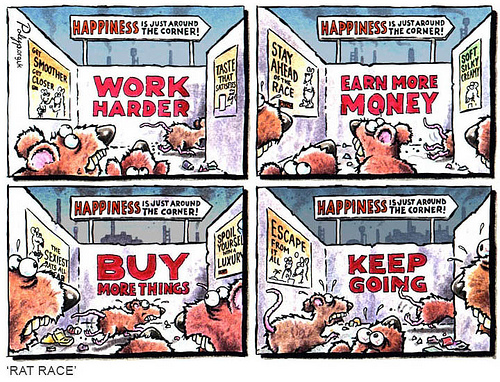
The Republican solution? Trust the free market! Empower the makers by cutting their taxes. Vilify the moochers and takers while starving them of their entitlement candy. Something like this cartoon, perhaps:
Long ago, George H.W. Bush described Reagan’s “supply side” tax plan as “voodoo economics.” That’s the idea you can cut taxes on the richest and most privileged Americans, thereby supposedly stimulating investment and growth, in which case the benefits would “trickle down” to the lowest of Americans on the economic ladder, even as the federal budget miraculously balanced itself.
If you thought that voodoo was thirty-five years in the grave, think again. It’s been exhumed from the graveyard of dead ideas, stalking us yet again, this time from the stage of that presidential debate in Boulder, Colorado.
For me, the scariest part of the Republican debate was its total lack of original ideas. Talk of Bolshevism is Cold War rhetoric that was dead a generation ago; supply-side economics was dead on arrival almost two generations ago; but like zombies these dead ideas are consuming the brains of the Republican candidates.
I don’t need to watch the TV series “The Walking Dead” to see zombies. For that, I just need to watch the Republican presidential debates.
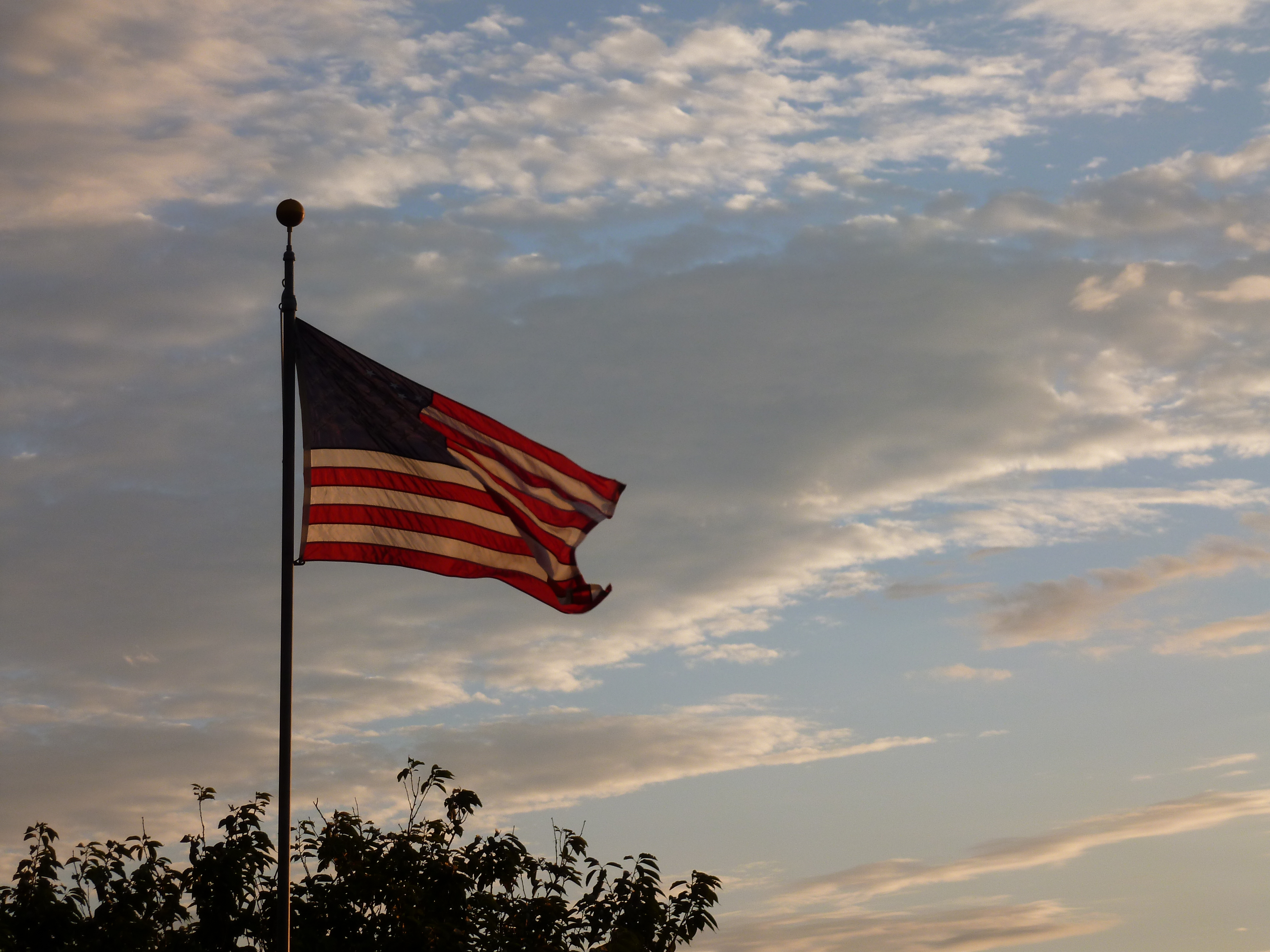
Waving the flag and wielding a gun: Hey, it’s the USA!
W.J. Astore
A century ago, the USA was a dynamic, forward-looking, freedom-espousing country that was focused on science and technology and its practical applications, as represented by Thomas Edison and Henry Ford. We were about to reelect a president, Woodrow Wilson, precisely because he had kept the country out of World War I. With the exception of the Navy, the U.S. military was small, and few Americans (Teddy Roosevelt comes to mind) boasted about the “manly” virtues of military service and war.
Here we are, a century later, in a country that has taken up militarism, a country which is increasingly reactionary, authoritarian, and backward-leaning, a country that leads the world not in innovation for ordinary people as in the days of Edison and Ford, but in weapons exports to the world’s trouble spots.
Anyone with a sense of history — indeed, anyone with common sense — should recognize that militaries are antithetical to democracy. Indeed, most Americans recognized exactly that in 1915. A true democracy has a military as a reluctant and regrettable choice, driven by the need to defend itself in a hostile and violent world. But over the last century a regrettable choice has become, not only requisite, but celebratory in the USA. Like so many amped up Teddy Roosevelt’s, striving to prove our manhood, America now believes military service conveys nobility. Heroic meaning.
Yet celebrating the military, nobilizing the military experience, finding purpose and meaning in continuous war, is the very definition of militarism.
Admittedly, American militarism is a peculiar strain. It’s not the Germanic kind in which a conservative aristocracy found its reason for being and its privileged position in military service. There are no Prussian Junkers who willingly revel in a martial code of honor and duty in war. Indeed, America’s aristocracy of wealth reserves the right to exclude itself from military service even as it applauds the sons and daughters of the lower orders who enlist to fight (and sometimes to die).
Again, it’s a strange militarism, militarism USA, one in which military service is indeed one of the few avenues for America’s working classes to rise by merit (tightly defined within a hierarchical structure that breeds and rewards conformity), and where a few generals actually attain a measure of cult status, however temporary (recent examples include Colin Powell, Tommy Franks, and David Petraeus). Yet celebrated generals come and go, even as America’s wars are continuous.
Indeed, we’ve become so accustomed to living with the drumbeats of war that we no longer hear them. It reminds me of a lesson an officer taught on World War I at the Air Force Academy. He played sounds of an artillery barrage for the entire 50 minutes of the lesson. When you first walked in, the noise hit you. Then you sort of forgot about it as he taught the lesson. Just before the end, he turned off the noise, and the silence spoke. You realized, just a little, what it had been like for troops in the trenches in 1916 living under artillery bombardment. And you also realized how quickly we can all become more or less accustomed to the drumbeats of war.
We’re hearing them all the time today — it’s the background noise to our lives. For some, it’s even become sweet music. But war and militarism is never sweet music to a functioning democracy.
One final point: Some Americans react as if calling attention to the militarization of our society/culture is the same as being anti-military. Being against militarism and war is not being anti-military: more the reverse. There’s a strange conflation or confusion there — and this conflation/confusion is a sign of how far militarism has gotten under our collective skin and into the nation’s blood stream.
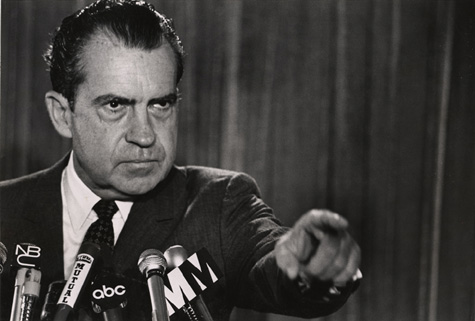
And Nixon said, “Let there be tapes.” And there was surveillance — and knowledge of good and evil — and a multitude of dirty tricks. And Nixon thought it was good. And American democracy was fallen, forevermore.
And after Nixon slew democracy, the Founders asked him where it was. And Nixon replied, “I know not. Am I democracy’s keeper?” And so he was banished, somewhere east of San Bernardino.
In his powerful introduction to Tim Weiner’s new book, Tom Engelhardt argues that Richard Nixon was in a sense the progenitor of today’s national security and surveillance state. That state seeks to sweep up everything, to know everything, because it mistrusts everyone, and because it seeks power over everyone, just as Nixon sought nearly half a century ago. If today’s surveillance state has a Bible (highly secret, no doubt, so how would I know?), Nixon contributed some of the earliest passages to its Book of Genesis.
How did our government come to implement on a macro scale what Nixon implemented on a micro (and microphone) scale? How did “dirty tricks” become legion — for they are many — in our government? Read on! W.J. Astore
Nixon’s Genesis of the Paranoid National Security State
Tom Engelhardt (used with kind permission of the author)
Let me give you a reason that’s anything but historical for reading Tim Weiner’s remarkable new book, One Man Against the World: The Tragedy of Richard Nixon. Mind you, with the last of the secret Nixon White House tapes finally made public some 40 years after the first of them were turned over to courts, prosecutors, and Congress, this will undoubtedly be the ultimate book on that president’s reign of illegality.
Still, think about the illegal break-in (or black-bag job) at the office of Daniel Ellsberg’s psychiatrist committed by a group of Nixon White House operatives dubbed “the Plumbers”; the breaking into and bugging of the Democratic National Committee’s headquarters at the Watergate office complex; the bugging, using warrantless wiretaps, of the phones of administration aides and prominent media figures distrusted by the president and National Security Adviser Henry Kissinger; the slush funds Nixon and his cronies created for his reelection campaign; the favors, including ambassadorships, they sold for “donations” to secure a second term in office; the privatized crew of contractors they hired to do their dirty work; the endemic lying, deceit, and ever more elaborate cover-ups of illegalities at home and of extra-constitutional acts in other countries, including secret bombing campaigns, as well as an attempt to use the CIA to quash an FBI investigation of White House activities on “national security grounds.” Put it all together and you have something like a White House-centered, first-draft version of the way the national security state works quite “legally” in the twenty-first century.
As a bonus, you also get a preview of the kinds of money machinations that, with the backing of the Supreme Court four decades later, would produce our present 1% democracy. The secret political funds Nixon and his cronies finagled from the wealthy outside the law have now been translated into perfectly legal billionaire-funded super PACs that do everything from launching candidate ad blitzes to running ground campaigns for election 2016.
Read Weiner’s new book — he’s also the author of a classic history of the CIA and another on the FBI — and it turns out that the president who resigned from office in disgrace in August 1974 provided a blueprint for the world that Washington would construct after the 9/11 attacks. If Weiner’s vision of Nixon is on the mark, then we never got rid of him. We still live in a Nixonian world. And if you need proof of that, just think about his infamous urge to listen in on and tape everyone. Does that sound faintly familiar?
Nixon had the Secret Service turn the Oval Office (five microphones in his desk, two at a sitting area), its telephones, the Cabinet Room (two mics), and his “hideaway” in the Executive Office Building into recording studios. He bugged his own life, ensuring that anything you said to the president of the United States would be recorded, thousands and thousands of hours of it. He was theoretically going to use those recordings for a post-presidential memoir (from which he hoped to make millions) and as a defense against whatever Henry Kissinger might someday write about him.
But whatever the initial impulse may have been, the point was to miss nothing. No one was to be exempted, including Nixon’s closest companions in office, no one but the president himself. He would know what others wouldn’t and act accordingly (though in the end he didn’t). What was one man’s mania for bugging and recording his world has become, in the twenty-first century, the NSA’s mania for bugging and recording the whole planet; a president’s mad vision, that is, somehow morphed into the modern surveillance state. The scale is staggeringly different, but conceptually it’s surprising how little has changed.
After all, the NSA’s global surveillance network was set up on the Nixonian principle of sweeping it all up — the words, in whatever form, of everyone who was anyone (and lots of people who weren’t). A generation of German politicians, Brazilians galore, terror suspects as well as just about anyone with a cell phone in the tribal backlands of the planet, twopresidents of Mexico, three German chancellors, three French presidents, at least 35 heads of state, the secretary general of the U.N., and so on. The list was unending. As with Nixon, only officials of the national security state were to know that all our communications were being logged and stored. Only they were to be exempt from potential scrutiny. (Hence their utter outrage when Edward Snowden revealed their racket to the world.) Like Nixon, they would, in the end, be left with the same hopeless, incriminating overload of words. They would sweep it all up and yet, drowning in data, they wouldn’t hear a thing.
So pick up Tim Weiner’s new book and don’t for a second imagine that it’s ancient history. Think of it as the book of Genesis for the American national security state’s Bible. In the meantime, thanks to the kindness of Weiner’s publisher, Henry Holt, TomDispatch offers a little taste of the lead-up to the last days of Richard Nixon from One Man Against the World — of the moment when his system began to cave in and threatened to bury him alive. Someday, we can only hope, the same thing will happen to those responsible for similar acts on an unimaginably larger scale in our own time.
“Whoever controls the media, controls the mind,” Jim Morrison said, and this is certainly true in America. Consider the lead stories over the July 4th weekend. The first was the threat of terror attacks against America. We were told that law enforcement officials were “in no mood for a national party” — that the threat of an ISIS-inspired terror attack was real. That no attack occurred is of no consequence. Fear was stoked, and that’s what matters. Prepare for the next terror reminder on the anniversary of 9/11, if not sooner.
The second story was shark attacks off the Carolina coast. Unusual, yes, but hardly a threat to America or to the vast majority of its people, even those who chose to go swimming in the ocean. “Shark surge!” “Fear at the beach!” “High alert!” These were common expressions in the media.
Of course, Americans were much more likely to be hurt in fireworks accidents than by terrorists or sharks, but the sensational always takes precedence over the mundane in our media. Indeed, if the goal was to safeguard ordinary Americans, we should have been told to stay off the roads this past weekend, but of course that would hurt tourism and the economy, so you weren’t about to hear that advice coming from America’s talking heads.
It seems nearly impossible to remember that one of FDR’s Four Freedoms was the freedom from fear. FDR knew the paralyzing and stultifying effects of fear, the way it erodes individual autonomy, the way it can be made to serve the powerful. Frank Herbert in Dune captured a powerful truth when he wrote that “Fear is the mind-killer.” The movie Blade Runner echoes the sentiment, with the Replicant Roy Batty (played by Rutger Hauer) explaining that to live in fear is to be a slave.
A media that spreads fear facilitates a government of wolves. Or, put slightly differently by the great Edward R. Murrow, “A nation of sheep will beget a government of wolves.”
There’s a definite method to the media madness, America.
Many people associate the Confederate flag (the “stars and bars”) with the South and the U.S. Civil War (Whoops — I mean “The War of Northern Aggression”). For some people, it’s been a more or less vague expression of Southern heritage, or a symbol of rebellion, a sort of redneck “good ol’ boy” badge of pride. Like any symbol, it is capable of holding multiple meanings. To use academic fancy talk, its semiotics is negotiated and interrogated contextually within contingent cultural settings in which radical interpretive flexibility is possible.
Did you follow that last sentence? If you didn’t, pat yourself on the back, because it’s all BS. The “stars and bars” may have been a Confederate battle flag 150 years ago, but after the Civil War it morphed into a symbol of White supremacy, becoming a symbol of race hatred and violent resistance to integration during the Civil Rights movement.
A little honesty: The Confederate flag is hardly restricted to the South, and therefore it’s not primarily about Southern heritage. In rural Central Pennsylvania, where I recently taught for nine years, the Confederate flag was astonishingly common. It was on license plates; it flew every day at a local gas station; I saw neighbors flying it openly on their flag poles. Why, you might ask?
My wife was very good friends with a Black woman in a local town; the (White) neighbor immediately behind her openly flew a Confederate flag from his flag pole. Remember, this was Pennsylvania, Union country, not the heart of the Confederacy. There was no mistaking this man’s message — his unhappiness that a Black family lived near him, and his decision to make them uncomfortable, to make them squirm, by flying “his” flag.
Think I’m reaching here? My wife’s friend has a son who went to the prom. He complimented a (White) classmate on her prom dress, saying it looked “hot” on her. He got a visit from an off-duty State Trooper who explained to him that Black boys don’t talk to White girls like that. Not around here, son. No, this wasn’t 1963. It was 2013. A half-century after the Civil Rights movement.
It’s good to see that the Confederate flag is finally being taken down from State Capitol buildings; that merchandise featuring it is being pulled from store shelves; that politicians are finally speaking out against it, even Republican candidates for president, who equivocated in such a cowardly manner until even they could no longer resist the pull of public outrage stemming from the latest racial hate crime in Charleston.
The question is: What the hell took them (and us) so long?
The American people are being kept divided, distracted, and downtrodden. Divisions are usually based on race and class. Racial tensions and discrimination exist, of course, but they are also exploited to divide people. Just look at the current debate on the Confederate flag flying in Charleston, South Carolina, with Republican presidential candidates refusing to take a stand against it as a way of appeasing their (White) radical activist base. Class divisions are constantly exploited to turn the middle class, or those who fancy themselves to be in the middle class, against the working poor. The intent is to blame the “greedy” poor (especially those on welfare or food stamps), rather than the greedy rich, for America’s problems. That American CEOs of top companies earn 300 times more than ordinary workers scarcely draws comment, since the rich supposedly “deserve” their money. Indeed, in the prosperity Gospel favored by some Christians, lots of money is seen as a sign of God’s favor.
As people are kept divided by race, class, and other “hot button” issues (abortion and guns, for example), they are kept distracted by insatiable consumerism and incessant entertainment. People are told they can have it all, that they “deserve it” (a new car, a bigger home, and so on), that they should indulge their wants. On HGTV and similar channels, people go shopping for new homes, carrying a long list of “must haves” with them. I “must have” a three-car garage, a pool, a media room, surround sound, and so on. Just tell me what mortgage I can afford, even if it puts me deeply in debt. As consumerism runs rampant, people are kept further distracted by a mainstream media that provides info-tainment rather than news. Ultimately, the media exists to sell product; indeed, it is product itself. No news is aired that will disturb the financial bottom line, that will threaten the corporations that run the media networks, that will undermine the privileged and the powerful.
The people, kept divided and distracted, are further rendered powerless by being kept downtrodden. Education is often of poor quality and focused on reciting rote answers to standardized tests. Various forms of debt (student loan debt, credit card debt, debt from health care and prescription drugs costs, and so on) work to keep the people downtrodden. Even workers with good jobs and decent benefits are worried. Worried that if they lose their jobs, they lose their health care. So much of personal status and identity, as well as your ability to navigate American society, is based on your position. For many it’s lose your job, lose your life, as you’re consumed by debt you can’t repay.
Divided, distracted, and downtrodden: It’s a recipe for the end of democracy in America. But it also serves as a roadmap to recovery. To reinvigorate our democracy, we must fight against divisiveness, we must put distractions behind us, and we must organize to fight for the rights of the people, rights like a better education for all, less debt (a college education that’s largely free, better health care for everyone, and far less emphasis on consumerism as a sign of personal and societal health and wealth), and improved benefits for the workers of America, who form the backbone of our nation.
We can’t wait for the politicians. Most of them are already co-opted by the moneyed interests. Meaningful change will have to come from us. That is, after all, the way democracy is supposed to work.
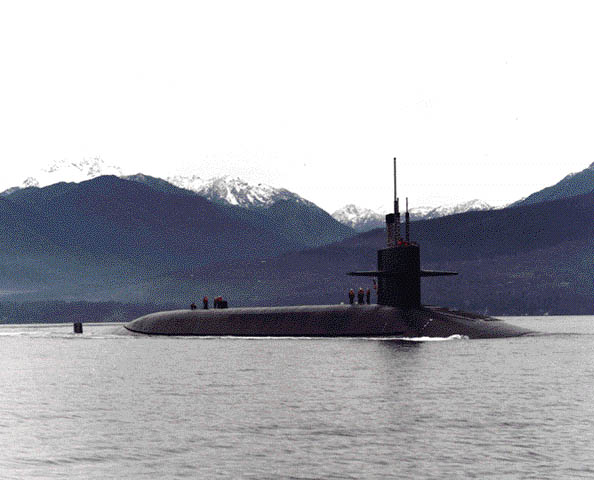
An Ohio-Class Submarine, armed with Trident nuclear missiles
W.J. Astore
I’ve been writing for TomDispatch.com and the amazing Tom Engelhardt since 2007. When I wrote my first article, “Saving the Military from Itself: Why Medals and Metrics Mislead,” I never imagined I would come to write 37 more for Tom and his site over the next eight years. TomDispatch has given me an opportunity to write about topics like the elimination of nuclear weapons, the rise of American militarism, the perils of calling all troops in the military “heroes,” the over-hyping of American military prowess by our leaders, and many others. In all my articles, I hope I’ve offered a contrary perspective on the U.S. military as well as American culture, among other subjects.
My latest article, America’s mutant military, is a personal odyssey of sorts. I reflect on how the military has changed since I entered it in 1985. Today’s post-Cold War U.S. military is, to put it bluntly, not as I envisioned it would be as the Berlin Wall was falling and the Soviet Union was collapsing. Today’s military still has its Cold War weaponry and mindset largely intact, even as a new “mutant” military has emerged, based on special ops and connected to corporations and intelligence agencies, a military hybrid that is often shrouded in secrecy even as it’s celebrated openly in Hollywood action films.
My essay runs 2300 words, so I encourage you to read all of it at TomDispatch. What follows are a few excerpts from it:
It’s 1990. I’m a young captain in the U.S. Air Force. I’ve just witnessed the fall of the Berlin Wall, something I never thought I’d see, short of a third world war. Right now I’m witnessing the slow death of the Soviet Union, without the accompanying nuclear Armageddon so many feared. Still, I’m slightly nervous as my military gears up for an unexpected new campaign, Operation Desert Shield/Storm, to expel Iraqi autocrat Saddam Hussein’s military from Kuwait. It’s a confusing moment. After all, the Soviet Union was forever (until it wasn’t) and Saddam had been a stalwart U.S. friend, his country a bulwark against the Iran of the Ayatollahs. (For anyone who doubts that history, just check out the now-infamous 1983 photo of Donald Rumsfeld, then special envoy for President Reagan, all smiles and shaking hands with Saddam in Baghdad.) Still, whatever my anxieties, the Soviet Union collapsed without a whimper and the campaign against Saddam’s battle-tested forces proved to be a “cakewalk,” with ground combat over in a mere 100 hours.
Think of it as the trifecta moment: Vietnam syndrome vanquished forever, Saddam’s army destroyed, and the U.S. left standing as the planet’s “sole superpower.”
Post-Desert Storm, the military of which I was a part stood triumphant on a planet that was visibly ours and ours alone. Washington had won the Cold War. It had won everything, in fact. End of story. Saddam admittedly was still in power in Baghdad, but he had been soundly spanked. Not a single peer enemy loomed on the horizon. It seemed as if, in the words of former U.N. ambassador and uber-conservative Jeane Kirkpatrick, the U.S. could return to being a normal country in normal times.
[But it didn’t happen. With the Soviets gone, the U.S. military itself was now uncontained, and many hankered to use its power to achieve America’s goal of global power.]
Yet even as civilian leaders hankered to flex America’s military muscle in unpromising places like Bosnia and Somalia in the 1990s, and Afghanistan, Iraq, Libya, Pakistan, and Yemen in this century, the military itself has remained remarkably mired in Cold War thinking. If I could transport the 1990 version of me to 2015, here’s one thing that would stun him a quarter-century after the collapse of the Soviet Union: the force structure of the U.S. military has changed remarkably little. Its nuclear triad of land-based ICBMs, submarine-launched SLBMs, and nuclear-capable bombers remains thoroughly intact. Indeed, it’s being updated and enhanced at mind-boggling expense (perhaps as high as a trillion dollars over the next three decades). The U.S. Navy? Still built around large, super-expensive, and vulnerableaircraft carrier task forces. The U.S. Air Force? Still pursuing new, ultra-high-tech strategic bombers and new, wildly expensive fighters and attack aircraft — first the F-22, now the F-35, both supremely disappointing. The U.S. Army? Still configured to fight large-scale, conventional battles, a surplus of M-1 Abrams tanks sitting in mothballs just in case they’re needed to plug the Fulda Gap in Germany against a raging Red Army. Except it’s 2015, not 1990, and no mass of Soviet T-72 tanks remains poised to surge through that gap.
[Along with the persistence of America’s “Cold War” military, a new military emerged, especially in the aftermath of 9-11.]
In 2015, so many of America’s “trigger-pullers” overseas are no longer, strictly speaking, professional military. They’re mercenaries, guns for hire, or CIA drone pilots (some on loan from the Air Force), or warrior corporations and intelligence contractors looking to get in on a piece of the action in a war on terror where progress is defined — official denials to the contrary — by body count, by the number of “enemy combatants” killed in drone or other strikes.
Indeed, the very persistence of traditional Cold War structures and postures within the “big” military has helped hide the full-scale emergence of a new and dangerous mutant version of our armed forces. A bewildering mish-mash of special ops, civilian contractors (both armed and unarmed), and CIA and other intelligence operatives, all plunged into a penumbra of secrecy, all largely hidden from view (even as they’re openly celebrated in various Hollywood action movies), this mutant military is forever clamoring for a greater piece of the action.
While the old-fashioned, uniformed military guards its Cold War turf, preserved like some set of monstrous museum exhibits, the mutant military strives with great success to expand its power across the globe. Since 9/11, it’s the mutant military that has gotten the lion’s share of the action and much of the adulation — here’s looking at you, SEAL Team 6 — along with its ultimate enabler, the civilian commander-in-chief, now acting in essence as America’s assassin-in-chief.
Think of it this way: a quarter-century after the end of the Cold War, the U.S. military is completely uncontained.
[And an uncontained military, in a country that celebrates its troops as heroes, that boasts of itself as having the best military in all of recorded history, does not bode well for America’s democratic future.]
Go to TomDispatch.com to read the entire article. Thank you!





 Bracing Views