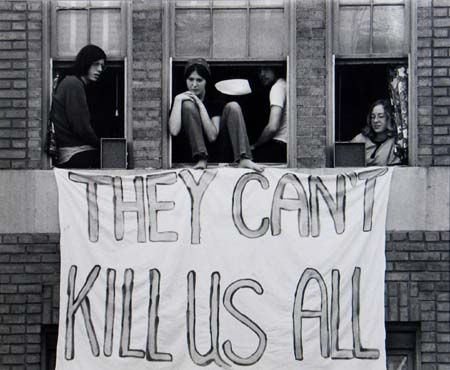
When you’re at war, even your own youth become potential enemies. A sign after the Kent State shootings (1970)
W.J. Astore
Here are a few excerpts from my latest article at TomDispatch.com. I urge you to read the entire article here. Thank you!
War on drugs. War on poverty. War in Afghanistan. War in Iraq. War on terror. The biggest mistake in American policy, foreign and domestic, is looking at everything as war. When a war mentality takes over, it chooses the weapons and tactics for you. It limits the terms of debate before you even begin. It answers questions before they’re even asked.
When you define something as war, it dictates the use of the military (or militarized police forces, prisons, and other forms of coercion) as the primary instruments of policy. Violence becomes the means of decision, total victory the goal. Anyone who suggests otherwise is labeled a dreamer, an appeaser, or even a traitor.
War, in short, is the great simplifier — and it may even work when you’re fighting existential military threats (as in World War II). But it doesn’t work when you define every problem as an existential one and then make war on complex societal problems (crime, poverty, drugs) or ideas and religious beliefs (radical Islam).
America’s Omnipresent War Ethos
Consider the Afghan War — not the one in the 1980s when Washington funneled money and arms to the fundamentalist Mujahideen to inflict on the Soviet Union a Vietnam-style quagmire, but the more recent phase that began soon after 9/11. Keep in mind that what launched it were those attacks by 19 hijackers (15 of whom were Saudi nationals) representing a modest-sized organization lacking the slightest resemblance to a nation, state, or government. There was as well, of course, the fundamentalist Taliban movement that then controlled much of Afghanistan. It had emerged from the rubble of our previous war there and had provided support and sanctuary, though somewhat grudgingly, to Osama bin Laden.
With images of those collapsing towers in New York burned into America’s collective consciousness, the idea that the U.S. might respond with an international “policing” action aimed at taking criminals off the global streets was instantly banished from discussion. What arose in the minds of the Bush administration’s top officials instead was vengeance via a full-scale, global, and generational “war on terror.” Its thoroughly militarized goal was not just to eliminate al-Qaeda but any terror outfits anywhere on Earth, even as the U.S. embarked on a full-fledged experiment in violent nation building in Afghanistan. More than 13 dismal years later, that Afghan War-cum-experiment is ongoing at staggering expense and with the most disappointing of results.
While the mindset of global war was gaining traction, the Bush administration launched its invasion of Iraq. The most technologically advanced military on Earth, one that the president termed “the greatest force for human liberation the world has ever known,” was set loose to bring “democracy” and a Pax Americana to the Middle East. Washington had, of course, been in conflict with Iraq since Operation Desert Storm in 1990-1991, but what began as the equivalent of a military coup (aka a “decapitation” operation) by an outside power, an attempt to overthrow Saddam Hussein and eliminate his armed forces and party, soon morphed into a prolonged occupation and another political and social experiment in violent nation-building. As with Afghanistan, the Iraq experiment with war is still ongoing at enormous expense and with even more disastrous results …
It’s the mindset that matters. In places like Iraq and Afghanistan, places that for most Americans exist only within a “war” matrix, the U.S. invades or attacks, gets stuck, throws resources at the problem indiscriminately, and “makes a desert and calls it ‘peace'” (to quote the Roman historian Tacitus). After which our leaders act surprised as hell when the problem only grows.
Sadly, the song remains monotonously the same in America: more wars, made worse by impatience for results driven by each new election cycle. It’s a formula in which the country is eternally fated to lose…
b. traven asked me about “First Causes” when it comes to America’s permanent war mentality. With respect to the Middle East, he mentioned the Saudis and Israelis and the extent to which the USA kowtows to each. Here is my quick response:
I’d say that our war mentality pre-dates our tango with the Saudis and Israelis. We really didn’t come to support them in a big way until the early 1970s, and by that point Korea and Vietnam and the military-industrial complex had already created a permanent war mentality.
First Cause(s): It’s so hard to say. The Cold War and anti-Communist hysteria played a powerful role. So did our culture: the John Wayne mentality. American exceptionalism and our own myths. The misreading of history: We must always resist violently or we’re risking another Munich. Capitalism and the pursuit of profit by any means, to include violence. Violence itself as a means to profit.
A Roman Cavalry Mask found at the presumed site of the Battle of Teutoburg Forest
W.J. Astore
Reports that President Obama is considering even more troops and bases to fight ISIS in Iraq put me to mind of Roman general Publius Quinctilius Varus. Two millennia ago, Varus committed three Roman legions to the Teutoburg Forest in Germania in terrain that neutralized Roman advantages in firepower and maneuverability. Ambushed and caught in a vise, his legions were destroyed in detail as Varus took his own life. To Rome the shock and disgrace of defeat were so great that Emperor Augustus cried, “Quinctilius Varus, give me back my Legions!”
Ever since 9/11, American presidents and their military advisors have repeatedly committed U.S. troops and prestige to inhospitable regions in terrain that largely neutralizes U.S. advantages in firepower and maneuverability. Whether it’s the urban jungles of Baghdad or Fallujah or Mosul or the harshly primitive and mountainous terrain of Afghanistan, American troops have been committed to campaigns that they can’t win (in any enduring sense), under conditions that facilitate ambushes by an elusive enemy with superior knowledge of the local terrain. The number of U.S. soldiers killed or seriously wounded in these campaigns is roughly equivalent to those lost by Varus, though unlike Varus no U.S. general has yet to fall on his sword.
Unlike Rome, which did learn from Varus’s catastrophe the perils of imperial overreach, the U.S. persists in learning nothing. Perhaps that’s because America’s defeat is collective and gradual, rather than singular and quick. America may lack a Varus or a calamity like Teutoburg Forest, yet the overall result since 9/11 has been no less debilitating to American foreign policy.
Despite setback after setback, American presidents and generals persist in trying to control hostile territory at the end of insecure logistical lines while mounting punitive raids designed to deny Al Qaeda or ISIS or the Taliban “safe havens.” We should have learned the impossibility of doing this from Vietnam, but it seems America’s presidents and generals keep trying to get Vietnam right, even if they have to move the fight to the deserts of Iraq or the mountains of Afghanistan.
Yet seeking to control territory in inhospitable regions like the Middle East or Afghanistan, whether you use American troops or proxy armies, is an exercise in strategic futility. It’s also old-fashioned thinking: the idea that, to exert influence and control, you need large numbers of military boots on the ground. But the world has already moved past such thinking into “borderless” hegemony as demonstrated by the Internet, by global business and finance, and by America’s own practice of drone strikes and cyber-war.
By repeatedly deploying American troops – whether in the tens of hundreds or tens of thousands – to so many equivalents of the Teutoburg Forest, our leaders continue a strategy of overreach that was already proven bankrupt in Vietnam. Meanwhile, despite our own early revolutionary history, our leaders seem to have forgotten that no country likes to be occupied or interfered with by foreigners, no matter how “generous” and “benevolent” they claim to be. Let’s also not forget that boots on the ground in faraway foreign lands cost an enormous amount of money, a cost that cannot be sustained indefinitely (just ask the British in 1781).
America simply cannot afford more troop deployments (and commitments of prestige) that set the stage for more military disasters. When you persist in committing your legions to torturous terrain against an enemy that is well prepared to exact a high price for your personal hubris and strategic stubbornness, you get the fate you deserve.
After Varus’s calamity, the Romans stopped campaigning east of the Rhine. When will America’s leaders learn that persistence in strategic overreach is nothing but folly?
Update (6/21/15): A friend writing from Germany reports that “new archaeological finds near the Elbe apparently show at least one major battle between Roman and Germanic forces in the second century AD. The documentary film’s claim was that the archaeological finds, combined with a few classical source references, show that the Roman armies did engage in major punitive expeditions deep into the territory across the Rhine in the time after Varus, including the one newly discovered which apparently showed a major Roman victory.”
Difficult to see. Always in motion the future, Yoda once said. He might have added that the past too “is always in motion.” Did a punitive raid such as this strengthen the Roman Empire or weaken it? If the Romans won a victory, was it of the Pyrrhic variety? Did the Romans attempt to sustain a presence across the Rhine only to abandon the attempt? It will be interesting to see what new evidence is uncovered by archaeologists working in the area.
History may not repeat itself, but it sure does echo – often loudly. That’s the theme of Tom Engelhardt’s new article, “Tomorrow’s News Today: Writing History Before It Happens.” Tom comes up with nine headlines that we’ve seen before, and that (sadly) we’re likely to see again — and again. Here, shortened, are his nine “future” headlines:
U.S. airstrike obliterates foreign wedding party.
U.S. government surveillance is far more intrusive than previously reported.
Patriotic whistleblower charged with espionage.
Extremist groups exploit unrest caused by U.S. military strikes.
Supposed U.S. ally snubs Presidential summit/meeting.
Young American with Islamic sympathies caught planning terrorism in FBI sting operation.
“Lone Wolf” homegrown terrorist kills innocents; says he was inspired by ISIS.
Toddler kills mother in gun accident.
President says U.S. is both exceptional and indispensable.
You can read all of Tom’s article here. Perhaps the most sobering aspect of his article is how readily predictable (and repetitive) such headlines are. Toddlers shooting parents and siblings? Sadly predictable due to the proliferation of guns and lack of safety measures. Whistleblowers charged with espionage? The next Snowden or Manning should be ready to be so charged, even when (especially when) their motives are focused on informing ordinary Americans of what their government is up to.
Inspired by Tom’s article, I came up with seven grim “future” headlines of my own. I challenge our readers to come up with a few as well. Just add them to the “Comments” section below.
This is not simply a whimsical or cynical exercise: it’s a reminder of how narrow our country’s narrative appears to be, both now and in the immediate future. Details change, a name here, a country there, but the headlines remain the same. We need to act to change these headlines.
My seven “future” headlines
U.S.-trained army [in Iraq, Afghanistan, whereverstan] collapses, abandoning heavy weapons and ammo stocks to rebel forces.
Deep-sea oil drilling platform [in Gulf of Mexico, Arctic Circle, insert environmentally sensitive area] malfunctions, triggering major spill and environmental disaster.
U.S. President starts new war without Congressional declaration of war.
After declaring “mission accomplished” [in Iraq, Afghanistan, Libya, Yemen, insert almost any Middle Eastern/African Country] and withdrawing U.S. troops, President [Bush, Obama, Bush/Clinton] orders troops to return as war is rekindled.
U.S. loses huge weapons cache [in Iraq, Afghanistan, whereverstan]; sends more weapons as replacements.
Lawbreaking major bank/corporation “too big to jail”; pays fine and admits no wrongdoing.
Pentagon weapon system, 10 years behind schedule and $100 billion over budget, fully funded by Congress.
Always in motion the future, as Yoda said. Let’s hope that a change for the better is not something that’s limited to “Star Wars” movies.
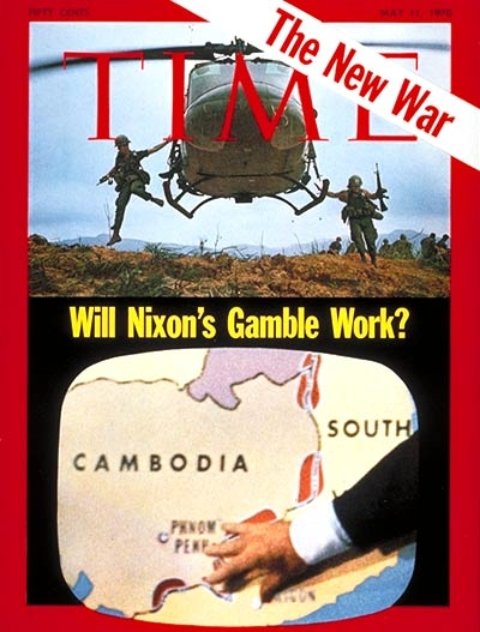
On 30 April 1970, 45 years ago this month, President Richard M. Nixon ordered an invasion into Cambodia. Explaining his reasoning for widening the war in Southeast Asia, Nixon declared:
If, when the chips are down, the world’s most powerful nation acts like a pitiful, helpless giant, the forces of totalitarianism and anarchy will threaten free nations and free institutions.” [Emphasis added]
So much of the U.S. foreign policy establishment, then and now, is frightfully worried about appearing weak, helpless, impotent. The solution, then and now, is military action. They all want to be Caesars, if only in their own besotted minds. As Shakespeare had Cassius say about Caesar:
he doth bestride the narrow world/Like a colossus, and we petty men/Walk under his huge legs and peep about/To find ourselves dishonorable graves.
America, to its image-conscious imperators like Nixon, must bestride the world like a well-hung giant, while little foreigners gasp in awe at the shadow cast, especially when aroused.
Think about John McCain’s fervent desire to bomb Iran, as Dan White deconstructed here. Think about George W. Bush’s transparent desire to play the conquering hero in the Middle East, ending Saddam Hussein’s reign once and for all in Iraq in 2003. Recall here the words of Henry Kissinger when he was asked about why he supported the invasion of Iraq, when it was clear that country bore no responsibility for the 9/11 attacks. “Because [attacks on] Afghanistan wasn’t enough,” Kissinger replied. Radical Islam had humiliated the U.S. at 9/11, and now it was our turn to strike back harder and to humiliate them. That simple.
As America’s foreign policy establishment continues to struggle with radical Islam and instability in Iraq, Syria, Yemen, Libya, and elsewhere, don’t expect any strategic retreats or retrenchment. Don’t expect wisdom. Don’t expect a containment policy that might allow radical Islam to burn itself out. No. Expect more military strikes, more troops, more weapons, more impassioned speeches about holding the line against barbarians determined to end our way of life.
Why? In part because it’s far easier for insecure men to lash out as a way of compensating for their impotence and growing irrelevance. Acting tough is the easier path. Having patience, demonstrating forbearance, knowing when to sheath the sword, requires a quieter strength and a more confident sense of self.
You would think the “most powerful nation on the planet” with “the world’s best military in all of history” would have such quiet strength and confidence. But remember that Nixon quote: No matter how big and strong we are, we can’t afford to look tiny and weak.
Like so many bloated Hollywood movies nowadays, America’s wars may bomb, but they always produce their own sequels.
Look at the latest news from Iraq and Afghanistan. These wars have persisted for more than a decade, with several re-releases to include “surges” and repeats. The latest from Iraq is preparations to retake the city of Mosul from ISIS, which promises a repeat of the level of destruction visited upon Fallujah in 2004. In this there are echoes of Vietnam: in Mosul, we may have to destroy the city to save it. Five Iraqi brigades, most likely supported by American airpower and some American troops on the ground (air controllers and Special Forces), are poised to strike as early as April. Doubtless they’ll prevail, at least for the moment, as the city and its civilians pay a price so dear as to be indistinguishable from defeat. Mosul will be “liberated,” but just look what happened to Fallujah, which after the American “victory” in 2004 is now a devastated city retaken by elements of al-Qaeda in 2014.
(As an aside, it’s interesting that the New York Times uses the word “epic” to describe the Battle of Fallujah from 2004. Surely a better word is “catastrophic.” What is epic about a battle that destroys a city, a battle that is ultimately inconclusive? Check out Bing West’s book about Fallujah, whose title, “No True Glory,” captures the frustrations and contradictions of that battle, mainly from the American perspective.)
Moving to Afghanistan, the latest is that American troops may stay longer than expected (surprise!). Despite all the talk of “progress” in Afghanistan, the takeaway is the following section, from Secretary of Defense Ash Carter’s recent visit to Afghanistan:
“Despite the aid of American air power, 2014 was the deadliest year for Afghan forces since the start of the war in 2001, and many Afghan and Western officials in Kabul believe that 2015 will likely be worse, particularly with less support from Western allies. That has begun to change the conversation about the possibility of slowing down in the [American] withdrawal.”
In other words, expect more micro-surges of American troops and assets in the coming years, as well as more reports of “progress,” however temporary or illusory (at least America’s best and brightest learned from Vietnam not to talk of seeing light at the end of tunnels).
America’s wars are much like the “Transformers” franchise of movies: thrilling and seemingly conclusive at first, with much talk of missions being accomplished, followed by sequel after sequel of repetitive battles, increasingly loud and destructive, signifying vapidity and intellectual bankruptcy even as a few profit greatly from them.
And no one (certainly none of the producers at the Pentagon) seems to be able to pull the plug on green-lighting ever more sequels to these wars. Even when they bomb.
(For a different perspective on how recent Hollywood movies support American warmaking through myth-making, see Peter Van Buren’s insightful article “War Porn” at TomDispatch.com.)
Privatization of war is making it far easier for America’s imperial state to wage endless war throughout the world. Consider the case of Afghanistan. The U.S. military is allegedly leaving that country, turning the fight over to the Afghan military, trained and equipped largely by America.
Ashton Carter, ready and willing to send in the Mercs — there ought to be Mercs — don’t bother, they’re here
But the truth is different: the U.S. has simply privatized the Afghan War, turning it over to military contractors, secretive Special Forces, and the CIA, as reported in this article by Tim Shorrock, in which you’ll find the following quote:
“If you define combat mission as only having large numbers of US combat troops in the field, doing patrols, and engaging the Taliban, then, yes, it [the Afghan War] is coming to an end,” says David Isenberg, a Navy veteran and author who has been researching private security and military contractors since the early 1990s. “But if you define it as continuing to attack and degrade those you consider hostile, via drone or Special Forces or CIA paramilitaries, all of which are supported by contractors, then not so much.”
Not so much, indeed. The future is indeed bright for privatized military contractors. So much so that I have a slogan to offer the next Blackwater/Xe/Academi, the next DynCorp, the next Triple Canopy, the next global mercenary outfit:
My Slogan: Your Wish Is My Commando
Your imperial wish is also my profit, but we won’t mention that fact too loudly.
America was not supposed to go to war like this. Remember our Founders and their ideas on war? War was supposed to be a terrible decision, hotly contested among the people by their duly elected representatives in Congress. It wasn’t supposed to be an easy choice made by presidents, with no real input or debate by that Congress. It was supposed to involve citizen-soldiers motivated to defend the Constitution and sacred freedoms, not pay-for-hire mercenaries motivated by profit and spoils.
But our imperial state knows that it can’t fool all of the people all of the time on the need for endless wars in places like Iraq and Afghanistan, hence the recourse to wars fought largely in secret by hired guns and CIA/paramilitaries. The mainstream media, of course, is owned by some of the same corporations that profit from weapons sales overseas, so don’t expect push-back from them. No — the push-back will have to come from us. We will have to use all the tools at our disposal to fight for enduring peace.
One thing I know: Without our push-back, enduring (as in endless) war is a certainty for America’s future.
Bonus Lesson: Isn’t it nice to know that this is Ashton Carter’s first day on the job as Secretary of Defense? And that he’s open to sending more American troops to Afghanistan? Just the man we needed at the Pentagon. No wonder he was confirmed 93-5 by the Senate.
In America’s war on terror, the groundhog always sees its own shadow, meaning six (or more) years of additional war. War is indeed the new normal in America, as I argue in this article today for TomDispatch.com.
War Is the New Normal Seven Deadly Reasons Why America’s Wars Persist
By William J. Astore
It was launched immediately after the 9/11 attacks, when I was still in the military, and almost immediately became known as the Global War on Terror, or GWOT. Pentagon insiders called it “the long war,” an open-ended, perhaps unending, conflict against nations and terror networks mainly of a radical Islamist bent. It saw the revival of counterinsurgency doctrine, buried in the aftermath of defeat in Vietnam, and a reinterpretation of that disaster as well. Over the years, its chief characteristic became ever clearer: a “Groundhog Day” kind of repetition. Just when you thought it was over (Iraq, Afghanistan), just after victory (of a sort) was declared, it began again.
Now, as we find ourselves enmeshed in Iraq War 3.0, what better way to memorialize the post-9/11 American way of war than through repetition. Back in July 2010, I wrote an article for TomDispatch on the seven reasonswhy America can’t stop making war. More than four years later, with the war on terror still ongoing, with the mission eternally unaccomplished, here’s a fresh take on the top seven reasons why never-ending war is the new normal in America. In this sequel, I make only one promise: no declarations of victory (and mark it on your calendars, I’m planning to be back with seven new reasons in 2019).
1. The privatization of war: The U.S. military’s recourse to private contractors has strengthened the profit motive for war-making and prolonged wars as well. Unlike the citizen-soldiers of past eras, the mobilized warrior corporations of America’s new mercenary moment — the Halliburton/KBRs (nearly $40 billion in contracts for the Iraq War alone), the DynCorps ($4.1 billion to train 150,000 Iraqi police), and the Blackwater/Xe/Academis ($1.3 billion in Iraq, along with boatloads of controversy) — have no incentive to demobilize. Like most corporations, their business model is based on profit through growth, and growth is most rapid when wars and preparations for more of them are the favored options in Washington.
“Freedom isn’t free,” as a popular conservative bumper sticker puts it, and neither is war. My father liked the saying, “He who pays the piper calls the tune,” and today’s mercenary corporations have been calling for a lot of military marches piping in $138 billion in contracts for Iraq alone, according to the Financial Times. And if you think that the privatization of war must at least reduce government waste, think again: the Commission on Wartime Contracting in Iraq and Afghanistan estimated in 2011 that fraud, waste, and abuse accounted for up to $60 billion of the money spent in Iraq alone.
To corral American-style war, the mercenaries must be defanged or deflated. European rulers learned this the hard way during the Thirty Years’ War of the seventeenth century. At that time, powerful mercenary captains like Albrecht von Wallenstein ran amok. Only Wallenstein’s assassination and the assertion of near absolutist powers by monarchs bent on curbing war before they went bankrupt finally brought the mercenaries to heel, a victory as hard won as it was essential to Europe’s survival and eventual expansion. (Europeans then exported their wars to foreign shores, but that’s another story.)
2. The embrace of the national security state by both major parties:Jimmy Carter was the last president to attempt to exercise any kind of control over the national security state. A former Navy nuclear engineer who had served under the demanding Admiral Hyman Rickover, Carter cancelled the B-1 bomber and fought for a U.S. foreign policy based on human rights. Widely pilloried for talking about nuclear war with his young daughter Amy, Carter was further attacked for being “weak” on defense. His defeat by Ronald Reagan in 1980 inaugurated 12 years of dominance by Republican presidents that opened the financial floodgates for the Department of Defense. That taught Bill Clinton and the Democratic Leadership Council a lesson when it came to the wisdom of wrapping the national security state in a welcoming embrace, which they did, however uncomfortably. This expedient turn to the right by the Democrats in the Clinton years served as a temporary booster shot when it came to charges of being “soft” on defense — until Republicans upped the ante by going “all-in” on military crusades in the aftermath of 9/11.
Since his election in 2008, Barack Obama has done little to alter the course set by his predecessors. He, too, has chosen not to challenge Washington’s prevailing catechism of war. Republicans have responded, however, not by muting their criticism, but by upping the ante yet again. How else to explain House Speaker John Boehner’s invitation to Israeli Prime Minister Benjamin Netanyahu to address a joint session of Congress in March? That address promises to be a pep talk for the Republicans, as well as a smack down of the Obama administration and its “appeasenik” policies toward Iran and Islamic radicalism.
Serious oversight, let alone opposition to the national security state by Congress or a mainstream political party, has been missing in action for years and must now, in the wake of the Senate Torture Report fiasco (from which the CIAemerged stronger, not weaker), be presumed dead. The recent midterm election triumph of Republican war hawks and the prospective lineup of candidates for president in 2016 does not bode well when it comes to reining in the national security state in any foreseeable future.
3. “Support Our Troops” as a substitute for thought. You’ve seen them everywhere: “Support Our Troops” stickers. In fact, the “support” in that slogan generally means acquiescence when it comes to American-style war. The truth is that we’ve turned the all-volunteer military into something like aforeign legion, deploying it again and again to our distant battle zones and driving it into the ground in wars that amount to strategic folly. Instead of admitting their mistakes, America’s leaders have worked to obscure them by endlessly overpraising our “warriors” as so many universal heroes. This may salve our collective national conscience, but it’s a form of cheap grace that saves no lives — and wins no wars.
Instead, this country needs to listen more carefully to its troops, especially the war critics who have risked their lives while fighting overseas. Organizations like Iraq Veterans Against the War and Veterans for Peace are good places to start.
4. Fighting a redacted war. War, like the recent Senate torture report, is redacted in America. Its horrors and mistakes are suppressed, its patriotic whistleblowers punished, even as the American people are kept in a demobilized state. The act of going to war no longer represents the will of the people, as represented by formal Congressional declarations of war as the U.S. Constitution demands. Instead, in these years, Americans were told togo to Disney World (as George W. Bush suggested in the wake of 9/11) and keep shopping. They’re encouraged not to pay too much attention to war’s casualties and costs, especially when those costs involve foreigners with funny-sounding names (after all, they are, as American sniper Chris Kyle so indelicately put it in his book, just “savages”).
Redacted war hides the true cost of a permanent state of killing from the American people, if not from foreign observers. Ignorance and apathy reign, even as a national security state that is essentially a shadow governmentequates its growth with your safety.
5. Threat inflation: There’s nothing new about threat inflation. We saw plenty of it during the Cold War (nonexistent missile and bomber gaps, for example). Fear sells and we’ve had quite a dose of it in the twenty-first century, from ISIS to Ebola. But a more important truth is that fear is a mind-killer, a debate-stifler.
Back in September, for example, Senator Lindsey Graham warned that ISIS and its radical Islamic army was coming to America to kill us all. ISIS, of course, is a regional power with no ability to mount significant operations against the United States. But fear is so commonplace, so effectively stoked in this country that Americans routinely and wildly exaggerate the threat posed by al-Qaeda or ISIS or the bogeyman du jour.
Decades ago, as a young lieutenant in the Air Force, I was hunkered down inCheyenne Mountain during the Cold War. It was the ultimate citadel-cum-bomb-shelter, and those in it were believed to have a 70% likelihood of surviving a five-megaton nuclear blast. There, not surprisingly, I found myself contemplating the very real possibility of a thermonuclear exchange with the Soviet Union, a war that would have annihilated life as we knew it, indeed much of life on our planet thanks to the phenomenon of nuclear winter. You’ll excuse me for not shaking in my boots at the threat of ISIS coming to get me. Or of Sharia Law coming to my local town hall. With respect to such fears, America needs, as Hillary Clinton said in an admittedly different context, to “grow a pair.”
6. Defining the world as a global battlefield: In fortress America, all realms have by now become battle spheres. Not only much of the planet, the seas, air, and space, as well as the country’s borders and its increasingly up-armored police forces, but the world of thought, the insides of our minds. Think of the 17 intertwined intelligence outfits in “the U.S. Intelligence Community” and their ongoing “surge” for information dominance across every mode of human communication, as well as the surveillance of everything. And don’t forget the national security state’s leading role in making cyberwar a reality. (Indeed, Washington launched the first cyberwar in history by deploying the Stuxnet computer worm against Iran.)
Think of all this as a global matrix that rests on war, empowering disaster capitalism and the corporate complexes that have formed around the Pentagon, the Department of Homeland Security, and that intelligence community. A militarized matrix doesn’t blink at $1.45 trillion dollars devoted to the F-35, a single under-performing jet fighter, nor at projections of $355 billion over the next decade for “modernizing” the U.S. nuclear arsenal, weapons that Barack Obama vowed to abolish in 2009.
7. The new “normal” in America is war: The 9/11 attacks happened more than 13 years ago, which means that no teenagers in America can truly remember a time when the country was at peace. “War time” is their normal; peace, a fairy tale.
What’s truly “exceptional” in twenty-first-century America is any articulated vision of what a land at peace with itself and other nations might be like. Instead, war, backed by a diet of fear, is the backdrop against which the young have grown to adulthood. It’s the background noise of their world, so much a part of their lives that they hardly recognize it for what it is. And that’s the most insidious danger of them all.
How do we inoculate our children against such a permanent state of war and the war state itself? I have one simple suggestion: just stop it. All of it. Stop making war a never-ending part of our lives and stop celebrating it, too. War should be the realm of the extreme, of the abnormal. It should be the death of normalcy, not the dreary norm.
It’s never too soon, America, to enlist in that good fight!
William J. Astore, a retired lieutenant colonel (USAF), is a TomDispatch regular. His D.Phil. is in Modern History from the University of Oxford. He’s just plain tired of war and would like to see the next politician braying for it be deployed with a rifle to the front lines of battle. He edits the blog The Contrary Perspective.
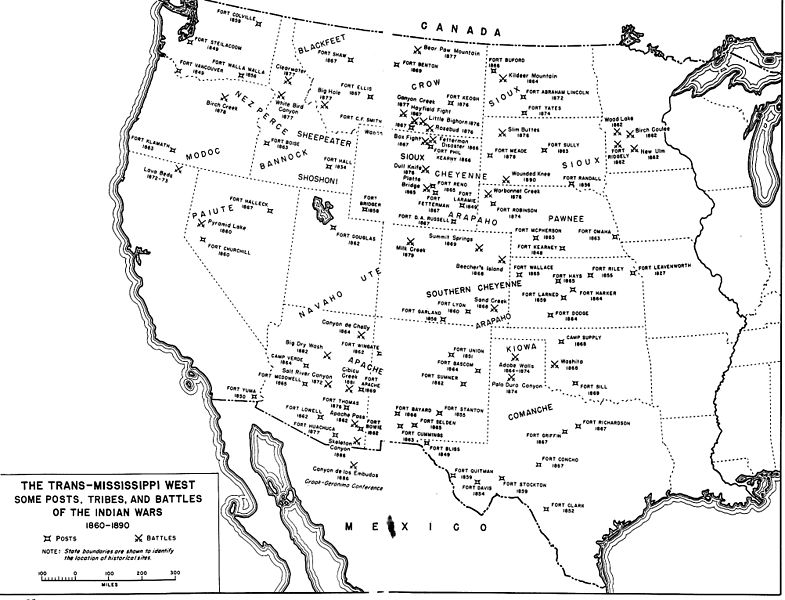
Just a few of the battles fought against Native Americans
W.J. Astore
A popular headline in the media is to describe the Afghan War as “America’s longest,” as in this brief summary today from Foreign Policy:
The war in Afghanistan, America’s longest, is now formally over. The 13-year war, which claimed more than 2,200 American lives and cost more than one trillion dollars, ended quietly at a ceremony in Kabul yesterday. U.S. President Barack Obama and other Western leaders promised their ongoing commitment under the rebranded Operation Resolute Support and insisted the war was a success. But the Taliban is poised for a comeback with a recent surge in violence in Kabul and around the country. There are concerns that Afghanistan’s military and fragile political institutions will crumble as the United States leaves.
There’s a big problem with this. America’s longest war, by far, is not the recent Afghan War; it was its more or less continuous effort against Native Americans from the early 1600s to the late 1800s. Americans like to forget that native peoples populated the land before European settlers began to arrive, and that these native peoples had to be killed, or corralled, or otherwise subjugated or shunted aside in the name of Manifest Destiny and in the pursuit of profit.
As historian John Grenier notes in The First Way of War: American War Making on the Frontier, 1607-1814,
For the first 200 years of our military heritage, then, Americans depended on arts of war … [that included] razing and destroying enemy villages and fields; killing enemy women and children; raiding settlements for captives; intimidating and brutalizing enemy noncombatants; and assassinating enemy leaders.
For Grenier, America’s “first way of war” relied on “extravagant violence” often aimed at “the complete destruction of the enemy,” in this case various Native American peoples. This was indeed America’s longest war. Yet despite (or perhaps because of) its long duration and brutal violence, the war against indigenous peoples is rarely mentioned today, especially by those who seek to promote American exceptionalism.
Another longer war than the Afghan one, more recent in America’s memory, was the Cold War we fought against the Soviet Union and its allies from the close of World War II to the collapse of the Soviet Union in the early 1990s. Lasting nearly half a century, this war ended in victory of a sort for the United States, even as its legacy continues to poison U.S. culture and foreign relations. For the Cold War left us with an enormous military-industrial-Congressional complex, to include nuclear forces capable of destroying the planet, which the U.S. continues to feed and even to enlarge. The result has been the growth of a second “shadow” government, a national security and surveillance state of enormous power, an apparatus with wide-reaching and unaccountable powers that is potentially a greater threat to American freedoms than the Soviet Union ever was.
When America forgets its longest wars, and especially when Americans forget the legacies of these wars, it’s more than history that suffers.
Update: Just after I wrote this, I came across this article on corporate “land grabs” that continue to bedevil Native Americans. Some would argue that the long war against native peoples never really ended. And to state a point that is perhaps obvious: the Afghan War grew out of the Cold War and U.S. efforts to embroil the Soviet Union in its own Vietnam in 1980. U.S. efforts to support the Afghan “freedom fighters” against the Soviets contributed to the rise of Osama bin Laden, who would eventually turn against the U.S. in the 1990s. America’s Afghan War, in other words, is not a 13-year war. To understand it, one must look back to 1979-80 and the machinations of a U.S. foreign policy establishment that was much more concerned with hobbling the Soviets than with helping the Afghan people.
Bush rebranded as a war president: Mission Accomplished!
W.J. Astore
The United States continues to insert the bodies of its troops into leaky Iraqi and Afghan dikes. That’s the image that came to mind with the recent news from Iraq and Afghanistan. More American “advisers” and weapons being sent to Iraq. The revival of night raids by U.S. Special Forces in Afghanistan. No matter the piss-poor results in Iraq or Afghanistan, the U.S. continues to double down on losing hands.
Why is there no learning curve in Washington? A big reason is that President Obama’s decisions have been, are, and will be driven by domestic politics. The Democrats don’t dare withdraw from either war since ISIS or the Taliban would grow in strength (at least in the short-term), and the Republicans would eagerly blame the Democrats for “losing” wars that George W. Bush and General David Petraeus and U.S. troops had allegedly won.
The cynical Democratic solution to this dilemma is to plug the Iraqi and Afghan dikes with more U.S. troops (and, most likely, more casualties) until after the election of 2016.
Domestic political advantage is often the major reason for continued folly in lost wars. We saw it in Vietnam: neither LBJ nor Nixon wanted to be seen as having “lost” Vietnam. Nixon in particular had his eye on the election of 1972 as well as on posterity as he made decisions about the war.
America’s wars overseas are far too often driven by public relations for domestic consumption. Consider the invasion of Iraq in 2003 and the Bush Administration’s announcement of “Mission Accomplished,” a staged Hollywood photo op meant to cement Bush’s status domestically as a war leader. Far better it was to have an image of co-pilot Bush landing in a flight suit on an aircraft carrier than one of a befuddled Bush reading about pet goats to schoolchildren on the morning of 9/11. Obama is hardly guiltless here. Even as he questioned the Iraq war, he ran in 2008 on the idea of Afghanistan being the necessary war, thus immunizing himself from charges of being “soft” on defense. Afghanistan is no closer to being “won” for the U.S. today than it was six years ago, yet Obama’s folly continues, aggravated by recent orders to return American troops to Iraq.
Internationally, it’s strategic folly for the U.S. to persist in these wars. But domestically, endless wars act as a coat of armor to deflect charges of being a wimp (for Obama) or of being incompetent (for Bush after 9/11). With his drone strikes, Obama has become the assassin-in-chief, even as Bush with the invasions of Afghanistan and Iraq became the “war president” (at least in his own mind, together with the minds of a subservient and fawning media).
Christ said, “Blessed are the peacemakers,” but America has no time for peace. Not when “peace” leaves one open to political charges of being an un-American wimp and loser.
Want to help change this? At the very least, vote for the candidate in 2016 who vows to end America’s wars in Iraq and Afghanistan. Vote for the candidate who vows to end the practice of stuffing American bodies into so many of the world’s leaky dikes. Vote for the candidate who stands for peace rather than for war. Regardless of the election results, that candidate won’t be a “loser.” For in America today, in a land tortured by gusty winds of war, it’s far gutsier to stand for peace.
The three Afghan officers who went missing (Cape Cod Times)
W.J. Astore
Two Afghan stories this week suggest much about U.S. progress in winning hearts and minds there. The first involves Hamid Karzai. Afghanistan’s departing president, the “Mayor of Kabul,” Karzai asserted that “America did not want peace for Afghanistan, because it had its own agendas and goals here.” It’s easy to paint Karzai as a dissembling ingrate, which is exactly what the American ambassador to Afghanistan did in response. But it truly says something that Karzai, the recipient of more than $100 billion in developmental aid from the U.S. for Afghanistan (not including military aid!), portrays the U.S. as working against the interests of the Afghan people. There’s one heart and mind the U.S. plainly didn’t win.
The second story involves three Afghan officers, one major and two captains, on a training mission at Camp Edwards in Massachusetts. The three officers, carefully vetted by U.S. Central Command, decided they had had enough of working with America. They drove to New York and attempted to enter Canada at Niagara Falls, seeking asylum, or so it seems. There are three more hearts and minds the U.S. plainly didn’t win.
The details of this particular story are farcical. The night before their unauthorized trip to the Canadian border, they enjoyed the pleasures of a genuine American strip club, where they were reportedly “well behaved” according to the club owner. The next day, they were brought to an American shopping mall as part of their introduction to “the cultural aspects of American life.” At the mall, they gave their escort the slip and headed to Canada, where they were eventually intercepted at the border crossing at Niagara Falls. According to The Cape Cod Times, when the three Afghan officers went missing, among the first places the U.S. military looked for them was at the strip club.
Talk about an introduction to American culture! First a strip club on Friday night, then a shopping mall on the weekend, then an unscheduled road trip to a major tourist attraction. These Afghan officers may have absorbed too much of the American way.
In all seriousness, what does it say about the success of American efforts vis-a-vis Afghanistan when its former president denounces the U.S. and visiting Afghan officers, after sampling American fleshpots and temples to consumerism, attempt to flee to Canada?
There’s a lesson here about folly, if only we would care to draw it.










 Bracing Views