Yesterday, I talked to Dick Price, a Vietnam War veteran, at the LA Progressive about the U.S. military, the Vietnam War, the all-volunteer military, media coverage, and why America just can’t stop making war.
When no one is held accountable for failure, when lies are used as the basis for killing, when war produces colossal profits for a select few, when Congress refuses to take responsibility for oversight, when war budgets keep climbing to the trillion dollar mark, it isn’t all that surprising that wars prove essentially endless as democracy withers.
“Fighting a war to fix something works about as good as going to a whorehouse to get rid of a clap.” — Norman Mailer, The Naked and the Dead
I read Norman Mailer’s fine book about World War II, “The Naked and the Dead,” several years ago, though I’d forgotten the quote above until I ran across it again in an article by Andrew Bacevich at Harper’s in 2009.
Bacevich’s article was titled “The War We Can’t Win,” in which he critiqued and rejected President Barack Obama’s decision to “surge” in Afghanistan. As Bacevich wrote back in 2009:
What is it about Afghanistan, possessing next to nothing, that the United States requires, that justified such lavish attention? In Washington, this question goes not only unanswered but unasked. Among Democrats and Republicans alike, with few exceptions, Afghanistan’s importance is simply assumed—much the way fifty years ago otherwise intelligent people simply assumed that the United States had a vital interest in ensuring the survival of South Vietnam. Today, as then, the assumption does not stand up to even casual scrutiny.
Bacevich was right, of course. And once America pulled out of Afghanistan in 2021, we were encouraged to forget about it, just as we were encouraged to forget about Vietnam after the fall of Saigon in 1975.
If it doesn’t matter much to the U.S. when we lose wars, doesn’t that suggest the wars meant little to begin with? That there never truly were vital matters of national interest at stake?
The same was true of the Iraq War, as Bacevich describes it in the same article for Harper’s. This war, Bacevich writes, was “utterly needless” as “no Iraqi weapons of mass destruction [were] found, no ties between Saddam Hussein and the [9/11] jihadists established, no democratic transformation of the Islamic world set into motion, no road to peace in Jerusalem discovered in downtown Baghdad,” yet the U.S. was nevertheless hyping the success of the “surge” there from 2007 and how it should be applied to Afghanistan, an example of obtuseness and self-delusion that Bacevich said “is nothing short of obscene.”
He was right, of course, as both surges proved as fragile and reversible as weasel-worded General David Petraeus hinted they would be. Petraeus might be America’s best example of Grima Wormtongue from “The Lord of the Rings,” though of course there’s a lot of competition for that honor.
Bacevich, a retired Army colonel, political scientist, and Vietnam War veteran, criticizes U.S. leaders for their “failure of imagination,” for their crusading zeal, for their hubris, and for their tendency to substitute technique for sound strategy. He is right about all this, but someone always profits from war. Somebody always wins. And so perhaps the best way to understand these wars is to focus on the winners.
So, who won these wars? Certainly, the military-industrial complex won them. Every war, winning or losing, wise or unwise, strengthens the MIC by expanding its budgetary authority and scope of action. Military contractors, the merchants of death, especially profit from war, notably long “stalemated” ones like Vietnam, Iraq, and Afghanistan.
In a short video clip, Wikileaks Founder Julian Assange explained the purpose of the Afghan War which, as Bacevich mentions above, is inexplicable in terms of U.S. national interest:
A vast money-laundering operation that enriches oligarchs who profit from war, death, and mayhem: it makes a lot of sense, doesn’t it? Note too how Assange explains that the ultimate purpose here is to make war permanent, to make it normal, to make it unremarkable, even to make it the height of sanity.
This has happened and is happening. Today, Iraq and Afghanistan are largely forgotten in the U.S. and Europe. New fears are focused on bigger fish: Russia and/or China, even as the U.S. pummels Yemen. Few Western leaders are talking about peace; Europe is fixated on Russia even as America is more concerned with pivoting to Asia and doing the bidding of Israel in the Middle East.
And so the money-laundering continues.
A lesson here is to follow the money, especially when wars seem strategically stupid, because the people and forces in charge aren’t stupid—their priorities are just far different from our priorities.
And this is something Bacevich catches in a different context as he explains that the costs of war are not borne “by the people who inhabit the leafy neighborhoods of northwest Washington, who lunch at the Palm or the Metropolitan Club and school their kids at Sidwell Friends.” Indeed not. The costs are borne by the peoples of Iraq, Afghanistan, Yemen, and so on, as well as those U.S. troops who get caught waging these wars, and who likely come from small towns in Alabama and Texas and similar rural areas.
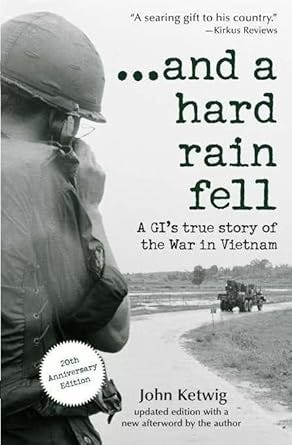
I’ve been reading John Ketwig’s memoir “…and a hard rain fell: A GI’s true story of the War in Vietnam,” and it’s reminding me just how plain dumb, destructive, and duplicitous America’s wars have been since World War II.
America’s wars are always dressed up with a necessary, even allegedly noble, cause. In Vietnam, we had to stop communism and all those dominoes from falling. In Iraq, it was about WMD and stopping Saddam Hussein, “the next Hitler.” In Afghanistan, it was about vengeance for 9/11, then creating democracy and even helping women. (How about helping women in America? Never mind.)
Vietnam is nominally communist today—and a big trading partner of the U.S. and an ally of sorts against China. No dominoes fell. Iraq didn’t have WMD and Saddam wasn’t the next Hitler; he was merely a regional strongman and a former U.S. ally who got a little too big for his britches, especially for Israel. Afghanistan was a war in search of a clear mission and attainable goals. After twenty years of effort and roughly $2 trillion in expenditures, the U.S. replaced the Taliban with—the Taliban. (I heard Norman Finkelstein say this first.)
We’re always told versions of the same lie: We need to fight them over there so that we don’t have to fight them here. Communism had to be rolled back in Vietnam else commies would be landing in Manhattan. Iraq had to be pummeled and Saddam overthrown before WMD landed in Boston. Afghanistan had to be pacified and modernized before the Taliban enforced conservative Sharia law in Biloxi.
None of this was true. The United States would have been perfectly safe without committing any troops to Vietnam, Iraq, and Afghanistan. In fact, the U.S. would have been far better off if those wars had never been fought. Certainly Vietnam, Iraq, and Afghanistan would have been far better off if they’d never become free-fire zones for American munitions (including the poisonous Agent Orange in Vietnam and, more recently, depleted uranium and other poisons in Iraq and Afghanistan).
Now we’re hearing about a possible U.S. war with Iran, allegedly to stop that country from acquiring an atomic bomb. It’s OK for the U.S. to have more than 5000 nuclear warheads and for Israel to have 200 or so, but it’s not OK for Iran to have even one, because reasons.
The U.S. military, vast as it is, with a vision of global dominance, always needs enemies. Of course, it’s not simply the military but the whole military-industrial complex, the MICIMATT,* which needs war and conflict to sustain itself.
I recently read “American War,” a powerful novel by Omar El Akkad. It imagines a second U.S. civil war starting roughly 50 years from now. It’s a fascinating book, well worth reading because it captures the horror of war, with all its atrocities, its massacres, its war crimes, and the deep wounds war leaves behind even among the most resolute survivors. John Ketwig’s book does the same as he recounts the fears and horrors of his year in Vietnam and the personal struggles he endured in coming to terms with what he’d seen and endured.
So, count me among those who are already against the next war, whether against Iran, China, or for that matter any other country. Sure, I think America needs to defend itself; I don’t think peace is going to break out spontaneously around the world; but I know for a fact that fighting constant wars is not a way toward greater peace and prosperity. Quite the opposite.
If you want to know what desperate and profoundly wounded war survivors are capable of, read “American War.” If you want to know what desperate and profoundly confused troops are capable of, read “…and a hard rain fell.” And ponder the continued propaganda here of the “good war,” the wonders of warriors and warfighters, and the repetition of slogans like “peace through strength,” a specific form of strength measured in kilotons and megatons of explosives, in massive body counts and military production figures.
Ask yourself: Is that “strength”? Are constant wars truly the path toward peace? How can we possibly be so dumb as to believe this?
MICIMATT: military-industrial-congressional-intelligence-media-academe-think-tank complex. It employs millions of people and spends more than a trillion dollars a year. It’s not easily confronted. Nor is it easily contained, let alone curtailed.
Perpetual War Abroad Is the Most Insidious Enemy to Liberty and Freedom at Home
I wrote my first article for TomDispatch in 2007, two years after I’d retired from the military. That article was highly critical of the U.S. military and its disastrous war in Iraq. I wrote that we, the citizens of America, had to save the military from itself and its worst excesses. Sadly, we the people have been demobilized; we have no say about “our” military and its wars.
In fact, while the Iraq and Afghan Wars are now officially over, both lost at enormous cost, we the people are still issuing blank checks to a Pentagon that is wildly if not fatally deluded and delusional.
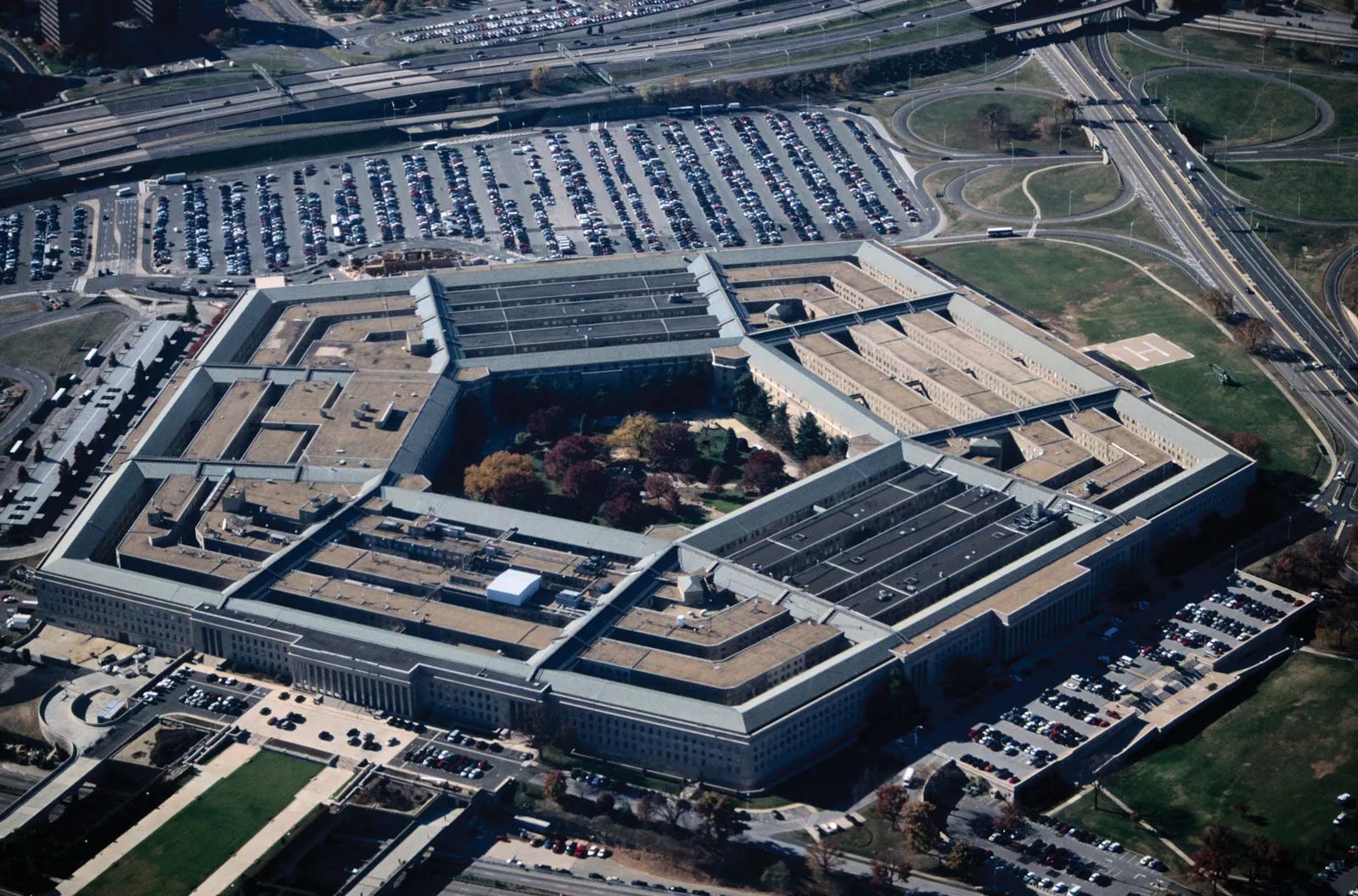
Much like a black hole, the Pentagon keeps sucking in everything around it, especially taxpayer dollars
Back in 2018, Tom Engelhardt, the creator, editor, and prime mover of TomDispatch, asked me to write a new introduction to my article from 2007. Here’s that intro as I wrote it back then:
Retiring from the U.S. military liberated my tongue, but I quickly learned few people were interested in what I had to say. In 2007, I was outraged by the way the Bush administration hid behind the richly bemedaled chest of General David Petraeus, using his testimony before a spineless Congress to evade responsibility for the catastrophic war in Iraq. I wrote an op-ed about how ‘my’ military was deluding itself not only into believing that it was the ‘greatest’ but that it could somehow find a formula to win an unwinnable war. I sent it to the usual suspects, newspapers like the New York Times and Boston Globe, with no response. A friend then mentioned a website I’d never heard of, TomDispatch.com, and I found a man there who would listen: today’s equivalent of I.F. Stone, Tom Engelhardt. What started as a one-off article led to 55 more ‘Tomgrams‘ over the last decade.
In that very first post, I asked, ‘How can you win someone else’s civil war?’ It’s a question the U.S. military still avoids asking, let alone answering. Indeed, a state of what I then called ‘ongoing self-delusion’ about war persists in that military and American society as a whole. More than a decade later, its commanders continue to mislead themselves and the rest of us by speaking about ‘new’ approaches that promise ‘progress’ in places like Afghanistan.
Who will teach the Pentagon that wars that never should have been fought cannot be won? Who will remind the American people that perpetual war abroad is the most insidious enemy to liberty and freedom at home? Members of the military, active duty and retired, need to speak up. Our oath to the Constitution was never about saluting smartly and following blindly, but about allegiance to the noble ideals expressed in that document. William J. Astore, May 2018
Since 2018, I’ve written another fifty or so articles for TomDispatch, nearly all of them focusing on U.S. military folly and fallacies. It hasn’t mattered. Both parties, Republicans and Democrats, profess their unconditional love of “our” troops, even as they’ve shoved and shoveled trillions of dollars to the military-industrial-congressional complex, the all-powerful MICIMATT* that increasingly infects our lives and infests our society and culture.
This November provides us another opportunity to go to the polls and allegedly vote for what we want. Most people want peace. The Republicans and Democrats offer us more war. Might I suggest that we vote for a person or party that actually seeks peace?
It’s highly unlikely we’re going to vote ourselves out of the mess we’re in. Look at the mainstream candidates! But at least we shouldn’t vote for yet more insanity.
*MICIMATT: military industrial congressional intelligence media academe think tank complex. To that you can now add Hollywood and the world of sports as well. Hercules had a much easier time vanquishing the hydra. It only had seven heads.
Finally a bit of truth from the New York Times, but for what reason, and why now?
Remember when Barack Obama claimed in 2007-09 the Afghan War was the right war, the good one, as opposed to the wrong and bad Iraq War prosecuted by Bush/Cheney? Of course, they were both disastrous wars, but until the Biden administration finally pulled out, chaotically so, in 2021, the mainstream media was still supporting the idea that America was doing good in Afghanistan.
I suppose enough time has passed for the New York Times to allow for a measure of honesty, if only to support Joe Biden’s reelection this year. See, Biden made the rightdecision to withdraw because now we finally can admit the war was a disaster. Naturally, it wasn’t entirely or even mainly the U.S. government’s fault …
Of course, plenty of people knew the Afghan War was a disaster; my colleague Matthew Hoh resigned from the State Department in 2009 in protest against Obama’s “surge” there and counterproductive U.S. policy decisions. Democrats in Congress listened to Hoh and a few wanted to change course, but they were brought to heel by Nancy Pelosi, who said no dissent on the Afghan War was permissible when Obama was fighting so hard for health care reform in America. Hoh heard those words straight from Pelosi’s mouth. So we got twelve more years of disastrous war and Obamacare.
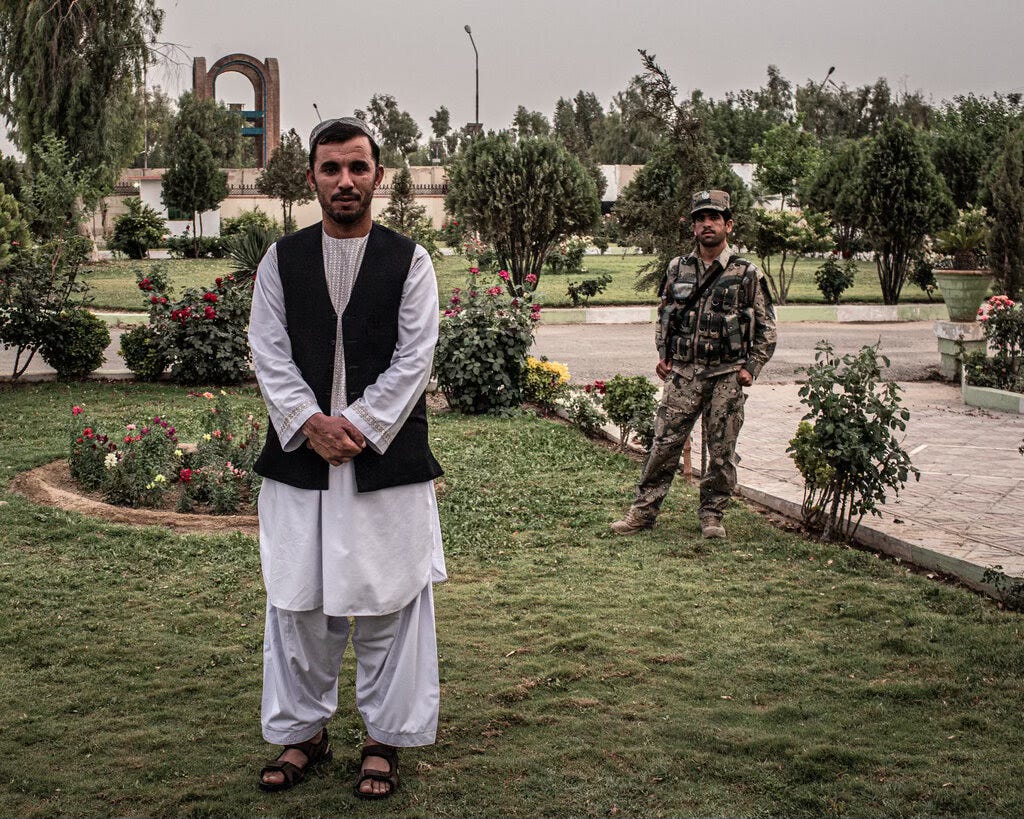
Abdul Aziq in 2015 (Bryan Denton for the New York Times)
Anyhow, in my NYT news feed this AM, the “hidden history” of America’s “savage campaign” is finally being covered, though the savageness is largely ascribed to an Afghan ally of the U.S., General Abdul Aziq. As usual, American “advisers” tried to curb his worst instincts, apparently without success. Well, what can you do with such “savages”?
Here’s how the NYT puts it:
But his [Aziq’s] success, until his 2018 assassination, was built on torture, extrajudicial killing and abduction. In the name of security, he transformed the Kandahar police into a combat force without constraints. His officers, who were trained, armed and paid by the United States, took no note of human rights or due process, according to a New York Times investigation into thousands of cases that published this morning. Most of his victims were never seen again.
Washington’s strategy in Afghanistan aimed to beat the Taliban by winning the hearts and minds of the people it was supposedly fighting for. But Raziq embodied a flaw in that plan. The Americans empowered warlords, corrupt politicians and outright criminals in the name of military expediency. It picked proxies for whom the ends often justified the means.
The NYT is shocked, shocked!, that there was a “flaw” in the U.S. plan that “empowered warlords, corrupt politicians and outright criminals” in the cause of military “progress.” Hmm…sounds more like a feature of U.S. policy than a flaw.
What about all those U.S. generals testifying to Congress under oath about the progress we were allegedly making in Afghanistan? Are any of them going to be called to account? You can bet your sweet combat boots that they’re not.
After Aziq, matters grew even worse in Afghanistan, as the NYT puts it here: “What they [new warlords and supposed U.S. allies] brought under the name of democracy was a system in the hands of a few mafia groups,” said one resident of Kandahar who initially supported the government. “The people came to hate democracy.”
So, instead of Operation Enduring Freedom, America brought Operation Endemic Corruption to Afghanistan. That latter operation most definitely succeeded.
Here’s how the NYT summarizes its new study of the Afghan War:
Historians and scholars will spend years arguing whether the United States could have ever succeeded. The world’s wealthiest nation had invaded one of its poorest and attempted to remake it by installing a new government. Such efforts elsewhere have failed.
But U.S. mistakes — empowering ruthless killers, turning allies into enemies, enabling rampant corruption — made the loss of its longest war at least partly self-inflicted. This is a story Matthieu [Aikins] and I [Azam Ahmed] will spend the coming months telling, from across Afghanistan.
Echoes of the Vietnam War here. The world’s wealthiest nation invading a much poorer one in the name of “democracy,” then spreading corruption and devastation ending in a chaotic withdrawal. And now grudging admission that maybe, just maybe, the U.S. loss in Afghanistan was “at least partly self-inflicted.”
Ya think? Or maybe we can just blame the Afghan people, just as we blamed our “allies” in South Vietnam.
Nothing against Aikins and Ahmed here. I’m sure their “hidden history” of America’s war in Afghanistan will be revelatory. Yet why was it “hidden” for so long? And why are the “hiders” never called to account?
And was it really “hidden”? Matthew Hoh wasn’t the only truth-teller willing to blow a whistle. Why was his honest voice suppressed while worm-tongued generals like David Petraeus and Stanley McChrystal were celebrated?
I wonder when we’ll get the “hidden history” of America’s “savage” involvement in Gaza and Ukraine? Perhaps in 2030?
From Boots on the Ground to Robot Assassins in the Sky
I’m proud to say I’ve been writing for TomDispatch since 2007, posting more than 100 original articles at the site. Among the many features of that remarkable site, run by Tom Engelhardt, this generation’s I.F. Stone, is its reach across political spectrums, across America, and indeed across the globe. My most recent article, for example, was translated into Portuguese (for a Brazilian site) and Swedish. Tom and I usually aren’t contacted for permission; these translations and postings just happen.
Briefly in 2010, a few of my “tomgrams” broke through to the mainstream media, being reposted by CBS News. What follows is one of them, “Seven Reasons Why We Can’t Stop Making War,” in which I refer to a disaster of that day, the BP Deepwater Horizon oil spill.
Sadly, despite a little boost from CBS News, my critique went unheeded. Surprise! America is still making war (with certain entities profiting greatly from this), now with yet more robots even as U.S. boots on ground in direct combat are far fewer. It’s a formula for “low-cost” forever war that of course comes at a very high cost indeed, starting with a Pentagon budget soaring toward $900 billion a year, not including more than $120 billion already provided or promised to Ukraine for its war effort.
From CBS News in 2010, my article on why the U.S. can’t stop making war. The original title was “Operation Enduring War” at TomDispatch in July 2010.
If one quality characterizes our wars today, it’s their endurance. They never seem to end.
Though war itself may not be an American inevitability, these days many factors combine to make constant war an American near certainty. Put metaphorically, our nation’s pursuit of war taps so many wellsprings of our behavior that a concerted effort to cap itwould dwarfBP’s efforts in the Gulf of Mexico.
Our political leaders, the media, and the military interpret enduring war as a measure of our national fitness, our global power, our grit in the face of eternal danger, and our seriousness. A desire to de-escalate and withdraw, on the other hand, is invariably seen as cut-and-run appeasement and discounted as weakness. Withdrawal options are, in a pet phrase of Washington elites, invariably “off the table” when global policy is at stake, as was true during the Obama administration’s full-scale reconsideration of the Afghan war in the fall of 2009. Viewed in this light, the president’s ultimate decision to surge in Afghanistan was not only predictable, but the only course considered suitable for an American war leader. Rather than the tough choice, it was the path of least resistance.
Why do our elites so readily and regularly give war, not peace, a chance? What exactly are the wellsprings of Washington’s (and America’s) behavior when it comes to war and preparations for more of the same?
Consider these seven:
1. We wage war because we think we’re good at it — and because, at a gut level, we’ve come to believe that American wars can bring good to others (hence our feel-good names for them, like Operations Enduring Freedom and Iraqi Freedom). Most Americans are not only convinced we have the best troops, the best training, and the most advanced weapons, but also the purest motives. Unlike the bad guys and the barbarians out there in the global marketplace of death, our warriors and warfightersare seen as gift-givers and freedom-bringers, not as death-dealers and resource-exploiters. Our illusions about the military we “support” serve as catalyst for, and apology for, the persistent war-making we condone.
2. We wage war because we’ve already devoted so many of our resources to it. It’s what we’re most prepared to do. More than half of discretionary federal spending goes to fund our military and its war making or war preparations. The military-industrial complex is a well-oiled, extremely profitable machine and the armed forces, our favorite child, the one we’ve lavished the most resources and praise upon. It’s natural to give your favorite child free rein.
3. We’ve managed to isolate war’s physical and emotional costs, leaving them on the shoulders of a tiny minority of Americans. By eliminating the draft and relying ever more on for-profit private military contractors, we’ve made war a distant abstractionfor most Americans, who can choose to consume it as spectacle or simply tune it out as so much background noise.
4. While war and its costs have, to date, been kept at arm’s length, American society has been militarizing fast. Our media outlets, intelligence agencies, politicians, foreign policy establishment, and “homeland security” bureaucracy are so intertwined with military priorities and agendas as to be inseparable from them. In militarized America, griping about soft-hearted tactics or the outspokenness of a certain general may be tolerated, but forceful criticism of our military or our wars is still treated as deviant and “un-American.”
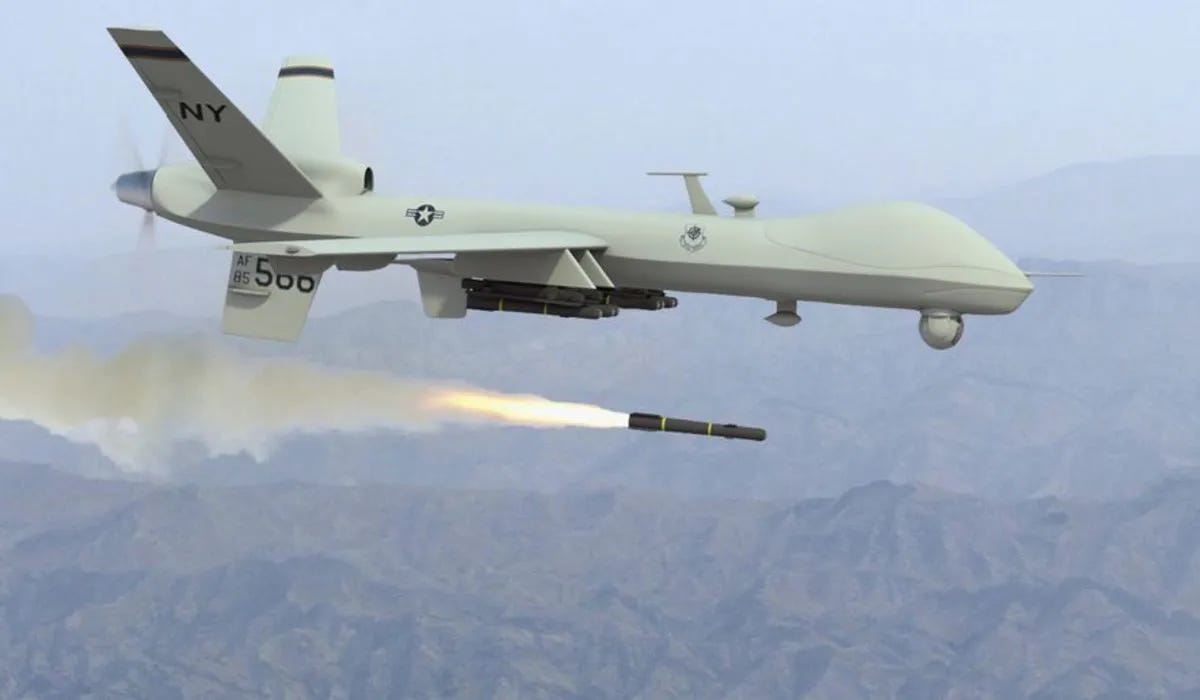
5. Our profligate, high-tech approach to war, including those Predator and Reaper drones armed with Hellfire missiles, has served to limit American casualties — and so has limited the anger over, and harsh questioning of, our wars that might go with them. While the U.S. has had more than 1,000 troops killed in Afghanistan, over a similar period in Vietnam we lost more than 58,000 troops. Improved medical evacuation and trauma care, greater reliance on standoff precision weaponry and similar “force multipliers,” stronger emphasis on “force protection” within American military units: all these and more have helped tamp down concern about the immeasurable and soaring costs of our wars.
It all seems so easy—even “clean”—from the sky. Not even a single U.S. pilot at risk.
6. As we incessantly develop those force-multiplying weapons to give us our “edge” (though never an edge that leads to victory), it’s hardly surprising that the U.S. has come to dominate, if not quite monopolize, the global arms trade. In these years, as American jobs were outsourced or simply disappeared in the Great Recession, armaments have been one of our few growth industries. Endless war has proven endlessly profitable — not perhaps for all of us, but certainly for those in the business of war.
7. And don’t forget the seductive power of beyond-worse-case, doomsday scenarios, of the prophecies of pundits and so-called experts, who regularly tell us that, bad as our wars may be, doing anything to end them would be far worse. A typical scenario goes like this: If we withdraw from Afghanistan, the government of Hamid Karzai will collapse, the Taliban will surge to victory, al-Qaeda will pour into Afghan safe havens, and Pakistan will be further destabilized, its atomic bombs falling into the hands of terrorists out to destroy Peoria and Orlando.
Such fevered nightmares, impossible to disprove, may be conjured at any moment to scare critics into silence. They are a convenient bogeyman, leaving us cowering as we send our superman military out to save us (and the world as well), while preserving our right to visit the mall and travel to Disney World without being nuked.
The truth is that no one really knows what would happen if the U.S. disengaged from Afghanistan. But we do know what’s happening now, with us fully engaged: we’re pursuing a war that’s costing us nearly $7 billion a month that we’re not winning (and that’s arguably unwinnable), a war that may be increasing the chances of another 9/11, rather than decreasing them.
Capping the Wellsprings of War
Each one of these seven wellsprings feeding our enduring wars must be capped. So here are seven suggestions for the sort of “caps” — hopefully more effective than BP’s flailing improvisations — we need to install:
1. Let’s reject the idea that war is either admirable or good — and in the process, remind ourselves that others often see us as “the foreign fighters” and profligate war consumers who kill innocents (despite our efforts to apply deadly force in surgically precise ways reflecting “courageous restraint“).
2. Let’s cut defense spending now, and reduce the global “mission” that goes with it. Set a reasonable goal — a 6-8% reduction annually for the next 10 years, until levels of defense spending are at least back to where they were before 9/11 — and then stick to it.
3. Let’s stop privatizing war. Creating ever more profitable incentives for war was always a ludicrous idea. It’s time to make war a non-profit, last-resort activity. And let’s revive national service (including elective military service) for all young adults. What we need is a revived civilian conservation corps, not a new civilian “expeditionary” force.
4. Let’s reverse the militarization of so many dimensions of our society. To cite one example, it’s time to empower truly independent (non-embedded) journalists to cover our wars, and stop relying on retired generals and admirals who led our previous wars to be our media guides. Men who are beholden to their former service branch or the current defense contractor who employs them can hardly be trusted to be critical and unbiased guides to future conflicts.
5. Let’s recognize that expensive high-tech weapons systems are not war-winners. They’ve kept us in the game without yielding decisive results — unless you measure “results” in terms of cost overruns and burgeoning federal budget deficits.
6. Let’s retool our economy and reinvest our money, moving it out of the military-industrial complex and into strengthening our anemic system of mass transit, our crumbling infrastructure, and alternative energy technology. We need high-speed rail, safer roads and bridges, and more wind turbines, not more overpriced jet fighters.
7. Finally, let’s banish nightmare scenarios from our minds. The world is scary enough without forever imagining smoking guns morphing into mushroom clouds.
There you have it: my seven “caps” to contain our gushing support for permanent war.
No one said it would be easy. Just ask BP how easy it is to cap one out-of-control gusher.
Nonetheless, if we as a society aren’t willing to work hard for actual change — indeed, to demand it — we’ll be on that military escalatory curve until we implode. And that way madness lies.
The opinions expressed in this commentary are solely those of the author.
By William J. Astore (2010)
Bonus Lesson (2023): “Enduring war” is not consistent with “enduring freedom.” Who knew? And we do seem as a society to be closer to implosion, a prediction I very much hope I’m ultimately proven wrong about.
A blast from my past, vintage 2009, with a postscript
Back in 2009, when President Barack Obama was debating a new “surge” in Afghanistan, I wrote an article for TomDispatch that urged him to reconsider, citing the words of Norman Mailer that he applied against the Vietnam War. Naturally, my article had no impact whatsoever on policy, though it was picked up by many outlets, including Salon. I was checking something else today at Salon and came across my old piece. I hope you enjoy reading (or re-reading) it.
This was that rare article I wrote that was actually excerpted at the New York Times. My article is mentioned at the end if you follow this link.
After this piece appeared, I had an opportunity to write a chapter for a book on “Star Wars and History.” Through the grapevine I heard George Lucas wasn’t too sure he wanted a retired military officer to write for a book in his “Star Wars” universe until he heard I’d recommended Norman Mailer (or someone like him) for Secretary of Defense. That seemed to persuade Lucas that my contribution might be acceptable.
POSTSCRIPT: In retrospect, I got one big thing right and one wrong here. I was right: the Afghan surge was doomed to fail. But what I didn’t realize was that its failure didn’t matter. What mattered was that Obama showed his obedience to Washington rules. He showed he’d largely defer to the Pentagon and the generals. His deference, his willingness to play the game rather than trying to end it, probably ensured his second term as president.
Yes, the surge was a failure, and the Afghan War would last another 12 years. But Obama easily won a 2nd term by showing he could wage war just like his predecessors, Bush/Cheney.
So, how was Joe Biden finally able to end the Afghan War in 2021? Two reasons. He could blame the Trump administration for putting him in an untenable position, and he could neutralize Pentagon opposition by giving them even more money even as he pulled troops from Afghanistan. Instead of the Pentagon budget decreasing by roughly $50 billion, the yearly cost of the Afghan War, it increased by that amount even as that war finally crashed and burned. There was never, ever, any talk of peace dividends, and once Russia invaded Ukraine early in 2022, vast increases in U.S. and NATO military spending were guaranteed. And so today’s Pentagon budget soars toward $900 billion, which doesn’t even include aid to Ukraine.
If Biden wins a 2nd term in 2024, it may be largely because he’s shown himself to be a slavish servant of the military-industrial-congressional complex and the national security state.
Anyhow, from October of 2009:
Norman Mailer for secretary of defense
On Afghanistan, Obama needs the input of freethinking outsiders, not generals. What if LBJ had listened to Mailer?
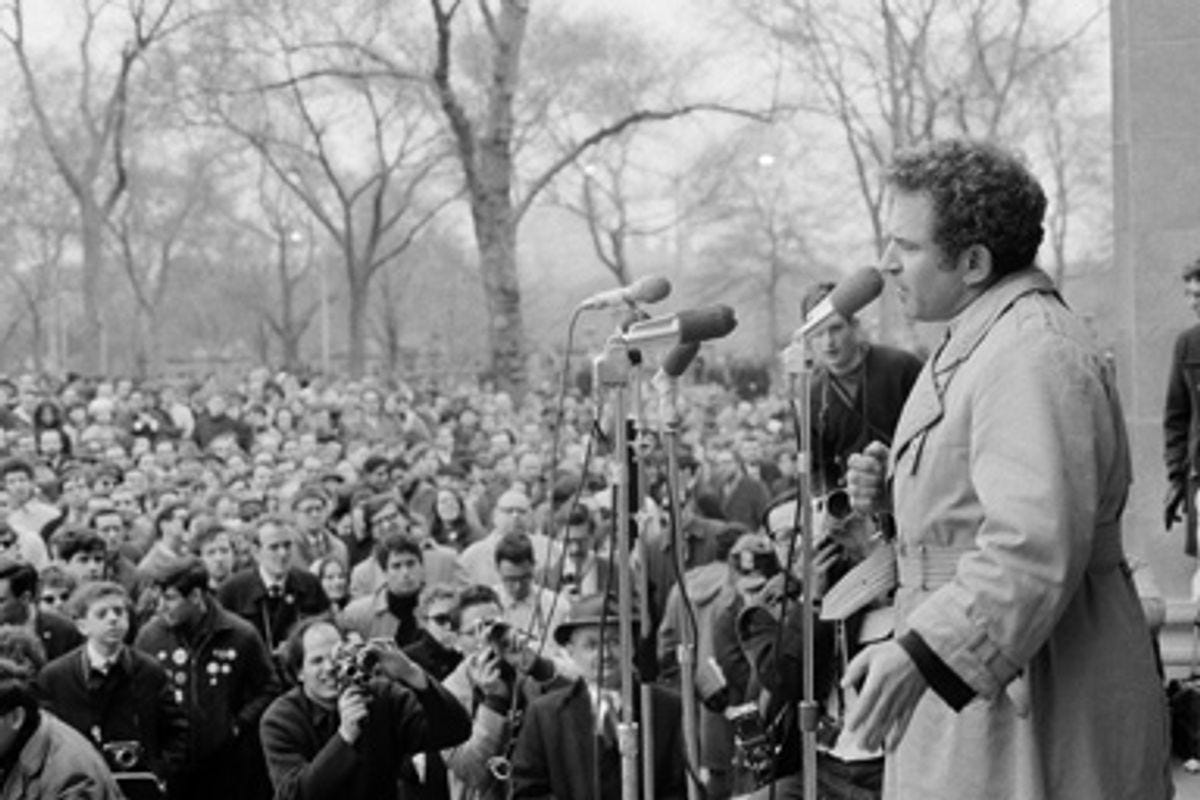
Author Norman Mailer speaks at an anti-war rally at the bandshell in New York’s Central Park, March 26, 1966.
It’s early in 1965, and President Lyndon B. Johnson faces a critical decision. Should he escalate in Vietnam? Should he say “yes” to the request from U.S. commanders for more troops? Or should he change strategy, downsize the American commitment, even withdraw completely, a decision that would help him focus on his top domestic priority, “The Great Society” he hopes to build?
We all know what happened. LBJ listened to the generals and foreign policy experts and escalated, with tragic consequences for the United States and calamitous results for the Vietnamese people on the receiving end of American firepower. Drawn deeper and deeper into Vietnam, LBJ would soon lose his way and eventually his will, refusing to run for reelection in 1968.
President Obama now stands at the edge of a similar precipice. Should he acquiesce to General Stanley A. McChrystal’s call for 40,000 to 60,000 or more U.S. troops for Afghanistan? Or should he pursue a new strategy, downsizing our commitment, even withdrawing completely, a decision that would help him focus on national healthcare, among his other top domestic priorities?
The die, I fear, is cast. In his “war of necessity,” Obama has evidently already ruled out even considering a “reduction” option, no less a withdrawal one, and will likely settle on an “escalate lite” program involving more troops (though not as many as McChrystal has urged), more American trainers for the Afghan army, and even a further escalation of the drone war over the Pakistani borderlands and new special operations actions.
By failing his first big test as commander-in-chief this way, Obama will likely ensure himself a one-term presidency, and someday be seen as a man like LBJ whose biggest dreams broke upon the shoals of an unwinnable war.
The conventional wisdom: Military escalation
To whom, we may ask, is Obama listening as he makes his decision on Afghanistan strategy and troop levels? Not the skeptics, it’s safe to assume. Not the freethinkers, not today’s equivalents of Mary McCarthy or Norman Mailer. Instead, he’s doubtless listening to the generals and admirals, or the former generals and admirals who now occupy prominent “civilian” positions at the White House and inside the beltway.
By his actions, Obama has embraced the seemingly sober conventional wisdom that senior military officers, whether on active duty or retired, have, as they say in the corridors of the Pentagon, “subject matter expertise” when it comes to strategy, war, even foreign policy.
Don’t we know better than this? Don’t we know, as Glenn Greenwald recently reminded us, that General McChrystal’s strategic review was penned by a “war-loving foreign policy community,” in which the usual suspects — “the Kagans, a Brookings representative, Anthony Cordesman, someone from Rand” — were rounded up to argue for more troops and more war?
Don’t we know, as Tom Engelhardt recently reminded us, that Obama’s “civilian” advisors include “Karl W. Eikenberry, a retired lieutenant general who is the U.S. ambassador to Afghanistan, Douglas Lute, a lieutenant general who is the president’s special advisor on Afghanistan and Pakistan (dubbed the “war czar” when he held the same position in the Bush administration), and James Jones, a retired Marine Corps general, who is national security advisor, not to speak of Secretary of Defense Robert Gates, a former director of the Central Intelligence Agency”? Are we surprised, then, that when we “turn crucial war decisions over to the military, [we] functionally turn foreign policy over to them as well”? And that they, in turn, always opt for more troops, more money and more war?
One person unsurprised by this state of affairs would have been Norman Mailer, who died in 2007. War veteran, famed author of the war novel “The Naked and the Dead” (1948) as well as the Pulitzer Prize-winning report on Vietnam-era protests, “The Armies of the Night” (1968), self-styled tough guy who didn’t dance, Mailer witnessed (and dissected) the Vietnam analog to today’s Afghan events. Back in 1965, Mailer bluntly stated that the best U.S. option was “to get out of Asia.” Period.
The unconventional wisdom: Military extrication
Can Obama find the courage and wisdom to extricate our troops from Afghanistan? Courtesy of Norman Mailer, here are three unconventional pointers that should be driving him in this direction:
1. Don’t fight a war, and clearly don’t escalate a war, in a place that means so little to Americans. In words that apply quite readily to Afghanistan today, Mailer wrote in 1965: “Vietnam [to Americans] is faceless. How many Americans have ever visited that country? Who can say which language is spoken there, or what industries might exist, or even what the country looks like? We do not care. We are not interested in the Vietnamese. If we were to fight a war with the inhabitants of the planet of Mars there would be more emotional participation by the people of America.”
2. Beware of cascading dominoes and misleading metaphors, whether in Southeast Asia or anywhere else. The domino theory held that if Vietnam, then split into north and south, was united under communism, other Asian countries, including Thailand, the Philippines, perhaps even India, would inevitably fall to communism as well, just like so many dominoes toppling. Instead, it was communism that fell or, alternately, morphed into a version that we could do business with (to paraphrase former British Prime Minister Margaret Thatcher).
We may no longer speak metaphorically of falling dominoes in today’s Af-Pak theater of operations. Nevertheless, our fears are drawn from a similarly misleading image: If Afghanistan falls to the Taliban, Pakistan will surely follow, opening a nuclear Pandora’s box to anti-American terrorists in which, in our fevered imaginations, smoking guns will once again become mushroom clouds.
Despite the fevered talk of falling dominoes in his era, Mailer was unmoved. Such rhetoric suggests, he wrote in 1965, “that we are not protecting a position of connected bastions so much as we are trying to conceal the fact that the bastions are about gone — they are not dominoes, but sand castles, and a tide of nationalism is on the way in. It is curious foreign policy to use metaphors in defense of a war; when the metaphors are imprecise, it is a swindle.”
To this I’d add that, in viewing countries and peoples as so many dominoes, which by the actions — or the inaction — of the United States are either set up or knocked down, we vastly exaggerate our own agency and emphasize our sense of self-importance. And before we even start in on the inevitable argument about “Who lost Afghanistan?” or “Who lost Pakistan?” is it too obvious to say that never for a moment did we own these countries and peoples?
3. Carrots and sticks may work together to move a stubborn horse, but not a proud people determined to find their own path. As Mailer put it, with a different twist: “Bombing a country at the same time you are offering it aid is as morally repulsive as beating up a kid in an alley and stopping to ask for a kiss.”
As our Predator and Reaper drones scan the Afghan terrain below, launching missiles to decapitate terrorists while unintentionally taking innocents with them, we console ourselves by offering aid to the Afghans to help them improve or rebuild their country. As it happens, though, when the enemy hydra loses a head, another simply grows in its place, while collateral damage only leads to a new generation of vengeance-seekers. Meanwhile, promised aid gets funneled to multinational corporations or siphoned off by corrupt government officials, leaving little for Afghan peasants, certainly not enough to win their allegiance, let alone their “hearts and minds.”
If we continue to speak with bombs while greasing palms with dollars, we’ll get nothing more than a few bangs for our $228 billion (and counting).
What if LBJ had listened to Mailer in ’65?
Not long before LBJ crossed his Rubicon and backed escalation in Vietnam, he could have decided to pull out. Said Mailer:
The image had been prepared for our departure — we heard of nothing but the corruption of the South Vietnam government and the professional cowardice of the South Vietnamese generals. We read how a Viet Cong army of 40,000 soldiers was whipping a government army of 400,000. We were told in our own newspapers how the Viet Cong armed themselves with American weapons brought to them by deserters or captured in battle with government troops; we knew it was an empty war for our side.
Substitute “the Hamid Karzai government” for “the South Vietnam government” and “Taliban” for “Viet Cong” and the same passage could almost have been written yesterday about Afghanistan. We know the Karzai government is corrupt, that it stole the vote in the last election, that the Afghan army is largely a figment of Washington’s imagination, that its troops sell their American-made weapons to the enemy. But why do our leaders once again fail to see, as Mailer saw with Vietnam, that this, too, is a recognizably “empty war for our side”?
Mailer experienced the relentless self-regard and strategic obtuseness of Washington as a mystery, but that didn’t stop him from condemning President Johnson’s decision to escalate in Vietnam. For Mailer, LBJ was revealed as “a man driven by need, a gambler who fears that once he stops, once he pulls out of the game, his heart will rupture from tension.” Johnson, like nearly all Americans, Mailer concluded, was a member of a minority group, defined not in racial or ethnic terms but in terms of “alienat[ion] from the self by a double sense of identity and so at the mercy of a self which demands action and more action to define the most rudimentary borders of identity.”
This American drive for self-definition through constant action, through headlong acceleration, even through military escalation, the novelist described, in something of a mixed metaphor, as “the swamps of a plague” in which Americans had been caught and continued to sink. He saw relief of the desperate condition coming only via “the massacre of strange people.”
To be honest, I’m not sure what to make of Mailer’s analysis here, more emotionally “Heart of Darkness” than coolly rational. But that’s precisely why I want someone Mailer-esque — pugnacious, free-swinging, and prophetical, provocative and profane — advising our president. Right now.
As Obama’s military experts wield their battlefield metrics and call for more force (to be used, of course, with ever greater precision and dexterity), I think Mailer might have replied: We think the only thing they understand is force. What if the only thing we understand is force?
Mailer, I have no doubt, would have had the courage to be seen as “weak” on defense, because he would have known that Americans had no dog in this particular fight. I think he would intuitively have recognized the wisdom of the great Chinese strategist Sun Tzu, who wrote more than 2,000 years ago in “The Art of War” that “to win one hundred victories in one hundred battles is not the acme of skill. To subdue the enemy without fighting is the acme of skill.” Our generals, by way of contrast, seem to want to fight those 100 battles with little hope of actually subduing the enemy.
What Obama needs, in other words, is fewer generals and ex-generals and more Norman Mailers — more outspoken free-thinkers who have no interest in staying inside the pentagonal box that holds Washington’s thinking tight. What Obama needs is to silence the endless cries for more troops and more war emanating from the military and foreign policy “experts” around him, so he can hear the voices of today’s Mailers, of today’s tough-minded dissenters. Were he to do so, he might yet avoid repeating LBJ’s biggest blunder — and so avoid suffering his political fate as well.
How do we stop the next war built on lies from being waged?
(I prepared these notes for a talk I gave on “Truth-killers: The Corporate Media and the Military-Industrial Complex,” sponsored by Massachusetts Peace Action. David Swanson also spoke.)
I served in the U.S. military for 20 years, and for the last 15 years I’ve been writing articles that are generally critical of that military and our nation’s drift into militarism and endless warfare. Here are two lessons I’ve learned:
1. I agree with I.F. Stone that all governments lie.
2. As a historian who’s read and studied military history for most of my life, I agree that the first casualty of war is truth.
Because all governments lie and because lies are especially common during war, a healthy democracy must have an outspoken and independent media that challenges and questions authority while informing the public.
But the mainstream media (MSM) in America is neither outspoken nor independent. The MSM in America serves as stenographers to the powerful. Far too often, the U.S. military/government lies and leaks, the MSM believes and repeats.
The result is clear: disastrous wars (Vietnam, Afghanistan, Iraq) from which little is ever learned, enabled by a media culture that is deeply compromised by, or openly in league with, President Dwight D. Eisenhower’s military-industrial-congressional complex (MICC).
Here’s the fundamental issue: We need a skeptical and powerful media to deter the MICC from wars, war profiteering, and folly. The MSM should, and must, serve as a check on the MICC while holding it accountable when it fails. By doing neither, it serves various “big lies,” enabling future abuses of power by the national security state. There is no accountability for failure, so failure is neither punished now nor is it curtailed in the future.
Even when the MICC fails, and since the Vietnam War it has failed frequently, it gets more money. Consider the FY2023 Pentagon budget, which sits at $858 billion, a nearly inconceivable sum and which is roughly $45 billion more than the Biden administration asked for.
The challenge, as I see it: How do we stop the next war built on lies from being waged?
Something to ponder: Could a more critical, more courageous, truly independent media have shortened or stopped the Vietnam War? Iraq? Afghanistan?
In his famous speech warning Americans about the MICC in 1961, Eisenhower (Ike) said that only an alert and knowledgeable citizenry could guard against the acquisition of power by the MICC. This may indeed be why most citizens are not kept informed or are misinformed about the U.S. military and its wars. It’s hard to act when you’re kept ignorant. You’ll also be reluctant to act when you’re told to defer to the “experts” in the MSM, most of whom are deeply compromised, often by conflicts of interest that are kept hidden from you.
Military Mendacity
Put simply, the U.S. military, in its upper ranks, lacks honor. What matters most is reputation and budgetary authority. Sharing negative news with the media is the absolute last thing the military wants to do. Surprisingly, most in the MSM are willing to look the other way, assuming they even know of military mendacity and malfeasance.
What this means, essentially, is that the MICC is unaccountable to the people–the very antithesis of democracy.
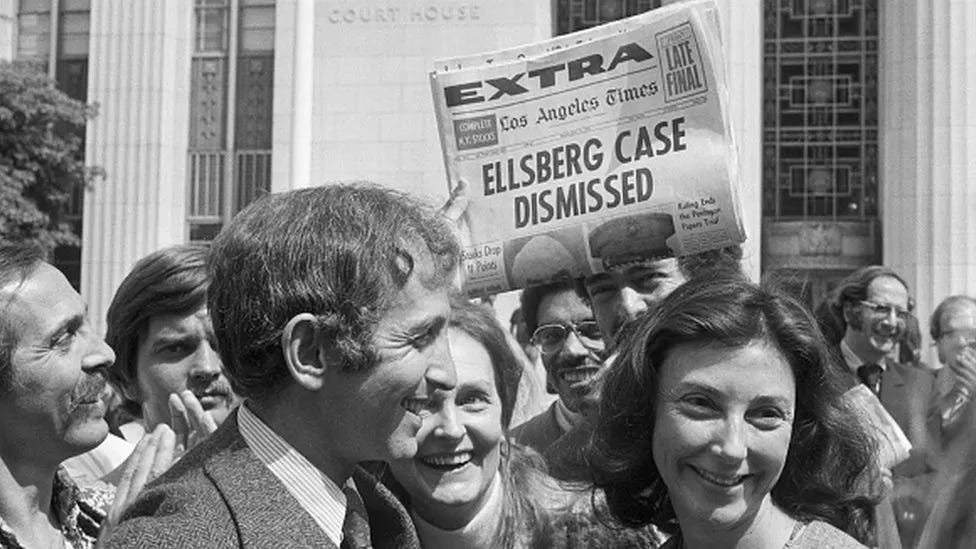
Three big examples of MICC mendacity: The Pentagon Papers revealed by Daniel Ellsberg during the Vietnam War; the Iraq War and lies about WMD (weapons of mass destruction); and the Afghan War Papers. Even as the U.S. military was losing these three wars, military commanders and government officials spoke publicly and confidently of lights at the end of tunnels, of corners being turned toward victory. (Privately, however, they talked of serious problems and lack of progress.)
With “The Pentagon Papers,” Daniel Ellsberg revealed the lies that helped fuel the Vietnam War
The MSM (with notable exceptions) largely repeated the happy-talk lies. Since 9/11, this is unsurprising, since the MSM leans heavily on senior retired military officers, CIA officials, and the like to “interpret” events in places like Iraq and Afghanistan. As journalist David Barstow showed, these “interpreters” were and are fed talking points by the Pentagon. Whatever this is, it’s not honest reporting. It’s not journalism. It’s state propaganda.
It’s not that the American people can’t handle the truth about “their” military. It’s that the MICC prefers to keep a lid on the truth, because the truth is often unfavorable to their positions, power, prestige, and profits.
There are many ways the MICC works with a complicit media (and a compliant Congress) to keep the truth from us.
1. Bad news is not reported. Or it’s classified or otherwise hushed up. Consider the My Lai Massacre in Vietnam or the “collateral murder” video from the Iraq War revealed by Chelsea Manning and Wikileaks.
2. Critical information is omitted. Coverage is edited. Consider the ban on showing flag-draped coffins by the Bush/Cheney administration, or official reports about drone strikes that omitted the true number of civilian/non-combatant casualties.
3. The military has its own PAOs (public affairs offices and officers) who feed news of “progress” and similar “good news” stories to the media. This is also true of the State Department. (See Peter Van Buren’s account, “We Meant Well,” of his Potemkin Village-like experience in Iraq.)
4. Ever-present appeals to patriotism and warnings that critical information will give aid and comfort to the enemy. Even worse, portraying critics as pro-Putin, as possible traitors, as in the NBC smear campaign against Congresswoman Tulsi Gabbard, abetted also by Hillary Clinton.
5. Run-of-the-mill propaganda. Consider, for example, how almost all U.S. sporting events include glowing coverage of the military and veterans. If all military members are “heroes,” how dare we question them! Instead, you’re encouraged to salute smartly and remain silent.
Media Complicity
Why is the MSM so hobbled and often so complicit with the MICC?
1. Intimidation. Critics are punished. Examples include Ashleigh Banfield, Phil Donahue, and Chris Hedges in the early days of the Iraq War. Think of Julian Assange today. Edward Snowden. Daniel Hale. Smart journalists know (or learn) that critics and whistleblowers are punished; cheerleaders are promoted, e.g. Brian Williams, demoted for stolen valor but redeemed for declaring his awe at “the beauty” of U.S. missiles.
2. Ratings/Economics. Recall that MSNBC fired Phil Donahue over concerns that his critical coverage of the Iraq War was turning off viewers, i.e. that the network wasn’t being seen as “patriotic” as rivals like CNN or Fox News, thereby losing market share and money.
3. Embedding Process. Reporters who want to cover war are often embedded with U.S. military units. They come to identify with “their” troops, who, after all, are protecting them from harm. The embedding process forges a sense of dependency and camaraderie that interferes with disinterested and balanced reporting.
4. Reliance on deeply conflicted experts from the MICC instead of independent journalists. Whatever else they are, retired generals and CIA directors are not reporters or journalists.
5. Corporate advertising dollars. Why air a report critical of Boeing or Northrop Grumman when that company is a major advertiser on your network? Why bite the hand that feeds you?
You don’t need a top secret “Mockingbird” project by the CIA to infiltrate and influence the MSM, as we witnessed during the Cold War and Vietnam. Today, the MSM and its owners acquiesce in their own infiltration, hiring retired CIA agents and similar senior government officials to give/sell their “unbiased” opinions.
Again, military contractors pay for ads and sponsor shows on TV. The media is not about to challenge or criticize a big revenue stream. And it’s not always a weapons maker like Boeing or Raytheon. Think of ExxonMobil. Their thirstiest customer is the U.S. military; ExxonMobil is unlikely to support media reports that criticize its biggest customer.
Meanwhile, there are precious few reporters and journalists willing to risk their careers to challenge the MICC. With so-called access journalism, if you reveal uncomfortable facts, you’ll likely lose access to the powerful, alienate your bosses, and probably lose your job.
Food for Thought: Journalists are selected and groomed for compliance to mainstream militarized agendas. They’ve learned and internalized what is acceptable and what isn’t. If they refuse to play along, they’re fired or shunted aside. (See Noam Chomsky and the manufacturing of consent.)
For the U.S. military, full-spectrum dominance includes information and the control of the same, including most especially in America.
A final shocking truth: The U.S. military lost in Vietnam, Iraq, Afghanistan, and elsewhere while avoiding responsibility. Indeed, its cultural authority and its command over the media have only grown stronger. Worse, the military promulgates, or goes along with, various stab-in-the-back myths that exculpate itself while mendaciously blaming the few good media outlets for accurate reporting about the MICC’s failings.
A crucial step in preventing future disastrous wars is a media culture that sees the MICC for what it is: a danger to democracy and liberty, as Ike warned us in 1961 in his farewell address. How we get there is a crucial issue; the failures above suggest remedies.
One remedy I wrote about in 2008: the major networks need to develop their own, independent, journalists who are experts on the military, rather than relying largely on retired military officers and other senior government officials.
We are told that America has independent media rather than state media like China or Russia. Yet, if America had official state media, would its coverage differ from today’s content? The MSM supports state and corporate agendas because that’s how it makes money even as it claims it’s “independent.”
A Couple of Anecdotes
A journalist colleague told me of his experience teaching students at one of America’s universities. His sense: most students today don’t want to be Bob Woodward and Carl Bernstein. They aspire to be on-air personalities who make six-figure salaries while being invited to all the right parties. They don’t want to afflict the comfortable while comforting the afflicted; they want to be among the most comfortable. Crusading for truth isn’t what they’re about. They seek to be insiders.
From the Robert Redford movie, “Three Days of the Condor.” If a whistleblower goes to the MSM (in the movie, it’s The New York Times), will the truth ever see the light of day? More to the point, if the American people do see it, will they even care?
What we’re witnessing in America, according to Matt Taibbi, is an “elaborate, systematized method of censorship and opinion control.” Taibbi mentions agencies like Homeland Security and Justice/FBI and their focus on “collecting domestic intelligence on a grand scale … seeking to distort the public’s perception of reality through mass moderation, via programs we’ve been told little to nothing about.”
While Taibbi, in his latest investigation, focused on social media and especially Twitter, the reality is that the MSM (and social media as well) is complicit with the government/military, collaborating on what “truths” are fed to the people while suppressing facts that are deemed dangerous, embarrassing, inconvenient, and otherwise not in the interest of the MICC.
With so many Americans now getting their news from social media sites rather than the MSM, that the government serves as a powerful content-moderator for what counts as “reliable” news on social media should disturb us all.
Again, it’s hard for Americans to serve as Ike’s “alert and knowledgeable” citizenry when they are fed lies, disinformation, and propaganda by the government and MSM.
Even more fundamentally, when corporations are elevated and protected as super-capable “citizens” and when citizens themselves are reduced to passive consumers—when corporations own the MSM while profiting greatly from war and militarism—there’s little hope of fostering freedom and of ever escaping from a state of permanent warfare.
Winning a war based on lies is truly a fool’s errand, which is why the U.S. military’s record since World War II is so poor. Yet no one is ever held responsible for these lies, which suggests something worse than a losing military: one that is without honor, especially among the brass. That’s the theme of my latest article for TomDispatch, which is appended below in its entirety.
As a military professor for six years at the U.S. Air Force Academy in the 1990s, I often walked past the honor code prominently displayed for all cadets to see. Its message was simple and clear: they were not to tolerate lying, cheating, stealing, or similar dishonorable acts. Yet that’s exactly what the U.S. military and many of America’s senior civilian leaders have been doing from the Vietnam War era to this very day: lying and cooking the books, while cheating and stealing from the American people. And yet the most remarkable thing may be that no honor code turns out to apply to them, so they’ve suffered no consequences for their mendacity and malfeasance.
Where’s the “honor” in that?
It may surprise you to learn that “integrity first” is the primary core value of my former service, the U.S. Air Force. Considering the revelations of the Pentagon Papers, leaked by Daniel Ellsberg in 1971; the Afghan War papers, first revealed by the Washington Post in 2019; and the lack of weapons of mass destruction in Iraq, among other evidence of the lying and deception that led to the invasion and occupation of that country, you’ll excuse me for assuming that, for decades now when it comes to war, “integrity optional” has been the true core value of our senior military leaders and top government officials.
As a retired Air Force officer, let me tell you this: honor code or not, you can’t win a war with lies — America proved that in Vietnam, Afghanistan, and Iraq — nor can you build an honorable military with them. How could our high command not have reached such a conclusion themselves after all this time?
So Many Defeats, So Little Honesty
Like many other institutions, the U.S. military carries with it the seeds of its own destruction. After all, despite being funded in a fashion beyond compare and spreading its peculiar brand of destruction around the globe, its system of war hasn’t triumphed in a significant conflict since World War II (with the war in Korea remaining, almost three-quarters of a century later, in a painful and festering stalemate). Even the ending of the Cold War, allegedly won when the Soviet Union collapsed in 1991, only led to further wanton military adventurism and, finally, defeat at an unsustainable cost — more than $8 trillion — in Washington’s ill-fated Global War on Terror. And yet, years later, that military still has a stranglehold on the national budget.
So many defeats, so little honesty: that’s the catchphrase I’d use to characterize this country’s military record since 1945. Keeping the money flowing and the wars going proved far more important than integrity or, certainly, the truth. Yet when you sacrifice integrity and the truth in the cause of concealing defeat, you lose much more than a war or two. You lose honor — in the long run, an unsustainable price for any military to pay.
Or rather it should be unsustainable, yet the American people have continued to “support” their military, both by funding it astronomically and expressing seemingly eternal confidence in it — though, after all these years, trust in the military has dipped somewhat recently. Still, in all this time, no one in the senior ranks, civilian or military, has ever truly been called to account for losing wars prolonged by self-serving lies. In fact, too many of our losing generals have gone right through that infamous “revolving door” into the industrial part of the military-industrial complex — only to sometimes return to take top government positions.
Our military has, in fact, developed a narrative that’s proven remarkably effective in insulating it from accountability. It goes something like this: U.S. troops fought hard in [put the name of the country here], so don’t blame us. Indeed, you must support us, especially given all the casualties of our wars. They and the generals did their best, under the usual political constraints. On occasion, mistakes were made, but the military and the government had good and honorable intentions in Vietnam, Afghanistan, Iraq, and elsewhere.
Besides, were you there, Charlie? If you weren’t, then STFU, as the acronym goes, and be grateful for the security you take for granted, earned by America’s heroes while you were sitting on your fat ass safe at home.
It’s a narrative I’ve heard time and time again and it’s proven persuasive, partially because it requires the rest of us, in a conscription-free country, to do nothing and think nothing about that. Ignorance is strength, after all.
War Is Brutal
The reality of it all, however, is so much harsher than that. Senior military leaders have performed poorly. War crimes have been covered up. Wars fought in the name of helping others have produced horrendous civilian casualties and stunning numbers of refugees. Even as those wars were being lost, what President Dwight D. Eisenhowerfirst labeled the military-industrial complex has enjoyed windfall profits and expanding power. Again, there’s been no accountability for failure. In fact, only whistleblowing truth-tellers like Chelsea Manning and Daniel Hale have been punished and jailed.
Ready for an even harsher reality? America is a nation being unmade by war, the very opposite of what most Americans are taught. Allow me to explain. As a country, we typically celebrate the lofty ideals and brave citizen-soldiers of the American Revolution. We similarly celebrate the Second American Revolution, otherwise known as the Civil War, for the elimination of slavery and reunification of the country; after which, we celebrate World War II, including the rise of the Greatest Generation, America as the arsenal of democracy, and our emergence as the global superpower.
By celebrating those three wars and essentially ignoring much of the rest of our history, we tend to view war itself as a positive and creative act. We see it as making America, as part of our unique exceptionalism. Not surprisingly, then, militarism in this country is impossible to imagine. We tend to see ourselves, in fact, as uniquely immune to it, even as war and military expenditures have come to dominate our foreign policy, bleeding into domestic policy as well.
If we as Americans continue to imagine war as a creative, positive, essential part of who we are, we’ll also continue to pursue it. Or rather, if we continue to lie to ourselves about war, it will persist.
It’s time for us to begin seeing it not as our making but our unmaking, potentially even our breaking — as democracy’s undoing as well as the brutal thing it truly is.
A retired U.S. military officer, educated by the system, I freely admit to having shared some of its flaws. When I was an Air Force engineer, for instance, I focused more on analysis and quantification than on synthesis and qualification. Reducing everything to numbers, I realize now, helps provide an illusion of clarity, even mastery. It becomes another form of lying, encouraging us to meddle in things we don’t understand.
This was certainly true of Secretary of Defense Robert McNamara, his “whiz kids,” and General William Westmoreland during the Vietnam War; nor had much changed when it came to Secretary of Defense Donald Rumsfeld and General David Petraeus, among others, in the Afghan and Iraq War years. In both eras, our military leaders wielded metrics and swore they were winning even as those wars circled the drain.
And worse yet, they were never held accountable for those disasters or the blunders and lies that went with them (though the antiwar movement of the Vietnam era certainly tried). All these years later, with the Pentagon still ascendant in Washington, it should be obvious that something has truly gone rotten in our system.
Here’s the rub: as the military and one administration after another lied to the American people about those wars, they also lied to themselves, even though such conflicts produced plenty of internal “papers” that raised serious concerns about lack of progress. Robert McNamara typically knew that the situation in Vietnam was dire and the war essentially unwinnable. Yet he continued to issue rosy public reports of progress, while calling for more troops to pursue that illusive “light at the end of the tunnel.” Similarly, the Afghan War papers released by the Washington Post show that senior military and civilian leaders realized that war, too, was going poorly almost from the beginning, yet they reported the very opposite to the American people. So many corners were being “turned,” so much “progress” being made in official reports even as the military was building its own rhetorical coffin in that Afghan graveyard of empires.
Too bad wars aren’t won by “spin.” If they were, the U.S. military would be undefeated.
Two Books to Help Us See the Lies
Two recent books help us see that spin for what it was. In Because Our Fathers Lied, Craig McNamara, Robert’s son, reflects on his father’s dishonesty about the Vietnam War and the reasons for it. Loyalty was perhaps the lead one, he writes. McNamara suppressed his own serious misgivings out of misplaced loyalty to two presidents, John F. Kennedy and Lyndon B. Johnson, while simultaneously preserving his own position of power in the government.
Robert McNamara would, in fact, later pen his own mea culpa, admitting how “terribly wrong” he’d been in urging the prosecution of that war. Yet Craig finds his father’s late confession of regret significantly less than forthright and fully honest. Robert McNamara fell back on historical ignorance about Vietnam as the key contributing factor in his unwise decision-making, but his son is blunt in accusing his dad of unalloyed dishonesty. Hence the title of his book, citing Rudyard Kipling’s pained confession of his own complicity in sending his son to die in the trenches of World War I: “If any question why we died/Tell them, because our fathers lied.”
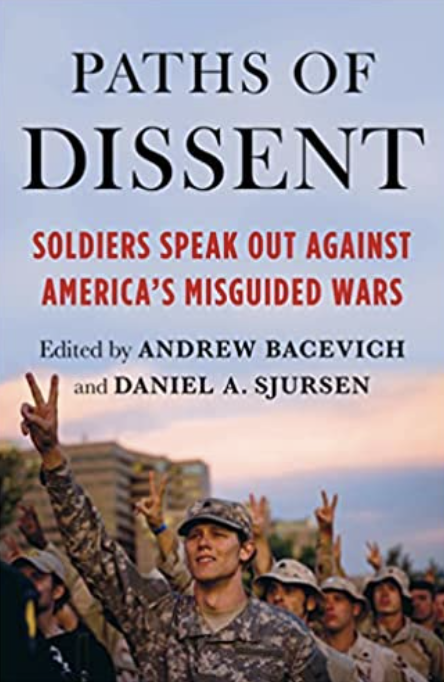
The second book is Paths of Dissent: Soldiers Speak Out Against America’s Misguided Wars, edited by Andrew Bacevich and Danny Sjursen. In my view, the word “misguided” doesn’t quite capture the book’s powerful essence, since it gathers 15 remarkable essays by Americans who served in Afghanistan and Iraq and witnessed the patent dishonesty and folly of those wars. None dare speak of failure might be a subtheme of these essays, as initially highly motivated and well-trained troops became disillusioned by wars that went nowhere, even as their comrades often paid the ultimate price, being horribly wounded or dying in those conflicts driven by lies.
This is more than a work of dissent by disillusioned troops, however. It’s a call for the rest of us to act. Dissent, as West Point graduate and Army Captain Erik Edstrom reminds us, “is nothing short of a moral obligation” when immoral wars are driven by systemic dishonesty. Army Lieutenant Colonel Daniel Davis, who blew an early whistle on how poorly the Afghan War was going, writes of his “seething” anger “at the absurdity and unconcern for the lives of my fellow soldiers displayed by so many” of the Army’s senior leaders.
Former Marine Matthew Hoh, who resigned from the State Department in opposition to the Afghan “surge” ordered by President Barack Obama, speaks movingly of his own “guilt, regret, and shame” at having served in Afghanistan as a troop commander and wonders whether he can ever atone for it. Like Craig McNamara, Hoh warns of the dangers of misplaced loyalty. He remembers telling himself that he was best suited to lead his fellow Marines in war, no matter how misbegotten and dishonorable that conflict was. Yet he confesses that falling back on duty and being loyal to “his” Marines, while suppressing the infamies of the war itself, became “a washing of the hands, a self-absolution that ignores one’s complicity” in furthering a brutal conflict fed by lies.
As I read those essays, I came to see anew how this country’s senior leaders, military and civilian, consistently underestimated the brutalizing impact of war, which, in turn, leads me to the ultimate lie of war: that it is somehow good, or at least necessary — making all the lying (and killing) worth it, whether in the name of a victory to come or of duty, honor, and country. Yet there is no honor in lying, in keeping the truth hidden from the American people. Indeed, there is something distinctly dishonorable about waging wars kept viable only by lies, obfuscation, and propaganda.
An Epigram from Goethe
John Keegan, the esteemed military historian, cites an epigram from Johann Wolfgang von Goethe as being essential to thinking about militaries and their wars. “Goods gone, something gone; honor gone, much gone; courage gone, all gone.”
The U.S. military has no shortage of goods, given its whopping expenditures on weaponry and equipment of all sorts; among the troops, it doesn’t lack for courage or fighting spirit, not yet, anyway. But it does lack honor, especially at the top. Much is gone when a military ceases to tell the truth to itself and especially to the people from whom its forces are drawn. And courage is wasted when in the service of lies.
Courage wasted: Is there a worst fate for a military establishment that prides itself on its members being all volunteers and is now having trouble filling its ranks?
About 15 years ago, I was talking to a U.S. Army lieutenant colonel who’d served with the 101st Airborne as a battalion commander in Iraq. He told me his troops were well trained and packed a tremendous punch. An American platoon, given its superiority in firepower, communications, and the artillery and air support it can call on, could take on enemy units three times its size and win (easily). Yet this tremendous advantage in firepower proved politically indecisive in Iraq as well as places like Afghanistan and Vietnam.
The typical U.S. military response is to argue for even more firepower – and to blame the rules of engagement (ROE) for not allowing them to use it indiscriminately.
The U.S. military has optimized and always seeks to optimize its hitting power at the sharp end of war. It takes pride in its “hardness” and its “warriors.” But the skirmishes and battles it “wins” never add up to anything. If anything, the more the U.S. military used its superior firepower in Iraq as well as places like Vietnam and Afghanistan, the more collateral damage it spread, the more people it alienated, the more the results became retrograde.
Even as U.S. leaders cited impressive (and false) metrics to show “progress” about districts “pacified,” or how many Vietnamese or Afghan or Iraqi troops were “trained” and ready to assume the roles of U.S. troops, the truth was that U.S. military units were sinking ever deeper into quagmires of their own making. Meanwhile, elements within Vietnam or Afghanistan or Iraq, enabled by America’s own military-industrial complex, worked cleverly to extract more wealth and resources from a U.S. government that was only fooling itself and the American people with its lies about “progress.”
Let’s take a closer look at the Afghan War as an example. The military historian Dennis Showalter put it memorably to me. He talked of Taliban units offering “symmetry,” or fighting as American units are trained to do, only under exceptional circumstances, and typically to the Taliban’s advantage (e.g. small-unit ambushes using IEDs that drove U.S. troops to respond with massive firepower). Since U.S. troops are adept at reacting quickly and deploying massive firepower, they believe that this is war’s cutting edge. Find ‘em, fix ‘em, kill ‘em, is often the start and end of U.S. military strategy.
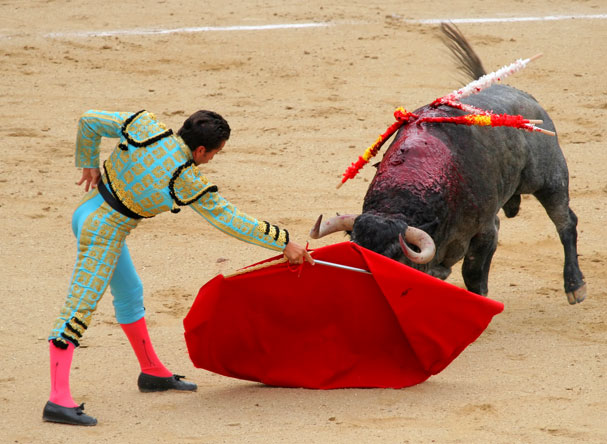
As Showalter put it: Like a bull the U.S. military rushes the Taliban cape as the sword goes into its shoulders. If you’re the enemy, wave that cape – just be sure to sidestep the bull’s rush.
Yes, the U.S. military has impressive firepower. Yes, no one projects force like the U.S. military. Yes, the U.S. military can charge and hit with bullish impact. But for what purpose, and to what end? The bull in a bullfight, after all, doesn’t often win.
And when you move the bull from the fighting ring to a delicate situation, a more political one, one that requires subtlety and care, things go very poorly indeed, as they do when bulls find themselves in china shops.


 Bracing Views