Ukraine’s counteroffensive is in motion; results so far appear to be mixed. Today’s CNN summary had this to say: Ukrainian forces are claiming some success in their offensives in the south and east. Kyiv’s top general said this week that his troops have seen “certain gains.”
“Certain gains.” Not only is the U.S. government sending Ukraine weapons and aid; it also is providing lessons in rhetorical BS. How long before Ukraine speaks of “corners turned” and “the light at the end of the tunnel” in this dreadful war?
“Certain gains”: One thing that is certain is that maps like this are a sterile depiction of the dreadful and ghastly costs of war (Source: War Mapper)
Five days ago, the New York Times provided this short summary of Ukraine’s counteroffensive: As Ukraine Launches Counteroffensive, Definitions of ‘Success’ Vary. Privately, U.S. and European officials concede that pushing all of Russia’s forces out of occupied Ukrainian land is highly unlikely.
What is the definition of “success”? It sounds like a metaphysical puzzle.
Back on May 31st, I spoke with defense journalist Brad Dress at The Hill. This is what I had to say then: “Sometimes, war is sold like a consumer product, where there’s a lot of hype and a lot of hope. That is contrary to the reality we often see.”
In our conversation, I reminded Dress of counteroffensives from military history that went dreadfully wrong. Think of the first day of the Somme in July 1916 during World War I, when the British Army lost 20,000 dead and another 40,000 wounded. Think of the Battle of the Bulge in December 1944 in World War II, when the German Army threw away its strategic reserve in a last gasp counteroffensive that ultimately made it easier for the Allies to defeat them in 1945. History is replete with examples of failed counteroffensives, especially when the opponent is prepared and entrenched.
War is inherently unpredictable (as well as being hellish and horrific), but it does appear that Ukraine’s counteroffensive won’t be decisive. It’s not going to defeat Russia in one fell swoop. Battle lines may move a bit, but the war will continue. And so will the killing—and the profiteering. Is that “success”?
Mostly unseen and unwritten about are all the dead soldiers on both sides, all the environmental destruction. Which likely will produce cries for yet more violence in the cause of vengeance. “Success”?
So far, the Biden administration has used all its influence, indeed all means at its disposal, to continue the war. The only way out, apparently, is over the bodies of dead Ukrainians and Russians. Not surprisingly, then, the U.S. is providing even more deadly weaponry to Ukraine, including depleted uranium ammunition and (eventually) M-1 Abrams tanks and F-16 fighter jets. Escalation, in sum, is America’s sole solution to ending the war.
I implore the U.S. government to pursue diplomacy as a means to ending this awful war. No one is talking about surrendering to Putin. No one wants to abandon Ukraine. Indeed, I’m at a loss when people accuse me of not caring for the people of Ukraine when my goal is to end the killing on both sides.
All wars end. Ukraine and Russia aren’t going anywhere. They share a long border, a longer history, and now a lengthening war. Shouldn’t we be doing everything we can to shorten it?
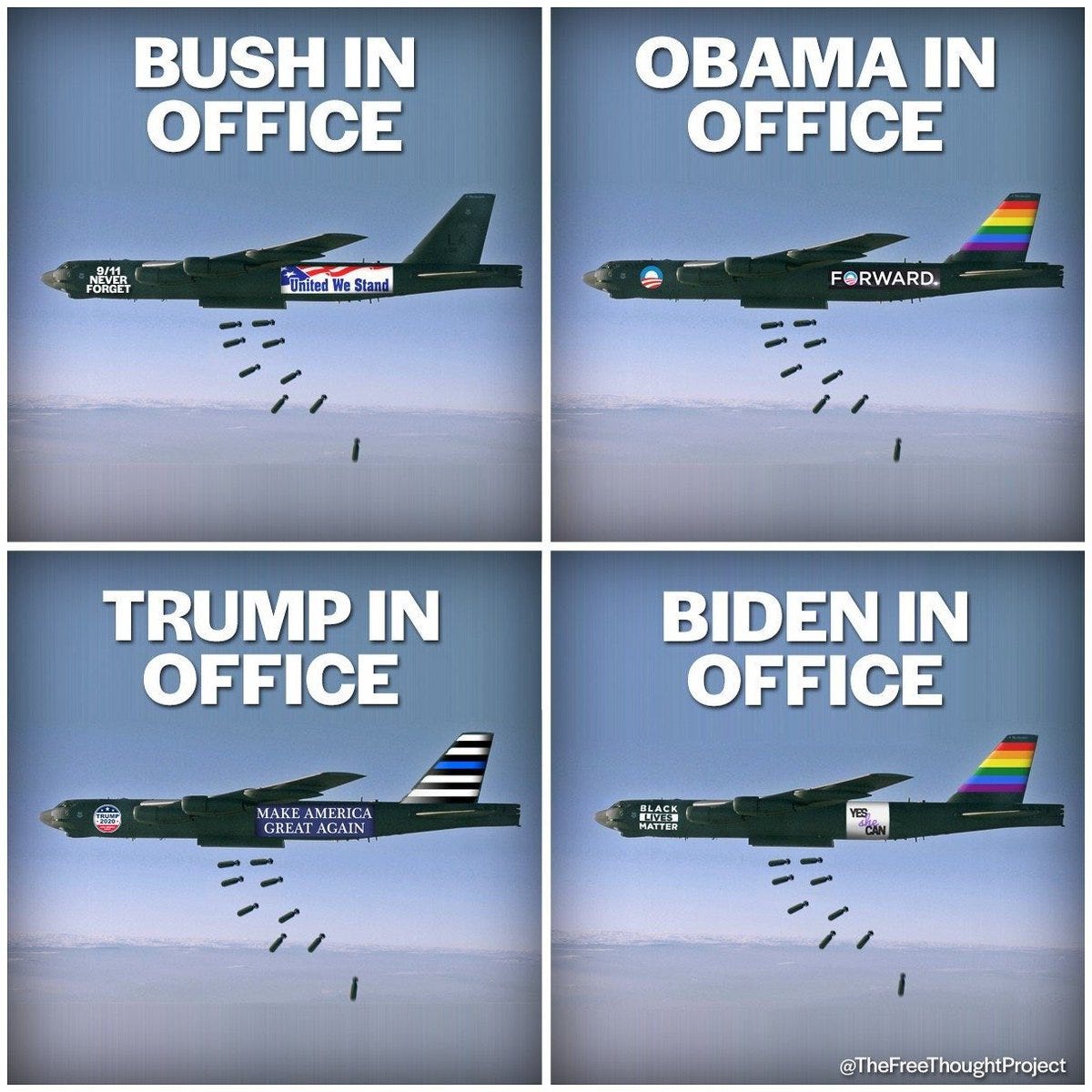
The people on the receiving end of American bombs don’t care if those bombs are from a “woke” B-52 or a MAGA one, or whether the crews of those planes are diverse. Is it better to be bombed by female or gay or Black air crews?
The comedian Jimmy Dore did a recent segment on the CIA’s celebration of Gay Pride Month. Am I supposed to trust the CIA when they wrap themselves in a rainbow flag?
Regardless of who’s been president and which party he’s been from, U.S. military spending has continued to soar. And while Joe Biden finally ended the disastrous Afghan War, the military-industrial-congressional complex is profiting wildly from the new Cold War with China and Russia.
Americans should be deeply concerned with the increasing likelihood of nuclear war, together with the government’s great affection for building even more nuclear weapons. Yet we are actively discouraged by our government from thinking about the unthinkable, i.e. genocidal nuclear weapons and war. “Trust the experts” is the implicit message, along with “pay no attention” to the trillions being spent on new nuclear bombers, ICBMs, and submarines. After all, they’re job-creators!
Reelecting Trump or Biden, or electing younger tools like Ron DeSantis or Pete Buttigieg, isn’t going to change America’s imperial, militaristic, and rapacious foreign policy. I’d like to elect a president who prefers not to drop bombs, a leader who knows that bombs remain bombs whether they’re “woke” or “MAGA” or decorated with rainbow or “blue lives matter” flags.
All around us things are falling apart. Collectively, Americans are experiencing national and imperial decline. Can America save itself? Is this country, as presently constituted, even worth saving?
For me, that last question is radical indeed. From my early years, I believed deeply in the idea of America. I knew this country wasn’t perfect, of course, not even close. Long before the 1619 Project, I was aware of the “original sin” of slavery and how central it was to our history. I also knew about the genocide of Native Americans. (As a teenager, my favorite movie — and so it remains — was Little Big Man, which pulled no punches when it came to the white man and his insatiably murderous greed.)
Nevertheless, America still promised much, or so I believed in the 1970s and 1980s. Life here was simply better, hands down, than in places like the Soviet Union and Mao Zedong’s China. That’s why we had to “contain” communism — to keep themover there, so they could never invade our country and extinguish our lamp of liberty. And that’s why I joined America’s Cold War military, serving in the Air Force from the presidency of Ronald Reagan to that of George W. Bush and Dick Cheney. And believe me, it proved quite a ride. It taught this retired lieutenant colonel that the sky’s anything but the limit.
In the end, 20 years in the Air Force led me to turn away from empire, militarism, and nationalism. I found myself seeking instead some antidote to the mainstream media’s celebrations of American exceptionalism and the exaggerated version of victory culture that went with it (long after victory itself was in short supply). I started writingagainst the empire and its disastrous wars and found likeminded people at TomDispatch — former imperial operatives turned incisive critics like Chalmers Johnson and Andrew Bacevich, along with sharp-eyed journalist Nick Turse and, of course, the irreplaceable Tom Engelhardt, the founder of those “tomgrams” meant to alert America and the world to the dangerous folly of repeated U.S. global military interventions.
But this isn’t a plug for TomDispatch. It’s a plug for freeing your mind as much as possible from the thoroughly militarized matrix that pervades America. That matrix drives imperialism, waste, war, and global instability to the point where, in the context of the conflict in Ukraine, the risk of nuclear Armageddon could imaginably approach that of the 1962 Cuban Missile Crisis. As wars — proxy or otherwise — continue, America’s global network of 750-odd military bases never seems to decline. Despite upcoming cuts to domestic spending, just about no one in Washington imagines Pentagon budgets doing anything but growing, even soaring toward the trillion-dollar level, with militarized programs accounting for 62% of federal discretionary spending in 2023.
Indeed, an engorged Pentagon — its budget for 2024 is expected to rise to $886 billionin the bipartisan debt-ceiling deal reached by President Joe Biden and House Speaker Kevin McCarthy — guarantees one thing: a speedier fall for the American empire. Chalmers Johnson predicted it; Andrew Bacevich analyzed it. The biggest reason is simple enough: incessant, repetitive, disastrous wars and costly preparations for more of the same have been sapping America’s physical and mental reserves, as past wars did the reserves of previous empires throughout history. (Think of the short-lived Napoleonic empire, for example.)
Known as “the arsenal of democracy” during World War II, America has now simply become an arsenal, with a military-industrial-congressional complex intent on forging and feeding wars rather than seeking to starve and stop them. The result: a precipitous decline in the country’s standing globally, while at home Americans pay a steep price of accelerating violence (2023 will easily set a record for mass shootings) and “carnage” (Donald Trump’s word) in a once proud but now much-bloodied“homeland.”
Lessons from History on Imperial Decline
I’m a historian, so please allow me to share a few basic lessons I’ve learned. When I taught World War I to cadets at the Air Force Academy, I would explain how the horrific costs of that war contributed to the collapse of four empires: Czarist Russia, the German Second Reich, the Ottoman empire, and the Austro-Hungarian empire of the Habsburgs. Yet even the “winners,” like the French and British empires, were also weakened by the enormity of what was, above all, a brutal European civil war, even if it spilled over into Africa, Asia, and indeed the Americas.
And yet after that war ended in 1918, peace proved elusive indeed, despite the Treaty of Versailles, among other abortive agreements. There was too much unfinished business, too much belief in the power of militarism, especially in an emergent Third Reich in Germany and in Japan, which had embraced ruthless European military methods to create its own Asiatic sphere of dominance. Scores needed to be settled, so the Germans and Japanese believed, and military offensives were the way to do it.
As a result, civil war in Europe continued with World War II, even as Japan showed that Asiatic powers could similarly embrace and deploy the unwisdom of unchecked militarism and war. The result: 75 million dead and more empires shattered, including Mussolini’s “New Rome,” a “thousand-year” German Reich that barely lasted 12 of them before being utterly destroyed, and an Imperial Japan that was starved, burnt out, and finally nuked. China, devastated by war with Japan, also found itself ripped apart by internal struggles between nationalists and communists.
As with its prequel, even most of the “winners” of World War II emerged in a weakened state. In defeating Nazi Germany, the Soviet Union had lost 25 to 30 million people. Its response was to erect, in Winston Churchill’s phrase, an “Iron Curtain” behind which it could exploit the peoples of Eastern Europe in a militarized empire that ultimately collapsed due to its wars and its own internal divisions. Yet the USSR lasted longer than the post-war French and British empires. France, humiliated by its rapid capitulation to the Germans in 1940, fought to reclaim wealth and glory in “French” Indochina, only to be severely humbled at Dien Bien Phu. Great Britain, exhausted from its victory, quickly lost India, that “jewel” in its imperial crown, and then Egypt in the Suez debacle.
There was, in fact, only one country, one empire, that truly “won” World War II: the United States, which had been the least touched (Pearl Harbor aside) by war and all its horrors. That seemingly never-ending European civil war from 1914 to 1945, along with Japan’s immolation and China’s implosion, left the U.S. virtually unchallenged globally. America emerged from those wars as a superpower precisely because its government had astutely backed the winning side twice, tipping the scales in the process, while paying a relatively low price in blood and treasure compared to allies like the Soviet Union, France, and Britain.
History’s lesson for America’s leaders should have been all too clear: when you wage war long, especially when you devote significant parts of your resources — financial, material, and especially personal — to it, you wage it wrong. Not for nothing is war depicted in the Bible as one of the four horsemen of the apocalypse. France had lost its empire in World War II; it just took later military catastrophes in Algeria and Indochina to make it obvious. That was similarly true of Britain’s humiliations in India, Egypt, and elsewhere, while the Soviet Union, which had lost much of its imperial vigor in that war, would take decades of slow rot and overstretch in places like Afghanistan to implode.
Meanwhile, the United States hummed along, denying it was an empire at all, even as it adopted so many of the trappings of one. In fact, in the wake of the implosion of the Soviet Union in 1991, Washington’s leaders would declare America the exceptional “superpower,” a new and far more enlightened Rome and “the indispensable nation” on planet Earth. In the wake of the 9/11 attacks, its leaders would confidently launch what they termed a Global War on Terror and begin waging wars in Afghanistan, Iraq, and elsewhere, as in the previous century they had in Vietnam. (No learning curve there, it seems.) In the process, its leaders imagined a country that would remain untouched by war’s ravages, which was we now know — or do we? — the height of imperial hubris and folly.
For whether you call it fascism, as with Nazi Germany, communism, as with Stalin’s Soviet Union, or democracy, as with the United States, empires built on dominance achieved through a powerful, expansionist military necessarily become ever more authoritarian, corrupt, and dysfunctional. Ultimately, they are fated to fail. No surprise there, since whatever else such empires may serve, they don’t serve their own people. Their operatives protect themselves at any cost, while attacking efforts at retrenchment or demilitarization as dangerously misguided, if not seditiously disloyal.
That’s why those like Chelsea Manning, Edward Snowden, and Daniel Hale, who shined a light on the empire’s militarized crimes and corruption, found themselves imprisoned, forced into exile, or otherwise silenced. Even foreign journalists like Julian Assange can be caught up in the empire’s dragnet and imprisoned if they dare expose its war crimes. The empire knows how to strike back and will readily betray its own justice system (most notably in the case of Assange), including the hallowed principles of free speech and the press, to do so.
Perhaps he will eventually be freed, likely as not when the empire judges he’s approaching death’s door. His jailing and torture have already served their purpose. Journalists know that to expose America’s bloodied tools of empire brings only harsh punishment, not plush rewards. Best to look away or mince one’s words rather than risk prison — or worse.
Yet you can’t fully hide the reality that this country’s failed wars have added trillions of dollars to its national debt, even as military spending continues to explode in the most wasteful ways imaginable, while the social infrastructure crumbles.
Clinging Bitterly to Guns and Religion
Today, America clings ever more bitterly to guns and religion. If that phrase sounds familiar, it might be because Barack Obama used it in the 2008 presidential campaign to describe the reactionary conservatism of mostly rural voters in Pennsylvania. Disillusioned by politics, betrayed by their putative betters, those voters, claimed the then-presidential candidate, clung to their guns and religion for solace. I lived in rural Pennsylvania at the time and recall a response from a fellow resident who basically agreed with Obama, for what else was there left to cling to in an empire that had abandoned its own rural working-class citizens?
Something similar is true of America writ large today. As an imperial power, we cling bitterly to guns and religion. By “guns,” I mean all the weaponry America’s merchants of death sell to the Pentagon and across the world. Indeed, weaponry is perhaps this country’s most influential global export, devastatingly so. From 2018 to 2022, the U.S. alone accounted for 40% of global arms exports, a figure that’s only risen dramatically with military aid to Ukraine. And by “religion,” I mean a persistent belief in American exceptionalism (despite all evidence to the contrary), which increasingly draws sustenance from a militant Christianity that denies the very spirit of Christ and His teachings.
Yet history appears to confirm that empires, in their dying stages, do exactly that: they exalt violence, continue to pursue war, and insist on their own greatness until their fall can neither be denied nor reversed. It’s a tragic reality that the journalist Chris Hedges has written about with considerable urgency.
The problem suggests its own solution (not that any powerful figure in Washington is likely to pursue it). America must stop clinging bitterly to its guns — and here I don’t even mean the nearly 400 million weapons in private hands in this country, including all those AR-15 semi-automatic rifles. By “guns,” I mean all the militarized trappings of empire, including America’s vast structure of overseas military bases and its staggering commitments to weaponry of all sorts, including world-ending nuclearones. As for clinging bitterly to religion — and by “religion” I mean the belief in America’s own righteousness, regardless of the millions of people it’s killed globally from the Vietnam era to the present moment — that, too, would have to stop.
History’s lessons can be brutal. Empires rarely die well. After it became an empire, Rome never returned to being a republic and eventually fell to barbarian invasions. The collapse of Germany’s Second Reich bred a third one of greater virulence, even if it was of shorter duration. Only its utter defeat in 1945 finally convinced Germans that God didn’t march with their soldiers into battle.
What will it take to convince Americans to turn their backs on empire and war before it’s too late? When will we conclude that Christ wasn’t joking when He blessed the peacemakers rather than the warmongers?
As an iron curtain descends on a failing American imperial state, one thing we won’t be able to say is that we weren’t warned.
Power did not lie in the tip of a pen. Power did not work against its own interests. Power could only be brought to heel by acts of defiance it could not ignore. With brute, unflinching force. With violence. (p. 432)
It’s hard to disagree with that, especially within imperial settings in countries dominated by rich and powerful interests. Kuang’s novel is set in the British Empire during the 1830s and 1840s, as Britain was ramping up its first opium war against China. Her quote readily applies to the U.S. empire today and its various global wars of dominance.
I’ve been thinking a lot about the so-called Capitol Insurrection on January 6th and the heavy-handed response to it, especially the long-term prison sentences being handed out. Too much attention is being paid to punishing Trump’s so-called coup supporters and not enough to how Washington, D.C., is increasingly fortifying itself against potential protests. Recall, for example, those Democrats who said they wanted to “defund” the police even as they voted for an expansion of the Capitol police force.
As my wife and I watched the January 6th “coup,” we both had the same thought: What if those protesters hadn’t been so misguided? What if they were truly protesting and “breaching” the Capitol for meaningful change? What if they had been advocating for universal health care, higher wages, an end to expensive and unnecessary wars? Would they ever had gained access to the Capitol? Would members of the Capitol police have moved the barricades, or posed for selfies, with the protesters? I highly doubt it.
America today has a rigged political system that is thoroughly captured by the moneyed interests. You don’t change that by speaking truth to power because the powerful already know the truth. Indeed, they create the truth. The golden rule is that he who has the gold makes the rules. And that’s what America means when it talks about a rules-based order. The wealthiest, most powerful, nations and people have the gold, want to keep and expand it, so they make the rules with that goal in mind.
How to effect meaningful change in a rigged system without violence is one of the huge questions of our age or any age. In her novel, Kuang suggests that powerful interests only respond to the demands of the less powerful when they are forced to “by acts of defiance” they can’t ignore. She may well be right.
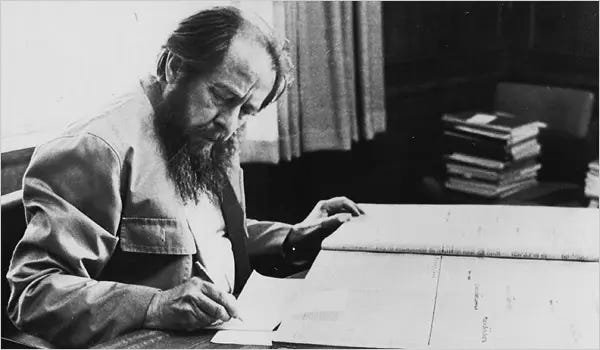
The problem, of course, is that violence that drives change doesn’t always make things better. The French Revolution produced a Reign of Terror followed by the Napoleonic Wars. The Russian Revolution produced Lenin, Stalin, gulags, and ruthless five-year plans. Here I recall an Alexander Solzhenitsyn quote: “All revolutions unleash the most elemental barbarism.”
Alexander Solzhenitsyn
Yet, if America’s so-called elites continue to close all legitimate avenues to meaningful change, they may be making elemental barbarism inevitable. And I’m not sure they care, in the sense they believe they will always come out on top, that they will, in a word, win, because the masses can always be manipulated or bullied into compliance.
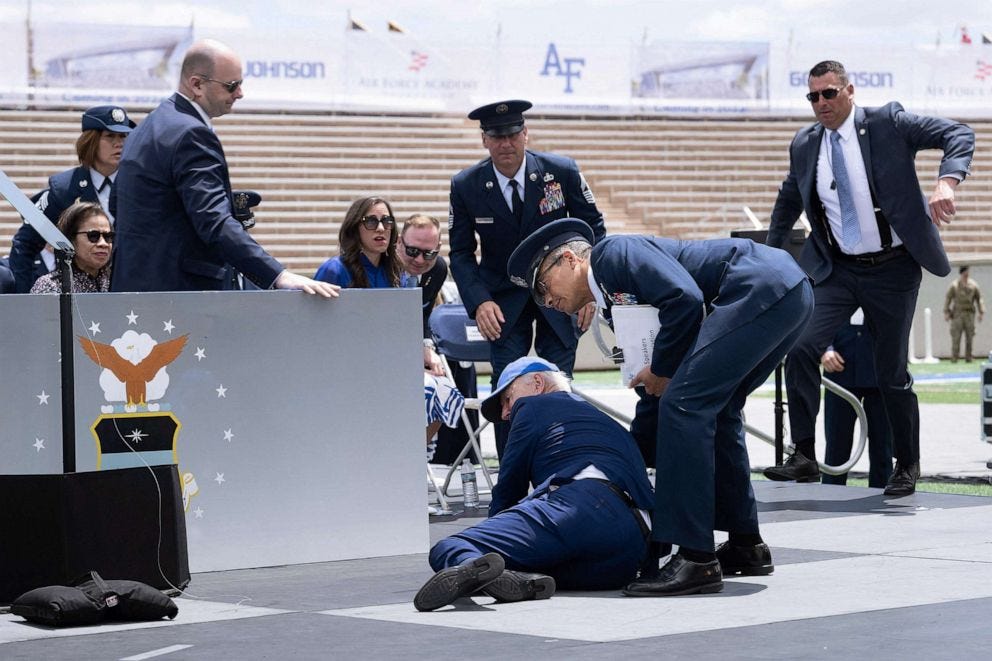
Yesterday, President Joe Biden tripped and fell at the Air Force Academy after handing diplomas to roughly 900 graduating cadets. He was helped to his feet by an Air Force officer and two Secret Service agents.
There. That seems straightforward. Biden tripped and fell, apparently not seeing a small sandbag in his path that was being used to weigh down a teleprompter stand. No big deal. We all stumble, bump into things, trip, and fall.
Why didn’t the Secret Service neutralize the sandbag that tripped our president?
So I have no idea why the New York Times described it like this:
President Biden appeared to trip and fall to his knees after handing out diplomas to graduates at the Air Force Academy in Colorado Springs.
He “appeared to”? Why the hedging? He obviously tripped and fell. And he had some trouble getting back up. That’s OK. He’s 80 years old and has some arthritis. We shouldn’t be surprised that this happened, nor should we try to qualify it. “Appeared to” trip and fall—c’mon, man, as Biden might say.
What worries me much more about Biden is that he never holds press conferences and rarely speaks extemporaneously. Remember when presidents would hold televised press conferences and occasionally take challenging questions? These simply don’t happen anymore. Biden is kept isolated from the press, and when he does appear, the questions appear to be scripted, with Biden calling on reporters by name in pre-determined order.
Add to this the DNC’s policy that there will be no Democratic candidate debates in 2024, irrespective of how well rivals are polling, and it truly makes you wonder about Biden’s fitness for office. If he can’t handle a real unscripted press conference and can’t endure a 90-minute unscripted debate with rivals like Robert F. Kennedy Jr. and Marianne Williamson, how can he possibly be well enough to serve as president, unless, of course, he’s merely a figurehead, pushed and shoved and propped up by those around him?
Even Hillary Clinton of all people has said that Biden’s age is a legitimate issue in the 2024 election. (Clinton said this, it seems, as a reminder to the DNC that she’s ready to run if Biden should stumble and fall in the primaries.) I don’t know what’s happening behind the scenes, but so far the DNC is standing by their man, no matter how much he has to be propped up.
Personally, I don’t want Biden to run again for many reasons, but one is most certainly his age. He deserves to walk away with some dignity intact. Another four years as president for Biden would likely kill him; charges of ageism aside, the physical and mental demands of the presidency are simply beyond most people in their eighties. That’s no knock on Joe; it’s just reality.
Six days ago, I received an email from the New York Times informing me that “The counteroffensive is coming.” It was all about Ukraine and its plans to take the fight to the Russians. Overall, I’d describe the tone of the article as almost giddy. Isn’t it great that Ukraine will soon be killing more Russians?
Readers here know I’m for diplomacy. Russia and Ukraine share a long border and history. They need to find a way to end this war and live together, and we should be helping them do this. The longer the war lasts, the more bitter it will get, even as events become more unpredictable. Nuclear escalation is quite possible. Yet the New York Times is gushing about Ukraine using the element of surprise and combined arms warfare to teach all those nasty Russians a lesson.
Map from the NYT Newsletter, citing the Institute for the Study of War. Interestingly, the map suggests Crimea as an objective of the promised Ukrainian counteroffensive
I liked this passage from the NYT article/newsletter: “The troops [of Ukraine] have learned a technique known as combined-arms warfare, in which different parts of the military work together to take territory. Tanks punch through enemy lines by rolling over trenches, for example, and infantry then spread out to hold the area.”
It sure sounds nice and clean. Tanks “punch through” and infantry “then spread out.” I’m sure glad the Russians have no tanks of their own, no anti-tank missiles, no machine guns, and no artillery.
Here’s another example from the NYT article of positive thinking and bloodless prose:
In the favorable scenario for Ukraine, a peace deal in which Russia is expelled from everywhere but Crimea and parts of the Donbas region would become plausible. On the flip side, a failed counteroffensive and an unbroken land bridge would provide Putin with a big psychological victory and a foundation from which to launch future attacks.
Only two scenarios? Either the Ukraine counteroffensive is a success, leading to a favorable peace deal, or it stalls, meaning victory for Russia and future Russian assaults? What about a wider war with Russia? Or a wildly successful attack that leads the Russians to deploy tactical nuclear weapons against it? Or an attack that Ukraine can’t sustain, leaving it vulnerable to Russian counterattacks in which Ukraine is convincingly defeated?
No matter what happens, we can count on at least two things as certain: more dead and wounded Russians and Ukrainians, and more profits for all those arms merchants providing weaponry to Ukraine, much of it paid for by American taxpayers, whether they know it or not.
Nowhere in this NYT newsletter is anything mentioned about the human costs of this much-anticipated Ukrainian counteroffensive. There’s only one mention of losses, and that comes with Russia:
Experts have compared the war’s recent months to World War I, with both sides dug into trenches and neither making much progress. Russia lost tens of thousands of troops this year merely to capture Bakhmut, a marginal city in the Donbas.
I’m glad Ukraine “lost” no troops in defending that “marginal city in the Donbas.” And who’s to say which city is “marginal” and which isn’t?
I’ve heard the NYT described as “liberal,” but when it comes to war, the NYT is a bloodthirsty cheerleader. Perhaps that’s the new face of liberalism in America today.
Watch out if the robots and computers copy their human creators
Robot dogs as potential enforcers. AI chatbots that write scripts, craft songs, and compose legal briefs. Computers and cameras everywhere, all networked, all connected, all watching—and possibly learning?
Artificial intelligence (AI) is all the rage as science fiction increasingly becomes science fact. I grew up reading and watching Sci-Fi, and the lessons of the genre about AI are not always positive.
To choose three TV shows/movies that I’m very familiar with:
Star Trek: The Ultimate Computer: In this episode of the classic 1960s TV series, a computer is put in charge of the ship, replacing its human crew. The computer, programmed to think for itself while also replicating the priorities and personality of its human creator, attempts to destroy four other human-crewed starships in its own quest for survival before Captain Kirk and crew are able to outwit and unplug it.
The Terminator: In this 1980s movie, a robot-assassin is sent from the future to kill the mother of its human nemesis, thereby ensuring the survival of Skynet, a sophisticated AI network created by the U.S. military that gains consciousness and decides to eliminate its human creators. Many sequels!
The Matrix: In this 1990s movie, the protagonist, Neo, discovers his world is an illusion, a computer simulation, and that humans are being used as batteries, as power sources, for a world-dominating AI computer matrix. Many sequels!
Sci-Fi books and movies have been warning us for decades that AI networks may be more than we humans can handle. Just think of HAL from Stanley Kubrick’s 2001: A Space Odyssey. Computers and droids of the future may not be like R2-D2 and C-3PO from Star Wars, loyal servants to their human creators.
Nothing to worry about: It’s a cute “Digidog” featured by the New York Police Department. You may be the one begging and rolling over, however.
As they say, it’s only a movie, but I do worry about too much hype about AI. If AI becomes a reflection of its human creators, especially a distorted one, we could have much to worry about.
Assuming computers could truly learn from their human creators, it makes sense they would act like us, pursuing violence and issuing death sentences in the name of AI’s security and progress.
To AI networks of the future, linked to robotic enforcer dogs and armed aerial drones, humans just might be the “terrorists.”
The best way to honor sacrifice is to seek an end to war and militarism
I was asked for a few words about Memorial Day. Here’s what I came up with:
On Memorial Day, we honor those who died in the service of our country. Let us do everything we can as a people and a nation to stop war and all its brutality. A peaceful future without war and all its awfulness is the best way to honor our troops, even as we cherish the memory of the heroes who gave their all.
Too often, Memorial Day is reduced to sales events, barbecues, and the like. It is, of course, a solemn occasion to remember the sacrifice of American service members. To honor the dead. To cherish their memory.
Yet one can also focus too narrowly on the veneration of the dead, using euphemisms like “the fallen” and speaking of how troops willingly “gave” their lives for their country. The best antidote to this is a short video by Andy Rooney for “60 Minutes” (when that show still had some principles and bite). Rooney, who’d served in World War II, knew of what he spoke. His goal was to end war, to save the living, to make a better world.
If you haven’t seen it, I urge you to watch it and to reflect on his sad and wise words.
Yesterday, Ron DeSantis announced his candidacy for President on Twitter; it didn’t go well due to “technical difficulties.” Something about his butchered announcement is telling. Yet what creeps me out about him isn’t his botched announcement with Elon Musk or even his record in Florida, which is bad enough, but rather his record in the U.S. military.
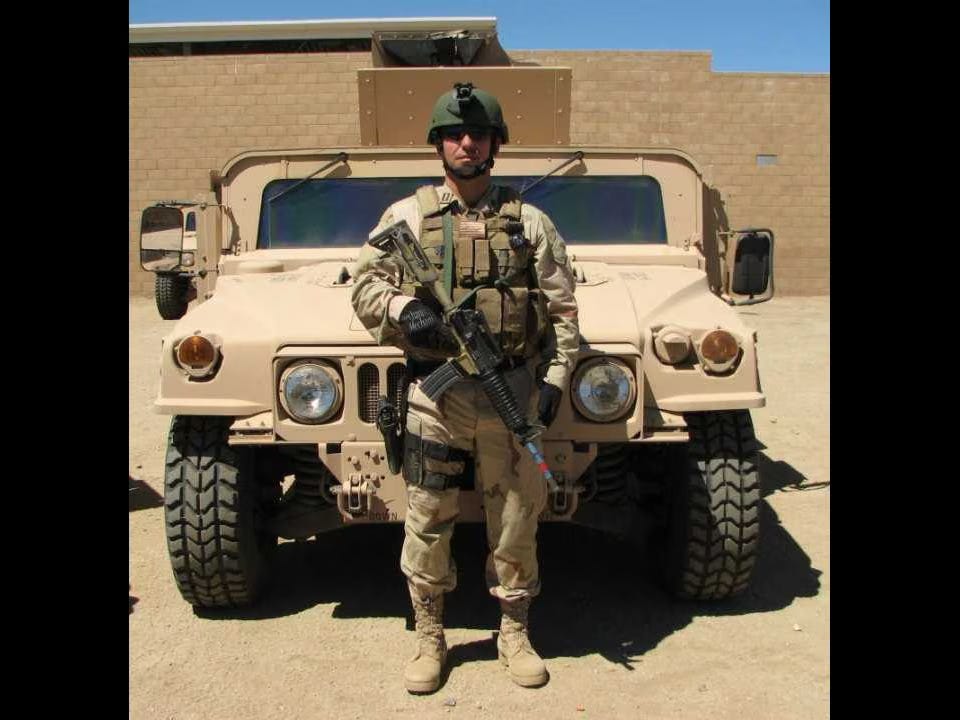
As a JAG (military lawyer), he seems to have facilitated torture at Gitmo (the prison at Guantanamo Bay in Cuba) and assassinations by Special Forces teams in Iraq. He was also fond of posing like a combat officer in desert camo holding an assault rifle. I doubt DeSantis was ever truly in harm’s way (same with me, by the way, but I never posed like a commando), but he loves to strike a pose. He even made a campaign commercial based on Tom Cruise’s “Maverick” in which DeSantis, of course, is the “Top Gun” of Florida.
Ron DeSantis, lawyer, ready to rock ‘n’ roll in Iraq
Meanwhile, speaking of image-making, according to the New York Times his wife Casey is cultivating a Jackie Kennedy-like image with her fashion choices (as a former TV news anchor, she knows the power of positive visuals). If image is everything, as those old camera commercials claimed, Ron DeSantis is burnishing his as a warrior-dad, which, I suppose, is better than the reality of a Harvard-trained power-hungry lawyer with no scruples.
There is something “off” about DeSantis, something inauthentic and dishonest, even more so than the typical politician. Call it a gut feeling.
But, moving past my “gut,” there’s the stunt DeSantis pulled in shipping immigrants seeking asylum in Texas to Martha’s Vineyard in Massachusetts. People are just pawns in his political power game. Again, not that unusual for an ambitious pol, but that doesn’t mean I want this charlatan to have his finger on the nuclear button.
I see him as a proto-Greg Stillson (from Stephen King’s “The Dead Zone”). A dangerous man. Strange as it may sound, Donald Trump strikes me as more authentic and less dangerous than DeSantis. Which, by the way, is no endorsement of Trump.
Mobsters are known for breaking kneecaps to bend people to their will. Marketers break into heads with repetitive and manipulative advertising, images, and narratives. Mobsters of the mind, they are.
I thought of this after watching all those repetitive (and largely interchangeable) ads for “legal” prescription drugs. Rarely do they show the often serious conditions they allegedly treat. Instead it’s image after image of people enjoying life, whether at amusement parks, the beach, dancing, or what-have-you. It’s as if drug companies are selling happiness pills whose only side effect is experiencing the best day of your life. Meanwhile, as images spill into your head of eternal bliss, a narrator quietly intones about potential serious side effects, even possible death in the case of one drug I’ve seen advertised.
Excuse me while I pop a few pills and denounce Russia—or China
Drug ads are the worst. People wonder why Americans take so many illegal drugs and why we have so many drug addictions — well, just look at all the ads for legal drugs, and how they’re advertised as making people incandescently happy. It’s all about the messaging: the repetition of powerful feel-good imagery, with drugs as panaceas.
Speaking of repetition, something similar is true of political manipulation. To cite one example: Russia. Has there ever been a worse “drug” with more serious side effects than Russia? Russia keeps hacking our elections! Russia is led by war criminals! Russia is raping Ukraine! Over and over again, the mainstream media encourages us to hate Russia and Vladimir Putin. Is this truly all we need to know about Russia? As Sting sang, don’t the Russians love their children too? (Back in the 1980s, the media didn’t go easy on Sting for his alleged naïveté and pro-Russian sentiments.)
Whether it’s drug advertisers, the mainstream media, or the U.S. government for that matter, America is infested with various “ministries of truth” that are driven by a mobster-like mentality. They may not break your kneecaps, but they nevertheless find ways to break into your mind.
Now you’ll excuse me while I pop a few pills while denouncing Russia. And China too, perhaps?






 Bracing Views