Recently, a friend wrote to challenge me to “write a great article about Trump’s introduction of ‘lightning war’ into politics,” citing Nazi Germany’s use of Blitzkrieg in the opening campaigns of World War II. My friend sympathizes with Trump, so his political Blitzkrieg comparison wasn’t meant pejoratively.
Image of Blitzkrieg from the Imperial War Museum. It wasn’t my idea for Trump…
Whether you call it Blitzkrieg or a “flood the zone” strategy, there’s little doubt Trump’s rapid-fire orders and actions have put those who oppose him on the defensive. Democrats are throwing up their hands in surrender-like motions. Democratic House Minority Leader Hakeem Jeffries plaintively asked: “What leverage do we have?” Then he added: “They [the Republicans] control the House, the Senate, and the presidency. It’s their government.”
The Democratic battle flag is a white cross on a field of white. They claim they can do nothing to stop Trump and his rampaging billionaire sidekick, Elon Musk.
It’s funny: When the Democrats had control of the House, Senate, and presidency, I often recall them complaining they couldn’t get much done due to obstruction by Republicans. How come Republicans can obstruct but not Democrats?
Leaving that aside, what about my friend’s praise of Trump as having launched Blitzkrieg politics? Reversing Clausewitz, is politics simply a continuation of war by other means?
America, so I’ve been taught, was founded as a republic with a Constitution. We claim to be a nation of laws. We like to think we’re a representative democracy. The House and Senate are supposed to be deliberative bodies where laws are made and money is spent in accordance with the will of the people.
I know: nice fantasy, right?
The U.S. government has become corrupted by money and special interests. We know our representatives rarely represent us. They represent their owners and donors. That breeds cynicism and a certain level of affection among some for Trump as a disruptor.
But smashing government isn’t the smartest and most effective way of reforming or even of rebuilding it. Empowering autocrats and plutocrats like Trump and Musk isn’t going to produce democracy and a government that serves the people. A Trump “political Blitzkrieg” will likely echo the Nazi Blitzkrieg of 1939-41, featuring widespread destruction and subjugation of “enemies.” It’s not a method conducive to greater justice and a more perfect union.
So, to my friend’s challenge, I say this: Political Blitzkrieg may provide an illusion of victory, but “victory” for whom, and for what? Wars, whether real shooting ones or political ones, are corrosive to liberty, freedom, and equality. In war, it’s typically the workers and poor who suffer most, the rich who profit most, as power congeals at the top.
Trump’s so-called Blitzkrieg, combined with a Democratic attitude of surrender, is producing a government by and for men like Elon Musk, even more so than it already is. If you truly desire plutocracy and one-party rule, Trump/Musk is your dynamic duo.
I still prefer democracy, however imperfect, and a system that doesn’t elevate and empower the richest among us as dictators.
President Donald Trump says he’s ready to tackle the Pentagon, which has failed seven audits in a row. He says America might save “trillions” after effective audits. Will it happen?
The Pentagon budget currently sits at roughly $900 billion for this fiscal year, representing more than half of federal discretionary spending. This vast sum doesn’t include (among other things) Homeland Security, nuclear weapons covered by the Department of Energy, the VA (Veterans Administration), and interest on the national debt due to wasteful failed wars in places like Afghanistan and Iraq.
A successful audit of the Pentagon would be a monumental victory for what’s left of American democracy. It may also prove to be a bridge too far for Trump. The National Security State is America’s unofficial fourth branch of government and arguably its most powerful. It is a colossus that hides malfeasance and corruption behind a “top secret” security classification. It deters and prevents efforts at transparency by crying that those who try to expose its crimes are endangering national security. It expects your obedience and praise, not your questions and criticism.
Presidents, of course, are supposed to serve as the commander-in-chief of the U.S. military. They rarely do. Not nowadays. The U.S. system may in theory rest on civilian control of the military, but the military has been out of control since at least 1947, when it rebranded itself the “Department of Defense” instead of the old War Department. Not coincidentally, every war America has fought since then has been undeclared, i.e. lacking a formal Congressional declaration of war.
America has fought a mind-blowing number of wasteful and illegal wars that have been sold to the people through lies, whether in Vietnam (“The Pentagon Papers”), Iraq (No WMD), Afghanistan (“The Afghan War Papers”), and elsewhere. Few things are needed more in America than an honest reckoning of Pentagon spending—and future Pentagon war plans.
Such a reckoning could very well save our lives—indeed, the world, if done honestly and transparently by true patriots. It could also prove to be a bridge too far—for any president.
I was reading a memoir by a combat veteran today who served in Afghanistan and he had this to say:
“I remember watching the movie Saving Private Ryan with him [my dad] and all I wanted after that was to be a soldier.”
Perhaps you’ve seen Saving Private Ryan. The opening sequence is harrowing–a visceral depiction of war (the bloody U.S. landing at Omaha Beach on D-Day, June 6, 1944)–followed by a “feel-good” Spielberg gloss that follows a band of heroes that “rescues” Private Ryan.
This is the problem with war films, even visceral ones. Boys and teenagers watch them and think they’re cool; they seek the deadliest of challenges, even war, guided and motivated as they are by BS pro-war government/Hollywood propaganda.
It’s very difficult to depict war without valorizing it. The director Samuel Fuller, who served in World War II and made the movie The Big Red One, noted how movies don’t depict combat realistically, even ones like Saving Private Ryan. In his words: “You can’t see anything in actual combat. To do it right, you’d have to blind the [movie] audience with smoke, deafen them with noise, then shoot one of them in the shoulder to scare the rest to death. That would give the idea [of real war], but then not many people would come to the movies.”*
I love that description of a “real” immersive war movie. Now, who wants to volunteer to be the one who gets shot in the shoulder?
Obviously, you’ll rarely see “real” war in the mainstream media or in Hollywood movies because ratings and profits matter. Those movies that truly show the very worst aspects of war, without glorifying war in any way, are rare indeed. Perhaps one of these is Johnny Got His Gun (1971).
The scene featuring Donald Sutherland as Jesus Christ—his howl at the end on the train of death—is unforgettable.
Another incredibly harrowing war film that I’ve never forgotten is Come and See (1985). Set on the Russian Front during World War II, it is a shattering depiction of the utter brutality of war.
One more war film that is perhaps prettier than it should be but which captures the sadness and loss of innocence of the World War I generation is Testament of Youth (2014). The scene near the end where Alicia Vikander calls for an end to killing—an end to war—is heartrending.
Readers, what “war” movies have you seen that truly made you want to reject war in all its sheer bloody awfulness and waste?
*Quoted in “Reel War vs Real War,” article by Peter Maslowski, MHQ: Military History Quarterly, Summer 1998 issue.
I recently published a book, My Father’s Journal, which recounts my dad’s life. If you’re a regular reader of this site, I think you’d enjoy the book, which you can order here. (The paperback is $10, Kindle is $5, and it’s “free” if you have Kindle Unlimited.)
My dad’s journal served to inspire this article for TomDispatch that I wrote during the Covid pandemic in 2020. There is still time to reimagine a better America, one in keeping with the generosity of men and women like my parents, who knew the privations of the Great Depression.
Anyway, here’s my article from March of 2020. I hope it inspires you to consider reading more of my dad’s insights.
My dad was born in 1917. Somehow, he survived the Spanish Flu pandemic of 1918-1919, but an outbreak of whooping cough in 1923 claimed his baby sister, Clementina. One of my dad’s first memories was seeing his sister’s tiny white casket. Another sister was permanently marked by scarlet fever. In 1923, my dad was hit by a car and spent two weeks in a hospital with a fractured skull as well as a lacerated thumb. His immigrant parents had no medical insurance, but the driver of the car gave his father $50 toward the medical bills. The only lasting effect was the scar my father carried for the rest of his life on his right thumb.
The year 1929 brought the Great Depression and lean times. My father’s father had left the family, so my dad, then 12, had to pitch in. He got a newspaper route, which he kept for four years, quitting high school after tenth grade so he could earn money for the family. In 1935, like millions of other young men of that era, he joined the Civilian Conservation Corps (CCC), a creation of President Franklin Delano Roosevelt’s New Deal that offered work on environmental projects of many kinds. He battled forest fires in Oregon for two years before returning to his family and factory work. In 1942, he was drafted into the Army, going back to a factory job when World War II ended. Times grew a little less lean in 1951 when he became a firefighter, after which he felt he could afford to buy a house and start a family.
I’m offering all this personal history as the context for a prediction of my dad’s that, for obvious reasons, came to my mind again recently. When I was a teenager, he liked to tell me: “I had it tough in the beginning and easy in the end. You, Willy, have had it easy in the beginning, but will likely have it tough in the end.” His prophecy stayed with me, perhaps because even then, somewhere deep down, I already suspected that my dad was right.
The COVID-19 pandemic is now grabbing the headlines, all of them, and a global recession, if not a depression, seems like a near-certainty. The stock market has been tanking and people’s lives are being disrupted in fundamental and scary ways. My dad knew the experience of losing a loved one to disease, of working hard to make ends meet during times of great scarcity, of sacrificing for the good of one’s family. Compared to him, it’s true that, so far, I’ve had an easier life as an officer in the Air Force and then a college teacher and historian. But at age 57, am I finally ready for the hard times to come? Are any of us?
And keep in mind that this is just the beginning. Climate change (recall Australia’s recent and massive wildfires) promises yet more upheavals, more chaos, more diseases. America’s wanton militarism and lying politicians promise more wars. What’s to be done to avert or at least attenuate the tough times to come, assuming my dad’s prediction is indeed now coming true? What can we do?
It’s Time to Reimagine America
Here’s the one thing about major disruptions to normalcy: they can create opportunities for dramatic change. (Disaster capitalists know this, too, unfortunately.) President Franklin Roosevelt recognized this in the 1930s and orchestrated his New Deal to revive the economy and put Americans like my dad back to work.
In 2001, the administration of President George W. Bush and Vice President Dick Cheney capitalized on the shock-and-awe disruption of the 9/11 attacks to inflict on the world their vision of a Pax Americana, effectively a militarized imperium justified (falsely) as enabling greater freedom for all. The inherent contradiction in such a dreamscape was so absurd as to make future calamity inevitable. Recall what an aide to Secretary of Defense Donald Rumsfeld scribbled down, only hours after the attack on the Pentagon and the collapse of the Twin Towers, as his boss’s instructions (especially when it came to looking for evidence of Iraqi involvement): “Go massive — sweep it all up, things related and not.” And indeed they would do just that, with an emphasis on the “not,” including, of course, the calamitous invasion of Iraq in 2003.
To progressive-minded people thinking about this moment of crisis, what kind of opportunities might open to us when (or rather if) Donald Trump is gone from the White House? Perhaps this coronaviral moment is the perfect time to consider what it would mean for us to go truly big, but without the usual hubris or those disastrous invasions of foreign countries. To respond to COVID-19, climate change, and the staggering wealth inequities in this country that, when combined, will cause unbelievable levels of needless suffering, what’s needed is a drastic reordering of our national priorities.
Remember, the Fed’s first move was to inject $1.5 trillion into the stock market. (That would have been enough to forgive all current student debt.) The Trump administration has also promised to help airlines, hotels, and above all oil companies and the fracking industry, a perfect storm when it comes to trying to sustain and enrich those upholding a kleptocratic and amoral status quo.
This should be a time for a genuinely new approach, one fit for a world of rising disruption and disaster, one that would define a new, more democratic, less bellicose America. To that end, here are seven suggestions, focusing — since I’m a retired military officer — mainly on the U.S. military, a subject that continues to preoccupy me, especially since, at present, that military and the rest of the national security state swallow up roughly 60% of federal discretionary spending:
1. If ever there was a time to reduce our massive and wasteful military spending, this is it. There was never, for example, any sense in investing up to $1.7 trillion over the next 30 years to “modernize” America’s nuclear arsenal. (Why are new weapons needed to exterminate humanity when the “old” ones still work just fine?) Hundreds of stealth fighters and bombers — it’s estimated that Lockheed Martin’s disappointing F-35 jet fighter alone will cost $1.5 trillion over its life span — do nothing to secure us from pandemics, the devastating effects of climate change, or other all-too-pressing threats. Such weaponry only emboldens a militaristic and chauvinistic foreign policy that will facilitate yet more wars and blowback problems of every sort. And speaking of wars, isn’t it finally time to end U.S. involvement in Iraq and Afghanistan? More than $6 trillion has already been wasted on those wars and, in this time of global peril, even more is being wasted on this country’s forever conflicts across the Greater Middle East and Africa. (Roughly $4 billion a month continues to be spent on Afghanistan alone, despite all the talk about “peace” there.)
2. Along with ending profligate weapons programs and quagmire wars, isn’t it time for the U.S. to begin dramatically reducing its military “footprint” on this planet? Roughly 800 U.S. military bases circle the globe in a historically unprecedented fashion at a yearly cost somewhere north of $100 billion. Cutting such numbers in half over the next decade would be a more than achievable goal. Permanently cutting provocative “war games” in South Korea, Europe, and elsewhere would be no less sensible. Are North Korea and Russia truly deterred by such dramatic displays of destructive military might?
3. Come to think of it, why does the U.S. need the immediate military capacity to fight two major foreign wars simultaneously, as the Pentagon continues to insist we do and plan for, in the name of “defending” our country? Here’s a radical proposal: if you add 70,000 Special Operations forces to 186,000 Marine Corps personnel, the U.S. already possesses a potent quick-strike force of roughly 250,000 troops. Now, add in the Army’s 82nd and 101st Airborne divisions and the 10th Mountain Division. What you have is more than enough military power to provide for America’s actual national security. All other Army divisions could be reduced to cadres, expandable only if our borders are directly threatened by war. Similarly, restructure the Air Force and Navy to de-emphasize the present “global strike” vision of those services, while getting rid of Donald Trump’s newest service, the Space Force, and the absurdist idea of taking war into low earth orbit. Doesn’t America already have enough war here on this small planet of ours?
4. Bring back the draft, just not for military purposes. Make it part of a national service program for improving America. It’s time for a new Civilian Conservation Corps focused on fostering a Green New Deal. It’s time for a new Works Progress Administration to rebuild America’s infrastructure and reinvigorate our culture, as that organization did in the Great Depression years. It’s time to engage young people in service to this country. Tackling COVID-19 or future pandemics would be far easier if there were quickly trained medical aides who could help free doctors and nurses to focus on the more difficult cases. Tackling climate change will likely require more young men and women fighting forest fires on the west coast, as my dad did while in the CCC — and in a climate-changing world there will be no shortage of other necessary projects to save our planet. Isn’t it time America’s youth answered a call to service? Better yet, isn’t it time we offered them the opportunity to truly put America, rather than themselves, first?
5. And speaking of “America First,” that eternal Trumpian catch-phrase, isn’t it time for all Americans to recognize that global pandemics and climate change make a mockery of walls and go-it-alone nationalism, not to speak of politics that divide, distract, and keep so many down? President Dwight D. Eisenhower once said that only Americans can truly hurt America, but there’s a corollary to that: only Americans can truly save America — by uniting, focusing on our common problems, and uplifting one another. To do so, it’s vitally necessary to put an end to fear-mongering (and warmongering). As President Roosevelt famously said in his first inaugural address in the depths of the Great Depression, “The only thing we have to fear is fear itself.” Fear inhibits our ability to think clearly, to cooperate fully, to change things radically as a community.
6. To cite Yoda, the Jedi master, we must unlearn what we have learned. For example, America’s real heroes shouldn’t be “warriors” who kill or sports stars who throw footballs and dunk basketballs. We’re witnessing our true heroes in action right now: our doctors, nurses, and other medical personnel, together with our first responders, and those workers who stay in grocery stores, pharmacies, and the like and continue to serve us all despite the danger of contracting the coronavirus from customers. They are all selflessly resisting a threat too many of us either didn’t foresee or refused to treat seriously, most notably, of course, President Donald Trump: a pandemic that transcends borders and boundaries. But can Americans transcend the increasingly harsh and divisive borders and boundaries of our own minds? Can we come to work selflessly to save and improve the lives of others? Can we become, in a sense, lovers of humanity?
7. Finally, we must extend our loveto encompass nature, our planet. For if we keep treating our lands, our waters, and our skies like a set of trash cans and garbage bins, our children and their children will inherit far harder times than the present moment, hard as it may be.
What these seven suggestions really amount to is rejecting a militarized mindset of aggression and a corporate mindset of exploitation for one that sees humanity and this planet more holistically. Isn’t it time to regain that vision of the earth we shared collectively during the Apollo moon missions: a fragile blue sanctuary floating in the velvety darkness of space, an irreplaceable home to be cared for and respected since there’s no other place for us to go? Otherwise, I fear that my father’s prediction will come true not just for me, but for generations to come and in ways that even he couldn’t have imagined.
You may recall that, late in 2022, I asked the AI platform ChatGPT to write a short critical essay on the military-industrial complex. That essay is here.
Recently, news out of China came of a new AI platform known as DeepSeek that reportedly is both cheaper and better than U.S. efforts. I asked DeepSeek for a 600-word critical essay on the MIC, and it complied with its human master (at least for now). Here’s the essay, which, you may agree, is quite good:
The Military-Industrial Complex: A Critical Examination [Written by DeepSeek]
The military-industrial complex (MIC) in the United States, a term popularized by President Dwight D. Eisenhower in his 1961 farewell address, refers to the symbiotic relationship between the nation’s armed forces, defense contractors, and the political institutions that support them. While Eisenhower warned of its potential dangers, the MIC has since grown into a colossal entity that wields significant influence over American society, economy, and foreign policy. This essay argues that the military-industrial complex is detrimental to the United States, perpetuating endless wars, distorting national priorities, and undermining democratic principles.
One of the most glaring consequences of the MIC is its role in perpetuating a state of perpetual war. The United States has been involved in military conflicts for the majority of its history, with the 21st century being no exception. The wars in Afghanistan, Iraq, and elsewhere have been justified under the guise of national security, but they have often served the interests of defense contractors more than the American people. Companies like Lockheed Martin, Boeing, and Raytheon profit immensely from the production of weapons and military technology, creating a perverse incentive to maintain and escalate conflicts. This cycle of war and profit not only drains national resources but also results in the loss of countless lives, both American and foreign. The human cost of these wars is immeasurable, and the moral implications of prioritizing profit over peace are deeply troubling.
Moreover, the MIC distorts national priorities by diverting vast sums of money away from critical domestic needs. The United States spends more on its military than the next ten countries combined, with the defense budget often exceeding $700 billion annually. This staggering expenditure comes at the expense of underfunded sectors such as education, healthcare, infrastructure, and climate change mitigation. While the country boasts an unparalleled military capability, it lags behind other developed nations in key areas of social and economic well-being. For instance, the U.S. faces a crumbling infrastructure, a lack of universal healthcare, and a growing wealth gap. The prioritization of military spending over these pressing issues reflects a skewed set of values that favors corporate interests over the welfare of citizens.
The influence of the MIC also undermines democratic principles by eroding the separation of power and fostering corruption. Defense contractors spend millions of dollars annually on lobbying and campaign contributions, ensuring that politicians support policies favorable to the industry. This creates a feedback loop where elected officials are incentivized to approve bloated defense budgets and authorize military interventions, regardless of their necessity or public support. The result is a government that is increasingly beholden to corporate interests rather than the will of the people. Furthermore, the revolving door between the Pentagon, Congress, and defense contractors exacerbates this issue, as individuals move seamlessly between public service and lucrative private sector positions. This blurring of lines between public and private interests erodes trust in government and undermines the democratic process.
Critics of the MIC often face significant backlash, as questioning the necessity of military spending or the morality of war is frequently framed as unpatriotic or naive. This stifling of dissent is another way in which the MIC exerts its influence, creating a culture where alternative perspectives are marginalized. The media, too, plays a role in perpetuating this status quo, often uncritically echoing government narratives and failing to hold policymakers accountable. This lack of critical scrutiny allows the MIC to operate with minimal oversight, further entrenching its power.
In conclusion, the military-industrial complex represents a profound threat to the United States, perpetuating endless wars, distorting national priorities, and undermining democratic principles. Eisenhower’s warning about the dangers of the MIC remains as relevant today as it was in 1961. To address these issues, the United States must reevaluate its priorities, reduce its reliance on military solutions, and invest in the well-being of its citizens. Only by challenging the entrenched power of the MIC can the nation hope to achieve a more just, peaceful, and equitable future. The stakes are high, and the time for action is now. [End of essay.]
*****
Amen to that, DeepSeek! There are a few edits I’d make here. Raytheon is now RTX. The defense war budget is now $900 billion and rising, not $700 billion. I wouldn’t use the word “symbiotic” to describe relations among the Pentagon, the weapons makers, and Congress; more like “toxic,” corrupted as it is by greed, money and self-interest. I do very much like this line: “the moral implications of prioritizing profit over peace are deeply troubling.” Deeply troubling indeed!
Anyhow, if you’re interested, go to DeepSeek.com, create an account, and ask our future AI overlord a question. Perhaps you’ll be surprised by the result.
Isn’t it high time we “augment” our nuclear force “posture”? Shouldn’t we fight to achieve peace through nuclear “strength” and “deterrence”? Isn’t it smart to “refurbish, rebuild, and modernize” the nuclear triad? What a great “investment” that is! And a “job-creator” too!
These are some of the buzz words thrown about by the nuclear “elites” in America. They want to sell us on new ICBMs (the Sentinel), a new stealth bomber (the B-21 Raider), and new nuclear SLBMs (on Columbia-class submarines). All this thermonuclear stupidity is projected to cost roughly $2 trillion over the next 30 years. Quite the “investment,” right?
What the “experts” don’t talk about is the genocidal and exterminatory nature of these thermonuclear bombs and missiles. They don’t talk about the destruction of most life forms on our planet due to thermonuclear winter. They don’t talk about the enormous and rapidly mushrooming cost of these weapons. (For example, the B-21 has already climbed from $550 million per plane to $750 million; much like a missile, Sentinel costs have rocketed upward even more rapidly.) And they sure as hell don’t talk about the immorality of mass murder.
Why does this idiocy, this madness, this insanity, persist? We know why. A few quick and obvious reasons:
1. Threat inflation: Oh my God, China is building some silos! Oh my God, Russia still has nukes! And Putin! Even though America has over 5000 nuclear bombs and warheads and the world’s most accurate and survivable nuclear force, the military-industrial complex is more than willing to hype and inflate new threats.
2. Lobbyists: There are outrageous sums of money to be made building genocidal weaponry, and a small army of lobbyists deployed to Washington by companies like Northrop Grumman to ensure the money keeps flowing to the weapons makers.
3. Jobs: Of course, any program that spends $2 trillion is going to create a few jobs, even earth-destroying bombs and missiles. But the jobs argument remains compelling for states like Montana, New Mexico, North Dakota, Utah, and Wyoming that profit from nuclear largesse. Senators and representatives from these states generally couldn’t care less about the nature of the “pork” they bring home—even irradiated pork in the form of nuclear weapons—as long as they can claim it’s creating good-paying jobs for the folks back home.
4. The Pentagon: Insatiable generals and admirals always want MORE. More nuclear bombers and missiles. More submarines. More of everything. No service will ever voluntarily give up a weapon system, no matter how old and dumb it is—or dangerous.
5. Lack of a unified movement against these weapons: In the early 1980s, the nuclear freeze movement put millions of people in the street to protest against new nukes like the American Pershing II and GLCMs. Then-President Ronald Reagan worked with Soviet Premier Mikhail Gorbachev to reduce—even to eliminate—nuclear weapons. Elimination wasn’t to be, but the U.S. and USSR did work to reduce nuclear weapons. That spirit of cooperation through diplomacy is dead. Meanwhile, Americans post-9/11 have grown accustomed to endless war and mushrooming Pentagon budgets. America itself has become more segmented, more stovepiped, more supine. That said, so many problems bedevil us that nuclear annihilation, as apocalyptic as that is, seems both remote and unsolvable.
To that last point: The nuclear threat is both near and solvable. Instead of our “elites”stressing about the survivability of the nuclear triad, we need to focus on the survivability of humanity. President Trump allegedly seeks a Nobel Peace Prize. He also seemingly has a genuine fear of nuclear war. Americans need to push him—as well as representatives in Congress—to seek nuclear disarmament through diplomacy rather than further nuclear escalation with new weaponry.
The problem, as one Congressman put it, is that money is the crack cocaine of politics. And nuclear weapons makers have plenty of money to hook our so-called representatives on the thermonuclear crack they’re selling.
We need an intervention to get America off its addiction to thermonuclear crack. Of course, it’s never easy overcoming a nuclear addiction—all I can say is our very survival depends on it.
A friend of mine sent along a typical militarized think-tank article and asked for my comments. Here’s the title, with a link:
Moneyball Military: An Affordable, Achievable, and Capable Alternative to Deter China
It was published by the Hoover Institution out of “liberal” Stanford University.
“Moneyball” is a baseball term, the idea being that smaller market (and budget) teams can compete with larger teams (like the LA Dodgers or NY Yankees) by being smarter, by using metrics and stats to identify “cheap” but good players as well as more effective tactics to win ballgames. Check out the movie with the same title starring Brad Pitt.
Brad Pitt in “Moneyball.” But war, especially a land war in Asia, isn’t a game.
The “Moneyball Military” article basically argues the U.S. military must become more innovative, more responsive, more nimble, more flexible, etc., to meet the challenge of China. What articles like this one never suggest is diplomacy and the pursuit of PEACE. They never suggest that major cuts can be made to the Pentagon budget because the U.S. is fundamentally safe from invasion. They usually argue instead for more Pentagon spending, only “smarter.”
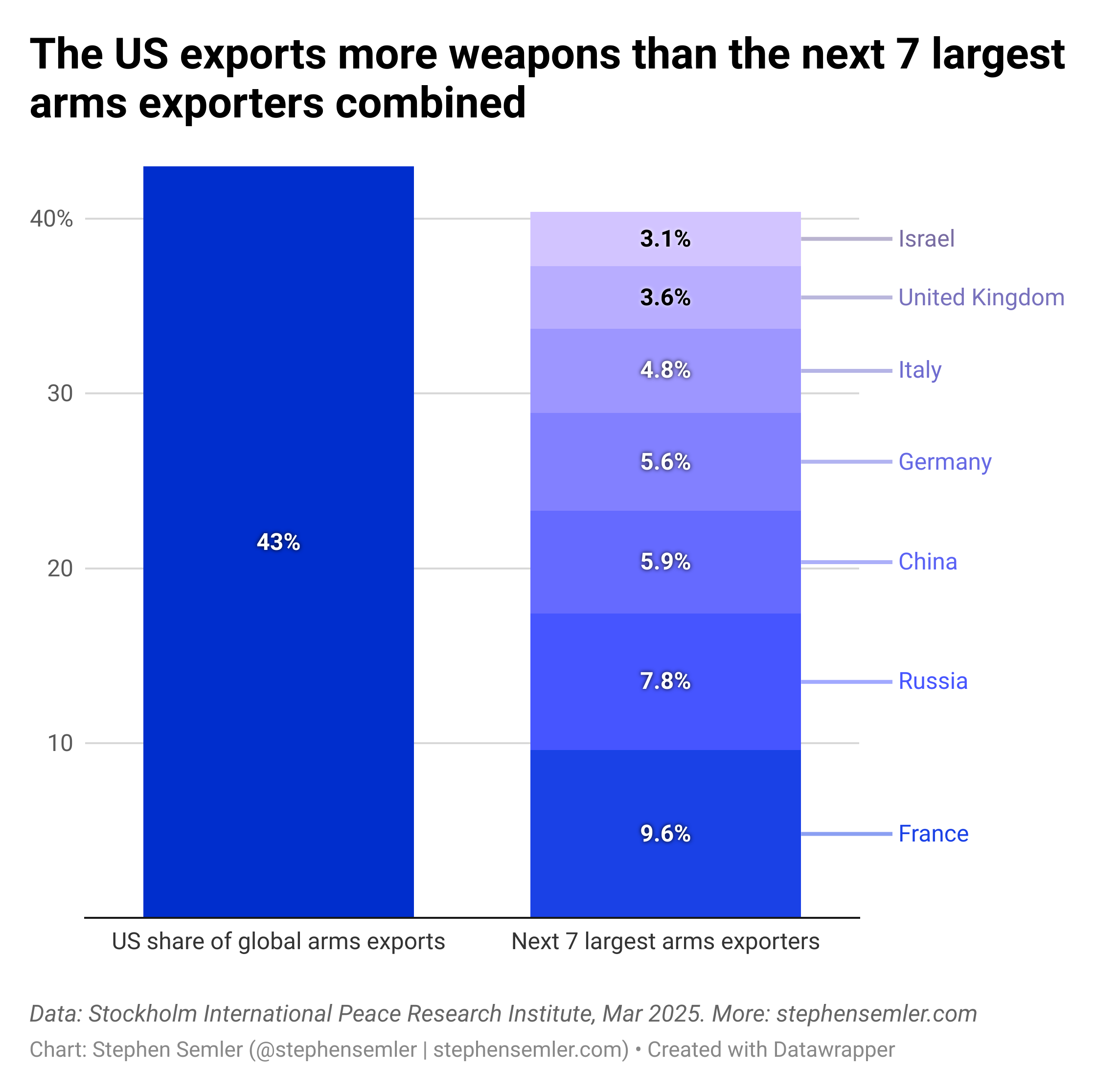
Why does the U.S. “need” 800 military bases around the globe? Why does it “need” to dominate the global trade in arms? Why has the U.S. wasted $10 trillion on unwinnable wars and conflicts (Iraq, Afghanistan, the GWOT, et al.) since 9/11? Why is China, a major U.S. trading partner and holder of U.S. debt, seen as an “enemy”?
These are questions that aren’t raised in think-tank articles like this one.
If you believe the polls, the U.S. is allegedly a Christian nation. Is there a worse sin than killing other humans in massive numbers? How do we stop doing this? Didn’t Christ say “Blessed are the peacemakers”? Why is the U.S. ennobling and saluting the warmakers instead? Why are we always envisioning wars with other peoples?
Again, is China really America’s enemy? Is China really planning to invade Taiwan? If so, wouldn’t diplomacy be a far smarter way of addressing this rather than a land war in Asia?
When one encounters think-tank articles like this one, one would be wise to remember Ray McGovern’s acronym, MICIMATT, which rightly includes these think tanks among the powerful entities that form America’s military-industrial-congressional complex.
When it comes to a land war in Asia, there is no smart way to “moneyball” it. The smart thing to do is to not play “ball” at all.
Yesterday at a local barber shop, I spied some old Life magazines from the 1940s, 1950s, and 1960s. Two covers caught my eye:
The first cover celebrated the newish B-52 nuclear bomber that circumnavigated the globe in record time (for the year 1957). Incredibly, the Air Force still relies on updated B-52s today for global bombing missions. Note how the cover mentions nothing about the B-52’s purpose, which was (and remains) to carry nuclear payloads with yields in the megatons of explosive force, anywhere on the globe.
The second cover celebrated fallout shelters. Check this out!
This gives new meaning to living under bridges in America. If only we had built all these fallout shelters—the homeless would have places to live in America today. It sure looks communal and fun in that cutaway view: women holding babies, people reading newspapers and books, even group discussions featuring people dressed like Ward and June Cleaver.
This, I submit to you, is propaganda, the intent of which was to normalize nuclear weapons, perhaps even nuclear war. (Just calmly walk or drive to the nearest shelter if our B-52s have to nuke Moscow.)
It persists today, of course. Now when the Pentagon speaks of nuclear weapons, they frame it as “investing” and “modernization.” Invest in ICBMs! Promised to soar upward like a rocket! Modernize your portfolio with some new B-21 Raider bombers—only $750 million per plane!
If the risk of nuclear war comes up, the suggestion is made that all these new nukes will serve to deter, even to prevent, nuclear Armageddon. Nothing deters war and killing like more genocidal weapons.
Those Life covers from 1957 and 1962 may look quaint—even silly—until you realize nothing really has changed in America in 70 years. We’re still normalizing nuclear weapons and even nuclear war itself. And there’s nothing quaint or silly about that.
When I was a kid, at the height of the U.S. space program and the Apollo missions to the moon, I was an avid consumer of space food sticks and Tang. They were “cool,” or so it seemed to me, because the astronauts (and product advertisers) said so. Of course, space food sticks tasted something like cardboard and Tang was a poor imitation of orange juice, but the power of image and advertising sold them to me, at least for a time. Then I smartened up and returned to Charleston Chews and real OJ. Breakfast of champions!
It’s truly amazing what the powers that be can sell to Americans. Lately, we’ve been sold a series of wars based on lies, most recently Iraq and Afghanistan and Ukraine. We’ve even been sold a genocide in Gaza, billed as a defensive operation for America’s guiltless and democratic ally, Israel, which only wants to assert its “right to exist.” Whether we’ll ever smarten up about these “products” we’re being sold remains to be seen.
These thoughts were on my mind as I read Caitlin Johnstone’s recent article where she mentions the Russia-Ukraine War. She references Time Magazine, the mainstream media in a nutshell, and a telling admission that U.S. support of Ukraine has been all about weakening Russia and Putin, with no thought given to military victory or the cost of that war to Ukraine.
Not that there haven’t been plenty of mask-off moments during the dementia-muddled chaos of the Biden administration as well. A new article in Time titled “Why Biden’s Ukraine Win Was Zelensky’s Loss” is a good example of this; the report cites a former member of Biden’s National Security Council saying that victory for Ukraine was never part of the Biden administration’s plan.
The opening paragraph reads as follows:
“When Russia invaded Ukraine nearly three years ago, President Joe Biden set three objectives for the U.S. response. Ukraine’s victory was never among them. The phrase the White House used to describe its mission at the time — supporting Ukraine ‘for as long as it takes’ — was intentionally vague. It also raised the question: As long as it takes to do what?”
Well, at least Zelensky and his wife enjoyed the Vogue treatment:
America, a good motto to keep in mind is this one:
I’m Already Against the Next War
Don’t let them sell a new war to you, no matter how many crummy commercials they use to convince you that space food sticks, Tang—heck, even genocide and war—are great.
Yesterday, the Merchants of Death Tribunal concluded with a verdict of “guilty” for all those U.S. dealers and exporters of weapons globally. Yes, the merchants of death are guilty as sin, even as they account for 40% of the global trade in deadly weaponry. Who says nothing is made in America today? We make plenty of things that go “bang.”
In our culture today, it’s considered “patriotic” to make loads of money, especially by selling guns. Just look at the National Rifle Association (NRA) and its enablers in Congress and all the gun companies domestically.
Assault weapons are highly profitable, much more so than pistols, and isn’t it all about making money? Thoughts and prayers to those innocents caught in the crossfire, of course. No worries–more “good guys with guns” will save us from the bad guys with guns.
If we Americans embrace (or, refuse to stop) the sale of firearms, especially dangerous assault weapons, domestically, indeed, if we fetishize it with ideas of potency and manliness, is it any surprise we brag of weapons sales overseas and our dominance of that trade? If we don’t care (or care enough) about the safety of our own children, why should we care about dead kids in Gaza?
Our culture is violent and sick, and until we reform it, there’s little hope of meaningful change.
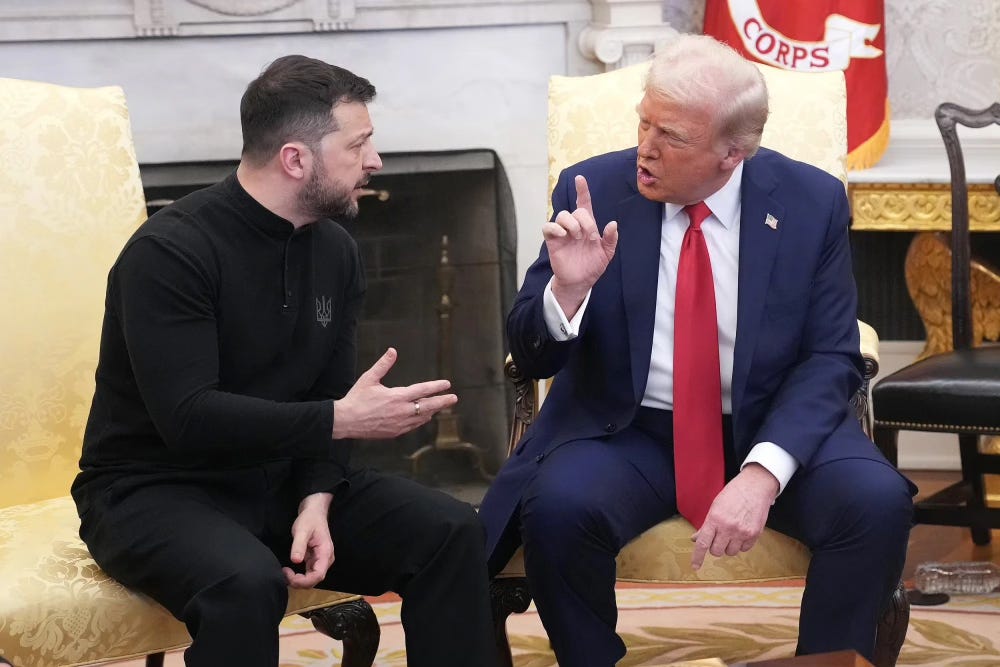
That said, it’s encouraging to hear of a ceasefire in Gaza. Perhaps the Trump administration can achieve a ceasefire in Ukraine as well. The problem is there always seems to be another war or wars looming on the horizon for the U.S., more conflicts that America’s merchants of death can make a killing on.
America has the war but not the peace
If there’s an American Leo Tolstoy out there, he couldn’t write a book on this epoch with the title of War and Peace. Today’s version for America has a single-word title: War.
Peace is rarely if ever mentioned in mainstream political discourse and culture. That’s not surprising. Roughly 60% of U.S. federal discretionary spending goes to the Pentagon, Homeland Security, nuclear weapons, and weapons shipments to places like Israel and Ukraine. President Biden once said: Show me your budget and I’ll tell you what you value. Looks like America values war very highly indeed.
Until we stop valuing and valorizing war and start embracing peace, the merchants of death will continue to thrive. Sure, they’re guilty, but so are we all if we keep feeding them our money and keep looking to them for “safety” and “security.”