It’s not Lebanon that’s the weak link here—it’s Israel.
Israel is the attacker. The aggressor. The country that wants to scupper the MOU between the USA and Iran. Everyone knows this—except the NYT, apparently.
I like too how the NYT describes it as the “American-Israeli war on Iran.” At the very least, it should be Israeli-American war of aggression against Iran.
And when was Lebanon a “secondary front” to the USA? America has no desire to seize land and water in southern Lebanon. That goal is entirely Israel’s, as is its fight against Hezbollah, which is responding to Israeli aggression.
The Iran War has been a huge loser (to put it in Trumpian terms) for the U.S., and only Israel seeks to prolong it. Again, who’s the weak link in the U.S.-Iran deal to end the war?
I’ve been playing with Trumpian language to describe the Iran War and its outcome. As Trump might say, it’s been a defeat for America the likes of which we’ve never seen before. No other defeat comes close.
I think Trump finally understands that. The question is, will “weak link” Israel let him withdraw or will the war become even more catastrophic?
It’s a most confusing time to be in the U.S. military. Who knows why we fight?
At the top, there’s a lack of principles, a lack of clarity, a lack of care.
There’s no accountability for losses and bad decisions.
The government keeps the people isolated from war’s true costs. There’s no call for sacrifice. No war bonds, no draft, no increase in taxes. Costs are largely kicked into the future as the national debt soars ever higher.
An all-volunteer military is essentially told to follow orders. Never mind about the morality or legality of the same.
The people are encouraged to cheer on or otherwise to support their warriors and warfighters. Basically, to wave the flag but otherwise to go about their business.
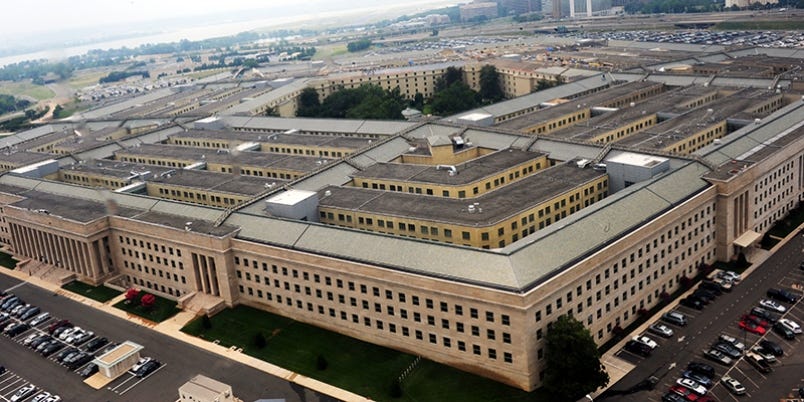
A divided Congress has essentially rendered itself powerless over war-making. Meanwhile, Members of Congress fight for their share of an expanding Pentagon pie of money (or pork) for their districts.
The Secretary of State says we went to war with Iran because Israel forced the U.S. government’s hand. So apparently in this case the U.S. military fights for Israel.
So far, the main beneficiaries of the war appear to be defense contractors, fossil fuel companies and banks, so apparently the U.S. military is fighting for them as well.
Clearly, with Iran the U.S. military is not fighting to defend the American people or to support and defend the U.S. Constitution.
Again, who knows why we fight?
The HAL 9000 knows the score
It’s always useful to ask Cui bono? while following the money. I asked my AI friends who’s benefiting from this war, and this was the answer the HAL 9000 spit out:
*****
The primary beneficiaries of the Iran war are Western defense contractors, major oil and gas corporations, and geopolitical rivals like Russia and China. The conflict has resulted in billions of dollars in windfalls for arms manufacturers and energy producers, while simultaneously shifting regional power balances. [1, 2, 3, 4, 5]
Defense Contractors
Stock Surges: Arms manufacturers like Lockheed Martin and Northrop Grumman have seen multi-billion dollar gains.
Missile & Defense Demand: High demand for THAAD interceptors and other Raytheon systems drives excess revenue. [1, 2]
Oil & Gas Majors
Record Profits: Surging crude prices have boosted revenues for producers like ExxonMobil and Chevron.
Energy Traders: European giants like Shell and BP capitalized on market chaos and sharp price movements. [1, 2, 3, 4]
Geopolitical Rivals
Russia: The conflict acts as a fiscal rescue by diverting Western attention and skyrocketing global energy prices.
China: China’s regional strategic influence is strengthened as the US is forced to divert military resources to the Middle East. [1]
Regional Powers
Israel: The war has neutralized immediate adversaries and solidified the country’s military posture in the region.
*****
Certainly, it’s indisputable how much the weapons makers and fossil fuel companies are profiting here.
Famously, Marine Corps Major General Smedley Butler confessed in the 1930s he’d served as a gangster for capitalism with Standard Oil being one of his biggest clients. The Iran War seems to have benefited Israel, oil and gas interests, and military contractors the most, even as the average American has been hurt by inflation with much higher prices for gas, oil, groceries, and the like.
Interestingly, my AI friend didn’t list Iran as a major beneficiary of the war, but many have argued persuasively that Iran will emerge stronger from this conflict.
Again, it’s a most confusing time to be in the U.S. military.
PS: I thought I’d add this response I made to TomR’s comment below:
In 1985, when I pinned on those 2LT bars, I thought I had some clarity. America, though hardly perfect, was better than the model offered by the Soviet Union. Then the USSR collapsed in 1991, and the government went looking for new dragons to slay. And we found them and we keep finding them because we keep sowing the dragon’s teeth.
So the U.S. military has become a perpetual fighting machine, never mind the Constitution, never mind democracy, never mind morality or legality. If we don’t have enemies, we’ll create them.
Sad to say it doesn’t seem to matter what we the people think about war and military spending.. President Trump doesn’t care that at least 70% of Americans are against the Iran War. Dick Cheney infamously replied, “So?” when he was told by a reporter that Americans opposed further escalation in the Iraq War.
It might matter what we thought if we lived in a democracy, but we don’t. We live in a kleptocracy, a kakistocracy.
First, we must recognize we’ve lost our say–that we don’t have a government that represents us–then we need to reform, re-create, or otherwise change that government.
Again, in the main, Americans don’t want militarism and wars–but there are other forces at work that do want these things, for their reasons, and they are in control.
Americans, I believe, don’t want more nuclear weapons. We’re getting them anyway. Read this article by Bill Hartung on the profiteers of Armageddon.
Americans, I believe, don’t want to spend between $1.5 trillion to $2.3 trillion each year on the Pentagon and war (read this POGO report on the true total U.S. military budget), but the warmongers and the military-industrial complex spend that money anyway.
As George Carlin said, the owners don’t care about you—at all! At all! At all! Your preferences, your needs, simply don’t matter. You have no say. To “our” leaders, the owners, inflation is good—just ask President Trump. Rising gas prices are great—for fossil fuel companies. Rising credit card balances and debt are healthy—for bankers.
We need to act. We need to change American-made destruction into American-made construction. We must become builders again, not destroyers.
The weapons they fund and build, the wars they prosecute, all the shredded human bodies, and for what? What morally abject fools the weapons makers and warmongers are. Why do we allow them to get away with it?
Until we regain our morality and our nerve, until we cast aside the kakistocrats and kleptocrats ruling us, we will remain stuck in the malaise of mindless militarism and endless war.
Withhold your consent. Run for office yourself. Organize and protest. Talk to your neighbors. Even write a blog. Whatever you can do to derail the war train rushing toward Armageddon is a good thing.
America’s leaders are always boasting of precision weaponry. Yet the NYT suggests that a precision strike against an Iranian water facility was possibly unintentional, an accident, I guess. Since an intentional strike against critical infrastructure (you can’t get more critical than potable water) for civilians would constitute a war crime—and obviously America would never do that!
Even asking that question, self-styled Secretary of War Pete Hegseth bloviated, is both “disingenuous” and “impugning” the motives of America’s military professionals.
We can’t have reporters asking questions that might impugn the motives of our brave leaders.
Hegseth seems to enjoy himself the most when he’s attacking the media for their lack of faith in him.
The Iran War, yet another disastrous war for the American people (and of course even more so for Iranians), may continue until President Trump’s morale improves. And that may prove to be a very long time. Remember when Hegseth suggested that the war would last eight weeks at most? It’s already roughly double that with no end in sight.
Check out the Iran War Clock. And the war clock keeps ticking …
With the Iran War, two men determined America’s attack on Iran, and one was a foreign leader. The latest aggression against Iran is inconceivable without Bibi Netanyahu and Donald Trump. Of course, there are plenty of operators and schemers and interests behind these men, but they are proud to take credit as the deciders.
This isn’t supposed to be how America goes to war. War is supposed to be a constitutional process involving the Congress and the people. There is to be no war without the consent of the governed. And there should be no wars of aggression, for a democracy should know that persistent wars are an insidious and pernicious enemy of freedom and liberty.
In spite of that, war persists in America. If you’re 25 years old or younger in America, you’ve never known a time when your country has been at peace. Nor is there any prospect of peace in the next three years. I’ve lost track of the countries the Trump administration has bombed or attacked or snatched the leader of, but besides Iran the list would include Venezuela, Somalia, Nigeria, and Yemen. And let us not forget U.S. efforts in the Russia-Ukraine War, for nuclear-armed Russia surely won’t forget.
There’s simply no end to America’s wars partly because it’s all just so easy.
A common expression inside the Washington Beltway is that “all options are on the table,” meaning the worst option, that of deadly attacks and even war, is always an option. A harsh truth is that it’s increasingly the only option considered in DC circles.
The U.S. State Department has become a tiny branch of the Pentagon. Diplomacy takes time. Patience. Expertise. Empathy. A willingness to compromise. Within the Trump administration, these are qualities in short supply, even as they’re not respected. Washington sees itself as a hegemon, the lone and dominant superpower, barking out orders and threats with unrestrained profligacy.
It’s a recipe for disaster and that is what it’s produced: disaster after disaster.
Yesterday, the House finally and narrowly approved a resolution to halt military action against Iran. Its immediate impact is limited and mainly symbolic. As usual, the Democrats fumbled the messaging, making it about gas and grocery prices:
“Enough is enough,” said Rep. Gregory Meeks of New York, the top Democrat on the House Foreign Affairs Committee, who led the effort.
“It is time for the president to do the right thing,” he said. “The people are tired of suffering because of his war of choice — suffering at the gas pump, suffering at the supermarkets.”
Let’s not focus on the unconstitutional nature of the war, the needless deaths of thousands of Iranians, the enormous price tag of $100 billion or more. It’s really about Americans having to pay more to gas up their steroidal SUVs and monster trucks.
As America approaches its 250th birthday, it’s enduring a tyranny of the warmongers. Yet again, Americans find themselves under the thumb of a tyrannical and foreign government. It is exceedingly difficult to see how we chart a new course when we are so hopelessly lost.
Take heart, America: At least there will be cage fighting soon on the White House lawn. Bread is dear, but the circuses are here.
UFC cage fight to celebrate Trump’s 80th birthday on June 14th!
I woke up this morning with a depressing reality in my head: Americans may have freedom of speech (be careful criticizing Zionist Israel, though), but we have no say. Those who have a say in (and sway over) “our” government are those with the most money and power. AIPAC is just one example of a powerful, highly organized, lobby that wields say and sway over “our” elected representatives. Other powerful lobbyists hail from Big Pharmaceutical companies, fossil fuels, Wall Street in general, the banks, and of course the military-industrial complex.
Generally speaking, Americans don’t want wars (Trump’s war on Iran is deeply unpopular) and they don’t want $1.5 trillion war budgets. Sorry, you have no say here. I may be able to write critiques of disastrous wars, bloated Pentagon budgets, and kleptocratic insiders, but it doesn’t move the needle because I have no say.
This reminds me of when I wrote to my senator back in 2018 about endless wars and the military-industrial complex. The response I received is recounted in the article below.
(Re-reading my article for TomDispatch in 2018, I noted that the Trump administration was scheming for war with Iran back then, which led me to a letter I cited signed by Veteran Intelligence Professionals for Sanity (VIPS), warning that such a war would be catastrophic. The VIPS, professionals like Larry C. Johnson and Ray McGovern, have been proven right, but even they have no say. When it comes to the Iran War, Israel and AIPAC arguably have had the most say of all.)
Endless War and the Lack of a Progressive Critique of the Pentagon
The Pentagon has won the war that matters most
W.J. Astore (Written in 2018)
In my latest article for TomDispatch.com, I argue the Pentagon has won the war that matters: the struggle for the “hearts and minds” of America. Pentagon budgets are soaring even as wars in places like Afghanistan continue to go poorly. Despite poor results, criticism of the Pentagon is rare indeed, whether in the mainstream U.S. media or even among so-called liberals and progressives, a point hammered home to me when I contacted my senator. Here’s an excerpt from TomDispatch; you can read my article in full here.
A Letter From My Senator
A few months back, I wrote a note to one of my senators to complain about America’s endless wars and received a signed reply via email. I’m sure you won’t be surprised to learn that it was a canned response, but no less telling for that. My senator began by praising American troops as “tough, smart, and courageous, and they make huge sacrifices to keep our families safe. We owe them all a true debt of gratitude for their service.” OK, I got an instant warm and fuzzy feeling, but seeking applause wasn’t exactly the purpose of my note.
My senator then expressed support for counterterror operations, for, that is, “conducting limited, targeted operations designed to deter violent extremists that pose a credible threat to America’s national security, including al-Qaeda and its affiliates, the Islamic State in Iraq and Syria (ISIS), localized extremist groups, and homegrown terrorists.” My senator then added a caveat, suggesting that the military should obey “the law of armed conflict” and that the authorization for the use of military force (AUMF) that Congress hastily approved in the aftermath of 9/11 should not be interpreted as an “open-ended mandate” for perpetual war.
Finally, my senator voiced support for diplomacy as well as military action, writing, “I believe that our foreign policy should be smart, tough, and pragmatic, using every tool in the toolbox — including defense, diplomacy, and development — to advance U.S. security and economic interests around the world.” The conclusion: “robust” diplomacy must be combined with a “strong” military.
Now, can you guess the name and party affiliation of that senator? Could it have been Lindsey Graham or Jeff Flake, Republicans who favor a beyond-strong military and endlessly aggressive counterterror operations? Of course, from that little critical comment on the AUMF, you’ve probably already figured out that my senator is a Democrat. But did you guess that my military-praising, counterterror-waging representative was Elizabeth Warren, Democrat of Massachusetts?
Full disclosure: I like Warren and have made small contributions to her campaign. And her letter did stipulate that she believed “military action should always be a last resort.” Still, nowhere in it was there any critique of, or even passingly critical commentary about, the U.S. military, or the still-spreading war on terror, or the never-ending Afghan War, or the wastefulness of Pentagon spending, or the devastation wrought in these years by the last superpower on this planet. Everything was anodyne and safe — and this from a senator who’s been pilloried by the right as a flaming liberal and caricatured as yet another socialist out to destroy America.
I know what you’re thinking: What choice does Warren have but to play it safe? She can’t go on record criticizing the military. (She’s already gotten in enough trouble in my home state for daring to criticize the police.) If she doesn’t support a “strong” U.S. military presence globally, how could she remain a viable presidential candidate in 2020?
And I would agree with you, but with this little addendum: Isn’t that proof that the Pentagon has won its most important war, the one that captured — to steal a phrase from another losing war — the “hearts and minds” of America? In this country in 2018, as in 2017, 2016, and so on, the U.S. military and its leaders dictate what is acceptable for us to say and do when it comes to our prodigal pursuit of weapons and wars.
So, while it’s true that the military establishment failed to win those “hearts and minds” in Vietnam or more recently in Iraq and Afghanistan, they sure as hell didn’t fail to win them here. In Homeland, U.S.A., in fact, victory has been achieved and, judging by the latest Pentagon budgets, it couldn’t be more overwhelming.
If you ask — and few Americans do these days — why this country’s losing wars persist, the answer should be, at least in part: because there’s no accountability. The losers in those wars have seized control of our national narrative. They now define how the military is seen (as an investment, a boon, a good and great thing); they now shape how we view our wars abroad (as regrettable perhaps, but necessary and also a sign of national toughness); they now assign all serious criticism of the Pentagon to what they might term the defeatist fringe.
In their hearts, America’s self-professed warriors know they’re right. But the wrongs they’ve committed, and continue to commit, in our name will not be truly righted until Americans begin to reject the madness of rampant militarism, bloated militaries, and endless wars.
When it comes to war (and more war), the USA is a dictatorship.
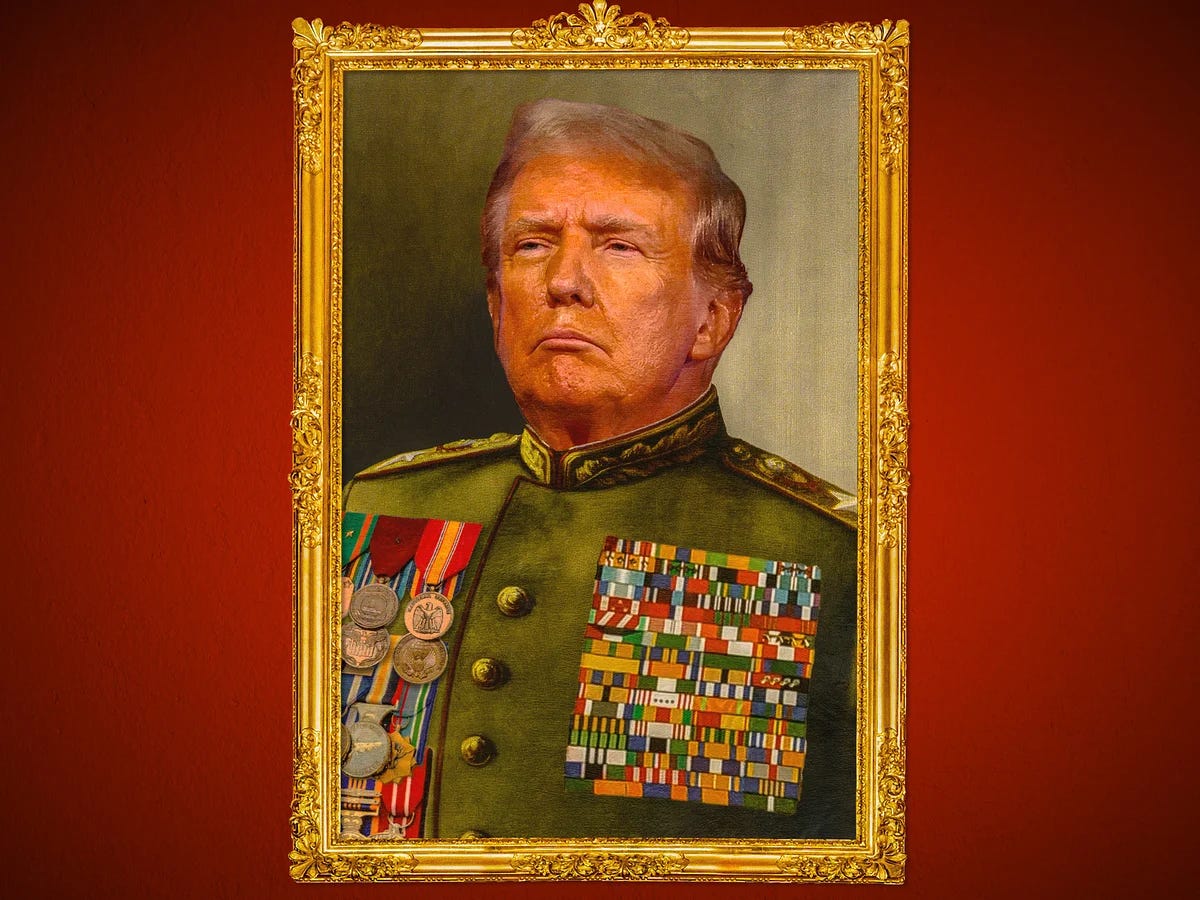
Consider Trump’s words that he will make “the final determination” whether the Iran War will persist. Roughly 342 million Americans and 93 million Iranians await Trump’s decision. The decision of an egotistical narcissist who’s convinced he must always be seen to be “winning”—that all that really matters is his own self-image.
How Trump sees himself (courtesy of the Guardian)
Trump, America’s de facto dictator, if not yet de jure, recently told the American people he didn’t care if the war was hurting their finances or making life more difficult for them. As Dick Cheney once said about American opposition to the Iraq War: “So?” So what? Who cares what the people think. What matters is what the dictators think.
What’s especially shameful here is mainstream media coverage, which presents Trump’s absolute power over war as completely normal—even legal.
Remember when wars were supposed to be declared only by Congress in the name of the people?
Saying when to fight, when to go to war, when to send U.S. troops into harm’s way, is the ultimate power, literally the power over life and death, and we the people, as much as I hate to say this, have accepted with little protest that Trump has total power here.
Meanwhile, the Democrats mutter something about affordability. And there’s always a Democrat or two (“the rotating villain”) in Congress who prevents any curb to Trump’s war-making authority.
Welcome to America’s shamocracy. We might be able to remove Trump’s name from the JFK Center for the Performing Arts, but we can’t remove Trump from sending U.S. troops to their deaths in an illegal war. Where’s Congress? Where’s SCOTUS? Why do they leave war-making to the whims of one greedy and power-driven man?
I was reading an old Atlantic Monthly from November 2007 and came across this quote:
We’ve got to be patient and committed [in Iraq], but we’ve got to multitask … We’ve got to talk about Iran—Iran is more dangerous than Iraq—and we have got to get the job done in Afghanistan and in Pakistan.
That was Rudolph Giuliani, speaking as a Republican presidential candidate in July 2007.
Back then, the saying was that everyone wants to go to Baghdad but that real men want to go to Tehran. Weirdly, neither Iran nor Iraq had anything to do with the 9/11 attacks in 2001. What those countries did have was oil—and lots of it.
The Iran obsession persists, of course, and it’s shared by both political parties. When she ran for president in 2024, Kamala Harris identified Iran as the greatest adversarythe United States faced in the world.
The truth is that neither Iran nor Iraq posed a direct or imminent threat to the USA. What each country possessed was an enormous amount of oil and political leaders who didn’t want to kowtow to U.S. economic imperatives.
A joke I learned circa 1975 involving calculators (fairly new back then) remains revealing of what drives the American obsession with the Middle East. It goes like this: 142 Israelis fight 154 Arabs over 69 oil wells for 5 years. Who wins? Punch 14215469 into your calculator, multiply by 5, then invert your calculator.
The result, which was amusing when I was about twelve years old:
Shell Oil!
Of course, U.S. and British meddling in Iran dates back to 1953 with the overthrow of its democratically elected leader Mohammad Mosaddegh so that British oil interests wouldn’t be threatened by efforts to nationalize Iran’s huge oil reserves.
Which brings me back to 1975 and one of my favorite movies, Three Days of the Condor, and a little honesty about what Americans expect from the CIA. I’ve always loved the speech near the end by CIA deputy director Higgins, played memorably by Cliff Robertson:
Higgins: It’s simple economics. Today it’s oil, right? In ten or fifteen years, food. Plutonium. Maybe even sooner. Now, what do you think the people are gonna want us to do then?
Higgins: Not now – then! Ask ‘em when they’re running out. Ask ‘em when there’s no heat in their homes and they’re cold. Ask ‘em when their engines stop. Ask ‘em when people who have never known hunger start going hungry. You wanna know something? They won’t want us to ask ‘em. They’ll just want us to get it for ‘em!
*****
And yet, despite what Higgins says, today the US government isn’t even that effective at stealing the oil, though it is true that Shell Oil and other fossil fuel conglomerates are making a killing as oil and gas prices soar.
Addendum: Shell Oil is now Shell plc or Shell Global. Judging by the Shell quarterly dividend report from the first quarter of this year, things are looking very bright indeed:
Shell delivered strong results enabled by our relentless focus on operational performance in a quarter marked by unprecedented disruption in global energy markets… Last week we announced the acquisition of ARC Resources, accelerating our strategy by adding complementary, high-quality, low-cost liquids and gas assets that we believe will deliver value for decades to come. Today, consistent with our value driven capital allocation philosophy, we are rebalancing our shareholder distributions, with a $3 billion share buyback programme for the next 3 months and a 5% increase in the dividend, in line with our existing 40-50% of CFFO distribution policy.
Excuse the snark, but the real green energy surge, “green” as in money, remains dirty fossil fuels.
It’s increasingly hard to remember how and why America is supposed to go to war. First, war is supposed to be a last resort, not a knee-jerk reaction to Israeli actions. Second, war is supposed to be a deliberative process, a constitutional one, involving Congress and needing its approval since war is declared in the name of the American people and only in response to America itself being directly threatened. Of course, presidents are expected to take the lead here, but prosecuting wars is supposed to be a national act of will requiring the mobilization of consent.
Yet when it comes to Iran today war just seemingly happens based on the whims of President Trump, a small network of loyal advisers, and the wishes of Bibi Netanyahu and Israel. The American people aren’t even asked if they approve. Little effort is made to mobilize national will. We’re simply told by the POTUS that “Iran can’t have a nuclear weapon.” Never mind that the DNI, Tulsi Gabbard, testified that Iran wasn’t actively pursuing such a weapon. Never mind that America has thousands of nukes and Israel a hundred or more. Iran simply can’t have one, apparently because that country can’t be trusted. America and Israel, of course, can have all the nukes they want.
The Iran War, put bluntly, might be the dumbest war ever for America. It has strengthened hardliners in Iran, weakened America’s economy and moral stature (what’s left of it), and arguably revived and accelerated Iran’s nuclear ambitions. It’s done the exact opposite of what the Trump administration claimed it was supposed to do and at enormous cost.
Nevertheless, despite this dumbass war (to put it in Trumpian terms), a frustrated U.S. president seems determined to double down on more war. If only those pesky Arab allies would stop getting in the way, what with all their concerns about getting hit by Iranian drones and missiles in retaliation for U.S. and Israeli attacks. How dare Iran defend itself!
War is the first refuge of the brain dead, to coin a phrase, which led me back to a book I read as a teenager, Isaac Asimov’s Foundation Trilogy. Asimov wrote that Violence is the last refuge of the incompetent. Springing into action, blowing things up, kicking and punching people when they’re down (to cite the noble sentiment of Pete Hegseth), is surely the refuge of the incompetents in the Trump administration.
If only we could put this confederacy of very unstable dunces in time out until they grew up and smartened up.
Can you win a war that isn’t really about the country you’re fighting? Where the aims keep shifting and the motivations are dishonest? We know from Secretary of State Marco Rubio that Israel more or less forced the Trump administration’s hand in attacking Iran. We know from Joe Kent’s testimony that Iran posed no imminent threat to the U.S. We know from President Trump himself that Iran’s nuclear program had been “obliterated” in previous strikes. So why wage war on Iran?
The way we label wars is illustrative of our confusion and dishonesty. “The Vietnam War”: more accurately, it was the U.S. government’s war on Vietnam. “The Iraq War”: again, the U.S. government’s war on Iraq. Same with Afghanistan. Same with Iran. America wages constant wars against other nations and peoples; these wars are really variations on a theme of militarism, imperialism, and profiteering.
Cui bono, who benefits, is always the question to ask. The answer is usually some combination of the military-industrial complex, U.S. oligarchical corporate interests, and, in the case of wars in the Middle East, Zionist Israel and fossil fuel interests.
By its nature, a constant state of warfare feeds authoritarianism and stifles freedom and democracy. Wars favor oligarchs and dictators and feed fascist tendencies. No nation can preserve its freedom in the midst of continual warfare, James Madison warned.
There is no “victory” to be had in these wars, not for the American people. This was true of the Vietnam War and it’s also true of the current war on Iran. America is losing and will lose because these wars weaken freedom and democracy while reinforcing authoritarian and fascistic elements.
America, as in people like us, can only “win” when these wars are ended.
All this has been on my mind as I recalled this review that I wrote (see below) on why the U.S. lost the Vietnam War.
*****
American Reckoning: Why the U.S. Lost the Vietnam War
Written in 2015.
Christian G. Appy, professor of history at U-Mass Amherst, has written a new and telling book on the Vietnam War: American Reckoning: The Vietnam War and Our National Identity (New York, Viking Press). Reading his book made me realize a key reason why the U.S. lost the war: for U.S. leaders it was never about Vietnam and the Vietnamese people. Rather, for these men the war was always about something else, a “something else” that constantly shifted and changed. Whereas for North Vietnam and its leaders, the goal was simple and unchanging: expel the foreign intruder, whether it was the Japanese or the French or the Americans, and unify Vietnam, no matter the cost.
Appy’s account is outstanding in showing the shifting goals of U.S. foreign policy vis-à-vis Vietnam. In the aftermath of World War II, the U.S. first supported the French in their attempts to reassert control over their former colony. When the French failed, the U.S. saw Vietnam through a thoroughly red-tinted lens. The “fall” of a newly created South Vietnam was seen as the first domino in a series of potential Communist victories in Asia. Vietnam itself meant little economically to American interests, but U.S. leaders were concerned about Malaysia and Indonesia and their resources. So to stop that first domino from falling, the U.S. intervened to prop up a “democratic” government in South Vietnam that was never democratic, a client state whose staying power rested entirely on U.S. “advisers” (troops) and weapons and aid.
Again, as Appy convincingly demonstrates, for U.S. leaders the war was never about Vietnam. Under Eisenhower, it was about stopping the first domino from falling; under Kennedy, it was a test case for U.S. military counterinsurgency tactics and Flexible Response; under Johnson, it was a test of American resolve and credibility and “balls”; and under Nixon, it was the pursuit of “peace with honor” (honor, that is, for the Nixon Administration). And this remained true even after South Vietnam collapsed in 1975. Then the Vietnam War, as Appy shows, was reinterpreted as a uniquely American tragedy. Rather than a full accounting of the war and America’s mistakes and crimes in it, the focus was on recovering American pride, to be accomplished in part by righting an alleged betrayal of America’s Vietnam veterans.
In the Reagan years, as Appy writes, American veterans, not the Vietnamese people, were:
portrayed as the primary victims of the Vietnam War. The long, complex history of the war was typically reduced to a set of stock images that highlighted the hardships faced by U.S. combat soldiers—snake-infested jungles, terrifying ambushes, elusive guerrillas, inscrutable civilians, invisible booby traps, hostile antiwar activists. Few reports informed readers that at least four of five American troops in Vietnam carried out noncombat duties on large bases far away from those snake-infested jungles. Nor did they focus sustained attention on the Vietnamese victims of U.S. warfare. By the 1980s, mainstream culture and politics promoted the idea that the deepest shame related to the Vietnam War was not the war itself, but America’s failure to embrace its military veterans.” (p. 241)
Again, the Vietnam War for U.S. leaders was never truly about Vietnam. It was about them. This is powerfully shown by LBJ’s crude comments and gestures about the war. Johnson acted to protect his Great Society initiatives; he didn’t want to suffer the political consequences of having been seen as having “lost” Vietnam to communism; but he also saw Vietnam as a straightforward test of his manhood. When asked by reporters why he continued to wage war in Vietnam, what it was really all about, LBJ unzipped his pants, pulled out his penis, and declared, “This is why!” (p. 82).
Withdrawal, of course, was never an option. As Appy insightfully notes,
LBJ and most of the other key Vietnam policymakers never imagined that withdrawal from Vietnam would be an act of courage. In one sense this moral blindness is baffling because these same men prided themselves on their pragmatic, hardheaded realism, their ability to cut through sentiment and softhearted idealism to face the most difficult realities of foreign affairs. They could see that the war was failing. But they could not pull out. A deeper set of values trumped their most coherent understandings of the war. They simply could not accept being viewed as losers. A ‘manly man’ must always keep fighting.” (p. 84)
A few pages later, Appy cites Nixon’s speech on the bombing of Cambodia, when Nixon insisted the U.S. must not stand by “like a pitiful, helpless giant,” as further evidence of this “primal” fear of presidential impotence and defeat.
Even when defeat stared American leaders in the face, they blinked, then closed their eyes and denied what they had seen. Beginning with Gerald Ford in 1975, America shifted the blame for defeat onto the South Vietnamese, with some responsibility being assigned to allegedly traitorous elements on the homefront, such as “Hanoi Jane” (Fonda). As Appy writes, “Instead of calling for a great national reckoning of U.S. responsibility in Vietnam, Ford called for a ‘great national reconciliation.’ It was really a call for a national forgetting, a willful amnesia.” (p. 224)
As a result of this “willful amnesia,” most Americans never fully faced the murderous legacies of the Vietnam War, especially the cost to the peoples of Vietnam, Laos, and Cambodia. Instead, our leaders and government encouraged us to focus on America’ssuffering. They told us to look forward, not backward, while keeping faith in America as the exceptional nation.
Appy notes in his introduction that America needs “an honest accounting of our history” if we are “to reject—fully and finally—the stubborn insistence that our nation has been a unique and unrivaled force for good in the world.” (p. xix) American Reckoning provides such an honest accounting. But are Americans truly ready and willing to put aside national pride, nurtured by a willed amnesia and government propaganda, to confront the limits as well as the horrors of American power as it is exercised in foreign lands?
Evidence from recent wars and military interventions in Iraq, Afghanistan, and elsewhere still suggests that Americans prefer amnesia, or to see other peoples through a tightly restricted field of view. Far too often, that field of view is a thoroughly militarized one, most recently captured in the crosshairs of an American sniper’s scope. Appy challenges us to broaden that view while removing those crosshairs.
*****
Addendum (2026): Self-styled Secretary of War Pete Hegseth has already floated the lie that Democrats (and a few Republicans) are betraying the country by seeking to constrain the Trump administration in its disastrous war on Iran. What Hegseth is saying, essentially, is that Congress is committing treason in attempting to exercise its constitutional duties.
Always when the warmongers lose a war, they resort to the hoary “stab-in-the-back” myth. Rare indeed is someone like Robert McNamara, who admitted decades after the Vietnam War that he had been wrong, terribly wrong, to prosecute that war.
Usually in America, those who are most unrepentant about war are the ones hired to comment on or wage the next one.