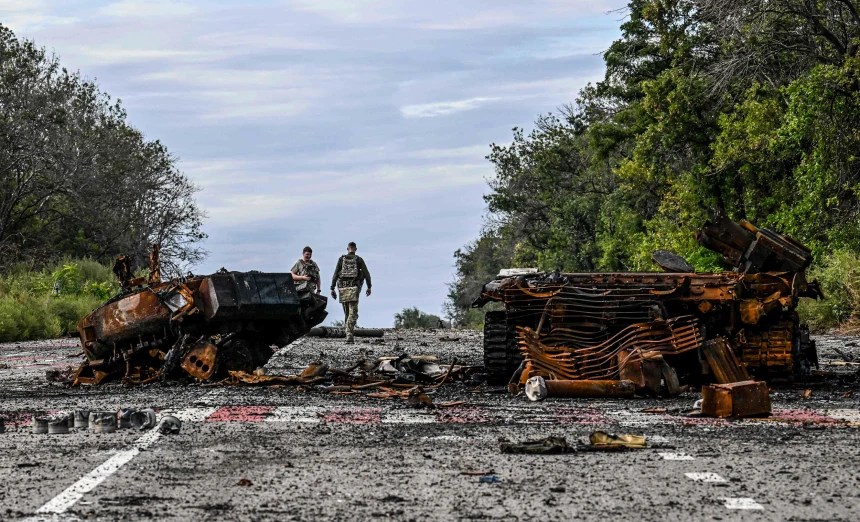
The detritus of war, but it’s Ukraine that’s bearing the brunt of war damage
W.J. Astore
At NBC News today, I saw this headline: “Ukraine’s offensive in the east surprised Russia — and it may be a turning point in the war.” Russian forces are retreating, but whether this represents a decisive turning point remains to be seen. Still, Ukraine resistance seems steady, and Russian will unsteady, at this moment in the war.
Surely, this is good news — or is it? With all the fighting taking place in Ukraine, the longer the war lasts, the worst it will likely turn out for Ukrainians. Turning points often are illusory: just ask all those U.S. generals who spoke of turning points in Afghanistan and Iraq over the last two decades. The best case scenario here is for Ukraine to use its military advantage and push for a favorable diplomatic settlement. I would hope Vladimir Putin might also see the wisdom of ending a war that has cost him more than he likely imagined when he started it earlier this year (as Andrew Bacevich explains at TomDispatch).
Too many Americans, it seems to me, are determined to see Russia suffer as much as possible. With Russia, the Pentagon’s argument goes something like this: Putin is a malevolent and irredentist dictator. Without NATO expansion, the Baltic States would already have been reabsorbed by Russia, with Poland and other (former) eastern bloc nations next on Putin’s target list. Putin, a “clear and present danger,” is only kept in line by U.S. and NATO military power, because his goal is a new Russian empire with borders much like those that Russia had in 1914 or, if that proves overly ambitious, 1989 before the Soviet collapse. Only a resolute America (and now Ukraine) stands in his way, but that requires massive military spending in a renewed effort at containment, together with yet more spending on America’s nuclear triad. “Containment” and “deterrence,” once again, are the neutral-sounding words that enable open-ended U.S. military spending against Russia (and of course Red China as well).
Truly what we don’t need is Cold War 2.0. The world barely survived the first one, and that was before climate change emerged as the serious threat that it is today.
In the 1990s, the U.S. and NATO rejected the idea that Russia maybe, just maybe, could be incorporated into the European Community in a security architecture respectful of Russian history and goals while also securing nascent democracies in former Warsaw Pact countries. Today, that rejection is complete, as Russia and Putin are dismissed as irredeemable deplorables, to borrow a phrase from Hillary Clinton.
Yet I wouldn’t underestimate Russian resilience. Just ask Hitler, Napoleon, or Charles XII about that. They all invaded Russia and got spanked. The time has come not to continue the vilification of Russia but to reach accords that Russians, Ukrainians, and other Europeans can all live with.
You wage war long, you wage it wrong, especially when it’s being waged on your turf. Short of total capitulation by either side, which is unlikely, let’s hope Zelensky and Putin can find a way to resolve their differences Let’s hope as well that the U.S. sees the wisdom of facilitating a diplomatic settlement that ends the killing.
Though President Biden previously has suggested Putin must go, I’d be very careful what he wishes for. Russia under new leaders may prove even more volatile and vengeful than U.S. leaders think it’s been under Putin.
You’d think watching the U.S. Open finals in tennis would constitute a break from incessant propaganda about war, but you’d be wrong to do so.
I’m a tennis fan so I watched this weekend’s finals with interest. A Pole defeated a Tunisian in the women’s final and a Spaniard defeated a Norwegian in the men’s final, which is a fair representation of the international flavor of the field. At both trophy ceremonies, what did the U.S. Tennis Association choose to highlight? The USTA boasted of raising $2 million for Ukraine war relief while describing the Russian invasion of Ukraine as “unprovoked.”
First of all, why is Russia’s war with Ukraine being mentioned at both trophy ceremonies? What has this got to do with tennis?
Second, why is the USTA raising money for Ukraine war relief? Shouldn’t it be raising money for, well, tennis? Perhaps for scholarships for underprivileged kids around the world to play tennis? After all, the U.S. taxpayer is already on the hook for nearly $70 billion in aid to Ukraine, roughly half of it in the form of arms and armaments. Compared to this sum, $2 million is a drop in the bucket.
Third, why is Russia’s invasion always described as “unprovoked,” as if Putin and Russia simply woke up one day and decided to invade a former Soviet republic?
Let’s think back to America’s invasion of Iraq in 2003. Was that also “unprovoked”? (After all, Saddam Hussein had no WMD and nothing to do with the 9/11 attacks.) Did the USTA raise money to help Iraqi civilians recover from U.S. war damage and crimes? Not that I recall.
Earlier this year, at Wimbledon, players from Russia and Belarus were banned from the tournament. (I guess because they were waging war with their tennis rackets for Putin?) At the U.S. Open, they were allowed to play but not under the flags of their countries. Do you recall U.S. tennis players being banned because of the “unprovoked” Iraq War? Neither do I.
The U.S. mainstream managers — even tennis officials! — are so concerned to describe the Russian attack as “unprovoked” that you know that they know it wasprovoked — and they’re at pains to deny it, even during tennis tournaments.
The heavy hand of U.S. propaganda only gets heavier when it intrudes on what should have been an apolitical and celebratory trophy ceremony for international athletes.
Note: I am, of course, against Russia’s invasion of Ukraine. What I would like to see is the U.S. supporting diplomatic efforts to end the war as quickly as possible. Currently, we hear much of Ukrainian victories, but it’s possible the war will only grow longer and more deadly as a result of these “victories.”
A classic “Tom Tomorrow” cartoon from 2002. Now, of course, “real Americans” must believe Russia’s invasion of Ukraine was completely unprovoked, that Ukraine deserves a blank check in U.S. taxpayer funds, and that Russian athletes should be ashamed of their own flag
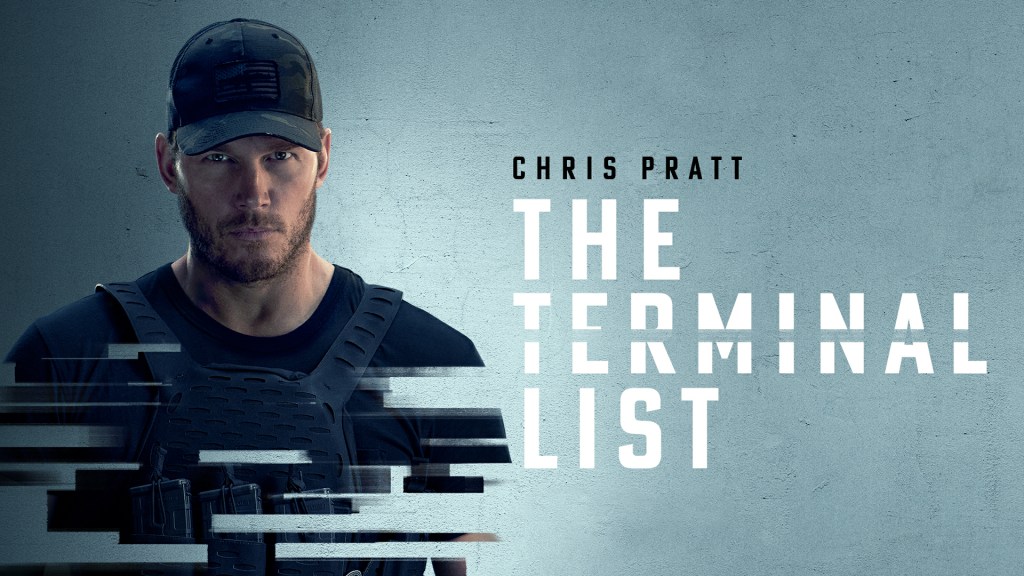
“Trust no one” could be the motto of “The Terminal List.” And “kill all those who betray you.”
W.J. Astore
What is it about this country and guns and violence?
The Westerns I watched as a kid (John Wayne in particular) had guns in them, of course. Colt pistols, Winchester rifles, an occasional shotgun. And there was no shortage of violence.
But nowadays shows/movies feature much more gunplay with military-grade weapons and armor. The Western isn’t in vogue today. It’s military dramas instead. America’s overseas wars have come home for real on our streets and in mass shootings, but they’ve also come home on our screens, where SEALs are the new heroes.
A short series I recently watched, The Terminal List, features a Navy SEAL who must “go to war” domestically because he’s been betrayed by the U.S. government, which even kills his wife and daughter. Action scenes feature sniper rifles, assault rifles, grenades, explosions, and torture (one man is hung by his own intestines).
Torture and war, common to America’s war on terror, are now here to terrorize us, on our screens but also increasingly on our streets. Strangely, I don’t hear anyone complaining about violence on TV, as people did in the 1980s. It’s now acceptable, par for the course. We are inured to it. Worse: we desire it, or at least some of us do, judging by the success of The Terminal List and similar shows.
The theme is “trust no one” and exact your revenge in the most violent way possible. The SEAL in Terminal List keeps his own kill list: echoes of Barack Obama and his presidential kill list. But a democracy saturated in militarized violence can’t possibly survive as a democracy.
Interestingly, today it’s the MAGA Right that distrusts government with a passion. Fifty years ago, with the Vietnam War running down and Watergate winding up, it was the Left that distrusted government.
One of my favorite movies from the 1970s is Three Days of the Condor, which can profitably be compared to The Terminal List. The hero in the first movie is a bookish guy who’s betrayed by the CIA. The hero in this year’s Terminal List is a Navy SEAL and a violent man of action. In Condor, Robert Redford’s character outthinks his opponents and goes to the New York Times with proof of governmental corruption. The Navy SEAL simply kills all his enemies, or they kill themselves when faced with his demands for retribution, with an impressive range of deadly weapons. (Of course, such violent fantasies of hard men meting out murderous justice are hardly new; think of Sylvester Stallone as Rambo or various Chuck Norris vehicles.)
The Terminal List is truly a series for our times. It’s slickly done, and Chris Pratt is good in it. What it reveals is the profound skepticism so many Americans have in their government and in corporations — and rightly so.
The problem is elevating a Navy SEAL as the principled hero. SEALs make good warriors but are they what America wants for vigilante justice? In real life, SEALs can be loose cannons, as recent events show.
For me, real heroes are not often chiseled men of action like Chris Pratt’s Navy SEAL, with all his guns and violence. Or for that matter Rambo. Think instead of Chelsea Manning, Daniel Hale, Edward Snowden, and Julian Assange. They may lack bulging biceps and impressive arsenals, yet Manning and Hale went to prison to reveal war crimes, Snowden is in exile for taking on the government and telling us the truth about wars and our surveillance state, and Assange is being tortured in prison for practicing oppositional journalism, otherwise known as real reporting.
Heroes in life come in all shapes and sizes; a Navy SEAL may be among the least likely of shapes and sizes we’ll see. They often do their best work without guns and grenades and without lengthy kill lists and torture routines. Their strength is measured by their principles, not by their pecs.
Eisenhower knew war and hated it. He spoke of spending on wars and weapons as humanity crucifying itself on a cross of iron. He warned America in the strongest terms of the perils of the “military-industrial complex.” The Eisenhower Memorial in DC fails to capture his most powerful and memorable sentiments against war
W.J. Astore
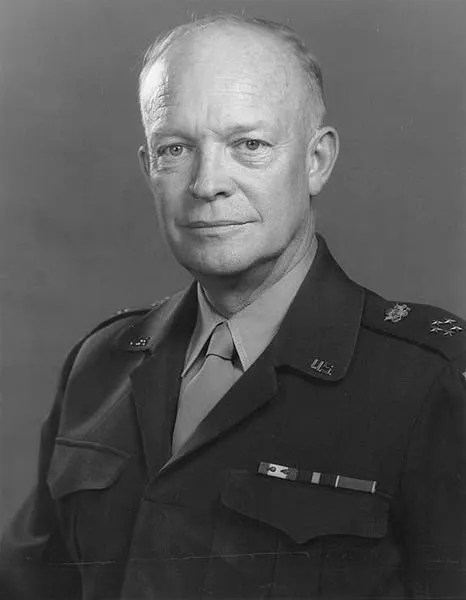
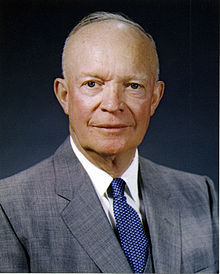
Dwight D. Eisenhower’s most famous address was his last one to the nation in January of 1961, when he warned America of what he termed “the military-industrial complex.” It was a warning as powerful as it was prescient, and though Ike achieved much in life, surely this speech and the meaning of his warning deserve to be captured in the boldest terms in the memorial to Ike in Washington, DC.
Sadly, it isn’t. Though I haven’t yet seen the monument in person, images of it are available online with audio commentary. Let’s tackle the audio commentary first. In Part 5, “Leader of the Free World,” the narrator speaks of Ike’s “farewell address,” not his address on the military-industrial complex, and that it included a “caution” (not a “warning”) to the nation. Ike is allowed a few sentences on the military-industrial complex, but the narrator provides no additional context or commentary. The narrator then ends by saying this was Ike’s goodbye speech; again, no mention of how powerful Ike’s speech was in its criticism of a force that Ike declared threatened America’s democracy and our personal liberties. And then the kicker: at the end of the narration, we’re told the audio commentary was made possible by “a generous donation” by Boeing!
I burst out in rueful laughter. Of course Ike’s warning about the military-industrial complex was played down; the military-industrial complex funded the audio commentary! I felt like Ralphie in “A Christmas Story” when he discovers his secret magic decoder ring is only useful for decoding crummy commercials that urge him to drink his Ovaltine.
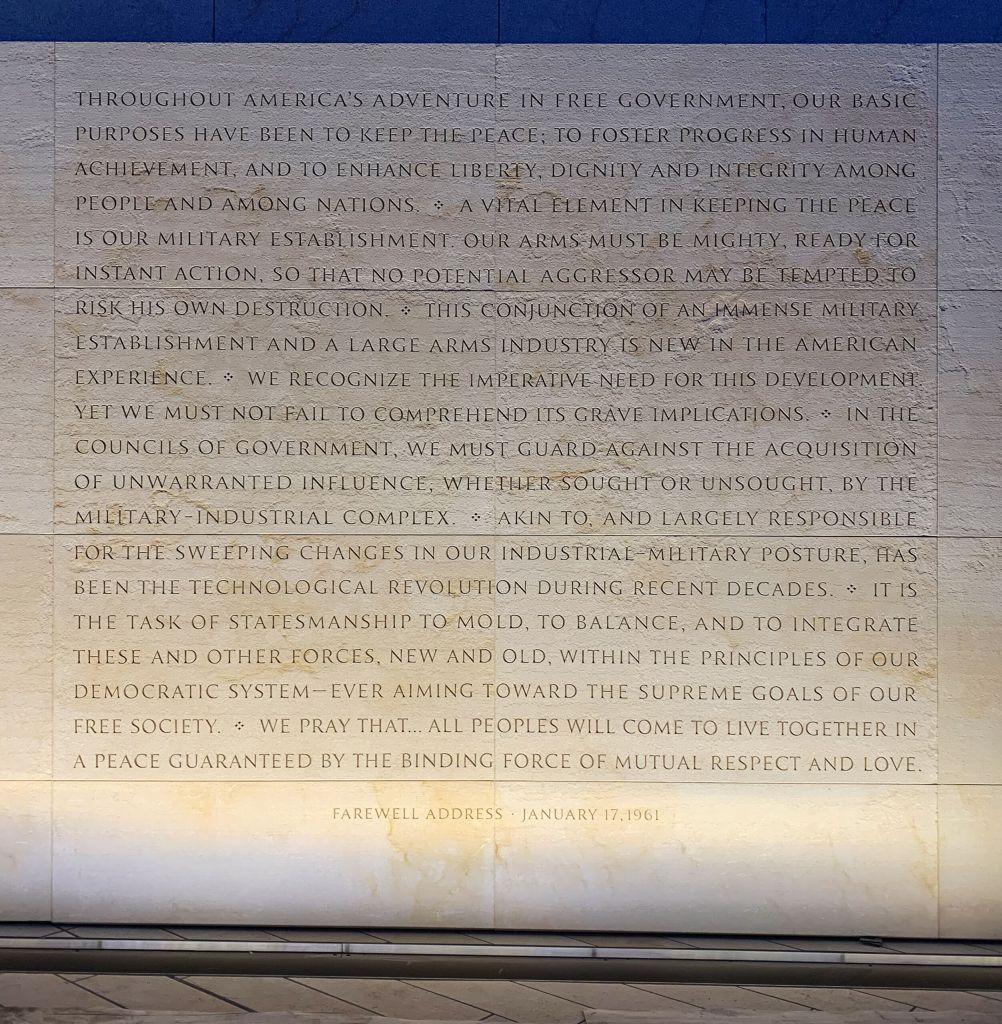
Turning to the memorial inscriptions themselves, here is the one for Ike’s “farewell address”:
Throughout America’s adventure in free government, our basic purposes have been to keep the peace; to foster progress in human achievement, and to enhance liberty, dignity and integrity among people and among nations. A vital element in keeping the peace is our military establishment. Our arms must be mighty, ready for instant action, so that no potential aggressor may be tempted to risk his own destruction. This conjunction of an immense military establishment and a large arms industry is new in the American experience. We recognize the imperative need for this development. Yet we must not fail to comprehend its grave implications. In the councils of government, we must guard against the acquisition of unwarranted influence, whether sought or unsought, by the military-industrial complex. Akin to and largely responsible for the sweeping changes in our industrial-military posture, has been the technological revolution during recent decades. It is the task of statesmanship to mold, to balance, and to integrate these and other forces, new and old, within the principles of our democratic system — ever aiming toward the supreme goals of our free society. We pray that…all peoples will come to live together in a peace guaranteed by the binding force of mutual respect and love.
Farewell Address January 17, 1961
Notice how Ike’s warning (which I’ve bolded) about the military-industrial complex is buried in the text. Even more critically, the very heart of Ike’s warning is torn out. For here are Ike’s words that followed the warning about a military-industrial complex, and which are omitted on the memorial:
The potential for the disastrous rise of misplaced power exists and will persist.
We must never let the weight of this combination endanger our liberties or democratic processes. We should take nothing for granted. Only an alert and knowledgeable citizenry can compel the proper meshing of the huge industrial and military machinery of defense with our peaceful methods and goals, so that security and liberty may prosper together.
Why weren’t these powerful words of Ike also engraved in stone? Could it be because no one in the DC area, especially the military, its many corporations, and the Congress, wants the American people to come to grips with “the disastrous rise of misplaced power” in America?
Putting this memorial together required corporate funding. Congress was also heavily involved. So too was the military. Is it any wonder that Ike’s warning about the military-industrial-Congressional complex has been watered down to a “caution” and buried in the text of a fond “farewell”?
Remember, Ike implored us to be alert and knowledgeable citizens. How can we be when his speeches are bowdlerized at his own memorial and the audio commentary to the same is funded by Boeing?
It’s easy to lose the thrust of Ike’s powerful warning about the military-industrial complex when it’s buried in the middle of this monument, and when Ike’s strongest words weren’t even included
You truly need to sharpen your focus if you want to catch a glimpse of what truly worried Ike:
Something tells me that Ike, if he were alive today, would be none too happy about this. Ike’s memorial celebrates his boyhood, his service and great victory in World War II, and his presidency, but it fails to capture his finest speeches against war, against wasteful and immoral spending on deadly weaponry, and against a powerful alliance among the military, its weapons makers, and Congress that Ike saw as a fundamental threat to liberty and democracy.
Our monuments betray us, America, in more ways than one.
The big news in U.S. politics today is Liz Cheney, daughter of former Vice President Dick Cheney, losing her House seat to a Trump-backed challenger.
Liz Cheney has recently built a reputation as the “sensible” Republican, calling on other Republicans to reject Trumpism, alternative facts, fake news, and all the rest of Trump’s baggage. She was an outspoken critic of Trump’s role in the January 6th Capitol riots. She broke from the Trump cult and was punished for it.
Liz Cheney concedes defeat
Trump’s hold on the Republican Party is indeed strong, but I don’t see him as a cult-like leader. I think many of Trump’s followers are with him because of the lack of viable alternatives. Trump’s strength, in other words, is the weakness of his competitors, including Republican has-been challengers like Ted Cruz and Marco Rubio, but especially of Democrats like Joe Biden, Kamala Harris, and Nancy Pelosi.
There’s been much hype in the mainstream media about Joe Biden having finally found his groove, with legislation being passed that is supposed to address climate change, to lower prescription drug prices, and to make health care more affordable. But when you look closely at what Biden has signed into law, the benefits largely disappear. Provisions to address climate change include massive handouts to the fossil fuel industry. New regulations to lower drug prices won’t come into effect until 2025 at the earliest, and only for a small number of drugs. (The cost of insulin will remain high for anyone not on Medicare, i.e. anyone under 65 without excellent health insurance.) Subsidies for health insurance are available but drive people into the “marketplace” where they can buy private for-profit health care plans that include high co-pays and deductibles.
In short, the Democrats, the main opposition to Trump, are up to their usual tricks, promising to make things better for the working classes while doing the bidding of their owners and donors. It’s Democratic actions and inaction, more so than the wonders of Trump’s personality, that drive so many people to look to Trump as a viable alternative.
The Democrats could win back many of Trump’s supporters if they simply kept their campaign promises. Those included, among others, a $15 federal minimum wage, significant student debt relief, a public option for health care, and family-friendly benefits for child care, family leave, education, and the like. They simply haven’t done it, and won’t do it, because the quest for corporate money and donors continues to drive policy.
So the Democratic playbook for this fall is the same as it’s been for years: scare the people into voting against “crazy” Republicans. Indeed, the Democratic establishment has actively funded more extreme right-wing candidates, boosting their chances in primaries against more moderate Republicans, because the Democrats assume they’ll have a better chance defeating the “crazy” right-wingers in November. One might ask Hillary Clinton how that worked out for her campaign in 2016 as she boosted Donald Trump against candidates like Jeb Bush, knowing in her heart that Trump would be far easier to defeat. What happened there, Hillary?
Trump, of course, has always been a sly con man. In a sense, he isn’t a hypocrite. What you see is what you get with Trump. With the Democrats, what you see is not what you get. We keep being told that Biden is accomplishing great things, that he’s channeling FDR (!), when it’s obvious he is what he’s always been: a centrist law-and-order Democrat who’s loyally served Wall Street, Big Pharma, and similar big money and corporate interests for virtually his entire 50-year career.
Those Americans who choose to follow Trump, in short, are not a bunch of irredeemable deplorables, they’re not gullible cultists, they’re not bigots, racists, and white supremacists. Not in the main. They’re Americans looking for answers, caught in a vise, being squeezed by the uncaring powers around them, including their own government, and including politicians like Liz Cheney.
Liz Cheney’s father didn’t prevent the 9/11 attacks. He got America involved in two disastrous wars in Afghanistan and Iraq that killed and wounded tens of thousands of U.S. troops and hundreds of thousands of Afghan and Iraqi people. He was a director of America’s military-industrial complex that harmed so many of the sons and daughters of parents who became Trump supporters because they were tired of endless wars that served no one but the friends of Cheney. And Liz Cheney used her father in campaign ads that touted her as a patriot against the corruption of Trump.
That obviously didn’t sit well with the people of Wyoming.
There’s an increasing sense of desperation in America, a growing sense that things are getting worse, that we’re headed for Dickensian times of hardship and exploitation. And Democratic “solutions” aren’t even half measures. Nor was signing up Liz Cheney as an ally to rail against Trump and his MAGA followers.
The answer — and we’ve heard it before — is hope and change. Real hope and real change. We had a candidate and a movement in 2008 who seemed to embody true change, but as soon as he won the presidency, he disbanded his movement, kowtowed to Wall Street, and passed a Republican health care bill that ironically became known as Obamacare. After that record, you can see why so many Americans decided they “won’t get fooled again,” and why more than a few Obama supporters switched to Trump in 2016.
What’s the answer? One thing is certain. It’s not “centrists” like Liz Cheney — or Joe Biden. The voters have spoken.
Back on June 1st, I noted that Ukraine couldn’t possibly absorb more than $54 billion in U.S. aid, most of it related to weaponry and munitions, given the country’s lack of infrastructure as well as the chaos inherent to a shooting war.
As I wrote back then:
The entire defense budget of Ukraine before the war was just under $6 billion. How can Ukraine possibly absorb (mostly) military “aid” that represents NINE TIMES their annual defense budget? It simply can’t be done…
From a military perspective, the gusher of money and equipment being sent to Ukraine makes little sense because there’s no way Ukraine has the infrastructure to absorb it and use it effectively. The U.S. approach seems to be to flood the zone with weaponry and assorted equipment of all sorts, irrespective of how it might be used or where it might ultimately end up. I can’t see how all this lethal “aid” will stay in the hands of troops and out of the hands of various criminal networks and black markets.
And so it goes. Recent reports suggest that only 30-40% of U.S. military aid is actually reaching Ukrainian troops. The rest is being siphoned off, lost, stolen, what-have-you. The response in U.S. media is to suppress this truth, per dictates from Ukraine!
Caitlin Johnstone does an excellent job of summarizing the case, and since she generously encourages her readers to share her posts, I thought I’d avail myself of her generosity. Without further ado:
Caitlin Johnstone, CBS Tries Critical Journalism; Stops After Ukraine Objects
Following objections from the Ukrainian government, CBS News has removed a short documentary which had reported concerns from numerous sources that a large amount of the supplies being sent to Ukraine aren’t making it to the front lines.
The Ukrainian government has listed its objections to the report on a government website, naming Ukrainian officials who objected to it and explaining why each of the CBS news sources it dislikes should be discounted. After the report was taken down and the Twitter post about it removed, Ukrainian Foreign Minister Dmytro Kuleba said this was a good start but still not enough.
“Welcome first step, but it is not enough,” Kuleba tweeted. “You have misled a huge audience by sharing unsubstantiated claims and damaging trust in supplies of vital military aid to a nation resisting aggression and genocide. There should be an internal investigation into who enabled this and why.”
“This article has been updated to reflect changes since the CBS Reports documentary ‘Arming Ukraine’ was filmed, and the documentary is also being updated. Jonas Ohman says the delivery has significantly improved since filming with CBS in late April. The government of Ukraine notes that U.S. defense attaché Brigadier General Garrick M. Harmon arrived in Kyiv in August 2022 for arms control and monitoring.”
CBS News does not say why it has taken so long for this report to come out, why it didn’t check to see if anything had changed in the last few months during a rapidly unfolding war before releasing its report, or why it felt its claims were good enough to air before Kyiv raised its objections but not after.
Someone uploaded the old version of the documentary on YouTube here, or you can watch it on Bitchute here if that one gets taken down. It was supportive of Ukraine and very oppositional to Russia, and simply featured a number of sources saying they had reason to believe a lot of the military supplies being sent to Ukraine aren’t getting where they’re supposed to go.
The original article quotes the aforementioned Jonas Ohman as follows:
“All of this stuff goes across the border, and then something happens, kind of like 30% of it reaches its final destination,” said Jonas Ohman, founder and CEO of Blue-Yellow, a Lithuania-based organization that has been meeting with and supplying frontline units with military aid in Ukraine since the start of the conflict with Russia-backed separatists in 2014.
“30-40%, that’s my estimation,” he said in April of this year.
“The US has sent tens of thousands of anti-aircraft and anti-armor systems, artillery rounds, hundreds of artillery systems, Switchblade armored drones, and tens of millions of rounds of small arms ammunition,” CBS’s Adam Yamaguchi tells us at 14:15 of the documentary. “But in a conflict where frontlines are scattered and conditions change without warning, not all of those supplies reach their destination. Some also reported weapons are being hoarded, or worse fear that they are disappearing into the black market, an industry that has thrived under corruption in post-Soviet Ukraine.”
“I can tell you unarguably that on the frontline units these things are not getting there,” the Mozart Group‘s Andy Milburn tells Yamaguchi at 17:40. “Drones, Switchblades, IFAKs. They’re not, alright. Body armor, helmets, you name it.”
“Is it safe to characterize this as a little bit of a black hole?” Yamaguchi asked him, perhaps in reference to an April report from CNN whose source said the equipment that’s being sent “drops into a big black hole, and you have almost no sense of it at all after a short period of time.”
“I suppose if you don’t have visibility of where this stuff is going, and if you’re asking that question, then it would appear that it’s a black hole, yeah,” Milburn replied.
“We don’t know,” Amnesty International’s Donatella Rovera tells Yamaguchi at 18:45 when asked if it’s known where the weapons being sent to Ukraine are going.
“There is really no information as to where they’re going at all,” Rovera says. “What is more worrying is that at least some of the countries that are sending weapons do not seem to think that it is their responsibility to put in place a very robust oversight mechanism to ensure that they know how they’re being used today, but also how they might and will be used tomorrow.”
A news outlet pulling a report because their own government didn’t like it would be a scandalous breach of journalistic ethics. A news outlet pulling a report because a foreign government didn’t like it is even more so.
We’ve already seen that the western media will uncritically report literally any claim made by the government of Ukraine in bizarre instances like the recent report that Russia was firing rockets at a nuclear power plant it had already captured, or its regurgitation of claims that Russians are raping babies to death from a Ukrainian official who ended up getting fired for promoting unevidenced claims about rape. Now not only will western media outlets uncritically report any claim the Ukrainian government makes, they will also retract claims of their own when the Ukrainian government tells them to.
It’s not just commentators like me who see the western press as propagandists: that’s how they see themselves. If you think it’s your job to always report information that helps one side of a war and always omit any information which might hinder it, then you have given yourself the role of propagandist. You might not call yourself that, but that’s what you are by any reasonable definition of that word.
And a great many western Zelenskyites honestly see this as the media’s role as well. They’ll angrily condemn anyone who inserts skepticism of the US empire’s narratives about Ukraine into mainstream consciousness, but then they’ll also yell at you if you say we’re not being told the truth about Ukraine. They demand to be lied to, and call you a liar if you say that means we’re being lied to.
You can’t have it both ways. Either you want the mass media to serve as war propagandists or you want them to tell the truth. You cannot hold both of those positions simultaneously. They are mutually exclusive. And many actually want the former.
The first presidential election in which I voted was 1984 and Ronald Reagan got my nod. Back then, I was a Cold War officer-to-be and I wasn’t convinced that Walter Mondale and the Democrats had a handle on anything. Today, I’d be more likely to vote for Mondale, I think, but I still have some affection for Reagan, who dreamed big.
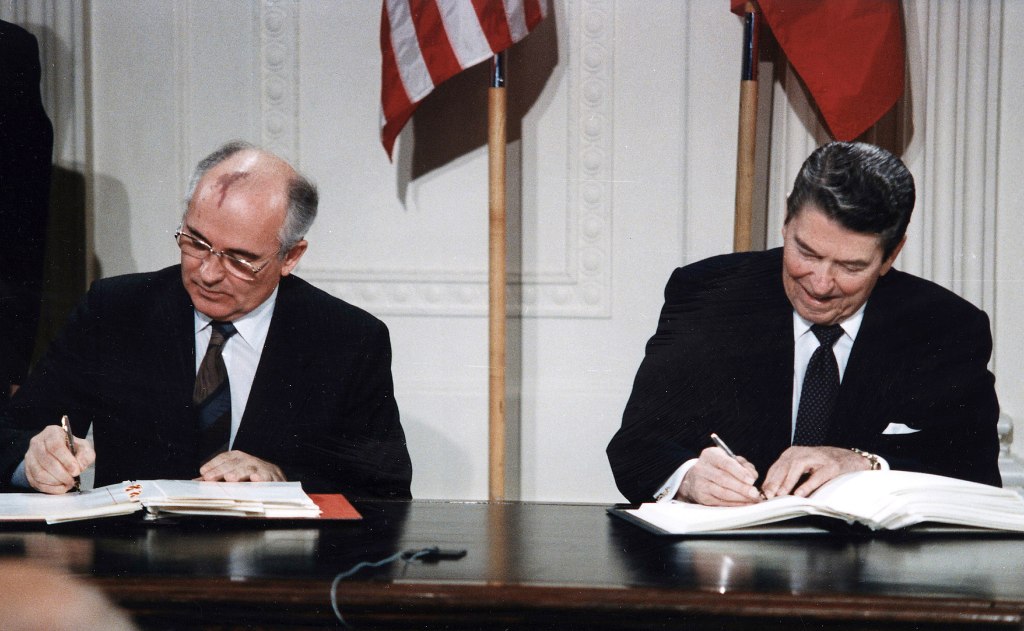
Reagan’s biggest dream was eliminating nuclear weapons, which he came close to doing with Mikhail Gorbachev. Apparently, the sticking point was Reagan’s enthusiasm for the Strategic Defense Initiative, or “Star Wars,” his misbegotten scheme to defend America against nuclear attack. It’s truly a shame that these two leaders didn’t fulfill a shared dream of making the world safer through nuclear disarmament.
Still, Reagan and Gorbachev did eliminate an entire class of nuclear weapons via the intermediate range nuclear forces (INF) treaty, as represented by the American Pershing II and Soviet SS-20 missiles as well as ground-launched nuclear cruise missiles. Sadly, I recall talking to a senior colleague in the early 1990s who relayed an anecdote that he (or someone he knew, I can’t quite recall) had talked to Reagan and praised the ex-president for that achievement, only to be met with a vague look because Reagan apparently couldn’t remember by that point. It appears Reagan did start to suffer from memory loss in his second term in office, and by the early 1990s it wouldn’t surprise me if he couldn’t recall details of nuclear treaties.
Reagan and Gorbachev sign the INF Treaty, which eliminated an entire class of nuclear weapons
Even so, Reagan, despite all his flaws, had a bold vision motivated by human decency. He was something more than a bumbler, and indeed his energy and eloquence were leagues ahead of what Joe Biden exhibits today.
Which put me to mind of this classic “Saturday Night Live” of Reagan in action. Of course, it’s a spoof, but it’s well done and funny while capturing something of Reagan’s own sense of humor:
Please, dear readers, don’t tell me all the crimes of Reagan in the comments section. Nor do I want anyone to whitewash the man. Today, I just wanted to capture Reagan’s abhorrence of nuclear war, which got him to dream of SDI (“Star Wars”) and which almost produced a major breakthrough in total nuclear disarmament.
How shameful is it that Reagan could dream big with Gorbachev but that Biden can’t speak at all to Vladimir Putin?
Not exactly the “Great Society” envisioned by LBJ in the 1960s. How long before war becomes both programmed and automated into our society as an unstoppable force?
W.J. Astore
Readers, I admit to you I’m demoralized after seeing this news a couple of days ago:
The House on Thursday passed, 329-101, its version of the fiscal 2023 National Defense Authorization Act, which would authorize $840.2 billion in national defense spending.
I’ve been writing against massive and unnecessary spending on wars and weapons since the early 1980s, when I did a college project that was highly critical of the Reagan “Defense Buildup” under then-Secretary of Defense Caspar Weinberger. Those were the days when there was a real movement against Reagan’s pursuit of the MX “Peacekeeper” ICBM and the deployment of nuclear-tipped Pershing II and GLCMs (ground-launched cruise missiles, or “glick-ems”) to Europe. The Nuclear Freeze Movement helped to stimulate talks between Reagan and Gorbachev that led to the elimination of weapons like the Pershing II, the GLCMs, and Soviet SS-20s, introducing a small sliver of (temporary) sanity to U.S.-Soviet relations.
Then came the collapse of the Soviet Union in 1991 and America’s unipolar moment of triumph. Who knew that 30 years later, America would be vigorously advancing and inflating a new Russian threat that would then be used to “justify” renewed spending on all sorts of esoteric, exorbitant, and wildly unnecessary weaponry to feed the never-satiated military-industrial-congressional complex (MICC). I didn’t predict it, that’s for sure.
For the last 15 years, I’ve been writing for TomDispatch.com, averaging six articles a year whose main theme has been the often colossal failures of the MICC and the total lack of accountability for the same. Never has failure bred so much success for an institution. And the institution itself, I truly hesitate to write, is woefully lacking in integrity. Whether it was the Pentagon Papers in Vietnam, the Afghan War Papers, the lies about WMD in Iraq that precipitated the disastrous Iraq War in 2003, or that hoary chestnut about babies being ripped from incubators in Kuwait that helped to justify Desert Shield/Storm in 1991-92, the American people have been told so many lies about war by “their” MICC that it boggles the mind.
And don’t even get me started about how the military lied about Pat Tillman’s death, tarnishing the legacy of a brave soldier inspired by service and idealism.
People with integrity who try to tell us the truth about America’s wars, like Chelsea Manning and Daniel Hale, end up in jail. The liars and the ones who always get it wrong end up being richly rewarded and often promoted to the highest levels.
This has to end, or America itself will come to an end. And it’s so frustrating because, again, I’ve been writing about this, off and on, for forty years, and steadily over the last 15 years. But nothing I say or write, or other critics like Andrew Bacevich and William Hartung say or write, makes any difference, so it seems, as the MICC continues to become the giant war robot that rules America.
It’s staggering the number of people dying in America in ways that are preventable. Here’s a quick summary, courtesy of Blake Fleetwood at Scheerpost:
Gun deaths are at record levels, up 45% from the previous decade. In 2020 there were a total of 45,222 firearm deaths in the US.
Suicide rates have gone up more than 30% in the last 20 years. More than 1.4 million adults attempt suicide every year in America. And 45,979 succeeded in killing themselves in 2020. The highest rate of suicide is among middle class white men. Suicides rose to the highest in the central part of the country. In 2020, 54% of people who died by suicide did not have a known mental health condition.
Health risks for adolescents have shifted from pregnancy, alcohol, and drug use to depression, suicide, and self harm.
Drug overdose data from the CDC indicates that there were an estimated 100,306 drug overdose deaths in the United States during the 12-month period ending in April 2021, an increase of 28.5% from the 78,056 deaths during the same period the year before.
When you start adding these numbers, you reach a grim conclusion: Americans are killing themselves and others at record rates. Grimmer still are the numbers from the Covid-19 pandemic, which in the U.S. has killed more than a million people. Estimates suggest that a true national health care system could have reduced this number by 300,000 (!), but there’s no interest among Democrats or Republicans to create such a system. Our politicians, corrupted by money from the health care “industry,” Big Pharma, etc., have no interest in saving lives (or even saving money, since a national health care system would save trillions over time).
Is it any wonder why the U.S. government embraces violence with such zeal? If you can’t care for your own people, why should you care at all for other peoples, such as in Yemen or Ukraine? What matters is profit from selling weapons, whether in the U.S., awash in assault rifles and other guns, or overseas with massive arms sales or shipments to Saudi Arabia and Ukraine, among others.
Violence or the threat of violence can be enormously profitable to those who deal in it.
Last night, I was watching baseball and saw an advertisement for a new show. In one 30-second clip, I saw several assault rifles and a gun battle, with a few handguns thrown in for good measure. We are assaulted constantly by such imagery, so much so that gun violence is seen as “normal” because it has become our new normal. Hence the gruesome spike in mass shootings across America.
Way back in the early 1980s, I had a sticker that read “NRA Freedom.” Remarkably, “freedom” in America has become synonymous with having guns everywhere, more than 400 million of them. Other freedoms, such as freedom of speech, freedom of the press, and freedom of assembly, are being curtailed and eroded with barely a complaint, but any attempt to make it slightly more difficult for a few people to buy guns is instantly opposed.
A culture of freedom is increasingly a cult of death. And as the Outlaw Josey Wales said, “Dyin’ ain’t much of a living.” Time to learn from Josey.
Unless you’re working for Raytheon or some other weapons contractor, you’re being robbed whenever our government spends excessively on the military, which is always. $54 billion of your money was stolen from you and sent to Ukraine, with much of it going to Raytheon and similar merchants of death. More than $813 billion will be spent next year on the Pentagon, with roughly half of that being unnecessary for true national defense. Excessive military spending is a form of theft in which workers and the poor are the biggest victim.
My point here isn’t original. President Dwight D. Eisenhower said it nearly 70 years ago in 1953 in his brilliant “Cross of Iron” speech. In Ike’s words:
Every gun that is made, every warship launched, every rocket fired signifies, in the final sense, a theft from those who hunger and are not fed, those who are cold and are not clothed.
This world in arms is not spending money alone. It is spending the sweat of its laborers, the genius of its scientists, the hopes of its children. The cost of one modern heavy bomber is this: a modern brick school in more than 30 cities. It is two electric power plants, each serving a town of 60,000 population. It is two fine, fully equipped hospitals. It is some fifty miles of concrete pavement. We pay for a single fighter plane with a half million bushels of wheat. We pay for a single destroyer with new homes that could have housed more than 8,000 people.
This is, I repeat, the best way of life to be found on the road the world has been taking. This is not a way of life at all, in any true sense. Under the cloud of threatening war, it is humanity hanging from a cross of iron. These plain and cruel truths define the peril and point the hope that come with this spring of 1953.
Ike, a Republican, a retired five-star general, told it like it was, is, and remains. Excessive military spending isn’t a left-right issue. It isn’t a Democrat-Republican issue. It’s a class issue. It’s a moral issue. Ike knew this and was unafraid to say it.
Ike said we are crucifying ourselves with this militarized way of life. He chose this image deliberately for its Christian meaning and moral power. He spoke openly of “plain and cruel truths.” Ike, a true public servant, wanted to make a better America. He had no fear of the military-industrial-Congressional complex because he knew it so well and could resist its old siren song of perpetual war as being somehow in our national interest. I salute him for his honesty and his wisdom.
What do we need to do? We need to reject militarism, we need to reinvest in America, we need to reanimate our democracy, and we need to restore peace. We need more Americans to run and work on these 4 Rs. America needs a thoroughgoing reformation now or, mark my words, as my dad used to say, we will soon experience something far more disruptive and unpleasant.