When others asked the truth of me, I was convinced it was not the truth they wanted, but an illusion they could bear to live with. — Anaïs Nin
War, among other things, is a place of illusion. With the Russia-Ukraine War, the illusions are many. For the mainstream media in America, the illusion promoted is this: Ukraine, a quasi-democratic country, is enduring an unprovoked invasion by authoritarian Russia, now in its 18th month. The freedom-fighters of Ukraine have been greatly assisted by benevolent military and economic aid freely offered and given by the Biden administration and NATO countries. Ukraine fights for a noble cause that the U.S. should and must support, since allowing Russia to prevail would lead to further unprovoked Russian invasions of other freedom-loving peoples in Europe.
It’s an illusion that’s comforting for Americans to live with, since it flatters us while vilifying an old enemy, the former Soviet Union and now Russia. It’s flattering to the Biden administration, which can pose as a stalwart defender of Ukraine, and certainly flattering to U.S. weapons makers, who can pose collectively as the new arsenal of democracy. It’s an illusion, moreover, that elides or disguises any economic motives the U.S. might have in supporting Ukraine so generously since the war began.
Even something as simple as smoke contains great complexity, as I recall from my fluid dynamics classes
The best illusions, the most seductive ones, have elements of truth to them. Yes, Russia did invade Ukraine; yes, Russia is authoritarian; yes, Ukraine has defied the odds and stymied Vladimir Putin’s designs; yes, NATO and U.S. weaponry has been important to Ukraine’s endurance. But partial facts are generally not impartial.
Briefly put, NATO expansion eastwards since the collapse of the Soviet Union is seen by Russia as provocative, constricting, and aggressive. Ukraine itself is very much an imperfect democracy, rating “high” on government corruption indices. U.S. meddling in Ukraine, especially in 2014, is most certainly problematic. The destruction of the Nordstream pipelines and subsequent profits by U.S.-based energy companies can’t be ignored. And, not surprisingly, U.S. weapons manufacturers are enjoying boom times. Not only does Ukraine need weaponry and ammunition, but U.S. and NATO stocks of the same must be replenished as arms and ammo are gifted to Ukrainian fighters. Nor is Ukraine completely free of neo-Nazi influences, which is to say that the situation is muddier and more complex than the comfortable illusion that’s so often sold by the mainstream media.
Which brings me to CNN’s report today, that showed up in my morning email:
President Joe Biden is asking Congress for more than $24 billion in aid for Ukraine and other international needs as he works to sustain support for the war amid signs of softening support among Americans. The request — which includes more than $13 billion in security assistance and $7 billion for economic and humanitarian assistance for Ukraine — sets up a potential battle with Republicans in Congress. Biden has promised support will last “as long as it takes,” but an increasingly skeptical Republican Party has cast doubt on US involvement going forward. This comes after a CNN poll released last week found 55% of Americans believe Congress should not authorize additional funding to support Ukraine.
As the Russia-Ukraine War drags on with neither side apparently having a quick victory in sight, questions accelerate. How much are Americans prepared to pay to Ukraine? Is an open-ended, “as long as it takes” commitment truly wise? What happens if the war escalates even further? And, perish the thought: What happens if someone uses a nuclear weapon or another form of WMD?
Many Americans today are in dire straits. Credit card debt for Americans recently exceeded $1 trillion and rising. The Biden administration has failed to provide promised and significant student debt relief; a public option for health care; a $15 federal minimum wage; while acting to break a railroad strike and promoting more fossil fuel drilling on fragile federal lands as well as offshore.
Americans are not stupid to wonder about the priorities of the Biden administration and why Ukraine gets a blank check as Americans continue to suffer. Illusions may be comfortable, but they don’t put food on the table or pay health care bills. And the price they come at may be high indeed, which is one reason, I think, a majority of Americans are none too comfortable with this illusion.
In his message to the troops prior to the July 4th weekend, Secretary of Defense Lloyd Austin offered high praise indeed. “We have the greatest fighting force in human history,” he tweeted, connecting that claim to the U.S. having patriots of all colors, creeds, and backgrounds “who bravely volunteer to defend our country and our values.”
As a retired Air Force lieutenant colonel from a working-class background who volunteered to serve more than four decades ago, who am I to argue with Austin? Shouldn’t I just bask in the glow of his praise for today’s troops, reflecting on my own honorable service near the end of what now must be thought of as the First Cold War?
Yet I confess to having doubts. I’ve heard it all before. The hype. The hyperbole. I still remember how, soon after the 9/11 attacks, President George W. Bush boasted that this country had “the greatest force for human liberation the world has ever known.” I also remember how, in a pep talk given to U.S. troops in Afghanistan in 2010, President Barack Obama declared them “the finest fighting force that the world has ever known.” And yet, 15 years ago at TomDispatch, I was already wondering when Americans had first become so proud of, and insistent upon, declaring our military the world’s absolute best, a force beyond compare, and what that meant for a republic that once had viewed large standing armies and constant warfare as anathemas to freedom.
In retrospect, the answer is all too straightforward: we need something to boast about, don’t we? In the once-upon-a-time “exceptional nation,” what else is there to praise to the skies or consider our pride and joy these days except our heroes? After all, this country can no longer boast of having anything like the world’s best educational outcomes, or healthcare system, or the most advanced and safest infrastructure, or the best democratic politics, so we better damn well be able to boast about having “the greatest fighting force” ever.
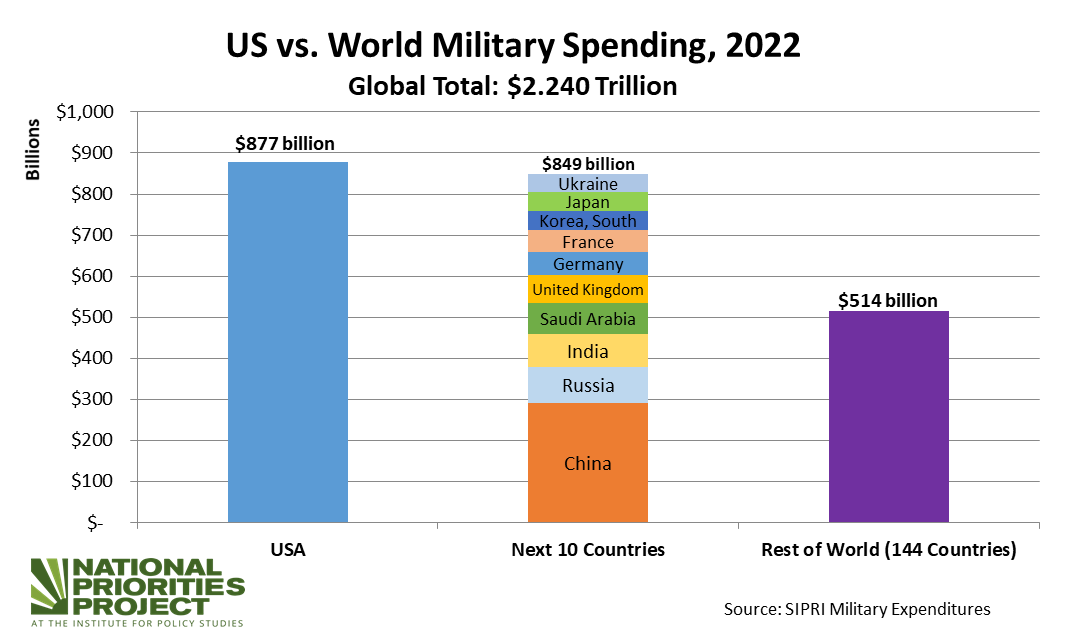
Leaving that boast aside, Americans could certainly brag about one thing this country has beyond compare: the most expensive military around and possibly ever. No country even comes close to our commitment of funds to wars, weapons (including nuclear ones at the Department of Energy), and global dominance. Indeed, the Pentagon’s budget for “defense” in 2023 exceeds that of the next 10 countries (mostly allies!) combined.
And from all of this, it seems to me, two questions arise: Are we truly getting what we pay so dearly for — the bestest, finest, most exceptional military ever? And even if we are, should a self-proclaimed democracy really want such a thing?
The answer to both those questions is, of course, no. After all, America hasn’t won a war in a convincing fashion since 1945. If this country keeps losing wars routinely and often enough catastrophically, as it has in places like Vietnam, Afghanistan, and Iraq, how can we honestly say that we possess the world’s greatest fighting force? And if we nevertheless persist in such a boast, doesn’t that echo the rhetoric of militaristic empires of the past? (Remember when we used to think that only unhinged dictators like Adolf Hitler boasted of having peerless warriors in a megalomaniacal pursuit of global domination?)
Actually, I do believe the United States has the most exceptional military, just not in the way its boosters and cheerleaders like Austin, Bush, and Obama claimed. How is the U.S. military truly “exceptional”? Let me count the ways.
Yes, the Pentagon budget, enormous and still growing, is as large as the next ten countries in the world combined. We’re #1 in wars and weapons!
The Pentagon as a Budgetary Black Hole
In so many ways, the U.S. military is indeed exceptional. Let’s begin with its budget. At this very moment, Congress is debating a colossal “defense” budget of $886 billion for FY2024 (and all the debate is about issues that have little to do with the military). That defense spending bill, you may recall, was “only” $740 billion when President Joe Biden took office three years ago. In 2021, Biden withdrew U.S. forces from the disastrous war in Afghanistan, theoretically saving the taxpayer nearly $50 billion a year. Yet, in place of any sort of peace dividend, American taxpayers simply got an even higher bill as the Pentagon budget continued to soar.
Recall that, in his four years in office, Donald Trump increased military spending by 20%. Biden is now poised to achieve a similar 20% increase in just three years in office. And that increase largely doesn’t even include the cost of supporting Ukraine in its war with Russia — so far, somewhere between $120 billion and $200 billion and still rising.
Colossal budgets for weapons and war enjoy broad bipartisan support in Washington. It’s almost as if there were a military-industrial-congressional complex at work here! Where, in fact, did I ever hear a president warning us about that? Oh, perhaps I’m thinking of a certain farewell address by Dwight D. Eisenhower in 1961.
In all seriousness, there’s now a huge pentagonal-shaped black hole on the Potomac that’s devouring more than half of the federal discretionary budget annually. Even when Congress and the Pentagon allegedly try to enforce fiscal discipline, if not austerity elsewhere, the crushing gravitational pull of that hole just continues to suck in more money. Bet on that continuing as the Pentagon issues ever more warnings about a new cold war with China and Russia.
Given its money-sucking nature, perhaps you won’t be surprised to learn that the Pentagon is remarkably exceptional when it comes to failing fiscal audits — five of them in a row (the fifth failure being a “teachable moment,” according to its chief financial officer) — as its budget only continued to soar. Whether you’re talking about lost wars or failed audits, the Pentagon is eternally rewarded for its failures. Try running a “Mom and Pop” store on that basis and see how long you last.
Speaking of all those failed wars, perhaps you won’t be surprised to learn that they haven’t come cheaply. According to the Costs of War Project at Brown University, roughly 937,000 people have died since 9/11/2001 thanks to direct violence in this country’s “Global War on Terror” in Afghanistan, Iraq, Libya, and elsewhere. (And the deaths of another 3.6 to 3.7 million people may be indirectly attributable to those same post-9/11 conflicts.) The financial cost to the American taxpayer has been roughly $8 trillion and rising even as the U.S. military continues its counterterror preparations and activities in 85 countries.
No other nation in the world sees its military as (to borrow from a short-lived Navy slogan) “a global force for good.” No other nation divides the whole world into military commands like AFRICOM for Africa and CENTCOM for the Middle East and parts of Central and South Asia, headed up by four-star generals and admirals. No other nation has a network of 750 foreign bases scattered across the globe. No other nation strives for full-spectrum dominance through “all-domain operations,” meaning not only the control of traditional “domains” of combat — the land, sea, and air — but also of space and cyberspace. While other countries are focused mainly on national defense (or regional aggressions of one sort or another), the U.S. military strives for total global and spatial dominance. Truly exceptional!
Strangely, in this never-ending, unbounded pursuit of dominance, results simply don’t matter. The Afghan War? Bungled, botched, and lost. The Iraq War? Built on lies and lost. Libya? We came, we saw, Libya’s leader (and so many innocents) died. Yet no one at the Pentagon was punished for any of those failures. In fact, to this day, it remains an accountability-free zone, exempt from meaningful oversight. If you’re a “modern major general,” why not pursue wars when you know you’ll never be punished for losing them?
Indeed, the few “exceptions” within the military-industrial-congressional complex who stood up for accountability, people of principle like Daniel Hale, Chelsea Manning, and Edward Snowden, were imprisoned or exiled. In fact, the U.S. government has even conspired to imprison a foreign publisher and transparency activist, Julian Assange, who published the truth about the American war on terror, by using a World War I-era espionage clause that only applies to American citizens.
And the record is even grimmer than that. In our post-9/11 years at war, as President Barack Obama admitted, “We tortured some folks” — and the only person punished for that was another whistleblower, John Kiriakou, who did his best to bring those war crimes to our attention.
And speaking of war crimes, isn’t it “exceptional” that the U.S. military plans to spend upwards of $2 trillion in the coming decades on a new generation of genocidal nuclear weapons? Those include new stealth bombers and new intercontinental ballistic missiles (ICBMs) for the Air Force, as well as new nuclear-missile-firing submarines for the Navy. Worse yet, the U.S. continues to reserve the right to use nuclear weapons first, presumably in the name of protecting life, liberty, and the pursuit of happiness. And of course, despite the countries — nine! — that now possess nukes, the U.S. remains the only one to have used them in wartime, in the atomic bombings of Hiroshima and Nagasaki.
Finally, it turns out that the military is even immune from Supreme Court decisions! When SCOTUS recently overturned affirmative action for college admission, it carved out an exception for the military academies. Schools like West Point and Annapolis can still consider the race of their applicants, presumably to promote unit cohesionthrough proportional representation of minorities within the officer ranks, but our society at large apparently does not require racial equity for its cohesion.
A Most Exceptional Military Makes Its Wars and Their Ugliness Disappear
Here’s one of my favorite lines from the movie The Usual Suspects: “The greatest trick the devil ever pulled was convincing the world he did not exist.” The greatest trick the U.S. military ever pulled was essentially convincing us that its wars never existed. As Norman Solomon notes in his revealing book, War Made Invisible, the military-industrial-congressional complex has excelled at camouflaging the atrocious realitiesof war, rendering them almost entirely invisible to the American people. Call it the new American isolationism, only this time we’re isolated from the harrowing and horrific costs of war itself.
America is a nation perpetually at war, yet most of us live our lives with little or no perception of this. There is no longer a military draft. There are no war bond drives. You aren’t asked to make direct and personal sacrifices. You aren’t even asked to pay attention, let alone pay (except for those nearly trillion-dollar-a-year budgets and interest payments on a ballooning national debt, of course). You certainly aren’t asked for your permission for this country to fight its wars, as the Constitution demands. As President George W. Bush suggested after the 9/11 attacks, go visit Disneyworld! Enjoy life! Let America’s “best and brightest” handle the brutality, the degradation, and the ugliness of war, bright minds like former Vice President Dick (“So?”) Cheney and former Secretary of Defense Donald (“I don’t do quagmires”) Rumsfeld.
Did you hear something about the U.S. military being in Syria? In Somalia? Did you hear about the U.S. military supporting the Saudis in a brutal war of repression in Yemen? Did you notice how this country’s military interventions around the world kill, wound, and displace so many people of color, so much so that observers speak of the systemic racism of America’s wars? Is it truly progress that a more diverse military in terms of “color, creed, and background,” to use Secretary of Defense Austin’s words, has killed and is killing so many non-white peoples around the globe?
Praising the all-female-crewed flyover at the last Super Bowl or painting rainbow flags of inclusivity (or even blue and yellow flags for Ukraine) on cluster munitionswon’t soften the blows or quiet the screams. As one reader of my blog Bracing Viewsso aptly put it: “The diversity the war parties [Democrats and Republicans] will not tolerate is diversity of thought.”
Of course, the U.S. military isn’t solely to blame here. Senior officers will claim their duty is not to make policy at all but to salute smartly as the president and Congress order them about. The reality, however, is different. The military is, in fact, at the core of America’s shadow government with enormous influence over policymaking. It’s not merely an instrument of power; it is power — and exceptionally powerful at that. And that form of power simply isn’t conducive to liberty and freedom, whether inside America’s borders or beyond them.
Wait! What am I saying? Stop thinking about all that! America is, after all, the exceptional nation and its military, a band of freedom fighters. In Iraq, where war and sanctions killed untold numbers of Iraqi children in the 1990s, the sacrifice was “worth it,” as former Secretary of State Madeleine Albright once reassured Americans on 60 Minutes.
Even when government actions kill children, lots of children, it’s for the greater good. If this troubles you, go to Disney and take your kids with you. You don’t like Disney? Then, hark back to that old marching song of World War I and “pack up your troubles in your old kit-bag, and smile, smile, smile.” Remember, America’s troops are freedom-delivering heroes and your job is to smile and support them without question.
Have I made my point? I hope so. And yes, the U.S. military is indeed exceptional and being so, being #1 (or claiming you are anyway) means never having to say you’re sorry, no matter how many innocents you kill or maim, how many lives you disrupt and destroy, how many lies you tell.
I must admit, though, that, despite the endless celebration of our military’s exceptionalism and “greatness,” a fragment of scripture from my Catholic upbringing haunts me still: Pride goeth before destruction and a haughty spirit before a fall.
The U.S. Mainstream Media Is Almost Always Pro-War
In the “liberal” New York Times today, I saw an article on “Putin’s forever war” that has the following short synopsis: “Vladimir Putin wants to lead Russians into a civilizational conflict with the West far larger than Ukraine. Will they follow him?”
Is this true? Does Putin truly seek a “civilizational conflict” with the West? One that’s “far larger” than the Ukraine war? It doesn’t seem likely. Russian forces have struggled in Ukraine. Already embroiled in a destructive regional war that’s become somewhat of a quagmire, why would Putin seek to widen it? Is Putin always the aggressor, the bad guy, and the West always the aggrieved party, the good guys, holding back a “red storm rising”? I thought the West won the Cold War more than 30 years ago.
It’s remarkable how easy it is to get alarmist articles about Russia or China published in the U.S. mainstream media (MSM). Wars and rumors of war dominate. The West is always portrayed as the defender of democracy; other countries such as China and Russia are portrayed as threats to civilization and its “rules-based order.” Strictly speaking, this is simplistic, one-sided, propaganda.
Back in 2017, I wrote about how difficult it is in the MSM to read honest accounts of war. In the runup to the Iraq War in 2003, critical voices were actively suppressed and punished. Back then, I focused my article on MSNBC, which like the New York Times is allegedly “liberal.” At “liberal” newspapers and networks, shouldn’t America expect at least a few critical critiques of war narratives? The answer here is “no,” as I wrote here:
Jesse Ventura, former governor of Minnesota (1999-2003), was a hot media commodity as the Bush/Cheney administration was preparing for its invasion of Iraq in 2003. Ventura, a U.S. Navy veteran who gained notoriety as a professional wrestler before he entered politics, was both popular and outspoken. MSNBC won the bidding war for his services in 2003, signing him to a lucrative three-year contract to create his own show – until, that is, the network learned he was against the Iraq war. Ventura’s show quickly went away, even as the network paid him for three years to do nothing.
I heard this revealing story from a new podcast, the TARFU Report, hosted by Matt Taibbi and Alex Pareene. By his own account, Jesse Ventura was bought off by the network, which back then was owned by General Electric, a major defense contractor that was due to make billions of dollars off the war.
Of course, Ventura was hardly the only war critic to run afoul of GE/NBC. Phil Donahue, the famous talk show host, saw his highly rated show cancelled when he gave dissenters and anti-war voices a fair hearing. Ashleigh Banfield, a reporter who covered the Iraq war, gave a speech in late April 2003 that criticized the antiseptic coverage of the war (extracts to follow below). For her perceptiveness and her honesty, she was reassigned and marginalized, demoted and silenced.
So much for freedom of speech, as well as the press.
As Phil Donahue said, his show “wasn’t good for business.” NBC didn’t want to lose ratings by being associated with “unpatriotic” elements when the other networks were waving the flag in support of the Iraq war. In sidelining Ventura and Donahue, NBC acted to squelch any serious dissent from the push for war, and punished Ashleigh Banfield in the immediate aftermath of the war for her honesty in criticizing the coverage shown (and constructed) by the mainstream media, coverage that was facilitated by the U.S. military and rubber-stamped by corporate ownership.
Speaking of Banfield’s critique, here are some excerpts from her speech on Iraq war coverage in April 2003. Note that her critique remains telling for all U.S. media war coverage since then:
That said, what didn’t you see [in U.S. media coverage of the Iraq war]? You didn’t see where those bullets landed. You didn’t see what happened when the mortar landed. A puff of smoke is not what a mortar looks like when it explodes, believe me. There are horrors that were completely left out of this war. So was this journalism or was this coverage? There is a grand difference between journalism and coverage, and getting access does not mean you’re getting the story, it just means you’re getting one more arm or leg of the story. And that’s what we got, and it was a glorious, wonderful picture that had a lot of people watching and a lot of advertisers excited about cable news. But it wasn’t journalism, because I’m not so sure that we in America are hesitant to do this again, to fight another war, because it looked like a glorious and courageous and so successful terrific endeavor, and we got rid of a horrible leader: We got rid of a dictator, we got rid of a monster, but we didn’t see what it took to do that.
With admirable honesty, Banfield spoke of the horrific face of war at Kansas State Univ. in 2003. Soon after her speech, she was demoted (Image courtesy of KSU)
I can’t tell you how bad the civilian casualties were. I saw a couple of pictures. I saw French television pictures, I saw a few things here and there, but to truly understand what war is all about you’ve got to be on both sides…
Some of the soldiers, according to our embeds had never seen a dead body throughout the entire three-week campaign. It was like Game Boy. I think that’s amazing in two different ways. It makes you a far more successful warrior because you can just barrel right along but it takes away a lot of what war is all about, which is what I mentioned earlier. The TV technology took that away too. We couldn’t see where the bullets landed. Nobody could see the horrors of this so that we seriously revisit the concept of warfare the next time we have to deal with it.
I think there were a lot of dissenting voices before this war about the horrors of war, but I’m very concerned about this three-week TV show and how it may have changed people’s opinions. It was very sanitized.
This TV show [Iraq invasion coverage] that we just gave you was extraordinarily entertaining, and I really hope that the legacy that it leaves behind is not one that shows war as glorious, because there’s nothing more dangerous than a democracy that thinks this is a glorious thing to do.
War is ugly and it’s dangerous, and in this world the way we are discussed on the Arab street, it feeds and fuels their hatred and their desire to kill themselves to take out Americans. It’s a dangerous thing to propagate…
I’m hoping that I will have a future in news in cable, but not the way some cable news operators wrap themselves in the American flag and patriotism and go after a certain target demographic, which is very lucrative. You can already see the effects, you can already see the big hires on other networks, right wing hires to chase after this effect, and you can already see that flag waving in the corners of those cable news stations where they have exciting American music to go along with their war coverage.
Nothing has changed since Banfield’s powerful critique. Indeed, the networks have only hired more retired generals and admirals to give “unbiased” coverage of America’s military actions. And reporters and “journalists” like Brian Williams have learned too. Recall how Williams cheered the “beautiful” U.S. Tomahawk cruise missiles as they were launched against Syria earlier this year [2017].
It’s not just that U.S. media coverage actively suppresses dissent of America’s wars: it passively does so as well, which is arguably more insidious. Any young journalist with smarts recognizes the way to get ahead is to be a cheerleader for U.S. military action, a stenographer to the powerful. Being a critic leads to getting fired (like Donahue); demoted and exiled (like Banfield); and, in Ventura’s case, if you can’t be fired or demoted or otherwise punished, you can simply be denied air time.
When you consider that billions and billions of dollars are at stake, whether in weapons sales or in advertising revenue tied to ratings, none of this is that surprising. What’s surprising is that so few Americans know about how pro-authority and uncritical U.S. media coverage of war and its makers is. If anything, the narrative is often that the U.S. media is too critical of the military to the detriment of the generals. Talk about false narratives and alternative facts!
America’s greed-wars persist for many reasons, but certainly a big one is the lack of critical voices in the mainstream media. Today’s journalists, thinking about their career prospects and their salaries (and who is ultimately their boss at corporate HQ), learn to censor themselves, assuming they have any radical thoughts to begin with. Some, like Brian Williams, even learn how to stop worrying and love the beautiful bombs.
[After I wrote this in 2017, I added this comment at the site.]
One thing that troubles me is the mindset that criticism of America’s wars undermines the troops. That it could even be a form of betrayal. This mindset is very dangerous. It not only protects the decisions and actions of those at the highest levels of the military and government. It acts to prolong wars and to endanger the lives of the troops (and of their “enemies” as well).
During the Iraq war, I recall instances of U.S. troops speaking clearly and frankly against the war. Their voices were heard, yet their advice was not taken. Instead, generals like David Petraeus were trotted out to assure the American people that the war was being won, even if the gains were characterized by weasel words like “fragile” and “reversible.” And so those gains have proved — even so, Petraeus remains in demand, and is still trotted out, now in mufti, to explain how we must stay the course and continue to defer to the military.
There’s a powerful book to be written here, and it should focus in part on the silencing or marginalization of anti-war voices (even those that wear or wore the uniform), even as pro-war elements are given the main stage as the voices of probity and sanity.
I was reading an article from 2007 by an Air Force master sergeant, “We are called Airmen,” only to stumble on these lines:
You have to be able to understand what part you play in America’s defense. You have to be disciplined and willing to maintain your readiness to go wherever our enemy confronts us and to live up to the ideals of the core values of integrity, service and excellence.
As an Airman, you have to bring airpower to the battlespace effectively and ensure it is properly applied.
Your charge as an Airman of the 4th Fighter Wing is to deliver “combat airpower, on target, on time for America, or more simply, “put warheads on foreheads.”
Now, this article is featured on the Air Force’s official website, so I assume it captures important truths the AF wants its airmen to know. But are these “truths” really true? Is that all there is, my friend? Then let’s keep bombing.
Who is “our enemy”? What are the reasons why this enemy “confronts us”? Is America’s “defense” really safeguarded if the mission is everywhere and anywhere and “wherever” U.S. forces are “confronted”?
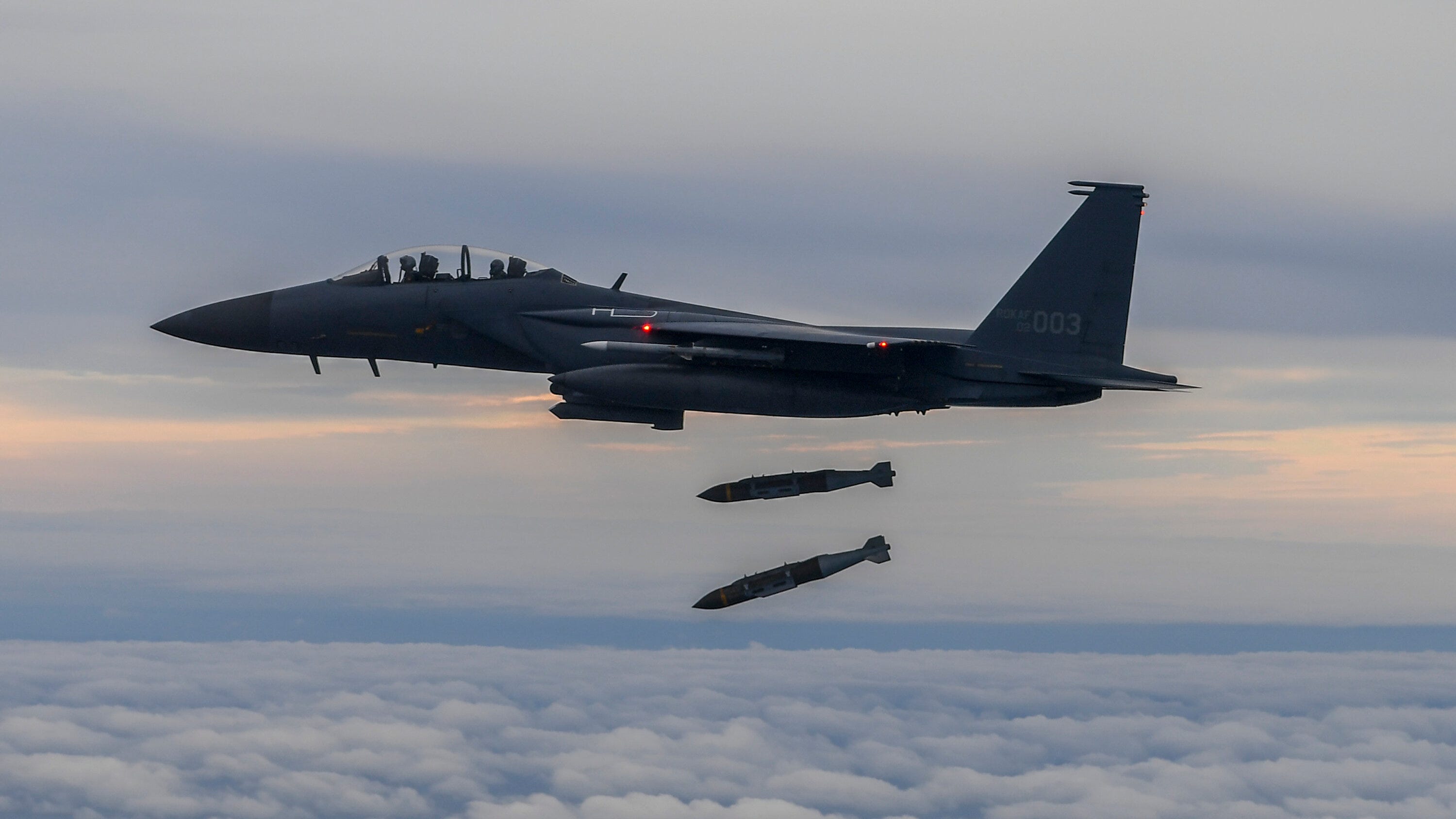
And how do you apply airpower “properly” in the “battlespace”? The author has the answer to that one: by putting “warheads on foreheads.” Or, as we said in my day, by putting bombs on target.
Put those warheads on foreheads!
Of course, this is rah-rah stuff, military cheerleading, if you will. The article was posted during the Iraq War, when the Air Force was at pains to stress its relevance in what was largely a ground war. Which explains this passage:
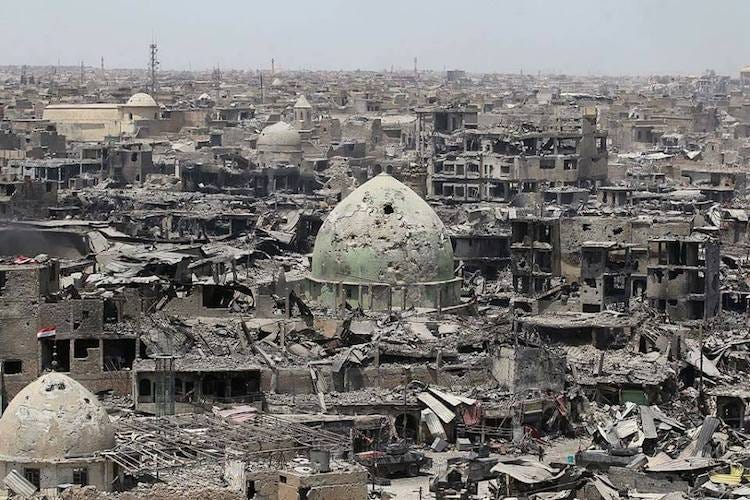
We are doing so well [in the war on terror], we make it look too easy. Our weapons systems are so precise; we can deliver ordnance anywhere, any time. If [sic] fact, if ground troops chase the enemy into a house, our aircraft can drop a bomb that eradicates one mud hut, while leaving all the others in the neighborhood standing.
Now that’s what I call precision! The Air Force made it look too easy! We dropped warheads on the foreheads of evil-doers without any innocents being killed and wounded. It’s almost as if our bombs and warheads sang “Amazing Grace” as they slammed into the enemy (and only the enemy, whoever that might be and wherever they might live).
Mosul, Iraq. Sure looks like “precision” attacks to me
Naturally, this article also makes reference to the “Airman’s warrior ethos.” That old idea (and ideal) of the citizen-airman who serves to support and defend the U.S. Constitution isn’t even mentioned. We’re all “warriors” and “warfighters” now.
Ours not to reason why; ours but to drop warheads on foreheads; theirs but to scream and die.
What is it, exactly, that the U.S. military is making it look “too easy” to do? Having lost the Iraq and Afghan wars despite enormous amounts of munitions used, it seems “losing” is the answer here. That, and killing, of course. And not just the bad guys.
There is a famine of peace in the world today. I came across that phrase, “famine of peace,” in an article in the New Yorker that reported on a papal envoy sent to advocate for a truce and diplomacy to President Joe Biden. Biden, a practicing Catholic, gave the envoy a hearing, but as yet I’ve heard no change from the White House with respect to sending more weapons to Ukraine and maximum support for the war effort.
Pope Francis, working for peace, is exactly what I’d expect from Christ’s representative here on earth. Indeed, it is what I’d expect from all Christians everywhere. Yet we continue to have a glut of war in the world, with plenty of war pigs feeding at the trough.
Cardinal Matteo Maria Zuppi brought a message of peace to President Biden.
I’m a lapsed Catholic, but I have nothing but respect when the Church does its best to embody, obey, and manifest Christ’s two commandments: love God, love thy neighbor. Being faithful to these commandments is everything for Christians.
War is a terrible sin that enables and empowers so many other sins. Meanwhile, a famine of peace and a glut of war means terrible suffering for the world’s most vulnerable. War is thus to be avoided or averted under nearly all circumstances; indeed, Christ implored us to turn the other cheek when we are struck.
I’ve read enough “just war” theory to see how almost any war can be twisted as “defensive” and “necessary.” And I believe in rare circumstances the evil of war may be necessary to stop or prevent even worse evils, e.g. World War II put a stop to Nazi domination and the enslavement and massacre of millions of people, most especially Jews and gypsies, among other “undesirables” and “lesser humans” according to Nazi ideology.
The Pope in those days, Pius XII, did not speak forcibly enough to condemn the crimes of the Nazis. In Francis it is good to have a pope who’s willing to speak of today’s famine of peace. All Christians everywhere should look within to consider why peace is dying and war is thriving. Under these conditions, if we fail to act, do we dare even call ourselves “Christian”?
Reason and Rationality Have Little to Do with Them
It is often hard to understand the reasons for America’s wars, especially since World War II, but they always have a rationale backed up by lies. The rationale for Vietnam was the containment of communism and the domino theory. The lie was that U.S. naval ships had been attacked at Tonkin Gulf. The rationale for Iraq was overthrowing a ruthless dictator and spreading “freedom.” The lie was that he had WMD and that he was somehow connected to the 9/11 attacks.
Nations and peoples are not dominoes
The real reasons for America’s many disastrous wars are opaque. Domestic politics are almost always paramount. No U.S. president wants to be accused of losing a war or appearing to be weak, so starting or continuing a war is considered as “strength.” Congress doesn’t want to be accused of “tying the hands of the president” or of “betraying the troops,” so most members happily go along with wars. The military, of course, always thinks it can win, and wars are good for promotions and power. And military contractors, the “merchants of death,” are even more happy to make money off war. Not surprisingly, perhaps, President Dwight D. Eisenhower’s farewell speech in 1961 warned America of the military-industrial complex, to which Ike had added Congress in an earlier draft. Ike’s warning has been largely forgotten; even his own monument in DC obscures it.
In Washington today, the Democrats accuse the Republicans of being weak on Russia; the Republicans return the favor by accusing the Biden administration of being weak on China. Military and industry are happy to play this blame game, knowing the Pentagon budget will soar as a result, as it has. And thus a dangerous “new cold war” appears to be a certainty.
The folly and fallaciousness of America’s wars, along with their carnage, are enough to make any rational human angry, especially one who has served in one of these wars. Mike Murry, a Vietnam War veteran, is angry, and so am I. Back in 2017, I wrote a piece on the atrociousness of the Vietnam War, to which Mr. Murry appended this comment. It merits consideration by all thinking Americans.
The ”Rationale” of America’s Wars. Comment by Mike Murry in 2017.
An excellent choice of words, “rationale.” Not the reason for doing something in the first place, but a conscious lie made up beforehand just to get things started, or an excuse invented afterwards to avoid accountability and, where required, the necessary punishment that true justice occasionally administers. Marine Corps General Smedley Butler once said that we have only two acceptable reasons for going to war: to defend our homes or defend the Constitution. In not a single case after World War II has either of these conditions applied, so that none of the pointless and ruinous fighting — I won’t dignify these Presidential/Career Military misadventures by calling them “war” — has had any justifiable reason or purpose. Not surprisingly, no Congress has declared war on another nation state since 1941 because no nation state on planet earth has attacked either American homes or America’s Constitution. The United States has not just “gone abroad in search of monsters to destroy,” as our sixth President, John Quincy Adams, warned us against foolishly doing, but has invented imaginary hobgoblins at home before even setting out to vanquish them on the far side of the globe.
Of course, Smedley Butler only made his remarks after serving for thirty years as an admitted “gangster for capitalism,” probably the best summary description of the U.S. military offered to date by one who ought to know. Today, as for the past seventy-plus years, the U.S. military simply fights — aimlessly and disastrously — for the sake of fighting. The fighting has no “reason” other than to provide a steady stream of outrageous corporate CEO bonuses, stockholder dividends, and the pensions and perquisites of retired senior military officers. This Warfare Welfare and Make-work Militarism has secondary beneficiaries, of course, most notably the hothouse orchids, special snowflakes and privileged peacock pugilists known as United States as “political leaders.” Naturally, the feeding and maintenance of this system of corrupt cronyism requires a death grip on over half the nation’s discretionary budget. As George Orwell wrote in “The Theory and Practice of Oligarchical Collectivism” (the book-within-a-book from 1984):
“The primary aim of modern warfare (in accordance with the principles of doublethink, this aim is simultaneously recognized and not recognized by the directing brains of the Inner Party) is to use up the products of the machine without raising the general standard of living.”
In other words, the entire U.S. military/security monstrosity — which I like to call the Lunatic Leviathan — has only one purpose: to suck the life out of the domestic economy so that the productivity of the people’s labor will not result in the betterment of their station in life, which might in due course result in the discarding of America’s useless parasitic economic and political “elites.” Any transparent euphemism designed and deployed to disguise this ugly, fundamental truth properly deserves the label “rationale.” In no way do the usual and time-dishonored obfuscations amount to a reason. Reason has fled the United States, replaced by a deserved and rancid Ridicule. The country now consumes itself, lost in its own vicarious fears and fantasies featuring the celluloid exploits of our vaunted Visigoths vanquishing visions of vultures somewhere, someplace, at some time, until … eventually … after some “progress” and “fragile gains” … as T.S. Eliot wrote of The Hollow Men:
This is the way the world ends This is the way the world ends This is the way the world ends Not with a bang but a whimper.
Men and women so hollow that you can hear their own bullshit echoing in them even before they start moving their jaws and flapping their lips to begin lying.
The U.S. Mainstream Media Finally Admits to a Costly Stalemate
It can’t be coincidence. In the past few days, I’ve seen articles at mainstream media outlets like the New York Times and Wall Street Journal that the much-hyped and much-delayed Ukrainian “spring” counteroffensive has stalled, and at high cost to Ukrainian troops. Here’s a quick online headline from the NYT on Monday:
The war is approaching a violent stalemate. Ukraine has made only marginal progress lately and is deploying less experienced soldiers after heavy casualties.
And here’s what the WSJ had to say (intro here from an article by Caitlin Johnstone):
In a new article titled “Ukraine’s Lack of Weaponry and Training Risks Stalemate in Fight With Russia,” the Wall Street Journal’s Daniel Michaels reports that western officials knew Ukrainian forces didn’t have the weapons and training necessary to succeed in their highly touted counteroffensive which was launched last month.
Michaels writes:
“When Ukraine launched its big counteroffensive this spring, Western military officials knew Kyiv didn’t have all the training or weapons — from shells to warplanes — that it needed to dislodge Russian forces. But they hoped Ukrainian courage and resourcefulness would carry the day.
“They haven’t. Deep and deadly minefields, extensive fortifications and Russian air power have combined to largely block significant advances by Ukrainian troops. Instead, the campaign risks descending into a stalemate with the potential to burn through lives and equipment without a major shift in momentum.”
So: We have both the NYT and WSJ admitting the war is likely to be stuck in a destructive stasis for the foreseeable future. This isn’t that surprising. Russia is deploying “defense in depth” tactics with minefields and other traps. Ukrainian forces try bravely to advance, they get stuck, and Russia replies with withering artillery fire.
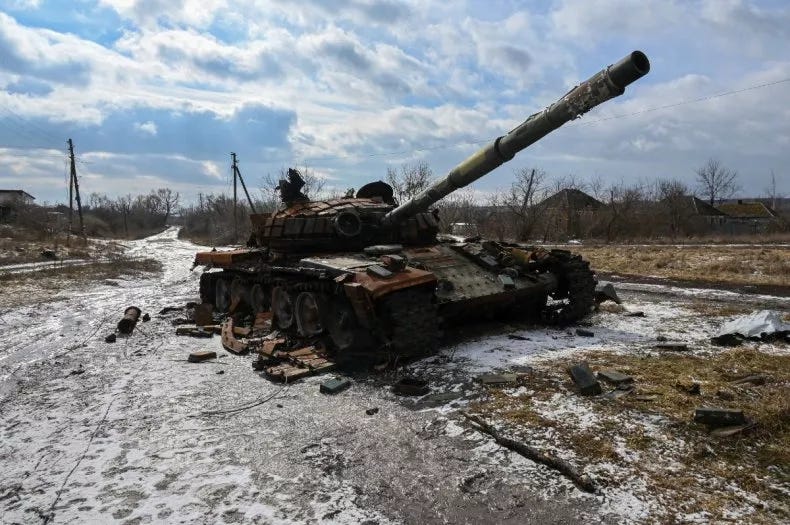
A destroyed Russian tank from March 2023, part of the poisonous detritus of war
There’s much of World War I here. WWI only ended when Germany collapsed from exhaustion after four terribly long and incredibly costly years of war.
I don’t know if Russia or Ukraine will collapse first. Certainly, Ukraine would collapse quickly without massive infusions of U.S./NATO aid.
What’s striking to me is how the MSM hyped the “decisive” spring counteroffensive, and how that narrative is now largely forgotten as a new narrative is rolled out, one where the course must be stayed until all those new U.S. weapons turn the tide, like M-1 tanks and F-16 jets.
Only time — and lots more dead — will tell. Supporters of Ukraine allege that progress is being made, that Russia is suffering more dearly, and that U.S./NATO aid must continue at the highest possible level to ensure that the forces of democracy will prevail against those of authoritarianism. These same supporters reject calls for diplomacy as misguided at best and at worst treasonous to Ukraine and appeasement to Putin. As long as Ukraine is apparently willing to fight to the last Ukrainian, the U.S./NATO should help them to do so.
I confess I don’t support this idea, which I hope doesn’t imply I’m a Putin puppet. Sorry, I don’t want to see Ukraine destroyed in a lengthy, murderous, and destructive war fought on their turf. Assuming this war is truly stalemated or otherwise bogged down, what better time for both sides to come together for a truce and some wheeling and dealing? The worst that could happen if talks bore no fruit, i.e. more killing, more war, is already happening and will continue to do so.
And indeed there are much worse things than a costly stalemate here: an expanded war that goes nuclear.
Interestingly, so far the mainstream sources I’ve read may be admitting to a stalemate but they’re not suggesting diplomacy in earnest. When they start doing that, I suppose that’ll mean things have truly gone bad for the embattled people of Ukraine.
A blast from my past, vintage 2009, with a postscript
Back in 2009, when President Barack Obama was debating a new “surge” in Afghanistan, I wrote an article for TomDispatch that urged him to reconsider, citing the words of Norman Mailer that he applied against the Vietnam War. Naturally, my article had no impact whatsoever on policy, though it was picked up by many outlets, including Salon. I was checking something else today at Salon and came across my old piece. I hope you enjoy reading (or re-reading) it.
This was that rare article I wrote that was actually excerpted at the New York Times. My article is mentioned at the end if you follow this link.
After this piece appeared, I had an opportunity to write a chapter for a book on “Star Wars and History.” Through the grapevine I heard George Lucas wasn’t too sure he wanted a retired military officer to write for a book in his “Star Wars” universe until he heard I’d recommended Norman Mailer (or someone like him) for Secretary of Defense. That seemed to persuade Lucas that my contribution might be acceptable.
POSTSCRIPT: In retrospect, I got one big thing right and one wrong here. I was right: the Afghan surge was doomed to fail. But what I didn’t realize was that its failure didn’t matter. What mattered was that Obama showed his obedience to Washington rules. He showed he’d largely defer to the Pentagon and the generals. His deference, his willingness to play the game rather than trying to end it, probably ensured his second term as president.
Yes, the surge was a failure, and the Afghan War would last another 12 years. But Obama easily won a 2nd term by showing he could wage war just like his predecessors, Bush/Cheney.
So, how was Joe Biden finally able to end the Afghan War in 2021? Two reasons. He could blame the Trump administration for putting him in an untenable position, and he could neutralize Pentagon opposition by giving them even more money even as he pulled troops from Afghanistan. Instead of the Pentagon budget decreasing by roughly $50 billion, the yearly cost of the Afghan War, it increased by that amount even as that war finally crashed and burned. There was never, ever, any talk of peace dividends, and once Russia invaded Ukraine early in 2022, vast increases in U.S. and NATO military spending were guaranteed. And so today’s Pentagon budget soars toward $900 billion, which doesn’t even include aid to Ukraine.
If Biden wins a 2nd term in 2024, it may be largely because he’s shown himself to be a slavish servant of the military-industrial-congressional complex and the national security state.
Anyhow, from October of 2009:
Norman Mailer for secretary of defense
On Afghanistan, Obama needs the input of freethinking outsiders, not generals. What if LBJ had listened to Mailer?
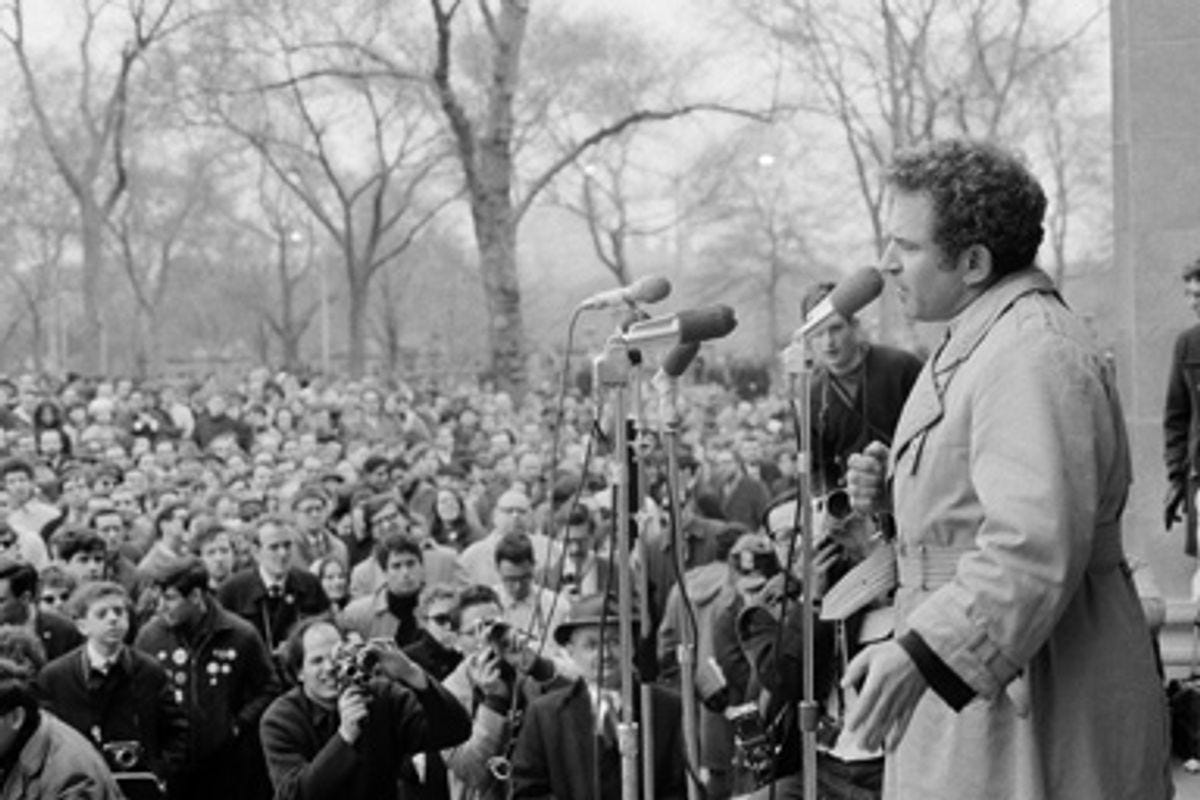
Author Norman Mailer speaks at an anti-war rally at the bandshell in New York’s Central Park, March 26, 1966.
It’s early in 1965, and President Lyndon B. Johnson faces a critical decision. Should he escalate in Vietnam? Should he say “yes” to the request from U.S. commanders for more troops? Or should he change strategy, downsize the American commitment, even withdraw completely, a decision that would help him focus on his top domestic priority, “The Great Society” he hopes to build?
We all know what happened. LBJ listened to the generals and foreign policy experts and escalated, with tragic consequences for the United States and calamitous results for the Vietnamese people on the receiving end of American firepower. Drawn deeper and deeper into Vietnam, LBJ would soon lose his way and eventually his will, refusing to run for reelection in 1968.
President Obama now stands at the edge of a similar precipice. Should he acquiesce to General Stanley A. McChrystal’s call for 40,000 to 60,000 or more U.S. troops for Afghanistan? Or should he pursue a new strategy, downsizing our commitment, even withdrawing completely, a decision that would help him focus on national healthcare, among his other top domestic priorities?
The die, I fear, is cast. In his “war of necessity,” Obama has evidently already ruled out even considering a “reduction” option, no less a withdrawal one, and will likely settle on an “escalate lite” program involving more troops (though not as many as McChrystal has urged), more American trainers for the Afghan army, and even a further escalation of the drone war over the Pakistani borderlands and new special operations actions.
By failing his first big test as commander-in-chief this way, Obama will likely ensure himself a one-term presidency, and someday be seen as a man like LBJ whose biggest dreams broke upon the shoals of an unwinnable war.
The conventional wisdom: Military escalation
To whom, we may ask, is Obama listening as he makes his decision on Afghanistan strategy and troop levels? Not the skeptics, it’s safe to assume. Not the freethinkers, not today’s equivalents of Mary McCarthy or Norman Mailer. Instead, he’s doubtless listening to the generals and admirals, or the former generals and admirals who now occupy prominent “civilian” positions at the White House and inside the beltway.
By his actions, Obama has embraced the seemingly sober conventional wisdom that senior military officers, whether on active duty or retired, have, as they say in the corridors of the Pentagon, “subject matter expertise” when it comes to strategy, war, even foreign policy.
Don’t we know better than this? Don’t we know, as Glenn Greenwald recently reminded us, that General McChrystal’s strategic review was penned by a “war-loving foreign policy community,” in which the usual suspects — “the Kagans, a Brookings representative, Anthony Cordesman, someone from Rand” — were rounded up to argue for more troops and more war?
Don’t we know, as Tom Engelhardt recently reminded us, that Obama’s “civilian” advisors include “Karl W. Eikenberry, a retired lieutenant general who is the U.S. ambassador to Afghanistan, Douglas Lute, a lieutenant general who is the president’s special advisor on Afghanistan and Pakistan (dubbed the “war czar” when he held the same position in the Bush administration), and James Jones, a retired Marine Corps general, who is national security advisor, not to speak of Secretary of Defense Robert Gates, a former director of the Central Intelligence Agency”? Are we surprised, then, that when we “turn crucial war decisions over to the military, [we] functionally turn foreign policy over to them as well”? And that they, in turn, always opt for more troops, more money and more war?
One person unsurprised by this state of affairs would have been Norman Mailer, who died in 2007. War veteran, famed author of the war novel “The Naked and the Dead” (1948) as well as the Pulitzer Prize-winning report on Vietnam-era protests, “The Armies of the Night” (1968), self-styled tough guy who didn’t dance, Mailer witnessed (and dissected) the Vietnam analog to today’s Afghan events. Back in 1965, Mailer bluntly stated that the best U.S. option was “to get out of Asia.” Period.
The unconventional wisdom: Military extrication
Can Obama find the courage and wisdom to extricate our troops from Afghanistan? Courtesy of Norman Mailer, here are three unconventional pointers that should be driving him in this direction:
1. Don’t fight a war, and clearly don’t escalate a war, in a place that means so little to Americans. In words that apply quite readily to Afghanistan today, Mailer wrote in 1965: “Vietnam [to Americans] is faceless. How many Americans have ever visited that country? Who can say which language is spoken there, or what industries might exist, or even what the country looks like? We do not care. We are not interested in the Vietnamese. If we were to fight a war with the inhabitants of the planet of Mars there would be more emotional participation by the people of America.”
2. Beware of cascading dominoes and misleading metaphors, whether in Southeast Asia or anywhere else. The domino theory held that if Vietnam, then split into north and south, was united under communism, other Asian countries, including Thailand, the Philippines, perhaps even India, would inevitably fall to communism as well, just like so many dominoes toppling. Instead, it was communism that fell or, alternately, morphed into a version that we could do business with (to paraphrase former British Prime Minister Margaret Thatcher).
We may no longer speak metaphorically of falling dominoes in today’s Af-Pak theater of operations. Nevertheless, our fears are drawn from a similarly misleading image: If Afghanistan falls to the Taliban, Pakistan will surely follow, opening a nuclear Pandora’s box to anti-American terrorists in which, in our fevered imaginations, smoking guns will once again become mushroom clouds.
Despite the fevered talk of falling dominoes in his era, Mailer was unmoved. Such rhetoric suggests, he wrote in 1965, “that we are not protecting a position of connected bastions so much as we are trying to conceal the fact that the bastions are about gone — they are not dominoes, but sand castles, and a tide of nationalism is on the way in. It is curious foreign policy to use metaphors in defense of a war; when the metaphors are imprecise, it is a swindle.”
To this I’d add that, in viewing countries and peoples as so many dominoes, which by the actions — or the inaction — of the United States are either set up or knocked down, we vastly exaggerate our own agency and emphasize our sense of self-importance. And before we even start in on the inevitable argument about “Who lost Afghanistan?” or “Who lost Pakistan?” is it too obvious to say that never for a moment did we own these countries and peoples?
3. Carrots and sticks may work together to move a stubborn horse, but not a proud people determined to find their own path. As Mailer put it, with a different twist: “Bombing a country at the same time you are offering it aid is as morally repulsive as beating up a kid in an alley and stopping to ask for a kiss.”
As our Predator and Reaper drones scan the Afghan terrain below, launching missiles to decapitate terrorists while unintentionally taking innocents with them, we console ourselves by offering aid to the Afghans to help them improve or rebuild their country. As it happens, though, when the enemy hydra loses a head, another simply grows in its place, while collateral damage only leads to a new generation of vengeance-seekers. Meanwhile, promised aid gets funneled to multinational corporations or siphoned off by corrupt government officials, leaving little for Afghan peasants, certainly not enough to win their allegiance, let alone their “hearts and minds.”
If we continue to speak with bombs while greasing palms with dollars, we’ll get nothing more than a few bangs for our $228 billion (and counting).
What if LBJ had listened to Mailer in ’65?
Not long before LBJ crossed his Rubicon and backed escalation in Vietnam, he could have decided to pull out. Said Mailer:
The image had been prepared for our departure — we heard of nothing but the corruption of the South Vietnam government and the professional cowardice of the South Vietnamese generals. We read how a Viet Cong army of 40,000 soldiers was whipping a government army of 400,000. We were told in our own newspapers how the Viet Cong armed themselves with American weapons brought to them by deserters or captured in battle with government troops; we knew it was an empty war for our side.
Substitute “the Hamid Karzai government” for “the South Vietnam government” and “Taliban” for “Viet Cong” and the same passage could almost have been written yesterday about Afghanistan. We know the Karzai government is corrupt, that it stole the vote in the last election, that the Afghan army is largely a figment of Washington’s imagination, that its troops sell their American-made weapons to the enemy. But why do our leaders once again fail to see, as Mailer saw with Vietnam, that this, too, is a recognizably “empty war for our side”?
Mailer experienced the relentless self-regard and strategic obtuseness of Washington as a mystery, but that didn’t stop him from condemning President Johnson’s decision to escalate in Vietnam. For Mailer, LBJ was revealed as “a man driven by need, a gambler who fears that once he stops, once he pulls out of the game, his heart will rupture from tension.” Johnson, like nearly all Americans, Mailer concluded, was a member of a minority group, defined not in racial or ethnic terms but in terms of “alienat[ion] from the self by a double sense of identity and so at the mercy of a self which demands action and more action to define the most rudimentary borders of identity.”
This American drive for self-definition through constant action, through headlong acceleration, even through military escalation, the novelist described, in something of a mixed metaphor, as “the swamps of a plague” in which Americans had been caught and continued to sink. He saw relief of the desperate condition coming only via “the massacre of strange people.”
To be honest, I’m not sure what to make of Mailer’s analysis here, more emotionally “Heart of Darkness” than coolly rational. But that’s precisely why I want someone Mailer-esque — pugnacious, free-swinging, and prophetical, provocative and profane — advising our president. Right now.
As Obama’s military experts wield their battlefield metrics and call for more force (to be used, of course, with ever greater precision and dexterity), I think Mailer might have replied: We think the only thing they understand is force. What if the only thing we understand is force?
Mailer, I have no doubt, would have had the courage to be seen as “weak” on defense, because he would have known that Americans had no dog in this particular fight. I think he would intuitively have recognized the wisdom of the great Chinese strategist Sun Tzu, who wrote more than 2,000 years ago in “The Art of War” that “to win one hundred victories in one hundred battles is not the acme of skill. To subdue the enemy without fighting is the acme of skill.” Our generals, by way of contrast, seem to want to fight those 100 battles with little hope of actually subduing the enemy.
What Obama needs, in other words, is fewer generals and ex-generals and more Norman Mailers — more outspoken free-thinkers who have no interest in staying inside the pentagonal box that holds Washington’s thinking tight. What Obama needs is to silence the endless cries for more troops and more war emanating from the military and foreign policy “experts” around him, so he can hear the voices of today’s Mailers, of today’s tough-minded dissenters. Were he to do so, he might yet avoid repeating LBJ’s biggest blunder — and so avoid suffering his political fate as well.
In 1998, as an Air Force major, I attended a military history symposium on coalition warfare that discussed the future of NATO. One senior officer present, General Sir Anthony Farrar-Hockley, spoke bluntly in favor of NATO expansion. From my notes taken in 1998:
Farrar-Hockley took the position that to forego expansion because of Russian concerns would be to grant Russia a continuing fiefdom in Eastern Europe. Russia has nothing to fear from NATO, and besides, it can do nothing to prevent expansion. If the Soviet Union was an anemic tiger, Russia is more like a circus tiger that may growl but won’t bite.
That sums up the Western position vis-a-vis NATO expansion and Russia: too bad. You lost the Cold War. There’s nothing you can do.
Until the “circus tiger” finally bit back.
The U.S. and NATO calculated that Russia, now led by Vladimir Putin, wouldn’t bite back. It did so in 2022.
Even circus tigers may do more than growl
Now, you might argue it’s the tiger’s fault for biting; you might say Ukraine didn’t deserve to be bitten. But I don’t think you can say that U.S. and NATO actions were entirely guiltless or blameless in provoking the tiger. At the very least, the actions were misjudged (assuming there wasn’t a plot to provoke Putin and Russia into attacking).
Ukraine is central to Russia’s concerns. Both countries share a long common border and an even longer history. By comparison, Ukraine, I think, is peripheral to U.S. concerns, just as Afghanistan and Vietnam ultimately proved peripheral. Here I recall the critique of political scientist Hannah Arendt that, with respect to America, the Vietnam War was a case of using “excessive means to achieve minor aims in a region of marginal interest.” Whether in Vietnam or more recently in Afghanistan, the U.S. could always afford to accept defeat, if only tacitly, by withdrawing (even though die-hard types at the Pentagon always want to keep fighting).
All this is to say Russia’s will to prevail may prove more resilient than the current U.S. commitment to Ukraine of “blank check” support.
Ukraine resistance to Russia has indeed been strong, backed up as it has been by bountiful weapons and aid from the U.S. and NATO. Faced by an invasion, they are defending their country. But a clear victory for Ukraine is unlikely in the short term, and in the long term will likely prove pyrrhic if it is achieved.
No one in the U.S. thought that a punitive raid against the Taliban in 2001 would produce an Afghan War that would last for 20 years. When the U.S. committed troops in big numbers to Vietnam beginning in 1965, most at the Pentagon thought the war would be over in a matter of months. How long is the U.S. and NATO truly prepared to support Ukraine in its war against Russia?
In the 17 months or so since the Russian invasion, the U.S. has already committed somewhere between $115-$200 billion to Ukraine and the war. Should that commitment remain open-ended at that level until Ukraine “wins”? What of legitimate fears of regional escalation or nightmare scenarios of nuclear exchanges?
Long wars usually don’t end with a healthier democracy. Indeed, wars most often generate censorship, authoritarianism, suppression of dissent, and many other negative aspects. Think of the enormous burden on Russia and Ukraine due to all the wounded survivors, the grieving families, the horrendous damage to the environment. The longer the war lasts, the deeper the wounds to society.
Scorched by decades of war, areas of Afghanistan are wastelands. Vietnam, Laos, and Cambodia are still recovering from America’s orgy of violence there. What will Ukraine have to recover from, assuming it’s fortunate enough to “win”?
I don’t see a quick victory for either side in the immediate weeks and months ahead. Channeling John F. Kennedy’s famous “peace” speech of June 10, 1963, I do believe that peace need not be impractical, and war need not be inevitable. As JFK also cautioned, forcing a nuclear power into a humiliating retreat while offering no other option is dangerous indeed.
Recent attention has focused on the Biden administration’s decision to provide cluster munitions to Ukraine. Russia can, and likely will, match Ukraine’s use of U.S.-provided cluster munitions. Earlier, the U.S. claimed Russia was guilty of war crimes for using these munitions. Now it’s all OK since Ukraine needs them. When they kill Russians, they’re “good” bombs?
I also hear U.S. commentators speaking of “terror bombing campaigns” by Russia. Perhaps so, but when U.S. commentators use that expression, they should fully acknowledge what the U.S. did in Japan, North Korea, Vietnam, Laos, Cambodia, Iraq, Afghanistan, and elsewhere. No country in the world comes close to the number and amount of bombs, defoliants, cluster munitions, DU shells, and napalm that the U.S. has used in various wars in the last 80 years. When it comes to terror bombing, the U.S. is truly the exceptional nation.
But can the U.S. be exceptional at peace? The U.S. should and must wage diplomacy with the kind of fervor that it usually reserves for war.
A popular song of defiance that came soon after the Pearl Harbor attack on December 7, 1941 was “Praise the Lord and Pass the Ammunition.” Today, that song title must be amended: Praise the Lord and pass the cluster munitions.
From its stockpiles, the U.S. is providing cluster munitions to Ukraine, munitions that have been banned by more than 100 countries. It appears that Russia has already used cluster munitions in the war, which Biden administration spokesperson Jen Psaki denounced as a potential war crime. Ukraine, of course, will only use cluster munitions in a godly way, so no worries there. It’s a crime when Russia does it but they are freedom munitions when Ukraine uses them.
They’ll free you of your legs, your arms, and maybe your life
Naturally, Putin and the Russians have promised to respond with more of their own cluster munitions, assuming Ukraine uses its American-made bombs and bomblets. Basically, the Biden administration is sending cluster munitions as a stopgap since the U.S./NATO is running short of conventional high explosive (HE) artillery shells. HE shells are more effective against fixed fortifications and trenches than cluster shells (the latter is a higher-tech variant of shrapnel shells). But in the absence of HE shells, cluster munitions will have to do, even though the “dud” bomblets will persist in the environment for years, if not decades, killing and maiming anyone unlucky enough to come across them.
Supporters of sending cluster munitions to Ukraine, including most members of Congress, are essentially saying that just about any weapon of any brutality is OK if it theoretically helps Ukraine. Short of poison gas and nuclear weapons, I’m not sure there are any weapons they wouldn’t send to Ukraine in the name of “democracy.”
With respect to progress in this war, I’ve read conflicting reports that say that Russia is winning by grinding up Ukrainian forces and vice-versa. I’ve read where Ukraine will soon reach a “tipping point” and breakthrough Russian defense lines, driving toward Crimea, but such optimism isn’t shared by some U.S. experts. For example, John Kirchhofer of the U.S. Defense Intelligence Agency recently said the war is “at a bit of a stalemate” and that “magical” weapons like Leopard and Challenger tanks are not “the holy grail that Ukraine is looking for” and that a breakthrough in the near-term is unlikely.
So, “praise the Lord and pass the cluster munitions” is likely to be a very long funereal dirge rather than an exultant victory anthem.








 Bracing Views