Incurious Donald: The Woeful Trump Presidency

Trump-immigration-ban-extreme-vetting-670x450
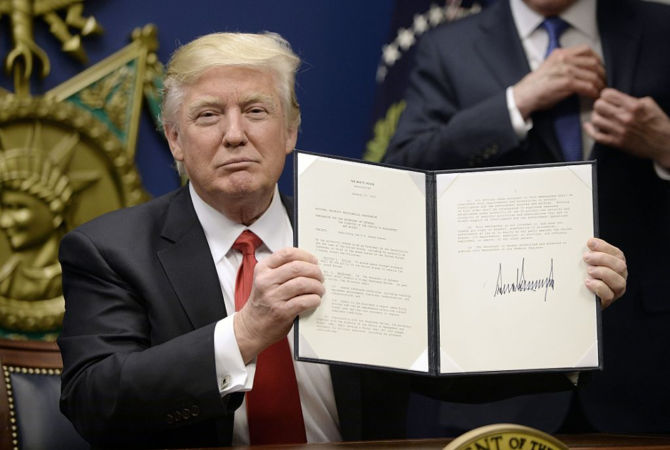
Look at what I signed!

W.J. Astore

President Donald Trump is incurious, ignorant, and ill-informed.  He hides this with rudeness, bluster, and lies.  As an anonymous German Foreign Ministry official said during Chancellor Merkel’s visit, Trump “uses rudeness to compensate for his weakness.”

Trump couldn’t hold his own with a brilliant woman of substance like Angela Merkel, so he changed the narrative.  He accused Germany of not paying up with NATO; he said Obama wiretapped Merkel, just like he tapped Trump tower; he whined about unfair trade with Germany.  In public, Trump showed little substance and no sophistication.

It’s not that Trump can’t learn; he doesn’t want to.  He’s happy watching Fox News or movies like “Finding Dory,” golfing at his expensive resorts, signing executive orders and holding them aloft like a proud second-grader (Look Ma!  I can sign my name!), and holding rabble-rousing rallies (“Lock her up!”) and basking in applause.

Trump operates in the shallows.  His experience is in high-priced real-estate and media.  He’s best at hyping a certain image of himself.  He’s a bull-shitter, and he’s had lots of practice.

A big part of the presidency is ceremonial: the U.S. president is king and prime minister all in one.  Trump is failing at both jobs.  As a symbol of America, he’s boorish, boastful, and bullying.  As a prime minister, he’s incurious, ignorant, and vain.

Five examples: Candidate Trump knew nothing about America’s nuclear triad.  He didn’t know it consists of SLBMs (on Trident submarines), ICBMs (land-based), and “air-breathing” bombers.  All he “knew” is that allegedly the U.S. nuclear arsenal is obsolete and inferior to the Russian arsenal.  But actually the U.S. arsenal is more accurate, more survivable, and far superior to that of any other country, including Russia.

Second example.  According to Trump, before he came along, nobody knew how complicated health care could be.  We owe that stunning insight to Trump.  Third example.  According to Trump, Germany owes vast sums of money to the U.S. for defense costs, a false claim rejected by the Germans.

Fourth example: Based on a false Fox News report, Trump accused the previous president of committing a felony by tapping his phones during the campaign season, a charge for which there is no evidence whatsoever.  Yet Trump refuses to rescind the charge, despite its repudiation by the FBI, NSA, British intelligence, and his own party.

Fifth example: Trump refuses to admit his Muslim ban is, well, a Muslim ban.  Yet the ban refuses to target the one country that supplied 15 out of the 19 hijackers on 9/11: Saudi Arabia.  Most experts agree that Trump’s ban is unconstitutional and counterproductive in the war on terror.

Being Trump means never having to say you’re sorry.  In his unapologetic blustering, Trump echoes the foreign leader he seems to admire most: Vladimir Putin.  In Putin’s Russia, with its history of Tsars and other strong leaders, uncompromising firmness and unyielding certitude are expected if not always applauded.  In democratic America, an ability to compromise and a willingness to yield on matters of fact are generally seen as signs of adult leadership by statesmen who serve the people rather than themselves.

Trump’s behavior is better suited to that of Tsars and other anti-democratic strongmen.  Trump the incurious has surrounded himself with loyalists, family members like his daughter Ivanka and her husband Jared Kushner, and commissars who watch over his cabinet appointees to ensure their loyalty.  Pettiness, paranoia, and score-settling characterize the Executive branch.

Trump often harkens back to World War II and the likes of Generals Patton and MacArthur.  How does he compare to the president back then?  Franklin D. Roosevelt had a global view of the world while exhibiting a mastery of detail. (So too did Winston Churchill.)  Self-confident, FDR looked for no-men, not yes-men.  He and his administration took pains to be inclusive and bipartisan.  And FDR, with help from Allies like Churchill and Stalin, won World War II.

By comparison, Trump has a parochial view of the world and can’t even master himself (witness those temper-driven tweets).  He hires yes-men and demonizes Democrats and indeed anyone he sees as against him.  Alienating allies like Britain, Australia, and Germany, Trump seems least critical of Russia.

Some leaders surprise: they grow in office.  But Trump’s smugness, his unwillingness to admit when he’s wrong, his showboating to hide uncomfortable truths, are stunting him.  Effective at selling himself and entertaining as a blowhard on (un)reality TV, Trump is failing as a statesman.

Rather than grow, it’s likely Trump will wither in office.  The problem is he won’t be alone in his decline and fall.

Update: To state the obvious, Trumpcare is not a health care plan: it’s a massive tax cut for the rich combined with a cut in services for the working classes and poor.  Under this “plan,” the CBO estimates that 14 million will initially lose coverage, rising by another 10 million in the next decade.  How is this a health care plan?  Add cynicism and broken promises to Trump’s qualities.

Update (3/25): As Heather Digby Parton puts it, Trump “truly believes that he’s never ever been wrong about anything and when he lies he’s actually telling the future. He said it over and over again in that astonishing interview [for Time Magazine].”

Matt Taibbi, in his inimitable style, captured Trump during the election season: “On the primary trail we had never seen anything like him: impulsive, lewd, grandiose, disgusting, horrible, narcissistic and dangerous, but also usually unscripted and 10 seconds ahead of the news cycle … maybe he was on the level, birthing a weird new rightist/populist movement, a cross of Huey Long, Pinochet and David Hasselhoff.  He was probably a monster, but whatever he was, he was original.” (Insane Clown President, pg. 221)
Trump Is Hurting the Pentagon!  (By Giving It Too Much Money)

Pentagon-Money
Throwing money at the Pentagon is never a good idea

W.J. Astore

Anyone who’s been in the military knows what happens as the end of a fiscal year approaches: wild spending.  Any money that’s left in your budget must be spent, if only to justify next year’s budgetary appropriation.  Woe to any unit with leftover money!  Not only is there no incentive to economize at the Pentagon: there’s a negative incentive to save money, and a positive one to spend as much as possible within your yearly allotment, while complaining to anyone within earshot that you never have enough.

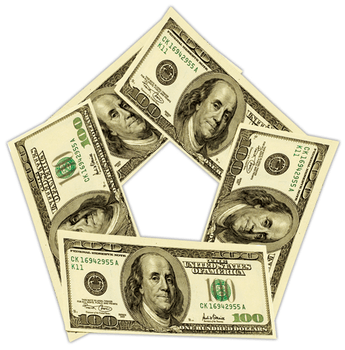
Trump has already promised to enlarge Pentagon funding by 10% next year, or roughly $54 billion.  According to Mick Mulvaney, director of the Office of Management and Budget, Trump’s budget is all about “hard-power,” a signal to “our allies and our potential adversaries that this is a strong-power administration.”  At $54 billion, that is indeed a very expensive signal.

Forget about the global fight against ISIS: The big focus at the Pentagon is now going to be on spending that windfall of taxpayers’ dollars.  And, unlike the ISIS fight, which is expected to last for at least another generation, the “fight” to spend lots of money quickly is one that the Pentagon will surely win.  Believe me, the military-industrial-Congressional complex knows how to spend.

Want to make the Pentagon a better, more effective, place?  Cut its budget by 10%.  And keep cutting, year by year, while downsizing its mission.  Force it to economize – force it to think.

Let me give you a few examples.  How does the stealthy, super-expensive, F-35 jet fighter contribute to the war on terror?  It doesn’t.  Does the U.S. Navy really need more super-expensive aircraft carriers?  No, it doesn’t.  Do U.S. nuclear forces really need to be modernized and expanded at a cost of nearly a trillion dollars over the next few decades?  No, they don’t.  More F-35s, more carriers, and more nukes are not going “to make America great again.”  What they will do is consume enormous amounts of money for little real gain.

Throwing cash at the Pentagon is not the way to greater security: it’s a guarantee of frivolous military wish lists and “more of the same, only more” thinking.  In case you haven’t noticed, the Pentagon’s record since 9/11/2001 is more than a little mixed; some would say it’s been piss-poor.  Why is this?  One thing is certain: shortage of money hasn’t been the problem.

Want to send a signal about “hard-power,” President Trump?  Go hard on the Pentagon by cutting its budget.  Spend the savings on alternative energy development and similar investments in American infrastructure.  That’s the best way to put America first.

Trump: Yet Another War President?

trump
Yet another war president?

W.J. Astore

Is Donald Trump going to be yet another American war president?  Come to think of it, is there any other kind?

This is no accident.  Tom Engelhardt has an insightful article at TomDispatch today about how Trump the blowhard is a product of blowback from America’s failed wars, notably Iraq.  There’s much truth in this insight, since it’s hard to imagine demagogue Trump’s rise to power in a pacific climate.  Trump arose in a climate of fear: fear of the Other, especially of the terrorist variety, but also of any group that can be marginalized and vilified.  Think of Mexicans and the infamous Wall, for example.

In a separate post, Engelhardt noted the recent death of Marilyn Young, an historian who found herself specializing in America’s wars, notably Vietnam.  He cited a New York Times obituary on Young that highlighted her attentiveness to America’s wars and their continuity.

Since her childhood, Young noted, America had been at war: “the wars were not really limited and were never cold and in many places have not ended — in Latin America, in Africa, in East, South and Southeast Asia.”

She confessed that:

“I find that I have spent most of my life as a teacher and scholar thinking and writing about war.  I moved from war to war, from the War of 1898 and U.S. participation in the Boxer Expedition and the Chinese civil war, to the Vietnam War, back to the Korean War, then further back to World War II and forward to the wars of the 20th and early 21st centuries.”

“Initially, I wrote about all these as if war and peace were discrete: prewar, war, peace or postwar,” she said. “Over time, this progression of wars has looked to me less like a progression than a continuation: as if between one war and the next, the country was on hold.”

As George Orwell wrote in 1984, all that matters is for a state of war to exist (whether declared or, nowadays in the USA, undeclared).  A war mentality is the driver for autocratic excesses of all sorts.  It serves to focus the attention of people to various perceived enemies, whether from without or from within.  It promotes simplified thinking and generates fear, and fear is the mind-killer.  “Us and Them,” as Pink Floyd sang.

Aggravating simplistic and hateful “us and them” thinking in the USA is the lack of a major political party dedicated to peace.  In the USA, we have two war parties.  Trump knew this and readily exploited (and continues to exploit) it.  He knows the modern Democratic Party won’t seriously challenge the war rhetoric that drove and drives America’s new militarized reality.

Why?  Because the Democrats nurtured it.  Recall that in 2004 John Kerry “reported for duty” by saluting the Democratic National Convention.  Barack Obama in 2008 quickly morphed from a “hope and change” liberal to a drone-wielding assassin-in-chief while pursuing his “good” war in Afghanistan.  Hillary Clinton in 2016 proudly embraced Henry Kissinger and projected a harsh exterior as a hardheaded hawk.  “We came, we saw, he died,” she famously chuckled about Libya and the death of Qaddafi.  Even Bernie Sanders, with all his dreams, said little about cutting the Pentagon’s budget.

You can go back further and tag other recent Democratic presidents, such as LBJ during the Vietnam War or JFK during the Cuban Missile Crisis.  Candidate Kennedy wantonly exaggerated the “missile gap” in nuclear capability between the US and USSR (JFK had it backwards; it was the US that had clear superiority).  Jimmy Carter took a different approach, but he too soon learned his lesson, ordering a huge military buildup (overseen by the Reagan Administration) and declaring the “Carter Doctrine” to safeguard Persian Gulf oil supplies as a vital US interest.  That policy contributed in its own way to America’s recent disasters in the Greater Middle East.

Did Jimmy Carter, then, lead to Donald Trump?  Indirectly, yes.  America’s insatiable hunger for global resources (especially oil) and its desire for global power bred the conditions under which blowback came to America’s shores.  Blowback helped to generate the fear and confused desires for revenge that Trump tapped with great success in his campaign.

Today, America’s state of incessant warfare is consuming its democracy, yet President Trump’s answer is to call for more military spending, more violent attacks overseas, and more walls at home, all in a vain quest to “win” again.  Small wonder then that he’s ramping up military spending while ordering more attacks.

Trump knows what got him to the Oval Office, and it wasn’t his keen intelligence or gentlemanly charm or skill at diplomacy.  Recall that his favorite generals, George Patton and Douglas MacArthur, were all about “winning” even as they both wanted to wage the wrong wars (Patton was ready to take on the Soviets in 1945; MacArthur wanted to cross the Yalu River and invade China during the Korean War).

Will Trump, like his favorite World War II generals, seek to wage the wrong wars?  Will he recognize that fighting the wrong war is a loss even when you “win”?  Does he want to be a “war president,” and, if so, who will stop him?

Afghan War Update: Fail, Fail Again

Khanabad 08-04-2008 carpenters
Afghan carpenters: the peaceful, “normal,” Afghanistan that Americans rarely see, because “Afghan” and “War” are always co-joined in our minds (Photo by Anna M.)

W.J. Astore

According to General Joseph Votel, Commander of U.S. Central Command, several thousand more U.S. troops will likely be sent to Afghanistan in an attempt to stabilize Afghan governmental forces and to halt, and eventually reverse, recent Taliban gains.

Basically, the U.S. is rewarding Afghan governmental forces for failure.  The more they fail, the more aid the U.S. sends in the form of money, weaponry, and troops.  Naturally, warrior-corporations (among others) profit from this, so even though the Afghan war itself is unwinnable (you can’t win someone else’s civil war), someone always wins in the sense of making loads of money.

The motto for the U.S. war in Afghanistan might go something like this: If at first you succeed (in defeating the Taliban in 2001), fail and fail again by overstaying your welcome and flailing around in a country that has a well-deserved reputation as “the graveyard of empires.”

There are several reasons why U.S. folly in Afghanistan persists.  First, there’s our national conviction that all wars must be won, else American credibility will be irreparably damaged.  We’d rather persist in a losing cause than to admit defeat and withdraw.  Smart, right?

Second is the domestic political scene.  Afghanistan is already being advertised (by the New York Times, no less) as “Trump’s war.”  Do you think “winner” Trump wants to be seen as backing away from a fight?

Third is the men in charge of the fight and how they see the war.  Trump’s generals and top civilian advisers don’t see the Afghan war in terms of Afghanistan; they see it in terms of themselves and their global war on radical Islamic terrorism.  They can’t be seen as “losing” in that global war, nor can they see themselves as lacking in toughness (especially when compared to the Obama administration), so queue up more troop deployments and future mission creep.

Parallels to Vietnam in the 1960s are immediate and telling.  The refusal to admit defeat.  Domestic politics.  War in the name of containing a global enemy, whether it’s called communism or terrorism.  Nowadays, since there’s no military draft and relatively few U.S. troops are being killed and wounded, there’s little opposition to the Afghan war in the U.S.  Lacking an opposition movement like the one the U.S. experienced during the Vietnam War, the Afghan war may well continue for generations, sold as it has been as a critical “platform” in the war on terror.

Two comments.  First, we’ll never win the war in Afghanistan because that’s the only way we understand the country and its peoples: as a war.  Second, as the saying goes in Afghanistan, the U.S. has the watches, but the Taliban has the time.  Sure, we have all the fancy technology, all the force multipliers, but all the Taliban (and other “insurgent” forces) has to do is to survive, biding its time (for generations, if necessary) until Americans finally see the light at the end of their own tunnel and leave.

It’s been sixteen years and counting, but we still don’t see the light. Maybe in another sixteen years?

Update (3/11/17): I wrote the following to a reader:

Most of what I read or see about Afghanistan is filtered through the U.S. military, or journalists embedded with the U.S. military.  Rarely do we see in the USA the “real” Afghanistan, the one that’s not synonymous with war or terrorism or corruption or violence or drugs.

chick pea
Afghan Chick Pea Vendor (Anna M.)

That’s a BIG problem for our understanding of Afghanistan.  We see what we want to see, which is mainly (to repeat myself) terrorism, violence, IEDs, and heroin.

Back in 2008 or thereabouts, I had a student who’d been in the Army and deployed to Afghanistan.  I asked him what he remembered: he said “dirt” and primitiveness.  That it made him think of Biblical times.  So I think Americans see Afghanistan as “primitive” and “dirty” and benighted. Again, how can we “win” there, with that attitude?

The Madness of King Trump I

trump
Mad King Trump, promising a new American Armada

W.J. Astore

At TomDispatch.com today, Rebecca Gordon writes about “American carnage” resulting from forever wars across the globe.  Her article references King George III, the “mad king” of Britain during the American Revolution, which raises an interesting point.  In Britain today, there’s a Royal Navy and a Royal Air Force, but there is no Royal Army.  That’s because the British acted to limit the authority of the monarchy, notably in the aftermath of the disastrous English Civil War and the rise of Cromwell in the 17th century.  Royal armies, the British learned, can be powerful forces for suppression of the rights of citizens.

In the 18th century, America’s founders tapped into a commonly held fear of royal armies to motivate fence-straddling colonists to rebel against King George III.  The colonists, as Gordon notes, accused the king in the Declaration of Independence of making “the Military independent of and superior to the Civil power.”

Thus it was when the colonists gained their independence, they acted to keep America’s standing army as small as possible while subjecting it firmly to civilian control.  America wanted no “royal” army, no class of aristocrats whose identity resided in that army, and certainly no leader who postured and posed as a military commander, as kings of that age typically did.

What America has witnessed since the end of World War II is the emergence of a large standing military that is increasingly identified with our president as a quasi-monarch “commander-in-chief.”  And like monarchs of the past, U.S. presidents now dress up in military uniforms, strutting about as if they literally are “the king” of their military.  (Trump, for example, talks of “my” generals.) Meanwhile, a U.S. president has, with the paramilitary CIA, his own private military augmented by a newly empowered military within the military, Special Operations Command, whose operations are often so highly classified as to be beyond effective civilian oversight.

America has regressed to the pre-revolutionary 17th century, when monarchs fought long wars against other monarchs, often in religious/confessional conflicts which were also motivated by money, power, resources, and similar concerns and which lasted for decades or even centuries.  These wars, often involving mercenaries and warrior-corporations, ran out of control and eventually came to bankrupt states, leading to an “enlightenment” witnessed at the creation of the United States, whose founders tried to rein in the tyranny of monarchs and their wasteful forever wars.

Sadly, America is no longer “enlightened.”  King Trump is a mix of Mad King George III and France’s imperious and vainglorious Louis XIV (“I am the state”), but without George’s or Louis’s interest in science and wider forms of knowledge.  And, much like royal courtiers of the past, King Trump’s courtiers are often “aristocratic” generals or slithering sycophants.

Consider a Trump courtier who’s been getting a lot of press lately: Sebastian Gorka.  He’s embraced the idea of a war against radical Islamic terrorism, tracing that war to jihadist flaws within Islam.  This virulent disease within Islam, Gorka and likeminded advisers to Trump argue, must and can be wiped out by American-led military action.  Much like Catholic King Philip II, who launched the Spanish Armada to extirpate the heresy of English Protestantism under Queen Elizabeth I, Trump and Gorka and Crew seek to unleash the American armada against the heresy of radical jihadist Islam.

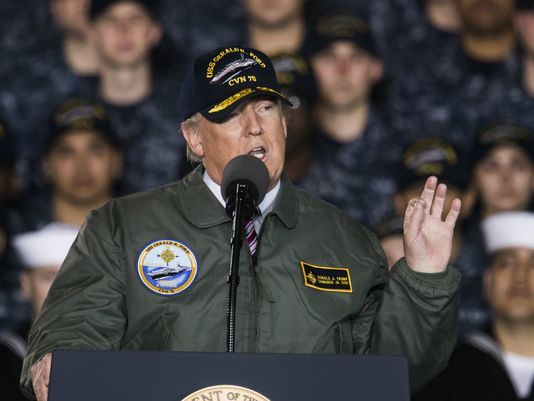
King Trump I is about to escalate what he and his courtiers see as a religious/civilizational war.  Donning a military cap and flight jacket, Trump promises quick victories against a dastardly enemy.  Even as he pursues his wars, the U.S. military will continue to expand, as will paramilitaries and warrior-corporations.  Even as victory proves as elusive as the fighting is enervating to domestic concerns, Mad King Trump will persist.  America must win.  For he is the state.

Under Trump, as with mad King George III, big changes are ahead.  Just not the ones these monarchs imagined for themselves and their empires.

Cynicism: It Defines Trump’s Words and Deeds

trump
He can read from a teleprompter without barking: presidential?

W.J. Astore

One word defines Trump and his cronies: cynicism.  His cabinet picks illustrate this; many of them are against the very agencies’ missions that they’re supposed to uphold, like public education, environmental protection, and decent health care.  He hires billionaires for his cabinet in the name of draining the swamp and championing the cause of the working classes.  Meanwhile, even as Trump poses as commander-in-chief, he ducks responsibility for the failed raid on Yemen, shifting it to “his” generals, whom he otherwise praises as super-capable and deeply respected.

Under Trump, Americans are witnessing the negation of idealism.  Some might say that America’s ideals such as liberty and freedom and democracy have been observed more in the breach than in practice (consider slavery, for example, or the treatment of Native Americans), but at least we had ideals.  They were imperfectly practiced, but with Trump ideals no longer matter.  It’s just cynicism, a naked grab for wealth and power.

Cynics don’t believe in much of anything, except perhaps their own perspicacity in seeing the world “as it is.”  If you don’t believe in anything, you can lash out at anything, without guilt.  And Trump is a lasher.  He attacks everything: “failed” generals, “murderous” Mexicans, “terrorist” Muslims, the “lying” press, unfair judges, even Rosie O’Donnell , beauty queens, and Nordstrom (!).  Anyone and everything can be attacked and vilified when you’re a cynic with no core beliefs other than your own rectitude.

Trump is not a leader, he’s a cynic.  A negator of meaning.  What’s amazing to me is that some in the media recently suggested he looked presidential just because he read a speech written by others off a teleprompter without barking or snarling.  Of course, cynicism is not unique to Trump; Hillary and the Democrats have their share, as Chris Hedges has noted.  Recall, for example, the silencing of anti-war protesters at the Democratic National Convention in July.  Trump just has less class, even trotting out a war widow while passing the buck on taking responsibility for her grief.

Why is cynicism so dangerous?  I recall watching a documentary on the Holocaust in which a witness to a massacre described the horrific events.  He ended with a cry against cynicism.  The negation of human life he’d witnessed had, at its core, the cynical belief that human life simply didn’t matter.  That people were just so much matter, just things to be exploited or disposed of as their “masters” decreed.

Cynicism, a denial of idealism, of higher meaning, and of humanity, was a propellant to, an accelerant of, the Holocaust.  We see cynicism in Trump’s reference to the dead Navy SEAL in the Yemen raid.  His service and death is celebrated as uniquely heroic and noble (“etched in eternity”), whereas the many Yemeni people killed, including several children, are forgotten.  They simply don’t count; they are beneath being noticed.

Cynicism is spreading in America, with Jewish tombstones being toppled over, with darker-skinned immigrants being shot and killed in the name of “taking back one’s country,” of certain Muslims being excluded solely on their country of origin.  Policies are being driven by cynicism – a cold calculus of profit and power.

To a cynic, all facts are “alternative,” which is to say a lie is judged the same way truth is, by the criterion of whether it advances one’s agenda and one’s power.  What’s “true” is what’s expedient.  To a cynic, facts are unimportant.  All that matters is what you can get people to believe, how you can manipulate them and get them to act to fulfill your agenda.

Cynicism is the enemy of idealism, of truth, of humanity.  Where it ends I truly hesitate to say.

What Is True National Security?

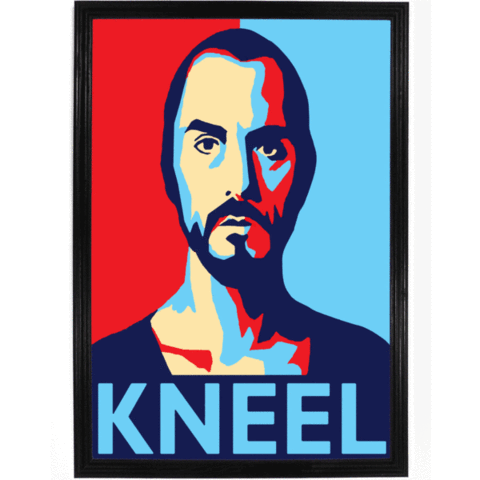
general-zod-kneel
He promises safety and security.  You just have to kneel.

W.J. Astore

What is true national security?  Recent answers to this question focus on the U.S. military, Homeland Security, various intelligence agencies, and the like.  The “threat” is usually defined as foreign terrorists, primarily of the Islamist variety; marauding immigrants, mainly of the Mexican variety; and cyber hackers, often of the Russian variety.  To “secure” the homeland, to make us “safe,” the U.S. government spends in the neighborhood of $750 billion, each and every year, on the Department of Defense, Homeland Security, and intelligence agencies such as the CIA and NSA (and there are roughly 15 more agencies after those two goliaths).

But what makes people truly secure?  How about a living wage, decent health care, and quality education?  Affordable housing?  Some time off to decompress, to pursue one’s hobbies, to connect with family and friends, to continue to grow as a human being?  Water without lead, air without toxins, land without poisons?

These thoughts came to me as I read the usual anodyne statement put out by Lt. Gen. H.R. McMaster, nominated as President Trump’s new National Security Adviser.  “The safety of the American people and the security of the American homeland are our top priorities,” McMaster said in his statement.

I agree that safety and security are important, but I wouldn’t place them as America’s top priorities, even in the realm of national defense.  Our top priority is supporting and defending the U.S. Constitution, including all those rights and freedoms that are often threatened in nervous and excitable times.  Institutions like the press, freedoms like the right to assemble and protest, the right to individual privacy, and the like.

When the powerful threaten those freedoms, as President Trump is doing by denouncing the press as the enemy of the people, that very act is a bigger threat to national security than ISIS or illegal immigrants or Russian hackers or what-have-you.

Security is not just about weapons and warriors and killing terrorists and other “bad hombres,” and safety is not just about guarding your money and property or even your person from physical harm.  Safety and security draw their strength from our Constitution, our communities, and our societal institutions, not only those that catch and punish criminals, but those that enlighten us, those that make us better, those that enrich our souls.

In the USA, we have a very narrow and negative definition of safety and security.  It’s a definition that’s been increasingly militarized, much like our government, over the last few decades.

We’d be wise to broaden and deepen our view of what security and safety really mean; we’d be especially wise not to allow leaders like Donald Trump to define them for us.  In their minds, security and safety mean doing what you’re told while shutting up and paying your taxes.

Kneeling before General Zod (to cite Superman for a moment) or indeed any other leader is not what I call safety and security.

Update: Just after I wrote this, I saw these two headlines from today: “Trump on deportations: ‘It’s a military operation,'” and “Trump adviser Bannon assails media at CPAC: Of media coverage of Trump, Steve Bannon said: ‘It’s not only not going to get better — it’s going to get worse every day… they’re corporatist, globalist media.'”

There you have it: militarization (at least of rhetoric) and scapegoating of the media before the fact.  Judge Trump, Bannon, and Co. by their deeds, but also by their words.

Update 2: Last night, a PBS report noted that the USA, with less than 5% of the world’s population, accounts for 80% of opioid prescriptions.  The overuse of powerful and addictive painkillers points to serious problems in national morale.  Even as many Americans have poor access to health care or overpay for it, America itself is awash in prescription drugs, many of them either highly expensive or highly addictive, or both. This reliance on prescription drugs is a sign of a complex communal malaise, yet the government seems most focused on policing the use of marijuana, which is now legal in many states.

“We’re a nation at war”

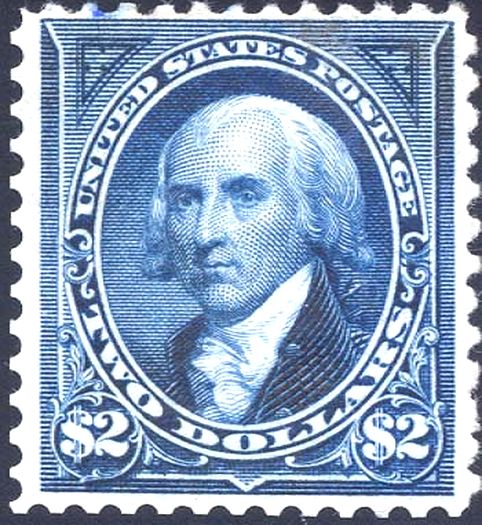
james_madison_1894_issue-2
Madison: Permanent war marks the end of democracy

W.J. Astore

Last week, Army General Raymond “Tony” Thomas, head of U.S. Special Operations Command (SOCOM), expressed his dismay about the Trump administration. “Our government continues to be in unbelievable turmoil,” Thomas opined.  “I hope they sort it out soon because we’re a nation at war.”

What does that mean, we’re a nation at war?  Many will think that a dumb question, but is it?  Sure, we have roughly 10,000 troops in Afghanistan, and that war isn’t over.  Sure, the U.S. is still helping Iraqi forces (notably in Mosul) against ISIS and related terrorist groups. Yes, the U.S. and NATO (joined by Russia?) are seeking to corral and eventually to end ISIS and “radical Islamic extremism/terrorism.”  But do these efforts constitute a world war, like World Wars I and II?

It doesn’t feel like a war — not in the USA, at least.  Congress has made no formal declaration of war.  Few Americans are sacrificing (of course, the troops in harm’s way are). There’s no rationing.  No tax increases to pay for the war.  No national mobilization of resources.  No draft.  No change in lifestyles or priorities. Nothing.  Most Americans go about their lives oblivious to the “war” and its progress (or lack thereof).

Here’s my point. Terrorism, whether radical Islamist or White supremacist or whatever variety, will always be with us.  Yes, it must be fought, and in a variety of ways.  Police action is one of them.  Political and social changes, i.e. reforms, are another.  Intelligence gathering.  Occasionally, military action is warranted.  But to elevate terrorism to an existential threat is to feed the terrorists.  “War” is what they want; they feed on that rhetoric of violence, a rhetoric that elevates their (self)-importance.  Why feed them?

Another aspect of this: a war on terrorism is essentially a permanent war, since you’ll never get rid of all terrorists.  And permanent war is perhaps the greatest enemy of democracy — and a powerful enabler of autocrats. James Madison saw this as clearly as anyone:

Of all the enemies of true liberty, war is, perhaps, the most to be dreaded, because it comprises and develops the germ of every other.  War is the parent of armies; from these proceed debt and taxes; and armies, and debts, and taxes are the known instruments for bringing the many under the domination of the few.  In war, too, the discretionary power of the Executive is extended; its influence in dealing out offices, honors and emoluments is multiplied; and all the means of seducing the minds, are added to those of subduing the force, of the people.  The same malignant aspect in republicanism may be traced in the inequality of fortunes, and the opportunities of fraud, growing out of a state of war, and in the degeneracy of manner and of morals, engendered in both. No nation can preserve its freedom in the midst of continual warfare …

After reading Madison, does anyone dedicated to democracy really want to be “at war” for, well, generations?  Forever?

Of course, there’s another aspect to General Thomas’s critique that must be mentioned, and that’s his audacity in criticizing the government (and, by extension, his commander-in-chief) for not having its act together in “the war.”  Generals are supposed to fight wars, not critique in public the government they serve.

War rhetoric doesn’t just inspire terrorists and empower autocrats while weakening democracy: It also emboldens generals.  They begin to think that, if the nation is at war, they should have a powerful role in making sure it runs well, until the state becomes an apparatus of the military (as it did in Germany during World War I, when Field Marshal Hindenburg and General Ludendorff ran Germany from 1916 to its collapse in November 1918).  The Trump administration has already put (long-serving and recently retired) generals at the helm of defense, homeland security, and the National Security Council. Remember the days when civilians filled these positions?

One more point: If the U.S. is now “a nation at war,” when, do tell, will we return to being a nation at peace?  If the answer is, “When the last terrorist is eliminated,” say goodbye right now to what’s left of American democracy.

Making America Divided Again

trump
Rise above the pettiness, don’t be the pettiness

W.J. Astore

Trump’s latest press conference is worrisome for so many reasons.  He seems to live in his own reality (e.g. his administration is “a fine-tuned machine“).  He’s still obsessed with Hillary Clinton and the margin of his victory.  He seems only recently to have learned how serious the prospects of a nuclear holocaust could and would be.  He continues to defend General Michael Flynn, saying that even though Flynn undermined the Obama administration and lied to Vice President Mike Pence, his rapprochement to Russia was laudable (with Trump suggesting that, even though he hadn’t approved Flynn’s actions, he might have).  He even tasked a Black reporter to set up a meeting with the Congressional Black Caucus for him!

What to make of The Donald?  Trump seems to thrive on creating animosity, then exploiting it.  Special targets for him include the U.S. intelligence community and the media, both of which he sees as implacable enemies.  But is animosity and chaos any way to run a country or to represent a people?

I can see how calling out your perceived enemies might work in business, especially a personal one, though Trump’s bankruptcies suggest otherwise.  But Trump is no longer a free-wheeling real estate tycoon.  He’s president now, a symbol (like it or not) of America. Generating animosity and discord as a public servant is divisive, fractious, selfish, and unwise.

A united America is much stronger than a disunited America, but since Trump thrives on division, his personal style is weakening our country. You might say he’s the opposite of Abraham Lincoln, who appealed to the better angels of our nature in a noble but ultimately failed attempt to unite a disunited country. Whatever else Trump is about, it’s not better angels.

Instead of making America great again, Trump is making it divided and uncivil again.

Mister President: Please stop blaming the media, or Hillary, or the intelligence community, or judges, or anyone else for that matter.  Get on with the job of being a public servant.  America needs inspired leadership, not self-serving rhetoric.  We need a uniter, not a divider.

Rise above the pettiness, Mister President.  For the nation’s sake, don’t be the pettiness.

General Flynn’s Resignation: A Holy Warrior Derails Himself

flynn
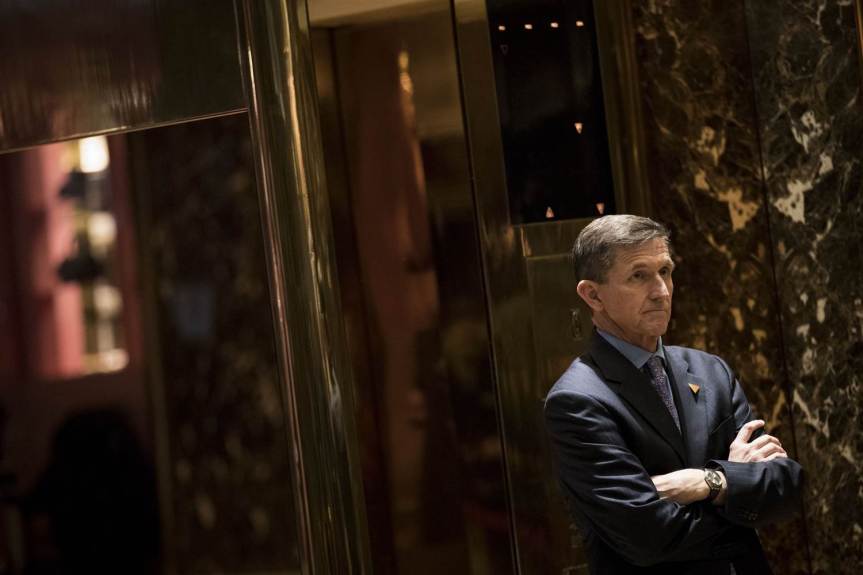
Flynn waiting for an elevator in Trump Tower back in December (NBC)

W.J. Astore

General Michael Flynn’s resignation as National Security Adviser is good news, and not only because of his lack of candor in regards to Russia.  Flynn is a believer in religious war.  He sacralized the war on terror and saw himself as a holy warrior against radical Islamist terrorists.  (Of course, he couldn’t perceive his own extremism and radicalism.)

Both in religious terms and in predatory terms, men like Flynn and Steve Bannon see radical Islamists as the enemy.  These “animals” cut off heads!  A creed war that treats the enemy as animals is a combustible combination.  When you see the enemy as an inferior yet insidious “Other,” there is no opportunity for compromise.  Vermin can only be exterminated.  Especially when they are allegedly out to destroy your “Judeo-Christian” values.

Flynn’s war against radical Islamists would be unending, driven as it would be by outrage against what he saw as a verminous enemy.  In such a “holy” war, killing acquires quasi-sacred meaning.  Flynn’s war was not to be a Clausewitzian war of politics by other means. Nor was it a greed-war driven by money and empire.  His war was far more insidious.

When you conceive of the enemy as predators who simultaneously have the human ability to enslave you with their own creed (Sharia Law): Well, this enemy is a shape-shifting monster. Small wonder that Flynn infamously tweeted: “Fear of Muslims is RATIONAL.”

What was the source of his fear?  In theory, what is the biggest threat to humans?  Not tigers or snakes or other predators; they can be identified.  The biggest threat is something human but not quite human.  Something that looks human, has human skills, human smarts, but is ruthlessly inhuman, even as it readily blends in with “normal” humans.

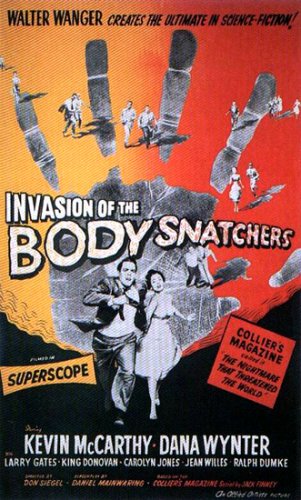
The tight Islamophobic circle around Trump (one weaker, with Flynn’s resignation) appears to view Muslims in this way.  It’s a little like the Invasion of the Body Snatchers.

film1956-invasionofthebodysnatchers-originalposter

They look like us — act like us — and that’s precisely the problem!  Even a five-year-old Muslim refugee, no matter how innocent-looking, is seen by Sean Spicer and crew as an opening to an unstoppable invasion of America, hence Trump’s hurried and sweeping ban on Muslim immigration.

Flynn’s ideology supported the dynamic of permanent religious war.  His writings and tweets were consistent with an exterminatory struggle for existence of the worst kind.  His actions and views would only perpetuate jihad, a struggle he apparently sees as inevitable.

Until we neutralize jihadists like Flynn (and Bannon) and his Islamist counterparts, until we see a common humanity instead of viewing the enemy as insanely ferocious predators who are out to destroy our way of life, there is no hope for even a semblance of peace in this world.