I was going through old notes and came across emails written to me from 2009 in response to an article I wrote for TomDispatch about militarism in America and its many dangers. (When I tell readers that I often learn as much from them as they do from me, I mean it.)
Without further ado, four “letters” from readers, vintage 2009:
I enjoyed very much your article on patriots and the flag. Out here in Wyoming we get a real dose of it. It bothers me a great deal to see political candidates wrap themselves in the flag and even use the flag as advertising items. Many people have a flag on their driveway that hangs there until it falls apart and they are proclaiming they are patriots. I served in the army and the Wyoming National Guard and I feel that I do not need my motives scrutinized. I feel that my saying “bring the troops home” is supporting them and not wanting any other young people maimed or killed should speak for itself. Keep up the good work.
The next letter highlighted the “cult of hyper-patriotism” that Bush/Cheney in particular were cultivating:
Suffice it to say that you have touched on a number of issues that I strongly agree with. The cult of hyper-patriotism that seems to have sprung up since the early to mid 80s seems to sucking the marrow from America’s bones, rather than strengthening and replenishing it. Too many of our fellow citizens are only familiar with the first half of Carl Schurz’s quote: “My country, right or wrong; if right, to be kept right; and if wrong, to be set right.”
Another reader, an Army veteran, questioned all the “thank you for your service” hoopla:
I cannot say how we arrived at the point we are today, regarding some of the issues you raised, but we have reached a point that I think is not right. And, unfortunately, raising questions about this draws rapid condemnation.
The extra thing, that your article did not mention, which I find unsettling, is that we seem to have become a citizenry of gestures, rather than resolve (and Gary Cooper was all about being resolute). As if plastering the trunk lid of one’s car with yellow ribbon magnets and ‘Freedom isn’t free’ stickers is somehow just as valid as actually serving the country. As if the ostentatious example of thanking soldiers one coincidentally meets in the airport for their service makes up for staying home oneself. I volunteered and served my three years in the Army (and didn’t like military life at all, so left when my enlistment was up), but can’t imagine why anyone would thank me for simply doing my duty, and without knowing whether I did my duty well.
In one of my favorite letters, a reader noted the melding of sports and the military along with Hollywood’s predilection for big men with even bigger guns:
I just read your essay “What Happened to Gary Cooper” on Middle East Online and loved it. As a screenwriter in California, I’m often in meetings where some twenty something “exec” speaks lovingly about big men with big guns. I try to steer the discussion to a different kind of hero, the reluctant kind that solve their problems with keen insight instead of quick trigger fingers. I’m sure you can imagine how those suggestions are treated.
And also, as a former professional football player and lifelong sports fan, I’m also very interested in the melding of military and sports cultures. Watch an NFL game and it’s readily apparent. Pregame shows with military guards, monstrous flags, reverential tributes to the troops overseas, etc.
And always the flyovers! A few years back I was at an Angels World Series game with a friend. A stealth bomber thundered overhead right before the first pitch and the crowd went wild. My friend said he had tears in his eyes, and I said, just think how many tears are shed by the people whose countries those things flyover every single day. He thought I was joking. I wasn’t.
These reader comments from 2009 could have been made yesterday—or today. Steroidal displays of hyper-patriotism and exotic weaponry continue apace in allegedly peace-loving America as the president boasts of trillion-dollar war budgets.
A final comment from another reader:
I served in the US Coast Guard back when it wasn’t fashionable to be in the military. I remember having garbage thrown at me from passing cars when on liberty from the Academy. I don’t desire a return to those days but I firmly believe that the pendulum has gone too far the other way.
I love my country as much as anyone but I really wish that they’d stop singing ‘God Bless America’ during the 7th inning stretch and replace it with “America the Beautiful”, prefereably all verses but at least the first two. For the past 8 years, I’ve been moved to tears when singing te second verse as it ends,
“America! America! God mend thine ev’ry flaw;
Confirm thy soul in self control, thy liberty in law! “
We could use a bit more self control.
These comments come from men who at first glance might be seen as “conservative” or even as “deplorable” by some sectors of society. This is deeply unfortunate. I’m not sure how else to put this, so I’ll just say it: these men would not be out of step with the efforts of groups like Code Pink. We need to come together.
In America there is a “silent majority” who are tired of vapid patriotism, rabid nationalism, and endless wars. How we activate that silent majority—how we get them to stand up, to march, to declare “Enough is enough!” is a question for the ages.
A few months ago, I sorted through some old pennies. I know: Who does this anymore? Aren’t pennies obsolete? Does anybody still bend down to pick up pennies?
I found an old Lincoln “wheat” penny from 1944 (I used to see a lot more “wheat” pennies when I was young), and somehow, somewhere, I picked up an Indian head penny from 1888 (in fair condition at best). But the one that most surprised me was a Canadian penny from 1943 featuring King George VI.
My King George VI penny had this inscription on the front: GEORGIUS VI D:G: REX ET IND IMP. I confess I had to look that up. What it means is this:
George VI, by the grace of God, King and Emperor of India
And it immediately occurred to me that this is the type of coin Trump would want, though of course I doubt Trump would want his profile on a penny. Anyhow, I could imagine a big Trump coin (gold, naturally), with an inscription like this:
Trumpus I, by the grace of God, King and Emperor of Canada, Greenland, and the Panama Canal
It got me to laughing as a way to hide my tears.
Anyhow, just four years after my George VI penny was minted, India was on its way to independence, recognizing it didn’t need a British monarch to rule over it. Who knew India would gain its independence so quickly after World War II? Certainly not the British monarchy.
History is full of surprises, and events can often move far more quickly than we think possible. I hope that means that America will free itself of Trump as quickly as India sloughed off George VI. Who needs a wannabe monarch like Trump?
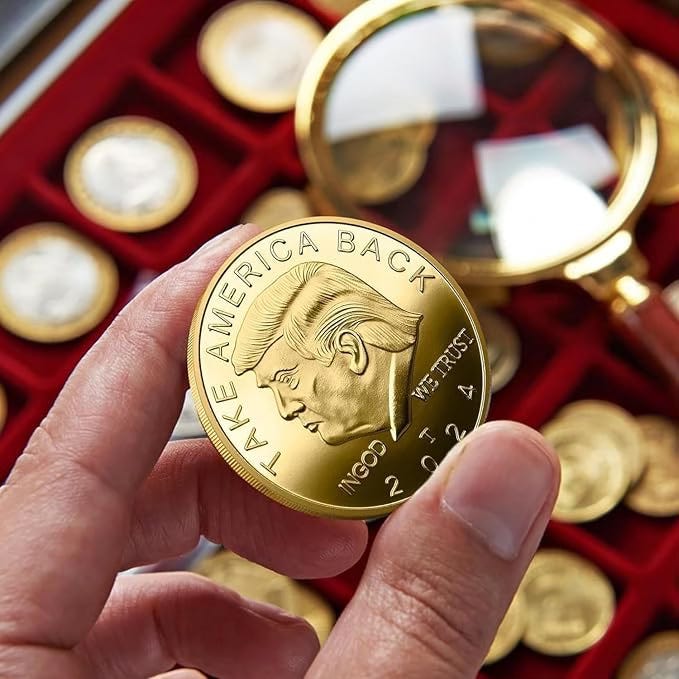
Let’s hope Trump’s image never adorns official U.S. coinage. After all, his image is already on far too many “commemorative” coins that he sells to his admirers and followers.
You can buy ten of these “coins” at Amazon for $16.99. Good grief!
Are we living through a nightmarish simulacrum of reality, a Hollywood without happy endings? If so, let’s call it “Trumpwood.”
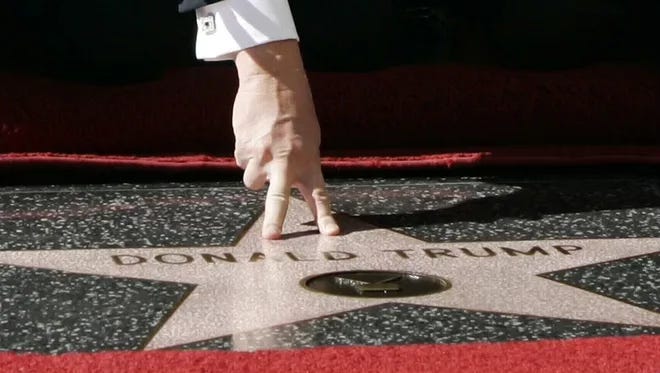
You may know that Donald Trump, who’s appeared in movies and had his own popular TV show, The Apprentice (where his signature line was, “You’re fired!”), has his very own star on Hollywood’s walk of fame (and shame). It’s rather amazing to recall that Trump was once seen as an entertaining billionaire buffoon, a friend to the Clintons, among other liberal A-listers. The relatable billionaire, so to speak, whose vulgar tastes ran to golden toilets. As they say, who cares if it’s true—go with the legend!
He’s a star! A star!
Trumpwood, I’d argue, is a twisted and bizarre version of Hollywood, where the Oval Office is just a set to him, where the world is just a stage where he manifests all his hatred and trauma and egotism. The rest of us are just bit players (or scenery, easily changeable and discardable) in his psychodrama.
It’s all show business to The Donald, all centered on himself, where he is (at least in his own mind) the ultimate A-lister. He is the “very stable genius,” the most powerful man in the world with the biggest nuclear button, the man who craves attention but who also demands obedience. Adoration is what fuels him. Without adoring masses, without his trumped-up towers to himself, he would wither away.
Trump is the ultimate taker, feeding off the adoration as well as the hatred of the rest of us. I wish we could ignore him, but he is the president, after all, so we can’t just wish him into the cornfield.
Perhaps in 2028, assuming we last that long, Americans might care to elect a public servant rather than a self-centered scene-stealing “star” as president. A man can dream.
P.S. Check out Tom Engelhardt’s latest at TomDispatch, which helped to inspire these thoughts of mine.
I read the news today, oh boy. About a lucky man named Elon Musk. But he lost out on one thing: he didn’t get a top secret briefing on Pentagon war plans for China. And the news people breathed a sigh of relief.
With apologies to John Lennon and The Beatles, a day in the life is getting increasingly tough to take here in the land of the free. I’m meant to be reassured that Musk didn’t get to see America’s top-secret plans for — yes! — going to war with China, even as I’m meant to ignore the constant drumbeat of propaganda, the incessant military marches that form America’s background music, conveying the message that America must have war plans for China, that indeed war in or around China is possible, even probable, in the next decade. Maybe in 2027?
My fellow Americans, we should be far more alarmed by such secret U.S. war plans, along with those “pivots” to Asia and the Indo-Pacific, and the military base-building efforts in the Philippines, than reassured by the “good news” that Comrade Billionaire Musk was denied access to the war room, meaning (for Dr. Strangelove fans) he didn’t get to see “the big board.”
It’s war, war, everywhere in America. We do indeed have a strange love for it. I’ve been writing for TomDispatch for 18 years now — this is my 111th essay (the other 110 are in a new book of mine) — most of them focusing on militarism in this country, as well as our disastrous wars in Iraq, Afghanistan, and elsewhere, the ruinous weapons systems we continue to fund (including new apocalyptic nuclear weapons), and the war song that seems to remain ever the same.
A few recent examples of what I mean: President Trump has already bombed Yemen more than once. He’s already threatening Iran. He’s sending Israel all the explosives, all the weaponry it needs to annihilate the Palestinians in Gaza (so too, of course, did Joe Biden). He’s boasting of building new weapons systems like the Air Force’s much-hyped F-47 fighter jet, the “47” designation being an apparent homage by its builder, Boeing, to Trump himself, the 47th president. He and his “defense” secretary, Pete Hegseth, continually boast of “peace through strength,” an Orwellian construction that differs little from “war is peace.” And I could, of course, go on and on and on and on…
Occasionally, Trump sounds a different note. When Tulsi Gabbard became the director of national intelligence, he sang a dissonant note about a “warmongering military-industrial complex.” And however haphazardly, he does seem to be working for some form of peace with respect to the Russia-Ukraine War. He also talks about his fear of a cataclysmic nuclear war. Yet, if you judge him by deeds rather than words, he’s just another U.S. commander-in-chief enamored of the military and military force (whatever the cost, human or financial).
Consider here the much-hyped Department of Government Efficiency (DOGE) led by that lucky man Elon Musk. Even as it dismantles various government agencies like the Department of Education and USAID, it has — no surprise here! — barely touched the Pentagon and its vast, nearly trillion-dollar budget. In fact, if a Republican-controlled Congress has any say in the matter, the Pentagon budget will likely be boosted significantly for Fiscal Year 2026 and thereafter. As inefficient as the Pentagon may be (and we really don’t know just how inefficient it is, since the bean counters there keep failing audit after audit, seven yearsrunning), targeted DOGE Pentagon cuts have been tiny. That means there’s little incentive for the generals to change, streamline their operations, or even rethink in any significant fashion. It’s just spend, spend, spend until the money runs out, which I suppose it will eventually, as the national debt soars toward $37 trillion and climbing.
Even grimmer than that, possibly, is America’s state of mind, our collective zeitgeist, the spirit of this country. That spirit is one in which a constant state of war (and preparations for more of the same) is accepted as normal. War, to put it bluntly, is our default state. It’s been that way since 9/11, if not before then. As a military historian, I’m well aware that the United States is, in a sense, a country made by war. It’s just that today we seem even more accepting of that reality, or resigned to it, than we’ve ever been. What gives?
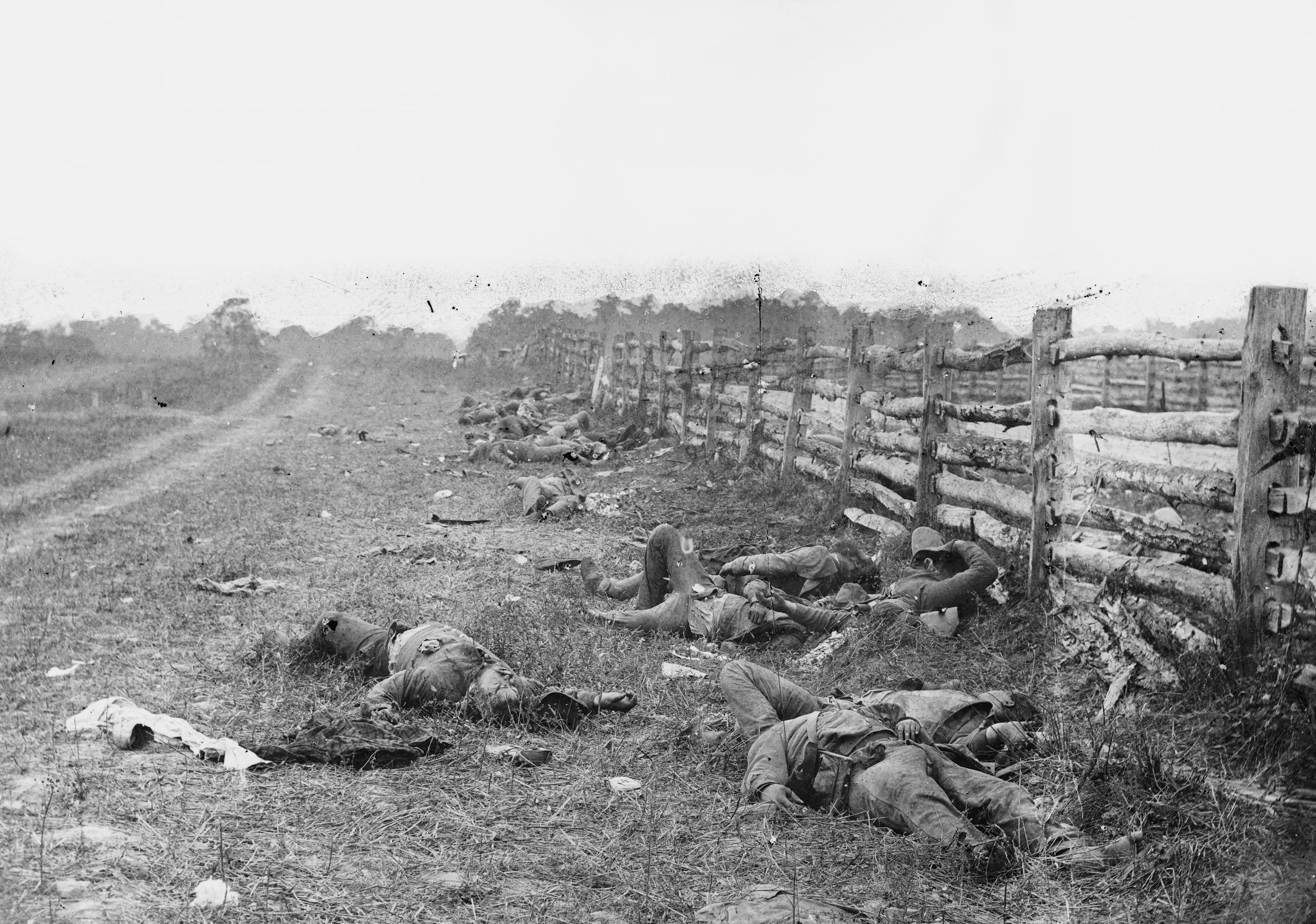
The Face of War: Confederate Dead at Antietam (Matthew Brady)
Remember when, in 1963, Alabama Governor George Wallace said, “Segregation now, segregation tomorrow, and segregation forever”? Fortunately, after much struggle and bloodshed, he was proven wrong. So, can we change the essential American refrain of war now, war tomorrow, and war forever? Can we render that obsolete? Or is that too much to hope for or ask of America’s “exceptional” democracy?
Taking on the MICIMATT(SH)
Former CIA analyst Ray McGovern did America a great service when he came up with the acronym MICIMATT, or the Military-Industrial-Congressional-Intelligence-Media-Academia-Think-Tank complex, an extension of President Dwight D. Eisenhower’s military-industrial complex, or MIC (from his farewell speech in 1961). Along with the military and industry (weapons makers like Boeing and Lockheed Martin), the MICIMATT adds Congress (which Eisenhower had in his original draft speech but deleted in the interest of comity), the intelligence “community” (18 different agencies), the media (generally highly supportive of wars and weapons spending), academia (which profits greatly from federal contracts, especially research and development efforts for yet more destructive weaponry), and think tanks (which happily lap up Pentagon dollars to tell us the “smart” position is always to prepare for yet more war).
You’ll note, however, that I’ve added a parenthetical SH to McGovern’s telling acronym. The S is for America’s sporting world, which eternally gushes about how it supports and honors America’s military, and Hollywood, which happily sells war as entertainment (perhaps the best known and most recent film being Tom Cruise’s Top Gun: Maverick, in which an unnamed country that everyone knows is Iran gets its nuclear ambitions spanked by a plucky team of U.S. Naval pilots). A macho catchphrase from the original Top Gun was “I feel the need — the need for speed!” It may as well have been: I feel the need — the need for pro-war propaganda!
Yes, MICIMATT(SH) is an awkward acronym, yet it has the virtue of capturing some of the still-growing power, reach, and cultural penetration of Ike’s old MIC. It should remind us that it’s not just the military and the weapons-makers who are deeply invested in war and — yes! — militarism. It’s Congress; the CIA; related intel “community” members; the mainstream media (which often relies on retired generals and admirals for “unbiased” pro-war commentary); academia (consider how quickly institutions like Columbia University have bent the knee to Trump); and think tanks — in fact, all those “best and brightest” who advocate for war with China, the never-ending war on terror, war everywhere.
But perhaps the “soft power” of the sporting world and Hollywood is even more effective at selling war than the hard power of bombs and bullets. National Football League coaches patrol the sidelines wearing camouflage, allegedly to salute the troops. Military flyovers at games celebrate America’s latest death-dealing machinery. Hollywood movies are made with U.S. military cooperation and that military often has veto power over scripts. To cite only one example, the war movie 12 Strong (2018) turned the disastrous Afghan War that lasted two horrendous decades into a stunningly quick American victory, all too literally won by U.S. troops riding horses. (If only the famed cowboy actor John Wayne had still been alive to star in it!)
The MICIMATT(SH), employing millions of Americans, consuming trillions of dollars, and churning through tens of thousands of body bags for U.S. troops over the years, while killing millions of people abroad, is an almost irresistible force. And right now, it seems like there’s no unmovable object to blunt it.
Believe me, I’ve tried. I’ve written dozens of “Tomgrams” suggesting steps America could take to reverse militarism and warmongering. As I look over those essays, I see what still seem to me sensible ideas, but they die quick deaths in the face of, if not withering fire from the MICIMATT(SH), then being completely ignored by those who matter.
And while this country has a department of war (disguised as a department of defense), it has no department of peace. There’s no budget anywhere for making peace, either. We do have a colossal Pentagon that houses 30,000 workers, feverishly making war plans they won’t let Elon Musk (or any of us) see. It’s for their eyes only, not yours, though they may well ask you or your kids to serve in the military, because the best-laid plans of those war-men do need lots of warm bodies, even if those very plans almost invariably (Vietnam, Afghanistan, Iraq, etc.) go astray.
So, to repeat myself, how do you take on the MICIMATT(SH)? The short answer: It’s not easy, but I know of a few people who had some inspirational ideas.
On Listening to Ike, JFK, MLK, and, Yes, Madison, Too
Militarism isn’t exactly a new problem in America. Consider Randolph Bourne’s 1918 critique of war as “the health of the state,” or General Smedley Butler’s confession in the 1930s that “war is a racket” run by the “gangsters of capitalism.” In fact, many Americans have, over the years, spoken out eloquently against war and militarism. Many beautiful and moving songs have asked us to smile on your brother and “love one another right now.” War, as Edwin Starr sang so powerfully once upon a time, is good for “absolutely nothin’,” though obviously a lot of people disagree and indeed are making a living by killing and preparing for yet more of it.
And that is indeed the problem. Too many people are making too much money off of war. As Smedley Butler wrote so long ago: “Capital won’t permit the taking of the profit out of war until the people — those who do the suffering and still pay the price — make up their minds that those they elect to office shall do their bidding, and not that of the profiteers.” Pretty simple, right? Until you realize that those whom we elect are largely obedient to the moneyed class because the highest court in our land has declared that money is speech. Again, I didn’t say it was going to be easy. Nor did Butler.
As a retired lieutenant colonel in the U.S. Air Force, I want to end my 111th piece at TomDispatch by focusing on the words of Ike, John F. Kennedy (JFK), Martin Luther King, Jr. (MLK), and James Madison. And I want to redefine what words like duty, honor, country, and patriotism should mean. Those powerful words and sentiments should be centered on peace, on the preservation and enrichment of life, on tapping “the better angels of our nature,” as Abraham Lincoln wrote so long ago in his First Inaugural Address.
Why do we serve? What does our oath of office really mean? For it’s not just military members who take that oath but also members of Congress and indeed the president himself. We raise our right hands and swear to support and defend the U.S. Constitution against all enemies, foreign and domestic, to bear true faith and allegiance to the same.
There’s nothing in that oath about warriors and warfighters, but there is a compelling call for all of us, as citizens, to be supporters and defenders of representative democracy, while promoting the general welfare (not warfare), and all the noble sentiments contained in that Constitution. If we’re not seeking a better and more peaceful future, one in which freedom may expand and thrive, we’re betraying our oath.
If so, we have met the enemy — and he is us.
Ike told us in 1953 that constant warfare is no way of life at all, that it is (as he put it), humanity crucifying itself on a cross of iron. In 1961, he told us democracy was threatened by an emerging military-industrial complex and that we, as citizens, had to be both alert and knowledgeable enough to bring it to heel. Two years later, JFK told us that peace — even at the height of the Cold War — was possible, not just peace in our time, but peace for all time. However, it would, he assured us, require sacrifice, wisdom, and commitment.
How, in fact, can I improve on these words that JFK uttered in 1963, just a few months before he was assassinated?
What kind of peace do we seek? Not a Pax Americana enforced on the world by American weapons of war. Not the peace of the grave or the security of the slave. I am talking about genuine peace, the kind of peace that makes life on earth worth living…
I speak of peace because of the new face of war. Total war makes no sense in an age… when the deadly poisons produced by a nuclear exchange would be carried by wind and water and soil and seed to the far corners of the globe and to generations yet unborn… surely the acquisition of such idle [nuclear] stockpiles — which can only destroy and never create — is not the only, much less the most efficient, means of assuring peace.
I speak of peace, therefore, as the necessary rational end of rational men. I realize that the pursuit of peace is not as dramatic as the pursuit of war — and frequently the words of the pursuer fall on deaf ears. But we have no more urgent task.
Are we ready to be urgently rational, America? Are we ready to be blessed as peacemakers? Or are we going to continue to suffer from what MLK described in 1967 as our very own “spiritual death” due to the embrace of militarism, war, empire, and racism?
Of course, MLK wasn’t perfect, nor for that matter was JFK, who was far too enamored of the Green Berets and too wedded to a new strategy of “flexible response” to make a clean break in Vietnam before he was killed. Yet those men bravely and outspokenly promoted peace, something uncommonly rare in their time — and even more so in ours.
More than 200 years ago, James Madison warned us that continual warfare is the single most corrosive force to the integrity of representative democracy. No other practice, no other societal force is more favorable to the rise of authoritarianism and the rule of tyrants than pernicious war. Wage war long and it’s likely you can kiss your democracy, your rights, and just maybe your ass goodbye.
America, from visionaries and prophets like MLK, we have our marching orders. They are not to invest yet more in preparations for war, whether with China or any other country. Rather, they are to gather in the streets and otherwise raise our voices against the scourge of war. If we are ever to beat our swords into plowshares and our spears into pruning hooks and make war no more, something must be done.
Let’s put an end to militarism in America. Let’s be urgently rational. To cite John Lennon yet again: You may say I’m a dreamer, but I’m not the only one. Together, let’s imagine and create a better world.
Meanwhile, Institute of War Is Going Full Throttle
Surprise! America’s Institute of Peace (USIP), admittedly a think tank that is neither that peaceful nor successful, is being shut down by the Trump administration. Meanwhile, the Institute of and for War, otherwise known as the Pentagon, is going full throttle and likely getting even more money to crank up conflict around the globe.
The symbolism here is almost too obvious for words. The budget for the Peace Institute is roughly $55 million. The budget for the War Institute (Pentagon) is roughly $900 billion. That means America spends 16,000 times as much money preparing for war than it does thinking about peace. That might be one reason why we always get war—we get what we pay for.
For the yearly budget of the USIP, we could buy roughly one-half of an F-35 fighter jet. Now there’s some meaningful cost savings.
A Reminder: My new book, American Militarism on Steroids, goes live on Amazon Kindle tomorrow. It gathers all the essays I’ve written for TomDispatch, which amazingly add up to over 230,000 words. Prolix? Prolific? Profane? It must be profane if it criticizes our beloved Institute of War. Available for downloading for $7.50 at this link. Thank you.
In “The Matrix,” Agent Smith asks humanity’s hero, Neo, “What good is a phone call if you’re unable to speak?” It’s a powerful scene and perhaps the creepiest in the film.
What good is democracy, America, if you’re unable to speak? If your opposition to genocide in Gaza leads to you being labeled a terrorist and sent away to a place where your voice won’t be heard. If your shouts for peace, for greater fairness, for real change are simply drowned out by the “speech” of those with vastly more money than you, thus vastly bigger and louder megaphones.
Who does Donald Trump listen to, small donors who send him $20 or $200 or Miriam Adelson who gave him $100 million? Who would you listen to if you were Trump? Small wonder he’s Making Israel Great Again (MIGA).
Broadly speaking, Americans don’t want a war with Yemen. They don’t support Israel’s annihilation of Gaza. Yet your wants simply don’t matter. You have no say. Not when billionaires and powerful corporations have already bought “your” president and “your” representatives.
Public funding of elections is absolutely essential to curbing this corruption. Despite what the Supreme Court claims, money isn’t speech, and corporations are not citizens. Money is money, and those with the most money shouldn’t be allowed to use that money to drown out the voices of everyone else.
Oh, in the scene above, you’ll note that Neo is “bugged.” We’re all bugged as well. It’s called a Smart phone.
The U.S. Empire, Thrashing and Lashing Out as It Declines
President Donald Trump has promised to bomb Yemen for a “long time.” Trump is a real president now. Presidents become “real” when they bomb something. Remember how Trump was praised by the U.S. mainstream media when he launched missiles against Syria in 2017?
Back in 2017, I wrote this: The launch of 59 expensive cruise missiles against a Syrian airfield did little to change the actions of the Assad government. Nor did it knockout the airfield. Yet it was spun by Trump as a remarkable victory. In his words, “We’ve just fired 59 missiles, all of which hit, by the way, unbelievable, from, you know, hundreds of miles away, all of which hit, amazing. It’s so incredible. It’s brilliant. It’s genius. Our technology, our equipment, is better than anybody by a factor of five. I mean look, we have, in terms of technology, nobody can even come close to competing.”
“Only we can bomb it” should replace “In God we trust” as the U.S. national motto.
America’s best and brightest (who were never quite that) have become the worst and dimmest. And that’s true whether the president is blue or red, Biden or Trump. The problem is our “leaders” have no moral principles. No integrity. No sense of right and wrong. They’re all about power and sending “messages” through bombing. Or sending tons and tons of bombs to Israel so that the Zionists can send “messages” to the Palestinians. The main message: begone or be dead.
Even as our “leaders” do this, they seek to solidify a mythic history of the U.S. (see video above) where America is exceptional in its rightness and where they (the leaders) are the ones who grant us our rights (such as freedom of speech) when these rights are inalienable. Indeed, rather than protecting our rights, they want to control them, limit them, and make them obedient and subservient to power.
Rulers’ ideas rule. And our rulers’ ideas are increasingly toxic.
With democracy already deeply compromised in America, we’re witnessing and experiencing the thrashing and lashing out of a declining American empire, not only externally but in the “homeland.”
The so-called SignalGate scandal centered on the bombing of Yemen is highly revelatory. First, some resources. CNN has a useful annotated account of the chats exchanged at the highest levels of the Trump administration. At their respective Substacks, Lenny Broytman and Caitlin Johnstone have telling dissections of these chats as well. At Jacobin, Branko Marcetic has an important article that reminds us of the illegality of the attacks. As the article’s subheading puts it: The press [mainstream media] is mostly framing the Yemen group chat scandal as a story of incompetence. There’s little attention being paid to the deadliness, illegality, and ineffectiveness of the strikes themselves.
To me, among the most telling “chats” came from Secretary of Defense Pete Hegseth. It highlights the “exceptional” nature of America:
*****
Pete Hegseth to Vice President JD Vance: I fully share your loathing of European free-loading. It’s PATHETIC.
But Mike [Waltz, the National Security Adviser] is correct, we are the only ones on the planet (on our side of the ledger) who can do this. Nobody else even close. Question is timing…
*****
This is precisely the problem for America since the Vietnam War, if not before then. We’ve created a monster military, a “global strike” force, that is capable of destroying any target anywhere around the globe. “Nobody else even close,” SecDef Hegseth correctly says. And because we can do it, because we are exceptional in military force, our leaders believe we should do it, even if it’s only to send a “message” to the world how tough we are, how committed we are to killing others.
Other countries—like those “free-loading” European ones—are PATHETIC because they don’t have America’s military might. Only we can smite evildoers around the globe, only we can do so while also arming Israel to the teeth and covering its flanks while it continues its annihilation of Gaza, and this is something we are immensely proud of.
My fellow Americans, this is not something to be proud of. Consider if America’s military in the 1960s had lacked the ability to deploy over half a million troops to Vietnam while also facing down the Warsaw Pact in Europe. Consider if America’s military had lacked the ability to invade Iraq in 2003 while also waging war in Afghanistan and garrisoning the globe with roughly 800 military bases. Consider how much blood would not have been spilled, and treasure wasted, if the U.S. military was smaller, focused on defense, and led by people who didn’t put muscle and flame emojis in their chats to celebrate U.S. military prowess at killing people in Yemen.
That U.S. military forces are the only ones who can kill globally with such comparative ease, that “nobody else even close,” is exactly what is wrong with our government. We place far too much faith and pride in military prowess, so much so that the Pentagon becomes the Pentagod, something we worship, something we make immense sacrifices to, as in budgets that approach $1 trillion yearly.
Not for nothing did President Dwight D. Eisenhower say in 1953 that this is no way of life at all—that we are crucifying ourselves on a cross of iron. Tell me again, who are the pathetic ones?
We must end our intoxication with military power before it ends us.
Officially, the U.S. has the DOD, the department of defense. But when was the last time the U.S. military was primarily oriented toward defense of the CONUS? (CONUS is a military acronym for continental United States.)
My old service, the U.S. Air Force, is far more open about its true aims. It boasts assertively of “global reach, global power” and notably of “global strike.” Not to be outdone, the U.S. Navy has “carrier strike groups,” what used to be termed carrier task forces when they fought real battles in World War II.
Here’s a recent official description: “A Carrier Strike Group (CSG) is a highly powerful, self-contained naval force, capable of projecting power globally, with an aircraft carrier as its core, supported by cruisers, destroyers, submarines, and an air wing, making it a formidable force capable of striking targets 1,000 miles away.”
Doesn’t sound defensive, does it? And of course the U.S. Marines are defined as “expeditionary” forces that are “forward-deployed” for all sorts of expected “contingencies” overseas.
The U.S. military is not about defense. It’s about “full-spectrum dominance.” That means dominance of the land, sea, air, space, cyber, information in all its forms, indeed just about any realm you can think of. No other military, moreover, divides the world into global commands (CENTCOM, AFRICOM, etc.) for the application of U.S. military power. This is not about defending America. It’s about dominating the world. Such a grandiose vision of defense dominance is partly what drives colossal Pentagon budgets that are climbing toward a trillion dollars a year.
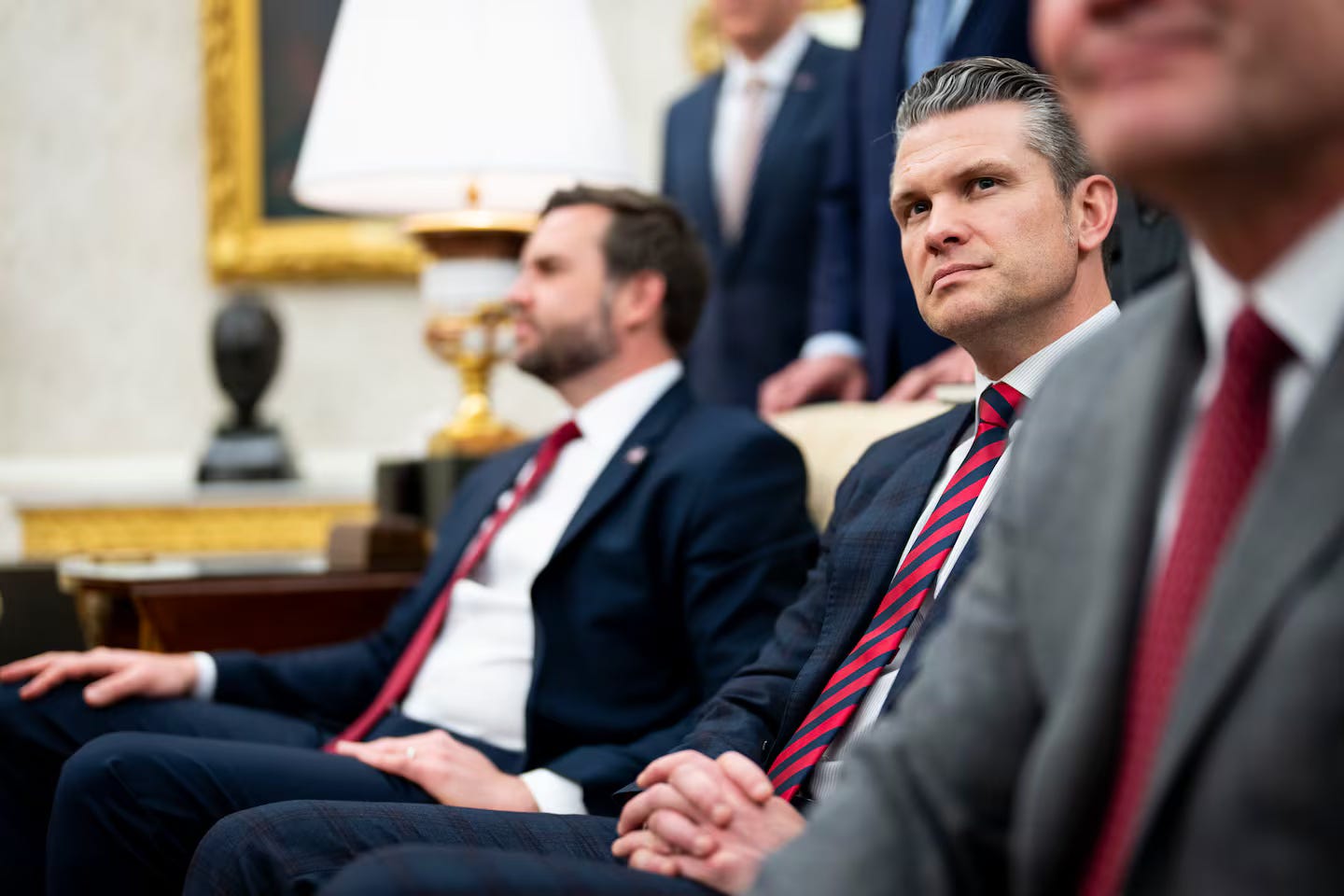
SecDef Pete Hegseth, always talking warrior-tough (Doug Mills/NYT)
Consider here the recent kerfuffle about leaked U.S. strike plans for Yemen, which were inadvertently shared with the editor-in-chief at The Atlantic. Here’s an excerpt from those plans:
From Secretary of Defense Offense Pete Hegseth
“1215et: F-18s LAUNCH (1st strike package)”
“1345: ‘Trigger Based’ F-18 1st Strike Window Starts (Target Terrorist is @ his Known Location so SHOULD BE ON TIME – also, Strike Drones Launch (MQ-9s)”
“1410: More F-18s LAUNCH (2nd strike package)”
“1415: Strike Drones on Target (THIS IS WHEN THE FIRST BOMBS WILL DEFINITELY DROP, pending earlier ‘Trigger Based’ targets)”
Note the repetition of the word “strike” and the closing prayer to America’s “warriors.” And ask yourself: Is this truly what national defense should look like? Prayerful appeals to “warriors” as they strike weak and poor countries thousands of miles away in undeclared (and therefore unconstitutional) wars?
Coming soon to a Kindle store near you: all my articles for TomDispatch, with a new introduction by me and a foreword by Tom Engelhardt. You can preorder it by clicking on this link. Thanks!
Speaking of American militarism on steroids:
It’s been called the “House of War” by esteemed author James Carroll. Within the military, it’s jokingly referred to as the five-sided puzzle palace on the Potomac. It’s a monetary black hole that consumes eagerly and without bounds (in light of seven failed audits in a row) roughly a trillion dollars in yearly military expenditures. It’s a place where full-bird colonels, who should be leading regiments in the field, become errand boys and girls to a grossly inflated number of generals. Yes, it’s America’s very own Pentagon, built in record time in the early months of World War II to manage that colossal war—and never shuttered since because perpetual global war is very much fundamental to the American way of life.
If there’s a symbol of America that captures current and past governmental budgetary priorities and foreign policy commitments, it’s the Pentagon. Forget the Statue of Liberty. Never mind Freedom Towers and national parks and bald eagles and the like. Increasingly, the Pentagon is America, a highly militarized version of our country, which is precisely why it needs to be closed down. Where’s Elon Musk and the DOGE wunderkinds when you need them?
Nearly 30,000 people work in the Pentagon on a daily basis. It makes for some crowded parking lots—and cramped offices even for those aforementioned bird colonels. It’s a hotbed of intrigue and competition among the services for money and resources. It’s depressingly short on natural light. It’s a repository for hidebound thinking, a place where good ideas go to die. A line from the original “Star Wars” has been used more than once to describe it: “You will never find a more wretched hive of scum and villainy.”
And (again) it’s time to shut it down.
Here’s an idea to make the U.S. military far more efficient. Empty the Pentagon of all its worker-bees and from them create infantry battalions. An average battalion consists of roughly 800 “effectives,” so demobbing the Pentagon work force and mobilizing them instead for action in the field would create roughly 35 battalions. Send these battalions to all combat zones where U.S. troops are deployed today. Does Ukraine need more troops at the front? Does Israel need more stormtroopers in Gaza? We’ve got some Pentagon legions for you, Bibi.
Of course, I jest. I want to close the Pentagon to weaken militarism, not to wage war and genocide. Nevertheless, I’m guessing putting the entire Pentagon workforce at the point of the spear might serve to dull it a bit. Perhaps war boosterism might decrease if the cheerleaders were sent directly into the trenches instead of remaining safely on the sidelines?







 Bracing Views