No matter the results, U.S. leaders praise the military as the very best in all of human history
W.J. Astore
[Note: I originally wrote this article for Truthout, where it appeared in August 2011. Little has changed since then; indeed, the current president has surrounded himself with advisers who are both screaming hawks and true believers in U.S. military strength. It’s a curious feature of American exceptionalism that our leaders parrot the notion that the U.S. military is “the finest fighting force” in history — and this boast comes despite disastrous results in Iraq, Afghanistan, and elsewhere. As my dad used to say, the best don’t have to boast.]
A line at the tail end of Nicholas Schmidle’s article in The New Yorker (August 8, 2011) on SEAL Team Six’s takedown of Osama bin Laden captured the military zeitgeist of the moment. Upon meeting the SEAL team, President Obama gushed that the team was, “literally, the finest small-fighting force that has ever existed in the world.”
As a military historian, I was struck by the sweeping nature of that boast.
The “finest small-fighting force” ever in the history of the world? What about the Spartan 300 who gave their all at Thermopylae against the Persians, thereby saving Greek civilization for posterity? What about those Royal Air Force pilots in the Battle of Britain, about whom Winston Churchill said, “Never in the field of human conflict was so much owed by so many to so few”? Turning to an American example, what about the Rangers lionized by President Ronald Reagan for their sacrificial service at Pointe du Hoc to mark the 40th anniversary of the D-Day invasion of Normandy during World War II?
Such caveats are not meant to diminish the bravery and toughness of the SEALs and other US Special Forces teams; the deadly risks they take are only too evident, as the helicopter crash in Afghanistan on August 6 [2011] reminds us. But immoderate boasts of how the US military is the “best ever” contributes to a myth of American omnipotence that has disturbing implications for the conduct of our wars and even for the future of our country.
The historian George Herring made an important point when he noted that a key reason the US lost in Vietnam was “the illusion of American omnipotence, the traditional American belief that the difficult we do tomorrow, the impossible may take a while.” Because of this illusion, we’re psychologically unprepared when events go south, therefore, we tend, as Herring notes, to “find scapegoats in our own midst: the poor judgment of our leaders, the media, or the anti-war movement.”
We’re so wrapped up in our own ethnocentric drama, Herring suggests, that we deny any agency or initiative to the enemy, as well as the vital importance of “the nature of the conflict itself, the weakness of our ally, the relative strength of our adversary.” We have no context, in other words, in which to process setbacks, to reconsider our commitment of troops overseas, to know when it’s both prudent and wise to walk away. How can we, when we’re always at pains to celebrate our troops as the finest warriors ever on planet Earth?
Our military is full of highly motivated professionals, but no matter how tempting it may be, we should take great care in elevating them to the pantheon of the warrior heroes of Valhalla. For only the dead gain access to its hall.
Nor should we mistake warrior prowess for true national security. As President Dwight D. Eisenhower said in his State of the Union address in 1957, “National security requires far more than military power. Economic and moral factors play indispensable roles.” Eschewing Ike’s wisdom, our government today equates national security with astronomical defense budgets and global military intervention, never mind the damage done to our economy or to our moral standing.
Better than anyone, perhaps, Ike came to recognize the perils of misplaced power and the folly of placing too much faith in military action. Afforded the luxury of space provided by two oceans, rich natural resources and the wisdom of the founders who forged a representative democracy (however imperfect) based on personal liberty, the United States had the option of preferring peace and prosperity to war and destitution.
Yet, partly because we’ve come to believe in our own military omnipotence, we seem today to be determined to choose the latter option of war and destitution. We persist in dissipating our economy and our energy in endless military action, a fate Ike perhaps had in mind when he said, “Only Americans can hurt America.”
We can do better. And one small step we can take is to stop boasting of how great we supposedly are at fielding the “finest” fighting forces ever.
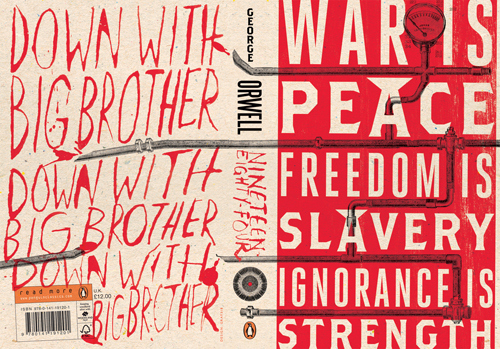
Fans of George Orwell’s 1984 will recall Newspeak, the development of a new language that also involved the elimination of certain words and concepts. The method is clearly defined by the character of Syme in Orwell’s book:
“You think … our chief job is inventing new words. But not a bit of it! We’re destroying words—scores of them, hundreds of them, every day. We’re cutting language down to the bone … You don’t grasp the beauty of the destruction of words. Do you know that Newspeak is the only language in the world whose vocabulary gets smaller every year?”
“Don’t you see that the whole aim of Newspeak is to narrow the range of thought? In the end we shall make thought-crime literally impossible, because there will be no words in which to express it. Every concept that can ever be needed will be expressed by exactly one word, with its meaning rigidly defined and all its subsidiary meanings rubbed out and forgotten … Every year fewer and fewer words, and the range of consciousness always a little smaller… The Revolution will be complete when the language is perfect…”
Trumpspeak is America’s version of Newspeak. Whatever you choose to call it, the intent is clear: the control of thought through the elimination of certain words and concepts. Today at TomDispatch.com, Karen Greenberg documents the destruction of certain words and concepts within the Trump administration. These words and concepts include refugees, climate change, greenhouse gases, America as a nation of immigrants, and even the notion of science-based evidence.
The suppression or elimination of words and phrases is one big step toward thought control; so too is the parroting of certain pet phrases and concepts, such as “support our troops” or “make America great again” or “homeland security.” In an article about Alfred Döblin’s Berlin Alexanderplatz that appeared in the Nation, Adam Kirsch writes of how Döblin recognized the “sinister” nature of “the colonization of the individual mind by parasitic discourses,” the way in which reality itself is “cloaked” by “predigested phrases.” Döblin wrote of how “The words come rolling toward you, you need to watch yourself, see that they don’t run you over.”
And I think something like this is happening in America today. We’re being run over by certain words and concepts, even as other words and concepts related to democracy and cherished freedoms are carefully elided or eliminated.
Of course, Orwell wrote about this as well. “Predigested phrases” is captured by Orwell’s concept of duck-speak, in which proles just quack like ducks when they speak, echoing the sounds fed to them by party operatives. Quacking like a duck requires no thought, which is precisely the intent.
Pay attention, America, to the words you’re losing before they’re gone forever; and also to the words you’re using before they run you over.
[This essay is the introduction to Tom Engelhardt’s new book, A Nation Unmade by War, a Dispatch Book published by Haymarket Books.]
(Since 2007, I’ve had the distinct honor of writing for Tom Engelhardt and TomDispatch.com. Tom is a patriot in the best sense of that word: he loves his country, and by that I mean the ideals and freedoms we cherish as Americans. But his love is not blind; rather, his eyes are wide open, his mind is sharp, and his will is unflagging. He calls America to account; he warns us, as Dwight D. Eisenhower did, about the many dangers of an all-powerful national security state; and, as Ike did sixty years ago, he reminds us that only Americans can truly hurt America. I think Ike would have commended his latest book, “A Nation Unmade by War.” Having read it myself, I highly recommend it to thinking patriots everywhere.W.J. Astore.)
Tom Engelhardt, A Staggeringly Well-Funded Blowback Machine
As I was putting the finishing touches on my new book, the Costs of War Project at Brown University’s Watson Institute published an estimate of the taxpayer dollars that will have gone into America’s war on terror from September 12, 2001, through fiscal year 2018. That figure: a cool $5.6 trillion (including the future costs of caring for our war vets). On average, that’s at least $23,386 per taxpayer.
Keep in mind that such figures, however eye-popping, are only the dollar costs of our wars. They don’t, for instance, include the psychic costs to the Americans mangled in one way or another in those never-ending conflicts. They don’t include the costs to this country’s infrastructure, which has been crumbling while taxpayer dollars flow copiously and in a remarkably — in these years, almost uniquely — bipartisan fashion into what’s still laughably called “national security.” That’s not, of course, what would make most of us more secure, but what would make them — the denizens of the national security state — ever more secure in Washington and elsewhere. We’re talking about the Pentagon, the Department of Homeland Security, the U.S. nuclear complex, and the rest of that state-within-a-state, including its many intelligence agencies and the warrior corporations that have, by now, been fused into that vast and vastly profitable interlocking structure.
In reality, the costs of America’s wars, still spreading in the Trump era, are incalculable. Just look at photos of the cities of Ramadi or Mosul in Iraq, Raqqa or Aleppo in Syria,Sirte in Libya, or Marawiin the southern Philippines, all in ruins in the wake of the conflicts Washington set off in the post–9/11 years, and try to put a price on them. Those views of mile upon mile of rubble, often without a building still standing untouched, should take anyone’s breath away. Some of those cities may never be fully rebuilt.
And how could you even begin to put a dollars-and-cents value on the larger human costs of those wars: the hundreds of thousands of dead? The tens of millions of people displaced in their own countries or sent as refugees fleeing across any border in sight? How could you factor in the way those masses of uprooted peoples of the Greater Middle East and Africa are unsettlingother parts of the planet? Their presence (or more accurately a growing fear of it) has, for instance, helped fuel an expanding set of right-wing “populist” movements that threaten to tear Europe apart. And who could forget the role that those refugees — or at least fantasy versions of them — played in Donald Trump’s full-throated, successful pitch for the presidency? What, in the end, might be the cost of that?
Opening the Gates of Hell
America’s never-ending twenty-first-century conflicts were triggered by the decision of George W. Bush and his top officials to instantly define their response to attacks on the Pentagon and the World Trade Center by a tiny group of jihadis as a “war”; then to proclaim it nothing short of a “Global War on Terror”; and finally to invade and occupy first Afghanistan and then Iraq, with dreams of dominating the Greater Middle East — and ultimately the planet — as no other imperial power had ever done.
Their overwrought geopolitical fantasies and their sense that the U.S. military was a force capable of accomplishing anything they willed it to do launched a process that would cost this world of ours in ways that no one will ever be able to calculate. Who, for instance, could begin to put a price on the futures of the children whose lives, in the aftermath of those decisions, would be twisted and shrunk in ways frightening even to imagine? Who could tote up what it means for so many millions of this planet’s young to be deprived of homes, parents, educations — of anything, in fact, approximating the sort of stability that might lead to a future worth imagining?
Though few may remember it, I’ve never forgotten the 2002 warning issued by Amr Moussa, then head of the Arab League. An invasion of Iraq would, he predicted that September, “open the gates of hell.” Two years later, in the wake of the actual invasion and the U.S. occupation of that country, he altered his comment slightly. “The gates of hell,” he said, “are open in Iraq.”
His assessment has proven unbearably prescient — and one not only applicable to Iraq. Fourteen years after that invasion, we should all now be in some kind of mourning for a world that won’t ever be. It wasn’t just the US military that, in the spring of 2003, passed through those gates to hell. In our own way, we all did. Otherwise, Donald Trump wouldn’t have become president.
I don’t claim to be an expert on hell. I have no idea exactly what circle of it we’re now in, but I do know one thing: we are there…
Read the rest of Tom’s article here at TomDispatch.com.
Trump, America’s very stable genius, doing what he loves
W.J. Astore
My wife perceptively notes how the USA is sliding backwards. Racism has new vigor even as science is rejected, e.g. climate change denial. A woman’s right to choose is under attack. Immigrants once again are openly subjected to prejudice and scorn. Diversity of views and efforts at inclusion are rejected as so many exercises in “political correctness.” Unions are being weakened and the working poor are attacked as lazy and irresponsible. Life expectancy for many is declining, mainly due to suicide, opioid and other addictions, and illnesses related to poor eating habits and obesity. War is perpetual and violence is never-ending. Meanwhile, the rich are getting richer, a sign of “greatness,” at least to Trump and his followers.
Sexism, racism, prejudice, ignorance, scapegoating, the privilege of rich white men to say and do whatever they want: this is “greatness” to Trump. The embodiment of fat cat privilege, Trump rides about in his golf cart and swats balls at his various “resorts.” Indeed, America’s hard-working president, who said as a candidate he’d have no time for golf or vacations, has spent one-third of his presidency on vacation. Mission accomplished!
Meanwhile, Democratic officialdom is looking backwards, not forwards. The Democratic National Committee’s (DNC) idea of progress is to bring a lawsuit against Russia, the Trump campaign, and WikiLeaks for the 2016 election. This act will “fire up the base,” or so leading Democrats appear to think. But it’s really sour grapes, a loser policy conducted by pols who remain out of touch with the pressing concerns of ordinary Americans (you know, things like health care, a living wage, and other issues associated with Bernie Sanders’s campaign). If only America had a true Labor Party instead of a DNC that mirrors the Republicans while lacking their focus and ruthlessness.
Let’s face it: America needs a new leader, a fresh start, an unapologetic progressive, someone who’s smart but who also possesses empathy. Someone on the side of workers; someone like Jacinda Ardern, the prime minister of New Zealand.
PM Jacinda Ardern of New Zealand. Yes, she’s pregnant and taking maternity leave after she gives birth.
Roughly half Trump’s age, Jacinda Ardern represents the future. Intelligent, principled, committed to her people, Ardern is refreshingly honest and frank. Imagine, for a moment, a truly progressive woman as president of the United States, one who has the courage of her convictions, one committed to fairness and equity in society, one untainted by big money, even one who’s unabashedly pregnant and who supports maternity and paternity leave for parents.
She’s got spunk too. When she first met Trump and he had a snide remark for her, she replied that masses of people didn’t take to the streets to protest when she was elected. As my Kiwi friend put it, “It’s the ability of Jacinda to not only represent her own party but pull together alliances that is impressive. Not only an arrangement with the conservative ‘New Zealand First’ party but also the Greens.” She brings people together for the greater good — making concessions when she has to. What a quaint concept.
America could use a woman like Jacinda Ardern as president. If only my Kiwi friends would let her emigrate! (Yes, sadly, she wasn’t born here so she couldn’t run, but let a man dream, dammit.) Perhaps Congresswoman Tulsi Gabbard will emerge as America’s Jacinda in 2020; aligned with Bernie Sanders, Gabbard has moxie as well as military experience. But I wouldn’t bank on it. The DNC, still with its collective head up its ass, isn’t seeing the future too clearly.
Who are we supposed to hate today? The Russians for allegedly throwing the presidential election? The Chinese for allegedly stealing our jobs? The North Koreans for allegedly planning our nuclear destruction? The Iranians for allegedly working to acquire nuclear weapons? The “axis of evil” for being, well, evil?
President Franklin Delano Roosevelt famously told Americans that the only thing they had to fear is fear itself. However, recent American presidents have encouraged us to fear everything. Let’s not forget the stoking of fear by people like Condoleezza Rice and her image of a smoking gun morphing into a nuclear mushroom cloud. That image helped to propel America into a disastrous war in Iraq in 2003 that festers still.
One of the most powerful scenes I’ve seen in any movie came in the adaptation of George Orwell’s 1984. The film version begins with the “two minutes of hate” directed against various (imagined) enemies. Check it out. Doubleplusgood!
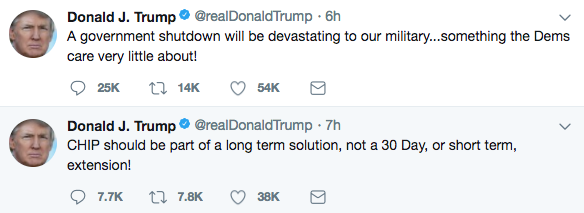
Especially disturbing is the rant against Goldstein, the enemy within. Here I think of Donald Trump claiming that the Democrats are anti-military for not rubberstamping his budget, a dishonest as well as ridiculous charge, since both parties support high military spending. Indeed, high Pentagon spending is the one bipartisan area of agreement in Congress.
The top tweet is typical of Trump: Accusing Democrats of not caring about “our” troops
This is among the biggest problems in America today: the stoking of hate against the enemy within, e.g. “illegal” immigrants (rapists, gang members, killers, according to our president), Democrats who allegedly don’t support our military, rival politicians who should be “locked up,” protesters who should be punched and kicked and otherwise silenced, high school students who are dismissed as phonies and professional actors, and on and on.
Irrational fear is nothing new to America, of course. Consider the fear of communism that produced red scares after World Wars I and II. Consider how fears of the spread of communism led to criminal intervention in Southeast Asia and the death of millions of people there. Massive bombing, free-fire artillery zones, the profligate use of defoliants like Agent Orange, the prolongation of war without any regard for the suffering of peoples in SE Asia: that behavior constituted a crime of murderous intensity that was in part driven by hatred and fear.
And when hatred and fear are linked to tribalism and a xenophobic form of patriotism, murderous war becomes almost a certainty. When the zealots of hate are screaming for blood, it’s very hard to hear appeals for peace based on compassion and reason.
Anger, fear, aggression: that way leads to the dark side, as Yoda, that Jedi master, warned us. Hate too, Yoda says, must be resisted, lest one be consumed by it. Sure, he’s just an imaginary character in the “Star Wars” universe, but that doesn’t negate the truth of his message.
God is love, the Christian religion says. Why then are we so open to hate and fear?
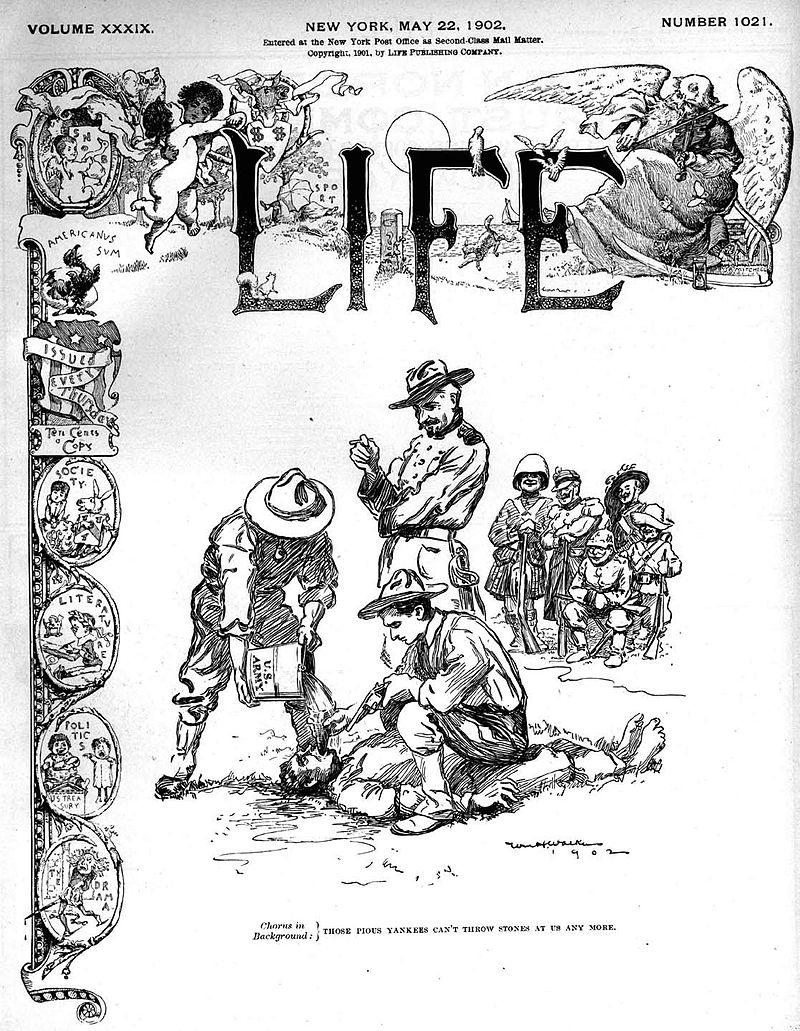
U.S. troops use the “water cure” in the Philippines, 1902
W.J. Astore
Back in 2009, I wrote a few articles on torture during the Bush/Cheney administration. With Barack Obama elected on a vague platform of hope, change, and transparency, there was a sense torture would be outlawed and torturers would be called to account. Obama did sign an executive order to outlaw torture — which really meant nothing more than that the U.S. would abide by international treaties and follow international law with respect to torture — but torturers were never called to account. The failure to do so has left us with a new president, Donald Trump, who says he supports torture (though his Defense Secretary, James Mattis, does not), and a person nominated to head the CIA who enabled torture and helped to cover it up.
Here are a few points I made back in 2009. We should consider these as Congress debates whether to place the CIA in the hands of a torturer.
Recently [2009] in the New York Times, Scott Shane and Mark Mazzetti showed that the Bush administration, the CIA, and the Senate and House Intelligence Committees failed to ask for any historical context before approving so-called “harsh interrogation techniques,” including waterboarding, in 2002. No one apparently knew, or wanted to know, that the U.S. had defined waterboarding as torture and prosecuted it as a war crime after World War II. Did our leaders think the events of 9-11 constituted an entirely new reality, one in which historical precedent was rendered nugatory?
Perhaps so, but their failure to ask historically-based questions also highlights the narrowness of their intellectual training. Like the accused Nazi judges before the bar in the movie Judgment at Nuremberg (1961), they asked themselves only what the law is (or what it became under John Ashcroft and John Yoo), not whether it is just. If a legal brief authorized brutal methods such as waterboarding, who were they to question, let alone challenge, the (freshly minted) legal opinion?
Clearly, the leaders making and implementing decisions on torture constituted a single, self-referencing, self-identified Washington elite almost entirely divorced from thinking historically, let alone tragically. And because they could think neither historically nor tragically, they found false comfort in picturing themselves as stalwart defenders of the nation, not recognizing the mesmerizing power of vengeance and hate.
Our elected officials who find history books too onerous would do well to invest three hours of their time to watch Judgment at Nuremberg. They might learn that a compromised judiciary will uphold any action — discriminatory race laws, involuntary sterilization, even mass murder — all in the name of defending the people from supposedly apocalyptic threats.
Indeed, defending the country from apocalyptic threats is a popular line for those wishing to uphold the Bush Administration’s policy on torture. After the tragedy of 9/11, and subsequent panic in the wake of Anthrax attacks, our leaders were compelled to “take the gloves off” in our defense, even compelled to exact vengeance as a way of deterring future attacks — or so these torture apologists claim.
In their haste to make America safe, Bush and Company effectively declared vengeance was theirs and not the Lord’s. But the human lust for vengeance is blinding, even more so when it’s perceived as righteous. Here our wrathful lawyers/politicians might consider the lessons of Giuseppe Verdi’s opera, Rigoletto. The hunchbacked court jester, Rigoletto, delights in other people’s misfortune, and for this he is cursed by a cuckolded husband. Soon, his own daughter, Gilda, the joy of his life, is kidnapped and despoiled, the first bitter fruits of the curse. Despite Gilda’s pleas to forgive the transgressor, Rigoletto, blinded by his own murderous desire for vengeance, sets in motion a chain of events that ends with the sacrificial death of his beloved Gilda and the annihilation of any vestige of goodness in his tortured soul.
In Rigoletto, the desire for total vengeance produces total tragedy. In Judgment at Nuremberg, man’s ability to justify the worst crimes in the name of “safeguarding the people” is memorably exposed and justly condemned.
What we need today in Washington are fewer leaders who base their decisions on vengeance empowered by legal briefs and more who are willing to embrace the toughest lessons to be gleaned from history and tragedy. What we need today as well is our own version of Judgment at Nuremberg — our own special prosecutorial court — one that is unafraid to elevate justice, truth, and the value of a single human being above all other concerns — especially political ones.
A full accounting of the torture decisions made by the Bush Administration would serve powerfully to reassure Americans that their government is, in fact, transparent and accountable to the law. Such a result would be more than advantageous: It would indirectly strengthen our national defense as well as people’s patriotism. Far easier it is to trust a government that owns up to its mistakes than one that cloaks them in bombast and bromides.
Self-serving bromides that excuse torture as the price of keeping America safe from evil-doers must be dismissed. Self-preservation is no excuse for torture or similar war crimes. It’s easier to see the truth of this when you look at the abuses committed by countries other than one’s own.
Think, for example, of Germany in the opening weeks of World War I. As John Horne and Alan Kramer have shown in German Atrocities, 1914: A History of Denial (2001), German soldiers clearly committed atrocities against Belgian civilians. But the Germans themselves refused to admit culpability. As Germany’s Chancellor, Theobald von Bethmann Hollweg, explained: “We are in a position of necessity and necessity knows no law.” The court of history, however, has rendered a far different judgment.
When the argument from necessity failed to convince, the Bush administration disputed whether waterboarding actually was torture, even though American soldiers had been punished for it during the Philippine-American War. Indeed, even in Nazi Germany, government functionaries tried to fight a rear-guard action against the Gestapo and its use of waterboarding. In a 1979 article on “The Nazi Concentration Camps,” Henry Friedlander cites a complaint made by the Reich Minister of Justice in regards to a murder in 1934 at a concentration camp in Saxony: “The nature of the assault, especially the use of water torture,” the Reich Minister noted, “reveals a brutality and cruelty on the part of the perpetrator that is alien to German sensibilities and feelings. These cruelties, reminiscent of oriental sadism, can neither be explained nor excused by even the most extreme form of hatred in battle.”
If “water torture” was so clearly illegal and so utterly reprehensible to German legal authorities in 1934, even as they battled the baneful influence of Nazism, how can its true nature remain a matter of dispute among some former Bush administration functionaries?
We fancy ourselves to be a nation of laws that apply equally to all. If our new president truly stands for hope and change, he needs to act appropriately. “Hope” in this case means full exposure of torture and appropriate punishment for those who authorized and conducted it. “Change” means accountability for all, even for (especially for) the highest ranking officials in government.
We need a “Truth Commission” to investigate torture. Efforts to suppress the truth, even seemingly innocuous ones, like looking ahead instead of back, will only make the eventual revelations that much worse. Delays in holding people accountable may even empower others to commit new war crimes in our name. Such are the perils of refusing to confront the truth.
Here, the lessons of the French in Algiers continue to resonate. Think back to the revelations of General Paul Aussaresses in 2001, which scandalized France. Aussaresses unrepentantly confessed that, in attempting to suppress terrorism in Algeria in the 1950s, detainee abuse, torture, even murder became routine, first-choice, approaches. The resort to torture simply begat more torture.
Investigators should look at whether this dynamic also applied to America in Afghanistan and Iraq. How many of our counterterrorist experts became like General Aussaresses: Self-perceived “patriots” who believed torture and even murder were justified in the name of protecting the state? After all, if the state’s essential purpose is to protect its citizens, and you’re dealing with an enemy that’s malevolently contumacious, as Al Qaeda appeared to be, what’s to stop avowed “patriots” from torturing suspects, especially when the state’s leaders have authorized harsh techniques and are pressing you for results?
In the case of the Bush administration, not only did torture apparently provide unreliable intelligence: It also abrogated America’s fidelity to international treaties that forbade torture, and compromised our own ethos of truth, justice, and the American way.
And in the case of the Obama administration, its failure to confront the legacy of torture and to prosecute those responsible helped to facilitate the rise of Trump, a man who boasts of favoring torture while nominating for high office officials who served as torture enablers and supporters.
The words “American” and “torture” are linked together. Isn’t it time we separated them?
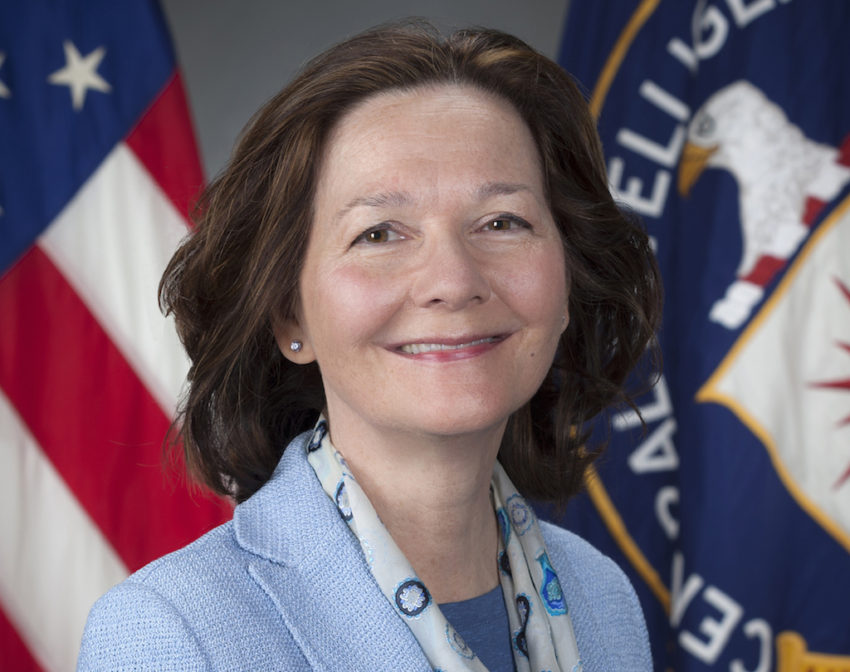
President Trump has nominated Gina Haspel to be the new director of the Central Intelligence Agency (CIA). Haspel had an important role in the torture regimen approved by the Bush/Cheney administration, and she worked to destroy videotaped evidence of the same. What does it say about the United States that Haspel is now being rewarded both for enabling torture and for covering it up?
As Peter Van Buren writes at We Meant Well, “Unless our Congress awakens to confront the nightmare and deny Gina Haspel’s nomination as Director of the CIA, torture has already transformed us and so will consume us. Gina Haspel is a torturer. We are torturers. It is as if Nuremberg never happened.”
Back in December of 2008, I wrote about torture for Nieman Watchdog. The title of my article was “Cheney says he approved waterboarding. Is that the end of the story?” The header to my article read: “The vice president gave the go-ahead for tactics commonly regarded as torture. Was that a war crime or not? William J. Astore provides some background on the issue and urges the press to show that it too can do aggressive interrogations. And do them now, without waiting for a new administration or a new Congress.”
Naturally, our Congress and the press did very little, and the Obama administration chose to ignore torture, urging America to look forward, not backwards. Hence no one was ever held accountable; indeed, it was whistle blowers who came out against torture who were punished.
Here is the rest of my article from 2008. Sadly, over the last decade nothing has changed in the U.S. Indeed, the nomination of Haspel to head the CIA proves only that it’s getting worse.
Is our sitting vice president a war criminal because he condoned torture? In an interview on ABC News on December 15th [2008], Dick Cheney coolly admitted he had approved “harsh” and “aggressive” interrogation techniques, notably waterboarding, in an attempt to extract intelligence from known or suspected terrorists, including Khalid Sheikh Mohammed. Vital intelligence gathered about Al Qaeda, Cheney claimed, vindicated his decision, though this is much disputed. Subsequently, Cheney claimed that waterboarding and other harsh techniques did not constitute torture; this categorical denial was balanced by a counterclaim that he would have been remiss had he not authorized aggressive techniques in an attempt to safeguard Americans.
For approving these techniques and for other practices, The New York Timeshas attacked Cheney, former Secretary of Defense Donald Rumsfeld, and other Bush Administration officials. Calls have been issued for war crimes investigations. Are such calls warranted? Did Cheney, Rumsfeld, and others authorize techniques that constituted torture, and, if so, are they complicit in the crime?
Here, the Holocaust survivor, Jean Améry, and the political philosopher, Hannah Arendt, offer valuable insights. Améry, himself a victim of torture, wrote about it in At the Mind’s Limits (1980). Torture, he observed, was a monstrous immorality because it violated another person’s body, reducing it to a vessel of fear and pain. Under such distress, the victim confesses to anything, even the wildest fictions and fantasies, as Améry himself did when he was tortured.
In its simulation of death by drowning, waterboarding is intended to produce great fear and psychological dislocation. It may perhaps leave no physical traces, but the mental wounds it inflicts are something else altogether. Their insidious effects on victims were captured by Améry in his conclusion on torture:
Whoever has succumbed to torture can no longer feel at home in the world. The shame of destruction cannot be erased. Trust in the world, which already collapsed in part at the first blow, but in the end, under torture, fully, will not be regained …. It is fear that henceforth reigns over him. Fear—and also what is called resentments. They remain, and have scarcely a chance to concentrate into a seething, purifying thirst for revenge.
Torture, in short, alienates its victims from humanity and generates (or strengthens) vengeful resentments. Améry carried his own resentments as a burden to remind himself—and us—of the moral enormity of any attempt to demolish another human being’s will through torture. For Améry, such attempts are both crimes and mistakes because they sow the seeds of future acts of vengeance.
A further disturbing insight comes from Hannah Arendt’s Eichmann in Jerusalem (1964). Adolf Eichmann, desk-bound executioner and “Jewish expert” for the Third Reich, oversaw the deportation of Jews to their deaths during the Final Solution. A bureaucrat who never dirtied his own hands, Eichmann therefore judged himself to be less than fully responsible for the murder of millions. On this point, the judges at Eichmann’s trial reached a far different conclusion: “the degree of responsibility increases as we draw further away from the man who uses the fatal instrument with his own hands.” In crimes against humanity, degrees of separation from the dirty work only add to the offense.
Waterboarding is torture; Cheney and Rumsfeld approved it; and Améry and Arendt’s reflections suggest the immorality of, and culpability for, the crime. What now? Whether we find this distasteful or not, the press needs to show that it too can aggressively interrogate sources. Rather than waiting a month for an Obama Justice Department or a congressional investigation, the press should challenge incoming Obama administration officials now, together with new members of Congress. Outside legal experts should also be consulted. Does Baltasar Garzón—the Spanish judge who pursued Augusto Pinochet relentlessly—have an opinion? These are obvious leads for reporters.
To strengthen America’s moral authority, we need to reject the idea that demolishing our enemies’ resistance through torture is a necessary price of our safety. Let’s not balk at an expeditious and complete accounting of our mistakes—and of crimes committed in our name.
Let us remember the service and sacrifice of Muslim-Americans
W.J. Astore
Lately, Ben Carson at Housing and Urban Development (HUD) has been criticized in the news for wanting taxpayers to fund a dining set that costs $31,000. (He’s tried to shift the blame to his wife.) We seem to forget a far more disturbing aspect of Carson’s behavior: his Islamophobia. Remember his anti-Muslim comments as a presidential candidate? Remember he said that no Muslim-American should ever serve as president?
Back then, I heard from a fellow Air Force officer, a Muslim-American, originally from Iraq, who served proudly in our armed forces. He said Ben Carson’s comment brought him to tears — that a candidate for a major political party would insist on a religious test that would bar all Muslims from serving this country as president.
Yet for his Islamophobic position, which was contrary to the U.S. Constitution that forbids any religious test for political office, Ben Carson was rewarded by the Trump administration and appointed Secretary at HUD.
Don’t focus on his pricey dining set, America: Focus on his ignorance and his prejudice against millions of patriotic Americans, who just happen to be Muslim. And remember how he was rewarded for this.
This episode came back to me when I read TomDispatch today. A U.S. Navy veteran, Nate Terani, recalls his own personal nightmares of being targeted as a Muslim-American by a Trump administration that leans increasingly toward Islamophobia. As Tom Engelhardt notes in his introduction to Terani’s article, Trump has “tapped the [CIA’s] previous director, Mike Pompeo, a notorious Tea Party Islamophobe and Iranophobe, to replace Twitter-fired Rex Tillerson as secretary of state. Now, another key post is evidently about to be up for grabs. National Security Advisor H.R. McMaster is reportedly almost out the door as the president openly considers a replacement for him, possibly former Bush-era ambassador to the U.N. John Bolton. He’s another major Iranophobe, who has called for launching military operations against that country for years … [Combine this with] the potential return of torture, the possible refilling of Guantanamo with new prisoners, the intensification of war across the Greater Middle East with a new focus on Iran, and the entrenchment of particularly extreme forms of Islamophobia” and you truly have a recipe for a nightmarish America.
There is no room in America for prejudice based on religious belief (or lack thereof). Religious wars are nightmares of our past; we must not allow the haters to bring them back into our present or our future.
U.S. troops and outposts and flags are everywhere, but for whose interests, and at what cost?
W.J. Astore
In my latest article for TomDispatch.com, I address America’s real wars overseas and contrast them with the phony war in the so-called Homeland. What I mean by “phony” is the lack of national mobilization for, and even interest in, these overseas wars. These wars exist and persist; they are both ever-spreading and never-ending; yet few Americans outside of the military and the Washington beltway crowd have any stake in them. Except when U.S. troops die or a spectacular bomb is used, the mainstream media rarely covers them.
Meanwhile, the Trump administration has defined a new National Defense Strategy (NDS) that has only expanded America’s list of enemies and rivals. A quick summary:
Conventional conflict against peer enemies, e.g. Russia and China.
Conventional conflict against “rogue” states, e.g. North Korea and Iran.
Unconventional (anti-terror) operations, e.g. Afghanistan, Syria, Yemen, Niger, etc.
If that’s not enough, the Pentagon also seeks extended nuclear supremacy (at a cost of at least $1.2 trillion over the next few decades) and full-spectrum dominance for space and cyber as well as land, sea, and air. As U.S. “defense” budgets continue to grow, there’s really no sense of limits, monetary or otherwise. Rising budgets feed endless war, and vice-versa. It’s a fail-safe recipe for imperial over-stretch and the decline if not collapse of America.
What follows is an excerpt from my latest article; you can read the entire article here at TomDispatch.com.
America’s New (Phony) National Defense Strategy
Even phony wars need enemies. In fact, they may need them more (and more of them) than real wars do. No surprise then that the Trump administration’s recently announced National Defense Strategy (NDS) offers a laundry list of such enemies. China and Russia top it as “revisionist powers” looking to reverse America’s putative victory over Communism in the Cold War. “Rogue” powers like North Korea and Iran are singled out as especially dangerous because of their nuclear ambitions. (The United States, of course, doesn’t have a “rogue” bone in its body, even if it is now devoting at least $1.2 trillion to building a new generation of more usable nuclear weapons.) Nor does the NDS neglect Washington’s need to hammer away at global terrorists until the end of time or to extend “full-spectrum dominance” not just to the traditional realms of combat (land, sea, and air) but also to space and cyberspace.
Amid such a plethora of enemies, only one thing is missing in America’s new defense strategy, the very thing that’s been missing all these years, that makes twenty-first-century American war so phony: any sense of national mobilization and shared sacrifice (or its opposite, antiwar resistance). If the United States truly faces all these existential threats to our democracy and our way of life, what are we doing frittering away more than $45 billion annually in a quagmire war in Afghanistan? What are we doing spending staggering sums on exotic weaponry like the F-35 jet fighter (total projected program cost: $1.45 trillion) when we have far more pressing national needs to deal with?
Like so much else in Washington in these years, the NDS doesn’t represent a strategy for real war, only a call for more of the same raised to a higher power. That mainly means more money for the Pentagon, the Department of Homeland Security, and related “defense” agencies, facilitating more blitz attacks on various enemies overseas. The formula — serial blitzkrieg abroad, serial sitzkrieg in the homeland — adds up to victory, but only for the military-industrial complex.
Five years ago, I remember talking about lockdown drills (or “active shooter drills”) with colleagues at Penn College. Such drills were voluntary. Basically, the drill involved locking the classroom door, moving students to the back of the classroom, and having them hunker down, away from windows, while keeping silent so as to avoid detection by a shooter roaming the halls.
I was against these drills. I thought they added to the fear, and I chose not to do them. But maybe I would do them today.
After one shooting massacre (I can’t recall if it was Virginia Tech in 2007 or Sandy Hook in 2012), locks were added to the classroom doors. In theory, if I heard gunshots, I or one of my students could jump up and lock the door before a shooter got in. But what if a determined shooter shot the lock out?
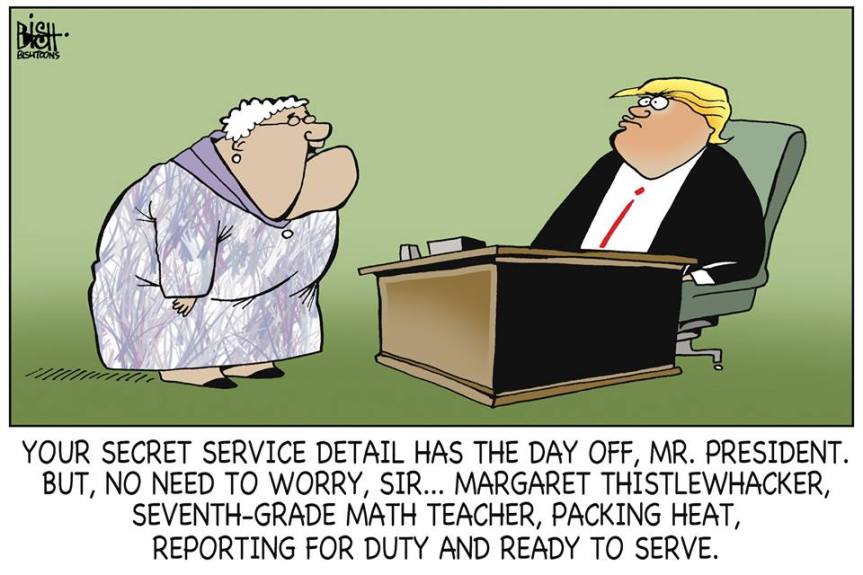
What a world we Americans live in. Locked classrooms, lockdown drills for active shooters, and now the proposal to turn teachers into so many Harry Callahans (Clint Eastwood’s Dirty Harry) and our schools into “hardened” targets by arming teachers with pistols. Perhaps we should keep an AR-15 in each classroom (alongside the fire extinguisher), with a sign that reads, “In case of emergency, break glass – then lock and load.”
President Trump has argued that select teachers be armed – following the NRA’s theory that a good man with a gun is the best insurance against a bad man with a gun. It’s a crazy idea, but we live in a crazy country. Among the worst parts of Trump’s proposal was his stingy suggestion that armed and trained teachers might earn “a little bit” of a bonus. How generous of our brave commander-in-chief.
Think about that for a moment. There is an active shooter (or shooters) in a school, armed with military-style assault weapons and perhaps protected by body armor. Young people are running and screaming, bullets are flying, and in this bloody chaos, we place our faith in a teacher, perhaps armed with a 9mm pistol, thoroughly trained in shooting under combat conditions, willing to risk it all “for a little bit of a bonus.”
It’s a powerful fantasy: the cold bold Harry Callahan-like teacher, taking aim with his or her pistol and blowing away school intruders with perfect head shots. And that’s exactly what it is: a fantasy. As Belle Chesler, a teacher, put it at TomDispatch.com, “We are not warriors, we are teachers. We are not heroes, we are teachers.”
It’s one thing to shoot at paper targets on a gun range; it’s another thing entirely to fire accurately in combat when you’re outgunned and someone is firing back at you. What if, during the chaos of shooting, a teacher accidentally shoots a few students? So-called friendly fire incidents happen frequently in combat, despite the most careful troop training.
If you want more security guards in America’s schools, hire them. Don’t try to turn teachers into cheap cut-rate guards. Yet “a little bit of a bonus” for armed teachers is the best idea our stingy billionaire of a president can come up with.
As we saw in Parkland, Florida, even armed and trained deputies may hesitate before confronting a heavily-armed shooter. How is your average teacher going to react? At least we know Trump will rush in, heel spurs and all, whether he’s armed or unarmed, to save the day. Or so he says.
Most people, even when armed, will not rush toward the sound of gunfire. We tend instinctively to freeze, to take cover, or to run. It takes a combination of training, willpower, and courage to rush toward danger, often strengthened by teamwork and inspired by one or more leaders who set the example. The problem is not as simple as “give a teacher a gun, and he or she will blow the bad guy away.”
In a country awash in weapons, there are no easy answers. One model is to turn our schools into fortresses, complete with surveillance cameras and panic buttons and smoke ejectors in hallways, as in this “safe” school in Indiana. Trump’s model is to arm select teachers for a tiny bonus. Limited efforts at gun control, such as raising the age to purchase an assault rifle from 18 to 21, are like putting a Band-Aid on a sucking chest wound. One thing is certain: better law enforcement is crucial, e.g. there were many warnings about the Parkland shooter that were dismissed or ignored.
Again, there are no easy answers. And so Lockdown America is now our reality.
Update (3/9/18): In the wake of the Parkland shootings, Florida legislators have approved guns for teachers in the classroom, as well as more spending on school security. Assault weapons, however, are not to be banned. So the solution to bad men with guns is indeed good men with guns, according to Florida. The NRA wins again.
How long before a teacher, teacher’s aide, or coach with a gun accidentally or intentionally hurts a student with a gun? How long before the inevitable lawsuits result from this, the multi-million dollar settlements? Will school districts be required to carry expensive insurance against gun shootings by educators? Are taxpayers ready to pony up a lot more money to cover the costs of insurance premiums and lawsuits?







 Bracing Views