As a historian, I have an allegiance to the past, and to getting the facts right about that past. Because, if you can’t get the facts right, if you can’t do research with rigor and honesty, you can’t call yourself an historian.
So you won’t be surprised to learn that Trump’s version of the Republican Party is anathema to me. The party has no respect for the past. And getting facts right? What does that matter in a time of “alternative facts,” in an administration that lies routinely and about everything?
Trump’s version of the Republican Party is a party of the perpetual now, in which the meaning of “now” is remarkably labile and open to interpretation (and re-interpretation). In a strange way, Trump’s party is the party of post-modernism, where all facts are contingent, where everything is open to being constructed and deconstructed. Truth itself is a social construct in the Trumpian universe, determined by Trump himself and the various ass-kissers he’s assembled around him.
Not only is the Trumpian Party without a meaningful past: it’s also without a mediated future. According to the official platform of the Republican Party adopted last night, the party and its platform is what Trump says it is, world without end, Amen.
Here’s how it was put in a press release:
“RESOLVED, That the Republican Party has and will continue to enthusiastically support the President’s America-first agenda” and “The 2020 Republican National Convention will adjourn without adopting a new platform until the 2024 Republican National Convention.”
The platform is Trump and Trump is the platform. The future is whatever Trump wills it to be, in his usual egotistical and often nonsensical way.
Facts don’t matter. The (true) past doesn’t matter. America as will and idea, as defined by Trump’s mind and driven by Trump’s desires.
As many have said, this isn’t a party, it’s a cult. A cult of unreflective minds, a cult unconcerned with critical thinking about the past, a cult that believes the future is best defined by one man.
One thing is certain: You won’t need any historians in Trump’s world. Just a lot of stenographers and sycophants willing to accept reality as Trump presents it, a perpetual now that’s constantly constructed and deconstructed before your eyes, the only constant being the celebration of Trump.
Remember: you can’t believe your lying eyes, but you can believe in Trump. If that’s not the end of history, I don’t know what is.
With Trump trailing in the polls, some people have suggested an “October surprise” looms, such as a provocation against Iran, that could swing the election. But what if this “surprise” is something different. What if Trump decides to outflank Biden on an issue of great importance to ordinary Americans. It’s a scenario that’s more than possible, as the redoubtable M. Davout argues in his latest article for this site. W.J. Astore
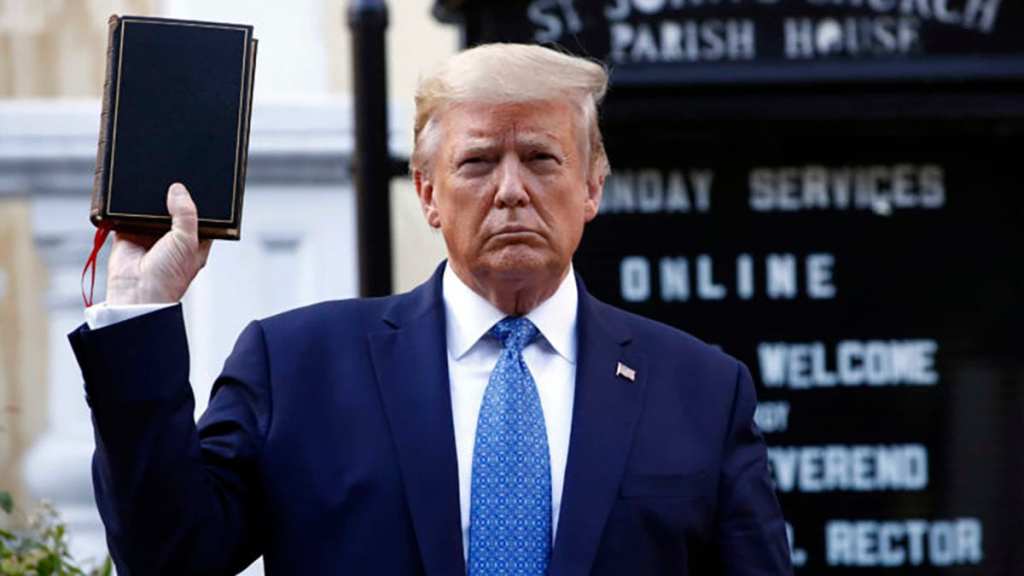
He’s willing to thump a Bible — why not thump Medicare for All?
M. Davout
In my first contribution to Bracing Views a little more than four years ago, I appealed, as an enthusiastic advocate for Bernie Sanders during the Democratic primaries, to fellow Bernie supporters in swing states to vote for Hillary Clinton in the upcoming general election. This election cycle I will be taking a different approach.
The virtual Democratic National Convention for the 2020 general election has just ended with the nomination of a candidate, Joe Biden, whose political instincts, record in office, and stated policy goals are in most essential respects updates of Clinton’s. Despite the convention speakers’ almost universal silence about policy, we can expect from a Biden win a continuation of what has largely been the Democratic Party policy agenda of the last forty years: maintenance of the US global military umbrella, protection of neoliberal economic interests, and gestures of racial inclusiveness and multicultural tolerance.
If Biden wins, it will be because of Trump’s catastrophic public health leadership failures in the face of the Covid pandemic, which has radically disrupted social life, tanked many parts of the economy, and thus far killed 175,000+ American lives. And Trump’s heartless and authoritarian response to the mobilization of millions of people in street demonstrations affirming that Black Lives Matter has not helped his electoral prospects.
In his acceptance speech, Biden emphatically told us that if elected he will take effective action to get a grip on the Covid crisis. Yet, on other occasions, he has also told us that if he wins, he will not fundamentally address the more insidious and chronic crisis of tens of millions of Americans with few, if any, health care options, even going so far as to say that he would veto any Medicare-for-All bill passed by Congress. On the issue of policing, he has been up front about his intention not to challenge the militarized and racist institutions of policing in this country other than to call for more training and prohibition of police use of choke holds.
The sad truth is that of the two major party candidates, only one has ever run a national campaign as an economic populist and it isn’t the current standard bearer of the Democratic Party. In 2016, Donald Trump promised Americans that he would get all of them great health care, take on Big Pharma and make prescription drugs affordable, end the hemorrhaging of American lives and treasure in foreign wars and drain the swamp by putting a stop to special interest corruption of members of Congress. Trump was lying, of course, but these lies were just effective enough in states like Wisconsin and Pennsylvania because the Democratic Party had lost all credibility as the party of working people.
So, this cycle, rather than try to persuade my fellow Bernie supporters once again to vote democratic, let me try a different approach and offer Trump some electoral advice. Give a nationally televised Oval Office speech in which you commit to stopping the pandemic and embrace, as one of the main pillars of your pandemic response, Medicare-for-All. Tell the American people the truth—that the private health insurance system in the U.S. has failed to protect the health of the American people and instead has lined the pockets of CEOs, rich shareholders, medical specialists, insurance industry lobbyists and members of Congress. Tell them that ensuring universal and affordable access to healthcare through universal expansion of Medicare is an essential step not only in defeating Covid-19 but also in protecting against the pandemics that might occur down the road. A true nation-state takes care of its own and Medicare-for-All will Make America Great Again.
As a certified political scientist, I can guarantee that you stand only to gain electorally by taking this advice. You won’t lose your business supporters and anti-Communist Republican voters–they will know that you are lying. The idea of universal health insurance based on the expansion of a system on which their parents and grandparents have relied will be attractive to your white working class base voters who have suffered disproportionately from opioid and alcohol addiction and deaths. And, who knows, maybe some progressives, unhinged by Biden’s hostility to universal coverage, will pull the lever for you. It may be enough to keep Michigan, Wisconsin, and Pennsylvania in your column (and maybe even swing Minnesota your way).
I give this advice not because I want Trump to win but because of my conviction that until the Democratic Party is forced to compete for working class votes on the basis of economic populism, we are going to be locked into an ever more dangerous cycle of alternating rule by neoliberal Democrats and nationalist-racist Republican populists.
M. Davout teaches political science in the Deep South.
I’ve given a lot of thought to my vote for the presidency in 2020. Neither Trump nor Biden is attractive to me. These men haven’t earned my vote. Who has?
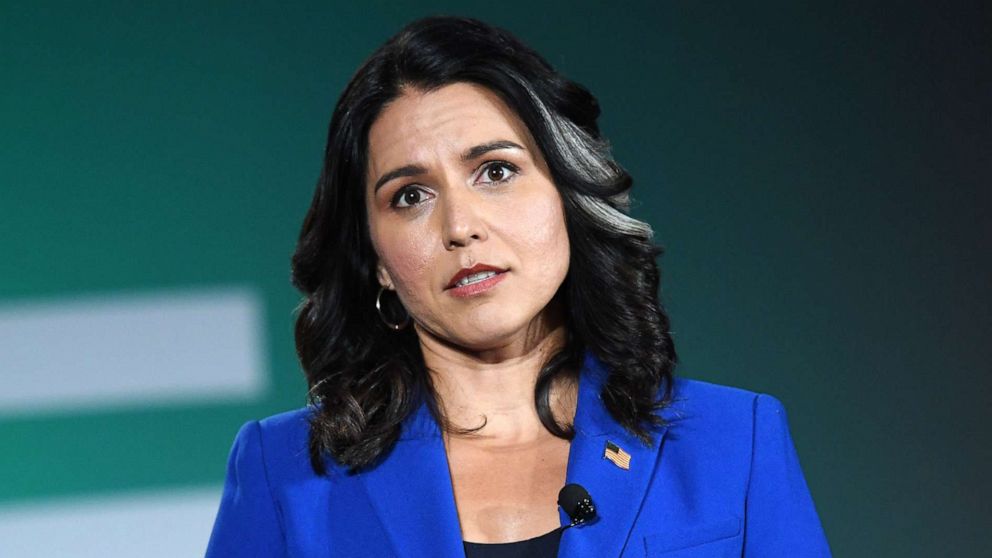
I like Tulsi Gabbard, and I’m planning on voting for her in November 2020.
I know: she’s pulled out of the race. She even endorsed Joe Biden. But I can’t vote for the Biden/Harris ticket. To me, they’re corporate cronies who endorse U.S. militarism and empire.
Trump, the Republican alternative, is a disaster. Totally self-absorbed and lazy to boot, Trump cares nothing about our country and will sacrifice anything and everything to his own definition of success.
Now, I live in a state that is safely blue; in the big picture, my vote is meaningless. But it’s not meaningless to me. I want to vote for something I believe in, and I believe in Tulsi’s stand against war.
Here’s a recent statement from Tulsi Gabbard that convinced me she’s still in the vanguard of reform. If only Biden/Harris would say something like this, but of course they won’t.
STATEMENT FROM TULSI GABBARD
When I first ran for Congress in 2012, I knew that we needed to bring our troops home from Afghanistan and made that a central focus of my campaign. After two decades of fighting in a war that has no clear objective, cost thousands of lives, and continues to cost taxpayers at least $4 billion a month, most Democrats and Republicans want to continue this war. This is why I voted against this year’s National Defense Authorization Act (NDAA) – a $740.1 Billion defense bill that disproportionately benefits the military industrial complex, continues to escalate the new Cold War, and needlessly continues our decades-long war in Afghanistan.
Unfortunately, this bill passed the House with bipartisan support.
Nevertheless, as a senior member of the House Armed Services Committee, I fought hard to get many provisions added to the bill, including:
improving the quality of life for servicemembers and military families,
addressing sexual assault in the military,
providing transparency of the devastating humanitarian impact of U.S. sanctions,
allowing servicemembers to use over-the-counter hemp products,
and helping to mitigate and reduce the environmental threats that impact our troops.
We have much work ahead of us. I will continue to do all I can to bring our troops home from Afghanistan, work to end the new Cold War and nuclear arms proliferation, and ensure the safety, prosperity, and well-being of the American people and our planet.
Now, it’s time for Congress and this Administration to do the same.
Mahalo and be well,
Tulsi
Update (8/16/20): I believe politicians have to earn our votes. We should never feel obligated to vote for them.
For the sake of argument, let’s say Trump wins. People will predictably argue that it’s people like me who are to blame, since I didn’t vote for Biden. (Nor will I vote for Trump.)
No. It won’t be my fault. If you wish to blame someone, blame the Trump voters. And blame the DNC for nominating a candidate (Biden) who didn’t earn the vote of people like me.
The same applies to Hillary’s loss in 2016. She lost to a con man and a reality TV celebrity because she ran a poor campaign, and because her hypocrisy and elitism were so obvious. Remember her “basket of deplorables” comment? Remember all the money she took from Goldman Sachs and the like? $675K for three speeches, even as she opposed Bernie’s call for $15 minimum wage.
With a $15 minimum wage, it would take a “deplorable” more than 22 years of hard work to earn what Hillary got in roughly three hours of speechifying.
And I’m supposed to admire Hillary and vote for her because the DNC said so?
And I’m supposed to vote for Biden because once again the DNC, joined by Obama and Hillary, gave the shaft to Bernie Sanders and Tulsi Gabbard?
If I vote for Joe, I’m rewarding the DNC for its blatant corruption. So I choose to vote for someone who’s offering something more than the status quo of endless war and bottomless corruption.
Update (8/18/20):
I’m surprised that David Sirota, who worked for Bernie Sanders, had this to say about Democrats’ alleged “choice”:
“If the Sanders-Biden battle was perceived as a choice between Sanders’s daunting promise of an exhausting revolutionary struggle and Biden’s promise of a glide path back to normal, then it’s no mystery why Biden ultimately prevailed. Easy street was an understandably alluring vision for an electorate already tired out by Trump’s never-ending conflicts and controversies.
In reality, though, this was not a choice between two possibilities — it was a choice between honesty and fantasy, and Democratic voters picked the latter.”
I disagree with him because Democratic voters chose nothing. They had no choice. The DNC, the establishment, and especially Obama intervened to torpedo and sink Bernie just as he was riding high. Saint Obama even convinced Amy K. and Mayor Pete to drop out; we’ll see their rewards/price if Biden wins.
Democratic voters, when polled, broadly support Bernie’s agenda. But DNC operatives don’t give a f*ck about what voters want; they care about what the owners and donors want.
This is why I refuse to watch this convention. It’s a rigged, dishonest, show.
I know what happened to the two candidates I favored: Bernie and Tulsi. And I refuse to reward the DNC with my vote based on everything that we witnessed in this corrupt primary season.
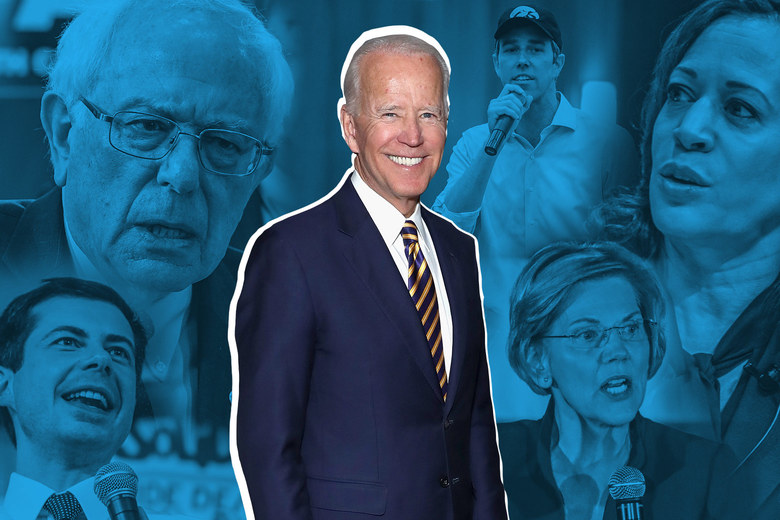
Joe Biden, meet your VP, Kamala Harris (appropriately on the far right)
W.J. Astore
Back in April 2019, before all the primaries and posturing, I made a grim prediction: Joe Biden and Kamala Harris would emerge as the dream ticket of the DNC.
I can. Not because I’m that smart. Not because I’m some kind of soothsayer. In making that prediction, I was being as coldly cynical as I could be. I pretended, in my own mind, to be a corporate operator in the DNC. And it followed Biden/Harris would be the dream ticket. Both are basically moderate Republicans who are business-friendly. Both have no progressive vision whatsoever. Both are “pay-to-play” politicians. And so on, in distressing and depressing detail.
Below is what I wrote in April of last year. You can see I wasn’t right about the scenario, but I was right about the candidates. My secret? Be coldly cynical. Think money and power without principles. And you’ll have your dream ticket. A “dream” that’s a nightmare for progressives, for workers, indeed for anyone looking for real change in America.
Now that Joe Biden is officially in the race, the dream Democratic ticket has emerged: Biden and Kamala Harris.
By “dream,” I don’t mean the Progressive dream. I don’t mean the dream of working-class voters who are hurting. I don’t mean the dream of Americans who are tired of never-ending wars that enfeeble our economy (and kill lots of people, mainly foreigners). Those “dream” candidates are true Progressives like Bernie Sanders and Tulsi Gabbard. A Sanders/Gabbard ticket would truly shake things up, which is why it’s not going to happen, as much as I’d like to see it.
No — the corporate-loving DNC wants to preserve the status quo, wants to feed the military-industrial complex, wants big funding from Wall Street, and therefore favors status quo candidates like Joe Biden and Kamala Harris.
A likely scenario in 2020: Bernie Sanders wins the most votes and delegates, but Joe Biden emerges as a close second. With all the other candidates (roughly 20 now) splitting the vote, no candidate has enough delegates to win in the first round at the national convention. So the super-delegates (remember them?), the corporate tools, spring into action in the second and subsequent rounds of voting and throw their support to the “sensible, electable” candidate, in this case Biden. But of course they can’t let an old white guy represent the “new” Democratic Party, and that’s where Kamala Harris comes in. She’s black! And a woman! And makes noises that sound slightly progressive. The perfect balanced ticket! Shut up and color, liberals and Progressives.
Of course, if gaffe-prone Biden implodes, a distinct possibility, there are other safe white guys waiting in the wings to headline the ticket. Mayor Pete? Beto O’Rourke?
It’s all so sadly predictable. And so too is Biden’s loss to Trump in 2020.
P.S. To state the obvious, I hope I’m wrong about this.
Note: I wrote this article in 2015 on the 70th anniversary of Hiroshima. Nuclear weapons should be eliminated from the planet.
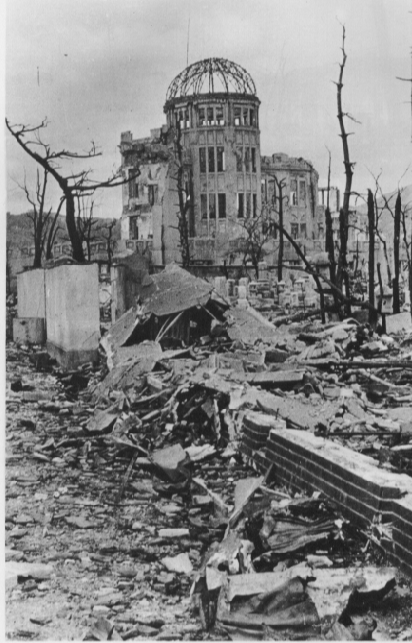
August 6, 1945. Hiroshima. A Japanese city roughly the size of Houston. Incinerated by the first atomic bomb. Three days later, Nagasaki. Japanese surrender followed. It seemed the bombs had been worth it, saving countless American (and Japanese) lives, seeing that a major invasion of the Japanese home islands was no longer needed. But was the A-bomb truly decisive in convincing the Japanese to surrender?
President Truman’s decision to use atomic bombs against Japan is perhaps the most analyzed, and, in the United States, most controversial decision made during World War II. The controversy usually creates more heat than light, with hardliners posed on mutually opposed sides. The traditional interpretation is that Truman used the A-bombs to convince a recalcitrant Japanese Emperor that the war was truly lost. A quick Japanese surrender appeared to justify Truman’s choice. It also saved tens of thousands of Allied lives in the Pacific (while killing approximately 250K Japanese). This thesis is best summed up in Paul Fussell’s famous essay, “Thank God for the Atomic Bomb.”
Even before Hiroshima, however, a small number of scientists argued that the A-bomb should not be used against Japan without a prior demonstration in a remote and uninhabited location. Later, as the horrible nature of radiation casualties became clearer to the American people, and as the Soviet Union developed its own arsenal of atomic weapons, threatening the United States with nuclear Armageddon, Americans began to reexamine Truman’s decision in the context of the Cold War and the nuclear arms race. Gar Alperovitz’s revisionist view that Truman was practicing “atomic diplomacy” won its share of advocates in the 1960s. (Alperovitz expanded upon this thesis in the 1990s.) Other historians suggested that racism and motives of revenge played a significant role in shaping the U.S. decision. This debate reached its boiling point in the early 1990s, as the Smithsonian’s attempt to create a “revisionist” display to mark the bomb’s 50th anniversary became a lightning rod in the “culture wars” between a Democratic administration and a resurgent Republican Congress.
Were the atomic bombs necessary to get the Japanese to surrender? Would other, more humane, options have worked, such as a demonstration to the Japanese of the bomb’s power? We’ll never know with certainty the answer to such questions. Perhaps if the U.S. had been more explicit in their negotiations with Japan that “unconditional surrender” did not mean the end of Japan’s Emperor, the Japanese may have surrendered earlier, before the A-bomb was fully ready. Then again, U.S. flexibility could have been interpreted by Japanese hardliners as a sign of American weakness or war fatigue.
Unwilling to risk appearing weak or weary, U.S. leaders dropped the A-bomb to shock the Japanese into surrendering. Together with Stalin’s entry into the war against Japan, these shocks were sufficient to convince the Japanese emperor “to bear the unbearable,” in this case total capitulation, a national disgrace.
A longer war in the Pacific — if only a matter of weeks — would indeed have meant higher casualties among the Allies, since the Japanese were prepared to mount large-scale Kamikaze attacks. Certainly, the Allies were unwilling to risk losing men when they had a bomb available that promised results. The mentality seems to have been: We developed it. We have it. Let’s use it. Anything to get this war over with as quickly as possible.
That mentality was not humane, but it was human. Truman had a weapon that promised decisiveness, so he used it. The attack on Hiroshima was basically business as usual, especially when you consider the earlier firebombing raids led by General Curtis LeMay. Indeed, such “conventional” firebombing raids continued after Hiroshima and Nagasaki until the Japanese finally sent a clear signal of surrender.
Of course, an event as momentous, as horrific, as Hiroshima took on extra meaning after the war, given the nuclear arms race, the Cold War and a climate represented by the telling acronym of MAD (mutually assured destruction). U.S. decisionmakers like Truman were portrayed as callous, as racist, as war criminals. Yet in the context of 1945, it’s difficult to see any other U.S. president making a different decision, especially given Japan’s apparent reluctance to surrender and their proven fanaticism at Iwo Jima, Okinawa and elsewhere.
As Andrew Rotter notes in Hiroshima: The World’s Bomb (2008),World War II witnessed the weakening, if not erasure, of distinctions between combatants and non-combatants, notably during LeMay’s firebombing of Tokyo in March 1945 but in many other raids as well (Rotterdam and Coventry and Hamburg and Dresden, among so many others). In his book, Rotter supports the American belief that Japan would fight even more fanatically for their home islands than they did at Iwo Jima and Okinawa, two horrendous battles in 1945 that preceded the bomb. But he argues that Truman and Secretary of War Henry Stimson engaged in “self-deception” when they envisioned that the effects of the atomic bomb could be limited to “a purely military” target.
A quarter of a million Japanese died at Hiroshima and Nagasaki and in the years and decades following. They died horrible deaths. And their deaths serve as a warning to us all of the awful nature of war and the terrible destructiveness of nuclear weapons.
Hans Bethe worked on the bomb during the Manhattan Project. A decent, humane, and thoughtful man, he nevertheless worked hard to create a weapon of mass destruction. His words of reflection have always stayed with me. They come in Jon Else’s powerful documentary, “The Day After Trinity: J. Robert Oppenheimer and the Atomic Bomb.”
Here is what Bethe said (edited slightly):
The first reaction we [scientists] had [after Hiroshima] was one of fulfillment. Now it has been done. The second reaction was one of shock and awe: What have we done? What have we done. The third reaction was it should never be done again.
It should never be done again: Just typing those words here from memory sends chills up my spine.
Let us hope it is never done again. Let us hope a nuclear weapon is never used again. For that way madness lies.
Here are two comments I made in response to previous comments on this article:
1.
I think the comments once again show that no consensus is possible on whether the atomic bombs were decisive in ending the war sooner. Even well-informed people at the time disagreed.
Again, I return to the context of August 1945. A war-weary America, facing the prospect of a delayed Japanese surrender, was using every weapon at its disposal to drive the Japanese into the ground. That included blockade, firebombing, and invasions (Iwo Jima and Okinawa). A longer blockade and more Japanese would have starved. More firebombing, more dead Japanese. More invasions, more dead Japanese, and of course Allied troops as well. The Japanese were well indoctrinated to fall in battle like cherry blossoms in the service of the emperor, whom they viewed as a god.
How to get a Japanese leadership and people to surrender when they saw the very act as dishonorable to the warrior code of Bushido? How to persuade a military that was already committing suicide on a massive scale in Kamikaze attacks against Allied ships to capitulate and live on with the shame of defeat?
It’s clear from the evidence that Truman believed the atomic bomb would shock the “beast” of Japan (“beast” was Truman’s word, a description that Allied soldiers and other Asian peoples who suffered at the hands of Japan, e.g. the Chinese, the Vietnamese, the Koreans, would have agreed with). It surely did shock them. Profoundly. Was it sufficient? Was it necessary?
Again, there is no alternate reality in which the atomic bomb wasn’t dropped, and thus no way of knowing whether in that other reality, the Japanese would have agreed to surrender on August 15th.
2.
My reading of the evidence is that impressing the Soviets was a factor, but not THE factor, in the decision to use the bomb. Ending the war as quickly as possible was the driving factor. If the bomb had been ready in December 1944, it would have been used against Nazi Germany as the Battle of the Bulge raged. But the bomb wasn’t ready until July 1945, when the Germans had already surrendered.
Iwo Jima and Okinawa were fresh in the minds of everyone. Though the Japanese had extended peace-feelers, others in Japan were hardline and didn’t wish to surrender on any terms. Faced with a war that could last weeks or months longer, perhaps into 1946 if an invasion of the Japanese home islands had been necessary, the US leadership decided the bomb could be the shock that would force the Japanese to capitulate. And so it seemed, after the fact.
It’s a very complicated question that I’ve read a lot about, and written about as well. Many people at the time simply saw the bomb as a “bigger” bomb, not as something world-changing. Only a few people truly grasped the horror of atomic weapons.
I know this probably isn’t convincing, but again this is my reading of the evidence. Certainly, Nagasaki was completely unnecessary — it came far too quickly for the Japanese to process what had happened at Hiroshima.
I need one of these to protect me from Covid-19. And it will stimulate the economy!
W.J. Astore
Item: After reading an interesting story about Joseph McCarthy’s rise and fall in the 1950s, I came across this headline today at NBC News: “‘I’m not a communist’: Potential Biden running mate Rep. Bass reassures Cuban American voters.”
Explains Congresswoman Bass of California: “I’m not a socialist. I’m not a communist. I’ve belonged to one party my entire life and that’s the Democratic Party and I’m a Christian,” Bass told NBC News.
Isn’t that reassuring? She’s a Christian and a Democrat. And she has to deny strongly that she’s a communist, as if 2020 was really 1952 at the height of McCarthyism.
Why today are we supposed to be so scared of the commie wolf? I thought America won the Cold War thirty years ago.
Item: Speaking of the big bad commie wolf, a friend who’s privy to senior U.S. military thinking (ha!) tells me that this is the “New Era of Great Power Competition,” i.e. a new cold war. How else can you justify rapidly expanding “defense” budgets? Another concept — or opportunistic notion — being kicked around is “unbounded strategic uncertainty.” For the military-industrial complex, this sounds like a very useful concept indeed. In these unbounded, uncertain times, shouldn’t America’s “defense” budget also be unbounded? Who knows what will be the next threat? We must dominate everything!
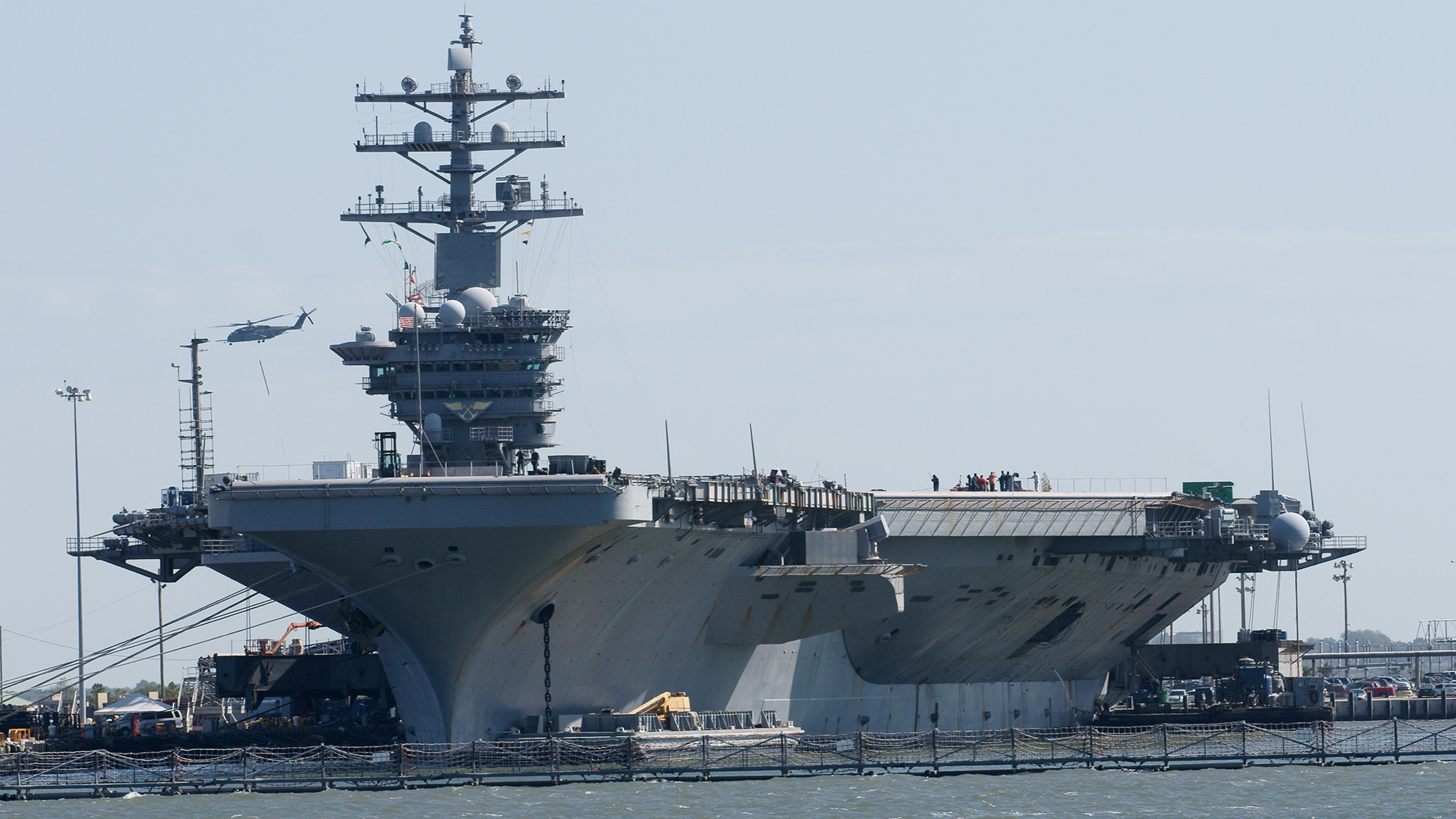
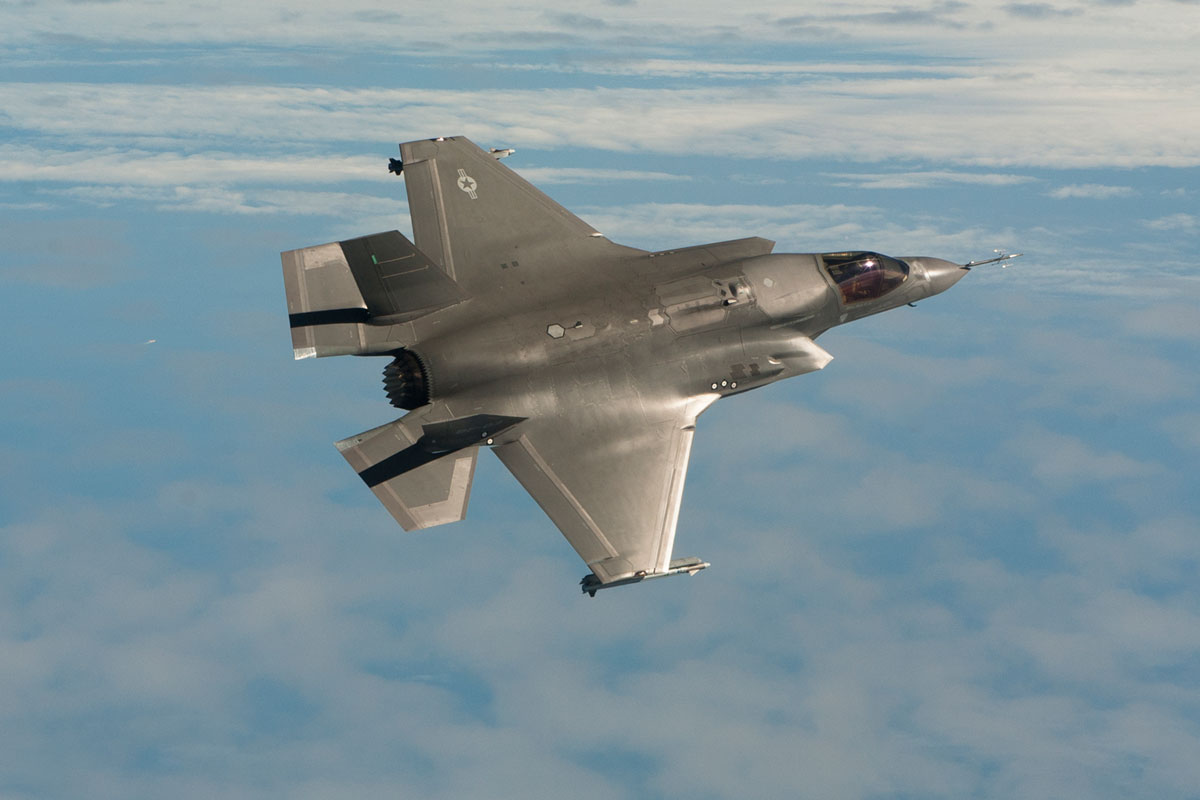
This reminds me of the story of mask shortages among troops in the U.S. military. The military’s solution, at least in the short-term, was to encourage troops and their families to make their own protective masks for the Covid-19 outbreak. A trillion-dollar military complex can’t afford to outfit troops with protective masks that cost pennies on the dollar. But of course we can fund more F-35s, more aircraft carriers … It’s like the satirical Onion said: Each American should get an aircraft carrier as a stimulus. What better way to protect ourselves while stimulating the economy?
Item: Andrea Mazzarino, a Navy spouse, has a great new article at TomDispatch.com that brings together two subjects that are rarely connected: the U.S. has a global empire with bases in 80 countries, even as Covid-19 cases spike in the “homeland” and affect (and infect) U.S. troops. It’s conceivable that infected U.S. troops, in their worldwide deployments, will emerge as super-spreaders of a sort, especially given the out-of-control nature of Covid-19 cases in the American South, where so many U.S. troops are stationed.
We Americans fancy ourselves as the world’s sole superpower. Will we emerge as the world’s viral super-spreader as well? Yet another example of full spectrum dominance!
And that’s enough items to ponder today. Readers, what say you?
I saw this headline and story at the Guardian today: “Pandemic and protests spur Americans to buy guns at record pace.”
And it just made me sad. Sad because Americans see guns as a security blanket. Sad because guns are so expensive and also so easily misused. Sad because more guns is really not the answer to anything. Certainly not a pandemic.
Consider the sheer expense of guns. A decent revolver, ammunition, a cleaning kit, and a few hours at your local gun range will likely cost at least a grand ($1000) at a time when almost half of Americans can’t meet an unexpected expense of $400. Yet people find solace in a gun, a form of mental comfort, a sense of “I’m prepared.” For Covid-19? For peaceful protesters? For the Purge? Who knows?
It’s sad as well to recognize a gun in the home raises the risk of suicide by gun, and of course of accidental shootings. Too many people buy a gun without knowing much about them — and how important it is to keep them secure, especially from children.
Look: I’ve owned guns and have shot everything from pellet pistols and rifles to Dirty Harry’s famed Smith & Wesson .44 magnum. I can even cite Harry’s “Feel lucky, punk” line from memory. I’m not anti-gun, but I am anti-hysteria.
Too many Americans are looking down the barrel of a loaded pistol for answers — and that’s neither the wisest nor safest place to look. We need to strengthen our communities, not fortify our bunkers. Buying more guns only does the latter.
Give me love/Give me love/Give me peace on earth/Give me light/Give me life
Keep me free from birth/Give me hope/Help me cope, with this heavy load
Trying to, touch and reach you with,/Heart and soul.
What he sang. That’s what we need, America, not more guns.
While the mainstream media focuses on alleged threats from without, the most insidious dangers are those from within America, as I argue in my latest article for TomDispatch.com. Here’s an excerpt:
Killing Democracy in America The Military-Industrial Complex as a Cytokine Storm
By William J. Astore
The phrase “thinking about the unthinkable” has always been associated with the unthinkable cataclysm of a nuclear war, and rightly so. Lately, though, I’ve been pondering another kind of unthinkable scenario, nearly as nightmarish (at least for a democracy) as a thermonuclear Armageddon, but one that’s been rolling out in far slower motion: that America’s war on terror never ends because it’s far more convenient for America’s leaders to keep it going — until, that is, it tears apart anything we ever imagined as democracy.
I fear that it either can’t or won’t end because, as Martin Luther King, Jr., pointed out in 1967 during the Vietnam War, the United States remains the world’s greatest purveyor of violence — and nothing in this century, the one he didn’t live to see, has faintly proved him wrong. Considered another way, Washington should be classified as the planet’s most committed arsonist, regularly setting or fanning the flames of fires globally from Libya to Iraq, Somalia to Afghanistan, Syria to — dare I say it — in some quite imaginable future Iran, even as our leaders invariably boast of having the world’s greatest firefighters (also known as the U.S. military).
Scenarios of perpetual war haunt my thoughts. For a healthy democracy, there should be few things more unthinkable than never-ending conflict, that steady drip-drip of death and destruction that drives militarism, reinforces authoritarianism, and facilitates disaster capitalism. In 1795, James Madison warned Americans that war of that sort would presage the slow death of freedom and representative government. His prediction seems all too relevant in a world in which, year after year, this country continues to engage in needless wars that have nothing to do with national defense.
You Wage War Long, You Wage It Wrong
To cite one example of needless war from the last century, consider America’s horrendous years of fighting in Vietnam and a critical lesson drawn firsthand from that conflict by reporter Jonathan Schell. “In Vietnam,” he noted, “I learned about the capacity of the human mind to build a model of experience that screens out even very dramatic and obvious realities.” As a young journalist covering the war, Schell saw that the U.S. was losing, even as its military was destroying startlingly large areas of South Vietnam in the name of saving it from communism. Yet America’s leaders, the “best and brightest” of the era, almost to a man refused to see that all of what passed for realism in their world, when it came to that war, was nothing short of a first-class lie.
Why? Because believing is seeing and they desperately wanted to believe that they were the good guys, as well as the most powerful guys on the planet. America was winning, it practically went without saying, because it had to be. They were infected by their own version of an all-American victory culture, blinded by a sense of this country’s obvious destiny: to be the most exceptional and exceptionally triumphant nation on this planet.
As it happened, it was far more difficult for grunts on the ground to deny the reality of what was happening — that they were fighting and dying in a senseless war. As a result, especially after the shock of the enemy’s Tet Offensive early in 1968, escalating protests within the military (and among veterans at home) together with massive antiwar demonstrations finally helped put the brakes on that war. Not before, however, more than 58,000 American troops died, along with millions of Vietnamese, Cambodians, and Laotians.
In the end, the war in Indochina was arguably too costly, messy, and futile to continue. But never underestimate the military-industrial complex, especially when it comes to editing or denying reality, while being eternally over-funded for that very reality. It’s a trait the complex has shared with politicians of both parties. Don’t forget, for instance, the way President Ronald Reagan reedited that disastrous conflict into a “noble cause” in the 1980s. And give him credit! That was no small thing to sell to an American public that had already lived through such a war. By the way, tell me something about that Reaganesque moment doesn’t sound vaguely familiar almost four decades later when our very own “wartime president” long ago declared victory in the “war” on Covid-19, even as the death toll from that virus approaches 150,000 in the homeland.
In the meantime, the military-industrial complex has mastered the long con of the no-win forever war in a genuinely impressive fashion. Consider the war in Afghanistan. In 2021 it will enter its third decade without an end in sight. Even when President Trump makes noises about withdrawing troops from that country, Congress approves an amendment to another massive, record-setting military budget with broad bipartisan support that effectively obstructs any efforts to do so (while the Pentagon continues to bargain Trump down on the subject).
The Vietnam War, which was destroying the U.S. military, finally ended in an ignominious withdrawal. Almost two decades later, after the 2001 invasion, the war in Afghanistan can now be — the dream of the Vietnam era — fought in a “limited” fashion, at least from the point of view of Congress, the Pentagon, and most Americans (who ignore it), even if not the Afghans. The number of American troops being killed is, at this point, acceptably low, almost imperceptible in fact (even if not to Americans who have lost loved ones over there).
More and more, the U.S. military is relying on air power, unmanned drones, mercenaries, local militias, paramilitaries, and private contractors. Minimizing American casualties is an effective way of minimizing negative media coverage here; so, too, are efforts by the Trump administration to classify nearly everything related to that war while denying or downplaying “collateral damage” — that is, dead civilians — from it.
Their efforts boil down to a harsh truth: America just plain lies about its forever wars, so that it can keep on killing in lands far from home.
When we as Americans refuse to take in the destruction we cause, we come to passively accept the belief system of the ruling class that what’s still bizarrely called “defense” is a “must have” and that we collectively must spend significantly more than a trillion dollars a year on the Pentagon, the Department of Homeland Security, and a sprawling network of intelligence agencies, all justified as necessary defenders of America’s freedom. Rarely does the public put much thought into the dangers inherent in a sprawling “defense” network that increasingly invades and dominates our lives.
Meanwhile, it’s clear that low-cost wars, at least in terms of U.S. troops killed and wounded in action, can essentially be prolonged indefinitely, even when they never result in anything faintly like victory or fulfill any faintly useful American goal. The Afghan War remains the case in point. “Progress” is a concept that only ever fits the enemy — the Taliban continues to gain ground — yet, in these years, figures like retired general and former CIA director David Petraeus have continued to call for a “generational” commitment of troops and resources there, akin to U.S. support for South Korea.
Who says the Pentagon leadership learned nothing from Vietnam? They learned how to wage open-ended wars basically forever, which has proved useful indeed when it comes to justifying and sustaining epic military budgets and the political authority that goes with them. But here’s the thing: in a democracy, if you wage war long, you wage it wrong. Athens and the historian Thucydides learned this the hard way in the struggle against Sparta more than two millennia ago. Why do we insist on forgetting such an obvious lesson?
The Bible tells us that all is vanity, and that’s most certainly true of the Trump campaign and its search for donors. A friend of mine sent me the following come-on from Trump/Pence 2020:
******
“I’ll admit I’m disappointed [that you haven’t contributed as yet], but I know you have it in you to be one of my STRONGEST supporters, which is why I’m reaching out with a one-time offer in the hope that you’ll join me in making history.
When you make your FIRST contribution of ANY AMOUNT, you’ll instantly join the ranks in the Trump Donor Hall of Fame. This prestigious group will be remembered forever as the Patriots who won us the 2020 Election, and I’m offering YOU a spot. The Trump Donor Hall of Fame is very competitive and your offer is only available for the NEXT HOUR. After that, I’ll be forced to reach out to the next Patriot.Please make your FIRST contribution of ANY AMOUNT IMMEDIATELY and you’ll automatically get your name cemented in the Trump Donor Hall of Fame.”
*****
Now, tell me, dear reader, who could refuse such an offer? A chance to be enshrined (or “cemented”) in the “Trump Donor Hall of Fame.” And all you need to contribute is a dollar — or even a penny! Not only that, but you’ll gain personal recognition from one Donald J. Trump. According to the ad:
“I’ll be walking through the Hall of Fame later today and I’ll be looking for your name. Make sure I see it.”
Donald Trump — walking? Well, it’s nice to see him getting some exercise.
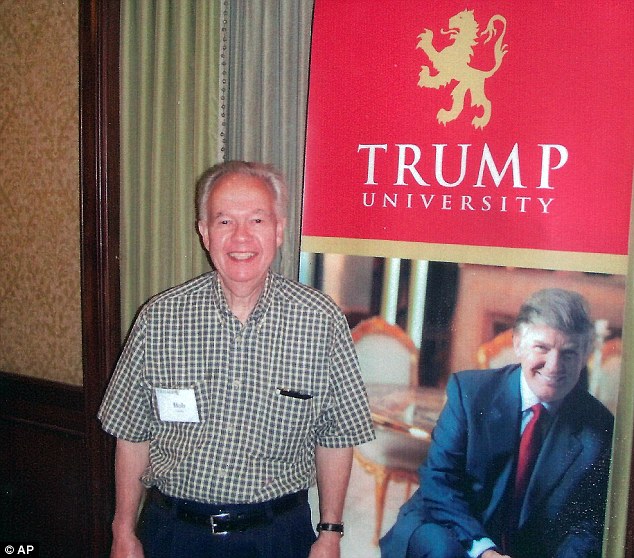
This come-on reminds me of Trump University, where you were guaranteed to meet Trump and get a photo with him. Turns out that guarantee was bogus (like most of Trump’s presidency, and his businesses for that matter), but some people did get a photo with a cardboard cutout of Trump.
Trump has a keen sense of human vanity, powered as it is by his own bottomless vanity and venality. But will it be enough to get him reelected? (Along with the usual fear-mongering, race-baiting, flag-waving, and the like?) Stay tuned.
The Pentagon Budget: Up, Up, and Away! That budget is the true stealth warplane, nearly invisible to oversight and nearly impregnable to all challenges
W.J. Astore
Who’s going to win the 2020 election? I can already tell you who’s won: the military-industrial-congressional complex. With broad bipartisan support, the next Pentagon budget will be $740.5 billion, and that’s just for starters. Congress has also acted to thwart troop withdrawals from Afghanistan, because fighting a devastating war for 19 years and counting isn’t enough. (See this excellent article and video by Glenn Greenwald at The Intercept.) We must keep fighting that war because — well, reasons. You can insert various phony reasons here: we must support our Afghan allies; we must combat terrorism; we must stay loyal to the Nato allies we dragooned into the war; we must continue fighting or else Russia wins because … bounties? Putin?
The real reasons: profit. Bases. Resources. And a total lack of sense and fortitude within the Washington Beltway.
It’s deja vu all over again, because in 2012 I wrote the following article on how the Pentagon had already won the election irrespective of which candidate — Barack Obama or Mitt Romney — prevailed. And so it proved.
Even during a pandemic, even during a recession, even when American workers and our armies of the unemployed need all the help they can get, the Pentagon budget reigns supreme. War and weapons are truly the health of the state here in America, uniting Democrats and Republicans in a form of militaristic bliss. But fighting and containing Covid-19? Helping the needy? Not so much.
Here’s my article from 2012, originally posted at TomDispatch.com:
The National Security State Wins (Again) Why the Real Victor in Campaign 2012 Won’t Be Obama or Romney
By William J. Astore
Now that Mitt Romney is the presumptive nominee of the Republican Party, the media is already handicapping the presidential election big time, and the neck-and-neck opinion polls are pouring in. But whether President Obama gets his second term or Romney enters the Oval Office, there’s a third candidate no one’s paying much attention to, and that candidate is guaranteed to be the one clear winner of election 2012: the U.S. military and our ever-surging national security state.
The reasons are easy enough to explain. Despite his record as a “warrior-president,” despite the breathless “Obama got Osama” campaign boosterism, common inside-the-Beltway wisdom has it that the president has backed himself into a national security corner. He must continue to appear strong and uncompromising on defense or else he’ll get the usual Democrat-as-war-wimp label tattooed on his arm by the Republicans.
Similarly, to have a realistic chance of defeating him — so goes American political thinking — candidate Romney must be seen as even stronger and more uncompromising, a hawk among hawks. Whatever military spending Obama calls for, however much he caters to neo-conservative agendas, however often he confesses his undying love for and extols the virtues of our troops, Romney will surpass him with promises of even more military spending, an even more muscular and interventionist foreign policy, and an even deeper love of our troops.
Indeed, with respect to the national security complex, candidate Romney already comes across like Edward G. Robinson’s Johnny Rocco in the classic film Key Largo: he knows he wants one thing, and that thing is more. More ships for the Navy. More planes for the Air Force. More troops in general — perhaps 100,000 more. And much more spending on national defense.
Clearly, come November, whoever wins or loses, the national security state will be the true victor in the presidential sweepstakes.
Of course, the election cycle alone is hardly responsible for our national love of weaponry and war. Even in today’s straitened fiscal climate, with all the talk of government austerity, Congress feels obliged to trump an already generous president by adding yet more money for military appropriations. Ever since the attacks of 9/11, surging defense budgets, forever war, and fear-mongering have become omnipresent features of our national landscape, together with pro-military celebrations that elevate our warriors and warfighters to hero status. In fact, the uneasier Americans grow when it comes to the economy and signs of national decline, the more breathlessly we praise our military and its image of overwhelming power. Neither Obama nor Romney show any sign of challenging this celebratory global “lock and load” mentality.
To explain why, one must consider not only the pro-military positions of each candidate, but their vulnerabilities — real or perceived — on military issues. Mitt Romney is the easier to handicap. As a Mormon missionary in France and later as the beneficiary of a high draft lottery number, Romney avoided military service during the Vietnam War. Perhaps because he lacks military experience, he has already gone on record (during the Republican presidential debates) as deferring to military commanders on decisions such as whether we should bomb Iran. A President Romney, it seems, would be more implementer-in-chief than civilian commander-in-chief.
Romney’s métier at Bain Capital was competence in the limited sense of buying low and selling high, along with a certain calculated ruthlessness in dividing companies and discarding people to manufacture profit. These skills, such as they are, earn him little respect in military circles. Compare him to Harry Truman or Teddy Roosevelt, both take-charge leaders with solid military credentials. Rather than a Trumanesque “the buck stops here,” Romney is more about “make a buck here.” Rather than Teddy Roosevelt’s bloodied but unbowed “man in the arena,” Romney is more bloodless equity capitalist circling high above the fray in a fancy suit.
Consider as well Romney’s five telegenic sons. It’s hard to square Mitt’s professions of love for our military with his sons’ lack of interest in military service. Indeed, when asked about their lack of enthusiasm for joining the armed forces during the surge in Iraq in 2007, Mitt off-handedly replied that his sons were already performing an invaluable national service by helping him get elected.
An old American upper class sense of noblesse oblige, of sons of privilege like George H.W. Bush or John F. Kennedy volunteering for national service in wartime, has been dead for decades in our otherwise military-happy country. When it comes to sending American sons (and increasingly daughters) into harm’s way, for President Romney it’ll be another case of chickenhawk guts and working-class blood.
For election 2012, however, the main point is that the Romney family’s collective lack of service makes him vulnerable on national defense, a weakness that has already led Mitt and his campaign to overcompensate with ever more pro-military policy pronouncements supplemented with the usual bellicose rhetoric of all Republicans (Ron Paul excepted). As a result, President-elect Romney will ultimately find himself confined, cowed, and controlled by the national security complex — and he’ll have only himself (and Barack Obama) to blame.
Obama, by way of contrast, has already shown a passion for military force that in saner times would make him invulnerable to charges of being “weak” on defense. Fond of dressing up in military flight jackets and praising the troops to the rafters, Obama has substance to go with his style. He’s made some tough calls like sending SEAL Team 6 into Pakistan to kill Osama Bin Laden; using NATO airpower to take down Qaddafi in Libya; expanding special ops and drone warfare in Afghanistan, Yemen, and elsewhere, including the assassination of U.S. citizens without judicial process. America’s Nobel Peace Prize winner of 2009 has become a devotee of special forces, kill teams, and high-tech drones that challenge the very reality of national sovereignty. Surely such a man can’t be accused of being weak on defense.
The political reality, of course, is different. Despite his record, the Republican Party is forever at pains to portray Obama as suspect (that middle name Hussein!), divided in his loyalties (that Kenyan connection!), and not slavish enough in his devotion to “underdog” Israel. (Could he be a crypto-Muslim?)
The president and his campaign staff are no fools. Since any sign of “weakness” vis-à-vis Iran and similar enemies du jour or any expression of less than boundless admiration for our military will be exploited ruthlessly by Romney et al., Obama will continue to tack rightwards on military issues and national defense. As a result, once elected he, too, will be a prisoner of the Complex. In this process, the only surefire winner and all-time champ: once again, the national security state.
So what can we expect on the campaign trail this summer and fall? Certainly not prospective civilian commanders-in-chief confident in the vitally important role of restraining or even reversing the worst excesses of an imperial state. Rather, we’ll witness two men vying to be cheerleader-in-chief for continued U.S. imperial dominance achieved at nearly any price.
Election 2012 will be all about preserving the imperial status quo, only more so. Come January 2013, regardless of which man takes the oath of office, we’ll remain a country with a manic enthusiasm for the military. Rather than a president who urges us to abhor endless war, we’ll be led by a man intent on keeping us oblivious to the way we’re squandering our nation’s future in fruitless conflicts that ultimately compromise our core constitutional principles.
For all the suspense the media will gin up in the coming months, the ballots are already in and the real winner of election 2012 will be the national security state. Unless you’re a denizen of that special interest state, we know the loser, too. It’s you.
William J. Astore, a retired lieutenant colonel (USAF), is a TomDispatch regular. He welcomes reader comments at wjastore@gmail.com. To listen to Timothy MacBain’s latest Tomcast audio interview in which Astore discusses how the two presidential candidates are sure to out-militarize each other in the coming election campaign, click here or download it to your iPod here.
Follow TomDispatch on Twitter @TomDispatch and join us on Facebook.






 Bracing Views