A book that shook my world was journalist Hedrick Smith’s “The Power Game,” published 35 years ago in 1987. It was about “How Washington really works,” and what I remember about it is how it made me feel, as in discouraged and outraged. I learned about the power of lobbyists, the power of money, and what money gains you, which is access. More-or-less legal forms of corruption in 1987 are now most definitely legal, with the Supreme Court decreeing that corporations are citizens and that money is speech. It’s amazing how the law can be twisted to serve the interests of the powerful. I for one do not believe that Raytheon and I are both equal citizens and that we both have equivalent access to elected representatives through our “speech,” i.e. our money. But the Supreme Court professes to believe this so there you have it.
When you look at who runs America, it’s a fairly short list. Wall Street, Big Pharma, the fossil fuel companies, Big Tech and Silicon Valley, the military-industrial complex (National Security State), the major banks and insurance companies: any “citizen” with access to billions of dollars who can then buy or rent politicians with millions of dollars. It’s a great deal for them, “investing” in politicians, making them dance to their tune, but it’s a lousy deal for the rest of us.
This makes me think of one of my father’s favorite sayings: He who pays the piper calls the tune. If I toss a penny and ask for a tune, and another “citizen” tosses twenty bucks and asks for a different one, I’m not surprised when the piper doesn’t play my tune. So when the Princeton Study said that the U.S. is an oligarchy and that politicians in Washington don’t listen to us, I wasn’t surprised. I learned it from Hedrick Smith in 1988 when I read his book.
Interestingly, when Smith wrote “The Power Game,” America had just over 4000 political action committees, or PACs. In 2014, America had well over 7000 PACs, including “Super” PACs, which have far fewer constraints in how they can use their money in the political realm. Now we even have “dark” money, and so we’re barraged by ads on TV and elsewhere attacking a candidate or an issue without any clear idea of who’s behind it all and why. But, remember, money is speech and corporations are citizens, so let the good times roll in the U.S. political process.
When Hedrick Smith wrote, things weren’t quite as bad in America. There were more newspapers, more media sources, more real journalists. Nowadays, five or six corporations own all the mainstream media outlets, and it’s not in their interest to promote views that are honest and provocative. Indeed, they love PACs and Super PACs and all the money spent by them and political campaigns to influence voting.
It’s gotten to be so corrupt, and so tightly controlled, as in rigged, that it almost doesn’t matter who runs for office. Clearly, Joe Biden and Kamala Harris aren’t driving policy in America. The few decisions they themselves truly make are almost inconsequential.
One thing I really liked about Hedrick Smith is his honesty. He gave a talk on his book, link here:
Where he explained that, if you’re a politician and you accept certain campaign donations, it’s understood between both parties that when the donor needs you to vote a certain way, you will vote that way, no questions asked. Everyone in Congress understands this. It’s why every effort by real citizens to get big money out of politics fails. It fails because the big donors won’t have it. They like to be able to buy politicians, thank you very much. That’s how democracy works, so says the Supreme Court. If you don’t like it, start your own corporation, make a few billion, then you too can buy your own politician.
A revival of democracy in America starts with campaign finance reform, which most politicians say they’re for even as they vote against it. Sounds like a conundrum to me. Can we solve it by explaining to our esteemed justices (John Roberts, can you hear me?) that money is not the same as speech and that corporations really aren’t the same as citizens?
Finally, a rather obvious point, but it bears repeating. Justices like Thomas, Roberts, Kavanaugh, Gorsuch, and Barrett weren’t just selected because they were reliable votes against abortion. They were really vetted and selected because they will always rule with the powerful against the powerless. They are, in a word, pro-corporate.
And if the Supreme Court is pro-corporate, if Congress is pro-corporate, and if the president is a figurehead known for his pro-corporate policies as a Senator from Delaware, what kind of America are we truly looking at?
In the power game that is Washington, it’s the American people who suffer the agony of defeat.
The last real Democratic President was Jimmy Carter. The last U.S. election offering a real alternative vision was George McGovern versus Richard Nixon in 1972.
Since then, Democratic Presidents like Clinton, Obama, and Biden have been DINOs, or Democrats in name only. In a rare moment of honesty, Obama admitted his administration had echoed the policies of “moderate” Republicans. Friendly to Wall Street, banking interests, corporations, the military-industrial complex, and the usual assortment of oligarchs. Obama’s health care plan was a corporate-friendly sellout that echoed the plan put together by Republicans like Mitt Romney. The DINOs fully support forever war and huge military budgets; Obama was quite happy to admit America had “tortured some folks” and that he’d gotten very good at ordering people to be killed, mainly via assassination by drone. It’s a far cry from Jimmy Carter trying to put human rights at the center of his foreign policy in the late 1970s.
Democrats began to move rightwards after McGovern’s resounding defeat in 1972. They haven’t stopped this rightward drift; indeed, it’s accelerated. The Republicans responded by embracing men like Trump as they found plenty of room even further to the right of the DINOs. America, Gore Vidal once said, basically has one property party with two right wings, and that’s only become truer and more obvious over the last fifty years.
What is to be done? We need viable alternatives, but of course the game is rigged, as Matthew Hoh, principled candidate for the Senate in North Carolina, discovered as Democrats conspired to keep him off the ballot, even though his efforts with the Green Party were more than sufficient to earn him a place on that ballot. Both parties, Democrat and Republican, will do anything to keep their duopoly while also endlessly punching each other. Neither party serves the interests of the people.
Perhaps Caitlin Johnstone can offer some hope, or at least a diagnosis for the right path ahead. Here’s what she had to say in her latest post about how the political system in America is structured and manipulated for the benefits of the powerful:
1. Use narrative manipulation to divide the population into a roughly 50/50 ideological split.
2. Ensure you control both of those factions.
3. Convince everyone that the only reason nothing changes is because their half of the population doesn’t win enough elections.
Everyone’s pulling on a rope that doesn’t lead anywhere and doesn’t do anything, convinced by powerful manipulators that they’re engaged in a life-or-death tug o’ war match of existential importance. Meanwhile the powerful just do as they like, completely indifferent to that spectacle and its back-and-forth exchanges.
A group is artificially split into two sides and told to pull a rope in opposite directions while someone else stands back and shoots them all with a BB gun. When they complain about the welts, they’re told it’s happening because their side isn’t pulling hard enough. But really they’d be getting shot no matter what they did.
This doesn’t mean give up, it just means give up on the fake tug o’ war game. If you’re playing tug o’ war while someone rummages through your handbag looking for cash, the first step to stopping them is putting down the rope and going after them. It’s like if everyone was pushing on a fake fire escape in a burning building: the first step to getting them out of there is showing them that the door is just painted on the wall and doesn’t lead anywhere. That’s not telling them to give up hope, it’s just telling them to give up on an ineffective strategy.
Perhaps Johnstone didn’t go far enough here. Americans go in for assault rifles, not BB guns. But she’s surely right that you’re not going to reform this system from within, i.e. from pulling harder on the Democrat or Republican rope. You need to stop playing an unwinnable game.
Organize. Vote third party when a sane candidate is available. Stop donating to DINOs and their even more dubious Republican cousins. Protest. Tell others. You never know what will be the spark that ignites true and meaningful change.
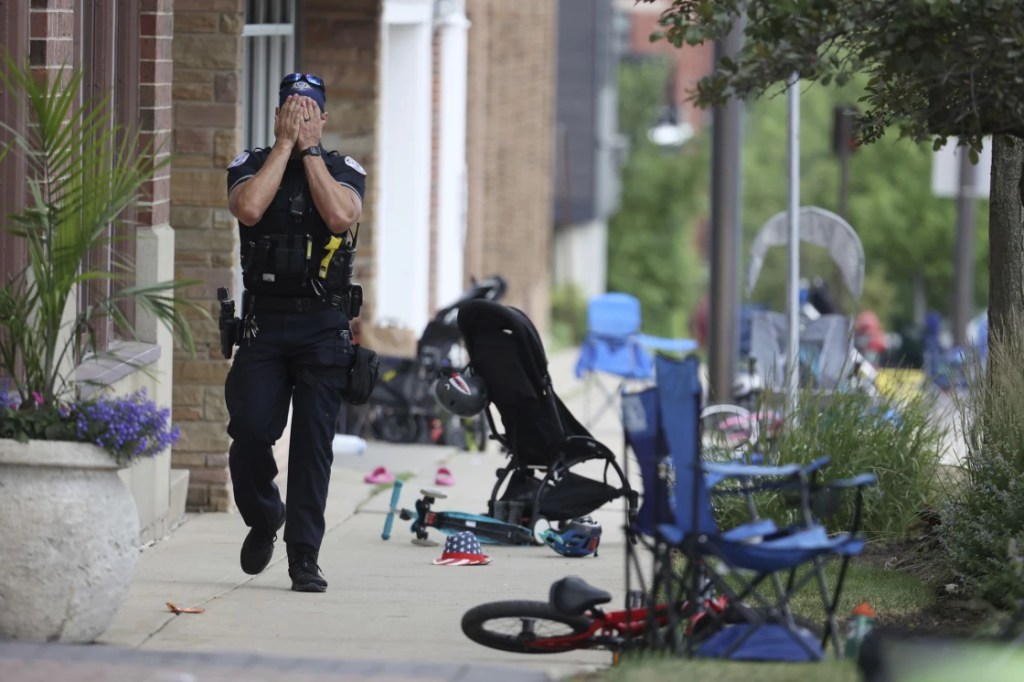
A police officer reacts to the Highland Park mass shooting near Chicago on July 4th (Getty images)
W.J. Astore
Another mass shooting in America, this one during a July 4th parade, killing six and wounding dozens. I saw this blinding flash of the obvious at the New York Times today: “Why does the U.S. have so many mass shootings? Mostly because people have so many guns.” Well, that seems logical. I saw an interview on MSNBC where it was asked whether the shooter was a Trump supporter and whether he was a “loner.” To his credit, the expert being interviewed explained that, though the shooter posed with a Trump flag, it may have been meant ironically, and that he wasn’t a loner in the traditional sense as he was part of an active online community of bizarre mass shooting enthusiasts.
There’s always the tendency to dismiss these shooters as loners, as nutcases, and to politicize it as well by suggesting that Trump or some other figure was at least partially responsible. But America had plenty of mass shootings before Trump came along, and these guys are not all loners. Indeed, in some sense they’re a manifestation of a society obsessed with guns and violence, of settling scores and dominating the Other (or others) through killing, mainly with guns.
Speaking of killing with guns, is it really necessary to shoot an apparently unarmed Black man sixty times (!) after he fled a traffic stop? Here’s the story from CNN:
The city of Akron, Ohio, remains on edge one week after the fatal police shooting of 25-year-old Jayland Walker. A news conference held by city officials on Sunday — along with the release of 13 police body camera videos — has started to paint a fuller picture of the shooting, which police say happened when Walker, who is Black, fled an attempted traffic stop on June 27. Walker was unarmed at the time he was killed, Akron Police Chief Stephen Mylett said. Authorities said Walker suffered at least 60 wounds in the fatal shooting. The Mayor of Akron declared a state of emergency and issued a curfew for Monday night through this morning in order to “preserve peace” in the community.
A “curfew” to preserve peace: Something tells me we’re going to see a lot more of these “curfews” in the U.S. in the coming years, enforced by heavily armed police with converted MRAPs and similar tank-like vehicles. It’s hard not to think that America’s overseas wars have come home to Main Street USA, not in the same form as Baghdad or Kabul, but close enough.
Americans tend to put a lot of faith in “good guys with guns.” Those “good guys” failed to act for more than an hour in Uvalde, Texas, a delay that led to more children being slaughtered. In Akron, Ohio, the “good guys” apparently fired more than 60 rounds at Jayland Walker, who apparently was unarmed at the time of the shooting (though apparently he had a gun in his car). I like this official statement by the police: “The decision to deploy lethal force as well as the number of shots fired is consistent with use of force protocols and officers’ training,” the Fraternal Order of Police Akron Lodge 7 said in a statement.
America is in the (pistol) grips of a massive social experiment: what happens to a society when it’s consistently betrayed by its leaders, when people are increasingly desperate and fearful, and where those same people are massively armed with readily-available guns, including military-grade firearms. A society that continues to advertise violence on its TV and cable shows, that continues to suggest that more guns are the answer to gun violence, where the Supreme Court of the land embraces the idea of open carry of loaded firearms as a fundamental Constitutional right. It seems a foregone conclusion that such an experiment can only lead to higher body counts across the country. And indeed there were many more deadly shootings this past weekend, as this article summarizes.
Welcome to “extreme life,” as Tom Engelhardt notes today at TomDispatch.com. And while his article focuses mainly on soaring temperatures and extreme weather due to climate change, he starts by noting how the Supreme Court struck down the New York law that restricted the carrying of concealed firearms. Yes, America today is “packing heat” in more ways than one. Rising temperatures, soaring gun sales, more and more mass shootings, increasing alienation and unease: these times aren’t just “interesting,” as the alleged Chinese curse goes, they truly are increasingly extreme.
And in extremity, people often make the worst of choices, turning to anyone who promises them relief, a measure of “peace,” even if it takes the form of a militarized curfew.
Matt Hoh, speaking truth, and we can’t have that in America. Or can we?
W.J. Astore
If the Republican and Democratic Parties are virtually identical on most issues involving big money, like the military, banking, corporations, and so on, you don’t have a democracy. Democracy implies choice among many alternatives. We have virtually no alternatives. Hence this video by Briahna Joy Gray, which spells out a “Dem-Exit” in progress, as many Democrats wake up to the fact that the party almost never keeps its promises and is mainly engaged in raising money for itself and maintaining its increasingly tenuous grip on power.
Even worse, when other parties try to offer true choice, like the Green Party, the Democrats scheme to block legitimate candidates. Consider the case of Matthew Hoh, who’s running for the Senate in North Carolina as a candidate for the Green Party. I know Matt. He’s a former Marine who resigned in 2009 from the State Department in protest against U.S. policy in Afghanistan. Matt knew that Obama’s so-called surge wasn’t working and he spoke out against it. Matt had (and has) integrity. If only more people in the U.S. military and the foreign policy establishment had Matt’s combination of integrity, intelligence, and guts.
Matt gathered more than 22,000 signatures to get on the ballot in North Carolina (he needed 13,685), so surely he was easily approved because we Americans love democracy and principled politicians like Matt Hoh, right? Wrong.
The Democratic establishment did everything possible, legal and illegal, to block him from getting on the ballot in North Carolina. And it appears they’ve blocked him.
What are they afraid of? Well, they’re afraid to lose a bit of their money and power, and they’re especially afraid of a principled person like Matt Hoh, who actually believes what he says, and says what he believes.
Matt Hoh is a disabled combat veteran who ably served his country, who is indeed still serving it to the best of his ability, with a mixture of candor and courage that has won me over and plenty of people in North Carolina and elsewhere. And we can’t allow that! so sayeth establishment Democrats.
Blocking Matt Hoh from running is yet another clear sign of the death of democracy in America.
A short statement from Matt Hoh:
“We represent single-payer health care. We represent affordable housing. We represent living wages, action on the climate, etc, etc. And those things aren’t represented by the [Cheri] Beasley campaign [the Democratic candidate for Senate] at all. They claim to be for working-class people, but you and I know, the Democratic Party, it’s been decades since they’ve addressed the needs of working class people.”
The Matthew Hoh Campaign is appealing the decision by the State Board of Elections, which voted 3-2 against, with all three Democrats voting against Hoh getting on the ballot.
There is a mid-August deadline for Matt Hoh’s name getting on the ballot. It’s a safe bet that establishment Democratic leaders in North Carolina will do everything in their power, legal or illegal, to block him. Why? Because Matt Hoh represents the people; the Democratic Party represents the owners and donors.
Godspeed, Matthew Hoh. Thank you for fighting for North Carolina and for America.
Heck, even I chipped in $100, and I rarely donate to political campaigns. As Matt said today on “The Jimmy Dore Show,” people are being brutalized by America’s political system. If we keep simply voting Democrat or Republican, all we’re doing is “perpetuating a deadly status quo.”
Time to try real democracy. Time to vote for candidates like Matthew Hoh.
American schools are soft, you say? I know what you mean. I taught college for 15 years, so I’ve dealt with my share of still-teenagers fresh out of high school. Many of them inspired me, but some had clearly earned high marks too easily and needed remedial help in math, English, or other subjects. School discipline had been too lax perhaps and standards too slack, because Johnny and Janey often couldn’t or wouldn’t read a book, though they sure could text, tweet, take selfies, and make videos.
Oh, wait a sec, that’s not what you meant by “soft,” is it? You meant soft as in “soft target” in the context of mass school shootings, the most recent being in Uvalde, Texas. Prominent Republicans like Senators Lindsey Graham and Ted Cruz have highlighted the supposed softness of American schools, their vulnerability to shooters armed with military-style assault rifles and intent on mass murder.
That “softness” diagnosis leads to a seemingly logical quick fix: “harden” the schools, of course! Make them into “targets” too intimidating to approach thanks to, among other security measures, surveillance cameras, metal detectors, bulletproof doors and windows, reinforced fences, armed guards, and even armed teachers.
Here’s the simple formula for it all: no more limpness, America, it’s time to get hard. Johnny and Janey may still find it challenging to read books or balance a checkbook (or even know what a checkbook is), but, hey, there must be an app for that, right? At least they’ll stay alive in our newly hardened schools. Or so we hope. There’s no app, after all, for reviving our kids after they’ve been shot and shredded by some assault-rifle-wielding maniac.
As a retired military officer and professor, and a former gun owner, the latest chapter in this country’s gun mania, the Republican urge to keep all those assault weapons circulating and still protect our children, strikes me not just all too strangely, but all too familiarly as well. Those voices calling for billions of dollars to “harden” schools reflect, of course, the imagery of a sexualized hyper-masculinity, but something else as well: a fetish for military-speak. In my service, the Air Force, we regularly spoke of “hardening” targets or “neutralizing” them.
In essence, politicians like Graham and Cruz seem way too eager to turn our schools into some combination of fortresses and bomb shelters, baby versions of the massive nuclear shelter I occupied in the 1980s during my first tour of duty in the Air Force (on which more in a moment). Button up and hunker down, America — not from the long-gone “red” enemy without, armed with nuclear missiles, but from the red-hot (as in murderously hateful) enemy within. These days, that increasingly means a school-age shooter or shooters armed with military-grade weaponry, usually acquired all too legally. Sound the klaxons! Lock and (especially) load! It’s time to go to DEFCON 1 (maximum military readiness, as in war) not in nuclear shelters but in America’s schools.
Speaking of my Cold War nuclear-bunker days in the 1980s, when I was stationed at Cheyenne Mountain, America’s command center for its nuclear defense in Colorado, a few things stood out then. Security guards, for one. Locking cipher doors, for another. Security ID badges. Razor wire. Video monitors. Blast doors. I was in the ultimate lockdown fortress. But tell me the truth: Is this truly what we want our schools to look like — pseudo-military bunkers for the (hot) war increasingly blazing in our society?
In fact, the whole “hardening” idea represents not a defense against, but a surrender to the notion of schools as potential sites of gun combat and mass death. To submit to such a scenario is, in the view of this retired military officer and educator, a thoroughly defeatist approach to both safety and education. It’s tantamount to admitting that violence and fear not only rule our lives but will continue to do so in ever more horrific ways and that the only solution is to go hard with even more “security” and even more guns. Hardening our schools implies hardening our hearts and minds, while we cede yet more power to security experts and police forces. And that may be precisely why so many authority figures so lustily advocate for the “hard” way. It is, in the end, the easy path to disaster.
The Hard Way as the Easy Way Out
Though six of my college-teaching years were at a military academy, where I wore a uniform and my students saluted me as class began, it never occurred to me to carry a loaded gun (even concealed). For the remaining nine years, I taught at a conservative college in rural Pennsylvania where, you may be surprised to learn, guns were then forbidden on campus. But that, of course, was in another age. Only at the tail end of my college teaching career were lockable doors installed and voluntary lockdown drills instituted.
I never ran such a drill myself.
Why not? Because I refused to inject more fear into the minds of my students. In truth, given the unimaginably violent chaos of a school shooting, you’d almost automatically know what to do: lock the door(s) to try to keep the shooter out, call 911, and duck and cover (which will sound familiar to veterans of early Cold War era schooling). If cornered and as a last resort, perhaps you’d even rush the shooter. My students, who were young adults, could have plausibly done this. Children in the third and fourth grades, as in the Uvalde slaughter, have no such option.
That mass shooting took place at a hardened school with locking doors, one that ran lockdown and evacuation drills regularly, and had fences. And yet, of course, none of that, including 911 calls from the students, prevented mass death. Not even the presence of dozens of heavily armed police inside and outside the school mattered because the commander at the scene misread the situation and refused to act. Well-trained “good guys with guns” proved remarkably useless against the bad guy with a gun because the “good guys” backed off, waited, and then waited some more, more than an hour in all, an excruciating and unconscionable delay that cost lives.
But combat can be like that. It’s chaotic. It’s confusing. People freeze or act too quickly. It’s not hard to make bad decisions under deadly pressure. At Uvalde, the police disregarded standard operating procedure that directs the immediate engagement of the shooter until he’s “neutralized.” But we shouldn’t be surprised. Fear and uncertainty cloud the judgment even of all-too-hardened professionals, which should teach us something about the limitations of the hard option.
A related hardening measure that’s been proposed repeatedly, including by former President Trump, is to arm and train teachers to confront shooters. It’s a comforting fantasy, imagining teachers as Dirty Harry-like figures, blowing away bad guys with poise and precision. Sadly, it’s just that, a fantasy. Imagine teachers with guns, caught by surprise, panicking as their students are shot before their eyes. How likely are they to respond calmly with deadly accuracy against school shooter(s) who, the odds are, will outgun them? “Friendly fire” incidents happen all too frequently even in combat featuring highly trained and experienced soldiers. Armed teachers could end up accidentally shooting one or more of their students as they tried to engage the shooter(s). How could we possibly ask teachers to bear such a burden?
Let’s also think about the kind of teacher who wants to carry a weapon in a classroom. My brother was a security policeman in the Air Force, and he understands all too well the allure of weaponry to certain types of people. As he put it to me recently, “A gun is power. To some, even the psychologically relatively stable among us, carrying a gun is indeed like having a permanent hard-on. You have the power of life and death as well. It can be a pure ego-driven power trip, sexual, every time you get to pull the trigger. You give a guy a gun and strange things can happen.”
Think of your least favorite teacher in your K-12 experience, perhaps the one who intimidated you the most. Now, think of that very teacher “hardened” with a gun in class. Sounds like a good idea, right?
Arming Lady Liberty (to the Teeth)
Arming teachers is a measure of our collective confusion and desperation, though some politicians like Donald Trump are sure to continue to press for it. Again, if I’m an armed teacher, perhaps with a concealed 9mm pistol, I’d have virtually no chance against a shooter or shooters with AR-15s and body armor. Does that mean I need an AR-15 and body armor, too? Who needs an arms race with the Russians or Chinese when we can have one in every school in America?
What, then, of hardening schools? We’re back to locking security doors, reinforced fences around campus, cameras everywhere, metal detectors at each entrance, and of course more armed police (or “school resource officers,” known as SROs) in the hallways. We’re talking about untold scores of billions of dollars spent to turn every American school into a fortress/bunker, a place to hunker down and ride out a violent weapons-of-mass-destruction storm of our own making.
And mind you, of all the things we don’t know, one thing we do: this hunkering down, this fear will be indelibly etched into the minds of our kids as they navigate our ever more hardened, over-armed schools. It won’t be healthy, that’s for sure. In seeking to reduce and eliminate school shootings in America, we should be guided by the goal of not making matters worse for our children.
As horrific as they are, headline-grabbing school shootings are rare indeed compared to the number of schools across America. Indeed, given the violence of this society and the extreme violence we routinely export to other countries across the globe, it’s surprising we don’t have more school shootings. Their relative rarity should reassure us that all is not lost. Not yet, anyway.
I get it. We all want to feel safe and, above all, we want our kids to be safe. But buying them bulletproof backpacks or hardening their schools is the wrong approach. Besides, if we spend massively on school security, what’s to stop a shooter determined to kill children from going elsewhere to find them? It’s horrifyingly grim logic, but he’d likely go to a playground, or the movies, or a dance recital, or any other “soft” place where children might gather. And what then? I for one don’t want to live in fortress America, surrounded by armed and armored police and intrusive security gadgetry “for my protection.”
Admittedly, in a country in which Republicans and Democrats can’t seem to agree on anything but the most modest gun reforms (forget banning military-style weapons or even restrictingtheir sale to people 21 and older), the hardening of schools is an easy target (so to speak). As gun enthusiasts like to say: don’t focus on the weapons, focus on the shooters.
Guns don’t kill people; people kill people, right? As best we can, we must identify those crazed enough to want to murder innocent kids and get them the help they need before they start squeezing triggers. We should deny unstable people the ability to own and wield weapons of mass destruction — that is, assault rifles (and preferably simply ban such weaponry period). We must do everything possible to reform our blood-drenched society with all its weapons-porn. One thing is guaranteed, as a “solution” to the gun problem, adding more of them and other forms of “hardness” into an already deadly mix will only worsen matters.
Quick fixes are tempting, but school-hardening measures and even more “good guys with guns” aren’t the answer. If they were, those 19 children and two adults in Uvalde might still be alive. An exercise in over-the-top security, meanwhile, is guaranteed to do one thing — and that is, of course, starve schools of the funds they need to… well, teach our kids. You know, subjects like math and science and English and history. We’re trending toward graduating a generation of young people who may have trouble reading and writing and adding but will be experts at ducking and covering behind hardened backpacks.
Going hard isn’t the answer, America. Unless the “hard” you’re talking about is the hard I grew up with, meaning high academic standards instilled by demanding and dedicated teachers. If, however, we continue to harden and militarize everything, especially our schools and the mindsets of our children, we shouldn’t be at all surprised when this country becomes a bastion bristling with weapons, one where Lady Liberty has relinquished her torch and crown for an AR-15 and a ballistic helmet from the local armory.
Fifty years ago, a remarkable thing happened in America. A pro-peace candidate, George McGovern, won the nomination for one of America’s two major political parties. Of course, McGovern went on to lose big time to Richard Nixon in the fall, but his rise within the Democratic Party, much of it driven by grassroots activism, still inspires hope.
McGovern was right in 1972 in his justly famous “Come home, America” speech after he gained the nomination. It’s time to end overseas wars and military adventurism and heal our divisions here at home. The big problem, of course, is that so many powerful elements within the U.S. thrive best when the masses are kept busy fighting each other.
A friend posted this image on Facebook, which sums up much of America’s predicament today:
Progress within the terrarium won’t happen as long as we keep fighting each other
To borrow from my father once again, in America the rich are getting richer and the poor poorer. And the rich have neither sympathy nor use for the poor. Unless by “use” you mean soldiers for empire, cleaners for mansions, and so on.
What is to be done? People ask me this a lot, expecting me to have a magical solution. I say fight the best you can, using your skills and the tools at your disposal. But make sure you’re fighting the right people and forces. Don’t fight your neighbors within the terrarium. Fight the powerful who are preventing change by keeping us divided, distracted, and downtrodden.
So much for the idea of “settled law” and judicial precedent. The Supreme Court of the U.S. (SCOTUS) has overturned Roe v Wade by a 6-3 majority vote. For nearly 50 years, abortion was legal in America if not always cheap or readily accessible. Now roughly half the states in America are poised to make it illegal, a major setback for women’s rights and bodily autonomy.
Many things will be written about this decision, and in fact I’ve already written about it. But one thing is glaringly obvious: this is a thoroughly politicized court of justices, several of whom perjured themselves before the Senate during their confirmation hearings.
Oh sure, they all talked carefully, saying neither “yes” nor “no” when it came to Roe v Wade. But the new justices all made noises about respecting previous court decisions, like Roe v Wade, suggesting that they wouldn’t reach a sweeping decision to overturn it. Of course, it was all BS, and many people knew it at the time. Speaking of “grooming,” recent SCOTUS justices have been groomed for decades to ensure they are against abortion and for business and corporations.
We now have a thoroughly partisan and mean-spirited court majority that will always side with business and corporations against the individual and who apparently believe that guns have far more rights to privacy and autonomy than women do.
A 6-3 majority court that embraces and advances gun rights while denying privacy and bodily autonomy to women is truly an American court.
A small coda: Shame on the Democrats for not codifying Roe v Wade into law. Even when Obama had a super-majority and promised abortion rights would be his first priority, he waffled because he just didn’t care. Now Democrats will cynically use this SCOTUS decision to raise funds. It’s just my opinion, but they’ve proved by their gutless inaction that they deserve none of your money.
The clock is spinning backwards, America. Will it stop in the 1950s — or the 1850s? And don’t forget that the 1850s were both bloody and led directly into the U.S. Civil War (1861-65).
Another small coda: I hate the calculated cowardice of these decisions that are announced on Fridays as a way of trying to limit controversy and outrage, as people’s attention is distracted by weekend plans. Dropping the bad news late on a Friday — it’s a tired approach by cowardly institutions.
One final saying: I think an anonymous female taxi driver had it right: If men could get pregnant, abortion would be a sacrament.
The Pentagon will never be forced to make choices if Congress keeps shoveling money its way
W.J. Astore
In the tradition of the U.S. Army, which talks about BLUF, or bottom line up front, here’s what I consider to be a sane defense budget for the United States: $333 billion.
I arrived at this figure by complex math. The U.S. population currently sits at just under 333 million. A reasonable figure to spend per person on national defense is $1000. Hence my figure for a sane defense budget.
How does this immense sum compare to other countries’ budgets? Russia’s defense budget (before its war with Ukraine) hovered around $70 billion a year. China’s defense budget hovered around $245 billion. So my “sane” defense budget easily surpasses the combined budgets of Russia and China, America’s main rivals, or so our military experts say.
Other countries that spend impressively on defense include Germany, France, and the U.K. But note that these are American allies; their spending should serve to lessen the need for our own.
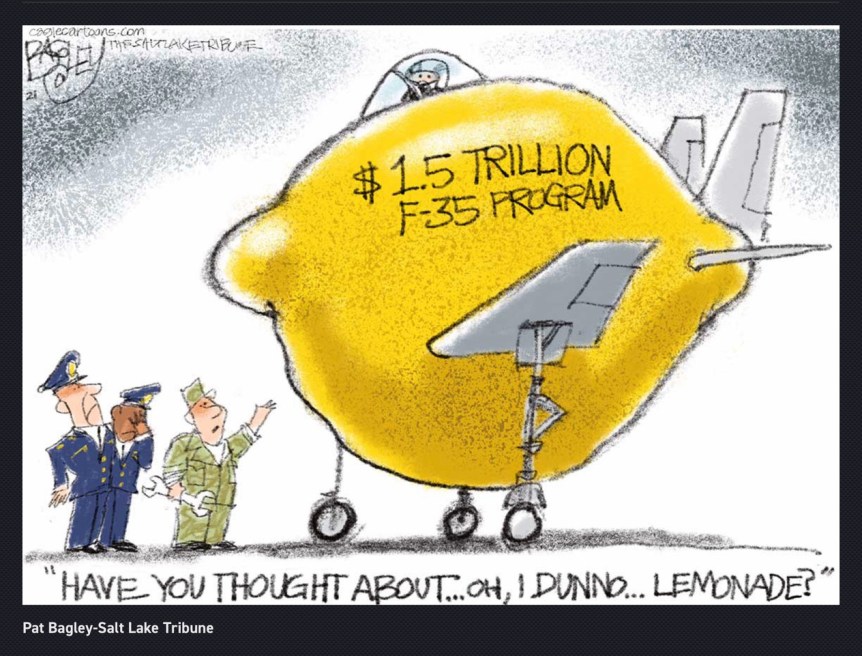
Now, I wish to stress my budget is about defense, as in defending the U.S. against all enemies, foreign and domestic. My budget is not about projecting imperial power around the globe; it’s not about full-spectrum dominance; it’s not about spending more than a trillion dollars over the next thirty years on unneeded nuclear weapons, or more than a trillion to buy and maintain more underperforming F-35 jet fighters.
Again, my sane budget is not a war budget, an imperial budget, or a budget to enrich U.S. weapons makers. It’s a budget intended to DEFEND our country.
So, let’s now compare my sane budget to the actual “defense” budget planned for FY2023. It appears that budget will likely exceed $833 billion, more than half a trillion higher than mine!
What could America do with half a trillion dollars? Think of how many good-paying jobs we could create, how much better our country could be, with safer roads and bridges, more alternative sources of energy, improved schools and hospitals, a cleaner environment. How about drinking water without lead in it? The list is long because we have so many needs as a country.
It wasn’t that long ago that $300 billion was considered more than enough for national defense. But since 9/11 the budget has spiraled upwards as the U.S. government pursued forever wars like Iraq and Afghanistan that ended disastrously. Things are now so bad that the Pentagon can’t even begin to pass a basic audit. Send a small army of accountants to the Pentagon and the brass surrenders instantly.
$333 billion is still an enormous sum of money, yet there will be many who’ll suggest this figure isn’t close to being enough for the brass, all those wearing stars who call the shots. My response: try it. If it doesn’t work, you can always boost the budget. But if you really want the Pentagon to think creatively, cut the budget to $333 billion and watch the real wars begin within the five-sided puzzle palace on the Potomac.
Three years ago, nature provided me a lesson in bird parasitism and its repercussions. Unbeknownst to me and especially to the yellow warblers I was watching, a cowbird snuck an egg into the warbler nest. The result is what you see in this photo I took:
Guess which one is the cowbird hatchling?
Cowbird chicks generally hatch quicker, and of course they’re bigger and can fight harder for food. What generally happens is what happened to the nest I was watching. The yellow warbler chicks died as the cowbird chick ate just about all the food provided by its warbler “parents.” All that was left in the end was a rather surly-looking cowbird chick that was incongruously bigger than the warbler “parents” that fed it. Nature can be cruel.
And, as I wrote about here, that cowbird chick made me think of a certain entity in Washington DC that always clamors for money, and which in its sheer bellicosity and bottomless appetite always dominates the nest and crowds out and kills its weaker yet more deserving rivals for sustenance. Yes, you guessed it: the Pentagon and the National Security State.
There’s something about the gaping mouth of that cowbird that says it all. For example, the Biden administration was planning on spending $813 billion on the Pentagon in FY2023, an already enormous sum, only for it to be revealed this week that a bipartisan effort in the Senate is seeking to increase this by $45 billion. That’s on top of the $55 billion or so provided to Ukraine, roughly half of which is going directly to America’s merchants of death.
As Jimmy Dore points out in this segment, at the same time as the Pentagon cowbird cries for and consumes all the money, smaller, vulnerable programs (our yellow warbler chicks) like money for free school lunches for 10 million needy kids are allowed to wither and die.
Imagine allowing kids in schools to go hungry because of alleged lack of funds but then funneling nearly a trillion dollars yearly to the parasitic Pentagon cowbird in our midst.
Nature can be cruel. So too is America’s political process.
Julian Assange before he was locked away for his truth-telling
W.J. Astore
The worst crime you can commit, in the eyes of the powerful, is to embarrass them and to reveal their crimes. That is what Julian Assange did, most notably about U.S. war crimes in Iraq, and that is why he is being hounded and punished. Assange is being made to suffer, and suffer greatly he is, because he spoke truth about the powerful to the powerless. That is arguably the number one job of a real journalist, to hold powerful people accountable, to reveal the truth when so many conspire to keep it hidden. But most journalists are not profiles in courage, just as most people aren’t. The courageous are few, and counted among their number is Assange.
If you’re a journalist looking to make a difference, to shed light in dark corners, do you dare to take on the U.S. government and national security state given its persecution of Assange? Do you want to spend years in a maximum security prison, almost in total isolation, facing extradition to the U.S. for a bogus and nonsensical charge? The U.S. government’s persecution of Assange, though it’s meant to punish him and silence him, is really about intimidating and silencing other journalists. Who now dares to follow Assange’s example?
Power operates most freely, meaning most tyrannically, when it’s unconstrained by accountability. The more Assange suffers, the more America slips into authoritarianism. Joining America in its drift toward tyranny is Great Britain and Australia, with Britain imprisoning Assange and approving his extradition and Australia doing nothing to stop the persecution of one of its own citizens. Such is the corrupting influence of power.
As usual, George Orwell explained all this in “1984” when he described the nature of power:
“The Party seeks power entirely for its own sake. We are not interested in the good of others; we are interested solely in power. Not wealth or luxury or long life or happiness; only power, pure power … [No] one ever seizes power with the intention of relinquishing it. Power is not a means, it is an end … The object of persecution is persecution. The object of torture is torture. The object of power is power. Now do you begin to understand me?”
Assange, like the character of Winston Smith in “1984,” now has a full understanding of the nature of power. It’s come at an enormous price to him. Yet Assange has also revealed the nature of our government to the rest of us, the way it brutally uses power to keep its monopoly on power.
The question is: Are we going to do anything about it? Or is it already too late? And if we do choose to resist, like Winston Smith (and Julian Assange), will we be taken to our own versions of Room 101, after which we too will profess our love for Big Brother?
Addendum: A comment by Dan White stimulated this reply by me. I think it’s worth adding here.
If not obliteration [of people like Assange], then marginalization, incarceration, diminishment, denouncement, and so on. Chelsea Manning. Daniel Hale. Daniel Ellsberg. And many more. Put them in prison and/or accuse them of treason. Seize their assets. Destroy their lives.
Most of all, intimidate those who are wavering, who are thinking, but who perhaps don’t have quite the nerve, or perhaps too much to lose.
The best way to silence whistle blowers is to make them choose to throw their whistle away before it even reaches their mouth.







 Bracing Views