America’s Longest Wars

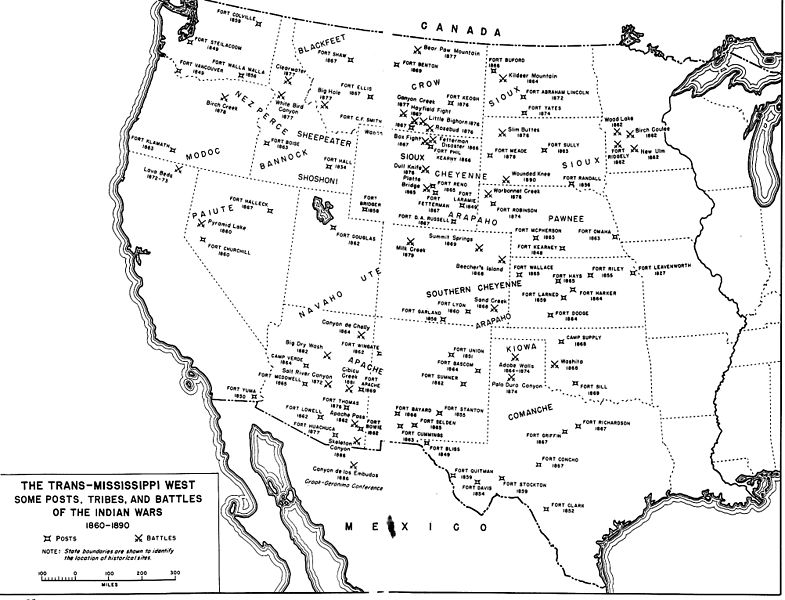
Just a few of the battles fought against Native Americans

W.J. Astore

A popular headline in the media is to describe the Afghan War as “America’s longest,” as in this brief summary today from Foreign Policy:

The war in Afghanistan, America’s longest, is now formally over. The 13-year war, which claimed more than 2,200 American lives and cost more than one trillion dollars, ended quietly at a ceremony in Kabul yesterday. U.S. President Barack Obama and other Western leaders promised their ongoing commitment under the rebranded Operation Resolute Support and insisted the war was a success. But the Taliban is poised for a comeback with a recent surge in violence in Kabul and around the country. There are concerns that Afghanistan’s military and fragile political institutions will crumble as the United States leaves.

There’s a big problem with this.  America’s longest war, by far, is not the recent Afghan War; it was its more or less continuous effort against Native Americans from the early 1600s to the late 1800s.  Americans like to forget that native peoples populated the land before European settlers began to arrive, and that these native peoples had to be killed, or corralled, or otherwise subjugated or shunted aside in the name of Manifest Destiny and in the pursuit of profit.

As historian John Grenier notes in The First Way of War: American War Making on the Frontier, 1607-1814,

For the first 200 years of our military heritage, then, Americans depended on arts of war … [that included] razing and destroying enemy villages and fields; killing enemy women and children; raiding settlements for captives; intimidating and brutalizing enemy noncombatants; and assassinating enemy leaders.

For Grenier, America’s “first way of war” relied on “extravagant violence” often aimed at “the complete destruction of the enemy,” in this case various Native American peoples.  This was indeed America’s longest war. Yet despite (or perhaps because of) its long duration and brutal violence, the war against indigenous peoples is rarely mentioned today, especially by those who seek to promote American exceptionalism.

Another longer war than the Afghan one, more recent in America’s memory, was the Cold War we fought against the Soviet Union and its allies from the close of World War II to the collapse of the Soviet Union in the early 1990s.  Lasting nearly half a century, this war ended in victory of a sort for the United States, even as its legacy continues to poison U.S. culture and foreign relations.  For the Cold War left us with an enormous military-industrial-Congressional complex, to include nuclear forces capable of destroying the planet, which the U.S. continues to feed and even to enlarge.  The result has been the growth of a second “shadow” government, a national security and surveillance state of enormous power, an apparatus with wide-reaching and unaccountable powers that is potentially a greater threat to American freedoms than the Soviet Union ever was.

When America forgets its longest wars, and especially when Americans forget the legacies of these wars, it’s more than history that suffers.

Update: Just after I wrote this, I came across this article on corporate “land grabs” that continue to bedevil Native Americans.  Some would argue that the long war against native peoples never really ended.  And to state a point that is perhaps obvious: the Afghan War grew out of the Cold War and U.S. efforts to embroil the Soviet Union in its own Vietnam in 1980.  U.S. efforts to support the Afghan “freedom fighters” against the Soviets contributed to the rise of Osama bin Laden, who would eventually turn against the U.S. in the 1990s.  America’s Afghan War, in other words, is not a 13-year war.  To understand it, one must look back to 1979-80 and the machinations of a U.S. foreign policy establishment that was much more concerned with hobbling the Soviets than with helping the Afghan people.

The Nuclear Triad Is Not the Holy Trinity

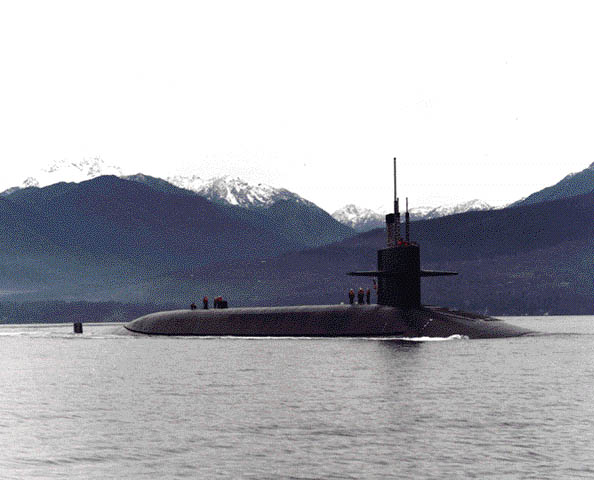
An Ohio-Class Submarine, armed with Trident nuclear missiles

W.J. Astore

America’s nuclear triad of land-based intercontinental ballistic missiles (ICBMs), sub-launched ballistic missiles (Ohio-class nuclear submarines), and nuclear-capable bombers is a relic of the Cold War.  The triad may have made some sense in a MAD (as in mutually assured destruction) way in the 1960s and 1970s, at the height of the Cold War with the USSR.  But it makes no strategic or financial (or moral) sense today.  Nevertheless, the U.S. is investing $10 billion over the next six years to update land-based ICBMs, missiles that should be decommissioned rather than updated precisely because they are both outdated and redundant.

The most survivable leg of the nuclear triad remains the U.S. Navy’s nuclear submarines, which carry Trident II missiles with multiple warheads.  These submarines are virtually impossible for any potential American foe to locate and sink in any timely fashion, therefore ensuring a survivable nuclear deterrent that is more than sufficient in any conceivable crisis.

Indeed, it’s arguable whether the U.S. needs any nuclear deterrent, given the size of the U.S. military and the power of its conventional military forces.  Even old Cold War warriors like Henry Kissinger have come out in favor of eliminating nuclear weapons from the earth, as did Barack Obama when he first ran for president in 2008.

But morality and common sense quickly disappear when politics and fear-mongering intervene.  States where nuclear missiles are currently based, such as North Dakota and Wyoming, want to keep them in their silos so that federal dollars continue to flow into local and state economies.  Fearful “hawks” point to the existence of nuclear missiles in China or Russia (or even Pakistan!) as the reason why the U.S. needs to maintain nuclear superiority, even though no country comes close to the power and survivability of the U.S. Navy’s Trident submarines.

And let’s not, of course, forget morality.  With Christmas coming, I recall something about “Thou Shall Not Kill” and loving thy neighbor.  Spending scores of billions (maybe even a trillion dollars!) to update America’s nuclear arsenal, an arsenal that has the capacity to unleash genocide against multiple enemies while plunging the planet into nuclear winter, seems more than a little contrary to the Christian spirit, whether at Christmas or indeed any time of the year.

The decision to “invest” in outdated and redundant land-based ICBMs says much about the American moment.  It’s almost as if our government believes the nuclear triad really is the Holy Trinity.  Heck — why else did our country choose to anoint genocidal nuclear missiles as “Peacekeepers“?

It should sadden us all that some American leader of the future may yet utter the line, “We had to destroy the planet to save it.”  Such is the horrifying potential and maddening logic of our nuclear forces.


More Thoughts on America’s Military Academies

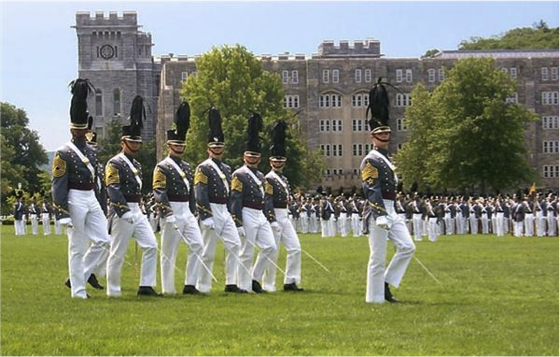
West-Point-Cadets-Marching1

W.J. Astore

The passionate discussion generated by our last article, America’s Military Academies Are Seriously Flawed, was heartening.  Our military academies will not be improved if we merely accept the status quo, with allowance for minor, mainly cosmetic, reforms.  But truly radical reforms are difficult to achieve since the academies are so deeply rooted in tradition.  A reluctance to change can be a good thing, especially when an institution is performing well.  Yet since the Korean Conflict, and certainly since the Vietnam War, America’s military performance has been mediocre.  Placing blame here is obviously contentious, with military professionals tending to point to poor decisions by civilian leaders, among other causes.

Rather than placing blame, let’s entertain some probing questions about the future structure and mission of military academies, with the intent of making them better schools for developing military leaders, as well as better institutions for defending America and advancing its values.

Here in no particular order are a few questions and proposals:

1.  Is America best served by military academies that emulate undergraduate colleges in providing a course of study lasting four years? Or should the academies recruit from students who have already finished most (or all) of an undergraduate degree?  The academies could then develop a concentrated course of study, specifically tailored to military studies, lasting roughly two years.  In effect, the academies would become graduate schools, with all cadets graduating with master’s degrees in military studies with varying concentrations (engineering, science, English, history, and so on).  Such a change would also eliminate the need to kowtow to undergraduate accreditation boards such as ABET.

2.  West Point and the AF Academy rely primarily on serving military officers as instructors, whereas Annapolis relies primarily on civilian instructors. Is this a distinction without difference?  Would West Point and the AF Academy profit from more civilian instructors, and Annapolis from more military ones?  Should all the service academies work harder to bring in top instructors from the Ivy League and similar universities as full-time visiting professors?

3.  How much of today’s experience at military academies is busy work? Or work driven mainly by tradition, i.e. “We do this because we’ve always done this.”  Do we still need lots of inspections, marching, parades, and the like?  Do freshman (call them plebes, doolies, smacks, what have you) truly profit from being sleep-deprived and harassed and otherwise forced into compliance as a rite of passage in their first year?  Does this truly develop character?  Or are cadet schedules so jam-packed that they have little time to think?

4.  Why do cadets continue to have limited exposure to the enlisted ranks? NCOs are the backbone of a professional military, a fact that is not stressed enough in officer training.  How do we increase opportunities for cadets to work with NCOs in the field?

5.  A strong emphasis on physical fitness and sports is smart. But is it necessary to place so much emphasis on big-time sports such as Division I-A football?  What is gained by focusing academy recruiting on acquiring athletes that will help to win football games?  What is gained by offering such athletes preferential treatment within the corps of cadets?  (Some will claim that athletes receive no preferential treatment; if you believe this, I suggest you listen very carefully to cadets who are outside of the charmed circle of celebrated athletes.)

6.  When I was a serving officer at the AF Academy, cadets used to ask me whether I believed they were “the best and the brightest.” Certain senior leaders had told them that, by virtue of being selected to attend a military academy, they were better than their civilian peers at universities such as Harvard or MIT.  Is it wise to sell cadets on the idea that they are America’s best and brightest?

How I answered the question: I told my cadets that comparing military academies to universities such as Harvard or MIT was an apples/oranges situation.  First and foremost, military academies were and are about developing military leaders of strong character.  If you compared cadets to their peers at Harvard or MIT, of course you’d find smarter students at these and similar top-flight universities.  But that wasn’t the point.  Military academies had a different intent, a different purpose, a different mission.  This answer seemed to satisfy my cadets; what I sensed was that they were tired of being told they were America’s best, when they could see for themselves that this often wasn’t true.

We do our cadets no service when we applaud them merely for showing up and working hard, just as our civilian leaders do the military no service when they applaud us as the best-led, best-equipped, best-trained, and so on, military force in all of human history.  Any student of military history should laugh at such hyperbolic praise.

7.  And now for a big question: Are the academies contributing to America’s current state of perpetual war? Have we abandoned Washington’s ideal of Cincinnatus, the citizen-soldier, the soldier who fights reluctantly and who seeks not military honors but only a return to normalcy and an end to war?

Some will argue that the world today demands perpetual vigilance and a willingness to use overwhelming “shock and awe” force to intimidate and defeat America’s enemies.  And that only a professional corps of devoted regulars can lead such a force.  Perhaps so.

But is it time to consider new paradigms?

What are the most serious threats that America faces today?  For example, American infrastructure is crumbling even as we spend hundreds of billions in Iraq and Afghanistan with indifferent results.  Should West Point return to its roots, unleashing its officer-engineers to lead a new Civilian Conservation Corps to rebuild America?  (Recall that George C. Marshall ran the CCC.)  Should America’s military be refocused not on winning the “global war on terror” (unwinnable by definition, for terror will always be with us), but on preserving the global environment?

As humans wage war against our planet and biosphere, should not a force dedicated to the defense of America focus on preserving our livelihood as represented by our planet’s resources?  With its global presence, the American military is uniquely situated to take the lead here.  Indeed, the U.S. Navy already advertises itself as “A global force for good.”  Can we make that a reality?

Too pie in the sky?  The U.S. military has enormous resources and a global role in leadership.  What would it mean to America if our military took the lead in preserving the earth while rebuilding the core strength of America?  Aren’t these “wars” (against global environmental degradation; for America’s internal infrastructure) worth fighting?  Are they not more winnable than a perpetual war on terror?

There you have it.  Let’s hear your ideas in the comments.  And thanks.

America’s Military Academies Are Seriously Flawed

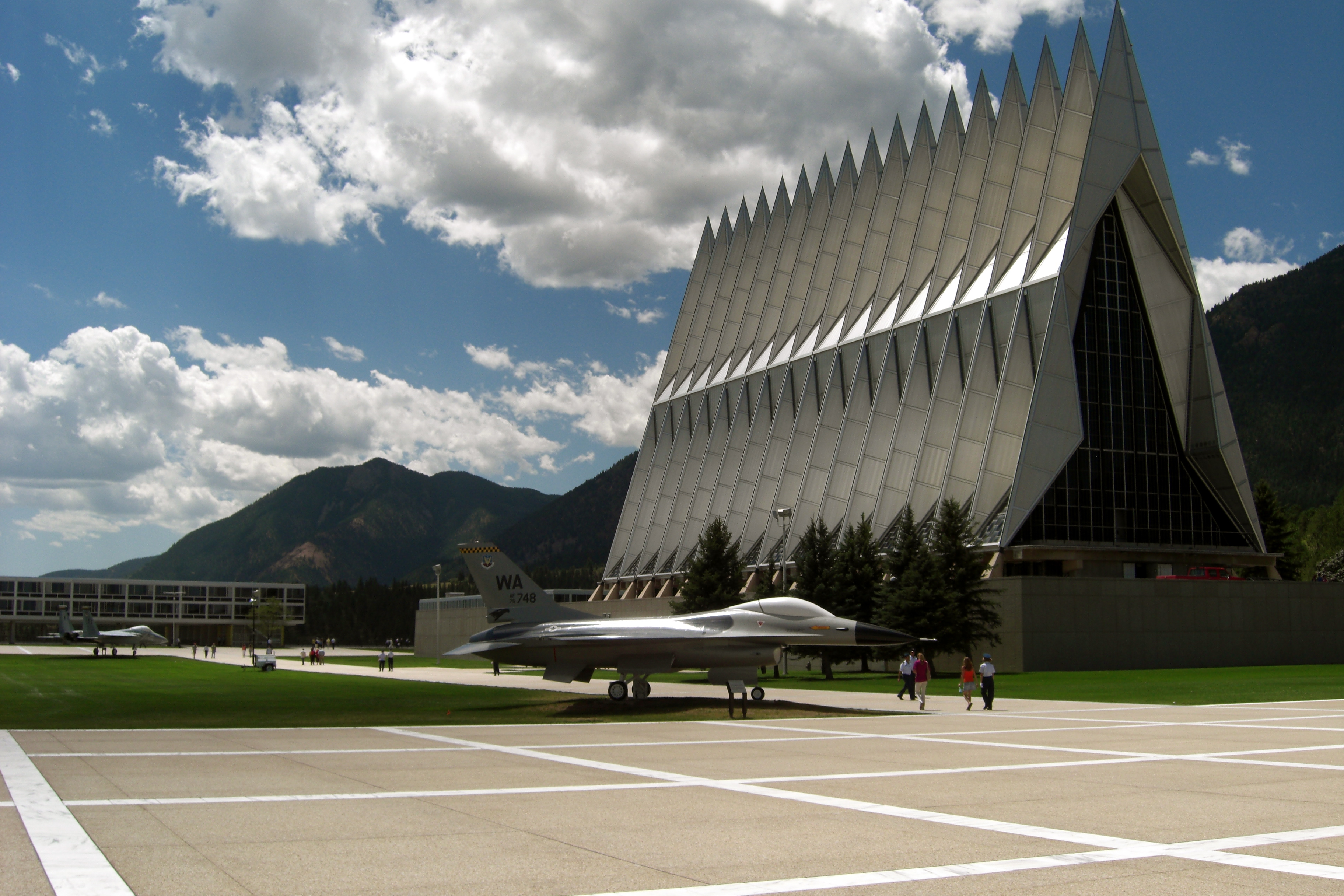
The Air Force Academy Chapel: God and Fighter Jets

W.J. Astore

U.S. military academies are neither Spartan in being dedicated to war, nor are they Athenian in recognizing humanism (even the humanism of war).  They are Archimedean.  They focus on engineering and the machinery of war.  But two millennia ago even Archimedes with his clever war machinery could not save Syracuse from defeat at the hands of Rome.

There is a lesson here for America’s military academies – if only they spent more time studying history and the humanities and less time solving equations.  But they do not.  I taught history at the Air Force Academy (AFA) for six years.  My experience?  The AFA was far too focused on STEM subjects (science/tech/engineering/math) to the neglect of history, political science, and the humanities.  Today, America’s military cadets still concentrate on STEM, and they still receive Bachelor of Science degrees, even when they choose to major in subjects like history.

A technical emphasis may make sense for Air Force test pilots or Navy nuclear engineers; it does not make sense for Marine or Army lieutenants patrolling the mountains of Afghanistan.  Nor does it make sense in counterinsurgency warfare and nation-building operations, which involve soft skills and judgment rather than kinetic action and calculation.  Small wonder that the U.S. military in 2007 had to hire civilian anthropologists to teach the troops that winning is not only about hammering the enemy with superior firepower.

Emerging from an engineering mindset, young officers are too number-oriented, too rule-bound, too risk-averse.  U.S. military officers, old as well as young, tend to think geopolitical problems – even in destabilized cauldrons like Iraq and Afghanistan – are solvable if you identify and manipulate the right variables.  They think history and politics, human and cultural factors, can be controlled or compensated for.

Ever since their service academy days, they have internalized a puzzle-solving mindset, one that is suitable to technocratic hierarchies in which “progress” is measured by metrics.  Their thinking about war is infected by quantification and business-speak in which assets are leveraged and force is optimized.  Reinforcing this impoverished view of war is an officer evaluation system that stresses numbers, numbers, and more numbers, since if it cannot be quantified, it did not happen or does not exist.

When I was an officer and professor teaching history, many military cadets would ask, “What can I do with a History degree?”  They were thinking not in terms of which course of study would make them savvier, more effective, officers and leaders.  They were thinking in terms of which academic major would help them become a pilot (even better: a test pilot or astronaut), or they were thinking which major would make them more marketable once they left the military.

As a result, the vast majority of cadets at the Air Force Academy took two, and only two, history courses: a one-semester survey on world history and another survey course on military history.  (Cadets at West Point take more history courses, but technical subjects are over-stressed there as well.) They had virtually no exposure to U.S. history (unless you count AF heritage or Academy trivia as “history”), but plenty of exposure to thermodynamics, calculus, physics, civil engineering, astronautics, and related technical subjects.  Naturally, an engineering mentality pervaded the air.  Notably absent were critical and sustained studies of recent U.S. military performance.

Combine a reductive, problem-solving approach shared among U.S. military officers with the dominance of lawyers in U.S. governmental systems and you have a recipe for number-crunching rationality and rule-bound conformity.  Solutions, when proffered by such a system, involve cleverness with weapons and Jesuitical reasoning with laws.  A perfect example: America’s high-tech drones and the tortured legal reasoning to sanction their assassination missions.

Educated as engineers and technicians, young officers are deployed to places like Iraq and Afghanistan and charged with negotiating the “human terrain” of cultures utterly foreign to them.  Lacking knowledge of their own history as well as the history of the cultures they walk among, it is hardly surprising that they make little progress, despite hard work and honorable intentions.

Today’s U.S. military likes to fancy itself a collection of warriors, but America is not Sparta.  Today’s military likes to fancy itself the bringers of democracy, but America is not Athens.  Today’s military is Archimedean, infatuated by technology, believing in smart machines and victory achieved through violent action — much like America itself.

But mastery of machines by the military or, for that matter, tortured legalistic gymnastics by civilian commanders, is not in itself sufficient for victory.  Just ask Archimedes at Syracuse, or a US Marine at Fallujah, or even the constitutional lawyer-in-chief at the White House.

Inserting American Bodies in Iraqi and Afghan Dikes

Image is everything
Bush rebranded as a war president: Mission Accomplished!

W.J. Astore

The United States continues to insert the bodies of its troops into leaky Iraqi and Afghan dikes.  That’s the image that came to mind with the recent news from Iraq and Afghanistan.  More American “advisers” and weapons being sent to Iraq.  The revival of night raids by U.S. Special Forces in Afghanistan.  No matter the piss-poor results in Iraq or Afghanistan, the U.S. continues to double down on losing hands.

Why is there no learning curve in Washington?  A big reason is that President Obama’s decisions have been, are, and will be driven by domestic politics.  The Democrats don’t dare withdraw from either war since ISIS or the Taliban would grow in strength (at least in the short-term), and the Republicans would eagerly blame the Democrats for “losing” wars that George W. Bush and General David Petraeus and U.S. troops had allegedly won.

The cynical Democratic solution to this dilemma is to plug the Iraqi and Afghan dikes with more U.S. troops (and, most likely, more casualties) until after the election of 2016.

Domestic political advantage is often the major reason for continued folly in lost wars.  We saw it in Vietnam: neither LBJ nor Nixon wanted to be seen as having “lost” Vietnam.  Nixon in particular had his eye on the election of 1972 as well as on posterity as he made decisions about the war.

America’s wars overseas are far too often driven by public relations for domestic consumption.  Consider the invasion of Iraq in 2003 and the Bush Administration’s announcement of “Mission Accomplished,” a staged Hollywood photo op meant to cement Bush’s status domestically as a war leader.  Far better it was to have an image of co-pilot Bush landing in a flight suit on an aircraft carrier than one of a befuddled Bush reading about pet goats to schoolchildren on the morning of 9/11.  Obama is hardly guiltless here.  Even as he questioned the Iraq war, he ran in 2008 on the idea of Afghanistan being the necessary war, thus immunizing himself from charges of being “soft” on defense.  Afghanistan is no closer to being “won” for the U.S. today than it was six years ago, yet Obama’s folly continues, aggravated by recent orders to return American troops to Iraq.

Internationally, it’s strategic folly for the U.S. to persist in these wars.  But domestically, endless wars act as a coat of armor to deflect charges of being a wimp (for Obama) or of being incompetent (for Bush after 9/11).  With his drone strikes, Obama has become the assassin-in-chief, even as Bush with the invasions of Afghanistan and Iraq became the “war president” (at least in his own mind, together with the minds of a subservient and fawning media).

Christ said, “Blessed are the peacemakers,” but America has no time for peace.  Not when “peace” leaves one open to political charges of being an un-American wimp and loser.

Want to help change this?  At the very least, vote for the candidate in 2016 who vows to end America’s wars in Iraq and Afghanistan.  Vote for the candidate who vows to end the practice of stuffing American bodies into so many of the world’s leaky dikes.  Vote for the candidate who stands for peace rather than for war.  Regardless of the election results, that candidate won’t be a “loser.”  For in America today, in a land tortured by gusty winds of war, it’s far gutsier to stand for peace.

Would a better prepared U.S. have used torture?

tmw2014-08-13colorlarge

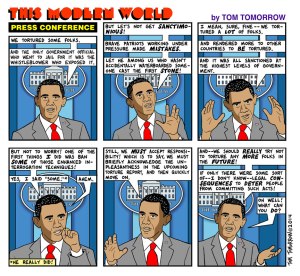
The so-called Senate CIA Torture Report is supposed to be released today.  Five years ago, I wrote an article for Nieman Watchdog on the Bush Administration’s decision to resort to “enhanced interrogation techniques,” or torture in plain speak.  Torture, I wrote back then, was the refuge of the impatient and incompetent, an approach that abrogated America’s fidelity to international treaties even as it became habit-forming.  In other words, the resort to torture simply begat more torture, irrespective of results.  As President Obama said, “We tortured some folks.”  And so on.  W.J. Astore

COMMENTARY | May 18, 2009

Did a lack of trained interrogators with appropriate language proficiency lead Bush administration officials to embrace torture as a ‘short cut’? A former dean at the Defense Language Institute writes that America was unprepared to wage a patient and savvy war of counterintelligence against Al Qaeda – which may have made less humane and less effective methods seem like an attractive option. Seventh in a series of articles calling attention to the things we still need to know about torture and other abuses committed by the Bush administration after 9/11.

By William J. Astore

In a letter dated May 10, 2007, General David H. Petraeus wrote to American troops serving in the Multi-National Force in Iraq:

Some may argue that we would be more effective if we sanctioned torture or other expedient methods to obtain information from the enemy.  They would be wrong.  Beyond the basic fact that such actions are illegal, history shows that they also are frequently neither useful nor necessary.  Certainly, extreme physical action can make someone “talk;” however, what the individual says may be of questionable value.

Petraeus’s directive to the troops was unequivocal: Besides being illegal, torture is counterproductive, unnecessary, and generates “intelligence” of dubious reliability.

Evidence suggests the U.S. military was telling the Bush Administration these cold, hard facts all along.  Why then did George Bush and Dick Cheney approve torture under the guise of “enhanced interrogation techniques”?

To answer this question, I think we need to remember not only the immense pressure the Bush Administration was under in 2002 (the events of 9/11, after all, occurred on their watch), not only their idée fixe for a settling of accounts with Saddam Hussein and Iraq, but also America’s lack of preparedness to wage a patient and savvy war of counterintelligence against Al Qaeda.

I witnessed this indirectly at the Defense Language Institute Foreign Language Center (DLIFLC), where I served as the Associate Provost/Dean of Students from 2002 to 2005.  Clearly, the U.S. lacked translators, interpreters, and especially trained military interrogators.  I recall interrogators being pulled from assignments at DLIFLC and reassigned to operational tours in the Middle East and Central Asia; the problem was that their language proficiency was often in Chinese or Korean or a Romance language – not, as one might expect, in Arabic, Pashto or Dari.

Few people understand how long it takes to produce a skilled military interrogator.  Attaining basic language proficiency in Arabic takes nearly 18 months of constant training at DLIFLC.  But attaining mastery of the language and the culture – the acuity and sensitivity to interrogate a suspect who’s deliberately trying to mislead you – takes years and even decades of study and practice.  From 2002 to 2005, it may be that our country simply didn’t have enough skilled and disciplined interrogators to take the indirect approach.

Torture, I’m suggesting, wasn’t used because of a simple Machiavellian calculus of “the ends justify the means.”  Rather, we lacked the most humane and most effective means to attain the ends that the Bush Administration so desperately wanted – “actionable intelligence” that could prevent yet another 9/11 from occurring on their watch.  So they deployed “enhanced interrogation techniques,” which carried with them not merely the risk but the certainty of excesses and mistakes.

As investigators look more closely at America’s resort to torture, they should ask if we decided to go rough because we couldn’t go smooth.  Because we lacked the language and cultural skills to play good cop, we played bad cop as a short cut.  The problem, of course, is that short cuts are habit-forming.  And in the name of results, they often sacrifice the essential for the expedient.  In the case of the Bush Administration, not only did torture apparently provide unreliable intelligence: It also abrogated America’s fidelity to international treaties that forbade torture, and compromised our own ethos of truth, justice, and the American way.

Here, the lessons of the French in Algiers continue to resonate.  Think back to the revelations of General Paul Aussaresses in 2001, which scandalized France.  Aussaresses unrepentantly confessed that, in attempting to suppress terrorism in Algeria in the 1950s, detainee abuse, torture, even murder became routine, first-choice, approaches.  The resort to torture simply begat more torture.

Investigators should look at whether this dynamic also applied to America in Afghanistan and Iraq.  How many of our counterterrorist experts became like General Aussaresses: Self-perceived patriots who believed torture and even murder were justified in the name of protecting the state?  After all, if the state’s essential purpose is to protect its citizens, and you’re dealing with an enemy that’s malevolently contumacious, as Al Qaeda appeared to be, what’s to stop avowed “patriots” from torturing suspects, especially when the state’s leaders have authorized harsh techniques and are pressing you for results?

Patriotism, it’s been said, is the last refuge of the scoundrel.  Is torture the last refuge of the impatient and the incompetent?  If so, how do we instill patience and competence?  Of the hundreds of billions we spend on national defense each year, surely we should dedicate more funding to training and retaining skilled and disciplined military interrogators.  Counterterrorism succeeds or fails based on human intelligence (HUMINT).  But to get the most reliable HUMINT, we have to be able to outsmart our foes.  And the best way to do this is to treat them as humans, not as vessels to be beaten until they voice the echoes of our worst fears.

Updated (12/9/2014, 11:50AM EST): The Executive Summary to the “Torture Report” has been released.  I’ve scanned the first 40 pages.  One remarkable data point is that supposedly the CIA did not brief the President on the full extent of the “enhanced interrogation techniques” until April 8, 2006.  In short, the CIA and its hired contractors used certain torture techniques on their own authority for four years.  Here’s an excerpt from the report:

On August 1, 2002, based on comments from White House Counsel Alberto Gonzales, the talking points were revised to eliminate references to the waterboard.  CIA records indicate, however, that the talking points were not used to brief the president. On August 2, 2002, the National Security Council legal advisor informed the DCI’s chief of staff that “Dr. Rice had been informed that there would be no briefing of the President on this matter, but that the DCI had policy approval to employ the CIA’s enhanced interrogation techniques.”

Records state that prior to the use of the CIA’s enhanced interrogation techniques on Abu Zubaydah in 2002, the CIA did not brief Secretary of State Colin Powell or Secretary of Defense Donald Rumsfeld, two members of the National Security Council, on the techniques. The Committee, including the chairman and vice chairman, was also not briefed on the CIA’s enhanced interrogation techniques prior to their use.

It seems like the CIA is shouldering all of the blame here.  The failure (if it was that) to brief the president, the secretary of state, the secretary of defense, as well as the Senate Intelligence Committee, constitutes a fundamental breakdown in Constitutional safeguards.  (Unless, of course, the “failure” to brief senior civilian leaders was all about protecting them and maintaining “plausible deniability.”)

Whatever else the report reveals, this violation of the Constitution is especially egregious.  If true, it would suggest that the CIA should be severely disciplined or even disbanded.

But I truly doubt whether the buck stops with rogue elements in the CIA …

Update (12/10/14): Eric Fair was a contract interrogator for the Army in 2004.  In an Op-Ed for the New York Times today, he writes:

I was an interrogator at Abu Ghraib. I tortured.

Today, the Senate released its torture report. Many people were surprised by what it contained: accounts of waterboardings far more frequent than what had previously been reported, weeklong sleep deprivation, a horrific and humiliating procedure called “rectal rehydration.” I’m not surprised. I assure you there is more; much remains redacted.

Most Americans haven’t read the report. Most never will. But it stands as a permanent reminder of the country we once were.


More Military Interventions? For what, Ashton Carter?

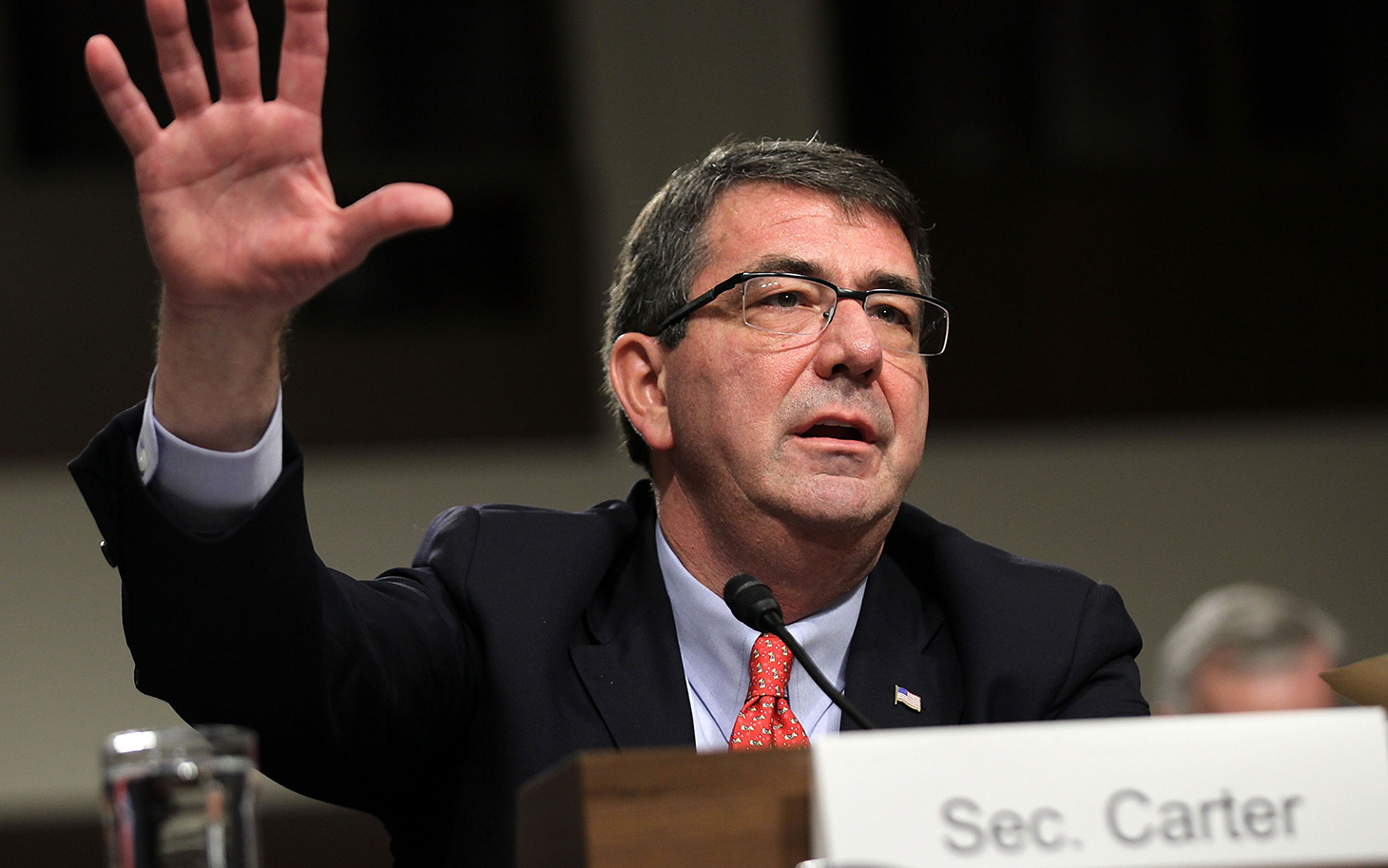
Ashton Carter,  I have some questions for you
Ashton Carter, I have some questions

W.J. Astore

The juxtaposition of two stories in my NY Times military “feed” got me to thinking this morning.  The first story involves Ashton Carter, President Obama’s nominee to replace Chuck Hagel as America’s new Secretary of Defense.  Carter, the article suggests, is a “centrist who may advocate a stronger use of American power.” The second article updates American casualties in Afghanistan, noting that the Department of Defense (DoD) has identified 2,340 American troops who have died in the Afghan War and related operations.  Died for what was left unspecified.  A resurgent Taliban?  Record-setting opium production in Afghanistan?  An Afghan governmental power-sharing agreement that is actually contrary to its official constitution?

In U.S. governmental circles today, you’re “serious” if you favor military aggression and interventionism overseas; you’re hopelessly idealistic if you favor non-intervention and strategic retrenchment.

This is apparently why Chuck Hagel was ash-canned.  A Vietnam War veteran, Hagel was skeptical about continued U.S. military interventionism in Afghanistan, Iraq, and elsewhere.  Hagel knew from experience that Vietnam — a supposedly necessary war to combat communism — was actually a sucking chest wound that rapidly debilitated the U.S. military even as it deeply divided the country.  Such hard-won experience is in short supply in Washington today, which is why it’s sad to see Hagel being booted out of the corridors of power.

His replacement, Carter, is a technocrat who lacks military experience.  His main experience is as a weapons buyer for the DoD.  His confirmation hearings should be friendly, unlike those of Hagel, who’d been impolite to question the Iraq War, the success of the Petraeus Surge, as well as Israeli governmental actions.

Back to those casualty figures.  It was only after Vietnam became a sucking chest wound that the U.S. finally cut its losses and pulled out.  The problem with the latest wars is that they are not a sucking chest wound; they are more like slow internal bleeding.  The pain threshold seems tolerable to bloodless government bureaucrats, but of course it isn’t, especially to those families who’ve lost loved ones in these never-ending wars of choice.

At Ashton Carter’s confirmation hearings, the first questions should be: What is your plan to end America’s wars in the Middle East and Asia?  And how many more young American troops have to die before your plan to end these interventionist and unnecessary wars comes to fruition?

Something tells me these questions won’t only go unanswered: they won’t even be asked.

Update (12/7/14): Upon being introduced by President Obama, Ash Carter praised the U.S. military as “the greatest fighting force the world has ever known.”  Such hyperbolic praise of the U.S. military is standard today. Consider these words of Obama on 8/7/2013 that the U.S. military is “the best-led, best-trained, best-equipped military in human history.” Instead of exaggerated praise, what the U.S. military needs today is forceful leadership by civilians who are not content to look in a mirror that reflects a narcissistic opinion that the U.S. has the fairest military of them all.

Some might claim that such praise, even if unmerited, is harmless.  Such is not the case.  For how can you exercise firm oversight over a powerful and sprawling bureaucracy when you praise it as being the best in human history?  Such praise is not only exaggerated — it’s counterproductive.  More than that: it’s unhinged.


Kicking the Vietnam Syndrome

President George H.W. Bush, fist clenched, ready to smack down the Vietnam Syndrome

W.J. Astore

The Vietnam Syndrome refers to an alleged reluctance on the part of the United States to use military force after the disaster of the Vietnam War.  In a recent article, Tom Engelhardt reminds us that President George H.W. Bush referred to the success of Desert Shield/Storm in 1990-91 (which evicted Iraq from Kuwait) as helping America to overcome its reluctance to fight wars (a laudable achievement, right?).  In Bush’s words:

“It’s a proud day for America. And, by God, we’ve kicked the Vietnam syndrome once and for all.”

Indeed, let’s give thanks to God for overcoming our reluctance to engage in wars of choice thousands of miles from American shores.  Wars that debilitate the U.S. even as they spread destruction among the peoples of foreign lands.

Let’s return to President Bush’s phrase and deconstruct it.  “It’s a proud day for America.”  Proud because the U.S. military, aided by coalition forces, defeated an Iraqi opponent that possessed a third-class military?  To use a sports analogy, would the New England Patriots football team be “proud” of defeating a Division III college football team?  “By God.”  Does God really march solely with American troops?  Did America win because its god is bigger than the Iraqi “idol” god, as Christian soldiers like General William Boykin have suggested in the past?  “Kicked the Vietnam syndrome once and for all.”  So it’s a good thing America has “kicked” its reluctance to engage in costly wars of intervention, not only in the immediate aftermath of Desert Storm, but for “all” time?

Following the example set by Engelhardt in his article, let’s play a game of role reversal here, and imagine Bush’s quotation coming from the mouths of others:

“It’s a proud day for Germany.  And, by God, we’ve kicked the Hitler/Nazi syndrome once and for all.”  Said by a newly unified Germany after invading Poland in 1991 to reclaim territory ceded in the aftermath of World War II.

“It’s a proud day for Russia.  And, by God, we’ve kicked the Afghan War syndrome once and for all.”  Said by Vladimir Putin after Russia’s invasion and conquest of Ukraine.

Now, imagine how U.S. leaders would respond to such statements.  Would they not be denounced as bombastic?  Propagandistic?  Delusionary?

One might argue that Desert Storm was an international “police action” in response to Iraqi aggression.  OK.  How about America’s ongoing war in Afghanistan?  The invasion of Iraq in 2003?  The destabilization of Libya?  An open-ended, and apparently never-ending, “global” war on terror?

The real “Vietnam Syndrome” was not a reluctance by the U.S. to use military force in the aftermath of that war.  It was a reluctance to face the legacies and lessons of that war, a failure truly to learn from its violent excesses, a failure to say “no, never again” and to mean it.

By continuing to wage unwinnable wars in regions of marginal interest to the American people, the country is slowly succumbing to this syndrome.  The cure is simple: put an end to these wars.  Only then can an American president truly speak of taking pride in kicking the Vietnam syndrome once and for all.

Charles Darwin Has Much to Teach Us About War

Charles Darwin
Charles Darwin

W.J. Astore.  Also at Huff Post.

America’s thinking about military action is impoverished. The U.S. military speaks of precision munitions and surgical strikes, suggesting a process that is controllable and predictable. Experts cite Prussian military theorist Carl von Clausewitz for his axiom that war is a continuation of political discourse with the admixture of violent means. Here, military action is normalized as an extreme form of politics, suggesting again a measure of controllability and predictability.

But what if war is almost entirely imprecise and unpredictable? What if military action and its impacts are often wildly out of line with what the “experts” anticipate? In fact, this is precisely what military history shows, time and time again, to include recent U.S. military actions in Iraq and Afghanistan.

U.S. military action essentially acts like hammer blows that upset the state of nature within the complex ecologies of societies like Iraq and Afghanistan. These blows ripple in unpredictable directions, creating new states of nature that change the ecologies of these societies in fundamental ways. They further generate fault lines that are often contrary to U.S. goals and interests.

Charles Darwin can lend a hand in explaining why this is so. Darwin is best known for his theory of evolution with its idea of “the survival of the fittest,” although Darwin did not use that term when he originally published The Origin of Species in 1859. Indeed, Darwin’s view of evolution was highly complex and multifaceted, as befits a man who studied the natural world in great detail for his entire adult life.

In an earlier, unpublished version of his masterwork, Darwin employed a complex image, known as the “wedge” metaphor, to explain interactions within the natural world that led to species extinction. Here is the way Darwin described “The Struggle for Existence” in his Notebook prior to The Origin of Species:

Nature may be compared to a surface covered with ten‐thousand sharp wedges, many of the same shape & many of different shapes representing different species, all packed closely together & all driven in by incessant blows: the blows being far severer at one time than at another; sometimes a wedge of one form & sometimes another being struck; the one driven deeply in forcing out others; with the jar & shock often transmitted very far to other wedges in many lines of direction: beneath the surface we may suppose that there lies a hard layer, fluctuating in its level, & which may represent the minimum amount of food required by each living being, & which layer will be impenetrable by the sharpest wedge.

In his model of the face of nature, Darwin showcases the interconnectedness of all species, together with the way in which changes to that face (the hammer blows) favor some species (wedges) while forcing out others. The hard layer, which represents the minimum amount of food for all, and which Darwin says cannot be penetrated, suggests an ecology that will continue to sustain life even as some species (wedges) are forced out and die off. The face of nature constantly changes, some species perish, but life itself endures.

How does Darwin’s wedge metaphor apply to military action? Consider, for example, U.S. airstrikes in the Middle East. They are the hammer blows, if you will, to the face of nature in the region. The wedges are various groups/sects/factions/tribes in the region. The U.S. believes its hammer blows will force out “bad” wedges, driving them toward extinction, which will ultimately improve the prospects of “good” wedges, such as so-called moderates in Syria. But what if U.S. blows (airstrikes and other violent military action) are driving radical sects (wedges) more deeply into the face of nature (in this case, the face of politics and society in the Middle East)? What if these radical sects, like Darwin’s driven wedges, are forcing out rival sects that are more moderate? What if the “jar & shock” of these U.S. military hammer blows is being propagated throughout Middle Eastern societies and Islam in ways that are as unpredictable as they are long-lasting?

Darwin’s complex wedge metaphor should make us think more deeply about the results of blows to complex, interconnected, and interdependent systems. Using military strikes in an attempt to destroy “bad” wedges may have the very opposite effect than the one intended. Instead of being destroyed, such wedges (such as the Islamic State) are driven deeper into the ecology of their communities, helping them to thrive, even as they send out vibrations “in many lines of direction” that harden the new ecology of the region against U.S. interests.

What, then, to make of Darwin’s “hard layer” in his wedge metaphor, which varies in its level but which persists in that no wedge may penetrate it? The “hard layer” represents that which all wedges can’t do without. All species are dependent on a source of food and energy, a source of sustenance to sustain reproduction. Darwin notes that the hard layer fluctuates, and though he doesn’t explicitly state it, those fluctuations must also act much like blows, displacing some wedges while favoring others with effects that ripple across the face of nature.

Rise or fall, the “hard layer” persists, meaning life on earth persists, even as individual species perish. Darwin explicitly states that no wedge can penetrate the hard layer, but here his metaphor breaks down when we consider humans as a wedge. Because humans can and do penetrate that layer. As a species, we do have the capacity to damage, even to destroy, the hard layer of nature upon which all species are dependent. We’re the killer wedge in the wedge metaphor.

Politically speaking, piercing that hard layer in the Middle East would be equivalent to igniting a new Crusade that leads to world war, one involving nuclear weapons or other forms of WMD. Devolution in place of evolution.

Of course, one shouldn’t push any metaphor too far. That said, Darwin’s “wedge” metaphor, in its imagery and subtlety, is more useful in understanding the complexity and unpredictability of military action than analogies that reduce war to exercises in precision surgery or power politics.

William Astore is a retired lieutenant colonel (USAF) and former professor of history who edits the blog The Contrary Perspective.

In Iraq, That Dog Don’t Hunt

That President Don't Hunt?
That President Don’t Hunt?

W.J. Astore

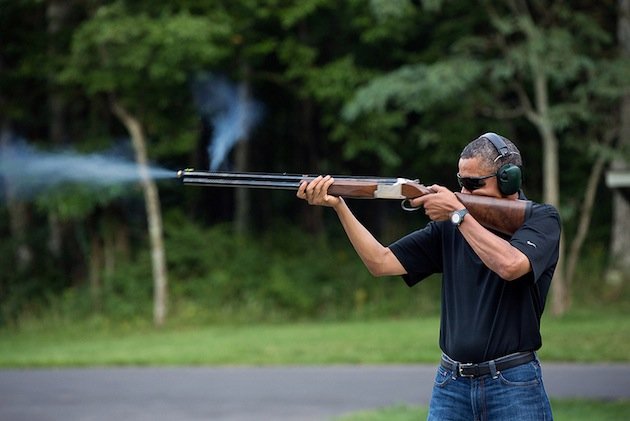
News that President Obama has doubled the number of American troops (whoops — I mean advisers) in Iraq to 3100 is already a tacit admission of defeat in that troubled region.  Let’s recall that the Iraqi security forces the U.S. trained and equipped to the tune of $25 billion simply melted away when faced with serious combat this summer.  Their performance put me to mind of the National Rifle Association’s slogan against John Kerry in the presidential campaign of 2004.  Kerry had gone bird shooting, mainly it seems to be photographed with a gun in his hand, a necessity for any red-blooded American male (just ask Obama).  But the NRA wasn’t fooled (or so they claimed).  “That dog don’t hunt,” the NRA said about Kerry.  And something about that slogan stuck.

You could say the same of that Iraqi army that the U.S. created and funded and trained and equipped: That dog don’t hunt. Or, it won’t hunt for us.  Because that’s not its purpose.  That’s not how or even why we trained it.  But that’s OK.  We’ll just send more American troops to Iraq, and waste more money, further destabilizing the region, making it even easier for radical jihadists to recruit more followers, whether to the ISIS banner or some other Islamist flag (Khorasan, perhaps?).

It’s just incredible how inept U.S. foreign policy is today.  If George C. Marshall had been like this during World War II, we’d be speaking German today at the Pentagon, instead of simply misinterpreting Clausewitz.

Of course, Congress will have to authorize funding for the latest U.S. military misadventure.  Anyone want to offer odds on Congress actually exercising oversight on our foreign entanglements?  A long shot, indeed.

Even as Congress seeks to cut funding to the poor, there’s always plenty of money for military adventurism overseas, no matter how often those adventures fail.  When it comes to exercising real oversight, Congress is always a lame duck — so lame that even a dog that don’t hunt (that Iraqi military again) succeeds in bagging billions of dollars from the American taxpayer.

The moral to the story?  America doesn’t lack for guns; we lack for brains.

Update: Iraq has “shook up” its military, relieving 26 officers of their commands and forcibly retiring 10 others, even as 18 new commanders were appointed by Prime Minister Haider al-Abadi among promises of greater professionalism and less graft and corruption.  Progress?  Time will tell.  But what does it say about a military that, in spite of prolonged training and massive infusions of cash from the U.S., was so ridden with corruption that it collapsed when facing its first challenge?  Sadly, the need for ever more U.S. advisers and money suggests this is yet another case of rearranging the deck chairs on the Titanic.

Update 2 (written by b. traven)

What is truly tragic is how the back story to the total failure of the Bush-Cheney wars is not reviewed by Obama, the Senate, or the House as this tragedy for Iraq unfolds. Obama just continues to follow the Bush lies by one week saying no “boots on the ground” while his top military people say “yes, more boots” and the next week Obama announces doubling the number of troops with no sense of embarrassment. And the American people stay entranced with baseball, football, and basketball scores.

And you can say you saw it here first. No sooner had General Dempsey said he wanted more troops in Iraq then Obama complied by doubling the force. Now Dempsey has told Obama what he wants even more troops so you can count on Obama complying in a couple of weeks. There’s nothing like doubling down on a failed policy in hopes that the result will come out differently than the last failure. Here’s Dempsey’s new demand as reported in the Guardian of London newspaper:

“The top-ranking officer in the American military said on Thursday that the US is actively considering the direct use of troops in the toughest upcoming fights against the Islamic State (Isis) in Iraq, less than a week after Barack Obama doubled troop levels there.

General Martin Dempsey, the chairman of the joint chiefs of staff, indicated to the House of Representatives armed services committee that the strength of Isis relative to the Iraqi army may be such that he would recommend abandoning Obama’s oft-repeated pledge against returning US ground troops to combat in Iraq.”

President Truman fired the most renowned five star General of his day, Douglas MacArthur for voicing a policy contradicting Truman’s in regard to China. If we had a real president he would do the same with Dempsey, who is certainly no MacArthur.