Wrapping herself in the flag: Hillary talks foreign policy in San Diego, Calif. (AP Photo/John Locher)
W.J. Astore
Yesterday, Hillary Clinton gave a foreign policy speech in San Diego that was notably flat and misleading. It’s been getting decent reviews in the mainstream media for the zingers she tossed at Donald Trump. But when you listen to the speech (you can watch it here) and think about it, you realize how insipid and unoriginal it really was.
Here are my thoughts on Clinton’s speech:
1. The speech featured the usual American exceptionalism, the usual fear that if America withdraws from the world stage, chaos will result. There was no sense that America’s wars of choice in Iraq, Afghanistan, Libya, etc. have greatly contributed to that chaos. Oh, there was also the usual boast that America has the greatest military. That’s what Imperial and Nazi Germany used to boast — until the Germans lost two world wars and smartened up.
2. Hillary mentioned we’re electing “our” next commander-in-chief. No, we’re not. The president is a public servant, not “our” commander-in-chief. The president serves as the civilian commander-in-chief of the military, and the military alone.
3. Hillary mentioned the US has a “moral obligation” to defend Israel. Why is this? Sure, Israel is an American ally, but why is Israel the one country we’re “morally” obligated to defend? There’s only one country we’re morally obligated to defend, and that’s the USA, assuming our government is actually honoring the US Constitution.
4. The speech had no new ideas. It was a laundry list of neo-conservative principles about making America stronger, safer, and so on. As a friend of mine put it, “Nothing that I heard her say deviated in any way from her hawkish record of recommending bombing at every opportunity.”
5. Hillary seems to have two speech-giving styles: a somewhat bored monotone and a somewhat agitated yell. A line like, “this isn’t reality TV, it’s reality,” should have been a big applause line, but her delivery was flat and her timing was off. In this case, style and substance met as one.
Hillary Clinton reminds me of the grey leaders in the USSR before Gorbachev. She’s like a Brezhnev or an Andropov. A cookie-cutter product of the system with no fresh ideas.
For many people who are leery of a Trump presidency, Hillary’s hawkish and colorless conformity to the Washington system is more than enough to qualify her. If she wins the presidency, she will be much like Brezhnev and Andropov, senior apparatchiks of an empire in denial of its own precipitous decline.
In a notorious night raid near Gardez in Afghanistan in February 2010, a US Special Ops team apparently hit the wrong suspect’s house, resulting in the deaths of innocents to include pregnant women. It was further alleged that US troops dug bullets out of the bodies of these women. Jeremy Scahill’s recent article at The Intercept reviews the US military’s investigation into these allegations, an investigation that cleared the troops involved of any wrongdoing. Scahill’s article is here and warrants careful reading.
I want to focus on a piece of evidence that Scahill obtained: the U.S. military’s evaluation of the Afghan province and its after-action report about the failure of its IO (information operations) “battle.” Here is the document in question:
First, I want to focus on the BLUF at the bottom right. In the Army, it stands for bottom line up front. Most senior commanders will read this first; in some cases, the BLUF will be all they read (and remember). What does the BLUF conclude?
It says the US military “lost the IO battle in our silence,” and that it’s only getting worse as the military remains silent. It sounds vaguely reassuring: at least the military realizes it bungled the “information operations” job. But it’s a bureaucratic message in bureaucratic language. It reduces the objective to winning the “information” war, which the military says it’s not winning because of poor coordination with Afghan and other forces, lack of responsiveness, and so on.
How about some honesty? Here’s my BLUF: The US military is losing because it often misidentifies the enemy and misunderstands the culture, leading to the deaths of innocents and the estrangement of even those Afghans who are initially open to American influence. And no matter how hard you try to spin those facts, you can’t hide that cold truth from the Afghan people. (You can hide it from the American people, but that’s another story.)
As General Stanley McChrystal himself said about Afghanistan in 2010: “We have shot an amazing number of [Afghan] people [often at checkpoints], but to my knowledge, none has ever proven to be a threat.”
Tell me again how you win “information operations” by shooting “an amazing number” of innocent people?
I want to focus on a second aspect of the US military’s document from Scahill’s article: the illusion of data substituting for real knowledge. Here’s the document again:
Look at the left column. It has “atmospherics” for the province, to include percentages for literacy, support for the Taliban and Al Qaeda (as if those are fixed in place), access to radio and telephone, and so on. Is this knowledge? Or a masquerade for it?
Interestingly, a quarter of the people are viewed as hostile to the USA. One assumes this percentage went up significantly after the raid in question.
My point is these maps and charts and slides give an illusion of data-driven competence, but when you read Scahill’s article, you realize American forces were totally ignorant of basic Afghan customs, such as rituals to prepare bodies for burial. That ignorance seems to have driven the initial confused and inaccurate account of honor killings of females, an account that was repeated widely (and wrongly) in the Western media.
Another minor yet telling point: An unnamed Ph.D. describes some of the Afghan peoples of the region as “great robbers” and “utter savages.” Think about how that description would color the attitudes of US troops assigned to the region. “Here we go, men. Time to kill us some robbers and savages.”
Scahill’s article and the document he provides is a microcosm of the wider failure of US operations in Afghanistan. The war, already in its 15th year, promises to be never-ending unless and until the US finally withdraws. In a profile not of courage but of pusillanimity, Obama has punted the decision to the next president, which doubtless means another 2-4 years of war, mistakes and misunderstandings and more deaths of innocents included.
Andrew Bacevich has a new article at TomDispatch.com in which he highlights the bankruptcy of US strategy in the Greater Middle East. Here’s an excerpt: “We have it on highest authority: the recent killing of Taliban leader Mullah Akhtar Muhammad Mansour by a U.S. drone strike in Pakistan marks ‘an important milestone.’ So the president of the United States has declared, with that claim duly echoed and implicitly endorsed by media commentary — the New York Times reporting, for example, that Mansour’s death leaves the Taliban leadership ‘shocked’ and ‘shaken.’
“But a question remains: A milestone toward what exactly?
“Toward victory? Peace? Reconciliation? At the very least, toward the prospect of the violence abating? Merely posing the question is to imply that U.S. military efforts in Afghanistan and elsewhere in the Islamic world serve some larger purpose.
“Yet for years now that has not been the case. The assassination of Mansour instead joins a long list of previous milestones, turning points, and landmarks briefly heralded as significant achievements only to prove much less than advertised.”
He concludes this way: “Try this thought experiment. Imagine the opposing candidates in a presidential campaign each refusing to accept war as the new normal. Imagine them actually taking stock of the broader fight that’s been ongoing for decades now. Imagine them offering alternatives to armed conflicts that just drag on and on. Now that would be a milestone.”
But we won’t be seeing that milestone. Why? One word: hubris. Like a bunch of bad actors, US leaders will continue to hog the world stage, hamming it up even as they bomb (pun intended). No matter what, they can’t vacate the stage until they’re thrown off of it. They are as delusional as Gloria Swanson in “Sunset Boulevard,” but without her style.
Like Gloria Swanson in “Sunset Boulevard,” Our Hubristic Leaders Are Always Ready for their Close-up
W.J. Astore
When Hannah Arendt, the famous German-American political philosopher, criticized American involvement in the Vietnam War, she said that our foreign policy “experts” fell prey to using excessive means to achieve minor aims in a region of marginal interest to the United States. You could say the same of most of America’s foreign interventions since 1945. We are a superpower with a boundless propensity for meddling in world affairs. We waste enormous amounts of money and resources intervening in areas that are of marginal importance to our national security.
There are many reasons for these wasteful interventions, of course. The military-industrial-Congressional complex plays its role. Presidents love to intervene as a sign of “strength.” Natural resources, especially oil, are usually in play. The usual motives, in short: profit, power, greed.
My dad was in the Army in World War II. He was a dental technician in an armored headquarters group and never went overseas. But many of his friends did go overseas and saw combat. What follows are some excerpts from letters sent to my dad.
Bill Zerby was attached to the 781 Tank Battalion, 7th Army, in France and Germany. In December 1944, just before the Battle of the Bulge, Zerby wrote to my dad that:
“Here we have plenty of mud and rain and 24 hours a day the field artillery lays down a barrage with everything they have. The outfit is making out pretty well so far. One good thing these boys don’t believe in taking prisoners…. We all live in houses and have lanterns for lights. Everything is blacked out at 5 P.M. till dawn.”
President Obama’s visit to Hiroshima reminds us of the horrors of war. As Hans Bethe said, nuclear weapons should never be used again. The horrors are simply too great. Indeed, it’s time to eliminate nuclear weapons — they are weapons of genocidal murder.
August 6, 1945. Hiroshima. A Japanese city roughly the size of Houston. Incinerated by the first atomic bomb. Three days later, Nagasaki. Japanese surrender followed. It seemed the bombs had been worth it, saving countless American (and Japanese) lives, seeing that a major invasion of the Japanese home islands was no longer needed. But was the A-bomb truly decisive in convincing the Japanese to surrender?
President Truman’s decision to use atomic bombs against Japan is perhaps the most analyzed, and, in the United States, most controversial decision made during World War II. The controversy usually creates more heat than light, with hardliners posed on mutually opposed sides. The traditional interpretation is that Truman used the A-bombs to convince a recalcitrant Japanese Emperor that the war was truly lost. A quick Japanese surrender appeared to justify Truman’s choice. It also saved tens of thousands of…
The United States is addicted to war — and to war-spending. That’s the message of Bill Hartung’s latest article at TomDispatch.com. Hartung, the director of the Arms and Security Project at the Center for International Policy, writes:
The more that’s spent on “defense”… the less the Pentagon wants us to know about how those mountains of money are actually being used. As the only major federal agency that can’t pass an audit, the Department of Defense (DoD) is the poster child for irresponsible budgeting.
It’s not just that its books don’t add up, however. The DoD is taking active measures to disguise how it is spending the hundreds of billions of taxpayer dollars it receives every year — from using the separate “war budget” as a slush fund to pay for pet projects that have nothing to do with fighting wars to keeping the cost of its new nuclear bomber a secret. Add in dozens of other secret projects hidden in the department’s budget and the Pentagon’s poorly documented military aid programs, and it’s clear that the DoD believes it has something to hide.
Having served in the military and DoD for twenty years and having read about it for twenty more, none of this surprises me.
Here’s the thing: In the Pentagon and the wider military, there’s absolutely no incentive to save money. Indeed, the incentive is to spend as much as possible, because that is the best way to increase next year’s budgetary allotment. The military is filled with “Type A” officers whose job it is to spend, spend, spend, while fighting sister services for a bigger slice of the budgetary pie. The more money you get for your program and service, the more likely you’ll get pats on the back, a medal or two, and a glowing promotion recommendation.
Next, Members of Congress. Their incentive is also to spend — to bring home the pork to their districts. And the most lucrative source of pork is “defense” spending, which has the added benefit of being easily spun as “patriotic” and in “support” of the troops.
Finally, the President. His incentive is also to spend. That’s the best way to avoid being charged as being “weak” on defense. It’s also about the only leverage the US has left in foreign policy. Just look at President Obama’s recent trip to Vietnam. The headlines have focused on the US ending its 50-year arms embargo with Vietnam, as if that’s a wonderful thing for Americans and the Vietnamese. As Peter Van Buren noted, normalizing relations with Vietnam by selling them lethal weapons is truly an exercise in cynicism by a declining American empire.
Whether it’s the Pentagon, the Congress, or the president, the whole defense wars and weapons complex is structured to spend the maximum amount of money possible while engorging and enlarging itself. Small wonder it’s never passed an audit!
Making matters worse is how the Pentagon uses various shady practices (e.g. secret budgets) to hamstrung reformers seeking to corral the system’s excesses. After detailing the Byzantine complexity of the budgetary process, Hartung concludes that:
If your head is spinning after this brief tour of the Pentagon’s budget labyrinth, it should be. That’s just what the Pentagon wants its painfully complicated budget practices to do: leave Congress, any administration, and the public too confused and exhausted to actually hold it accountable for how our tax dollars are being spent. So far, they’re getting away with it.
Put succinctly, the US National Security State may be losing its overseas wars, yet losing equates to winning when it comes to increased budgetary authority abetted by a Congress that prefers enablement to oversight. And as any military officer knows, authority without responsibility is a recipe for serious abuse.
Should we enlarge the military, buy more weapons, or fight more wars? Heck, let’s do all three!
W.J. Astore
Inside the Washington beltway, the debate is never focused on making major cuts to the defense budget, then using that money to improve infrastructure, health care, education, and other projects that benefit all of us domestically. No: the debate is whether we should fight more wars overseas or buy more weapons and enlarge the military for those wars.
That is the lesson from the following summary at FP: Foreign Policy that I’m pasting below:
There’s a fight brewing over the 2017 Defense Department budget, and right in the middle of the scrum is how to use the $58 billion the White House has set aside to pay for military operations in Iraq, Syria, and Afghanistan. The House of Representatives votes this week on its version of the bill, which yanks $18 billion from that account and uses it to buy more ships, dozens of fighter jets, and adding about 50,000 more troops to the rolls.
The White House and Pentagon aren’t happy about the whole thing.
On Monday, the Office of Management and Budget released a memo threatening a presidential veto of the bill, calling the move a “gimmick.” The memo added, “shortchanging wartime operations by $18 billion and cutting off funding in the middle of the year introduces a dangerous level of uncertainty for our men and women in uniform carrying out missions in Afghanistan, Iraq, Syria, and elsewhere. ”
And there are lots of elsewheres. Yemen, Somalia, Libya, Cameroon, and the Central African Republic, just to name a few. On Thursday, the Senate Armed Services Committee passed its own version of the 2017 defense policy bill, which rejects the House funding plan. The entire defense bill is $610 billion.
Indeed, there are lots of “elsewheres.” And how are those “elsewhere” wars going for the United States? As Peter Van Buren wrote on Sunday at TomDispatch.com, those wars have been repetitive disasters.
Peter Van Buren
Van Buren, who learned firsthand about the folly and fruitlessness of US reconstruction efforts in Iraq while working for the State Department, writes that:
Starting wars under murky circumstances and then watching limited commitments expand exponentially is by now so ingrained in America’s global strategy that it’s barely noticed. Recall, for instance, those weapons of mass destruction that justified George W. Bush’s initial invasion of Iraq, the one that turned into eight years of occupation and “nation-building”? Or to step a couple of no-less-forgettable years further into the past, bring to mind the 2001 U.S. mission that was to quickly defeat the ragged Taliban and kill Osama bin Laden in Afghanistan. That’s now heading into its 16th year as the situation there only continues to disintegrate…
Or for those who like to look ahead, the U.S. has just put troops back on the ground in Yemen, part of what the Pentagon is describing as “limited support” for the U.S.-backed war the Saudis and the United Arab Emirates launched in that country.
The new story is also the old story: just as you can’t be a little pregnant, the mission never really turns out to be “limited,” and if Washington doesn’t know where the exit is, it’s going to be trapped yet again inside its own war, spinning in unpredictable and disturbing directions.
The baseball-philosopher Yogi Berra coined the motto for recent US military efforts in the Greater Middle East: It’s like deja-vu, all over again. The same saying applies to Pentagon budget “debates.” It’s never about how to save money, or what “defense” truly means to America. It’s always about how to get more money, and whether it should be spent on enlarging the military, buying more weapons, or fighting more wars. The perfect trifecta is doing all three. Perhaps that’s the true “triad” of US defense policy.
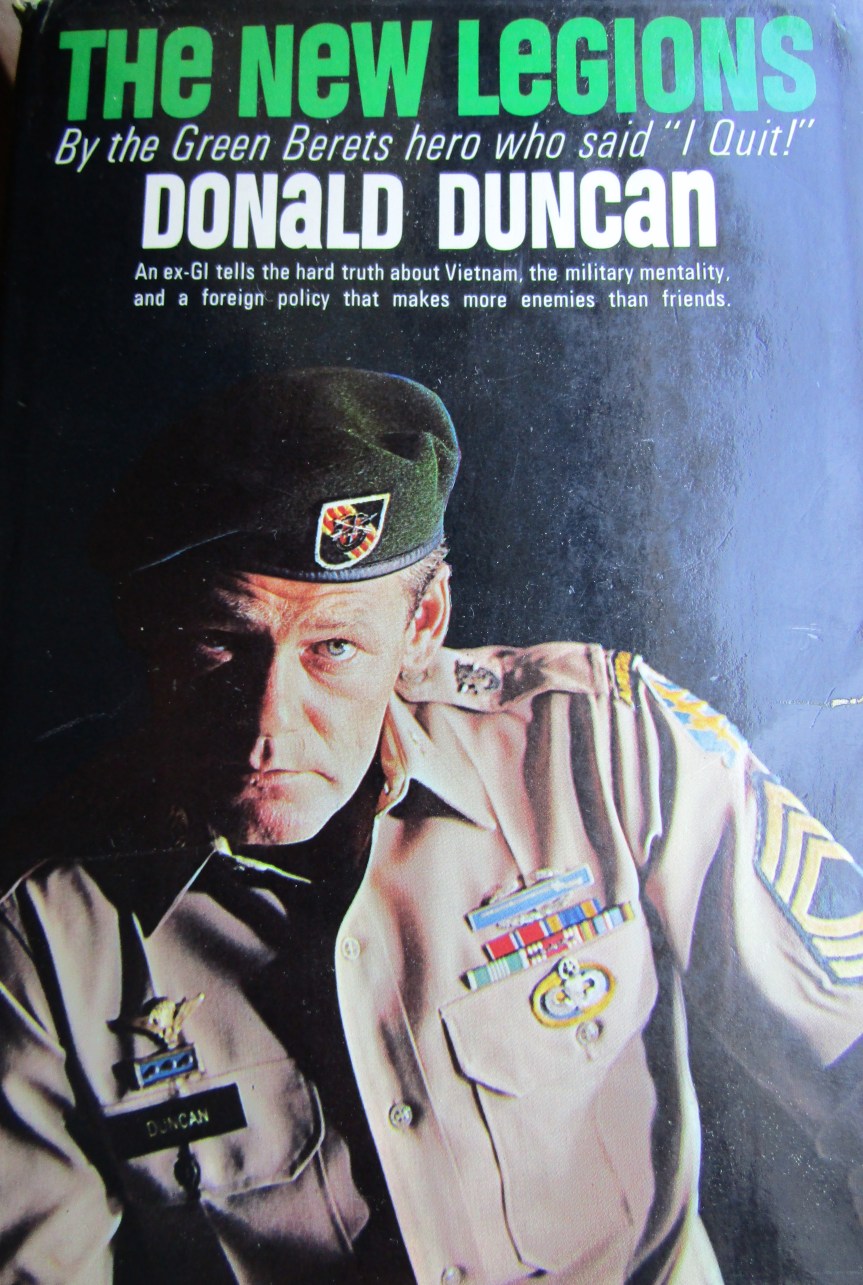
In today’s New York Times, there’s an obituary for Donald Duncan, a Green Beret and master sergeant who became an early and outspoken critic of America’s war in Vietnam. The obituary is at this link http://www.nytimes.com/2016/05/07/us/donald-w-duncan-79-ex-green-beret-and-early-critic-of-vietnam-war-is-dead.html, and I want to highlight some of what Duncan said about that war. Here are two excerpts: “The whole thing [the war] was a lie,” Mr. Duncan wrote. “We weren’t preserving freedom in South Vietnam. There was no freedom to preserve. To voice opposition to the government meant jail or death. Neutralism was forbidden and punished. Newspapers that didn’t say the right thing were closed down. People are not even free to leave, and Vietnam is one of those rare countries that doesn’t fill its American visa quota.” Another quotation: He concluded that America was destined to lose the war. “I don’t think Vietnam will be better off under Ho’s brand of communism,” he said. “But it’s not for me or my government to decide. That decision is for the Vietnamese. I also know that we have allowed the creation of a military monster that will lie to our elected officials, and that both of them will lie to the American people.” These words, coming from a decorated combat veteran with direct knowledge of events in Vietnam, must be remembered. Yet as the NYT obituary makes clear, Duncan died in obscurity, all but forgotten. We need to remember people like him: people who are willing to speak up and tell uncomfortable truths.
In November 1971, the political philosopher Hannah Arendt published “Lying in Politics: Reflections on the Pentagon Papers” in the New York Review of Books. Earlier that year, Daniel Ellsberg had shared those highly classified government papers with the U.S. media. They revealed a persistent and systematic pattern of lying and deception by the government about U.S. progress in the Vietnam War. By undermining the people’s trust in government, lies and deception were destabilizing democracy in America, Arendt said. Furthermore, America was witnessing two new and related categories of lying. The first was lying as public relations, the creation and distribution of images substituting for facts and premised in human manipulability (a Madison Avenue approach to war and foreign policy). The second was lying tied to a country’s reputation as embraced by professional “problem-solvers” as the basis for political action. …
I’m a fan of books and book sales. A few weeks ago, I came across a vintage copy of Hugh Prather’s “Notes to Myself.” Published in 1970, it caught the Zeitgeist of the “Age of Aquarius” and became a surprise best seller. Its considerable influence is shown by the fact it was lampooned on “Saturday Night Live” as part of the “Deep Thoughts” series.
Some of Prather’s “notes” are solipsistic and more than a little pretentious, a fact he himself recognized, but some of them also have considerable depth of meaning.
Consider this one:
When I see I am doing it wrong there is
a part of me that wants to keep on doing
it the same way anyway and even starts
looking for reasons to justify the continuation.
When I read this, I instantly thought of U.S. strategy when it comes to the Middle East. I recently read Colonel (ret.) Andrew Bacevich’s new book, “America’s War for the Greater Middle East,” and Prather’s note could serve as an epigraph to the book, and an epitaph to U.S. wars and policy in the Middle East.
Despite a painfully expensive and tragically wasteful record of militarized interventions in Iraq, Afghanistan, Lebanon, Iran, Somalia, Libya, and many other countries throughout the greater Middle East, the U.S. military and foreign policy establishment persists in staying its presence course. Sure, the tactics have changed slightly over the years. Obama is less enamored of committing big battalions of ground troops than Bush/Cheney were, yet his administration is nevertheless committed to constant military interventions, misguided and one-sided relationships with Israel and Saudi Arabia, and unwavering optimism that this time, maybe this time, we’ll finally build effective Iraqi (or Afghan) security forces while simultaneously encouraging liberty in the region by sending more U.S. troops and selling more weaponry (together with bombing and killing, of course).
As Bacevich notes in his book (you should beg, borrow, or otherwise acquire a copy), experience has not taught the U.S. national security state much of anything. Whether that state is led by a Clinton or a Bush or an Obama matters little. The U.S. can’t help but meddle, using its powerful military as a more or less blunt instrument, at incredible expense to our country, and at a staggering cost in foreign lives lost or damaged by incessant warfare. And no matter how catastrophic the results, that national security state can’t help but find reasons, no matter how discredited by events, to “stay the course.”
Consistent with what Prather says, it looks “for reasons to justify the continuation” of present policy, even when it knows things are going wrong in a very bad way.
Perhaps the U.S. national security state needs to make some “notes to itself.” Consider it a personal audit of sorts, since the Pentagon can’t pass a financial one. If it ever does, Prather’s “note” above would be a good place to start.
This weekend, I watched a few minutes of NFL draft coverage on ESPN. If you’re not familiar with NFL football or ESPN coverage of the same in the USA, you should be, because it says much about the American moment. The first round of the draft kicks off on Thursday night in prime time, followed by the second and third rounds on Friday night in prime time. The draft concludes on Saturday with rounds four through seven, roughly 250 total picks if you include “supplemental” picks.
Yet this quick summary vastly understates the coverage devoted to the draft. From the end of the Super Bowl early in February to the draft itself at the end of April, coverage of the draft on ESPN is virtually non-stop, with innumerable “mock” drafts for each team and a parade of “experts” speculating about the prospects of each player and team. Exhaustive (and exhausting) is the word to describe this coverage. Interminable is another one.
When Round One finally kicks off, it’s essentially a parade of soon-to-be millionaires. These players, selected from various college football teams, can count on multi-year contracts and signing bonuses in the millions of dollars. ESPN and the NFL stage manages the selection process, turning it into an extravaganza complete with musicians, cheering (or booing) fans, and plenty of past NFL greats, along with the draftees and their families and friends. Coverage also includes shots of the “war rooms” of the various NFL teams as they decide which players to pick, which draft picks to trade, and so on. The war room — isn’t that a telling phrase?
Indeed, let’s push that further. Most red-blooded NFL fans would be hard-pressed to find Iraq or Afghanistan on a map, but they can tell you all about their team’s draft picks, rattling off statistics such as times in the 40-yard dash, vertical leap, even the size of a player’s hands (considered especially pertinent if he’s a quarterback or wide receiver). What always astonishes me is the sheer wealth of detail gathered about each player, the human intelligence (or HUMINT in military terms). Players, especially those projected to go in the first few rounds, are scrutinized from every angle: physical, mental, emotional, you name it.
With millions of dollars at stake, such an exhaustive approach is not terribly surprising. Yet even with a wealth of data, each year there are major draft busts (e.g. Ryan Leaf, selected #2 overall in the first round and a flop) and major surprises (e.g. Tom Brady, selected late in the 6th round as the 199th pick, meaning that not much was expected from him, after which he won four Super Bowls). Results from the NFL draft should teach us something about the limits of data-driven “intelligence” in “wars,” yet our various military intelligence agencies continue to believe they can quantify, predict, and control events.
But again what wows me is the extent as well as the slickness of ESPN’s coverage of the draft. As soon as a player is selected, ESPN instantly has video of that player’s college highlights, together with his vital statistics (height, weight, performance at the draft combine in various drills, and so on). Video and stats are backed up by interviews with a draftee’s previous coaches, who extol his virtues, along with interviews with those “war rooms” again as to why they decided to draft that particular player and not another. Once the draft is completed, teams are then awarded “grades” by various commentators, even though these players have yet to play a snap in the NFL. (Imagine if your kid received an instant grade in college — before he attended a single class or completed a single assignment — based upon his performance in high school.)
But you have to hand it to ESPN: their coverage of the draft is an exercise in total information awareness. It’s blanket coverage, an exercise in full-spectrum dominance. It’s slick, professional, and driven by a relentless pursuit of victory by each team (and a relentless pursuit of ratings by ESPN).
So, a modest proposal: To win the war on terror, let’s put ESPN in charge of intelligence gathering and coverage. Just imagine if your average red-blooded American devoted as much attention to foreign wars as they do to their favorite NFL team! Just imagine if America’s leaders were held accountable for poor results as NFL coaches and staffs are! America still might not win its wars, but at least we’d squarely face the fact that we’re continuing to lose at incredibly high cost. Indeed, someone high-up in the government might actually be held accountable for these losses.
I know: It’s a frivolous suggestion to treat war like a sport. But is it? After all, America currently treats the NFL draft with all the seriousness of a life-and-death struggle, even as it treats wars with comparative frivolity.
Our wars are games and our games are wars. Small wonder America continues to lose its wars while fielding some winning NFL teams.