Today, I saw another article on why America is losing its wars in places like Iraq, Afghanistan, and elsewhere. The gist of this and similar articles is that America’s wars are winnable. That is, if we bomb more, or send more troops, or change our strategy, or alter our ROE (rules of engagement), or give more latitude to the generals, or use all the weapons at our disposal (to include nukes?), and so on, these wars will prove tractable and even winnable. This jibes with President Trump’s promises about America winning again, everywhere, especially in wars.
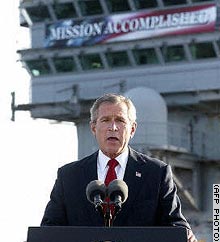
Sorry: The Missions Are Never Going to be “Accomplished”
Nonsense. The U.S. military hasn’t won these wars since the wars themselves are unwinnable by U.S. military action. Indeed, U.S. military action only makes them worse.
Consider Iraq. Our invasion in 2003 and our toppling of Saddam kicked off a regional, religious, ethnic, and otherwise complicated civil war that is simply unwinnable by American troops. Indeed, the presence of (and blunders made by) American troops in Iraq helped to produce ISIS, much-hyped as the current bane of American existence.
Consider Afghanistan. Our invasion in 2001 toppled the Taliban, at least for a moment, but did not produce peace as various Afghan factions and tribes jostled for power. Over time, the U.S. and NATO presence in the country produced instability rather than stability even as the Taliban proved both resilient and resurgent. U.S. and NATO forces have simply become yet another faction in the Afghan power game, but unless we want to stay there permanently, we are not going to “win” by any reasonable definition of that word.
You could say the same of the U.S. military’s involvement in similar conflicts like Yemen or Syria (look at the mess we made of Libya). We can kill a lot of “terrorists” and drop a lot of bombs, spreading our share of chaos, but we aren’t going to win, not in the sense of these wars ending on terms that enhance U.S. national security.
This hard reality is one that the U.S. military explains away by using jargon. Military men talk of generational wars, of long wars, of fourth generation warfare, of gray zones, of military operations other than war (which has its own acronym, MOOTW), and so on. A friend of mine, an Air Force captain, once quipped: “You study long, you study wrong.” You can say something similar of war: “You wage war for long, you wage it wrong.” This is especially true for a democracy.
America’s wars today are unwinnable. They are unwinnable not only because they are not ours to win: they aren’t even ours. We refuse to take ownership of them. At the most fundamental level, we recognize they are not vital to us, since we don’t bother to unify as a country to declare war and to wage it. Most Americans ignore them because we can ignore them. The Afghans, the Iraqis, the Syrians, and so on don’t have the luxury of ignoring them.
Trump, with all his talk of winning, isn’t going to change this. The more he expands the U.S. military, the more he leans on “his” generals for advice, the more he’s going to fail. Our new commander-in-chief needs to learn one lesson: The only way to win America’s wars is to end them.
The NFL draft is back on TV this weekend with blanket coverage by ESPN. As I wrote this time a year ago, what if Americans paid as much attention to their wars as they did their NFL teams (including of the “fantasy” variety)? I’m always dazed and amazed by the sheer work that goes into the NFL draft: the thoroughness of it all, the expertise on display, the active and informed involvement of the fans. Imagine if ESPN (or any media outlet, for that matter) covered America’s wars with the same commitment to detail and facts as is displayed yearly for American football!
As I wrote last year: “To win the war on terror, let’s put ESPN in charge of intelligence gathering and coverage. Just imagine if your average red-blooded American devoted as much attention to foreign wars as they do to their favorite NFL team! Just imagine if America’s leaders were held accountable for poor results as NFL coaches and staffs are! America still might not win its wars, but at least we’d squarely face the fact that we’re continuing to lose at incredibly high cost.”
This weekend, I watched a few minutes of NFL draft coverage on ESPN. If you’re not familiar with NFL football or ESPN coverage of the same in the USA, you should be, because it says much about the American moment. The first round of the draft kicks off on Thursday night in prime time, followed by the second and third rounds on Friday night in prime time. The draft concludes on Saturday with rounds four through seven, roughly 250 total picks if you include “supplemental” picks.
Yet this quick summary vastly understates the coverage devoted to the draft. From the end of the Super Bowl early in February to the draft itself at the end of April, coverage of the draft on ESPN is virtually non-stop, with innumerable “mock” drafts for each team and a parade of “experts” speculating…
Did you know the U.S. has built nearly 70,000 nuclear weapons since 1945? Did you know the U.S. Air Force lost a B-52 and two hydrogen bombs in an accident over North Carolina in 1961, and that one of those H-bombs was a single safety-switch away from exploding with a blast equivalent to three or four million tons of TNT (roughly 200 Hiroshima-type bombs)? Did you know a U.S. nuclear missile exploded in its silo in Arkansas in 1980, throwing its thermonuclear warhead into the countryside?
On more the one occasion, the U.S. has come close to nuking itself
That last accident is the subject of a PBS American Experiencedocumentary that I watched last night, “Command and Control.” I highly recommend it to all Americans, not just for what it reveals about nuclear accidents and the lack of safety, but for what it reveals about the U.S. military.
Here are a few things I learned about U.S. nuclear weapons and the military from the documentary:
During the silo accident, the Strategic Air Command (SAC) general in charge of nuclear missiles was a pilot with no experience in missiles. His order to activate a venting fan during a fuel leak led to the explosion that destroyed the missile and killed an airman. (Experts from Martin Marietta, the military contractor that built the Titan II missile, advised against such action.)
Airmen who courageously tried against long odds to mitigate the accident, and who were wounded in the explosion, were subsequently punished by the Air Force.
The Air Force refused to provide timely and reliable knowledge to local law enforcement as well as to the Arkansas governor (then Bill Clinton) and senators. Even Vice President Walter Mondale was denied a full and honest accounting of the accident.
Nuclear safety experts concluded that “luck” played a role in the fact that the Titan’s warhead didn’t explode. It was ejected from the silo without its power source, but if that power source had accompanied the warhead as it flew out of the silo, an explosion equivalent to two or three megatons could conceivably have happened.
Finally, the number of accidents involving U.S. nuclear weapons is far greater than the military has previously reported. Indeed, even the nation’s foremost expert in nuclear weapons development was not privy to all the data from these accidents.
In short, the U.S. has been very fortunate not to have nuked itself with multiple hydrogen bombs over the last 70 years. Talk today of a threat from North Korea pales in comparison to the threat posed to the U.S. by its own nuclear weapons programs and their hair-raising record of serious accidents and safety violations.
Despite this record, President Obama and now President Trump have asked for nearly a trillion dollars over the next generation to modernize and improve U.S. nuclear forces. Talk about rewarding failure!
Threatening genocidal murder is what passes for “deterrence,” then and now. This madness will continue as long as people acquiesce to the idea the government knows best and can be trusted with nuclear weapons that can destroy vast areas of our own country, along with most of the world.
To end the insanity, we must commit to eliminating nuclear weapons. Ronald Reagan saw the wisdom of total nuclear disarmament. So should we all.
An Addendum: In my Air Force career, I knew many missileers who worked in silos. They were dedicated professionals. But accidents happen, and complex weapons systems fail often in complex and unpredictable ways. Again, it’s nuclear experts themselves who say that luck has played a significant role in the fact that America hasn’t yet nuked itself. (Of course, we performed a lot of above-ground nuclear testing in places like Nevada, making them “no-go” places to this day due to radiation.)
Update (4/27/17): I’d heard of Air Force plans to base nuclear weapons on the moon, but today I learned that a nuclear test was contemplated on or near the moon as a way of showcasing American might during the Cold War. As the New York Timesreported, “Dr. [Leonard] Reiffel revealed that the Air Force had been interested in staging a surprise lunar explosion, and that its goal was propaganda. ‘The foremost intent was to impress the world with the prowess of the United States.’ It was a P.R. device, without question, in the minds of the people from the Air Force.” Dr. Reiffel further noted that, “The cost to science of destroying the pristine lunar environment did not seem of concern to our sponsors [the U.S. military] — but it certainly was to us, as I made clear at the time.”
The U.S. military wasn’t just content to pollute the earth with nuclear radiation: they wanted to pollute space and the moon as well. All in the name of “deterrence.”
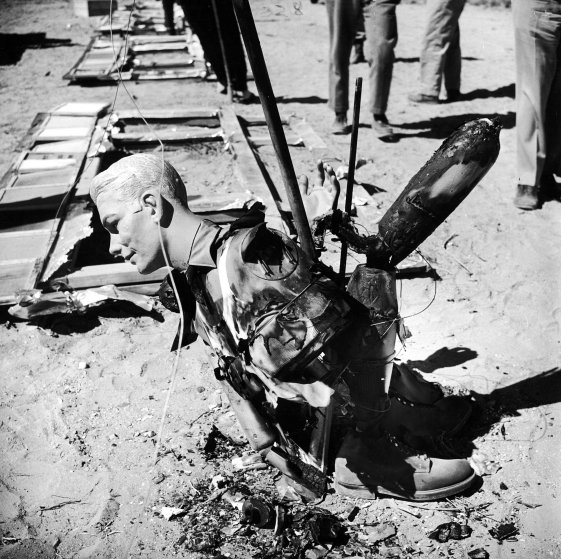
Two pictures of above-ground nuclear testing in Nevada in 1955
Here’s a tip, ladies: Wear light-colored dresses during a nuclear war. They absorb less heat
As the end of Trump’s first 100 days in office approaches, we can already see the novice commander-in-chief’s approach to military action. The approach is to empower “his” generals. And the results? A triumph of image over substance. “Spin it to win it” is the byword for Trump’s military “strategy.”
A few examples:
The disastrous raid on Yemen that led to the death of a Navy SEAL as well as many civilians, including children, was spun by the Trump administration as a great success. At the same time, Trump pinned the death of the SEAL on his generals, saying “they” lost him.
The launch of 59 expensive cruise missiles against a Syrian airfield did little to change the actions of the Assad government. Nor did it knockout the airfield. Yet it was spun by Trump as a remarkable victory. In his words, “We’ve just fired 59 missiles, all of which hit, by the way, unbelievable, from, you know, hundreds of miles away, all of which hit, amazing. It’s so incredible. It’s brilliant. It’s genius. Our technology, our equipment, is better than anybody by a factor of five. I mean look, we have, in terms of technology, nobody can even come close to competing.”
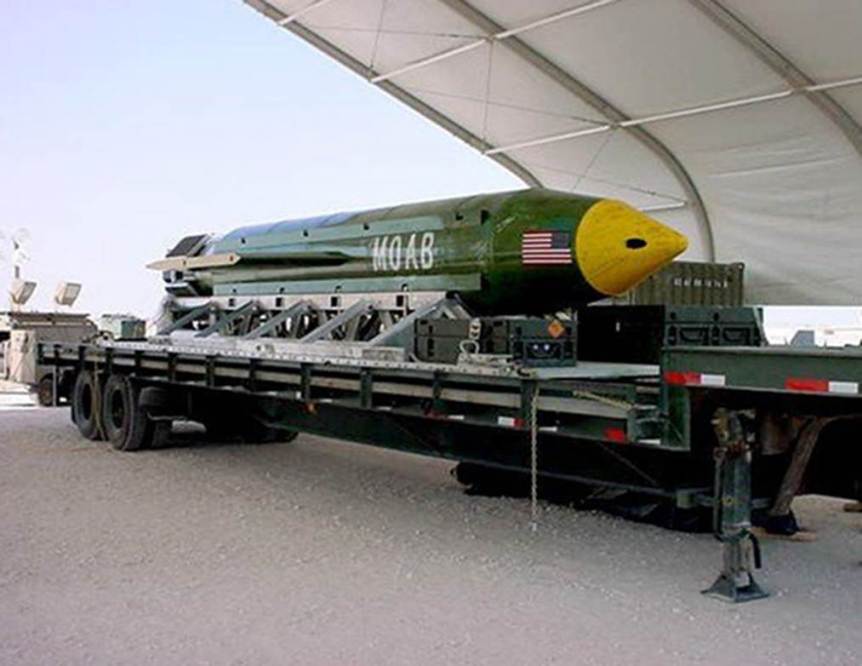
The use of the “mother of all bombs” (MOAB) in Afghanistan was seized upon by Trump as an example of his toughness and decisiveness vis-à-vis the Obama administration’s use of force. Yet Trump didn’t even know about the bomb until after it was used. Nevertheless, he boasted “If you look at what’s happened over the last eight weeks [of my administration] and compare that really to what’s happened over the past eight years, you’ll see there’s a tremendous difference, tremendous difference.” Dropping MOAB, Trump claimed on scant evidence, “was another very, very successful mission.”
The Trump administration lost track of an aircraft carrier battle group, saying it was on its way as a show of force against North Korea even as it was headed in the opposite direction. This blunder was chalked up to a miscommunication between the White House and Pentagon, even as allies such as South Korea and Japan expressed concern about the credibility of U.S. support at a time of rising tensions.
As Tom Engelhardt notes in his latest must-read piece at TomDispatch.com:
President Trump did one thing decisively. He empowered a set of generals or retired generals — James “Mad Dog” Mattis as secretary of defense, H.R. McMaster as national security adviser, and John Kelly as secretary of homeland security — men already deeply implicated in America’s failing wars across the Greater Middle East. Not being a details guy himself, he’s then left them to do their damnedest. “What I do is I authorize my military,” he told reporters recently. “We have given them total authorization and that’s what they’re doing and, frankly, that’s why they’ve been so successful lately.”
Have the generals really been “so successful lately,” President Trump? The facts suggest otherwise. Meanwhile, Trump has not yet learned that generals always want more – they believe they can win if they just get more troops, more money, more weaponry. They’ll support Trump as long as he keeps funneling more of everything their way – and as long as he keeps spinning their blunders and missteps as victories.
Is this the face of “success” in Yemen? A little girl dead?
For the moment, Trump’s generals may love him for his “spin it to win it” boosterism and his blank checks of support. But beware, men wearing stars. Trump has already shown he prefers to delegate responsibility as well as authority when things go bad (recall the failed raid on Yemen and the dead SEAL).
Trump may not be a micro-manager, but that’s because he doesn’t know anything. He just wants to spin military action as a win – for Trump. If the generals keep losing, Trump will turn on them. The question is, will they turn on him?
More disturbing still: When failed military actions are spun as alt-fact “victories,” the violence isn’t done simply to facts: it’s done to innocent people around the world. It’s no game when innocent children die in the false name of “winning.”
I’ve written a lot about America’s warrior ethos and how it represents a departure from a citizen-soldier ideal as embodied by men like George Washington and Major Dick Winters (of “Band of Brothers” fame). This warrior ethos grew in the aftermath of defeat in Vietnam and the ending of the draft. It gained impetus during the Reagan years and was symbolized in part by the development of fictional rogue symbols of warrior-toughness such as John Rambo. Today’s U.S. military has various warrior codes and songs and so on, further reinforcing ideals of Spartan toughness.
The Rambo Ideal: “Sir, Do We Get to Win This Time?” (Wiki)
My writings against this warrior hype have, on occasion, drawn fire from those who identify as warriors. I’d like to share two examples.
Here is the first:
The day that we encourage our soldiers to be anything but warriors is the day that we start losing battles and wars. If we are controlled by citizens who are our ultimate leaders then it is up to them to handle the niceties of diplomacy and nation building. But most of them don’t have the balls to get into the thick of things and try and convert the citizens of the place we are fighting to play at being nice children in the sand pile. We had to dominate Japan to the nth degree to get them to surrender and so the same for Germany. You academics never to cease to amaze me with your naïveté.
This reader cites World War II and America’s victory over Japan and Germany without mentioning the Greatest Generation’s embodiment of the citizen-soldier ideal and their rejection of Japanese and Nazi militarism. Back then, America’s victory was interpreted as a triumph of democracy over authoritarian states like Japan and Germany. While it’s true the Soviet Union played the crucial role in defeating Nazi Germany, the Soviets ultimately lost the Cold War, another “victory” by a U.S. military that didn’t self-identify as warriors. Despite this history, this reader suggests that America’s recent military defeats are attributable to weak civilian leadership and a lack of warrior dominance. He fails to notice how America’s new ethos of the warrior, inculcated over the last 30 years, has produced nothing close to victory in Iraq, Afghanistan, and elsewhere.
My second example comes from a U.S. Marine:
I watched the transition we made from life takers and widow makers to peace keepers and other terms that did us no good whatsoever. Then, in 1987, along came a new Commandant, General Al Grey, who resurrected the warrior ethos in our Corps.
We were told, and accepted the fact, that the best way to win a war or battle was to kill the enemy in numbers that could not be sustained. We did just that during Desert Storm. I flew 67 combat missions in an F/A-18 and took great pride and satisfaction in killing as many Iraqis as I could so that when our infantry and other ground units pushed through the berms and other obstacles, they had a clear path to their objectives.
We need more emphasis on killing the enemy and maintaining a warrior ethos and less drivel from folks like you who think it’s some type of a debating match rather than combat we undertake when our nation goes to war.
Basically, this Marine argues that war is killing. Kill enough of the enemy and you win. Of course, winning by attrition and body count failed during the Vietnam War, but I’m guessing this Marine would argue that the U.S. military simply didn’t kill enough of the enemy there.
This Marine further sets up a straw man argument. Nowhere did I write or even suggest that war is “some type of debating match.” Nowhere did I write or even suggest that war doesn’t involve combat and killing. But criticism of the warrior ideal is often caricatured in this way, making it easier to dismiss it as “naïve” or “drivel.”
The warrior ethos is surging in America today, and not just within the military. Witness the U.S. media’s positive reaction to President Trump’s missile strikes on Syria or the use of “the mother of all bombs” against ISIS in Afghanistan. Gushing media praise comes to presidents who let slip the “beautiful” missiles and “massive” bombs of war.
Two centuries ago, the rocket’s red glare, the bombs bursting in air, did so over an American fortress that was under attack on our soil. They gave proof through the night that America’s citizen-soldiers were defending our country (our flag was still there). Nowadays, our rocket’s red glare appears in Syrian skies, our bombs bursting do so in remote regions of Afghanistan, giving proof through the night that America’s warrior ethos is anywhere and everywhere, killing lots of foreign peoples in the name of “winning.”
Call me naïve, say I write drivel, but I don’t see this as a victory for our democracy, for our country, or even for our “warriors.”
In my latest article for TomDispatch.com, I investigate what an “America first” foreign policy actually means in practice. What follows is an extract from the article in which I consider whether the U.S. military has morphed from a deterrent force (at least in its own eyes) to a doomsday machine. This idea is inspired in part by an article that Dennis Showalter, a fine historian and an even better friend, wrote back in 2000 about the German military prior to World War I. Excerpt follows:
Deterring Our Way to Doomsday
Who put America’s oil under all those Middle Eastern deserts? That was the question antiwar demonstrators asked with a certain grim humor before the invasion of Iraq. In Trump’s oft-stated opinion, the U.S. should indeed have just taken Iraq’s oil after the 2003 invasion. If nothing else, he said plainly what many Americans believed, and what various multinational oil companies were essentially seeking to do.
Consider here the plight of President Jimmy Carter.Nearly 40 years ago, Carter urged Americans to scale back their appetites, start conserving energy, and free themselves from a crippling dependency on foreign oil and the unbridled consumption of material goods. After critics termed it his “malaise” speech, Carter did an about-face, boosting military spending and establishing the Carter Doctrine to protect Persian Gulf oil as a vital U.S. national interest. The American people responded by electing Ronald Reagan anyway. As Americans continue to enjoy a consumption-driven lifestyle that gobbles up roughly 25% of the world’s production of fossil fuels (while representing only 3% of the world’s population), the smart money in the White House is working feverishly to open ever more fuel taps globally. Trillions of dollars are at stake.
Small wonder that, on becoming president, Trump acted quickly to speed the building of new pipelines delayed or nixed by President Obama while ripping up environmental protections related to fossil fuel production. Accelerated domestic production, along with cooperation from the Saudis — Trump’s recent Muslim bans carefully skipped targeting the one country that provided 15 of the 19 terrorists in the 9/11 attacks — should keep fuel flowing, profits growing, and world sea levels rising.
One data point here: The U.S. military alone guzzles more fossil fuel than the entire country of Sweden. When it comes to energy consumption, our armed forces are truly second to none.
With its massive oil reserves, the Middle East remains a hotbed in the world’s ongoing resource wars, as well as its religious and ethnic conflicts, exacerbated by terrorism and the destabilizing attacks of the U.S. military. Under the circumstances, when it comes to future global disaster, it’s not that hard to imagine that today’s Middle East could serve as the equivalent of the Balkans of World War I infamy.
If Gavrilo Princip, a Serbian “Black Hand” terrorist operating in a war-torn and much-disputed region, could set the world aflame in 1914, why not an ISIS terrorist just over a century later? Consider the many fault lines today in that region and the forces involved, including Russia, Turkey, Iran, Israel, Saudi Arabia, and the United States, all ostensibly working together to combat terrorism even as they position themselves to maximize their own advantage and take down one another. Under such circumstances, a political temblor followed by a geo-political earthquake seems unbearably possible. And if not an ISIS temblor followed by major quake in the Middle East, there’s no shortage of other possible global fault lines in an increasingly edgy world — from saber-rattling contests with North Korea to jousting over Chinese-built artificial islands in the South China Sea.
As an historian, I’ve spent much time studying the twentieth-century German military. In the years leading up to World War I, Germany was emerging as the superpower of its day, yet paradoxically it imagined itself as increasingly hemmed in by enemies, a nation surrounded and oppressed. Its leaders especially feared a surging Russia. This fear drove them to launch a preemptive war against that country. (Admittedly, they attacked France first in 1914, but that’s another story.) That incredibly risky and costly war, sparked in the Balkans, failed disastrously and yet it would only be repeated on an even more horrific level 25 years later. The result: tens of millions of dead across the planet and a total defeat that finally put an end to German designs for global dominance. The German military, praised as the “world’s best” by its leaders and sold to its people as a deterrent force, morphed during those two world wars into a doomsday machine that bled the country white, while ensuring the destruction of significant swaths of the planet.
Today, the U.S. military similarly praises itself as the “world’s best,” even as it imagines itself surrounded by powerful threats (China, Russia, a nuclear North Korea, and global terrorism, to start a list). Sold to the American people during the Cold War as a deterrent force, a pillar of stability against communist domino-tippers, that military has by now morphed into a potential tipping force all its own.
Recall here that the Trump administration has reaffirmed America’s quest for overwhelming nuclear supremacy. It has called for a “new approach” to North Korea and its nuclear weapons program. (Whatever that may mean, it’s not a reference to diplomacy.) Even as nuclear buildups and brinksmanship loom, Washington continues to spread weaponry — it’s the greatest arms merchant of the twenty-first century by a wide mark — and chaos around the planet, spinning its efforts as a “war on terror” and selling them as the only way to “win.”
In May 1945, when the curtain fell on Germany’s last gasp for global dominance, the world was fortunately still innocent of nuclear weapons. It’s different now. Today’s planet is, if anything, over-endowed with potential doomsday machines — from those nukes to the greenhouse gas emissions that cause global warming.
That’s why it’s vitally important to recognize that President Trump’s “America-first” policies are anything but isolationist in the old twentieth century meaning of the term; that his talk of finally winning again is a recipe for prolonging wars guaranteed to create more chaos and more failed states in the Greater Middle East and possibly beyond; and that an already dangerous Cold War policy of “deterrence,” whether against conventional or nuclear attacks, may now have become a machine for perpetual war that could, given Trump’s bellicosity, explode into some version of doomsday.
Or, to put the matter another way, consider this question: Is North Korea’s Kim Jong-un the only unstable leader with unhinged nuclear ambitions currently at work on the world stage?
Why does the U.S. military invest so much pride in working to the point of tedium, if not exhaustion? A friend of mine, an Army major, worked at the Pentagon. He worked hard during his normal shift, after which he did what sensible people do – he went home. His co-workers, noses to the grindstone, would hassle him about leaving “early.” He’d reply, I can leave on-time because I don’t waste hours at the coffee maker or in the gym.
A caffeinated emphasis on work and fitness, another friend suggested, may be a post-Vietnam War reaction to Secretary of Defense Robert McNamara’s “managerial culture” of the 1960s. As he put it, “One easy way of showing one has the ‘right stuff’ [in the U.S. military] is to be an exercise nut, and the penumbras of that mind-set have really distorted the allocation of effort in our military.”
Two recent examples of work- and fitness-mania are Army Generals David Petraeus and Stanley McChrystal. The U.S. media extolled them as ascetic-warriors, yet both flamed out due to serious errors in judgment (Petraeus for an affair with his biographer, with whom he illegally shared highly classified information, and McChrystal for tolerating a climate that undermined his civilian chain of command). Asceticism and sweaty fitness routines, after all, are no substitute for sound judgment and a disciplined mind.
Busy-work within the military is related to Parkinson’s Law, the idea that work expands to fill the time allotted to it. In this case, with America’s wars on terror being open-ended, or “multi-generational” as the U.S. military puts it, the “work” on these wars will continue to expand to fill this time, with the added benefit of “validating” the extra money ($54 billion in 2017 alone) being shoveled to the Pentagon by President Trump.
Along with busy-work are the virtues of suffering, as related by a societal celebration of Navy SEALs and similar special forces (“100 men will test today/but only three win the Green Beret”). I’ve lost count of the times I’ve read articles and seen films featuring these “supermen” and their arduous training. The meme of “sweet–and public–suffering” is related to the whole “warrior” ideal (more on this later) within the U.S. military. There’s a self-righteous shininess here, a triumph of image over substance, or image as substance. (Being physically tough is of course an asset in close quarters combat, but it’s no guarantor of strategic sense or even of common sense.)
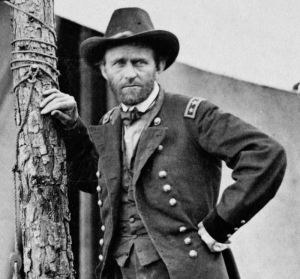
In the past, some of America’s finest military leaders had no shame in appearing common, most famously the “shabby” Ulysses S. Grant during the U.S. Civil War.
Grant at Cold Harbor, 1864
Civil War officers – true citizen-soldiers, most of them – often had unruly hair and unkempt beards, but they sure as hell fought hard and got the job done. Nowadays, as another reader put it, “there appears to be a whole lot of Army officers who think a white sidewall haircut proves you’re a great officer. It actually is a homage to the Prussian Army that shaved its soldiers’ heads to prevent lice.”
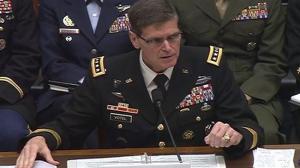
Speaking again of image, let’s take a close look at the beribboned uniforms of today’s military officers. General Joseph Votel, presently U.S. Centcom commander, is only the most recent example of an excess of ribbons, badges, and other devices:
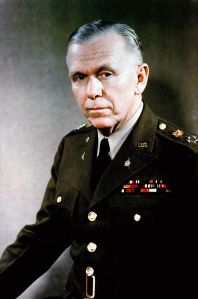
Contrast Votel’s image to that of General George C. Marshall, who defeated Nazi Germany and Imperial Japan during World War II.
Marshall in 1946
How did Marshall manage such military feats with so few ribbons? Nowadays, U.S. generals sport more bling than the Kardashians.
But let’s return to the notion of U.S. troops as “warriors” and “warfighters.” I’ve written extensively on this subject. I see today’s “warrior” conceit as a way of eliminating our democratic citizen-soldier ideal, making the U.S. military a thoroughly professional force, subservient to the government and divorced from the people.
However, there’s another aspect to this “warrior” mythology, a powerful psychological one: the duping of the “warriors” themselves, distracting them from a bitter reality they may be little more than cannon fodder for greed-war.* The U.S. military today is awash with warrior creeds that to me are antithetical to the citizen-soldier ideal of America.
To sum up the U.S. military’s current ethos, then: We have a lot of guys who take great pride in constant busy-work and excessive physical exertion, sporting high and tight haircuts, their uniforms festooned with bewildering displays of ribbons and medals and badges, extolling a warrior code in the service of a government that tells them that multi-generational wars are unavoidable.
And so it shall prove, if these shadows remain unaltered.
*Thanks to Michael Murry for bringing my attention to how the semiotics of “warrior” are dramatically changed if we substitute “gladiator” for “warrior,” followed by less grandiose terms such as “those about to die,” i.e. as scapegoats to the king’s ambition, an insight he gleaned from reading Umberto Eco.
Remember that saying from the Vietnam War era, “Suppose they gave a war and no one came?” Considering present events, we need to modify that. Suppose they kept giving us war after war and no one cared?
It’s remarkable that, even as President Trump expands our military involvement overseas, there is no significant anti-war protest movement in America. Why is this? Perhaps Americans don’t recognize the reality of today’s wars?
Tom Engelhardt has a great article today in which he reflects about World War II, the Vietnam War, and current conflicts around the world. He ends his article with this powerful question:
In many ways, from its founding the United States has been a nation made by wars. The question in this century is: Will its citizenry and its form of government be unmade by them?
The answer to that is “yes,” if we continue largely to ignore them.
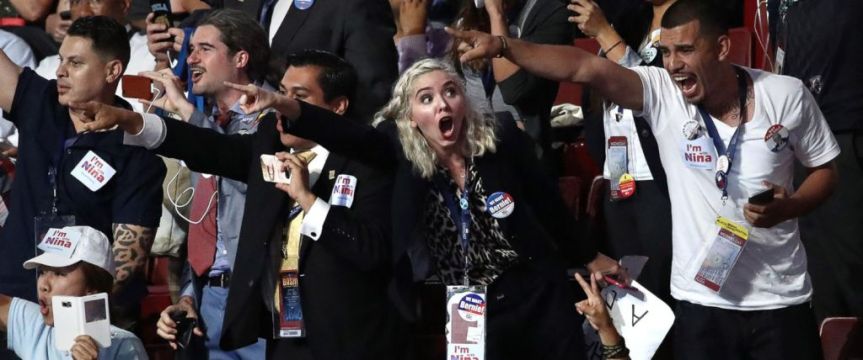
Protesters who shouted “No more war!” at the Democratic National Convention were silenced
Let me give you an example; it may sound trivial, but I think it’s indicative. I just finished watching a seven-part series on HBO, “Big Little Lies.” Set on the Monterey peninsula in California, the series revolved around several sets of mostly affluent, mostly White, parents and the travails of their privileged children. The series did tackle serious issues, especially spousal abuse, and did feature fine acting. What it did not feature was any sense that the U.S. has a military, let alone that America is at war around the world.
Wait a minute, you’re saying. Why should a series featuring mostly affluent adults and their precocious children have said anything about the U.S. military and its wars? Because of the setting. I lived in Monterey for three years while serving as the military dean of students at the Defense Language Institute Foreign Language Center at the Presidio of Monterey. I also taught at the Naval Postgraduate School in Monterey. The U.S. military has a high profile there, but you’d never know it from watching “Big Little Lies.” From that series, you’d think nearly everyone lived in sleek and expensive houses gazing out on the Pacific Ocean. You’d never think that American adults had any concern whatsoever about what their military was up to around the world. And perhaps that’s even true.
One teenager in “Big Little Lies” stirs family controversy by plotting to sell her virginity on the Internet to raise awareness of human trafficking. (She eventually backs down.) Perhaps she might have protested America’s wars instead?
So, why aren’t Americans protesting war? Besides the unreality of these wars to the “Big Little Lies” crowd, here are some reasons that come to mind:
They’re couched as “necessary” wars against terrorism.
Unlike WWII or Vietnam, there’s no draft, hence the wars directly impact only American “volunteers” and their families/friends.
Recent U.S. casualties are much lower than they were from 2004-10 before, during, and after the “surges” in Iraq and Afghanistan, and much lower than in Vietnam. Americans care most when Americans die. Witness the reaction to one Navy SEAL dying in a raid in Yemen. If comparatively few American are dying, we don’t care much.
There is no major anti-war political party in the USA; the Democrats have embraced war as tightly as the Republicans. In short, there’s no strong rallying point against war.
The U.S. military has developed a form of war, based on technologies such as “smart” munitions and drones, that at least to us seems antiseptic and low cost.
American exceptionalism also plays a role, the government/mainstream media spin that Americans always enter wars reluctantly and only to do good.
Fear. And nationalism (America First!) disguised as patriotism.
Another crucial reason: Many if not most Americans are remarkably disconnected from their government and its actions. As Engelhardt wrote in another article (on the legendary journalist I. F. Stone):
What’s missing is any sense of connection to the government, any sense that it’s “ours” or that we the people matter. In its place—and you can thank successive administrations for this—is the deepest sort of pessimism and cynicism about a national security state and war-making machine beyond our control. And why protest what you can’t change?
Engelhardt wrote this in 2015, when Barack Obama was still commander-in-chief. Now we have Trump and his unmerry crew, operating in their own bellicose reality. In 2017 even more Americans are disconnected from the government, which they don’t see as “theirs.” (Meanwhile, those who do see Trump and Crew as “theirs” probably embrace a bellicose approach to foreign policy.)
Disconnecting from government does not mean one should disconnect from its wars. Those wars are being waged in our name; it’s up to us to work to end them.
Afterthoughts: Many Americans think that anti-war protest is somehow against “our” troops. Yet, what could be better for our troops than fewer wars and less fighting? Also, it’s foolhardy to give the U.S. military a blank check when it comes to war. We the people are supposed to control our military, which is why America’s Founders gave Congress the power to declare war and to control the budget. Finally, whether they know it or not, the Pentagon and its generals seriously need push-back from the American people. When I watch Congressional hearings, most of our representatives are at pains to praise the military, instead of challenging it with tough questions.
Our military gets enough kudos! What it needs is serious criticism, not unstinting praise along with buckets of money.
General Joseph Votel, U.S. Centcom commander, testified to the House Armed Services Committee this week that the greatest destabilizing force in the Middle East is Iran, and that the U.S. must be prepared to use “military means” to confront and defeat the Iranian threat to the region.
No doubt Iran is a pest to U.S. designs in the Middle East. No doubt Iran has its own agenda. No doubt Iran is no friend to Israel. But the greatest destabilizing force in the Greater Middle East? That’s the USA. We’re the ones who toppled Iraq in 2003, along with the legitimate government of Iran 50 years earlier.
Iran/Persia has lived in, and sometimes dominated, the Greater Middle East for 2500 years. By comparison, the USA is a newcomer on the block. Yet it’s the Iranians who are the destabilizers, the ones operating in a nefarious “grey zone” between peace and war, at least according to U.S. generals.
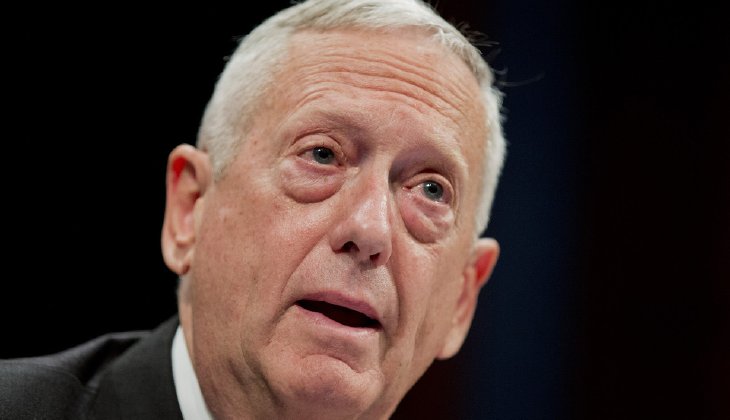
According to General Mattis, the Iranians are the greatest threat to stability and peace in the Middle East. The U.S., with its massive military and extensive weapons sales, only safeguards peace and stability.
Besides the disastrous U.S. invasion of Iraq in 2003, which accidentally helped Iran, the U.S. continues to sell massive amounts of weaponry to Iran’s rivals, most especially Saudi Arabia. U.S. military operations in Yemen, Syria, Iraq, and elsewhere in the Middle East have both destabilized the region and created marketplaces for U.S. weaponry and opportunities for economic exploitation by multinational corporations.
I’m no fan of Iran and its leaders, but can one blame them for resisting U.S. military and economic incursions into their sphere of influence? Recall how we reacted when the Russians put missiles into Cuba. Look at all the hostile rhetoric directed today against Mexico and its allegedly unfair trade practices vis-a-vis the U.S.
Let’s not forget that for 25 years (1953-78), the Shah of Iran was an American ally. The U.S. military loved to sell him our most advanced weaponry, which at that time included F-14 Tomcat fighters and HAWK missile systems. That cozy relationship died with the Iranian Revolution (1979); ally turned to enemy as the U.S. supported Saddam Hussein and Iraq during the bloody Iran-Iraq War of the 1980s.
Yet, despite all this history, despite all the U.S. meddling, all the weapons sales, all the invasions and sanctions, somehow it’s the Iranians who are the destabilizing force, the ones deserving of more “disruptive” U.S. military action.
As America’s designs are frustrated in the Middle East, American generals never look in the mirror to see their own faults and failings. Instead, they cast about for new countries to blame — and to attack. Iran is seemingly next on the list, a country that General Mattis, America’s Secretary of Defense, said is “the single most enduring threat to stability and peace in the Middle East.”
Anyone for war with Iran? U.S. generals are ready.
News out of Trump-land today is that the president is signing an executive order to rollback environmental protections passed by President Obama. All the Republicans can seemingly agree on is to attack Obama’s actions; as a friend said to me, “They’re a bunch of spiteful mofos.”
We only have one Planet Earth, and we seem determined to ruin it, once again in the name of profit and jobs and “growth.” On a planet with shrinking resources, why is “growth” such a wonderful thing?
The other day, I was watching a typical truck commercial on TV. It showed trucks literally tearing up the backroads, along with ATVs spinning and jumping and chewing up the countryside, all synonymous with “adventure” and “freedom.”
I remember those old Coors commercials featuring Mark Harmon. They were set in Colorado (I think) and featured him quietly extolling the virtues of barley and clean water. Now most Coors commercials are about self-indulgent partying (but please drink responsibly).
My point? We need a change in mindset — one that values nature and its preservation. We’re doomed if we keep selling the idea “you can have it all,” so go party and tear up nature — who cares as long as you’re having fun?
We act as if we have many planet earths, but we have only one. And we’re slowly and surely making…



 Our wars are games and our games are wars



 Guess What? There’s Only One Earth
  Bracing Views