The U.S. government still keeps 41 prisoners at the Guantánamo Bay Detention Camp in Cuba. Incredibly, some of these so-called alien enemy combatants have been imprisoned for up to 15 years without benefit of trial; indeed, without even being charged with a crime. How is this possible in a democracy? What does it say about our country?
I happen to own an old map of Cuba from 1897 that shows Guantánamo Bay, which is along the southeastern coast of Cuba. Here’s a photo of a segment of my old map that shows the Bahia de Guantánamo:
Who could have predicted that when our government, in an imperial land grab, “leased” this base from Cuba in 1903, it would become a century later the site of a loathsome prison for Muslim men snatched mostly from central Asia in a “global war on terror”?
In the immediate aftermath of 9/11, the U.S. government needed a place to send prisoners gathered in the chaotic roundup of suspects in the war’s opening stages. Among other locations they chose the U.S. naval base at Guantánamo, considered a “safe” spot since it’s both isolated and not in the USA while also being far from the eyes of the media. What was an expedient, a temporary holding facility, became permanent. President Obama vowed to close it and failed; President Trump has vowed to expand it with fresh batches of prisoners.
In a remarkable piece at TomDispatch.com, Erin Thompson reminds us that the prisoners at Guantánamo are human beings. She did (and does) this by curating and displaying their art works. Their paintings, ship models, and other creations remind us that they exist, that they create, that they hope, that they dream. The U.S. government has responded by asserting ownership rights over their art.
America’s prison at Guantánamo Bay has been a spectacular fail. Its very existence amounts to a huge propaganda victory for terrorists and would-be terrorists everywhere. It’s a stain on our democracy (what’s left of it). In the eyes of much of the world, it reveals the USA itself to be a terrorist.
The persistence of this prison shows America is losing its own “war on terror.” Our government lacks the courage to try these men because of fear a few might go free and perhaps spearhead future attacks, despite a national security complex that spends roughly three quarters of a trillion dollars to predict and prevent such attacks.
To paraphrase Shakespeare in Julius Caesar: Cowards die a thousand deaths; a hero dies but once. By keeping this prison open, and by refusing to offer justice to its occupants out of fear of what they might do if released, we are dying a thousand deaths.
In a word, dishonesty. That’s the key reason why America keeps losing its wars of choice, whether in Iraq, Afghanistan, Libya, Syria, or elsewhere.
Dishonesty is nothing new, of course. Recall the lessons from the Pentagon Papers in the Vietnam War. U.S. leaders knew the war was lost, yet they lied to the American people about seeing lights at the end of tunnels. Recall the Iraq war and the “fixing” of intelligence to justify the invasion. Today the newspeak for Afghanistan is “corners,” as in we’ve turned yet another corner toward victory in that 16-year conflict, according to military testimony before Congress this week.
About those “corners,” here’s a concise summary from FP: Foreign Policy:
Afghanistan turning a corner. Again.Or still? After 16 years of war, the United States and its Afghan partners “have turned the corner,” and Kabul’s battered forces are “on a path to a win.” the top U.S. general there told reporters on Tuesday.
But FP’s Paul McLeary notes that we’ve heard this before. American generals have been seeing victory on the horizon since at least 2007, and “Gen. John Nicholson is at least the eighth top commander in the last decade to forecast a pathway to victory in a war that has dragged on nearly all century, and his optimistic forecasts contrast starkly with deteriorating Afghan government control and a resurgent Taliban.”
The military and our leaders can’t even level with us on the number of troops deployed in Syria. Consider this report today, courtesy of FP: Foreign Policy:
The Pentagon is good at a great many things, but they can do absolutely magical things with troop numbers. The U.S. Central Command announced this week that it was pulling 400 Marines out of Syria, where they had been providing artillery support for the Syrian Democratic Forces battling ISIS.
The number is remarkable given that the military continues to insist there are only 503 U.S. troops in Syria overall. And somehow, that 503 number has managed to remain exactly the same even after the Marines left. Recently, a general running U.S. special operations in Iraq and Syria said there were 4,000 U.S. troops in Syria. He quickly backtracked, saying the number was around 500 and holding steady, despite all actual physical evidence to the contrary.
Do we have 500 troops in Syria, or 2000, or 4000? Who are our generals trying to fool? Our rivals and enemies know how many troops we have in their regions and countries. Why can’t the American people have a full and honest accounting of what “our” troops are up to in places like Syria?
Whether from the Executive branch or from the military, the dishonesty keeps coming. This is exactly why we fail.
Why are we so persistent in our folly? For several reasons. Some people come to believe their own lies, their own happy talk. Careerism plays a role; so does politics. Money is a big concern, since there’s so much of it to be made in war. Some people even think it’s OK to lie if it’s for the “right” reason, i.e. better to project an image of dumb strength than one of pacific wisdom. America must never appear “weak”! For some, that means never quitting a war, no matter how foolish. Better to lie about “progress” than to admit problems that should lead to dramatic change.
Deception is at the heart of war, but we’re supposed to be deceiving the enemy, not ourselves. We’ve allowed public relations — driven by dishonesty — to rule our thinking and reporting on war. But, to paraphrase a saying of Richard Feynman with respect to the Space Shuttle Challenger disaster,
To wage a successful war, reality must take precedence over public relations, for the war gods cannot be fooled.
And to borrow from the penultimate sentence of his report (using the Pentagon in place of NASA): The Pentagon “owes it to the citizens from whom it asks support to be frank, honest, and informative, so that these citizens can make the wisest decisions for the use of their limited resources.”
Imagine if our leaders were frank, honest, and informative about our wars and their costs? But they prefer dishonesty instead — and that is why they (and we) fail.
Stalemate: That’s the word of choice being used by U.S. generals to describe the Afghan War. What, exactly, is a stalemate? I played chess at an early age, caught up in the Bobby Fischer craze of the early 1970s, and I still play occasionally. In chess, a stalemate is a special kind of draw, and an often frustrating one. Put concisely, “Stalemate is a situation in the game of chess where the player whose turn it is to move is not in check but has no legal move.”
For example, I may be winning decisively, with only my opponent’s king left on the board. But if I carelessly put my opponent’s (unchecked) king in such a position that his only move is into harm (or “check”), the position is stalemated. My decisive material advantage makes no difference: the game is over, it’s a draw. In effect, given my material advantage, it’s a win for him and a loss for me.
Is the Afghan War “stalemated”? Not according to the U.S. military, since it believes the “stalemate” can be reversed, that the U.S. can still “win.” Indeed, President Trump has already gone on record last week as saying his administration is winning in Afghanistan. No stalemate here.
A stalemated chess match is simply a bad metaphor for the Afghan War. It’s not that one side can’t make a legal move, therefore the game is over. (Would that the war could end so easily and cleanly!) The situation today in Afghanistan is that the Taliban continues to tighten its grip on the country, or, in chess terms, it’s enlarging its span of control over the board, even as U.S. and Coalition forces send more troops, expend more munitions, and issue more reports about how they can still win — as long as U.S. generals get exactly what they want.
So, if stalemate is the wrong word, what is the right one? I have one: defeat. U.S. and Coalition forces have been fighting the Afghan War for 16 years. Surges have come and gone. More than a trillion dollars has been spent. Yet the enemy retains the initiative and largely dictates the terms of the conflict. Whatever this is, it isn’t “victory”; it’s not “progress”; nor is it “stalemate.” It’s a lost position, a defeat, pure and simple.
There’s nothing wrong with defeat. The very best chess grandmasters lose; and when they do, they almost always tip their king and resign before they’re checkmated (defeated utterly). By doing so, they conserve their energy for the next opponent, even as they study the lost game so they can learn from their mistakes.
Isn’t it time the U.S. did the same in the Afghan War? Admit a lost position, resign, and withdraw? Then learn?
Trump, of course, says he’s all about winning. He’ll continue to push pieces about the board, despite the lost position. This is not reversing a stalemate (which, by the rules of chess, can’t be done). It’s only delaying defeat – at a high cost indeed to all those “pieces” being shunted about and sacrificed on the chessboard that is Afghanistan.
Another Black Friday followed by Cyber Monday! When you look at the commodification of our lives, and the belief in happiness gained through consumption and materialism, perhaps it’s not so surprising that we’re now ruled by a huckster-in-chief, Donald Trump. The one thing Trump excels at is selling a certain image of himself. But why are so many buying it? Read on!
Today’s Teresas are driven to ecstasy by commodities
W.J. Astore
It’s Black Friday: shop ’til you drop! I watch my share of TV (mainly sports), and this week I’ve been subjected to a bumper crop of commercials showing me that my happiness–even my life–depends on buying more and more stuff. People on these commercials experience paroxysms of pleasure when they save a few dollars on sweaters or shoes or electronic gizmos (probably all made in China). Thank goodness I stopped watching morning “news” shows and other infotainment, which simply reinforce the drive to consume like gormless zombies.
Speaking of zombies, my favorite scene from the “Walking Dead” series came in Season 1 when our intrepid heroes are hiding in a department store among the racks of merchandise as hordes of zombies press against the doors, fighting desperately to gain access so they can consume some choice brains. What a telling…
U.S. and Coalition forces have seriously undercounted the number of civilians killed in air attacks against ISIS. That is the key finding of an 18-month-long investigation led by Azmat Khan and Anand Gopal and published this week in the New York Times Magazine. Khan/Gopal surveyed 103 sites of air strikes in northern Iraq, extrapolating from these attacks into other regions in which the Coalition launched air attacks against ISIS since 2014. They conclude that between 8000 and 10,000 civilians have been killed in these attacks, far higher than the U.S. government’s estimate of roughly 500 civilians killed (or the 3000 civilian deaths estimated by Airwars.org over this same period).
Does it matter to Americans if the true count of civilian deaths is closer to 10,000 than 500? To most Americans, sadly, I’m not sure it matters. Not if these air strikes are described and defended as saving American and Coalition lives as well as killing terrorists.
Airwars.org keeps a running tally of U.S. and Coalition airstrikes in Iraq and Syria. Their website today (11/19/17) records 28,380 strikes over an almost four-year period, using 102,082 bombs and missiles. It would be remarkable if only a few hundred innocents were killed by such an astonishing number of bombs and missiles, and indeed they estimate that nearly 6000 civilians have been killed in these attacks.
Why are U.S./Coalition figures so much lower than those estimated by Khan/Gopal and Airwars.org?
In March 2013, I wrote an article for TomDispatch in which I explained that airpower and bombing missions are neither cheap nor surgical nor decisive. More recently, I lamented the horrific euphemism of “collateral damage,” a term often used to elide the realities of death by bombing. There are good reasons why officialdom in Washington is content to undercount the number of civilians killed in bombing and drone attacks overseas. Some are obvious; others perhaps less so:
It’s not in the best interests of the U.S. military to give a full and honest accounting of civilian casualties, so they don’t.
A full and honest accounting requires direct investigations (boots on the ground) like the ones conducted by Khan/Gopal. These are not generally done, partly because they would expose U.S. troops to considerable risk.
A full and honest accounting might suggest that air attacks are too costly, murderously so. The Coalition and the U.S. military prefer to advertise airpower as a “precise” and “decisive” weapon, and of course the Coalition relies on airpower to keep their casualties limited.
Related to (3), as airpower is sold as “surgical” and decisive, there are billions and billions of dollars riding on this image. Think of the hundreds of billions of dollars invested in warplanes, drones, and munitions. Is the U.S. willing to suggest that this approach is often not that effective in the “war on terror”? Even worse, that it results in the death and grievous wounding of thousands of innocent men, women, and children? That it may, in fact, exacerbate terrorism and intensify the war?
Another possible angle: Do you want to tell pilots and other crew members that their bombs and missiles often kill innocents rather than the enemy? What would that do to morale?
When civilian deaths are mentioned in the U.S. media, they are often explained, or explained away, as the byproduct of ISIS/ISIL using innocents as human shields, or of the messiness and unpredictability of urban warfare in densely packed cities like Mosul. But the Khan/Gopal study notes that civilian deaths from the air war are often due to poor intelligence – a failure of process, the result of insufficient resources and inadequate understanding of events on the ground. In a word, negligence.
Again, do Americans care about civilian casualties in Iraq or Syria or other faraway places? We seem to have a blasé attitude toward foreign peoples being killed at a distance in air strikes. I suppose this is so because those killings are termed “accidental” by military spokesmen even as they’re attributed to a nefarious enemy or to technological errors. It’s also so because these deaths have been both undercounted and underreported in America.
In showing that the U.S. government seriously undercounts civilian casualties and by highlighting systemic flaws in intelligence-gathering and targeting, the Khan/Gopal study makes a major contribution to our understanding of the true costs of America’s endless war on terror.
Carrier strike forces, bombers, fighters: As American as apple pie
W.J. Astore
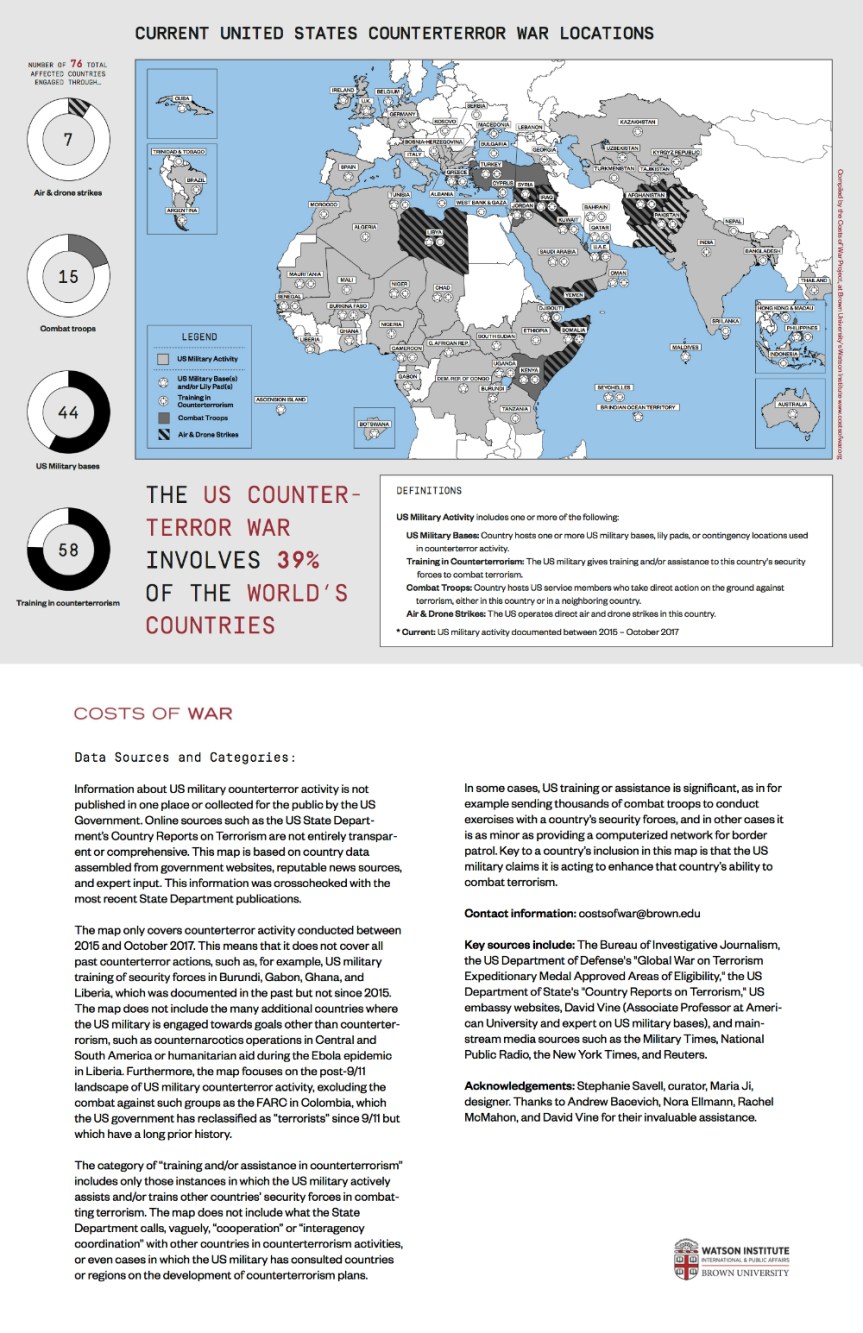
Our government likes to talk about global security, which in their minds is basically synonymous with homeland security. They argue that the best defense is a good offense, that “leaning forward in the foxhole,” or always being ready to attack, is the best way to keep Americans safe. Hence the 800 U.S. military bases in foreign countries, the deployment of special operations units to 130+ countries, and the never-ending “war on terror.”
Consider this snippet from today’s FP: Foreign Policy report:
If Congress votes through the massive tax cuts currently on the House floor, it would likely mean future cuts to Pentagon budgets “for training, maintenance, force structure, flight missions, procurement and other key programs.”
That’s according to former defense secretaries Leon E. Panetta, Chuck Hagel and Ash Carter, who sent a letter to congressional leadership Wednesday opposing the plan. “The result is the growing danger of a ‘hollowed out’ military force that lacks the ability to sustain the intensive deployment requirements of our global defense mission,” the secretaries wrote.
“Our global defense mission”: this vision that the U.S., in order to be secure, must dominate the world ensures profligate “defense” spending, to the tune of nearly $700 billion for 2018. Indeed, the Congress and the President are currently competing to see which branch of government can throw more money at the Pentagon, all in the name of “security,” naturally.
Here’s a quick summary of the new “defense” bill and what it authorizes (from the Washington Post):
The bill as it stands increases financial support for missile defense, larger troop salaries and modernizing, expanding and improving the military’s fleet of ships and warplanes. The legislation dedicates billions more than Trump’s request for key pieces of military equipment, such as Joint Strike Fighters — there are 20 more in the bill than in the president’s request — and increasing the size of the armed forces. The bill also outlines an increase of almost 20,000 service members — nearly twice Trump’s request.
In the House of Representatives, the bill passed by a vote of 356-70. At least Congress can agree on something — more and more money for the Pentagon. (The $700 billion price tag includes $65.7 billion “for combat operations in Iraq, Afghanistan, Syria, Yemen, various places in Africa, and elsewhere,” notes FP: Foreign Policy.)
Besides all this wasteful spending (the Pentagon has yet to pass an audit!), the vision itself is deeply flawed. If you want to defend America, defend it. Strengthen the National Guard. Increase security at the border (including cyber security). Spend money on the Coast Guard. And, more than anything, start closing military bases overseas. End U.S. participation in wars in Afghanistan, Iraq, and throughout the greater Middle East and Africa. Bring ground troops home. And end air and drone attacks (this would also end the Air Force’s “crisis” of being short nearly 2000 pilots).
This is not a plea for isolationism. It’s a quest for sanity. America is not made safer by spreading military forces around the globe while bombing every “terrorist” in sight. Quite the reverse.
Until we change our vision of what national defense really means–and what it requires–America will be less safe, less secure, and less democratic.
My father’s family was Italian, and his relatives fought, suffered, and died in Italy’s wars before and during World War I. In his diary, my dad recounted these relatives and their fates:
My mother as far as I can recall had two brothers in the [Italian military] service. One brother had an exploding shell land near him. He was highly agitated. A doctor who knew my mother’s family saw that he got a medical discharge.
His brother had a much more dangerous career in the Italian Army. He was a forward observer for an artillery unit. He was severely gassed on the Austrian front. He survived the war but had a premature death from the effects of the gas.
Luigi, Uncle Louie, Astore had quite a career in the Italian Army. My mother used to call him El Sargento.
Uncle Louie fought three years in the Turkish War[1911-12] and four years in World War 1. He was a prisoner of war in Germany for a year. I overheard a conversation and he remarked that things were tough as a prisoner and food was a scarce item. He never told me about his experiences in World War 1.
So, my grandmother had one brother who had shell-shock (PTSD) and another who died prematurely from poison gas. My grandfather had a brother (Luigi) who was a POW who nearly starved and who didn’t talk about his war experiences. (I am too young to have clear memories of Luigi, but photos show an unsmiling man, which is not surprising given his war experiences.)
War is all hell, as General William Sherman said, and my father’s family’s experience in Italy illustrates the truth of that.
A childhood friend of mine, who also had Italian parents, sent along a book recommendation to me: The White War: Life and Death on the Italian Front, 1915-1919 by Mark Thompson. My friend wrote a nice little review of it in an email to me, which follows below:
The White War (about Italy’s WWI fight against the Austro-Hungarians) has been fascinating but also depressing. The insistence of Italian staff officers to send poorly armed and trained men into a battlefield even more deadly than the western front (the Italians had to scale hills and mountains in the face of withering machine gun and artillery fire) boggles the mind. The Italian high command also had the dubious distinction of ordering more summary executions of the rank and file than the Brits, French, Germans, and Austrians. Illiterate peasants needlessly sent to their deaths in the hundreds of thousands with Italian military policemen stationed with machine guns to their rear with orders to fire on them in case they did not show the requisite élan. (My mother’s paternal uncle fell in that war–I wonder what horrors he saw and experienced.) If it did not already exist, surely the stereotypical Italian cynicism toward governmental authority resulted from the incompetence and brutality of Italian military leadership in WWI.
With respect to Italian POWs and food scarcity during captivity, my friend noted the following startling fact that he gleaned from reading The White War:
Italian authorities made it a policy to prevent food packages from being sent to Italian POWs in Austrian control as part of their strategy to deter Italian soldiers from surrendering. Many POWs died as a result. Unbelievable.
So much for the alleged glories of war. Italy’s war against Austria-Hungary, fought under bitterly cold conditions in the torturous terrain of the alps, is little known in the United States. It was a disastrous struggle that consumed nearly a million men for little reason, and the frustrations of that war – the betrayal of common soldiers by societal elites – contributed to estrangement, bitterness, and the embrace of fascism in the 1920s as an alternative to the status quo.
In U.S. politics today, with the backdrop of President Donald Trump’s strong man posturing that recalls the thrusting belligerence of the Italian fascist dictator Benito Mussolini, are we witnessing something similar? Recall that Trump in 2016 garnered a lot of support in rural areas by taking a position against America’s wasteful wars, even as he beckoned to an unspecified “great” past. Mussolini, who railed against Italy’s “mutilated victory” in World War I, also won support by calling for societal revival, even as he beckoned to the greatness of Italy’s imperial past.
Like Mussolini, Trump wasn’t (and isn’t) against war. Rather, both men were against losing wars. Appealing to tough-guy generals like George Patton and Douglas MacArthur, Trump promised Americans who had suffered they’d “win” again. Like Mussolini, he promised a brighter future (endless victories!) through higher military spending and aggressive military action. No more shame of “mutilated” victories — or so Mussolini and Trump promised.
Did Trump win because he had the nerve to highlight the “mutilated victory” nature of America’s wars? (Note that the caption here, from the Krinera/Shen study and the Zaid Jilani article, is unclear. The intent is to show that higher casualty rates favored Trump, and, if rates had been lower, Hillary Clinton may have won instead.)
Trump tapped the anger and resentments of American families who’d borne the sacrifices and suffering of the mutilated victories of Afghanistan and Iraq. He did this so well that, according to Zaid Jilani at The Intercept, citing a study by Boston University political science professor Douglas Krinera and University of Minnesota Law professor Francis Shen, it may have provided his winning margin of victory in 2016. As the study notes (also see the illustration above):
“[The] three swing states — Wisconsin, Pennsylvania, and Michigan — could very well have been winners for [Hillary] Clinton [in 2016] if their war casualties were lower.”
Like rural Italian families in the aftermath of World War I, American rural families in the Bush-Obama “war on terror” rejected the status quo posturing of establishment politicians (e.g. Hillary Clinton), turning instead to the anger-driven nationalism (Italy first! America first!) of self-styled strong men like Mussolini and Trump.
The question is, as America’s fruitless wars persist, and as rural American families continue to bear a disproportionate share of the burden of these wars, will “strong” men like Trump continue to prosper? Put differently, will the Democratic Party finally have the guts to offer an alternative vision that rejects forever war across the planet?
We know what happened to Mussolini’s quest to make Italy great again — total defeat in World War II. Will a similar fate befall Trump’s quest?
The revolving door between major defense contractors and the Pentagon is spinning ever more rapidly, notes FP: Foreign Policy. Here’s a telling report from last week:
McCain says enough, but does he mean it? During a hearing Thursday to vet several Trump administration nominees for top Pentagon jobs, Sen. John McCain (R-Ariz.) said he was tired of seeing defense industry executives go to work in the Pentagon.
But he indicated he’ll support the Mark Esper, chief lobbyist for for Raytheon — the fourth largest defense contractor in the United States — for secretary of the Army, telling Esper his concerns “grew out of early consultations I had with the administration about potential nominations, including yours.” McCain added that “it was then that I decided I couldn’t support further nominees with that background, beyond those we had already discussed.”
Lots of defense industry execs already at work. But at least one more will soon pass through McCain’s Senate Armed Services Committee, however. At some point in the coming weeks, John C. Rood, senior vice president for Lockheed Martin International will testify for the under secretary of defense for policy job, the third highest position in the Defense Department.
The Senate has already approved former Boeing executive Patrick Shanahan to be deputy defense secretary — the second highest position in the Pentagon — and Ellen Lord, the former chief executive officer of Textron Systems, to be undersecretary of defense for acquisition.
In short, there are no fresh thinkers at the Pentagon: just men and women drawn mainly from the corporate world or from the ranks of military retirees (or both). They’re hired because they know the system — but also because they believe in it. They’re not going to rock the boat. They believe in “staying the course.”
The result is a system with no new ideas. Consider Afghanistan. Sixteen years after the initial invasion after 9/11, American forces are still bogged down there. As FP: Foreign Policy reports today, we finally have an official number for the latest mini-surge orchestrated by retired Generals John Kelly and James Mattis:
We have a surge number. After months of tapdancing around exactly how many more U.S. troops are are heading to Afghanistan, Monday’s request asks for $1.2 billion to support an additional 3,500 U.S. troops in Afghanistan.
Somehow, a few thousand extra U.S. troops are supposed to reverse the growth of the Taliban while improving Afghan security forces and reining in Afghan governmental corruption. In short, sixteen years’ experience has meant nothing to U.S. decision makers.
It puts me to mind of a great description of military thinking from C.S. Forester’s “The General,” a remarkable novel about British generalship in World War I (and one of General John Kelly’s favorite books). Here’s what Forester had to say about the persistence of military folly among the generals planning major offensives in that war:
“In some ways it was like the debate of a group of savages as to how to extract a screw from a piece of wood. Accustomed only to nails, they had made one effort to pull out the screw by main force, and now that it had failed they were devising methods of applying more force still, of obtaining more efficient pincers, of using levers and fulcrums so that more men could bring their strength to bear. They could hardly be blamed for not guessing that by rotating the screw it would come out after the exertion of far less effort; it would be a notion so different from anything they had ever encountered that they would laugh at the man who suggested it.”
Forester goes on to write that:
“The Generals round the table were not men who were easily discouraged–men of that sort did not last long in command in France. Now that the first shock of disappointment had been faced they were prepared to make a fresh effort, and to go on making those efforts as long as their strength lasted.”
That’s the U.S. military in Afghanistan in a nutshell: fresh efforts, but no fresh thinking. How could it not be so? The same generals are in charge, men like Mattis and Kelly, who led previous “surges,” backed by civilian leaders drawn from private military contractors, whose main priority it is to spend this year’s massive defense budget while ensuring next year’s budget will be even more massive.
There’s no incentive in the system for fresh thinking, and certainly none for saving money. Instead, it’s all about showing “resolve,” even if resolve in this case means hammering and pulling away at so many screws. And this even makes a weird sort of sense, for there’s a lot of profit to be made in the name of developing better pincers and levers and fulcrums to tackle “screws” like Afghanistan.
Here are two items this morning from FP: Foreign Policy (foreignpolicy.com), which provides a daily summary (Situation Report, or SITREP) of news items related to the U.S. military and foreign policy. Together, they represent the very definition of insanity.
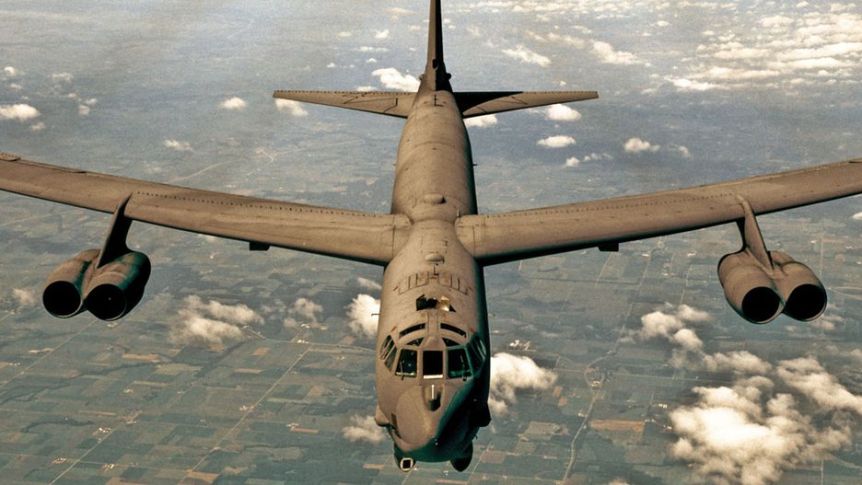
Item 1: The Congressional Budget Office on Tuesday said U.S. taxpayers are on the hook for about $1.2 trillion over the next 30 years to modernize the country’s nuclear arsenal. That huge number takes into account the replacement of nuclear-capable submarines, ICBMs, and new aircraft for the Air Force.
The budget office warned that the projected costs would muscle out some conventional weapons programs in the coming years unless the Pentagon’s budget is increased substantially. The CBO identified some cost savings however, saying the Pentagon could save as much as $139 billion if it delayed production of a new ICBM, stalled a secretive new nuclear-capable bomber called the B-21, and reduced the number of ICBMs and missile-carrying nuclear submarines than planned.
All of those plans are carry-overs from the Obama administration, as the Trump team has yet to articulate a nuclear weapons strategy.
Item 2: War in Afghanistan, redacted. The Afghan government is losing control of more and more territory to the Taliban, according a grim new report from the congressionally-mandated Special Inspector General for Afghanistan Reconstruction. On the humanitarian side, civilian casualties from coalition and Afghan air strikes spiked by 52 percent in the first nine months of this year over last year, the report notes.
In response to those unfriendly stats, the U.S. military has started to withhold information from the American public, refusing to report figures related to the size and success of Afghan security forces — which the U.S. taxpayer has spent tens of billions to build and sustain.
“The Afghans know what’s going on; the Taliban knows what’s going on; the U.S. military knows what’s going on,” John F. Sopko, the special inspector general for Afghanistan, told the New York Times. “The only people who don’t know what’s going on are the people paying for it.”
In sum, the American people will possibly pay more than a trillion dollars in the next three decades for more nuclear weapons (when the stated goal of leaders like Obama had been to eliminate them), even as information about the never-ending war in Afghanistan is withheld from the American people (especially the jaw-dropping waste of billions of dollars on Afghan security forces that can’t or won’t fight).
Meanwhile, U.S. citizens in Puerto Rico languish in the dark, the victims of a U.S. government that seeks to punish the island for its debt to various financial institutes and power brokers.
Nick Turse has an excellent article at TomDispatch.com documenting how U.S. special ops forces are involved in many countries that share a border with Russia. A telling quotation from his article comes from General Raymond Thomas, the head of U.S. Special Operations Command (SOCOM). Testifying before Congress, Thomas said
“We are working relentlessly with our [European] partners and the Department of State to build potency in eastern and northern Europe to counter Russia’s approach to unconventional warfare, including developing mature and sustainable Special Operations capabilities across the region.”
This looks like typical bureaucratese, but two words struck me as revealing: “relentlessly” and “potency.” Typically, one might say one is working “tirelessly,” or “cooperatively,” or just plain working. The idea one is working “relentlessly” serves to highlight the often frenetic nature of U.S. military deployments, the emphasis on ceaseless toil and constant action, especially of the kinetic variety. This is a leading feature of America’s can-do military, a strong preference for acting first, thinking later. And it doesn’t bode well as American special ops forces take up “mature and sustainable” positions in former Soviet satellite countries for the alleged reason of deterring Russian aggression.
The second word that struck me from the general’s testimony was “potency.” Americans certainly can’t be seen as impotent. But potency here is really a weasel word for offensive potential — the ability to strike “kinetically” at an enemy. For example, one could say the Soviets were building up potency in Cuba during the early 1960s, but the Kennedy administration didn’t exactly see nuclear missiles being based there in those terms. Is Kim Jong-un similarly building up regional “potency,” working “relentlessly” to deter U.S. aggression in his region of the world? American military and foreign policy experts would laugh at those words and sentiments coming from the mouth of rival leaders like Vladimir Putin or Kim Jong-un.
With ever bigger military budgets, and ever growing ambitions, the U.S. military is relentlessly building up potency, which is nevertheless always framed as defensive, even benign.
Something tells me the Russians don’t see it this way.