I was looking at some old military history notes today and came across this photo of Lieutenant General Hubert Reilly Harmon, known today as the father of the Air Force Academy and its first superintendent:
I love the simplicity of this photo. General Harmon is wearing four ribbons on his uniform and his pilot’s wings. He commanded an air force in the Pacific during World War II and helped to win that war.
Of course, the architect of victory for the entire U.S. military in World War II was George C. Marshall. His portrait as a five-star general is here:
A simple uniform with three rows of ribbons.
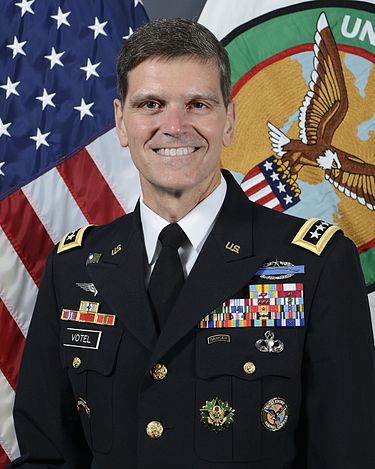
But that was then, and this is now. Generals today have far busier uniforms that are festooned with ribbons, badges, and other militaria. General Joseph Votel, currently the commanding general of Central Command, is typical:
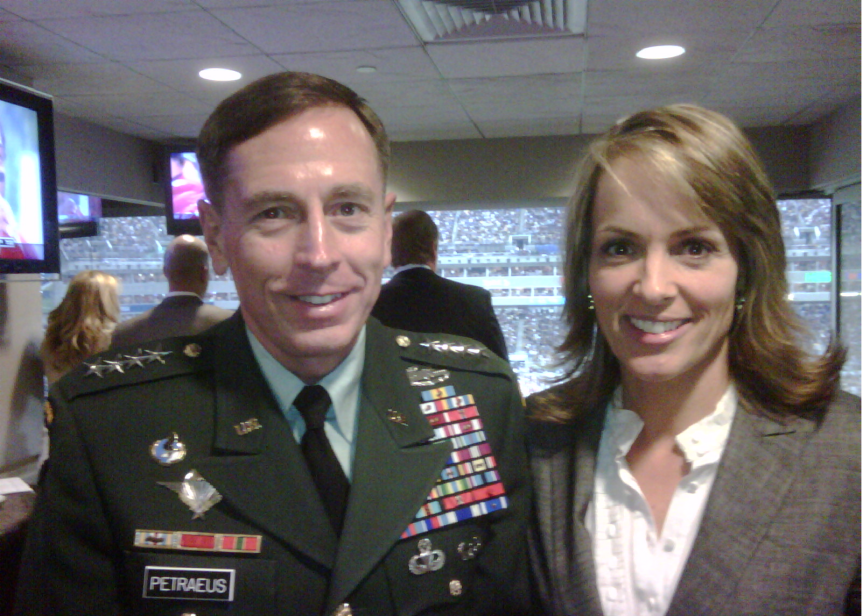
But I don’t think any general has outdone David Petraeus in the pursuit of ribbons and badges:
Petraeus: Lots of ribbon candy crowded on that uniform
What would men like Hubert Harmon and George Marshall say about today’s crop of American generals? How did Marshall win World War II without a Ranger tab, without parachute wings, and without ten rows of ribbons?
America’s citizen-soldier military of the era of the “Greatest Generation” was concerned with one measure of success: victory over Imperial Japan and Nazi Germany in a war vital not only to U.S. security but to the survival of the free world (even if that world isn’t as “free” as they or we would like it to be). Today’s military is distracted by the pursuit of the right “tabs” and “wings” and other paraphernalia even as they wage wars without end (and without any apparent prospect of victory).
I suppose today’s generals will talk about how complex the world is today, how asymmetrical our wars are, how our enemies occupy a “grey zone” that is difficult to master, and so forth and so on. Even so, why the grade inflation? Why the over-the-top uniforms?
Perhaps America will start winning wars again (even better: avoiding them altogether) when its military leaders stop acting like crazed Boy Scouts in the pursuit of merit badges and ribbon candy.
Postscript: I’ve written about this issue before (here and here) and also here way back in 2007. But nothing seems to change; if anything, the ribbons and badges continue to proliferate, so much so that the U.S. military now has more bling than the Kardashians.
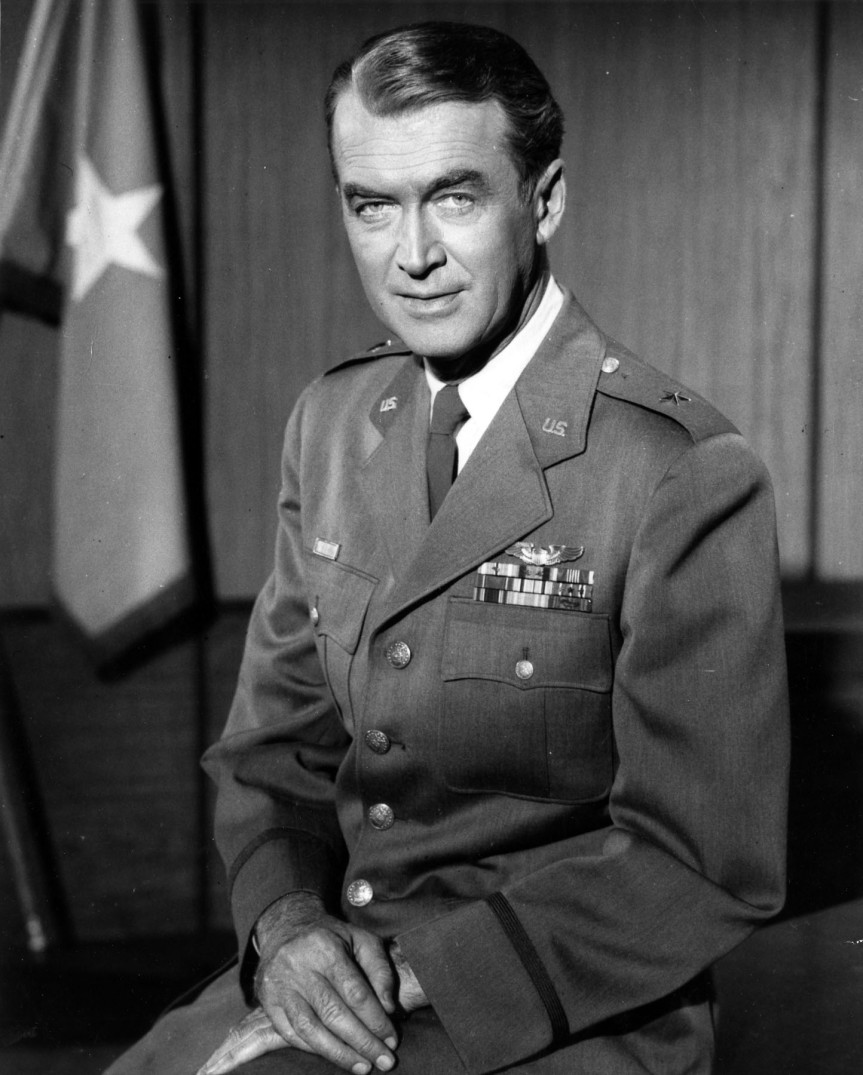
No — Jimmy Stewart is not acting here. He flew bombers in World War II and rose to the rank of brigadier general in the Air Force
W.J. Astore
Back in 2013, I wrote an article on U.S. wars and the absence of movie and sports stars in the ranks of those who serve. Hollywood and sports leagues such as the NFL and MLB celebrate the military today, but that celebration does not extend to service and sacrifice. Indeed, the main service is lip service: basically, cheap words to the effect that we celebrities “support” the troops. It’s not exactly the kind of service we associate with the Greatest Generation of World War II, is it?
Yet the absence of Hollywood celebrities and sports “heroes” in the ranks may be indicative of another, much more serious, issue. Maybe America’s wars simply aren’t vital to them — or to us? And if they’re not vital, why are they still in progress? Why can’t we end them?
Here is what I wrote in 2013:
The tradition of the citizen-soldier is still alive in this country — just look at our National Guard units. But the burden of military service is obviously not equally shared, with the affluent and famous tucked away safely at home. How many people remember that Jimmy Stewart, legendary Hollywood actor, flew dangerous combat missions in the skies over Europe during World War II? Stewart didn’t flaunt his combat service; in fact, playing against type, he stayed home as the unhallowed George Bailey in It’s A Wonderful Life, a movie that celebrated the heroism of the ordinary citizen. In the movie, Stewart’s quiet, home-based heroism, his powerful sense of fairness and decency, is even allowed to overshadow that of his younger brother, who returns from war with the Medal of Honor.
There’s an interesting lesson there. In World War II, celebrities often risked life and limb in real military service, then after the war played against type to celebrate the virtues of a homespun heroism. Today’s celebrities avoid military service altogether but play tough in action films where they pose as “heroes.”
Other than Pat Tillman, who gave up a promising NFL football career to join the military after 9/11, I can’t think of a single celebrity who answered the call to arms as a citizen-soldier.
Then again, that call was never issued. After 9/11, President George W. Bush famously told us to keep calm and carry on — carrying on shopping and patronizing Disney, that is. He did so because he already had a large standing professional military he could call on, drawn primarily from the middling orders of society. This “all volunteer military” is often described (especially in advertisements by defense contractors) as a collection of “warfighters” and “warriors.” In the field, they are supplemented by privatized militaries provided by companies like Academi (formerly Blackwater/Xe), Triple Canopy, and DynCorp International. In a word, mercenaries. These bring with them a corporate, for-profit, mindset to America’s wars.
If we as a country are going to keep fighting wars, we need a military drawn from the people. All the people. As a start, we need to draft young men (and women) from Hollywood, from the stage and screen. And we need to draft America’s sports stars (I shouldn’t think this would be an issue, since there are so many patriotic displays in favor of the troops at NFL stadiums and MLB parks).
Jimmy Stewart served in combat. So too did Ted Williams. So too did so many of their Hollywood and sporting generation.
Until today’s stars of stage and screen and sports join with the same sense of urgency as their counterparts of “The Greatest Generation,” I’ll remain deeply skeptical of all those Hollywood and sporting world patriotic displays of troop support.
If this whole line of argument sounds crazy to you, I have a modest suggestion. Rather a plea. If our celebrities who profit the most from America are unwilling to defend it the way Stewart and Williams did, perhaps that’s not just a sign of societal rot. Perhaps it’s a sign that our wars are simply not vital to us. And if that’s the case, shouldn’t we end them? Now?
My family’s old wringer-washer. Look closely: as a kid, I stuck an American flag just above the “Maytag” label.
W.J. Astore
Walls and weapons and wars have come to define the USA in the 21st century. The most infamous wall is Donald Trump’s proposed extension of the border wall with Mexico. Weapons are everywhere, domestically with guns and mass shootings even as weapons sales overseas drive U.S. foreign policy. Wars are simply endless in places that most Americans would struggle to identify on maps. What percentage of Americans, for example, could identify Niger before the ambush that cost four Green Berets or Yemen before a Navy SEAL died there after Trump’s first military action (which he subsequently blamed on the generals)? Indeed, how many Americans could identify these countries now, even with U.S. troops having died there, ostensibly in the name of fighting terrorism and keeping America safe?
I’m both a baby boomer and a retired military officer. Looking back to the 20th century and in the context of the Cold War, when I thought of walls, images of Berlin came to mind, with desperate people risking life and limb to seek freedom in the West. A wall was a symbol of them – you know, the Evil Empire, the Soviets, the Stasi, the freedom-deniers. The USA, land of liberty, neither needed nor wanted walls. Weapons? Sure, we had plenty of those when I was young, and sold lots of them too to countries overseas, when we weren’t using them ourselves to pummel Southeast Asia and other regions. But military-style assault weapons for citizens were virtually unknown until the 1980s, and extensive weapons sales overseas had a purpose (at least in theory) of deterring communist expansion. Nowadays, weapons sales need have no purpose other than profit for those who make and sell them.
And wars? However evil the U.S. had acted during the Vietnam War, and indeed there’s much evil in policies that enjoin troops to “kill anything that moves,” as Nick Turse has documented in his book by that name, at least one thing can be said of that war: it ended, and America lost. Even the Cold War ended (or so we believed, until recent claims that Russia and China represent the threats of the future). Today, America’s wars never end. Retired generals like David Petraeus spout gibberish about the wisdom of a “sustainable sustained commitment” to the war in Afghanistan, with the Pentagon babbling on about “long” and “generational” campaigns, as if prolonging wars for less-than-vital causes is a sign of U.S. strength.
The point is this: Walls were not us. Weapons, however prevalent throughout U.S. history, were not treated as panaceas and sold as solutions to everything from classroom shootings to saving American jobs to boosting economic growth and cutting trade imbalances. Even America’s wars were not open-ended or openly described as “generational.” All of this is either new today or a twisted version of past policies and practices.
The Unmaking of American Idealism
As a teenager, I embraced American idealism. The bicentennial was coming in 1976, and I was the proud owner of a reproduction of the Declaration of Independence. It was on pseudo-parchment paper, a cheap copy for sure, but I treated it as if were precious because it was – and is. It’s precious for the ideals it represents, the enshrinement of self-evident truths like life and liberty and the pursuit of happiness, however imperfectly America upheld and advanced these in practice.
Maybe this is why I bought a roll of American flag stickers and stuck them on everything (including our kitchen door and our washing machine, which must have thrilled my parents). Back then, I thought I knew what America stood for, or at least what my country stood against. Despite all our sins, America was anti-wall, and even as we built and sold weapons and fought proxy wars in a contest with the Soviets, there was a sense America stood for freedom, or so I believed. Meanwhile, in the immediate aftermath of Vietnam, we were also not as eager to fight wars everywhere and without end.
But that was then, and this is now. Forget about the “Age of Aquarius,” a trippy song about peace and love that I remember singing when I was eight years old. Today in America, it’s the Age of Mars, the Age of Walls and Weapons and War.
Coming of age in the 1970s, I heard and read a lot about war. Vietnam had been a disaster, but there was always the example of World War II to set things right in my mind. I could read about American heroism at Wake Island and during the Battle of the Bulge; I could watch movies like “Patton” that glorified tough-talking U.S. generals; I could look to my uncle who won a bronze star fighting at Guadalcanal in the Pacific. I knew (or so I thought) that America stood for freedom and against tyranny.
But that ideal of freedom was always tinged by images of violent frontier justice, as depicted in popular culture. Memorable movies of my teen years included Clint Eastwood playing a rogue cop in “Dirty Harry,” Charles Bronson playing a shattered vigilante in “Death Wish,” and John Wayne playing tough cop roles in movies like “McQ” and “Brannigan.” These movies were clear about one thing: the rule of law wasn’t enough to keep us safe. Sometimes, a man’s gotta do what a man’s gotta do, which usually involved Clint or Chuck or John (and, later, Sylvester Stallone’s John Rambo) dispensing justice with fists and from the barrels of various (big) guns.
Extreme violence as well as images of the lone gunfighter were and are features of American history and culture, of course. But these were counterbalanced in the 1960s and 1970s by peace anthems such as John Lennon’s “Imagine.” A less known song, one I sang as a kid, was “Billy don’t be a hero” (how could I resist: It had my name in it). In this song, young Billy wants to go off to war, but his fiancée discourages him. Predictably, Billy goes anyway, the words of his fiancée following him (Billy don’t be a hero/don’t be a fool with your life). Billy, after volunteering for a dangerous mission, dies a hero, the government sending a laudatory letter to his fiancée, who tearfully tosses it into the trash.
That song made an impression, though it didn’t stop me from joining the military. Why? Because I bought the narrative: the U.S. was fighting a war of survival against godless communism, showing patient resolve as we worked to contain a threat to freedom around the world.
That cold war ended more than 25 years ago, yet nevertheless the U.S. continues to build and sell more weapons than any other country; to support higher and higher military spending; and to wage more wars in more places than ever. Clinton or Bush, Obama or Trump, the war song remains the same. It all represents a narrowing of national horizons, a betrayal of American promise, one we’ll overcome only when we change course and reject walls and weapons and war.
Stopping Walls, Weapons, and Wars
There are two war parties in the U.S. today. We call them Republicans and Democrats. When it comes to fostering and feeding war, both are essentially the same. Both are slaves to the national security state, even if Democrats make a show of rattling their chains a bit more. Both define patriotism in militaristic terms and loyalty in terms of blanket support of, even reverence for, American military adventurism and interventionism. Political candidates who have rival ideas, such as Libertarian Gary Johnson (remember him?) or Green Party candidate Jill Stein, are not even allowed on the stage. Even when heard, they’re dismissed as jokes.
In 2016, for example, Johnson suggested cuts to military spending approaching 20%; Jill Stein suggested cuts as deep as 50%. Their proposals, however, were simply rejected as preposterous by the mainstream media. Even Bernie Sanders, a democratic socialist, refused to propose serious cuts to military spending: if he had, he knew he’d be dismissed as either a weak-kneed appeaser or an unserious ignoramus. (Recall how Gary Johnson was depicted as clueless by the mainstream media because he couldn’t place Aleppo in Syria or instantly name a foreign leader he adored.)
Unmasked military authoritarianism is the new reality in U.S. government and society today, complete with a martial parade in Washington, D.C. come this November. This is no surprise. Recall how both Hillary Clinton and Donald Trump boasted of how many generals and admirals supported them in their respective presidential campaigns, as if they couldn’t run for office unless they’d been anointed by men in military uniforms wearing stars.
And we dare call this a democracy?
Seeing the problem clearly is a way to begin to solve it. Want to restore American liberty? Stop building walls (and tearing children from parents). Stop buying and selling massive amounts of weaponry here and everywhere. And stop waging war across the globe. Americans used to know the chief result of divisive walls, proliferating weapons, and endless war is chaos everywhere and democracy nowhere. How did we come to forget this lesson?
If we take these simple yet profound steps, I could look again at my childhood copy of the Declaration of Independence with a renewed sense of hope.
River in rural Pennsylvania. Do I hear banjos? (Author’s photo)
W.J. Astore
Back in January of 2010, I wrote the following article as a thought experiment on whether Obama’s “surge” in Afghanistan would succeed or fail. I bet on failure, which wasn’t much of a reach. Why? It’s not because U.S. troops weren’t brave or dedicated. They sure didn’t lack weaponry. What they lacked was the ability to enforce their will at a sustainable cost. They were strangers in a strange land, among strange people, and the mission they were given was simply beyond them. I tried to explain this with some role reversal. Eight years later, the Taliban and similar forces are even stronger than they were at the start of 2010. Surprised?
A Thought Experiment for Our Afghan Surge (2010)
Consider the following thought experiment. Give the Afghan Taliban our technology and money, and have them journey thousands of miles to the densely forested hills and mountains of rural Pennsylvania, close to where I currently live. Who’s going to prevail? The Afghans fighting a high-tech counterinsurgency campaign, or the PA locals fighting a low-tech campaign to defend their homes and way of life?
My money would be on my “hillbilly” (a term I use affectionately) neighbors who love to hunt, who know the terrain, and who are committed to liberty. My students, male and female, are generally tough, resourceful, love the outdoors, make their own beef jerky, cut and split their own wood, have plenty of guns and ammo and bows and knives and, well, you get the idea. Even in my classes, they’re wearing camouflage pants, vests, and hats. They could go from college student to people’s warrior before you could say Mao Zedong. And I doubt they’d spare much love for foreign fighters on their turf.
Now, consider an Afghan intelligence officer trying to understand rural PA culture, to blend in with the locals, to win hearts and minds. What are the chances this intelligence operative would be successful? If he speaks English, it’s in a broken, heavily accented form, insensitive to local and regional variations. If he can’t bargain with words, he might be able to bribe a few locals into helping him, but their allegiance will wane as the money runs out.
As this imaginary Afghan force seeks to gain control over the countryside, its members find themselves being picked off like so many whitetail deer. Using their drones and Hellfire missiles, they strike back at the PA rebels, only to mistake a raucous yet innocent biker rally for a conglomeration of insurgents. Among the dead bodies and twisted Harleys, a new spirit of resistance is born.
Now, if you’ve followed me in this thought experiment, why don’t we get it? Why can’t we see that the odds are stacked against us in Afghanistan? Why are we surprised that, by our own assessment, our intelligence in Afghanistan is still “clueless” after eight years and “ignorant of local economics and landowners, hazy about who the powerbrokers are and how they might be influenced … and disengaged from people in the best position to find answers”?
And why would we think that a surge of more “clueless” operatives would reverse the tide?
Would more Taliban forces deployed to the hills and valleys of PA win the hearts and minds of the locals?
I know the answer to that hypothetical: as the PA rebels might say, no friggin’ way.
Afterthought (2018): I’ve done some hiking in the backwoods of Pennsylvania. It can be tough terrain. Heavily forested hills and valleys, rattlesnakes among the rocks (my wife walked past two of them, entwined), quite primitive in its own way. I pity a foreign army trying to force its agenda on Appalachia and the people who live there. My favorite t-shirt (sported by a native woman) read: “Hunting bucks, driving trucks: that’s what makes me roll.” Good luck pacifying her and her kin, foreigner.
Weekends are a good time to sit back, reflect, and think. Here are a few ideas I’ve been thinking about:
1. Remember 9/11/2001? Of course you do. Almost everyone back then seemed to compare it to Pearl Harbor, another date that would live in infamy — and that was a big mistake. In 1941, the USA was attacked by another sovereign nation. In 2001, we were attacked by a small group of terrorists. But international terrorism was nothing new, and indeed the U.S. was already actively combating Al Qaeda. The only new thing was the shock and awe of the 9/11 attacks — especially the images of the Twin Towers collapsing.
By adopting the Pearl Harbor image, our response was predetermined, i.e. the deployment of the U.S. military to wage war. Even that wasn’t necessarily a fatal mistake, if we’d stopped with Afghanistan and overthrowing the Taliban. But, as Henry Kissinger said, Afghanistan wasn’t enough. Someone else had to pay, in this case the unlucky Iraqis. And then the U.S. military was stuck with two occupations that it was fated to lose. And millions of Afghan and Iraqi people suffered for our leaders’ mistakes.
But perhaps the most remarkable aspect of 9/11 was how no one in Washington took the blame for it. I don’t recall any high-level firings. The buck stopped nowhere. Same with torture. The buck stopped nowhere. Officialdom looked the other way, including the next administration under the “change” candidate, Barack Obama. He changed nothing in this area. His mantra about “looking forward” meant learning nothing from history.
It’s this lack of accountability, perhaps, that made Trump possible. He lies constantly and blunders and blusters, yet (so far) there’s no accountability for that either. People just expect our government to be composed of con men and serial liars, so why not just elect one as president?
No accountability after 9/11 and torture led to “no accountability” Trump.
2. Another thought on 9/11: The 9/11 war-driven response was part of American exceptionalism. What I mean is this: America is not supposed to be on the receiving end of “shock and awe.” We are supposed to be the givers of it. As Americans, we were totally unprepared, psychologically, for such a blow. (A Soviet nuclear attack, a million times more devastating, would have made more “sense” in that the danger was drummed into us.) An attack by hijacked airliners, a mutant form of airpower? Well, America is supposed to rule the skies. We bomb others; they don’t bomb us. Right?
It was all so shocking and destabilizing, hence the “rally around the flag” effect and the blank check issued by Congress to Bush/Cheney for what has proved to be a forever war on terror — or something. And now, with Trump and crew, is the new “something” Iran?
3. In our military-first culture, projects like the B-21 stealth bomber are just accepted as business as usual — the cost of keeping America “safe.” We had more debate about weapons systems during the Cold War, when we truly faced an existential threat. Now, weapons ‘r’ us. It’s a peculiar moment in American history, a sort of cult of the gun, whether that “gun” is a bomber, missile, aircraft carrier, etc.
Put differently, our personal insecurities (due to debt, health care, jobs, weather catastrophes, fear of immigrants, etc.) have driven a cult of security in which guns and related military technologies have been offered as a palliative or even a panacea. Feel secure — buy a gun. Feel secure — build a new stealth bomber. Stand your ground — global strike. The personal is the political is the military.
4. If Reagan’s motto was “trust — but verify” with the Soviet Union, Trump’s motto with North Korea is simply “trust.” Yes — it’s a good thing that Trump is no longer threatening to bring nuclear fire and fury to the North Koreans, but his recent meeting with Kim Jong-un, large in image, was short on substance. Will those verification details be worked out in the future? Do the North Koreans have any intent to give up their nuclear weapons? Both are doubtful. So, does Trump deserve a Nobel peace prize? About as much as Obama did.
5. I’ve never witnessed a man destroy a political party like Trump has taken apart the Republicans. It’s a remarkable achievement, actually. And I don’t mean that as a compliment. I was once a Gerald Ford supporter in the 1976 election, and I voted for Ronald Reagan in 1984. (We make mistakes when we’re young; that said, Walter Mondale was an uninspiring Democratic candidate.) I thought the Republican Party had principles; I think it did in the 1970s and 1980s. Now, the only “principles” are money and power, as in getting more of both. If that means kowtowing to Trump, so be it. Kneel before Zod, Republicans!
That’s enough for my Saturday afternoon. Fire away in the comments section, readers!
Can we get 10-20 million Americans to settle here?
W.J. Astore
I was jesting with a friend the other day about how the U.S. could win the Afghan War. There were two ways, I suggested. The first is to relocate about 10 or 20 million Americans to Afghanistan and declare it the 51st state. Then wait a generation or two. The second was to withdraw all American forces and declare “mission accomplished.” Half-measures that fall in between these options are doomed to fail, which is what we’ve been witnessing since the fall of 2001.
In Afghanistan today, the Taliban controls more territory than ever, the drug trade is flourishing, government corruption is endemic, yet the U.S. military/government continues to speak of progress. This “spin it to win it” approach to the Afghan War is nothing new, of course, which is why the following article that I wrote in 2010 is still relevant.
President Trump had a sound instinct in seeking to end the Afghan War. He was talked out of it by the military. For all his faults, Trump knows a loser policy when he sees it. Will he have the moxie to withdraw U.S. forces from Afghanistan?
No More Afghanistans (originally posted in 2010)
In grappling with Afghanistan, President Obama and his team of national security advisors reveal a tendency all too common within the Washington beltway: privileging fleeting and reversible signs of local success while downplaying endemic difficulties and larger patterns of strategic failure. Our latest intelligence estimates, we are told, show signs of progress. But of what sort? The Taliban appears to be extending its hold in the countryside, corruption continues to spread in the Karzai government, and the Afghan National Army remains unreliable, all despite (or rather because of) prodigious infusions of cash courtesy of the American taxpayer.
The president and his advisors would do well to toss aside the latest “feel good” intel and pick up a good book on war. I’d recommend Summons of the Trumpet: U.S.-Vietnam in Perspective, by Colonel (later, Lieutenant General) Dave Richard Palmer. “One of the essential ingredients of [national] preparedness,” wrote then-Colonel Palmer in 1978, “is a diligent and honest study of the past, an intellectual examination of historical successes and failures.” True to his word, Palmer quoted Major G.P. Baldwin, who wrote in 1928 of the Russo-Japanese War that:
The [Russian] government, the press, and the people as a whole had no enthusiasm for the war, indeed failed to understand what the nation was fighting about … Such support is necessary in any war … Unless the people are enthusiastic about war, unless they have a strong will to win it, they will become discouraged by repeated [setbacks] … no government can go to war with hope of success unless it is assured that the people as a whole know what the war is about, that they believe in their cause, are enthusiastic for it, and possess a determination to win. If these conditions are not present the government should take steps to create them or keep the peace.
Palmer cited these words at the end of his probing account of America’s defeat in Vietnam. Though I don’t agree with all of Palmer’s conclusions, his book is stimulating, incisive, and compelling in its concluding vow: “There must be no more Vietnams.”
Let’s consider the points that Baldwin and Palmer raise in light of today’s situation in Afghanistan. Are the American people enthusiastic for this war? Do they have a strong will to win it (assuming the war is winnable on terms consistent with our interests)? Do they know what the war is about (this seems unlikely, since nine out of ten Americans can’t seem to locate Afghanistan on a map)?
If the answer to these fundamental questions is “no,” and I believe it is, shouldn’t our government and our troops be withdrawing now? Because I don’t see that our government will seek to mobilize the people, mobilize our national will, tell us clearly what our cause is and why it is just, and persist in that cause until it is either won or lost. And if I’m right about this, our government had best work to “keep the peace.”
Some of the reasons Palmer cites for why Vietnam was such an “incomprehensible war” for the United States bear careful consideration for President Obama’s policy review. These reasons include that few Americans knew exactly why we were fighting in Vietnam; that it was a “limited war” during which most Americans “sensed no feeling of immediate danger and certainly no spirit of total involvement”; that no “unifying element” was at work to suppress internal doubt and dissent, common elements in all wars; that the struggle was not only (or even primarily) a military one but one in which economic, political, and psychological factors often intruded; and that a cultural gap of great perplexity separated us from both our in-country allies and our enemy, a gap that “foment[ed] mistrust and misunderstanding.”
In light of these points, Afghanistan may qualify as a new “incomprehensible war.” Let’s not be distracted by the minutia of the latest intelligence reports and their uncertain metrics of “success.” Unless we can give convincing answers to General Palmer’s questions and points – and unless we can wage a war that doesn’t entail destroying the Afghan village in order to save it – our only sound course is expedient withdrawal, followed by a renewed vow: There must be no more Vietnams – or Afghanistans.
Back in July 2011, I wrote an article on how sports were being militarized in American life. On this subject as well as protest by (mostly) Black athletes, there’s a new book out, The Heritage, written by Howard Bryant, a journalist for ESPN. The book is excellent and is truly required reading for all sports fans, and indeed for all concerned Americans.
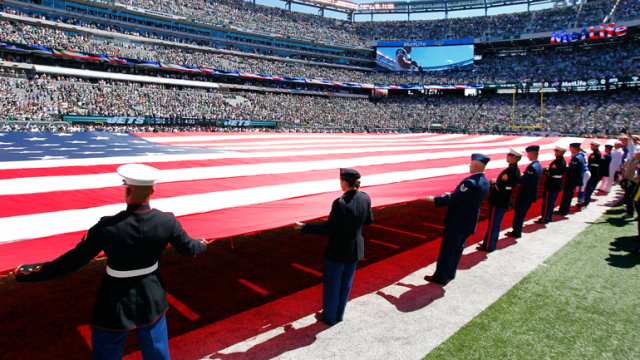
Sports have become infected by often pro forma, often coerced, often empty displays of “patriotism” that consist of gigantic flags, flyovers by combat jets, the wearing of faux camouflage uniforms by players, and similar displays. (There’s nothing wrong, I should add, with teams and players supporting military charities and the like.) These so-called patriotic displays are celebrated and applauded even as rare and respectful protests by players are attacked as unpatriotic and un-American.
Every military member knows that our oath of office is to support and defend the U.S. Constitution against all enemies, foreign and domestic. The enemies of our Constitution are not those players who take a knee in protest when they know it’ll prove unpopular; the enemies are those who attack those players while hiding behind the military and the troops.
Dissent and protest is American; it’s what our founders dared to do against long odds when in 1776 they declared their independence from a powerful empire. Isn’t it astonishing that in these days so many Americans need to be reminded of this vital fact? W.J. Astore, 6/10/18
The Militarization of Sports — And the Sportiness of Military Service
Connecting sports to military service and vice versa has a venerable history. The Battle of Waterloo (1815) was won on the playing fields of Eton, Wellington allegedly said. Going over the top at the Battle of the Somme (1916), a few British soldiers kicked soccer balls in the general direction of the German lines. American service academies have historically placed a high value on sports (especially football) for their ability to generate and instill leadership, teamwork and toughness under pressure.
But in today’s America, we are witnessing an unprecedented militarization of sports, and a concomitant emphasis on the sportiness of military service. With respect to the latter, take a close look at recent Army recruitment ads (which I happen to see while watching baseball). These ads show soldiers lifting weights, playing volleyball, climbing mountains and similar sporty activities. The voice-over stresses that army service promotes teamwork and toughness (“There’s strong. Then there’s army strong.”) There are, of course, no shots of soldiers under direct fire, of wounded soldiers crying for help, of disabled veterans. Army service in these ads is celebrated as (and reduced to) an action-filled sequence of sporting events.
Today’s militarization of sports is even more blatant. Consider this excellent article by U.S. Army Colonel (retired) Andrew Bacevich, which highlights the “cheap grace” available to crowds at major sporting events. For-profit sports corporations and the Pentagon join hands to orchestrate pageants that encourage (manipulate?) us to cheer and celebrate our flag, our troops and our sports and military heroes, as the obligatory fighter jets roar overhead.
Now, I’m sure there are well-meaning people who see such pageantry as an uncontroversial celebration of love of country, as well as a gesture of generosity and thanks to our military. And this retired veteran admits to feeling my heart swell when I see our flag flying proudly and our troops marching smartly. But the co-joining of corporate-owned sports teams and events (which are ultimately about entertainment and making a buck) with the military (which is ultimately in the deadly business of winning wars) strikes me as more than disturbing.
To cite only one example: The San Diego Padres baseball team takes “tremendous pride” in being “the first team in professional sports to have a dedicated military affairs department,” according to a team press release quoting Tom Garfinkel, the Padres president and chief operating officer. But is it truly “tremendous” for sports teams to be creating “military affairs” departments? As our sporting “heroes” celebrate our military ones, does not a dangerous blurring take place, especially in the minds of America’s youth?
War is not a sport; it’s not entertainment; it’s not fun. And blurring the lines between sport and war is not in the best interests of our youth, who should not be sold on military service based on stadium pageantry or team marketing, however well-intentioned it may be.
We’ve created a dangerous dynamic in this country: one in which sporting events are exploited to sell military service for some while providing cheap grace for all, even as military service is sold as providing the thrill of (sporting) victory while elevating our troops to the status of “heroes” (a status too often assigned by our society to well-paid professional athletes).
Which brings me to a humble request: At our sporting events, is it too much to ask that we simply “Play Ball?” In our appeals for military recruits, is it too much for us to tell them that war is not a sport?
Think of these questions the next time those military warplanes roar over the coliseum of your corporate-owned team.
B-52 with lots of bombs on Guam during the Vietnam War
W.J. Astore
I have a simple proposition: Let’s rebuild America instead of paving roads to nowhere in Afghanistan.
The U.S. has spent nearly a trillion dollars on fighting and (mostly) losing the Afghan War over the last seventeen years. That price tag includes paving roads that have already fallen into disrepair. Yet as money continues to flow freely to the Pentagon and to America’s fruitless wars overseas, money for America’s infrastructure barely flows at a trickle from the federal government. How stupid is that?
I was talking to a guy yesterday who owns a local landscaping company. Like me, he couldn’t stomach Trump or Hillary for president in 2016, so he voted for a third-party candidate. He got to asking about my latest writing efforts and I mentioned my recent article on the Air Force’s $100 billion stealth bomber. He asked if I was for it or against it, and I said against. Good, he said. And he started talking about the 1930s and how America invested in itself by building bridges, roads, canals, dams, and other infrastructure. Why aren’t we doing more of that today? Sensible question. Our infrastructure is decaying all around us, but our government would rather invest in military weaponry.
Today, I had to go to the auto dealership, and I got talking to an old buck who served as an infantry platoon leader in Vietnam in 1967. What he recalled about the war, he said, was its enormity. All those B-52s lined up at Guam. All those napalm tanks in Vietnam. He remembered pilots dropping napalm in the morning, coming back after the mission to drink (and some to get drunk), then flying the next day to drop more napalm. (The stuff worked, he said, meaning the napalm, but he might have added the alcohol at the club as well.) He had thought about extending his time in the Army, but a lieutenant colonel talked him out of it. (The LTC explained that he’d be coming back to Vietnam much sooner than he thought, probably as a company commander, and so my conversational partner voted with his feet and left the Army.)
America is incredibly profligate in war. We spend like drunken sailors (or pilots) on everything from the biggest and most destructive weapons to bubble gum and comic books for the troops. Yet at least in the olden days our wars had some sense of closure. Nowadays, America’s leaders talk of “long” war, “generational” war, even “infinite” war, as Tom Engelhardt and Colonel (ret.) Andrew Bacevich note at TomDispatch.com. Infinite war — again, how stupid can we be as a people?
Long war or infinite war is becoming a self-fulfilling prophecy. America is on a permanent war footing, at least in terms of the federal budget and societal propaganda enjoining us to “support our troops” and to be cheerleaders for whatever they do.
We need to call BS on these wars — and also on prodigal weapons like the B-21 — and start rebuilding this country. How about some new roads, bridges, dams, etc.? Instead of paving roads to nowhere in Afghanistan, or blowing cities up in Iraq, let’s pave new roads and rebuild cities right here in the USA.
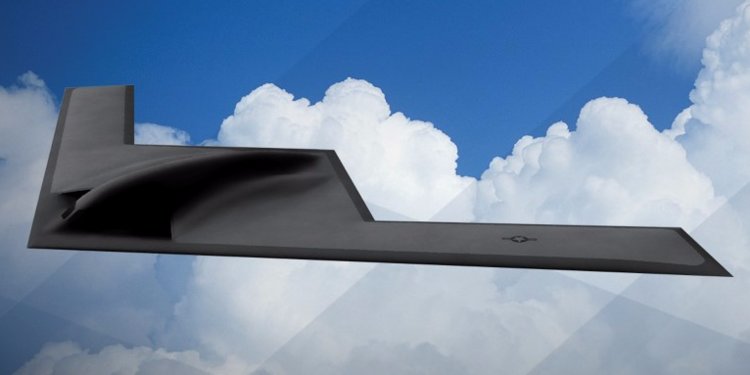
In a new article for TomDispatch.com. I tackle the Air Force’s latest stealth bomber, the B-21 Raider. The project will likely cost $100 billion, and possibly much more than this over its lifetime. Is this truly what we need for our national “defense”?
By their nature, bombers are not defensive weapons. They’re designed to take the fight to the enemy with overwhelming destructive force. In other words, the B-21, strictly speaking, is not for national defense: it’s for national offense. That’s why the U.S. Air Force speaks so proudly of “global strike” against “any target.” It’s the empowerment as well as the enshrinement of a vision of violent and disruptive action by the U.S. military anytime, anywhere, on the planet. If we weren’t Americans, we’d recognize this vision for what it really is: a form of militarism gone mad.
Here is an excerpt from my article at TomDispatch.
The Air Force’s Strange Love for the New B-21 Bomber The Military-Industrial Complex Strikes (Out) Again
By William J. Astore
Did you know the U.S. Air Force is working on a new stealth bomber? Don’t blame yourself if you didn’t, since the project is so secret that most members of Congress aren’t privy to the details. (Talk about stealthy!) Known as the B-21 Raider, after General Doolittle’s Raiders of World War II fame, it’s designed to carry thermonuclear weapons as well as conventional missiles and bombs. In conceptual drawings, it looks much like its predecessor, the B-2 Spirit stealth bomber, all wing and no fuselage, a shape that should help it to penetrate and survive the most hostile air defense systems on Earth for the purposes of a “global strike.” (Think: nuclear Armageddon.)
As the Air Force acquires those future B-21s, the B-2s will be retired along with the older B-1B bomber, although the venerable B-52 (of the Cold War era), much modified, will remain in service for the foreseeable future. At $550 million per plane (before the inevitable cost overruns even kick in), the Air Force plans to buy as many as 200 B-21s. That’s more than $100 billion in procurement costs alone, a boon for Northrop Grumman, the plane’s primary contractor.
If history is any judge, however, a boon for Northrop Grumman is likely to prove a bust for the American taxpayer. As a start, the United States has no real need for a new, stealthy, super-expensive, nuclear-capable, deep-penetrating strategic bomber for use against “peer” rivals China and Russia …
Here’s the nightmarish reality of actually bringing such weapons systems online: when the U.S. military develops a capability, it seeks to use it, even in cases where it’s wildly inappropriate. (Again, think of the massive B-52 bombings in Vietnam, Laos, and Cambodia in a counterinsurgency campaign classically meant to win “hearts and minds.”) Fielding a new strategic bomber for global strike, including potential thermonuclear attacks, will not so much enhance national security as potentially embolden future presidents to strike whenever and wherever they want in a fashion devastating to human life. The B-21 isn’t a force-multiplier. It’s an Armageddon-enabler.
Flying High in our B-21s
Having marketed himself as a savvy military critic, is there any possibility that Donald Trump will have the smarts of Jimmy Carter when it comes to the B-21 program? Will he save America at least $100 billion (and probably far more) while eliminating yet another redundant weapons system within the Department of Defense? Fat chance. Even if he wanted to, The Donald doesn’t stand a chance against the Pentagon these days.
Flush with billions and billions of new taxpayer dollars, including funds for those F-35s and for new nukes from a bipartisan coalition in an otherwise riven Congress, America’s military services will fight for any and all major weapons systems, the B-21 included. So, too, will Congress, especially if Northrop Grumman follows the production strategy first employed by Rockwell International with the B-1: spreading the plane’s subcontractors and parts suppliers to as many states and Congressional districts as possible. This would, of course, ensure that cuts to the B-21 program would impact jobs and so drive votes in Congress in its favor. After all, what congressional representative would be willing to vote against high-paying jobs in his or her own state or district in the name of American security?
So here’s my advice to young model-builders everywhere: don’t blow up your B-21s anytime soon. Rest assured that the real thing is coming. If the Air Force wants to ensure that it has a new bomber, in the name of blasting America’s enemies to oblivion, so be it. It worked (partially and at tremendous cost) in 1943 in the flak- and fighter-filled skies of Nazi Germany, so why shouldn’t it work in 2043 over the skies of who-knows-where-istan?
Why does “your” Air Force think this way? Not just because it loves big bombers, but also because its biggest rivals aren’t in Russia or China or some “rogue” state like Iran. They’re right here in “the homeland.” I’m talking, of course, about the other military services. Yes, interservice rivalries remain alive and well at the Pentagon. If the U.S. Navy can continue to build breathtakingly expensive nuclear-powered aircraft carriers (like the much-troubled USS Gerald R. Ford) and submarines, and if the Army can have all its tanks, helicopters, and associated toys, then, dammit, the Air Force can have what truly makes it special and unique: a new stealthy strategic bomber escorted by an even newer long-range stealthy fighter.
And don’t just blame the Air Force for such retrograde thinking. Its leaders know what’s easiest to sell Congress: big, splashy projects that entail decades of funding and create tens of thousands of jobs. As congressional representatives line up to push for their pieces of the action, military contractors are only too happy to oblige. As the lead contractor for the B-21, Northrop Grumman of Falls Church, Virginia, has the most to gain, but other winners will include United Technologies of East Hartford, Connecticut; BAE Systems of Nashua, New Hampshire; Spirit Aerosystems of Wichita, Kansas; Orbital ATK of Clearfield, Utah, and Dayton, Ohio; Rockwell Collins of Cedar Rapids, Iowa; GKN Aerospace of St Louis, Missouri; and Janicki Industries of Sedro-Woolley, Washington. And these are just the major suppliers for that aircraft; dozens of other parts suppliers will be needed, and they’ll be carefully allocated to as many Congressional districts as possible. Final assembly of the plane will likely take place in Palmdale, California, integrating components supplied from sea to shining sea. Who says America’s coastal enclaves can’t join with the heartland to get things done?
Even if President Trump wanted to cancel the B-21 — and given his recent speech to graduates of the Naval Academy, the odds are that there isn’t a weapons system anywhere he doesn’t want to bring to fruition — chances are that in today’s climate of militarism he would face enormous push-back. As a colleague who’s still on active duty in the Air Force puts it, “What makes today worse than the Carter days is our flag-humping, military-slobbering culture. We can’t even have a discussion of what the country’s needs are for fear of ‘offending’ or ‘disrespecting’ the troops. Today, Carter would be painted as disloyal to those troops he was consigning to an early death because every procurement decision centers on a ‘grave’ or ‘existential’ threat to national security with immediate and deadly consequences.”
And so the Air Force and its flyboy generals will win the fight for the B-21 and take the American taxpayer along for the ride — unless, that is, we somehow have the courage to pry the control sticks from the cold, dead hands of hidebound military tradition and lobbying firepower. Until we do, it’s off we go (yet again), into the wild blue yonder, flying high in our B-21s.
These are not exactly happy times. Americans have fewer safeguards for their jobs, financial well-being, and, ultimately, their very lives. Uncertainty and insecurity have become more prevalent than ever I can remember. As a consequence, insomnia, depression, angst seem to be characteristic of an increasing number of people across the country, almost as American as apple pie. Just as being a divorcee in California is nothing to write home about—you’re even considered odd if you have never been divorced—so is the sense that something “bad” can happen at any time, without warning. Sociologists—I am a sociologist–call this condition “anomie,” a concept formulated by one of the founders of sociology, Emile Durkheim. The Trump presidency, it may be argued, exacerbates anomie since we seem to be moving closer to economic nightmares and possibly nuclear holocaust than in recent decades.
What exactly is anomie? Anomie literally means without norms. It’s a psychological condition, according to Durkheim, in which an individual member of a society, group, community, tribe, fails to see any purpose or meaning to his/her own life or reality in general. Anomie is the psychological equivalent to nihilism. Such a state of mind is often characteristic of adults who are unemployed, unaffiliated with any social organization, unmarried, lack family ties and for whom group and societal norms, values, and beliefs have no stabilizing effect.
The last situation can readily be the outcome of exposure to sociology courses in college, providing the student does not regularly fall asleep in class. I’ve always tried to caution my own students that sociology could be, ironically, dangerous to their mental health because of the emphasis on critical thinking regarding social systems and structures. Overcoming socialization or becoming de-socialized from one’s culture—when one begins to question the value of patriotism, for instance—can be conducive to doubt and cynicism which may give rise to anomie. Of course, I also emphasize the benefits of the sociological enterprise to the student and to society in general. For example, a sociology major is perhaps less likely to participate voluntarily in wars that only favor special interests and which unnecessarily kill civilians.
Clinical depression is virtually an epidemic in the U.S. these days. Undoubtedly, anomie is a major factor, especially in a culture where meaningful jobs or careers are difficult to obtain. To a great extent social status constitutes one’s definition of self. In Western societies the answer to the perennial philosophical question, “Who are you?” is one’s name and then job or role in the social structure. Both motherhood and secure jobs or careers are usually antidotes against anomie. Childless women and unemployed or under-employed males are most susceptible to anomie.
What does postmodernism offer to combat the anomie of modern society and now the Trump era itself? An over-simplification of post-modernism or the postmodern perspective is that there is no fixed or certain reality external to the individual. All paradigms and scientific explanations are social constructs, one model being no more valid than the other. A good example of the application of the postmodern perspective is the popular lecture circuit guru, Byron Katie. Ms. Katie has attracted thousands of followers by proclaiming that our problems in life stem from our thoughts alone. The clutter of consciousness, thoughts, feelings, can simply be recognized as such during meditation and then dismissed as not really being real. Problems gone.
An analogy here is Dorothy Day, the founder of the Catholic worker movement, proclaiming in the 1960s that “our problems stem from our acceptance of this filthy, rotten system.” Postmodernists would claim that our problems stem from our acceptance of the Enlightenment paradigm of reality—the materialist world-view, rationality itself. Reality, postmodernists claim, is simply what we think it is. There is no “IS” there. Postmodern philosophers claim that all experiences of a so-called outside world are only a matter of individual consciousness. Nothing is certain except one’s own immediate experience. The German existential philosopher, Martin Heidegger, contributed significantly to the postmodern perspective with his concept, “dasein,” or “there-being.” Dasein bypasses physiology and anatomy by implying that neurological processes are not involved in any act of perception, that what we call “scientific knowledge” is a form of propaganda, that is, what we are culturally conditioned to accept as real. There is no universal right or wrong, good or bad.
The great advantage of adopting the postmodern perspective as a way of overcoming anomie is the legitimacy or validation it gives to non-ordinary experiences. If the brain and nervous system are social constructs then so-called altered states of consciousness such as near death experience (NDE), out-of-body experience, reincarnation, time-travel, spirits, miraculous healing become plausible. Enlightenment science and rationality are only social constructs, byproducts of manufactured world-views. The “new age” idea that we create our own reality rather than being immersed in it has therapeutic value to those suffering from anomie.
Sociologist Peter Berger employs the concept of “plausibility structures” to legitimize (make respectable) views of the “real world” which conflict with the presuppositions of Enlightenment science. Science then becomes “science” or social constructs which may or may not have validity even though they are widely accepted as such. A good example is the postmodern practice of deconstructing or calling into question empirical science and rational thought itself, disregarding the brain as source of all perceptions, feelings, desires, and ideas. Postmodernists maintain that only individual consciousness is real; the brain is a social construct which doesn’t hold water—no pun intended—as the source of what it means to be human.
CAVEAT
The postmodern perspective may work for a while in suppressing anomie and dealing with the horrors of a hostile or toxic social and political environment. Sooner or later, however, existential reality intervenes. The question is, can postmodernism alleviate physical pain, the death of a loved one, personal injury and illness, the loss of one’s home and livelihood? At this point in the evolution of my philosophical reflections I would argue that postmodernism can reduce or eliminate the depression that inevitably comes from too much anomie–but only temporarily. The postmodern perspective is not up to the task of assuaging the truly catastrophic events in one’s life. As much as I would like not to believe this, I’m afraid only political and social action can help us out when the going really gets rough, although I don’t recommend sacrificing the teaching of critical thinking, a possible cause of anomie, in regard to society’s values and institutions.
Richard Sahn, a professor of sociology in Pennsylvania, is a free-thinker.









 Bracing Views