I was bantering online with an old friend and fellow historian and I hit him with my best shot: history is un-American. If you think like an historian, and especially if you think America and its future actions should be informed, or possibly even constrained, by history, you are clearly un-American. History is more or less bunk, Henry Ford famously said, and Americans can safely ignore it. We are like gods, creating our own futures out of nothing, imposing our will on everything around us.
Henry Ford, American god
This attitude, this hubris, explains much about the U.S. military’s woeful record since 1945. The French lost in Indochina? No matter. Americans will prevail in Vietnam, Laos, and Cambodia because we’re not the French. The Soviet Union lost in Afghanistan? No matter. Americans will prevail there because we’re not the Russians. Overthrowing Saddam Hussein and his minority Sunni government will unleash chaos that strengthens Shia forces in Iraq, aligning that country more closely with Iran? No matter. America will bring order and the blessings of democracy to Iraq at the point of gun or a Hellfire missile.
Karl Rove, a major player in the Bush/Cheney administration, summed up this hubris in this now-infamous passage:
“We’re an empire now, and when we act, we create our own reality. And while you’re studying that reality — judiciously, as you will — we’ll act again, creating other new realities, which you can study too, and that’s how things will sort out. We’re history’s actors . . . and you, all of you, will be left to just study what we do.”
That man did not want for confidence.
Related to the idea of history being un-American is the business- and management-oriented nature of the officer corps in the U.S. military. To be promoted to field-grade (major or lieutenant commander), you almost have to have a master’s degree or be close to finishing one. But rarely do officers choose to pursue a master’s in history or any other subject related to the humanities. The master’s of choice is in business administration or some type of management.
By pursuing MBAs and management degrees, officers show their practical nature. They also set themselves up well for future careers once they retire or separate from the military. After all, who needs to know history, even military history? The U.S. military will simply act, creating its own realities, which feckless historians will then passively study as America’s real actors get on with the job of remaking the world in America’s image.
We live in the United States of Amnesia, Gore Vidal quipped, and history is part of that amnesia. Who remembers that America was at war in Afghanistan as late as 2021? It’s on to new “great power” struggles with China and Russia. Look forward, not backward, Barack Obama said when he became president, meaning there was no need to hold the Bush/Cheney administration responsible for anything, including torture and other war crimes. “We tortured some folks” — time to move on!
An expression I learned in the U.S. military is “analysis paralysis,” as in don’t overthink the problem. Act! But if America’s military record since World War II proves one thing, it’s that ignoring history because it’s “bunk” or less practical than another business or management course is a very unwise idea.
Acting should be informed by thinking. Dare I say, historically-informed thinking. Even for America’s wannabe gods.
In 2023, let’s embrace the Vulcan salute, not military ones
2022 has been the year of living dangerously. The Russia-Ukraine War escalated with no immediate end in sight. U.S. government officials, most notably the Democratic Party, have gotten behind Ukraine as if it’s the 51st American state. Aid to Ukraine, mainly in the form of weapons and other war materiel, has approached $100 billion in less than a year. Zelensky has been touted as a “wartime” leader akin to Winston Churchill and lionized before Congress. President Biden, meanwhile, has called for Putin to be removed from power, joined by Republican voices like Senator Lindsey Graham. Biden, with Armageddon on his mind, as in nuclear war, nevertheless persisted in rejecting calls for diplomatic efforts to end the war.
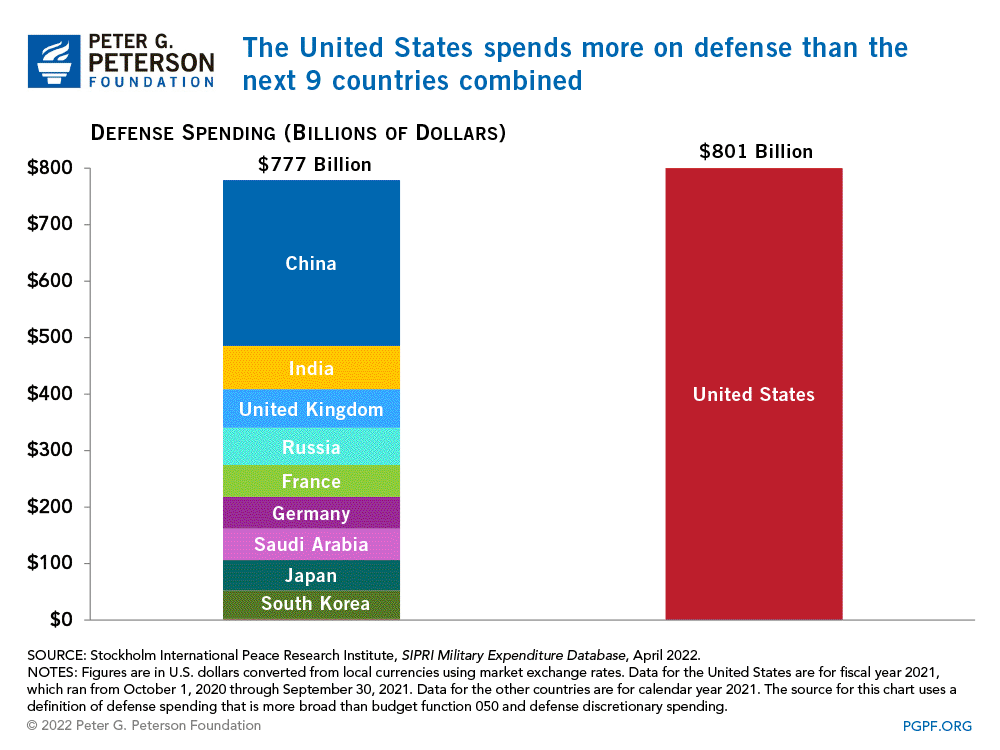
As we turn toward 2023, wars and rumors of war persist. Fear of possible Chinese moves against Taiwan helped drive a record Pentagon budget of $858 billion, $45 billion more than Joe “Armageddon” Biden requested. The Air Force requested 100 new B-21 nuclear bombers and hundreds of new Sentinel ICBMs at a projected cost of roughly $500 billion. That the Pentagon yet again failed an audit, its fifth failure in a row, is no reason to cut or even to control massive military spending, so Congress has collectively concluded.
The so-called leftist or liberal Democrats have emerged as America’s war party; Republicans, meanwhile, are torn between calling for yet higher military spending and trying to curtail military aid to Ukraine and runaway spending on “Ferrari” weapons systems like the F-35. No one of any prominence in either party is calling for peace and for serious reductions in spending on wars and weapons.
Show me your budget and I’ll tell you what you value, Biden once said. Obviously, the Washington elites value war and profits from the same. It’s an anti-democratic commitment that fosters greater authoritarianism and repression in the so-called homeland as well as abroad.
I wish I could say 2023 promises change. It doesn’t, at least not from our government and its leaders. The change will have to come from us.
I have an old polaroid from 1/1/1980. In that photo, I’m caught rendering the Vulcan gesture of welcome with a high school friend. Recently, I got together with another old friend and gave the same salute:
Your author, out in the wild
The message, of course, of the Vulcan salute is “Peace. Live long and prosper.” The Vulcans, those eminently logical aliens of “Star Trek” fame, did their best to change their warlike nature, adopting logic and emotional control in place of violence and mass murder. While I doubt America is prepared to adopt logic and emotional control en masse, surely we can find a way to cultivate peace. We have the means as well to “live long and prosper,” assuming we can ever stop wasting so much of our energy and efforts on war and weaponry.
There is much wisdom contained in the Vulcan salute. May we learn to embrace its message in 2023.
In my eclectic reading, I came across a couple of references to ChatGPT, an experiment in artificial intelligence (AI). You ask the AI bot a question, or give it a task, and it spits out an answer, and I must say a pretty good one judging from the task I gave it.
My task to the AI bot: “Write a critical essay on the military-industrial complex.” Here’s what it generated:
The military-industrial complex refers to the relationship between a country’s military and the defense industry that supplies it, seen together as a vested interest which influences public policy. This relationship has been a source of concern for many people, who argue that it can lead to an unnecessary expansion of military budgets and an over-reliance on military solutions to problems.
One of the main criticisms of the military-industrial complex is that it can result in the waste of taxpayer money. Military contracts are often given to a select group of companies, which can result in overcharging for goods and services. Additionally, the military often purchases weapons and equipment that are unnecessary or not well-suited for the tasks at hand. This can lead to a tremendous amount of waste and inefficiency, as resources are poured into projects that do not provide much value.
Another concern is that the military-industrial complex can distort foreign policy decision-making. Countries with a strong military-industrial complex may be more likely to engage in military action, even when diplomatic solutions would be more appropriate. This can lead to an escalation of conflicts and an increased risk of war.
The military-industrial complex can also have negative impacts on domestic policy. It can divert resources away from other important priorities, such as education and healthcare. Additionally, the influence of the defense industry on policy decisions can lead to the prioritization of the needs of military contractors over the needs of the general public.
Some have argued that the military-industrial complex represents a threat to democracy, as it can give undue influence to a small group of powerful interests. This can lead to a lack of transparency and accountability in decision-making, as well as a distorted political process.
In conclusion, the military-industrial complex is a complex and multifaceted issue that has the potential to have negative impacts on both domestic and foreign policy. It is important for citizens to be aware of the potential dangers of this relationship and to hold their elected officials accountable for ensuring that military spending is responsible and transparent.
Not bad! Firstly, I’m glad I’m no longer a professor actively teaching and grading papers. Something tells me more than a few students might be reaching for help from the AI bot on their assignments. Often, I was able to catch plagiarism (the giveaway was an essay written too well with too many “big words” used correctly) by searching for certain phrases or sentences that struck me as more than odd or much too advanced, but now with these AI programs I’m guessing it’s going to be a lot harder to ensure students do their own work.
Anyhow, the AI bot essay on the military-industrial complex makes some good points, don’t you think? Though there’s still room for a human here (at least I hope so).
So what does this human intelligence (that’s me) have to say?
“Unnecessary expansion of military budgets”: that’s for sure! The latest Pentagon budget is $858 billion, and that doesn’t count roughly $45 billion in aid (mostly military) to Ukraine. It also leaves out much spending related to homeland security, policing, and the like. By some estimates, 2/3rds of the federal discretionary budget is devoted to military, security, and policing.
“Over-reliance on military solutions”: bingo! Afghanistan, Iraq, Libya, Syria, Somalia, Yemen, the whole “war on terror” was and is driven by the idea that America’s singular military strength can solve everything.
A “vested interest” that “influences public policy”: I think the AI bot has read Eisenhower’s warning about the undue influence of the MIC and the danger it poses to freedom and democracy.
A “tremendous amount of waste and inefficiency”: Looks like the AI bot has heard that the Pentagon is missing trillions of dollars and has failed five audits in a row. It’s probably heard about wasteful weapons like the F-35 and B-21 as well. (Coincidence: as I was typing “wasteful,” the computer corrected my initial misspelling to “hateful.” Yes, I suppose a nuclear bomber that can kill millions could be described as “hateful”).
“Escalation of conflicts” and “an increased risk of war”: Well, I’m glad our leaders have the Ukraine situation firmly in hand and are seeking a well-considered diplomatic solution. (Yes, that’s sarcasm. Match that, AI bot!)
“Negative impacts on domestic policy”: Well, I’m glad Americans have excellent and affordable health care, virtually no debt due to educational costs, and that John Q. Public is heard as much as Boeing and Raytheon in the halls of power. (More sarcasm from the human!)
“Lack of transparency and accountability”: Boy, this AI bot is smart! When’s the last time you heard of a U.S. general or admiral being cashiered for losing a war?
“Important for citizens to be aware of the potential dangers” of the MIC: Hooray for the AI bot! If only we still had citizens in America who were kept informed about the dangers of the MIC. We’ve all been reduced to passive consumers and occasional voters who are told by the mainstream media to cheer for war and to revel in the beauty of our missiles.
I think you’ll agree, dear reader, that the AI bot is less sarcastic and more dispassionate than I am. It also speaks with much greater probity of the dangers of the MIC than people like Biden or Trump or Pelosi or DeSantis. So I say “three cheers!” for our new robot master. ChatGPT for President in 2024!
Terminology is so important. There was a time when America spoke honestly of a Department of War. But not everyone is keen on war, even Americans, so in 1947 the national (in)security state slyly changed its name to the Department of Defense (DoD). And who can be against “defense”?
The problem is that America’s fundamental vision is offensive. We speak openly of global reach, global power, global vigilance. We never speak of regional or hemispheric defense. Regional power? Forget about it! Everything has to be “global.” Indeed, not just global but soaring above it into space. And not just outer space but virtual space and inner space, into one’s mind, so-called information dominance. For that’s what “full-spectrum” dominance is all about. To be safe, to “defend” us, the DoD must dominate everywhere, so we’re told.
This vision serves to generate yearly budgets that consume more than half of federal discretionary spending. It’s used to justify 750 military bases around the world. It’s consistent with dividing the globe into commands headed by four-star generals and admirals, e.g. AFRICOM, CENTCOM, NORTHCOM, and the like. It generates U.S. involvement in wars that few Americans know anything about, e.g. Somalia, Syria, and Yemen. It’s a vision consistent with a state of permanent warfare driven by imperial ambitions.
I don’t think there’s ever been a military more ambitious and vainglorious than the U.S. military and its various straphangers (industry, congress, intelligence agencies, the media, academe, think tanks, hence the term MICIMATT).1 No wonder its “thought” leaders keep demanding and getting more and more money: at least $858 billion for FY2023 alone. The DoD is supposed to be a means to an end. Clearly, it’s become an end in and of itself; it may yet lead to the end of everything.
He who has the gold makes the rules—and no government agency gets more gold to dominate rule-making than the DoD/Pentagon. It’s a golden fleecing of America, as the Pentagon after five attempts has yet to pass an audit. The war on terror, including failed wars in Iraq and Afghanistan cost America as much as $8 trillion, yet those failures have already been largely forgotten, with no senior officials called to account.
Our future is being stolen from us by wanton military spending. At the same time, our past is being rewritten. Lincoln’s ideal that “right makes might” and Washington’s ideal of the citizen-soldier have been replaced by might makes right enforced by warriors. Orwell rules the moment as war is sold as peace, surveillance as privacy, and censorship as free speech.
I remember my military oath of office: to support and DEFEND the Constitution of the United States against all enemies, foreign and domestic. I still believe in defending the Constitution. I just don’t see that we’re doing it when we spend $858 billion (and more) on a global quest to dominate everyone everywhere all at once.
MICIMATT: military-industrial-congressional-intelligence-media-academia-think-tank complex. Awkward acronym that has the virtue of capturing the size and scope of Ike’s old military-industrial complex.
How do we stop the next war built on lies from being waged?
(I prepared these notes for a talk I gave on “Truth-killers: The Corporate Media and the Military-Industrial Complex,” sponsored by Massachusetts Peace Action. David Swanson also spoke.)
I served in the U.S. military for 20 years, and for the last 15 years I’ve been writing articles that are generally critical of that military and our nation’s drift into militarism and endless warfare. Here are two lessons I’ve learned:
1. I agree with I.F. Stone that all governments lie.
2. As a historian who’s read and studied military history for most of my life, I agree that the first casualty of war is truth.
Because all governments lie and because lies are especially common during war, a healthy democracy must have an outspoken and independent media that challenges and questions authority while informing the public.
But the mainstream media (MSM) in America is neither outspoken nor independent. The MSM in America serves as stenographers to the powerful. Far too often, the U.S. military/government lies and leaks, the MSM believes and repeats.
The result is clear: disastrous wars (Vietnam, Afghanistan, Iraq) from which little is ever learned, enabled by a media culture that is deeply compromised by, or openly in league with, President Dwight D. Eisenhower’s military-industrial-congressional complex (MICC).
Here’s the fundamental issue: We need a skeptical and powerful media to deter the MICC from wars, war profiteering, and folly. The MSM should, and must, serve as a check on the MICC while holding it accountable when it fails. By doing neither, it serves various “big lies,” enabling future abuses of power by the national security state. There is no accountability for failure, so failure is neither punished now nor is it curtailed in the future.
Even when the MICC fails, and since the Vietnam War it has failed frequently, it gets more money. Consider the FY2023 Pentagon budget, which sits at $858 billion, a nearly inconceivable sum and which is roughly $45 billion more than the Biden administration asked for.
The challenge, as I see it: How do we stop the next war built on lies from being waged?
Something to ponder: Could a more critical, more courageous, truly independent media have shortened or stopped the Vietnam War? Iraq? Afghanistan?
In his famous speech warning Americans about the MICC in 1961, Eisenhower (Ike) said that only an alert and knowledgeable citizenry could guard against the acquisition of power by the MICC. This may indeed be why most citizens are not kept informed or are misinformed about the U.S. military and its wars. It’s hard to act when you’re kept ignorant. You’ll also be reluctant to act when you’re told to defer to the “experts” in the MSM, most of whom are deeply compromised, often by conflicts of interest that are kept hidden from you.
Military Mendacity
Put simply, the U.S. military, in its upper ranks, lacks honor. What matters most is reputation and budgetary authority. Sharing negative news with the media is the absolute last thing the military wants to do. Surprisingly, most in the MSM are willing to look the other way, assuming they even know of military mendacity and malfeasance.
What this means, essentially, is that the MICC is unaccountable to the people–the very antithesis of democracy.
Three big examples of MICC mendacity: The Pentagon Papers revealed by Daniel Ellsberg during the Vietnam War; the Iraq War and lies about WMD (weapons of mass destruction); and the Afghan War Papers. Even as the U.S. military was losing these three wars, military commanders and government officials spoke publicly and confidently of lights at the end of tunnels, of corners being turned toward victory. (Privately, however, they talked of serious problems and lack of progress.)
With “The Pentagon Papers,” Daniel Ellsberg revealed the lies that helped fuel the Vietnam War
The MSM (with notable exceptions) largely repeated the happy-talk lies. Since 9/11, this is unsurprising, since the MSM leans heavily on senior retired military officers, CIA officials, and the like to “interpret” events in places like Iraq and Afghanistan. As journalist David Barstow showed, these “interpreters” were and are fed talking points by the Pentagon. Whatever this is, it’s not honest reporting. It’s not journalism. It’s state propaganda.
It’s not that the American people can’t handle the truth about “their” military. It’s that the MICC prefers to keep a lid on the truth, because the truth is often unfavorable to their positions, power, prestige, and profits.
There are many ways the MICC works with a complicit media (and a compliant Congress) to keep the truth from us.
1. Bad news is not reported. Or it’s classified or otherwise hushed up. Consider the My Lai Massacre in Vietnam or the “collateral murder” video from the Iraq War revealed by Chelsea Manning and Wikileaks.
2. Critical information is omitted. Coverage is edited. Consider the ban on showing flag-draped coffins by the Bush/Cheney administration, or official reports about drone strikes that omitted the true number of civilian/non-combatant casualties.
3. The military has its own PAOs (public affairs offices and officers) who feed news of “progress” and similar “good news” stories to the media. This is also true of the State Department. (See Peter Van Buren’s account, “We Meant Well,” of his Potemkin Village-like experience in Iraq.)
4. Ever-present appeals to patriotism and warnings that critical information will give aid and comfort to the enemy. Even worse, portraying critics as pro-Putin, as possible traitors, as in the NBC smear campaign against Congresswoman Tulsi Gabbard, abetted also by Hillary Clinton.
5. Run-of-the-mill propaganda. Consider, for example, how almost all U.S. sporting events include glowing coverage of the military and veterans. If all military members are “heroes,” how dare we question them! Instead, you’re encouraged to salute smartly and remain silent.
Media Complicity
Why is the MSM so hobbled and often so complicit with the MICC?
1. Intimidation. Critics are punished. Examples include Ashleigh Banfield, Phil Donahue, and Chris Hedges in the early days of the Iraq War. Think of Julian Assange today. Edward Snowden. Daniel Hale. Smart journalists know (or learn) that critics and whistleblowers are punished; cheerleaders are promoted, e.g. Brian Williams, demoted for stolen valor but redeemed for declaring his awe at “the beauty” of U.S. missiles.
2. Ratings/Economics. Recall that MSNBC fired Phil Donahue over concerns that his critical coverage of the Iraq War was turning off viewers, i.e. that the network wasn’t being seen as “patriotic” as rivals like CNN or Fox News, thereby losing market share and money.
3. Embedding Process. Reporters who want to cover war are often embedded with U.S. military units. They come to identify with “their” troops, who, after all, are protecting them from harm. The embedding process forges a sense of dependency and camaraderie that interferes with disinterested and balanced reporting.
4. Reliance on deeply conflicted experts from the MICC instead of independent journalists. Whatever else they are, retired generals and CIA directors are not reporters or journalists.
5. Corporate advertising dollars. Why air a report critical of Boeing or Northrop Grumman when that company is a major advertiser on your network? Why bite the hand that feeds you?
You don’t need a top secret “Mockingbird” project by the CIA to infiltrate and influence the MSM, as we witnessed during the Cold War and Vietnam. Today, the MSM and its owners acquiesce in their own infiltration, hiring retired CIA agents and similar senior government officials to give/sell their “unbiased” opinions.
Again, military contractors pay for ads and sponsor shows on TV. The media is not about to challenge or criticize a big revenue stream. And it’s not always a weapons maker like Boeing or Raytheon. Think of ExxonMobil. Their thirstiest customer is the U.S. military; ExxonMobil is unlikely to support media reports that criticize its biggest customer.
Meanwhile, there are precious few reporters and journalists willing to risk their careers to challenge the MICC. With so-called access journalism, if you reveal uncomfortable facts, you’ll likely lose access to the powerful, alienate your bosses, and probably lose your job.
Food for Thought: Journalists are selected and groomed for compliance to mainstream militarized agendas. They’ve learned and internalized what is acceptable and what isn’t. If they refuse to play along, they’re fired or shunted aside. (See Noam Chomsky and the manufacturing of consent.)
For the U.S. military, full-spectrum dominance includes information and the control of the same, including most especially in America.
A final shocking truth: The U.S. military lost in Vietnam, Iraq, Afghanistan, and elsewhere while avoiding responsibility. Indeed, its cultural authority and its command over the media have only grown stronger. Worse, the military promulgates, or goes along with, various stab-in-the-back myths that exculpate itself while mendaciously blaming the few good media outlets for accurate reporting about the MICC’s failings.
A crucial step in preventing future disastrous wars is a media culture that sees the MICC for what it is: a danger to democracy and liberty, as Ike warned us in 1961 in his farewell address. How we get there is a crucial issue; the failures above suggest remedies.
One remedy I wrote about in 2008: the major networks need to develop their own, independent, journalists who are experts on the military, rather than relying largely on retired military officers and other senior government officials.
We are told that America has independent media rather than state media like China or Russia. Yet, if America had official state media, would its coverage differ from today’s content? The MSM supports state and corporate agendas because that’s how it makes money even as it claims it’s “independent.”
A Couple of Anecdotes
A journalist colleague told me of his experience teaching students at one of America’s universities. His sense: most students today don’t want to be Bob Woodward and Carl Bernstein. They aspire to be on-air personalities who make six-figure salaries while being invited to all the right parties. They don’t want to afflict the comfortable while comforting the afflicted; they want to be among the most comfortable. Crusading for truth isn’t what they’re about. They seek to be insiders.
From the Robert Redford movie, “Three Days of the Condor.” If a whistleblower goes to the MSM (in the movie, it’s The New York Times), will the truth ever see the light of day? More to the point, if the American people do see it, will they even care?
What we’re witnessing in America, according to Matt Taibbi, is an “elaborate, systematized method of censorship and opinion control.” Taibbi mentions agencies like Homeland Security and Justice/FBI and their focus on “collecting domestic intelligence on a grand scale … seeking to distort the public’s perception of reality through mass moderation, via programs we’ve been told little to nothing about.”
While Taibbi, in his latest investigation, focused on social media and especially Twitter, the reality is that the MSM (and social media as well) is complicit with the government/military, collaborating on what “truths” are fed to the people while suppressing facts that are deemed dangerous, embarrassing, inconvenient, and otherwise not in the interest of the MICC.
With so many Americans now getting their news from social media sites rather than the MSM, that the government serves as a powerful content-moderator for what counts as “reliable” news on social media should disturb us all.
Again, it’s hard for Americans to serve as Ike’s “alert and knowledgeable” citizenry when they are fed lies, disinformation, and propaganda by the government and MSM.
Even more fundamentally, when corporations are elevated and protected as super-capable “citizens” and when citizens themselves are reduced to passive consumers—when corporations own the MSM while profiting greatly from war and militarism—there’s little hope of fostering freedom and of ever escaping from a state of permanent warfare.
It’s time for a Christmas truce followed by negotiation
Three articles related to the Russia-Ukraine War caught my attention today.
The first, at NBC News, argues that Patriot missile batteries are not enough to defend Ukraine. The article urges the U.S. to provide Gray Eagle drones to Ukraine to enable attacks deep into the interior of Russia, including most especially bases where strategic bombers are located. The subtitle to this article is especially provocative: “Western limitations on providing Kyiv with long-distance offensive capabilities are becoming nonsensical.”
Did you get that? It’s “nonsensical” to be concerned about providing offensive weaponry that would exert more escalatory pressure on this war.
The second article, also at NBC News, suggests that Ukraine in the near future may possess the military wherewithal to take Crimea from Russia. Some concern was expressed that Putin could respond with nuclear weapons if Russia’s hold on Crimea was threatened.
The third article from the British Guardian addresses recent Russian attacks on Kharkiv, as follows: “Kharkiv left without power, heating and water as Russian attack causes ‘colossal’ damage, says mayor. Ukraine’s second-largest city, Kharkiv, is without power, heating and water after Russian missile strikes on Friday morning caused ‘colossal’ damage to infrastructure, its mayor Ihor Terekhov said.”
What this all adds up to is a war that is growing increasingly dangerous and destructive not just for Ukraine and Russia but possibly for Europe and indeed the world.
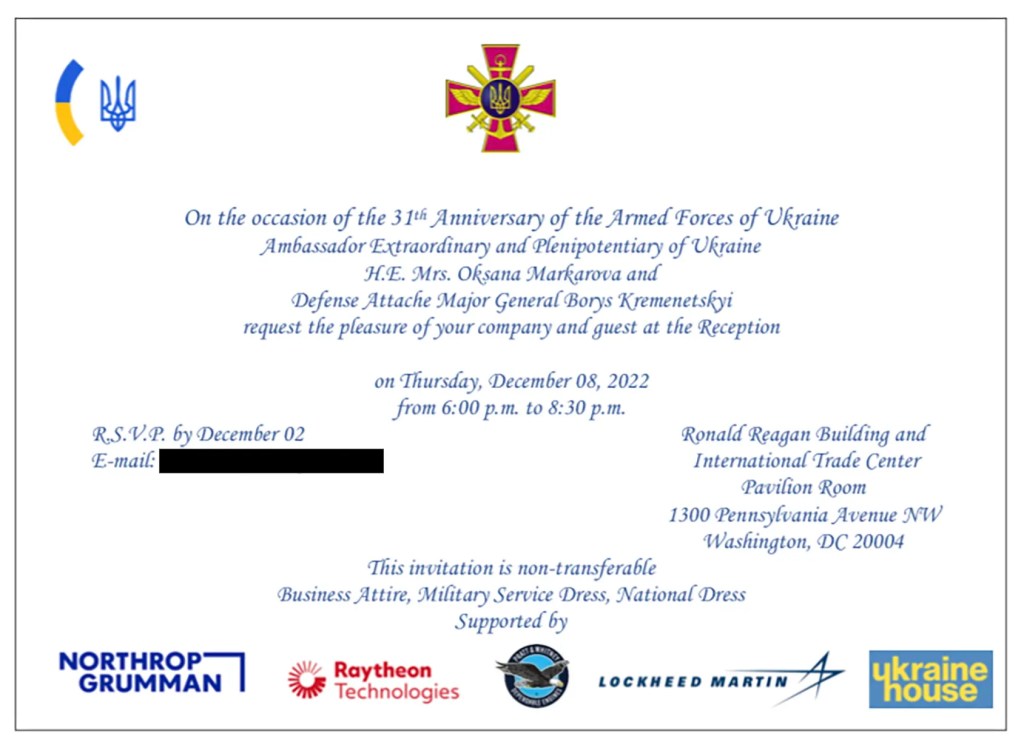
Meanwhile, a friend sent me this article from Vox about a recent party in Washington D.C. focused on Ukraine and the war. The party’s invitations were sponsored by major U.S. weapons contractors, in this case Northrop Grumman, Raytheon, and Lockheed Martin.
Invitation obtained by Vox for a party supported by big hitters in the military-industrial complex
Strangely, I heartily approve of this invitation because the sponsors are, for once, obvious. Can’t say that I blame the corporations: they know a great opportunity when they see it.
What Russia and Ukraine need are not more pressures to escalate but more reasons to talk, to negotiate, to put an end to this war before it truly runs out of control.
Unfortunately, many people in the U.S. see more weaponry as the answer. One thing is certain: you won’t get an argument on that from those “supporters” listed on the invitation above.
Can we not, as Vera Brittain argued, find the courage to end these cycles of vengeance and violence? We must learn to say “no” to killing. “No” to war. In that spirit, I signed a declaration calling for a Christmas truce in Ukraine. Here’s an article from Codepink on the effort.
Here’s hoping for a Christmas truce that gains traction.
The Madness of Nuclear Warfare, Alive and Well in America
W.J. Astore
(Here’s my latest for TomDispatch.com; If you haven’t subscribed, you should!)
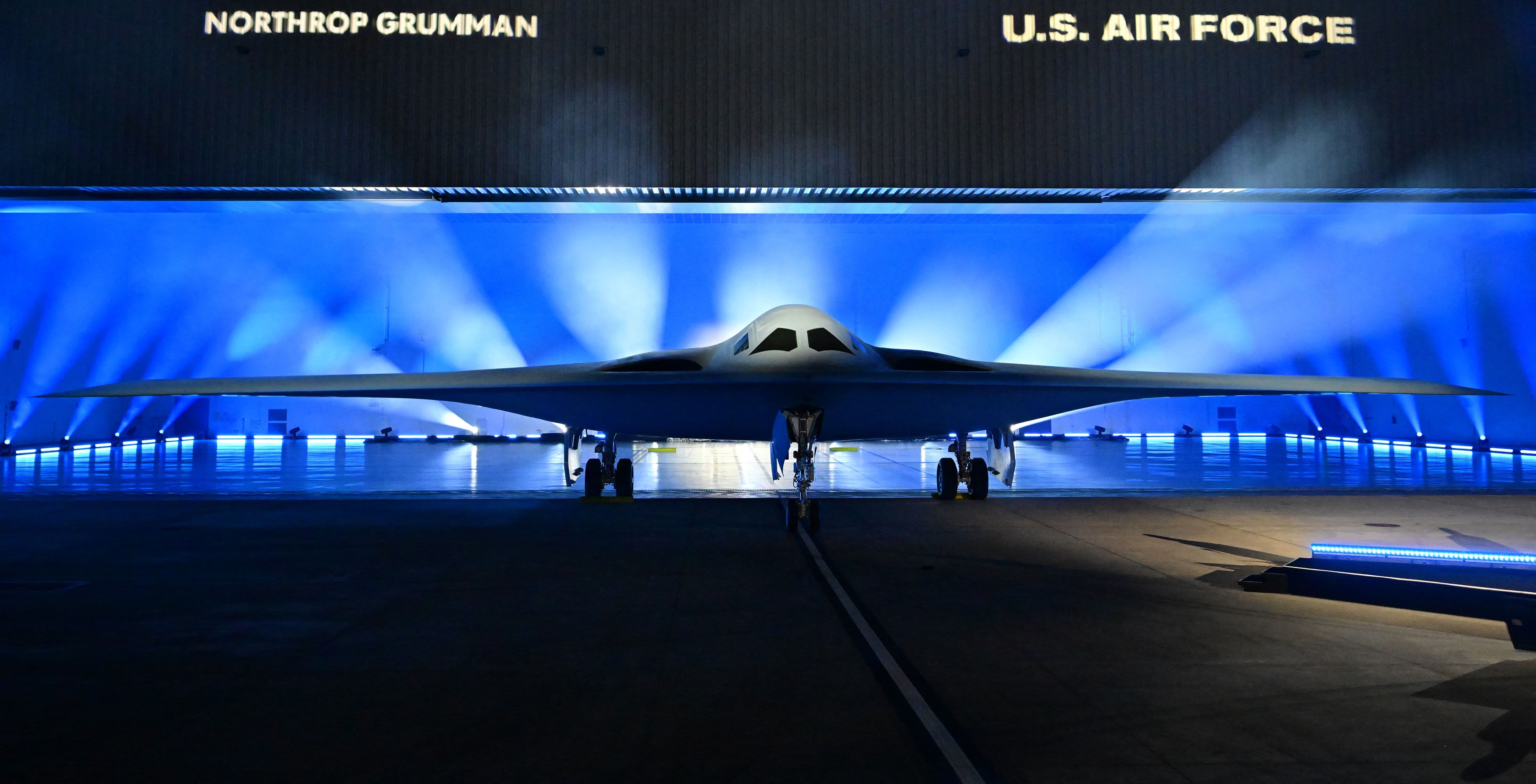
Hey, cheer up because it truly is a beauty! I’m talking about this country’s latest “stealth bomber,” the B-21 Raider, just revealed by Northrop Grumman, the company that makes it, in all its glory. With its striking bat-winged shape and its ability to deliver a very big bang (as in nuclear weapons), it’s our very own “bomber of the future.” As Secretary of Defense Lloyd Austin put it at its explosive debut, it will “fortify America’s ability to deter aggression, today and into the future.” Now, that truly makes me proud to be an American.
And while you’re at it, on this MAD (as in mutually assured destruction) world of ours, let that scene, that peculiar form of madness, involving the potential end of everything on Planet Earth, sink in. As a retired Air Force officer, it reminded me all too vividly of my former service and brought to mind the old motto of the Strategic Air Command(SAC), “Peace Is Our Profession.” Headed in its proudest years by the notorious General Curtis LeMay, it promised “peace” via the threat of the total nuclear annihilation of America’s enemies.
SAC long controlled two “legs” of this country’s nuclear triad: its land-based bombers and intercontinental ballistic missiles, or ICBMs. During the Cold War, those Titans, Minutemen, and MX “Peacekeepers” were kept on constant alert, ready to pulverize much of the planet at a moment’s notice. It didn’t matter that this country was likely to be pulverized, too, in any war with the Soviet Union. What mattered was remaining atop the nuclear pile. A concomitant benefit was keeping conventional wars from spinning out of control by threatening the nuclear option or, as was said at the time, “going nuclear.” (In the age of Biden, it’s “Armageddon.”)
Luckily, since the atomic destruction of Hiroshima and Nagasaki in 1945, the world hasn’t gone nuclear again and yet this country’s military continues, with the help of weapons makers like Northrop Grumman, to hustle down that very path to Armageddon. Once upon a time, the absurdity of all this was captured by Stanley Kubrick’s masterpiece, the satirical 1964 film Dr. Strangelove, which featured a “war room” in which there was no fighting, even as its occupants oversaw a nuclear doomsday. Sadly enough, that movie still seems eerily relevant nearly 60 years later in a world lacking the Soviet Union, where the threat of nuclear war nonetheless looms ever larger. What gives?
The short answer is that America’s leaders, like their counterparts in Russia and China, seem to have a collective death wish, a shared willingness to embrace the most violent and catastrophic weapons in the name of peace.
Nuclear Bombers and ICBMs Return!
There’s nothing magical about the nuclear triad. It’s not the Holy “Trinity,” as a congressman from Florida said long ago. Even so, it’s worshipped by the U.S. military in its own all-too-expensive fashion. America’s triad consists of bombers capable of carrying nuclear weapons (B-52s, B-1s, B-2s, and someday B-21s), those land-based ICBMs, and that most survivable “leg,” the U.S. Navy’s Trident-missile-firing submarines. No other country has a triad quite as impressive (if that’s the word for it), nor is any other country planning to spend up to $2 trillion over the next three decades “modernizing” it. The Air Force, of course, controls the first two legs of that triad and isn’t about to give them up just because they’re redundant to America’s “defense” (given those submarines), while constituting a threat to life on this planet.
Recently, when the Air Force unveiled that B-21 Raider, its latest nuclear-capable bomber, we learned that it looks much like its predecessor, the B-2 Spirit, with its bat-like shape (known as a “flying wing” design) driven by stealth or the avoidance of radar detection. The Air Force plans to buy “at least” 100 of those planes at a projected cost of roughly $750 million each. Count on one thing, though: with the inevitable delays and cost overruns associated with any high-tech military project these days, the flyaway cost will likely exceed $1 billion per plane, or at least $100 billion of your taxpayer dollars (and possibly even $200 billion).
Four years ago, when I first wrote about the B-21, its estimated cost was $550 million per plane, but you know the story, right? The F-35 was supposed to be a low-cost, multi-role fighter jet. A generation later, by the Air Force’s own admission, it’s now a staggeringly expensive “Ferrari” of a plane, sexy in appearance but laden with flaws. Naturally, the B-21 is advertised as a multi-role bomber that can carry “conventional” or non-nuclear munitions as well as thermonuclear ones, but its main reason for being is its alleged ability to put nuclear bombs on target, even without Slim Pickens (“Major Kong” in Kubrick’s Dr. Strangelove) riding down on one of them.
The main arguments for expensive nuclear bombers are that they can be launched as a show of resolve but also, unlike missiles, recalled, if necessary. (Or so we hope anyway.) They have a “man in the loop” for greater targeting flexibility and so complicate the enemy’s defensive planning. Such arguments may have made some sense in the 1950s and early 1960s, before ICBMs and their sub-launched equivalents were fully mature technologies, but they’re stuff and nonsense today. If nuclear-capable nations like Russia and China aren’t already deterred by the hundreds of missiles with thousands of highly accurate nuclear warheads in America’s possession, they’re not about to be deterred by a few dozen, or even 100, new B-21 stealth bombers, no matter the recent Hollywood-style hype about them.
Yet logic couldn’t matter less here. What matters is that the Air Force has had nuclear-capable bombers since those first modified B-29s that dropped Little Boy and Fat Man on Hiroshima and Nagasaki, and the generals are simply not about to give them up — ever. Meanwhile, building any sophisticated weapons system like the B-21 is sure to employ tens of thousands of workers. (There are already 400 parts suppliersfor the B-21 scattered across 40 states to ensure the undying love of the most congressional representatives imaginable.) It’s also a boondoggle for America’s many merchants of death, especially the lead contractor, Northrop Grumman.
A reader at my Bracing Views Substack, a Vietnam veteran, nailed it when he described his own reaction to the B-21’s unveiling:
“What struck me in my heart (fortunately, I have a great pacemaker) was the self-assured, almost condescending demeanor of the Secretary [of Defense], the Hollywood staging and lighting, and the complete absence of consideration of what cognitive/emotional/moral injuries might be inflicted on the viewer, never mind experiencing exposure to the actual bomber and its payload — add in the incredible cost and use of taxpayer money for a machine and support system that can never actually be used, or if used, would produce incalculable destruction of people and planet; again, never mind how all that could have been used to start making America into a functioning social democracy instead of a declining, tottering empire.”
Social democracy? Perish the thought. The U.S. economy is propped up by a militarized Keynesianism tightly embraced by Congress and whatever administration is in the White House. So, no matter how unnecessary those bombers may be, no matter how their costs spiral ever upwards, they’re likely to endure. Look for them flying over a sports stadium near you, perhaps in 2030 — if, that is, we’re still alive as a species.
As the Air Force buys new stealth bombers with your tax dollars, they also plan to purchase a new generation of ICBMs, or a “ground-based strategic deterrent” in Newspeak, to plant in missile silos in garden spots like rural Montana, Nebraska, North Dakota, and Wyoming. The Air Force has had ICBMs since the 1960s. Roughly 1,000 of them (though that service initially requested 10,000) were kept on high alert well into the 1980s. Today’s ICBM force is smaller, but ever more expensive to maintain due to its age. It’s also redundant, thanks to the Navy’s more elusive and survivable nuclear deterrent. But, again, logic doesn’t matter here. Whether needed or not, the Air Force wants those new land-based missiles just like those stealth bombers and Congress is all too willing to fund them in your name.
Ka-ching! But hopefully not ka-boom!
Just as the purchase price for the B-21 project is expected to start at $100 billion (but will likely far exceed that), the new ICBMs, known as Sentinels, are also estimated to cost $100 billion. It brings to mind an old saying (slightly updated): a hundred billion here, a hundred billion there, and pretty soon you’re talking real money. In a case of egregious double-dipping, Northrop Grumman is once again the lead contractor, having recently opened a $1.4 billion facility to design the new missile in Colorado Springs, conveniently close to the Air Force Academy and various other Air and Space Force facilities. Location, location, location!
Why such nuclear folly? The usual reasons, of course. Building genocidal missiles creates jobs. It’s a boon and a half for the industrial part of the military-industrial-congressional complex. It’s considered “healthy” for the communities where those missiles will be located, rural areas that would suffer economically if the Air Force bases there were instead dismantled or decommissioned. For that service, shiny new ICBMs are a budget bonanza, while helping to ensure that the real “enemy” — and yes, I have the U.S. Navy in mind — won’t end up with a monopoly on world-ending weaponry.
In the coming decades, expect those “Sentinels” to be planted in fields far from where most Americans live under the guiding principle that, if we keep them out of sight, they’ll be out of mind as well. Yet I can’t help but think that this country’s military is out of its mind in “planting” them there when the only harvest can be of mass death.
It’s a MAD Old World
As MAD magazine’s Alfred E. Neuman would undoubtedly have said, “What, me worry?”
Oh, MAD old world that has such nukes in it! Color me astonished, in fact, that America’s nuclear weapons mix hasn’t changed much since the 1960s. That sort of world-ending persistence should tell us something, but what exactly? For one thing, that not enough of us can imagine a brave new world without genocidal nuclear weapons in it.
In 1986, President Ronald Reagan and Soviet leader Mikhail Gorbachev actually did so. They came close, in fact, to reaching a deal to eliminate nuclear weapons. Sadly, Reagan proved reluctant to abandon his dream of a nuclear space shield, then popularly known as “Star Wars” or, more formally, as the Strategic Defense Initiative. Since Reagan, sadly enough, U.S. presidents have stayed the course on nukes. Most disappointingly, the Nobel Prize-winning Barack Obama spoke of eliminating them, supported by former Cold War stalwarts like Henry Kissinger and George Schultz, only to abandon that goal, partly to solidify support in the Senate for a nuclear deal with Iran that, no less sadly, is itself pretty much dead and buried today.
If saintly Reagan and saintly Obama couldn’t do it, what hope do ordinary Americans have of ending our nuclear MADness? Well, to quote a real saint, Catholic peace activist Dorothy Day, “Our problems stem from our acceptance of this filthy, rotten system.” It’s hard to think of a system more filthy or rotten than one that threatens to destroy most life on our planet, so that this country could in some fashion “win” World War III.
Win what, exactly? A burnt cinder of a planet?
Look, I’ve known airmen who’ve piloted nuclear bombers. I’ve known missileersresponsible for warheads that could kill millions (if ever launched). My brother guarded ICBM silos when he was a security policeman in SAC. I sat in the Air Force’s missile-warning center at Cheyenne Mountain under 2,000 feet of solid granite as we ran computerized war games that ended in… yep, mutually assured destruction. We were, at least individually, not insane. We were doing our duty, following orders, preparing for the worst, while (most of us, anyway) hoping for the best.
A word of advice: don’t look for those within this nightmarish system to change it, not when our elected representatives are part of the very military-industrial complex that sustains this MADness. Only an alert and knowledgeable citizenry, with real freedom, could act to do so for the benefit of humanity. But will we ever do that?
“We’re going backwards as a country,” my wife reminds me — and I fear that she’s right. She summarized the hoopla at the B-21’s recent unveiling this way: “Let’s go gaga over a mass-murder machine.”
Collectively, it seems that we may be on the verge of returning to a nightmarish past, where we lived in fear of a nuclear war that would kill us all, the tall and the small, and especially the smallest among us, our children, who really are our future.
My fear: that we’ve already become comfortably numb to it and no longer can take on that culture of mass death. I say this with great sadness, as an American citizen and a human being.
No matter. At least a few of us will have profited from building new ultra-expensive stealth bombers and shiny new missiles, while ensuring that mushroom clouds remain somewhere in our collective future. Isn’t that what life is truly all about?
Tune In to War, Turn On to Heroes, Otherwise Drop Out
In 2010, I wrote an article for TomDispatch on “the new American isolationism.” I argued that Americans were being kept isolated from the horrific costs of the war on terror, rather than pursuing old-style isolationist policies to keep us out of war. Here’s how I opened that article:
“A new isolationism is metastasizing in the American body politic. At its heart lies not an urge to avoid war, but an urge to avoid contemplating the costs and realities of war. It sees war as having analgesic qualities — as lessening a collective feeling of impotence, a collective sense of fear and terror. Making war in the name of reducing terror serves this state of mind and helps to preserve it. Marked by a calculated estrangement from war’s horrific realities and mercenary purposes, the new isolationism magically turns an historic term on its head, for it keeps us in wars, rather than out of them.”
This is as true today as it was when I wrote it a dozen years ago. Americans are never encouraged to look at the ugly face of war, unless it involves alleged war crimes by “evildoers” like Russia. With Russia’s invasion of Ukraine, Americans have been encouraged to think about alleged mass rapes, mass murder, deliberate targeting of civilians, and the like. Alleged crimes by Ukraine, by comparison, are largely dismissed as Russian propaganda.
All wars produce atrocities because war itself is an atrocity. Tell me how constant artillery shelling won’t produce civilian casualties; tell me how bullets being sprayed everywhere, missiles being fired from a distance, explosive drones being employed, mines being planted, bombs being dropped: tell me how war won’t kill innocents. Tell me how war, in all its confusion and chaos, won’t produce “friendly fire” casualties. (Remember Pat Tillman?) Tell me how POWs won’t be mistreated by both sides, despite the Geneva Convention, or how civilian populations won’t be exploited in one way or another. War has always been recognized as a plague on humanity and civilization, which is why it should be the absolute last resort.
Yet far too often war is sold as necessary, even desirable, with heavy censorship accompanying it. Recall that in the Bush/Cheney years, as U.S. KIA (killed in action) figures rose, especially in Iraq, Americans weren’t allowed to see flag-draped caskets returning to our soil. Out of sight, out of mind, right? We were told to salute the generals and support “our” troops, but not to question Bush and Cheney’s wars and not to consider their horrific costs, certainly not to Iraqis and Afghans or other “foreigners.”
Grisly images like this one of a dead Iraqi soldier were not shown in America
Today in America, Ukrainians are almost universally celebrated as the good guys, the Russians are bad, thus the more dead Russians the better. Not surprisingly, Ukraine’s leader is Time Magazine’s person of the year. He is a hero, Putin is the devil, and that’s all you need to know.
Demonizing an enemy is a dangerous thing, for how can you negotiate with the devil? It’s a surefire way of firing people up but also of prolonging a war, which means more destruction, more atrocities, and a lot more body bags. Yes, I want Russia to withdraw from Ukraine. Yes, I don’t want Putin to “win” in any sense of the word. But at what price total victory for Ukraine?
So I read passages that Ukraine must “push back” and “expel” the Russian invader and that all territory must be “won back.” Bloodless phrases that reduce war to something like a game of Risk, where troops are just counters on a game board, and where winning and losing is determined by a roll of the dice.
In actuality what expressions like these mean is perhaps another 100,000 Russian and Ukrainian troops killed and wounded; buildings and homes blasted; plants and animals obliterated by more human-caused destruction; water and the land itself poisoned.
Will it be worth it? Is there perhaps another way? Couldn’t Ukrainians and Russians come together to talk, to settle their differences, without more killing? How many more widows must be made, how many more children must be killed or left as orphans, in the cause of “victory”?
I’m told it’s not up to me to decide. I’m encouraged to support Time Magazine’s Person of the Year in his holy war against the evil Putin. But all I see is more and more dead bodies, even as more and more “Made in USA” weapons are sent to Ukraine to multiply the dead, even as my taxpayer dollars help to fund it.
And, once again, I am kept isolated from it all, physically of course but also mentally, encouraged to tune in to pro-Ukrainian war coverage, to turn on to heroic leaders like Zelensky, but otherwise to drop out of truly thinking about war and its horrendous costs as well as its escalatory pressures.
Ukrainian Attacks on Russia Are Dangerously Escalatory
Reports that Ukraine is launching modified drones to strike airbases deep in Russia highlight the unpredictability and escalatory nature of wars. Ukraine is no longer content at defending itself against Russian aggression; Russia itself must be made a target, which will likely provoke harsher Russian counterattacks. Meanwhile, the U.S. Congress continues to authorize billions in military aid to Ukraine, which is pitched as defending democracy and freedom.
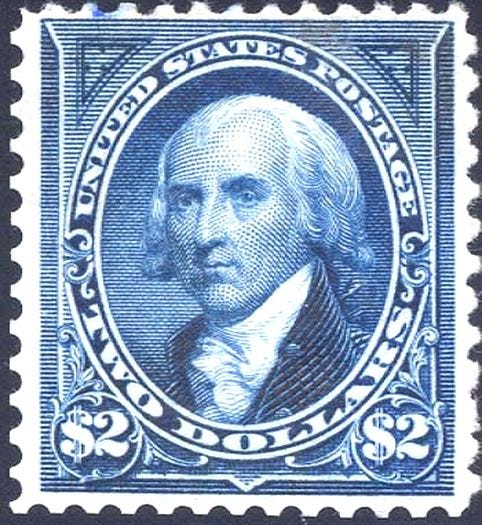
War is many things but it is rarely democratic. Indeed, as James Madison warned, war is inherently anti-democratic. It strengthens authoritarian forces and contributes to abuses of power and corruption. As the Russia-Ukraine War goes on, with no clear resolution in sight, Ukraine suffers more even as the chances of escalation rise.
James Madison warned that no nation can preserve its freedom in the midst of continual warfare
What’s needed now is resolute diplomacy — a committed effort to end the war by all parties involved, obviously Russia and Ukraine but also the U.S. and NATO. The longer this disastrous war lasts, the more unpredictable it will become, the more atrocious it will prove, and the more likely ordinary Ukrainians and Russians will suffer and die, whether at various battlefronts or on the homefront.
Negotiation is not weakness nor is it appeasement. Negotiation is sensible, rational, and life-affirming. But there’s little reason for Ukraine to negotiate when it’s enjoying a blank check of support from the U.S. and NATO.
Meanwhile, as Ukraine continues striking deep into Russia, one wonders to what extent the U.S. military and intelligence agencies are involved. Did the U.S. provide technology? Targeting information? Intelligence? Or is Ukraine doing this entirely on its own, a scenario that is less than comforting?
I sure hope the U.S. and Russia are talking. In the confusion and chaos of war, how is Russia to know for sure that an attack on one of their strategic air bases is coming from Ukraine and not from NATO territory? Even if it’s clearly coming from Ukraine, if these attacks are enabled or approved by the U.S./NATO, will the Russians see them as an act of war? Will they respond militarily, creating even more escalatory pressure?
Bizarrely, Ukraine’s defensive war against Russia has been sold as America’s “good” war, a chance to weaken Russia and Putin in the cause of defending Ukrainian “democracy.” But as Ukraine’s tactics turn more offensive, and as the Ukrainian government likely becomes more authoritarian due to the pressures of war, how wise is it for the United States to continue to send massive amounts of military aid there while discouraging diplomacy?
Policies that end in prolonging the Russia-Ukraine War in the name of teaching Putin a lesson and eroding his power may teach us all a lesson in how war is not just anti-democratic. War runs to extremes, and only fools believe they can control it in a way that is conducive to liberty and freedom and justice.
The Pentagon Budget Keeps Soaring Up, Up, and Away!
When the Soviet Union collapsed in 1991 and the Cold War ended, I heard a lot about peace dividends. It was time to become a normal country in normal (more peaceful) times, said Jeanne Kirkpatrick, an early neocon who served under Ronald Reagan. More than thirty years later, America still awaits its peace dividends from the Cold War.
When the Afghan War came to a sputtering and ignominious end in 2021, I didn’t hear much at all about peace dividends. Even though the Afghan War was costing the United States almost $50 billion a year before it crashed and burned, the Pentagon budget for 2022 went up by that amount rather than down. You’d think the end of wars would lead to a decrease in military spending, but not in America.
And so we come to today, when I learned that the Pentagon budget for 2023, which sat at $802 billion per the request of the Biden administration, has been boosted big time to $847 billion by the House and Senate Armed Services Committees. That’s $45 billion extra for more wars and weapons, a whopping sum of money that would likely end homelessness if it was invested in America.
One thing is certain: war dividends always come through. Peace dividends? Not so much.
How does the Washington Beltway crowd justify such enormous sums for “national defense”? Threat inflation, of course. Because of its debilitating war with Ukraine, Russia is weaker but somehow that means America must spend more because Putin or something. Chinese maneuvers near Taiwan are treated like direct incursions into U.S. coastal waters. A few North Korean missiles are enough to justify more than a trillion dollars for new or revamped nuclear forces over the next thirty years. And of course military Keynesianism is always a factor, as in Pentagon-related jobs spread as widely as possible through every Congressional district.
The Pentagon can’t even pass an audit (for the fifth year in a row!), yet it still gets more and more billions from you the taxpayer.
I took a quick look at NBC News online to see if there were any objections to this massive $847 billion budget for the Pentagon. The only story featured warned that “GOP senators threaten to delay military bill over vaccine mandate.” Yes, what’s truly worrisome is that a few troops might have to accept a COVID vaccine against their will. Geez, where were these senators when the military was jabbing me in the arm every year with a mandatory flu vaccine?
Trees are falling in the forest to print all the money the Pentagon wants (and then some), but few Americans hear a sound since the mainstream media refuses to cover wasteful military spending and disastrous American wars.
If you should want a sure bet in America, don’t toss money at your favorite sports team. Place your bet on America’s war horse. Whether it wins, places, or shows, or even comes up lame, it will always pay dividends.







 Bracing Views