Yesterday, I went on a network that was new to me, TMJ News, to discuss the Iran War ceasefire and related issues.
I also wanted to share something I put in a note/restack. I’ll post that below:
*****
I’ve always disliked [the idea of] “TACO” Trump because the Democrats are often basically goading a bully into being more of a bully. That is, don’t “chicken out,” Trump, be even more murderous and relentless in war. And then Trump denounces them as the “radical left”! When often Democrats are essentially being more radical and rabidly rightist [than Trump himself].
American politics is such a sham. Two rightist parties fighting over which one can kill more foreigners.
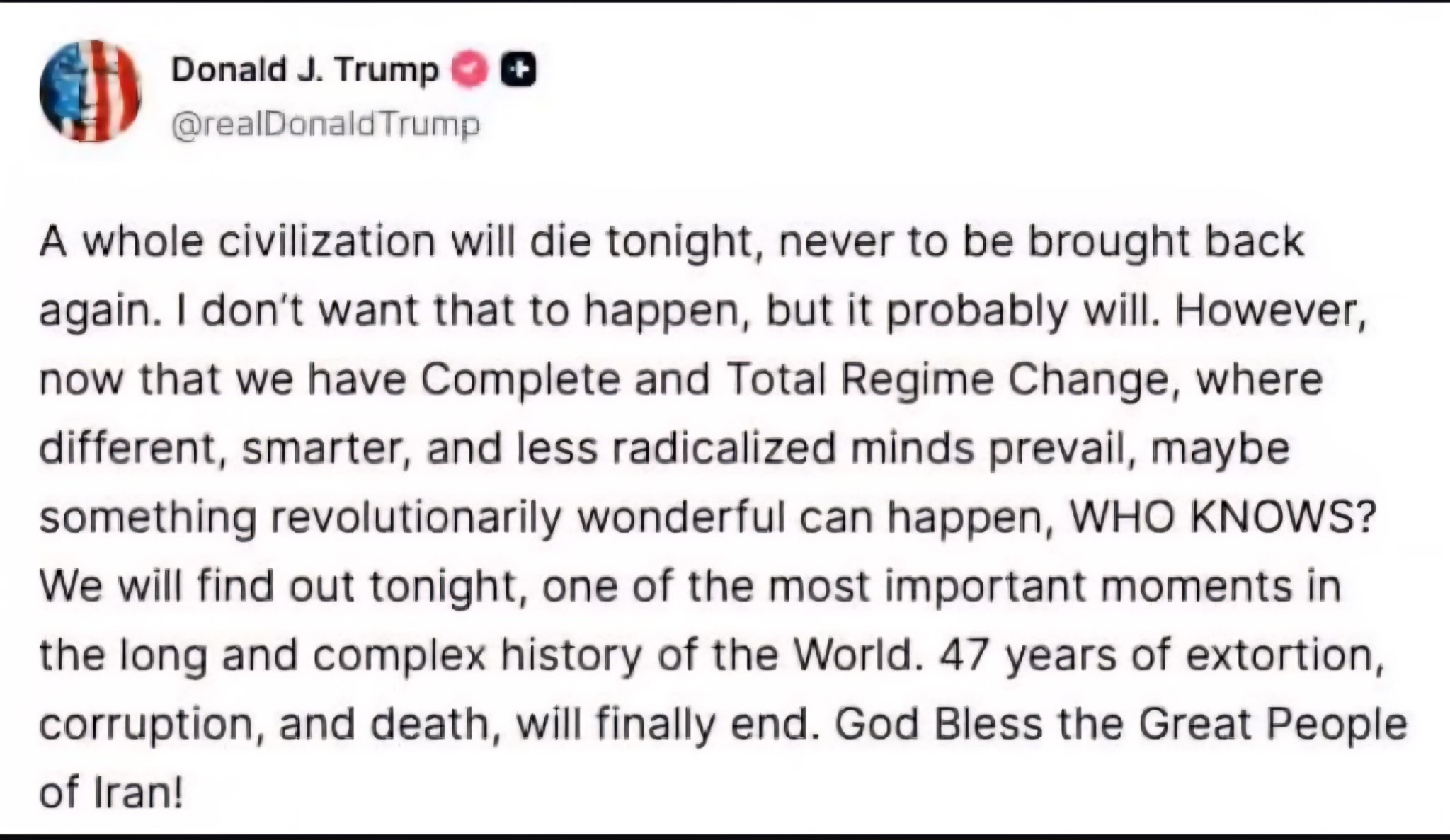
This is madness. Unhinged madness. Imagine “blessing” the people of Iran while threatening to end their entire civilization.
Yesterday, I was watching the war movie, “Fury,” which does a decent job of showing some of the horrors of warfare. We get a few fairly honest scenes about war, as in the opening sequence of “Saving Private Ryan,” yet war coverage in our media portrays war as a bloodless video game.
Meanwhile, Trump tweets about mass murder and most in the media just seem to shrug. Mass murder!
For two decades I’ve been writing about America’s warrior nonsense and the increasing militarization of our country even as we’re kept deliberately isolated from war and all its horrors. It all seems like it’s coalesced into the nightmare we have today.
I was on Judge Napolitano’s show this morning, Judging Freedom, and I was somewhat at a loss to describe my reaction to this. If we can’t unite to stop mass murder of innocents, when are we going to unite?
I watched President Trump’s speech to the nation last night on the Iran War. The lies and boasts flew thick. According to Trump, America is winning and winning big. Under Joe Biden, America was “crippled” and “dead,” but Trump has reanimated the dead and healed it. (An obvious aside: Trump has a serious Christ complex.)
From dead and crippled, America is now the meanest, toughest, hombre in the valley. We take what we want and if you resist we’ll bomb you back to the Stone Age. As the New York Times reported: “We are going to hit them extremely hard,” Trump said. “Over the next two to three weeks, we’re going to bring them back to the Stone Ages, where they belong.”
The proud Iranian people, with Persia as one of the cradles of civilization—they mean less than zero to Trump. It doesn’t matter how many people have to die for Trump to feel like a winner.
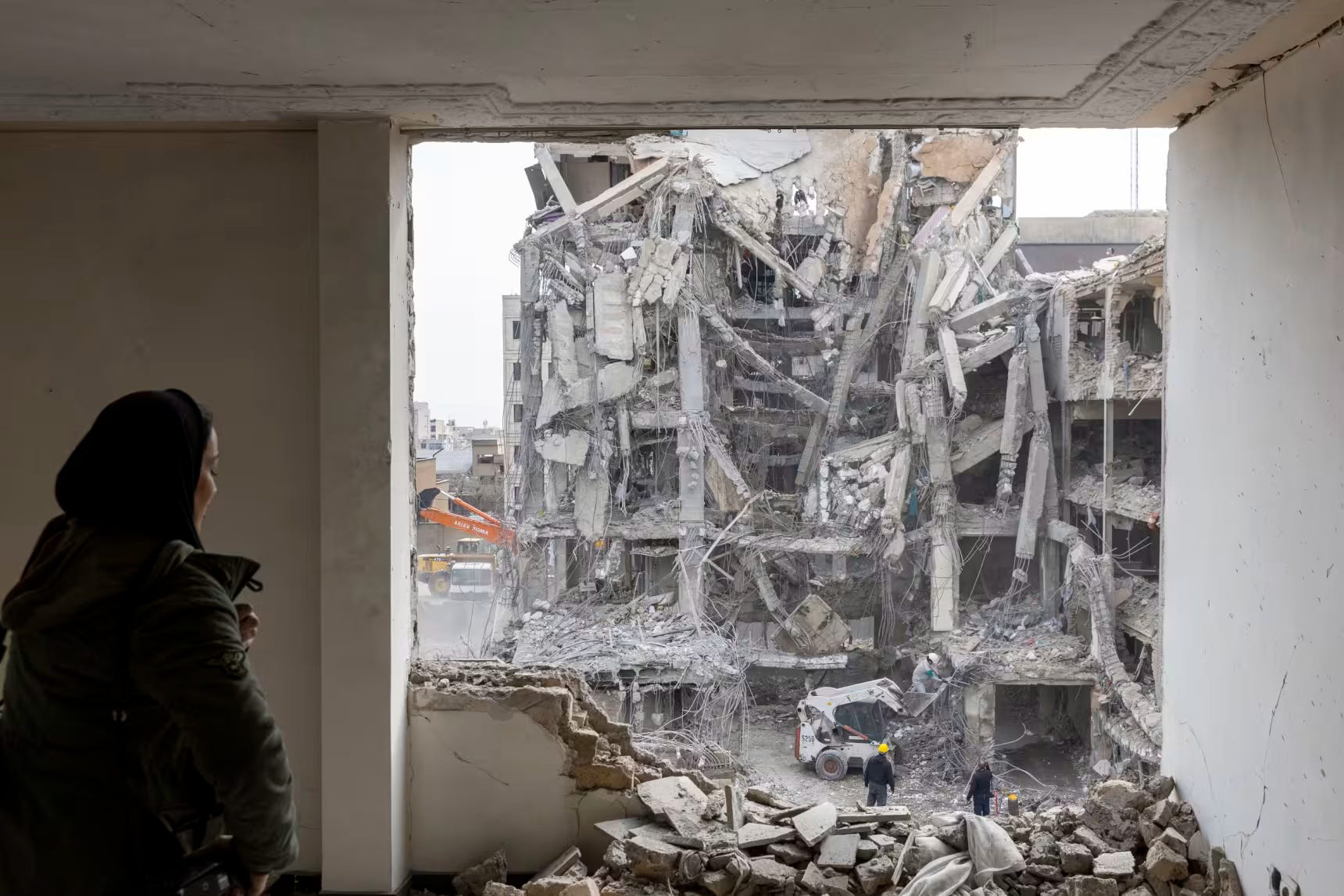
“Beautiful” damage in Tehran (Majid Saeed/Getty)
A transcript of the speech is here. You’ll read about America’s “beautiful” B-2 bombers and how they’ve performed “magnificently.” You’ll read about America’s “warriors” and “heroes” who “laid down their lives” to prevent Iran from getting a nuclear weapon. You’ll read about their families who, even as they grieve the loss of loved ones in this war, are beseeching Trump to “Please, sir, please finish the job.” Every one of them, Trump added.
There were many reasons to be offended by Trump’s speech last night, but the idea of every grieving family member begging the president to “finish the job” by continuing to bomb and kill Iranians is certainly high on the list of offenses to morality and truth.
More than anything, what Trump’s speech told us is what he values. First, of course, himself and his identity as a man of action—a winner. The economy and the stock market. Oil and gas. Military might. And taking cheap shots at perceived opponents.
This sentence was especially revealing: The most violent and thuggish regime on earth would be free to carry out their campaigns of terror, coercion, conquest and mass murder from behind a nuclear shield.
Trump was referring to Iran here, but what he’s really saying is that only one violent and thuggish regime merits such a blank check on inflicting global violence protected by a nuclear shield. It’s not Iran’s, it’s his.
I was reading an article today about Pete Hegseth, self-styled Secretary of War, and his decision to remove four officers from the Brigadier General-select list. Turns out the four officers were either Black or female, but I’m sure that was a coincidence.
Anyhow, the article referenced this pearl of wisdom from Hegseth from last September:
“The leaders who created the woke department have already driven out too many hard chargers. We reverse that trend right now.”
For those of you who don’t know military jargon, “hard charger” is a term of approval. And that’s been Trump and Hegseth’s approach to war with Iran. Call it the bull in the china shop approach. Charge in hard, kill people, break things. Drop enough bombs, kill enough people, and obviously victory must follow.
Hard chargers are what we want in this man’s military, so might Pete Hegseth say. I’ve heard Hegseth’s nickname at the Pentagon is “Dumb McNamara,” apparently for his slicked-back hair together with his, well, lack of intelligence. (Robert McNamara was Secretary of Defense during the disastrous Vietnam War.)
Of course, the military needs its share of Type A, Can-do, mission-driven, hard charging men and women. It also needs its share of skilled, knowledgeable, and smart people as well. And there’s nothing that says that a “hard charger” can’t also be a thinker, especially as that can-do type learns from experience that not every problem can be solved with bullets and bombs.
Deep thinkers are especially needed at strategic levels, else wars go nowhere and are quickly lost. One thing is certain: the so-called Department of War isn’t being led by a deep thinker.
Hegseth, surely a leading member of the kakistocracy, prefers pushups to planning and bombs to diplomacy. He’ll keep charging hard, or, more accurately, he’ll order others to charge hard into harm’s way, all in a quest to drive out “wokeness” and win wars through maximum violence and minimal thought.
Charge harder!
Any enemy wanting to fool Pete Hegseth should invest in a red cape and start waving it smartly.
Trump weighing several options for U.S. troops inside Iran
Discussions about possible ground troops have focused on missions aimed at escalating the war in attempt to end it, sources say, but no decisions have been made.
*****
Somebody please explain to me how committing ground troops to Iran and escalating the war is in any way a sane method of deescalating the war.
The Trump administration is out-Orwelling George Orwell. Rather than a sobering warning, Orwell’s “1984” has become a user’s manual for autocrats like Trump and Hegseth, where war is waged in the name of peace and escalation is deescalation.
Meanwhile, Tulsi Gabbard, the Director of National Intelligence, told us that it’s not America’s 18 (!) intelligence agencies that determine whether we face an “imminent threat.” No—only the president can make that determination.
Can somebody please tell me why we have 18 intelligence agencies that we spend scores of billions on? All we really need is the president’s gut. I suggest we eliminate America’s entire intelligence “community” and replace it with Trump’s intestines.
If Trump has any sense left in his gut, he should declare victory and end this colossal mistake of a war.
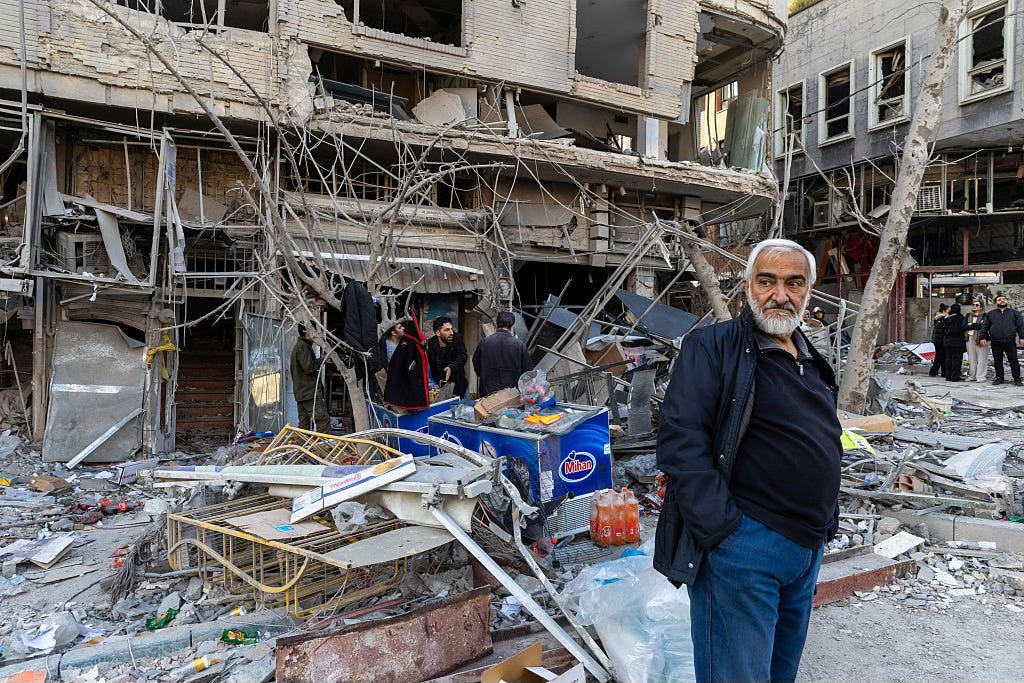
Residential building in Iran. Just imagine if Iran was raining bombs and missiles on the USA. (Majid Saeedi, Getty Images)
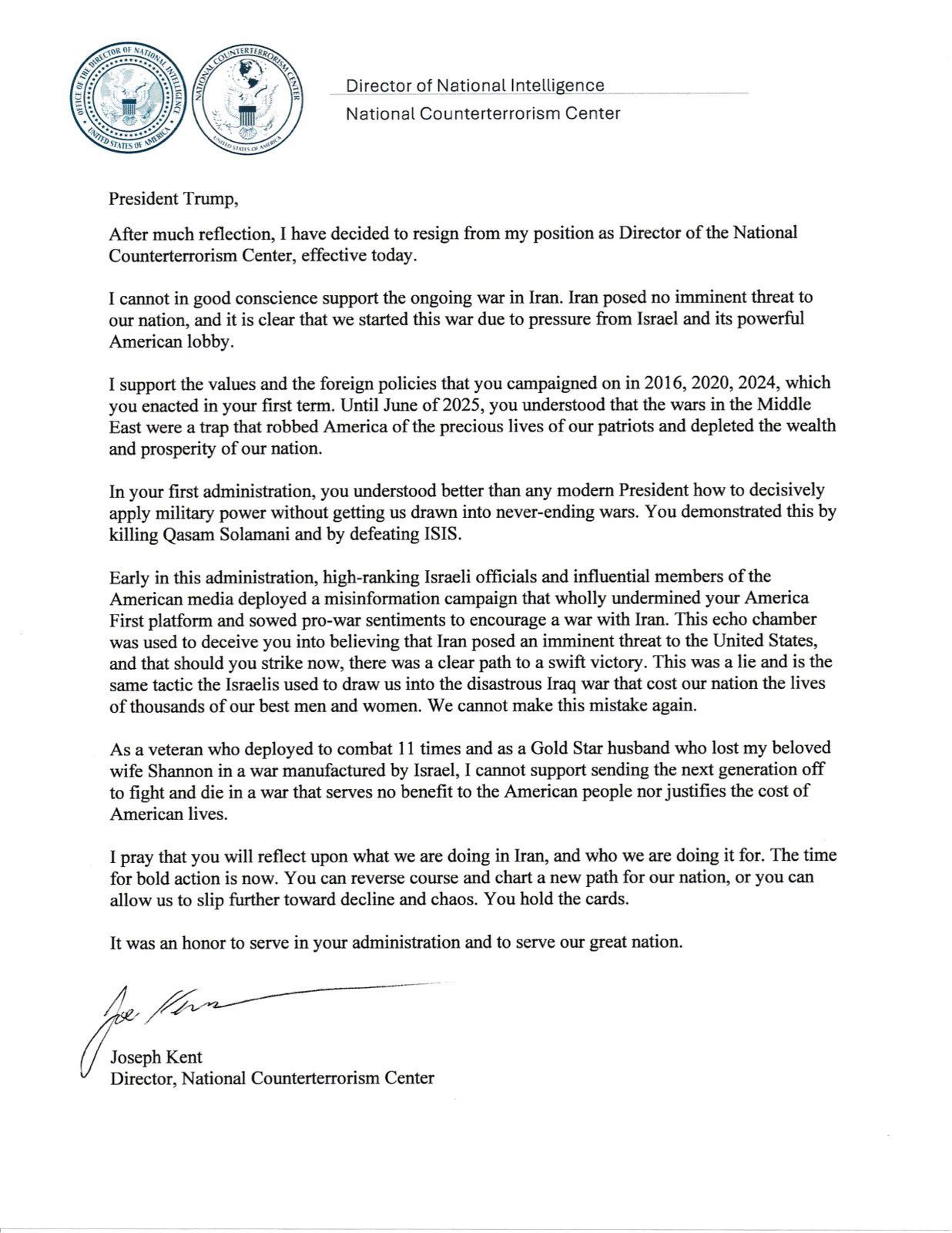
Joe Kent’s principled resignation letter, in which he calls out the influence of Israel and AIPAC on President Trump’s decision to go to war with Iran, illustrates the nature of power and dissent in government circles.
The main response is denunciation. Leading the way was Trump, whose response to the news was basically good riddance even as he claimed that Kent, a former Green Beret with extensive combat experience, was “weak on security.” Organizations like the Jewish Anti-Defamation League and AIPAC suggested that Kent was trafficking in age-old anti-semitic tropes (apparently it’s “anti-semitic” to suggest that Israel and AIPAC have influence over the President and Congress).
In the age of social media, denunciation is nearly instantaneous — and often unhinged. I’ve even seen calls to have Kent investigated under the espionage act!
The method to the madness is obvious: discredit Kent by smears, attack him as disloyal, even as such efforts are designed to intimidate others from airing their legitimate concerns.
Kent deserves a lot of credit for going on the record because he surely knew he’d be denounced.
Not quite denouncing him, but showing (so far) conformity that’s more than disappointing is Tulsi Gabbard, the Director of National Intelligence (DNI) and Kent’s former boss. Previously, Tulsi was on the record as being strongly against regime-change wars and especially against war with Iran. She’s often made speeches in the name of her “brothers and sisters in uniform.” Yet so far she has quietly abetted Trump’s policies and actions in his foolish and illegal war against Iran.
I fear Tulsi’s “brothers and sisters” will pay a high price for her complicity.
Here’s her message posted yesterday at X/Twitter:
Donald Trump was overwhelmingly elected by the American people to be our President and Commander in Chief. As our Commander in Chief, he is responsible for determining what is and is not an imminent threat, and whether or not to take action he deems necessary to protect the safety and security of our troops, the American people and our country.
The Office of the Director of National Intelligence is responsible for helping coordinate and integrate all intelligence to provide the President and Commander in Chief with the best information available to inform his decisions.
After carefully reviewing all the information before him, President Trump concluded that the terrorist Islamist regime in Iran posed an imminent threat and he took action based on that conclusion.
This is carefully-worded nonsense, designed to satisfy Trump and his handlers. I bolded a few obvious BS phrases. First, Trump wasn’t “overwhelmingly” elected president, though Trump loves to think he was. Second, anyone who knows how Trump operates can’t imagine him “carefully reviewing” all the intelligence, but perhaps Tulsi is being cute here, since she adds the intel “before him.” (I truly wonder how much of the DNI’s intel actually reached Trump, how much he truly read and reviewed; not much, I’d wager.)
Finally, there’s the notion of an “imminent threat,” which Iran truly didn’t pose to U.S. national security, not before the Israeli/U.S. attacks. And the usual dismissal of Iran as “terrorist Islamist,” i.e. “bad people” we don’t like.
I’ve been a Tulsi supporter for many years and I wrote that she’d make a fine DNI. Recent events are proving me wrong. Her message on X in response to Kent’s resignation was more than disappointing. I’m hoping she also resigns for cause, but perhaps she thinks she can do more as an insider to restrain the worst impulses of Trump, his toadies, and those who have always spoiled for a war against Iran. Her resignation, I think, would be more powerful than her restraining influence (assuming she has any influence).
Of course, if she does resign for cause, she will be smeared and denounced, and not for the first time.
Readers, what do you make of all this?
Addendum: Perhaps I should add that I don’t agree with everything in Kent’s resignation letter, nor would I be likely to vote for him, assuming he runs for office again. His resignation letter is useful exactly because he was a strong Trump loyalist whose military record earns him respect among those who are otherwise unlikely to question Trump and the official narrative. In short, for me this isn’t about Kent and his character, It’s about his recognition that there wasn’t an imminent threat from Iran and his willingness to highlight the roles played by Israel and AIPAC in U.S. politics and foreign policy. As a Trump insider, his words carry persuasive weight. They could also indicate a fracturing of support for Trump’s disastrous war with Iran.
Back in 2008, I wrote an article for Neiman Watchdog calling for war salesmen and cheerleaders on the mainstream media to be replaced. Of course, nothing of the sort happened, and today I saw a new article by Ken Klippenstein: “The TV Generals Have Something to Sell You About Iran,” and that something is war and more war (and weapons too).
You can trust him — he’s a general!
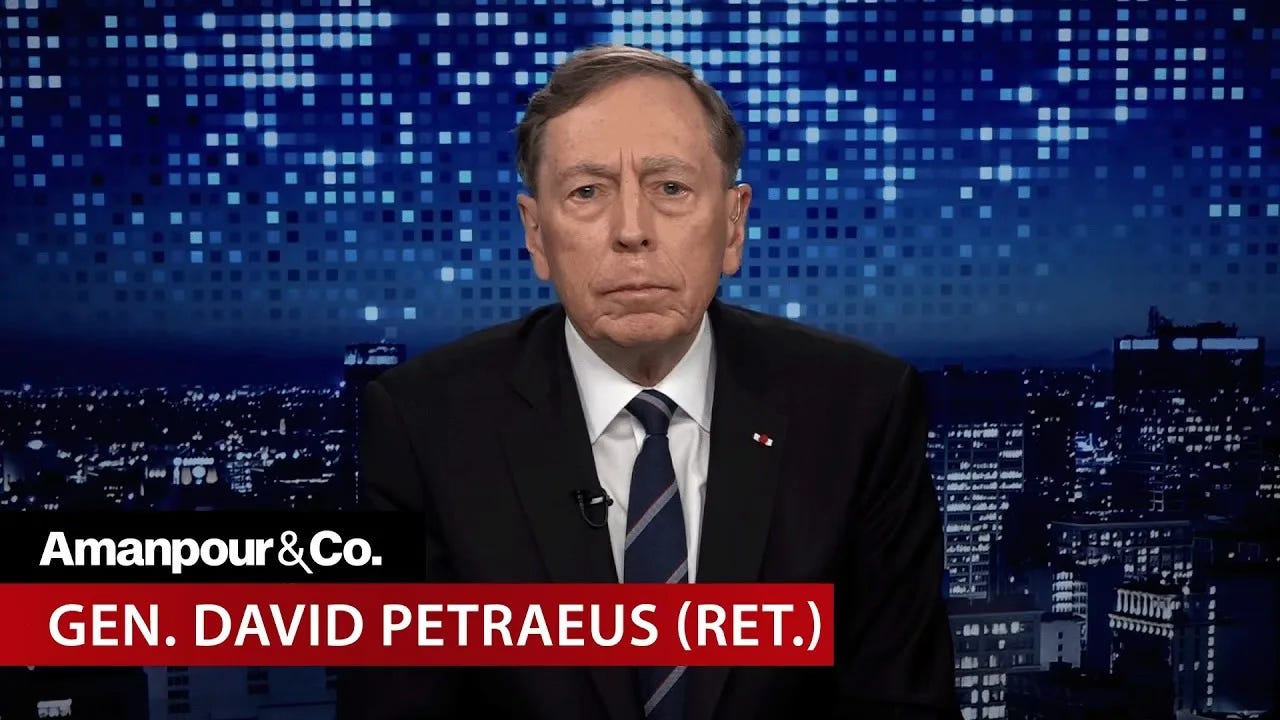
In the article, Klippenstein has a great line about retired general David Petraeus: “Can anyone fit more stars up their asses?” Clearly not.
Anyhow, here’s my article from 2008, unchanged because the dynamic of TV and cable networks using retired senior military officers to sell wars and weapons also remains unchanged.
Networks should replace Pentagon cheerleaders with independent military analysts
COMMENTARY| December 04, 2008
Even without special Pentagon briefings and corrupting financial relationships, former top military brass simply are too conflicted to be relied upon for tough-minded analysis, writes a former Air Force officer.
By William J. Astore
Media outlets must develop their own, independent, military analysts, ones not beholden to the military-industrial complex, ones whose very sense of self is not defined, nourished, and sustained by the U.S. military.
In separate exposés in The New York Times (April 20 and November 30), David Barstow showed how major media outlets came to rely on retired generals like Barry McCaffrey for analysis. Predictably, many of these men (they were all men) continued as paid advisors to defense contractors even as they appeared on TV. They also often accepted favors from the Pentagon, to include special, often classified, briefings; overseas junkets; and, most valuable of all, access to the Office of the Secretary of Defense.
But such influence-peddling and collusion are hardly surprising. Relying on high-ranking, retired military officers to serve as frank and disinterested critics is a bit like inviting Paul von Hindenburg, ex-Field Marshal of the German Army, to testify in 1919 on why his army lost World War I. You’ll get some interesting testimony — just don’t expect it to be critical or for that matter even true.
So why did the networks hire so many retired colonels and generals? Perhaps they followed a rationale analogous to that used in hiring retired professional athletes to cover sports — to provide hard-earned, technical commentary, leavened with occasional anecdotes.
But in the “forever war” in which we became engaged, these retired military officers soon provided not just the color commentary but the play-by-play. And network anchors, lacking first-hand military experience, were reduced to bobble-heads, nodding in respectful agreement.
But war is not a sport. Nor should we cover it as such. We need tough-minded military analysts, not “Team America” boosters and Pentagon spin-meisters.
Why Relying on Senior Military Officers Is Wrongheaded
Our media’s concept of relying on retired senior colonels and generals for frank and unbiased analysis was deeply flawed from the beginning. Let’s consider five facets to the problem:
Despite their civilian coat-and-tie camouflage, these officers are not ex-generals and ex-colonels: they are retired generals and colonels. They still carry their rank; they still wear the uniform at military functions; they’re still deferentially called “sir” by the rank-and-file. They enjoy constant reminders of their privileged military status. It’s not that these men over-identify with the U.S. military — they are the military.
The senior colonels and generals I’ve known despise Monday-morning quarterbacks. Loath to criticize commanders in the field, they tend to defer to the commander-in-chief. Putting on mufti doesn’t change this mindset. Rather than airing their most critical thoughts, they tend to keep them private, especially in cases where service loyalty is perceived to be involved.
Military officers are especially averse to airing criticism if they perceive it might undermine troop morale in the field. Related to this is the belief that “negative” media criticism led to America’s defeat in Vietnam, the hoary but nevertheless powerful “stab-in-the-back” myth. Thus, these men see Pentagon boosterism as a service to the nation — one that they believe is desperately needed to redress the balance of negatively-charged, “liberal,” anti-war coverage.
Paradoxically, that the “War on Terror” has gone badly is a reason why some retired military officers believe we can’tafford serious criticism. If you believe the war can and must be won, as most of them do, you may suppress your own doubts, fearing that, if you air them, you’ll be responsible for tipping the balance in favor of the enemy.
The fifth, perhaps most telling, reason why networks should not rely on retired colonels and generals is that it’s extremely difficult for anyone, let alone a die-hard military man, to criticize our military because such criticism is taken so personally by so many Americans. When you criticize the military, even abstractly, people hear you attacking Johnny or Suzy — their son or daughter, or the boy or girl next door, who selflessly enlisted to defend America. Who wants to hear that Johnny or Suzy may possibly be fighting (even dying) for a mistake? And, assuming he believed it, what senior military man wants to appear on TV to pass along thatmessage to America’s mothers and fathers?
The Next Step
It’s not that retired colonels and generals lack integrity [well, some do, I’d add in 2026], but they are often deeply conflicted and lacking in self-awareness. And you certainly can’t profess to be an objective media analyst while representing contractors vying for funding from the Pentagon.
So what should the media do? Since it will take time for networks to develop their own corps of independent military analysts, they should consider hiring junior officers and NCOs, with recent combat experience, who have left the military after a few years of honorable service. Civilian military historians could also provide critical commentary. Even foreign military officers might be queried; at least they need not worry about their patriotism being impugned each time they hazard a criticism of the Pentagon.
French premier Georges Clemenceau famously noted that “War is too important to be left to generals.” So too is the TV and cable networks’ analysis of our wars.
*****
Quick comment in 2026: I wasn’t critical enough in 2008. Some of these “cheerleaders” are shameless sales- and pitchmen who are profiting from war.
Brian McGinnis, a U.S. Marine Corp veteran, was wounded in action protesting the Iran War in the U.S. Senate. Thrown down, his arm broken, McGinnis was a victim of friendly fire from the Capitol police and Senator Tim Sheehy, who decided he’d join the police in wrestling McGinnis out of the hearing room.
McGinnis’s “crime”? Using his freedom of speech to declare that no one wants to die in a war for Israel.
You can watch it all here. (You can hear the bone crack in his arm.)
This is what happens in America when you stand up and speak truth to power. The powerful already know the truth. Their response is either to ignore truth-tellers or to silence them, sometimes with extreme prejudice.
This Marine, this patriot, exercising his Constitutional right of free speech before the Senate, became yet another casualty of the U.S./Israeli War on Iran, a victim of a deliberate and unconscionable act of friendly fire. All he wanted was to have his voice heard; all he got in return was a broken arm and a most violent silencing, even as U.S. senior leaders in uniform steadfastly ignored him.
Again, this Marine was wounded in action; his action was to speak truth before the powerful, but they don’t traffic in hard or noble truths, only in easy and convenient lies.
Shame on the U.S. Senate, shame on the military’s senior leaders, and shame on the Trump administration for waging an illegitimate, unconstitutional, and illegal war against Iran and against legitimate and courageous dissent in America.
Reading NBC News this morning, I saw where the U.S. “is winning decisively, devastatingly and without mercy,” so claimed self-styled Secretary of War Pete Hegseth. “We are only four days in,” he added, and the U.S. “will take all the time we need” to prevail. He further added “We are punching them while they’re down, which is exactly how it should be.” (There’s nothing more honorable than punching someone when they’re down, right?)
“They [the Iranians] are toast, and they know it, or at least, soon enough, they will know it. And we have only just begun, to hunt, dismantle, demoralize, destroy and defeat their capabilities,” Hegseth boasted. As far as how long the war will last, he equivocated. Three weeks? Eight weeks? Who knows? Hegseth doesn’t.
Hegseth also doesn’t know something fundamental: You can’t do a wrong thing the right way.
The Iran War is wrong. It’s illegal, unconstitutional, immoral, and also extremely dangerous. There’s no way to prevail in a war fought for the wrong reasons, a war fought without clear goals, a war that is already beginning to spiral out of control. But Hegseth thinks if the U.S. launches enough missiles, drops enough bombs, and torpedoes enough ships, somehow the U.S. will “win.”
Congratulations, U.S. and Israel: You made him a martyr
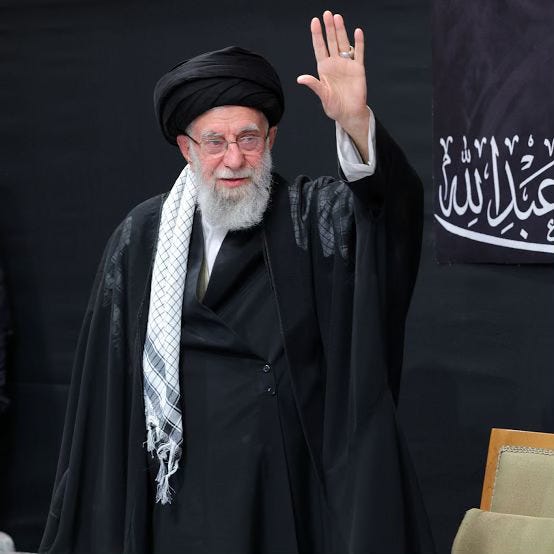
In so many ways, the U.S. has already lost. The Ayatollah Khamenei is now a martyr. Iran is now more likely to pursue a nuclear weapon. Even more so than usual, Israel is now in the driver’s seat, calling America’s shots in the Middle East. This has all the makings of a major catastrophe for U.S. forces, but all Hegseth can see is the promise of punching a man when he’s down.
Clearly, Hegseth is intoxicated with winning “without mercy.” Think about that for a moment—war without mercy. Only the most barbaric or fanatical person would boast about waging war without mercy.
With the Iran War, the Trump administration is marching down the most perilous of paths, blinded by illusions of total victory.
A warning: More than anything, America must not allow this to become a religious war, a crusade, between a Judeo-Christian force and a Shia-Islamic force. We’re already seeing a lot of talk within the U.S. military of a God-driven mission against Iran, with (positive!) references to Armageddon. Such rhetoric is incredibly dangerous and inflammatory. (In this context, that crusader cross tattoo on Hegseth’s chest is more than alarming.)
If anything, the best outcome for the U.S. would be an immediate ceasefire before more U.S. troops are killed and wounded. But how is such a ceasefire to be negotiated? U.S. diplomacy has no credibility. None.
Among the worst outcomes would be the commitment of U.S. troops to Iran, so-called boots on the ground, which would likely create a massive Bay of Pigs-style fiasco. America can ill afford yet another land war quagmire in the Middle East. There is already talk, however, of committing U.S. Special Forces to Iran, perhaps to organize Kurdish and Iranian dissidents against the legitimate Iranian government. Such folly must be prevented.
Any commitment of U.S. troops to Iran would further accelerate escalation. If you begin to hear rumblings about Selective Service and a return to a military draft, you’ll know the Trump administration has become completely unhinged (if it isn’t already).
In just a few days of “major combat operations,” the Trump administration already has more than enough innocent Iranian blood on its hands. That toll in blood is only going to increase, as will the risk of blowback on the “homeland.”
The smartest course for America at this moment is to declare “victory” and leave. Since it’s unlikely Trump and Hegseth will see the light, Congress should immediately cut war funding. Sadly, a weak-willed Congress seems far more likely to pass supplemental funding bills to give Trump and Hegseth a blank check to wage a Judeo-Christian crusade.
We don’t live in interesting times: we live in unhinged times. Perilous times. We must find a way to seek a merciful peace. The alternative just might be World War III.
Here are some macro ideas and thoughts about America’s latest war of choice with Iran:
1. It’s a war so call it that. It’s not “strikes” or “major combat operations.”
2. It’s an unconstitutional, illegal, immoral, and potentially escalatory war.
3. The war has no clear objective other than decapitation of the Iranian leadership (achieved?) and installation of a new regime that will play ball with USA/Israel. That latter outcome is extremely unlikely.
4. It’s a war for Israel to advance its regional hegemony.
5. In the main, the war is neither supported nor understood by the American people. That fact doesn’t seem to matter to the Trump administration.
6. For all those involved, the war will prove increasingly expensive in blood and treasure.
7. Recklessly begun, the war is utterly unpredictable in its final outcomes.
8. The war does not serve the national defense interests of the U.S., as Iran posed no imminent threat to U.S. national security.
9. With no clear Congressional mandate, the war lacks the critical support of the American people. Again, the Trump administration remains unconcerned here.
10. For these reasons, among others, there should be an immediate ceasefire followed by negotiations, leading to discussion of war reparations to be paid by the aggressors. (This scenario, I realize, is unlikely in the extreme.)
Yesterday, I went on “Judging Freedom” with Judge Andrew Napolitano to discuss the Iran War.
As I said to the Judge, I am still confused about America’s true rationale, its intent, and its goals, and I have no clear idea of how this war is going to proceed, let alone end. War is inherently unpredictable, much like fire. Trying to predict its path of destruction, what it will burn and what it will leave behind, and when it will end, is nearly impossible. We must work to contain and extinguish this new fire in the Middle East before it becomes an inferno that engulfs even wider areas, leading to yet more innocents dead.



 Bracing Views