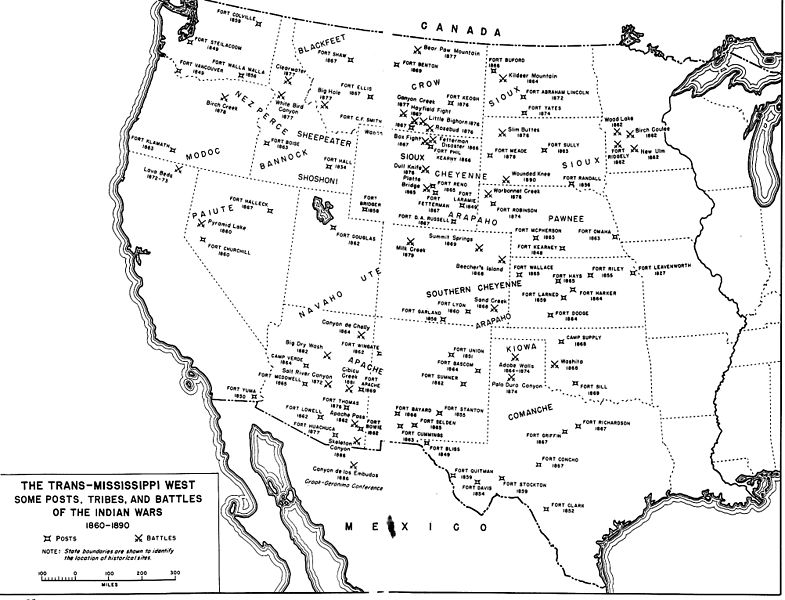
Just a few of the battles fought against Native Americans
W.J. Astore
A popular headline in the media is to describe the Afghan War as “America’s longest,” as in this brief summary today from Foreign Policy:
The war in Afghanistan, America’s longest, is now formally over. The 13-year war, which claimed more than 2,200 American lives and cost more than one trillion dollars, ended quietly at a ceremony in Kabul yesterday. U.S. President Barack Obama and other Western leaders promised their ongoing commitment under the rebranded Operation Resolute Support and insisted the war was a success. But the Taliban is poised for a comeback with a recent surge in violence in Kabul and around the country. There are concerns that Afghanistan’s military and fragile political institutions will crumble as the United States leaves.
There’s a big problem with this. America’s longest war, by far, is not the recent Afghan War; it was its more or less continuous effort against Native Americans from the early 1600s to the late 1800s. Americans like to forget that native peoples populated the land before European settlers began to arrive, and that these native peoples had to be killed, or corralled, or otherwise subjugated or shunted aside in the name of Manifest Destiny and in the pursuit of profit.
As historian John Grenier notes in The First Way of War: American War Making on the Frontier, 1607-1814,
For the first 200 years of our military heritage, then, Americans depended on arts of war … [that included] razing and destroying enemy villages and fields; killing enemy women and children; raiding settlements for captives; intimidating and brutalizing enemy noncombatants; and assassinating enemy leaders.
For Grenier, America’s “first way of war” relied on “extravagant violence” often aimed at “the complete destruction of the enemy,” in this case various Native American peoples. This was indeed America’s longest war. Yet despite (or perhaps because of) its long duration and brutal violence, the war against indigenous peoples is rarely mentioned today, especially by those who seek to promote American exceptionalism.
Another longer war than the Afghan one, more recent in America’s memory, was the Cold War we fought against the Soviet Union and its allies from the close of World War II to the collapse of the Soviet Union in the early 1990s. Lasting nearly half a century, this war ended in victory of a sort for the United States, even as its legacy continues to poison U.S. culture and foreign relations. For the Cold War left us with an enormous military-industrial-Congressional complex, to include nuclear forces capable of destroying the planet, which the U.S. continues to feed and even to enlarge. The result has been the growth of a second “shadow” government, a national security and surveillance state of enormous power, an apparatus with wide-reaching and unaccountable powers that is potentially a greater threat to American freedoms than the Soviet Union ever was.
When America forgets its longest wars, and especially when Americans forget the legacies of these wars, it’s more than history that suffers.
Update: Just after I wrote this, I came across this article on corporate “land grabs” that continue to bedevil Native Americans. Some would argue that the long war against native peoples never really ended. And to state a point that is perhaps obvious: the Afghan War grew out of the Cold War and U.S. efforts to embroil the Soviet Union in its own Vietnam in 1980. U.S. efforts to support the Afghan “freedom fighters” against the Soviets contributed to the rise of Osama bin Laden, who would eventually turn against the U.S. in the 1990s. America’s Afghan War, in other words, is not a 13-year war. To understand it, one must look back to 1979-80 and the machinations of a U.S. foreign policy establishment that was much more concerned with hobbling the Soviets than with helping the Afghan people.
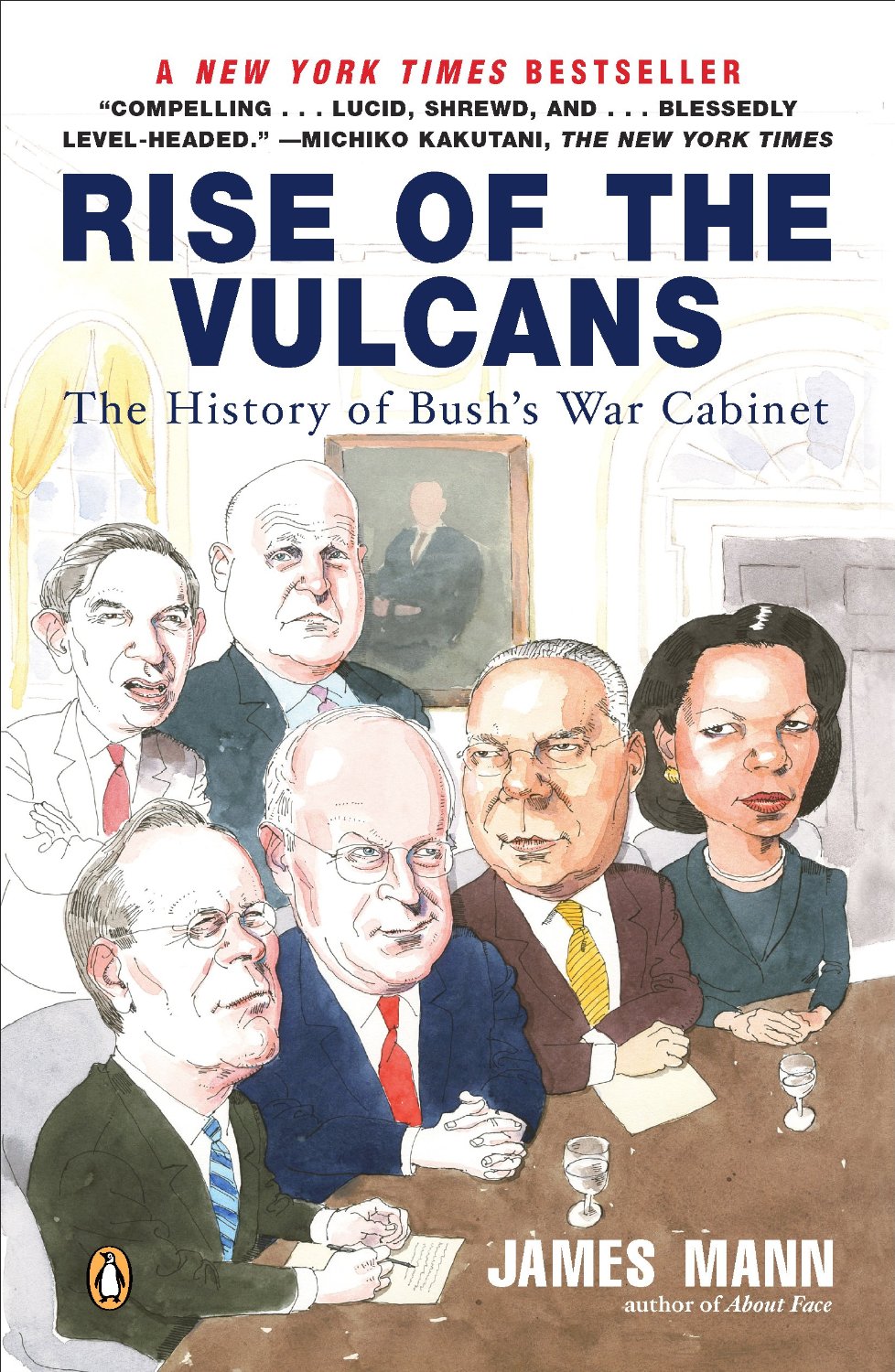
Leading figures in the Bush Administration — Dick Cheney, Donald Rumsfeld, Condoleezza Rice, Paul Wolfowitz — fancied themselves to be the new Vulcans. As in Vulcan, the Roman god of fire and the forge, armorer for gods and mortals. In the aftermath of 9/11, they didn’t look to Darth Vader in their journey to “the dark side” — they looked to Ancient Rome. They believed that Rome had prospered because of its willingness to use force with unparalleled ruthlessness. As the “new Rome,” the new hegemon of the globe, America too would prosper if it proved willing to use brutal force.
Call it “shock and awe.” In the process, they sowed the dragon’s teeth of war in Afghanistan, Iraq, and indeed throughout the world. In attempting to intimidate the enemies they saw everywhere, they tortured widely as well.
In her book Rome and the Enemy (1990), historian Susan P. Mattern noted that:
Rome’s success, its very safety, ultimately depended less on the force that it could wield, which was not necessarily large or overwhelming, than on the image of the force it could wield and on its apparent willingness to use that force at whatever cost.
The American Vulcans, people like Cheney, concluded the same: they had to be willing to use brutal force at whatever cost. Image was everything. They had to be willing to project an image of ruthlessness, because the language of brutality was the only language “they,” the enemy, could and would understand. It wasn’t necessary to sacrifice democracy to defend democracy, since to the Vulcans, America wasn’t really a democracy anyway. No: America was the new Rome, the new global hegemon, and it had to act like it.
To the Vulcans, torture was not an aberration. It was method. A method of intimidation that sent a message to barbarians about America’s willingness to use whatever force was necessary to defend itself. Whether torture yielded reliable intelligence was beside the point. The torture was the message.
That’s why you’ll hear no apology from Dick Cheney or the other Vulcans. They speak the language of naked power. A fiery power that consumes. And they’re proud of it.
Two millennia ago, in a riposte to Rome’s utter ruthlessness, the Roman historian Tacitus wrote a critique using Calgacus, a Celtic chieftain, as his mouthpiece. In Agricola, Tacitus wrote:
The Romans’ tyranny cannot be escaped by any act of reasonable submission. These brigands of the world have exhausted the land by their rapacity, so they now ransack the sea. When their enemy is rich, they lust after wealth; when their enemy is poor, they lust after power. Neither East nor West has satisfied their hunger. They are unique among humanity insofar as they equally covet the rich and the poor. Robbery, butchery, and rapine they call ‘Empire.’ They create a desert and call it ‘Peace.’
This may not be quite the self-image that America’s new Vulcans had in mind, but it is the reality when you set yourself up as acolytes of the god of fire. But fire is an especially capricious and elemental force, impossible to master, raging treacherously as it consumes everything in its path. Beware when you play with fire, for even the Roman Empire burnt itself out.
(With thanks to the reader below who reminded me of the different roles Vulcan and Mars played in Roman mythology.)
The so-called Senate CIA Torture Report is supposed to be released today. Five years ago, I wrote an article for Nieman Watchdog on the Bush Administration’s decision to resort to “enhanced interrogation techniques,” or torture in plain speak. Torture, I wrote back then, was the refuge of the impatient and incompetent, an approach that abrogated America’s fidelity to international treaties even as it became habit-forming. In other words, the resort to torture simply begat more torture, irrespective of results. As President Obama said, “We tortured some folks.” And so on. W.J. Astore
COMMENTARY | May 18, 2009
Did a lack of trained interrogators with appropriate language proficiency lead Bush administration officials to embrace torture as a ‘short cut’? A former dean at the Defense Language Institute writes that America was unprepared to wage a patient and savvy war of counterintelligence against Al Qaeda – which may have made less humane and less effective methods seem like an attractive option. Seventh in a series of articles calling attention to the things we still need to know about torture and other abuses committed by the Bush administration after 9/11.
By William J. Astore
In a letter dated May 10, 2007, General David H. Petraeus wrote to American troops serving in the Multi-National Force in Iraq:
Some may argue that we would be more effective if we sanctioned torture or other expedient methods to obtain information from the enemy. They would be wrong. Beyond the basic fact that such actions are illegal, history shows that they also are frequently neither useful nor necessary. Certainly, extreme physical action can make someone “talk;” however, what the individual says may be of questionable value.
Petraeus’s directive to the troops was unequivocal: Besides being illegal, torture is counterproductive, unnecessary, and generates “intelligence” of dubious reliability.
Evidence suggests the U.S. military was telling the Bush Administration these cold, hard facts all along. Why then did George Bush and Dick Cheney approve torture under the guise of “enhanced interrogation techniques”?
To answer this question, I think we need to remember not only the immense pressure the Bush Administration was under in 2002 (the events of 9/11, after all, occurred on their watch), not only their idée fixe for a settling of accounts with Saddam Hussein and Iraq, but also America’s lack of preparedness to wage a patient and savvy war of counterintelligence against Al Qaeda.
I witnessed this indirectly at the Defense Language Institute Foreign Language Center (DLIFLC), where I served as the Associate Provost/Dean of Students from 2002 to 2005. Clearly, the U.S. lacked translators, interpreters, and especially trained military interrogators. I recall interrogators being pulled from assignments at DLIFLC and reassigned to operational tours in the Middle East and Central Asia; the problem was that their language proficiency was often in Chinese or Korean or a Romance language – not, as one might expect, in Arabic, Pashto or Dari.
Few people understand how long it takes to produce a skilled military interrogator. Attaining basic language proficiency in Arabic takes nearly 18 months of constant training at DLIFLC. But attaining mastery of the language and the culture – the acuity and sensitivity to interrogate a suspect who’s deliberately trying to mislead you – takes years and even decades of study and practice. From 2002 to 2005, it may be that our country simply didn’t have enough skilled and disciplined interrogators to take the indirect approach.
Torture, I’m suggesting, wasn’t used because of a simple Machiavellian calculus of “the ends justify the means.” Rather, we lacked the most humane and most effective means to attain the ends that the Bush Administration so desperately wanted – “actionable intelligence” that could prevent yet another 9/11 from occurring on their watch. So they deployed “enhanced interrogation techniques,” which carried with them not merely the risk but the certainty of excesses and mistakes.
As investigators look more closely at America’s resort to torture, they should ask if we decided to go rough because we couldn’t go smooth. Because we lacked the language and cultural skills to play good cop, we played bad cop as a short cut. The problem, of course, is that short cuts are habit-forming. And in the name of results, they often sacrifice the essential for the expedient. In the case of the Bush Administration, not only did torture apparently provide unreliable intelligence: It also abrogated America’s fidelity to international treaties that forbade torture, and compromised our own ethos of truth, justice, and the American way.
Here, the lessons of the French in Algiers continue to resonate. Think back to the revelations of General Paul Aussaresses in 2001, which scandalized France. Aussaresses unrepentantly confessed that, in attempting to suppress terrorism in Algeria in the 1950s, detainee abuse, torture, even murder became routine, first-choice, approaches. The resort to torture simply begat more torture.
Investigators should look at whether this dynamic also applied to America in Afghanistan and Iraq. How many of our counterterrorist experts became like General Aussaresses: Self-perceived patriots who believed torture and even murder were justified in the name of protecting the state? After all, if the state’s essential purpose is to protect its citizens, and you’re dealing with an enemy that’s malevolently contumacious, as Al Qaeda appeared to be, what’s to stop avowed “patriots” from torturing suspects, especially when the state’s leaders have authorized harsh techniques and are pressing you for results?
Patriotism, it’s been said, is the last refuge of the scoundrel. Is torture the last refuge of the impatient and the incompetent? If so, how do we instill patience and competence? Of the hundreds of billions we spend on national defense each year, surely we should dedicate more funding to training and retaining skilled and disciplined military interrogators. Counterterrorism succeeds or fails based on human intelligence (HUMINT). But to get the most reliable HUMINT, we have to be able to outsmart our foes. And the best way to do this is to treat them as humans, not as vessels to be beaten until they voice the echoes of our worst fears.
Updated (12/9/2014, 11:50AM EST): The Executive Summary to the “Torture Report” has been released. I’ve scanned the first 40 pages. One remarkable data point is that supposedly the CIA did not brief the President on the full extent of the “enhanced interrogation techniques” until April 8, 2006. In short, the CIA and its hired contractors used certain torture techniques on their own authority for four years. Here’s an excerpt from the report:
On August 1, 2002, based on comments from White House Counsel Alberto Gonzales, the talking points were revised to eliminate references to the waterboard. CIA records indicate, however, that the talking points were not used to brief the president. On August 2, 2002, the National Security Council legal advisor informed the DCI’s chief of staff that “Dr. Rice had been informed that there would be no briefing of the President on this matter, but that the DCI had policy approval to employ the CIA’s enhanced interrogation techniques.”
Records state that prior to the use of the CIA’s enhanced interrogation techniques on Abu Zubaydah in 2002, the CIA did not brief Secretary of State Colin Powell or Secretary of Defense Donald Rumsfeld, two members of the National Security Council, on the techniques. The Committee, including the chairman and vice chairman, was also not briefed on the CIA’s enhanced interrogation techniques prior to their use.
It seems like the CIA is shouldering all of the blame here. The failure (if it was that) to brief the president, the secretary of state, the secretary of defense, as well as the Senate Intelligence Committee, constitutes a fundamental breakdown in Constitutional safeguards. (Unless, of course, the “failure” to brief senior civilian leaders was all about protecting them and maintaining “plausible deniability.”)
Whatever else the report reveals, this violation of the Constitution is especially egregious. If true, it would suggest that the CIA should be severely disciplined or even disbanded.
But I truly doubt whether the buck stops with rogue elements in the CIA …
Update (12/10/14): Eric Fair was a contract interrogator for the Army in 2004. In an Op-Ed for the New York Times today, he writes:
I was an interrogator at Abu Ghraib. I tortured.
Today, the Senate released its torture report. Many people were surprised by what it contained: accounts of waterboardings far more frequent than what had previously been reported, weeklong sleep deprivation, a horrific and humiliating procedure called “rectal rehydration.” I’m not surprised. I assure you there is more; much remains redacted.
Most Americans haven’t read the report. Most never will. But it stands as a permanent reminder of the country we once were.
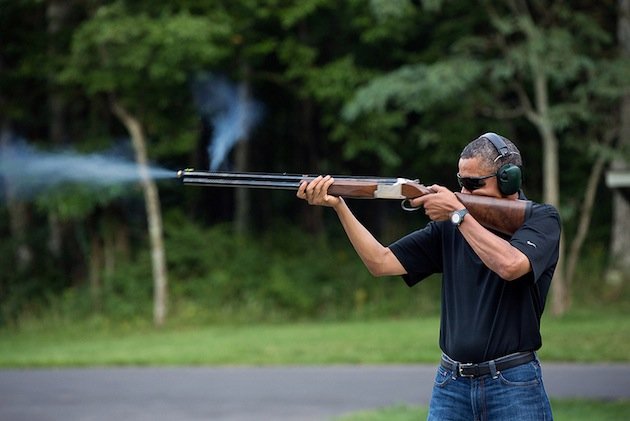
News that President Obama has doubled the number of American troops (whoops — I mean advisers) in Iraq to 3100 is already a tacit admission of defeat in that troubled region. Let’s recall that the Iraqi security forces the U.S. trained and equipped to the tune of $25 billion simply melted away when faced with serious combat this summer. Their performance put me to mind of the National Rifle Association’s slogan against John Kerry in the presidential campaign of 2004. Kerry had gone bird shooting, mainly it seems to be photographed with a gun in his hand, a necessity for any red-blooded American male (just ask Obama). But the NRA wasn’t fooled (or so they claimed). “That dog don’t hunt,” the NRA said about Kerry. And something about that slogan stuck.
You could say the same of that Iraqi army that the U.S. created and funded and trained and equipped: That dog don’t hunt. Or, it won’t hunt for us. Because that’s not its purpose. That’s not how or even why we trained it. But that’s OK. We’ll just send more American troops to Iraq, and waste more money, further destabilizing the region, making it even easier for radical jihadists to recruit more followers, whether to the ISIS banner or some other Islamist flag (Khorasan, perhaps?).
It’s just incredible how inept U.S. foreign policy is today. If George C. Marshall had been like this during World War II, we’d be speaking German today at the Pentagon, instead of simply misinterpreting Clausewitz.
Of course, Congress will have to authorize funding for the latest U.S. military misadventure. Anyone want to offer odds on Congress actually exercising oversight on our foreign entanglements? A long shot, indeed.
Even as Congress seeks to cut funding to the poor, there’s always plenty of money for military adventurism overseas, no matter how often those adventures fail. When it comes to exercising real oversight, Congress is always a lame duck — so lame that even a dog that don’t hunt (that Iraqi military again) succeeds in bagging billions of dollars from the American taxpayer.
The moral to the story? America doesn’t lack for guns; we lack for brains.
Update: Iraq has “shook up” its military, relieving 26 officers of their commands and forcibly retiring 10 others, even as 18 new commanders were appointed by Prime Minister Haider al-Abadi among promises of greater professionalism and less graft and corruption. Progress? Time will tell. But what does it say about a military that, in spite of prolonged training and massive infusions of cash from the U.S., was so ridden with corruption that it collapsed when facing its first challenge? Sadly, the need for ever more U.S. advisers and money suggests this is yet another case of rearranging the deck chairs on the Titanic.
Update 2 (written by b. traven)
What is truly tragic is how the back story to the total failure of the Bush-Cheney wars is not reviewed by Obama, the Senate, or the House as this tragedy for Iraq unfolds. Obama just continues to follow the Bush lies by one week saying no “boots on the ground” while his top military people say “yes, more boots” and the next week Obama announces doubling the number of troops with no sense of embarrassment. And the American people stay entranced with baseball, football, and basketball scores.
And you can say you saw it here first. No sooner had General Dempsey said he wanted more troops in Iraq then Obama complied by doubling the force. Now Dempsey has told Obama what he wants even more troops so you can count on Obama complying in a couple of weeks. There’s nothing like doubling down on a failed policy in hopes that the result will come out differently than the last failure. Here’s Dempsey’s new demand as reported in the Guardian of London newspaper:
“The top-ranking officer in the American military said on Thursday that the US is actively considering the direct use of troops in the toughest upcoming fights against the Islamic State (Isis) in Iraq, less than a week after Barack Obama doubled troop levels there.
General Martin Dempsey, the chairman of the joint chiefs of staff, indicated to the House of Representatives armed services committee that the strength of Isis relative to the Iraqi army may be such that he would recommend abandoning Obama’s oft-repeated pledge against returning US ground troops to combat in Iraq.”
President Truman fired the most renowned five star General of his day, Douglas MacArthur for voicing a policy contradicting Truman’s in regard to China. If we had a real president he would do the same with Dempsey, who is certainly no MacArthur.
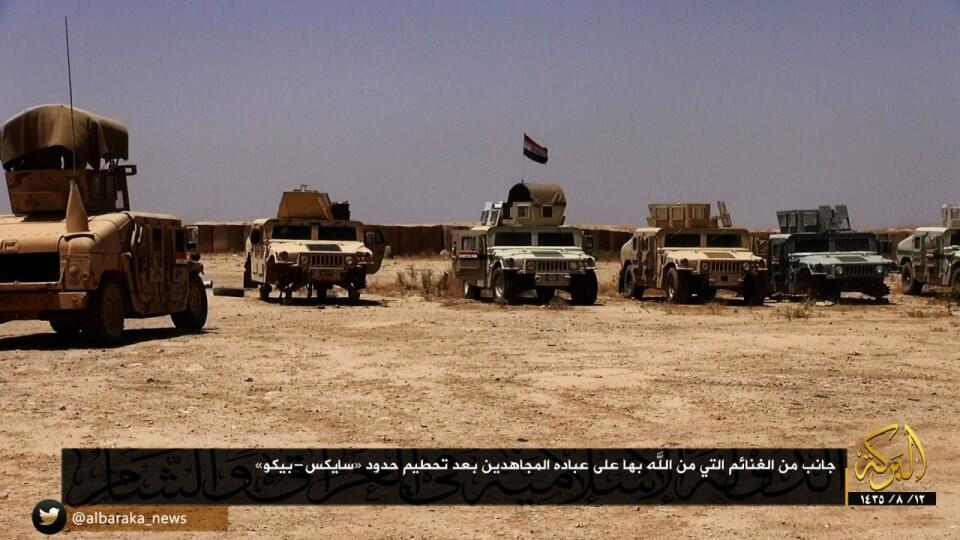
Iraqi equipment provided by the U.S. and captured by ISIS
W.J. Astore
In my latest article for TomDispatch, I examine why the Iraqi security forces that the U.S. trained and equipped at a cost of $25 billion performed so poorly when attacked by ISIS in June. Read on! And be sure to check out other articles at TomDispatch, a contrarian site edited by the inestimable (and indefatigable) Tom Engelhardt.
In June, tens of thousands of Iraqi Security Forces in Nineveh province north of Baghdad collapsed in the face of attacks from the militants of the Islamic State (IS or ISIS), abandoning four major cities to that extremist movement. The collapse drew much notice in our media, but not much in the way of sustained analysis of the American role in it. To put it bluntly, when confronting IS and its band of lightly armed irregulars, a reputedly professional military, American-trained and -armed, discarded its weapons and equipment, cast its uniforms aside, and melted back into the populace. What this behavior couldn’t have made clearer was that U.S. efforts to create a new Iraqi army, much-touted and funded to the tune of $25 billion over the 10 years of the American occupation ($60 billion if you include other reconstruction costs), had failed miserably.
Though reasonable analyses of the factors behind that collapse exist, an investigation of why U.S. efforts to create a viable Iraqi army (and, by extension, viable security forces in Afghanistan) cratered so badly are lacking. To understand what really happened, a little history lesson is in order. You’d need to start in May 2003 with the decision of L. Paul Bremer III, America’s proconsul in occupied Iraq and head of the Coalition Provisional Authority (CPA), to disband the battle-hardened Iraqi military. The Bush administration considered it far too tainted by Saddam Hussein and his Baathist Party to be a trustworthy force.
Instead, Bremer and his team vowed to create a new Iraqi military from scratch. According to Washington Post reporter Tom Ricks in his bestselling book Fiasco, that force was initially conceived as a small constabulary of 30,000-40,000 men (with no air force at all, or rather with the U.S. Air Force for backing in a country U.S. officials expected to garrison for decades). Its main job would be to secure the country’s borders without posing a threat to Iraq’s neighbors or, it should be added, to U.S. interests.
Bremer’s decision essentially threw 400,000 Iraqis with military training, including a full officer corps, out onto the streets of its cities, jobless. It was a formula for creating an insurgency. Humiliated and embittered, some of those men would later join various resistance groups operating against the American military. More than a few of them later found their way into the ranks of ISIS, including at the highest levels of leadership. (The most notorious of these is Izzat Ibrahim al-Douri, a former general in Saddam’s army who was featured as the King of Clubs in the Bush administration’s deck of cards of Iraq’s most wanted figures. Al-Douri is now reportedlyhelping to coordinate IS attacks.)
IS has fought with considerable effectiveness, quickly turning captured American and Syrian weaponry, including artillery pieces, Humvees, and even a helicopter, on their enemies. Despite years of work by U.S. military advisers and all those billions of dollars invested in training and equipment, the Iraqi army has not fought well, or often at all. Nor, it seems, will it be ready to do so in the immediate future. Retired Marine Corps General John R. Allen, who played a key role in organizing, arming, and paying off Sunni tribal groups in Iraq the last time around during the “Anbar Awakening,” and who has been charged by President Obama with “coordinating” the latest American-led coalition to save Iraq, has alreadygone on record on the subject. By his calculations, even with extensive U.S. air support and fresh infusions of American advisers and equipment, it will take up to a year before that army is capable of launching a campaign to retake Mosul, the country’s second largest city.
What went wrong? The U.S. Army believes in putting the “bottom line up front,” so much so that they have even turned the phrase into an acronym: BLUF. The bottom line here is that, when it comes to military effectiveness, what ultimately matters is whether an army — any army — possesses spirit. Call it fire in the belly, a willingness to take the fight to the enemy. The Islamic State’s militants, at least for the moment, clearly have that will; Iraqi security forces, painstakingly trained and lavishly underwritten by the U.S. government, do not.
This represents a failure of the first order. So here’s the $60 billion question: Why did such sustained U.S. efforts bear such bitter fruit? The simple answer: for a foreign occupying force to create a unified and effective army from a disunified and disaffected populace was (and remains) a fool’s errand. In reality, U.S. intervention, now as then, will serve only to aggravate that disunity, no matter what new Anbar Awakenings are attempted.
In the military, it’s called an “after action report” or a “hotwash” — a review, that is, of what went wrong and what can be learned, so the same mistakes are not repeated. When it comes to America’s Iraq training mission, four lessons should top any “hotwash” list:
1. Military training, no matter how intensive, and weaponry, no matter how sophisticated and powerful, is no substitute for belief in a cause. Such belief nurtures cohesion and feeds fighting spirit. ISIS has fought with conviction. The expensively trained and equipped Iraqi army hasn’t. The latter lacks a compelling cause held in common. This is not to suggest that ISIS has a cause that’s pure or just. Indeed, it appears to be a complex mélange of religious fundamentalism, sectarian revenge, political ambition, and old-fashioned opportunism (including loot, plain and simple). But so far the combination has proven compelling to its fighters, while Iraq’s security forces appear centered on little more than self-preservation.
2. Military training alone cannot produce loyalty to a dysfunctional and disunified government incapable of running the country effectively, which is a reasonable description of Iraq’s sectarian Shia government. So it should be no surprise that, as Andrew Bacevich has noted, its security forces won’t obey orders. Unlike Tennyson’s six hundred, the Iraqi army is unready to ride into any valley of death on orders from Baghdad. Of course, this problem might be solved through the formation of an Iraqi government that fairly represented all major parties in Iraqi society, not just the Shia majority. But that seems an unlikely possibility at this point. In the meantime, one solution the situation doesn’t call for is more U.S. airpower, weapons, advisers, and training. That’s already been tried — and it failed.
3. A corrupt and kleptocratic government produces a corrupt and kleptocratic army. On Transparency International’s 2013 corruption perceptions index, Iraq came in 171 among the 177 countries surveyed. And that rot can’t be overcome by American “can-do” military training, then or now. In fact, Iraqi security forces mirror the kleptocracy they serve, often existing largely on paper. For example, prior to the June ISIS offensive, as Patrick Cockburn has noted, the security forces in and around Mosul had a paper strength of 60,000, but only an estimated 20,000 of them were actually available for battle. As Cockburn writes, “A common source of additional income for officers is for soldiers to kickback half their salaries to their officers in return for staying at home or doing another job.”
When he asked a recently retired general why the country’s military pancaked in June, Cockburn got this answer:
“‘Corruption! Corruption! Corruption!’ [the general] replied: pervasive corruption had turned the [Iraqi] army into a racket and an investment opportunity in which every officer had to pay for his post. He said the opportunity to make big money in the Iraqi army goes back to the U.S. advisers who set it up ten years ago. The Americans insisted that food and other supplies should be outsourced to private businesses: this meant immense opportunities for graft. A battalion might have a nominal strength of six hundred men and its commanding officer would receive money from the budget to pay for their food, but in fact there were only two hundred men in the barracks so he could pocket the difference. In some cases there were ‘ghost battalions’ that didn’t exist at all but were being paid for just the same.”
Only in fantasies like J.R.R. Tolkien’s Lord of the Rings do ghost battalions make a difference on the battlefield. Systemic graft and rampant corruption can be papered over in parliament, but not when bullets fly and blood flows, as events in June proved.
Such corruption is hardly new (or news). Back in 2005, in his article “Why Iraq Has No Army,” James Fallows noted that Iraqi weapons contracts valued at $1.3 billion shed $500 million for “payoffs, kickbacks, and fraud.” In the same year, Eliot Weinberger, writing in the London Review of Books, cited Sabah Hadum, spokesman for the Iraqi Ministry of the Interior, as admitting, “We are paying about 135,000 [troop salaries], but that does not necessarily mean that 135,000 are actually working.” Already Weinberger saw evidence of up to 50,000 “ghost soldiers” or “invented names whose pay is collected by [Iraqi] officers or bureaucrats.” U.S. government hype to the contrary, little changed between initial training efforts in 2005 and the present day, as Kelley Vlahos noted recently in her article “The Iraqi Army Never Was.”
4. American ignorance of Iraqi culture and a widespread contempt for Iraqis compromised training results. Such ignorance was reflected in the commonplace use by U.S. troops of the term “hajji,” an honorific reserved for those who have made the journey (or hajj) to Mecca, for any Iraqi male; contempt in the use of terms such as “raghead,” in indiscriminate firing and overly aggressive behavior, and most notoriously in the events at Abu Ghraib prison. As Douglas Macgregor, a retired Army colonel, noted in December 2004, American generals and politicians “did not think through the consequences of compelling American soldiers with no knowledge of Arabic or Arab culture to implement intrusive measures inside an Islamic society. We arrested people in front of their families, dragging them away in handcuffs with bags over their heads, and then provided no information to the families of those we incarcerated. In the end, our soldiers killed, maimed, and incarcerated thousands of Arabs, 90 percent of whom were not the enemy. But they are now.”
Sharing that contempt was Secretary of Defense Donald Rumsfeld, who chose a metaphor of parent and child, teacher and neophyte, to describe the “progress” of the occupation. He spoke condescendingly of the need to take the “training wheels” off the Iraqi bike of state and let Iraqis pedal for themselves. A decade later, General Allen exhibited a similarly paternalistic attitude in an article he wrote calling for the destruction of the Islamic State. For him, the people of Iraq are “poor benighted” souls, who can nonetheless serve American power adequately as “boots on the ground.” In translation that means they can soak up bullets and become casualties, while the U.S. provides advice and air support. In the general’s vision — which had déjà vu all over again scrawled across it — U.S. advisers were to “orchestrate” future attacks on IS, while Iraq’s security forces learned how to obediently follow their American conductors.
The commonplace mixture of smugness and paternalism Allen revealedhardly bodes well for future operations against the Islamic State.
What Next?
The grim wisdom of Private Hudson in the movie Aliens comes to mind: “Let’s just bug out and call it ‘even,’ OK? What are we talking about this for?”
Unfortunately, no one in the Obama administration is entertaining such sentiments at the moment, despite the fact that ISIS does not actually represent a clear and present danger to the “homeland.” The bugging-out option has, in fact, been tested and proven in Vietnam. After 1973, the U.S. finally walked away from its disastrous war there and, in 1975, South Vietnam fell to the enemy. It was messy and represented a genuine defeat — but no less so than if the U.S. military had intervened yet again in 1975 to “save” its South Vietnamese allies with more weaponry, money, troops, and carpet bombing. Since then, the Vietnamese have somehow managed to chart their own course without any of the above and almost 40 years later, the U.S. and Vietnam find themselves informally allied against China.
To many Americans, IS appears to be the latest Islamic version of the old communist threat — a bad crew who must be hunted down and destroyed. This, of course, is something the U.S. tried in the region first against Saddam Hussein in 1991 and again in 2003, then against various Sunni and Shiite insurgencies, and now against the Islamic State. Given the paradigm — a threat to our way of life — pulling out is never an option, even though it would remove the “American Satan” card from the IS propaganda deck. To pull out means to leave behind much bloodshed and many grim acts. Harsh, I know, but is it any harsher than incessant American-led bombing, the commitment of more American “advisers” and money and weapons, and yet more American generals posturing as the conductors of Iraqi affairs? With, of course, the usual results.
One thing is clear: the foreign armies that the U.S. invests so much money, time, and effort in training and equipping don’t act as if America’s enemies are their enemies. Contrary to the behavior predicted by Donald Rumsfeld, when the U.S. removes those “training wheels” from its client militaries, they pedal furiously (when they pedal at all) in directions wholly unexpected by, and often undesirable to, their American paymasters.
And if that’s not a clear sign of the failure of U.S. foreign policy, I don’t know what is.
A golem to smite enemies; until it becomes the enemy
W.J. Astore
“Global reach, global power”: that was one motto of the U.S. Air Force when I was on active duty. “A global force for good”: that’s the new motto in advertisements for the U.S. Navy. Note that word: global. For the ambitions of the U.S. government and military transcend national security: they truly are global ambitions of dominance, which is exactly what Tom Engelhardt documents so fully in his new book, Shadow Government: Surveillance, Secret Wars, and a Global Security State in a Single-Superpower World (Haymarket Books).
Engelhardt powerfully documents the growing power of a “shadow government,” a government shrouded in secrecy (and which routinely classifies 100 million documents per year), a government that relentlessly prosecutes anyone who tries to lift this shroud of secrecy, a government that continues to grow in size and power despite, or rather because of, its failures. It’s a government of intelligence agencies and Special Forces and drone strikes and private military contractors and a 1000+ military bases overseas and carrier task forces and rendition/black sites, a government that divides the globe into major military commands like CENTCOM and AFRICOM and NORTHCOM, a government that can’t think of the “homeland” without adding the word “security” and lots of guns and tanks.
This week, Engelhardt introduced his new book at TomDispatch with the following shocker:
“What are the odds? You put about $68 billion annually into a maze of 17 major intelligence outfits. You build them glorious headquarters. You create a global surveillance state for the ages. You listen in on your citizenry and gather their communications in staggering quantities. Your employees even morph into avatars and enter video-game landscapes, lest any Americans betray a penchant for evil deeds while in entertainment mode. You collect information on visits to porn sites just in case, one day, blackmail might be useful. You pass around naked photos of them just for… well, the salacious hell of it. Your employees even use aspects of the system you’ve created to stalk former lovers and, within your arcane world, that act of ‘spycraft’ gains its own name: LOVEINT.
“You listen in on foreign leaders and politicians across the planet. You bring on board hundreds of thousands of crony corporate employees, creating the sinews of an intelligence-corporate complex of the first order. You break into the ‘backdoors’ of the data centers of major Internet outfits to collect user accounts. You create new outfits within outfits, including an ever-expanding secret military and intelligence crew embedded inside the military itself (and not counted among those 17 agencies). Your leaders lie to Congress and the American people without, as far as we can tell, a flicker of self-doubt. Your acts are subject to secret courts, which only hear your versions of events and regularly rubberstamp them — and whose judgments and substantial body of lawmaking are far too secret for Americans to know about.”
And yet despite all the trillions invested in America’s global security state, we’re no safer today than we were before 9/11. Indeed, we’re less safe in a thoroughly militarized world in which Americans increasingly find their rights being abridged in the false name of security.
A painful irony is that however much they fail (like in their recent failure to predict the rise of ISIS), America’s global security state continues to grow. As Engelhardt notes:
“Keep in mind that the twenty-first-century version of intelligence began amid a catastrophic failure: much crucial information about the 9/11 hijackers and hijackings was ignored or simply lost in the labyrinth. That failure, of course, led to one of the great intelligence expansions, or even explosions, in history. (And mind you, no figure in authority in the national security world was axed, demoted, or penalized in any way for 9/11 and a number of them were later given awards and promoted.) However they may fail, when it comes to their budgets, their power, their reach, their secrecy, their careers, and their staying power, they have succeeded impressively.
“You could, of course, say that the world is simply a hard place to know and the future, with its eternal surprises, is one territory that no country, no military, no set of intelligence agencies can occupy, no matter how much they invest in doing so. An inability to predict the lay of tomorrow’s land may, in a way, be par for the course. If so, however, remind me: Why exactly are we supporting 17 versions of intelligence gathering to the tune of at least $68 billion a year?”
Good question. The more they fail, the more money and power they get.
In some ways, the U.S. global security state is like a Rube Goldberg machine, absurdly and immensely complicated, with many points of potential failure. Then again, Rube Goldberg might not be the best metaphor, since his devices actually worked. They accomplished a simple task in an absurdly and often amusingly complex way. But there’s nothing amusing about the U.S. global security machine, which can’t win its wars even as it succeeds in perpetuating its own growth.
What the global security state resembles most is a golem, a soulless monster of immense power. The government summoned it in the name of smiting enemies, but it has now grown so powerful that no one fully controls it. It continues to intervene powerfully and destructively, with wildly unpredictable results. Yet its creators are so simultaneously frightened of it and in awe of it that they continue to feed the beast while sending it forth to do battle.
The shadow government as golem: a shambling monster seeking vengeance but lacking a soul and without a hint of compassion. It’s a terrifying idea. After reading Engelhardt’s new book, you should indeed be terrified of what is lurking in the immense and menacing shadow cast by the global security state.
The three Afghan officers who went missing (Cape Cod Times)
W.J. Astore
Two Afghan stories this week suggest much about U.S. progress in winning hearts and minds there. The first involves Hamid Karzai. Afghanistan’s departing president, the “Mayor of Kabul,” Karzai asserted that “America did not want peace for Afghanistan, because it had its own agendas and goals here.” It’s easy to paint Karzai as a dissembling ingrate, which is exactly what the American ambassador to Afghanistan did in response. But it truly says something that Karzai, the recipient of more than $100 billion in developmental aid from the U.S. for Afghanistan (not including military aid!), portrays the U.S. as working against the interests of the Afghan people. There’s one heart and mind the U.S. plainly didn’t win.
The second story involves three Afghan officers, one major and two captains, on a training mission at Camp Edwards in Massachusetts. The three officers, carefully vetted by U.S. Central Command, decided they had had enough of working with America. They drove to New York and attempted to enter Canada at Niagara Falls, seeking asylum, or so it seems. There are three more hearts and minds the U.S. plainly didn’t win.
The details of this particular story are farcical. The night before their unauthorized trip to the Canadian border, they enjoyed the pleasures of a genuine American strip club, where they were reportedly “well behaved” according to the club owner. The next day, they were brought to an American shopping mall as part of their introduction to “the cultural aspects of American life.” At the mall, they gave their escort the slip and headed to Canada, where they were eventually intercepted at the border crossing at Niagara Falls. According to The Cape Cod Times, when the three Afghan officers went missing, among the first places the U.S. military looked for them was at the strip club.
Talk about an introduction to American culture! First a strip club on Friday night, then a shopping mall on the weekend, then an unscheduled road trip to a major tourist attraction. These Afghan officers may have absorbed too much of the American way.
In all seriousness, what does it say about the success of American efforts vis-a-vis Afghanistan when its former president denounces the U.S. and visiting Afghan officers, after sampling American fleshpots and temples to consumerism, attempt to flee to Canada?
There’s a lesson here about folly, if only we would care to draw it.
In April 2009, I wrote an article for TomDispatch.com recounting Mary McCarthy’s critique of the American experience in Vietnam, and how her lessons applied to President Obama’s “surge” in Afghanistan. A central lesson cited by McCarthy was the American desire never to be labeled a loser. That desire explains, at least in part, the persistence of folly within the Obama Administration today, as Peter Van Buren explains in his latest article for TomDispatch, “Apocalypse Now, Iraq Edition: Fighting in Iraq Until Hell Freezes Over.”
Here’s what McCarthy had to say in 1968 about the American moment and the Vietnam War:
The American so-called free-enterprise system, highly competitive, investment-conscious, expansionist, repels a loser policy by instinctive defense movements centering in the ganglia of the presidency. No matter what direction the incumbent, as candidate, was pointing in, he slowly pivots once he assumes office.
Obama campaigned in 2008 as a “hope” and “change” candidate who as president would end the war in Iraq (so he could prosecute the “better” war in Afghanistan). Yet the U.S. finds itself yet again bombing widely in Iraq (and now Syria) while deploying thousands of military “advisers” (combat troops in plain speak). And after six weeks of airstrikes in Iraq against ISIS, with indecisive results, how long before those U.S. “advisers” start taking the fight directly to the enemy on the ground?
The questions I posed for President Obama back in 2009 were these:
Have you, like Vietnam-era presidents, pivoted toward yet another surge simply to avoid the label of “loser” in Afghanistan? And if the cost of victory (however defined) is hundreds, or even thousands, more American military casualties, hundreds of billions of additional dollars spent, and extensive collateral damage and blowback, will this “victory” not be a pyrrhic one, achieved at a price so dear as to be indistinguishable from defeat?
Similar questions apply to our latest military operations in Iraq and Syria. Is the U.S. surging militarily just to avoid the label of “loser”? And even if the U.S. “wins” this latest round (whatever “win” means), won’t the price paid be indistinguishable from defeat?
In his article, Van Buren offers an excellent summary of the U.S. experience in Iraq since the overthrow of Saddam in 2003. In his words:
The staggering costs of all this — $25 billion to train the Iraqi Army, $60 billion for the reconstruction-that-wasn’t, $2 trillion for the overall war, almost 4,500 Americans dead and more than 32,000 wounded, and an Iraqi death toll of more than190,000 (though some estimates go as high as a million) — can now be measured against the results. The nine-year attempt to create an American client state in Iraq failed, tragically and completely. The proof of that is on today’s front pages.
According to the crudest possible calculation, we spent blood and got no oil. Instead, America’s war of terror resulted in the dissolution of a Middle Eastern post-Cold War stasis that, curiously enough, had been held together by Iraq’s previous autocratic ruler Saddam Hussein. We released a hornet’s nest of Islamic fervor, sectarianism, fundamentalism, and pan-nationalism. Islamic terror groups grew stronger and more diffuse by the year. That horrible lightning over the Middle East that’s left American foreign policy in such an ugly glare will last into our grandchildren’s days. There should have been so many futures. Now, there will be so few as the dead accumulate in the ruins of our hubris. That is all that we won.
Under a new president, elected in 2008 in part on his promise to end American military involvement in Iraq, Washington’s strategy morphed into the more media-palatable mantra of “no boots on the ground.” Instead, backed by aggressive intel and the “surgical” application of drone strikes and other kinds of air power, U.S. covert ops were to link up with the “moderate” elements in Islamic governments or among the rebels opposing them — depending on whether Washington was opting to support a thug government or thug fighters.
The results? Chaos in Libya, highlighted by the flow of advanced weaponry from the arsenals of the dead autocrat Muammar Gaddafi across the Middle East and significant parts of Africa, chaos in Yemen, chaos in Syria, chaos in Somalia, chaos in Kenya, chaos in South Sudan, and, of course, chaos in Iraq.
And then came the Islamic State (IS) and the new “caliphate,” the child born of a neglectful occupation and an autocratic Shia government out to put the Sunnis in their place once and for all. And suddenly we were heading back into Iraq. What, in August 2014, was initially promoted as a limited humanitarian effort to save the Yazidis, a small religious sect that no one in Washington or anywhere else in this country had previously heard of, quickly morphed into those 1,600 American troops back on the ground in Iraq and American planes in the skies from Kurdistan in the north to south of Baghdad. The Yazidis were either abandoned, or saved, or just not needed anymore. Who knows and who, by then, cared? They had, after all, served their purpose handsomely as the casus belli of this war. Their agony at least had a horrific reality, unlike the supposed attack in the Gulf of Tonkin that propelled a widening war in Vietnam in 1964 or the nonexistent Iraqi WMDs that were the excuse for the invasion of 2003.
And this is how Van Buren concludes his article:
We’ve been here before, as the failures of American policy and strategy in Vietnam metastasized into war in Cambodia and Laos to deny sanctuary to North Vietnamese forces. As with ISIS, we were told that they were barbarians who sought to impose an evil philosophy across an entire region. They, too, famously needed to be fought “over there” to prevent them from attacking us here. We didn’t say “the Homeland” back then, but you get the picture.
As the similarities with Vietnam are telling, so is the difference. When the reality of America’s failure in Vietnam finally became so clear that there was no one left to lie to, America’s war there ended and the troops came home. They never went back. America is now fighting the Iraq War for the third time, somehow madly expecting different results, while guaranteeing only failure. To paraphrase a young John Kerry, himself back from Vietnam, who’ll be the last to die for that endless mistake? It seems as if it will be many years before we know.
That is indeed the question. As Mary McCarthy noted about the Vietnam War, “The more troops and matériel committed to Vietnam, the more retreat appears to be cut off — not by an enemy, but by our own numbers. To call for withdrawal in the face of that commitment… is to seem to argue not against a policy, but against facts, which by their very nature are unanswerable.”
Back to 2014 and the present moment: The more troops committed against ISIS, the more bombing raids made, the more money spent, the more prestige put on the line, the fewer the options the United States has in the Middle East. Indeed, the only option that remains is “to win,” since losing is unacceptable for the reason Mary McCarthy indicated.
But as Michael Murry, a Vietnam Veteran and regular contributor to this site, noted about Vietnam (citing Bernard Fall’s classic book, Street Without Joy), “You can’t do a wrong thing the right way,” and “We lose the day we start (these stupid imperial wars) and we win the day we stop.” Put differently, just as with Vietnam, the Middle East is not an incredibly complex puzzle for us to solve; it’s simply an impossible situation. Impossible for us. Until we admit this, the U.S. can never “win”; it can only lose.
The U.S. finally “won” in Vietnam when we admitted defeat and left. How long before we come to this realization in the Middle East? Tragically, the persistence of American hubris, amplified by resistance to the very idea of being labeled a “loser,” suggests yet another long, bloody, learning curve.
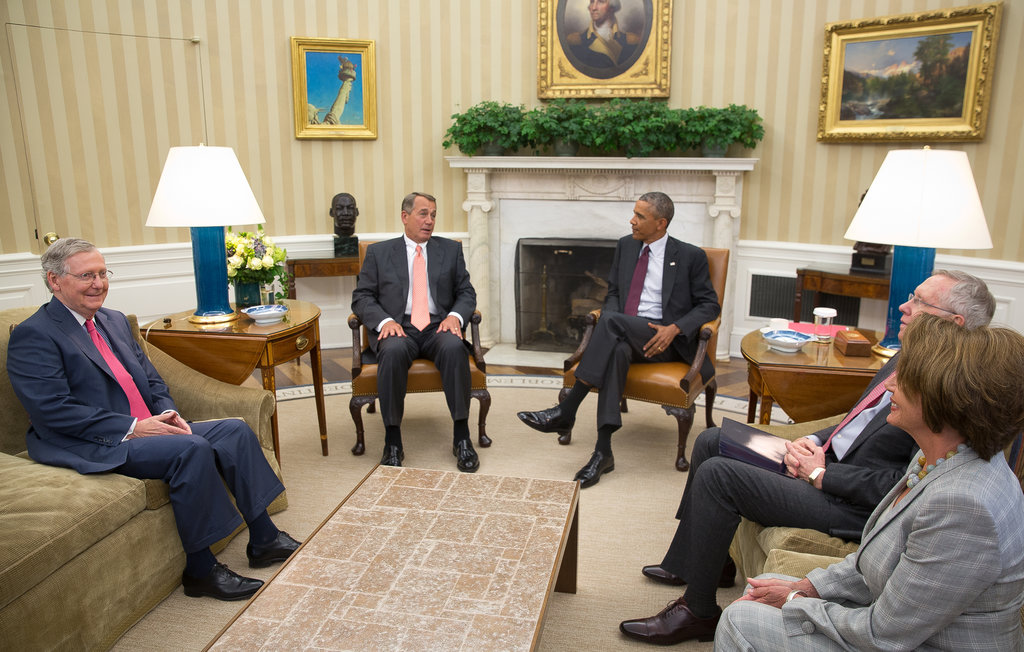
Obama “consults” with Congress before ordering more bombing. Note the irony of George Washington’s portrait, the man who warned us to avoid foreign entanglements (Source: NYT)
W.J. Astore
President Obama’s speech tonight on the Islamic State (or ISIS) promises more military action. More airstrikes, more boots on the ground (mainly Special Forces), more training for the Iraqi military (who have endured more than a decade’s worth of U.S. military training, with indifferent results), and more weapons sales (which often end up in the hands of ISIS, thereby necessitating more U.S. airstrikes to destroy them).
All of this is sadly predictable. Call it the TINA militarized strategy, as in “There is no alternative” (TINA) but to call in the military.
There are three reasons for the TINA strategy. One is domestic politics. Facing elections in November, the Obama Administration and the Democrats must appear to be strong. They must take military action, at least in their eyes, else risk being painted by Republicans as terrorist-appeasers.
The second reason is also obvious: The military option is the only one the U.S. is heavily invested in; the only option we’re prepared, mentally as well as physically, to embrace. The U.S. is militarized; we see the military as offering quick results; indeed, the military promises such results; we’re impatient people; so we embrace the military.
Never mind the talk of another long war, perhaps of three years or longer. When they bother to pay attention, what most Americans see on their TV and computer screens is quick results, like the video released by Central Command showing the U.S. military blowing up ISIS equipment (often, U.S. military equipment provided to Iraq but appropriated by ISIS). And unlike those ISIS “medieval” beheadings, decapitation by laser-guided bomb is both unoffensive and justified.
And if we’re blowing things up with our 21st-century decapitation bombs, we must be winning — or, at least we’re doing something to avenge ISIS barbarism. Better to do something than nothing. Right?
The third reason is more subtle and it comes down to our embrace of “dominance” as our de facto military strategy. Allow me to explain. After World War II, the U.S. military embraced “containment” as the approach to the Soviet Union. “Parity” was the buzzword, at least in the nuclear realm, and “deterrence” was the goal. With the collapse of the Soviet Union, the U.S. did not become “a normal country in normal times,” nor did we cash in our peace dividends. Instead, the U.S. military saw a chance for “global reach, global power,” global dominance in other words. And that’s precisely the word the U.S. military uses: dominance (expanded sometimes to full spectrum dominance, as in land, sea, air, space, cyberspace, and who knows what else).
You can explain a lot of what’s happened since 9/11 with that single word: dominance. The attacks of 9/11 put the lie to U.S. efforts to dominate global security, which drove the Bush/Cheney Administration to double down on the military option as the one and only way of showing the world who’s boss. Clear failures of the military option in Iraq, Afghanistan, and elsewhere did not encourage soul-searching; rather, it simply drove Obama and his generals to promise that “this time, we’ll do it (bombing and raids and interventions) better and smarter” than the previous administration.
There’s simply no learning curve when your overall goal is to exercise dominance each and every time you’re challenged. Ask John McCain.
So as you listen to the president’s speech tonight, keep those three elements in mind: domestic politics, our enormous investment (cultural as well as financial) in the military and our preference for quick results at any price, and finally our desire to exercise dominance across the globe. It may help you to parse the president’s words more effectively. Perhaps it will also explain why our leaders never seem to learn. It’s not because they’re stupid: it’s because their careers and commitments require them not to learn.
Bombs away.
Update: There’s another aspect of our dominance that is fascinating to consider. The US sees its dominance as benevolent or benign, never as bellicose or baneful. This is reflected brilliantly in the US Navy’s current motto, “A global force for good.” Not to deny that the Navy does good work, but I’m not sure we’d applaud if F-18s were dropping laser-guided bombs on our troops. The point is that as a society we have a willed blindness to how our “dominance” plays out in the rest of the world. We only seem to care when that “dominance” comes to Main Street USA, as it did recently in Ferguson, Mo. (The ongoing militarization of police forces, and their aggressiveness toward ordinary people, are surely signs of “dominance,” but who wants to argue this is benevolent or benign in intent?)
If another country sought global reach/global power through military dominance, that country would be instantly denounced by US leaders as inherently hostile and treated as a major threat to world peace.
Update 2 (9/12/14): Dan Froomkin at The Intercepthas a stimulating round-up of criticism about Obama’s latest plans for war (courtesy of Tom Engelhardt at TomDispatch.com). A summary:
Yesterday, Dan Froomkin of the Intercept offered a fairly devastating round-up of news reports from the mainstream (finally coming in, after much deferential and semi-hysterical reportage!) suggesting just what a fool’s errand the latest expansion of the U.S. intervention in Iraq/Syria could be. (And today’s NY Times has more of the same.) Here are just some selections from his post. Tom Engelhardt
“President Obama’s plan to “degrade and destroy” the Islamic State counts on pretty much everything going right in a region of the world where pretty much anything the U.S. does always goes wrong. Our newspapers of record today finally remembered it’s their job to point stuff like that out.
“The New York Times, in particular, calls bullshit this morning — albeit without breaking from the classic detached Timesian tonelessness. Mark Mazzetti, Eric Schmitt and Mark Landler (with contributions from Matt Apuzzo and James Risen) start by pointing out the essential but often overlooked fact that ‘American intelligence agencies have concluded that [the Islamic State] poses no immediate threat to the United States.’
“And then, with the cover of ‘some officials and terrorism experts,’ they share a devastating analysis of all the coverage that has come before: ‘Some officials and terrorism experts believe that the actual danger posed by ISIS has been distorted in hours of television punditry and alarmist statements by politicians, and that there has been little substantive public debate about the unintended consequences of expanding American military action in the Middle East….’
“In the Washington Post this morning, Rajiv Chandrasekaran focuses on all the implausible things that have to go right beyond ‘U.S. bombs and missiles hitting their intended targets’: ‘In Iraq, dissolved elements of the army will have to regroup and fight with conviction. Political leaders will have to reach compromises on the allocation of power and money in ways that have eluded them for years. Disenfranchised Sunni tribesmen will have to muster the will to join the government’s battle. European and Arab allies will have to hang together, Washington will have to tolerate the resurgence of Iranian-backed Shiite militias it once fought, and U.S. commanders will have to orchestrate an air war without ground-level guidance from American combat forces…’
“The McClatchy Newspapers Washington bureau , finally no longer alone in expressing skepticism about Obama’s plans, goes all Buzzfeed with a Hannah Allam story: ‘5 potential pitfalls in Obama’s plan to combat the Islamic State’. Allam notes that Yemen and Somalia are hardly examples of success; that the new Iraqi government is hardly “inclusive”; that training of Iraqi soldiers hasn’t worked in the past; that in Syria it’s unclear which “opposition” Obama intends to support; and that it may be too late to cut off the flow of fighters and funds.”
Update 3 (9/12/14): US Army Colonel (ret.) Andrew Bacevich has a sound critique of the bankruptcy of Obama’s strategy. Here’s an excerpt:
Destroying what Obama calls the Islamic State of Iraq and the Levant won’t create an effective and legitimate Iraqi state. It won’t restore the possibility of a democratic Egypt. It won’t dissuade Saudi Arabia from funding jihadists. It won’t pull Libya back from the brink of anarchy. It won’t end the Syrian civil war. It won’t bring peace and harmony to Somalia and Yemen. It won’t persuade the Taliban to lay down their arms in Afghanistan. It won’t end the perpetual crisis of Pakistan. It certainly won’t resolve the Israeli-Palestinian conflict.
All the military power in the world won’t solve those problems. Obama knows that. Yet he is allowing himself to be drawn back into the very war that he once correctly denounced as stupid and unnecessary — mostly because he and his advisers don’t know what else to do. Bombing has become his administration’s default option.
Rudderless and without a compass, the American ship of state continues to drift, guns blazing.
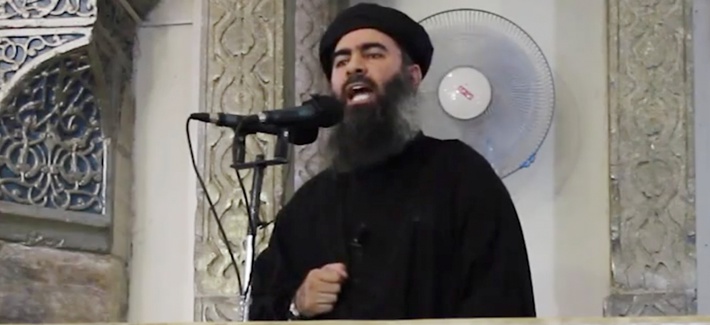
Is this the leader of a “scourge” and an “abomination” and a “witch’s brew”?
W.J. Astore
General John Allen wants to “destroy the Islamic State now.” So he says in an article for Defense One. Allen, a retired Marine Corps general who led troops in Iraq and Afghanistan, is currently a distinguished fellow at the Brookings Institution. But what is distinguishing him in this article is his crusader-speak, a remarkable blend of religious extremism and chauvinistic parochialism.
Let’s tackle the latter first. For Allen, the good people of Iraq are “poor” and “benighted.” But some of them can serve as our “boots on the ground” in the region, i.e. they can serve as bullet magnets while the U.S. provides air support with impunity. It’s up to the U.S. to “orchestrate” their attacks against the Islamic State. As long as they follow our conductor’s baton, all will end well, perhaps with a crescendo of U.S. bombs. (As an aside, he describes the Taliban in Afghanistan as “cavemen” when compared to the new enemy in Iraq. Some of those “cavemen” did fairly well against the former Soviet Union, did they not?)
My charge that the general’s language is that of “religious extremism” may itself appear extreme, but take a close look at his article. The general refers to the Islamic State as a “scourge” and an “abomination.” (I’ve read my Bible and recognize the religious resonances here.) They are “beyond the pale of humanity” and must be “eradicated” because they are engaged in “total war” aided by a “witch’s brew” of foreign recruits.
In sum, General Allen has demonized the enemy while at the same time diminishing potential allies (those “poor benighted” people in need of an American conductor). The answer is eradication, i.e. extermination of that enemy. Now!
Remind me again: Which side is engaged in religious war here?
As Richard Nixon used to say, let me make one thing perfectly clear: I’m not in any way defending the murderous extremism of the Islamic State. What I’m saying is that the best solution is not to return the favor (unless you’re truly seeking a crusade). I’m also suggesting that the general’s article is (unintentionally) indicative of a mindset that explains much about why American efforts in Iraq and Afghanistan have failed.





 Bracing Views