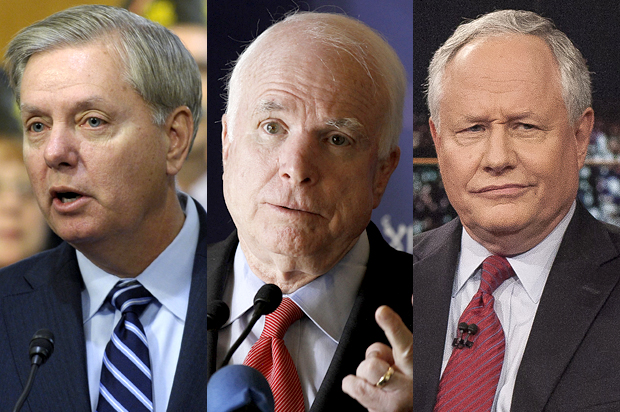
John McCain (middle) bookended by “warriors” Lindsey Graham (left) and Bill Kristol (right)
W.J. Astore
In his latest introduction at TomDispatch.com, Tom Engelhardt reveals a remarkable double standard — perhaps craziness is a better term — in the U.S. approach to terrorism in the wake of the Paris attacks. Prominent “conservative” leaders are calling for a major U.S. military invasion of territory controlled by ISIS, even though they know that ISIS has the “home field advantage.” They know, in short, that such an invasion will be both risky and costly, spreading chaos even further in the region, but they just can’t help themselves: they must “do something,” and the “something” in this case is sending other people’s sons and daughters into harm’s way.
But when it comes to incurring any risk, no matter how remote, to the American “homeland” from allowing refugees fleeing the chaos of the Middle East (chaos partly made by the USA and its previous military interventions, of course) to enter, these same conservative leaders cower. We can’t let “them” in. Too dangerous!
So, where the U.S. has an overwhelming “home field” advantage, these self-styled warriors retreat into paralyzing timidity. “Not in my backyard,” they say. But we sure as hell will send “our” troops into their backyards. See how brave we are in taking the fight to ISIS?
Here is Engelhardt’s introduction that so clearly highlights this tension:
In Washington, voices are rising fast and furiously. “Freedom fries” are a thing of the past and everyone agrees on the need to support France (and on more or less nothing else). Now, disagreements are sharpening over whether to only incrementally “intensify” the use of U.S. military power in Syria and Iraq or go to “war” big time and send in the troops. The editor of the right-wing Weekly Standard, Bill Kristol, is already calling for 50,000 American troops to take the Islamic State’s “capital,” Raqqa. Republican presidential candidate Senator Lindsey Graham, who has been urging that another 20,000 troops be dispatched to the region for months, offers this illuminating analogy to sports: “I’m looking for an away game when it comes to ISIL, not a home game. I want to fight them in their backyard.”
And don’t forget that increasingly angry sideline discussion about the Obama administration’s plan to let 10,000 Syrian refugees, carefully vetted for up to two years, trickle into the country. Alternatives proposed include setting up even harsher, more time-consuming vetting processes to insure that few of them can make it, allowing only certified, God-fearing Christian Syrians in while — give a rousing cheer for the “clash of civilizations” — leaving Muslims to rot in hell, or just blocking the whole damn lot of them.
I’m all for Bill Kristol and Lindsey Graham’s warrior fervor. I wish them every success as they deploy to Raqqa in their “away game” against ISIS.
Greg Grandin has a new book on Henry Kissinger and a new article at TomDispatch.com. Kissinger, writes Grandin, had an affinity (or perhaps an avidity) for power, especially air power, as a way of demonstrating his (and America’s) resolve.
Notes Grandin:
Henry Kissinger is, of course, not singularly responsible for the evolution of the U.S. national security state into a monstrosity. That state has had many administrators. But his example — especially his steadfast support for bombing as an instrument of “diplomacy” and his militarization of the Persian Gulf — has coursed through the decades, shedding a spectral light on the road that has brought us to a state of eternal war …
Kissinger was very hands-on. “Strike here in this area,” Sitton recalled Kissinger telling him, “or strike here in that area.” The bombing galvanized the national security adviser. The first raid occurred on March 18, 1969. “K really excited,” Bob Haldeman, Nixon’s chief of staff, wrote in his diary. “He came beaming in [to the Oval Office] with the report.”
In fact, he would supervise every aspect of the bombing. As journalist Seymour Hersh later wrote, “When the military men presented a proposed bombing list, Kissinger would redesign the missions, shifting a dozen planes, perhaps, from one area to another, and altering the timing of the bombing runs… [He] seemed to enjoy playing the bombardier.” (That joy wouldn’t be limited to Cambodia. According to Washington Post reporters Bob Woodward and Carl Bernstein, when the bombing of North Vietnam finally started up again, Kissinger “expressed enthusiasm at the size of the bomb craters.”) A Pentagon report released in 1973 stated that “Henry A. Kissinger approved each of the 3,875 Cambodia bombing raids in 1969 and 1970” — the most secretive phase of the bombing — “as well as the methods for keeping them out of the newspapers.”
All told, between 1969 and 1973, the U.S. dropped half-a-million tons of bombs on Cambodia alone, killing at least 100,000 civilians. And don’t forgetLaos and both North and South Vietnam. “It’s wave after wave of planes. You see, they can’t see the B-52 and they dropped a million pounds of bombs,” Kissinger told Nixon after the April 1972 bombing of North Vietnam’s port city of Haiphong, as he tried to reassure the president that the strategy was working: “I bet you we will have had more planes over there in one day than Johnson had in a month… Each plane can carry about 10 times the load [a] World War II plane could carry.”
As the months passed, however, the bombing did nothing to force Hanoi to the bargaining table. It did, on the other hand, help Kissinger in his interoffice rivalries. His sole source of power was Nixon, who was a bombing advocate. So Kissinger embraced his role as First Bombardier to show the tough-guy militarists the president had surrounded himself with that he was the “hawk of hawks.” And yet, in the end, even Nixon came to see that the bombing campaigns were a dead end. “K. We have had 10 years of total control of the air in Laos and V.Nam,” Nixon wrote him over a top-secret report on the efficacy of bombing, “The result = Zilch.” (This was in January 1972, three months before Kissinger assured Nixon that “wave after wave” of bombers would do the trick).
During those four-and a half years when the U.S. military dropped more than 6,000,000 tons of bombs on Southeast Asia, Kissinger revealed himself to be not a supreme political realist, but the planet’s supreme idealist. He refused to quit when it came to a policy meant to bring about a world he believed heought to live in, one where he could, by the force of the material power of the U.S. military, bend poor peasant countries like Cambodia, Laos, and North Vietnam to his will — as opposed to the one he did live in, where bomb as he might he couldn’t force Hanoi to submit. As he put it at the time, “I refuse to believe that a little fourth-rate power like North Vietnam does not have a breaking point.”
In fact, that bombing campaign did have one striking effect: it destabilized Cambodia, provoking a 1970 coup that, in turn, provoked a 1970 American invasion, which only broadened the social base of the insurgency growing in the countryside, leading to escalating U.S. bombing runs that spread to nearly the whole country, devastating it and creating the conditions for the rise to power of the genocidal Khmer Rouge…
Bombing for Kissinger was a way to show he was tough within an inner circle around Nixon that put a premium on toughness. It was also a way to minimize casualties to Americans while demonstrating a total disregard for casualties among the peoples of Southeast Asia.
Kissinger the bombardier was seduced by the seemingly god-like potential of air power — the ability to strike from on high, to smite evil-doers and those who would thwart Kissinger’s designs. Best of all, Kissinger never had to bloody his own hands. (Can you imagine Kissinger in a knife fight? Of course not. But you can imagine him gleefully gushing over bombing reports and bomb craters as bomber jets knifed through the sky.)
There’s a “Star Trek” episode in which Captain Kirk says, “Above all else, a god needs compassion.” Kissinger the “air power god” had no compassion. It was all about power. The little people who refused to kowtow to him — the Vietnamese, the Cambodians, the Chileans, and so on — these people were simply abstractions for Kissinger. Put differently, they were pawns on the geopolitical chessboard, to be sacrificed at will by self-styled grandmasters like Kissinger.
In his book “Secrets,” Daniel Ellsberg captured Kissinger’s blithe disregard for the lives of others in a probing question about Vietnamization. Was it moral, Ellsberg asked, to turn the war over to the South Vietnamese, knowing they were going to incur high casualties while fighting North Vietnam, even as American troops withdrew? Kissinger had no answer, one senses because the morality of his policies didn’t much matter to him. The goal was to save America’s “face” in Vietnam; for Kissinger the fates of the peoples of Southeast Asia paled in comparison to the importance of American prestige.
In his deliberately ponderous Germanic accent, Kissinger spoke softly as he wielded the big stick of American bombing. It didn’t work then, nor is it working today for those who still worship at the altar of Kissinger’s Realpolitik.
“The president announced last week that American troops will remain in Afghanistan beyond the planned withdrawal at the end of 2016. This is a devastating blow. We’ve already spent $716 billion and counting on the war in Afghanistan alone, plus countless lives lost and derailed.”
Of course, not the same American troops will “remain” in Afghanistan until 2017 (or 2024, or who knows what year). U.S. troops, intelligence operatives, privatized paramilitaries, and assorted imperial straphangers are constantly rotating in and out of war zones around the world, sometimes on yearly tours, often on much shorter ones. This reality got me to thinking about American imperialism as a peculiar form of global tourism. All those repetitive, fairly short-term, “tours” to foreign countries, followed by new American tour groups (fresh deployments of new combat units). The result is needless repetition, endless waste, and flat learning curves for Americans. For the locals who have to endure America’s “tours,” the results are often far worse — and unlike Americans they usually can’t get on a boat or helicopter or jet and leave.
I was stimulated to write this new article on America’s “tourists of empire,” which appears at TomDispatch.com today. You can read it in full here. I’ve included some excerpts below. I hope this article provides a contrary perspective on U.S. military efforts around the world.
Tourists of Empire: America’s Peculiar Brand of Global Imperialism
The United States is a peculiar sort of empire. As a start, Americans have been in what might be called imperial denial since the Spanish-American War of 1898, if not before. Empire — us? We denied its existence even while our soldiers were administering “water cures” (aka waterboarding) to recalcitrant Filipinos more than a century ago. Heck, we even told ourselves we were liberating those same Filipinos, which leads to a second point: the U.S. not only denies its imperial ambitions, but shrouds them in a curiously American brand of Christianized liberation theology. In it, American troops are never seen as conquerors or oppressors, always as liberators and freedom-bringers, or at least helpers and trainers. There’s just enough substance to this myth (World War II and the Marshall Plan, for example) to hide uglier imperial realities.
Denying that we’re an empire while cloaking its ugly side in missionary-speak are two enduring aspects of the American brand of imperialism, and there’s a third as well, even if it’s seldom noted. As the U.S. military garrisons the planet and its special operations forces alone visit more than 140 countries a year, American troops have effectively become the imperial equivalent of globetrotting tourists. Overloaded with technical gear and gadgets (deadly weapons, intrusive sensors), largely ignorant of foreign cultures, they arrive eager to help and spoiling for action, but never (individually) staying long…
Call it Imperial Tourist Syndrome, a bizarre American affliction that creates its own self-sustaining dynamic. To a local, it might look something like this: U.S. forces come to your country, shoot some stuff up (liberation!), take some selfies, and then, if you’re lucky, leave (at least for a while). If you’re unlucky, they overstay their “welcome,” surge around a bit and generate chaos until, sooner or later (in places like Iraq and Afghanistan, much, much later), they exit, not always gracefully (witness Saigon 1975 or Iraq 2011).
And here’s the weirdest thing about this distinctly American version of the imperial: a persistent short-time mentality seems only to feed its opposite, wars that persist without end. In those wars, many of the country’s heavily armed imperial tourists find themselves sent back again and again for one abbreviated tour of duty after another, until it seems less like an adventure and more like a jail sentence.
The paradox of short-timers prosecuting such long-term wars is irresolvable because, as has been repeatedly demonstrated in the twenty-first century, those wars can’t be won. Military experts criticize the Obama administration for lacking an overall strategy, whether in Syria, Iraq, Afghanistan, or elsewhere. They miss the point. Imperial tourists don’t have a strategy: they have an itinerary. If it’s Tuesday, this must be Yemen; if it’s Wednesday, Libya; if it’s Thursday, Iraq …
It was a dynamic already obvious five decades ago in Vietnam: a ticket-punching mentality that involved the constant rotation of units and commanders; a process of needless reinvention of the most basic knowledge as units deployed, bugged out, and were then replaced by new units; and the use of all kinds of grim, newfangled weapons and sensors, everything from Agent Orange and napalm to the electronic battlefield and the latest fighter planes and bombers — all for naught. Under such conditions, even the U.S. superpower lacked staying power, precisely because it never intended to stay. The “staying” aspect of the Vietnam War was often referred to in the U.S. as a “quagmire.” For the Vietnamese, of course, their country was no “big muddy” that sucked you down. It was home. They had little choice in the matter; they stayed — and fought.
Combine a military with a tourist-like itinerary and a mentality to match, a high command that in its own rotating responsibilities lacks all accountability for mistakes, and a byzantine, top-heavy bureaucracy, and you turn out to have a surefire recipe for defeat. And once again, in the twenty-first century, whether among the rank and file or at the very top, there’s little continuity or accountability involved in America’s military presence in foreign lands. Commanders are constantly rotated in and out of war zones. There’s often a new one every year. (I count 17 commanders for the International Security Assistance Force for Afghanistan, the U.S.-led military coalition, since December 2001.) U.S. troops may serve multiple overseas tours, yet they are rarely sent back to the same area. Tours are sequential, not cumulative, and so the learning curve exhibited is flat…
At some level, the U.S. military knows it’s screwed. That’s why its commanders tinker so much with weapons and training and technology and tactics. It’s the stuff they can control, the stuff that seems real in a way that foreign peoples aren’t (at least to us). Let’s face it: past as well as current events suggest that guns and how to use them are what Americans know best.
But foreign lands and peoples? We can’t control them. We don’t understand them. We can’t count on them. They’re just part of the landscape we’re eternally passing through — sometimes as people to help and places to rebuild, other times as people to kill and places to destroy. What they aren’t is truly real. They are the tourist attractions of American war making, sometimes exotic, sometimes deadly, but (for us) strangely lacking in substance.
I read the news today, oh boy. President Obama has decided to keep thousands of U.S. troops in Afghanistan until 2017, effectively kicking the war to the next president. According to the New York Times, “The Obama administration sees the choice to slow down the United States’ Afghan exit as the best of bad options.” Not to be cynical, but the decision to keep U.S. troops in Afghanistan until 2017 is obviously intended to prevent an Iraq-like collapse in 2016, a collapse that Republicans would seize upon in next year’s election cycle to portray democrats as weak and feckless. All politics is local, as Tip O’Neill said.
Afghanistan is known as the graveyard of empires, but the United States believes if we whistle loud enough past it, no harm will come to us. In other words, we refuse to learn anything from history, the theme of an article I wrote back in 2009 for TomDispatch on the lessons of Vietnam for Obama, recently anointed as presidential savior. Sections (2) and especially (4) below seem especially germane to today’s news of yet another extension to America’s troop commitment to Afghanistan.
Mary McCarthy in Vietnam, Barack Obama in Afghanistan
Seven Lessons and Many Questions for the President
By William Astore (written in 2009)
In 1967, outraged by the course of the Vietnam War, as well as her country’s role in prolonging and worsening it, Mary McCarthy, novelist, memoirist, and author of the bestseller The Group, went to Saigon, then the capital of South Vietnam, to judge the situation for herself. The next year, she went to the North Vietnamese capital, Hanoi. She wrote accounts of both journeys, published originally in pamphlet format as Vietnam (1967) and Hanoi (1968), and later gathered with her other writings on Vietnam as a book, The Seventeenth Degree (1974). As pamphlets, McCarthy’s accounts sold poorly and passed into obscurity; deservedly so, some would say.
Those who’d say this, however, would be wrong. McCarthy brought a novelist’s keen eye to America’s activities and its rhetoric in Vietnam. By no means a military expert, not even an expert on Vietnam — she only made a conscious decision to study the war in Vietnam after she returned from her trip to Saigon — her impressionistic writings were nevertheless insightful precisely because she had long been a critical thinker beholden to no authority.
Her insights into our approach to war-fighting and to foreign cultures are as telling today as they were 40 years ago, so much so that President Obama and his advisors might do well to add her unconventional lessons to their all-too-conventional thinking on our spreading war in Afghanistan and Pakistan.
What were those lessons? Here are seven of them, each followed by questions that, four decades later, someone at President Obama’s next press conference should consider asking him:
1. McCarthy’s most fundamental objection was to the way, in Vietnam, the U.S. government decided to apply “technology and a superior power to a political situation that will not yield to this.” At the very least, the United States was guilty of folly, but McCarthy went further. She condemned our technocentric and hegemonic form of warfare as “wicked” because of its “absolute indifference to the cost in human lives” to the Vietnamese people.
Even in 1967, the widespread, at times indiscriminate, nature of American killing was well known. For example, U.S. planes dropped roughly 7 million tons of bombs on Vietnam and parts of Laos and Cambodia during the war, nearly five times the tonnage used against Germany during World War II. The U.S. even waged war on the Vietnamese jungle and forest, which so effectively hid Vietnamese guerrilla forces, spraying roughly 20 million gallons of toxic herbicides (including the dioxin-contaminated Agent Orange) on it.
In her outrage, McCarthy dared to compare the seeming indifference of many of her fellow citizens toward the blunt-edged sword of technological destruction we had loosed on Vietnam to the moral obtuseness of ordinary Germans under Adolf Hitler.
Questions for President Obama: Aren’t we once again relying on the destructive power of technology to “solve” complex political and religious struggles? Aren’t we yet again showing indifference to the human costs of war, especially when borne by non-Americans? Even though we’re using far fewer bombs in the Af-Pak highlands than we did in Vietnam, aren’t we still morally culpable when these “precision-guided munitions” miss their targets and instead claim innocents, or hit suspected “terrorists” who suddenly morph into wedding parties? In those cases, do we not seek false comfort in the phrase, C’est la guerre, or at least that modern equivalent: unavoidable collateral damage?
2. As Richard Nixon campaigned for the presidency in 1968 by calling for “peace with honor” in Vietnam, McCarthy offered her own warning about the dangers that arose when the office of the presidency collided with an American desire never to be labeled a loser: “The American so-called free-enterprise system, highly competitive, investment-conscious, expansionist, repels a loser policy by instinctive defense movements centering in the ganglia of the presidency. No matter what direction the incumbent, as candidate, was pointing in, he slowly pivots once he assumes office.”
Questions for President Obama: Have you, like Vietnam-era presidents, pivoted toward yet another surge simply to avoid the label of “loser” in Afghanistan? And if the cost of victory (however defined) is hundreds, or even thousands, more American military casualties, hundreds of billions of additional dollars spent, and extensive collateral damage and blowback, will this “victory” not be a pyrrhic one, achieved at a price so dear as to be indistinguishable from defeat?
3. Though critical of the U.S. military in Vietnam, McCarthy was even more critical of American civilian officials there. “On the whole,” she wrote, they “behaved like a team of promoters with a dubious ‘growth’ stock they were brokering.” At least military men were often more forthright than the civilians, if not necessarily more self-aware, McCarthy noted, because they were part of the war — the product, so to speak — not its salesmen.
Questions for President Obama: In promising to send a new “surge” of State Department personnel and other civilians into Afghanistan, are you prepared as well to parse their words? Are you braced in case they sell you a false bill of goods, even if the sellers themselves, in their eagerness to speak fairy tales to power, continually ignore the Fantasyland nature of their tale?
4.Well before Bush administration officials boasted about creating their own reality and new “facts on the ground” in Iraq, Mary McCarthy recognized the danger of another type of “fact”: “The more troops and matériel committed to Vietnam, the more retreat appears to be cut off — not by an enemy, but by our own numbers. To call for withdrawal in the face of that commitment… is to seem to argue not against a policy, but against facts, which by their very nature are unanswerable.”
Questions for President Obama: If your surge in Afghanistan fails, will you be able to de-escalate as quickly as you escalated? Or will the fact that you’ve put more troops in harm’s way (with all their equipment and all the money that will go into new base and airfield and road construction), and committed more of your prestige to prevailing, make it even harder to consider leaving?
5.A cursory reading of The Pentagon Papers, the famously secret government documents on Vietnam leaked to the New York Times by Daniel Ellsberg, reveals how skeptical America’s top officials were, early on, in pursuing a military solution to the situation in South Vietnam. Nevertheless, knowing better, the “best and brightest,” as journalist David Halberstam termed them in his famous, ironic book title, still talked themselves into it; and they did so, as McCarthy noted, because they set seemingly meaningful goals (“metrics” or “benchmarks,” we’d say today), which they then convinced themselves they were actually achieving. When you trick yourself into believing that you’re meeting your goals, as Halberstam noted, there’s no reason to reexamine your course of action.
Questions for President Obama: Much has been written about an internal struggle within your administration over the wisdom of surging in Afghanistan. Now, you, too, have called for the setting of “benchmarks”for your new strategy’s success. Are you wise enough to set them to capture the complexities of political realities on the ground rather than playing to American strengths? Are you capable of re-examining them, even when your advisors assure you that they are being achieved?
6.In her day, Mary McCarthy recognized the inequities of burden-sharing at home when it came to the war in Vietnam: “Casualty figures, still low [in 1967], seldom strike home outside rural and low-income groups — the silent part of society. The absence of sacrifices [among the privileged classes] has had its effect on the opposition [to the war], which feels no need, on the whole, to turn away from its habitual standards and practices — what for? We have not withdrawn our sympathy from American power and from the way of life that is tied to it — a connection that is more evident to a low-grade G.I. in Vietnam than to most American intellectuals.”
Questions for President Obama: Are you willing to listen to the common G.I. as well as to the generals who have your ear? Are you willing to insist on greater equity in burden-sharing, since once again most of the burden of Iraq and Afghanistan has fallen on “the silent part of society”? Are you able to recognize that the “best and brightest” in the corridors of power may not be the wisest exactly because they have so little to lose (and perhaps much to gain) from our “overseas contingency operations”?
7.McCarthy was remarkably perceptive when it came to the seductiveness of American technological prowess. Our technological superiority, she wrote, was a large part of “our willingness to get into Vietnam and stay there… The technological gap between us and the North Vietnamese constituted, we thought, an advantage which obliged us not to quit.”
Questions for President Obama: Rather than providing us with a war-winning edge, might our robot drones, satellite imagery, and all our other gadgetry of war seduce us into believing that we can “prevail” at a reasonable and sustainable cost? Indeed, do we think we should prevail precisely because our high-tech military brags of “full spectrum dominance”?
One bonus lesson from Mary McCarthy before we take our leave of her: Even now, we speak too often of “Bush’s war” or, more recently, “Obama’s war.” Before we start chattering mindlessly about Iraq and Afghanistan as American tragedies, we would do well to recall what McCarthy had to say about the war in Vietnam: “There is something distasteful,” she wrote, “in the very notion of approaching [Vietnam] as an American tragedy, whose protagonist is a great suffering Texan [President Lyndon Baines Johnson].”
Yes, there is something distasteful about a media that blithely refers to Bush’s or Obama’s war as hundreds of thousands of Iraqis and Afghans suffer. For American troops, after all, are not the only ones paying the ultimate price when the U.S. fights foreign wars for ill-considered reasons and misguided goals.
A Barechested Putin Riding Bareback on a Bear: The Ideal Republican Candidate for President!
W.J. Astore
At the New York Times, Robert Draper had a fascinating article last month on how Republican candidates for president are positioning themselves on foreign policy. Rand Paul excepted, all of the Republican candidates are calling for a more “aggressive” U.S. foreign policy, one that promises more military interventions and higher military spending. The goal is apparently to show more muscle than President Obama, who has been “weak,” according to these same Republicans.
The language here fascinates me. Again and again in Draper’s article, you see references to “a more muscular foreign policy.” Showcasing muscles appears to be a favorite trope of Republican advisers, as is the need to be more “aggressive” overseas (Obama, of course, is viewed as being passive and timid). Republicans according to Draper favor the “aggressive promotion of American values” (whatever those are), an aggression that will somehow avoid recklessness (good luck with that). So, ISIS will be aggressively “destroyed,” even as the Middle East is stabilized by infusing it with “American values” (freedom? democracy? human rights?) promulgated by (as near as I can tell) American military muscle.
To cite just one example, consider this political ad featuring Senator Lindsey Graham, seen in his Air Force reserve uniform, highlighting his promise to “destroy” ISIS.
A muscular and aggressive foreign policy to destroy America’s enemies: If that excites you, vote Republican. But consider the cost of this love affair with muscles and aggression. And then ask yourself: Are they not the real “American values”?
All this talk of bulging military muscles and coldly calculated aggression: the ideal candidate for gung ho Republicans is not the reincarnation of Ronald Reagan. It’s an American Vladimir Putin.
As David Vine reports for TomDispatch.com, the U.S. has roughly 800 military bases in foreign countries. Maintaining these bases costs upwards of $100 billion each year, more than the federal government spends on U.S. education.
The sheer extent and cost of these bases got me to thinking. Each base is basically a “little America,” with a few of those bases being large enough to constitute an American city. If we can envision them collectively, would they not constitute America’s 51st state? But instead of adding one more star to the American flag, we’d have to add a white Pentagon to the field of blue to represent the controlling interest of “base world,” our 51st state.
Fifty stars and one Pentagon: Or, if you prefer, 51 stars arranged in the shape of a Pentagon.
Sound crazy? Not when you consider “base world’s” population, its corporate interests, its influence on American politics, and its leading role in American foreign policy. “Base world” is at least as significant to U.S. interests as real states like Wyoming. We really should have two U.S. senators elected from “base world.” Then again, they’re not really needed, since all 100 of our current U.S. senators represent the Pentagon (as long as the Pentagon keeps funneling money to their respective states, of course).
We have all these foreign bases because America needs them to protect our far-flung national interests against evil-doers. Right? Let’s think about these bases for a moment, the influence they wield, and the image they present of America. After all, for many foreigners, the USA = base world. What they know of America is represented by our military facilities and our troops. Most of our troops are decent individuals; believe me, I’ve known a lot of them. But there’s a reason why the Third Amendment to the U.S. Constitution forbids the quartering of troops in American households.
Ever been around a major military base in the USA? Often it’s easy to find them. Look for pawn shops, strip clubs, tattoo parlors, payday loan shops, and predatory car dealers. And if you think such “attractions” are a little sordid, perhaps you best not go overseas. This may surprise a few people, but young troops overseas are not always chaste and sage ambassadors of democracy. America’s “base world” is often not pretty, as young troops look for cheap suits and cheaper women, among other “bennies” (benefits) of an overseas deployment.
Statement of the obvious: Young troops of any nationality misbehave, especially when abroad. And that’s how many foreigners come to know America: through the misbehavior of our young troops from “base world.”
And here’s another point about “base world” that’s as obvious as it’s rarely made: How many Americans would like it if foreign troops had major military facilities near or within our cities? Perhaps some Russians or Saudis or Iranians in LA and Chicago and NYC. Because those “allies” would be “protecting” us with their bases on American soil. Right? Let’s add some foreign fighter jets into the mix, and perhaps some aerial drones as well. Surely we can trust our allies and their jets armed with bombs above our heads — right?
Incredibly expensive, often counterproductive, and sometimes disruptive, America’s “base world” needs to be downsized dramatically. If you truly want to shrink government, don’t start with your local post office. Start with America’s mega military bases overseas.
Francis Bacon is famous for the aphorism, “Knowledge is power.” Yet the reverse aphorism is not true. The United States is the most powerful nation in the world, yet its knowledge base is notably weak in spite of all that power. Of course, many factors contribute to this weakness. Our public educational systems are underfunded and driven by meaningless standardized test results. Our politicians pander to the lowest common denominator. Our mainstream media is corporate-owned and in the business of providing info-tainment when they’re not stoking fear. Our elites are in the business of keeping the American people divided, distracted, and downtrodden, conditions that do not favor critical thinking, which is precisely the point of their efforts.
All that is true. But even when the U.S. actively seeks knowledge, we get little in return for our investment. U.S. intelligence agencies (the CIA, NSA, DIA, and so on) aggregate an enormous amount of data, then try to convert this to knowledge, which is then used to inform action. But these agencies end up drowning in minutiae. Worse, competing agencies within a tangled bureaucracy (that truly deserves the label of “Byzantine”) end up spinning the data for their own benefit. The result is not “knowledge” but disinformation and self-serving propaganda.
When our various intelligence agencies are not drowning in minutiae or choking on their own “spin,” they’re getting lost in the process of converting data to knowledge. Indeed, so much attention is put on process, with so many agencies being involved in that process, that the end product – accurate and actionable knowledge – gets lost. Yet, as long as the system keeps running, few involved seem to mind, even when the result is marginal — or disastrous.
Consider the Vietnam War. Massive amounts of “intelligence” data took the place of knowledge. Data like enemy body counts, truck counts, aircraft sorties, bomb tonnages, acres defoliated, number of villages pacified, and on and on. Amassing this data took an enormous amount of time; attempting to interpret this data took more time; and reaching conclusions from the (often inaccurate and mostly irrelevant) data became an exercise in false optimism and self-delusion. Somehow, all that data suggested to US officialdom that they were winning the war, a war in which US troops were allegedly making measurable and sustained progress. But events proved such “knowledge” to be false.
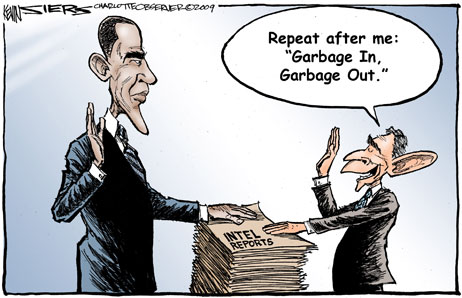
Of course, there’s an acronym for this: GIGO, or garbage (data) in, garbage (knowledge) out.
In this case, real knowledge was represented by the wisdom of Marine Corps General (and Medal of Honor recipient) David M. Shoup, who said in 1966 that:
I don’t think the whole of Southeast Asia, as related to the present and future safety and freedom of the people of this country, is worth the life or limb of a single American [and] I believe that if we had and would keep our dirty bloody dollar-crooked fingers out of the business of these nations so full of depressed, exploited people, they will arrive at a solution of their own design and want, that they fight and work for. And if, unfortunately, their revolution must be of the violent type…at least what they get will be their own and not the American style, which they don’t want…crammed down their throat.
But few wanted to hear Shoup and his brand of hard-won knowledge, even if he’d been handpicked by President Kennedy to serve as the Commandant of the Marine Corps exactly because Shoup had a reputation for sound and independent thinking.
Consider as well our rebuilding efforts in Iraq after 2003. As documented by Peter Van Buren in his book “We Meant Well,” those efforts were often inept and counterproductive. Yet the bureaucracy engaged in those efforts was determined to spin them as successes. They may even have come to believe their own spin. When Van Buren had the clarity and audacity to say, We’re fooling no one with our Kabuki dance in Iraq except the American people we’re sworn to serve, he was dismissed and punished by the State Department.
Why? Because you’re not supposed to share knowledge, real knowledge, with the American people. Instead, you’re supposed to baffle them with BS. But Van Buren was having none of that. His tell-all book (you can read an excerpt here) captured the Potemkin village-like atmosphere of US rebuilding efforts in Iraq. His accurate knowledge had real power, and for sharing it with the American people he was slapped down.
Tell the truth – share real knowledge with the American people – and you get punished. Massage the data to create false “knowledge,” in these cases narratives of success, and you get a pat on the back and a promotion. Small wonder that so many recent wars have gone so poorly for America.
What the United States desperately needs is insight. Honesty. A level of knowledge that reflects mastery. But what we’re getting is manufactured information, or disinformation, or BS. Lies, in plainspeak, like the lie that Iraq had in 2002 a large and active program in developing WMD that could be used against the United States. (Remember how we were told we had to invade Iraq quickly before the “smoking gun” became a “mushroom cloud”?)
If knowledge is power, what is false knowledge? False knowledge is a form of power as well, but a twisted one. For when you mistake the facade you’re constructing as the real deal, when you manufacture your own myths and then forget they’re myths as you consume them, you may find yourself hopelessly confused, even as the very myths you created consume you.
So, a corollary to Francis Bacon: Knowledge is power, but as the United States has discovered in Vietnam, Iraq, and elsewhere, power is no substitute for knowledge.
Put them on? Take them off? The dilemma of US foreign policy “experts”
W.J. Astore
You read it here first: the fatal flaw in U.S. foreign policy is training wheels. Yes, those supplemental wheels you add to your child’s bike when she’s first trying to learn how to balance herself as she pedals.
How so? Listen closely to America’s leaders as they talk about helping Iraqis, Afghans, and other peoples. A common expression they use is training wheels, which they visualize themselves as affixing to or removing from the Iraqi or Afghan governmental bike. Because the idea of democracy is apparently so new and novel to foreign peoples, and because these foreigners basically act like so many children when it comes to governing themselves equitably, the U.S. must treat them like so many unskilled and tippy children on bikes. We must affix training wheels to their bikes of state, and at the proper moment – a moment that only American adults can determine – those training wheels must then be removed.
Sounds simple – or is it?
Some examples suggest it’s not so simple. In January 2004, President George W. Bush told his fellow Republicans that Iraqis were ready to “take the training wheels off” and assume some responsibility for their own self-government. Yet a decade later in June 2014, retired General Michael Hayden, formerly head of the NSA and CIA, claimed that America “took the training wheels off the new Iraqi government far too early,” and by “too early” Hayden meant 2011, not seven years earlier in 2004.
Another American “adult” in the room, retired General Anthony Zinni, formerly commander of US Central Command, disagreed with Hayden, saying in December 2014 that those training wheels were still very much on in Iraq as well as Afghanistan, and that it was now high time for us to take them off. That may have surprised Vice President Joe Biden, who said back in November 2010 that it was time for Afghans to remove their governmental training wheels, and if they didn’t, “Daddy” would do it for them.
In fact, those were Biden’s exact words on Larry King Live: “Daddy is going to start to take the training wheels off … next July [2011], so you [Afghan leaders had] better practice riding.” That admonition from their American “Daddy” in 2010 has failed over the last half-decade to inspire Afghan leaders to pedal smartly for American-style democracy.
And there’s the rub. You don’t win foreign peoples to your side by treating them like so many unskilled and tippy children. You don’t condescend to them by comparing their efforts to children trying to learn to ride a bike for the first time. And you certainly don’t shake a finger at them that “Daddy” has lost patience and is going to remove the training wheels, whether they’re ready or not.
So, how do Americans respond when their Iraqi or Afghan “children” get angry at “Daddy” for messing with their training wheels? Whether oblivious or indifferent to their own condescension, Americans respond by treating their foreign “children” as ingrates. “Ingratitude, the vilest weed that grows,” to cite Eugene O’Neill’s play, Long Day’s Journey Into Night, generates anger – and violence.
Dammit, why can’t these foreign “kids” learn to ride their democratic bikes? Time to cut their allowance (in this case, American aid). Or perhaps it’s even time for a good ass whooping with Daddy’s belt (in this case, drones firing Hellfire missiles).
Those foreign ingrates! We gave them everything — lots of money, lots of aid, American troops and advisers, even “training wheels” for their bikes of democracy — and they still despise us. Why?
I’ll tell you why. They don’t hate us for our freedoms, as former President George W. Bush once claimed. But they may very well despise us for our training wheels – and for all the smugness and paternalism and condescension they represent.
Much is being made of Hillary Clinton’s private email server, which she used when she was Secretary of State. To me, the real issue is not that Hillary endangered national security by sending classified information in the clear. No — the real issue is that the Clintons act as if they are above the rules and laws that apply to “the little people.” They are superior and smug, totally devoted to themselves and their pursuit of power and the privileges that come with it. It’s a matter of character, in other words. Hillary’s evasiveness, her lack of transparency, her self-righteousness, her strong sense of her own rectitude, make her a dangerous candidate for the presidency.
My second point is this: The issue of classification should be turned on its head. The real issue is not that Hillary potentially revealed secrets. No — the real issue is that our government keeps far too much from us. Our government uses security classification not so much to keep us safe, but to keep the national security state safe — safe from the eyes of the American people.
“A committee established by Congress, the Public Interest Declassification Board, warned in December that rampant over-classification is ‘imped[ing] informed government decisions and an informed public’ and, worse, ‘enabl[ing] corruption and malfeasance’. In one instance it documented, a government agency was found to be classifying one petabyte of new data every 18 months, the equivalent of 20m filing cabinets filled with text.”
Nowadays, seemingly everything is classified. And if it’s classified, if it’s secret, we can’t know about it. Because we can’t be trusted with it. That’s a fine idea for an autocracy or dictatorship, but not so fine for a democracy.
Government of the people, by the people, for the people? Impossible when nearly everything of any importance is classified.
Too bad Hillary didn’t send everything in the clear — what a service she would have done for the American people and for democracy!
Heck ya! Send some B-52s to Israel (U.S. Air Force photo)
W.J. Astore
Any optimism that the Iran nuclear deal might slow the momentum of weapons sales to the Middle East has already been strangled in the cradle. Consider the following news item, courtesy of FP: Foreign Policy:
While U.S. Defense Department officials make promises to partner with Middle East allies nervous about the Iranian missile threat in their backyard, U.S. defense contractors are rushing in to ink multiple billion dollar deals to fill the gap. On Wednesday, the State Department announced a pending $5.4 billion deal with Saudi Arabia for a 600 new PAC-3 Patriot missile interceptors, which will bring the Saudi missiles up to date with the latest version of the Patriot.
The massive deal follows an April agreement with Riyadh for $2 billion worth of Patriots, and another $1.5 billion sale, announced this month, for Patriot interceptors in Qatar, United Arab Emirates, Taiwan, South Korea, and Saudi Arabia. Defense contractors Lockheed Martin and Raytheon will produce the missiles.
That’s $9 billion in Patriot surface-to-air missile (SAM) sales, a coup indeed for Lockheed Martin and Raytheon.
At least the Patriot SAM is largely defensive in nature. One former Obama official has gone a quantum leap further in advocating that the U.S. supply B-52 bombers to Israel armed with special bunker-busting bombs. Here’s the gist of the story, courtesy of Defense News:
A former top adviser to US President Barack Obama is calling on Washington to provide bunker-busting B-52 bombers to Israel as a means of bolstering Israeli deterrence and the credibility of its so-called military option should Iran opt out of commitments codified in Tuesday’s deal with world powers.
“To have a credible military option, it’s not enough to say all options are on the table. We have to be much more blunt,” said Ambassador Dennis Ross, a longtime diplomat and former special adviser to Obama on Iran.
In an interview Thursday, Ross said he favors the transfer of an unspecified quantity of B-52 Stratofortress bombers outfitted to deliver 30,000-pound GBU-57 Massive Ordnance Penetrators as one of the means of shoring up deterrence vis a vis Iran.
Sure: Just what the Israelis need: a huge long-range strategic bomber, originally built in the 1950s to deter, and if necessary to attack, the Soviet Union with nuclear weapons. Perhaps an Israeli Major Kong can ride one of those bunker-busters right into the heartland of Iran.








 Bracing Views