Just spray the bad bugs with DDT. What can go wrong?
W.J. Astore
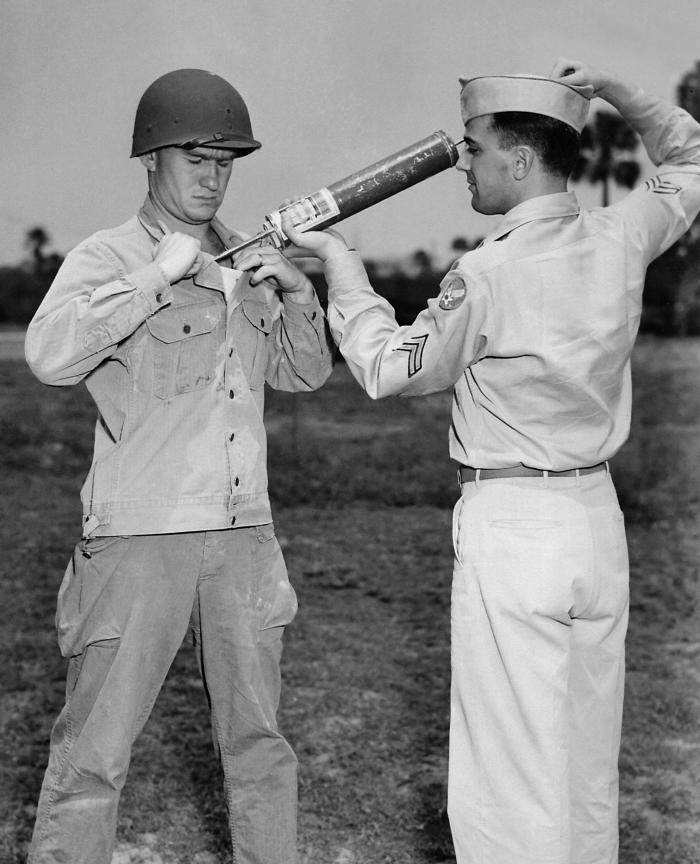
Today, the essence of U.S. military “strategy” is targeting. The enemy is treated as vermin to be exterminated with the right bug bomb. As if those bombs had no negative consequences; as if we learned nothing from the overuse of DDT, for example.
You might recall DDT, the miracle insecticide of the 1950s and 1960s. It wiped out bad bugs (and a lot of good ones as well) while leading to DDT-resistant ones. It also damaged the entire ecology of regions (because DDT is both persistent and bio-accumulative). Something similar is happening in the Greater Middle East. The U.S. is killing bad “bugs” (terrorists) while helping to breed a new generation of smarter “bugs.” Meanwhile, constant violence, repetitive bombing, and other forms of persistent meddling are accumulating in their effects, damaging the entire ecology of the Greater Middle East.
The U.S. government insists the solution is all about putting bombs on target, together with Special Forces operating as bug zappers on the ground. At the same time, the U.S. sells billions of dollars in weaponry to our “friends” and allies in the region. Israel just got $38 billion in military aid over ten years, and Saudi Arabia has yet another major arms deal pending, this time for $1.15 billion (with Senator Rand Paul providing that rare case of principled opposition based on human rights violations by the Saudis).
Of course, the U.S. has provided lots of guns and military equipment to Iraqi and Afghan security forces, which often sell or abandon them to enemies such as ISIS and the Taliban. The special inspector general in Afghanistan reported in 2014 that “As many as 43% of all small arms supplied to the Afghan National Security Forces remain unaccounted for – meaning more than 200,000 guns, including M2s, M16s, and M48s, are nowhere to be found.” A recent tally this year that includes Iraq suggests that 750,000 guns can’t be accounted for, according to Action on Armed Violence (AOAV), a London-based charity. The Pentagon’s typical solution to missing guns is simply to send more of them. Thus the U.S. is effectively arming its enemies as well as its allies, a business model that’s a win-win if you’re an arms merchant.
The essence of U.S. strategy makes me think of a Warren Zevon song lyric, “Send lawyers, guns, and money.” As we’ve seen, U.S. lawyers can authorize anything, even torture, even as U.S. guns and money go missing and end up feeding war and corruption. The tag line of Zevon’s song is especially pertinent: “The shit has hit the fan.” How can you flood the Greater Middle East with U.S.-style bureaucracy, guns and money, and not expect turmoil and disaster?
Back in World War II, the USA was an arsenal of democracy. Now it’s just an arsenal. Consider Bill Hartung’s article on U.S. military weaponry that’s flooding the Middle East. The business of America is war, with presidential candidates like Donald Trump just wanting to dump more money into the Pentagon.
There is no end to this madness. Not when the U.S. economy is so dependent on weapons and war. Not when the U.S. national security state dominates the political scene. Not when Americans are told the only choices for president are Trump the Loose Cannon or Hillary the Loaded Gun.
Last night’s “commander-in-chief” security forum that featured Hillary Clinton and Donald Trump was, not surprisingly, disappointing. (You can read the transcript here.) Trump recently stated he was in favor of large increases in defense spending, but he wasn’t asked about this. He wasn’t asked about his support of torture, nor was he challenged on his remarkably dangerous statement back in March that military officers would obey his presidential decrees, even when they were unlawful. Hillary was challenged on her email fiasco at the State Department, and rightly so, but she pretty much got a free pass on her support of the calamitous Iraq war and the chaos following the Libyan intervention. And of course neither candidate was challenged on their blanket support of Israel.
What you got was two self-absorbed candidates, one wonkish, the other one clearly a wanker, both of them posing as warriors as long as someone else’s kids are doing the fighting. Here’s a question for Trump and Hillary: the next time you deploy troops to Iraq or Syria or Afghanistan or wherever, will you include Ivanka or Chelsea, respectively, and put them in harm’s way?
Most interesting to me was Trump’s old-fashioned imperialism, which explains much of his appeal to the rabid right. Here’s what Trump had to say about how the Iraq war should have turned out for the USA:
“We [the USA] go in [to Iraq in 2003], we spend $3 trillion, we lose thousands and thousands of lives, and then, Matt, what happens is, we get nothing. You know, it used to be to the victor belong the spoils. Now, there was no victor there, believe me. There was no victor. But I always said: Take the oil.”
You have to hand it to The Donald: at least he’s occasionally honest. The Iraq war was about oil, among other things, and Trump says the USA as the “victor” should have taken it. Why? Because might makes right. Because, as Thucydides said so many centuries ago, the strong do what they will and the weak suffer as they must.
Remember when George W. Bush said Iraq’s oil was the “patrimony” of the Iraqi people and that the USA wasn’t about to take it? That the Iraq war was about freedom and democracy in the Middle East, not a naked grab for resources? Trump is having none of that. Any wonder that he’s so popular among Americans who are tired, as they see it, of losing?
“Take the oil!” It’s a statement that could easily appear on the next iteration of Trump’s baseball cap.
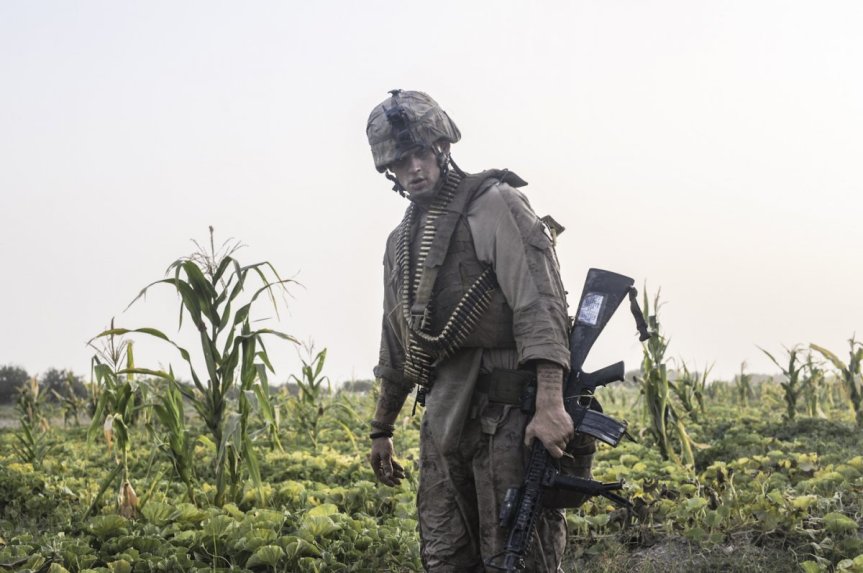
Why can’t we bring them home? (U.S. Marine in Afghanistan; photo by Peter van Agtmael/Magnum)
W.J. Astore
Carl von Clausewitz, the Prussian military theorist who wrote at the end of the Napoleonic Era, is noted for saying that war is a continuation of politics. That saying explains much of current U.S. military war-making, but only if you first and foremost focus on domestic politics – and economics.
Wars make money for weapons makers, and the U.S. dominates the world’s arms trade. Wars require a large “defense” establishment, and the U.S. national security state has essentially become a fourth branch of government that threatens to eat the rest. Wars tend to strengthen reactionary elements within society, shunting to the fringes those who argue for peace amid a climate of fear. Wars, in short, have their purposes – it’s just that the salient ones often differ from the stated ones. For clarity, it often helps to follow the money. Who profits from war? Addressing that question will explain many of the reasons why America’s wars have no promise of ending.
In the meantime, current U.S. war-making looks something like this:
In places like Iraq and Afghanistan, the pursuit of “stability” (whatever that means) mainly through the arming and training of indigenous security forces. Using Afghans and Iraqis as foot soldiers, as well as a heavy reliance on private military contractors (mercenaries), reduces the U.S. military “footprint” on the ground, which reduces U.S. casualties and thus domestic interest in as well as opposition to these wars. Typical U.S. governmental actions include military training, selling weapons, and providing air support (mainly in the form of bombing and reconnaissance).
Waging these wars, at the end of long logistical lines, is profligate in dollars — witness the high cost of indigenous forces in Iraq and Afghanistan, which rarely perform anywhere close to U.S. expectations — which has the added benefit of justifying enormous “defense” budgets in the U.S.
What these wars don’t promise is either “victory” or closure. But that’s not the main point of them. U.S. politicians like George W. Bush and Barack Obama are not concerned with victory: they’re focused on sustaining illusions of progress for domestic political gain. For example, the recent recapture of Falluja from ISIS is defined by the U.S. government as “progress,” even though that city had already been “pacified,” i.e. largely destroyed at high cost to U.S. forces, more than a decade ago.
In the war on terror, the heavy use of special operations forces and drones, both to kill terrorists and to interdict their supplies, logistics, and sources of their funding. Again, the emphasis is on minimizing U.S. casualties, which is the key consideration in U.S. domestic politics. American lives are not risked in drone attacks, and relatively few Americans have been killed in special ops raids, which, because they are often so highly classified, rarely register in the U.S. media unless Americans are indeed killed.
Here again, it’s unclear if any real progress is being made in this war, but the Obama administration in particular has sold such raids and strikes as killing thousands of terrorists while minimizing U.S. casualties. Such claims serve to squelch, if only temporarily, Republican claims that Obama is weak and soft on defense. Domestic political concerns, rather than long lasting effectiveness, once again rule.
Confrontation with “peer” rivals like Russia and China. This is old-school stuff, a variant of Cold War containment and deterrence. “Pivots” to the Pacific and the rhetorical pillorying of Vladimir Putin help to justify massive U.S. military spending that approaches $750 billion each and every year. The war on lightly armed terrorists isn’t enough to sustain this figure, but reports that China’s getting an aircraft carrier or Russia’s working on nuclear weapons justify new U.S. carriers and a trillion-dollar splurge on U.S. nuclear arsenals.
Here again, U.S. war-making is driven far more by domestic politics (and economics) than by needs-driven analysis of national defense. Exaggerating peer threats like China and Russia keeps a sclerotic Pentagon, a supine Congress, and a bloated military-industrial complex happy.
At this point, an astute reader might ask: But what is the real Clausewitzian strategy for war-making in the United States? How is war a continuation of politics? Again, one must look to U.S. domestic politics to address this question. “Toughness” must be demonstrated, therefore wars must be continued, no matter how costly and unpromising, if only to keep up appearances. President Obama, for example, has refused to make key decisions about the Afghan war, leaving it to the next president to decide whether the U.S. commitment of troops continues after 2017. There’s an outstanding chance that the next U.S. president will continue that war, placing it on the backburner to simmer until the next election cycle in 2020.
In sum, the new American way of war-making consists of methods rather than strategies, methods that produce endless war that serve mostly domestic political and economic purposes. A telltale sign that things are going really poorly is when the U.S. military declares another “surge” of its ground forces, which whether in Iraq in 2007 or Afghanistan in 2009-10 seemed calculated not to produce victory or closure but again to squelch domestic political opposition from hawkish rivals. That in itself is considered a “win” for whichever administration is in power.
What is never considered in U.S. war-making is ending the wars. Domestically, attempts at limiting U.S. war-making are instantly tarred with the brush of “cutting and running,” of weakness, even of cowardice. Rare is the U.S. president who dares to stand up to those clamoring for war.
Attempts to downsize the global presence of the U.S. military are similarly equated with weakness. As a result, no U.S. president (or major party candidate for president, like Clinton or Trump) dares to suggest it. Refusing to walk away, fearing loss of face but especially fearing domestic political defeat, presidents as diverse as Lyndon Johnson and Richard Nixon in the 1960s and lately Bush and Obama have embraced the folly of waging unwinnable wars. It’s likely little will change in 2017, irrespective of which major party wins the election.
Both presidential nominees of the major parties, Hillary Clinton and Donald Trump, have promised to make the U.S. military bigger and better. But for what purpose? A bigger, badder military is the purpose, and again it’s driven by domestic political and economic imperatives. You have to go outside the major parties, to the Libertarians or the Greens, to hear any talk of significant military reductions. Libertarians have talked of military reductions of 20%, the Greens of deeper cuts of up to 50%. In today’s militarized America, those parties aren’t going anywhere.
War-making as a continuation of domestic politics for political and economic profit – it sure explains a lot about the actions of the U.S. government and military. It may not be what Carl von Clausewitz had in mind, but it surely is America’s reality.
Recently, a good friend gave me a copy of Daniel Anselme’s “On Leave,” a book published in 1957 in the early stages of France’s war in Algeria, which ultimately ended in France’s defeat and Algerian independence in 1962. A novel, it follows three French soldiers on furlough in and around Paris and their desperate (and mostly failed) efforts to reconnect to home prior to returning to a brutal war.
The main themes are disaffection and disorientation. The gulf in understanding between the soldier-conscripts and their families and the wider public is simply too wide to be bridged. Instead, the soldiers find comfort in drink, women, and especially in each other. Having relied on each other in war, they come to rely on each other again in the short downtime they have from its brutalities.
What struck me forcibly was the indifference of France to the soldiers. We see a similar indifference today in the U.S., despite all of the “support our troops” rhetoric. This “support” often is, as the saying goes, a mile wide but only an inch deep. Another similarity between then and now is the gulf in understanding between what the soldiers know about war and what the people think they know. The soldiers know the horrors; the people only know a few talking points. Back then it was about upholding the honor of France; nowadays in the USA it’s about fighting them (the terrorists) over there so we don’t have to fight them here.
For the troops, it’s always the same cause: preservation. Survival. Saving oneself and one’s buddies.
One soldier gives an electric speech about “when will it end.” How many men is France willing to lose in its attempt to hold onto some smidgen of colonial glory? How long will the wars in Africa go on? His speech made me think of our own, seemingly endless, wars.
All three men in this story — a sergeant, a corporal, and a private — are unwounded physically from war. Yet all three are psychological casualties. War and atrocity has already inflicted a serious toll, as all three suffer some of the less obvious costs of war and extended military service (broken marriages, family arguments and estrangement and resentment, guilt at not being able to conform to family expectations, a growing sense of fatalism).
Recognizing a lost cause, French President Charles de Gaulle eventually smartened up and pulled out of Algeria. But the U.S. today doesn’t have leaders of de Gaulle’s grit and smarts to recognize a losing hand. So America’s wars just grind on and on.
“On Leave” is a fine book. Would that it were on President Obama’s summer reading list, or on Hillary’s or Trump’s. They could all use a heavy dose of reality about war’s futility.
So many flags, but where’s the fresh thinking? (AP Photo/John Locher)
W.J. Astore
Andrew Bacevich has written a whip-smart article at TomDispatch.com on this November’s choice for the presidency. Here are a few excerpts:
Trump is a bozo of such monumental proportions as to tax the abilities of our most talented satirists. Were he alive today, Mark Twain at his most scathing would be hard-pressed to do justice to The Donald’s blowhard pomposity.
Similarly, how did the party of Adlai Stevenson, but also of Stevenson’s hero Franklin Roosevelt, select as its candidate someone so widely disliked and mistrusted even by many of her fellow Democrats? True, antipathy directed toward Hillary Clinton draws some of its energy from incorrigible sexists along with the “vast right wing conspiracy” whose members thoroughly loathe both Clintons. Yet the antipathy is not without basis in fact.
Even by Washington standards, Secretary Clinton exudes a striking sense of entitlement combined with a nearly complete absence of accountability. She shrugs off her misguided vote in support of invading Iraq back in 2003, while serving as senator from New York. She neither explains nor apologizes for pressing to depose Libya’s Muammar Gaddafi in 2011, her most notable “accomplishment” as secretary of state. “We came, we saw, he died,” she bragged back then, somewhat prematurely given that Libya has since fallen into anarchy and become a haven for ISIS.
She clings to the demonstrably false claim that her use of a private server for State Department business compromised no classified information. Now opposed to the Trans Pacific Partnership (TTP) that she once described as the “gold standard in trade agreements,” Clinton rejects charges of political opportunism. That her change of heart occurred when attacking the TPP was helping Bernie Sanders win one Democratic primary after another is merely coincidental. Oh, and the big money accepted from banks and Wall Street as well as the tech sector for minimal work and the bigger money still from leading figures in the Israel lobby? Rest assured that her acceptance of such largesse won’t reduce by one iota her support for “working class families” or her commitment to a just peace settlement in the Middle East.
Let me be clear: none of these offer the slightest reason to vote for Donald Trump. Yet together they make the point that Hillary Clinton is a deeply flawed candidate, notably so in matters related to national security. Clinton is surely correct that allowing Trump to make decisions related to war and peace would be the height of folly. Yet her record in that regard does not exactly inspire confidence.
Not much of a “choice,” right? Donald Trump is a loose cannon, with no apparent rangefinder, whereas Hillary Clinton is a “fire-at-will” cannon, with a known record of pounding a select list of targets. Trump doesn’t know what a nuclear triad is and asks why the U.S. has so many nuclear weapons while not using them (good question, actually, but I don’t think The Donald wants to follow this to the logical conclusion that we should eliminate our nuclear arsenal). Clinton is hopelessly compromised on Israel and so many other issues and is a card-carrying member of American exceptionalism and neo-conservative military adventurism.
Here’s another telling excerpt from Bacevich:
When it comes to fresh thinking, Donald Trump has far more to offer than Clinton — even if his version of “fresh” tends to be synonymous with wacky, off-the-wall, ridiculous, or altogether hair-raising.
The essential point here is that, in the realm of national security, Hillary Clinton is utterly conventional. She subscribes to a worldview (and view of America’s role in the world) that originated during the Cold War, reached its zenith in the 1990s when the United States proclaimed itself the planet’s “sole superpower,” and persists today remarkably unaffected by actual events. On the campaign trail, Clinton attests to her bona fides by routinely reaffirming her belief in American exceptionalism, paying fervent tribute to “the world’s greatest military,” swearing that she’ll be “listening to our generals and admirals,” and vowing to get tough on America’s adversaries. These are, of course, the mandatory rituals of the contemporary Washington stump speech, amplified if anything by the perceived need for the first female candidate for president to emphasize her pugnacity.
A Clinton presidency, therefore, offers the prospect of more of the same — muscle-flexing and armed intervention to demonstrate American global leadership — albeit marketed with a garnish of diversity. Instead of different policies, Clinton will offer an administration that has a different look, touting this as evidence of positive change.
Yet while diversity may be a good thing, we should not confuse it with effectiveness….
So the question needs be asked: Has the quality of national security policy improved compared to the bad old days when men exclusively called the shots? Using as criteria the promotion of stability and the avoidance of armed conflict (along with the successful prosecution of wars deemed unavoidable), the answer would, of course, have to be no. Although Madeleine Albright, Condoleezza Rice, Susan Rice, Samantha Power, and Clinton herself might entertain a different view, actually existing conditions in Afghanistan, Iraq, Libya, Syria, Somalia, Sudan, Yemen, and other countries across the Greater Middle East and significant parts of Africa tell a different story.
The abysmal record of American statecraft in recent years is not remotely the fault of women; yet neither have women made a perceptibly positive difference. It turns out that identity does not necessarily signify wisdom or assure insight. Allocating positions of influence in the State Department or the Pentagon based on gender, race, ethnicity, or sexual orientation — as Clinton will assuredly do — may well gratify previously disenfranchised groups. Little evidence exists to suggest that doing so will produce more enlightened approaches to statecraft, at least not so long as adherence to the Washington playbook figures as a precondition to employment. (Should Clinton win in November, don’t expect the redoubtable ladies of Code Pink to be tapped for jobs at the Pentagon and State Department.)
In the end, it’s not identity that matters but ideas and their implementation. To contemplate the ideas that might guide a President Trump along with those he will recruit to act on them — Ivanka as national security adviser? — is enough to elicit shudders from any sane person. Yet the prospect of Madam President surrounding herself with an impeccably diverse team of advisers who share her own outmoded views is hardly cause for celebration.
In short, if you want more endless foreign wars and the abridgment of rights here at home in the name of “security,” vote for Hillary. If you want “rogue” actions based on knee-jerk sentiments and biases backed by inexperience and a stunning ignorance of even the most basic world facts, vote for Trump.
Quite a “choice,” right?
Be sure to read the rest of Bacevich’s article here.
Someday, someone will write a history of the U.S. national security state in the twenty-first century and, if the first decade and a half are any yardstick, it will be called something like State of Failure. After all, almost 15 years after the U.S. invaded the Taliban’s Afghanistan, launching the second American Afghan War of the past half-century, U.S. troops are still there, their “withdrawal” halted, their rules of engagement once again widened to allow American troops and air power to accompany allied Afghan forces into battle, and the Taliban on the rise, having taken more territory (and briefly one northern provincial capital) than at any time since that movement was crushed in the invasion of 2001.
Thirteen years after George W. Bush and his top officials, dreaming of controlling the oil heartlands, launched the invasion of Saddam Hussein’s Iraq (the second Iraq War of our era), Washington is now in the third iteration of the same, with 6,000 troops (and thousands of private contractors) back in that country and a vast air campaign underway to destroy the Islamic State. With modest numbers of special operations troops on the ground and another major air campaign, Washington is also now enmeshed in a complex and so far disastrous war in Syria. And if you haven’t been counting, that’s three wars gone wrong.
Then, of course, there was the American (and NATO) intervention in Libya in 2011, which cracked that autocratic country open and made way for the rise of Islamic extremist movements there, as well as the most powerful Islamic State franchise outside Syria and Iraq. Today, plans are evidently being drawn up for yet more air strikes, special operations raids, and the like there. Toss in as well Washington’s never-ending drone war in Pakistan’s tribal borderlands, its disastrous attempt to corral al-Qaeda in the Arabian Peninsula in Yemen (leading to a grim and horrifying Saudi-led, American-supported internecine conflict in that country), and the unending attempt to destroy al-Shabaab in Somalia, and you have at least seven wars and conflicts in the Greater Middle East, all about to be handed on by President Obama to the next president with no end in sight, no real successes, nothing. In these same years Islamic terror movements have only spread and grown stronger under the pressure of the American war machine.
It’s not as if Washington doesn’t know this. It’s quite obvious and, as TomDispatch Managing Editor Nick Turse, author of the highly praisedNext Time They’ll Come to Count the Dead, points out today in his latest report on the U.S. military’s pivot to Africa, the pattern is only intensifying, something clearly recognized by key American commanders. What’s strange, however, is that none of this seems to have caused anyone in the national security state or the military to reconsider the last 15 years of military-first policies, of bombs dropped, troops dispatched, drones sent in, and what the results were across the Greater Middle East and now Africa. There is no serious recalibration, no real rethinking. The response to 15 years of striking failure in a vast region remains more of the same. State of failure indeed!
Be sure to read Nick Turse on how U.S. military efforts in Africa show more regress than progress.
Hillary Clinton has selected her vice president and it’s Tim Kaine from Virginia. Kaine is known as steady, Catholic, in favor of “free” (corporate) trade agreements like the TPP, a man with foreign policy experience, and also a man with the right pedigree (Harvard-educated lawyer). Being from Virginia, naturally he’s considered to bring “balance” to the ticket.
But what about all those progressive passions that Bernie Sanders mobilized? What about tapping that movement? What about a candidate like Elizabeth Warren? By choosing Kaine, Hillary is saying, Forget all that, Democrats. I’m in charge here, and they’ll be no tomfoolery about progressive issues like health care or education or bank reform. They’ll be no reform of a “rigged system” because we are the rigged system and we like it that way, thank you very much.
Hillary is banking that progressives have nowhere else to go, so to speak. They’re not going to vote for Trump. Sure, a few might go Green or Libertarian. But most will stay with her, Hillary believes, as the best and only chance to keep Trump at bay. And perhaps she’s right.
An interesting statement from a puff piece at the New York Times: “He’s a company man,” said Dan Allen, who was an adviser to George Allen (no relation), the Republican Mr. Kaine beat in 2012 to win his Senate seat. “He was in Mark Warner’s footsteps as lieutenant governor, then he was in the footsteps of Obama. From a Clinton standpoint, this is a guy who’s shown a pattern of, he’s more than willing to be a follower in the footsteps of whomever is the leader.”
That makes perfect sense. Hillary wouldn’t want a VP who would eclipse her. Elizabeth Warren would have. Plus Warren is tough-minded, a fighter, an independent thinker. Hillary’s number one priority has always been herself and keeping those beneath her loyal and subservient. Seems like Kaine fits the bill.
In the aftermath of the Tim Kaine choice, if anyone out there still believes in a “progressive” Hillary, I have a bridge to sell you in Brooklyn, some great vacation land in the swamps of Florida …
All they are sayin’ is give bombing a chance (U.S. Air Force photo)
W.J. Astore
In my latest article for TomDispatch.com, which you can read in its entirety here, I tackle the American infatuation with air power and bombing. Despite its enormous destructiveness and indecisive results in Korea, Vietnam, Desert Storm, the Iraq invasion of 2003, and in the ongoing War on Terror, U.S. leaders persist in bombing as a means to victory, even against dispersed organizations such as ISIS and the Taliban that offer few targets. As I put it in my article:
For all its promise of devastating power delivered against enemies with remarkable precision and quick victories at low cost (at least to Americans), air power has failed to deliver, not just in the ongoing war on terror but for decades before it. If anything, by providing an illusion of results, it has helped keep the United States in unwinnable wars, while inflicting a heavy toll on innocent victims on our distant battlefields. At the same time, the cult-like infatuation of American leaders, from the president on down, with the supposed ability of the U.S. military to deliver such results remains remarkably unchallenged in Washington.
Indeed, as Glenn Greenwald points out, Hillary Clinton’s presumptive Defense Secretary, Michele Flournoy, has already issued calls for more U.S. bombing and military interventions in the Middle East. Talk about doubling down on a losing strategy.
Yet “strategy” isn’t really the right word. Bombing is a method of war, not a strategy. And in this case the method truly is the madness, with the end being perpetual war.
When will the madness end? To be honest, I don’t see an end in the immediate future, so invested in bombing are America’s leaders and foreign “diplomats.”
Here’s the rest of my article for TomDispatch.com.
Yet despite this “asymmetric” advantage [America’s dominance of the air], despite all the bombing, missile strikes, and drone strikes, “progress” proved both “fragile” and endlessly “reversible” (to use words General David Petraeus applied to his “surges” in Iraq and Afghanistan). In fact, 12,000 or so strikes after Washington’s air war against ISIS in Syria and Iraq began in August 2014, we now know that intelligence estimates of its success had to be deliberately exaggerated by the military to support a conclusion that bombing and missile strikes were effective ways to do in the Islamic State.
So here we are, in 2016, 25 years after Desert Storm and nearly a decade after the Petraeus “surge” in Iraq that purportedly produced that missing mission accomplished moment for Washington — and U.S. air assets are again in action in Iraqi and now Syrian skies. They are, for instance, flying ground support missions for Iraqi forces as they attempt to retake Falluja, a city in al-Anbar Province that had already been “liberated” in 2004 at a high cost to U.S. ground troops and an even higher one to Iraqi civilians. Thoroughly devastated back then, Falluja has again found itself on the receiving end of American air power.
If and when Iraqi forces do retake the city, they may inherit little more than bodies and rubble, as they did in taking the city of Ramadi last December. About Ramadi, Patrick Cockburn noted last month that “more than 70% of its buildings are in ruins and the great majority of its 400,000 people are still displaced” (another way of saying, “It became necessary to destroy the town to save it”). American drones, meanwhile, continue to soar over foreign skies, assassinating various terrorist “kingpins” to little permanent effect.
Tell Me How This Ends
Here’s the “hot wash”: something’s gone terribly wrong with Washington’s soaring dreams of air power and what it can accomplish. And yet the urge to loose the planes only grows stronger among America’s political class.
Given the frustratingly indecisive results of U.S. air campaigns in these years, one might wonder why a self-professed smart guy like Ted Cruz, when still a presidential candidate, would have called for “carpet” bombing our way to victory over ISIS, and yet in these years he has been more the norm than the exception in his infatuation with air power. Everyone from Donald Trump to Barack Obama has looked to the air for the master key to victory. In 2014, even Petraeus, home from the wars, declared himself “all in” on more bombing as critical to victory (whatever that word might now mean) in Iraq. Only recently he also called for the loosing of American air power (yet again) in Afghanistan — not long after which President Obama did just that.
Even as air power keeps the U.S. military in the game, even as it shows results (terror leaders killed, weapons destroyed, oil shipments interdicted, and so on), even as it thrills politicians in Washington, that magical victory over the latest terror outfits remains elusive. That is, in part, because air power by definition never occupies ground. It can’t dig in. It can’t swim like Mao Zedong’s proverbial fish in the sea of “the people.” It can’t sustain persuasive force. Its force is always staccato and episodic.
Its suasion, such as it is, comes from killing at a distance. But its bombs and missiles, no matter how “smart,” often miss their intended targets. Intelligence and technology regularly prove themselves imperfect or worse, which means that the deaths of innocents are inevitable. This ensures new recruits for the very organizations the planes are intent on defeating and new cycles of revenge and violence amid the increasing vistas of rubble below. Even when the bombs are on target, as happens often enough, and a terrorist leader or “lieutenant” is eliminated, what then? You kill a dozen more? As Petraeus said in a different context: tell me how this ends.
Recalling the Warbirds
From Ronald Reagan to Barack Obama, dropping bombs and firing missiles has been the presidentially favored way of “doing something” against an enemy. Air power is, in a sense, the easiest thing for a president to resort to and, in our world, has the added allure of the high-tech. It looks good back home. Not only does the president not risk the lives of American troops, he rarely risks retaliation of any kind.
Whether our presidents know it or not, however, air power always comes with hidden costs, starting with the increasingly commonplace blowback of retaliatory terrorist strikes on “soft” targets (meaning people) in cities like Paris or Madrid or London. Strikes that target senior members of enemy armies or terrorist organizations often miss, simply stoking yet more of the sorts of violent behavior we are trying to eradicate with our own version of violence. When they don’t miss and the leadership of terror groups is hit, as Andrew Cockburn has shown, the result is often the emergence of even more radical and brutal leaders and the further spread of such movements. In addition, U.S. air power, especially the White House-run drone assassination program, is leading the way globally when it comes to degrading the sovereignty of national borders. (Witness the latest drone strike against the head of the Taliban in violation of Pakistani airspace.) Right now, Washington couldn’t care less about this, but it is pioneering a future that, once taken up by other powers, may look far less palatable to American politicians.
Despite the sorry results delivered by air power over the last 65 years, the U.S. military continues to invest heavily in it — not only in drones but also in ultra-expensive fighters and bombers like the disappointing F-35 (projected total cost: $1.4 trillion) and the Air Force’s latest, already redundant long-range strike bomber (initial acquisition cost: $80 billion and rising). Dismissing the frustratingly mixed and often destabilizing results that come from air strikes, disregarding the jaw-dropping prices of the latest fighters and bombers, America’s leaders continue to clamor for yet more warplanes and yet more bombing.
And isn’t there a paradox, if not a problem, in the very idea of winning a war on terror through what is in essence terror bombing? Though it’s not something that, for obvious reasons, is much discussed in this country, given the historical record it’s hard to deny that bombing is terror. After all, that’s why early aviators like Douhet and Mitchell embraced it. They believed it would be so terrifyingly effective that future wars would be radically shortened to the advantage of those willing and able to bomb.
As it turned out, what air power provided was not victory, but carnage, terror, rubble — and resistance.
Americans should have a visceral understanding of why populations under our bombs and missiles resist. They should know what it means to be attacked from the air, how it pisses you off, how it generates solidarity, how it leads to new resolve and vows of vengeance. Forget Pearl Harbor, where my uncle, then in the Army, dodged Japanese bombs on December 7, 1941. Think about 9/11. On that awful day in 2001, Homeland USA was “bombed” by hijacked jet liners transformed into guided missiles. Our skies became deadly. A technology indelibly associated with American inventiveness and prowess was turned against us. Colossally shocked, America vowed vengeance.
Are our enemies any less resolutely human than we are? Like us, they’re not permanently swayed by bombing. They vow vengeance when friends, family members, associates of every sort are targeted. When American “smart” bombs obliterate wedding parties and other gatherings overseas, do we think the friends and loved ones of the dead shrug and say, “That’s war”? Here’s a hint: we didn’t.
Having largely overcome the trauma of 9/11, Americans today look to the sky with hope. We watch the Blue Angels and Thunderbirds with a sense of awe, wonder, and pride. Warplanes soar over our sports stadiums. The sky is ourhigh ground. We see evidence of America’s power and ingenuity there. Yet people in Afghanistan, Iraq, and elsewhere often pray for clouds and bad weather; for them, clear skies are associated with American-made death from above.
It’s time we allow other peoples to look skyward with that same sense of safety and hope as we normally do. It’s time to recall the warbirds. They haven’t provided solutions. Indeed, the terror, destruction, and resentments they continue to spread are part of the problem.
I am a lifelong Democrat living in one of the former Confederate states that will not turn purple in the 2016 presidential election cycle no matter what Trump says or does. I therefore feel free to withhold my vote from Secretary Clinton this election cycle because of serious doubts about her neoliberal domestic policy instincts and her hawkish foreign policy leanings. To the extent that she is responsive to the demands of electoral politics, I think her first term administration can be influenced in a progressive direction (especially in matters of political economy and foreign affairs). The following thoughts are intended to suggest one way of exercising progressive pressure.
These thoughts are aimed at people like me–progressives living in NON-battleground states who feel free to vote for a third party progressive at the presidential level in this election but who also hope for progressive leadership if (as currently seems likely) Secretary Clinton wins. As a result of the Bernie Sanders campaign, progressives have come to understand that they have real leverage and it doesn’t only consist of their votes.
During this past primary season, I engaged in a level of political activity that was unprecedented for me. In addition to donating to the Sanders campaign what turned out to be about one percent of my annual income, I held a fundraising dinner with friends that raised another (albeit smaller) chunk of money for the campaign. I made phone calls to voters in Colorado, Massachusetts, and Oklahoma before Super Tuesday and lobbied friends and family members across several states to vote for Sanders. To the extent that tens (if not hundreds) of thousands of others had similar unprecedented experiences, we constitute a political force whose collective fundraising capacity and campaign labor are robust enough to make it worthwhile to a first term Clinton administration to try to earn our support for the 2020 campaign.
What concrete actions would earn my support? I could list several but I’ll limit myself in this post to the issue of presidential appointments in two areas. (I welcome contributions to this list from progressives out there from non-battleground states with similar experiences who see some promise in this approach.)
The first thing a first term Clinton Administration could do to earn my vote in 2020 is to demonstrate independence from the special interests who have financially rewarded Secretary Clinton, members of her family, and the Clinton Foundation with extremely generous speaking fees, lucrative positions, and/or donations. In the appointments process in the domestic policy area this would mean refusing to nominate people to departmental, agency, or judicial positions who are products or beneficiaries of, or otherwise beholden to, those special interests, which include investment banks, private health insurers, fossil fuel industry. For example, don’t choose a Wall Street insider for the position of Secretary of the Treasury. Better a Wall Street whistle blower or an academic Jeremiah who warned of the coming mortgage securities implosion.
In national security deliberations, ensure that the people at the table include those who have proven to be prescient about the limited efficacy of military force as well as those who have expressed concern about imperial overreach. Whether or not the rumor is true that Secretary Clinton was consistently one of the most hawkish people in the room during Obama Administration foreign policy deliberations, she needs to have at the critical meetings foreign policy and national security figures of weight and influence who can provide alternative perspectives to the drumbeat of hawkish advice which so often passes for serious thinking in DC foreign policy circles. In this respect, it would go a long way merely as a symbolic gesture for Secretary Clinton to make clear that she isn’t going to take advice from Henry Kissinger, that he won’t be visiting the White House, that his calls will not be taken, and that any efforts to give advice through back channels will be rebuffed.
Secretary Clinton’s impending choice of a running mate may be the best indication we have of the direction in which she will go in the appointments process. Will she pick a proven progressive and independent voice such as Elizabeth Warren or Tom Perez? Or will she opt for someone firmly in the Clinton mold (e.g., a cultivator of Wall Street and other special interest contacts and money)?
In a future post, the sort of policy proposals that could earn progressive votes will be taken up.
M. Davout is a pseudonym for a professor of political science and critic of US politics, culture, and empire.
The FP: Foreign Policy feed that I receive had two items that grabbed my attention this morning. The first involves the war in Afghanistan. In short, there’s no end in sight. Unlike in the Vietnam War, no one is seeing any lights at the end of tunnels. Nevertheless, U.S. and NATO leaders vow to keep supporting Afghan forces as they continue to lose territory to a resurgent Taliban that had basically given up in 2001.
Here’s the latest from FP (co-authored by Paul McLeary with Adam Rawnsley):
NATO’s not done in Afghanistan. It looks like the United States and NATO are going to stick it out in Afghanistan for at least a few more years, as the Afghan army continues to battle a resurgent Taliban with no end in sight. Following a NATO meeting in Brussels this week, British Defense Secretary Michael Fallon told reporters that U.S. Defense Secretary Ash Carter “told us the troop numbers and the dispositions are being looked at again,” as President Barack Obama weighs whether to draw the U.S. presence in Afghanistan down from 9,800 to 5,000 by the end of this year. NATO says it’s in, at least through the end of next year. Secretary-General Jens Stoltenberg said the allies are abandoning their plans to pull back to Kabul by the end of this year, and “will have what we call a flexible regional approach, meaning that we will continue to be of course in Kabul but also out in the different regions.”
That’s significant. So are comments by an anonymous NATO diplomat who told the AP that the alliance will most likely come up with the $5 billion needed to fund the current number of Afghan security forces through 2020. The longest of the Long Wars grinds on.
Put bluntly, U.S. and NATO leaders continue to reinforce failure in Afghanistan. Their strategy, such as it is, is simply more of what hasn’t worked over the last fifteen years. Apparently, forever war is sustainable to the U.S. and NATO. No one seems to be asking whether the cost is sustainable to the Afghan people.
The second item involves American aid to Israel, which is primarily military aid. Here’s how the folks at FP put it:
Israel: After much back and forth sparring, the U.S. and Israel appear to be nearing an agreement on a U.S. military aid package. Israeli officials had been hoping that the Obama administration would agree to a memorandum of understanding (MOU) promising $40 billion in aid over a decade — an increase of $10 billion over the last MOU. So far, the U.S. has been discussing a deal in the range of $35-37 billion. Other questions about the aid remain up in the air such as whether the final package will include money for missile defense and how much of the money Israel will be able to spend among its own defense contractors versus American companies.
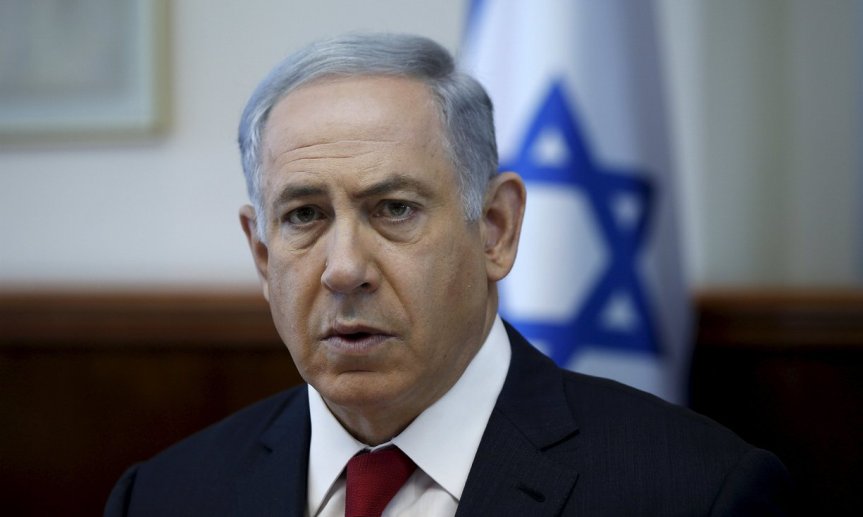
There you have it: the “sparring” between Israel and the U.S. is about whether Israel will get a huge chunk of America aid, or a gargantuan chunk of aid. Meanwhile, the U.S. government seems to have no influence over the Israeli government. Netanyahu does pretty much what he wants to do, even as he thumbs his nose at Obama.
The “punishment” for Netanyahu’s intractability – well, there is none. As a punch-drunk American heavyweight boxer staggers about the ring, a sneering Israeli lightweight launches punch after punch, taunt after taunt. And after absorbing the punishment the heavyweight simply throws in the towel and agrees to the lightweight’s terms.
Of course, none of this will change under President Hillary Clinton. If anything, Clinton will pursue the Afghan War with more vigor and ladle even more “aid” to Israel. Under President Trump, who knows? All bets are truly off since Trump changes his positions as often as most men change their underwear. (For example, Trump first affirmed neutrality in negotiating between the Israelis and Palestinians, then pledged one-sided support for Israel in a speech to AIPAC.)
Well, my dad always said, the more things change, the more they remain the same. In these two cases, he was right – yet again.







 Bracing Views