U.S. and Coalition Aid to Iraq Is Ungenerous and Self-Interested

anna cartoon

By Pamela

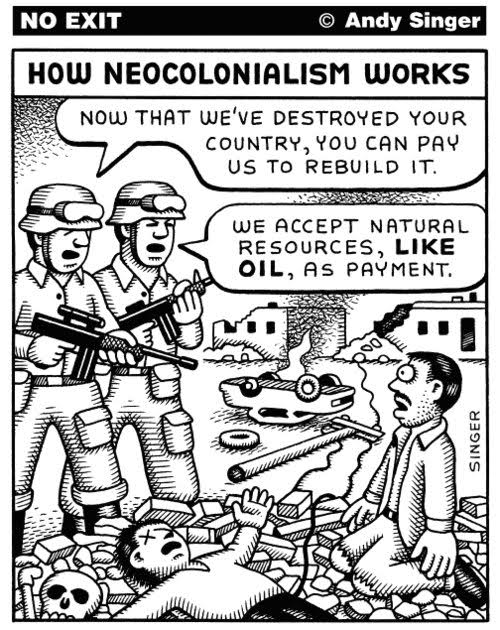
At the donor conference for the “post-ISIL reconstruction” of Iraq which just ended in Kuwait, U.S. Secretary of State Rex Tillerson talked about Iraqi corruption and insecurity, which he claimed had to be tackled for rebuilding investments to be feasible.  He said nothing about donations or reparations for the immeasurable damage the U.S. inflicted on Iraq since the first Gulf war in 1991, let alone since the invasion in 2003.  I do not recall reading that Iraq had been successfully rebuilt before ISIL struck in 2014.  And let’s recall that ISIL was largely the result of L. Paul Bremer and assorted US generals’ disastrous policies.

The US “aid” offered by Tillerson is a financial package from the U.S. Export-Import Bank in the amount of $3 billion in loans, loan guarantees, and insurance funds to American firms investing in Iraq.  Compare that paltry sum to the post-WWII Marshall Plan to Western Europe — including defeated enemy Germany and its allies — which amounted to about $140 billion in today’s dollars. Without going into the increasingly disputed purpose and even effectiveness of that aid, it amounted to more than the totality of Iraq’s needs as estimated at this moment.  And only some 10-15% of it were loans; the rest were grants, even if most of these had to finance goods imported from the U.S.

After Saddam’s capture in 2003, the U.S. apparently promised some $20 billion in reconstruction money in the form of credit against Iraq’s future oil revenues.  Whether this ever materialized I do not know, and there may well have been similar pledges, but there is no reason to assume that any of it was a grant without major strings attached.

The U.S. government is not the only hypocrite in this matter.  The overwhelming majority of the $30 billion in reconstruction pledges concerns credit and investments.  Is this simply donor fatigue?  How come the U.S.-led coalition had no trouble spending untold billions on the destruction of Iraq and its people, but cannot afford to help them rebuild their country?

The only governmental exception seems to be the nearly half a billion in donations from the European Union, but I wonder how much of this is dedicated to purchases from the EU.

I doubt my own government [Poland] will contribute anything but a token investment — if anything — while it enthusiastically joined the unholy coalition in 2003 for three candidly stated reasons: gain more importance in NATO, train its military in field conditions (!), and benefit from economic off-sets.  We do not even have the vibrant veterans-against-war associations which in the U.S. fight to prevent more of such wars from happening.  One such admirable initiative is We Are Not Your Soldiers, with veterans visiting high schools to harness kids against the propaganda of military recruiters, by explaining what war really looks like and what damage it inflicts on both victims and perpetrators.

In sum, American “Shock & Awe” doctrine destroyed Iraq, initial reconstruction efforts were haphazard and insufficient, and now in 2018 Iraq is sure to end up with a debt noose around its neck and ever greater dependence on the whims of foreign investors.

With respect to foreign investors, consider this quotation: “Iraq also is Opec’s second-largest crude producer and home to the world’s fifth-largest known reserves, though it has struggled to pay international firms running them.”

As for the Iraqi government, this is how it was described by New York-based Iraqi poet and long-term exile Sinan Antoon:  “The Iraqi government and the entire political class are beneficiaries of the U.S. and its wars. They recognize and commemorate the crimes of Saddam Hussein and the Baath regime and now ISIL and exploit them for their narrow and sectarian political purposes.”

Antoon’s critique of the Iraqi government should be kept in mind when reading Prime Minister’s Haider al-Abadi’s glowing appreciation of our “generous aid.”

Pamela, a former aid worker with a decade’s worth of on-the-ground experience in Afghanistan, worked with the Afghan people in relationships characterized by trust and friendship.

Our Enemy, Ourselves

W.J. Astore

In my latest article for TomDispatch.com, I suggest how America can pursue a wiser, more peaceful, course.  This is exactly what our leaders are not doing (and haven’t been doing for decades), as I document in the first half of my article, which I’m sharing here.  Bottom line: perpetual war doesn’t produce perpetual peace.  Nor does it make us safer.

Whether the rationale is the need to wage a war on terror involving 76 countries or renewed preparations for a struggle against peer competitors Russia and China (as Defense Secretary James Mattis suggested recently while introducing America’s new National Defense Strategy), the U.S. military is engaged globally.  A network of 800 military bases spread across 172 countries helps enable its wars and interventions.  By the count of the Pentagon, at the end of the last fiscal year about 291,000 personnel (including reserves and Department of Defense civilians) were deployed in 183 countries worldwide, which is the functional definition of a military uncontained.  Lady Liberty may temporarily close when the U.S. government grinds to a halt, but the country’s foreign military commitments, especially its wars, just keep humming along.

As a student of history, I was warned to avoid the notion of inevitability.  Still, given such data points and others like them, is there anything more predictable in this country’s future than incessant warfare without a true victory in sight?  Indeed, the last clear-cut American victory, the last true “mission accomplished” moment in a war of any significance, came in 1945 with the end of World War II.

Yet the lack of clear victories since then seems to faze no one in Washington.  In this century, presidents have regularly boasted that the U.S. military is the finest fighting force in human history, while no less regularly demanding that the most powerful military in today’s world be “rebuilt” and funded at ever more staggering levels.  Indeed, while on the campaign trail, Donald Trump promised he’d invest so much in the military that it would become “so big and so strong and so great, and it will be so powerful that I don’t think we’re ever going to have to use it.”

As soon as he took office, however, he promptly appointed a set of generals to key positions in his government, stored the mothballs, and went back to war.  Here, then, is a brief rundown of the first year of his presidency in war terms.

In 2017, Afghanistan saw a mini-surge of roughly 4,000 additional U.S. troops (with more to come), a major spike in air strikes, and an onslaught of munitions of all sorts, including MOAB (the mother of all bombs), the never-before-used largest non-nuclear bomb in the U.S. arsenal, as well as precision weapons fired by B-52s against suspected Taliban drug laboratories.  By the Air Force’s own count, 4,361 weapons were “released” in Afghanistan in 2017 compared to 1,337 in 2016.  Despite this commitment of warriors and weapons, the Afghan war remains — according to American commanders putting the best possible light on the situation — “stalemated,” with that country’s capital Kabul currently under siege.

How about Operation Inherent Resolve against the Islamic State?  U.S.-led coalition forces have launched more than 10,000 airstrikes in Iraq and Syria since Donald Trump became president, unleashing 39,577 weapons in 2017. (The figure for 2016 was 30,743.)  The “caliphate” is now gone and ISIS deflated but not defeated, since you can’t extinguish an ideology solely with bombs.  Meanwhile, along the Syrian-Turkish border a new conflict seems to be heating up between American-backed Kurdish forces and NATO ally Turkey.

Yet another strife-riven country, Yemen, witnessed a sixfold increase in U.S. airstrikes against al-Qaeda on the Arabian Peninsula (from 21 in 2016 to more than 131 in 2017).  In Somalia, which has also seen a rise in such strikes against al-Shabaab militants, U.S. forces on the ground have reached numbers not seen since the Black Hawk Down incident of 1993.  In each of these countries, there are yet more ruins, yet more civilian casualties, and yet more displaced people.

Finally, we come to North Korea.  Though no real shots have yet been fired, rhetorical shots by two less-than-stable leaders, “Little Rocket Man” Kim Jong-un and “dotard” Donald Trump, raise the possibility of a regional bloodbath.  Trump, seemingly favoring military solutions to North Korea’s nuclear program even as his administration touts a new generation of more usable nuclear warheads, has been remarkably successful in moving the world’s doomsday clock ever closer to midnight.

Clearly, his “great” and “powerful” military has hardly been standing idly on the sidelines looking “big” and “strong.”  More than ever, in fact, it seems to be lashing out across the Greater Middle East and Africa.  Seventeen years after the 9/11 attacks began the Global War on Terror, all of this represents an eerily familiar attempt by the U.S. military to kill its way to victory, whether against the Taliban, ISIS, or other terrorist organizations.

This kinetic reality should surprise no one.  Once you invest so much in your military — not just financially but also culturally (by continually celebrating it in a fashion which has come to seem like a quasi-faith) — it’s natural to want to put it to use.  This has been true of all recent administrations, Democratic and Republican alike, as reflected in the infamous question Madeleine Albright posed to Chairman of the Joint Chiefs Colin Powell in 1992: “What’s the point of having this superb military you’re always talking about if we can’t use it?”

With the very word “peace” rarely in Washington’s political vocabulary, America’s never-ending version of war seems as inevitable as anything is likely to be in history.  Significant contingents of U.S. troops and contractors remain an enduring presence in Iraq and there are now 2,000 U.S. Special Operations forces and other personnel in Syria for the long haul.  They are ostensibly engaged in training and stability operations.  In Washington, however, the urge for regime change in both Syria and Iran remains strong — in the case of Iran implacably so.  If past is prologue, then considering previous regime-change operations in Afghanistan, Iraq, and Libya, the future looks grim indeed.

Despite the dismal record of the last decade and a half, our civilian leaders continue to insist that this country must have a military not only second to none but globally dominant.  And few here wonder what such a quest for total dominance, the desire for absolute power, could do to this country.  Two centuries ago, however, writing to Thomas Jefferson, John Adams couldn’t have been clearer on the subject.  Power, he said, “must never be trusted without a check.”

The question today for the American people: How is the dominant military power of which U.S. leaders so casually boast to be checked? How is the country’s almost total reliance on the military in foreign affairs to be reined in? How can the plans of the profiteers and arms makers to keep the good times rolling be brought under control?

As a start, consider one of Donald Trump’s favorite generals, Douglas MacArthur, speaking to the Sperry Rand Corporation in 1957:

“Our swollen budgets constantly have been misrepresented to the public. Our government has kept us in a perpetual state of fear — kept us in a continuous stampede of patriotic fervor — with the cry of grave national emergency. Always there has been some terrible evil at home or some monstrous foreign power that was going to gobble us up if we did not blindly rally behind it by furnishing the exorbitant funds demanded. Yet, in retrospect, these disasters seem never to have happened, seem never to have been quite real.”

No peacenik MacArthur.  Other famed generals like Smedley Butler and Dwight D. Eisenhower spoke out with far more vigor against the corruptions of war and the perils to a democracy of an ever more powerful military, though such sentiments are seldom heard in this country today.  Instead, America’s leaders insist that other people judge us by our words, our stated good intentions, not our murderous deeds and their results.

For ten suggestions (plus a bonus) on how the U.S. can pursue a wiser, and far less bellicose, course, please read the rest of my article here at TomDispatch.com. 

America’s Cascading Disaster in Afghanistan

the Oval Offrice ...
A U.S. government promotional photo.  Pamela notes, “Look closely at the expressions on the faces of the Afghans.”

By Pamela

Editor’s Intro: I asked Pamela if I could highlight a recent comment she made at this site about the U.S. military’s approach to Afghanistan.  Not only did she give me her permission: she elaborated on her point in an email.  Pamela, a former aid worker with a decade’s worth of on-the-ground experience in Afghanistan, worked with the Afghan people in relationships characterized by trust and friendship.  Her words should be read by all Americans, especially our foreign policy “experts.” W.J. Astore

Cascading disaster is an apt term for the U.S. military’s strategy in Afghanistan, which involves the indiscriminate killing of terrorist leaders, whether Taliban, Al Qaeda, ISIS or whatever else.

In addition to heavily underreported civilian casualties, U.S. military strikes increase the ferocity of those terrorist outfits. Not just because those outfits want to show the world how strong they are.  There is another element which arguably is even worse, as it is virtually impossible to reverse. Each “neutralized” leader leaves a power void within his organization and a number of usually younger and more ruthless members start fighting among each other to take over — with cruelty and spectacular attacks obviously being stronger “election” arguments than a “softy” willingness and capacity for peaceful dialogue.

Thus in Afghanistan the original Taliban – the ones who were ousted in 2001 – probably could have been convinced to take part in negotiations. They were an unsavory lot to have as a government, with medieval habits, but they were not terrorists like the ones nowadays. Few people know that in 2000 the British charity Christianaid (yes, with such a provocative name) had an office there, run by a female Australian doctor with her husband and little Sam, their six-month-old son. They enjoyed it very much and the Taliban had no objection against a foreign woman providing medical care to women and children, despite the obvious need for careful diplomacy.

Since then, however, there have been so many cascading series of eliminations of Taliban leaders at all levels – all for the purpose of PR spin rather than any coherent strategy – that we now have the umptiest generation, which has lost whatever dignity and humanity their predecessors may have had.

Furthermore, we knew the original Taliban leaders, and they were relatively predictable.  Each new batch needs to be infiltrated, investigated and analyzed from scratch, after which we kill those too. What a waste of energy and knowledge! But President Trump believes that the evident lack of success is caused by too little rather than too much bombing/eliminating, so this vicious cascade can be expected to go on and on until doomsday.

This “destroy the Taliban by assassination” strategy has one more layer: the eroding authority of their original leaders.  By continuously eliminating (often after several failed attempts in which civilians are killed instead) successive leaders at all levels — from village to nation-wide – the U.S. has shattered the Taliban into different splinter factions, each with its own power structure & power struggles.  This has increased pressure and violence at the village level, as people who during the day were already pressured by coalition armies and at night by the Taliban, ended up with several competing “Taliban” factions all pressuring them to join. Some of these factions were foreign, as Afghan friends would tell me, meaning they were from some other part of Afghanistan, not necessarily from a different country, which made it even harder to negotiate with them.  Multiple terrorist factions contributed to anarchy in which common criminality has flourished.

At the same time, as this cascading fracturing continued, successive local “terrorist” leaders became increasingly detached from central top leadership and therefore any negotiations with Mullah Omar or any other grey eminence might not translate into concrete changes in the field.

Negotiations should have been conducted in 2002, when the Taliban had been wiped out, which then was no major feat as the vast majority of its followers had been coerced into joining and were only too happy to have been delivered from this burden and being able to return home.

So few true believers were left in 2002 that the Taliban was in a very weak bargaining position, a perfect starting point for negotiations.

Systematic demonizing by the U.S., however, and the ludicrous strategy of killing them one by one — which is as absurd as believing that the best way to eliminate ants is by crushing them one at a time as they appear at our sugar bowl — have led to what we have now: a thoroughly opaque playing field with regularly shifting alliances and competition, which makes it even harder to keep track of who’s who, with whom, against whom.   This increasingly chaotic situation makes counter-terror operations even more complicated (spectacular attacks may have more centralized backing, but smaller attacks are often initiated by local splinter factions).

The addition of ISIS further complicated the situation, as the Taliban have been fiercely fighting them — Afghans generally do not like Arabs nor any other foreigners who want to impose their ways — and thus the absurd situation developed in which everyone is fighting everyone — Taliban, ISIS, Haqqani et al, the Afghan army & police, coalition-supported local militias and coalition armies themselves.  A bit like the present proxy-wars in the Middle East in a nutshell.

We also tend to forget that the Taliban — for all their senseless cruelty and often medieval ideas — were welcomed in 1996 with a huge sigh of relief when they cleaned up the murderous chaos of the civil war and restored law and order.  When asking Afghan friends what part of their experiences since 1979 was the worst, they all would name the civil war.  Unfortunately power corrupts and soon this relief was replaced with a different kind of horror. The Taliban regime was loathed but at least was relatively predictable.  One could somehow adapt to its rules.

I am convinced that given a bit more time, the Afghans would have gotten rid of that regime themselves and the ensuing civil war would have been relatively short-lived as then they all were thoroughly fed-up with fighting.

Today, the chaos and corruption in Afghanistan is being hidden further, as the U.S.-led coalition acts to suppress information, specifically the reports of SIGAR, the Special Inspector General for Afghanistan Reconstruction.  John Sopko, the head of SIGAR, has always been a hero of mine, shining a bright light on the mess that otherwise was swept under the carpet.

Now even that light is being switched off.

The Kennedy Administration: Camelot or Incompetence?

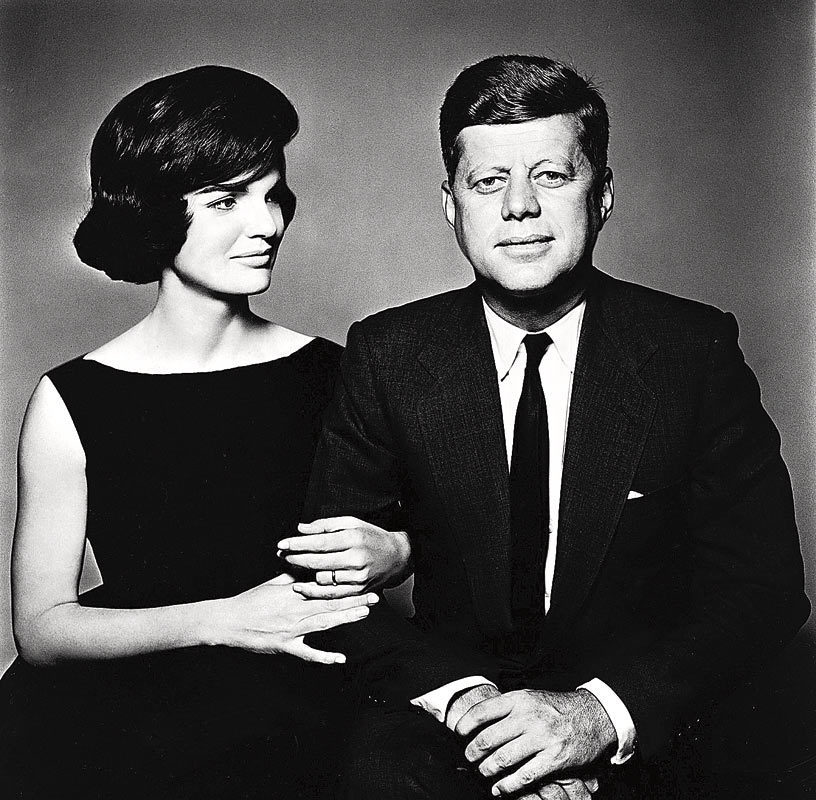
jackie-and-john-jackie-kennedy-3856502-816-800
They seemed perfect …

The Kennedy Administration: Camelot or Incompetence?

W.J. Astore

President John F. Kennedy is surrounded by myths, the most famous of which is Camelot. The Kennedys brought youth and glamour to the White House, a reprieve from the perceived stodginess of Ike and Mamie Eisenhower (as well as the “square” and indeed criminal Nixon White House to come).  They seemed the perfect couple, John and Jackie, and it seems churlish and graceless to note how much of this was image.  Kennedy was a notorious womanizer, a fact both known and suppressed by a fawning Washington Press Corps.  Jackie came across as a traditional wife: loyal, unobjectionable, limited by her times but also steely in her grace and fortitude after her husband was assassinated in Dallas in November 1963 (the latest movie that captures this awful event is Jackie, starring Natalie Portman).

Kennedy’s father, Joe Sr., taught his sons a sense of winning at all costs. A sense of recklessness. Kennedy’s older brother, Joe Jr. died leading a risky bombing mission in World War II, and John F. Kennedy nearly died when he lost his PT boat in action in the Pacific.  The loss of PT-109 was depicted as a heroic act, as the young JFK helped to save some of his crew, but one may question how he came to lose his boat in the first place. JFK’s perfect marriage, as already mentioned, was a sham, and despite his relative youth, he was not in the best of health, plagued by a bad back, Addison’s disease, and other health issues. His Pulitzer-prize winning book, “Profiles in Courage,” was largely ghost written.  JFK’s life was often more a triumph of image than a profile in courage.

As President, Kennedy made many unwise decisions.  He escalated American involvement in Laos and Vietnam, setting the stage for a major commitment of U.S. ground troops by President Lyndon Johnson early in 1965.  He oversaw the disastrous Bay of Pigs invasion of Cuba, which backfired badly on the inexperienced U.S. commander-in-chief.  As Lawrence Freedman put it in his book, Kennedy’s Wars (2000), “This was exactly the sort of move—gambling on the basis of insufficient strength and then abandoning the operation before it was complete—that made [Dean] Acheson despair.”  Freedman further cites Acheson as saying European leaders compared JFK’s bungling to “a gifted amateur practicing with a boomerang and suddenly knocking himself cold.  They were amazed that so inexperienced a person should play with so lethal a weapon.”

Greater lethality was to come the next year with the Cuban Missile Crisis.  This is often sold as JFK’s moment of steely toughness, when he made the Soviets blink and back down, but as a recent book by Daniel Ellsberg reveals, that crisis nearly resulted in nuclear war between the U.S. and the Soviet Union.  It was yet another instance of JFK’s tendency toward taking big risks as a way of proving himself.  Almost precipitating nuclear Armageddon, however, is terrifying way to prove one’s fitness for office.

Even before JFK became president, he fabricated what today might be called “alternative facts.”  He invented a missile gap vis-à-vis the Soviet Union that didn’t exist.  In fact, the true missile gap was the opposite of what JFK claimed, in that the U.S. had many more nuclear ICBMs than the Soviets did.  When he became president, JFK embarked on a strategic policy of “Flexible Response” (suggested by General Maxwell Taylor) that activated and empowered more conventional operations by the U.S. military.  In practice what this meant was that the U.S. became embroiled in conflicts that were secondary to national interests; worst of all, of course, was a major land war in Vietnam that was essentially a lost cause even before Kennedy chose to escalate it with more advisers and materiel aid.

Defenders of JFK suggest he grew in office and would have seen the folly of continuing in Vietnam, but there’s little evidence to support this narrative.  The recent Ken Burns series on the Vietnam War cites Kennedy as saying the U.S. couldn’t win in Vietnam, but that he couldn’t order a withdrawal because to do so would cost him his reelection in 1964.  JFK, moreover, fancied the notion of Flexible Response, his New Look military and its emphasis on special ops forces such as the Green Berets, and he saw Vietnam as a test bed for a “counterinsurgency” approach to defeating communism. What LBJ did in 1965 in escalating that conflict by committing U.S. ground troops is probably what JFK would have done if he had lived.  (In his book, Choosing War: The Lost Chance for Peace and the Escalation of War in Vietnam, Fredrik Logevall suggests JFK may have had the political will to resist escalation in 1965, effectively allowing South Vietnam to fall to communism, an intriguing if unprovable scenario.)

In sum, JFK set the stage for America’s disastrous war in Southeast Asia while provoking the Soviet Union into an escalatory nuclear arms race that threatened the world with extinction.  Profiles in courage these are not.

It’s worth briefly comparing JFK’s record to that of Richard Nixon, who has no Camelot myths attached to him.  Nixon, of course, was and is vilified as “Tricky Dick” and dismissed as one of America’s worst presidents.  He deserves opprobrium for his mendacious, meretricious, and murderous policies vis-à-vis Southeast Asia, especially his well-nigh treasonous meddling in peace negotiations in 1968, before he was elected president.  Nixon and Henry Kissinger saw themselves as the world’s powerbrokers, working to overthrow governments they disliked, as in Chile with the coup against Allende.  But Nixon and Kissinger deserve a measure of credit for opening negotiations with communist China as well as starting a process of détente with the Soviet Union.  Nixon showed a capacity for growth in office even as he permitted his own ego and paranoia to undermine his administration’s accomplishments in foreign policy.

The point here is not to praise Nixon, a man of considerable gifts but also of crippling flaws.  Rather, the point is to highlight an overly fawning approach to the presidency of John F. Kennedy.  His administration, rather than serving as a shining moment, a Camelot, ultimately was an exercise in imagery and incompetence.

The “War on Terror”: The Globalization of Perpetual War

W.J. Astore

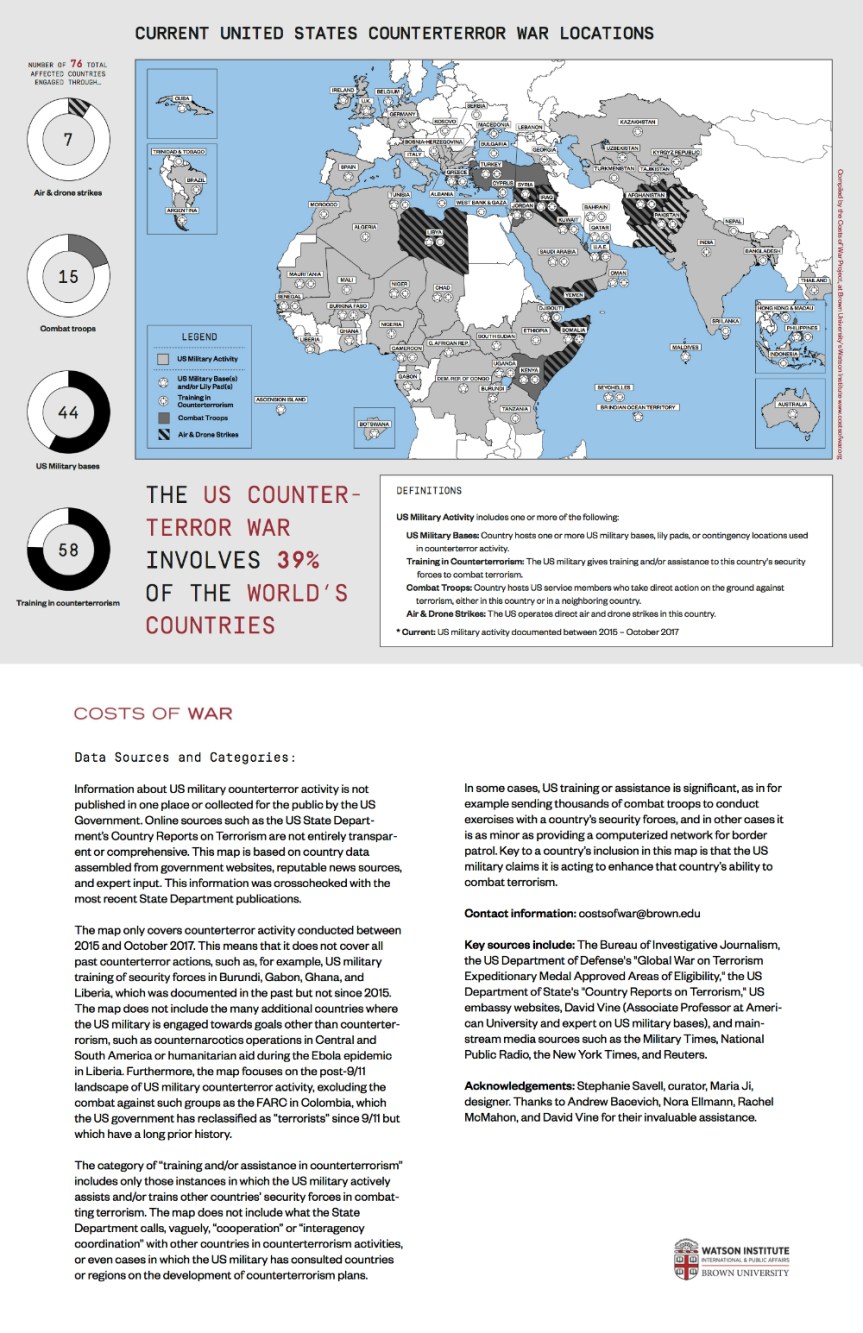
At TomDispatch.com, Tom Engelhardt has a revealing article on the truly global nature of America’s war on terror, accompanied by a unique map put together by the Costs of War Project at Brown University’s Watson Institute for International and Public Affairs.  The map reveals that America’s war on terror has spread to 76 countries, as shown below:

costofwar_projectmap_large1

This metastasizing of “counterterror” efforts is truly paradoxical: the more the U.S. military works to stop terror, the more terror spreads.  “Progress” is measured only by the growth of efforts to stem terror networks in more and more countries.  But the notion of “progress” is absurd: That 76 countries are involved in some way in this war on terror is a sign of regress, not progress.  After 16 years and a few trillion dollars, you’d think terror networks and efforts to eradicate them would be decreasing, not increasing.  But the war on terror has become its own cancer, or, in social-media-speak, it’s gone viral, infecting more and more regions.

A metaphor I like to use is from Charles Darwin.  Consider the face of nature — or of terrorism — as a series of tightly interlinked wedges.  Now, consider the U.S. military and its kinetic strikes (as well as weapons sales and military assistance) as hammer blows.  Those hammer blows disturb and contort the face of nature, fracturing it in unpredictable ways, propagating faults and creating conditions for further disturbances.

By hammering away at the complex ecologies of regions, the U.S. is feeding and complicating terrorism with its own violence.  Yet new fracture lines are cited as evidence of the further growth of terrorism, thus necessitating more hammer blows (and yet more military spending).  And the cycle of violence repeats as well as grows.

A sensible approach: Stop hammering away with missiles and bombs and drones.  Stop feeding the terrorist wolf with more blood and violence.

But the U.S. government is caught up in a seemingly endless cycle of violence and war, as Engelhardt notes here:

Let me repeat this mantra: once, almost seventeen years ago, there was one [country, Afghanistan, the U.S. targeted]; now, the count is 76 and rising.  Meanwhile, great cities have been turned into rubble; tens of millions of human beings have been displaced from their homes; refugees by the millions continue to cross borders, unsettling ever more lands; terror groups have become brand names across significant parts of the planet; and our American world continues to be militarized

This should be thought of as an entirely new kind of perpetual global war.  So take one more look at that map.  Click on it and then enlarge it to consider the map in full-screen mode.  It’s important to try to imagine what’s been happening visually, since we’re facing a new kind of disaster, a planetary militarization of a sort we’ve never truly seen before.  No matter the “successes” in Washington’s war, ranging from that invasion of Afghanistan in 2001 to the taking of Baghdad in 2003 to the recent destruction of the Islamic State’s “caliphate” in Syria and Iraq (or most of it anyway, since at this moment American planes are still dropping bombs and firing missiles in parts of Syria), the conflicts only seem to morph and tumble on.

A new kind of perpetual global war: Engelhardt nails it.  To end it, we need to stop feeding it.  But as the map above indicates, it seems likely that U.S. hammer blows will continue and even accelerate, with results as violently unpredictable as they are counterproductive.

The Doomsday Machine: The Madness of America’s Nuclear Weapons

41zhRYUMyYL

W.J. Astore

I just finished Daniel Ellsberg’s new book, The Doomsday Machine: Confessions of a Nuclear War Planner.  Talk about hair-raising!  Ellsberg, of course, is famous for leaking the Pentagon papers, which helped to end the Vietnam war and the presidency of Richard Nixon as well.  But before Ellsberg worked as a senior adviser on the Vietnam war, he helped to formulate U.S. nuclear policy in the late 1950s and early 1960s.  His book is a shattering portrayal of the genocidal nature of U.S. nuclear planning during the Cold War — and that threat of worldwide genocide (or omnicide, a word Ellsberg uses to describe the death of nearly everything from a nuclear exchange that would generate disastrous cooling due to nuclear winter) persists to this day.

Rather than writing a traditional book review, I want to list some memorable facts and lessons I took from the book, lessons that should lead us to question the very sanity of America’s leaders.  To wit:

  1. U.S. nuclear war plans circa 1960 envisioned a simultaneous attack on the USSR and China that would generate 600 million deaths after six months.  As Ellsberg notes, that is 100 Holocausts.  This plan was to be used even if China hadn’t directly attacked the U.S., i.e. the USSR and China were lumped together as communist bad guys who had to be eliminated together in a general nuclear war.  Only one U.S. general present at the briefing objected to this idea: David M. Shoup, a Marine general and Medal of Honor winner, who also later objected to the Vietnam War.
  2. The U.S. military consistently overestimated the Soviet nuclear threat, envisioning missile and bomber gaps that didn’t exist.  In the nuclear arms race, the U.S. was often racing itself in the fielding of more and more nuclear weapons.
  3. General Curtis LeMay, the famous commander of Strategic Air Command (SAC) and later AF Chief of Staff, said that once war started, politicians like the president had no role to play in decision-making.
  4. When the atomic bomb was first tested in 1945, there were fears among the scientists involved that the atmosphere could be ignited, ending all life on earth.  The chance was considered remote (perhaps 3 in a million), so the scientists pressed ahead.
  5. The Cuban Missile Crisis of 1962 came much closer to nuclear war than most people recognize.  Soviet submarines in the area, attacked by mock U.S. depth charges, were prepared to launch nuclear torpedoes against U.S. ships.  Fidel Castro’s air defenses were also preparing to shoot down American planes, which may have ended in U.S. air attacks and an invasion in which Soviet troops on Cuba may have used nuclear weapons to defend themselves.
  6. The U.S. military was (and probably still is) extremely reluctant to reveal nuclear secrets to senior American civilian leaders, including even the President himself.  Ellsberg, possessing the highest security clearances and acting with presidential authority, had to pry answers from military officers who refused to provide detailed and complete information.
  7. The U.S. has always refused, and continues to refuse, to pledge to a “no first use” policy for nuclear weapons.
  8. The U.S. remains the only country to have used nuclear weapons (Hiroshima and Nagasaki).  Yet, as Ellsberg notes, the U.S. uses nuclear weapons all the time — by threatening their use, as President Eisenhower did during the Korean War, as President Nixon did during the Vietnam War, and as President Trump is doing today, promising “fire and fury” against North Korea.  The U.S. uses nuclear weapons like a loaded gun — holding it to an enemy’s head and threatening to pull the trigger, Ellsberg notes.  In short, there’s nothing exceptional about Trump and his nuclear threats.  All U.S. presidents have refused to take nuclear attacks “off the table” of options for U.S. action.
  9. Interservice rivalry has always been a driver of U.S. nuclear force structure and strategy.  The Navy (with its nuclear submarine programs, Polaris followed by Trident) and especially the Air Force (with its ICBMs and bombers) jealously guard their nuclear forces and the prestige/power/budgetary authority they convey.
  10. President Eisenhower’s emphasis on massive retaliation (as represented by SAC and its war plan, the SIOP) was a way for him to limit the power of the military-industrial complex (MIC).  But once Ike was gone, so too was the idea of using the nuclear deterrent as a way of restricting U.S. expenditures on conventional weaponry and U.S. adventurism in foreign wars, e.g. Vietnam.  (It should be said that Ike’s exercise at limiting the MIC in America held the world as a nuclear hostage.)
  11. Ellsberg shows convincingly that control over U.S. nuclear weapons was decentralized and delegated to much lower levels than most Americans know.  It’s not the case that only the president can launch a nuclear war.  Especially in the late 1950s and early 1960s, Ellsberg shows how it was possible that field-grade officers (majors and colonels) could have made decisions in the heat of battle to release nuclear weapons without direct orders from the president.
  12. Most Americans, Ellsberg notes, still don’t understand the huge quantitative and qualitative differences between atomic bombs and hydrogen (thermonuclear) weapons.  Hydrogen bombs are measured in megatons in equivalent TNT yield; atomic bombs are in kilotons.  In short, hydrogen bombs are a thousand times more destructive than atomic ones.  And this is just their explosive yield.  Radioactive fallout and massive fires are even bigger threats to life on earth.
  13. Most Americans still don’t understand that even a smallish nuclear exchange involving a few dozen hydrogen bombs could very well lead to nuclear winter and the deaths of billions of people on the earth (due to the widespread death of crops and resulting famine and disease).
  14. Despite the genocidal threat of nuclear weapons, the U.S. is persisting in plans to modernize its arsenal over the next 30 years at a cost of $1 trillion.

Ellsberg sees this all as a form of collective madness, and it’s hard to disagree.  He quotes Nietzsche to the effect that madness in individuals is rare, but that it’s common among bureaucracies and nations.  The tremendous overkill inherent to U.S. nuclear weapons — its threat of worldwide destruction — is truly a form of madness.  For how do you protect a nation or uphold its ideals by launching a nuclear war that would kill nearly everyone on earth?  How does that make any sense?  How is that not mad?

Ellsberg ends his “confessions” with many sane proposals for downsizing nuclear arsenals across the world.  But is anyone in power listening?  Certainly not U.S. presidents like Trump or Obama, who both signed on to that trillion dollar modernization program for U.S. nuclear weapons.

Ellsberg shows us there have been many chair-bound paper-pushers in the U.S. government who’ve drawn up plans to murder hundreds of millions of people — to unleash doomsday — all in the name of protecting America.  He also shows how close they’ve come to doing just that, especially during the Cuban Missile Crisis, but during other crises as well.

Nuclear brinksmanship, threats of nuclear war, and similar uses of nuclear weapons to intimidate hold the potential for catastrophe.  Miscalculations, mishaps, mistakes, are more than possible in an atmosphere of mistrust, when words and actions can be misinterpreted.

Ellsberg’s recommendations for changes point the way to a better world, a world where the threat of nuclear doomsday could be much reduced, perhaps eliminated completely.  The question remains: Is anyone in power listening?

The Biggest National Security Threats

694940094001_5677950187001_5677904359001-vs
Trump, surrounded by the military, vows to give it more (and more!) money

W.J. Astore

Today at 2PM, the Trump administration releases its National Security Strategy.  It’s already making news because Trump is dropping climate change (added by the Obama administration) as a threat.  Instead, Trump is placing new emphasis on economic competitiveness and border security (“Build the wall!”), which are two corporate-friendly policies (read: boondoggles).

I’d like to cite two threats that Trump won’t mention in his national security strategy.  These two threats are perhaps the biggest ones America faces, and they are related.  The first is threat inflation, and the second is the U.S. military itself, as in Dwight D. Eisenhower’s military-industrial-Congressional complex.

Threat inflation is a huge problem in America.  The threat of terrorism is vastly inflated, as is the threat from North Korea.  If we wanted to focus on what threatens Americans, we’d be redoubling efforts to help those with opioid addictions even as we work to cut deaths by guns and in road accidents.  Roughly 120,000 Americans are dying each year from opioid overdoses, road accidents, and shootings.  How many are dying from terrorism or from attacks by North Korea?

North Korea is a weak regional power led by an immature dictator who is desperate to keep his grip on power.  Kim Jong-un knows that any use of nuclear weapons by North Korea would end in his death and the annihilation of his country.  He also knows that nuclear weapons serve as a deterrent and a symbol of prestige domestically and internationally.  Does he need to be deterred?  Yes.  Should Americans cower in fear?  Of course not.

Cyberwar is certainly a threat–just look at Russian meddling in our last presidential election.  China and Russia are nuclear powers and rivals that bear close watching, but they are not enemies.  Indeed, since the end of the Cold War the United States hasn’t faced serious peer enemies.  We should have been cashing in our “peace dividends” for the last 25 years.  Why haven’t we?

Enter the military-industrial-Congressional complex.  Ike warned us about it in 1961.  He warned about its misplaced power, its persistence, and its anti-democratic nature.  Ike, a retired five-star general who led the allied armies on the Western Front in World War II against the Nazis, knew of what he spoke.  He knew the Complex exaggerated threats, such as missile or bomber “gaps” (which didn’t exist) vis-a-vis the Soviet Union.  Ike knew the military, its corporate feeders and enablers, and Congress always wanted one thing: more.  He did his best to control the military, but once he left office, it was the Complex that took control, leading America into a disastrous war in Vietnam, the first of many “wars of choice” that ended in American defeats, but which proved highly profitable to the Complex itself.

Those endless wars that feed the Complex persist today.  Elements of the U.S. military are deployed to 149 countries and 800 foreign bases at a budgetary cost of $700 billion (that’s just for the “defense” budget).  Spending so much money on the military represents a tremendous opportunity cost–for that money, Americans could have free health care and college tuition, but who wants good health and a sound education, right?

Ike recognized the opportunity cost of “defense” spending in 1953 in this famous speech:

Every gun that is made, every warship launched, every rocket fired signifies, in the final sense, a theft from those who hunger and are not fed, those who are cold and are not clothed.

This world in arms is not spending money alone. It is spending the sweat of its laborers, the genius of its scientists, the hopes of its children. The cost of one modern heavy bomber is this: a modern brick school in more than 30 cities. It is two electric power plants, each serving a town of 60,000 population. It is two fine, fully equipped hospitals. It is some fifty miles of concrete pavement. We pay for a single fighter with a half-million bushels of wheat. We pay for a single destroyer with new homes that could have housed more than 8,000 people. . . . This is not a way of life at all, in any true sense. Under the cloud of threatening war, it is humanity hanging from a cross of iron.

What Ike said.  The point is not that Ike was a perfect man (look at the Iran coup, also in 1953), but he sure as hell was a sound and at times a penetrating thinker, a mature man who knew the awful burdens of war.

And now we have Trump, the opposite of Ike, an unsound and shallow thinker, an immature man who knows nothing of the awfulness of war.  Add Trump himself–his immaturity, his bellicosity, his ignorance, and his denial of reality–as a threat to our national security.

So, a quick summary of three big threats that won’t make Trump’s “strategy” today:

  1. Threat inflation: terrorism, North Korea, Iran, etc.
  2. The Complex itself and its profligate, prodigal, and anti-democratic nature.
  3. Trump.

And add back one more: climate change/global warming.  Because flooding, fires, droughts, famines, etc., exacerbated by global warming, are already creating security challenges, which will only grow worse over the next half-century.  Denying that reality, or calling it “fake news,” won’t change Mother Nature; she has her own implacable ways,

Trump, His Generals, and the Road to Authoritarianism

W.J. Astore

An article yesterday at NBC focusing on Trump and “his” generals got me to thinking on this subject again.  Its author, Suzanne Garment, suggests that Trump likes generals as obedient alpha males.  They lend him credibility without directly threatening his delicate ego.  And there’s truth in this.

trump generals
Trump and his generals.  Mattis and Kelly flanking Trump.  From the NBC article.

But I want to focus on other reasons for Trump’s preference for generals in high positions.  A year ago, I wrote an article for TomDispatch.com on “All the President’s Generals.”  That article focused mainly on the potential impact of these generals on America’s foreign policy and domestic culture.  As I wrote last December:

Collectively, the team of Mattis, Flynn, and Kelly could not be more symbolic of the ongoing process of subversion of civilian control of the military.  With Trump holding their reins, these self-styled warriors will soon take charge of the highest civilian positions overseeing the military of the world’s sole superpower.  Don’t think of this, however, as a “Seven Days in May” scenario in which a hard-headed general mounts a coup against an allegedly soft-hearted president.  It’s far worse.  Who needs a coup when generals are essentially to be given free rein by a president-elect who fancies himself a military expert because, as a teenager, he spent a few years at a military-themed boarding school?

In all of this, Trump represents just the next (giant) step in an ongoing process.  His warrior-steeds, his “dream team” of generals, highlight America’s striking twenty-first-century embrace of militarism.

I continue to think this is true.  Trump is empowering further military adventurism, even as he reinforces military-style solutions to problems.  But there are other reasons for Trump’s tight and eager embrace of the military.

Basically, by embracing the military and elevating it (while feeding it lots of money), Trump has neutralized it as a rival to his power.  Indeed, he is borrowing from the military’s authority and standing within our culture to bolster his own.

Recall how Candidate Trump was often quite critical of the U.S. military.  He knew more than the generals, he said.  Their wars he often called wasteful follies.  He was going to win (or end) these wars, he claimed, and hinted that quite a few “loser” generals might be on the receiving end of his infamous “You’re fired” line.

You hear none of this today. Trump is at pains to praise the military and his generals. He says they’re on a winning path, even in Afghanistan (because of Trump’s decisions, naturally).  He rewards them with record budgets and unalloyed praise.

And it’s working.  The military (and the larger national security state) is content with Trump.  He’s letting them have their way, which is another way of saying Trump is having his way.

In American society today, there aren’t too many power centers that truly can challenge Trump.  The media he’s diminished with all his attacks (“Fake news!”).  A Republican Congress remains quietly subservient.  Trump is stacking the judiciary with conservative judges to his liking.  The Democratic Party remains feckless and divided.  Bankers and corporations?  Trump has hired the former and given a huge gift to the latter in the latest Republican tax cut for the richest.

When you think about it, the one power center that could challenge Trump is the military-industrial complex: America’s fourth branch of government.  Yet by hiring so many of its generals and by praising it while passing loads of moola its way, Trump has co-opted its authority and power, attaching it to himself in his role as commander-in-chief.

Trump’s last hurdle may be the Robert Mueller investigation into Russian meddling and possible complicity or obstruction by Trump.  If Trump gets past this (perhaps even by firing Mueller), is there anyone left with the balls, the sand, the spine, the guts, the moxie (choose your favorite measure of fortitude) and the authority to stop his ambition and designs as an authoritarian leader?

Jerusalem and an Alabama Senate Race

171116210448-roy-moore-1116-exlarge-169
Roy Moore: Was the timing of Trump’s Jerusalem announcement driven by his election bid?

M. Davout

The December 6 announcement by Trump of U.S. recognition of Jerusalem as the capital of Israel and his administration’s intention to move the U.S. embassy from Tel Aviv to that storied city sparked much consternation and puzzlement, both prospectively and in its aftermath. The consternation, especially among career diplomats and Middle East policy experts, revolved around the likely effects of such a move both for Israeli-Palestinian relations and U.S. relationships with the larger Arab world. Wouldn’t this policy change, by making a unilateral concession to Israel, make even more difficult a two-state solution and unnecessarily inflame Arab world opinion?

The puzzlement stemmed from the timing. Why announce this now? Israel declared Jerusalem as its eternal, united and undivided capital in 1980 and the U.S. Congress passed a law requiring the U.S. to move its embassy to Jerusalem in 1995 but U.S. presidents, including Trump, have signed a waiver of the law every six months for the last two decades justifying their actions in terms of national security concerns. Why didn’t Trump wait another six months or year or announce this policy change six months ago?

The consensus answer to why Trump broke with precedent is that his actions are being driven by domestic political priorities, in particular, the support for a militant Israel evinced by members of his white evangelical base as well as of deep-pocketed rightwing donors such as casino magnate Sheldon Adelson. Johnnie Moore, co-chairman of Trump’s unofficial faith advisory board, said in the aftermath of Trump’s announcement that, “The issue was–to many–second only to concerns about the judiciary among the president’s core evangelical supporters.”

While this macro-scale view of Trump’s domestic political support might explain why he is choosing to break with U.S. foreign policy precedent and risk so much, it does not explain why this break is happening now.  For a more nuanced and plausible answer to this latter question, one has to zoom in for a closer look at Trump’s domestic political landscape and ask what Jerusalem might have to do with a closely contested Alabama senate race between Republican Roy Moore, proud fundamentalist and accused pedophile, and Democrat Doug Jones.

For several weeks after the accusations against Moore for sexual abuse and harassment of teenage girls during the time he was in his thirties, he seemed radioactive to the national Republican establishment. Trump changed that with his December 4 early morning tweet endorsing Moore. The very next day, Steve Bannon, Trump’s alt-right alter ego, spoke at a Moore rally in Mobile, Alabama. And on December 6, Trump upended U.S. policy in the Middle East with his Jerusalem announcement.

Is the quick succession of these events a coincidence? Or is it evidence that Bannon continues in his former role as Don Trump’s consigliere? Changing U.S. policy was something Trump had wanted to do from the start. He was evidently persuaded to forego the move six months ago and sign the waiver. However, the unexpected events of late November turned what would have been a shoo-in for the Republican Senate candidate in Alabama into a slogging match with a capable Democratic contender. Might this turn of events have seemed to Trump (if not also to Bannon) the perfect moment to throw some red meat to the base in Alabama and motivate any evangelicals having second thoughts about voting in an accused pedophile to go to the polls on December 12?

Whatever the motivation for Trump’s move on Jerusalem, one thing is certain. This president’s first and (apparently) only priority is to please his base by fulfilling as many of his election season promises as he can. In doing so, he demonstrates that he truly is the President of Red America.

M. Davout (pseudonym) is a professor of political science who teaches in the Deep South.

Donald Trump and His Global War on Truth

Trump-Locker-Room-Cartoon-58b8fdb25f9b58af5cc8205d
Too many lies

W.J. Astore

Donald Trump is waging a global war on truth.  He is the anti-truth president.  From Trump steaks to his “university” to his support of the “birther” movement against Barack Obama, he’s perpetually selling lies.  Now he’s selling lies on a global stage.  By making everything potentially a lie, e.g. climate change as a “Chinese hoax,” Trump is doing his best to demolish facts, paving the way to do whatever he pleases.

Trump believes he can have his own facts and tweet them too.  We can blame Trump for being the vain, venal, and vile man that he is, but America elected him (yes, not all Americans, but enough to carry the Electoral College).  He’s a con man, a crafty one, and the media can’t look away, nor can the rest of us.

How did we end up with Trump and his assault on truth?  I’d like to focus on two reasons.  The first was noted by Bernie Sanders back in September of 1998.  Then a congressman, Sanders noted how the Democratic Party under the Clinton regime, with its corporate-friendly pursuit of “free” trade and feel-good globalization, was screwing the working classes.  Sanders then issued the following warning (in an editorial in The Nation entitled, “Globalization’s the Issue”):

Right-wing populists like Pat Buchanan are lining up to ride to power on public fear and anger about globalization.  If corporate globalism continues to result in deteriorating conditions of life for ordinary Americans, we’re likely to see a rise of scapegoating demagogy and virulent right-wing economic nationalism.

Scapegoating demagogy?  Trump and Mexicans, Trump and Muslims, Trump and immigrants in general.  Right-wing economic nationalism?  Trump and “making America great again” through massive military spending and weapons exports combined with tax cuts that are sold as helping the poor even as they reward the rich.

By betraying the working classes and becoming yet another business party, the Clinton Democrats helped pave the way for right-wing populists and unprincipled opportunists like Trump.  Indeed, by running the corporate-friendly Hillary Clinton against Trump in 2016, the Democratic Party turned its back on their own populist, Bernie Sanders, who genuinely was (and is) concerned with helping the working classes.

The second reason for Trump’s assault on truth has been all around us for decades, but it was exacerbated by the 9/11 attacks.  Think back to the Vietnam War, the Pentagon Papers, and Watergate.  If there’s one thing we learned from these debacles, it’s how much our government lies to us.  Now fast-forward to 9/11.  In the aftermath of those attacks, the Bush/Cheney administration did its level best to deflect all responsibility, and especially their responsibility, for the attack.  Al Qaeda inflicted a major defeat on the U.S., yet no one took the blame.  The buck stopped nowhere.  Instead, Bush/Cheney drove a climate of fear and revenge, attacking Afghanistan followed by a disastrous war in Iraq.

By turning so quickly to war on a massive scale, Bush/Cheney knew that most Americans would rally around the flag.  They further cynically used the moment to pass the PATRIOT Act to extend their power and that of the government.  Choosing not to rally Americans, they instead made them fearful, obedient, and passive (Go to Disney!  Go shopping!).

The leaders and the government that so badly let us down on 9/11 worked to convince us that only those same leaders and government could keep us safe after 9/11.  Bush/Cheney and Crew, in essence, told a Big Lie that led, I think directly, to a Big Liar being elected as president in 2016.  But I don’t just blame Bush/Cheney.  The Obama administration refused to call these men to account, e.g. no prosecution for torture and other war crimes.  Furthermore, Obama expanded the legacy of illegal surveillance, excessive secrecy, and incessant warfare that has characterized the manic opportunism of a government that refuses accountability, whether for the defeat of 9/11 or for the ongoing disasters of Afghanistan, Iraq, Libya, et al.

Long in the making, Trump’s victory march of 2016 quickened its pace in the aftermath of 9/11 and all the anti-Muslim, anti-immigrant, and anti-anything-I-don’t-like, hysteria stirred up by Bush/Cheney and Crew.  But its impetus goes back further: to the lies and deceptions revealed by the Pentagon Papers, to the sordid lies and cover-ups of Watergate, and to the abandonment of the working classes by Democrats, the latter of which provided fertile soil for right-wing populist demagogy to take root and grow.

Whether led by democrats or republicans, our government has been telling us so many lies for so long that it’s not surprising we now have a president whose chief skill is as a con man and a liar.  His global war on truth is the culmination of too much governmental lying and too little attention paid to the real needs of ordinary Americans.