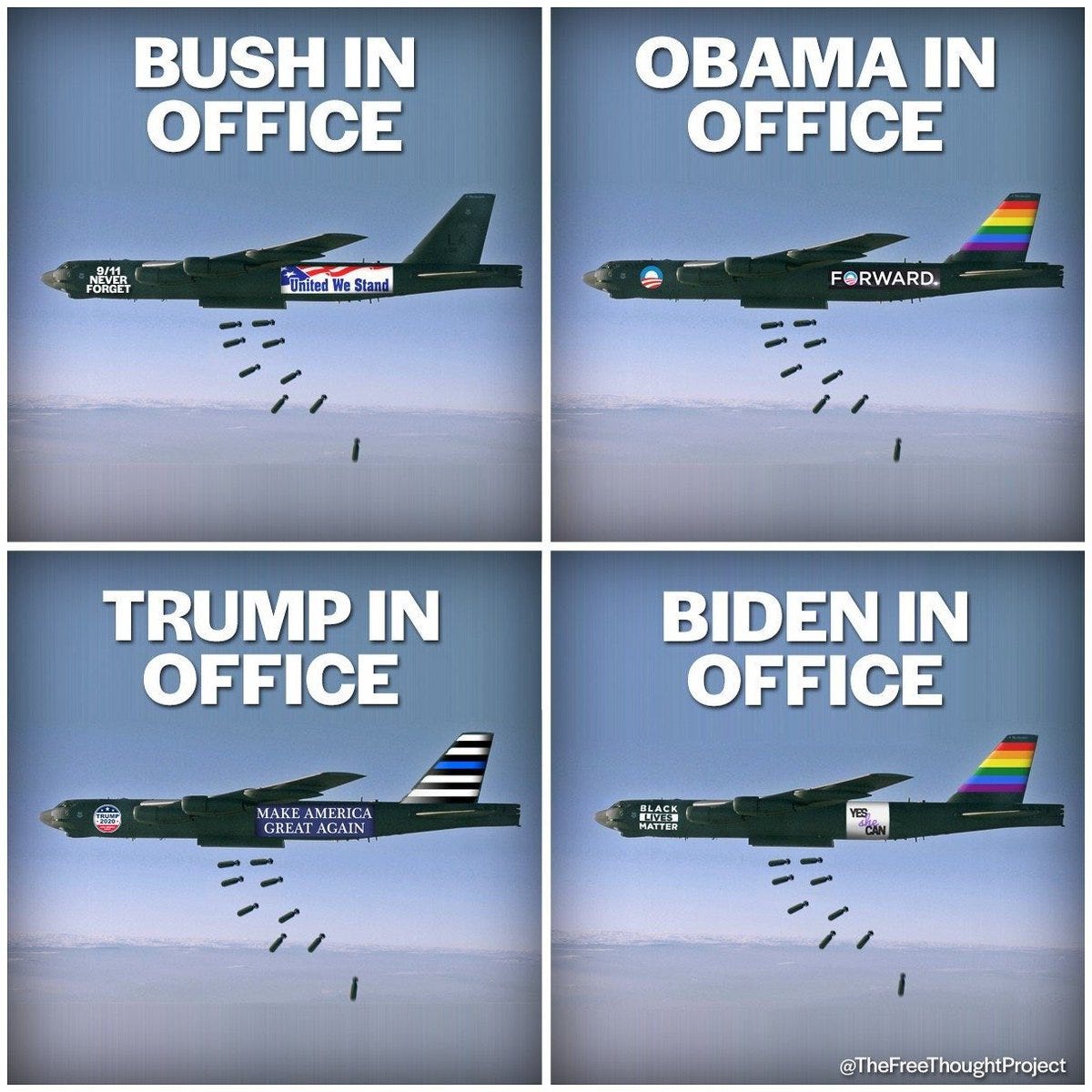
The people on the receiving end of American bombs don’t care if those bombs are from a “woke” B-52 or a MAGA one, or whether the crews of those planes are diverse. Is it better to be bombed by female or gay or Black air crews?
The comedian Jimmy Dore did a recent segment on the CIA’s celebration of Gay Pride Month. Am I supposed to trust the CIA when they wrap themselves in a rainbow flag?
Regardless of who’s been president and which party he’s been from, U.S. military spending has continued to soar. And while Joe Biden finally ended the disastrous Afghan War, the military-industrial-congressional complex is profiting wildly from the new Cold War with China and Russia.
Americans should be deeply concerned with the increasing likelihood of nuclear war, together with the government’s great affection for building even more nuclear weapons. Yet we are actively discouraged by our government from thinking about the unthinkable, i.e. genocidal nuclear weapons and war. “Trust the experts” is the implicit message, along with “pay no attention” to the trillions being spent on new nuclear bombers, ICBMs, and submarines. After all, they’re job-creators!
Reelecting Trump or Biden, or electing younger tools like Ron DeSantis or Pete Buttigieg, isn’t going to change America’s imperial, militaristic, and rapacious foreign policy. I’d like to elect a president who prefers not to drop bombs, a leader who knows that bombs remain bombs whether they’re “woke” or “MAGA” or decorated with rainbow or “blue lives matter” flags.
All around us things are falling apart. Collectively, Americans are experiencing national and imperial decline. Can America save itself? Is this country, as presently constituted, even worth saving?
For me, that last question is radical indeed. From my early years, I believed deeply in the idea of America. I knew this country wasn’t perfect, of course, not even close. Long before the 1619 Project, I was aware of the “original sin” of slavery and how central it was to our history. I also knew about the genocide of Native Americans. (As a teenager, my favorite movie — and so it remains — was Little Big Man, which pulled no punches when it came to the white man and his insatiably murderous greed.)
Nevertheless, America still promised much, or so I believed in the 1970s and 1980s. Life here was simply better, hands down, than in places like the Soviet Union and Mao Zedong’s China. That’s why we had to “contain” communism — to keep themover there, so they could never invade our country and extinguish our lamp of liberty. And that’s why I joined America’s Cold War military, serving in the Air Force from the presidency of Ronald Reagan to that of George W. Bush and Dick Cheney. And believe me, it proved quite a ride. It taught this retired lieutenant colonel that the sky’s anything but the limit.
In the end, 20 years in the Air Force led me to turn away from empire, militarism, and nationalism. I found myself seeking instead some antidote to the mainstream media’s celebrations of American exceptionalism and the exaggerated version of victory culture that went with it (long after victory itself was in short supply). I started writingagainst the empire and its disastrous wars and found likeminded people at TomDispatch — former imperial operatives turned incisive critics like Chalmers Johnson and Andrew Bacevich, along with sharp-eyed journalist Nick Turse and, of course, the irreplaceable Tom Engelhardt, the founder of those “tomgrams” meant to alert America and the world to the dangerous folly of repeated U.S. global military interventions.
But this isn’t a plug for TomDispatch. It’s a plug for freeing your mind as much as possible from the thoroughly militarized matrix that pervades America. That matrix drives imperialism, waste, war, and global instability to the point where, in the context of the conflict in Ukraine, the risk of nuclear Armageddon could imaginably approach that of the 1962 Cuban Missile Crisis. As wars — proxy or otherwise — continue, America’s global network of 750-odd military bases never seems to decline. Despite upcoming cuts to domestic spending, just about no one in Washington imagines Pentagon budgets doing anything but growing, even soaring toward the trillion-dollar level, with militarized programs accounting for 62% of federal discretionary spending in 2023.
Indeed, an engorged Pentagon — its budget for 2024 is expected to rise to $886 billionin the bipartisan debt-ceiling deal reached by President Joe Biden and House Speaker Kevin McCarthy — guarantees one thing: a speedier fall for the American empire. Chalmers Johnson predicted it; Andrew Bacevich analyzed it. The biggest reason is simple enough: incessant, repetitive, disastrous wars and costly preparations for more of the same have been sapping America’s physical and mental reserves, as past wars did the reserves of previous empires throughout history. (Think of the short-lived Napoleonic empire, for example.)
Known as “the arsenal of democracy” during World War II, America has now simply become an arsenal, with a military-industrial-congressional complex intent on forging and feeding wars rather than seeking to starve and stop them. The result: a precipitous decline in the country’s standing globally, while at home Americans pay a steep price of accelerating violence (2023 will easily set a record for mass shootings) and “carnage” (Donald Trump’s word) in a once proud but now much-bloodied“homeland.”
Lessons from History on Imperial Decline
I’m a historian, so please allow me to share a few basic lessons I’ve learned. When I taught World War I to cadets at the Air Force Academy, I would explain how the horrific costs of that war contributed to the collapse of four empires: Czarist Russia, the German Second Reich, the Ottoman empire, and the Austro-Hungarian empire of the Habsburgs. Yet even the “winners,” like the French and British empires, were also weakened by the enormity of what was, above all, a brutal European civil war, even if it spilled over into Africa, Asia, and indeed the Americas.
And yet after that war ended in 1918, peace proved elusive indeed, despite the Treaty of Versailles, among other abortive agreements. There was too much unfinished business, too much belief in the power of militarism, especially in an emergent Third Reich in Germany and in Japan, which had embraced ruthless European military methods to create its own Asiatic sphere of dominance. Scores needed to be settled, so the Germans and Japanese believed, and military offensives were the way to do it.
As a result, civil war in Europe continued with World War II, even as Japan showed that Asiatic powers could similarly embrace and deploy the unwisdom of unchecked militarism and war. The result: 75 million dead and more empires shattered, including Mussolini’s “New Rome,” a “thousand-year” German Reich that barely lasted 12 of them before being utterly destroyed, and an Imperial Japan that was starved, burnt out, and finally nuked. China, devastated by war with Japan, also found itself ripped apart by internal struggles between nationalists and communists.
As with its prequel, even most of the “winners” of World War II emerged in a weakened state. In defeating Nazi Germany, the Soviet Union had lost 25 to 30 million people. Its response was to erect, in Winston Churchill’s phrase, an “Iron Curtain” behind which it could exploit the peoples of Eastern Europe in a militarized empire that ultimately collapsed due to its wars and its own internal divisions. Yet the USSR lasted longer than the post-war French and British empires. France, humiliated by its rapid capitulation to the Germans in 1940, fought to reclaim wealth and glory in “French” Indochina, only to be severely humbled at Dien Bien Phu. Great Britain, exhausted from its victory, quickly lost India, that “jewel” in its imperial crown, and then Egypt in the Suez debacle.
There was, in fact, only one country, one empire, that truly “won” World War II: the United States, which had been the least touched (Pearl Harbor aside) by war and all its horrors. That seemingly never-ending European civil war from 1914 to 1945, along with Japan’s immolation and China’s implosion, left the U.S. virtually unchallenged globally. America emerged from those wars as a superpower precisely because its government had astutely backed the winning side twice, tipping the scales in the process, while paying a relatively low price in blood and treasure compared to allies like the Soviet Union, France, and Britain.
History’s lesson for America’s leaders should have been all too clear: when you wage war long, especially when you devote significant parts of your resources — financial, material, and especially personal — to it, you wage it wrong. Not for nothing is war depicted in the Bible as one of the four horsemen of the apocalypse. France had lost its empire in World War II; it just took later military catastrophes in Algeria and Indochina to make it obvious. That was similarly true of Britain’s humiliations in India, Egypt, and elsewhere, while the Soviet Union, which had lost much of its imperial vigor in that war, would take decades of slow rot and overstretch in places like Afghanistan to implode.
Meanwhile, the United States hummed along, denying it was an empire at all, even as it adopted so many of the trappings of one. In fact, in the wake of the implosion of the Soviet Union in 1991, Washington’s leaders would declare America the exceptional “superpower,” a new and far more enlightened Rome and “the indispensable nation” on planet Earth. In the wake of the 9/11 attacks, its leaders would confidently launch what they termed a Global War on Terror and begin waging wars in Afghanistan, Iraq, and elsewhere, as in the previous century they had in Vietnam. (No learning curve there, it seems.) In the process, its leaders imagined a country that would remain untouched by war’s ravages, which was we now know — or do we? — the height of imperial hubris and folly.
For whether you call it fascism, as with Nazi Germany, communism, as with Stalin’s Soviet Union, or democracy, as with the United States, empires built on dominance achieved through a powerful, expansionist military necessarily become ever more authoritarian, corrupt, and dysfunctional. Ultimately, they are fated to fail. No surprise there, since whatever else such empires may serve, they don’t serve their own people. Their operatives protect themselves at any cost, while attacking efforts at retrenchment or demilitarization as dangerously misguided, if not seditiously disloyal.
That’s why those like Chelsea Manning, Edward Snowden, and Daniel Hale, who shined a light on the empire’s militarized crimes and corruption, found themselves imprisoned, forced into exile, or otherwise silenced. Even foreign journalists like Julian Assange can be caught up in the empire’s dragnet and imprisoned if they dare expose its war crimes. The empire knows how to strike back and will readily betray its own justice system (most notably in the case of Assange), including the hallowed principles of free speech and the press, to do so.
Perhaps he will eventually be freed, likely as not when the empire judges he’s approaching death’s door. His jailing and torture have already served their purpose. Journalists know that to expose America’s bloodied tools of empire brings only harsh punishment, not plush rewards. Best to look away or mince one’s words rather than risk prison — or worse.
Yet you can’t fully hide the reality that this country’s failed wars have added trillions of dollars to its national debt, even as military spending continues to explode in the most wasteful ways imaginable, while the social infrastructure crumbles.
Clinging Bitterly to Guns and Religion
Today, America clings ever more bitterly to guns and religion. If that phrase sounds familiar, it might be because Barack Obama used it in the 2008 presidential campaign to describe the reactionary conservatism of mostly rural voters in Pennsylvania. Disillusioned by politics, betrayed by their putative betters, those voters, claimed the then-presidential candidate, clung to their guns and religion for solace. I lived in rural Pennsylvania at the time and recall a response from a fellow resident who basically agreed with Obama, for what else was there left to cling to in an empire that had abandoned its own rural working-class citizens?
Something similar is true of America writ large today. As an imperial power, we cling bitterly to guns and religion. By “guns,” I mean all the weaponry America’s merchants of death sell to the Pentagon and across the world. Indeed, weaponry is perhaps this country’s most influential global export, devastatingly so. From 2018 to 2022, the U.S. alone accounted for 40% of global arms exports, a figure that’s only risen dramatically with military aid to Ukraine. And by “religion,” I mean a persistent belief in American exceptionalism (despite all evidence to the contrary), which increasingly draws sustenance from a militant Christianity that denies the very spirit of Christ and His teachings.
Yet history appears to confirm that empires, in their dying stages, do exactly that: they exalt violence, continue to pursue war, and insist on their own greatness until their fall can neither be denied nor reversed. It’s a tragic reality that the journalist Chris Hedges has written about with considerable urgency.
The problem suggests its own solution (not that any powerful figure in Washington is likely to pursue it). America must stop clinging bitterly to its guns — and here I don’t even mean the nearly 400 million weapons in private hands in this country, including all those AR-15 semi-automatic rifles. By “guns,” I mean all the militarized trappings of empire, including America’s vast structure of overseas military bases and its staggering commitments to weaponry of all sorts, including world-ending nuclearones. As for clinging bitterly to religion — and by “religion” I mean the belief in America’s own righteousness, regardless of the millions of people it’s killed globally from the Vietnam era to the present moment — that, too, would have to stop.
History’s lessons can be brutal. Empires rarely die well. After it became an empire, Rome never returned to being a republic and eventually fell to barbarian invasions. The collapse of Germany’s Second Reich bred a third one of greater virulence, even if it was of shorter duration. Only its utter defeat in 1945 finally convinced Germans that God didn’t march with their soldiers into battle.
What will it take to convince Americans to turn their backs on empire and war before it’s too late? When will we conclude that Christ wasn’t joking when He blessed the peacemakers rather than the warmongers?
As an iron curtain descends on a failing American imperial state, one thing we won’t be able to say is that we weren’t warned.
Six days ago, I received an email from the New York Times informing me that “The counteroffensive is coming.” It was all about Ukraine and its plans to take the fight to the Russians. Overall, I’d describe the tone of the article as almost giddy. Isn’t it great that Ukraine will soon be killing more Russians?
Readers here know I’m for diplomacy. Russia and Ukraine share a long border and history. They need to find a way to end this war and live together, and we should be helping them do this. The longer the war lasts, the more bitter it will get, even as events become more unpredictable. Nuclear escalation is quite possible. Yet the New York Times is gushing about Ukraine using the element of surprise and combined arms warfare to teach all those nasty Russians a lesson.
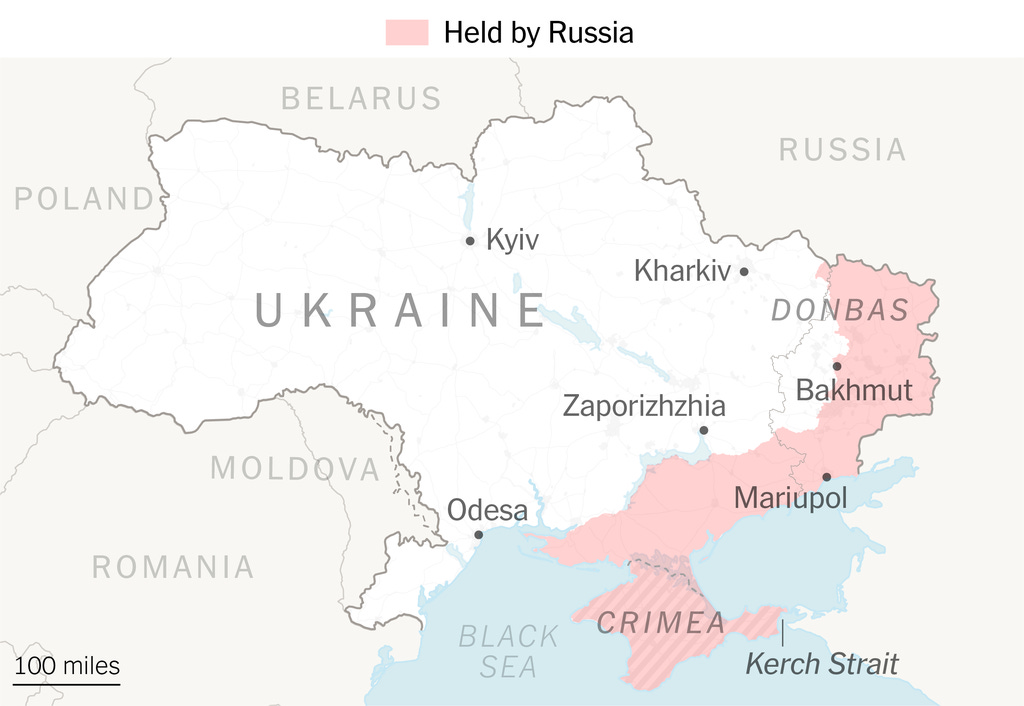
Map from the NYT Newsletter, citing the Institute for the Study of War. Interestingly, the map suggests Crimea as an objective of the promised Ukrainian counteroffensive
I liked this passage from the NYT article/newsletter: “The troops [of Ukraine] have learned a technique known as combined-arms warfare, in which different parts of the military work together to take territory. Tanks punch through enemy lines by rolling over trenches, for example, and infantry then spread out to hold the area.”
It sure sounds nice and clean. Tanks “punch through” and infantry “then spread out.” I’m sure glad the Russians have no tanks of their own, no anti-tank missiles, no machine guns, and no artillery.
Here’s another example from the NYT article of positive thinking and bloodless prose:
In the favorable scenario for Ukraine, a peace deal in which Russia is expelled from everywhere but Crimea and parts of the Donbas region would become plausible. On the flip side, a failed counteroffensive and an unbroken land bridge would provide Putin with a big psychological victory and a foundation from which to launch future attacks.
Only two scenarios? Either the Ukraine counteroffensive is a success, leading to a favorable peace deal, or it stalls, meaning victory for Russia and future Russian assaults? What about a wider war with Russia? Or a wildly successful attack that leads the Russians to deploy tactical nuclear weapons against it? Or an attack that Ukraine can’t sustain, leaving it vulnerable to Russian counterattacks in which Ukraine is convincingly defeated?
No matter what happens, we can count on at least two things as certain: more dead and wounded Russians and Ukrainians, and more profits for all those arms merchants providing weaponry to Ukraine, much of it paid for by American taxpayers, whether they know it or not.
Nowhere in this NYT newsletter is anything mentioned about the human costs of this much-anticipated Ukrainian counteroffensive. There’s only one mention of losses, and that comes with Russia:
Experts have compared the war’s recent months to World War I, with both sides dug into trenches and neither making much progress. Russia lost tens of thousands of troops this year merely to capture Bakhmut, a marginal city in the Donbas.
I’m glad Ukraine “lost” no troops in defending that “marginal city in the Donbas.” And who’s to say which city is “marginal” and which isn’t?
I’ve heard the NYT described as “liberal,” but when it comes to war, the NYT is a bloodthirsty cheerleader. Perhaps that’s the new face of liberalism in America today.
Former President Donald Trump went on CNN last week and said something sensible. When asked if he wanted Ukraine to win the war, Trump replied he didn’t think about the war in terms of winning and losing. His priority was to stop the killing on both sides by ending the war. Naturally, he boasted he could end the war in 24 hours, surely a hyperbolic claim, though if the U.S. ended its massive package of military and financial aid, Ukraine would likely be forced to sue for peace, and quickly.
Interestingly, the CNN anchor badgered Trump, trying to get him to say he favored Ukraine over Russia and that Ukraine had to win. Trump, to his credit, was having none of it. Nor would Trump declare that Putin was a war criminal for the sensible reason that such a declaration would make a diplomatic settlement much more problematic.
Readers here know I’m no fan of Trump. I think he’s a dangerous con man without a clue about what public service is about. But I give him credit for not giving the easy answers, the expected ones, that Ukraine must win, that Russia must lose, that Putin is a war criminal, and that as long as Ukraine wins it really doesn’t matter how many people die in this disastrous war.
Former President Donald Trump at the recent CNN “Town Hall”
The CNN anchor never bothered to define what “winning” looks like for Ukraine. I assume she meant something like this: All Russian troops expelled from Ukraine; democracy flourishing in Ukraine as the country is rebuilt, in part from sanctions put on Russia; Ukraine eventually joining NATO; and perhaps even the end of Vladimir Putin’s power and his possible execution as a war criminal. Such a decisive win for Ukraine is unlikely; what I see is more stalemate, more dead and wounded on both sides, more destruction, and escalatory pressure as the war continues without a clear end in sight.
I can’t fault Trump for wanting to stop the killing in the Russia-Ukraine War. I also can’t fault him for refusing to take the bait and declaring Ukraine must win. It matters because a lot of Americans find Trump attractive because he’s willing to pose as antiwar. Clearly, he’s an alternative to the Democrats and Joe Biden who insist on prosecuting the war for reasons that I believe are largely cynical and self-interested.
Americans are war-weary. Very few Americans, I think, truly want a war with Russia or China. Trump is a serial liar, a venal manipulator, and a selfish braggart, but he doesn’t want World War III. Who knows: that very fact alone might be enough to win him four more years in the Oval Office.
What has America learned from the colossal failure of the Iraq War? Not what it should have learned, notes historian (and retired U.S. Army colonel) Greg Daddis at War on the Rocks. Daddis recently attended a 20-year retrospective symposium on the Iraq War, where he heard two distinctive narratives. As he put it:
Most, if not all, veterans of “Iraqi Freedom” told an inward-facing story focusing on tactical and operational “lessons” largely devoid of political context. Meanwhile, Iraqi scholars and civilians shared a vastly different tale of political and social upheaval that concentrated far more on the costs of war than on the supposed benefits of U.S. interventionism.
In short, the U.S. view of the Iraq War remains insular and narcissistic. The focus is on what U.S. troops may have gotten wrong, and how the military could perform better in the future. It’s about tactical and operational lessons. In this approach, Iraq and the Iraqi people remain a backdrop to American action on the grand stage. Put differently, the Iraqis are treated much like clay for Americans to mould or discard should they refuse to behave themselves under our hands.
So the “lessons” for America focus on how to become better, more skilled, manipulators of the “clay” at hand. Issues of right and wrong aren’t addressed. The morality or legality of war isn’t questioned. And Iraqis themselves, their suffering, their plight, even their say in determining their own futures within their country, is pretty much dismissed as irrelevant. And the same is largely true when considering the Vietnam War or the Afghan War; we matter, they don’t, even when we’re fighting in their country and spreading enormous destruction in undeclared and illegal wars.
As Mike Murry, a Vietnam veteran who comments frequently at this site, has said: you can’t do a wrong thing the right way. America’s Vietnam War was wrong; the Iraq War was wrong. There was no “right” way to do these wars. Yet, far too often, U.S. military officers and veterans, joined by far too many Americans who lack military experience, want to focus on how to wage a wrong war in a better, smarter, often more ruthless, way
Indeed, the narrative at times is reduced to “We lost because we weren’t ruthless enough, or we were about to win until the U.S. military was betrayed.” I wrote about this back in 2007 after I heard Senator John McCain speak on PBS. Basically, his point was that if America lost the Iraq War (which we already had), it wouldn’t be the U.S. military’s fault. It would be the fault of anyone who questioned the war. McCain, in other words, was spouting yet another exculpatory stab-in-the-back myth.
What can we learn from the Iraq War, then? Let’s start with these basic lessons: Don’t fight a war based on governmental lies and unfounded fears. Don’t fight illegal and immoral wars. Don’t fight undeclared wars. Don’t meddle in the societies of other people where you are seen as invaders and about which you are ignorant. Don’t wage war, period, unless the domestic security of the U.S. is truly threatened.
Those seem like the right lessons to me, not lessons about how to recognize insurgencies or how to respond more quickly to asymmetries like IEDs and ambushes.
In sum, learn this lesson: Vietnam, Iraq, Afghanistan, were and are countries with rich pasts and proud peoples who were not about to submit to American invaders and agendas, no matter how well-intentioned those invaders believed or advertised themselves to be.
I don’t get bogged down in the operational and tactical details of the Russia-Ukraine War. I don’t know which side is winning or allegedly winning, or which side is best prepared to launch a spring offensive, or which weapons will allegedly turn the tide (likely answer: none). In my view, both sides are losing, especially Ukraine since the war is being fought on their turf. Each side has suffered well over 100,000 killed. Russia has captured territory; whether they can keep it remains to be seen.
War—it sucks. But let’s keep fighting so someone can “win.” (Natali Sevriukova mourns the loss of her home in Kyiv; Sky News)
My focus is on larger questions and points. Here they are, in no special order:
1. Does Ukraine truly seek to retake Crimea from Russia? If so, how much are the U.S. and NATO prepared to assist in this? Assuming Ukraine can launch such an offensive, how might Russia respond? Is the nuclear option on the table for Putin if Crimea is invaded? Could war in Crimea escalate to World War III?
2. If the U.S. doesn’t like China’s peace plan to end the war, where is the U.S. peace plan? Does the U.S. even have one?
3. If peace talks can’t proceed until Russia withdraws all its forces from Ukraine, doesn’t that mean they’ll be no peace talks without a total military victory by Ukraine? Aren’t we talking about a prolonged and even more murderous war for both sides?
4. Why is it that the West sees peace talks as weakness? Ukraine has done better than expected in battle; can’t Ukrainians negotiate from a position of strength?
5. Diplomats like to say that no one wants war, but that simply isn’t true. Plenty of people make lots of money from war. The longer the war lasts, the more money they’ll make.
6. The U.S. has benefited geopolitically from the weakening of Russia. Economically too with the destruction of the Nord Stream pipelines. That doesn’t delegitimize efforts to aid Ukraine in this war, but it does make you seriously question U.S. motives and intent.
7. Observers have noted inept tactics by Russian forces; at the same time, they call for higher U.S. and NATO spending due to Russia’s dangerous military. Doesn’t Russia’s mediocre performance suggest deliberate threat inflation here? Couldn’t U.S. and NATO military spending be sinking instead of surging?
8. Observers suggest Ukraine is an “aspiring” democracy. Restrictions to free press, high rates of corruption, and similar issues suggest Ukraine’s democratic aspirations are already victims of this war. Since war is the enemy of democracy, it’s unlikely Ukraine’s “aspirations” will survive if this war continues without end.
9. Putin’s invasion of Ukraine was illegal, immoral, and wrong. But that doesn’t mean it was “unprovoked.”
10. Are wars best ended by sending expensive and advanced weaponry to the battlefront?
11. To the claim that reducing U.S. and NATO weapons shipments while promoting negotiation would “embolden” Putin and Russia: If it did and does, just resume the shipments while denouncing Putin for reneging on peace talks.
12. Putin doesn’t want peace; he’s “worse than Hitler.” That claim is more than misleading. If the war is going poorly for Russia, Putin may calculate that a negotiated peace would be better for him in the long run than more killing, especially if the Ukraine boosters are correct about the formidable nature of Ukraine’s planned spring offensive.
13. A U.S. policy decision to work for a negotiated truce and peace could conceivably lead to an end to fighting. That truce/peace could be couched in terms of avoiding a wider war that could escalate to nuclear weapons, while still upholding Ukraine’s right to exist and to pursue its own form of government. Of course, the devil would be in the details with respect to the terms of the truce/treaty. Why isn’t the U.S. working to advance this?
14. Strictly for Americans: What vital national interest does the U.S. have in providing more than $110 billion in aid, and counting, to Ukraine? How are we supporting and defending the U.S. Constitution in Ukraine? Ukraine is not a NATO member. The U.S. has no formal alliance with Ukraine. Ukrainian democracy is (at best) imperfect. Continued support of Ukraine runs the risk of a wider, more calamitous, war. Certainly, Americans can legitimately ask why Ukraine has received $110 billion in one year while U.S. states continue to be starved of funds for the homeless, the mentally ill, education, and other worthy social causes within the U.S. itself.
15. Strictly for Americans: In 2023, is the U.S. to send another $110 billion to Ukraine? How about in 2024? Until Ukraine “wins”? What if the war lasts for five years? Ten years?
In raising these questions and making these points, I seek to promote an approach that lessens the danger of a wider war while saving lives on both sides. Sadly, challenging official U.S. policy often leads to accusations of spouting Kremlin talking points. Which makes me wonder: Is democracy even more tenuous and illusory in the U.S. than it is in Ukraine and Russia? We know Russia is a corrupt dictatorship controlled by Putin. Are we willing to see clearly how corrupt the U.S. government is and how little say the American people have in matters of state?
Humanity wins when wars end. I’m for humanity. I sincerely hope Russians and Ukrainians stop killing each other, and I believe my country should be doing everything in its power to put a stop to this war. That doesn’t mean freezing it so that Putin can allegedly “win.” It means helping to broker a settlement amenable to both sides.
Or should I prefer yet more killing with yet greater chances of dangerous escalation?
It began in August 1914, a war in Europe that was supposed to be over by Christmas of that year. But it exploded out of control, becoming the “Great War” or “The World War” or even “The War to End All Wars.” And when it finally ended on 11/11 in 1918, something like ten million troops were dead.
We know it as World War I or the First World War because we know what came after it: yet another calamitous world war, a sequel, one that was far worse than the original. And after that war finally ended in 1945, something like 75-80 million people were dead around the world, including 25 million in the Soviet Union, six million Jews in the Holocaust, and 250,000 at Hiroshima and Nagasaki.
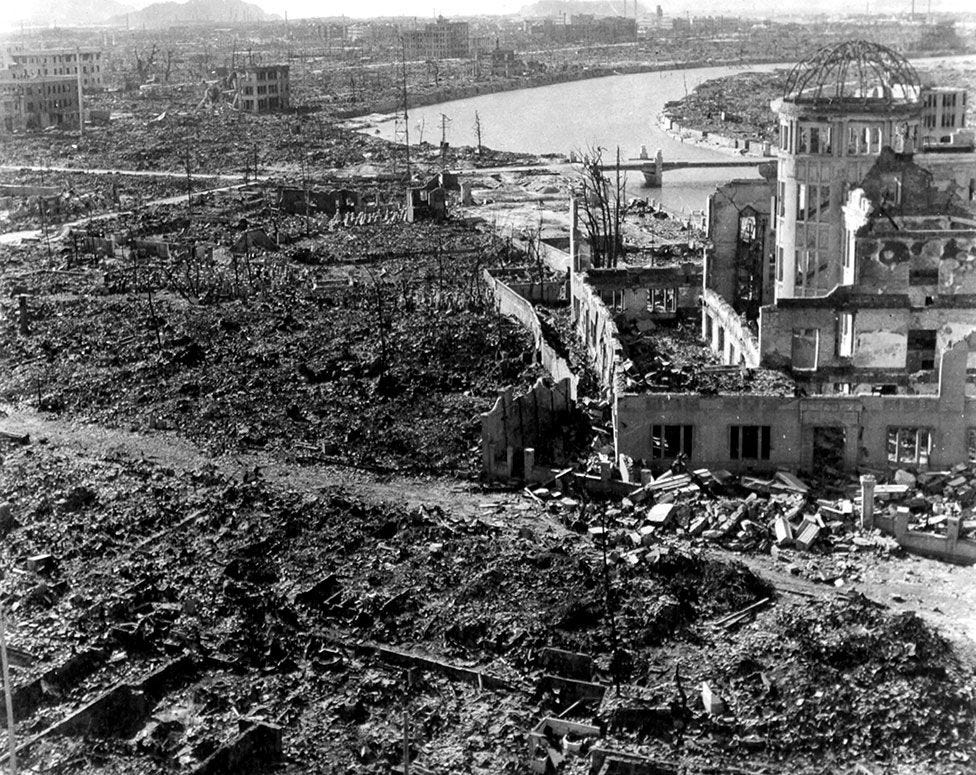
Hiroshima, 1945, after a “small” atomic bomb. Nuclear attacks in a “new” Cold War will be inconceivably worse
Of course, World War II also wasn’t the end of the killing. The so-called Iron Curtain descended in Europe, leading to the Cold War between the U.S. and the Soviet Union that almost ended with Armageddon in 1962 during the Cuban Missile Crisis. That Cold War came to an end in 1991 with the collapse of the Soviet Union. The U.S. celebrated its apparent victory, even calling briefly for “peace dividends” in the 1990s. It was not to be.
Thirty years after the (First) Cold War, we now hear of a “new Cold War.” We hear again that China and Russia are America’s enemies, a new “Axis of Evil,” notes Caitlin Johnstone. America is already engaged in a proxy war with Russia in Ukraine. Now America’s leaders are posturing over Taiwan and threatening war with China if the Chinese military makes aggressive moves against that country. (Of course, the Chinese consider Taiwan to be China, a “One China” policy the U.S. used to support.)
It does seem as if “my” Cold War, when I served in the U.S. military, may be remembered to history as the First Cold War, and that America has already begun a Second Cold War. And, just as World War II was far worse than World War I in casualties and destruction, Cold War II could conceivably be a LOT worse than Cold War I if we choose to continue to wage it.
Sequels, as a general rule, are usually worse, sometimes far worse, than the originals. We had better stop this nonsense of a new Cold War before we relearn this in the hardest way possible.
Military invasions don’t produce democracies—who knew? Whether in Afghanistan or Iraq, somehow the U.S. government worked to convince itself and the American people that democracy could be exported at rifle point. Not surprisingly, military invasions spread what they usually do: death, destruction and chaos while sowing seeds for further violence and conflict. Such is one of the many lessons of Bush/Cheney’s disastrous decision to invade Iraq 20 years ago this weekend.
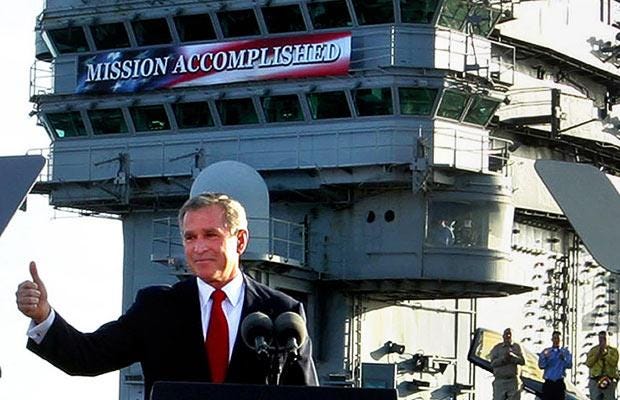
When the U.S. invaded Iraq in March of 2003, I was still on active duty in the military. I was a lieutenant colonel assigned to the Defense Language Institute Foreign Language Center in Monterey, California, or DLI for short. I can tell you this: the U.S. government expected a short and utterly victorious war, since there was no direction to us to expand foreign language training in Arabic. Only after Bush’s premature “Mission Accomplished” speech and the war’s subsequent degeneration into occupation, torture, battles of frustration like Fallujah, and subsequent quagmire did DLI finally get direction and more resources to expand training in Arabic.
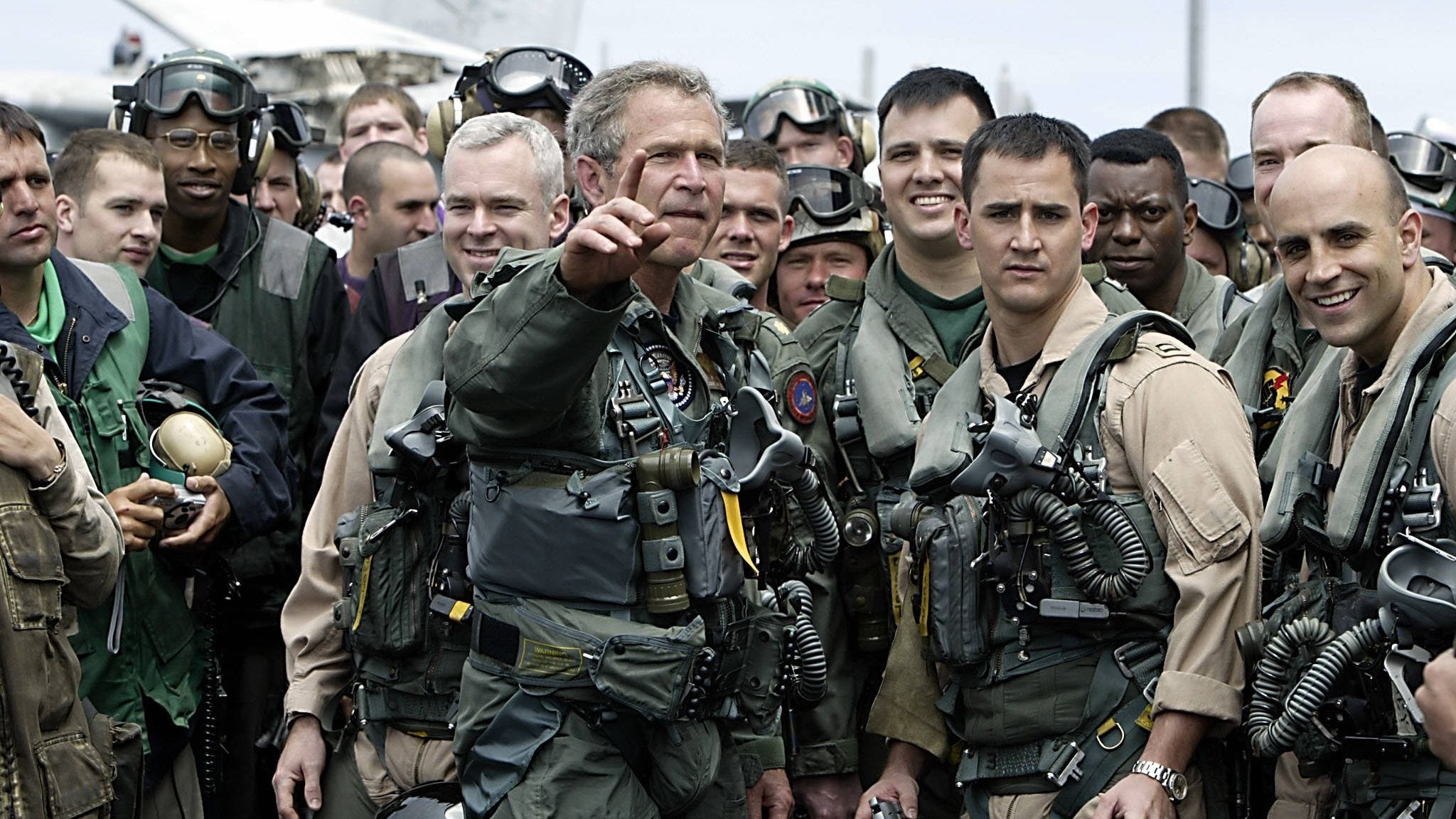
Mission Accomplished! But the Iraq War had only just begun.
That led to my first and only interview as a military officer in May 2005, when a reporter for the CS Monitor asked me about the importance of language training for U.S. troops. Here was my glib reply:
“We are trying to win the peace, and it is very important for us to be able to communicate even at a basic level,” says Lt. Col. William Astore, dean of students at the DLI. “I would much rather have soldiers communicate using words rather than using a rifle butt.”
OK as far as it went, but by the middle of 2005 we had already lost the peace in Iraq and Afghanistan. For one thing, we simply had too few troops with language skills, and it took 16 months to train them to a decent level of competence in Arabic. So we resorted to those rifle butts—and worse.
Another minor controversy at the time was the loss of skilled linguists to the military’s “Don’t ask, don’t tell” policy. As soon as a soldier said he was gay, he was basically gone, regardless of his language proficiency. A few troops gamed the system, finishing the bulk of their language training then self-reporting they were gay. That was enough to get them discharged.
Along with that mess, I recall a friend of mine, an Army major, being sent to Iraq in 2004 and working for the CPA, the Coalition Provisional Authority. He said he and his colleagues at the CPA knew Iraq wasn’t ready for the transfer of power overseen by the hapless L. Paul Bremer, but it went ahead anyway for political reasons.
He also told me how the military filled billets at the CPA and in the Green Zone of Baghdad. Basically, Big Army tasked unit commanders for bodies. The DLI Commandant sent one of his best officers, an experienced and skilled FAO (foreign area officer). But many other commanders took advantage of this “draft” by sending their worst officers to Iraq, the under-performers. At the same time, the Bush/Cheney administration was recruiting inexperienced civilians for Iraq and vetting them based on their views on abortion, capital punishment, and similar hot-button issues within the Republican Party. Combine less-than-competent officers with unprepared and largely clueless civilians and it’s not surprising the CPA performed poorly.
My experience with the chaos of Iraq was indirect and limited, but I well recall an urgent tasking to DLI to help with the translation of a Peter, Paul & Mary song to promote tolerance within Iraqi schools. No, I’m not kidding. Some American in Iraq decided a smart way of defusing ethnic and religious tensions in Iraq was to translate a song for kids. So we gathered some of our best Arabic instructors and quickly learned the song was more than problematic. It was about American kids making fun of other kids with braces and glasses, but any Iraqi kid with braces or glasses would be fortunate indeed. Other lines of the song mentioned gays, lesbians, and a teenage mother trying to overcome her past — not a place we wanted to go.
The song just didn’t translate, just like much of the American effort “to win the peace” and build a stable democratic Iraq didn’t translate (if you accept for the moment that that was the true mission). Too many Americans were prisoners of their own illusions in Iraq, or trying to make a fast buck, while troops at the front were simply fighting to survive a ghastly war, a war that was obviously far worse for the Iraqi people.
In the first few weeks of the Iraq invasion in 2003, the U.S. military did its job fairly well, and by that I mean the narrow mission of destroying Iraqi forces and overthrowing Saddam Hussein. After that, it was one disaster after another, one lie after another, because once Saddam was removed from power and the Iraqi military was disbanded, all hell broke loose. Civil war was the result, and, as I wrote in 2007, you can’t win someone else’s civil war. What we got in place of a “win” were the lies of Bush/Cheney and of General David Petraeus about “progress” in the Surge. But as the weasel Petraeus always said, his “gains” were fragile and reversible, and so they proved.
Of course, the Iraq War was based on alarmist lies (those WMD that weren’t there, those mushroom clouds in American skies). It was then preserved by lies until the lies could no longer be countenanced (or until they proved no longer profitable). Yet the liars were promoted (whether in the military or outside of it) and those who warned of the folly of war 20 years ago or those who tried to reveal the truth about war crimes or profiteering during the war were punished.
Though Donald Rumsfeld lost his job as Defense Secretary, few in the hierarchy were ever called to account for their crimes and blunders, so little was learned and much was forgotten.
So, it’s on to the next war, this time with China or Russia or Iran or whomever, but not to worry, the experts that brought you Iraq and Afghanistan and all the rest will get it right. Just look at their track record and how much they’ve learned!
If you read the mainstream media, it would seem the answer to the Russia-Ukraine War, now about to enter its second year of mass death and widespread destruction, is weapons of various sorts. Western tanks like the German Leopard and American Abrams. Fighter jets like the F-16 produced by Lockheed Martin. If only Ukraine had more tanks, more jets, and the like, they would be able decisively to defeat the Russian military, ejecting it from Ukrainian territory, even from the Crimea, so the argument goes.
As a historian of technology and warfare, I’ve studied this belief in magical weapons. History teaches us that weapons alone usually do not determine winners and losers in war. Weapons themselves are rarely decisive, especially when the sides engaged fight symmetrically. In such cases, new weaponry often increases the carnage.
Consider the events of World War I. Various weapons were tried in an attempt to win the war decisively through military action. These weapons included poison gas (of various types), tanks, flamethrowers, and submarines, among others. None of these weapons broke the stalemate on the Western Front. Countermeasures were found. And World War I dragged on for more than four long years, producing hecatombs of dead.
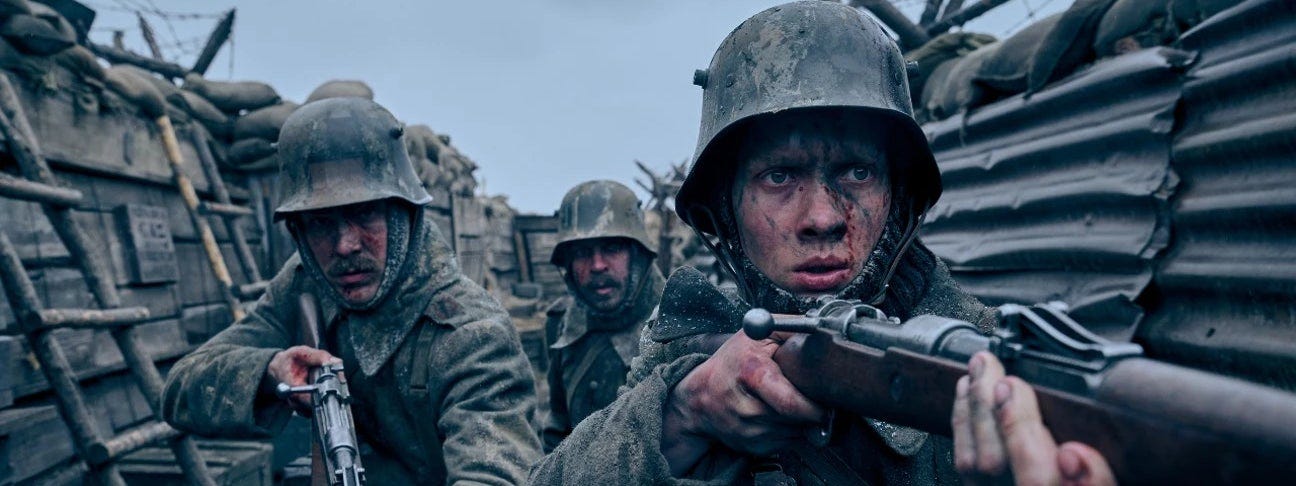
Image from “All Quiet on the Western Front,” 2022, Netflix
What did work? In a word, exhaustion. In the spring of 1918, Germany launched massive, last-ditch, offensives to win the war before U.S. troops arrived in Europe in large numbers. (The U.S. had entered the war in 1917 but was still mobilizing in 1918.) The Germans came close to winning, but when their offensives grounded to a halt, they had little left in the tank to endure Allied counterattacks. Yes, the Allies had more tanks than the Germans, and were learning to use them effectively with airpower in combined arms assaults. But what truly mattered was exhaustion within the German ranks, exacerbated by the Spanish flu, hunger, and demoralization.
No magical weapon won World War I. And no magical weapon is going to provide Ukraine a decisive edge in its struggle with Russia. Certainly not a hundred or so Western tanks or a few dozen fighter jets.
Indeed, looking at some of the media coverage of the Russia-Ukraine War in the West, you might be excused from mistaking it for advertising videos at a weapons trade show. Over the last year, we’ve learned a lot about Javelin and Stinger missiles, HIMARS rocket launchers, and of course various tanks, fighter jets, and the like. But we’ve seen very little coverage of the mass carnage on both sides. It’s been said the real costs of war will never get in the history books, for who wishes to confront fully the brutality and madness of industrialized warfare?
I’m in the middle of watching the new German version of “All Quiet on the Western Front,” a film deservedly nominated for an Oscar for best picture (available on Netflix). It’s one of the better war films I’ve seen in its depiction of the horrific and dehumanizing aspects of modern industrial warfare. Something like this movie is happening currently in Ukraine, but our leaders, supported by the media, think the answer to the carnage is to send even more destructive weaponry so that more troops (and civilians) can die.
Magical weapons are not the answer. For of course there’s nothing magical about weapons of mass destruction.
A favorite movie of mine is “White Heat” (1949) with James Cagney playing Cody Jarrett, one-time gangster and all-time mama’s boy. In the famous ending to the movie, Cody finally makes it to the “top of the world,” in this case a refinery that explodes around him in a fireball that looks something like a nuclear mushroom cloud.
Top of the world, Ma! James Cagney at the end of “White Heat”
America’s foreign policy leaders remind me of Cody Jarrett. They want to dominate. They want to be top dog. They want to play king-of-the-hill, like so many bully-boys, and all that matters is making it to the top.
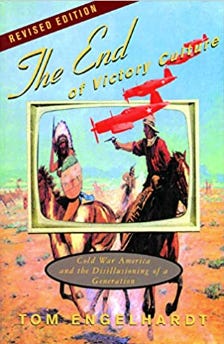
All this came to mind as I read Tom Engelhardt’s latest article at TomDispatch.com. His article reminded me that we as Americans simply don’t like dissent, no matter how well informed, no matter how well intended. In World War I, you weren’t supposed to question a war that President Woodrow Wilson had promised Americans we wouldn’t get involved in. In the 1950s, you weren’t supposed to question virulent anti-communism; you were supposed to salute smartly and demonize all communists everywhere. Today, you’re supposed to hate Putin, distrust the Chinese, and accept fully the idea that the Pentagon is wise to wage a new Cold War that may well end much like the ending of “White Heat.”
Engelhardt’s article salutes dissenters like I.F. “Izzy” Stone, people who are willing to challenge established narratives, to work against demonizing other peoples, to work toward mutual understanding and peace. Indeed, we need more Izzy Stones in America.
These are dangerous times. We’re supposed to go along with wars, with demonizing enemies, with high military spending. Bully-boy rhetoric and tactics are touted as the American way. Our politics is retrograde, our attitude toward the world almost childish, again in a king-of-the-hill way. (America must be king, of course.)
So I fear we may well end up like Cagney at the end of “White Heat.” Our gangster-leaders will shout: “Made it Ma, top of the world!” as the nuclear warheads explode around us.





 Bracing Views