Some Qualities of Good Leadership

Does Donald Trump Exhibit Any?

BILL ASTORE

SEP 29, 2025

Recently, I jotted down some qualities of good leadership. Of course, the importance of specific traits depends on context—a leader who is overly cautious may be a liability in a crisis requiring quick action, though less so in a college faculty meeting. That said, here are thirteen attributes I consider essential, in no particular order:

· Decisiveness balanced with care: the ability to decide informed by experience and consultation.

· Integrity and character.

· Bringing people together–motivating and inspiring them.

· Calmness under pressure.

· Leading by example, or “walking the walk.”

· Honor and trustworthiness.

· A commitment to fairness. Setting high standards that apply equally to all.

· Selflessness. A belief in service.

· Compassion. A hard-ass shouldn’t have a hard heart.

· Open-mindedness. A willingness to listen.

· Humility. A willingness to admit no one knows everything or always gets it right.

· Experience (again). While people want to know a leader cares, they also expect competence. Confidence erodes quickly if a leader doesn’t grasp the fundamentals of the job and mission.

· A commitment to ethics, or “doing the right thing.

That’s my baker’s dozen. Sadly, when I measure Donald Trump against these qualities, I don’t see him embodying any of them with consistency. Yet his supporters insist he is not only effective but “great.” In Trump’s case, does he have the integrity to support and defend the U.S. Constitution? Does he realize that no man is above the law? Is the example he sets a selfless one? Does he bring people together for the greater good?

In business and the military, leadership is often judged narrowly by results—profits earned, battles won. But that standard can elevate sociopaths, people who care only about themselves and about producing results at any cost. Such leaders may achieve short-term gains, like higher profits, but at immense costs to those beneath them. Ultimately, a self-absorbed, “results-at-any-cost” leader drives organizations into the ground.

Leadership can be lonely, in the sense of “uneasy lies the head that wears a crown.” True leaders must sometimes accept unpopularity, stand firm, and take responsibility—“the buck stops here.” Leadership is both privilege and burden, which is why many shy away from it. Sociopaths, by contrast, don’t hesitate; they feel no weight from the consequences of their actions.

So, America, are we doing our best to identify the right—truly qualified—leaders? Evidence suggests we are not.

A final thought. I was once asked, as a young lieutenant competing for “Company Grade Office of the Quarter,” to explain the difference between management and leadership. For management, I said something about teamwork, smarts, effectiveness—taking on a project and bringing it to fruition. For leadership, I remember saying something like the ability to make good things happen. Here I was inspired by Chief Dan George in “Little Big Man” when he asks the Great Spirit “to grant me my old power—to make things happen.” And I remember a friend of mine, another lieutenant, saying the selection board loved short snappy answers. Maybe it was true—I won the award for that quarter.

Zuckerberg Tells a Truth

W.J. Astore

Ready for Your AI “Friends”?

I caught this snippet from Mark Zuckerberg, guru of Facebook:

There’s this stat that I always think is crazy. The average American, I think has, I think it’s fewer than three friends, three people that they’d consider friends and the average person has demand for meaningfully more. I think it’s like 15 friends or something.

If you’re familiar with Facebook, every personal contact you make on there is categorized as a “friend.” When you want to add someone to your Facebook page, you “friend” them. Alternatively, when you want to get rid of someone, you “unfriend” them.

Now, the typical Facebook user has roughly 200-300 “friends.” What Zuckerberg is unintentionally revealing in that snippet above is that Facebook “friends” aren’t real friends. They’re mostly acquaintances. People we’ve met once or twice, maybe even people we’ve never met. They’re not close friends, intimate friends, “real” friends. 

So why call them “friends,” Facebook? For obvious reasons. Just about anyone would like more friends, and indeed I know people with over 2000 “friends” on Facebook. But, again, how many close or intimate friends can you really have?

That’s where Zuckerberg comes in, yet again, riding to the rescue with AI “friends.” Yes, he’s suggesting that the solution to loneliness in America, our lack of intimacy, is AI programs that will be your “friend,” a little bit like the movie “Her” with Joaquin Phoenix and Scarlett Johansson.

So, I suppose you’ll soon be able to buy AI “friends” from Mark Zuckerberg or someone like him. Or perhaps they’ll be offered for “free,” as Facebook is, with your most intimate data being sold to the highest bidder.

I really don’t want AI “friends.” I have a few real friends, people I’ve known for decades, people I do feel close to, and I’m lucky to have them. Two quick lessons come to mind. First, of course, friends aren’t perfect. They can be annoying, frustrating, maddening. (Guess what? I can be too.) Part of being a friend and keeping one is tolerance, acceptance, patience. The second lesson: To have a friend you have to be a friend. If you want people to be there when you need them, it’s a good idea to be there when they need you.

Sorry, Zuckerberg: I don’t think AI “friends” are the answer here. But thanks for debunking the whole idea of “friends” on Facebook.

Superman

W.J. Astore

Truth, Justice, and the American Way

The new “Superman” movie trailer has dropped, and it hit me in the feels.

I grew up watching reruns of those old “Adventures of Superman” episodes starring George Reeves. Then Christopher Reeve came along and embodied the character to perfection in the 1978 film. (To me, Reeve will always be the definitive Superman, just as Sean Connery is the definitive James Bond.) I’ve seen other Superman movies and shows; my wife and I enjoyed watching “Smallville,” a coming-of-age story for the character that was generally thoughtful and interesting. More recently, Henry Cavill made a compelling Superman, though he lacked the easy charm of Christopher Reeve.

I don’t know what it is about Superman—he’s always been my favorite superhero. I think it’s his nobility, his grace, his compassion for the weakest among us. The new trailer shows a flicker of a scene where Superman rescues a young girl from certain death. That, in a flash, is Superman.

There’s one scene in “Superman” with Christopher Reeve that stays with me: when he tells Lois Lane (played with a perfect mix of wide-eyed wonder and hardboiled cynicism by Margot Kidder) that he’s come to fight for “truth, justice, and the American way” and Lane laughs, telling him he’s going to end up fighting every elected official in the country. In a post-Watergate climate, that line resonated with me then; it hits home even more so today.

As a teenager in the 1970s, I had hopes America stood for something, even after the disastrous wars in Southeast Asia, the crimes of Nixon and Kissinger, and all the rest. I thought my country aspired to be something better than what it was.

It’s exceedingly hard to entertain such notions in 2024. America’s war budget just hit nearly $900 billion as Biden/Trump and the Congress continue to support mass murder in Gaza.

I wish a real Superman existed to step in front of all the missiles and bombs we send to Israel that are being used to kill young girls and boys. Better yet, why can’t we be our own Superman and stop the flow of these awful weapons that enable the worst atrocities? Why don’t we act?

Truth, justice, and the American way: words that used to mean something to me. Words that can mean something again, if only we could channel some of the heart, the goodness, and the strength of will of a comic book character known as Superman.

Life Lessons from Diana Rigg

W.J. Astore

Pay Women! And Find a Way for Death with Dignity

This morning, an article on Diana Rigg caught my eye. I loved her in “The Avengers,” which I watched in reruns in the 1970s. She was sexy, smart, vivacious, and tough, and I saw where Vanessa Redgrave said that Rigg was ahead of her time, that she was sexy and smart when women as actors were supposed to be either/or, not both.

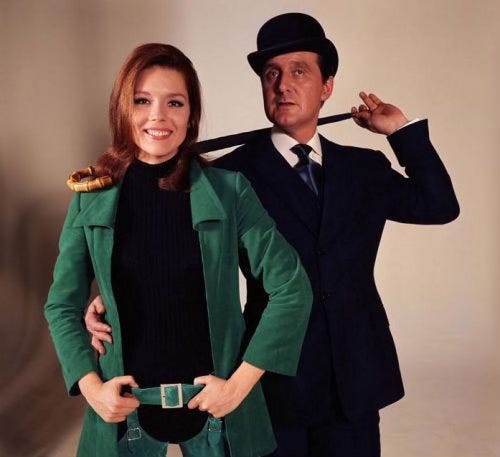
Rigg as Emma Peel in “The Avengers,” 1968

This snippet caught my eye: “I spoke out when I was doing the Avengers and learned I was earning less than the cameraman. I was called ‘money grabbing.’”

Rigg was an absolute star of that show, yet she earned less than a crew member. While the cameraman probably deserved a raise, Rigg deserved to be paid what her male costar, Patrick Macnee, earned. She was as good as gold and better.

The article on Rigg references her painful battle with cancer and how she wished to die with dignity. Death with dignity is something I fully support. I see no reason why people should suffer and die in agony when drugs are available to prevent this. But of course the idea of assisted suicide raises all kinds of ethical and legal questions. And our inhibitions about talking about death and dying contribute to a status quo in which people are expected to “rage against the dying of the light,” no matter how much pain they’re in and no matter how fruitless the raging.

Diana Rigg with costar Patrick Macnee in “The Avengers”

Diana Rigg was a fighter. She wasn’t afraid to speak out for what she believed in. I hope her example inspires others to fight for equity and for dignity in all aspects of life, even death.

Rot at the Supreme Court

W.J. Astore

Injustices, Not Justice

A big part of the American experiment is the idea we are a nation of laws as defined by the U.S. Constitution. The law is supposed to apply equally to all, and disinterested, impartial, justices are supposed to make rulings that are unaffected by money or race or religion or any other factor other than the law itself and what’s right and what isn’t.

That doesn’t describe today’s Supreme Court of the U.S. (SCOTUS).

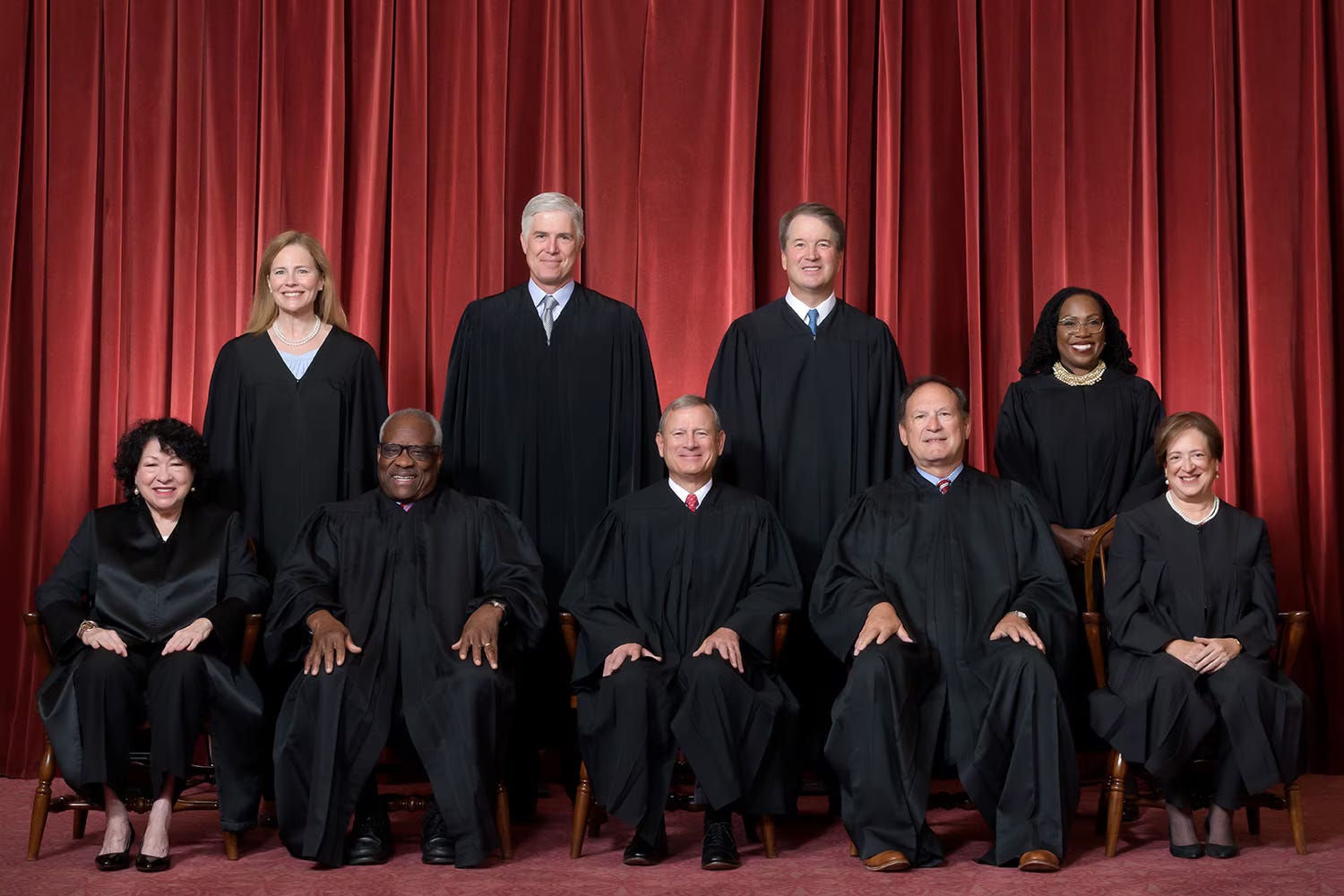
It’s nice to see Justice Thomas smiling so broadly

Justice Clarence Thomas has accepted all kinds of undeclared gifts from a billionaire supporter, including tuition for his great-nephew at private boarding schools. Justice Neil Gorsuch profited from a real estate transaction with a rich law firm CEO with extensive business before the court. Apparently, SCOTUS polices itself here, and so far the SCOTUS cop on watch is asleep.

Justice Brett Kavanaugh gained his seat under a storm of controversy. I wrote in September 2018 that he should withdraw his name from consideration, based on the demeanor he showed at his Senate hearing, but of course he didn’t. Justice Amy Coney Barrett was specifically “saved” by President Trump to replace Ruth Bader Ginsburg; everyone knew she was a conservative Catholic opposed to abortion with a clear record of being pro-business to boot.

You’d think the #1 criterion for a SCOTUS justice would be unassailable integrity, but today it seems to be predictable partisan positions (both political parties are guilty here, though Republicans are more blatant). Allegiance to moneyed interests is a big plus. The latter point is why these justices see no problem with accepting “gifts,” otherwise known as bribes (for that is what they are, in plain speak).

SCOTUS, in short, is becoming a tinier version of Congress, featuring partisan hacks serving elite interests. Of course, not all SCOTUS justices are equally guilty here, but if the court fails to police itself, they are all accessories to the actions of Thomas, Gorsuch, et al.

If we had the best legal minds of unassailable integrity on SCOTUS, a layman like me would have little chance of predicting how the court would rule. Yet we generally know ahead of time the decision SCOTUS will reach and even how the justices will vote.

Sadly, partisan predictability and allegiance to powerful interests rule. And so we have a SCOTUS featuring an increasing number of injustices in place of justice.

Don’t Get Too Big For Your Britches

W.J. Astore

A lesson from my dad

One of the sayings my dad taught me was “don’t get too big for your britches.” It’s sound advice. Too many people are too quick to try to punch above their weight, to push and boast and to try to take charge when they shouldn’t. It’s a lesson my friends and I used to quote from the movie “Magnum Force,” where Inspector Harry Callahan, played to perfection by Clint Eastwood, reminds those around him that “a man’s got to know his limitations.”

You’re in the CCC now. My dad is on the far left, seated in front.

Recently, I was reading my father’s journal that recounts his days in the CCC, or Civilian Conservation Corps, during the 1930s at the height of the Great Depression. My father had ringside seats to a boxing match that didn’t end well for a fighter who most definitely didn’t know his limitations and got too big for his britches. But I’ll let my dad recount the story:

James Strollo was a misfit and a welterweight boxer on our team.  About 5’6” tall, he was a “no mercy” fighter.  A tall Irish boy who was a lightweight sparred with him but later refused to box with him.  Jimmy would try to knock out anyone he trained with.  But a bantamweight boxer, Jimmy Souza who fought professionally was a good friend of Jimmy Strollo—about the only feller he wouldn’t try to hurt while sparring.

Well, Al Gelinas was a pro boxer from Holyoke, Mass., who agreed to help our CCC boxing team.  He was a ranking welterweight and a real nice guy.  He agreed to fight an exhibition match with Jimmy Strollo.  The show was put on for all the CCC camp members.

The bell rang for the first and only round of the Gelinas/Strollo fight.  I was standing next to the ring and had a good view of the match.  Well, Strollo made a big mistake.  Instead of just boxing and putting on a good show, he started to pressure Al and tried to knock him out.  Well, two left jabs, a left hook, and a beautiful straight right and Strollo was K.O. right in front of me.  What a sight.  Strollo went glassy eye from the punches and collapsed on the canvas.  All the fight was taken out of him.  Nobody blamed Al Gelinas for the K.O. of Strollo.  I hope Strollo learnt a lesson.

Willie, most fighters are the nicest people you can meet.

Be careful picking your fights — and be very careful fighting against someone more skilled than you. Push too hard and you’re likely to be knocked on your britches.

We All Represent “Diversity”

W.J. Astore

On not judging books by their covers

It was only a few years ago that I learned I’m a “cis white male.” As such, I guess I’m a dime a dozen. Ordinary. Not representative of “diversity.”

I get it. I’m a historian so I know something about how various peoples have suffered extreme, even murderous, prejudice and exploitation over time. I’ve taught about slavery, the Holocaust, and various forms of discrimination against women and minorities, among other groups and peoples. The list goes on and on. The recent shootings in Colorado Springs where the LGBTQ community was targeted reminds us that too many people see diversity as a threat.

If only we could see ourselves just as human beings in all the richness that term describes. We are all part of the human community. We contain multitudes, as Walt Whitman said.

These people aren’t diverse. Where are the unhappy people? Seriously, this stock image is supposed to represent diversity, but I don’t see any blue-collar workers. Where’s the cleaning crew? Is everyone in this company lean and fit? Too often, even “diversity” images lack diversity.

Nevertheless, I understand how various people and organizations want to exhibit diversity by hiring or showcasing more women, or more Blacks, or more members of the LGBTQ community, and so on. It seems as if guys like me have ruled the world (or we act as if we have) for so long that we need to be taken down a peg or two. Or three.

What happens, sadly, is that in some cases what we get is what my wife likes to term “optical” diversity. Think about the U.S. government. You get a Black female (think Condi Rice) in a position of power, but she basically thinks and acts the same as a cis white male neo-conservative. You get a Black male (think Lloyd Austin) in a position of power, but he’s basically a card-carrying member of the military-industrial complex. You get “Mayor” Pete Buttigieg in a position of power, but he’s just another government technocrat spouting bromides in the pursuit of power.

Optical diversity shouldn’t be the main goal. What we’re striving for, or should be striving for, is diversity of perspectives, of life experiences, along with an openness to new ideas and viewpoints. A willingness to listen, to learn, to come together based on mutual respect, a shared commitment to work toward justice.

What about me? Am I just another aging cis white male? Just another out-of-touch white guy? Okay, Boomer!

I hope not. I was taught by my parents not to judge a book by its cover. So how do I represent diversity? If you were looking for “diversity,” would I fit the bill (no pun intended)? Here are ten reasons why I might be a “diverse” human:

  • I’m politically independent. In my life I’ve voted Republican, Democrat, and Green. I’m generally “progressive,” though I find labels reductive.
  • I’m a military veteran who’s written a lot of articles that are highly critical of the U.S. military.
  • I’m from a blue-collar family and I’m the first in my family to finish college.
  • I was educated as a mechanical engineer before I turned to history, where I specialized in the history of science, technology, and religion.
  • Speaking of religion, I was raised Catholic but now consider myself to be agnostic. I did my master’s thesis on Catholics and science; for my doctorate, I turned to evangelicals and science. I have a keen interest in both science and religion, respecting both of them as ways of knowing, ways of making sense of the world and ourselves.
  • I love the outdoors and consider myself to be pro-environment. So, for example, I am against fracking because of its demonstrable harm to our planet.
  • I lived and studied overseas in England for three years and have traveled to Italy, Germany, Scotland, and Wales. I gained a new perspective on America by being away from it.
  • I’m an introvert. (Do you want your team or organization to be all extroverts?)
  • I’m a science fiction fan. My favorite character on “Star Trek” is Mr. Spock. Yes, I can be a bit of a geek.
  • I like sports. Being from New England, I’m a fan of the Red Sox, Patriots, etc. I probably spend too much time watching “my” teams compete. My wife and I broke out bottles of champagne to celebrate the Red Sox winning the World Series.

Here’s my real point: All of you, everyone reading this, could make a similar list to showcase your (and our) diversity. In fact, if you’re reading this and would like to comment and share, please put a couple of things below that mark you as a “diverse” person. Because we all contain multitudes. Thanks so much.

Don’t Play the Sap for Any Government

W.J. Astore

In The Maltese Falcon, Humphrey Bogart famously tells Mary Astor that he won’t play the sap for her. It’s an immortal cinematic line:

https://www.youtube.com/watch?v=wPT49WXC0Zo

It’s election time in America, meaning there are plenty of candidates wishing we’d all play the sap for them. Don’t do it. Vote for those you believe in: candidates who are principled and have a record of taking bold stances and of telling the truth. People like Matt Hoh, who’s running for the Senate as a member of the Green Party in North Carolina.

Occasionally, I need to state the obvious, if only to remind myself of the realities of this world. All governments lie and all have their instruments of repression. The most dangerous government is most likely your own government, whatever country you live in, because that governing party has direct power over you, and also because you’re likely to have some allegiance to it, perhaps even some affection for it. As an American, for example, it’s far easier to play the patriot than to act as a dissident. The patriot gets applauded and rewarded; the dissident gets attacked and punished.

The U.S. government, like any other government, lies. Think of the Pentagon papers, the Afghan War papers, the “slam dunk” case of WMD in Iraq that were never found, and so on. All governments lie, as I.F. Stone said.

The message is simple: Always question authority, whether it’s Russian or Chinese or American. Be skeptical. Don’t play the sap. Make Humphrey Bogart proud.

Joe Biden’s Failure to Raise the Federal Minimum Wage

W.J. Astore

When Joe Biden was running for president in 2020, he promised to raise the federal minimum wage for workers from $7.25, where it’s sat since 2009, to $15 an hour.  Today, despite his promise and surging inflation, the federal minimum wage remains at $7.25.

My Democratic friends tell me that Biden wants to keep his promise and that it’s not his fault that nothing has been done.  Senators Manchin and Sinema are obstructing him.  Senate parliamentary procedures are roadblocks too.  Poor Joe Biden.  He’s the “leader of the free world,” the most powerful person in America, but his powers are limited by recalcitrant members of his own party, who are blocking Lunch Bucket Joe from helping workers across America.

I’m not buying it.  Occam’s Razor applies here.  Since 2009, the Democratic Party hasn’t raised the minimum wage because the leadership hasn’t wanted to.

Sure, Democrats say they want to do it.  But I trust Americans are familiar with politicians and the sincerity of their “promises.”

Consider the promises made by Barack Obama and Joe Biden to codify Roe v. Wade into law; indeed, Obama in 2007 said it would be his top priority as president, only to backtrack when he took office.  Biden in 2020 made similar promises but accomplished nothing.  But I’m sure it’s not their fault.  They tried but something or someone was always in their way.

Sadly, Democrats like Obama and Biden are compromised, corrupt, and, with respect to helping workers, not that much better than the MAGA Republicans they profess to despise as enemies within.

Consider again the federal minimum wage, which hasn’t gone up since 2009.  Obama/Biden had nearly eight years in office to raise it above $7.25 but they never did.  When Bernie Sanders ran his insurgent campaign in 2015-16, he made a “radical” proposal to raise it immediately to $15.  Hillary Clinton countered with $12 to be phased in over time.  Under much pressure, she eventually gave unconvincing lip service to $15.  She lost the election, of course, to a trumped-up celebrity apprentice and failed casino owner.

Despite this history, my Democratic friends tell me I simply don’t understand separation of powers in the U.S. government.  Presidents Obama and now Biden truly wanted to raise the federal minimum wage but were hamstrung by Congress and members of their own political party.  Interestingly, my Democratic friends rarely mention how their party is aligned with big business and corrupted by big money (as is the Republican Party).

There’s a clear reason why the federal minimum wage remains stuck at $7.25 an hour: Establishment Democrats are simply against raising it.  Sure, they always promise to, but then something always goes wrong.  Just as Lucy always promises to hold the football so Charlie Brown can kick it, only to pull it away every time Charlie goes to kick it.  She doesn’t know why; it just happens.

Once again, the $15 football is swept away when Charlie Brown goes to kick it (Joey Waggoner)

I come back to the words of Thucydides: The strong do what they will and the weak suffer as they must.  Powerful people and institutions, either in or aligned with the Democratic Party, are against raising the federal minimum wage, including Joe Biden. My proof is the total lack of results since 2009 in raising that wage.

Few things would help women and minority workers more than a $15 minimum wage, simply because women and minorities have more of the jobs that don’t pay well.  Unfortunately for them, they can’t hire big-money lobbyists or make huge campaign donations to the Democratic Party.  In America, where money is speech, they simply don’t have the money to have their say.

Assuming Biden runs again in 2024, I’m guessing we’ll hear another promise about a $15 minimum wage.  And then, assuming he wins, we’ll hear yet more excuses about how Joe just can’t get it done because of the filibuster or whatever.  Just think Charlie Brown, the football, and the American worker landing flat on his back as promises for fairer wages yet again go unfulfilled.

Transvestism as a Cultural Phenomenon and a Political Issue

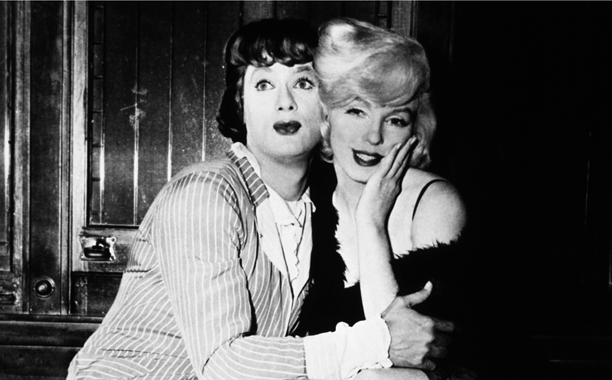
Tony Curtis with Marilyn Monroe, “Some Like It Hot”

Richard Sahn 

Discussions and readings about social deviancy are exciting in the liberal arts college classroom. One example of deviant behavior in contemporary American society I always looked forward to discussing is trans-vesting. The word means cross-dressing, intentionally wearing the garments culturally designated for the opposite sex, a taboo violation depending on where you live.

In a hypothetical society where men and women are not socially or even legally restricted in what they can wear it would be impossible to cross dress or trans vest. In most Western countries today, it is very difficult if not impossible for women to cross dress. The reason should be obvious:  it is now acceptable for females to wear clothing, such as trousers, once meant only for males. On the other hand, in a Muslim culture or community a woman can, indeed, cross dress if she wears, say, coat and tie.  Transvestites like to argue that if a woman can wear “male” clothing why can’t men wear “female” garments?

I’m not a transvestite myself so how did I become invested in the subject and, more importantly, why am I such a fan of transvestism? It all started when I asked a friend of mine who knew a transvestite from New York City to invite someone he knew to speak to my sociology class when I was covering social deviance. At the end of the class where he spoke, I interviewed him on tape. According to Michael, the guest speaker, and to subsequent research I did on the subject, there are five psychologically significant reasons why men trans vest:

  1. Auto-eroticism: When a transvestite looks at himself in the mirror, he becomes physically attracted to himself. The image in the mirror is an alter-ego. Perhaps a masturbatory fantasy.  No dating service required. And no flowers.
  2. Benign rebelliousness: Cross-dressing is a type of rebellion against mainstream society.  The transvestite is a rebel with a cause.
  3. Attracting other males (the drag queen). Most transvestites are heterosexual, but a sub-category of cross-dressers are gay males who, while in drag, want to be with other males. And there is a sub-category of this sub-category, namely, gay transvestite males who desire other males in drag.
  4. Sociological envy: Getting more respect or attention appearing as a female. The cross-dresser may feel that he lives in community that is more concerned with the rights of girls and women than with boys and men. As comedian Rodney Dangerfield always used to say as part of his stand-up act, “I get no respect.” (Perhaps Rodney shouldhave become a transvestite.) 
  5. Finally, female impersonation by a male actor on stage, such as the old Milton Berle and Flip Wilson shows or Tony Curtis and Jack Lemmon in the movie, “Some Like it Hot.”

As a straight male I welcome the cross dresser. I want to live in a society, or at least a community, where LGBTQ+ is acceptable, maybe even encouraged. Frankly, I take delight in people who exhibit forms of unconventional behavior and desires which are harmless to the public. They are a relief from those who consistently conform to conventional dress code norms.  I simply feel freer, socially and even legally, to engage in unconventional behaviors and conversations.

Spare us from the xenophobes and haters in politics who would return us to the “respectable” conformist behaviors of other eras.

Clarifying Notes

A transvestite is not a transsexual. The latter is a person who literally changes physically, and to some extent, physiologically to the opposite sex—the so-called sex change operation. The transvestite male only identifies temporarily as a female and thus usually has no problem using restrooms designated for males. (Of course, he might have a problem if he is still dressed in drag with other males thinking he is female.)

Why do some people, notably men, fear transvestites? My guess is that they see the male in drag as a threat to their masculinity or male identity, especially if they have the slightest desire (perhaps on an unconscious level) to wear female garments.

What about legal rights for trans people? My position is that in any society people should be free from the fear of being abused for appearing the way they want to appear. Anyone who abuses another person for his/her/their appearance should be subject to fines or imprisonment.

Richard Sahn, a retired sociology professor, is an occasional contributor to Bracing Views.