Supporting trillions of dollars “to update and modernize our nuclear arsenal” is akin to advocating for more production of Zyklon B and improved gas chambers.
Incendiary claim? I think not. Like Zyklon B, nuclear weapons are genocidal. They are designed to kill millions; used en masse, they will kill billions. They are ecocidal as well; nuclear weapons with their intense heat and blast and radiation kill virtually everything in their radius. How can anyone who’s sane want more of them?
I happened to catch Kelly Ayotte, a former U.S. senator who’s now the Chair of the Board of Directors for BAE Systems, a major weapons contractor, say that she’s “always” been a strong supporter of updating and modernizing the U.S. nuclear arsenal. Of course, she and her company stand to profit from this. But at what cost to life on this planet?
Nevertheless, nuclear “modernization” proceeds apace in the U.S. at an estimated cost of nearly $2 trillion over the next few decades. Is this not the very definition of a murderous insanity?
As Daniel Ellsberg pointed out, U.S. nuclear attacks plans in the early 1960s could have resulted in the death of 600 million people, mainly in China and the Soviet Union. As Ellsberg noted, the U.S. was prepared to launch 100 Holocausts in the name of defending its “ideals.” (And this was before we knew about the dangers of nuclear winter.)
This murderous madness has to stop before we put an end to ourselves and our planet.
We’ll produce new nuclear missiles like so many sausages. But it’s all OK because we need to “update” and “modernize” our (genocidal and ecocidal) nuclear arsenal. Sure makes me proud to be an American.
Addendum: When you think of nuclear weapons as “investments” or as “sensible” (see comments), please consider this scene from “Terminator II.”
What is “sensible” about any of this? Sorry, count me out of “investing” in mass death via nuclear holocaust.
Thirty years ago, I co-taught a course on the making and use of the atomic bomb at the U.S. Air Force Academy. We took cadets to Los Alamos National Laboratory in New Mexico, where the first nuclear weapons were designed and built during World War II, and we also visited the Trinity test site, where the first atomic device exploded in a test conducted in July of 1945. It was after that first test when J. Robert Oppenheimer, the father of the atomic bomb, mused that he had become death, the destroyer of worlds. And that is what nuclear weapons are: they are death, and they can literally destroy our world, producing nuclear winter and mass sickness and starvation.
Over the last two years, the Covid-19 pandemic has killed millions of people across the globe. A general nuclear war could kill billions of people in a matter of days. As Soviet Premier Nikita Khrushchev reportedly said in 1963, “The living will envy the dead” after such a nuclear cataclysm.
Not a good idea
Despite this, an intellectual fad of the Cold War era was to “think about the unthinkable,” to “war game” or plan for various nuclear “exchanges” resulting in the deaths of hundreds of millions of people, even to imagine that there could be a “winner” of such a war. Remarkably, in the context of the ongoing Russia-Ukraine war, that fad is returning today as pundits write articles that suggest the US needs to show the Russians it is willing and able to fight and win a nuclear war, as an op-ed in the Wall Street Journal argued on April 27th of this year.
Such suggestions are madness.
As a young Air Force lieutenant, I sat in the Missile Warning Center in Cheyenne Mountain during an exercise that simulated a nuclear war. This was 35 years ago, but I still remember those simulated Soviet missile tracks crossing the North Pole and ending in various American cities. There were no snazzy special effects or colorful high-definition computer monitors. It all happened in silence on a monochrome monitor as I sat under two thousand feet of solid granite in America’s largest nuclear bomb shelter. “There goes Kansas City,” somebody quietly said. It was a sobering experience that I’ll never forget.
Many years later, I watched a stunning documentary, The Day After Trinity, that detailed the development of the atomic bomb. I’ll never forget the words of Hans Bethe, legendary physicist and one of the bomb’s key developers. The first reaction among the scientists to the news the bomb had exploded over Hiroshima, Bethe recalled, was a feeling of fulfillment. The crash project to build the bomb had worked. The second reaction was one of shock and awe, of “What have we done,” Bethe quietly noted. And the third reaction: It should never be done again. And after Nagasaki the world somehow managed not to do it again, despite nearly catastrophic events like the Cuban Missile Crisis 60 years ago.
I was raised Roman Catholic, and I can think of no worse crime against humanity than mass murder by genocidal weaponry, not only of ourselves but of all life forms that would be vaporized by thermonuclear warheads. Let’s not think about the unthinkable; let’s not think we must show the Russians (or anyone else) that we’re willing to use nuclear weapons. Rather, let’s achieve the difficult but doable. The only sane course of action here is for all the world’s nations to negotiate major reductions in nuclear arsenals with the eventual goal of total nuclear disarmament.
I was thinking today about my old service branch’s core values. No — not “more fighters, more bombers, more missiles” or “put bombs on target” or “jet noise is the sound of freedom” or “show me the money!” or that old Strategic Air Command classic, “peace is our profession.” No — the core values all airmen are supposed to uphold — integrity first, service before self, and excellence in all we do, in that order, sometimes abbreviated as integrity, service, excellence. How’s the Air Force doing here?
Not well, I’m afraid. Think of “integrity,” which I think of as truth-telling. Over the last 20 years, and indeed over the life of the service, going back to 1947 and before, the Air Force has consistently overestimated the accuracy of its bombing and consistently underestimated the number of civilians and non-combatants killed by that bombing. And that’s putting it charitably. In reality, the Air Force has conspired to advance an image of airpower as surgical and precise when it clearly isn’t, and indeed never has been. My old service branch advances this image because it’s good for the Air Force. It’s really that simple. Such image-making, i.e. lying, may be good for the Air Force budget, but it isn’t good for integrity. Nor is it good for America or those unfortunates on the receiving end of U.S. munitions.
Turning to “service before self,” I think of a system that when I served often stressed and rewarded self before service. For example, the promotion system in the military was structured to reward the hard-chargers, the overachievers, Type-A personalities, the thrusters and the true believers. Perhaps this is true of most bureaucracies, but the emphasis on ticket-punching and hoop-jumping in the Air Force was conducive to a narrow form of achievement in which “service” played second fiddle, when it played at all. Another way of putting it is that a certain kind of personal selfishness is more than acceptable as long as it advances institutional goals and agendas — a quite narrow form of service, if one is again being charitable.
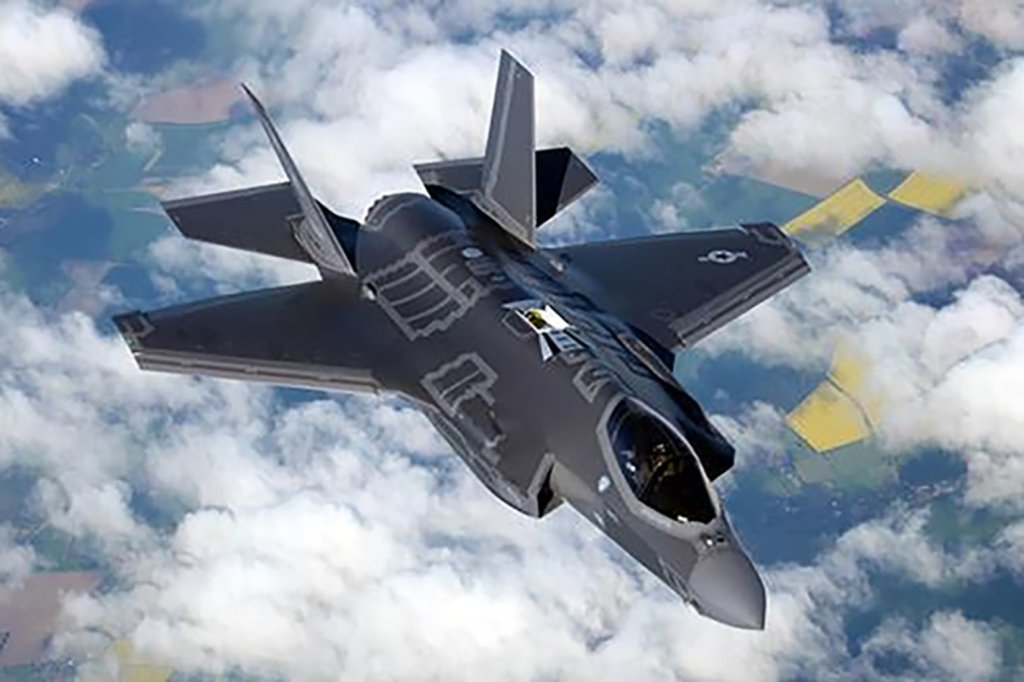
And now we come to “excellence in all we do,” which brings to mind all kinds of disasters, such as drone strikes that kill innocents, or wayward generals, or cheating nuclear missile crews, and so on. But I’d like to focus on recent procurement practices, such as the lamentable F-35 jet fighter, which was supposed to be a fairly low-cost, high-availability fighter but which even the Air Force Chief of Staff now compares to a Ferrari, i.e. super-expensive and often in the shop. From tankers that can’t refuel to fighter planes that can’t shoot straight to nuclear bombers and missiles that the country (and, for that matter, humanity) simply doesn’t need, the Air Force’s record of excellence is spotty indeed.
What are we to do with a service that is so unwilling or unable to live up to its core values? Well, as usual, accountability and punishment are out of the question. I guess we’ll just have to give the Air Force more money while hoping it’ll reform itself, because you know that strategy always works.
The F-35 “Ferrari”: It costs a lot and is often in the shop, but it looks kinda sexy. Too bad the F-35 was supposed to be a reliable workhorse, not a temperamental stallion. Interestingly, the inspiration for the Ferrari symbol of a prancing horse came from an Italian fighter pilot during World War I.
I subscribe to a news feed called “Breaking Defense” (the name may be more ironic than the site creators intended). I saw this advertisement today, which sums up much of what is common in America, where jargon substitutes for thought:
Kratos’ next generation unmanned aerial target drones and their capabilities continue to evolve to represent ever changing, evolving threats from near-peer adversaries to best prepare the American warfighter while keeping costs down for the American taxpayer.
I know nothing about the company (Kratos), but it does appear to have a good command of Pentagon jargon. Those “near-peer adversaries” (meaning China and Russia, mainly). Those “ever changing, evolving threats.” And of course the almost obligatory appeal to the “warfighter.”
From this ad (and others like it), it’s simply assumed that America will always be at war. There’s also an assumption that Americans fall into two basic categories: warfighters and taxpayers. Warfighters are the doers, the hard men and women on the front lines, deserving of everlasting support and praise, and the taxpayers are there to fund it all and cheer along. Naturally, there’s no mention of “peacemakers.”
If we truly want to keep costs down for the American taxpayer, maybe we shouldn’t buy any of these target drones?
In the same email send-out, here’s a sample of the articles at “Breaking Defense”:
In 2022, the Pentagon will need to see real movement on acquisition reform to reduce long understood vulnerabilities that have been essentially ignored for many years.
Here’s the key Army storylines we’ll be tracking at Breaking Defense next year.
Seems like the “Space Force” will be spending lots of money in 2022 due to “vulnerabilities.” Meanwhile, a Russian invasion of Ukraine might “derail” the DoD’s “new strategy.” And the Army is looking at “multi-domains,” which I assume is a smart way for the Army to expand its budgetary reach in the new year.
Nice to know the Pentagon has a new strategy, but how could a Russian incursion into Ukraine derail it? If the U.S. invaded Mexico, would that derail Russia’s defense planning? Or China’s?
Here’s another ad from a different “Breaking Defense” send-out.
Systel’s fully rugged computing solutions are purpose-built for the most demanding environments and workloads. High performance, SWaP-optimized, single LRU solutions supporting edge AI and force-protection missions. MOSA/CMOA, SAVE, and GCIA-compliant. Fully rugged, configurable, and modular. Centralized sensor ingest and data fusion support.
Ah, the good old days of military acronyms! Again, I know nothing about Systel, but the company has a solid command of opaque acronyms. Even the ad has redundancy in the sense that it mentions “fully rugged” twice! Note the mission of “force-protection,” as in keeping U.S. “warfighters” safe while in harm’s way.
Maybe we should keep our troops safe by not putting them in harm’s way, unless the defense of America truly requires it?
There’s nothing special about these ads or stories, which is why I cite them here. Just another day in the American empire of warfighters buying weapons systems to force-protect and confront near-peer threats out to exploit our vulnerabilities across multiple domains. Or, put simply, multi-domain everything!
Did you know Vice President Kamala Harris is Chairwoman of the National Space Council? I didn’t — until a friend notified me of a feel-good video featuring Harris and a few earnest and photogenic kids on YouTube. The kids were decidedly diverse: boys and girls, black and brown and white, but they all had something in common. No, it wasn’t their enthusiasm for space — it’s that they were all paid actors.
As my wife and I watched the video, my better half turned to me and said, “stagey” and “fake.”
I had to laugh as Kamala Harris tried to wow the kids about seeing craters on the moon. My goodness — on a clear night you can see craters with the naked eye. A decent pair of binoculars (I have 10×50 Tasco binoculars) will reveal plenty of gorgeous detail. You don’t exactly have to visit the Naval Observatory to see moon craters.
Even through my relatively cheap $200 camera, I can see plenty of detail. Here’s a photo I took of the moon, a handheld shot done quickly and inexpertly:
The Moon by me. Look at the craters!
I have some experience talking to real kids about astronomy. Elementary school kids can be fun. One class I talked to wanted to know all about UFOs. Another wiseguy kid asked about Uranus, pronouncing it “your anus,” of course. I smiled, quietly corrected his pronunciation, and answered his question. We both had a laugh.
Yet apparently Kamala Harris is not to be trusted talking to real kids who might go off-script. Perish the thought of a kid who might make a joke about Uranus. The horror! It doesn’t inspire confidence that she’s only a heartbeat away from the presidency, as the saying goes.
If and when the space aliens come for me, I know what I’m saying: Take me to your leader — mine is lost in space.
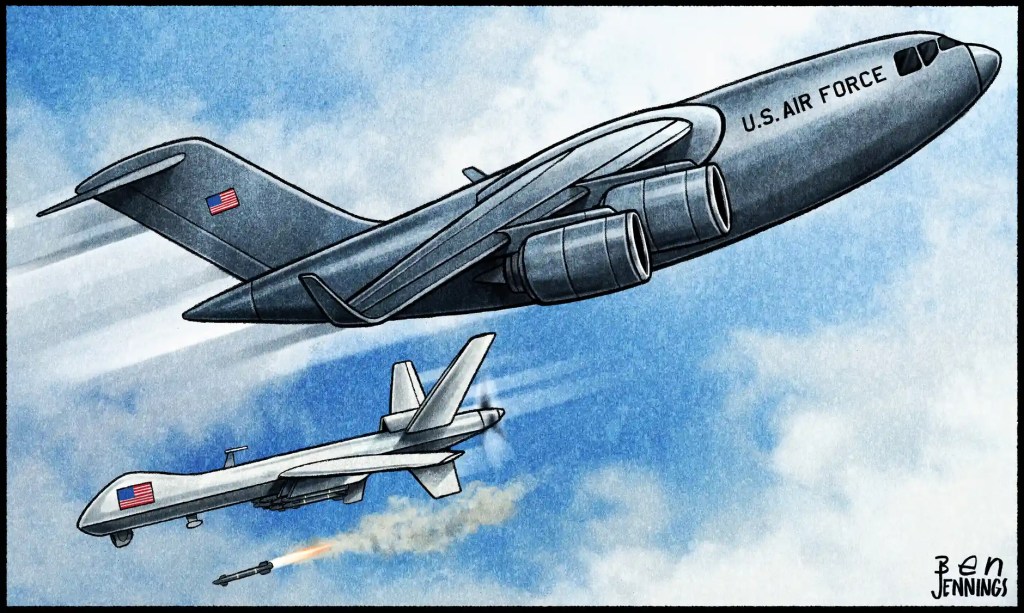
We can airlift people and also kill them by remote control missile. USA! USA! (Cartoon from The Guardian)
W.J. Astore
As U.S. airplanes evacuated so many desperate people from Afghanistan, I got to thinking about all those drone strikes, assassinations by Hellfire missiles, and bombing runs that the U.S. did in Afghanistan over the last two decades (in a quest for peace, naturally). Much like Vietnam in the 1960s, air power kept U.S. forces in a lost war for far longer than they should have been, yet air power made no difference to the ultimate, disastrous outcome.
So what will the U.S. do? What “lesson” will we draw? Build more drones and F-35 attack jets, of course!
You simply can’t occupy and control a country from the air. What America’s dominance of the air emboldens it to do is to intervene on the cheap. Here “cheap” means fewer killed-in-action for America. It’s not cheap to those people on the receiving end of American air power, nor is it cheap to the American taxpayer.
Remember all those assassinations by drone of HVTs (high-value targets), of “key” Taliban figures and fighters? All for nothing. As in Vietnam, the U.S. military kept a body count that meant nothing.
A few statistics, courtesy of The Nation. There have been 14,000 confirmed drone strikes in Somalia, Yemen, Pakistan and Afghanistan since 2004. Roughly 90% of the more than 200 people killed in Afghanistan via drone strike during one five-month period of the Afghan War were not the intended targets. U.S. drone strikes have killed somewhere between 9000 and 17,000 people since 2004, with an estimated 2200 of these being children. And this is just “precision” drone strikes; the number of bombs dropped (including the MOAB, or mother of all bombs) has been staggering. All these bombs and missiles made war corporations richer, but they didn’t bring victory to America.
If America’s troops had lacked air support in Afghanistan (and this is also true of Vietnam), they probably would have left the war far sooner, which would have been a very good thing for all concerned.
But technology and firepower are seductive. U.S. troops in Afghanistan could call on A-10 and F-16 attack jets, drones like Predators and Reapers, “strategic” B-1 and B-52 bombers designed originally for nuclear war, and that’s just the Air Force side of the equation. Troops on the ground also had Apache and Kiowa helicopters, heavy artillery, mortars, indeed virtually every weapon in the U.S. arsenal short of nuclear weapons. (And President Trump once hinted we could use them, theoretically, but he didn’t want to kill all Afghans. What mercy!)
The Taliban, by comparison, had assault rifles, RPGs, IEDs, a few mortars, and a cause they believed in. Expel the invader. Their strategy was to outlast U.S. forces while profiting from America’s wild expenditure of money there. It was a good strategy and they won.
Will America finally learn that massive firepower, especially from the air, is not only a crime but a mistake?
Update: After I wrote that final line, I got this report in my email: “The largest Muslim civil rights organization in the United States has demanded that the Biden administration immediately put in place a “moratorium on drone warfare” after the U.S. killed at least 10 Afghan civilians—including half a dozen children—with an airstrike in Kabul over the weekend.” Call for Drone Moratorium After Latest Civilian Killings, article by Jake Johnson at Consortium News.
More sweltering heat, wildfires, and other extreme weather and weather-related events remind us that global warming and climate change are here to stay. When I taught about global warming a decade ago, most scientists were predicting harsh events in 2030 or 2040. Yet here it is, the year 2021, and we’re already seeing the implacable face of Mother Nature, shaking her head at our naughtiness and thoughtlessness vis-a-vis her planet. She won’t be appeased by our excuse-making or our lying or our attempts to pass the buck. As we bicker, she acts.
Mother Nature: Implacable (Josh Addessi at Blogspot.com)
Climate change is here to stay with a take no prisoners vibe, notes Tom Engelhardt in his latest post at TomDispatch.com. Tom’s message is clear: we’re reaping or about to reap what our “leaders” and corporate elites have sown for us, a much hotter, much less hospitable, planet. As Tom puts it, we’re about to witness, and indeed are already witnessing, a climate Armageddon in slow motion. Check out his article for all the grim details.
Here’s the thing. A half-century ago, America’s wonderful fossil-fuel companies knew all about this threat. More than 40 years ago, President Jimmy Carter tried to persuade America to conserve fuel and live thriftier, more meaningful, lives. But America rejected Carter’s hard facts for Reagan’s sunny optimism (or, put bluntly, his lies) and so here we are.
After Carter, the Democrats swiftly moved to the right and embraced those same fossil-fuel companies. Democrats may have made fun of Sarah Palin and her “drill, baby, drill” message, but that is exactly what Presidents Obama and Biden decided to do: drill, baby, drill. A recent article puts it well from The Guardian: Joe Biden has approved two thousand (!) drilling and fracking permits. Not exactly a green new deal, is it?
President Obama was even worse, notes David Sirota at The Guardian. He loved to boast of how he made America the world’s number one oil producer. He even asked Americans to thank him for it! Remind me again how the Democrats are so much different on this issue than the big bad Republicans?
Here’s the kicker. Even as America’s leaders acted to accelerate fossil fuel production, despite all the warnings about climate change, they squandered $6 trillion on the Iraq and Afghan wars, money that would have made a dramatic difference in preparing America for climate change while also facilitating alternative energy sources, which also would have created millions of “green” jobs in America.
I think a key inflection point for America came in the immediate aftermath of the collapse of the Soviet Union three decades ago. If America had invested its peace dividend into creating a cleaner, safer, better world, perhaps by leading the way, as Carter had suggested, in solar energy and in efforts at conservation, we truly could have been a shining city on a hill, a beacon of sanity. But we chose more weapons and more war. We chose more fossil fuel consumption. Indeed, we chose more consumption (and more guns) in general.
And thus we are where we are today, caught on a sinking warship on a rapidly melting iceberg. OK, perhaps it’s not the most clever metaphor, but you try coming up with a better one when you’re typing in a room at 87 degrees with 73% humidity. Must keep that image of an iceberg in my head …
Serving in the U.S. Air Force, Daniel Hale witnessed America’s drone assassination program and decided to speak out against it. As he awaits sentencing under the Espionage Act for sharing secrets about that program so that the American people could gain insight into the murderous realities of this war from a distance, he penned this letter to the judge hearing his case.
It is a heartfelt and harrowing letter that should be read by all Americans. The Biden administration is seeking a 9-year prison sentence and would prefer an even tougher punishment. This is exactly what is wrong about the United States today: the innocent are punished severely while the guilty are celebrated and promoted.
What follows are the words of Daniel Hale.
Daniel Hale (Photo by Bob Hayes via AP)
Dear Judge O’Grady,
It is not a secret that I struggle to live with depression and post traumatic stress disorder. Both stem from my childhood experience growing up in a rural mountain community and were compounded by exposure to combat during military service. Depression is a constant. Though stress, particularly stress caused by war, can manifest itself at different times and in different ways. The tell-tale signs of a person afflicted by PTSD and depression can often be outwardly observed and are practically universally recognizable. Hard lines about the face and jaw. Eyes, once bright and wide, now deepset and fearful. And an inexplicably sudden loss of interest in things that used to spark joy. These are the noticeable changes in my demeanor marked by those who knew me before and after military service. To say that the period of my life spent serving in the United States Air Force had an impression on me would be an understatement. It is more accurate to say that it irreversibly transformed my identity as an American. Having forever altered the thread of my life’s story, weaved into the fabric of our nation’s history. To better appreciate the significance of how this came to pass, I would like to explain my experience deployed to Afghanistan as it was in 2012 and how it is I came to violate the Espionage Act, as a result.
In my capacity as a signals intelligence analyst stationed at Bagram Airbase, I was made to track down the geographic location of handset cellphone devices believed to be in the possession of so-called enemy combatants. To accomplish this mission required access to a complex chain of globe-spanning satellites capable of maintaining an unbroken connection with remotely piloted aircraft, commonly referred to as drones. Once a steady connection is made and a targeted cell phone device is acquired, an imagery analyst in the U.S., in coordination with a drone pilot and camera operator, would take over using information I provided to surveil everything that occurred within the drone’s field of vision. This was done, most often, to document the day-to-day lives of suspected militants. Sometimes, under the right conditions, an attempt at capture would be made. Other times, a decision to strike and kill them where they stood would be weighed.
The first time that I witnessed a drone strike came within days of my arrival to Afghanistan. Early that morning, before dawn, a group of men had gathered together in the mountain ranges of Patika provence around a campfire carrying weapons and brewing tea. That they carried weapons with them would not have been considered out of the ordinary in the place I grew up, muchless within the virtually lawless tribal territories outside the control of the Afghan authorities. Except that among them was a suspected member of the Taliban, given away by the targeted cell phone device in his pocket. As for the remaining individuals, to be armed, of military age, and sitting in the presence of an alleged enemy combatant was enough evidence to place them under suspicion as well. Despite having peacefully assembled, posing no threat, the fate of the now tea drinking men had all but been fulfilled. I could only look on as I sat by and watched through a computer monitor when a sudden, terrifying flurry of hellfire missiles came crashing down, splattering purple-colored crystal guts on the side of the morning mountain.
Since that time and to this day, I continue to recall several such scenes of graphic violence carried out from the cold comfort of a computer chair. Not a day goes by that I don’t question the justification for my actions. By the rules of engagement, it may have been permissible for me to have helped to kill those men—whose language I did not speak, customs I did not understand, and crimes I could not identify—in the gruesome manner that I did. Watch them die. But how could it be considered honorable of me to continuously have laid in wait for the next opportunity to kill unsuspecting persons, who, more often than not, are posing no danger to me or any other person at the time. Nevermind honorable, how could it be that any thinking person continued to believe that it was necessary for the protection of the United States of America to be in Afghanistan and killing people, not one of whom present was responsible for the September 11th attacks on our nation. Notwithstanding, in 2012, a full year after the demise of Osama bin Laden in Pakistan, I was a part of killing misguided young men who were but mere children on the day of 9/11.
Nevertheless, in spite of my better instincts, I continued to follow orders and obey my command for fear of repercussion. Yet, all the while, becoming increasingly aware that the war had very little to do with preventing terror from coming into the United States and a lot more to do with protecting the profits of weapons manufacturers and so-called defense contractors. The evidence of this fact was laid bare all around me. In the longest or most technologically advanced war in American history, contract mercenaries outnumbered uniform wearing soldiers 2 to 1 and earned as much as 10 times their salary. Meanwhile, it did not matter whether it was, as I had seen, an Afghan farmer blown in half, yet miraculously conscious and pointlessly trying to scoop his insides off the ground, or whether it was an American flag-draped coffin lowered into Arlington National Cemetery to the sound of a 21-gun salute. Bang, bang, bang. Both served to justify the easy flow of capital at the cost of blood—theirs and ours. When I think about this I am grief-stricken and ashamed of myself for the things I’ve done to support it.
The most harrowing day of my life came months into my deployment to Afghanistan when a routine surveillance mission turned into disaster. For weeks we had been tracking the movements of a ring of car bomb manufacturers living around Jalalabad. Car bombs directed at US bases had become an increasingly frequent and deadly problem that summer, so much effort was put into stopping them. It was a windy and clouded afternoon when one of the suspects had been discovered headed eastbound, driving at a high rate of speed. This alarmed my superiors who believe he might be attempting to escape across the border into Pakistan.
A drone strike was our only chance and already it began lining up to take the shot. But the less advanced predator drone found it difficult to see through clouds and compete against strong headwinds. The single payload MQ-1 failed to connect with its target, instead missing by a few meters. The vehicle, damaged, but still driveable, continued on ahead after narrowly avoiding destruction. Eventually, once the concern of another incoming missile subsided, the driver stopped, got out of the car, and checked himself as though he could not believe he was still alive. Out of the passenger side came a woman wearing an unmistakable burka. As astounding as it was to have just learned there had been a woman, possibly his wife, there with the man we intended to kill moments ago, I did not have the chance to see what happened next before the drone diverted its camera when she began frantically to pull out something from the back of the car.
A couple of days passed before I finally learned from a briefing by my commanding officer about what took place. There indeed had been the suspect’s wife with him in the car. And in the back were their two young daughters, ages 5 and 3 years old. A cadre of Afghan soldiers were sent to investigate where the car had stopped the following day. It was there they found them placed in the dumpster nearby. The eldest was found dead due to unspecified wounds caused by shrapnel that pierced her body. Her younger sister was alive but severely dehydrated. As my commanding officer relayed this information to us she seemed to express disgust, not for the fact that we had errantly fired on a man and his family, having killed one of his daughters; but for the suspected bomb maker having ordered his wife to dump the bodies of their daughters in the trash, so that the two of them could more quickly escape across the border. Now, whenever I encounter an individual who thinks that drone warfare is justified and reliably keeps America safe, I remember that time and ask myself how could I possibly continue to believe that I am a good person, deserving of my life and the right to pursue happiness.
One year later, at a farewell gathering for those of us who would soon be leaving military service, I sat alone, transfixed by the television, while others reminisced together. On television was breaking news of the president giving his first public remarks about the policy surrounding the use of drone technology in warfare. His remarks were made to reassure the public of reports scrutinizing the death of civilians in drone strikes and the targeting of American citizens. The president said that a high standard of “near certainty” needed to be met in order to ensure that no civilians were present. But from what I knew, of the instances where civilians plausibly could have been present, those killed were nearly always designated enemies killed in action unless proven otherwise. Nonetheless, I continued to heed his words as the president went on to explain how a drone could be used to eliminate someone who posed an “imminent threat” to the United States. Using the analogy of taking out a sniper, with his sights set on an unassuming crowd of people, the president likened the use of drones to prevent a would-be terrorist from carrying out his evil plot. But, as I understood it to be, the unassuming crowd had been those who lived in fear and the terror of drones in their skies and the sniper in this scenario had been me. I came to believe that the policy of drone assasiniation was being used to mislead the public that it keeps us safe, and when I finally left the military, still processing what I’d been a part of, I began to speak out, believing my participation in the drone program to have been deeply wrong.
I dedicated myself to anti-war activism, and was asked to partake in a peace conference in Washington, DC late November, 2013. People had come together from around the world to share experiences about what it is like living in the age of drones. Fazil bin Ali Jaber had journeyed from Yemen to tell us of what happened to his brother Salem bin Ali Jaber and their cousin Waleed. Waleed had been a policeman and Salem was a well-respected firebrand Imam, known for giving sermons to young men about the path towards destruction should they choose to take up violent jihad.
One day in August 2012, local members of Al Qaeda traveling through Fazil’s village in a car spotted Salem in the shade, pulled up towards him, and beckoned him to come over and speak to them. Not one to miss an opportunity to evangelize to the youth, Salem proceeded cautiously with Waleed by his side. Fazil and other villagers began looking on from afar. Farther still was an ever present reaper drone looking too.
As Fazil recounted what happened next, I felt myself transported back in time to where I had been on that day, 2012. Unbeknownst to Fazil and those of his village at the time was that they had not been the only watching Salem approach the jihadist in the car. From Afghanistan, I and everyone on duty paused their work to witness the carnage that was about to unfold. At the press of a button from thousands of miles away, two hellfire missiles screeched out of the sky, followed by two more. Showing no signs of remorse, I, and those around me, clapped and cheered triumphantly. In front of a speechless auditorium, Fazil wept.
About a week after the peace conference I received a lucrative job offer if I were to come back to work as a government contractor. I felt uneasy about the idea. Up to that point, my only plan post military separation had been to enroll in college to complete my degree. But the money I could make was by far more than I had ever made before; in fact, it was more than any of my college-educated friends were making. So, after giving it careful consideration, I delayed going to school for a semester and took the job.
For a long time I was uncomfortable with myself over the thought of taking advantage of my military background to land a cushy desk job. During that time I was still processing what I had been through and I was starting to wonder if I was contributing again to the problem of money and war by accepting to return as a defense contractor. Worse was my growing apprehension that everyone around me was also taking part in a collective delusion and denial that was used to justify our exorbitant salaries, for comparatively easy labor. The thing I feared most at the time was the temptation not to question it.
Then it came to be that one day after work I stuck around to socialize with a pair of co-workers whose talented work I had come to greatly admire. They made me feel welcomed, and I was happy to have earned their approval. But then, to my dismay, our brand-new friendship took an unexpectedly dark turn. They elected that we should take a moment and view together some archived footage of past drone strikes. Such bonding ceremonies around a computer to watch so-called “war porn” had not been new to me. I partook in them all the time while deployed to Afghanistan. But on that day, years after the fact, my new friends gaped and sneered, just as my old one’s had, at the sight of faceless men in the final moments of their lives. I sat by watching too; said nothing and felt my heart breaking into pieces.
Your Honor, the truest truism that I’ve come to understand about the nature of war is that war is trauma. I believe that any person either called-upon or coerced to participate in war against their fellow man is promised to be exposed to some form of trauma. In that way, no soldier blessed to have returned home from war does so uninjured. The crux of PTSD is that it is a moral conundrum that afflicts invisible wounds on the psyche of a person made to burden the weight of experience after surviving a traumatic event. How PTSD manifests depends on the circumstances of the event. So how is the drone operator to process this? The victorious rifleman, unquestioningly remorseful, at least keeps his honor intact by having faced off against his enemy on the battlefield. The determined fighter pilot has the luxury of not having to witness the gruesome aftermath. But what possibly could I have done to cope with the undeniable cruelties that I perpetuated?
My conscience, once held at bay, came roaring back to life. At first, I tried to ignore it. Wishing instead that someone, better placed than I, should come along to take this cup from me. But this too was folly. Left to decide whether to act, I only could do that which I ought to do before God and my own conscience. The answer came to me, that to stop the cycle of violence, I ought to sacrifice my own life and not that of another person.
So, I contacted an investigative reporter, with whom I had had an established prior relationship, and told him that I had something the American people needed to know.
Did you know the U.S. is developing a new land-based ICBM? That’s intercontinental ballistic missile, and back in the 1980s we pretty much considered them obsolete in the Air Force. That’s because they’re the least survivable “leg” of the nuclear triad, which consists of ICBMs, nuclear bombers like the B-2 stealth, and submarines like the current Ohio-class ones armed with Trident missiles.
But never mind all that. When I visited Los Alamos National Laboratory (home of the Manhattan Project) as an Air Force captain in the spring of 1992, the mood there was glum. With the collapse of the Soviet Union, Los Alamos was facing major cuts in funding, since back then we naively believed there was going to be a “peace dividend” and the U.S. would return to being a normal country in normal times. We wouldn’t have to “invest,” as our military likes to say, in more nukes. We had plenty already; indeed, more than enough to end life on earth.
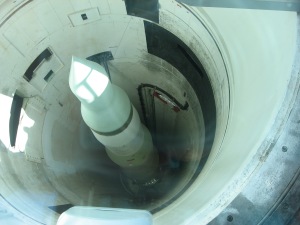
But that was then and this is now and the Biden administration, joining the previous Trump and Obama administrations, is “investing” up to $1.7 trillion over the next thirty years in more nuclear weapons to destroy the earth. It’s a job-creator, don’t you know. And rural areas with nuclear missile bases, like Wyoming and North Dakota, don’t want to lose jobs or the billions in federal dollars that flow to their states in the stated cause of nuclear deterrence. Deterring who or what is uncertain.
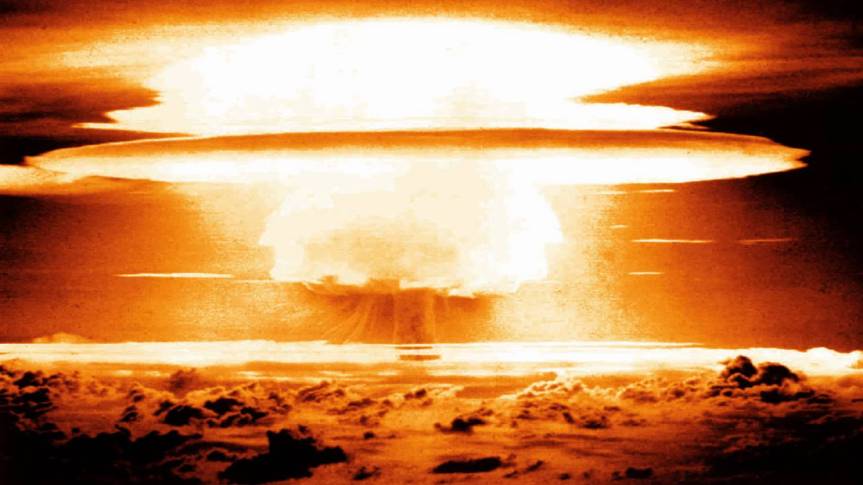
Americans love things that blow up while lighting up the sky and causing the heavens to glow. We witness it every year at this time. Let’s just hope the nuclear firecrackers stay stashed away. Some firecrackers are too dangerous to contemplate.
I remember back in 1992 walking around the desert at Alamogordo, New Mexico, site of the first atomic blast that preceded Hiroshima and Nagasaki. There’s not much left of the tower where the bomb sat: just the concrete base and some twisted metal. Walking around the area, you can still find sand that’s been fused into glass by the heat of the atomic blast. I didn’t take any home with me as it’s still radioactive. People were walking around with masks before masks became a thing with Covid. It was an eerie experience.
We don’t spend much time, if any, on July 4th thinking about all our weapons that are designed with great care and ingenuity to blow up and kill, whether it’s one person or millions (or perhaps even the planet itself). But I urge you to set aside a few minutes to read Tom Engelhardt’s latest article at TomDispatch.com. He writes about his own eerie and disturbing experience visiting Japan and Hiroshima and thinking about the unthinkable.
The bomb in “Beneath the Planet of the Apes.” Not our Alpha, but it could very well be our Omega
Coming of age in the 1970s, I had a real fear of nuclear Armageddon. Mutually Assured Destruction, or MAD, guaranteed both the USA and USSR would be destroyed in the case of a “general” nuclear war (as opposed to a “limited” one). When Ronald Reagan was elected and started denouncing the Soviet Union as an “Evil Empire” while stationing Pershing II and Ground Launched Cruise Missiles in Europe in the early 1980s, a powerful movement calling for a “nuclear freeze” (no new nuclear weapons) helped to provide a measure of sanity. With the collapse of the Soviet Union in the early 1990s, it seemed the world had stepped back from the brink of nuclear annihilation. Indeed, Barack Obama campaigned on eliminating nuclear weapons, supported by conservative voices like Henry Kissinger and George Schultz.
But you can’t keep a bad bomb down, apparently. Amazingly, nuclear weapons are back and in a big way. So-called nuclear modernization of America’s strategic triad may cost as much as $1.7 trillion over the next 30 years, notes Andrew Bacevich in his latest article for TomDispatch.com. Here’s an excerpt:
President Biden has left essentially untouched the core assumptions that justify the vast (and vastly well funded) national security apparatus created in the wake of World War II. Central to those assumptions is the conviction that global power projection, rather than national defense per se, defines the U.S. military establishment’s core mission. Washington’s insistence on asserting global primacy (typically expressed using euphemisms like “global leadership”) finds concrete expression in a determination to remain militarily dominant everywhere.
So far at least, Biden shows no inclination to renounce, or even reassess, the practices that have evolved to pursue such global military dominion. These include Pentagon expenditures easily exceeding those of any adversary or even plausible combination of adversaries; an arms industry that corrupts American politics and openly subverts democracy; a massive, essentially unusable nuclear strike force presently undergoing a comprehensive $1.7 trillion “modernization”; a network of hundreds of bases hosting U.S. troop contingents in dozens of countries around the world; and, of course, an inclination to use force unmatched by any nation with the possible exception of Israel.
Of course, “global military dominion” makes little sense if the world is a burnt out radioactive husk after a general nuclear strike. So why is America’s military pursuing a new generation of land-based ICBMs, new nuclear stealth bombers, and submarines (the most secure and survivable “leg” of the triad)? Money and jobs, I suppose, are always key factors. But there’s something deeper at work here, a sort of bizarre religion in which America’s death-dealers actually worship the bomb, as in the movie “Beneath the Planet of the Apes.” Here’s a relevant scene from that movie:
Worshiping at the altar of global destruction is about as black of a mass as I can imagine. The only course of action that makes any sense for the future of humanity is a nuclear freeze (no new nuclear weapons, warheads, and delivery systems) followed by reductions and culminating in elimination.
Meanwhile, let’s assume we save $1.7 trillion by not “modernizing” the triad. How about investing that money in America’s crumbling infrastructure? Why not build bridges and roads and high-speed rail and dams instead of planning on blowing them up and all of humanity with them?
To read all of Andrew Bacevich’s article, go to TomDispatch.com.







 Bracing Views