News that Hillary Clinton has selected Ken Salazar to head her transition team should give pause to anyone who believes Hillary’s claim that she’s a “Progressive.” Assuming Hillary wins the presidency, Salazar will chair the team that helps her to fill more than 4000 appointments.
What do we know about Salazar? According to a report at The Intercept,
As a senator, Salazar was widely considered a reliable friend to the oil, gas, ranching and mining industries. As interior secretary, he opened the Arctic Ocean for oil drilling, and oversaw the botched response to the BP oil spill in the Gulf of Mexico. Since returning to the private sector, he has been an ardent supporter of the TPP, while pushing back against curbs on fracking….
“We know that, from everything we’ve seen, there’s not a single case where hydraulic fracking has created an environmental problem for anyone,” Salazar told the attendees, who included the vice president of BP America, another keynote speaker at the conference. “We need to make sure that story is told.”
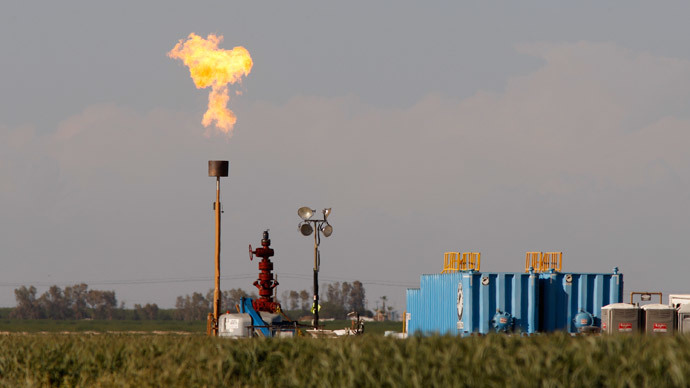
Really, Mr. Salazar? I lived in Pennsylvania for nine years, during the height of the fracking boom. A friend of mine lost his family farm and land due to poisoned water caused by fracking. Earthquakes have been traced to fracking. Methane seepage and burn-off contributes to global warming. Fracking chemicals are highly toxic and wastewater from fracking is radioactive. And these are just a few of the dangers associated with fracking.
It’s one thing to argue that fracking is hazardous but that those hazards can be controlled through rigorous practices that emphasize environmental safety. It’s a defensible position, though I believe the hazards are not fully known, therefore they can’t be fully controlled, let alone minimized. But Salazar is arguing fracking has not caused a single environmental problem! For anyone!
Yes, Hillary now claims she’s against fracking (when she led the State Department, she was strongly for it). But how does that flip-flop square with her decision to appoint yet another earth wrecker to a key position in her government-to-be? Just what the planet needs: a pro-fracking, pro-industry, corporate shill who will help to ensure that people like himself will occupy key positions of authority in a Clinton government.
I’ve witnessed enough earth wrecking. Count me out of Hillary 2016.
Nuclear proliferation and global warming are two big issues that Donald Trump is wrong about. They’re also the two biggest threats to our planet. Nuclear war followed by nuclear winter could end most life on earth within a matter of weeks or months. Global warming/climate change, though not as immediate a threat as nuclear war and its fallout, is inexorably leading to a more dangerous and less hospitable planet for our children and their children.
What does “The Donald” believe? On nuclear proliferation, which only makes nuclear war more likely, Trump is essentially agnostic and even in favor of other nations joining the nuclear club, nations like Japan, South Korea, even Saudi Arabia. When all countries should be earnestly working to reduce and then eliminate nuclear stockpiles, Trump is advocating their expansion. (An aside: recall in a previous debate that Trump had no idea what America’s nuclear triad is; add intellectual sloth to his many sins.)
On global warming, Trump is essentially a skeptic on whether it exists (“hoax” and “con job” are expressions of choice), even as he seeks to protect his resorts from its effects. Along with this rank hypocrisy, Trump is advocating an energy plan that is vintage 1980, calling for more burning of fossil fuels, more drilling and digging, more pipelines, as if fossil fuel consumption was totally benign to the environment and to human health.
Along with his tyrannical and fascist tendencies, Trump is wrong on two of the biggest issues facing our planet today. His ignorance and recklessness render him totally unfit to be president.
Remember when Abraham Lincoln wrote about our government as being “of the people, by the people, for the people”? Even after 150 years, those words still resonate, but they are increasingly less true. Today, our government places itself above the people, and when the government is not working against the interests of (most of) the people, it acts as if the people’s interests are beside the point.
We’ve entered a new historical moment in America, which is precisely the point of Tom Engelhardt’s latest essay at TomDispatch.com. As Engelhardt notes, our electoral process is “part bread-and-circuses spectacle, part celebrity obsession, and part media money machine.” Our foreign policy, and increasingly our domestic policy as well, is dominated by the national security state, the one leviathan in our government that is never paralyzed. The political process itself is ever more divisive, polarized, and disconnected from the hardships faced by the working and middle classes. Even planetary dangers such as climate change are either denied or ignored, as if denial or ignorance will keep seas and temperatures from rising.
The very disconnection of our government from painful realities explains in part the appeal of “maverick” candidates like Donald Trump and Bernie Sanders. Yes, they are two very different men, but what they have in common is their willingness to take the side of ordinary Americans, who have seen their standard of living stagnate or drop over the last thirty years. Trump says he wants to make America great again: the implicit message is that we pretty much suck now, that we are a nation in decline, and that the sooner we admit it, the sooner we can take action to restore America to greatness. Sanders says he wants a future we can believe in, which is at its core much like Trump’s message. America has serious problems, both men are saying, but greatness is still within our grasp if only we act together as a people.
Again, much separates Trump and Sanders, yet both are willing to admit the times are bad for many hardworking Americans. What they’re saying is this: the American dream is increasingly a nightmare. And part of the nightmare is a government that doesn’t act in the people’s interests because it’s been co-opted by special interests. A government that can’t even do its job, such as to declare war or to advise on a Supreme Court nominee, in accordance with its Constitutional duties.
The promise and potential of our country remains. But that promise, that potential, is being squandered by an alliance of various interests that are no longer responsive to the people. If not dead, representative democracy in America is on life support. Unless we can reinvigorate it, as Engelhardt notes in his article, we will continue to suffer a decline analogous to the declines of other great empires (think Rome, for example). The difference today is the possibility of planetary-wide destruction, whether quickly from nuclear weapons or slowly from climate change.
Never was a revival in American democracy more urgently needed, not only for ourselves, but for the world.
The other day, I was watching a typical truck commercial on TV. It showed trucks literally tearing up the backroads, along with ATVs spinning and jumping and chewing up the countryside, all synonymous with “adventure” and “freedom.”
I remember those old Coors commercials featuring Mark Harmon. They were set in Colorado (I think) and featured him quietly extolling the virtues of barley and clean water. Now most Coors commercials are about self-indulgent partying (but please drink responsibly).
My point? We need a change in mindset — one that values nature and its preservation. We’re doomed if we keep selling the idea “you can have it all,” so go party and tear up nature — who cares as long as you’re having fun?
We act as if we have many planet earths, but we have only one. And we’re slowly and surely making our planet less habitable for humans.
Our planet is already having its revenge. As Tom Engelhardt wrote about in a recent article about “Emperor Weather,”
Of course, his [Emperor Weather’s] air power — his bombers, jets, and drones — would be superstorms; his invading armies would be mega-droughts and mega-floods; and his navy, with the total or partial melting of the Greenland and Antarctic ice sheets, would be the rising seas of the planet, which would rob humanity of its coastlines and many of its great cities. His forces would occupy not just one or two countries in the Greater Middle East or elsewhere, but the entire planet, lock, stock, and barrel.
Emperor Weather’s imperial realms would be global on an awe-inspiring scale and the assaults of his forces would fragment the present planet in ways that could make much of it, in human terms, look like Syria. Moreover, given how long it takes greenhouse gases to leave the atmosphere, his global rule would be guaranteed to last an inhumanly long period of time unchallenged.
Heat (think burning Australia today, only far worse) would be the coin of the realm. While humanity will undoubtedly survive in some fashion, whether human civilization as we now know it can similarly survive on a planet that is no longer the welcoming home that it has been these last thousands of years we have no way of knowing.”
Wars will doubtless follow in the wake of disruptions by Emperor Weather, which will only make matters worse for humanity. Think of all those weapons that run on fossil fuels — ships, planes, and tanks. All those weapons that pollute the earth while consuming valuable resources that could be used for alternative energies (solar panels, for example).
It’s time to beat our weapons into wind turbine blades, and to make war no more, either on ourselves or on nature.
Twenty-five years ago, I wrote the following paper for a class in the history of technology. Back then, chlorofluorocarbons (CFCs) and acid rain as well as global warming were issues highlighting the drawbacks of technology. CFCs were damaging the ozone layer, acid rain was poisoning our lakes and streams and damaging trees, with the buildup of greenhouse gases looming as a future threat. The future is now, of course, since we’ve done virtually nothing to address global warming. If anything, the debate in 1989 was far more sober, since back then there were no “climate change deniers.”
Written at the tail end of the Cold War, my paper from 1989 is colored by the threat of nuclear annihilation, another threat (like acid rain and CFCs) that has abated in the last two decades. Reason for hope, perhaps?
Yet in those 25 years, technology has only proliferated even as compassion for those less fortunate has declined. I wrote this paper before there was an Internet and World Wide Web, before cell phones and smart phones became ubiquitous, before we had so much conclusive evidence of the dangers of man-accelerated global warming. I was attempting to argue that scientists and engineers had an obligation to consider the larger impact of their work, to include the moral implications of their research.
I’ve made one major change to this paper as written 25 years ago. Back then, I concluded with the idea that an ethics based on Christianity needed to inform the work of scientists and engineers. Today, this argument seems far too parochial and limiting, so I have removed it.
Technology and the Role of Scientists and Engineers in Modern Society (1989)
What is the proper role of scientists and engineers in modern society? This question is especially relevant today, as can readily be confirmed by opening the September 1989 special issue of Scientific American entitled “Managing Planet Earth.” Technology, it seems, has spawned many monsters: chlorofluorocarbons that tear holes in our protective ozone shield, factory smoke that turns our rain acidic, carbon dioxide that threatens to convert our planet into one big greenhouse. The contributors to Scientific American assert that humanity must regain control over technology before its monsters inflict irreparable damage to the earth.
Defenders of technology, not surprisingly, advance the opposite thesis. Samuel Florman, an engineer and the author of Blaming Technology, counters that “technology is still very much under society’s control, that it is in fact an expression of our very human desires, fancies, and fears.” In Florman’s opinion, engineers should dedicate themselves to doing works for the good of society, but they should not try to define what is good for society. Their mission, Florman holds, is to achieve rather than to set society’s goals.
Florman does not exonerate engineers from all responsibility, however. He asserts that engineers must be guided by their individual consciences, but he also suggests that society should not expect any “special compassion” from its engineers. In fact he implies that society must resign itself to emotionally-detached engineers: “If we accept the single-minded dedication of ballet dancers and other artists,” Florman analogizes, “we should be able to accept, however regretfully, the same characteristic in a number of scientists and engineers.”
But a serious flaw lies at the heart of Florman’s plea for the sanctity of the engineering profession. He disregards the vastly different societal roles of artists versus scientists and engineers, as well as the serious dangers of a powerful technical elite. The philosopher Hannah Arendt noted these dangers in the context of atomic experimentation:
The simple fact that physicists split the atom without any hesitations … although they realized full well the enormous destructive potentialities … demonstrates that the scientist qua scientist does not even care about the survival of the human race on earth or, for that matter, about the survival of the planet itself.
Arendt makes an important point here. Scientists and engineers sometimes pursue their interests even when they threaten the survival of humanity (or themselves for that matter). Evidence from the Manhattan Project lends credibility to this argument. Most scientists who worked on the project were too caught up in the technical challenges of building the atomic bomb to entertain moral qualms about the bomb’s purpose. Robert R. Wilson, the leader of the cyclotron group during the Project, observed that he never considered quitting:
We were the heroes of our epic, and there was no turning back. We were working on a problem to which we were completely committed; there was little time to re-examine our moral position from day to day.
The atomic bomb was the grail for these knights of science; they focused on their pursuit and little else. Perhaps they believed they could wash their hands clean of the stains of Hiroshima and Nagasaki, for they neither made the decision to drop the bombs nor did they pilot the planes. Yet they could not deny that it was their expertise that brought humanity to the brink of its own destruction during the Cold War.
So what does our nuclear heritage teach us? It teaches us that humanity needs a more humane technology and more humane engineers. In sum, we need a new purpose for technology, one that is inspired by social and humanitarian concerns.
Jules Verne captured the risk of failing to do so. “If men go on inventing machinery, they’ll end by being swallowed up by their own inventions,” Verne prophesized. There are still some people, however, who continue to believe that technological advances themselves will eliminate technology’s harms. Charles F. Kettering, a remarkably inventive General Motor’s executive and a quintessential company man, captured this idea. In Paul de Kruif’s words, Kettering felt that
You cannot put the brakes on any discovery … you’ve got to go on with it even if we’re all blown to hell with it. What you should do is step up the study of human nature, you may even find a chemical, a vitamin, a hormone, a simple pill to take the devil out of human nature….
Here one cannot help but be reminded of Aldous Huxley’s Brave New World, where another automotive engineer, Henry Ford, was god, morality was but a faint memory, and drugs were the panacea for human ills.
Elting Morison, in Men, Machines, and Modern Times (1984), suggests that since technology forces humanity into its categories, humanity has no choice but to create a new culture to accommodate it. He proposes that a series of small experiments be performed world-wide, with “man as the great criterion” (or, perhaps more accurately, the great guinea pig). Apparently, a successful experiment will be one in which humans thrive, while an unsuccessful one will be one where humans “break down.” Rather oddly, Morison believes the military provides us with the paradigm of how to proceed. In his words:
They [the military] have the nuclear weapon that has fulfilled the exaggerated extreme toward which the system always tends … But for practical purposes they have created around this extreme a whole arsenal of carefully graded instruments of limited destruction – old-fashioned armaments of lesser power and new weapons of modulated nuclear energy.
It’s shocking how Morison waxes nostalgic over those “old-fashioned” weapons, and his addition of “modulation” to atomic bombs makes them seem downright cozy. As George Orwell observed in his famous 1946 essay entitled Politics and the English Language, “such phraseology is needed if one wants to name things without calling up mental pictures of them.” Thus cluster bombs that send shrieking hunks of shrapnel through the air, napalm that sears lungs and burns human skin, and atomic artillery shells that annihilate armies (but not cities, we hope) become, for Morison, “modest examples of how to begin to proceed.”
A more pessimistic prospectus for the future of technology is held by Arnold Pacey in The Maze of Ingenuity (1980). For Pacey, history reveals that technology cannot “easily accommodate the broad aims and the mixture of human and technical factors which a socially-orientated direction of progress in technology … require[s]. Thus the efforts made to encourage a more directly social form of technical progress … have been relatively ineffective.”
Pacey attributes this failure to the dominance of the mechanical world view. Beginning with Galileo, Pacey maintains, scientists and engineers restricted their own view of the world, blinding themselves to the larger purposes of technology.
Pacey does more than lament, though. He offers several potential solutions, all of which seem flawed. He assumes that new, less destructive, technologies are needed to meet human needs, or to ease poverty, yet the world currently has enough resources to end poverty, and present technology could doubtless be used more constructively. Pacey also unconsciously undermines his argument by citing education and medical care as “examples of how continuous improvement is possible without any large accompanying drain on material resources.” Unfortunately for Pacey, both education and medical care are currently (and rightly) under siege in this country. Despite large sums of money spent and countless reform proposals, education remains mediocre, while medical care remains compassionless and costly.
No wonder Pacey despairs. He half-heartedly mentions other potential balms, e.g. critical science, which pursues “careful, rigorous researches into the relationship between technical innovation, nature and society,” and general systems theory, yet it is unclear from reading Pacey how critical science differs from general systems theory. In the end, Pacey supplies the reader with little in the way of hope, for he despondently observes that systems theory is corruptible.
In the end, we’re left with today’s dehumanizing technological imperative, as noted by Carlo Cipolla, a noted historian of technology, in this passage:
Each new machine … creates new needs, besides satisfying existing ones, and breeds newer machines. The new contrivances modify and shape our lives and our thoughts; they affect the arts and philosophy, and they intrude even into our spare time.
To prevent this dominance of the machine, science and technology need to serve social and humanitarian needs more directly. In “Thinking about Human Extinction,” George Kateb holds that individuals must attach themselves first and foremost to existence. This attachment “cannot be cultivated by way of a theology that bestows [from the outside] meaning or worth on existence,” and it must be able to withstand “all temptations to go along with policies that may lead to human and natural extinction.”
Existence is justified by a sense of beauty; specifically, Martin Heidegger’s wonderment at the very indefiniteness of existence. For Kateb, “because there could have been earthly nothingness … one must finally attach oneself to earthly existence, whatever it is, and act to preserve it … [To this end] persons must be schooled in beauty to acquire the disposition to sustain wonder that there is earthly existence rather than none.” In sum, we must learn to revel in the very fact of humanity’s existence against the longest of cosmic odds.
In a world that grows ever more fragile with each passing day, an appreciation for the fragility of our existence, as well as an abiding compassion for humanity, is exactly what we need from our scientists and engineers.
________________________
Sources in order of citation
Samuel C. Florman, Blaming Technology: The Irrational Search for Scapegoats (New York: St. Martin’s Press, 1981).
Hannah Arendt, “A Symposium on Space: Has Man’s Conquest of Space Increased or Diminished his Stature?”, The Great Ideas Today 1963 (Chicago: Encyclopedia Britannica, Inc., 1963).
Robert R. Wilson, “The Scientists who Made the Atom Bomb,” Science, Conflict and Society (San Francisco: W.H. Freeman, 1969).
Jules Verne, Five Weeks in a Balloon (1862), quoted in James R. Newman, “The History and Present State of Science Fiction,” Science, Conflict and Society (San Francisco: W.H. Freeman, 1969).
Paul de Kruif, Life Among the Doctors (New York: Harcourt, Brace, 1949), p. 445, quoted in William Leslie, Boss Kettering (New York: Columbia University Press, 1983).
Elting E. Morison, Men, Machines, and Modern Times (Cambridge, Mass: MIT Press, 1966, 1984).
Arnold Pacey, The Maze of Ingenuity: Ideas and Idealism in the Development of Technology (New York: Holmes/Meier, 1974, 1980).
Carlo M. Cipolla, Clocks and Culture 1300-1700 (New York: W.W. Norton & Co., 1978).
George Kateb, “Thinking about Human Extinction: (I) Nietzsche and Heidegger,” Raritan (Fall 1986), pp. 1-28.
It’s Joe Bageant week at The Contrary Perspective. Bageant is best know for writing Deer Hunting with Jesus, but his second (and sadly his last) book, Rainbow Pie: A Redneck Memoir, is equally good. Bageant, a self-confessed “redneck,” worked his way into the middle class as an editor. But he never forgot his roots in Appalachia and the subsistence farming of his Scots-Irish family. Bageant had a brutally honest and unadorned way of speaking and writing, and also a great affection and respect for traditional communal values in America.
The theme of Rainbow Pie is loss: the loss of down homey (even homely) values and their replacement by a “monstrous fetish of commodities, their acquisition and their production through an insane scale of work and round-the-clock commerce and busyness” in America (Rainbow Pie, 68-69).
Joe Bageant in Belize
Here is an extended selection from Rainbow Pie, pp. 69-70. I for one have never read a better description of what ails us as a country:
Is it at all possible to regain a meaningful, positive, and satisfying expression of character while working in such a monolithic, non-human scale of “production”? Anybody else feel like America is just one big workhouse, with time off to shit, shower, and shop? Or is it just me? Must our jobs necessarily be the most important thing in our lives?
Yeah, yeah, I know, them ain’t jobs. In America we don’t have jobs–we have careers. I’ve read the national script, and am quite aware that all those human assets writing computer code and advertising copy, or staring at screen monitors in the “human services” industry, are “performing meaningful and important work in a positive workplace environment.” “Performing?” Is this brain surgery? Or a stage act? If we are performing, then for whom? Exactly who is watching?
Proof abounds of the unending joy and importance of work and production in our wealth-based economy. Just read the job-recruitment ads. Or ask any of the people clinging fearfully by their fingernails to those four remaining jobs in America. But is a job–hopefully, a good one–and workplace striving really everything? Most of us would say, “Well, of course not.” But in a nation that now sends police to break up tent camps and car camps of homeless unemployed citizens who once belonged to the middle class, it might very well be everything …
But you won’t hear anyone complaining. America doesn’t like whiners. A whiner or a cynic is about the worst thing you can be here in the land of gunpoint optimism. Foreigners often remark on the upbeat American personality. I assure them that our American corpocracy has its ways of pistol-whipping or sedating its human assets into appropriate levels of cheerfulness.
Rainbow Pie is a searing memoir on the loss of community in the U.S. and its replacement by commodities. Bageant shows how we came to embrace the lurid appeals of Pottersville at the expense of the humble values of Bedford Falls. The result: it’s no longer a wonderful life.
At least coins were more attractive in 1884 (Morgan silver dollar) W.J. Astore
One of the occupational hazards of being a historian is reading old books. The one in front of me is John Fiske’s The Destiny of Man (1884). Fiske was an American philosopher and popular writer on Darwinism, Spencerism, and many other representative isms of his day. Like many thinkers of the late 19th century, he believed in inevitable progress as well as the inherent superiority of men like himself.
From the vantage point of 2013, what is perhaps most striking about Fiske was his optimism that war was coming to an end. In his words:
The nineteenth century, which has witnessed an unprecedented development of industrial civilization, with its attendant arts and sciences, has also witnessed an unprecedented diminution of the primeval spirit of militancy. It is not that we have got rid of great wars, but that the relative proportion of human strength which has been employed in warfare has been remarkably less than in any previous age … In almost every case [of war since the Revolutionary War and Napoleon] the result has been to strengthen the pacific tendencies of modern society …[War] has now become narrowly confined in time and space, it no longer comes home to everybody’s door, and, in so far as it is still tolerated…it has become quite ancillary to the paramount needs of industrial civilization …the final extinction of warfare is only a question of time.
War was coming to an end, to be replaced by the reign of law, Fiske predicted in 1884. Thirty years later, the horrors of World War I came to visit (in one way or another) almost everyone’s door, with World War II proving an even more persistent caller. Today, the United States finds itself in a self-defined, and apparently endless, “war on terror.” What happened to Fiske’s pacific progress?
We all have blind spots. For Fiske one of those was the European imperialism of his day, which he didn’t treat as war since inferior brutes needed civilizing by Whites. Another was his belief in inevitable progress and the perfectibility of man, as shown by “the pacific principle of federalism” and the “due process of law,” which he believed would settle future disputes without war.
Rather than bashing Fiske, it’s perhaps more useful to ask what our blind spots might be. American exceptionalism is certainly one. Just as Fiske believed that the White man was inherently superior – the culmination and fruition of evolution and civilization – many Americans seem to believe that the United States is the best nation in the world, the most technologically advanced, the most favored by God. This belief that “When America does it, it’s OK; when another country does it, it’s wrong” is one that’s opened many a Pandora’s Box. A second blind spot is our belief that more and better technology will solve the most intractable problems. Consider global warming. It’s most definitely happening, driven in part by unbridled consumption of goods and fossil fuels. Our solution? Deny the problem exists, or avoid responsibility even as our country goes whole hog into boosting production of new (and dirtier) sources of fossil fuels via hydraulic fracturing (fracking).
Like Fiske, Americans by nature believe in their own exceptionalism. Like Fiske, Americans by nature are generally optimistic. But Fiske dismissed the horrors of imperialism even as he missed the looming disaster of mass industrialized killing in two world wars.
What are we dismissing? What are we missing? I’ve suggested we’re dismissing the blowback produced by our own exceptionalism even as we’re missing the peril we pose to the health of our planet. I encourage you to add your thoughts below.
The Good Old Days of Artificial ObsolescenceA U.S. Air Force F-16 Fighting Falcon. Not stealthy, but still a great jet. And compared to the F-35, very cheap indeed! (U.S. Air Force photo by Staff Sgt. Cherie A. Thurlby) (Photo credit: Wikipedia)
Harley Earl was Vice President of Styling for General Motors and considered the father of American automotive design. Since its inception in the 1920s, GM styling was based on a concept known as “artificial obsolescence,” which involved redesigning and retooling the entire line of cars every two years so that car owners would want to sell or trade in their old car and buy the “latest” model. It worked so well for GM that Ford and Chrysler were driven to follow the same business model which ultimately, years later, led to the financial collapse of the automotive industry.
The economic waste due to the enormous cost of retooling body parts and production lines so that automobiles could present a “fresh face” to consumers was of little consequence to executives. What mattered was that to be “in” consumers had to have the “new” model. This manufactured need boosted short term profit for the companies. When I [b. traven] worked in Detroit, I had an older utilitarian Ford station wagon which drove my co-workers crazy. It was disloyal to my GM employer, but it got me where I wanted to go. Even back then I was a brand and style contrarian.
Artificial obsolescence and manufactured need is of course not limited to cars. Consider America’s defense industry and its high-ticket items. Let’s kick the tires of the F-22 Raptor “stealth” fighter and the F-35 Lightning II “stealth” fighter-bomber. First of all, stealth technology (involving esoteric and expensive radar absorbing and reflecting materials) adds billions of dollars to the sticker price of these planes, yet the need for this “option” is marginal (at best). There’s little need to evade sophisticated radars in a world with only one superpower.
Leaving that aside, consider the effectiveness of previous American fighter jets, such as the F-15 Eagle (available in air superiority and “strike” versions), the F-16 Fighting Falcon, the F-18 Hornet (and Super Hornet), even the ungainly A-10 Warthog. All of these planes are proven performers; they are also far cheaper than the F-22 and F-35, and arguably more effective.
Even our profligate Pentagon spenders stopped buying F-22s because at roughly $400 million a copy, they were just too expensive (and also too proneto killing their pilots). Yet the Pentagon is persisting in plans to spend roughly $400 billion to acquire F-35s (despite serious teething pains and horrendous cost overruns), even though older and more reliable models like the A-10 or F-18 are perfectly capable of accomplishing the mission.
That’s the story of our military-industrial complex and the compliant representatives of the people who approve these foolish expenditures. They’ll spend countless billions on the equivalent of new tail fins for their latest Cadillac fighter jet. Harley Earl is laughing somewhere.
But what’s really obsolete is our thinking, which prefers the new and shiny, never mind the cost, all in the name of short-term profits for industry. It’s an economic model that wasn’t sustainable in the automotive industry. And it sure isn’t sustainable in military circles at a time of supposed fiscal austerity.
But, heck: We’re winning style points even as we imperil our economy. Hooray, America!
Update 1 (10/3/2013): The Inspector General (IG) for the Department of Defense has identified 719 problems with the F-35 fighter-bomber. Efforts to solve these problems will continue to drive up the per unit cost of the F-35. Meanwhile, Predator and Reaper unmanned drones continue to supplant manned fighters. And when we need a pilot in the cockpit, legacy fighters such as the F-15, F-16, and F-18 continue to perform the mission.
Actually, what matters more than new planes to combat effectiveness is the skill of pilots and the weapons attached to those planes. Yet with the F-35 we continue to pursue the “bleeding edge” of aircraft technology — and hence our country continues to bleed scores of billions for a plane we arguably don’t need. But we are scoring style points…
Update 2 (10/25/2013): For a detailed (and very sobering) article on the F-35 and all its problems, see Adam Ciralsky, “Will It Fly?” at Vanity Fair. Link here. Also useful is this article by JP Sottile.








 Bracing Views