Hi Everyone: If you’d like to support this site but don’t want to subscribe and pay a yearly fee, perhaps you’d consider my new book, My Father’s Journal, available through Amazon for $10 (paperback) or $5 (Kindle). Just click on that link and order away. Order five copies for your dad! (Yes, that’s reference to a song lyric, “Gonna buy five copies for my mother.”)
Anyhow, here’s an except from the book, which details my father’s efforts to fight raging forest fires on the West Coast in Oregon and California during the 1930s. His account will likely remind you of the recent fires in LA.
A big “thank you” to those who order the book—I hope you enjoy it.
*****
It is surprising how many forest fires our crew fought and other groups that we assisted in the two summers I was in Oregon.
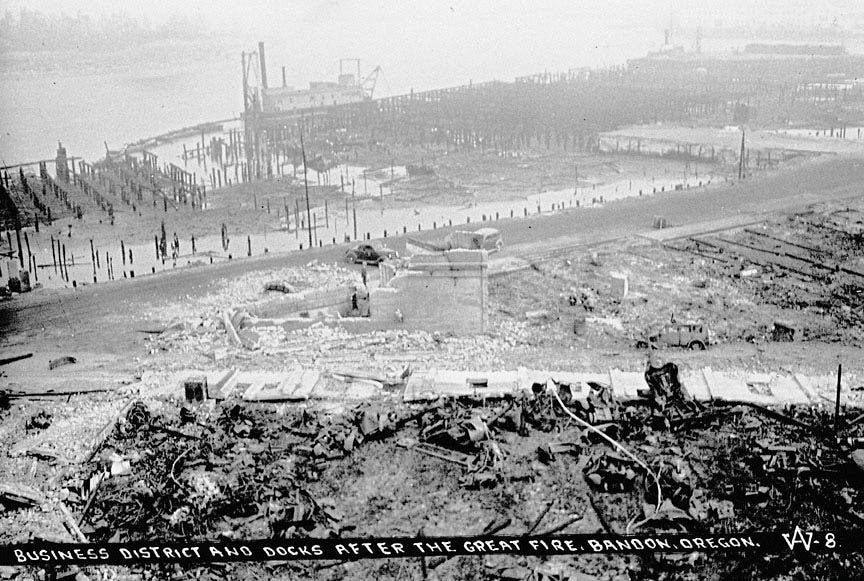
The main and largest fire we fought was in the fall of 1936. A very dry summer and fall added to the fire danger. We were in Enterprise, Oregon when we got our call to go to Bandon “By the Sea” Oregon. Enterprise is in the northeast corner of the state. The day before, Bandon had been swept by the forest fire. Twelve people lost their lives. It could have been much worse but all inhabitants fled to the ocean beaches. One pregnant lady gave birth to a baby on the beach.
Fifty of the men in our camp, using 2.5-ton trucks, traveled across the state (guessing approximately 300 miles). The areas were involved in hundreds of fires that covered an area greater than the state of Massachusetts.
We were on the fire lines for over five weeks. At times we were put on reserve where we could shower and shave. We had about 5000 men, woodsmen, rangers, and CCC boys fighting this fire.
We were at Gold Beach, Oregon and we could look into California at the Siskiyou Mt. Range. There was a rumor we were going to fight a fire in the redwoods of California. But the call never came. We drove through Bandon; there were rows and rows of dwellings, gas stations and buildings burned to the ground. Quite a few chimneys were still standing. Every once in a while you’d see a dwelling or building spared by the fire. Just a whim of fate.
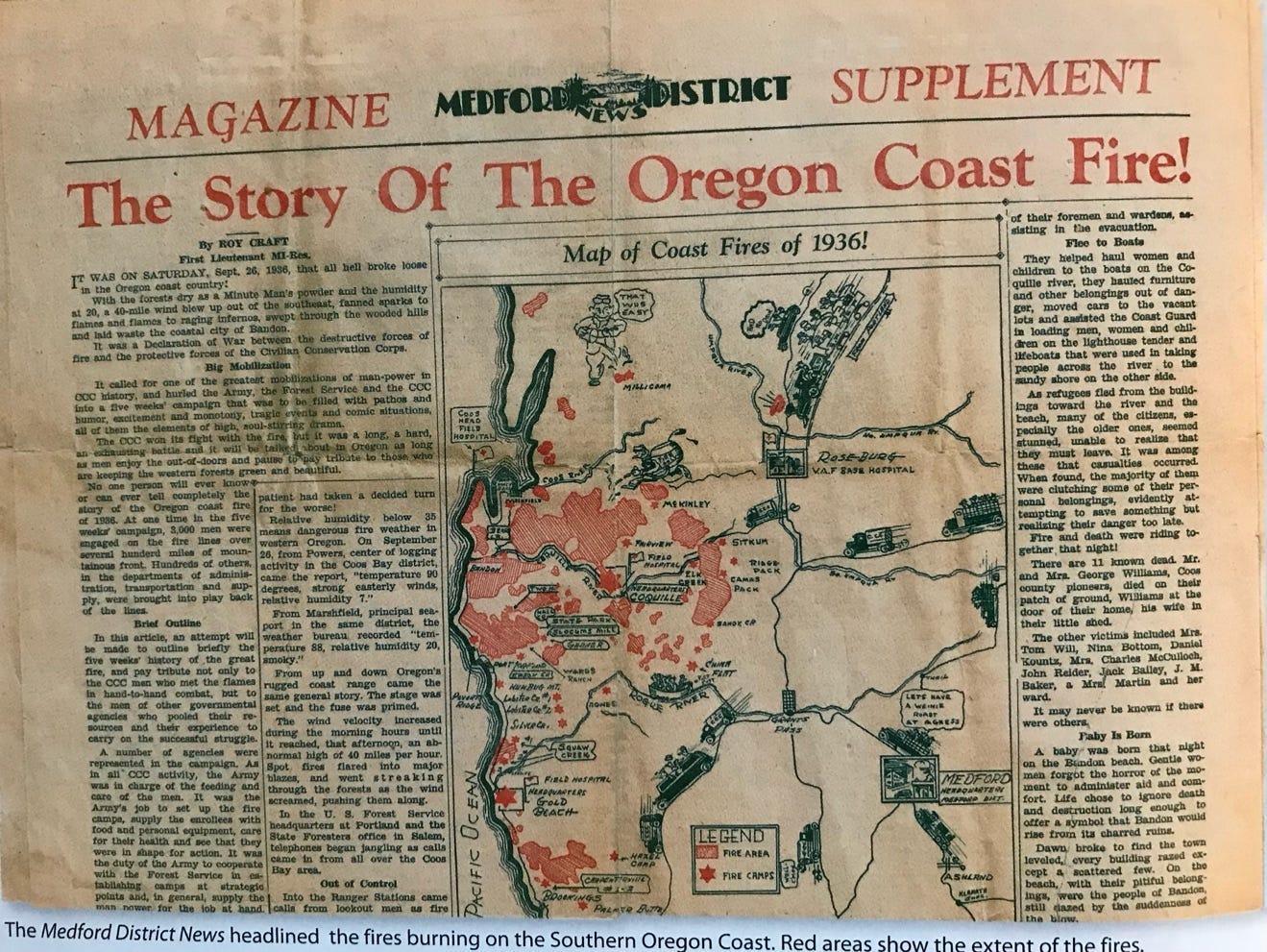
My father was a great saver of documents, including in this case The Medford District News, a local newspaper in Oregon that devoted two full pages to the five-week campaign to contain the Bandon Fires of 1936.[i] Written by Roy Craft, a first lieutenant, the story is worth quoting at length:
It was on Saturday, Sept. 26, 1936, that all hell broke loose in the Oregon coast country! With the forests dry as a Minute Man’s powder and the humidity at 20%, a 40-mile wind blew up out of the southeast, swept through the wooded hills and laid waste the coastal city of Bandon. It was a Declaration of War between the destructive forces of fire and the protective forces of the Civilian Conservation Corps….
As in all CCC activity, the Army oversaw the feeding and care of the men. It was the Army’s job to set up the fire camps, supply the enrollees with food and personal equipment, care for their health and see that they were in shape for action….
[Later that night] the fire had swept up to the very edge of the city. Then, borne on the shoulders of the 40-mile wind, the flames rode into Bandon. The Bandon fire department and the CCC men made a desperate stand but normal fire equipment was no match for the blaze.
As the fire approached the town, many residents were still unaware of the impending tragedy and had gone to the local theatre to see the feature picture, “Thirty-Six Hours to Live.” The film didn’t last that long, for in the middle of the show the film was stopped and a call was made for volunteer fire fighters.
As the fire poured into Bandon, building after building went up in flames. The residents literally “ran for their lives,” with men of the CCC … assisting in the evacuation.
Many people escaped in boats across the Coquille River, but the fire claimed at least eleven lives. As my father mentioned, a baby was indeed born that very night on the beach, which was taken as a “symbol that Bandon would rise from it charred ruins,” according to a somewhat fanciful newspaper account.
More than 100,000 acres burned over a period of five weeks until the November rains came to extinguish the flames for good. (Dad penned a quick postcard, dated 10/26/36, to tell the family he was fine and that he’d “been out fighting forest fires for over a month now.”)
As LT Craft put it in his newspaper account,
Anybody can play at being a hero for a couple of hours, or face trying and dangerous situations when the stimulus of excitement makes them glamorous and daring. But it takes guts to put out day after day on the fire line! Nothing tests a man’s mettle like a five weeks’ siege with fire, when it’s drudgery to put in a day and a night on the line, sleep a few hours on the hard ground, and then crawl out again and go back to pitch in with shovel, hazel hoe and back pump.
The Bandon Fire was the largest that my father faced, and he spoke of it often.
(If you’d like to order the book, here’s that link again. Thanks!)
Recently, a friend wrote to challenge me to “write a great article about Trump’s introduction of ‘lightning war’ into politics,” citing Nazi Germany’s use of Blitzkrieg in the opening campaigns of World War II. My friend sympathizes with Trump, so his political Blitzkrieg comparison wasn’t meant pejoratively.
Image of Blitzkrieg from the Imperial War Museum. It wasn’t my idea for Trump…
Whether you call it Blitzkrieg or a “flood the zone” strategy, there’s little doubt Trump’s rapid-fire orders and actions have put those who oppose him on the defensive. Democrats are throwing up their hands in surrender-like motions. Democratic House Minority Leader Hakeem Jeffries plaintively asked: “What leverage do we have?” Then he added: “They [the Republicans] control the House, the Senate, and the presidency. It’s their government.”
The Democratic battle flag is a white cross on a field of white. They claim they can do nothing to stop Trump and his rampaging billionaire sidekick, Elon Musk.
It’s funny: When the Democrats had control of the House, Senate, and presidency, I often recall them complaining they couldn’t get much done due to obstruction by Republicans. How come Republicans can obstruct but not Democrats?
Leaving that aside, what about my friend’s praise of Trump as having launched Blitzkrieg politics? Reversing Clausewitz, is politics simply a continuation of war by other means?
America, so I’ve been taught, was founded as a republic with a Constitution. We claim to be a nation of laws. We like to think we’re a representative democracy. The House and Senate are supposed to be deliberative bodies where laws are made and money is spent in accordance with the will of the people.
I know: nice fantasy, right?
The U.S. government has become corrupted by money and special interests. We know our representatives rarely represent us. They represent their owners and donors. That breeds cynicism and a certain level of affection among some for Trump as a disruptor.
But smashing government isn’t the smartest and most effective way of reforming or even of rebuilding it. Empowering autocrats and plutocrats like Trump and Musk isn’t going to produce democracy and a government that serves the people. A Trump “political Blitzkrieg” will likely echo the Nazi Blitzkrieg of 1939-41, featuring widespread destruction and subjugation of “enemies.” It’s not a method conducive to greater justice and a more perfect union.
So, to my friend’s challenge, I say this: Political Blitzkrieg may provide an illusion of victory, but “victory” for whom, and for what? Wars, whether real shooting ones or political ones, are corrosive to liberty, freedom, and equality. In war, it’s typically the workers and poor who suffer most, the rich who profit most, as power congeals at the top.
Trump’s so-called Blitzkrieg, combined with a Democratic attitude of surrender, is producing a government by and for men like Elon Musk, even more so than it already is. If you truly desire plutocracy and one-party rule, Trump/Musk is your dynamic duo.
I still prefer democracy, however imperfect, and a system that doesn’t elevate and empower the richest among us as dictators.
Private health insurers make money denying care–not providing it
Luigi Mangione, the young man who shot and killed a senior health insurance executive, is emerging as a folk hero of sorts in America. This requires some explanation for people outside of America.
Luigi Mangione
Most peer countries to the United States have national health care systems. Countries like Britain, Germany, France, Japan, New Zealand, and the like. These national health care systems, run by the government, are not perfect, but overall they are cheaper and produce better results for patients than the American system, where health care is basically wealth care for the rich and privileged.
America primarily has a privatized health care system where profit is the prime directive. (Programs like Medicare* and Medicaid are a public-private partnership and are government-funded; the former focuses on people 65 and older, the latter on the poorest of Americans.) Most Americans get their private health insurance with their job, else they’re required to buy private health insurance on their own nickel. These health insurance plans are expensive and often come with high deductibles and co-pays.
So, for example, when you visit a doctor for a routine appointment, your co-pay is likely between $50 and $100 per visit. If you get seriously sick, break a bone, etc., your health insurance provider may not start paying your bills until a certain yearly deductible is met, which may sit between $5000 and $10,000. Not surprisingly with these deductibles, co-pays, and the like, Americans often declare bankruptcy due to medical bills even when they have health insurance and are in theory “covered.”
A quick Google search reveals that an unsubsidized private health care plan for a family of four in America cost an average of $24,000 a year in 2023. Other figures suggest a cost of roughly $18,000 a year, but it depends on what state you live in as well as your age. The various plans that you can buy are quite complicated and include the aforementioned deductibles, co-pays, and other complexities. Employer-based plans cost less; perhaps in the neighborhood of $6000 to $8000 per year.
Again, health insurers’ #1 priority isn’t to provide health care. It’s to make money for shareholders—and for the senior executives in the industry. So their profit-driven approach to claims is the now infamous “deny, delay, depose (or defend)” strategy. As often as possible, they seek to deny claims outright, forcing sick and desperate people to fight an incomprehensible bureaucracy shrouded in fine-print legalese. Or they seek to delay payment on claims. Or they take Americans to court (“defend and depose”), forcing people to hire lawyers (quite expensive) while aiming for the quickest and cheapest settlement.
For the insurers, this strategy makes all the sense in the world. They are in this business to maximize profits and earnings, not to provide generous health care benefits.
Efforts to create a fairer and more just system for Americans have failed due to political corruption at the highest levels as well as propaganda (remember those rumored “death panels” if the government ran health care). The idea of a national non-profit healthcare system is nothing new; the Truman administration advocated for it after World War II, and various other proposals were floated by LBJ in the 1960s, the Clintons in the 1990s, and even tepidly by the ultimate sellout Barack Obama with his Affordable Care Act, which is unaffordable for many and less than generous with its care. These and similar efforts have failed as Big Pharma, the AMA, health insurers, and other forces have combined to exert tremendous pressure so as to prevent meaningful reforms that would cut into their profits, salaries, and market share.
Basically, the U.S. health wealth care system costs roughly double that of comparable countries with worse outcomes for patients. Again, this isn’t a surprising result, since the health and well-being of patients isn’t the guiding priority. It never has been. The U.S. system is all about producing the highest possible salaries and profits for Big Pharma, for health insurers, for privileged doctors (specialists often make yearly salaries in the high six-figures), and for all the other stakeholders (and shareholders) in the current system.
Here in America, the Hippocratic oath of “first do no harm” in medicine doesn’t apply. Our oath is the Gordon Gekko one of “Greed is good.” It doesn’t matter if people go bankrupt or die as a result. It’s wealth care, not health care, silly!
It’s unlikely the Trump administration will do anything to change this. Its top priority seems to be the expulsion of immigrants. Members of Congress are completely in the pocket of Big Pharma, the health insurers, and powerful medical lobbies, so don’t look for meaningful change there.
That’s why so many Americans, deeply frustrated with an exploitative system of healthwealth care, where costs rise year by year as benefits shrink, sympathize with Luigi Mangione, even if they disagree with his murderous method of expressing his anger and disgust.
Put bleakly, America’s health wealth care system is another way of enriching the few while impoverishing the rest. It is also a form of social control. (Act out, protest—lose your job, your health care, maybe your life.) Only the most revolutionary acts are likely to change this system. That is exactly why the government, the mainstream media, and corporate elites are acting to suppress sympathy for Mangione.
Consider this article by Ken Klippenstein about a mom who, frustrated with her health insurer, repeated “deny-delay-depose” while saying “you people are next” on the phone; she quickly apologized, but not before the police and FBI were called in and charged her with threatening “an act of terrorism.”
Know your place, Americans. Stay supine and obedient or they’ll take away your health insurance. Better yet, they’ll finally give you affordable health care—in prison.
Most people think Medicare is a government program. That’s only partly true. While Congress created Medicare, and continues to develop Medicare coverage and appeal rules, decisions to pay claims are actually made by private companies. The government does not make those decisions. This was one of the compromises made in order to pass Medicare in 1965 – and the public-private partnership continues to date.
Indeed, the entities granting or denying coverage, and those deciding whether or not to pay claims, are mostly private insurance companies. For example, Anthem is the parent company of “National Government Services,” one of the major Medicare claims administrators. Another Medicare administrative contractor, “MAXIMUS,” is a for-profit company that helps state, federal and foreign governments administer programs.
In addition, about 30% of Medicare beneficiaries are enrolled in private “Medicare Advantage” plans. These plans are also run by private companies, mostly within the insurance industry, and they make Medicare initial coverage decisions for their enrollees.
We know that when Medicare is working right and covering necessary care, everyone is content. But, if coverage is denied unfairly… don’t blame the government. It’s probably not “Medicare” that made the decision; it’s most likely a private insurance company that’s paid by Medicare to make coverage decisions.
Thanks to a reader, Sally Moore, for pointing out the public-private nature of Medicare. It’s more complicated than I thought—I should have known better.
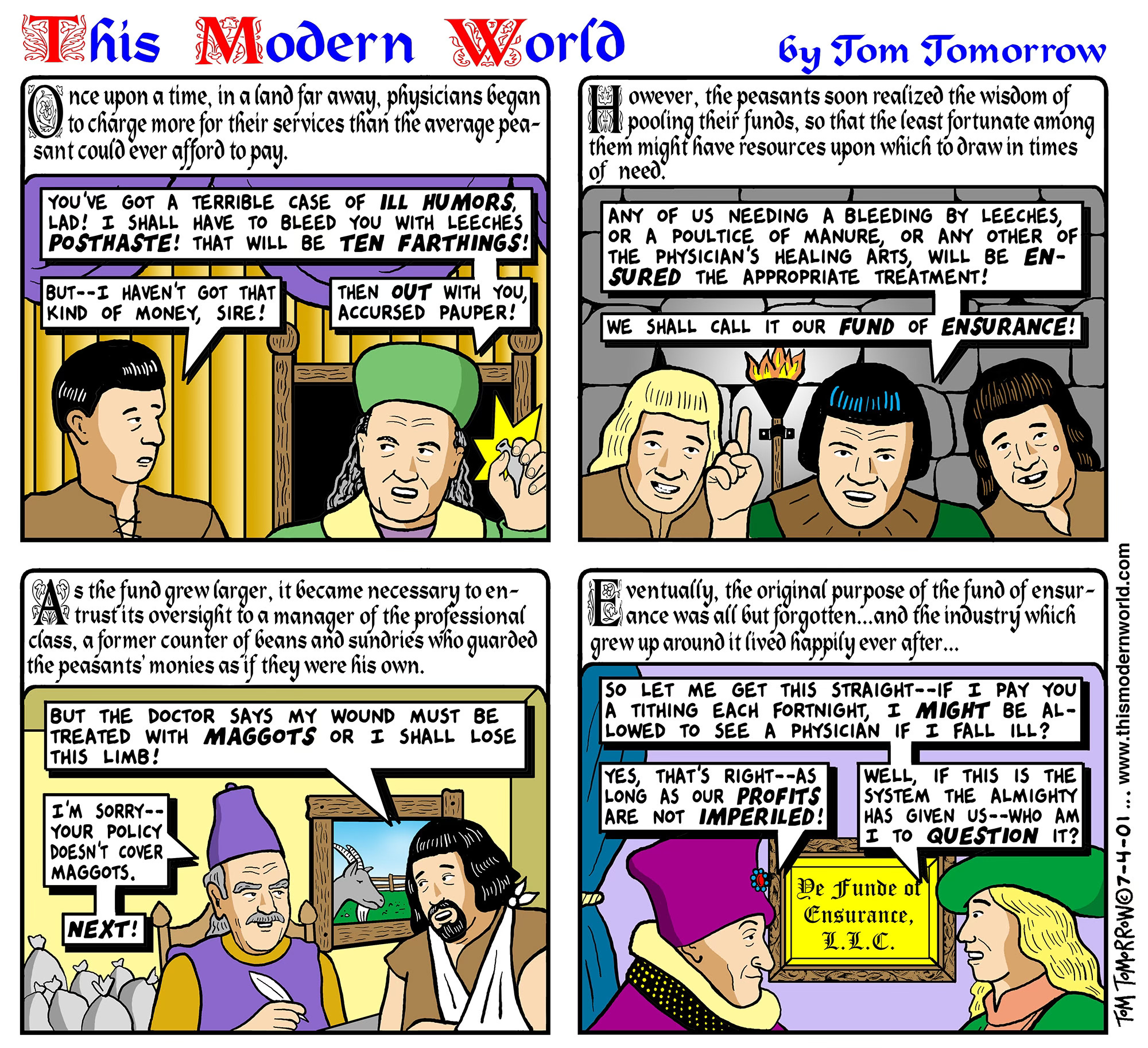
Update: A classic cartoon from Tom Tomorrow seems appropriate here:
It’s Independence Day in America, so it seems like a good day to declare our independence from the insanity of war.
Sadly, since the presidency of George W. Bush if not before, it’s become routine for U.S. commanders-in-chief to boast of having the world’s finest military in all of history. Obama did it routinely, and Biden recently said the same during his disastrous debate with Trump. Few Americans stop to think about the implications of boasting about having the world’s greatest military—is such a boast truly consistent with democracy, liberty, and freedom?
Certainly, empires rely on strong militaries. Think of the Roman Empire or the Mongol Empire, or the Third Reich (Empire) of Nazi Germany. Do we want to be like them?
Those empires lived by the sword (quite literally so with the Roman Empire) and died by it as well. Their militaries, I would argue, were also more effective than the U.S. one, which hasn’t won a major war since 1945, the latter with a lot of help from our “friends” like the Soviet Union. The Roman, Mongol, and German empires are no more, worn down in part through the constant costs and demands of war. We need to learn more from history than the “fact” that America’s military is supposedly the world’s best since forever and a day ago.
I’ve been reading Oriana Fallaci’s “Nothing, and So Be It,” in which she recounted her time reporting on the Vietnam War. Two conversations with U.S. troops in Vietnam caught my attention. On pages 22-23, she recounts a conversation with Army Captain Scher, during which Scher confesses his disgust with war:
God, how disgusting war is. Let me say it—I’m a soldier. People who enjoy making war, who find it glorious and exciting, must have twisted minds. There’s nothing glorious, nothing exciting; it’s just a filthy tragedy you can only cry over. You cry for the man you refused a cigarette to and who didn’t come back with the patrol. You cry for the man you bawled out and who is blown to pieces in front of you. You cry for the man who killed your friends …
Later in the book, she interviews a Marine Lieutenant whose surname is Teanek (pages 174-75). Here’s what he had to say:
Teanek: “Men have been saying that [we should abolish war] for thousands of years, and with the justification that they’re abolishing war, they’ve soaked the greatest periods of their civilization in blood.”
Fallaci: “That’s no good reason to keep on doing it.”
Teanek: “Theoretically, you’re right, but in practice what you’re saying is very silly. It’s like convincing yourself—as I bet you do—that when you describe people dying in war you’re helping to abolish war. On the contrary. The more you see people who’ve been killed in war, the more you want to go on fighting wars: it’s a mystery of the human soul.”
It is indeed “a mystery of the human soul” why we humans persist in killing each other in such vast numbers through war. Of course, it’s partly because we glorify it, when we should recognize, as Fallaci does on page 187, that “War is a madhouse.”
I am sane!
One of my favorite scenes in any war film came in “The Big Red One,” a World War II movie by Samuel Fuller starring Lee Marvin as a grizzled Army sergeant of the 1st Infantry Division. It’s a scene in which U.S. troops liberate an insane asylum.
The unforgettable part of this scene for me is when one of the madhouse residents picks up a submachine gun and starts blasting away, crying “I am one of you. I am sane!”
Today is Earth Day: a good day to commit ourselves to saving the earth from the ravages of nuclear war. Global warming may get us in the long term, but nothing will kill the planet quicker than a nuclear war.
I’ve written a lot about the folly, the greed, the absurdity, of yet another round of “investment” in nuclear weapons. There’s no need for an updated nuclear triad when the present triad is more than enough to destroy the earth and probably several other planets as well.
America’s nuclear triad currently consists of land-based ICBMs (Minuteman III), bombers like the B-1 and B-2, and submarines that carry nuclear-tipped missiles. The Pentagon plans to “modernize” all these “legs” of the triad at a possible total cost of $2 trillion over the next 30 years.
First off, land-based ICBMs and nuclear bombers are no longer needed. The ICBMs are especially vulnerable to attack, putting pressure on DC decisionmakers to launch them quickly in case of a warning (perhaps false) of a nuclear attack against their silos.
All the U.S. truly needs for deterrence is the current Ohio-class sub force with its Trident II missiles. That force can be modernized without an entirely new class of sub being built, which is perhaps why we’re seeing ads about building new submarines as “job-creators.”
In the USA, more nukes are “justified” most often by threat inflation (or even threat creation) and military Keynesianism—morally dubious claims that jobs are created by building genocidal weapons and doomsday machines.
Speaking of America’s submarines and their missiles: Each Trident II D5 missile has up to 8 warheads, with up to 20 missiles per submarine. One submarine could conceivably destroy 160 targets, with each of those warheads having a “yield” of somewhere between 5 and 25 Hiroshima bombs. That arsenal, if launched, could very well tip the world into nuclear winter while killing tens of millions of people outright. A nuclear winter would kill billions. From one sub! And the Navy has 14 of them!
Senator George McGovern in 1963 complained about the absurd nuclear “overkill” the U.S. possesses. Just over 60 years ago, some members of Congress vowed to do something to stop the madness. And then came Vietnam … and so many other wars and rumors of war.
We Americans are so easily distracted by war and propagandized into believing that safety comes from swinging the biggest nuclear club.
Anyone who thinks about nuclear weapons and war games in the abstract should watch this scene from “Terminator II.” It’s perhaps the best, most visceral, image of what one nuclear bomb would produce.
“There’s no fate but what we make for ourselves.” The more nuclear weapons we build, the darker our fate becomes, and the closer we come to terminating ourselves and our planet.
On this Earth Day, the U.S. should commit itself to a “no first use” policy with respect to using nuclear weapons and to total nuclear disarmament, to be achieved over the next 20-30 years.
Something like a JFK-like vow is needed here: Before the decade is out, America should commit itself to halving its nuclear forces, working with other countries on the goal of nuclear disarmament.
Only the future of humanity, as well as that of the earth and all living things, is at stake here.
Early in the 19th century, Alexis De Tocqueville famously wrote “Democracy in America.” Early in the 21st century, that title is more appropriate for a fictional or even fantasy work on America.
How so? A BV reader sent along an article from the American Prospect: “America is not a democracy,” by David Dayen. Based on that article and a few reflections of my own, here’s how and why democracy is dead in the USA:
Big money in politics. Members of Congress chase the money and are obedient to it. So are presidents. So too are even SCOTUS justices. Indeed, SCOTUS basically said corporations are citizens and that money is speech in the infamous Citizens United decision. Those with the most money have the most speech in America. Those with no money are essentially mute and powerless.
Gerrymandering. Both Democrats and Republicans draw district lines to inhibit real electoral competition. Thus most seats in Congress are “safe,” dominated by a single party.
Voter Suppression. There are all sorts of tactics to depress voter turnout among the “unwashed.” Unnecessary voter ID laws. The closing of polling stations. Dropping people from the polling lists. Holding the vote on a work day. Even the presence of police officers and “voting monitors” at the polls.
Corporate Ownership of the Mainstream Media: The MSM touts corporate-friendly candidates from the two major parties. Third-party candidates are almost entirely ignored when not openly vilified and condemned as “spoilers.”
For the presidency, the electoral college. Presidents aren’t elected by popular vote; what matters is winning the electoral college. As a result, this year’s election will likely come down to roughly 500,000 voters in six “swing” states.
For the senate, the persistence of the filibuster. Both parties conveniently use the filibuster as an excuse for why they can’t get things done for workers and the middle class.
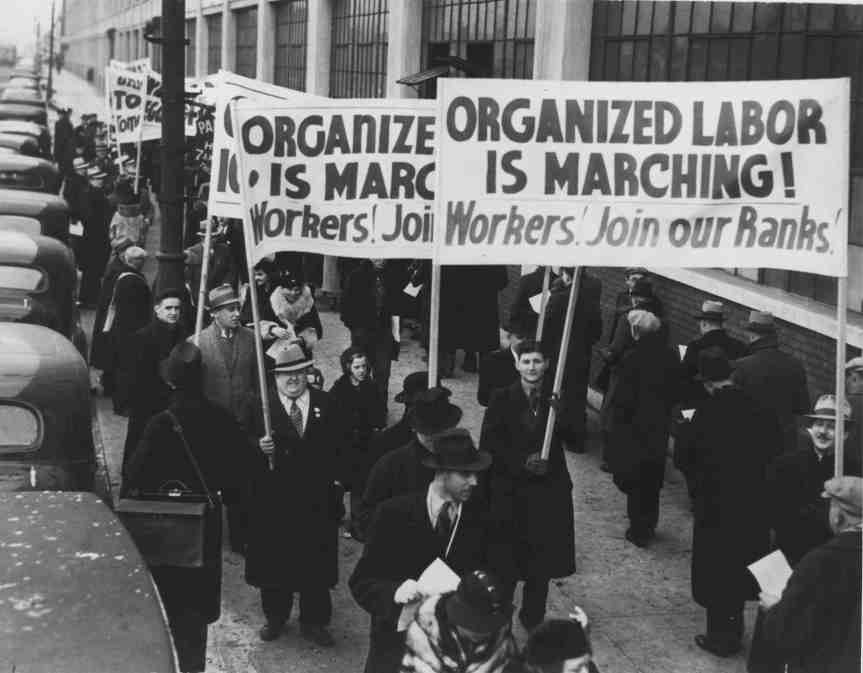
The decline of unions. Workers only have power when they organize and stand together as one, flexing their muscles with strikes and other actions. The decline of unions has largely neutered the working classes.
Constant wars overseas. As James Madison noted, constant warfare is the enemy of democracy and the friend of authoritarianism and corruption.
Obstacles to third-party challengers. Republicans and Democrats share a contempt for third-party challengers, erecting obstacles via lawsuits and similar activities. Just ask Ralph Nader or RFK Jr.
Sham primaries. The RNC and DNC are private institutions. The DNC is controlled by so-called superdelegates. Neither party is interested in the will of voters; they serve the whims of the owners and donors.
There are several words you can use to describe America’s system of government. Oligarchy, rule by the few, applies. Plutocracy, rule by the rich, applies. Kleptocracy, rule by the greedy and corrupted, applies. Even kakistocracy, rule by the worst, has some applicability. The word that doesn’t apply is democracy.
Well, it’s an idea …
This is not news to my readers, of course. Consider the Princeton Study from 2014, which reached the following conclusions:
When a majority of citizens [in the USA] disagrees with economic elites and/or with organised interests, they generally lose. Moreover, because of the strong status quo bias built into the US political system, even when fairly large majorities of Americans favour policy change, they generally do not get it.
The study concludes:
Americans do enjoy many features central to democratic governance, such as regular elections, freedom of speech and association and a widespread (if still contested) franchise. But we believe that if policymaking is dominated by powerful business organisations and a small number of affluent Americans, then America’s claims to being a democratic society are seriously threatened.
Sure, we have regular elections, but who’s excited by this year’s likely choice of Biden/Trump for the presidency? And do we really have freedom of speech? Try protesting in DC against genocide in Gaza, especially in the hearing rooms of Congress.
America is an oligarchy ruled by powerful interests such as the military-industrial-congressional complex, Wall Street, Big Pharma, the banks, health insurers, the billionaire class, and indeed any entity with deep pockets that can transmute its gold into political reach and speech. All legal, of course!
We’d like to think America is a land of decent George Baileys and small-town egalitarianism like Bedford Falls, but America’s owners and donors much prefer Pottersville USA, where the rich and powerful call the shots. And so Pottersville it is.
P.S. People ask me, OK, smartypants, how do we change this? As they say, power concedes nothing without a demand. A demand backed up by the power of the masses. Specific steps are easy to state, difficult to achieve. Get big money out of politics. End the filibuster. Eliminate the electoral college. End gerrymandering and voter suppression. Revive unions. End wars. And so on. In a word, fight.
Note: I originally wrote a version of this post in 2018. I’ve made a few updates below to include a reader’s comment that was especially apropos.
Labor Day weekend is a reminder that there’s no labor party in U.S. politics. Instead, we have two pro-business parties: the Republican and the Republican-lite, otherwise known as the Democratic Party. Both are coerced if not controlled by corporations through campaign finance “contributions” (bribes) and lobbyists (plus the promise of high-paying jobs should your local member of Congress lose an election or wish to transition to a much higher paying job as a lobbyist/influence peddler). With money now defined as speech, thanks to the Supreme Court, there’s a lot of “speech” happening in Congress that has nothing to do with the concerns of workers.
Nevertheless, a myth exists within the mainstream media that “socialist” progressive politicians are coming to take your money and to give it to the undeserving poor (and especially to “illegal” immigrants, who aren’t even citizens!). First of all, the so-called Democratic Socialists are not advocating nationalization of industry; they’re basically New Deal Democrats in the tradition of FDR. Just like Republicans, they believe in capitalism (and bow to corporatism) and the “free” market; they just want to sand down some of the rougher edges of exploitation.
Consider, for example, Bernie Sanders’s past efforts to get a living wage for Disney employees. In 2018 Disney finally promised to pay workers $15.00 an hour (phased in over the next few years), even as the corporation made record profits and the CEO earned hundreds of millions. Second, the bulk of the Trumpian tax breaks didn’t go to the workers and middle class: the richest Americans (and corporations) benefited the most from Trump’s tax cuts. Some of that money was supposed to “trickle down” to workers, but most of it didn’t. (Funding stock buy-backs, not pay raises, was and is especially popular among corporations.)
(An aside: trickle-down economics is almost an honest term, for that is what both major political parties in America support for workers: a “trickle” of pay and benefits. Forget about a stream or steady flow; of course, gushers and floods of money flow upwards to the richest few and remain there, irrespective of physical laws like gravity.)
My father knew the score. As a factory worker, he lived the reality of labor exploitation and fought his own humble battle for decent wages. His experience led him to conclude that the rich had neither sympathy nor use for the poor.
***
I’d like to share a comment made at Bracing Views by a reader back in 2018. It captured the sad reality of Labor Day as it exists today in America:
Labor Day is perhaps our most hollowed out and meaningless of all the the National Holidays we celebrate…
Celebrating Labor Day as it should be, that is the documentation of Labor’s over 100 years of historical struggle against Capitalism is not something we can do. We cannot celebrate it for two reasons: One it would be admission of the class warfare the 1% vs us Proles, and Two we have no Labor Party here in the USA to represent us. ********************* As Leo W. Gerard is the International President of the United Steelworkers (USW) union has written:
“American corporations weren’t always shareholder-centered. For about three decades after World War II, worker wages rose in tandem with productivity. This was a time during which corporations subscribed to the philosophy that they were obligated to serve their customers, communities, workers and shareholders.
Over the past 30 years, however, US corporations embraced a new notion, which is that they had only one responsibility, to fill the pockets of shareholders.
That is the same 30 years during which workers’ wages stagnated and CEO pay rose no matter how badly the executive performed. That is the same 30 years in which private equity firms bought manufacturers, loaded them up with debt, sold them off at massive profit then shrugged when a stumble threw the firm into bankruptcy, closed factories and killed good, family-supporting American jobs. That is the same 30 years when American corporations moved manufacturing from the United States to low-wage, high-pollution countries like Mexico and China.” *******************************************
Today, Labor Day, you can celebrate it by going to your local Big Box Store and take advantage of the Labor Day Sales, and purchase a product NOT Made in USA and sold to you by cashiers probably not making a Living Wage.
Would you buy a new car if its longevity was 40% of your old one?
When I was still in the Air Force, the F-35 was on the drawing boards as a fairly low cost, multi-role, fighter-bomber somewhat akin to an F-150 pickup truck. Being designed and built by Lockheed Martin and also having to meet the varying requirements of the U.S. Air Force, the Navy, and the Marine Corps, cost and complexity quickly escalated, so much so that an AF Chief of Staff recently compared it to a Ferrari rather than to a trusty and capable pickup truck.
That Ferrari comparison is apt with respect to cost, though even Ferraris may be more durable and reliable than the F-35.
How so? A friend sent along an article on the F-15EX Eagle II fighter.
F-15EX Eagle II. Not stealthy, but its lasts 2.5 times as long as the F-35
Now, I’ve been reading about the F-15 since I was a teenager in the 1970s. It’s a proven fighter jet but it lacks the stealthy characteristics of the F-35. But here’s the section that got my attention from the article:
Remember, the F-15EX has a 20,000-hour airframe life. The F-35A has an 8,000-hour airframe life. This is one way the F-15EX gets done dirty when people make comparisons between it and the F-35, often based on unit cost alone, which is about equal. We are talking about two-and-a-half times the airframe hours out of the box with the F-15EX. That is not a knock against the F-35A at all. The F-15EX is just a very mature aircraft that has been optimized for longevity over a much younger one.
I like the way the author tries to explain away the short airframe life of the F-35. Hey, it’s a young aircraft! What can you expect except a 60% drop in longevity?
How many of us would buy a car, a truck, or any other technology if we were told the new tech would last only 40% as long as roughly comparable older tech? Would Apple advertise a new iPhone battery as lasting only four hours when the previous version lasted ten hours? How many people would rush out to buy the “new and improved” iPhone in this case?
The F-35 has many issues, which I’ve written about here and here. Add a much quicker expiration date to the mix.
I’m assuming Ferrari is none too happy with its cars being compared to the F-35!
So many people vote for a Democrat or Republican without having a clue what their candidate stands for. Politicians are adept at refusing to take positions; profiles in courage they are not. This is one big reason why I respect Matthew Hoh, candidate for the U.S. Senate in North Carolina. He takes firm stances based on his personal convictions and principles. Here, courtesy of INDY Week in North Carolina, is an article that details these. Not surprisingly, the Democratic and Republican candidates chose not to answer these questions.
My suggestion: Find a candidate in your district who’s willing to go on the record with strong stances that you believe in. If you can’t find such a candidate, write someone in, or don’t vote for that office, or (big ask) consider running for office yourself in the future, or consider joining new parties that seek to break the corrupt hold on our politics that the Democrats and Republicans have enjoyed for far too long.
1) What are your primary concerns for the State of North Carolina?
I have been to all parts of North Carolina throughout the campaign, and the three things I hear everywhere are healthcare, housing, and drugs.
Millions of people in NC live without healthcare due to being uninsured or underinsured, while more than 20% of NC adults are in collections for medical debt. Housing is unaffordable across the state. Home prices are out of reach for most working families, while rents have increased at a criminally staggering rate of 25-50%. Individuals, families and communities, particularly Black, Latino, and Native American communities, have been devastated by the War on Drugs. Every day 12 North Carolinian lives are lost from fatal overdoses. At the same time, the mass incarceration and prohibition policies of Republicans and Democrats have ruined lives and wrecked families, destroyed neighborhoods, and sustained cycles of crime.
These are the same issues I see in my life. My family, friends and neighbors suffer and are hurt by these deliberate bipartisan policies. I’m running to make sure there is a voice in this race for Medicare for All and not for for-profit healthcare; that there are meaningful, affordable housing policies that are not simply tax breaks and subsidies for developers and banks; and that we end the War on Drugs and treat substance abuse and addiction as public health matters rather than as crimes.
2) What in your background qualifies you to represent the people of this state effectively? What would you cite as your biggest career accomplishments?
I’m a disabled Marine Corps combat veteran. I live paycheck to paycheck, often solely on my veteran disability payments. Due to my disability, I went five years unable to earn an income. This, more than anything else, has prepared me to represent working families in Washington, DC.
In 2009, I resigned my position with the State Department in Afghanistan in protest over the escalation of that war. I’ve worked in Washington, DC with members of Congress and their staff for over a decade on war and peace, veterans issues and foreign policy. I’m very familiar with how Congress and the DC establishment operate, and this, perhaps, is the best explanation as to why I am running with the Green Party and not as a Democrat or Republican.
Locally, I have done peer support in the veterans and homeless communities.
If elected, what three policies would you prioritize and how would you work across the aisle to enact those initiatives?
I believe there are Democrats who are willing to break with their party and support meaningful climate and healthcare legislation (not giveaways to the fossil fuel industry and healthcare insurance companies such as the Inflation Reduction Act and the Affordable Care Act.) At the same time, some Democrats and Republicans are willing to reduce the bloated military-industrial complex, rein in the gross violations of constitutional rights and liberties by law enforcement and intelligence agencies, and end corporate subsidies. I look forward to working with progressives and libertarians on ending the War on Drugs, protecting and expanding civil liberties, particularly LGTBQIA+ rights, and ending our militarized foreign policy.
To accomplish this, I will work in a manner similar to how Senators Joe Manchin and Kyrsten Sinema have operated these past two years. However, rather than my efforts being for the benefit of fossil fuel companies and hedge fund managers, as with Senators Manchin and Sinema, my efforts will be for the working and middle classes. I have said repeatedly: no one will get $15 billion aircraft carriers unless our people get healthcare.
3) More than 1 million Americans have died due to COVID-19 and millions more are struggling with astronomical medical bills. Do you believe the American health system is working? What is your plan for making sure health care is affordable and accessible to all American citizens? Are you in favor of a single-payer option?
I’m running because I have many people in my life, people I love, that must check their bank account before calling their doctor. Around a third of all COVID deaths occurred due to people’s inability to afford medical care. That is a consequence of our for-profit healthcare system and a legacy of the Affordable Care Act. Before the pandemic, tens of thousands of Americans were dying each year as a result of not being able to pay for healthcare. I support Medicare for All, which would provide people with affordable and quality healthcare under a single-payer system. This would save our society hundreds of billions of dollars annually while ensuring everyone can get the healthcare they need. I’m also in favor of canceling all medical debt.
4) What factors are fueling the country’s growing political polarization and how will you work to mend it?
Politicians in both parties have increasingly relied on culture war rhetoric to maintain voter loyalty, despite taking millions of dollars from corporations who couldn’t care less about issues like LGBTQ rights or religious freedom. Additionally, partisan gerrymandering has increasingly resulted in noncompetitive districts, denying voters the chance to support candidates from other parties. I support reforms like ranked-choice voting, proportional representation for legislatures, and public campaign financing. These improvements would take the pressure off voters not to “split the vote” and allow them to vote for candidates based on issues and policies and not party identity.
Rent, property taxes, and home sale prices have generally been rising over the past several years. What, if anything, should the federal government do to address this growing affordability crisis?
The federal government plays a dominant role in housing as it backs loans and mortgages, subsidizes development and construction, and provides grants to developers. This allows the federal government to institute rent control, which should be done. Public banking would allow working families to qualify for home loans based on their rental histories. Corporations, banks, and investment firms should be banned from purchasing single-family homes. Housing policy, like other areas of the economy, needs a reversal of the decades of bi-partisan support for corporations, banks and the wealthy at the expense of the working and middle classes. Our homeless epidemic, a massive moral failing, is the direct consequence of this choice to prioritize profit over people.
5) Do you believe the federal minimum wage should be increased? If, by how much? If not, why?
I support a federal living wage that annually increases to match inflation and the rising cost of living, particularly housing costs. That would currently equal around $22 an hour. I fully support the right of workers to organize through unions for higher wages, better benefits, and safer working conditions. Additionally, we need to incentivize employee ownership, cooperatives and workplace democracy.
6) What specific policies or programs do you endorse or would pursue to combat inflation? Do you foresee the US heading into a larger economic recession and if so, what is the best way for Congress to address it?
Food and energy price increases are a result of climate change and war. Droughts, floods, and wildfires will continue to impact our economy, as will foreign wars, while our dependence on fossil fuels will keep us at the mercy of US and foreign oil companies. We need a Real Green New Deal to address these causes.
Supply chain shortages, resulting from decades of infrastructure neglect, are another reason for inflation. Most significantly, however, the current inflation rate is driven by corporate greed and price gouging, not labor costs or productivity issues. Fed interest rate hikes, meant to cause unemployment and which will fully push us into a recession, are not the answer.
Economic inequality has devastated the working and middle classes. This has resulted from deliberate policies over decades meant to ensure those at the top not only remain at the top but see their wealth grow. Working families have been squeezed to the point that 60% of us now live paycheck to paycheck while a third of families can’t make ends meet, with that number rising to more than half of Black and Latino families. I’m the only candidate in the race for US Senate calling for Medicare for All, rent control, public banking, universal public education from pre-K through university, including vocational and trade schools, and living wages adjusted annually for cost of living increases. These measures will substantially and fundamentally address economic inequality and establish healthcare, housing, education and jobs as human rights.
7) The US Supreme Court issued a ruling this summer overturning Roe v. Wade. Do you believe abortion should be a fundamental human right? If elected, would you support a federal ban on abortion? What role, if any, should Congress play in restricting or expanding access to abortion?
Abortion, like other reproductive rights, is healthcare, and healthcare is a human right. Abortion is ultimately the sole decision of a woman. Like all other forms of healthcare, abortion should be available through a universal single-payer healthcare system available to all people without cost at the point of service. Abortion should be available without conditions and judgment. We must ensure women and their families have all the resources they need for healthy and productive lives, and we must protect abortion seekers and providers from violence.
8) Please state three specific policies you support to address climate change.
Ban fossil fuel extraction techniques and infrastructure, such as fracking, offshore drilling, and oil and gas pipelines. Invest in green energy tech, industry, transportation, agriculture and infrastructure to decrease and end our dependence on fossil fuels. Support training programs to help workers in fields like mining and farming transition to high-paying jobs in sustainable energy and agriculture. These and other actions to mitigate the climate collapse and to assimilate to our changing world, particularly transforming and strengthening our economic and societal infrastructure, are key elements of the Green Party’s Green New Deal.
9) What more, if anything, should Congress do to regulate firearms?
I carried rifles and pistols in combat. The American people have the right to use firearms for self-defense and hunting. Still, measures like background checks, proper training standards, and mandatory waiting periods need to be implemented so that these weapons don’t end up in the hands of people who plan to harm others. A thorough in-person licensing and training program should be a requirement for possessing a firearm, especially outside the home. These measures must be consistent across states. We must also work to dismantle the gun lobby, whose continued obstruction of common sense gun regulations puts us all in danger.
Prohibition and poverty are and have long been, the primary root causes of crime. End the decades-long, failed, counterproductive and shameful War on Drugs. We must address the deep state of poverty by ensuring all people are paid a living wage and have healthcare and access to free public education from pre-K through college (including trade/vocational programs.)
10) Are there any issues this questionnaire has not addressed that you would like to address?
Environment: I’ve lost track of the number of NC communities that can’t drink their water. The poisoning of our air, land and water by corporations backed and protected by Democrat and Republican politicians is a mass environmental catastrophe that has caused immense environmental harm, devastated wildlife and sickened and killed North Carolinians.
Immigration: My grandparents were immigrants. If any other nation were treating people at its border the way the US treats people at its southern border, we would decry it as a crime against humanity. The bipartisan Democrat and Republican border policies have not only been failures but are massive human rights violations. We must treat all people with dignity and address the systemic reasons why people leave their home countries.
This nation needs immigrants to grow and develop our economy. There is no reason we cannot achieve an immigration policy that treats people humanely, allows for a pathway to citizenship, and provides economic benefits to our society. It’s simply a question of choosing to do so rather than continuing decades of racist fearmongering for political gain.
Democracy: Voting should be expanded, strengthened and made more inclusive. We need to make voting more accessible and easier for individual voters and we must update and modernize our political process.
A Pew poll found that 70% of Americans support the need for more political parties. Voters should have more options. I support ranked choice voting, proportional representation, abolishing the electoral college, ending gerrymandering, establishing term limits and fighting continuously to get money out of politics.
This past summer, the North Carolina Green Party and my campaign had to go to federal court to participate in this election. This was necessary because of a well-funded legal campaign by the Democratic Party to keep the Green Party off the ballot. At all levels, the Green Party prevailed (multiple county boards of elections, NC State Boards of Elections, Wake County Superior Court, US District Court and US Federal Appeals Court); however, the effect on our ability to participate in elections and to represent voters who otherwise would not be represented was dramatically impacted. Voter suppression occurs in multiple forms by both of the major parties.
Reparations: I support Black and Indigenous-led efforts to provide reparations.
When Joe Biden was running for president in 2020, he promised to raise the federal minimum wage for workers from $7.25, where it’s sat since 2009, to $15 an hour. Today, despite his promise and surging inflation, the federal minimum wage remains at $7.25.
My Democratic friends tell me that Biden wants to keep his promise and that it’s not his fault that nothing has been done. Senators Manchin and Sinema are obstructing him. Senate parliamentary procedures are roadblocks too. Poor Joe Biden. He’s the “leader of the free world,” the most powerful person in America, but his powers are limited by recalcitrant members of his own party, who are blocking Lunch Bucket Joe from helping workers across America.
I’m not buying it. Occam’s Razor applies here. Since 2009, the Democratic Party hasn’t raised the minimum wage because the leadership hasn’t wanted to.
Sure, Democrats say they want to do it. But I trust Americans are familiar with politicians and the sincerity of their “promises.”
Consider the promises made by Barack Obama and Joe Biden to codify Roe v. Wade into law; indeed, Obama in 2007 said it would be his top priority as president, only to backtrack when he took office. Biden in 2020 made similar promises but accomplished nothing. But I’m sure it’s not their fault. They tried but something or someone was always in their way.
Sadly, Democrats like Obama and Biden are compromised, corrupt, and, with respect to helping workers, not that much better than the MAGA Republicans they profess to despise as enemies within.
Consider again the federal minimum wage, which hasn’t gone up since 2009. Obama/Biden had nearly eight years in office to raise it above $7.25 but they never did. When Bernie Sanders ran his insurgent campaign in 2015-16, he made a “radical” proposal to raise it immediately to $15. Hillary Clinton countered with $12 to be phased in over time. Under much pressure, she eventually gave unconvincing lip service to $15. She lost the election, of course, to a trumped-up celebrity apprentice and failed casino owner.
Despite this history, my Democratic friends tell me I simply don’t understand separation of powers in the U.S. government. Presidents Obama and now Biden truly wanted to raise the federal minimum wage but were hamstrung by Congress and members of their own political party. Interestingly, my Democratic friends rarely mention how their party is aligned with big business and corrupted by big money (as is the Republican Party).
There’s a clear reason why the federal minimum wage remains stuck at $7.25 an hour: Establishment Democrats are simply against raising it. Sure, they always promise to, but then something always goes wrong. Just as Lucy always promises to hold the football so Charlie Brown can kick it, only to pull it away every time Charlie goes to kick it. She doesn’t know why; it just happens.
Once again, the $15 football is swept away when Charlie Brown goes to kick it (Joey Waggoner)
I come back to the words of Thucydides: The strong do what they will and the weak suffer as they must. Powerful people and institutions, either in or aligned with the Democratic Party, are against raising the federal minimum wage, including Joe Biden. My proof is the total lack of results since 2009 in raising that wage.
Few things would help women and minority workers more than a $15 minimum wage, simply because women and minorities have more of the jobs that don’t pay well. Unfortunately for them, they can’t hire big-money lobbyists or make huge campaign donations to the Democratic Party. In America, where money is speech, they simply don’t have the money to have their say.
Assuming Biden runs again in 2024, I’m guessing we’ll hear another promise about a $15 minimum wage. And then, assuming he wins, we’ll hear yet more excuses about how Joe just can’t get it done because of the filibuster or whatever. Just think Charlie Brown, the football, and the American worker landing flat on his back as promises for fairer wages yet again go unfulfilled.








 Bracing Views